 Administrative Law deals with the Powers
and Functions of the Administrative
Authorities, the manner in which the Power
are to be exercised by them and the remedies
that are available to the aggrieved persons
when those powers are abused by these
Authorities.
The Powers and Functions of the administrative
authorities.
The procedure to be followed by these authorities in
exercising such power.
The remedies available to the aggrieved person, when
the authorities abuse the powers.
 Change in the philosophy as to the role played by the
state.
 Inadequate Judicial System-
 Judiciary was slow, costly, unexpert, complex and
formalistic.
 Overburdening of judicial system-Speedy disposal was not
possible-resulted in strikes and lockout in disputes between
employers and employees.
 As a result, industrial tribunals and labor courts where
established-they possessed techniques and expertise to
handle these complex problems.
 Tribunals are not courts but executive authorities having
judicial power.
 The legislative process was also inadequate.
Legislature had no time and technique to deal with
all the detailed rules and procedure.
 Detailed procedure made by the legislature was
found to be defective and inadequate.
 All these resulted in the delegation of some
legislative power to the administrative authority.
 When rules making is done by the executive bench
it is known as delegated legislation.
 There is scope for the experiments in administrative
process.
 The rule can made, tried for some time and if it is
found defective it can be altered or modified within
a short period.
 Thus, Legislation rigid in character while
administrative making is flexible.
 Administrative authorities can take preventive
measures-Licensing, rate fixing etc.
 They can also take effect measures for enforcement
of preventive measures like suspension, revocation
or cancellation of license, destruction of
contaminated articles etc. thee are not generally
available through regular courts of law.
 In most cases, such preventive actions prove to be
more effective rather then punishing a person after
he has committed a breach of any provision of law.
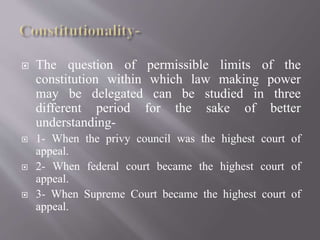
 The question of permissible limits of the
constitution within which law making power
may be delegated can be studied in three
different period for the sake of better
understanding-
 1- When the privy council was the highest court of
appeal.
 2- When federal court became the highest court of
appeal.
 3- When Supreme Court became the highest court of
appeal.
 The privy council was the highest court for appeal from
India in the constitutional matters till 1949.
 The question of the constitutionality come before the
privy council in the famous case R v/s BURAH. an Act
was passed in 1869 by the Indian legislature to remove
Garo Hills from the civil and criminal jurisdiction a
Bengal vesting the power of civil and criminal
administration in an officer appointed by the lieutenant
Governor of Bengal.
 The lieutenant Governor was further authorized by
Section 9 of the act to extend any provision of this act
with incidental changes to Khasi and Jaintia Hills. One
Burah was tried for murder. The commissioner kashi
and jaintia hills was sentenced to death.
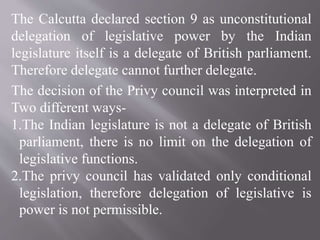
The Calcutta declared section 9 as unconstitutional
delegation of legislative power by the Indian
legislature itself is a delegate of British parliament.
Therefore delegate cannot further delegate.
The decision of the Privy council was interpreted in
Two different ways-
1.The Indian legislature is not a delegate of British
parliament, there is no limit on the delegation of
legislative functions.
2.The privy council has validated only conditional
legislation, therefore delegation of legislative is
power is not permissible.
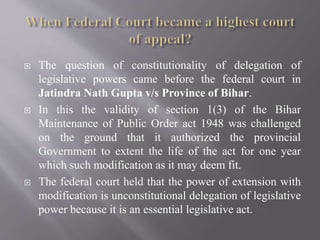
 The question of constitutionality of delegation of
legislative powers came before the federal court in
Jatindra Nath Gupta v/s Province of Bihar.
 In this the validity of section 1(3) of the Bihar
Maintenance of Public Order act 1948 was challenged
on the ground that it authorized the provincial
Government to extent the life of the act for one year
which such modification as it may deem fit.
 The federal court held that the power of extension with
modification is unconstitutional delegation of legislative
power because it is an essential legislative act.
 The decision in Jatindra Nath created doubts about
the limits of delegation of legislative powers.
Therefore, in order to clarify the position of law for
the further guidance of the legislature in matter of
delegation of legislative functions.
 The President of India sought the opinion of the
court under Article 143 of the constitution on the
constitutionality of three acts covering three
different period.
I. Section 7 of Delhi laws act,1912- Power to extent
to Delhi area with such restriction and
modification any law in force.
II. Section 2 of the Ajmer Mewara [extension of laws
act, 1947] – power to the government to extent the
province of Ajmer Mewara.
III. Section 2 of the part ‘C’ states laws act, 1950-
Delegated power to the control Government to
extent to part ‘C’
Submitted to-
Shahnawaz Ahmed Malik
(Assistant Professor)
(Dept. of Law)
A.M.U. CENTRE
MALAPPURAM
KERALA
Submitted by-
Abdul Rouf Naik
14BALLB16
GH 9033
B.A.LLB. (Hons.)
VI Semester
Necessity and constitutionality

Necessity and constitutionality

  • 2.
     Administrative Lawdeals with the Powers and Functions of the Administrative Authorities, the manner in which the Power are to be exercised by them and the remedies that are available to the aggrieved persons when those powers are abused by these Authorities.
  • 3.
    The Powers andFunctions of the administrative authorities. The procedure to be followed by these authorities in exercising such power. The remedies available to the aggrieved person, when the authorities abuse the powers.
  • 4.
     Change inthe philosophy as to the role played by the state.  Inadequate Judicial System-  Judiciary was slow, costly, unexpert, complex and formalistic.  Overburdening of judicial system-Speedy disposal was not possible-resulted in strikes and lockout in disputes between employers and employees.  As a result, industrial tribunals and labor courts where established-they possessed techniques and expertise to handle these complex problems.  Tribunals are not courts but executive authorities having judicial power.
  • 5.
     The legislativeprocess was also inadequate. Legislature had no time and technique to deal with all the detailed rules and procedure.  Detailed procedure made by the legislature was found to be defective and inadequate.  All these resulted in the delegation of some legislative power to the administrative authority.  When rules making is done by the executive bench it is known as delegated legislation.
  • 6.
     There isscope for the experiments in administrative process.  The rule can made, tried for some time and if it is found defective it can be altered or modified within a short period.  Thus, Legislation rigid in character while administrative making is flexible.
  • 7.
     Administrative authoritiescan take preventive measures-Licensing, rate fixing etc.  They can also take effect measures for enforcement of preventive measures like suspension, revocation or cancellation of license, destruction of contaminated articles etc. thee are not generally available through regular courts of law.  In most cases, such preventive actions prove to be more effective rather then punishing a person after he has committed a breach of any provision of law.
  • 9.
     The questionof permissible limits of the constitution within which law making power may be delegated can be studied in three different period for the sake of better understanding-  1- When the privy council was the highest court of appeal.  2- When federal court became the highest court of appeal.  3- When Supreme Court became the highest court of appeal.
  • 10.
     The privycouncil was the highest court for appeal from India in the constitutional matters till 1949.  The question of the constitutionality come before the privy council in the famous case R v/s BURAH. an Act was passed in 1869 by the Indian legislature to remove Garo Hills from the civil and criminal jurisdiction a Bengal vesting the power of civil and criminal administration in an officer appointed by the lieutenant Governor of Bengal.  The lieutenant Governor was further authorized by Section 9 of the act to extend any provision of this act with incidental changes to Khasi and Jaintia Hills. One Burah was tried for murder. The commissioner kashi and jaintia hills was sentenced to death.
  • 11.
    The Calcutta declaredsection 9 as unconstitutional delegation of legislative power by the Indian legislature itself is a delegate of British parliament. Therefore delegate cannot further delegate. The decision of the Privy council was interpreted in Two different ways- 1.The Indian legislature is not a delegate of British parliament, there is no limit on the delegation of legislative functions. 2.The privy council has validated only conditional legislation, therefore delegation of legislative is power is not permissible.
  • 12.
     The questionof constitutionality of delegation of legislative powers came before the federal court in Jatindra Nath Gupta v/s Province of Bihar.  In this the validity of section 1(3) of the Bihar Maintenance of Public Order act 1948 was challenged on the ground that it authorized the provincial Government to extent the life of the act for one year which such modification as it may deem fit.  The federal court held that the power of extension with modification is unconstitutional delegation of legislative power because it is an essential legislative act.
  • 13.
     The decisionin Jatindra Nath created doubts about the limits of delegation of legislative powers. Therefore, in order to clarify the position of law for the further guidance of the legislature in matter of delegation of legislative functions.  The President of India sought the opinion of the court under Article 143 of the constitution on the constitutionality of three acts covering three different period.
  • 14.
    I. Section 7of Delhi laws act,1912- Power to extent to Delhi area with such restriction and modification any law in force. II. Section 2 of the Ajmer Mewara [extension of laws act, 1947] – power to the government to extent the province of Ajmer Mewara. III. Section 2 of the part ‘C’ states laws act, 1950- Delegated power to the control Government to extent to part ‘C’
  • 15.
    Submitted to- Shahnawaz AhmedMalik (Assistant Professor) (Dept. of Law) A.M.U. CENTRE MALAPPURAM KERALA Submitted by- Abdul Rouf Naik 14BALLB16 GH 9033 B.A.LLB. (Hons.) VI Semester

Editor's Notes

  • #12 The decision of the Privy was interpreted in Two different ways- The Indian legislature is not a delegate of British parliament, there is no limit on the delegation of legislative functions. The privy council has validated only conditional legislation, therefore delegation of legislative is power is not permissible.
  • #16 Submitted to- SHAHNAWAZ AHMED MALIK (Assistant Professor) (Dept. of Law) A.M.U. CENTRE MALAPPURAM