A free online biodiversity resource
6.4.2010 Introduction to EOL EOL and the Census of Marine Life Resources and Tools Contributing to EOL Discussion of ways EOL might be able to support Summer Science in NE activities, possible connections, contributions. Survey (Help us build a better Field Guide!)
What is EOL? What:   On-line resource—plants, animals,  microorganisms Web pages for 1.9 million   known species Plus millions more yet to be described  Guiding Principles: Common format “ One stop knowledge shopping” Freely available Collaboratively built Customizable by user  Never completed
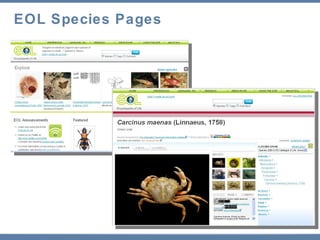
EOL Species Pages
Information can come from many partners Objects are sorted by topic Each partner gets credit
Typical species page
Overview   Introduction  Description  Physical Description  Molecular Barcode Life History  Identification  Original Description  Physiology Evolution and Systematics  Classification  Paleontology  Phylogeny Nomenclatural history Ecology and Distribution  Geographic Distribution  Habitat  Niche  Ecosystem Role  Conservation Relevance  Toxicity Ethnobotany  How to Grow  Example of detailed table of contents
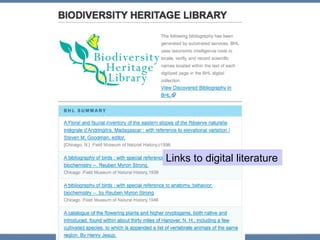
Links to digital literature
Maps from global museum  and observation data Multimedia and maps Image Gallery Videos
Diverse Contributors Scientific community Assemble scientific information Authenticate information – CURATORS Content partners  More than 60 organizations Nearly 200 contributing groups 40,000 registered individual contributors Students, teachers, enthusiasts Submit photos, videos, other species information Submissions with scientific value are brought into authenticated pages
Census of Marine Life and EOL EOL is a partner of the Census of Marine Life (CoML) Current CoML contributions to EOL species pages: World Registry of Marine Species  (Worms) Census of Coral Reef Ecosystems  (CReef) Arctic Ocean Diversity  (ArcOD) Census of Marine Zooplankton  (CMarZ) Census of the Diversity of Abyssal Marine Life  (CeDAMar) Pacific Ocean Shelf Tracking Project  (POST) Chemosynthitic Ecosystem Science  (ChEss)  Global Census of Marine Life on Seamounts  (CenSeam) CoML projects and many others have provided occurrence data to Ocean Biogeographic Information System  (OBIS)  and Global Biodiversity Information Facility  (GBIF) , which provides maps to EOL NaGISA?
EOL Learning + Education  Focus of the EOL Learning + Education Group is to  provide tools and services to groups to better  utilize and contribute to the Encyclopedia of Life.
Direct URL: http://education.eol.org
Podcast of Life Series Dive into the world of marine biology and biodiversity through the  Podcast of Life . Includes podcast audio, Meet the Scientist feature pages, related educational materials and intriguing extras. www.eol.org/podcast
EOL Field Guide  (beta) A refined view into the Encyclopedia of Life We’d like to think about ways to utilize this map and make it more interactive, useful
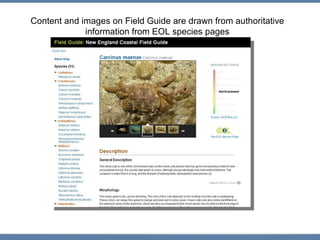
Content and images on Field Guide are drawn from authoritative information from EOL species pages
Education LifeDesk A LifeDesk is an online environment that provides a collaborative space for creating, editing, and publishing web pages of species information. The goal of using a LifeDesk in many cases is to generate content to publish to the Encyclopedia of Life (EOL).  Currently being beta tested by undergraduate biology students
Help Build EOL and the NE Coastal Field Guide: Contribute Images and Video
EOL Flickr Group Images and video harvested regularly Imported to EOL species pages as “unvetted”  content with a yellow background Once reviewed by a curator, yellow background is removed Helps build the Field Guide: Images are drawn from EOL species pages (only vetted images at this time) To date over 50,000 images contributed to EOL
Flickr “how to” Join Flickr Join the EOL Group Upload your photo (as public) Add at least one machine tag Change the license on your image Add the image to the EOL group pool Images will be automatically gathered up by EOL and displayed as “un-vetted” content with  a yellow background until they are reviewed. Tutorial available online at:  http://www.flickr.com/groups/encyclopedia_of_life
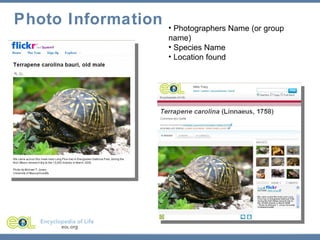
Photo Information Photographers Name (or group name) Species Name Location found
Possible uses of EOL Before Sampling Review field guide to learn about what species you might find. Look up species on  www.eol.org  for more detailed information Identify species that need images, video or content During Sampling Take pictures or video (max 30 sec for Flickr) of species found or observed Record name of species, location, etc After Sampling Upload images and video to Encyclopedia of Life Flickr Group for upload to species pages and field guide. Possibility of adding geographic information and observations to Field Guide  ( Thoughts and ideas about this?) Add content via Education LifeDesks ( If interested, let me know)
EOL Information EOL:  www.eol.org EOL Learning + Education:  http://education.eol.org/   Summer Science Resources http://education.eol.org/summerscience Contact:  Tracy Barbaro,  [email_address]  617-496-6764

Neaq june.4.10

  • 1.
    A free onlinebiodiversity resource
  • 2.
    6.4.2010 Introduction toEOL EOL and the Census of Marine Life Resources and Tools Contributing to EOL Discussion of ways EOL might be able to support Summer Science in NE activities, possible connections, contributions. Survey (Help us build a better Field Guide!)
  • 3.
    What is EOL?What: On-line resource—plants, animals, microorganisms Web pages for 1.9 million known species Plus millions more yet to be described Guiding Principles: Common format “ One stop knowledge shopping” Freely available Collaboratively built Customizable by user Never completed
  • 4.
  • 5.
    Information can comefrom many partners Objects are sorted by topic Each partner gets credit
  • 6.
  • 7.
    Overview Introduction Description Physical Description Molecular Barcode Life History Identification Original Description Physiology Evolution and Systematics Classification Paleontology Phylogeny Nomenclatural history Ecology and Distribution Geographic Distribution Habitat Niche Ecosystem Role Conservation Relevance Toxicity Ethnobotany How to Grow Example of detailed table of contents
  • 8.
    Links to digitalliterature
  • 9.
    Maps from globalmuseum and observation data Multimedia and maps Image Gallery Videos
  • 10.
    Diverse Contributors Scientificcommunity Assemble scientific information Authenticate information – CURATORS Content partners More than 60 organizations Nearly 200 contributing groups 40,000 registered individual contributors Students, teachers, enthusiasts Submit photos, videos, other species information Submissions with scientific value are brought into authenticated pages
  • 11.
    Census of MarineLife and EOL EOL is a partner of the Census of Marine Life (CoML) Current CoML contributions to EOL species pages: World Registry of Marine Species (Worms) Census of Coral Reef Ecosystems (CReef) Arctic Ocean Diversity (ArcOD) Census of Marine Zooplankton (CMarZ) Census of the Diversity of Abyssal Marine Life (CeDAMar) Pacific Ocean Shelf Tracking Project (POST) Chemosynthitic Ecosystem Science (ChEss) Global Census of Marine Life on Seamounts (CenSeam) CoML projects and many others have provided occurrence data to Ocean Biogeographic Information System (OBIS) and Global Biodiversity Information Facility (GBIF) , which provides maps to EOL NaGISA?
  • 12.
    EOL Learning +Education Focus of the EOL Learning + Education Group is to provide tools and services to groups to better utilize and contribute to the Encyclopedia of Life.
  • 13.
  • 14.
    Podcast of LifeSeries Dive into the world of marine biology and biodiversity through the Podcast of Life . Includes podcast audio, Meet the Scientist feature pages, related educational materials and intriguing extras. www.eol.org/podcast
  • 15.
    EOL Field Guide (beta) A refined view into the Encyclopedia of Life We’d like to think about ways to utilize this map and make it more interactive, useful
  • 16.
    Content and imageson Field Guide are drawn from authoritative information from EOL species pages
  • 17.
    Education LifeDesk ALifeDesk is an online environment that provides a collaborative space for creating, editing, and publishing web pages of species information. The goal of using a LifeDesk in many cases is to generate content to publish to the Encyclopedia of Life (EOL). Currently being beta tested by undergraduate biology students
  • 18.
    Help Build EOLand the NE Coastal Field Guide: Contribute Images and Video
  • 19.
    EOL Flickr GroupImages and video harvested regularly Imported to EOL species pages as “unvetted” content with a yellow background Once reviewed by a curator, yellow background is removed Helps build the Field Guide: Images are drawn from EOL species pages (only vetted images at this time) To date over 50,000 images contributed to EOL
  • 20.
    Flickr “how to”Join Flickr Join the EOL Group Upload your photo (as public) Add at least one machine tag Change the license on your image Add the image to the EOL group pool Images will be automatically gathered up by EOL and displayed as “un-vetted” content with a yellow background until they are reviewed. Tutorial available online at: http://www.flickr.com/groups/encyclopedia_of_life
  • 21.
    Photo Information PhotographersName (or group name) Species Name Location found
  • 22.
    Possible uses ofEOL Before Sampling Review field guide to learn about what species you might find. Look up species on www.eol.org for more detailed information Identify species that need images, video or content During Sampling Take pictures or video (max 30 sec for Flickr) of species found or observed Record name of species, location, etc After Sampling Upload images and video to Encyclopedia of Life Flickr Group for upload to species pages and field guide. Possibility of adding geographic information and observations to Field Guide ( Thoughts and ideas about this?) Add content via Education LifeDesks ( If interested, let me know)
  • 23.
    EOL Information EOL: www.eol.org EOL Learning + Education: http://education.eol.org/ Summer Science Resources http://education.eol.org/summerscience Contact: Tracy Barbaro, [email_address] 617-496-6764

Editor's Notes

  • #4 3-5 years to become We estimate that it will take about ten years to prepare the basic information on the currently known species, to digitize the literature in the BHL member libraries, and to set up a robust process whereby new species are incorporated as they are described. However, EOL will never be complete. We will always be discovering new things about species, and EOL will incorporate that new information. All content provided through EOL is either in the public domain or is served under a Creative Commons License
  • #5 Search by names, tag or full text
  • #9 Digitizing literature Focus on a region, or a group of organisms, or a set of journals or books Cost is approximately 10¢ per page Current status 11 million pages digitized. x journal or serials titles permissions obtained. Provisional agreements with BioOne and others for rehosting. Internet Archive Scanning Centers in many locations. Future Plans Pilot project: YouTube-style repository for articles vetted and entered by the taxonomic community Improved text extraction and data mining
  • #21 Appropriate for 9-12, possibly middle school. For younger students you might want to collect the best images and have an adult upload them