The Do-It-Yourself Guide to
STEM Community Engagement
How to Build Sustainable Education
Innovation inYour Community
First Edition 2012
This guide was created by
NC STEM Community Collaborative
with the N.C. Department of Public Instruction
and North Carolina’s
“Career & College: Ready, Set, Go!” initiative.
Authors: Akua Carraway
Karl Rectanus
Mark Ezzell
Layout & Design: NGC Communications
Released for use for North Carolina communities and beyond through a Creative Commons License.
Permissions beyond the scope of this license may be available at https://www.ncstem.org/news-and-events/acceptable-use-policy.html.
1
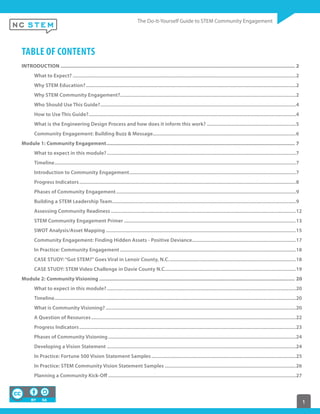
TABLE OF CONTENTS
INTRODUCTION ................................................................................................................................................................... 2
What to Expect? ..........................................................................................................................................................................2
Why STEM Education?................................................................................................................................................................2
Why STEM Community Engagement?......................................................................................................................................2
Who Should Use This Guide?.....................................................................................................................................................4
How to Use This Guide?..............................................................................................................................................................4
What is the Engineering Design Process and how does it inform this work? ....................................................................5
Community Engagement: Building Buzz & Message.............................................................................................................6
Module 1: Community Engagement................................................................................................................................... 7
What to expect in this module?................................................................................................................................................7
Timeline........................................................................................................................................................................................7
Introduction to Community Engagement...............................................................................................................................7
Progress Indicators.....................................................................................................................................................................8
Phases of Community Engagement.........................................................................................................................................9
Building a STEM Leadership Team............................................................................................................................................9
Assessing Community Readiness .............................................................................................................................................12
STEM Community Engagement Primer ...................................................................................................................................13
SWOT Analysis/Asset Mapping.................................................................................................................................................15
Community Engagement: Finding Hidden Assets - Positive Deviance...............................................................................17
In Practice: Community Engagement ......................................................................................................................................18
CASE STUDY: “Got STEM?” Goes Viral in Lenoir County, N.C.................................................................................................18
CASE STUDY: STEM Video Challenge in Davie County N.C....................................................................................................19
Module 2: Community Visioning ........................................................................................................................................ 20
What to expect in this module?................................................................................................................................................20
Timeline........................................................................................................................................................................................20
What is Community Visioning? .................................................................................................................................................20
A Question of Resources............................................................................................................................................................22
Progress Indicators.....................................................................................................................................................................23
Phases of Community Visioning ...............................................................................................................................................24
Developing a Vision Statement ................................................................................................................................................24
In Practice: Fortune 500 Vision Statement Samples ..............................................................................................................25
In Practice: STEM Community Vision Statement Samples ....................................................................................................26
Planning a Community Kick-Off ...............................................................................................................................................27
2
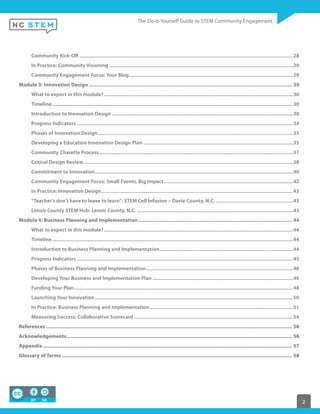
Community Kick-Off ...................................................................................................................................................................28
In Practice: Community Visioning ............................................................................................................................................29
Community Engagement Focus: Your Blog.............................................................................................................................29
Module 3: Innovation Design ............................................................................................................................................. 30
What to expect in this module?................................................................................................................................................30
Timeline........................................................................................................................................................................................30
Introduction to Innovation Design ..........................................................................................................................................30
Progress Indicators.....................................................................................................................................................................34
Phases of Innovation Design.....................................................................................................................................................35
Developing a Education Innovation Design Plan ..................................................................................................................35
Community Charette Process....................................................................................................................................................37
Critical Design Review................................................................................................................................................................38
Commitment to Innovation.......................................................................................................................................................40
Community Engagement Focus: Small Events, Big Impact ..................................................................................................42
In Practice: Innovation Design..................................................................................................................................................43
“Teacher’s don’t have to leave to learn”: STEM Cell Infusion – Davie County, N.C. ...........................................................43
Lenoir County STEM Hub: Lenoir County, N.C. .......................................................................................................................43
Module 4: Business Planning and Implementation........................................................................................................... 44
What to expect in this module?................................................................................................................................................44
Timeline........................................................................................................................................................................................44
Introduction to Business Planning and Implementation......................................................................................................44
Progress Indicators.....................................................................................................................................................................45
Phases of Business Planning and Implementation................................................................................................................46
Developing Your Business and Implementation Plan ...........................................................................................................46
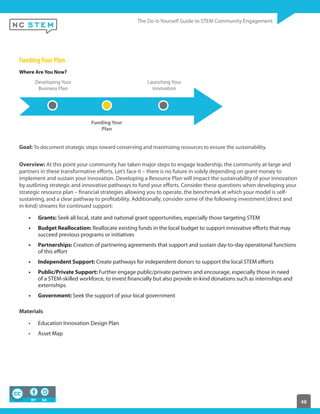
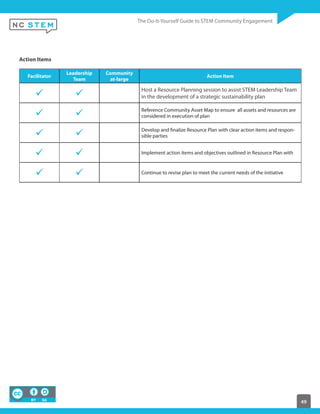
Funding Your Plan.......................................................................................................................................................................48
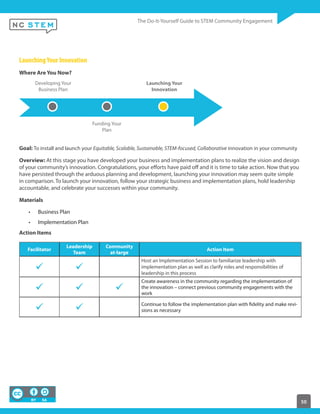
Launching Your Innovation .......................................................................................................................................................50
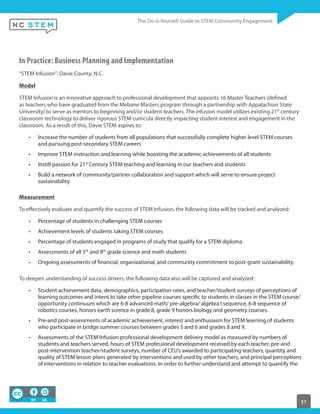
In Practice: Business Planning and Implementation .............................................................................................................51
Measuring Success: Collaborative Scorecard .........................................................................................................................54
References ........................................................................................................................................................................... 56
Acknowledgements............................................................................................................................................................. 56
Appendix ............................................................................................................................................................................. 57
Glossary of Terms ................................................................................................................................................................ 58
3
INTRODUCTION
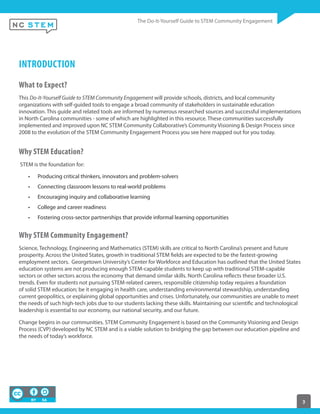
What to Expect?
This Do-It-Yourself Guide to STEM Community Engagement will provide schools, districts, and local community
organizations with self-guided tools to engage a broad community of stakeholders in sustainable education
innovation. This guide and related tools are informed by numerous researched sources and successful implementations
in North Carolina communities - some of which are highlighted in this resource. These communities successfully
implemented and improved upon NC STEM Community Collaborative’s Community Visioning & Design Process since
2008 to the evolution of the STEM Community Engagement Process you see here mapped out for you today.
Why STEM Education?
STEM is the foundation for:
Producing critical thinkers, innovators and problem-solvers
Connecting classroom lessons to real-world problems
Encouraging inquiry and collaborative learning
College and career readiness
Fostering cross-sector partnerships that provide informal learning opportunities
Why STEM Community Engagement?
Science, Technology, Engineering and Mathematics (STEM) skills are critical to North Carolina’s present and future
prosperity. Across the United States, growth in traditional STEM fields are expected to be the fastest-growing
employment sectors. Georgetown University’s Center for Workforce and Education has outlined that the United States
education systems are not producing enough STEM-capable students to keep up with traditional STEM-capable
sectors or other sectors across the economy that demand similar skills. North Carolina reflects these broader U.S.
trends. Even for students not pursuing STEM-related careers, responsible citizenship today requires a foundation
of solid STEM education; be it engaging in health care, understanding environmental stewardship, understanding
current geopolitics, or explaining global opportunities and crises. Unfortunately, our communities are unable to meet
the needs of such high-tech jobs due to our students lacking these skills. Maintaining our scientific and technological
leadership is essential to our economy, our national security, and our future.
Change begins in our communities. STEM Community Engagement is based on the Community Visioning and Design
Process (CVP) developed by NC STEM and is a viable solution to bridging the gap between our education pipeline and
the needs of today’s workforce.
4
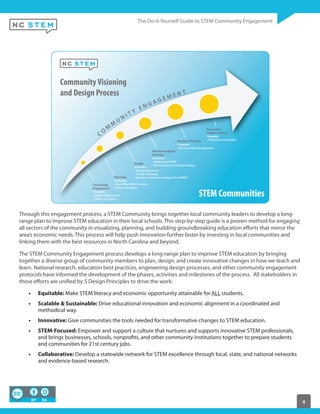
Through this engagement process, a STEM Community brings together local community leaders to develop a long-
range plan to improve STEM education in their local schools. This step-by-step guide is a proven method for engaging
all sectors of the community in visualizing, planning, and building groundbreaking education efforts that mirror the
area’s economic needs. This process will help push innovation further faster by investing in local communities and
linking them with the best resources in North Carolina and beyond. 
The STEM Community Engagement process develops a long-range plan to improve STEM education by bringing
together a diverse group of community members to plan, design, and create innovative changes in how we teach and
learn. National research, education best practices, engineering design processes, and other community engagement
protocols have informed the development of the phases, activities and milestones of the process. All stakeholders in
these efforts are unified by 5 Design Principles to drive the work: 
Equitable: Make STEM literacy and economic opportunity attainable for ALL students.
Scalable & Sustainable: Drive educational innovation and economic alignment in a coordinated and
methodical way. 
Innovative: Give communities the tools needed for transformative changes to STEM education.
STEM-Focused: Empower and support a culture that nurtures and supports innovative STEM professionals,
and brings businesses, schools, nonprofits, and other community institutions together to prepare students
and communities for 21st century jobs. 
Collaborative: Develop a statewide network for STEM excellence through local, state, and national networks
and evidence-based research.
5
Over the past three years, the STEM Community Engagement process has helped five communities throughout the
state with positive outcomes including sustained local engagement, multiple small and large education innovations,
increase network behavior, policy change, and cross-sector investments.
Who Should Use This Guide?
Simply put, YOU – anyone with a desire to impact their local community and economy through education innovation.
This guide is intended to unite schools, districts, communities, and others focusing on community engagement for
creating 21st century education for all kids. This guide was designed for teams to implement. However, whether
you are a single individual or a group, you’ll find the tools, process, and support to create STEM innovation in your
community.
How to Use This Guide?
There are two ways to use this Guide: (1) self-directed - the guide gives you everything you need to“do-it-yourself”
or (2) facilitated - working with an engaged, but impartial facilitator. Based on prior work in North Carolina
communities, we recommend a facilitated process for deep engagement, which includes“on-the-ground”delivery
of targeted area expertise and/or STEM content. This guide is made up of four modules: Community Engagement,
Community Visioning, Innovation Design and Business Planning, and Implementation. Each module includes
detailed documentation of the phases and milestones and embedded links of sample presentations, worksheets
and other useful materials. Despite sequential format of this guide, each module has the potential to serve as an
independent resource as the needs and objective(s) for each community likely will be different.
The following icons will be useful as you use this tool – highlighting valuable definitions, tips and links to materials:
Highlights vital STEM
attributes in the text
GRAPHIC PLACEHOLDER
Provides supplemental
tips and information
Progress Indicators to
gauge growth during
the process
6
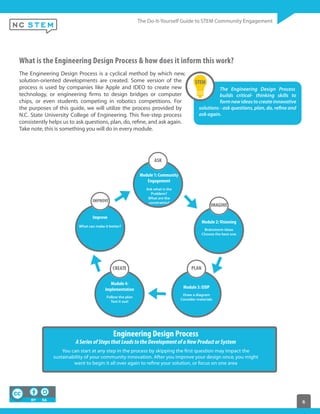
What is the Engineering Design Process & how does it inform this work?
The Engineering Design Process is a cyclical method by which new,
solution-oriented developments are created. Some version of the
process is used by companies like Apple and IDEO to create new
technology, or engineering firms to design bridges or computer
chips, or even students competing in robotics competitions. For
the purposes of this guide, we will utilize the process provided by
N.C. State University College of Engineering. This five-step process
consistently helps us to ask questions, plan, do, refine, and ask again.
Take note, this is something you will do in every module.
The Engineering Design Process
builds critical- thinking skills to
formnewideastocreateinnovative
solutions - ask questions, plan, do, refine and
ask again.
Engineering Design Process
ASeriesofStepsthatLeadstotheDevelopmentofaNewProductorSystem
sustainability of your community innovation. After you improve your design once, you might
ASK
IMPROVE
CREATE
IMAGINE
PLAN
Module 1: Community
Engagement
Ask what is the
Problem?
What are the
constraints?
Module 4:
Implementation
Follow the plan
Test it out!
Module 2: Visioning
Brainstorm ideas
Choose the best one
Module 3: EIDP
Draw a diagram
Consider materials
Improve
What can make it better?
7
Community Engagement Never Stops
Each module will have a section dedicated to further engaging your community in the process; because their
ownership breeds your innovation’s sustainability.
It’s critical to build a“buzz”in your community about your exciting work.
It’s critical to identify the core message(s) that will open your community’s hearts and minds.
It’s not critical to tell people everything because you don’t know everything.
It’s not critical to tell them where you’re going because you don’t know yet.
It’s critical to let them know they have a say in where your community is going.
8
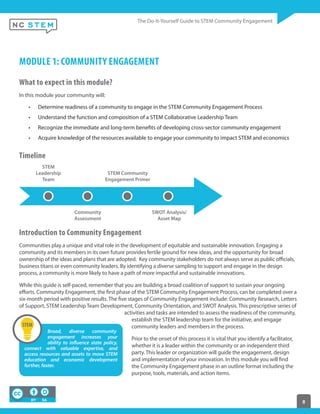
MODULE 1: COMMUNITY ENGAGEMENT
What to expect in this module?
In this module your community will:
Determine readiness of a community to engage in the STEM Community Engagement Process
Understand the function and composition of a STEM Collaborative Leadership Team
Recognize the immediate and long-term benefits of developing cross-sector community engagement
Acquire knowledge of the resources available to engage your community to impact STEM and economics 
Timeline
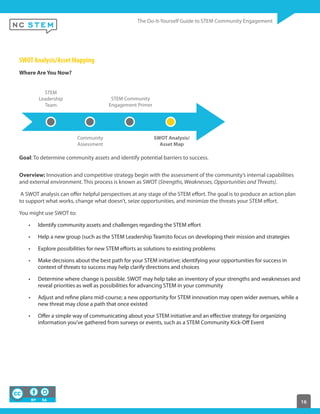
STEM
Leadership
Team
Community
Assessment
STEM Community
Engagement Primer
SWOT Analysis/
Asset Map
Introduction to Community Engagement
Communities play a unique and vital role in the development of equitable and sustainable innovation. Engaging a
community and its members in its own future provides fertile ground for new ideas, and the opportunity for broad
ownership of the ideas and plans that are adopted. Key community stakeholders do not always serve as public officials,
business titans or even community leaders. By identifying a diverse sampling to support and engage in the design
process, a community is more likely to have a path of more impactful and sustainable innovations. 
While this guide is self-paced, remember that you are building a broad coalition of support to sustain your ongoing
efforts. Community Engagement, the first phase of the STEM Community Engagement Process, can be completed over a
six-month period with positive results. The five stages of Community Engagement include: Community Research, Letters
of Support, STEM Leadership Team Development, Community Orientation, and SWOT Analysis. This prescriptive series of
activities and tasks are intended to assess the readiness of the community,
establish the STEM leadership team for the initiative, and engage
community leaders and members in the process.  
Prior to the onset of this process it is vital that you identify a facilitator,
whether it is a leader within the community or an independent third
party. This leader or organization will guide the engagement, design
and implementation of your innovation. In this module you will find
the Community Engagement phase in an outline format including the
purpose, tools, materials, and action items.
Broad, diverse community
engagement increases your
ability to influence state policy,
connect with valuable expertise, and
access resources and assets to move STEM
education and economic development
further, faster.
9
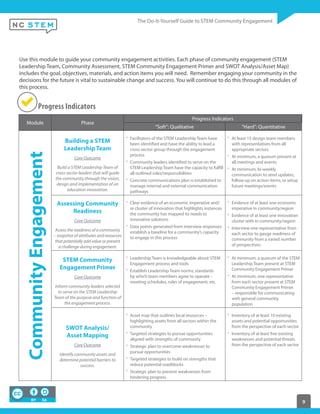
Use this module to guide your community engagement activities. Each phase of community engagement (STEM
Leadership Team, Community Assessment, STEM Community Engagement Primer and SWOT Analysis/Asset Map)
includes the goal, objectives, materials, and action items you will need. Remember engaging your community in the
decisions for the future is vital to sustainable change and success. You will continue to do this through all modules of
this process.
Progress Indicators
Module Phase
Progress Indicators
“Soft”: Qualitative “Hard”: Quantitative
CommunityEngagement
Building a STEM
Leadership Team
Core Outcome
Build a STEM Leadership Team of
cross-sector leaders that will guide
the community through the vision,
design and implementation of an
education innovation.
Facilitators of the STEM Leadership Team have
been identified and have the ability to lead a
cross-sector group through the engagement
process
Community leaders identified to serve on the
STEM Leadership Team have the capacity to fulfill
all outlined roles/responsibilities
Concrete communications plan is established to
manage internal and external communication
pathways
At least 15 design team members
with representatives from all
appropriate sectors
At minimum, a quorum present at
all meetings and events
At minimum, bi-weekly
communication to send updates,
follow-up on action items, or setup
future meetings/events
Assessing Community
Readiness
Core Outcome
Assess the readiness of a community
– snapshot of attributes and resources
that potentially add value or present
a challenge during engagement.
Clear evidence of an economic imperative and/
or cluster of innovation that highlights instances
the community has mapped its needs to
innovative solutions
Data points generated from interview responses
establish a baseline for a community’s capacity
to engage in this process
Evidence of at least one economic
imperative in community/region
Evidence of at least one innovation
cluster with in community/region
Interview one representative from
each sector to gauge readiness of
community from a varied number
of perspectives
STEM Community
Engagement Primer
Core Outcome
Inform community leaders selected
to serve on the STEM Leadership
Team of the purpose and function of
the engagement process.
Leadership Team is knowledgeable about STEM
Engagement process and tools
Establish Leadership Team norms; standards
by which team members agree to operate -
meeting schedules, rules of engagement, etc.
At minimum, a quorum of the STEM
Leadership Team present at STEM
Community Engagement Primer
At minimum, one representative
from each sector present at STEM
Community Engagement Primer
– responsible for communicating
with general community
population
SWOT Analysis/
Asset Mapping
Core Outcome
Identify community assets and
determine potential barriers to
success.
Asset map that outlines local resources –
highlighting assets from all sectors within the
community
Targeted strategies to pursue opportunities
aligned with strengths of community
Strategic plan to overcome weaknesses to
pursue opportunities
Targeted strategies to build on strengths that
reduce potential roadblocks
Strategic plan to prevent weaknesses from
hindering progress
Inventory of at least 10 existing
assets and potential opportunities
from the perspective of each sector
Inventory of at least five existing
weaknesses and potential threats
from the perspective of each sector
10
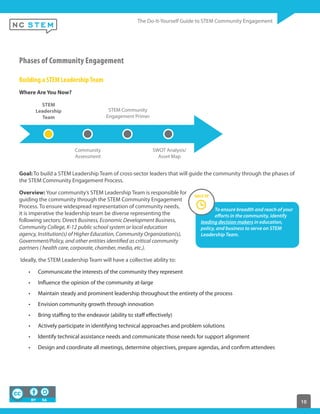
Phases of Community Engagement
Building a STEM LeadershipTeam
Where Are You Now?
Goal: To build a STEM Leadership Team of cross-sector leaders that will guide the community through the phases of
the STEM Community Engagement Process.
Overview: Your community’s STEM Leadership Team is responsible for
guiding the community through the STEM Community Engagement
Process. To ensure widespread representation of community needs,
it is imperative the leadership team be diverse representing the
following sectors: Direct Business, Economic Development Business,
Community College, K-12 public school system or local education
agency, Institution(s) of Higher Education, Community Organization(s),
Government/Policy, and other entities identified as critical community
partners ( health care, corporate, chamber, media, etc.).
 Ideally, the STEM Leadership Team will have a collective ability to:
Communicate the interests of the community they represent
Influence the opinion of the community at-large
Maintain steady and prominent leadership throughout the entirety of the process
Envision community growth through innovation
Bring staffing to the endeavor (ability to staff effectively)
Actively participate in identifying technical approaches and problem solutions
Identify technical assistance needs and communicate those needs for support alignment
Design and coordinate all meetings, determine objectives, prepare agendas, and confirm attendees
STEM
Leadership
Team
Community
Assessment
STEM Community
Engagement Primer
SWOT Analysis/
Asset Map
To ensure breadth and reach of your
efforts in the community, identify
leading decision makers in education,
policy, and business to serve on STEM
Leadership Team.
11
 
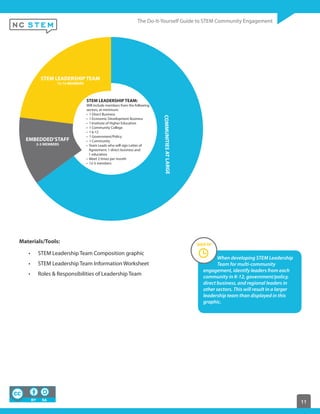
Materials/Tools:
STEM Leadership Team Composition graphic
STEM Leadership Team Information Worksheet
Roles & Responsibilities of Leadership Team
When developing STEM Leadership
Team for multi-community
engagement, identify leaders from each
community in K-12, government/policy,
direct business, and regional leaders in
other sectors. This will result in a larger
leadership team than displayed in this
graphic.
12
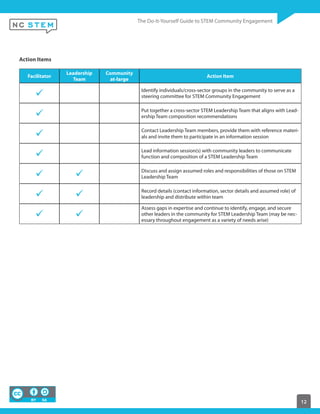
Action Items
Facilitator
Leadership
Team
Community
at-large
Action Item
Identify individuals/cross-sector groups in the community to serve as a
steering committee for STEM Community Engagement
Put together a cross-sector STEM Leadership Team that aligns with Lead-
ership Team composition recommendations
Contact Leadership Team members, provide them with reference materi-
als and invite them to participate in an information session
Lead information session(s) with community leaders to communicate
function and composition of a STEM Leadership Team
Discuss and assign assumed roles and responsibilities of those on STEM
Leadership Team
Record details (contact information, sector details and assumed role) of
leadership and distribute within team
Assess gaps in expertise and continue to identify, engage, and secure
other leaders in the community for STEM Leadership Team (may be nec-
essary throughout engagement as a variety of needs arise)
13
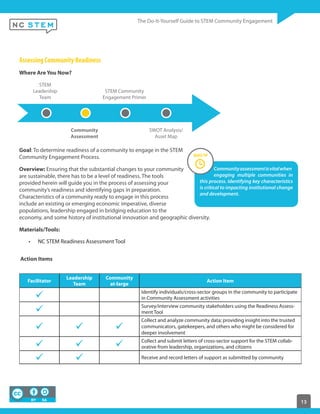
Assessing Community Readiness
Where Are You Now?
Goal: To determine readiness of a community to engage in the STEM
Community Engagement Process.
Overview: Ensuring that the substantial changes to your community
are sustainable, there has to be a level of readiness. The tools
provided herein will guide you in the process of assessing your
community’s readiness and identifying gaps in preparation.
Characteristics of a community ready to engage in this process
include an existing or emerging economic imperative, diverse
populations, leadership engaged in bridging education to the
economy, and some history of institutional innovation and geographic diversity. 
Materials/Tools:
NC STEM Readiness Assessment Tool 
Action Items
Facilitator
Leadership
Team
Community
at-large
Action Item
Identify individuals/cross-sector groups in the community to participate
in Community Assessment activities
Survey/interview community stakeholders using the Readiness Assess-
ment Tool
Collect and analyze community data; providing insight into the trusted
communicators, gatekeepers, and others who might be considered for
deeper involvement
Collect and submit letters of cross-sector support for the STEM collab-
orative from leadership, organizations, and citizens
Receive and record letters of support as submitted by community
Communityassessmentisvitalwhen
engaging multiple communities in
this process. Identifying key characteristics
is critical to impacting institutional change
and development.
STEM
Leadership
Team
Community
Assessment
STEM Community
Engagement Primer
SWOT Analysis/
Asset Map
14
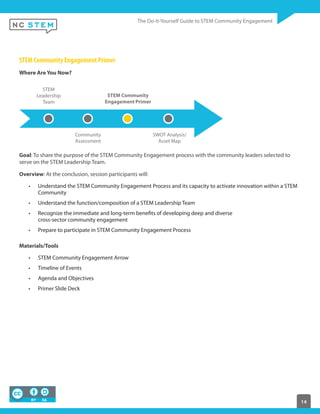
STEM Community Engagement Primer
Where Are You Now?
Goal: To share the purpose of the STEM Community Engagement process with the community leaders selected to
serve on the STEM Leadership Team.
Overview: At the conclusion, session participants will:
Understand the STEM Community Engagement Process and its capacity to activate innovation within a STEM
Community
Understand the function/composition of a STEM Leadership Team
Recognize the immediate and long-term benefits of developing deep and diverse
cross-sector community engagement
Prepare to participate in STEM Community Engagement Process
Materials/Tools
STEM Community Engagement Arrow
Timeline of Events
Agenda and Objectives
Primer Slide Deck
 
STEM
Leadership
Team
Community
Assessment
STEM Community
Engagement Primer
SWOT Analysis/
Asset Map
15
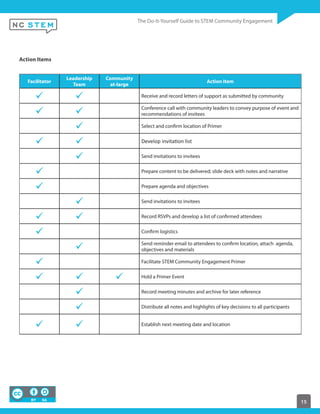
Action Items
Facilitator
Leadership
Team
Community
at-large
Action Item
Receive and record letters of support as submitted by community
Conference call with community leaders to convey purpose of event and
recommendations of invitees
Select and confirm location of Primer
Send invitations to invitees
Prepare content to be delivered; slide deck with notes and narrative
Prepare agenda and objectives
Send invitations to invitees
Record RSVPs and develop a list of confirmed attendees
Confirm logistics
Send reminder email to attendees to confirm location, attach agenda,
objectives and materials
Facilitate STEM Community Engagement Primer
Hold a Primer Event
Record meeting minutes and archive for later reference
Distribute all notes and highlights of key decisions to all participants
Establish next meeting date and location
16
SWOT Analysis/Asset Mapping
Where Are You Now?
Goal: To determine community assets and identify potential barriers to success.
Overview: Innovation and competitive strategy begin with the assessment of the community’s internal capabilities
and external environment. This process is known as SWOT (Strengths, Weaknesses, Opportunities and Threats).
 A SWOT analysis can offer helpful perspectives at any stage of the STEM effort. The goal is to produce an action plan
to support what works, change what doesn’t, seize opportunities, and minimize the threats your STEM effort.
You might use SWOT to:
Identify community assets and challenges regarding the STEM effort
Help a new group (such as the STEM Leadership Team)to focus on developing their mission and strategies
Explore possibilities for new STEM efforts as solutions to existing problems
Make decisions about the best path for your STEM initiative; identifying your opportunities for success in
context of threats to success may help clarify directions and choices
Determine where change is possible. SWOT may help take an inventory of your strengths and weaknesses and
reveal priorities as well as possibilities for advancing STEM in your community
Adjust and refine plans mid-course; a new opportunity for STEM innovation may open wider avenues, while a
new threat may close a path that once existed
Offer a simple way of communicating about your STEM initiative and an effective strategy for organizing
information you’ve gathered from surveys or events, such as a STEM Community Kick-Off Event
STEM
Leadership
Team
Community
Assessment
STEM Community
Engagement Primer
SWOT Analysis/
Asset Map
17
Materials/Tools
SWOT Analysis Template
Action Items 
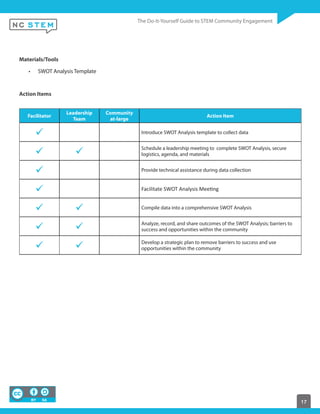
Facilitator
Leadership
Team
Community
at-large
Action Item
Introduce SWOT Analysis template to collect data
Schedule a leadership meeting to complete SWOT Analysis, secure
logistics, agenda, and materials
Provide technical assistance during data collection
Compile data into a comprehensive SWOT Analysis
Analyze, record, and share outcomes of the SWOT Analysis; barriers to
success and opportunities within the community
Develop a strategic plan to remove barriers to success and use
opportunities within the community
18
Community Engagement: Finding Hidden Assets - Positive Deviance
Community Engagement is vital to the discovery of the untapped talents, expertise, and resources that exist within
your community. This process of revealing and optimizing existing solutions or strategies within your community
and positively impacting behavior and social change is defined as Positive Deviance. Researchers have observed this
behavior in poverty stricken communities in Vietnam where a subgroup of the community was able to find a solution
to childhood malnutrition despite facing similar challenges and lack of resources of their peers. It has been concluded
from the application of Positive Deviant methodology that the“focus on practice rather than knowledge has proven to
be a key element in bringing about lasting behavioral change across the range of issues.” The lesson to learn here is that
positively deviant behavior in your community can be an invaluable resource while strategically designing solutions
to impact education and the economy. As you progress through this process, seek out instances of Positive Deviance
and make efforts to replicate, duplicate, and scale them for broader community improvement. For more information
on positive deviance, read The Vietnam Story – Positive Deviance.
19
In Practice: Community Engagement
The following highlights a successful engagement strategy in a North Carolina STEM Community
CASE STUDY: Got  STEM? campaign goes viral in Lenoir County, N.C.
STEM East in Lenoir County was developed by a group of citizens interested in
developing STEM resources in Eastern North Carolina. Lenoir County is home
to approximately 60,000 residents, and Lenoir County Public Schools serves
approximately 10,000 students. The county demographics are similar to many
Eastern North Carolina communities with significant poverty and educational
and economic challenges.
STEM East worked with NC STEM on plans to leverage their existing local assets
– especially those centered around Spirit Aerosystems and Global TransPark –
to increase the real-world experience of teachers in several local school districts
including Jones, Craven, Wayne, and Lenoir counties. They also continue to
develop innovative learning tools, such as a regional STEM hub, that can serve
Eastern North Carolina students and teachers.
The term“STEM”quickly became a household name in this community in a few short months. The success of this
community engagement belongs to the“Got STEM?”campaign – a multi-platform marketing strategy that effectively
engaged all community stakeholders in STEM efforts. The Leadership Team designed a logo to imprint on yard signs,
bumper stickers, and pins. They took advantage of local media outlets such as newspapers, blogs and the school
district website. The phrase“Got STEM?”made appearances at local fairs, meetings, and events – it essentially became
a viral phenomenon throughout Lenoir County, eventually moving into other areas of the state.
As a result of these efforts, STEM East has involved more than 800 people and numerous national, state, and local
organizations committed to making systematic changes in STEM education and fostering economic growth around
STEM jobs. In addition, the group has received thousands of dollars from private funders including a $350,000 grant
through Spirit Aerosystems and The Golden LEAF Foundation.
20
CASE STUDY: STEMVideo Challenge in Davie County N.C.
With approximately 40,000 residents, Davie County is located in the
Piedmont Triad economic development region of North Carolina. The
county takes pride in its scenic setting while still having access to industrial
hubs. It was chosen by NC STEM because of significant evidence in
innovation, local partnerships, and a desire to prepare students for
education and economic demands of the future, specifically in the bio-
medical fields.
The Leadership Team in Davie County further engaged their community by developing a STEM blog that serves as a
portal for all STEM-related events, updates, and news. Managed by a team identified by the leadership, the content
is updated on a regular basis reflecting the ever-changing and evolving work in the community. One of the more
successful uses of the blog was the launch of a county-wide video contest geared toward students and teachers.
The following blog post explained the challenge:
“Why STEM is Cool!
Do you think STEM (Science, Technology, Engineering, and Math) is cool? Do you want to share your passion for
STEM with others? Here is your chance to inspire thousands of people to be more curious, and to care about STEM
the way you do: create a short video that explores the question “Why STEM is Cool?”
We were seeking videos that are creative, surprising, and “contagious” in terms of spreading your enthusiasm about
STEM to others. Videos might explore a STEM concept, show us the wonders of nature, give us a glimpse into the
future, show us what scientific discovery has done for us in the past or will do for us in the future, introduce us to a
great scientist or engineer, tell us why you think STEM is so cool or simply show us why we should care about STEM
in Davie County.
Entries Due: December 12th 2010.”
In a month, they received 45 entries from students ranging from elementary to high school. Due to the quality of the
submissions, judges were unable to identify just one top contestant and decided to give prizes to a winning video in
four categories (elementary, middle school, high school, and teacher). Each winner received an iPod.
Need more information on creating your blog? Visit the Davie STEM Blog at www.daviecountySTEM.com.
21
MODULE 2: COMMUNITY VISIONING
What to expect in this module?
Timeline
What is Community Visioning?
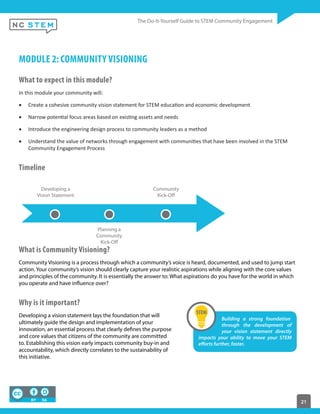
Community Visioning is a process through which a community’s voice is heard, documented, and used to jump start
action. Your community’s vision should clearly capture your realistic aspirations while aligning with the core values
and principles of the community. It is essentially the answer to: What aspirations do you have for the world in which
you operate and have influence over?
Why is it important?
Developing a vision statement lays the foundation that will
ultimately guide the design and implementation of your
innovation, an essential process that clearly defines the purpose
and core values that citizens of the community are committed
to. Establishing this vision early impacts community buy-in and
accountability, which directly correlates to the sustainability of
this initiative.
Developing a
Vision Statement
Planning a
Community
Kick-Off
Community
Kick-Off
Building a strong foundation
through the development of
your vision statement directly
impacts your ability to move your STEM
efforts further, faster.
22
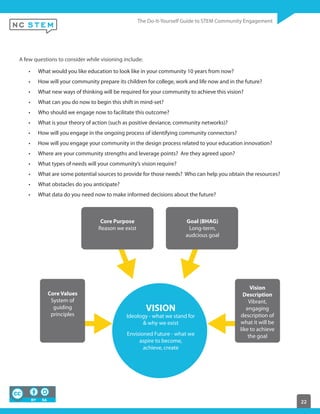
A few questions to consider while visioning include:
What would you like education to look like in your community 10 years from now?
How will your community prepare its children for college, work and life now and in the future?
What new ways of thinking will be required for your community to achieve this vision?
What can you do now to begin this shift in mind-set?
Who should we engage now to facilitate this outcome?
What is your theory of action (such as positive deviance, community networks)?
How will you engage in the ongoing process of identifying community connectors?
How will you engage your community in the design process related to your education innovation?
Where are your community strengths and leverage points? Are they agreed upon?
What types of needs will your community’s vision require?
What are some potential sources to provide for those needs? Who can help you obtain the resources?
What obstacles do you anticipate?
What data do you need now to make informed decisions about the future?
VISION
Ideology - what we stand for
& why we exist
Envisioned Future - what we
aspire to become,
achieve, create
23
A Question of Resources
During a better time for our economy, the adage“If you build it, they will come”described the support of valuable community
efforts, especially those that impacted education. However, amidst challenging budget deficits and cuts, most communities
increasingly are concerned with how to support opportunities to educate students and impact the local economy. So how
do you secure resources for Community Engagement in a challenging environment? Our answer is innovation, partnerships
and engagement, all which require a more proactive strategy than ever before. There are two choices: 1. Wait until resources
present themselves and meet the requirements that come with those resources, or 2. Decide what you are willing to commit
to now and and for how long. We suggest No. 2 as the logical step. Remember, committing to design something worthwhile
for your community is not the same as committing to build it, buy it, or make it a reality. By committing now to design
something with broad community support keeps an achievable goal in mind while also keeping doors open to future
resource partners. Available resources can take on many different forms like re-allocation of existing funds, new funding, or
innovative partnerships, just to name a few. We will address resourcing your education innovation later, but recommend you
keep this at the forefront of your mind throughout this guide.
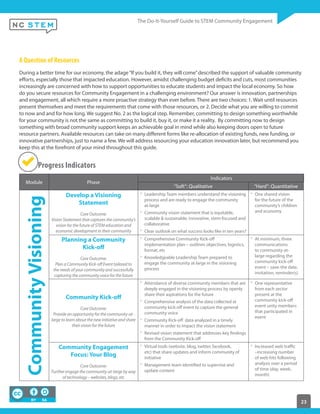
Progress Indicators
Module Phase
Indicators
“Soft”: Qualitative “Hard”: Quantitative
CommunityVisioning
Develop a Visioning
Statement
Core Outcome:
Vision Statement that captures the community’s
vision for the future of STEM education and
economic development in their community
Leadership Team members understand the visioning
process and are ready to engage the community
at-large
Community vision statement that is equitable,
scalable & sustainable, innovative, stem-focused and
collaborative
Clear outlook on what success looks like in ten years?
One shared vision
for the future of the
community’s children
and economy
Planning a Community
Kick-off
Core Outcome:
Plan a Community Kick-off Event tailored to
the needs of your community and successfully
capturing the community voice for the future
Comprehensive Community Kick-off
implementation plan – outlines objectives, logistics,
format, etc
Knowledgeable Leadership Team prepared to
engage the community at-large in the visioning
process
At minimum, three
communications
to community-at-
large regarding the
community kick-off
event – save-the date,
invitation, reminder(s)
Community Kick-off
Core Outcome:
Provide an opportunity for the community-at-
large to learn about the new initiative and share
their vision for the future
Attendance of diverse community members that are
deeply engaged in the visioning process by openly
share their aspirations for the future
Comprehensive analysis of the data collected at
community kick-off event to capture the general
community voice
Community Kick-off data analyzed in a timely
manner in order to impact the vision statement
Revised vision statement that addresses key findings
from the Community Kick-off
One representative
from each sector
present at the
community kick-off
event unity members
that participated in
event
Community Engagement
Focus: Your Blog
Core Outcome:
Further engage the community-at-large by way
of technology – websites, blogs, etc
Virtual tools (website, blog, twitter, facebook,
etc) that share updates and inform community of
initiative
Management team identified to supervise and
update content
Increased web traffic
–increasing number
of web hits following
analysis over a period
of time (day, week,
month)
24
Phases of Community Visioning
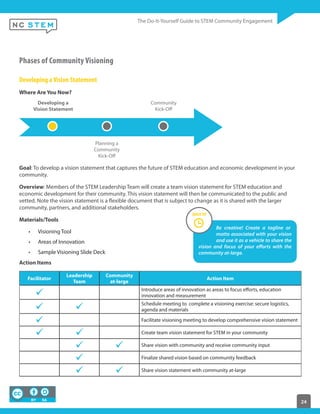
Developing aVision Statement
Where Are You Now?
Developing a
Vision Statement
Planning a
Community
Kick-Off
Community
Kick-Off
Goal: To develop a vision statement that captures the future of STEM education and economic development in your
community.
Overview: Members of the STEM Leadership Team will create a team vision statement for STEM education and
economic development for their community. This vision statement will then be communicated to the public and
vetted. Note the vision statement is a flexible document that is subject to change as it is shared with the larger
community, partners, and additional stakeholders.
Materials/Tools
Visioning Tool
Areas of Innovation
Sample Visioning Slide Deck
Action Items
Facilitator
Leadership
Team
Community
at-large
Action Item
Introduce areas of innovation as areas to focus efforts, education
innovation and measurement
Schedule meeting to complete a visioning exercise: secure logistics,
agenda and materials
Facilitate visioning meeting to develop comprehensive vision statement
Create team vision statement for STEM in your community
Share vision with community and receive community input
Finalize shared vision based on community feedback
Share vision statement with community at-large
Be creative! Create a tagline or
motto associated with your vision
and use it as a vehicle to share the
vision and focus of your efforts with the
community at-large.
25
Where do you want to be in 1, 3, and 10 years?
What are your dreams and aspirations for your children, community and economy? The vision statement you develop
should touch on these areas and fuel the engagement of your community going forward. There are many ways to
approach your visioning exercise, describing short-term intentions or declaring long-term goals of grandeur. The
choice is absolutely yours, but one common thread is that you capture the essence of where you want to be in 1 year,
3 years, or even 10 years.
In Practice: Fortune 500Vision Statement Samples
The following are examples of vision statements released by major U.S. companies:
Amazon
“Our vision is to be earth’s most customer-centric company; to build a place where people can come to find and discover
anything they might want to buy online.”
Toys‘R Us
“Our vision is to put joy in kids’ hearts and a smile on parents’ faces.”
Nike
“To bring inspiration and innovation to every athlete* in the world” (* If you have a body, you are an athlete)
McDonald’s
“McDonald’s vision is to be the world’s best quick service restaurant experience. Being the best means providing outstanding
quality, service, cleanliness, and value, so that we make every customer in every restaurant smile.”
Coca Cola
“Our vision guides every aspect of our business by describing what we need to accomplish in order to continue achieving
sustainable growth.
People: Being a great place to work where people are inspired to be the best they can be.
Portfolio: Bringing to the world a portfolio of quality beverage brands that anticipate and satisfy people’s
desires and needs.
Partners: Nurturing a winning network of customers and suppliers, together we create mutual, enduring value.
Planet: Being a responsible citizen that makes a difference by helping build and support sustainable
communities.
Profit: Maximizing long-term return to shareowners while being mindful of our overall responsibilities.”
26
In Practice: STEM CommunityVision Statement Samples
The following are vision statements developed by North Carolina STEM Communities:
Cabarrus/Rowan Collaborative
To develop a prosperous and global community of innovators, explorers and critical, adaptable and creative thinkers
committed to lifelong learning.
Davie
To increase student scores and proficiency in STEM-related areas, graduate students who are more prepared to enter
STEM employment upon leaving high school, increase numbers of students pursuing post-secondary STEM careers,
instill passion for 21st Century STEM teaching and learning in our teachers and students, and ultimately realize the
more macro-environmental benefits of a concentration of STEM talent in Davie County.
Ft. Bragg Region
Foster regional economic development by engaging all segments of
the community:
– in creating a culture that values STEM-related knowledge,
– in preparing our students to be lifelong learners, and
– in educating the regional workforce with the 21st
century skills to
successfully compete in a global economy.
To lead the state in the production of a STEM-educated, globally-
competitive workforce, and to use STEM technology to transform regional academic institutions to meet the demands
of a 21st
century global economy.
Lenoir
Improve STEM education and economic opportunity by offering student more experiential learning opportunities.
Design your Community Kick-off
to meet the specific needs of your
community. Use the enclosed
protocol as a guide but make this event
your own!
27
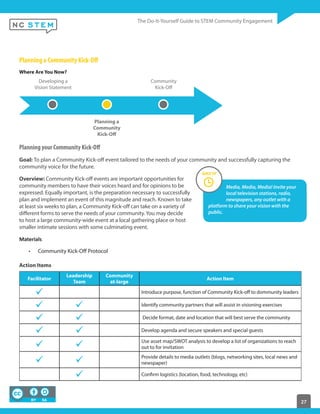
Planning a Community Kick-Off
Where Are You Now?
Developing a
Vision Statement
Planning a
Community
Kick-Off
Community
Kick-Off
Planning your Community Kick-Off
Goal: To plan a Community Kick-off event tailored to the needs of your community and successfully capturing the
community voice for the future.
Overview: Community Kick-off events are important opportunities for
community members to have their voices heard and for opinions to be
expressed. Equally important, is the preparation necessary to successfully
plan and implement an event of this magnitude and reach. Known to take
at least six weeks to plan, a Community Kick-off can take on a variety of
different forms to serve the needs of your community. You may decide
to host a large community-wide event at a local gathering place or host
smaller intimate sessions with some culminating event.
Materials
Community Kick-Off Protocol
Action Items
Facilitator
Leadership
Team
Community
at-large
Action Item
Introduce purpose, function of Community Kick-off to dommunity leaders
Identify community partners that will assist in visioning exercises
Decide format, date and location that will best serve the community
Develop agenda and secure speakers and special guests
Use asset map/SWOT analysis to develop a list of organizations to reach
out to for invitation
Provide details to media outlets (blogs, networking sites, local news and
newspaper)
Confirm logistics (location, food, technology, etc)
Media, Media, Media! Invite your
local television stations, radio,
newspapers, any outlet with a
platform to share your vision with the
public.
28
Community Kick-Off
Where Are You Now?
Developing a
Vision Statement
Planning a
Community
Kick-Off
Community
Kick-Off
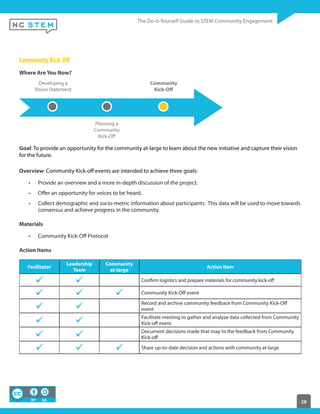
Goal: To provide an opportunity for the community at-large to learn about the new initiative and capture their vision
for the future.
Overview: Community Kick-off events are intended to achieve three goals:
Provide an overview and a more in-depth discussion of the project.
Offer an opportunity for voices to be heard.
Collect demographic and socio-metric information about participants.  This data will be used to move towards
consensus and achieve progress in the community.
Materials
Community Kick-Off Protocol
Action Items
Facilitator
Leadership
Team
Community
at-large
Action Item
Confirm logistics and prepare materials for community kick-off
Community Kick-Off event
Record and archive community feedback from Community Kick-Off
event
Facilitate meeting to gather and analyze data collected from Community
Kick-off event
Document decisions made that map to the feedback from Community
Kick-off
Share up-to-date decision and actions with community at-large
29
In Practice: Community Visioning
CASE STUDY: “400 people in a thunderstorm” – Davie County, N.C.
Davie County hosted one of the most successful Community Kick-Off events in North Carolina. Despite less than ideal
weather, more than 400 community members traveled to a local church to learn more about the STEM initiative and
share their vision for the future. The agenda featured an introduction by the president of The Mebane Foundation
and presentations by a pioneer researcher in regenerative medicine and the chief executive officer of Wake Forest
University Baptist Medical Center. The STEM Leadership Team took advantage of all media outlets to promote this
event including their STEM Blog, local news and newspapers, and the NC STEM website.
To see the introductory message and video, visit this link.
Community Engagement Focus:Your Blog
To further engage your community in this process, consider creating a website or blog to continue input and
engagement, show a path to future, and share information. Currently, there are many user-friendly platforms to host
your blog such as Wordpress, Blogger, or Google Sites. Such an undertaking is usually successful when a team is
identified to manage and update the site on a regular basis. This site also can serve as a data capturing tool for project
milestones and successes.
The following are examples of community based blogs and websites:
Davie County STEM
Cabarrus-Rowan STEM
STEM East
WCPSS STEM Schools Collaborative
30
MODULE 3: INNOVATION DESIGN
What to expect in this module?
In this module your community will:
Begin an engineering design process to develop an Education Innovation Design Plan (EIDP) that maps to the
five core design principles: equitable, scalable and sustainable, innovative, stem-focused and collaborative.
Develop a network of individuals, assets and other resources to the drive the design of a 21st century
education innovation.
Engage more community stakeholders by building and sharing an innovative design plan that impacts STEM
education and economics.
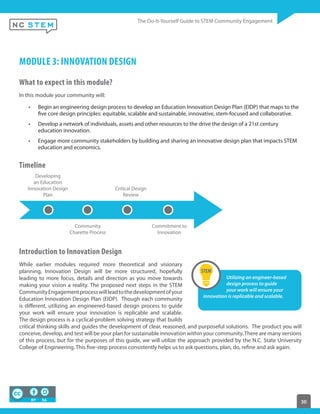
Timeline
Developing
an Education
Innovation Design
Plan
Community
Charette Process
Critical Design
Review
Commitment to
Innovation
Introduction to Innovation Design
While earlier modules required more theoretical and visionary
planning, Innovation Design will be more structured, hopefully
leading to more focus, details and direction as you move towards
making your vision a reality. The proposed next steps in the STEM
CommunityEngagementprocesswillleadtothedevelopmentofyour
Education Innovation Design Plan (EIDP). Though each community
is different, utilizing an engineered-based design process to guide
your work will ensure your innovation is replicable and scalable.
The design process is a cyclical-problem solving strategy that builds
critical thinking skills and guides the development of clear, reasoned, and purposeful solutions. The product you will
conceive, develop, and test will be your plan for sustainable innovation within your community.There are many versions
of this process, but for the purposes of this guide, we will utilize the approach provided by the N.C. State University
College of Engineering. This five-step process consistently helps us to ask questions, plan, do, refine and ask again.
Utilizing an engineer-based
design process to guide
your work will ensure your
innovation is replicable and scalable.
31
In this module you will map your design to the fundamental design principles and engage your design teams
and other community representatives in this final design of your EIDP. The EIDP is a major milestone of the
STEM Community Engagement process and serves as the community’s reference guide for ongoing design and
implementation of each innovation.
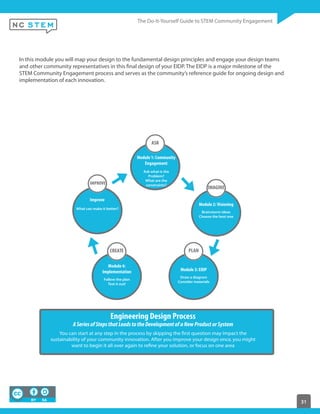
Engineering Design Process
ASeriesofStepsthatLeadstotheDevelopmentofaNewProductorSystem
sustainability of your community innovation. After you improve your design once, you might
ASK
IMPROVE
CREATE
IMAGINE
PLAN
Module 1: Community
Engagement
Ask what is the
Problem?
What are the
constraints?
Module 4:
Implementation
Follow the plan
Test it out!
Module 2: Visioning
Brainstorm ideas
Choose the best one
Module 3: EIDP
Draw a diagram
Consider materials
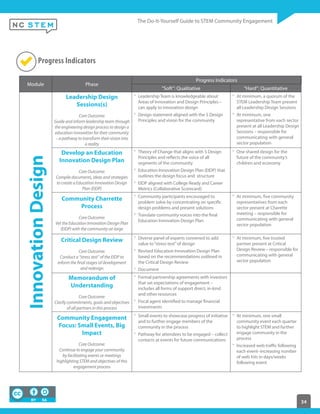
Improve
What can make it better?
32
As discussed in earlier modules, a cornerstone of this work is the 5 Design Principles by which all stakeholders are
unified. The design principles provide parameters for development of your innovation and provide clarity on the goals
of student-centered teaching and learning. Your innovation design must support the broad purpose of preparing
your community’s youth for college, career, and life. These principles should be a guide to your community as you
design your innovation:
Equitable: Make STEM literacy and economic opportunity attainable for ALL North Carolina students. 
Scalable & Sustainable: Drive educational innovation and economic alignment in a coordinated and
methodical way. 
Innovative: Give communities the tools needed for transformative changes to STEM education  
STEM-Focused: Empower and support a culture that nurtures and supports innovative STEM professionals,
and brings businesses, schools, nonprofits, and other community institutions together to prepare students
and communities for 21st
century jobs. 
Collaborative: Develop a statewide network for STEM excellence through local, state and national networks
and evidence-based research.
The design should also be in alignment with vital areas of education
innovation that the U.S. currently struggles with; these are known
as areas of innovation. These inter-related areas should not be
considered in a vacuum.
In order to prepare all students to be college and career ready and
to maximize the impact of education innovations within the STEM
network, communities will focus on one of the following areas:
1. Empower educators and communities to build the STEM Pipeline
2. Common Core Standards and innovative assessment for readiness of college and careers
3. STEM content and 21st
century technology
4. Experiential learning and project/problem-based curriculum
5. Data systems and accountability
6. Teaching and learning in designed environments (innovative schools/classrooms)
Your innovation should build
on the strengths of the region,
adding value economically and
improving accessibility of education for all
students
33
Potential Outcomes
Understanding and using these design principles, each community will partner to direct a collaborative process that
ensures community ownership and sustainability that allows for the development of a framework for truly innovative,
additive outcomes. This will ensure a shared vision for STEM education connected to a perpetual process, and each
community outcome may appear unique and may be as varied as these hypothetical outcomes:
An innovative school on the campus of a large high-end aerospace manufacturing facility, including
experiential learning and regulated internship/co-op opportunities as a part of rigorous STEM skill attainment.
An innovative path to the entire region taking innovative STEM curriculum in a hybrid (online/onsite)
environment using cloud computing and low cost net books (thin client devices) for cost-effective delivery for
all students; building on the virtual world expertise in the region, for more rigorous, accessible STEM learning.
A model for innovating the 21st
century teacher, combining multiple content, computing, and subject matter
approaches to deeply evaluate impact on STEM approaches.
A STEM Learn and Earn Program on a research-one higher education campus that forges the pathway for
higher education’s campus and the high school to merge.
These hypothetical outcomes are attainable and can be a lever for sustainable education with community support.
34
Progress Indicators
Module Phase
Progress Indicators
“Soft”: Qualitative “Hard”: Quantitative
InnovationDesign
Leadership Design
Sessions(s)
Core Outcome:
Guide and inform leadership team through
the engineering design process to design a
education innovation for their community
– a pathway to transform their vision into
a reality
Leadership Team is knowledgeable about
Areas of Innovation and Design Principles –
can apply to innovation design
Design statement aligned with the 5 Design
Principles and vision for the community
At minimum, a quorum of the
STEM Leadership Team present
all Leadership Design Sessions
At minimum, one
representative from each sector
present at all Leadership Design
Sessions – responsible for
communicating with general
sector population
Develop an Education
Innovation Design Plan
Core Outcome:
Compile documents, ideas and strategies
to create a Education Innovation Design
Plan (EIDP)
Theory of Change that aligns with 5 Design
Principles and reflects the voice of all
segments of the community
Education Innovation Design Plan (EIDP) that
outlines the design focus and structure
EIDP aligned with College Ready and Career
Metrics (Collaborative Scorecard)
One shared design for the
future of the community’s
children and economy
Community Charrette
Process
Core Outcome:
Vet the Education Innovation Design Plan
(EIDP) with the community-at-large
Community participants encouraged to
problem solve by concentrating on specific
design problems and present solutions
Translate community voices into the final
Education Innovation Design Plan
At minimum, five community
representatives from each
sector present at Charette
meeting – responsible for
communicating with general
sector population
Critical Design Review
Core Outcome:
Conduct a “stress test” of the EIDP to
inform the final stages of development
and redesign
Diverse panel of experts convened to add
value to“stress test”of design
Revised Education Innovation Design Plan
based on the recommendations outlined in
the Critical Design Review
Document
At minimum, five trusted
partner present at Critical
Design Review – responsible for
communicating with general
sector population
Memorandum of
Understanding
Core Outcome:
Clarify commitments, goals and objectives
of all partners in this process
Formal partnership agreements with investors
that set expectations of engagement –
includes all forms of support direct, in-kind
and other resources
Fiscal agent identified to manage financial
investments
Community Engagement
Focus: Small Events, Big
Impact
Core Outcome:
Continue to engage your community
by facilitating events or meetings
highlighting STEM and objectives of this
engagement process
Small events to showcase progress of initiative
and to further engage members of the
community in the process
Pathway for attendees to be engaged – collect
contacts at events for future communications
At minimum, one small
community event each quarter
to highlight STEM and further
engage community in the
process
Increased web traffic following
each event–increasing number
of web hits in days/weeks
following event
35
Phases of Innovation Design
Developing a Education Innovation Design Plan
Where Are You Now?
Developing
an Education
Innovation Design
Plan
Community
Charette Process
Critical Design
Review
Commitment to
Innovation
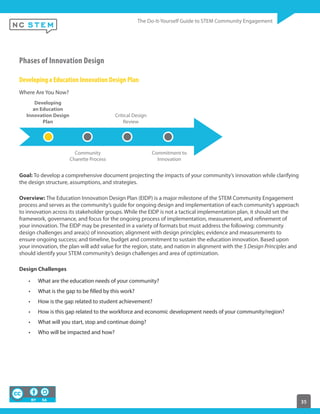
Goal: To develop a comprehensive document projecting the impacts of your community’s innovation while clarifying
the design structure, assumptions, and strategies.
Overview: The Education Innovation Design Plan (EIDP) is a major milestone of the STEM Community Engagement
process and serves as the community’s guide for ongoing design and implementation of each community’s approach
to innovation across its stakeholder groups. While the EIDP is not a tactical implementation plan, it should set the
framework, governance, and focus for the ongoing process of implementation, measurement, and refinement of
your innovation. The EIDP may be presented in a variety of formats but must address the following: community
design challenges and area(s) of innovation; alignment with design principles; evidence and measurements to
ensure ongoing success; and timeline, budget and commitment to sustain the education innovation. Based upon
your innovation, the plan will add value for the region, state, and nation in alignment with the 5 Design Principles and
should identify your STEM community’s design challenges and area of optimization.
Design Challenges
What are the education needs of your community?
What is the gap to be filled by this work?
How is the gap related to student achievement?
How is this gap related to the workforce and economic development needs of your community/region?
What will you start, stop and continue doing?
Who will be impacted and how?
  
36
Materials/Tools
Education Innovation Design Plan Template
EIDP Milestones
EIDP RFI
Areas of Innovation
Five Design Principles
STEM education/innovation slide deck (TIES)
Design Wheel
Action Items
Facilitator
Leadership
Team
Community
at-large
Action Item
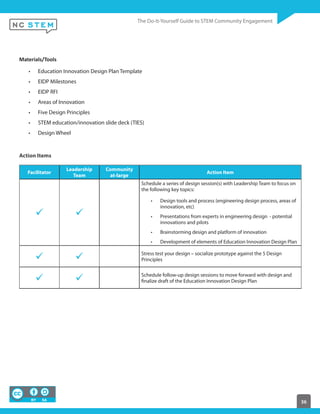
Schedule a series of design session(s) with Leadership Team to focus on
the following key topics:
Design tools and process (engineering design process, areas of
innovation, etc)
Presentations from experts in engineering design - potential
innovations and pilots
Brainstorming design and platform of innovation
Development of elements of Education Innovation Design Plan
Stress test your design – socialize prototype against the 5 Design
Principles
Schedule follow-up design sessions to move forward with design and
finalize draft of the Education Innovation Design Plan
37
Community Charette Process
Where Are You Now?
Developing
an Education
Innovation Design
Plan
Community
Charette Process
Critical Design
Review
Commitment to
Innovation
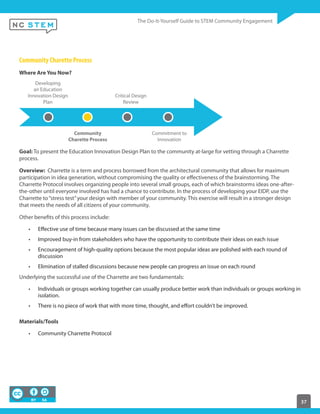
Goal: To present the Education Innovation Design Plan to the community at-large for vetting through a Charrette
process.
Overview: Charrette is a term and process borrowed from the architectural community that allows for maximum
participation in idea generation, without compromising the quality or effectiveness of the brainstorming. The
Charrette Protocol involves organizing people into several small groups, each of which brainstorms ideas one-after-
the-other until everyone involved has had a chance to contribute. In the process of developing your EIDP, use the
Charrette to“stress test”your design with member of your community. This exercise will result in a stronger design
that meets the needs of all citizens of your community.
Other benefits of this process include:
Effective use of time because many issues can be discussed at the same time
Improved buy-in from stakeholders who have the opportunity to contribute their ideas on each issue
Encouragement of high-quality options because the most popular ideas are polished with each round of
discussion
Elimination of stalled discussions because new people can progress an issue on each round
Underlying the successful use of the Charrette are two fundamentals:
Individuals or groups working together can usually produce better work than individuals or groups working in
isolation.
There is no piece of work that with more time, thought, and effort couldn’t be improved.
Materials/Tools
Community Charrette Protocol
38
Action Items:
Facilitator
Leadership
Team
Community
at-large
Action Item
Leadership finalize logistics to host Charrette event
Send communication to community at-large – ensuring appropriate
number of representatives from each sector have been invited to attend
Facilitate Charrette event for the community to review the draft EIDP
and give feedback
Collect and analyze feedback from Charrette event
Revise draft and finalize EIDP to reflect community feedback from
Charrette event
Critical Design Review
Where Are You Now?
Developing
an Education
Innovation Design
Plan
Community
Charette Process
Critical Design
Review
Commitment to
Innovation
Goal: To provide a mid-stream assessment of the readiness of the design and inform the final stages of the
development process. To conduct a“stress test”of design to reveal assumptions that may not be valid and risk
mitigation.
Overview: Your community has completed visioning and design exercises and is now moving into the Review and
Feedback Process. This process is designed to take your Leadership Team and community into a“deep dive”of your
EIDP – activities designed to prompt questions, guide planning, challenge assumptions, and lead to the redesign/
refinement of your EIDP. This process of questioning, redesign, and refinement is critical before investing the time,
talent, and treasure to create a business and implementation plan.
39
Materials/Tools
Critical Design Review Protocol
Action Items
Facilitator
Leadership
Team
Community
at-large
Action Item
Identify trusted partners with the expertise to critically review and
provide feedback on the design of your prototype
Invite trusted partners to participate in a critical design review of your
EIDP
Identify guidelines and parameters of critical design review format –
share protocol with all participants prior to meeting
Facilitate critical design review of EIDP using finalized protocol
Analyze response and revise document to reflect feedback
40
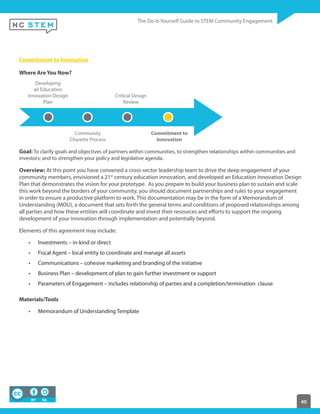
Commitment to Innovation
Where Are You Now?
Developing
an Education
Innovation Design
Plan
Community
Charette Process
Critical Design
Review
Commitment to
Innovation
Goal: To clarify goals and objectives of partners within communities, to strengthen relationships within communities and
investors; and to strengthen your policy and legislative agenda.
Overview: At this point you have convened a cross-sector leadership team to drive the deep engagement of your
community members, envisioned a 21st
century education innovation, and developed an Education Innovation Design
Plan that demonstrates the vision for your prototype. As you prepare to build your business plan to sustain and scale
this work beyond the borders of your community, you should document partnerships and rules to your engagement
in order to ensure a productive platform to work. This documentation may be in the form of a Memorandum of
Understanding (MOU), a document that sets forth the general terms and conditions of proposed relationships among
all parties and how these entities will coordinate and invest their resources and efforts to support the ongoing
development of your innovation through implementation and potentially beyond.
Elements of this agreement may include:
Investments – in-kind or direct
Fiscal Agent – local entity to coordinate and manage all assets
Communications – cohesive marketing and branding of the initiative
Business Plan – development of plan to gain further investment or support
Parameters of Engagement – includes relationship of parties and a completion/termination clause
Materials/Tools
Memorandum of Understanding Template
41
Action Items
Facilitator
Leadership
Team
Community
at-large
Action Item
Identify and document partners that will coordinate and invest
resources in your innovation through implementation
Outline all elements of partnerships related to your work into a cohesive
agreement
Formalize partnership agreements by signing the commitment
document
42
Community Engagement Focus: Small Events, Big Impact
Take a break from visioning and design; it’s time to show off all of your hard work!
To continually engage and reach out to the community, strive to maintain a level of transparency and accessibility
as you progress through these final stages of development and design. To accomplish this consider hosting intimate
community gatherings that have a far reaching impact.
The following are two examples of impactful events that engaged a community in STEM-related activities:
“Lift off Lenoir”– Lenoir County, N.C.
STEM East in Lenoir County partnered with the Community-Campus Partnership (CCP) at UNC Chapel Hill and Spirit
AeroSystems to officially launch“Lift off Lenoir”at a community event hosted at Spirit AeroSystems. The“Lift of Lenoir”
project provided Lenoir County elementary students the opportunity to experience North Carolina’s first portable,
digital planetarium and an innovative space-themed education program. This public event not only showcased this
valuable asset but provided an opportunity to inform the community at-large of immediate impacts of the efforts of
STEM East.
Kasey Kahne Foundation“Five Kahne”– Rowan/Cabarrus County, N.C.
NASCAR driver Kasey Kahne organizes an annual 5K charity run and kid’s dash in uptown Charlotte the day following
the fall NASCAR Sprint Cup race at Charlotte Motor Speedway. In 2010 at the first annual run, the Kasey Kahne
Foundation aimed to raise awareness for the grand opening of the new Ronald McDonald House in addition to
establishing a fund for STEM Field Trips to the NASCAR Hall of Fame for students associated with the local STEM
Community. This STEM educational experience included lessons from professionals making tangible connections
between the racing industry and STEM education. Hosting a 5K charity run is an ideal community event to spread
awareness and rally a community around one cause or initiative, as evident by approximately 300 participants raising
more than $12,000 for charity. The first field trips took place in January 2011, helping hundreds of seventh graders
from local middle schools and raising awareness for the local community’s work and its partners.
43
In Practice: Innovation Design
“Teacher’s don’t have to leave to learn”: STEM Cell Infusion – Davie County, N.C.
Davie County STEM believes that a direct pathway to improving education for all kids is through innovative professional
development. Who says teachers can’t learn in the classroom? STEM Infusion is designed to develop and implement
dynamic solutions to the systemic challenges of providing high-quality 21st
Century STEM professional development
for existing and beginning classroom teachers through technology integration. The model forms small professional
learning communities or“STEM Cells”that are populated with master, student, and first-year teachers who will, with the
support of a additional resources, intervene in classrooms to model delivery of STEM curricula and instruction as well
as provide individual teacher professional development. By implementing this model, Davie County Schools hope to
increase student scores and proficiency in STEM-related areas, graduate students who are more prepared to enter STEM
employment upon leaving high school, increase the number of students pursuing post-secondary STEM careers, instill
passion for 21st
century STEM teaching and learning in teachers and students, and ultimately realize the more macro-
environmental benefits of a concentration of STEM talent in Davie County. Cognizant of the need to promote and ensure
long-term sustainability, Davie County Schools has forged partnerships with local business and industry, post-secondary
institutions, and many economic development and philanthropic organizations.
Lenoir County STEM Hub: Lenoir County, N.C.
Following a Community Visioning and Design Process, STEM East in Lenoir County developed a concept for a novel
regional STEM Hub. The primary purpose of the Lenoir County STEM Hub will be to provide a foundational platform
of collaboration to impact the number of college and career ready students qualified to meet the 21st
century needs
of the local business industry. The STEM Hub was used as a trusted space and platform of collaboration to design and
launch STEM-focused applications that address targeted needs in the community.
Following a Community Visioning and Design Process, Lenoir County developed as a unique regional STEM Hub
formed through public/private partnerships. The primary purpose of the Lenoir County STEM Hub, now called STEM
East, is to provide a foundational platform of collaboration to impact the number of college and career ready students
qualified to meet the 21st century needs of the local business industry. These STEM Learning Labs give students the
tools to develop critical thinking skills needed to function in 21st
century careers.
These efforts will result in the establishment of four STEM Learning Labs in four middle schools that have a high
population of low/moderate income children in the counties of Lenoir, Craven, Wayne, and Jones. Each local school
district will provide the required classroom space to house the STEM Learning Lab and will commit resources to equip
and sustain the lab. This project is expected to serve as a model for developing more fixed labs throughout the region
and possibly generate interest in the development of mobile Labs to serve a greater number of students and counties
in the eastern region.
44
MODULE 4: BUSINESS PLANNING AND IMPLEMENTATION
What to expect in this module?
In this module your community will:
Develop a comprehensive business plan to include organizational governance and sustainability.
Develop a one, two, or three-year implementation plan outlining benchmarks and roles in the design roll-out.
Engage with partners and broader stakeholder groups
Transition to a more action-oriented focus
Timeline
Developing Your
Business Plan
Funding Your
Plan
Launching Your
Innovation
Introduction to Business Planning & Implementation
The value of business planning lies in the process of bringing together resources and actionable priorities to your
community to implement the vision and plan that will transform the lives of your children and the place you call
home. During the Business Planning and Implementation Phase, STEM Communities transition from the voluntary
efforts in previous modules to more formal, collaborative efforts aimed toward bringing an evidence-based vision to
the market. The business plan will serve as a means to clearly define resources currently available and identify gaps
that must be removed (or reduced) in order to implement the innovation. The format and content of your business
plan can vary from a simple“back of the napkin”model to a more detailed plan with clear short and long-term actions
– ultimately the approach you take should represent the uniqueness of your community’s needs and innovation
model. In this tool, elements of the business plan will be presented in a detailed format.
45
To assist in the development of the business structure and implementation, consider utilizing the following external
resources:
Embedded Network Staff: “On the ground”staff members from trusted network partners involved in the
deployment of STEM Community initiatives.
Technical Assistance Partner (organization with content and research capacity): Deploys a set of services and
consulting to STEM Community for knowledge dissemination, training, and gateway to best practice tool sets.
Public Policy/Research Affiliate (organization with aligned mission and proven capacity): Provides fact-
based examinations of local and state workforce development needs and translates this into policy and legislative
recommendations that also can relate to public awareness and influence campaigns.
In-Residence Appointments (unique expertise to create knowledge within others & build network
capacity): Peer-recognized subject matter experts charged with disseminating and advancing the value of STEM
education to network affiliates through personal participation and specialized technical and managerial work,
mentoring and/or research activities.
Progress Indicators
Module Phase
Progress Indicators
“Soft”: Qualitative “Hard”: Quantitative
BusinessPlanningandImplementation
Business Plan
Development
Core Outcome:
Develop a comprehensive business plan
– includes governance structure and
sustainability plan
Comprehensive business plan that
addresses key elements of design and
sustainability
Comprehensive financial plan including
source(s) for initial operating costs - use
local resources (30-40%)
One shared plan for the
development and sustainability of
the innovation that will impact the
future of the community’s children
and economy
Implementation Plan
Development
Core Outcome:
Develop a one to three year
implementation plan – outlines
benchmarks and leadership roles
Local support by way of investment in
innovation design and implementation
Broad knowledge and support of the
initiative in the community
One shared plan for the
implementation of the innovation
that will impact the future of
the community’s children and
economy
Launching Your Innovation
Core Outcome:
Successfully launch your innovation with
complete fidelity to the strategy outlined in
the implementation plan
Innovation launch that has wide spread
visibility to the community
Set by your team
Measuring Success:
Collaborative Scorecard
Core Outcome:
Measure the impact of your innovation
locally, statewide and nationally
Leadership team prepared to access metrics
outlined in the collaborative scorecard
Set by your team
46
Phases of Business Planning and Implementation
DevelopingYour Business and Implementation Plan
Where Are You Now?
Developing Your
Business Plan
Funding Your
Plan
Launching Your
Innovation
Goal: To document the Education Innovation Design Plan and roll-out the formal business and implementation plans.
Key objectives include:
Help activate near and long-term investments of resources from partners
Help your STEM Community articulate its vision and engage in strategic planning in business planning phase
Help assesses goals, market potential, and competitive advantage
Help create, communicate, and gain internal and external resource investment in an innovative education
prototype with value to the region, state, and nation
Overview: Developing focused business and implementation plans will provide the foundation for a more
sustainable, equitable, and scalable prototype. The Business Plan should clearly define your innovation model and
business structure while outlining near and long-term resource investments.
Key elements of your plan should address the following:
Business Model: Evidence of a sustainable model that conserves and maximizes resources – in addition to
evidence of local support from other education/government organizations
Alignment: Innovation design in full agreement with the core values of the design process – Equitable,
Sustainable, Scalable, STEM-Focused, and Collaborative
Governance Plan: Leadership structure that defines roles, responsibilities and daily processes
Sustainability Plan: Financial resource plan to ensure sustainability of innovation
Partnerships: Who are your local, state and national partners? How are they engaged?
Market Potential: Evidence of existing and increasing collaboration among organizations and leaders
Competitive Advantage: Evidence of an issue and a new, improved approach to a solution
47
The Implementation Plan should answer these questions by outlining strategies and action items that achieve the
objectives of the Business Plan.
Key elements of your plan should address the following:
Project Plan: What will you do, when, and by whom?
Competitive Landscape: Evidence that efforts address key community characteristics and demographics
Leadership Team: Evidence of flexible, knowledgeable leadership, use of feedback and data in making
decisions and results-oriented behavior
Contingencies
Materials
Business Plan Template
Implementation Plan Template
Action Items
Facilitator
Leadership
Team
Community
at-large
Action Item
Host business planning session to introduce template and
support STEM Leadership Team in the development of strategic
plan
Develop strategic business plan and implementation plan – consider
dedicating resources to support a full time employee or contractor in
the development of these plans
If needed, consult a third-party resource (e.g. university partners) for
support in structure and development of business plan
Vet business plan with trusted partners and make necessary revisions
48
FundingYour Plan
Where Are You Now?
Developing Your
Business Plan
Funding Your
Plan
Launching Your
Innovation
Goal: To document strategic steps toward conserving and maximizing resources to ensure the sustainability.
Overview: At this point your community has taken major steps to engage leadership, the community at-large and
partners in these transformative efforts. Let’s face it – there is no future in solely depending on grant money to
implement and sustain your innovation. Developing a Resource Plan will impact the sustainability of your innovation
by outlining strategic and innovative pathways to fund your efforts. Consider these questions when developing your
strategic resource plan – financial strategies allowing you to operate, the benchmark at which your model is self-
sustaining, and a clear pathway to profitability. Additionally, consider some of the following investment (direct and
in-kind) streams for continued support:
Grants: Seek all local, state and national grant opportunities, especially those targeting STEM
Budget Reallocation: Reallocate existing funds in the local budget to support innovative efforts that may
succeed previous programs or initiatives
Partnerships: Creation of partnering agreements that support and sustain day-to-day operational functions
of this effort
Independent Support: Create pathways for independent donors to support the local STEM efforts
Public/Private Support: Further engage public/private partners and encourage, especially those in need
of a STEM-skilled workforce, to invest financially but also provide in-kind donations such as internships and
externships
Government: Seek the support of your local government
Materials
Education Innovation Design Plan
Asset Map
49
Action Items
Facilitator
Leadership
Team
Community
at-large
Action Item
Host a Resource Planning session to assist STEM Leadership Team
in the development of a strategic sustainability plan
Reference Community Asset Map to ensure all assets and resources are
considered in execution of plan
Develop and finalize Resource Plan with clear action items and respon-
sible parties
Implement action items and objectives outlined in Resource Plan with
Continue to revise plan to meet the current needs of the initiative
50
LaunchingYour Innovation
Where Are You Now?
Developing Your
Business Plan
Funding Your
Plan
Launching Your
Innovation
Goal: To install and launch your Equitable, Scalable, Sustainable, STEM-focused, Collaborative innovation in your community
Overview: At this stage you have developed your business and implementation plans to realize the vision and design
of your community’s innovation. Congratulations, your efforts have paid off and it is time to take action. Now that you
have persisted through the arduous planning and development, launching your innovation may seem quite simple
in comparison. To launch your innovation, follow your strategic business and implementation plans, hold leadership
accountable, and celebrate your successes within your community.
Materials
Business Plan
Implementation Plan
Action Items
Facilitator
Leadership
Team
Community
at-large
Action Item
Host an Implementation Session to familiarize leadership with
implementation plan as well as clarify roles and responsibilities of
leadership in this process
Create awareness in the community regarding the implementation of
the innovation – connect previous community engagements with the
work
Continue to follow the implementation plan with fidelity and make revi-
sions as necessary
51
In Practice: Business Planning and Implementation
“STEM Infusion”: Davie County, N.C.
Model
STEM Infusion is an innovative approach to professional development that appoints 16 Master Teachers (defined
as teachers who have graduated from the Mebane Masters program through a partnership with Appalachian State
University) to serve as mentors to beginning and/or student teachers. The infusion model utilizes existing 21st
century
classroom technology to deliver rigorous STEM curricula directly impacting student interest and engagement in the
classroom. As a result of this, Davie STEM aspires to:
Increase the number of students from all populations that successfully complete higher level STEM courses
and pursuing post-secondary STEM careers
Improve STEM instruction and learning while boosting the academic achievements of all students
Instill passion for 21st
Century STEM teaching and learning in our teachers and students
Build a network of community/partner collaboration and support which will serve to ensure project
sustainability
Measurement
To effectively evaluate and quantify the success of STEM Infusion, the following data will be tracked and analyzed:
Percentage of students in challenging STEM courses
Achievement levels of students taking STEM courses
Percentage of students engaged in programs of study that qualify for a STEM diploma
Assessments of all 5th
and 8th
grade science and math students
Ongoing assessments of financial, organizational, and community commitment to post-grant sustainability.
To deepen understanding of success drivers, the following data also will be captured and analyzed:
Student achievement data, demographics, participation rates, and teacher/student surveys of perceptions of
learning outcomes and intent to take other pipeline courses specific to students in classes in the STEM course/
opportunity continuum which are 6-8 advanced math/ pre-algebra/ algebra I sequence, 6-8 sequence of
robotics courses, honors earth science in grade 8, grade 9 honors biology and geometry courses.
Pre-and post-assessments of academic achievement, interest and enthusiasm for STEM learning of students
who participate in bridge summer courses between grades 5 and 6 and grades 8 and 9.
Assessments of the STEM Infusion professional development delivery model as measured by numbers of
students and teachers served, hours of STEM professional development received by each teacher, pre-and
post-intervention teacher/student surveys, number of CEU’s awarded to participating teachers, quantity and
quality of STEM lesson plans generated by interventions and used by other teachers, and principal perceptions
of interventions in relation to teacher evaluations. In order to further understand and attempt to quantify the
52
impact that STEM professional development has on STEM-related student scores, DCS will utilize a Matching
Pairs statistical experiment, comparing identified pre-and post-metrics. In addition, Regression Analysis may
be utilized to infer causal relationships between the individual metrics and the dependent variable, in this
case, teacher professional development.
Assessments of frequency, quality, and financial support generated from collaborative events with business/
industry, stakeholders, and other community partners as well as the quantity and quality of community STEM
expert inclusion into our learning environments.
Sustainability
To ensure post-grant sustainability of the STEM Infusion project, Davie STEM will secure buy-in from business and
industry. The following strategies will be implemented to improve the sustainability of the model:
Davie County Schools will re-distribute existing Title I and II funds to help cover the cost of STEM Infusion
Model. (Examples include Title I: Improving Academic Achievement of the Disadvantaged, Disadvantaged
Student Supplemental Fund and Low Wealth and Small County Funds)
Davie County Schools to redirect existing funds for professional development materials and central office
professional development administrative positions towards the STEM Infusion model
Publish best practice materials in an open source format and offer materials for purchase to NC LEAs
considering STEM Infusion
Adoption of a“fee-for-service”program, whereby newly-designed curriculum and delivery kits could be
purchased by other school systems.
Davie County Schools may utilize student housing for summer professional development programs
Request that a small portion of North Carolina Education Lottery funds be redistributed to support STEM
Infusion/Professional Development.
“STEM Hub”- Lenoir County
Model
STEM East in Lenoir County has developed a concept for a novel regional STEM Hub. The primary purpose of the Lenoir
County STEM Hub will be to provide a foundational platform of collaboration between different local parties affiliated
with STEM (and the related topics of general economic development and youth advancement and education),
permitting positive impact on the STEM readiness of Lenoir County Public Schools graduates and on the size of the
pool of qualified future employees for local industry. Once a platform of STEM-related regional collaboration in Lenoir
County is launched and proven effective (“STEM Hub Phase I”), the county will have a solid base for deploying STEM-
focused“applications”to address specific, targeted needs in the Lenoir County population (“STEM Hub Phase II”). In
particular, two specific applications of the STEM Hub platform have been proposed as a“Curriculum-Development
Process”and an“Educational Enhancement”initiative; the content of these Hub applications will be detailed later in
this document.
53
The first application, a“Curriculum-Development Process,”relates less to the traditional development of one specific
curriculum track and more to the development of a systematic process to identify a STEM-related, project-learning
opportunity (needs or project ideas can be identified either at the education level or at the business level),solicit Hub
input through a series of pre-defined interface points, develop a curriculum module (or potentially employ a third-
party curriculum module) that integrates with the existing academic progression and with North Carolina education
standards, pilot the new curriculum module, and quantitatively benchmark results against a control group. The hope
is that with the effective Hub network established in Phase I, curriculum modules can provide new and exciting real-
world applications of core science and math topics that are needed by the rising local workforce.
Measurement
Quantifiable annual targets throughout the STEM Hub implementation support the long-term measures of success
identified above (see the Theory of Change section). Regular collection and transparent reporting of progress against
success metrics is seen as a key means of ensuring funder trust and long-term STEM Hub organizational sustainability.
Results relative to targets will be documented in an Annual Review document distributed to partners and posted on
the STEM Hub website.
Sustainability
In order to make the Hub sustainable, funds will be raised via grants, community associations, individual and
corporate giving, and governmental support.
Grants: With selectivity, the Hub will seek funding through the grants that are available for STEM-related
initiatives. The NC STEM organization has pledged its support in helping the STEM Hub to seek funding from
relevant grant-making bodies in the U.S.
Community-Association Giving: Community associations, such as the Committee of 100, have supported the
STEM Hub to date. Such community associations will be encouraged to continue their support, and others will
be encouraged to join this in this effort.
Individual Giving: The STEM Hub will seek generous donations from wealthy individuals in Lenoir County who
believe in the mission of the Hub. A key role of the Board of Directors is to link these potential donors with the
work of the Hub via their personal and professional networks.
Corporate Giving: Businesses that require a STEM-skilled workforce will be engaged in many ways such as
internships and externships and other in-kind donations.
Government: The support of the local government in Lenoir County will be solicited for support.
54
Measuring Success: Collaborative Scorecard
In business, the saying goes,“What gets measured, gets done.” In education, the saying is,“What gets tested, gets
taught.”Measurement is critical for all ongoing initiatives.
NC STEM, in consultation with many state and national STEM experts, has designed a tool that defines common STEM
education improvement measurements that align with critical areas of North Carolina’s statewide STEM strategy. The
primary function of the Collaborative Scorecard is to move STEM education and economic innovation further and
faster by providing clear success metrics that focus on:
College and Career Ready Student Achievement for ALL students
Teacher & Leader Effectiveness
Innovative Partnerships and Investments
Economic Impact
You can use this tool in your STEM Community to continuously evaluate, innovate, and ensure efficacy by measuring
the impact of your work – on the local, state, and national levels. Consider developing measurements of local impact
that are unique to your community as well as work with local, regional, and state agencies to collect and communicate
your efforts, results, and ongoing innovations.
Local Measures of Impact: Defined by STEM Community in alignment with the 5 Design Principles and
connected network of partners and communities. Should include measures of the community engagement as
well as particular measures of the STEM Community’s area of innovation.
State Measures of Impact: Defined in alignment with North Carolina measures of economic, education,
and community engagement in coordination with state government and industry partners. Work with
state organizations to identify a few, vital core STEM goals/measures for the efforts of the network of STEM
stakeholders and STEM Communities to align, extend, and fuel statewide impact.
National Measures of Impact: Defined in alignment with measures of economic, education, and community
engagement from the federal government, foundations, corporations, and international organizations.
Identify a few, vital core measures for alignment of the efforts of the network of STEM stakeholders and STEM
Communities to align, extend, and fuel national impact.
55
College and Career
Ready Achievement
Innovative Partnerships
and Investments
Economic
Impact
College and Career Ready Student Achievement
% Students graduating from high school within 5 years of entering 9th grade;
4 years
% Students passing (level III)/excelling (IV) in both reading, math, science
EOG/EOC tests
% Students taking Algebra I or equivalent prior to grade 9
% Graduates passing Integrated Mathematics BC or Algebra II
% Graduates scoring 3 or above on one or more AP/IB Exams
Average SAT/ACT composite (of % graduates taking)
% Students completing a capstone course in CTE, Arts, Second Languages,
ROTC
% Students obtaining an industry certification credential in high school
Proportion of graduates who enroll in postsecondary programs
Proportion of first year college students enrolled in at least
one remedial course (University, Community College)
% Students failing at least one high school course in grade 9
% Students in grades 6 and 9 completing a summer bridge
program
Innovative Partnerships and Investments
% Students obtaining a University/Community College
credential
% Students in grades 6 and 9 completing informal STEM
enrichment experience (camp, field study, workshop, job shadowing,
etc.)
% High school students completing an internship with a local business/
organization
% Teachers completing STEM related field experience (e.g., externship,
field study, camp, study visit)
# of cross-sector partner alliances (e.g. MOU)
Amount of partner investments (e.g., financial and in-kind) in STEM
education
Amount of reallocated funds to STEM education
# of STEM assets utilized/shared with STEM network
Adoption of Common Core Standards
Teacher Effectiveness
% Teachers proficient or better on Teacher Evaluation Process Standard
IV (facilitate learning for students)
% Teachers adding at least 1 year of value (per EVAAS value-added
module)
Proportion of full-time STEM teachers certified in STEM discipline(s)
% STEM teaching positions filled at beginning of school year
% STEM teacher retention rate
Proportion of Highly qualified STEM teachers placed in high –need
classrooms/schools
% of teachers employed through alternative licensure/staffing models
STEM Economic Impact
# 2 Year degrees and credentials with labor market
value in STEM-related fields
# 4 Year degrees and credentials with labor market
value in STEM-related fields
# of job expansions within existing STEM-related industries
# of new STEM-related jobs
% reduction of the supply-demand gap for workforce in STEM-related
fields
% decrease in average hire time for STEM-related jobs
% increase in average STEM-related salary
56
References
Atkinson, Robert and Scott Andes. The 2008 State New Economy Index: Benchmarking Economic Transformation in the States.
Rep. Information Technology and Innovation Foundation, 2008. Print
Christensen, Clayton, Heiner Baumaan, and Thomas Sadtler.“Disruptive Innovation for Social Change.”Harvard Business Review 1
Dec. 2006. Web.
Christensen, Clayton M., Michael B. Horn, and Curtis W. Johnson. Disrupting Class: How Disruptive Innovation Will Change the Way
the World Learns. New York: McGraw-Hill, 2008. Print.
Community Asset Mapping: A Critical Strategy for Service. Bonner Curriculum. Web. <http://www.bonner.org/resources/modules/
modules_pdf/BonCurCommAssetMap.pdf>.
Dede, Chris, and Saul Rockman.“Lessons Learned from Studying How Innovations Can Achieve Scale.”Threshold Magazine 2007:
4-10. Web.
DeVol, Ross and Anita Charuworn. State Technology and Science Index: Enduring Lessons for the Intangible Economy. Milken
Institute, 2008. Web. <http://www.milkeninstitute.org/tech/tech.taf?state=NC>
Fitzpatrick, Erika. Innovation America: A Final Report. National Governor’s Association. Washington, DC., September 2007. Print.
Illuminate. Asset Mapping Road Map: A Guide to Assessing Regional Development Resources. Rep. Council on Competitiveness, 2007.
Print.
Maier, Mark W. and Eberhardt Rechtin. The Art of Systems Architecting, second edition. CRC Press, Boca Raton, Florida, 2000
North Carolina Center for Public Policy Research. Changes Needed for Community Colleges to Address Shortages of Nurses, Teachers,
and Biotech Workers, Says Center. May 29, 2008.
Pascale, Richard, Jerry Sternin, and Monique Sternin. The Power of Positive Deviance: How Unlikely Innovators Solve the World’s
Toughest Problems. Boston, MA: Harvard Business, 2010. Print.
Salls, Manda.“It’s Back to Business - Basics for Non Profits.”Harvard Business School Working Knowledge (23 Feb. 2004). Web.
Stephenson, Karen.“The Community Solution.”Strategy + Business. Booz & Company Inc., 28 Feb. 2008. Web.
Stephenson, Karen. The Quantum Theory of Trust: Power, Networks and the Secret Life of Organisations. Harlow, England: FT Prentice
Hall, 2006. Print.
Warren, Mark R.“Communities and Schools: A New View of Urban Education Reform.”Harvard Educational Review 75.2 (2005). Print.
57
ACKNOWLEDGEMENTS
NC STEM Learning Network benefits from the support, expertise and valuable partnerships from a range of
organizations committed to improving STEM education opportunities for all students and impacting North
Carolina’s economic prosperity. NC STEM acknowledges the generous support and resources of the following
organizations that made this work a possibility in North Carolina:
North Carolina Department of Public Instruction – Race to the Top (RttT) Initiative
Battelle Memorial Institute
Bill and Melinda Gates Foundation
Burroughs Wellcome Fund
MCNC
Joint Legislative Study of the North Carolina General Assembly
The North Carolina Science, Mathematics and Technology (SMT) Education Center
The Teaching Institute for Excellence in STEM (TIES)
The Friday Institute for Educational Innovation at N.C. State University
Mangum Consultants
N.C. State University College of Engineering
UNC Kenan Institute
Multi-State STEM Network Partners: California STEM Learning Network, Empire State STEM Learning Network,
Innovate+Educate, Ohio STEM Learning Network, T-STEM and Washington STEM
North Carolina STEM Collaboratives: BRAC Region, Cabarrus-Rowan Counties, Davie County and Lenoir County
Education First Consulting
Innovate+Educate
NGC Communications
58
APPENDIX
Glossary of Terms
Areas of Innovation Target areas NC STEM has designated to maximize the impact of
education innovation within the network of STEM communities.
Business Model Document describing the organizational structure of the collabora-
tive, both human and financial. Also includes the critical success
factors and essential resources of the prototype.
Charrette Process Problem-solving protocol in which a team concentrates on specific
design problems and presents solutions.
Collaborative Scorecard Table displaying indicators and measures of success at the local,
state and national levels. Possible metrics include percentage of
STEM educators, retention rates and percentage first generation
entering college.
Community Asset Mapping The process of identifying the unique resources – human, financial
and otherwise – within a community.
Community Kick-off Public event hosted by the Design Team to introduce the Commu-
nity Visioning Process and partners while allowing the community
members to give feedback and learn more about the initiative.
Competitive Landscape Full scope of circumstances that have the ability to impact progress
of the project.
Design Principles Five principles that maximize innovation while providing clarity on
the goals of student-centered teaching and learning. These prin-
ciples are Equitable, Sustainable and Scalable, Innovative, STEM-
Focused and Collaborative.
Design Statement Description of specific academic and economic needs in the com-
munity and the proposed innovation that will address these needs
while aligning with the five design principles.
Design Team Collaborative panel of cross sector community members and inno-
vation thought partners who lead the development of a communi-
ty-supported education innovation plan for the county.
Education Innovation Design Plan Declaration of the innovative design structure a community will use
as it pertains to the area of innovation, prototype and collaborative
networks.
Embedded Staff Personnel deeply involved in delivery of target expertise and STEM
content from outside a community.
59
Letter of Agreement Record of a collaborative commitment to developing innovation
that will engage the community’s students in rigorous STEM educa-
tion.
Memorandum of Understanding Legal document designed to clarify goals and objectives of local
partners as well as document monetary and in-kind investments of
the NC STEM and community partners.
Positive Deviance Discovery and optimization of existing solutions or strategies within
the community or organization to affect behavior and social change.
Prototype The methodology formed to address a specific need in the commu-
nity that is identified as urgent and critical.
Ready to Launch Communities Communities that have created an Education Innovation Design
Plan (EIDP) in the NC STEM proprietary Community Vision and De-
sign Process and are working towards implementation.
STEM Community Engagement Process Targeted course of action to guide communities through their pro-
totype development and education innovation design plan.
STEM Pipeline Process by which students are educated, prepared and enter STEM
careers.
Theory of Change Comprehensive analysis of prototype to clarify assumptions and
strategies in addition to projecting short and long term impacts.
Thought Partner Individual with particular expertise who adds value to a project,
especially but not exclusively the CVP.
Vision Statement Descriptive statement that captures the aspirations of the commu-
nity as it pertains to STEM education and economic development, a
framework by which the innovation is focused and designed.

Ncstem diy guide_revised_final

  • 1.
    The Do-It-Yourself Guideto STEM Community Engagement How to Build Sustainable Education Innovation inYour Community First Edition 2012 This guide was created by NC STEM Community Collaborative with the N.C. Department of Public Instruction and North Carolina’s “Career & College: Ready, Set, Go!” initiative. Authors: Akua Carraway Karl Rectanus Mark Ezzell Layout & Design: NGC Communications Released for use for North Carolina communities and beyond through a Creative Commons License. Permissions beyond the scope of this license may be available at https://www.ncstem.org/news-and-events/acceptable-use-policy.html.
  • 2.
    1 TABLE OF CONTENTS INTRODUCTION................................................................................................................................................................... 2 What to Expect? ..........................................................................................................................................................................2 Why STEM Education?................................................................................................................................................................2 Why STEM Community Engagement?......................................................................................................................................2 Who Should Use This Guide?.....................................................................................................................................................4 How to Use This Guide?..............................................................................................................................................................4 What is the Engineering Design Process and how does it inform this work? ....................................................................5 Community Engagement: Building Buzz & Message.............................................................................................................6 Module 1: Community Engagement................................................................................................................................... 7 What to expect in this module?................................................................................................................................................7 Timeline........................................................................................................................................................................................7 Introduction to Community Engagement...............................................................................................................................7 Progress Indicators.....................................................................................................................................................................8 Phases of Community Engagement.........................................................................................................................................9 Building a STEM Leadership Team............................................................................................................................................9 Assessing Community Readiness .............................................................................................................................................12 STEM Community Engagement Primer ...................................................................................................................................13 SWOT Analysis/Asset Mapping.................................................................................................................................................15 Community Engagement: Finding Hidden Assets - Positive Deviance...............................................................................17 In Practice: Community Engagement ......................................................................................................................................18 CASE STUDY: “Got STEM?” Goes Viral in Lenoir County, N.C.................................................................................................18 CASE STUDY: STEM Video Challenge in Davie County N.C....................................................................................................19 Module 2: Community Visioning ........................................................................................................................................ 20 What to expect in this module?................................................................................................................................................20 Timeline........................................................................................................................................................................................20 What is Community Visioning? .................................................................................................................................................20 A Question of Resources............................................................................................................................................................22 Progress Indicators.....................................................................................................................................................................23 Phases of Community Visioning ...............................................................................................................................................24 Developing a Vision Statement ................................................................................................................................................24 In Practice: Fortune 500 Vision Statement Samples ..............................................................................................................25 In Practice: STEM Community Vision Statement Samples ....................................................................................................26 Planning a Community Kick-Off ...............................................................................................................................................27
  • 3.
    2 Community Kick-Off ...................................................................................................................................................................28 InPractice: Community Visioning ............................................................................................................................................29 Community Engagement Focus: Your Blog.............................................................................................................................29 Module 3: Innovation Design ............................................................................................................................................. 30 What to expect in this module?................................................................................................................................................30 Timeline........................................................................................................................................................................................30 Introduction to Innovation Design ..........................................................................................................................................30 Progress Indicators.....................................................................................................................................................................34 Phases of Innovation Design.....................................................................................................................................................35 Developing a Education Innovation Design Plan ..................................................................................................................35 Community Charette Process....................................................................................................................................................37 Critical Design Review................................................................................................................................................................38 Commitment to Innovation.......................................................................................................................................................40 Community Engagement Focus: Small Events, Big Impact ..................................................................................................42 In Practice: Innovation Design..................................................................................................................................................43 “Teacher’s don’t have to leave to learn”: STEM Cell Infusion – Davie County, N.C. ...........................................................43 Lenoir County STEM Hub: Lenoir County, N.C. .......................................................................................................................43 Module 4: Business Planning and Implementation........................................................................................................... 44 What to expect in this module?................................................................................................................................................44 Timeline........................................................................................................................................................................................44 Introduction to Business Planning and Implementation......................................................................................................44 Progress Indicators.....................................................................................................................................................................45 Phases of Business Planning and Implementation................................................................................................................46 Developing Your Business and Implementation Plan ...........................................................................................................46 Funding Your Plan.......................................................................................................................................................................48 Launching Your Innovation .......................................................................................................................................................50 In Practice: Business Planning and Implementation .............................................................................................................51 Measuring Success: Collaborative Scorecard .........................................................................................................................54 References ........................................................................................................................................................................... 56 Acknowledgements............................................................................................................................................................. 56 Appendix ............................................................................................................................................................................. 57 Glossary of Terms ................................................................................................................................................................ 58
  • 4.
    3 INTRODUCTION What to Expect? ThisDo-It-Yourself Guide to STEM Community Engagement will provide schools, districts, and local community organizations with self-guided tools to engage a broad community of stakeholders in sustainable education innovation. This guide and related tools are informed by numerous researched sources and successful implementations in North Carolina communities - some of which are highlighted in this resource. These communities successfully implemented and improved upon NC STEM Community Collaborative’s Community Visioning & Design Process since 2008 to the evolution of the STEM Community Engagement Process you see here mapped out for you today. Why STEM Education? STEM is the foundation for: Producing critical thinkers, innovators and problem-solvers Connecting classroom lessons to real-world problems Encouraging inquiry and collaborative learning College and career readiness Fostering cross-sector partnerships that provide informal learning opportunities Why STEM Community Engagement? Science, Technology, Engineering and Mathematics (STEM) skills are critical to North Carolina’s present and future prosperity. Across the United States, growth in traditional STEM fields are expected to be the fastest-growing employment sectors. Georgetown University’s Center for Workforce and Education has outlined that the United States education systems are not producing enough STEM-capable students to keep up with traditional STEM-capable sectors or other sectors across the economy that demand similar skills. North Carolina reflects these broader U.S. trends. Even for students not pursuing STEM-related careers, responsible citizenship today requires a foundation of solid STEM education; be it engaging in health care, understanding environmental stewardship, understanding current geopolitics, or explaining global opportunities and crises. Unfortunately, our communities are unable to meet the needs of such high-tech jobs due to our students lacking these skills. Maintaining our scientific and technological leadership is essential to our economy, our national security, and our future. Change begins in our communities. STEM Community Engagement is based on the Community Visioning and Design Process (CVP) developed by NC STEM and is a viable solution to bridging the gap between our education pipeline and the needs of today’s workforce.
  • 5.
    4 Through this engagementprocess, a STEM Community brings together local community leaders to develop a long- range plan to improve STEM education in their local schools. This step-by-step guide is a proven method for engaging all sectors of the community in visualizing, planning, and building groundbreaking education efforts that mirror the area’s economic needs. This process will help push innovation further faster by investing in local communities and linking them with the best resources in North Carolina and beyond.  The STEM Community Engagement process develops a long-range plan to improve STEM education by bringing together a diverse group of community members to plan, design, and create innovative changes in how we teach and learn. National research, education best practices, engineering design processes, and other community engagement protocols have informed the development of the phases, activities and milestones of the process. All stakeholders in these efforts are unified by 5 Design Principles to drive the work:  Equitable: Make STEM literacy and economic opportunity attainable for ALL students. Scalable & Sustainable: Drive educational innovation and economic alignment in a coordinated and methodical way.  Innovative: Give communities the tools needed for transformative changes to STEM education. STEM-Focused: Empower and support a culture that nurtures and supports innovative STEM professionals, and brings businesses, schools, nonprofits, and other community institutions together to prepare students and communities for 21st century jobs.  Collaborative: Develop a statewide network for STEM excellence through local, state, and national networks and evidence-based research.
  • 6.
    5 Over the pastthree years, the STEM Community Engagement process has helped five communities throughout the state with positive outcomes including sustained local engagement, multiple small and large education innovations, increase network behavior, policy change, and cross-sector investments. Who Should Use This Guide? Simply put, YOU – anyone with a desire to impact their local community and economy through education innovation. This guide is intended to unite schools, districts, communities, and others focusing on community engagement for creating 21st century education for all kids. This guide was designed for teams to implement. However, whether you are a single individual or a group, you’ll find the tools, process, and support to create STEM innovation in your community. How to Use This Guide? There are two ways to use this Guide: (1) self-directed - the guide gives you everything you need to“do-it-yourself” or (2) facilitated - working with an engaged, but impartial facilitator. Based on prior work in North Carolina communities, we recommend a facilitated process for deep engagement, which includes“on-the-ground”delivery of targeted area expertise and/or STEM content. This guide is made up of four modules: Community Engagement, Community Visioning, Innovation Design and Business Planning, and Implementation. Each module includes detailed documentation of the phases and milestones and embedded links of sample presentations, worksheets and other useful materials. Despite sequential format of this guide, each module has the potential to serve as an independent resource as the needs and objective(s) for each community likely will be different. The following icons will be useful as you use this tool – highlighting valuable definitions, tips and links to materials: Highlights vital STEM attributes in the text GRAPHIC PLACEHOLDER Provides supplemental tips and information Progress Indicators to gauge growth during the process
  • 7.
    6 What is theEngineering Design Process & how does it inform this work? The Engineering Design Process is a cyclical method by which new, solution-oriented developments are created. Some version of the process is used by companies like Apple and IDEO to create new technology, or engineering firms to design bridges or computer chips, or even students competing in robotics competitions. For the purposes of this guide, we will utilize the process provided by N.C. State University College of Engineering. This five-step process consistently helps us to ask questions, plan, do, refine, and ask again. Take note, this is something you will do in every module. The Engineering Design Process builds critical- thinking skills to formnewideastocreateinnovative solutions - ask questions, plan, do, refine and ask again. Engineering Design Process ASeriesofStepsthatLeadstotheDevelopmentofaNewProductorSystem sustainability of your community innovation. After you improve your design once, you might ASK IMPROVE CREATE IMAGINE PLAN Module 1: Community Engagement Ask what is the Problem? What are the constraints? Module 4: Implementation Follow the plan Test it out! Module 2: Visioning Brainstorm ideas Choose the best one Module 3: EIDP Draw a diagram Consider materials Improve What can make it better?
  • 8.
    7 Community Engagement NeverStops Each module will have a section dedicated to further engaging your community in the process; because their ownership breeds your innovation’s sustainability. It’s critical to build a“buzz”in your community about your exciting work. It’s critical to identify the core message(s) that will open your community’s hearts and minds. It’s not critical to tell people everything because you don’t know everything. It’s not critical to tell them where you’re going because you don’t know yet. It’s critical to let them know they have a say in where your community is going.
  • 9.
    8 MODULE 1: COMMUNITYENGAGEMENT What to expect in this module? In this module your community will: Determine readiness of a community to engage in the STEM Community Engagement Process Understand the function and composition of a STEM Collaborative Leadership Team Recognize the immediate and long-term benefits of developing cross-sector community engagement Acquire knowledge of the resources available to engage your community to impact STEM and economics  Timeline STEM Leadership Team Community Assessment STEM Community Engagement Primer SWOT Analysis/ Asset Map Introduction to Community Engagement Communities play a unique and vital role in the development of equitable and sustainable innovation. Engaging a community and its members in its own future provides fertile ground for new ideas, and the opportunity for broad ownership of the ideas and plans that are adopted. Key community stakeholders do not always serve as public officials, business titans or even community leaders. By identifying a diverse sampling to support and engage in the design process, a community is more likely to have a path of more impactful and sustainable innovations.  While this guide is self-paced, remember that you are building a broad coalition of support to sustain your ongoing efforts. Community Engagement, the first phase of the STEM Community Engagement Process, can be completed over a six-month period with positive results. The five stages of Community Engagement include: Community Research, Letters of Support, STEM Leadership Team Development, Community Orientation, and SWOT Analysis. This prescriptive series of activities and tasks are intended to assess the readiness of the community, establish the STEM leadership team for the initiative, and engage community leaders and members in the process.   Prior to the onset of this process it is vital that you identify a facilitator, whether it is a leader within the community or an independent third party. This leader or organization will guide the engagement, design and implementation of your innovation. In this module you will find the Community Engagement phase in an outline format including the purpose, tools, materials, and action items. Broad, diverse community engagement increases your ability to influence state policy, connect with valuable expertise, and access resources and assets to move STEM education and economic development further, faster.
  • 10.
    9 Use this moduleto guide your community engagement activities. Each phase of community engagement (STEM Leadership Team, Community Assessment, STEM Community Engagement Primer and SWOT Analysis/Asset Map) includes the goal, objectives, materials, and action items you will need. Remember engaging your community in the decisions for the future is vital to sustainable change and success. You will continue to do this through all modules of this process. Progress Indicators Module Phase Progress Indicators “Soft”: Qualitative “Hard”: Quantitative CommunityEngagement Building a STEM Leadership Team Core Outcome Build a STEM Leadership Team of cross-sector leaders that will guide the community through the vision, design and implementation of an education innovation. Facilitators of the STEM Leadership Team have been identified and have the ability to lead a cross-sector group through the engagement process Community leaders identified to serve on the STEM Leadership Team have the capacity to fulfill all outlined roles/responsibilities Concrete communications plan is established to manage internal and external communication pathways At least 15 design team members with representatives from all appropriate sectors At minimum, a quorum present at all meetings and events At minimum, bi-weekly communication to send updates, follow-up on action items, or setup future meetings/events Assessing Community Readiness Core Outcome Assess the readiness of a community – snapshot of attributes and resources that potentially add value or present a challenge during engagement. Clear evidence of an economic imperative and/ or cluster of innovation that highlights instances the community has mapped its needs to innovative solutions Data points generated from interview responses establish a baseline for a community’s capacity to engage in this process Evidence of at least one economic imperative in community/region Evidence of at least one innovation cluster with in community/region Interview one representative from each sector to gauge readiness of community from a varied number of perspectives STEM Community Engagement Primer Core Outcome Inform community leaders selected to serve on the STEM Leadership Team of the purpose and function of the engagement process. Leadership Team is knowledgeable about STEM Engagement process and tools Establish Leadership Team norms; standards by which team members agree to operate - meeting schedules, rules of engagement, etc. At minimum, a quorum of the STEM Leadership Team present at STEM Community Engagement Primer At minimum, one representative from each sector present at STEM Community Engagement Primer – responsible for communicating with general community population SWOT Analysis/ Asset Mapping Core Outcome Identify community assets and determine potential barriers to success. Asset map that outlines local resources – highlighting assets from all sectors within the community Targeted strategies to pursue opportunities aligned with strengths of community Strategic plan to overcome weaknesses to pursue opportunities Targeted strategies to build on strengths that reduce potential roadblocks Strategic plan to prevent weaknesses from hindering progress Inventory of at least 10 existing assets and potential opportunities from the perspective of each sector Inventory of at least five existing weaknesses and potential threats from the perspective of each sector
  • 11.
    10 Phases of CommunityEngagement Building a STEM LeadershipTeam Where Are You Now? Goal: To build a STEM Leadership Team of cross-sector leaders that will guide the community through the phases of the STEM Community Engagement Process. Overview: Your community’s STEM Leadership Team is responsible for guiding the community through the STEM Community Engagement Process. To ensure widespread representation of community needs, it is imperative the leadership team be diverse representing the following sectors: Direct Business, Economic Development Business, Community College, K-12 public school system or local education agency, Institution(s) of Higher Education, Community Organization(s), Government/Policy, and other entities identified as critical community partners ( health care, corporate, chamber, media, etc.).  Ideally, the STEM Leadership Team will have a collective ability to: Communicate the interests of the community they represent Influence the opinion of the community at-large Maintain steady and prominent leadership throughout the entirety of the process Envision community growth through innovation Bring staffing to the endeavor (ability to staff effectively) Actively participate in identifying technical approaches and problem solutions Identify technical assistance needs and communicate those needs for support alignment Design and coordinate all meetings, determine objectives, prepare agendas, and confirm attendees STEM Leadership Team Community Assessment STEM Community Engagement Primer SWOT Analysis/ Asset Map To ensure breadth and reach of your efforts in the community, identify leading decision makers in education, policy, and business to serve on STEM Leadership Team.
  • 12.
    11   Materials/Tools: STEM Leadership TeamComposition graphic STEM Leadership Team Information Worksheet Roles & Responsibilities of Leadership Team When developing STEM Leadership Team for multi-community engagement, identify leaders from each community in K-12, government/policy, direct business, and regional leaders in other sectors. This will result in a larger leadership team than displayed in this graphic.
  • 13.
    12 Action Items Facilitator Leadership Team Community at-large Action Item Identifyindividuals/cross-sector groups in the community to serve as a steering committee for STEM Community Engagement Put together a cross-sector STEM Leadership Team that aligns with Lead- ership Team composition recommendations Contact Leadership Team members, provide them with reference materi- als and invite them to participate in an information session Lead information session(s) with community leaders to communicate function and composition of a STEM Leadership Team Discuss and assign assumed roles and responsibilities of those on STEM Leadership Team Record details (contact information, sector details and assumed role) of leadership and distribute within team Assess gaps in expertise and continue to identify, engage, and secure other leaders in the community for STEM Leadership Team (may be nec- essary throughout engagement as a variety of needs arise)
  • 14.
    13 Assessing Community Readiness WhereAre You Now? Goal: To determine readiness of a community to engage in the STEM Community Engagement Process. Overview: Ensuring that the substantial changes to your community are sustainable, there has to be a level of readiness. The tools provided herein will guide you in the process of assessing your community’s readiness and identifying gaps in preparation. Characteristics of a community ready to engage in this process include an existing or emerging economic imperative, diverse populations, leadership engaged in bridging education to the economy, and some history of institutional innovation and geographic diversity.  Materials/Tools: NC STEM Readiness Assessment Tool  Action Items Facilitator Leadership Team Community at-large Action Item Identify individuals/cross-sector groups in the community to participate in Community Assessment activities Survey/interview community stakeholders using the Readiness Assess- ment Tool Collect and analyze community data; providing insight into the trusted communicators, gatekeepers, and others who might be considered for deeper involvement Collect and submit letters of cross-sector support for the STEM collab- orative from leadership, organizations, and citizens Receive and record letters of support as submitted by community Communityassessmentisvitalwhen engaging multiple communities in this process. Identifying key characteristics is critical to impacting institutional change and development. STEM Leadership Team Community Assessment STEM Community Engagement Primer SWOT Analysis/ Asset Map
  • 15.
    14 STEM Community EngagementPrimer Where Are You Now? Goal: To share the purpose of the STEM Community Engagement process with the community leaders selected to serve on the STEM Leadership Team. Overview: At the conclusion, session participants will: Understand the STEM Community Engagement Process and its capacity to activate innovation within a STEM Community Understand the function/composition of a STEM Leadership Team Recognize the immediate and long-term benefits of developing deep and diverse cross-sector community engagement Prepare to participate in STEM Community Engagement Process Materials/Tools STEM Community Engagement Arrow Timeline of Events Agenda and Objectives Primer Slide Deck   STEM Leadership Team Community Assessment STEM Community Engagement Primer SWOT Analysis/ Asset Map
  • 16.
    15 Action Items Facilitator Leadership Team Community at-large Action Item Receiveand record letters of support as submitted by community Conference call with community leaders to convey purpose of event and recommendations of invitees Select and confirm location of Primer Send invitations to invitees Prepare content to be delivered; slide deck with notes and narrative Prepare agenda and objectives Send invitations to invitees Record RSVPs and develop a list of confirmed attendees Confirm logistics Send reminder email to attendees to confirm location, attach agenda, objectives and materials Facilitate STEM Community Engagement Primer Hold a Primer Event Record meeting minutes and archive for later reference Distribute all notes and highlights of key decisions to all participants Establish next meeting date and location
  • 17.
    16 SWOT Analysis/Asset Mapping WhereAre You Now? Goal: To determine community assets and identify potential barriers to success. Overview: Innovation and competitive strategy begin with the assessment of the community’s internal capabilities and external environment. This process is known as SWOT (Strengths, Weaknesses, Opportunities and Threats).  A SWOT analysis can offer helpful perspectives at any stage of the STEM effort. The goal is to produce an action plan to support what works, change what doesn’t, seize opportunities, and minimize the threats your STEM effort. You might use SWOT to: Identify community assets and challenges regarding the STEM effort Help a new group (such as the STEM Leadership Team)to focus on developing their mission and strategies Explore possibilities for new STEM efforts as solutions to existing problems Make decisions about the best path for your STEM initiative; identifying your opportunities for success in context of threats to success may help clarify directions and choices Determine where change is possible. SWOT may help take an inventory of your strengths and weaknesses and reveal priorities as well as possibilities for advancing STEM in your community Adjust and refine plans mid-course; a new opportunity for STEM innovation may open wider avenues, while a new threat may close a path that once existed Offer a simple way of communicating about your STEM initiative and an effective strategy for organizing information you’ve gathered from surveys or events, such as a STEM Community Kick-Off Event STEM Leadership Team Community Assessment STEM Community Engagement Primer SWOT Analysis/ Asset Map
  • 18.
    17 Materials/Tools SWOT Analysis Template ActionItems  Facilitator Leadership Team Community at-large Action Item Introduce SWOT Analysis template to collect data Schedule a leadership meeting to complete SWOT Analysis, secure logistics, agenda, and materials Provide technical assistance during data collection Compile data into a comprehensive SWOT Analysis Analyze, record, and share outcomes of the SWOT Analysis; barriers to success and opportunities within the community Develop a strategic plan to remove barriers to success and use opportunities within the community
  • 19.
    18 Community Engagement: FindingHidden Assets - Positive Deviance Community Engagement is vital to the discovery of the untapped talents, expertise, and resources that exist within your community. This process of revealing and optimizing existing solutions or strategies within your community and positively impacting behavior and social change is defined as Positive Deviance. Researchers have observed this behavior in poverty stricken communities in Vietnam where a subgroup of the community was able to find a solution to childhood malnutrition despite facing similar challenges and lack of resources of their peers. It has been concluded from the application of Positive Deviant methodology that the“focus on practice rather than knowledge has proven to be a key element in bringing about lasting behavioral change across the range of issues.” The lesson to learn here is that positively deviant behavior in your community can be an invaluable resource while strategically designing solutions to impact education and the economy. As you progress through this process, seek out instances of Positive Deviance and make efforts to replicate, duplicate, and scale them for broader community improvement. For more information on positive deviance, read The Vietnam Story – Positive Deviance.
  • 20.
    19 In Practice: CommunityEngagement The following highlights a successful engagement strategy in a North Carolina STEM Community CASE STUDY: Got  STEM? campaign goes viral in Lenoir County, N.C. STEM East in Lenoir County was developed by a group of citizens interested in developing STEM resources in Eastern North Carolina. Lenoir County is home to approximately 60,000 residents, and Lenoir County Public Schools serves approximately 10,000 students. The county demographics are similar to many Eastern North Carolina communities with significant poverty and educational and economic challenges. STEM East worked with NC STEM on plans to leverage their existing local assets – especially those centered around Spirit Aerosystems and Global TransPark – to increase the real-world experience of teachers in several local school districts including Jones, Craven, Wayne, and Lenoir counties. They also continue to develop innovative learning tools, such as a regional STEM hub, that can serve Eastern North Carolina students and teachers. The term“STEM”quickly became a household name in this community in a few short months. The success of this community engagement belongs to the“Got STEM?”campaign – a multi-platform marketing strategy that effectively engaged all community stakeholders in STEM efforts. The Leadership Team designed a logo to imprint on yard signs, bumper stickers, and pins. They took advantage of local media outlets such as newspapers, blogs and the school district website. The phrase“Got STEM?”made appearances at local fairs, meetings, and events – it essentially became a viral phenomenon throughout Lenoir County, eventually moving into other areas of the state. As a result of these efforts, STEM East has involved more than 800 people and numerous national, state, and local organizations committed to making systematic changes in STEM education and fostering economic growth around STEM jobs. In addition, the group has received thousands of dollars from private funders including a $350,000 grant through Spirit Aerosystems and The Golden LEAF Foundation.
  • 21.
    20 CASE STUDY: STEMVideoChallenge in Davie County N.C. With approximately 40,000 residents, Davie County is located in the Piedmont Triad economic development region of North Carolina. The county takes pride in its scenic setting while still having access to industrial hubs. It was chosen by NC STEM because of significant evidence in innovation, local partnerships, and a desire to prepare students for education and economic demands of the future, specifically in the bio- medical fields. The Leadership Team in Davie County further engaged their community by developing a STEM blog that serves as a portal for all STEM-related events, updates, and news. Managed by a team identified by the leadership, the content is updated on a regular basis reflecting the ever-changing and evolving work in the community. One of the more successful uses of the blog was the launch of a county-wide video contest geared toward students and teachers. The following blog post explained the challenge: “Why STEM is Cool! Do you think STEM (Science, Technology, Engineering, and Math) is cool? Do you want to share your passion for STEM with others? Here is your chance to inspire thousands of people to be more curious, and to care about STEM the way you do: create a short video that explores the question “Why STEM is Cool?” We were seeking videos that are creative, surprising, and “contagious” in terms of spreading your enthusiasm about STEM to others. Videos might explore a STEM concept, show us the wonders of nature, give us a glimpse into the future, show us what scientific discovery has done for us in the past or will do for us in the future, introduce us to a great scientist or engineer, tell us why you think STEM is so cool or simply show us why we should care about STEM in Davie County. Entries Due: December 12th 2010.” In a month, they received 45 entries from students ranging from elementary to high school. Due to the quality of the submissions, judges were unable to identify just one top contestant and decided to give prizes to a winning video in four categories (elementary, middle school, high school, and teacher). Each winner received an iPod. Need more information on creating your blog? Visit the Davie STEM Blog at www.daviecountySTEM.com.
  • 22.
    21 MODULE 2: COMMUNITYVISIONING What to expect in this module? Timeline What is Community Visioning? Community Visioning is a process through which a community’s voice is heard, documented, and used to jump start action. Your community’s vision should clearly capture your realistic aspirations while aligning with the core values and principles of the community. It is essentially the answer to: What aspirations do you have for the world in which you operate and have influence over? Why is it important? Developing a vision statement lays the foundation that will ultimately guide the design and implementation of your innovation, an essential process that clearly defines the purpose and core values that citizens of the community are committed to. Establishing this vision early impacts community buy-in and accountability, which directly correlates to the sustainability of this initiative. Developing a Vision Statement Planning a Community Kick-Off Community Kick-Off Building a strong foundation through the development of your vision statement directly impacts your ability to move your STEM efforts further, faster.
  • 23.
    22 A few questionsto consider while visioning include: What would you like education to look like in your community 10 years from now? How will your community prepare its children for college, work and life now and in the future? What new ways of thinking will be required for your community to achieve this vision? What can you do now to begin this shift in mind-set? Who should we engage now to facilitate this outcome? What is your theory of action (such as positive deviance, community networks)? How will you engage in the ongoing process of identifying community connectors? How will you engage your community in the design process related to your education innovation? Where are your community strengths and leverage points? Are they agreed upon? What types of needs will your community’s vision require? What are some potential sources to provide for those needs? Who can help you obtain the resources? What obstacles do you anticipate? What data do you need now to make informed decisions about the future? VISION Ideology - what we stand for & why we exist Envisioned Future - what we aspire to become, achieve, create
  • 24.
    23 A Question ofResources During a better time for our economy, the adage“If you build it, they will come”described the support of valuable community efforts, especially those that impacted education. However, amidst challenging budget deficits and cuts, most communities increasingly are concerned with how to support opportunities to educate students and impact the local economy. So how do you secure resources for Community Engagement in a challenging environment? Our answer is innovation, partnerships and engagement, all which require a more proactive strategy than ever before. There are two choices: 1. Wait until resources present themselves and meet the requirements that come with those resources, or 2. Decide what you are willing to commit to now and and for how long. We suggest No. 2 as the logical step. Remember, committing to design something worthwhile for your community is not the same as committing to build it, buy it, or make it a reality. By committing now to design something with broad community support keeps an achievable goal in mind while also keeping doors open to future resource partners. Available resources can take on many different forms like re-allocation of existing funds, new funding, or innovative partnerships, just to name a few. We will address resourcing your education innovation later, but recommend you keep this at the forefront of your mind throughout this guide. Progress Indicators Module Phase Indicators “Soft”: Qualitative “Hard”: Quantitative CommunityVisioning Develop a Visioning Statement Core Outcome: Vision Statement that captures the community’s vision for the future of STEM education and economic development in their community Leadership Team members understand the visioning process and are ready to engage the community at-large Community vision statement that is equitable, scalable & sustainable, innovative, stem-focused and collaborative Clear outlook on what success looks like in ten years? One shared vision for the future of the community’s children and economy Planning a Community Kick-off Core Outcome: Plan a Community Kick-off Event tailored to the needs of your community and successfully capturing the community voice for the future Comprehensive Community Kick-off implementation plan – outlines objectives, logistics, format, etc Knowledgeable Leadership Team prepared to engage the community at-large in the visioning process At minimum, three communications to community-at- large regarding the community kick-off event – save-the date, invitation, reminder(s) Community Kick-off Core Outcome: Provide an opportunity for the community-at- large to learn about the new initiative and share their vision for the future Attendance of diverse community members that are deeply engaged in the visioning process by openly share their aspirations for the future Comprehensive analysis of the data collected at community kick-off event to capture the general community voice Community Kick-off data analyzed in a timely manner in order to impact the vision statement Revised vision statement that addresses key findings from the Community Kick-off One representative from each sector present at the community kick-off event unity members that participated in event Community Engagement Focus: Your Blog Core Outcome: Further engage the community-at-large by way of technology – websites, blogs, etc Virtual tools (website, blog, twitter, facebook, etc) that share updates and inform community of initiative Management team identified to supervise and update content Increased web traffic –increasing number of web hits following analysis over a period of time (day, week, month)
  • 25.
    24 Phases of CommunityVisioning Developing aVision Statement Where Are You Now? Developing a Vision Statement Planning a Community Kick-Off Community Kick-Off Goal: To develop a vision statement that captures the future of STEM education and economic development in your community. Overview: Members of the STEM Leadership Team will create a team vision statement for STEM education and economic development for their community. This vision statement will then be communicated to the public and vetted. Note the vision statement is a flexible document that is subject to change as it is shared with the larger community, partners, and additional stakeholders. Materials/Tools Visioning Tool Areas of Innovation Sample Visioning Slide Deck Action Items Facilitator Leadership Team Community at-large Action Item Introduce areas of innovation as areas to focus efforts, education innovation and measurement Schedule meeting to complete a visioning exercise: secure logistics, agenda and materials Facilitate visioning meeting to develop comprehensive vision statement Create team vision statement for STEM in your community Share vision with community and receive community input Finalize shared vision based on community feedback Share vision statement with community at-large Be creative! Create a tagline or motto associated with your vision and use it as a vehicle to share the vision and focus of your efforts with the community at-large.
  • 26.
    25 Where do youwant to be in 1, 3, and 10 years? What are your dreams and aspirations for your children, community and economy? The vision statement you develop should touch on these areas and fuel the engagement of your community going forward. There are many ways to approach your visioning exercise, describing short-term intentions or declaring long-term goals of grandeur. The choice is absolutely yours, but one common thread is that you capture the essence of where you want to be in 1 year, 3 years, or even 10 years. In Practice: Fortune 500Vision Statement Samples The following are examples of vision statements released by major U.S. companies: Amazon “Our vision is to be earth’s most customer-centric company; to build a place where people can come to find and discover anything they might want to buy online.” Toys‘R Us “Our vision is to put joy in kids’ hearts and a smile on parents’ faces.” Nike “To bring inspiration and innovation to every athlete* in the world” (* If you have a body, you are an athlete) McDonald’s “McDonald’s vision is to be the world’s best quick service restaurant experience. Being the best means providing outstanding quality, service, cleanliness, and value, so that we make every customer in every restaurant smile.” Coca Cola “Our vision guides every aspect of our business by describing what we need to accomplish in order to continue achieving sustainable growth. People: Being a great place to work where people are inspired to be the best they can be. Portfolio: Bringing to the world a portfolio of quality beverage brands that anticipate and satisfy people’s desires and needs. Partners: Nurturing a winning network of customers and suppliers, together we create mutual, enduring value. Planet: Being a responsible citizen that makes a difference by helping build and support sustainable communities. Profit: Maximizing long-term return to shareowners while being mindful of our overall responsibilities.”
  • 27.
    26 In Practice: STEMCommunityVision Statement Samples The following are vision statements developed by North Carolina STEM Communities: Cabarrus/Rowan Collaborative To develop a prosperous and global community of innovators, explorers and critical, adaptable and creative thinkers committed to lifelong learning. Davie To increase student scores and proficiency in STEM-related areas, graduate students who are more prepared to enter STEM employment upon leaving high school, increase numbers of students pursuing post-secondary STEM careers, instill passion for 21st Century STEM teaching and learning in our teachers and students, and ultimately realize the more macro-environmental benefits of a concentration of STEM talent in Davie County. Ft. Bragg Region Foster regional economic development by engaging all segments of the community: – in creating a culture that values STEM-related knowledge, – in preparing our students to be lifelong learners, and – in educating the regional workforce with the 21st century skills to successfully compete in a global economy. To lead the state in the production of a STEM-educated, globally- competitive workforce, and to use STEM technology to transform regional academic institutions to meet the demands of a 21st century global economy. Lenoir Improve STEM education and economic opportunity by offering student more experiential learning opportunities. Design your Community Kick-off to meet the specific needs of your community. Use the enclosed protocol as a guide but make this event your own!
  • 28.
    27 Planning a CommunityKick-Off Where Are You Now? Developing a Vision Statement Planning a Community Kick-Off Community Kick-Off Planning your Community Kick-Off Goal: To plan a Community Kick-off event tailored to the needs of your community and successfully capturing the community voice for the future. Overview: Community Kick-off events are important opportunities for community members to have their voices heard and for opinions to be expressed. Equally important, is the preparation necessary to successfully plan and implement an event of this magnitude and reach. Known to take at least six weeks to plan, a Community Kick-off can take on a variety of different forms to serve the needs of your community. You may decide to host a large community-wide event at a local gathering place or host smaller intimate sessions with some culminating event. Materials Community Kick-Off Protocol Action Items Facilitator Leadership Team Community at-large Action Item Introduce purpose, function of Community Kick-off to dommunity leaders Identify community partners that will assist in visioning exercises Decide format, date and location that will best serve the community Develop agenda and secure speakers and special guests Use asset map/SWOT analysis to develop a list of organizations to reach out to for invitation Provide details to media outlets (blogs, networking sites, local news and newspaper) Confirm logistics (location, food, technology, etc) Media, Media, Media! Invite your local television stations, radio, newspapers, any outlet with a platform to share your vision with the public.
  • 29.
    28 Community Kick-Off Where AreYou Now? Developing a Vision Statement Planning a Community Kick-Off Community Kick-Off Goal: To provide an opportunity for the community at-large to learn about the new initiative and capture their vision for the future. Overview: Community Kick-off events are intended to achieve three goals: Provide an overview and a more in-depth discussion of the project. Offer an opportunity for voices to be heard. Collect demographic and socio-metric information about participants.  This data will be used to move towards consensus and achieve progress in the community. Materials Community Kick-Off Protocol Action Items Facilitator Leadership Team Community at-large Action Item Confirm logistics and prepare materials for community kick-off Community Kick-Off event Record and archive community feedback from Community Kick-Off event Facilitate meeting to gather and analyze data collected from Community Kick-off event Document decisions made that map to the feedback from Community Kick-off Share up-to-date decision and actions with community at-large
  • 30.
    29 In Practice: CommunityVisioning CASE STUDY: “400 people in a thunderstorm” – Davie County, N.C. Davie County hosted one of the most successful Community Kick-Off events in North Carolina. Despite less than ideal weather, more than 400 community members traveled to a local church to learn more about the STEM initiative and share their vision for the future. The agenda featured an introduction by the president of The Mebane Foundation and presentations by a pioneer researcher in regenerative medicine and the chief executive officer of Wake Forest University Baptist Medical Center. The STEM Leadership Team took advantage of all media outlets to promote this event including their STEM Blog, local news and newspapers, and the NC STEM website. To see the introductory message and video, visit this link. Community Engagement Focus:Your Blog To further engage your community in this process, consider creating a website or blog to continue input and engagement, show a path to future, and share information. Currently, there are many user-friendly platforms to host your blog such as Wordpress, Blogger, or Google Sites. Such an undertaking is usually successful when a team is identified to manage and update the site on a regular basis. This site also can serve as a data capturing tool for project milestones and successes. The following are examples of community based blogs and websites: Davie County STEM Cabarrus-Rowan STEM STEM East WCPSS STEM Schools Collaborative
  • 31.
    30 MODULE 3: INNOVATIONDESIGN What to expect in this module? In this module your community will: Begin an engineering design process to develop an Education Innovation Design Plan (EIDP) that maps to the five core design principles: equitable, scalable and sustainable, innovative, stem-focused and collaborative. Develop a network of individuals, assets and other resources to the drive the design of a 21st century education innovation. Engage more community stakeholders by building and sharing an innovative design plan that impacts STEM education and economics. Timeline Developing an Education Innovation Design Plan Community Charette Process Critical Design Review Commitment to Innovation Introduction to Innovation Design While earlier modules required more theoretical and visionary planning, Innovation Design will be more structured, hopefully leading to more focus, details and direction as you move towards making your vision a reality. The proposed next steps in the STEM CommunityEngagementprocesswillleadtothedevelopmentofyour Education Innovation Design Plan (EIDP). Though each community is different, utilizing an engineered-based design process to guide your work will ensure your innovation is replicable and scalable. The design process is a cyclical-problem solving strategy that builds critical thinking skills and guides the development of clear, reasoned, and purposeful solutions. The product you will conceive, develop, and test will be your plan for sustainable innovation within your community.There are many versions of this process, but for the purposes of this guide, we will utilize the approach provided by the N.C. State University College of Engineering. This five-step process consistently helps us to ask questions, plan, do, refine and ask again. Utilizing an engineer-based design process to guide your work will ensure your innovation is replicable and scalable.
  • 32.
    31 In this moduleyou will map your design to the fundamental design principles and engage your design teams and other community representatives in this final design of your EIDP. The EIDP is a major milestone of the STEM Community Engagement process and serves as the community’s reference guide for ongoing design and implementation of each innovation. Engineering Design Process ASeriesofStepsthatLeadstotheDevelopmentofaNewProductorSystem sustainability of your community innovation. After you improve your design once, you might ASK IMPROVE CREATE IMAGINE PLAN Module 1: Community Engagement Ask what is the Problem? What are the constraints? Module 4: Implementation Follow the plan Test it out! Module 2: Visioning Brainstorm ideas Choose the best one Module 3: EIDP Draw a diagram Consider materials Improve What can make it better?
  • 33.
    32 As discussed inearlier modules, a cornerstone of this work is the 5 Design Principles by which all stakeholders are unified. The design principles provide parameters for development of your innovation and provide clarity on the goals of student-centered teaching and learning. Your innovation design must support the broad purpose of preparing your community’s youth for college, career, and life. These principles should be a guide to your community as you design your innovation: Equitable: Make STEM literacy and economic opportunity attainable for ALL North Carolina students.  Scalable & Sustainable: Drive educational innovation and economic alignment in a coordinated and methodical way.  Innovative: Give communities the tools needed for transformative changes to STEM education   STEM-Focused: Empower and support a culture that nurtures and supports innovative STEM professionals, and brings businesses, schools, nonprofits, and other community institutions together to prepare students and communities for 21st century jobs.  Collaborative: Develop a statewide network for STEM excellence through local, state and national networks and evidence-based research. The design should also be in alignment with vital areas of education innovation that the U.S. currently struggles with; these are known as areas of innovation. These inter-related areas should not be considered in a vacuum. In order to prepare all students to be college and career ready and to maximize the impact of education innovations within the STEM network, communities will focus on one of the following areas: 1. Empower educators and communities to build the STEM Pipeline 2. Common Core Standards and innovative assessment for readiness of college and careers 3. STEM content and 21st century technology 4. Experiential learning and project/problem-based curriculum 5. Data systems and accountability 6. Teaching and learning in designed environments (innovative schools/classrooms) Your innovation should build on the strengths of the region, adding value economically and improving accessibility of education for all students
  • 34.
    33 Potential Outcomes Understanding andusing these design principles, each community will partner to direct a collaborative process that ensures community ownership and sustainability that allows for the development of a framework for truly innovative, additive outcomes. This will ensure a shared vision for STEM education connected to a perpetual process, and each community outcome may appear unique and may be as varied as these hypothetical outcomes: An innovative school on the campus of a large high-end aerospace manufacturing facility, including experiential learning and regulated internship/co-op opportunities as a part of rigorous STEM skill attainment. An innovative path to the entire region taking innovative STEM curriculum in a hybrid (online/onsite) environment using cloud computing and low cost net books (thin client devices) for cost-effective delivery for all students; building on the virtual world expertise in the region, for more rigorous, accessible STEM learning. A model for innovating the 21st century teacher, combining multiple content, computing, and subject matter approaches to deeply evaluate impact on STEM approaches. A STEM Learn and Earn Program on a research-one higher education campus that forges the pathway for higher education’s campus and the high school to merge. These hypothetical outcomes are attainable and can be a lever for sustainable education with community support.
  • 35.
    34 Progress Indicators Module Phase ProgressIndicators “Soft”: Qualitative “Hard”: Quantitative InnovationDesign Leadership Design Sessions(s) Core Outcome: Guide and inform leadership team through the engineering design process to design a education innovation for their community – a pathway to transform their vision into a reality Leadership Team is knowledgeable about Areas of Innovation and Design Principles – can apply to innovation design Design statement aligned with the 5 Design Principles and vision for the community At minimum, a quorum of the STEM Leadership Team present all Leadership Design Sessions At minimum, one representative from each sector present at all Leadership Design Sessions – responsible for communicating with general sector population Develop an Education Innovation Design Plan Core Outcome: Compile documents, ideas and strategies to create a Education Innovation Design Plan (EIDP) Theory of Change that aligns with 5 Design Principles and reflects the voice of all segments of the community Education Innovation Design Plan (EIDP) that outlines the design focus and structure EIDP aligned with College Ready and Career Metrics (Collaborative Scorecard) One shared design for the future of the community’s children and economy Community Charrette Process Core Outcome: Vet the Education Innovation Design Plan (EIDP) with the community-at-large Community participants encouraged to problem solve by concentrating on specific design problems and present solutions Translate community voices into the final Education Innovation Design Plan At minimum, five community representatives from each sector present at Charette meeting – responsible for communicating with general sector population Critical Design Review Core Outcome: Conduct a “stress test” of the EIDP to inform the final stages of development and redesign Diverse panel of experts convened to add value to“stress test”of design Revised Education Innovation Design Plan based on the recommendations outlined in the Critical Design Review Document At minimum, five trusted partner present at Critical Design Review – responsible for communicating with general sector population Memorandum of Understanding Core Outcome: Clarify commitments, goals and objectives of all partners in this process Formal partnership agreements with investors that set expectations of engagement – includes all forms of support direct, in-kind and other resources Fiscal agent identified to manage financial investments Community Engagement Focus: Small Events, Big Impact Core Outcome: Continue to engage your community by facilitating events or meetings highlighting STEM and objectives of this engagement process Small events to showcase progress of initiative and to further engage members of the community in the process Pathway for attendees to be engaged – collect contacts at events for future communications At minimum, one small community event each quarter to highlight STEM and further engage community in the process Increased web traffic following each event–increasing number of web hits in days/weeks following event
  • 36.
    35 Phases of InnovationDesign Developing a Education Innovation Design Plan Where Are You Now? Developing an Education Innovation Design Plan Community Charette Process Critical Design Review Commitment to Innovation Goal: To develop a comprehensive document projecting the impacts of your community’s innovation while clarifying the design structure, assumptions, and strategies. Overview: The Education Innovation Design Plan (EIDP) is a major milestone of the STEM Community Engagement process and serves as the community’s guide for ongoing design and implementation of each community’s approach to innovation across its stakeholder groups. While the EIDP is not a tactical implementation plan, it should set the framework, governance, and focus for the ongoing process of implementation, measurement, and refinement of your innovation. The EIDP may be presented in a variety of formats but must address the following: community design challenges and area(s) of innovation; alignment with design principles; evidence and measurements to ensure ongoing success; and timeline, budget and commitment to sustain the education innovation. Based upon your innovation, the plan will add value for the region, state, and nation in alignment with the 5 Design Principles and should identify your STEM community’s design challenges and area of optimization. Design Challenges What are the education needs of your community? What is the gap to be filled by this work? How is the gap related to student achievement? How is this gap related to the workforce and economic development needs of your community/region? What will you start, stop and continue doing? Who will be impacted and how?  
  • 37.
    36 Materials/Tools Education Innovation DesignPlan Template EIDP Milestones EIDP RFI Areas of Innovation Five Design Principles STEM education/innovation slide deck (TIES) Design Wheel Action Items Facilitator Leadership Team Community at-large Action Item Schedule a series of design session(s) with Leadership Team to focus on the following key topics: Design tools and process (engineering design process, areas of innovation, etc) Presentations from experts in engineering design - potential innovations and pilots Brainstorming design and platform of innovation Development of elements of Education Innovation Design Plan Stress test your design – socialize prototype against the 5 Design Principles Schedule follow-up design sessions to move forward with design and finalize draft of the Education Innovation Design Plan
  • 38.
    37 Community Charette Process WhereAre You Now? Developing an Education Innovation Design Plan Community Charette Process Critical Design Review Commitment to Innovation Goal: To present the Education Innovation Design Plan to the community at-large for vetting through a Charrette process. Overview: Charrette is a term and process borrowed from the architectural community that allows for maximum participation in idea generation, without compromising the quality or effectiveness of the brainstorming. The Charrette Protocol involves organizing people into several small groups, each of which brainstorms ideas one-after- the-other until everyone involved has had a chance to contribute. In the process of developing your EIDP, use the Charrette to“stress test”your design with member of your community. This exercise will result in a stronger design that meets the needs of all citizens of your community. Other benefits of this process include: Effective use of time because many issues can be discussed at the same time Improved buy-in from stakeholders who have the opportunity to contribute their ideas on each issue Encouragement of high-quality options because the most popular ideas are polished with each round of discussion Elimination of stalled discussions because new people can progress an issue on each round Underlying the successful use of the Charrette are two fundamentals: Individuals or groups working together can usually produce better work than individuals or groups working in isolation. There is no piece of work that with more time, thought, and effort couldn’t be improved. Materials/Tools Community Charrette Protocol
  • 39.
    38 Action Items: Facilitator Leadership Team Community at-large Action Item Leadershipfinalize logistics to host Charrette event Send communication to community at-large – ensuring appropriate number of representatives from each sector have been invited to attend Facilitate Charrette event for the community to review the draft EIDP and give feedback Collect and analyze feedback from Charrette event Revise draft and finalize EIDP to reflect community feedback from Charrette event Critical Design Review Where Are You Now? Developing an Education Innovation Design Plan Community Charette Process Critical Design Review Commitment to Innovation Goal: To provide a mid-stream assessment of the readiness of the design and inform the final stages of the development process. To conduct a“stress test”of design to reveal assumptions that may not be valid and risk mitigation. Overview: Your community has completed visioning and design exercises and is now moving into the Review and Feedback Process. This process is designed to take your Leadership Team and community into a“deep dive”of your EIDP – activities designed to prompt questions, guide planning, challenge assumptions, and lead to the redesign/ refinement of your EIDP. This process of questioning, redesign, and refinement is critical before investing the time, talent, and treasure to create a business and implementation plan.
  • 40.
    39 Materials/Tools Critical Design ReviewProtocol Action Items Facilitator Leadership Team Community at-large Action Item Identify trusted partners with the expertise to critically review and provide feedback on the design of your prototype Invite trusted partners to participate in a critical design review of your EIDP Identify guidelines and parameters of critical design review format – share protocol with all participants prior to meeting Facilitate critical design review of EIDP using finalized protocol Analyze response and revise document to reflect feedback
  • 41.
    40 Commitment to Innovation WhereAre You Now? Developing an Education Innovation Design Plan Community Charette Process Critical Design Review Commitment to Innovation Goal: To clarify goals and objectives of partners within communities, to strengthen relationships within communities and investors; and to strengthen your policy and legislative agenda. Overview: At this point you have convened a cross-sector leadership team to drive the deep engagement of your community members, envisioned a 21st century education innovation, and developed an Education Innovation Design Plan that demonstrates the vision for your prototype. As you prepare to build your business plan to sustain and scale this work beyond the borders of your community, you should document partnerships and rules to your engagement in order to ensure a productive platform to work. This documentation may be in the form of a Memorandum of Understanding (MOU), a document that sets forth the general terms and conditions of proposed relationships among all parties and how these entities will coordinate and invest their resources and efforts to support the ongoing development of your innovation through implementation and potentially beyond. Elements of this agreement may include: Investments – in-kind or direct Fiscal Agent – local entity to coordinate and manage all assets Communications – cohesive marketing and branding of the initiative Business Plan – development of plan to gain further investment or support Parameters of Engagement – includes relationship of parties and a completion/termination clause Materials/Tools Memorandum of Understanding Template
  • 42.
    41 Action Items Facilitator Leadership Team Community at-large Action Item Identifyand document partners that will coordinate and invest resources in your innovation through implementation Outline all elements of partnerships related to your work into a cohesive agreement Formalize partnership agreements by signing the commitment document
  • 43.
    42 Community Engagement Focus:Small Events, Big Impact Take a break from visioning and design; it’s time to show off all of your hard work! To continually engage and reach out to the community, strive to maintain a level of transparency and accessibility as you progress through these final stages of development and design. To accomplish this consider hosting intimate community gatherings that have a far reaching impact. The following are two examples of impactful events that engaged a community in STEM-related activities: “Lift off Lenoir”– Lenoir County, N.C. STEM East in Lenoir County partnered with the Community-Campus Partnership (CCP) at UNC Chapel Hill and Spirit AeroSystems to officially launch“Lift off Lenoir”at a community event hosted at Spirit AeroSystems. The“Lift of Lenoir” project provided Lenoir County elementary students the opportunity to experience North Carolina’s first portable, digital planetarium and an innovative space-themed education program. This public event not only showcased this valuable asset but provided an opportunity to inform the community at-large of immediate impacts of the efforts of STEM East. Kasey Kahne Foundation“Five Kahne”– Rowan/Cabarrus County, N.C. NASCAR driver Kasey Kahne organizes an annual 5K charity run and kid’s dash in uptown Charlotte the day following the fall NASCAR Sprint Cup race at Charlotte Motor Speedway. In 2010 at the first annual run, the Kasey Kahne Foundation aimed to raise awareness for the grand opening of the new Ronald McDonald House in addition to establishing a fund for STEM Field Trips to the NASCAR Hall of Fame for students associated with the local STEM Community. This STEM educational experience included lessons from professionals making tangible connections between the racing industry and STEM education. Hosting a 5K charity run is an ideal community event to spread awareness and rally a community around one cause or initiative, as evident by approximately 300 participants raising more than $12,000 for charity. The first field trips took place in January 2011, helping hundreds of seventh graders from local middle schools and raising awareness for the local community’s work and its partners.
  • 44.
    43 In Practice: InnovationDesign “Teacher’s don’t have to leave to learn”: STEM Cell Infusion – Davie County, N.C. Davie County STEM believes that a direct pathway to improving education for all kids is through innovative professional development. Who says teachers can’t learn in the classroom? STEM Infusion is designed to develop and implement dynamic solutions to the systemic challenges of providing high-quality 21st Century STEM professional development for existing and beginning classroom teachers through technology integration. The model forms small professional learning communities or“STEM Cells”that are populated with master, student, and first-year teachers who will, with the support of a additional resources, intervene in classrooms to model delivery of STEM curricula and instruction as well as provide individual teacher professional development. By implementing this model, Davie County Schools hope to increase student scores and proficiency in STEM-related areas, graduate students who are more prepared to enter STEM employment upon leaving high school, increase the number of students pursuing post-secondary STEM careers, instill passion for 21st century STEM teaching and learning in teachers and students, and ultimately realize the more macro- environmental benefits of a concentration of STEM talent in Davie County. Cognizant of the need to promote and ensure long-term sustainability, Davie County Schools has forged partnerships with local business and industry, post-secondary institutions, and many economic development and philanthropic organizations. Lenoir County STEM Hub: Lenoir County, N.C. Following a Community Visioning and Design Process, STEM East in Lenoir County developed a concept for a novel regional STEM Hub. The primary purpose of the Lenoir County STEM Hub will be to provide a foundational platform of collaboration to impact the number of college and career ready students qualified to meet the 21st century needs of the local business industry. The STEM Hub was used as a trusted space and platform of collaboration to design and launch STEM-focused applications that address targeted needs in the community. Following a Community Visioning and Design Process, Lenoir County developed as a unique regional STEM Hub formed through public/private partnerships. The primary purpose of the Lenoir County STEM Hub, now called STEM East, is to provide a foundational platform of collaboration to impact the number of college and career ready students qualified to meet the 21st century needs of the local business industry. These STEM Learning Labs give students the tools to develop critical thinking skills needed to function in 21st century careers. These efforts will result in the establishment of four STEM Learning Labs in four middle schools that have a high population of low/moderate income children in the counties of Lenoir, Craven, Wayne, and Jones. Each local school district will provide the required classroom space to house the STEM Learning Lab and will commit resources to equip and sustain the lab. This project is expected to serve as a model for developing more fixed labs throughout the region and possibly generate interest in the development of mobile Labs to serve a greater number of students and counties in the eastern region.
  • 45.
    44 MODULE 4: BUSINESSPLANNING AND IMPLEMENTATION What to expect in this module? In this module your community will: Develop a comprehensive business plan to include organizational governance and sustainability. Develop a one, two, or three-year implementation plan outlining benchmarks and roles in the design roll-out. Engage with partners and broader stakeholder groups Transition to a more action-oriented focus Timeline Developing Your Business Plan Funding Your Plan Launching Your Innovation Introduction to Business Planning & Implementation The value of business planning lies in the process of bringing together resources and actionable priorities to your community to implement the vision and plan that will transform the lives of your children and the place you call home. During the Business Planning and Implementation Phase, STEM Communities transition from the voluntary efforts in previous modules to more formal, collaborative efforts aimed toward bringing an evidence-based vision to the market. The business plan will serve as a means to clearly define resources currently available and identify gaps that must be removed (or reduced) in order to implement the innovation. The format and content of your business plan can vary from a simple“back of the napkin”model to a more detailed plan with clear short and long-term actions – ultimately the approach you take should represent the uniqueness of your community’s needs and innovation model. In this tool, elements of the business plan will be presented in a detailed format.
  • 46.
    45 To assist inthe development of the business structure and implementation, consider utilizing the following external resources: Embedded Network Staff: “On the ground”staff members from trusted network partners involved in the deployment of STEM Community initiatives. Technical Assistance Partner (organization with content and research capacity): Deploys a set of services and consulting to STEM Community for knowledge dissemination, training, and gateway to best practice tool sets. Public Policy/Research Affiliate (organization with aligned mission and proven capacity): Provides fact- based examinations of local and state workforce development needs and translates this into policy and legislative recommendations that also can relate to public awareness and influence campaigns. In-Residence Appointments (unique expertise to create knowledge within others & build network capacity): Peer-recognized subject matter experts charged with disseminating and advancing the value of STEM education to network affiliates through personal participation and specialized technical and managerial work, mentoring and/or research activities. Progress Indicators Module Phase Progress Indicators “Soft”: Qualitative “Hard”: Quantitative BusinessPlanningandImplementation Business Plan Development Core Outcome: Develop a comprehensive business plan – includes governance structure and sustainability plan Comprehensive business plan that addresses key elements of design and sustainability Comprehensive financial plan including source(s) for initial operating costs - use local resources (30-40%) One shared plan for the development and sustainability of the innovation that will impact the future of the community’s children and economy Implementation Plan Development Core Outcome: Develop a one to three year implementation plan – outlines benchmarks and leadership roles Local support by way of investment in innovation design and implementation Broad knowledge and support of the initiative in the community One shared plan for the implementation of the innovation that will impact the future of the community’s children and economy Launching Your Innovation Core Outcome: Successfully launch your innovation with complete fidelity to the strategy outlined in the implementation plan Innovation launch that has wide spread visibility to the community Set by your team Measuring Success: Collaborative Scorecard Core Outcome: Measure the impact of your innovation locally, statewide and nationally Leadership team prepared to access metrics outlined in the collaborative scorecard Set by your team
  • 47.
    46 Phases of BusinessPlanning and Implementation DevelopingYour Business and Implementation Plan Where Are You Now? Developing Your Business Plan Funding Your Plan Launching Your Innovation Goal: To document the Education Innovation Design Plan and roll-out the formal business and implementation plans. Key objectives include: Help activate near and long-term investments of resources from partners Help your STEM Community articulate its vision and engage in strategic planning in business planning phase Help assesses goals, market potential, and competitive advantage Help create, communicate, and gain internal and external resource investment in an innovative education prototype with value to the region, state, and nation Overview: Developing focused business and implementation plans will provide the foundation for a more sustainable, equitable, and scalable prototype. The Business Plan should clearly define your innovation model and business structure while outlining near and long-term resource investments. Key elements of your plan should address the following: Business Model: Evidence of a sustainable model that conserves and maximizes resources – in addition to evidence of local support from other education/government organizations Alignment: Innovation design in full agreement with the core values of the design process – Equitable, Sustainable, Scalable, STEM-Focused, and Collaborative Governance Plan: Leadership structure that defines roles, responsibilities and daily processes Sustainability Plan: Financial resource plan to ensure sustainability of innovation Partnerships: Who are your local, state and national partners? How are they engaged? Market Potential: Evidence of existing and increasing collaboration among organizations and leaders Competitive Advantage: Evidence of an issue and a new, improved approach to a solution
  • 48.
    47 The Implementation Planshould answer these questions by outlining strategies and action items that achieve the objectives of the Business Plan. Key elements of your plan should address the following: Project Plan: What will you do, when, and by whom? Competitive Landscape: Evidence that efforts address key community characteristics and demographics Leadership Team: Evidence of flexible, knowledgeable leadership, use of feedback and data in making decisions and results-oriented behavior Contingencies Materials Business Plan Template Implementation Plan Template Action Items Facilitator Leadership Team Community at-large Action Item Host business planning session to introduce template and support STEM Leadership Team in the development of strategic plan Develop strategic business plan and implementation plan – consider dedicating resources to support a full time employee or contractor in the development of these plans If needed, consult a third-party resource (e.g. university partners) for support in structure and development of business plan Vet business plan with trusted partners and make necessary revisions
  • 49.
    48 FundingYour Plan Where AreYou Now? Developing Your Business Plan Funding Your Plan Launching Your Innovation Goal: To document strategic steps toward conserving and maximizing resources to ensure the sustainability. Overview: At this point your community has taken major steps to engage leadership, the community at-large and partners in these transformative efforts. Let’s face it – there is no future in solely depending on grant money to implement and sustain your innovation. Developing a Resource Plan will impact the sustainability of your innovation by outlining strategic and innovative pathways to fund your efforts. Consider these questions when developing your strategic resource plan – financial strategies allowing you to operate, the benchmark at which your model is self- sustaining, and a clear pathway to profitability. Additionally, consider some of the following investment (direct and in-kind) streams for continued support: Grants: Seek all local, state and national grant opportunities, especially those targeting STEM Budget Reallocation: Reallocate existing funds in the local budget to support innovative efforts that may succeed previous programs or initiatives Partnerships: Creation of partnering agreements that support and sustain day-to-day operational functions of this effort Independent Support: Create pathways for independent donors to support the local STEM efforts Public/Private Support: Further engage public/private partners and encourage, especially those in need of a STEM-skilled workforce, to invest financially but also provide in-kind donations such as internships and externships Government: Seek the support of your local government Materials Education Innovation Design Plan Asset Map
  • 50.
    49 Action Items Facilitator Leadership Team Community at-large Action Item Hosta Resource Planning session to assist STEM Leadership Team in the development of a strategic sustainability plan Reference Community Asset Map to ensure all assets and resources are considered in execution of plan Develop and finalize Resource Plan with clear action items and respon- sible parties Implement action items and objectives outlined in Resource Plan with Continue to revise plan to meet the current needs of the initiative
  • 51.
    50 LaunchingYour Innovation Where AreYou Now? Developing Your Business Plan Funding Your Plan Launching Your Innovation Goal: To install and launch your Equitable, Scalable, Sustainable, STEM-focused, Collaborative innovation in your community Overview: At this stage you have developed your business and implementation plans to realize the vision and design of your community’s innovation. Congratulations, your efforts have paid off and it is time to take action. Now that you have persisted through the arduous planning and development, launching your innovation may seem quite simple in comparison. To launch your innovation, follow your strategic business and implementation plans, hold leadership accountable, and celebrate your successes within your community. Materials Business Plan Implementation Plan Action Items Facilitator Leadership Team Community at-large Action Item Host an Implementation Session to familiarize leadership with implementation plan as well as clarify roles and responsibilities of leadership in this process Create awareness in the community regarding the implementation of the innovation – connect previous community engagements with the work Continue to follow the implementation plan with fidelity and make revi- sions as necessary
  • 52.
    51 In Practice: BusinessPlanning and Implementation “STEM Infusion”: Davie County, N.C. Model STEM Infusion is an innovative approach to professional development that appoints 16 Master Teachers (defined as teachers who have graduated from the Mebane Masters program through a partnership with Appalachian State University) to serve as mentors to beginning and/or student teachers. The infusion model utilizes existing 21st century classroom technology to deliver rigorous STEM curricula directly impacting student interest and engagement in the classroom. As a result of this, Davie STEM aspires to: Increase the number of students from all populations that successfully complete higher level STEM courses and pursuing post-secondary STEM careers Improve STEM instruction and learning while boosting the academic achievements of all students Instill passion for 21st Century STEM teaching and learning in our teachers and students Build a network of community/partner collaboration and support which will serve to ensure project sustainability Measurement To effectively evaluate and quantify the success of STEM Infusion, the following data will be tracked and analyzed: Percentage of students in challenging STEM courses Achievement levels of students taking STEM courses Percentage of students engaged in programs of study that qualify for a STEM diploma Assessments of all 5th and 8th grade science and math students Ongoing assessments of financial, organizational, and community commitment to post-grant sustainability. To deepen understanding of success drivers, the following data also will be captured and analyzed: Student achievement data, demographics, participation rates, and teacher/student surveys of perceptions of learning outcomes and intent to take other pipeline courses specific to students in classes in the STEM course/ opportunity continuum which are 6-8 advanced math/ pre-algebra/ algebra I sequence, 6-8 sequence of robotics courses, honors earth science in grade 8, grade 9 honors biology and geometry courses. Pre-and post-assessments of academic achievement, interest and enthusiasm for STEM learning of students who participate in bridge summer courses between grades 5 and 6 and grades 8 and 9. Assessments of the STEM Infusion professional development delivery model as measured by numbers of students and teachers served, hours of STEM professional development received by each teacher, pre-and post-intervention teacher/student surveys, number of CEU’s awarded to participating teachers, quantity and quality of STEM lesson plans generated by interventions and used by other teachers, and principal perceptions of interventions in relation to teacher evaluations. In order to further understand and attempt to quantify the
  • 53.
    52 impact that STEMprofessional development has on STEM-related student scores, DCS will utilize a Matching Pairs statistical experiment, comparing identified pre-and post-metrics. In addition, Regression Analysis may be utilized to infer causal relationships between the individual metrics and the dependent variable, in this case, teacher professional development. Assessments of frequency, quality, and financial support generated from collaborative events with business/ industry, stakeholders, and other community partners as well as the quantity and quality of community STEM expert inclusion into our learning environments. Sustainability To ensure post-grant sustainability of the STEM Infusion project, Davie STEM will secure buy-in from business and industry. The following strategies will be implemented to improve the sustainability of the model: Davie County Schools will re-distribute existing Title I and II funds to help cover the cost of STEM Infusion Model. (Examples include Title I: Improving Academic Achievement of the Disadvantaged, Disadvantaged Student Supplemental Fund and Low Wealth and Small County Funds) Davie County Schools to redirect existing funds for professional development materials and central office professional development administrative positions towards the STEM Infusion model Publish best practice materials in an open source format and offer materials for purchase to NC LEAs considering STEM Infusion Adoption of a“fee-for-service”program, whereby newly-designed curriculum and delivery kits could be purchased by other school systems. Davie County Schools may utilize student housing for summer professional development programs Request that a small portion of North Carolina Education Lottery funds be redistributed to support STEM Infusion/Professional Development. “STEM Hub”- Lenoir County Model STEM East in Lenoir County has developed a concept for a novel regional STEM Hub. The primary purpose of the Lenoir County STEM Hub will be to provide a foundational platform of collaboration between different local parties affiliated with STEM (and the related topics of general economic development and youth advancement and education), permitting positive impact on the STEM readiness of Lenoir County Public Schools graduates and on the size of the pool of qualified future employees for local industry. Once a platform of STEM-related regional collaboration in Lenoir County is launched and proven effective (“STEM Hub Phase I”), the county will have a solid base for deploying STEM- focused“applications”to address specific, targeted needs in the Lenoir County population (“STEM Hub Phase II”). In particular, two specific applications of the STEM Hub platform have been proposed as a“Curriculum-Development Process”and an“Educational Enhancement”initiative; the content of these Hub applications will be detailed later in this document.
  • 54.
    53 The first application,a“Curriculum-Development Process,”relates less to the traditional development of one specific curriculum track and more to the development of a systematic process to identify a STEM-related, project-learning opportunity (needs or project ideas can be identified either at the education level or at the business level),solicit Hub input through a series of pre-defined interface points, develop a curriculum module (or potentially employ a third- party curriculum module) that integrates with the existing academic progression and with North Carolina education standards, pilot the new curriculum module, and quantitatively benchmark results against a control group. The hope is that with the effective Hub network established in Phase I, curriculum modules can provide new and exciting real- world applications of core science and math topics that are needed by the rising local workforce. Measurement Quantifiable annual targets throughout the STEM Hub implementation support the long-term measures of success identified above (see the Theory of Change section). Regular collection and transparent reporting of progress against success metrics is seen as a key means of ensuring funder trust and long-term STEM Hub organizational sustainability. Results relative to targets will be documented in an Annual Review document distributed to partners and posted on the STEM Hub website. Sustainability In order to make the Hub sustainable, funds will be raised via grants, community associations, individual and corporate giving, and governmental support. Grants: With selectivity, the Hub will seek funding through the grants that are available for STEM-related initiatives. The NC STEM organization has pledged its support in helping the STEM Hub to seek funding from relevant grant-making bodies in the U.S. Community-Association Giving: Community associations, such as the Committee of 100, have supported the STEM Hub to date. Such community associations will be encouraged to continue their support, and others will be encouraged to join this in this effort. Individual Giving: The STEM Hub will seek generous donations from wealthy individuals in Lenoir County who believe in the mission of the Hub. A key role of the Board of Directors is to link these potential donors with the work of the Hub via their personal and professional networks. Corporate Giving: Businesses that require a STEM-skilled workforce will be engaged in many ways such as internships and externships and other in-kind donations. Government: The support of the local government in Lenoir County will be solicited for support.
  • 55.
    54 Measuring Success: CollaborativeScorecard In business, the saying goes,“What gets measured, gets done.” In education, the saying is,“What gets tested, gets taught.”Measurement is critical for all ongoing initiatives. NC STEM, in consultation with many state and national STEM experts, has designed a tool that defines common STEM education improvement measurements that align with critical areas of North Carolina’s statewide STEM strategy. The primary function of the Collaborative Scorecard is to move STEM education and economic innovation further and faster by providing clear success metrics that focus on: College and Career Ready Student Achievement for ALL students Teacher & Leader Effectiveness Innovative Partnerships and Investments Economic Impact You can use this tool in your STEM Community to continuously evaluate, innovate, and ensure efficacy by measuring the impact of your work – on the local, state, and national levels. Consider developing measurements of local impact that are unique to your community as well as work with local, regional, and state agencies to collect and communicate your efforts, results, and ongoing innovations. Local Measures of Impact: Defined by STEM Community in alignment with the 5 Design Principles and connected network of partners and communities. Should include measures of the community engagement as well as particular measures of the STEM Community’s area of innovation. State Measures of Impact: Defined in alignment with North Carolina measures of economic, education, and community engagement in coordination with state government and industry partners. Work with state organizations to identify a few, vital core STEM goals/measures for the efforts of the network of STEM stakeholders and STEM Communities to align, extend, and fuel statewide impact. National Measures of Impact: Defined in alignment with measures of economic, education, and community engagement from the federal government, foundations, corporations, and international organizations. Identify a few, vital core measures for alignment of the efforts of the network of STEM stakeholders and STEM Communities to align, extend, and fuel national impact.
  • 56.
    55 College and Career ReadyAchievement Innovative Partnerships and Investments Economic Impact College and Career Ready Student Achievement % Students graduating from high school within 5 years of entering 9th grade; 4 years % Students passing (level III)/excelling (IV) in both reading, math, science EOG/EOC tests % Students taking Algebra I or equivalent prior to grade 9 % Graduates passing Integrated Mathematics BC or Algebra II % Graduates scoring 3 or above on one or more AP/IB Exams Average SAT/ACT composite (of % graduates taking) % Students completing a capstone course in CTE, Arts, Second Languages, ROTC % Students obtaining an industry certification credential in high school Proportion of graduates who enroll in postsecondary programs Proportion of first year college students enrolled in at least one remedial course (University, Community College) % Students failing at least one high school course in grade 9 % Students in grades 6 and 9 completing a summer bridge program Innovative Partnerships and Investments % Students obtaining a University/Community College credential % Students in grades 6 and 9 completing informal STEM enrichment experience (camp, field study, workshop, job shadowing, etc.) % High school students completing an internship with a local business/ organization % Teachers completing STEM related field experience (e.g., externship, field study, camp, study visit) # of cross-sector partner alliances (e.g. MOU) Amount of partner investments (e.g., financial and in-kind) in STEM education Amount of reallocated funds to STEM education # of STEM assets utilized/shared with STEM network Adoption of Common Core Standards Teacher Effectiveness % Teachers proficient or better on Teacher Evaluation Process Standard IV (facilitate learning for students) % Teachers adding at least 1 year of value (per EVAAS value-added module) Proportion of full-time STEM teachers certified in STEM discipline(s) % STEM teaching positions filled at beginning of school year % STEM teacher retention rate Proportion of Highly qualified STEM teachers placed in high –need classrooms/schools % of teachers employed through alternative licensure/staffing models STEM Economic Impact # 2 Year degrees and credentials with labor market value in STEM-related fields # 4 Year degrees and credentials with labor market value in STEM-related fields # of job expansions within existing STEM-related industries # of new STEM-related jobs % reduction of the supply-demand gap for workforce in STEM-related fields % decrease in average hire time for STEM-related jobs % increase in average STEM-related salary
  • 57.
    56 References Atkinson, Robert andScott Andes. The 2008 State New Economy Index: Benchmarking Economic Transformation in the States. Rep. Information Technology and Innovation Foundation, 2008. Print Christensen, Clayton, Heiner Baumaan, and Thomas Sadtler.“Disruptive Innovation for Social Change.”Harvard Business Review 1 Dec. 2006. Web. Christensen, Clayton M., Michael B. Horn, and Curtis W. Johnson. Disrupting Class: How Disruptive Innovation Will Change the Way the World Learns. New York: McGraw-Hill, 2008. Print. Community Asset Mapping: A Critical Strategy for Service. Bonner Curriculum. Web. <http://www.bonner.org/resources/modules/ modules_pdf/BonCurCommAssetMap.pdf>. Dede, Chris, and Saul Rockman.“Lessons Learned from Studying How Innovations Can Achieve Scale.”Threshold Magazine 2007: 4-10. Web. DeVol, Ross and Anita Charuworn. State Technology and Science Index: Enduring Lessons for the Intangible Economy. Milken Institute, 2008. Web. <http://www.milkeninstitute.org/tech/tech.taf?state=NC> Fitzpatrick, Erika. Innovation America: A Final Report. National Governor’s Association. Washington, DC., September 2007. Print. Illuminate. Asset Mapping Road Map: A Guide to Assessing Regional Development Resources. Rep. Council on Competitiveness, 2007. Print. Maier, Mark W. and Eberhardt Rechtin. The Art of Systems Architecting, second edition. CRC Press, Boca Raton, Florida, 2000 North Carolina Center for Public Policy Research. Changes Needed for Community Colleges to Address Shortages of Nurses, Teachers, and Biotech Workers, Says Center. May 29, 2008. Pascale, Richard, Jerry Sternin, and Monique Sternin. The Power of Positive Deviance: How Unlikely Innovators Solve the World’s Toughest Problems. Boston, MA: Harvard Business, 2010. Print. Salls, Manda.“It’s Back to Business - Basics for Non Profits.”Harvard Business School Working Knowledge (23 Feb. 2004). Web. Stephenson, Karen.“The Community Solution.”Strategy + Business. Booz & Company Inc., 28 Feb. 2008. Web. Stephenson, Karen. The Quantum Theory of Trust: Power, Networks and the Secret Life of Organisations. Harlow, England: FT Prentice Hall, 2006. Print. Warren, Mark R.“Communities and Schools: A New View of Urban Education Reform.”Harvard Educational Review 75.2 (2005). Print.
  • 58.
    57 ACKNOWLEDGEMENTS NC STEM LearningNetwork benefits from the support, expertise and valuable partnerships from a range of organizations committed to improving STEM education opportunities for all students and impacting North Carolina’s economic prosperity. NC STEM acknowledges the generous support and resources of the following organizations that made this work a possibility in North Carolina: North Carolina Department of Public Instruction – Race to the Top (RttT) Initiative Battelle Memorial Institute Bill and Melinda Gates Foundation Burroughs Wellcome Fund MCNC Joint Legislative Study of the North Carolina General Assembly The North Carolina Science, Mathematics and Technology (SMT) Education Center The Teaching Institute for Excellence in STEM (TIES) The Friday Institute for Educational Innovation at N.C. State University Mangum Consultants N.C. State University College of Engineering UNC Kenan Institute Multi-State STEM Network Partners: California STEM Learning Network, Empire State STEM Learning Network, Innovate+Educate, Ohio STEM Learning Network, T-STEM and Washington STEM North Carolina STEM Collaboratives: BRAC Region, Cabarrus-Rowan Counties, Davie County and Lenoir County Education First Consulting Innovate+Educate NGC Communications
  • 59.
    58 APPENDIX Glossary of Terms Areasof Innovation Target areas NC STEM has designated to maximize the impact of education innovation within the network of STEM communities. Business Model Document describing the organizational structure of the collabora- tive, both human and financial. Also includes the critical success factors and essential resources of the prototype. Charrette Process Problem-solving protocol in which a team concentrates on specific design problems and presents solutions. Collaborative Scorecard Table displaying indicators and measures of success at the local, state and national levels. Possible metrics include percentage of STEM educators, retention rates and percentage first generation entering college. Community Asset Mapping The process of identifying the unique resources – human, financial and otherwise – within a community. Community Kick-off Public event hosted by the Design Team to introduce the Commu- nity Visioning Process and partners while allowing the community members to give feedback and learn more about the initiative. Competitive Landscape Full scope of circumstances that have the ability to impact progress of the project. Design Principles Five principles that maximize innovation while providing clarity on the goals of student-centered teaching and learning. These prin- ciples are Equitable, Sustainable and Scalable, Innovative, STEM- Focused and Collaborative. Design Statement Description of specific academic and economic needs in the com- munity and the proposed innovation that will address these needs while aligning with the five design principles. Design Team Collaborative panel of cross sector community members and inno- vation thought partners who lead the development of a communi- ty-supported education innovation plan for the county. Education Innovation Design Plan Declaration of the innovative design structure a community will use as it pertains to the area of innovation, prototype and collaborative networks. Embedded Staff Personnel deeply involved in delivery of target expertise and STEM content from outside a community.
  • 60.
    59 Letter of AgreementRecord of a collaborative commitment to developing innovation that will engage the community’s students in rigorous STEM educa- tion. Memorandum of Understanding Legal document designed to clarify goals and objectives of local partners as well as document monetary and in-kind investments of the NC STEM and community partners. Positive Deviance Discovery and optimization of existing solutions or strategies within the community or organization to affect behavior and social change. Prototype The methodology formed to address a specific need in the commu- nity that is identified as urgent and critical. Ready to Launch Communities Communities that have created an Education Innovation Design Plan (EIDP) in the NC STEM proprietary Community Vision and De- sign Process and are working towards implementation. STEM Community Engagement Process Targeted course of action to guide communities through their pro- totype development and education innovation design plan. STEM Pipeline Process by which students are educated, prepared and enter STEM careers. Theory of Change Comprehensive analysis of prototype to clarify assumptions and strategies in addition to projecting short and long term impacts. Thought Partner Individual with particular expertise who adds value to a project, especially but not exclusively the CVP. Vision Statement Descriptive statement that captures the aspirations of the commu- nity as it pertains to STEM education and economic development, a framework by which the innovation is focused and designed.