DRAFT
                               10/01/2010


Leading Change: A Plan for SAMHSA’s
         Roles and Actions
           2011 – 2014

                 1
DRAFT
                                                                                                                        10/01/2010

                                                     Table of Contents


Executive Summary .......................................................................................................... 3

Introduction ........................................................................................................................ 9

     1: Prevention of Substance Abuse and Mental Illness..................................................... 19
     Lead: Fran Harding, Director, Center for Mental Health Services

     2: Trauma and Justice ................................................................................................. 29
     Lead: Larke Huang, Director, Office of Behavioral Health Equity

     3: Military Families ....................................................................................................... 42
     Lead: A. Kathryn Power, Director, Center for Substance Abuse Prevention

     4: Health Care Reform ................................................................................................. 48
     Lead: John O’Brien, Senior Advisor for Behavioral Health Financing

     5: Housing and Homelessness.................................................................................... 59
     Lead: A. Kathryn Power, Director, Center for Substance Abuse Prevention

     6: Health Information Technology, Electronic Health Records and Behavioral
     Health ........................................................................................................................... 68
     Lead: Westley Clark, Director, Center for Substance Abuse

     7: Data, Outcomes, and Quality: Demonstrating Results........................................... 78
     Lead: Pete Delany, Director, Center for Behavioral Health Statistics and Quality

     8: Public Awareness and Support .............................................................................. 84
     Lead: Mark Weber, Director, Office of Communications


                                                                  2
DRAFT
                                                                                                      10/01/2010

                                  SAMHSA STRATEGIC INITIATIVES


                                          EXECUTIVE SUMMARY

Behavioral health is essential to the Nation’s health – for individuals, families, and
communities, as well as for the Nation’s health delivery systems. 1 SAMHSA’s mission
is to reduce the impact of substance abuse and mental illness on America’s
communities. SAMHSA, together with many partners, has demonstrated that
prevention works, treatment is effective, and people recover from mental and substance
use disorders.

Substance use disorders, poor emotional health and mental illnesses take a toll on
individuals, families, and communities. Like physical illnesses, they cost money and
lives if they are not prevented, left untreated, or poorly managed. Their presence
exacerbates the cost of treating co-morbid physical diseases 2 and results in some of the
highest disability burden in the world for individuals, families, businesses and
governments. 3 SAMHSA has a unique responsibility to focus the Nation’s health care
and social agendas on these preventable and treatable problems stemming from
disease, trauma, inadequate access to appropriate care, and insufficient community and
family supports. Our country can make a difference in its health, justice, social services,
educational, and economic systems by addressing the prevention and treatment of
mental and substance use disorders and related problems. 4

America’s people are central to SAMHSA’s values and mission. While systems,
services, and programs are the means, people’s lives matter most. SAMHSA’s goal is a
high-quality, self-directed, satisfying life in the community for everyone in America. This
life in the community includes:

         a) A physically and emotionally healthy lifestyle (health);
         b) A stable, safe and supportive place to live (a home);

1
  The term “behavioral health” is used in this document as a general term to encompass the promotion of emotional
health; the prevention of mental illnesses and substance use disorders; and treatments and services for substance
abuse, addiction, substance use disorders, mental illnesses, and/or mental disorders.
2
  Stein, M.B., Cox, B.J., Afefi, T.O., Belik, S.L., & Sareen, J. (2006). Does co-morbid depressive illness magnify the
impact of chronic physical illness? A population based perspective. Psychological Medicine, 36, 587-596.
3
  World Health Organization (2004). Prevention of mental disorders: Effective interventions and policy options.
Summary Report.
4
  U.S. Department of Health and Human Services. Mental Health: A Report of the Surgeon General—Executive
Summary. Rockville, MD: U.S. Department of Health and Human Services, Substance Abuse and Mental Health
Services Administration, Center for Mental Health Services, National Institutes of Health, National Institute of
Mental Health, 1999.

                                                          3
DRAFT
                                                                                  10/01/2010

       c) Meaningful daily activities such as a job, school, volunteerism, family
       caretaking, or creative endeavors and the independence, income, and resources
       to participate in society (a purpose); and,
       d) Relationships and social networks that provide support, friendship, love, and
       hope (a community).

A person’s life – that is, health, a home, a purpose and a community – is compromised
when emotional and mental resources are inadequate to contend with adverse events.
We fail when a mental disorder is left untreated; when drugs and alcohol are abused or
lead to addictive disorders; when families or communities are traumatized; when health
and behavioral health care is unavailable or of poor quality; or when basic needs such
as housing or employment go unmet. In these circumstances, security and hope are
lost. The prevention and treatment of mental and substance use disorders restore hope
for individuals, families, and communities.

The Nation’s health care systems are undergoing significant change with the passage of
the Affordable Care Act and parity legislation. The shifting economy continues to affect
the Nation’s behavioral health. States, Territories, and Tribal governments struggle to
provide leadership within limited resources. Communities working to promote healthy
living in safe, effective, and supportive neighborhoods are adapting to changing
conditions with resources spread across a variety of systems. SAMHSA must provide
leadership to address these national trends and local realities with its limited financial
and human resources.

SAMHSA cannot achieve its goals or its mission alone. The talented workforce at
SAMHSA needs the help of partners and collaborators within the Federal Government;
at State, Territorial, Tribal, local, and community levels; and in the business and non-
profit worlds. These partnerships enable SAMHSA to focus on far-reaching initiatives
while identifying specific actions within larger national agendas to ensure healthy
communities throughout the country. By helping and partnering with States, Territories,
Tribes, and communities to prevent illness and promote recovery, SAMHSA strives to
improve the lives of those it serves. This means providing a range of supports to meet
unique needs across our diverse society, including youth, older adults, ethnic and racial
minority groups, in rural and urban settings, with sensitivity to issues of gender,
disability, culture, language, and lifestyle.

To guide its work through at least 2012, SAMHSA has identified eight Strategic
Initiatives. In the years ahead, budgetary pressures mean that SAMHSA and the
behavioral health field will face serious financial constraints. These initiatives will focus
SAMHSA’s efforts and maximize the impact of our resources on areas of urgency and
opportunity. They will also enable SAMHSA to shift its programs to better complement
the shifting policy landscape resulting from the Affordable Care Act and Parity.

                                             4
DRAFT
                                                                                         10/01/2010


1. Prevention of Substance Abuse and Mental Illness

    Create Prevention Prepared Communities 5 where individuals, families, schools,
    faith-based organizations, workplaces, and communities take action to promote
    emotional health and reduce the likelihood of mental illness, substance abuse
    including tobacco, and suicide. This initiative will include a focus on the Nation’s
    youth, Tribal communities, and military families.

    Goal 1.1: Build emotional health, prevent or delay onset of, and mitigate symptoms
              and complications from substance abuse and mental illness.
    Goal 1.2: Prevent or reduce consequences of underage drinking and adult problem
              drinking.
    Goal 1.3: Prevent suicides and attempted suicides among populations at high risk,
              especially military families, youth, and American Indians and Alaska
              Natives.
    Goal 1.4: Reduce prescription drug misuse and abuse.


2. Trauma and Justice

    Reduce the pervasive, harmful, and costly health impact of violence and trauma by
    integrating trauma-informed approaches throughout health and behavioral health
    care systems and by diverting people with substance use and mental disorders from
    criminal and juvenile justice systems into trauma-informed treatment and recovery.

    Goal 2.1: Develop a comprehensive public health approach to trauma.
    Goal 2.2: Make screening for trauma and early intervention and treatment common
              practice.
    Goal 2.3: Reduce the impact of trauma and violence on children, youth, and
              families.
    Goal 2.4: Address the needs of people with mental and substance use disorders
              and with histories of trauma within the criminal and juvenile justice
              systems.
    Goal 2.5: Reduce the impact of disasters on the behavioral health of individuals,
              families, and communities.

5
  Prevention Prepared Communities are communities that work cooperatively with States and Territories
to implement effective mental illness and substance abuse prevention and health promotion practices,
strategies, and policies to improve community- and individual-level wellness. In FY 2011, SAMHSA plans
to fund the first cohort of Prevention Prepared Communities grants.

                                                  5
DRAFT
                                                                           10/01/2010


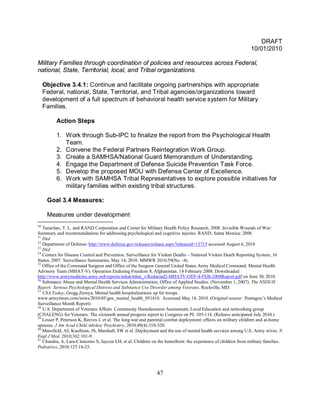
3. Military Families

   Support America’s service men and women – Active Duty, National Guard,
   Reserve, and Veterans – together with their families and communities by leading
   efforts to ensure needed behavioral health services are accessible and outcomes
   are successful.

   Goal 3.1: Improve Military Families’ access to community-based behavioral health
             care through coordination with TRICARE, Department of Defense, or
             Veterans Health Administration services.
   Goal 3.2: Improve quality of behavioral health prevention, treatment, and recovery
             support services by helping providers respond to the needs and culture
             of Military Families.
   Goal 3.3: Promote the behavioral health of Military Families with programs and
             evidence-based practices that support their resilience and emotional
             health.
   Goal 3.4: Develop an effective and seamless behavioral health service system for
             Military Families through coordination of policies and resources across
             Federal, national, State, Territorial, local, and Tribal organizations.


4. Health Care Reform Implementation

   Broaden health coverage to increase access to appropriate high quality care, and to
   reduce disparities that currently exist between the availability of services for
   substance abuse, mental disorders, and other medical conditions.

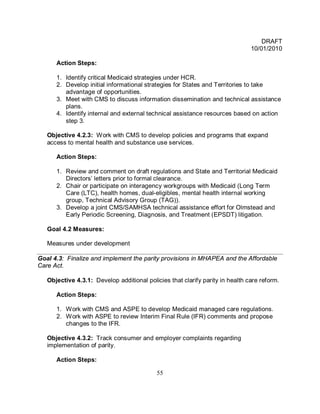
   Goal 4.1: Assure behavioral health is included in all aspects of Health Care Reform
             (HCR) implementation.
   Goal 4.2: Support Federal, State, and Territorial efforts to develop and implement
             new provisions under Medicaid/Medicare.
   Goal 4.3: Finalize and implement the parity provisions in Mental Health Parity and
             Addictions Equity Act and the Affordable Care Act.
   Goal 4.4: Develop changes in SAMHSA Block Grants to support recovery and
             resilience.
   Goal 4.5: Foster the integration of primary and behavioral health care.


5. Housing and Homelessness


                                         6
DRAFT
                                                                            10/01/2010

  Provide housing and reduce barriers to accessing effective programs that sustain
  recovery for individuals with mental and substance use disorders who are homeless.

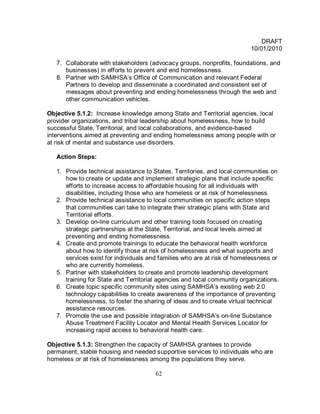
  Goal 5.1: Prevent homelessness among individuals with mental and substance use
            disorders.
  Goal 5.2: Create permanent stable housing for behavioral health populations.
  Goal 5.3: Implement supportive housing services.


6. Health Information Technology

  Ensure the behavioral health provider network, including prevention specialists and
  consumer providers, fully participates with the general health care delivery system in
  the adoption of Health Information Technology (HIT).

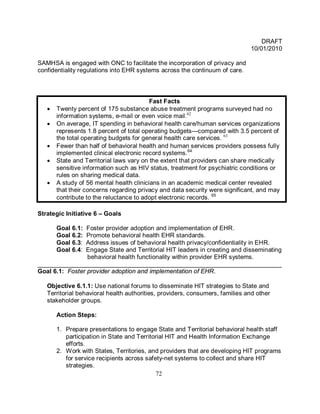
  Goal 6.1: Foster provider adoption and implementation of Electronic Health
            Records (EHR).
  Goal 6.2: Promote behavioral health EHR standards.
  Goal 6.3: Address issues of behavioral health privacy/confidentiality in EHR.
  Goal 6.4: Engage State and Territorial HIT leaders to develop and disseminate
            behavioral health functionality within provider EHR systems.


7. Data, Outcomes, and Quality

  Realize an integrated data strategy that informs policy and measures program
  impact leading to improved quality of services and outcomes for individuals, families,
  and communities.

  Goal 7.1: Implement an integrated approach for SAMHSA’s collection, analysis,
            and use of data.
  Goal 7.2: Create common standards for measurement and data collection to better
            meet stakeholder needs.
  Goal 7.3: Improve the quality of SAMHSA’s program evaluations and services
            research.
  Goal 7.4: Improve quality and accessibility of surveillance, outcome/performance,
            and evaluation information for SAMHSA staff, stakeholders, funders, and
            policymakers.


8. Public Awareness and Support


                                          7
DRAFT
                                                                            10/01/2010

Increase understanding of mental and substance use disorder prevention and
treatment services and activities to achieve the full potential of prevention and assist
people in accessing/getting help for these conditions with the same urgency as any
other health condition.

Goal 8.1: Increase capacity for Americans to understand and to access treatment
          and recovery supports for behavioral health conditions.
Goal 8.2: Create a cohesive SAMHSA identity and media presence.
Goal 8.3: Lead the field through communication around SAMHSA’s Strategic
          Initiatives and HHS Priorities
Goal 8.4: Get information to the workforce.
Goal 8.5: Increase social inclusion and reduce discrimination.
.


                                        8
DRAFT
                                                                                                   10/01/2010

                                 SAMHSA STRATEGIC INITIATIVES

                                              INTRODUCTION

As part of the U.S. Department of Health and Human Services (HHS), the Substance
Abuse and Mental Health Services Administration’s (SAMHSA’s) mission is to reduce
the impact of substance abuse and mental illness on America’s communities. SAMHSA
– in collaboration with other Federal agencies, States, Territories, Tribes, local
organizations, researchers, providers, and individuals including consumers, families,
and the recovery community – has demonstrated that:

        • Behavioral health is an essential part of health;
        • Prevention works;
        • Treatment is effective; and,
        • People recover from mental and substance use disorders.

Despite the simplicity of these messages, they are not well known or accepted by most
Americans.

Behavioral health is an essential part of health. 6 Individuals and families cannot be
healthy without positive mental health and freedom from addictions and abuse of
substances. Behavioral health prevention and treatment services are important parts of
health service systems and community-wide strategies that work to improve health
status and lower costs for individuals, families, businesses, and governments. Through
continued improvement in the delivery and financing of prevention, treatment, and
recovery support services, SAMHSA -- with its partners -- can advance and protect the
Nation’s health.

Substance abuse, addictions, poor emotional health and mental illnesses take a toll on
individuals, families and communities. They cost money, and they cost lives as surely
as do physical illnesses that are not prevented, left untreated, or poorly managed. Their
presence exacerbates the cost of treating co-morbid physical diseases and results in
some of the highest disability burden in the world for individuals, families, businesses,
and governments compared with other causes of disability. SAMHSA has a unique
responsibility to focus the Nation’s health care and social agendas on these preventable
and treatable problems stemming from disease, trauma, inadequate access to
appropriate care, and insufficient community and family supports. Our country can
make a difference in its health, justice, social services, educational, and economic

6
 The term “behavioral health” is used in this document as a general term to encompass the promotion of emotional
health; the prevention of mental illnesses and substance use disorders; and treatments and services for substance
abuse, addiction, substance use disorders, mental illness, and/or mental disorders.
                                                        9
DRAFT
                                                                                 10/01/2010

systems by addressing the prevention and treatment of mental and substance use
disorders.

SAMHSA can help with these endeavors. To guide the Agency’s work through at least
2012, SAMHSA has identified critical goals, partners, and opportunities to further its
mission and to assist States, Territories, Tribes, and communities in their respective
roles. This document outlines how SAMHSA will achieve the goals of its Strategic
Initiatives.

SAMHSA focuses on people. America’s people are central to SAMHSA’s values and
mission. While systems, services, and programs are the means, people’s lives matter
most. SAMHSA’s goal is a high-quality, self-directed, satisfying life in the community for
everyone in America. This life in the community includes:

       a) A physically and emotionally healthy lifestyle (health);
       b) A stable, safe and supportive place to live (a home);
       c) Meaningful daily activities such as a job, school, volunteerism, family
       caretaking, or creative endeavors and the independence, income, and resources
       to participate in society (a purpose); and
       d) Relationships and social networks that provide support, friendship, love, and
       hope (a community).

A person’s life – that is, health, a home, a purpose and a community – is compromised
when emotional resources are inadequate to contend with adverse events; when a
mental disorder is left untreated; when drugs and alcohol are abused or lead to
addictive disorders; when families or communities are violent; when health care is
unavailable; or when basic needs go unmet. In these circumstances, security and hope
are lost. SAMHSA’s role is to restore hope for individuals, families, and communities by
helping service delivery systems to prevent and improve these conditions so every
American has the opportunity to find and define a high-quality, satisfying life in his or her
own community. This is the essence of prevention and the value of recovery from
mental and substance use disorders.

SAMHSA works through partnerships. SAMHSA cannot achieve its goals or its
mission alone. We need the help of partners and collaborators within the Federal
Government, at State, Territorial, Tribal, and local levels, and in the private business
and non-profit worlds. Working with others will enable SAMHSA to focus on far-
reaching initiatives of its own while identifying specific actions within larger national
agendas to assure healthy communities throughout the country. Through partnerships
such as the HHS Behavioral Health Coordinating Committee, SAMHSA will guide a
National behavioral health response to the changing healthcare landscape.


                                            10
DRAFT
                                                                               10/01/2010

As U.S. health care systems are undergoing significant change, the economy also is
affecting the Nation’s behavioral health. States, Territories, and Tribal governments
struggle to provide leadership within significantly limited resources. Communities
struggle to adapt and to promote healthy living in safe, effective, and supportive
neighborhoods.

SAMHSA must address these national trends and needs with its limited financial and
human resources. For each Initiative outlined in this plan, SAMHSA is committed to
building on existing efforts and forming strategic partnerships wherever possible. We
will offer and enlist support to/from those interested in and responsible for improving the
behavioral health of the Nation.

SAMHSA embraces challenge and opportunity. Today is a historic time in America’s
approach to health care policy. The Affordable Care Act -- passed by Congress and
signed by the President in March 2010 – makes significant steps to include behavioral
health in the Nation’s health delivery system; to increase access to health and
behavioral health care; to grow the country’s health and behavioral health workforce; to
reduce physical and behavioral health disparities experienced by low-income
Americans, racial and ethnic minorities, and other underserved populations; and to
implement the science of behavioral health promotion and of prevention, treatment, and
recovery support services. Given the scope of the Affordable Care Act, significant work
lies ahead in order to help the field progress and thrive. SAMHSA is poised to ensure
that behavioral health is a priority as America prepares to implement health care reform;
therefore, Health Reform Implementation will be a Strategic Initiative that provides a
context for all of SAMHSA’s work.

With the unprecedented challenges of health care reform come unprecedented
opportunities:

   •   Through the Affordable Care Act, prevention and promotion activities at
       community and State/Territorial levels will expand significantly; therefore
       SAMHSA has identified Prevention of Substance Abuse and Mental Illness as its
       leading Strategic Initiative.

   •   A troubled national economy, violence and trauma experienced by youth and
       families, and an overburdened criminal justice system require new and better
       approaches to address behavioral health issues across health and human
       service sectors. SAMHSA will support States, Territories, Tribes, and
       communities to address these issues through a Strategic Initiative on Trauma
       and Justice.


                                            11
DRAFT
                                                                              10/01/2010

   •   Military families (Active Duty, National Guard, Reserve, and Veterans) are feeling
       the strain of frequent deployments, separation, exposure to combat, and health
       and behavioral health needs. For this reason, SAMHSA is committed to working
       with the Department of Defense, the Department of Veterans Affairs, States,
       Territories, Tribes, and communities as part of a Strategic Initiative on Military
       Families.

   •   Thanks to the American Recovery and Reinvestment Act and the Affordable
       Care Act, the Nation will finally realize the benefits of health information
       technology for quality improvement, cost containment, and increased patient
       control of personal health information. To ensure that Americans with behavioral
       health issues benefit from these innovations, SAMHSA is establishing a Strategic
       Initiative on Health Information Technology.

   •   Similarly, the demand for data and information is growing along with the growth
       in new technologies. This presents SAMHSA with an unprecedented opportunity
       to track results, improve quality and outcomes for the people SAMHSA serves,
       and increase transparency in government. For these reasons, SAMHSA is
       creating a new Strategic Initiative around Data, Outcomes, and Quality.

   •   Assuring widespread adoption of evidence-based practices and policies is a
       critical step of the public health model. SAMHSA also is responsible for
       increasing public understanding of behavioral health issues, increasing social
       inclusion of people with mental and substance use disorders, and eliminating
       related discrimination. These overarching goals will be the focus of a Strategic
       Initiative focused on Public Awareness and Support.

Today is a time of social change and economic difficulty which Federal agencies must
address and embrace. In this challenging context, SAMHSA will lead the way to reduce
the impact of substance abuse and mental illnesses on America’s communities.

SAMHSA sets priorities and takes action through its Strategic Initiatives. To
prioritize the Agency’s work and to best use limited financial and human resources,
SAMHSA will be guided by its Strategic Initiatives. This strategic plan will clarify
SAMHSA’s role and describe the challenges, goals, objectives, and action steps within
each of these Strategic Initiatives. This plan describes what the Agency will seek to
accomplish in each of these areas and what measurable improvements the public
should expect to see. These Strategic Initiatives were selected based on:

   1) Documented concerns of individuals, families, communities, States, Territories,
      Tribes and their service systems;
   2) Identified need and opportunity for Federal leadership; and,

                                           12
DRAFT
                                                                               10/01/2010

   3) Availability of resources and specific action steps to address the need.

Mental and substance use disorders are complex problems that affect nearly every
aspect of American life. As a result, SAMHSA’s Strategic Initiatives and other pieces of
the Agency’s work are interconnected and sometimes overlapping. For example, Data,
Outcomes, and Quality are essential components to every programmatic activity in the
Agency. Similarly, Prevention is closely related to treatment and has implications
across populations, including military families and individuals who have experienced
trauma. SAMHSA recognizes this complexity and remains committed to working with
partners inside and outside of the field to foster a comprehensive, coordinated approach
to behavioral health. Where there are gaps, SAMHSA will partner and innovate. Where
there is overlap, SAMHSA will increase collaboration and reduce redundancy. The lives
of people with or at risk for behavioral health problems do not fit neatly into silos, so
services cannot either. SAMHSA’s Strategic Initiatives reflect that reality.

Given the broad reach of SAMHSA’s mission as a Federal agency with responsibility for
improving the quality of behavioral health services, data, and information, it is tempting
to be at every policy table and address every programmatic issue. But like all
Americans, SAMHSA must live within its means. As a small Agency, SAMHSA will
adhere to its Strategic Plan, use limited resources wisely, and leverage the efforts of
partners and collaborators. This limitation also means staging work so that urgency,
opportunity, and readiness create a formula for identifying which issues come first, and
which issues we will address in the future.

For example, the issues of military families are both urgent and compelling. With
military suicides rising to all-time highs and increasing numbers of deployed personnel
returning to their families and communities, the time to act is now. In the future,
however, as community provider capacity is established and conflicts are resolved, the
issues of military families may become less pressing and SAMHSA may prioritize a new
Strategic Initiative. In this manner, the important issues related to jobs and the
economy – including the specific employment challenges of people with mental and
substance use disorders, the impact of economic downturns on individual, family and
community behavioral health, and the role of employers and the workplace in fostering
behavioral health – may build upon progress made by this first set of initiatives and
become a priority in later iterations of the Strategic Plan. Other important aspects of the
behavioral health system, such as its workforce and efforts to promote recovery and
eliminate behavioral health disparities, cut across all of the initiatives, and will be
addressed under each Initiative. Finally, there are those issues that will continue as
priorities for SAMHSA, even if they are not identified as strategic initiatives, such as
meeting the Agency’s regulatory and oversight responsibilities.

SAMHSA’s Roles

                                            13
DRAFT
                                                                              10/01/2010


SAMHSA supports the HHS Strategic Initiative to Transform Health Care by helping
individuals and communities to build resilience and support recovery from mental and
substance use disorders. In order to achieve this goal, SAMHSA plays many roles,
including providing funding and information, improving practice and capacity, leading
innovation, ensuring safe, high-quality care, and being a strong national voice for the
prevention and treatment of mental and substance use disorders.

These roles can be summarized as follows:

   Leadership and Voice
   • Developing policies, supporting policy development at other levels of government
      and providing input into policy development in related fields
   • Convening stakeholders and the field
   • Collaborating with partners inside and outside of government to discuss and
      come to agreement on policies and strategies
   • Collecting best practices and developing expertise around behavioral health
      services
   • Advocating for the needs of persons with mental and substance use disorders
      and emphasizing the importance of behavioral health in partnership with other
      agencies, systems, and the general public

   Funding – Service Capacity Development
   • Supporting States, Territories, and Tribes to build and improve basic and proven
     practices and system capacity
   • Helping local governments, providers, communities, universities and
     organizations innovate and address emerging issues
   • Building capacity across grantees
   • Strengthening States’, Territories’, and communities’ emergency response to
     disasters

   Information/Communications
   • Conducting national surveys and surveillance [National Survey on Drug Use and
       Health (NSDUH), Drug Abuse Warning Network (DAWN), Drug and Alcohol
       Service Information System (DASIS)]
   • Vetting and sharing information about evidence-based practices - National
       Registry of Evidence-based Programs and Practices (NREPP)
   • Using the web, print, social media, public appearances, and the press to reach
       the general public, providers (primary, specialty, guilds, peers), and other
       stakeholders in culturally and linguistically appropriate ways
   • Listening and reflecting the voices of consumers and persons in recovery

                                           14
DRAFT
                                                                              10/01/2010

   Regulation and Standard Setting
   • Preventing tobacco sales to minors (Synar Program)
   • Administering Federal Drug-Free Workplace and Drug-Testing programs
   • Overseeing opioid treatment programs and accreditation bodies
   • Informing physicians’ office-based opioid treatment prescribing practices
   • Partnering with other HHS agencies in regulation development and review

   Improve Practice (community-based, primary care, specialty care)
   • Holding State, Territorial, and Tribal policy academies
   • Providing technical assistance to States and Territories, grantees, providers,
      practitioners, and stakeholders
   • Convening conferences to disseminate practice information and facilitate
      communication
   • Providing guidance to the field
   • Developing and disseminating core competencies and evidenced-based
      practices
   • Supporting innovation in evaluation and services research, particularly among
      historically underserved/understudied populations
   • Moving innovations and evidence based approaches to scale

Furthermore, SAMHSA approaches every activity with a focus on people, partnerships,
and performance. The employees at SAMHSA are central to achieving the goals and
objectives outlined in this plan. Their commitment to the mission of the Agency and
passion for producing measurable improvements in the behavioral health of America
are what will propel SAMHSA, together with its partners, to succeed in this era of
change.

Service Recipients, Youth and Families, and Persons in Recovery

SAMHSA remains committed to the full inclusion of consumers, people in recovery,
youth, and their families in meaningful roles to improve behavioral health systems.
Empowerment, self-determination, and resilience are key objectives of this commitment,
and SAMHSA remains at the vanguard of the recovery movement. In order to help
each individual achieve his or her full potential, SAMHSA and its programs strive to
model shared decision-making and support concrete strategies such as consumer-
operated services, peer and family specialists, person-centered planning, and self-
directed care. Building on the strengths -- and following the direction of -- individuals
and families affected by behavioral health problems is essential to improving service
delivery and achieving meaningful positive outcomes.

Direct service providers, the broader public sector, and the private sector must
recognize the inherent worth of individuals and families, take a strong stand against
                                            15
DRAFT
                                                                                10/01/2010

prejudice and discrimination, and promote the message that people can be resilient to
and recover from mental and substance use disorders. In each individual or family’s
journey of recovery there is hope - hope for healing and health, for educational and
economic improvement, and for social inclusion and acceptance. As individuals in
recovery and families with resilient youth contribute to the health and well-being of their
communities, our Nation will benefit. America needs to recognize their achievements,
learn from their experience, provide support, and reach out to those still in need.


Cultural Competence and Eliminating Disparities

SAMHSA recognizes that certain racial and ethnic populations in the United States
historically have been under- or inappropriately served by the behavioral health system
with striking disparities in access, quality, and outcomes of care. As a result, American
Indians and Alaska Natives, African Americans, Asian Americans, Native Hawaiian and
Other Pacific Islanders, and Latinos bear a disproportionately high burden of disability
from mental and substance use disorders. This higher disability burden does not arise
from a greater prevalence or severity of behavioral health problems, but from barriers to
access (including stigma and discrimination, lack of insurance coverage, language, etc.)
and poor engagement in services compounded with endemic social risk factors. Across
its Strategic Initiatives, SAMHSA will encourage behavioral health services and systems
to incorporate respect for, and understanding of, the histories, traditions, beliefs,
language, sociopolitical contexts, and cultures of diverse racial and ethnic populations.

Mental and substance use disorders also disproportionately affect individuals who are
lesbian, gay, bisexual, and transgender (LGBT). Many behavioral health problems
affecting LGBT youth and adults, such as substance abuse, underage drinking,
depression, anxiety, suicidal ideation and suicide may be related to experiences of
family conflict, bullying, abuse, discrimination and social exclusion. SAMHSA seeks to
better understand these problems, increase awareness, and improve quality and
effectiveness of behavioral health care for the LGBT community.

As SAMHSA moves forward with this Strategic Plan, it will address the experiences,
barriers, needs, and outcomes for these and other groups including women, children,
older adults, persons with disabilities, persons who are deaf or hard of hearing, people
facing economic hardship, people living in healthcare workforce shortage areas, and
other underserved populations. This work will be guided by the leadership of a newly
established Office of Behavioral Health Equity within SAMHSA.

Intergovernmental Relationships – Partnering with States, Territories, and Tribes


                                            16
DRAFT
                                                                                                     10/01/2010

States and Territories 7 have primary responsibility for sustaining and operating the
public behavioral health prevention and treatment systems for the Nation. As such, it is
critical for SAMHSA to work closely with them as it implements this Strategic Plan.
Building on a long-history of strong collaboration and cooperative work, SAMHSA will
ensure that the roles and needs of States and Territories are reflected in the goals,
objectives, and action steps of the Strategic Initiatives. Health reform promises to
improve access to quality health care for millions of Americans with mental and
substance use disorders, the most vulnerable of whom are currently being served by
State, Territorial, and community systems. As provisions of the Affordable Care Act
come into effect, SAMHSA and the States and Territories will need to have a shared
vision regarding the use of Federal Block Grant funds as well as discretionary
investments to ensure the availability and effectiveness of comprehensive prevention,
treatment, and recovery support services for these priority populations.

Similarly, SAMHSA acknowledges that American Indian and Alaska Native tribal
governments are sovereign governmental entities with a unique historical and legal
relationship with the Federal government. SAMHSA will honor that relationship and
embrace a government-to-government approach, to the extent allowed by law, in
working with Tribal governments. SAMHSA’s Tribal activities will be based on early and
meaningful consultation, trust, mutual respect, and shared responsibility. The Agency
will seek guidance from Tribal governments about this Strategic Plan as well as other
existing and planned activities. This ongoing guidance will include:

    •   Identifying and addressing shared priorities and issues;
    •   Early and meaningful consultation;
    •   Working through mutually convenient channels of communication;
    •   Sharing helpful background information and clearly defining issues;
    •   Building relationships with key tribal organizations and institutions;
    •   Fostering intergovernmental cooperation and mutual respect between States and
        Tribes;
    •   Identifying promising approaches and providing technical assistance to Tribes about
        behavioral health programs and broader issues like financing;
    •   Supporting culturally appropriate care provided by staff representative of the
        population served whenever possible;
    •   Working to develop and support programs that address the unique needs of Tribes
        in a culturally competent manner and build on traditional health knowledge; and
    •   Consulting tribal governments early in the development of programs, projects, and
        other activities directed to their communities
7
  In this paper, the term “Territories” includes Territories of the United States (American Samoa, Guam, and the
U.S. Virgin Islands) and the United States Associated Jurisdictions (Commonwealth of the Northern Mariana
Islands, Freely Associated States of the Federated States of Micronesia, Republic of the Marshall Islands, and
Republic of Palau).
                                                        17
DRAFT
                                                                                10/01/2010

As needed, SAMHSA also will provide Tribal governments and providers assistance to
address issues stemming from entrenched poverty, historical trauma, small or sparse
populations, remote locations, lack of capacity, and differing requirements across
Federal programs. Accountability will be maintained while SAMHSA looks for ways to
accommodate the unique needs and strengths of American Indians and Alaska Natives.
While Tribes or Tribal issues are specific foci of several parts of this plan, broad Tribal
participation throughout SAMHSA’s programs is expected and encouraged.

Moving Forward

These Strategic Initiatives will provide direction to SAMHSA and ensure that Agency
resources are focused where need meets opportunity. Each initiative includes goals
and objectives that will guide the development and implementation of SAMHSA’s
programs and policies. These, in turn, will lead to action steps that influence new
grants, contracts, surveys, technical assistance resources, staffing patterns, and public
information. The Strategic Plan will guide how SAMHSA:

          − establishes budget and policy priorities;
          − streamlines and allocates resources using grants, contracts, technical
            assistance, internal staff and interagency collaborations;
          − engages partners at every level (National, State, Territorial, Tribal, local);
          − organizes its programs and workforce; and,
          − measures and communicates progress.

In order to maintain the current behavioral health infrastructure in States, Territories and
communities during this time of shrinking budgets, SAMHSA must stay focused and
disciplined. Whereas ten Strategic Initiatives had been considered in earlier
communications about the Strategic Initiatives, SAMHSA will begin with the eight
outlined in subsequent sections of this paper. Some of the originally proposed
activities, such as those to support and grow the behavioral health workforce, will be
highlighted and integrated throughout the remaining Initiatives. Others, such as Jobs
and the Economy may arise as priorities in subsequent stages of the plan.

In the meantime, current activities will lay the foundation for future work. SAMHSA is
committed to making its Strategic Plan a living document which will adapt to emerging
priorities and accommodate changing budget and policy contexts.

SAMHSA welcomes comments and suggestions from the field regarding these Strategic
Initiatives, their goals, objectives, action steps, and related measures. Through this
plan, SAMHSA will guide its work and engage collaborators at every level to advance
the behavioral health of the Nation.


                                            18
DRAFT
                                                                             10/01/2010

    Strategic Initiative #1: Prevention of Substance Abuse and Mental Illness
           Lead: Fran Harding, Director, Center for Mental Health Services


Issue Statement

Mental and substance use disorders have a powerful effect on the health of individuals,
and on the Nation’s social, economic, and health-related problems. Mental and
substance use disorders also are among the top conditions for disability, burden of
disease, and cost to families, employers, and publicly funded health systems.
Excessive alcohol use and illicit drug use are linked directly to increased burden from
chronic disease, diabetes, and cardiovascular problems. 1

The Institute of Medicine’s (IOM) 2009 report Preventing Mental, Emotional, and
Behavioral Disorders Among Young People: Progress and Possibilities describes
evidence-based services and interventions that build emotional health by addressing
risk factors and supporting protective factors and resilience to prevent many mental and
substance use disorders in children and young adults. The IOM report also documents
that behavior and symptoms signaling the likelihood of future behavioral disorders such
as substance abuse, adolescent depression, and conduct disorders often manifest two
to four years before a disorder is actually present. If communities and families can
intervene earlier, before mental and substance use disorders are typically diagnosed,
future disorders can be prevented or the symptoms mitigated. Doing so requires
multiple and consistent interventions by all systems touching these children and youth
(e.g., schools, health systems, churches, families, and community programs). Because
most adult mental and substance use disorders manifest before age 25, and many of
the same risk and protective factors affect physical health, this focus on preventing
mental health and substance abuse problems among children, adolescents, and young
adults is critical to our Nation’s behavioral and physical health now and in the future.

With the passage of the Affordable Care Act, there is increasing commitment to
prevention across government and in States, Territories, Tribes, and communities. This
commitment means fostering physical and behavioral health and well-being in addition
to ensuring access to affordable and effective health care. Now is a perfect opportunity
to engage stakeholders and partners – including AI/AN Tribes – to embrace prevention
as the number one Strategic Initiative in the behavioral health field. SAMHSA will
support Prevention Prepared Communities – that is, communities equipped to use a
comprehensive mix of universal, selective, and indicated prevention strategies – to help
States, Territories, and Tribal governments build greater social connectedness and
stronger community cohesion, strengthen family environments in which future
generations will live and grow, and develop a healthier and more effective workforce for
the future.

                                           19
DRAFT
                                                                              10/01/2010


Background

The promotion of positive mental health and prevention of substance abuse are key
parts of SAMHSA’s mission to reduce the impact of substance abuse and mental
illnesses on America’s communities. The World Health Organization defines health as
a “state of complete physical, mental, social well-being, and not merely absence of
disease or infirmity.” Mental, emotional, and behavioral (MEB) health refers to the
overall psychological well-being of individuals, and includes the presence of positive
characteristics such as the ability to manage stress, demonstrate flexibility under
changing conditions, and bounce back from adverse situations. SAMHSA plans to
promote health by placing a national priority on healthy mental, emotional, and
behavioral development, especially in children, youth, and young adults.

SAMHSA’s efforts will include programs to assist States, Territories, Tribal
governments, and communities to adopt evidence-based practices, deliver health
education related to prevention, and establish effective policies, programs, and
infrastructure to build resilience and prevent mental and substance use disorders. By
building capacity within States and Territories and supporting the development of
Prevention Prepared Communities, SAMHSA will promote the emotional health of
children and youth, and provide them with skills to overcome risks experienced in
adolescence and young adulthood. SAMHSA also will work to enhance the ability of
health systems, schools, families, and other entities to intervene early and consistently
in ways that meet the cultural and linguistic needs of diverse populations. In doing so,
SAMHSA will build on scientific evidence to create understanding of what works to help
young people exhibiting warning signs of mental and substance use disorders before
these conditions become disabling. SAMHSA will restructure multiple prevention
programs and activities to focus limited resources, to enhance collaboration, to identify
strategic problems, and to develop plans for addressing the health and well-being of
whole communities.

American Indian and Alaska Native communities face elevated levels of substance use
disorders and experience higher suicide rates than the general population. They also
face higher rates of certain risk factors for mental, emotional, and behavioral problems,
including poverty, domestic violence, childhood and historical trauma, as well as
involvement in the foster care and criminal justice systems. SAMHSA is committed to
addressing these disparities by improving prevention programs that serve members of
the AI/AN community and by working with Tribes and Tribal organizations to develop
culturally focused universal, selected, and indicated prevention programs.

Public awareness and health education will be an essential part of the overall
Prevention Strategic Initiative. Parents, schools, and communities have an intense

                                           20
DRAFT
                                                                                           10/01/2010

need for information to help keep their children safe and healthy. For example, problem
drinking, including underage drinking, is a serious health and safety issue, but many
Americans tolerate and even support it. Some adults, including some parents,
mistakenly think that underage drinking is part of growing up and a harmless rite of
passage. Problem drinking is not just an issue for young people. Many adults are
concerned about their own, their partner’s, or their aging parents’ use of alcohol.
Educating the public about problem drinking will likely result in better health outcomes
across the lifespan.

The field of prevention science, well known for advancing the health of people at risk for
illnesses such as cancer, diabetes, and heart disease, also has produced effective
strategies for behavioral health. Properly implemented, prevention and wellness
promotion efforts result in safer communities, better health outcomes, and increased
productivity. Preventing and/or delaying initiation of substance abuse or the onset of
mental illness can reduce the potential need for treatment later in life. Our prevention
efforts will also address the unique needs of people living with substance abuse and
mental illness. People with mental and substance use disorders are 2 to 5 times more
likely to smoke cigarettes than the general population, 8 and we must also work to
prevent this harmful behavior. Research shows that ongoing, community-based,
comprehensive approaches to preventing specific problems or risk behaviors can
achieve these goals.

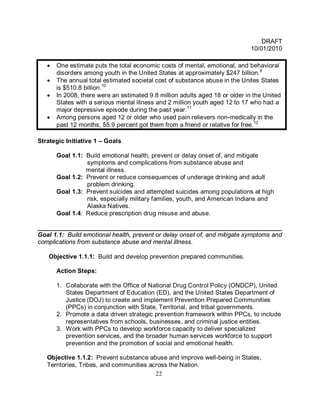
                                              Fast Facts
      •   By 2020, behavioral health disorders will surpass all physical diseases as a
          major cause of disability world-wide.2
      •   Nearly 5,000 deaths are attributable to underage drinking each year. 3
      •   Each year, tobacco use results in more deaths (443,000/year) than AIDS,
          unintentional injuries, suicide, homicide, and alcohol and drug abuse combined;
          almost half of these deaths occur among people with mental and substance use
          disorders.4
      •   In 2008, an estimated 2.9 million persons aged 12 or older used an illicit drug for
          the first time within the past 12 months; an average of 8,000 initiates per day.5
      •   Half of all lifetime cases of mental and substance use disorders begin by age 14
          and three-fourths by age 24.6
      •   Adults who began drinking alcohol before age 21 were more likely to be later
          classified with alcohol dependence or abuse than those who had their first drink
          at or after age 21.7
      •   Over 33,300 Americans die every year as a result of suicide, approximately one
          every 16 minutes.8


8
    Kalman D, Morissette SB, George TP. American Journal on Addictions. 2005;14,106-123.
                                                  21
DRAFT
                                                                              10/01/2010

   •   One estimate puts the total economic costs of mental, emotional, and behavioral
       disorders among youth in the United States at approximately $247 billion. 9
   •   The annual total estimated societal cost of substance abuse in the Unites States
       is $510.8 billion.10
   •   In 2008, there were an estimated 9.8 million adults aged 18 or older in the United
       States with a serious mental illness and 2 million youth aged 12 to 17 who had a
       major depressive episode during the past year.11
   •   Among persons aged 12 or older who used pain relievers non-medically in the
       past 12 months, 55.9 percent got them from a friend or relative for free.12

Strategic Initiative 1 – Goals

       Goal 1.1: Build emotional health, prevent or delay onset of, and mitigate
                 symptoms and complications from substance abuse and
                 mental illness.
       Goal 1.2: Prevent or reduce consequences of underage drinking and adult
                 problem drinking.
       Goal 1.3: Prevent suicides and attempted suicides among populations at high
                 risk, especially military families, youth, and American Indians and
                 Alaska Natives.
       Goal 1.4: Reduce prescription drug misuse and abuse.

______________________________________________________________________
Goal 1.1: Build emotional health, prevent or delay onset of, and mitigate symptoms and
complications from substance abuse and mental illness.

   Objective 1.1.1: Build and develop prevention prepared communities.

       Action Steps:

       1. Collaborate with the Office of National Drug Control Policy (ONDCP), United
          States Department of Education (ED), and the United States Department of
          Justice (DOJ) to create and implement Prevention Prepared Communities
          (PPCs) in conjunction with State, Territorial, and tribal governments.
       2. Promote a data driven strategic prevention framework within PPCs, to include
          representatives from schools, businesses, and criminal justice entities.
       3. Work with PPCs to develop workforce capacity to deliver specialized
          prevention services, and the broader human services workforce to support
          prevention and the promotion of social and emotional health.

   Objective 1.1.2: Prevent substance abuse and improve well-being in States,
   Territories, Tribes, and communities across the Nation.
                                          22
DRAFT
                                                                         10/01/2010


   Action Steps:

   1. Use SAMHSA Block Grant and discretionary funds in conjunction with other
      Federal prevention programs to build mental, emotional, and behavioral
      health from early childhood to young adulthood, and to implement universal,
      selective, and indicated prevention activities for substance abuse and mental
      illness in States, Territories, and Tribes.
   2. Provide technical assistance to States, Territories, Tribes, and communities to
      develop and implement strategic plans to prevent substance abuse and
      improve mental, emotional, and behavioral health.
   3. Coordinate SAMHSA prevention and promotion efforts with the President’s
      National Prevention, Health Promotion, and Public Health Council.
   4. Ensure a focus on communities facing behavioral health disparities,
      especially racial and ethnic minorities, Tribes, and LGBT youth.

Objective 1.1.3: Eliminate tobacco use among youth and reduce tobacco use
among persons with mental and substance use disorders.

   Action Steps:

   1. Promote tobacco cessation efforts among individuals with mental and
      substance use disorders through Block Grant requirements to States and
      Territories and grants to targeted provider agencies.
   2. Promote integration of State and Territorial Synar efforts with the State
      enforcement contracts funded by the Food and Drug Administration (FDA).
   3. Promote tobacco-free initiatives in mental health, substance abuse treatment,
      and community-based prevention efforts through SAMHSA’s 100 Pioneers for
      Smoking Cessation Virtual Leadership Academy.
   4. Promote tobacco cessation among individuals with mental and substance use
      disorders through the HHS Tobacco Prevention and Control Working Group
      (a collaboration with the Centers for Disease Control and Prevention (CDC),
      FDA, National Institutes of Health (NIH), Centers for Medicare and Medicaid
      Services (CMS), Indian Health Service (IHS), Administration for Children and
      Families (ACF), Administration on Aging (AoA), Health Resources and
      Services Administration (HRSA), and offices within HHS).
   5. Require all SAMHSA grantees to maintain a tobacco-free space.

Goal 1.1 Measures:

Measures under development


                                       23
DRAFT
                                                                             10/01/2010

Goal 1.2: Prevent or reduce consequences of underage drinking and adult problem
drinking.

   Objective 1.2.1: Establish the prevention of underage drinking as a priority issue for
   States, Territories, Tribal entities, universities, and communities.

      Action Steps:

      1. In collaboration with the Interagency Coordinating Committee on the
         Prevention of Underage Drinking (ICCPUD), develop and implement a
         national strategy to prevent underage drinking.
      2. Collaborate with HHS and other Federal partners to develop and adopt the
         HHS Secretary’s core underage drinking prevention messages.
      3. Through the Sober Truth on Preventing Underage Drinking Act (STOP Act)
         program, enhance intergovernmental cooperation and coordination on the
         issue of alcohol use among youth and provide communities timely information
         regarding state-of-the-art practices that have proven to be effective..

   Objective 1.2.2: Increase awareness of and reduce adult problem drinking.

      Action Steps:

      1. In conjunction with CDC and the National Institute on Alcohol Abuse and
         Alcoholism (NIAAA), develop and implement a national awareness campaign
         focused on adult problem drinking.
      2. Educate physicians, medical students, and other health care professionals
         about adult problem drinking and appropriate screening, brief intervention,
         and referral to treatment (SBIRT) interventions.
      3. Implement policy academies to assist States, Territories, communities, and
         universities to implement proven policies and test new policies to reduce adult
         problem drinking.

   Goal 1.2 Measures:

   Measures under development

Goal 1.3: Prevent suicides and attempted suicides among populations at high risk,
especially military families, youth, and American Indians and Alaska Natives.

   Objective 1.3.1: Improve mental, emotional, and behavioral health and well-being
   among military families, youth, and American Indians and Alaska Natives with a
   focus on ethnic minority and LGBT youth.

                                          24
DRAFT
                                                                            10/01/2010


   Action Steps:

   1. Educate primary care and behavioral health practitioners, communities,
      schools and the public about the risk and protective factors that contribute to
      emotional health and the ability to manage adverse life events.
   2. Develop and encourage culturally specific programs that develop strong
      sense of self and appropriate help-seeking among African American,
      American Indian and Alaska Native, Asian American, Native Hawaiian and
      Other Pacific Islander, Hispanic, and LGBT youth.
   3. Support suicide prevention programming for high risk populations through
      SAMHSA Block Grant funds and other prevention programs.

Objective 1.3.2: Increase public knowledge of the warning signs for suicide and
actions to take in response.

   Action Steps:

   1. Convene the Suicide Prevention National Action Alliance to update and
      implement the National Strategy to Prevent Suicide.
   2. Increase the visibility and accessibility of suicide prevention services in
      States, Territories, Tribal entities, and communities, and work to ensure the
      National Suicide Prevention Lifeline program is adequately funded.
   3. Increase access to suicide prevention resources by collaborating with
      physical and behavioral health organizations.
   4. Implement and develop a strategic plan to educate parents, health
      practitioners, school officials, community leaders, youth, State, Territorial, and
      Tribal leaders, first responders, and the general public about the warning
      signs for suicide and about actions to take to help someone contemplating a
      suicide attempt.
   5. Increase awareness of suicide prevention and the suicide hotline among
      populations at higher risk for suicide, especially military families, Tribes, and
      youth with a focus on racial and ethnic minorities and LGBT youth.

Objective 1.3.3: Increase the use and effectiveness of the Veterans Suicide
Prevention Hotline/Lifeline

   Action Steps:

   1. Collaborate with States,Territories, and Tribal entities, Veterans Affairs (VA),
      and Department of Defense (DoD), including collaboration with the VA’s
      National Suicide Prevention Coordinator, the VA’s Center of Excellence for

                                        25
DRAFT
                                                                               10/01/2010

         Suicide Prevention, and the DoD’s Center for Excellence on Psychological
         Health to improve access to and quality of suicide prevention resources for
         former and current members of the military and their families.
      2. Educate and conduct outreach activities to Military families to increase
         awareness and use of the Suicide Prevention Hotline/Lifeline through an
         Interagency Agreement (IAG) and partnership with the VA.

   Goal 1.3 Measures:

   Measures under development

Goal 1.4: Reduce prescription drug misuse and abuse.

   Objective 1.4.1: Educate current and future prescribers regarding appropriate
   prescribing practices for pain and other medications subject to abuse and misuse.

      Action Steps:

      1. Collaborate with NIAAA, the National Institute on Drug Abuse (NIDA), the
         National Institute on Mental Health (NIMH), the Agency for HealthCare
         Research and Quality (AHRQ), and FDA in collaboration with the Behavioral
         Health Coordinating Council, as well as intermediary organizations (e.g.,
         American Society for Addiction Medicine, Association of Medical Educators
         and Researchers in Substance Abuse, and Association of American Medical
         Colleges) to build upon and develop resources for prescribers specific to pain
         and other medications subject to abuse and misuse.
      2. Collaborate with the NIDA, ED, FDA, and other Federal agencies in
         collaboration with the HHS Behavioral Health Coordinating Council, as well as
         intermediary organizations (e.g., American Medical Association, American
         Psychological and Psychiatric Associations, American Dental Association,
         American Association of Medical Colleges and other relevant professional
         organizations) to incorporate information about warning signs and
         consequences of prescription drug abuse, strategies for patient referral, and
         the critical need for appropriate prescribing practices into curricula for medical
         professionals.
      3. Provide training and technical assistance to clinicians regarding appropriate
         prescribing practices for pain management, including the use of methadone.

   Objective 1.4.2: Educate the public about the appropriate use of opioid pain
   medications, and encourage the safe and consistent collection and disposal of
   unused prescription drugs.


                                           26
DRAFT
                                                                                                              10/01/2010

         Action Steps:

         1. Collaborate with NIDA, CMS, FDA, CDC, HRSA, and other Federal agencies
            as appropriate to build upon SAMHSA’s national prescription drug abuse
            public education campaign, targeting consumers regarding proper disposal of
            unused prescription drugs and keeping prescription drugs securely out of
            reach from unintended users.
         2. Develop a national turn in your drugs day/week campaign.

    Objective 1.4.3: Support the establishment of State/Territory-administered
    controlled substance monitoring systems, and develop a set of best practices to
    guide the establishment of new State and Territorial programs and the improvement
    of existing programs

          Action Steps

          1. Collaborate with the FDA and other Federal agencies as appropriate to
             expand the utility of prescription drug monitoring programs, allowing more
             States and Territories to share information internally and regionally with
             neighboring States and Territories.
         2. Collaborate with the FDA and other Federal agencies as appropriate to
             develop a set of best practices for States and Territories as they develop or
             enhance their prescription drug monitoring programs.

    Goal 1.4 Measures:

    Measures under development

1
  http://drugabuse.gov/consequences.
2
  Promoting Mental Health: Concepts, Emerging Evidence, Practice (summary report). Geneva (CH): World Health
Organization; 2004 www.who.int/mental_health/evidence/en/promoting_mhh.pdf.
3
  Centers for Disease Control and Prevention [CDC] 2004; Hingson and Kenkel 2004; Levy et al. 1999; National Highway
Traffic Safety Administration [NHTSA] 2003; Smith et al. 1999). Cited in Department of Health and Human Services. The
Surgeon General's Call to Action To Prevent and Reduce Underage Drinking. Department of Health and Human Services, Office
of the Surgeon General, 2007.
4
  Centers for Disease Control and Prevention. (2008). Smoking-Attributable Mortality, Years of Potential Life Lost, and
Productivity Losses—United States, 2000–2004. Morbidity and Mortality Weekly Report [serial online], 57(45): 1226–1228.
5
  Substance Abuse and Mental Health Services Administration (2009). Results from the 2008 National Survey on Drug Use and
Health: National Findings (Office of Applied Studies, NSDUH Series H-36, HHS Publication No. SMA 09-4434). Rockville,
MD.
6
  Kessler, R.C., Berglund, P., Demler, O., Jin, R., Merikangas, K.R., & Walters, E.E. (2005). Lifetime prevalence and age-of-
onset distributions of DSM-IV disorders in the National Comorbidity Survey Replication. Archives of General Psychiatry, 62(6),
593-602.
7
  Office of Applied Studies. (2009). Results from the 2008 National Survey on Drug Use and Health: National Findings (DHHS
Publication No. SMA 09–4434, NSDUH Series H–36). Rockville, MD: Substance Abuse and Mental Health Services
Administration.

                                                             27
DRAFT
                                                                                                             10/01/2010

8
  National Vital Statistics Reports, vol 57, no 14. Deaths: Final Data for 2006 by Melonie Heron, Ph.D.; Donna L. Hoyert,
Ph.D.; Sherry L. Murphy, B.S.; Jiaquan Xu, M.D.; Kenneth D. Kochanek, M.A.; and Betzaida Tejada-Vera, B.S.; Division of
Vital Statistics.
9
  National Research Council and Institute of Medicine (2009), Preventing Mental, Emotional, and Behavioral Disorders Among
Young People: Progress and Possibilities. Committee on the Prevention of Mental Disorders and Substance Abuse among
Children, Youth, and Young Adults: Research Advances and Promising Interventions. Mary Ellen O’Connell, Thomas Boat, and
Kenneth E. Warner, Editors. Board on Children, Youth, and Families, Division of Behavioral and Social Sciences and Education.
Washington, DC: The National Academies Press.
10
   Miller, T. and Hendrie, D. Substance Abuse Prevention Dollars and Cents: A Cost-Benefit Analysis. DHHS Pub. No. (SMA)
07-4298. Rockville, MD: Center for Substance Abuse Prevention, Substance Abuse and Mental Health Services Administration,
2009.
11
   Substance Abuse and Mental Health Services Administration (2009). Results from the 2008 National Survey on Drug Use and
Health: National Findings (Office of Applied Studies, NSDUH Series H-36, HHS Publication No. SMA 09-4434). Rockville,
MD.
12
   Substance Abuse and Mental Health Services Administration (2009). Results from the 2008 National Survey on Drug Use and
Health: National Findings (Office of Applied Studies, NSDUH Series H-36, HHS Publication No. SMA 09-4434). Rockville,
MD.


                                                            28
DRAFT
                                                                                10/01/2010

                    Strategic Initiative #2: Trauma and Justice
            Lead: Larke Huang, Director, Office of Behavioral Health Equity


Issue Statement

Trauma is a widespread, harmful, and costly public health problem. Trauma occurs as
a result of violence, abuse, neglect, disaster, war, and other emotionally destructive
experiences. Trauma has no boundaries with regard to age, gender, economics, race,
ethnicity, geography, or sexual orientation. Trauma is now understood to be an almost
universal experience of people receiving treatment for mental and substance use
disorders. The need to address trauma has become a fundamental obligation for
effective behavioral health service delivery.

The effects of trauma place a heavy burden on individuals, families, and communities
and create challenges for all public institutions and service systems. With appropriate
supports and intervention, people can overcome traumatic experiences. However, most
people go without support. Unaddressed trauma significantly increases the risk of
mental and substance use disorders, chronic physical diseases, and early death13.

Traumatic victimization often results in negative behaviors that bring both youth and
adults into the criminal justice system. Studies of people in jail and prison reveal high
rates of mental and substance use disorders and personal histories of trauma.
Preventing trauma is a promising avenue for reducing criminal justice involvement.
Treatment is also a key strategy for improving outcomes for people in jail and prison
who have mental and substance use disorders.

A better understanding of the needs of trauma survivors has emerged over the past
decade. Behavioral health providers have implemented “trauma specific” services to
directly address the impact of trauma on people’s lives as well as create service settings
that are “trauma informed.” In a trauma-informed setting, providers and clients feel safe
and the possibility of retraumatization is minimized.

While much of the focus on trauma is on individuals, some communities experience
historical trauma that is transmitted from one generation to the next. For example,
African Americans and American Indian and Alaska Native communities have suffered
historical losses of land and identity and assaults on their culture and way of life that
result in intergenerational trauma. The connection between historical trauma and the
undermining of the economic and social fabric of the community with associated
behavioral health problems and high risk behaviors is well documented. 14


                                            29
DRAFT
                                                                                10/01/2010

Another growing community exposed to trauma is military service members, veterans,
and their families. Dealing with the losses, fears, and injuries associated with two
ongoing wars, military families with trauma-associated symptoms and disorders are
increasingly coming to the attention of behavioral health providers. Repeated
deployments, relocations, military sexual trauma, and serious injuries exert an
emotional toll on military families.

In recent years, man-made and natural disasters such as terrorist attacks, hurricanes,
floods, and oil spills have received national attention as causes of death, physical injury,
environmental damage, economic hardship, and emotional trauma. Research indicates
that these disasters and their aftermath are likely to have an impact on the exposed
population’s behavioral health, resulting in an increase in mental and substance use
disorders, along with a decline in perceived quality of life. With appropriate and early
behavioral health services, trauma experienced by survivors of disasters can be
mitigated and deleterious effects prevented.

Addressing individual, family, and community trauma requires a comprehensive, multi-
prong public health approach. This includes increasing awareness of the harmful short-
and long-term effects of trauma experiences across the age span; development and
implementation of effective preventive, treatment, and recovery/resiliency support
services that reflect the needs of diverse populations; strong partnerships and networks
to facilitate knowledge exchange and systems development; training and tools to help
systems effectively identify trauma and intervene early; and informed public policy that
supports and guides these efforts.

The mission of this initiative has two related parts: 1) to create trauma-informed systems
to implement prevention and treatment interventions to reduce the incidence of trauma
and its impact on the behavioral health of individuals and communities; and 2) to better
address the needs of people with mental and substance use disorders in the criminal
justice system.

Background

SAMHSA is one of the leading agencies addressing the impact of trauma on individuals,
families, and communities. SAMHSA has made contributions in key areas through a
series of significant initiatives over the past decade. These contributions include the
development and promotion of trauma-specific interventions, the expansion of trauma-
informed care, and the consideration of trauma and its behavioral health effects across
health and social service delivery systems.

The SAMHSA-funded National Child Traumatic Stress Network (NCTSN) has generated
an array of evidence-supported screening, early interventions and treatments for

                                            30
DRAFT
                                                                              10/01/2010

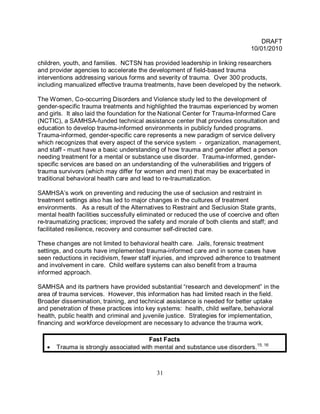
children, youth, and families. NCTSN has provided leadership in linking researchers
and provider agencies to accelerate the development of field-based trauma
interventions addressing various forms and severity of trauma. Over 300 products,
including manualized effective trauma treatments, have been developed by the network.

The Women, Co-occurring Disorders and Violence study led to the development of
gender-specific trauma treatments and highlighted the traumas experienced by women
and girls. It also laid the foundation for the National Center for Trauma-Informed Care
(NCTIC), a SAMHSA-funded technical assistance center that provides consultation and
education to develop trauma-informed environments in publicly funded programs.
Trauma-informed, gender-specific care represents a new paradigm of service delivery
which recognizes that every aspect of the service system - organization, management,
and staff - must have a basic understanding of how trauma and gender affect a person
needing treatment for a mental or substance use disorder. Trauma-informed, gender-
specific services are based on an understanding of the vulnerabilities and triggers of
trauma survivors (which may differ for women and men) that may be exacerbated in
traditional behavioral health care and lead to re-traumatization.

SAMHSA’s work on preventing and reducing the use of seclusion and restraint in
treatment settings also has led to major changes in the cultures of treatment
environments. As a result of the Alternatives to Restraint and Seclusion State grants,
mental health facilities successfully eliminated or reduced the use of coercive and often
re-traumatizing practices; improved the safety and morale of both clients and staff; and
facilitated resilience, recovery and consumer self-directed care.

These changes are not limited to behavioral health care. Jails, forensic treatment
settings, and courts have implemented trauma-informed care and in some cases have
seen reductions in recidivism, fewer staff injuries, and improved adherence to treatment
and involvement in care. Child welfare systems can also benefit from a trauma
informed approach.

SAMHSA and its partners have provided substantial “research and development” in the
area of trauma services. However, this information has had limited reach in the field.
Broader dissemination, training, and technical assistance is needed for better uptake
and penetration of these practices into key systems: health, child welfare, behavioral
health, public health and criminal and juvenile justice. Strategies for implementation,
financing and workforce development are necessary to advance the trauma work.

                                        Fast Facts
   •   Trauma is strongly associated with mental and substance use disorders.15, 16


                                           31
DRAFT
                                                                              10/01/2010

   •   More than 6 in 10 US youth have been exposed to violence within the past year,
       including witnessing a violent act, assault with a weapon, sexual victimization,
       child maltreatment, and dating violence. Nearly 1 in 10 were injured. 17
   •   An estimated 772,000 children were victims of maltreatment in 2008. 18
   •   Adverse Childhood Experiences (e.g., physical, emotional, and sexual abuse,
       and family dysfunction) are associated with mental illness, suicidality, and
       substance abuse.19
   •   A lifetime history of sexual abuse among women in childhood or adulthood
       ranges from 15-25 percent and the prevalence of domestic violence among
       women in the United States ranges from 9 – 44 percent depending on
       definitions.20
   •   The cost of intimate partner violence, which disproportionately affects women
       and girls, was estimated to be $8.3 billion in 2003. This includes the costs of
       medical care, mental health services, and lost productivity.21
   •   In a 2008 study by RAND, 18.5 percent of returning veterans reported symptoms
       consistent with PTSD or depression.22
   •   More than half of all prison and jail inmates (People in State and Federal prisons
       and local jails), meet criteria for having mental health problems, 6 in 10 meet
       criteria for a substance use problem, and more than a third meet criteria for
       having both a substance abuse and mental health problem. 23
   •   The use of seclusion and restraint on persons with mental and substance use
       disorders has resulted in deaths and serious physical injury and psychological
       trauma. In 1998, the Harvard Center for Risk Analysis estimated deaths due to
       such practices at 150 per annum across the Nation.24
   •   Racial incidents can be traumatic and have been linked to post traumatic stress
       symptoms among people of color.25
   •   Evidence suggests that some communities of color have higher rates of PTSD
       than the general population.26,27
   •   LGBT individuals experience violence and PTSD at higher rates than the general
       population.28
   •   18.9 percent of men and 15.2 percent of women in the United States reported a
       lifetime experience of a natural disaster.29

Strategic Initiative 2 – Goals

       Goal 2.1: Develop a comprehensive public health approach to trauma.
       Goal 2.2: Make screening for trauma and early intervention and treatment
                 common practice.
       Goal 2.3: Reduce the impact of trauma and violence on children, youth and
                 families.


                                           32
DRAFT
                                                                            10/01/2010

      Goal 2.4: Address the needs of people with mental and substance use
                disorders and with histories of trauma within the criminal and juvenile
                justice systems.
      Goal 2.5: Reduce the impact of disasters on the behavioral health of
                individuals, families, and communities.


Goal 2.1: Develop a comprehensive public health approach to trauma.

   Objective 2.1.1: Create a surveillance strategy for trauma and its association with
   behavioral health disorders.

      Action Steps:

      1. Build partnership between SAMHSA’s Center for Behavioral Health Statistics
         and Quality (CBHSQ) and trauma research experts and providers to develop
         a standard definition and measures of individual and community trauma to be
         included in individual assessments and community and national surveillance
         systems.
      2. Incorporate trauma measures into surveillance systems, e.g., NSDUH,
         Behavioral Risk Factor Surveillance System (BRFSS), National Health
         Interview Survey (NHIS), Youth Risk Behavior Survey (YRBS), etc., treatment
         and facility surveys, and performance measures for SAMHSA grant
         programs.
      3. Work with SAMHSA’s State, Territorial, and community epidemiological work
         groups to include trauma measures.
      4. Develop criteria and measures for trauma-informed care that can be used
         with programs department-wide.

   Objective 2.1.2: Build the public’s awareness of the impact of trauma on health and
   behavioral health.

      Action Steps:

      1. Develop and implement a national public information, education and
         awareness campaign on trauma and its association to health and behavioral
         health. This will include targeted work with Tribes, Asian American and
         Pacific Islanders, African American, and immigrant/refugee communities.
      2. Collaborate with other HHS Operating Divisions and other Federal partners to
         adopt trauma prevention messages and participate in the National Campaign.


                                          33
DRAFT
                                                                        10/01/2010

   3. Collaborate with the Indian Health Service and tribal communities to develop
      a specific information and awareness campaign on trauma and its sequelae
      (e.g., suicide, etc.) for American Indians and Alaska Natives.
   4. Collaborate with SAMHSA’s National Network to Eliminate Disparities in
      Behavioral Health (NNED) to develop and disseminate culturally relevant
      trauma information and materials to the diverse racial, ethnic and sexual
      minority communities in this Network.

Objective 2.1.3: Build a trauma informed behavioral health system.

   Action Steps:

   1. Coordinate the work of the NCTSN, NCTIC, Disaster Technical Assistance
      Center (DTAC) and the Seclusion and Restraint Coordinating Center, to
      streamline the availability of resource materials, training and technical
      assistance on trauma and trauma-informed care.
   2. Engage SAMHSA grantees and technical assistance providers as well as
      Federal/State/Territorial/Tribal partners and stakeholders from the field,
      including trauma survivors, providers, and researchers, to develop and
      implement a national strategy for trauma-informed care.
   3. Create core competencies for direct service professionals for screening,
      assessing and treating trauma among diverse populations. Create core
      competencies for administrators and managers for creating trauma-informed
      therapeutic environments.
   4. Conduct trainings on trauma-informed care and alternatives to seclusion and
      restraint for behavioral health facilities in collaboration with HHS Regional
      Areas and SAMHSA regional staff, Addiction Technology Transfer Centers
      (ATTCs), the Center for the Application of Prevention Technologies (CAPT)
      and other technical assistance centers.
   5. Provide training on trauma and trauma-informed care to SAMHSA staff and
      grantees.
   6. Evaluate SAMHSA programs using a trauma-informed approach to determine
      effectiveness in reducing the incidence of trauma and its impact on the
      behavioral health of individuals and communities.

Objective 2.1.4: Address historical trauma through a place-based trauma project.

   Action Steps:

   1. Identify communities where historical trauma has contributed to
      intergenerational transmission of trauma and high rates of trauma, violence
      and incarceration.

                                      34
DRAFT
                                                                               10/01/2010

      2. Using a public health perspective, target funding streams to educate about
         trauma community-wide, provide screening and early intervention in multiple
         settings, and implement evidence-based, culturally congruent trauma
         interventions.

   Goal 2.1 Measures:

   Measures under development
______________________________________________________________________
Goal 2.2: Make screening for trauma and early intervention and treatment common
practice.

   Objective 2.2.1: Identify effective screening tools for trauma based on
   developmental age, nature of trauma exposure, culture and service context.

      Action Steps:

      1. Develop an annotated compendium of screening tools for trauma and a
         statement of principles, guidance and standard protocols for trauma
         screening in various settings.
      2. Develop a strategy for incorporating trauma screening tools into standard
         practice in diverse settings (e.g., health centers, ERs, behavioral health, child
         welfare, criminal and juvenile justice, etc.) for diverse populations.

   Objective 2.2.2: Develop a continuum of interventions that are appropriate to the
   severity of trauma and that are included in benefits and services addressed in Health
   Reform.

      Action Steps:

      1. Convene a Consultative Session (e.g., trauma experts, intervention
         developers, researchers, providers, consumers and families) to identify gaps
         in the continuum of trauma interventions, e.g., brief interventions, and develop
         a strategy to fill these gaps.
      2. Work with HHS partners, e.g., NIH and CDC, to bring together trauma
         survivors, researchers, intervention developers, community-based
         practitioners and trainers from SAMHSA’s technical assistance centers to
         develop and evaluate practice improvement tools for trauma.
      3. Develop payment strategies in coordination with Affordable Care Act
         implementation and other funding streams to increase public awareness
         about trauma community-wide, provide screening and early intervention in
         multiple settings, and implement evidence-based trauma interventions.

                                           35
DRAFT
                                                                             10/01/2010


   Goal 2.2 Measures:

   Measures under development
______________________________________________________________________
Goal 2.3: Reduce the impact of trauma and violence on children, youth and families.

   Objective 2.3.1: Increase the use of programs/interventions that have been shown
   to prevent the behavioral health impacts (including trauma) of maltreatment and
   interpersonal and community violence in child serving settings.

      Action Steps:

      1. Reduce exposure to violence and risk factors for trauma through SAMHSA
         prevention programs for child serving settings, (e.g., Project LAUNCH,
         Prevention Prepared Communities, Safe Schools/Healthy Students, Suicide
         Prevention Programs, SAMHSA Block Grants and Drug Free Communities.)
      2. Partner with the Administration for Children and Families (ACF) and State,
         Territorial, and local child welfare agencies to increase the reach of
         prevention programs for children in early child care, child welfare and foster
         care settings.
      3. In the above action steps, ensure a focus on children of color who are
         disproportionately represented in out-of-home care in the child welfare system

   Objective 2.3.2: Support programs to address trauma experienced in childhood,
   and its subsequent impact across the life span.

      Action Steps:

      1. Develop a dissemination, training, and technical assistance strategy through
         the National Trauma Coordinating Center to move established trauma-
         focused interventions beyond the NCTSN and more broadly into child-serving
         systems. Through this strategy, identify and address barriers to access for
         trauma specific treatments. Ensure that this strategy is inclusive of racial,
         ethnic, and sexual minorities.
      2. Continue to raise the standard of care for sub-populations of children and
         families (i.e., those in child welfare) in need of trauma treatments through the
         development of specialized treatment interventions by the NCTSN. This
         includes the development of early intervention approaches for trauma in child-
         serving programs that promote the child’s recovery and also help parents or
         caregivers address their own trauma histories.


                                          36
DRAFT
                                                                             10/01/2010

      3. Collaborate with ONDCP, HHS partners, (e.g., ACF, HRSA, CDC, IHS) and
         with the 12 agency Interagency Work Group on Youth Programs (Education,
         DOL, DOJ, USDA, etc) to promote understanding of the impact of trauma and
         the importance of intervening early and increasing access to trauma
         interventions and trauma-informed care in child serving settings such as
         pediatric care, home visiting, early childhood systems, and child welfare.
      4. Identify and build on specific points of collaboration such as partnering with
         the Department of Education to create and disseminate materials related to
         bullying.

   Objective 2.3.3: Improve policies to address the impact of trauma on children.

      Action Steps:

      1. Ensure that SAMHSA funded programs (discretionary and block grant)
         address trauma prevention and treatment for children, youth and families.
      2. Collaborate with other programs and child serving systems such as Home
         Visiting Programs at HRSA, and Child Abuse Prevention and Child Welfare
         programs at ACF, to strengthen policy directives and program goals to
         include a trauma informed approach.
      3. Develop financing models to support trauma efforts that include family-
         centered/multi-generational interventions and prevention efforts.

   Goal 2.3: Measures:

    Measures under development
______________________________________________________________________
Goal 2.4: Address the needs of people with mental and substance use disorders and
with histories of trauma within the criminal and juvenile justice systems.

   Objective 2.4.1: Expand alternative responses and/or diversion for people with
   behavioral health problems and trauma histories within the criminal and juvenile
   justice system.

      Action Steps:

      1. Partner with the Bureau of Justice Assistance and constituency groups to
         explore expanding beneficial behavioral health problem solving courts (e.g.,
         alternative sanctions, links to social services, rigorous monitoring, etc.) to
         more people involved in the criminal and juvenile justice systems, including
         those served by more conventional courts.


                                           37
DRAFT
                                                                           10/01/2010

   2. Support State and Territorial planning efforts so that substance abuse, mental
      health and criminal justice planning are coordinated.
      a. Include language in SAMHSA justice-related grant solicitations that
          encourage State and Territorial Alcohol and Drug Abuse Agency, Mental
          Health Departments and State and Territorial Criminal Justice Agency
          involvement in the application process.
      b. Increase the frequency of contacts with State, Territorial and local
          governmental units, constituency groups, and Federal agencies to explore
          ways to increase State and Territorial government input into improving the
          State/Territorial-local coordination of grant applications.
   3. Support training for judges, prosecutors, defense attorneys, probation offices,
      court managers, and other court staff about the complex issues of substance
      use, mental health disorders and trauma, and about the community context of
      crime to improve decision making and justice system approaches to serving
      the community.
      a. Collaborate with OJP, NIDA, and the National Judicial College to develop
          a strategy for implementing additional judicial training in this area.
      b. Initiate judicial training on behavioral health issues including trauma for
          State and Territorial Chief Judges and Presiding Judges.

Objective 2.4.2: Improve the ability of first responders to respond appropriately to
people with mental health and substance use problems and histories of trauma.

   Action Steps:

   1. Partner with criminal justice and law enforcement groups, (e.g., International
      Association of Chiefs of Police (IACP), Associations of Sheriffs, the Office of
      Justice Programs (OJP), The National Association of Drug Court
      Professionals (NADCP), etc.) to expand the use of crisis intervention training
      and pre-booking diversion for people with behavioral health problems and
      histories of trauma.
   2. Provide technical assistance and training tools such as web-based training,
      toolkits, and training of trainers to improve first responder preparedness for
      intervening with people with behavioral health crises and histories of trauma.

Objective 2.4.3: Improve the availability of trauma-informed care, screening and
treatment in criminal and juvenile justice systems.

   Action Steps:

   1. Expand capacity of NCTIC and NCTSN to provide training and technical
      assistance on trauma-informed care, and trauma specific interventions

                                        38
DRAFT
                                                                               10/01/2010

           through partnerships with criminal and juvenile justice organizations,
           association, and agencies.
      2.   Work with HHS/The Office of the Assistance Secretary for Planning and
           Evaluation (ASPE)/The Administration on Children, Youth and Families
           (ACYF) to support intervention to children of incarcerated parents to address
           the range of trauma spectrum disorders experienced by the children.
      3.   Collaborate with DOJ/Office of Juvenile Justice and Delinquency Prevention
           (OJJDP) on their Children Exposed to Violence initiative.
      4.   Incorporate trauma-informed principles and practices into all criminal justice-
           based SAMHSA grants.
      5.   Collaborate with the Racial and Ethnic Disparities Issue Team of the
           Coordinating Council on Juvenile Justice and Delinquency Prevention to
           identify areas in which behavioral health issues contribute to disproportionate
           minority justice system contact (especially among Latino and African youth)
           and use SAMHSA’s current grant portfolio to support services to reduce
           disproportionate minority involvement in the justice system.

   Goal 2.4 Measures:

   Measures under development
______________________________________________________________________
Goal 2.5: Reduce the impact of disasters on the behavioral health of individuals,
families, and communities.

   Objective 2.5.1: Ensure that behavioral health is a core element of Federal, State,
   Territorial, and local disaster response policies and practices.

      Action Steps:

      1. Convene the behavioral health experts from the IOM meeting on the
         Deepwater Horizon spill to identify areas requiring development in research,
         policies, and practice across the three phases of disaster (preparedness,
         response, and recovery).
      2. Develop a “white paper” that collects the evidence that behavioral health is
         central to effective disaster response and recovery.
      3. Develop a strategy to ensure that behavioral health surveillance systems are
         in place before, immediately after and in the recovery phase following a
         disaster.
      4. Engage the State and Territorial Disaster Mental Health Coordinators to share
         training materials and resources with local disaster response personnel.


                                            39
DRAFT
                                                                                                                10/01/2010

     Objective 2.5.2: Build public awareness to ensure appropriate community response
     to disasters.

         Action Steps:

         1. Emphasize stress management, resilience building communications that
            make the link between traumatic events and health and behavioral health in
            public awareness materials.
         2. Ensure that lessons learned from the crisis counseling program are shared
            broadly.

     Objective 2.5.3: Enhance the approach to disasters across the three phases
     (preparedness, response, and recovery).

         1. Connect communities to the national disaster behavioral health hotline after
            they experience disasters through the DTAC, the CCP program, and
            SAMHSA communications efforts.
         2. Move lessons learned from the IOM committee white paper into appropriate
            SAMHSA programs such as the Crisis Counseling Program.

     Goal 2.5 Measures:

     Measures under development
13
   U.S. Department of Health and Human Services, Substance Abuse and Mental Health Services Administration, Center for
Substance Abuse Treatment, National Association of State Mental Health Program Directors (2004). The Damaging
Consequences of Violence and Trauma. Retrieved on July 2, 2010 from
http://www.nasmhpd.org/general_files/publications/ntac_pubs/reports/Trauma%20Services%20doc%20FINAL-04.pdf.
14
   Brave Heart, M. Y. H. (2003). The historical trauma response among Natives and its relationship with substance abuse: A
Lakota illustration. Journal of Psychoactive Drugs, 35, 7-13. ,
15
   National Center for Injury Prevention and Control, CDC. (2006). Understanding intimate partner violence: Fact sheet.
Retrieved from http://www.cdc.gov/ncipc/dvp/ipv_factsheet.pdf
16
   U.S. Department of Health and Human Services, Substance Abuse and Mental Health Services Administration, Center for
Substance Abuse Treatment, National Association of State Mental Health Program Directors (2004). The Damaging
Consequences of Violence and Trauma. Retrieved on July 2, 2010 from
http://www.nasmhpd.org/general_files/publications/ntac_pubs/reports/Trauma%20Services%20doc%20FINAL-04.pdf
17
   Substance Abuse and Mental Health Services Administration. (2009). Results from the 2008
National Survey on Drug Use and Health: National Findings (Office of Applied Studies,
NSDUH Series H-36, HHS Publication No. SMA 09-4434). Rockville, MD.
18
   U.S. Department of Health and Human Services, Administration for Children and Families, Administration on
Children, Youth and Families, Children’s Bureau. (2010). Child Maltreatment 2008. Retrieved from
http://www.acf.hhs.gov/programs/cb/pubs/cm08/cm08.pdf on July 2, 2010.
19
   Felitti, V. J., Anda, R. F., Nordenberg, D., Williamson, D. F., Spitz, A. M., Edwrds, V. Koss, M. P., &
Marks, J. S. (1998). Relationship of child abuse and household dysfunction to many of the leading causes of death in adults: The
Adverse Childhood Experiences (ACE) Study. American Journal of Preventive Medicine, 14, 245-258.
20
   U.S. Department of Health and Human Services, Substance Abuse and Mental Health Services Administration Center for
Substance Abuse Treatment (2009). Substance Abuse Treatment: Addressing the Specific Needs of Women. Retrieved from
http://www.ncbi.nlm.nih.gov/bookshelf/picrender.fcgi?book=hssamhsatip&part=tip51&blobtype=pdf

                                                              40
DRAFT
                                                                                                                 10/01/2010

21
   National Center for Injury Prevention and Control, CDC. (2006). Understanding intimate partner violence: Fact sheet.
Retrieved from http://www.cdc.gov/ncipc/dvp/ipv_factsheet.pdf
22
   Burnman, M.A., Meredith, L. S., Tanielian, T. and Jaycox, L. H. (2009). Mental health care for Iraq and Afghanistan war
veterans. Health Affairs, 28, 771-782, Retrieved on July 2, 2010 from
http://www.rand.org/pubs/research_briefs/2009/RAND_RB9451.pdf.
23
   U.S. Department of Justice, Office of Justice Programs, (2006). Bureau of Justice Statistics special report:Mental health
problems and jail inmates. NCJ213600. Retrieved on July 2, 2010 from
http://www.lsnj.org/keyRecentDevelopments/pdfs/ProblemsPrisonJailInmates.pdf
24
   SAMHSA National Action Plan on Seclusion and Restraint, Revised and Adopted May 2003
http://www.samhsa.gov/seclusion/sr_handout.aspx
25
   Bryant-Davis, T & Ocampo, C (2005). Racist-incident based trauma. The Counseling Psychologist, 33, 479 – 500.
26
   Alim, T. N., Graves, E., & Mellman, T. A. (2006). Trauma exposure, posttraumatic stress disorder and depression
in an African-American primary care population. Journal of the National Medical Association, 98, 1630-1636.
27
   Beals, J., Novins, D., Whitesell, N., Spicer, P., Mitchell, C., & Manson, S. (2005, September). Prevalence of
mental disorders and utilization of mental health services in two American Indian reservation populations: Mental
health disparities in a national context. American Journal of Psychiatry, 162, 1723-1732.
28
   Roberts, A.L., Austin, S.B., Corliss, H.L., Vandermorris, A.K., Koenen, K.C. (2010). Pervasive Trauma Exposure
Among US Sexual Orientation Minority Adults and Risk of Posttraumatic Stress Disorder. American Journal of
Public Health, 100(4).
29
   Kessler RC, Sonnega A, Bromet E, et al. Posttraumatic stress disorder in the National Comorbidity Survey. Arch Gen
Psychiatry 1995;52:1048–60.


                                                               41
DRAFT
                                                                                 10/01/2010

                      Strategic Initiative #3: Military Families
       Lead: A. Kathryn Power, Director, Center for Substance Abuse Prevention

Issue Statement

In the eight years since September 11, more than 2 million United States troops have
been deployed to Iraq and Afghanistan. A significant proportion of returning service men
and women suffer from Post Traumatic Stress Disorder (PTSD), depression, traumatic
brain injury, and substance abuse (particularly alcohol and prescription drug abuse),
and too many die from suicide. There is a growing body of research on the impact of
deployment and trauma-related stress on military families, particularly wives and
children. Although active duty troops and their families are eligible for care from the
Department of Defense (DoD), a significant number choose not to access those
services due to fear of discrimination or that receiving treatment for behavioral health
issues will harm their military career or that of their spouse. National Guard and
Reserve troops who have served in Iraq and Afghanistan (approximately 40 percent of
the total) are eligible for behavioral health care services from the Department of
Veterans Affairs (VA), but many are unable or unwilling to access those services.

National Guard, Reserve, veterans, and active duty service members, as well as their
families who do not seek care from the Department of Defense (DoD) or Veterans
Affairs (VA), do seek care in communities across this country, particularly from State,
Territorial, local, and private behavioral health care systems. These groups are the
focus of SAMHSA’s Military Families Strategic Initiative. As the Federal Agency with the
mission to reduce the impact of mental illnesses and substance abuse on America’s
communities, SAMHSA will provide support and leadership to improve the behavioral
health of the Nation’s Military Families through a collaborative and comprehensive
approach to increasing access to appropriate services, preventing suicide, promoting
emotional health and reducing homelessness for military service members, veterans
and their families.

The Mission of this Initiative is to facilitate innovative community-based solutions that
foster access to evidence-based prevention, treatment, and recovery support services
for military service members, veterans, and their families at risk for or experiencing
mental and substance use disorders through the provision of state of the art technical
assistance, consultation, and training.

Background

The President clearly has identified military families as a key priority for the Nation. In
May 2010, First Lady Michelle Obama, along with Dr. Jill Biden, rolled out a national
Call to Action for military families to focus on three broad areas: 1) the unique

                                             42
DRAFT
                                                                               10/01/2010

challenges facing military families, 2) building stronger civilian-military community ties,
and 3) engaging and highlighting the service and sacrifice of military families. SAMHSA
is perfectly positioned to support all of these elements of the Administration’s Call to
Action. SAMHSA will work with States, Territories, Tribes, and communities to ensure
needed behavioral health services are accessible to our service men and women and
their families and outcomes are successful.

Several fundamental expectations underlie the workplan for the Military Families
Strategic Initiative:

    •   When appropriate, military families should have access to well-prepared civilian
        service systems.
    •   Civilian, military, and veteran service systems should be coordinated.
    •   Suicide prevention for military families must be implemented across systems.
    •   Emotional health promotion for military families is important.
    •   Military families want and need permanent stable housing.

                                        Fast Facts
•   Approximately 18.5 percent of service members returning from Iraq or Afghanistan
    have PTSD or depression and 19.5 percent report experiencing a traumatic brain
    injury during deployment.30
•   Approximately 50 percent of returning service members who need treatment for
    mental health conditions seek it, but only slightly more than half who receive
    treatment receive adequate care.31
•   The Army suicide rate reached an all-time high in June 2010.32
•   For the first time, in 2008 and 2009 respectively, suicide rates among Soldiers and
    Marines exceeded the expected national average.33
•   Suicide among veterans accounts for as many as 1 in 5 suicides in the United
    States.34
•   In 2007, 8 percent of soldiers in Afghanistan reported using alcohol during
    deployment and 1.4 percent reported using illegal drugs/substances. 35
•   Between 2004 and 2006, 7.1 percent of United States veterans met the criteria for a
    substance use disorder. 36
•   Mental and substance use disorders caused more hospitalizations among United
    States troops in 2009 than any other cause.37
•   In 2009, on any given night, approximately 107,000 veterans were homeless. 38
•   Cumulative lengths of deployments are associated with more emotional difficulties
    among military children and more mental health diagnoses among United States
    Army wives.39,40
•   Children of deployed military personnel have more school-, family-, and peer-related
    emotional difficulties compared with national samples.41
                                            43
DRAFT
                                                                             10/01/2010


Strategic Initiative 3 - Goals

      Goal 3.1: Improve Military Families’ access to community-based behavioral
                health care through coordination with TRICARE, Department of
                Defense, or Veterans Health Administration services.
      Goal 3.2: Improve quality of behavioral health prevention, treatment, and
                recovery support services by helping providers respond to the needs
                and culture of Military Families.
      Goal 3.3: Promote the behavioral health of Military Families with programs and
                evidence-based practices that support their resilience and emotional
                health.
      Goal 3.4: Develop an effective and seamless behavioral health service system
                for Military Families through coordination of policies and resources
                across Federal, national, State, Territorial, local, and Tribal
                organizations.

________________________________________________________________
Goal 3.1: Improve Military Families’ access to community-based behavioral health
care through coordination with TRICARE, Department of Defense, or Veterans Health
Administration services.

   Objective 3.1.1: Encourage and support community-based behavioral health care
   providers’ participation in the TRICARE network.

      Action Steps:

      1. Sponsor TRICARE/Behavioral Health Care Provider Organizations Forums
         and an ongoing dialogue to provide a mechanism for sharing information
         about credentialing, reimbursable services, questions about filing claims, etc.
      2. Enhance communication, facilitate answers to questions, and identify system
         issues that need attention at senior management levels by acting as a liaison
         between the behavioral health field and TRICARE.

   Objective 3.1.2: Increase credentialing under TRICARE for behavioral health
   providers.

      Action Steps:

      1. Implement a pilot to assess value of on site TRICARE Technical Assistance
         Credentialing Teams in providing consultation and support to selected


                                          44
DRAFT
                                                                              10/01/2010

          Community Behavioral Health Care Centers interested in credentialing of staff
          for the TRICARE network.

   Objective 3.1.3: Educate and assist behavioral health care providers about the
   appropriate referral process to the Department of Veterans Affairs Health Care
   System and Department of Defense Military Treatment Facilities.

      Action Steps

      1. Work with DoD, VA, and HRSA to develop a user friendly resource package
         to guide providers in available referral sources for members of military,
         veterans and their families and procedures for referral.
      2. Distribute package to provider networks participating in two NGB/SAMHSA
         MOU Pilot states.
      3. Solicit feedback from providers on usefulness of the resource package.
      4. Assess possible expansion of use of this resource to other States and
      Territories.

   Goal 3.1 Measures:

   Measures under development
________________________________________________________________________
Goal 3.2: Improve quality of behavioral health prevention, treatment, and recovery
support services by helping providers respond to the needs and culture of Military
Families.

 Objective 3.2.1: Optimize SAMHSA grantees’ provision of prevention, treatment, and
 recovery support services to military families.

   Action Steps:

      1. Work with State and Territorial Mental Health and Substance Abuse
         Authorities to focus attention on needs of service members, veterans, and
         their families.
      2. Collect Military Families data in all SAMHSA data sets to identify military
         service members, veterans, and their families to track outcomes for this
         population.

 Objective 3.2.2: Strengthen community-based behavioral health care providers’
 understanding of military culture and their ability to provide effective prevention and
 treatment services to returning combat veterans, military service members, veterans,
 and their families.

                                           45
DRAFT
                                                                              10/01/2010


   Action Steps:

      1. Develop and conduct a webinar on Mental Health for Military Families –
         exploring the potential collaboration across the behavioral health field and
         SAMHSA programs.
      2. Support Tennessee Access to Recovery grantee to develop and conduct
         Operation Immersion and provide training in Tennessee for all Access to
         Recovery grantees. Explore the lessons learned from this project to see if it is
         a model for replication.
      3. Establish a national technical assistance behavioral health resource for
         behavioral health care providers, military members, veterans, and their
         families.

   Goal 3.2 Measures:

   Measures under development
______________________________________________________________________________
Goal 3.3: Promote the behavioral health of Military Families with programs and
evidence-based practices that support their resilience and emotional health.

 Objective 3.3.1: Identify and develop activities at SAMHSA that support a public
 health model for psychological health services that emphasizes prevention, resilience
 and when necessary, delivery of high quality recovery-oriented and specialized
 behavioral health care.

      Action Steps:

      1. Continued leadership as appropriate in implementation of the proposed
         recommendations included in the report of the Sub-IPC Group on
         Psychological Health.
      2. Review current inventory of existing SAMHSA Toolkits and ensure awareness
         of and use of these Toolkits by VA and DoD provider services.
      3. Explore possibility of use of all SAMHSA TA centers for supporting training
         and technical assistance in regard to programs that support resilience and
         promote emotional health.

   Goal 3.3 Measures:

   Measures under development
______________________________________________________________________________
Goal 3.4: Develop an effective and seamless behavioral health service system for

                                          46
DRAFT
                                                                                                              10/01/2010

Military Families through coordination of policies and resources across Federal,
national, State, Territorial, local, and Tribal organizations.

     Objective 3.4.1: Continue and facilitate ongoing partnerships with appropriate
     Federal, national, State, Territorial, and Tribal agencies/organizations toward
     development of a full spectrum of behavioral health service system for Military
     Families.

          Action Steps

          1. Work through Sub-IPC to finalize the report from the Psychological Health
             Team.
          2. Convene the Federal Partners Reintegration Work Group.
          3. Create a SAMHSA/National Guard Memorandum of Understanding.
          4. Engage the Department of Defense Suicide Prevention Task Force.
          5. Develop the proposed MOU with Defense Center of Excellence.
          6. Work with SAMHSA Tribal Representatives to explore possible initiatives for
             military families within existing tribal structures.

      Goal 3.4 Measures:

      Measures under development
30
   Tanielian, T. L. and RAND Corporation and Center for Military Health Policy Research, 2008. Invisible Wounds of War:
Summary and recommendations for addressing psychological and cognitive injuries. RAND, Santa Monica: 2008.
31
   Ibid
32
   Department of Defense: http://www.defense.gov/releases/release.aspx?releaseid=13715 accessed August 6, 2010
33
   Ibid
34
   Centers for Disease Control and Prevention. Surveillance for Violent Deaths – National Violent Death Reporting System, 16
States, 2007. Surveillance Summaries, May 14, 2010. MMWR 2010;59(No. -4).
35
   Office of the Command Surgeon and Office of the Surgeon General United States Army Medical Command. Mental Health
Advisory Team (MHAT-V). Operation Enduring Freedom 8, Afghanistan. 14 February 2008. Downloaded
http://www.armymedicine.army.mil/reports/mhat/mhat_v/Redacted2-MHATV-OEF-4-FEB-2008Report.pdf on June 30, 2010.
36
   Substance Abuse and Mental Health Services Administration, Office of Applied Studies. (November 1, 2007). The NSDUH
Report: Serious Psychological Distress and Substance Use Disorder among Veterans. Rockville, MD.
37
   USA Today, Gregg Zoroya. Mental health hospitalizations up for troops.
www.armytimes.com/news/2010/05/gns_mental_health_051410. Accessed May 14, 2010. (Original source: Pentagon’s Medical
Surveillance Month Report)
38
   U.S. Department of Veterans Affairs. Community Homelessness Assessment, Local Education and networking group
(CHALENG) for Veterans. The sixteenth annual progress report to Congress on PL 105-114. (Release anticipated July 2010.)
39
   Lesser P, Peterson K, Reeves J, et al. The long war and parental combat deployment: effects on military children and at-home
spouses. J Am Acad Child Adolesc Psychiatry, 2010;49(4):310-320.
40
   Mansfield, AJ, Kaufman, JS, Marshall, SW et al. Deployment and the use of mental health services among U.S. Army wives. N
Engl J Med, 2010;362:101-9.
41
   Chandra, A, Lara-Cinisomo S, Jaycox LH, et al. Children on the homefront: the experience of children from military families.
Pediatrics, 2010;125:16-25.


                                                             47
DRAFT
                                                                             10/01/2010

                    Strategic Initiative #4: Health Care Reform
          Lead: John O’Brien, Senior Advisor for Behavioral Health Financing


Issue Statement

In March of 2010, President Obama signed into law the Patient Protection and
Affordable Care Act and the Health Care and Education Reconciliation Act of 2010
(referred to together as the Affordable Care Act) which seek to make health insurance
coverage more affordable to individuals, families and the owners of small businesses.
When fully implemented, the law will provide access to coverage for an estimated 32
million Americans who are now uninsured. The Affordable Care Act reforms insurance
markets to make them more competitive and protects consumers’ rights by prohibiting
such practices as excluding people from coverage due to pre-existing conditions,
placing annual or lifetime caps on coverage, banning rescission of coverage, and
establishing basic minimum benefit packages. The Affordable Care Act recognizes that
prevention, early intervention and treatment of mental and substance use disorders are
an integral part of improving and maintaining overall health.

The passage of the Affordable Care Act assures that mental health and substance use
services provided to newly covered individuals are provided at parity and consistent with
the 2008 passage of the Mental Health Parity and Addiction Equity Act.

Under the Affordable Care Act, the Medicaid program will play an increasing role in the
financing and delivery of mental health and substance use services. The Affordable
Care Act expands the opportunity for States and Territories to use current and new
provisions of the Medicaid program to offer services to current and newly eligible
enrollees. This includes expanding eligibility to individuals without dependent children
and whose incomes are below 133 percent of the Federal poverty level (FPL). The
Affordable Care Act provides a significant focus on expanding and improving home and
community based services for individuals with disabilities, including those with a mental
or substance use disorder. In addition, the Medicaid program will cover prevention
services, including screening for depression and alcohol. The Centers for Medicare and
Medicaid Services (CMS) will enhance efforts to develop strategies for individuals who
are dually eligible for Medicare and Medicaid services—a significant number of these
individuals need mental health and substance use services.

The Affordable Care Act will also have an impact on SAMHSA’s Block Grants. The new
opportunities under the law will significantly expand mental health and substance use
treatment and support services under Medicaid and insurance products offered to
working class families. Some changes are already in effect while others are not yet
implemented including a major expansion in Medicaid enrollment that will take place in

                                           48
DRAFT
                                                                              10/01/2010

2014. Some of these individuals received treatment and supports funded through the
Mental Health Services Block Grant (MHBG) or the Substance Abuse Prevention and
Treatment Block Grant (SAPTBG). This will allow the Block Grants to purchase other
needed services that support individuals and families toward their recovery and
resiliency goals. Many of these services may not be covered by Medicaid or private
insurance. Therefore Block Grant services will be necessary to complete the benefit
package for some people with insurance and deliver the full range of services to others
who will still not have coverage. Through these and other efforts, SAMHSA will
consistently seek to align the efforts of public and private sectors.

Finally, the Affordable Care Act seeks to enhance the availability of primary care
services, especially for low-income individuals that have complex health needs. The
Affordable Care Act has many provisions that seek to identify and coordinate primary
care and specialty services for these individuals through medical homes. Medical
homes is a concept that has been used for many years and specifically designates a
health care professional, practice, or clinic, to be accountable for identifying and
coordinating a wide range of services. There are specific provisions in the law that will
increase access to medical homes for individuals with serious mental illness and
individuals with co-occurring addiction and other chronic conditions. Better coordinating
care will reign in unsustainable costs for families, government, and the private sector
making it more accessible and affordable.

SAMHSA has a prominent role in several key provisions of the Affordable Care Act. A
major provision requires States and Territories to consult with SAMHSA in developing
medical homes for individuals with mental health and substance use disorders.
SAMHSA is also responsible for developing Centers of Excellence for Depression and
Post Partum Depression. In addition, SAMHSA is taking a lead role in shaping policies
regarding home and community based services for individuals with mental and
substance use disorders.

Background

Reform of the health care system will be complex, challenging, and laden with
competing priorities. The next three years will provide the foundation for the newly
reconfigured health care system for many years. SAMHSA’s focus must be to ensure
that mental health and addiction services are an integral part of many health care
reform efforts. In addition, SAMHSA must support States, Territories, Tribes, primary
care and behavioral health providers, and individuals and families to understand and
participate actively in designing and implementing local health care reform efforts.

SAMHSA will need a multi-faceted strategy for addressing health care reform.
SAMHSA is already developing and implementing strategies that will address the

                                           49
DRAFT
                                                                              10/01/2010

provisions for which it is responsible. SAMHSA will also work closely with States and
Territories in developing specific strategies that will ensure individuals with mental and
substance use disorders and their families have access to services that promote
recovery and resiliency. SAMHSA will assist providers in their efforts to understand and
incorporate changes in their practices and strategies that comport with the major
themes of the Affordable Care Act: integration between primary care and behavioral
health, accountability, quality home and community based services, and availability of
wellness and prevention services. The changes that are proposed under the
Affordable Care Act are broad. SAMHSA will ensure that individuals and families
understand the tenets and implication of health care reform in order to be active
participants in their health care choices and services.

The Affordable Care Act includes many provisions applying specifically to Tribes, and
many of the other provisions of health care reform that disproportionately impact the
AI/AN community because of their overrepresentation in groups that will benefit from
health reform. Due to the complexity of these issues and the scope of the changes,
special attention will be required in order to make sure that implementation efforts meet
the necessary standard for Tribal consultation.

Parity between mental health and addiction services and medical/health services is also
one of SAMHSA’s priorities. This includes ensuring services offered under Affordable
Care Act are consistent with parity and these services are managed no differently than
medical and other health benefits offered by Medicaid and private insurance.

The passage of Affordable Care Act necessitates that SAMHSA and CMS work more
closely than ever before in designing services to meet the needs of individuals with a
wide range of mental health and substance use conditions. SAMHSA must provide the
content expertise to CMS in planning, designing, reimbursing and overseeing services.
Several provisions of the Act require the two agencies to provide technical assistance
and guidance to States, Territories, and providers regarding critical policies and
programs.

SAMHSA’s reexamination of the Block Grants will be thoughtful. While the details of
what services will be available to individuals under Medicaid and private insurance are
still pending, SAMHSA has expressed an interest in ensuring more recovery and
resiliency oriented services are purchased with Block Grant funds. SAMHSA will work
closely with States, Territories, and other stakeholders to discuss and design changes
to the Block Grant over the next several years to prepare for 2014 when 32 million more
Americans will be covered by health insurance.

SAMHSA will also build upon its Primary and Behavioral Health Care Integration
(PBHCI) program to implement new opportunities under the Affordable Care Act. This

                                           50
DRAFT
                                                                               10/01/2010

includes planning the next generation of PBHCI with CMS, Indian Health Service (IHS),
and Health Resources and Services Administration (HRSA). These efforts will include
developing new or expanding current models that support this integration. SAMHSA will
also be a lead investor in collaboration with HRSA in a technical assistance effort for
States, Territories, and providers to spread and sustain integration efforts.

                                           Fast Facts
   •   32 million more Americans will be covered in 2014. Between 20 and 30 percent
       of these (6-10 million people) will have a mental or substance use disorder. 42, 43
   •   CMS spends $370 billion on services for individuals who are dually eligible for
       Medicare and Medicaid. Almost 60 percent of these individuals have a mental
       disability.44
   •   Medicaid is a primary payer of mental health services. Forty-four percent of
       mental health funding managed by State Mental Health Authorities comes from
       Medicaid.45
   •   Thirty-five percent of all SAPTBG funds are used to support individuals in long
       term residential settings.46
   •   The Mental Health Parity and Addiction Equity Act affects 140 million individuals
       participating in group health plans.47
   •   Many individuals with mental health and substance use disorders will no longer
       pay significant out-of-pocket expenses for medication, due to the closing of the
       “doughnut hole” in Medicare Part D.48
   •   Some States spend 75 percent of their public behavioral health expenditures on
       children in residential settings.49
   •   The Affordable Care Act will increase the number of people who are insured.
       Currently individuals with a mental health disorder are twice as likely to be
       uninsured than those without a mental disorder.50
   •   Medicaid will play an increasing role in financing mental health and addiction
       services. Currently, Medicaid accounts for 58 percent of mental health
       expenditures by State Mental Health Agencies; as much as 80 percent for
       children.51
   •   Among the currently uninsured aged 22-64 w/family income < 150 percent of
       FPL, 32.4 percent had illicit drug or alcohol dependence/abuse or mental
       illness.52


Strategic Initiative 4 – Goals

       Goal 4.1: Assure behavioral health is included in all aspects of Health Care
                 Reform (HCR) implementation.


                                            51
DRAFT
                                                                             10/01/2010

      Goal 4.2: Support Federal, State, and Territorial efforts to develop and
                implement new provisions under Medicaid/Medicare.
      Goal 4.3: Finalize and implement the parity provisions in MHPAEA and the
                Affordable Care Act.
      Goal 4.4: Develop changes in SAMHSA Block Grants to support recovery and
                resilience.
      Goal 4.5: Foster the integration of primary and behavioral health care.

Goal 4.1: Assure behavioral health is included in all aspects of Health Care Reform
(HCR) implementation.

   Objective 4.1.1: Implement strategies that address critical provisions in the
   Affordable Care Act.

      Action Steps:

      1. Develop and implement work plans for major provisions that are owned by
         SAMHSA. Major areas of focus will be the development of integrated health
         homes that include mental health and addiction services, primary care
         behavioral health initiatives, Home Visiting Program, mental health and
         behavioral health education and training grants, Centers of Excellence for
         Depression and pilots for post-partum depression.
      2. Track and report progress on activities and policy decisions from HHS
         workgroups.
      3. Co-lead an HHS workgroup to develop policies for home- and community-
         based services offered by Federal and State agencies.
      4. Develop recommendations to HHS regarding the mental health and addiction
         services that should be available to individuals that receive services through
         essential and benchmark plans.

   Objective 4.1.2: Support States, Territories, and Tribes in their efforts to
   understand, design and implement State, Territory, and tribe-specific health care
   reform strategies and reduce health care disparities.

      Action Steps:

      1. Develop strategies for States and Territories to implement HCR reform,
         including identifying model policies and lessons learned from States and
         Territories that have expanded eligibility.
      2. Develop, coordinate and evaluate a technical assistance strategy to States
         and Territories regarding health care reform.


                                          52
DRAFT
                                                                         10/01/2010

   3. Support Tribes in their efforts to understand, design and implement health
      care reform strategies through tailored technical assistance and information
      resources.
   4. Develop strategies for Tribes to implement HCR reform, including identifying
      model policies and lessons learned from States and Territories that have
      expanded eligibility.
   5. Develop, coordinate and evaluate a technical assistance strategy for Tribes
      regarding health care reform (2011-2013).

Objective 4.1.3: Support providers in their efforts to understand, design and
implement State and Territory-specific Health Care Reform strategies.

   Action Steps:

   1. Assist provider organizations to identify their programmatic and operational
      needs under healthcare reform (and current tools that can help them with this
      transition).
   2. Develop strategy for addressing providers’ infrastructure needs for HCR
      (billing, Electronic Health Records (EHR), compliance, access and retention).
   3. Support SAMHSA and other HHS OPDIVs’ demonstration and targeted grant
      programs that encourage community providers to integrate behavioral health
      and primary health care activities.
   4. Establish a national training and technical assistance center on the
      bidirectional integration of primary and behavioral health care and related
      workforce development.

Objective 4.1.4: Ensure adults and children with mental and substance use
disorders and their families understand and take advantage of HCR and parity.

   Action Steps:

   1. Identify immediate HCR issues and concerns, develop and conduct
      environmental scan of HCR issues.
   2. Develop educational and other communication material based on action step
      1.
   3. Identify enrollment issues and effective enrollment strategies from States and
      Territories that have implemented expanded eligibility.
   4. Provide information and technical assistance to States and Territories
      regarding effective enrollment strategies, through expansion of and
      modification to Supplemental Security Income/ Social Security Disability
      Insurance (SSI/SSDI) Outreach, Access and Recovery (SOAR).


                                       53
DRAFT
                                                                             10/01/2010

      5. Develop processes to track and assess State and Territory-specific
         educational and enrollment processes.
      6. Target technical assistance for populations with behavioral health needs who
         may be harder to enroll.

   Objective 4.1.5: Effectively communicate with States, Territories, Tribes, providers,
   consumers and other stakeholders about health reform implementation.

      Action Steps:

      1.   Develop outreach materials for consumers and providers.
      2.   Coordinate initial webinars on high risk pools, exchanges and health homes.
      3.   Update SAMHSA website with new health reform section.
      4.   Launch SAMHSA Health Reform Blog.
      5.   Hold regular stakeholder meetings.
      6.   Conduct SAMHSA staff training on health reform.
      7.   Hold Monthly Brown Bag Lunches at SAMHSA related to health reform.
      8.   Provide input to Healthreform.gov and other Federal communication efforts
           related to health reform.

   Goal 4.1 Measures:

   Measures under development

Goal 4.2: Support Federal, State, and Territorial efforts to develop and implement new
provisions under Medicaid/Medicare.

   Objective 4.2.1: Increase SAMHSA staff’s understanding of current Medicaid
   program coverage and potential impact of HCR on States, Territories, and Tribes.

      Action Steps:

      1. Develop and implement a training strategy for SAMHSA staff that work
         closely with States and Territories regarding Medicaid, Medicare and HCR.
      2. Work with CMS to identify current coverage under Medicaid for mental and
         substance use disorders by State or Territory.
      3. Identify current Medicaid services coverage issues that will remain even after
         implementation of health reform and parity.

   Objective 4.2.2: Provide technical assistance to States and Territories regarding
   current and new opportunities under Medicaid program.


                                          54
DRAFT
                                                                               10/01/2010

      Action Steps:

      1. Identify critical Medicaid strategies under HCR.
      2. Develop initial informational strategies for States and Territories to take
         advantage of opportunities.
      3. Meet with CMS to discuss information dissemination and technical assistance
         plans.
      4. Identify internal and external technical assistance resources based on action
         step 3.

   Objective 4.2.3: Work with CMS to develop policies and programs that expand
   access to mental health and substance use services.

      Action Steps:

      1. Review and comment on draft regulations and State and Territorial Medicaid
         Directors’ letters prior to formal clearance.
      2. Chair or participate on interagency workgroups with Medicaid (Long Term
         Care (LTC), health homes, dual-eligibles, mental health internal working
         group, Technical Advisory Group (TAG)).
      3. Develop a joint CMS/SAMHSA technical assistance effort for Olmstead and
         Early Periodic Screening, Diagnosis, and Treatment (EPSDT) litigation.

   Goal 4.2 Measures:

   Measures under development

Goal 4.3: Finalize and implement the parity provisions in MHAPEA and the Affordable
Care Act.

   Objective 4.3.1: Develop additional policies that clarify parity in health care reform.

      Action Steps:

      1. Work with CMS and ASPE to develop Medicaid managed care regulations.
      2. Work with ASPE to review Interim Final Rule (IFR) comments and propose
         changes to the IFR.

   Objective 4.3.2: Track consumer and employer complaints regarding
   implementation of parity.

      Action Steps:

                                            55
DRAFT
                                                                            10/01/2010


      1. Identify State, Territorial, and Federal touch points for consumer complaints
         regarding coverage.
      2. Develop consumer and family tip sheets for parity based on action step 1.
      3. Work with CMS, DOL, and ASPE to collect and analyze information regarding
         complaints.
      4. Work with Federal partners and stakeholders to develop effective oversight
         and enforcement strategies.

   Goal 4.3 Measures:

   Measures under development

Goal 4.4: Develop changes in SAMHSA Block Grants to support recovery and
resilience.

   Objective 4.4.1: Develop a spending baseline for current Block Grants.

      Action Steps:

      1. Collect and analyze current Block Grant spending information.
      2. Identify information gap and develop strategies to obtain additional
         information.
      3. Collect and analyze information.
      4. Develop a report that provides baseline spending under the Block Grants.

   Objective 4.4.2: Develop recommendations for spending changes.

      Action Steps:

      1.   Based on analysis in 4.1, identify service gaps.
      2.   Project services that will be covered under third party reimbursement.
      3.   Identify service specific categories for use of Block Grant funds.
      4.   Identify use of Block Grant funds for non-service specific activities.
      5.   Review recommendations with SAMHSA’s Executive Leadership Team.

   Objective 4.4.3: Incorporate service definitions into Block Grants.

      Action Steps:

      1. Identify services workgroups (prevention, tribal services, recovery and
         children and family support services and residential).

                                          56
DRAFT
                                                                              10/01/2010

     2. Develop standard service definitions and/or service models.
     3. Meet with stakeholders to review service models.
     4. Amend Block Grant application to include new services.

  Objective 4.4.4: Develop changes in application and reporting under Block Grants.

     Action Steps:

     1.   Conduct Block Grant internal working group (bi-weekly).
     2.   Identify and implement changes in 2011 in preparation for FY 2012-2014.
     3.   Develop communication and planning strategies with State associations.
     4.   Identify services and infrastructure activities to be purchased with Block Grant
          funds in FY 2014.

  Goal 4.4 Measures:

   Measures under development
______________________________________________________________________
Goal 4.5: Foster the integration of primary and behavioral health care.

  Objective 4.5.1: Increase State, Territorial, and local efforts to integrate primary and
  behavioral health care.

     Action Steps:

     1. Implement a national training and technical assistance center on the
        bidirectional integration of primary and behavioral health care and related
        workforce development.
     2. Increase the number of primary care and behavioral health integration sites.
     3. Develop a targeted strategy for behavioral health and primary care providers
        to reduce the use of tobacco products by individuals with a mental illness or
        substance use disorder.
     4. In cooperation with HRSA, provide technical assistance to Federally Qualified
        Health Centers and Community Health Centers to address the behavioral
        health care needs of individuals with mental illnesses, substance use and co-
        occurring disorders.
     5. Develop and implement a strategy to provide technical assistance to States
        and Territories that seek to amend their Medicaid Plan to include health
        homes for persons with a mental illness or substance use disorder and to
        ensure that health homes screen for mental illness and substance use.
     6. Award cooperative agreement for the national technical assistance center on
        primary and behavioral health care integration.

                                           57
DRAFT
                                                                                                      10/01/2010


       Objective 4.5.2: Expand Screening, Brief Intervention and Referral to Treatment
       (SBIRT) across primary care settings.

            Action Steps:

            1. Develop a workforce development plan for FQHCs, CHCs and larger primary
               care practices to adopt effective SBIRT approaches in collaboration with
               HRSA.
            2. Increase efforts by federal agencies to promote the coverage of SBIRT in
               reimbursement and grant activities.
            3. Increase third party coverage of SBIRT for depression, addiction and other
               diseases.

       4.5 Measures:

       Measures under development

42
     (2010). Congressional Budget Office. March 3, 2010.
43
     (2010). SAMHSA Financing Center of Excellence.
44
   Reuters, T. Burwell, B & Saucier, P. (2010) Eligible Beneficiaries and Risk-based Managed Care.
45
   NASMHPD Research Institute, “Table 24: SMHA-Controlled Mental Health Revenues, By Revenue Source and by State, FY
2006,”www.nriinc.org/projects/Profiles/RevExp2006/T24.pdf.
46
   (2010). Treatment Capacity Matrix. SAMHSA Substance Abuse Prevention and Treatment Block Grant
47
   Advocate for Human Potential .(2010). Special Report: MHPAEA Regulations. Issue Paper Number 4, 3.
48
   Health Care and Education Reconciliation Act of 2010. 2010, 9
49
   Technical Assistance Collaborative.(2010). Out of Home Residential Services, State of New Mexico, Human Services
Department, 16
50
   Mechanic, D. (2001). Closing Gaps in Mental Health Care. Health Services Research 36:6.
51
   SAMHSA & NIH .(2000). Organizing and Financing Mental Health Services. Mental Health: A Reprot of the Surgeon
General, www.surgeongeneral.gov/library/mentalhealth/home.html
52
   Hyde, P.(2010). Health Insurance Reform- Possibilities: Shaping the Future of Behavioral Health.
http://www.thenationalcouncil.org/galleries/conference08-
files/Hyde%20Presentation%202010%20National%20Council%20Conf.pdf


                                                           58
DRAFT
                                                                             10/01/2010

               Strategic Initiative #5: Housing and Homelessness
        Lead: Kathryn Power, Director, Center for Substance Abuse Prevention

Issue Statement

Homelessness can be prevented through joint collaborations between the Federal
government, States, Territories, and local communities to provide affordable housing
and rental assistance to low income individuals and families, rapid re-housing to
individuals who become homeless, and supportive primary and behavioral health care
services to those in need. Current estimates for the number of people experiencing
homelessness on any given night in the United States is over 643,000 but due to the
current economic downturn, this number may double or even triple over the next several
years. Approximately, 63 percent of these people were individuals and 37 percent were
adults with children. Although Federal, State, and Territorial policies have been
successful in beginning to reduce the number of individuals and veterans who are
chronically homelessness, the number of families that are homeless at some point
during a year has increased about 30 percent since 2007. While Federal policies aimed
at preventing and ending homelessness must continue to work to eliminate chronic
homelessness among our nation’s adults and veterans, they clearly must do a better job
of preventing homelessness among low-income families and children and providing
rapid re-housing for families who become homeless. Federal policies also must re-focus
on the housing and service needs of ‘at risk” populations for homelessness, including
youth transitioning out of foster care and the juvenile justice system; people being
released from jails or prisons; and people being discharged from psychiatric hospitals or
substance use detox or treatment facilities.

While affordable housing is the key element to strategies aimed at preventing and
ending homelessness, many adults and children who are homeless or at risk of
homelessness experience a range of medical and behavioral health issues, which often
are exacerbated by the experience of living on the streets or in crowded shelters.
Previous research has indicated that approximately twenty-six percent of people who
are homeless have a serious mental illness, sixty-four percent have an alcohol or
substance use disorder; and over fifty percent have acute or chronic health conditions
that create major difficulties in accessing and maintaining stable, affordable, and
appropriate housing. Many individuals who are homeless repeatedly cycle through
emergency shelters and health care systems, and do not have access to a coordinated
system of care where their health and behavioral health issues can be successfully
managed. Indeed, these “frequent users” of public services get caught in a revolving
door of costly crisis services and temporary housing or institutional settings.

To address the need for a coordinated and consistent approach to preventing and
ending homelessness, the Substance Use and Mental Health Administration (SAMHSA)

                                           59
DRAFT
                                                                                10/01/2010

will provide leadership and expertise on how current Federal, State, Territorial, and local
systems that serve individuals who are homeless or at risk of homelessness can be
retooled to provide permanent housing, supportive primary and behavioral health
services (when needed), and rapid re-housing. SAMHSA’s Housing and Homelessness
strategic initiative will support the goals and objectives in the U.S. Interagency Council’s
(ICH) 2010 Federal Strategic Plan to Prevent and End Homelessness by expanding the
availability of permanent supportive housing options for the most vulnerable and high
cost individuals who are homeless or at risk of homelessness with mental health,
substance use, and co-occurring disorders.

Background

No single program, either within the Department of Health and Human Services (HHS)
or anywhere else in the Federal government, can solve the problem of homelessness.
Coordination of programs and the piecing together of the various resources offered
throughout the Federal government are necessary to provide the full range of housing
and behavioral health service options needed at the State, Territorial, and local
community level to effectively serve persons and families experiencing homelessness.
SAMHSA’s Housing and Homelessness Strategic Initiative aligns with current
Administration efforts to expand opportunities for individuals with disabilities to live in
integrated, community settings. The initiative fully supports the goals in the ICH’s 2010
Federal Strategic Plan to Prevent and End Homelessness, and supports the
collaborative work being undertaken in the current HHS and Department of Housing and
Urban Development (HUD) workgroup activities on both community living and
homelessness. Research on permanent supportive housing (PSH) clearly shows that
this approach successfully serves vulnerable individuals with disabilities, including
individuals who are homeless or at risk of homelessness, and that PSH approaches are
cost-effective. Through this initiative, the Substance Abuse and Mental Health Services
Administration (SAMHSA) can serve as the lead Federal agency for promoting and
increasing PSH practices for the most vulnerable individuals and families who are
homeless or at risk of homelessness.

                                     Fast Facts
   •   Over 643,000 Americans are homeless on any given night 53
   •   Approximately 110,000 people are chronically homeless54
   •   About 170,000 families are homeless and living in shelters at some point during
       2009.55
   •   5% to 7% of youth experience homelessness each year 56
   •   26% of persons who are homeless have a serious mental illness 57
   •   64% of persons who are homeless have a alcohol or substance use disorder 58
   •   Nearly 50% of persons who are homeless have acute or chronic health
       conditions 59
                                            60
DRAFT
                                                                              10/01/2010

   •   In one research study, providing housing for individuals with mental illness who
       are homeless reduces criminal justice involvement by 38% and prison days by
       84%60
   •   Research also has indicated that women who are homeless experience high
       rates of abuse, violence, and separation from families. 61

Strategic Initiative 5 – Goals

   Goal 5.1: Prevent homelessness among individuals with mental and substance use
             disorders.
   Goal 5.2: Create permanent stable housing for behavioral health populations.
   Goal 5.3: Implement supportive housing services.
______________________________________________________________________
Goal 5.1: Prevent homelessness among individuals with mental and substance use
disorders.

   Objective 5.1.1: Build leadership and promote collaborations at the Federal level to
   prevent and end homelessness among individuals with mental and substance use
   disorders.

       Action Steps:

       1. Collaborate with the ICH and Federal Partners to implement the 2010 Federal
          Strategic Plan to Prevent and End Homelessness.
       2. Work with Federal partners to develop policy guidance and directives that
          support a move to increase low-income housing capacity and primary and
          behavioral health services.
       3. Partner with HUD and other Federal partners to increase access to
          mainstream housing programs for low-income individuals and families who
          are at risk of homelessness, and to re-align targeted homeless programs to
          focus on permanent supportive housing models.
       4. Collaborate with the Health Resources and Services Administration (HRSA),
          the Administration for Children and Families (ACF), the Centers for Medicaid
          and Medicare Services (CMS), and Centers for Disease Control (CDC), and
          the Office of the Secretary within HHS to streamline and coordinate technical
          assistance approaches aimed at preventing and ending homelessness.
       5. Collaborate with the Indian Health Service (IHS) to ensure that the specific
          needs of American Indian and Alaska Native (AI/AN) people are included in
          Administration efforts to prevent and end homelessness.
       6. Collaborate with the Department of Veterans Affairs (VA) on ending homeless
          for our nation’s veterans, including women who are veterans and are
          homeless.
                                           61
DRAFT
                                                                         10/01/2010

   7. Collaborate with stakeholders (advocacy groups, nonprofits, foundations, and
      businesses) in efforts to prevent and end homelessness.
   8. Partner with SAMHSA’s Office of Communication and relevant Federal
      Partners to develop and disseminate a coordinated and consistent set of
      messages about preventing and ending homelessness through the web and
      other communication vehicles.

Objective 5.1.2: Increase knowledge among State and Territorial agencies, local
provider organizations, and tribal leadership about homelessness, how to build
successful State, Territorial, and local collaborations, and evidence-based
interventions aimed at preventing and ending homelessness among people with or
at risk of mental and substance use disorders.

   Action Steps:

   1. Provide technical assistance to States, Territories, and local communities on
      how to create or update and implement strategic plans that include specific
      efforts to increase access to affordable housing for all individuals with
      disabilities, including those who are homeless or at risk of homelessness.
   2. Provide technical assistance to local communities on specific action steps
      that communities can take to integrate their strategic plans with State and
      Territorial efforts.
   3. Develop on-line curriculum and other training tools focused on creating
      strategic partnerships at the State, Territorial, and local levels aimed at
      preventing and ending homelessness.
   4. Create and promote trainings to educate the behavioral health workforce
      about how to identify those at risk of homelessness and what supports and
      services exist for individuals and families who are at risk of homelessness or
      who are currently homeless.
   5. Partner with stakeholders to create and promote leadership development
      training for State and Territorial agencies and local community organizations.
   6. Create topic specific community sites using SAMHSA’s existing web 2.0
      technology capabilities to create awareness of the importance of preventing
      homelessness, to foster the sharing of ideas and to create virtual technical
      assistance resources.
   7. Promote the use and possible integration of SAMHSA’s on-line Substance
      Abuse Treatment Facility Locator and Mental Health Services Locator for
      increasing rapid access to behavioral health care.

Objective 5.1.3: Strengthen the capacity of SAMHSA grantees to provide
permanent, stable housing and needed supportive services to individuals who are
homeless or at risk of homelessness among the populations they serve.

                                       62
DRAFT
                                                                           10/01/2010


     1. Promote participation in state, Territorial, and community strategic planning
        for all SAMHSA grantees in targeted homeless programs.
     2. Promote efforts to prevent and end homelessness specifically through the
        PATH formula grant program and SAMHSA Block Grant requirements to
        States, Territories, and tribes.
     3. Partner with the Department of Justice to provide PSH for individuals leaving
        jails or prisons.
     4. Provide technical assistance to SAMHSA grantees on how to establish
        collaborative programs with HUD’s Continuums of Care grantees.

  Objective 5.1.4: Strengthen the ability of Federal agencies to coordinate data-driven
  prevention efforts.

     Action Steps:

     1. Collaborate with ICH to develop and disseminate a common set of definitions
        and terminology, data standards, and uniform performance measures across
        Federal agencies.
     2. Collaborate with relevant Federal Partners to combine and analyze data to
        better understand homelessness and the behavioral health care needs of the
        overall population and subpopulations and identify gaps in research to target
        additional data analyses and research.
     3. Train Projects for Assistance in Transition from Homelessness (PATH)
        providers to collect data using Homeless Management Information Systems
        (HMIS) in order to standardize performance measures, data collection efforts,
        and annual reporting requirements with HUD’s data and reporting efforts.

  Goal 5.1 Measures:

   Measures under development
______________________________________________________________________
Goal 5.2: Create permanent stable housing for behavioral health populations.

  Objective 5.2.1: Increase knowledge of effective strategies for financing and
  sustaining permanent housing programs for behavioral health populations.

     Action Steps:

     1. Collaborate with the ICH, national homeless organizations and other
        stakeholders to identify, document, and disseminate information on best


                                         63
DRAFT
                                                                             10/01/2010

        practices for braiding Federal, State, Territorial, and local funding to pay for
        permanent supportive housing.
   2.   Partner with HUD to examine current policies and practices related to housing
        individuals who are elderly and/or disabled in institutional settings, and to
        provide guidance on transitioning these individuals to PSH.
   3.   Partner with HUD and national homeless organizations to create guidance on
        best practices for transitioning individuals from institutional settings into PHS
        in a community.
   4.   Collaborate with HUD and VA to develop on-line guides and web-based
        training tools that promote effective strategies to finance permanent housing.
   5.   Disseminate information using on-site technical assistance, regional training,
        the web and other communication approaches about effective financing
        strategies for creating and providing linkages to permanent supportive
        housing.
   6.   Provide technical assistance to SAMHSA grantees on financing strategies
        that pay for permanent supportive housing.
   7.   Create community sites using SAMHSA’s web 2.0 technology among
        SAMHSA’s homeless grantees to provide technical assistance and foster
        peer to peer sharing of ideas around financing and sustaining permanent
        housing.
   8.   Ensure that all SAMHSA RFAs (as applicable) include language that requires
        grantees to collaborate with housing providers and refer treatment and
        service recipients to permanent housing.

Objective 5.2.2: Increase access to and utilization of existing mainstream and
targeted rental subsidies and housing assistance programs.

   Action Steps:

   1. Partner with HUD and VA to improve access to mainstream and targeted
      rental and housing assistance programs.
   2. Partner with HUD to provide technical assistance and guidance to State,
      Territorial, and local public housing authorities on using housing choice
      vouchers to create and sustain PSH.
   3. Collaborate with HUD, VA, and stakeholders to develop web-based guides
      and training tools to promote the use of existing rental and housing
      assistance programs for all disabled individuals, including those who are
      homeless or at risk of becoming homeless.
   4. Provide technical assistance to SAMHSA grantees on utilizing existing rental
      and housing assistance programs.


                                         64
DRAFT
                                                                           10/01/2010

     5. Disseminate information using on-site technical assistance, regional training,
        the web and other communication approaches about effectively using existing
        rental and housing assistance programs.

  Goal 5.2 Measures:

   Measures under development
______________________________________________________________________
Goal 5.3: Implement supportive housing services.

  Objective 5.3.1: Promote the adoption of permanent support housing programs

     Action Steps:

     1. Work with the ICH and Federal partners to implement the FY2011 Permanent
        Supportive Housing Demonstration, which combines 4,000 Housing Choice
        Vouchers with Medicaid and SAMHSA funding to provide PSH and behavioral
        health services.
     2. Collaborate with VA, HUD, and the Department of Labor to provide technical
        assistance to their homeless grantees on implementing supportive housing.
     3. Develop one Request for Applications in FY 2011 for SAMHSA’s Services in
        Supportive Housing Program.
     4. Broadly disseminate the permanent supportive housing, supportive education,
        and supportive employment toolkits using web technology and other
        marketing techniques.
     5. Provide technical assistance on supportive housing to SAMHSA grantees (as
        applicable).
     6. Create community sites using SAMHSA’s web 2.0 technology among
        SAMHSA’s homeless grantees to provide technical assistance and foster
        peer to peer sharing of ideas around developing permanent supportive
        housing programs.

  Objective 5.3.2: Prepare Homeless Providers for Medicaid Expansion.

     Action Steps:

     1. Collaborate within HHS and with Federal partners to create a set of consistent
        messages around the impact of health care reform on homeless persons and
        services.
     2. Provide technical assistance to States, Territories, and local communities on
        integrating behavioral health care services into State and Territorial Medicaid
        plans as they are revised to meet the provisions of the Affordable Care Act.

                                         65
DRAFT
                                                                          10/01/2010

   3. Partner with CMS to review and provide guidance on supportive housing and
      behavioral health services that could be included in States’ or territories’
      Medicaid plans.
   4. Collaborate with HRSA, CMS and other relevant partners to develop
      workshops, webinars and other training venues for implementing Medicaid
      changes.
   5. Work with SAMHSA’s Health Care Reform Strategic Initiative workgroup to
      disseminate technical assistance information to homeless service providers.
   6. Provide technical assistance to SAMHSA grantees on how to become or
      partner with qualified Medicaid service providers, including Health Care for
      the Homeless (HCH) organizations and Federally Qualified Health Centers
      (FQHC).

Objective 5.3.3: Improve access to mainstream benefit programs and services.

   Action Steps:

   1. Collaborate within HHS and with other Federal agencies to review Federal
      policies, procedures, and regulations for mainstream benefit programs to
      identify mechanisms and technical assistance to improve access to
      mainstream benefits for individuals and families who are homeless.
   2. Work with Federal partners to expand the use of proven models (such as the
      SSI/SSDI Outreach, Access, and Recovery (SOAR) program, the Homeless
      Outreach Projects and Evaluation (HOPE) program, and one-line benefit
      application software) to include Medicaid, SSI/SSDI, SNAPS, TANF, etc.
   3. Modify SAMHSA’s existing SOAR program to reflect changes occurring under
      health care reform.

Objective 5.3.4: Improve people’s health and residential stability by integrating
primary and behavioral health services.

   Action Steps:

   1. Partner with HRSA to promote collaborations between Health Care for the
      Homeless providers and SAMHSA’s Services in Supportive Housing, Grants
      for the Benefits of Homeless individuals, and Primary and Behavioral Health
      Care Integration (PBHCI) grantees to encourage integration of primary care
      and behavioral health services.
   2. Work with SAMHSA’s PBHCI National Training and Technical Assistance
      Center to identify and disseminate effective models for integrating primary
      and behavioral health care.


                                       66
DRAFT
                                                                                                   10/01/2010

        3. Work with the Center for Co-occurring Disorders Integration and Innovations
           to provide training and technical assistance to SAMHSA grantees on
           implementing co-occurring disorders interventions.
        4. Disseminate SAMHSA’s resources on implementing co-occurring disorders
           treatment (TIP 42 and Co-occurring Disorders Toolkit).
        5. Work with the Center for Trauma Informed Care to provide technical
           assistance to SAMHSA’s homeless grantees.
        6. Work with SAMHSA’s Addiction Technology Transfer Center Network to
           provide training and technical assistance to community-based providers on
           integrating substance use treatment.
        7. Ensure that SAMHSA RFAs encourage integration of primary health care with
           behavioral health care through screening, assessment, and referrals.

     Goal 5.3 Measures:

     Measures under development
53
   U.S. Department of Housing and Urban Development. (2010). The 2009 Annual Homeless Assessment Report to
Congress: Washington, DC.
54
   U.S. Department of Housing and Urban Development. (2010). The 2009 Annual Homeless Assessment Report to
Congress: Washington, DC.
55
   U.S. Department of Housing and Urban Development. (2010). The 2009 Annual Homeless Assessment Report to
Congress: Washington, DC.
56
   Robertson, M., Toro, P. (1998) Homeless Youth, Research, Intervention, and Policy, Practical Lessons: The 1998
National Symposium on Homelessness Research. Washington, DC: US Department of Housing and Urban
Development.
57
   U.S. Conference of Mayors (2008) Hunger and Homelessness Survey: A Status Report on Hunger and
Homelessness in America’s Cities: A 25-City Survey
58
   Urban Institute analysis of National Survey of Homeless Assistance Providers and Clients data. Burt, M., Aron,
L., Lee, E., & Valente, J. (2001). Helping America’s homeless: Emergency shelter or affordable housing?
Washington, DC: Urban Institute.
59
   Urban Institute analysis of National Survey of Homeless Assistance Providers and Clients data. Burt, M., Aron,
L., Lee, E., & Valente, J. (2001). Helping America’s homeless: Emergency shelter or affordable housing?.
Washington, DC: Urban Institute.
60
   Culhane, P. D., Metraux, S., & Hadley, T. (2002). Public Service Reduction Associated with Placement of
Homeless Persons with Severe Mental Illness in Supportive Housing. Housing Policy Debate, 13(1).
61
   Browne A. & Bassuk S.S. (1997). Intimate violence in the lives of homeless and poor housed women: prevalence
and patterns in an ethnically diverse sample. Am J Orthopsychiatry, 67: 261.


                                                       67
DRAFT
                                                                                                10/01/2010

Strategic Initiative #6: Health Information Technology, Electronic Health Records
                                and Behavioral Health
    Lead: H. Westley Clark, MD, Director, Center for Substance Abuse Treatment


Issue Statement

“Electronic health records will provide major technological innovation to our current
health care system by allowing doctors to work together to make sure patients get the
right care at the right time and want to be clear that in all our Health IT investments,
patient privacy is our top priority. 9”

“Health information technology has great potential for improving outcomes while
reducing costs and empowering consumers. For electronic health records to be
comprehensive, they must incorporate data related to all key components of health.
Behavioral health information should be included in the process of creating secure,
consumer-centered information technology systems. 10”

Health Information Technology (HIT) provides the overall framework to describe the
comprehensive management and secure exchange of health information among
providers, insurers, governments, including Tribes, consumers and other entities. It also
provides the matrix out of which the electronic health record (EHR) evolves.

Throughout the continuum of health care, there is a need for an integrated system
where general practitioners are supported by various specialty areas. Specialty fields,
such as pediatrics, cardiology, oncology, orthopedics, and behavioral health (mental
health and/or substance use disorder services) need to be able to share critical
information with primary care practitioners.

The use of HIT has the potential to improve health care quality, prevent medical errors,
increase administrative efficiencies, decrease paperwork, and improve patient health.
EHRs that link across clinical practice areas, transfer information seamlessly and
improve patient care by providing complete, accurate, and searchable health
information at the point of diagnosis and care.

HIT, in general, and EHRs specifically, will allow behavioral health practitioners to
engage their clients without having to wait for the exchange of records or paperwork,
and without requiring unnecessary or repetitive tests or procedures. Because other
medical and social consequences occur simultaneously with behavioral health

9
  Secretary Sebelius - http://www.whitehouse.gov/blog/2010/02/12/going-beyond-paper-and-pencil-investments-
health-it
10
   Hogg Foundation
                                                     68
DRAFT
                                                                                 10/01/2010

symptoms, having access to a patient’s medical history, medication history, and other
information is essential to identifying potential drug-drug interactions or other potentially
harmful responses to a course of treatment. By facilitating the flow of critical clinical
information, improved workflow efficiency and patient monitoring becomes achievable.

The SAMHSA HIT initiative operates under the umbrella of the Office of the National
Coordinator for Health (ONC) and is coordinating many different activities into a
coherent HIT strategy. The goal is to ensure the behavioral health provider network
participates with the general health care delivery system in the adoption of health
information technology, including electronic health records. SAMHSA is providing
leadership to the behavioral health community and will align HIT activities in order to
participate in health care reform and the integration of behavioral and primary health
care.

The necessary infrastructure and expertise to support the effective use of health
information technology is lacking in nearly every community in the United States, and
particularly among behavioral health providers. These deficits are likely to be more
severe for Tribal communities, so special attention should be paid to ensure that these
needs are met. In addition, past issues with the use of data in Tribal communities’
mean that special sensitivity is needed around the protection and use of data housed in
the HIT systems used by Tribes. SAMHSA is engaged in ONC-sponsored activities that
include collaborating with the Indian Health Service (IHS) to ensure our HIT activities
include Tribal requirements. SAMHSA will continue to collaborate with IHS and to reach
out through consultation with Tribes and Tribal organizations to make sure national
behavioral health HIT efforts support their special requirements.

The primary role of SAMHSA’s HIT effort is to support the behavioral health aspects of
the EHR based on the standards and systems promoted by ONC. EHR content must
be standardized (created in a standard format with standard terminology) so that it can
be readily shared among providers. Standardized data are also required to facilitate the
creation of clinical decision support. To facilitate the SAMHSA modern addictions and
mental health service system, the HIT initiative is working with State and Territorial
partners and emphasizing the importance of creating a holistic HIT strategy that
includes comprehensive recovery-oriented programs.

It is imperative that required program reporting and quality measures become based
upon the clinical information managed by the providers’ EHR as well as their
administrative systems.

Background


                                             69
DRAFT
                                                                            10/01/2010

Starting in 2001, in partnership with States, Territories, and counties, SAMHSA began
investing in EHR systems. Starting in 2004, SAMHSA has collaborated with many other
Federal agencies around the development of HIT and EHRs. SAMHSA is currently
participating with the HHS Office of the National Coordinator (ONC) for HIT, Department
of Veterans Affairs, Indian Health Service, Centers for Medicare and Medicaid Services,
and Department of Defense on several HIT initiatives. These initiatives include the
development of EHR standards for behavioral health, the integration of security and
privacy protection, and the ONC-Federal Health Architecture (FHA) Federal Health
Information Modeling and Standards (FHIMS) initiative to integrate HIT data models
across all Federal agencies.

                         Electronic Behavioral Health Records

To stay in business, safety-net behavioral health agencies (providers who deliver
behavioral health care services for uninsured, Medicaid, and other vulnerable
populations) must automate clinical records. To help them, SAMHSA recently re-joined
the open source EHR collaboration, with a new $3.2 million per year, 5-year contract,
starting in FY 2009 (open source refers to software that can be used and redistributed
free of charge). SAMHSA is using this project to incorporate behavioral health clinical
data standards so that States, Territories, and other government jurisdictions have
viable EHR options to offer providers who treat safety-net populations. Open source
software reduces the start-up costs to State and Territorial authorities and providers.
Technical assistance for adaptation and adoption become the principal cost centers for
using open source software.

From 2000-2004, SAMHSA invested $5.5 million in collaboration with leading State,
Territorial, and county behavioral health agencies to create an open source, substance
abuse treatment EHR. States and county agencies invested an additional $10M.
During 2009, about 20 jurisdictions hosted this EHR.

                             EHR Standards & Guidelines

Starting in 2004, SAMHSA staff worked on the collaborative development of behavioral
health EHR standards which included activities targeted at privacy protection.

Starting in 2005, SAMHSA staff worked on the collaborative development of behavioral
health EHR standards which included activities targeted at privacy protection through
HL7, the premier medical informatics standards development body and the ONC
sponsored Health Information Technology Standards Panel.


                                          70
DRAFT
                                                                                10/01/2010

Starting in 2006 and culminating in 2008, SAMHSA initiated and sponsored the
development of an American National Standards Institute (ANSI) recognized Behavioral
Health Electronic Health Record Functional Model.

In 2009, SAMHSA developed an EHRs Acquisition Guide for State and Territorial
behavioral health agencies.

                        State and Territorial Data Interoperability

Starting in 2008, SAMHSA has collaborated with CMS to develop behavioral health
components within the Medicaid Information Technology Architecture (MITA) initiative.
SAMHSA developed a guide to assist mental health and substance use agencies in
obtaining assistance through CMS for information technology initiatives to integrate
mental health, substance use, and Medicaid data systems.

SAMHSA is completing a study of State mental health, substance use, and Medicaid
data systems to determine their conformity with Federal data standards and assess
their ability to create interoperable data systems and meet EHR data requirements.

SAMHSA is supporting meetings of representatives from the National Association of
State Mental Health Program Directors (NASMHPD), the National Association of State
Alcohol and Drug Abuse Directors (NASADAD), and the National Association of State
Medicaid Directors (NASMD) to discuss common issues in State and Territorial data
interoperability and EHR adoption.

SAMHSA is working on a collaborative project with ONC to leverage their expertise in
quickly developing and piloting behavioral health data standards to present to
stakeholders and utilize in provider training, technical assistance efforts and information
dissemination presentations.

                                Privacy and Confidentiality

On April 15, 2010, SAMHSA held an open meeting to discuss the implications of privacy
and confidentiality in the evolving EHR framework. Representatives from ONC and
CMS presented on the critical issues of privacy and confidentiality. Another meeting
was held on August 4, 2010 to discuss Applying the Substance Abuse Confidentiality
Regulations to Health Information Exchange (HIE).

SAMHSA is participating in Standards Development Organizations such as HL7
including co-chairing security and privacy standards development.


                                            71
DRAFT
                                                                              10/01/2010

SAMHSA is engaged with ONC to facilitate the incorporation of privacy and
confidentiality regulations into EHR systems across the continuum of care.


                                          Fast Facts
   •   Twenty percent of 175 substance abuse treatment programs surveyed had no
       information systems, e-mail or even voice mail.62
   •   On average, IT spending in behavioral health care/human services organizations
       represents 1.8 percent of total operating budgets—compared with 3.5 percent of
       the total operating budgets for general health care services. 63
   •   Fewer than half of behavioral health and human services providers possess fully
       implemented clinical electronic record systems.64
   •   State and Territorial laws vary on the extent that providers can share medically
       sensitive information such as HIV status, treatment for psychiatric conditions or
       rules on sharing medical data.
   •   A study of 56 mental health clinicians in an academic medical center revealed
       that their concerns regarding privacy and data security were significant, and may
       contribute to the reluctance to adopt electronic records. 65

Strategic Initiative 6 – Goals

       Goal 6.1: Foster provider adoption and implementation of EHR.
       Goal 6.2: Promote behavioral health EHR standards.
       Goal 6.3:Address issues of behavioral health privacy/confidentiality in EHR.
       Goal 6.4:Engage State and Territorial HIT leaders in creating and disseminating
                 behavioral health functionality within provider EHR systems.
______________________________________________________________________
Goal 6.1: Foster provider adoption and implementation of EHR.

   Objective 6.1.1: Use national forums to disseminate HIT strategies to State and
   Territorial behavioral health authorities, providers, consumers, families and other
   stakeholder groups.

       Action Steps:

       1. Prepare presentations to engage State and Territorial behavioral health staff
          participation in State and Territorial HIT and Health Information Exchange
          efforts.
       2. Work with States, Territories, and providers that are developing HIT programs
          for service recipients across safety-net systems to collect and share HIT
          strategies.
                                            72
DRAFT
                                                                          10/01/2010


Objective 6.1.2: Coordinate HIT strategy across SAMHSA.

   Action Steps:

   1. Convene stakeholder meetings to participate in the development of the
      SAMHSA HIT Strategy.
   2. Facilitate the adoption of EHR for States, Territories, and providers who are
      committed to implementing the Good and Modern behavioral health system
      described by SAMHSA in consultation with the field.
   3. Prepare and distribute one white paper on using HIT to deliver Good and
      Modern services.

Objective 6.1.3: Enable the integration of modern addictions and mental health
services electronic health information into primary care and related safety net
services for coordinated treatment via health information exchange.

   Action Steps:

   1. Support the identification and promulgation of data and architectural
      standards, and minimum data sets for the integration of behavioral
      health/addictions services into certified EHR technology through collaboration
      with the Office of the National Coordinator for Health IT (ONC), the HIT
      Standards FACA Committee and other State, Territorial, and national
      stakeholders.

Objective 6.1.4: Create a sustainable network of providers and vendors to support
SAMHSA programs.

   Action Steps:

   1. Distribute the ANSI Standard Behavioral Health Functional Model to States,
      territories, providers and vendors.
   2. Distribute the SAMHSA Behavioral Health Medicaid Information Technology
      Architecture Framework to States, Territories, providers, and vendors.
   3. Distribute SAMHSA’s EHRs Acquisition Guide for State Behavioral Health
      Agencies and providers.
   4. Organize and deliver one presentation to engage State and Territorial Chief
      Information Officers and State and Territorial behavioral health staff at the
      next SAMHSA State Substance Abuse Director’s conference.

Goal 6.1 Measures:

                                       73
DRAFT
                                                                           10/01/2010


   Measures under development

Goal 6.2: Promote behavioral health EHR standards.

   Objective 6.2.1: Develop data analysis modeling framework.

      Action Steps:

      1. Collaborate with SAMHSA’s Priority Initiative Quality and Outcome Measures
         team to identify ways to improve coordination between EHR and performance
         management systems and use data across systems.
      2. Analyze data across safety net service systems and outcome measures in
         State and Territorial administrative data sets.
      3. Collaborate with the Center for Medicare and Medicaid Systems (CMS) to
         add behavioral health contributions to the Medicaid Information Technology
         Architecture framework.

   Objective 6.2.2: Propose new behavioral health quality measures to standards
   bodies such as National Quality Forum (NQF) and CMS.

      Action Steps:

      1. Establish formal relationship with non-profit quality standards and measures
         organizations, (e.g., NQF and the National Committee for Quality Assurance
         (NCQA)), including focus on modeling tools that may be unique to behavioral
         health.
      2. Work with other safety net behavioral health stakeholders to engage
         organizations like NQF & NCQA in the quality measure vetting process.
      3. Collaborate with ONC to define and implement behavioral health data and
         interoperability standards for meaningful use.
      4. Expand technical content analysis/standards development within various
         external, State, and Federal initiatives (including CMS).
      5. Collaborate with the ONC e-record data standards initiative to support the
         inclusion of behavioral health data quality measures.
      6. Contribute to the development of applicable Federal regulations to ensure
         that additional behavioral health measures are included in meaningful use
         quality measures.
      7. Expand collaboration with behavioral health stakeholder groups around
         specification of core data exchange sets that promote interoperability.


                                         74
DRAFT
                                                                             10/01/2010

      8. Collaborate with CMS, ASPE, VHA, ARHQ, IHS and NQF to make sure
         behavioral health EHR quality measures are defined and electronic
         specifications are defined.
      9. Engage a multi-center (CBHSQ, CSAT, and CMHS) effort to define
         meaningful use quality measures for 2013 and 2015 regulations to be
         promulgated by CMS and ONC.

   Goal 6.2 Measures:

   Measures under development
__________________________________________________________________
Goal 6.3: Address issues of behavioral health privacy/confidentiality in EHR.

   Objective 6.3.1: Educate and train behavioral health constituent groups on the
   options for including 42 CFR part 2 protections and mental health privacy within the
   EHR and HIE environment.

      Action Steps:

   1. Work with behavioral health constituent groups to disseminate privacy and
      confidentiality information through their stakeholder and provider networks.
   2. Organize and deliver one presentation to engage behavioral health constituent
      groups about privacy issues at the State Systems Development Program (SSDP)
      conference.

   Objective 6.3.2: Address 42 CFR Part 2 protections and mental health
   confidentiality standards within the HIE environment.

      Action Steps:

      1. Prepare and deliver presentations to facilitate understanding related to
         privacy in general and 42 CFR Part 2 specifically including the need for
         patient confidentiality.
      2. Work with the HHS/ONC Chief Privacy Officer to coordinate privacy and
         confidentiality policy, including 42 CFR Part 2 and collaboration around
         patient identity management.
      3. Provide education and training for State and Territorial HIE stakeholders on
         how to accommodate patient consent and privacy regulations in the sharing
         of protected health information and patient confidentiality across the
         continuum of care.


                                          75
DRAFT
                                                                            10/01/2010

      4. Expand SAMHSA participation in ONC privacy standards development
         activities around interface between privacy protection policy expressed in HIT
         privacy and appropriate software language.
      5. Collaborate with VA on development and testing of interoperable privacy
         consent directive and other privacy policy implementation.
      6. Develop and disseminate model forms or electronic transaction examples to
         accommodate 42 CFR Part 2 consent requirements in EHRs.
      7. Develop structured natural language templates standard for patients,
         providers, and jurisdictions to define their privacy protection policies as
         resources are available.
      8. Ensure that Federal Health Information Modeling (FHIM) project adopts one
         security and privacy model that incorporates Part 2 functionality.

   Goal 6.3 Measures:

   Measures under development
______________________________________________________________________
Goal 6.4: Engage State and Territorial HIT leaders in creating and disseminating
behavioral health functionality within provider EHR systems.

   Objective 6.4.1: Promote collaboration among substance abuse, mental health and
   Medicaid agencies within States and Territories, focusing on HIT/EHRs.

      Action Steps:

      1. Sponsor meetings among interested States and Territories to discuss IT
         integration strategy.
      2. Expand support for HL7(a private, not-for-profit- standard setting
         organization) and ONC/FHIM Security and privacy standards development.
      3. Facilitate the adoption of EHR systems for States, Territories, and providers
         that are committed to implementing the SAMHSA Good and Modern
         addictions and mental health service system.

   Objective 6.4.2 Participate in ONC, privacy standard setting organizations, and
   Medicaid Information Technology Architecture (MITA) software standards
   specification process.

      Action Steps:

      1. Re-start SAMHSA support for MITA development.
      2. Expand monitoring and commenting on ONC HIT FACA recommendations for
         technology standards development and adoption.

                                          76
DRAFT
                                                                                                      10/01/2010

         3. Continue and expand collaboration around open source development and re-
            use with States, Territories, and sister Federal agencies (e.g. currently
            Minnesota, Oregon, National Cancer Institute (NCI), and VA).

     Goal 6.4 Measures

     Measures under development
62
   Deni Carise, Ph.D., 2005
63
   National Council on Community Behavioral Health, 2009
64
   Behavioral Health/Human Services Information Systems Survey, 2009
65
   Salomon RM, Blackford JU, Rosenbloom ST, et al. J Am Med Inform Assoc. 2010 Jan-Feb;17(1):54-60.


                                                          77
DRAFT
                                                                                  10/01/2010

   Strategic Initiative #7: Data, Outcomes, and Quality: Demonstrating Results
   Lead: Pete Delany, Director, Center for Behavioral Health Statistics and Quality


Issue Statement

Transforming health care systems should improve the quality of life and behavioral
health outcomes for millions of Americans, while significantly reducing morbidity,
mortality, and overall health care expenditures in this country. However, without an
adequate system to understand behavioral health needs and measure appropriate
behavioral health outcomes, SAMHSA and the Nation have a limited capacity to know
definitively whether the impact of mental and substance use disorders on individuals,
families, and communities has been reduced. Improving the quality and availability of
data and analysis and promoting the dissemination of effective, evidence-based
interventions and services will facilitate efforts within States, Territories, and
communities to advance policies and programs that promote better health and
behavioral health outcomes for individuals, families and communities.

To this end, the current Administration has highlighted the importance of supporting
programming decisions with high quality data, and has emphasized the importance of
transparency in these decisions by making data readily available to the public.
SAMHSA continues to strive toward improving the national, State, Territory, community
and program level data it collects, but many budgetary and programmatic decisions are
still made with incomplete data.

The mission of this initiative is to realize an integrated data strategy that informs policy,
measures program impacts, and results in improved quality of services and outcomes
for individuals, families, and communities, including Tribal communities.

Background

In 2006, SAMHSA initiated a data strategy to better promote the coordinated use of
data for the formulation of policy and programming within the agency. This strategy
focused on:
    • Collecting information both to inform National, State, and Territorial mental and
       substance abuse policy decisions and the effectiveness of SAMHSA programs
       and activities;
    • Managing programs and monitoring performance; and
    • Advancing activities to promote the interoperability of data systems and the
       uptake of electronic health records (EHRs).
SAMHSA has made progress in each of these areas and has active and ongoing efforts
with Federal, State, Territorial, community, and other stakeholders.

                                             78
DRAFT
                                                                              10/01/2010


The current Administration has emphasized the use of and access to data to
demonstrate transparency in decision-making and to encourage the sharing of new
ideas and solutions. SAMHSA can take advantage of a revitalized national interest in
data activities and new technologies to establish a more robust behavioral health
information infrastructure for the Nation. Taking these steps now is critical to
establishing SAMHSA as the lead voice in addressing mental health and substance-use
conditions within national health reform efforts, and to assure that those who are most
vulnerable have access to high quality prevention, treatment and recovery services.

Services need to be of high quality, but that is not enough. Quality services may or may
not improve behavioral health at the population level. Policy makers must have valid
outcome data to allocate resources to services that are both high quality and meet the
needs of the population served. Quality and outcome measures for behavioral health
services have been developed that are accepted by the field. With the emphasis on
quality of care and better performance rather than more care in the Affordable Care Act,
the time is now for SAMHSA to provide leadership to develop a quality and outcome
framework for the field based on these accepted measures.

The mission of this initiative is to implement an integrated data strategy that allows
SAMHSA to meet the Administration’s goals and expectations for addressing the health
and behavioral health care needs of individuals, families, and communities. Expanding
access to data for policy development and decision-making is a guiding principal of this
Administration’s approach to transforming health care. This expansion includes
collecting and assessing national, State, Territorial, community, and program-level data
and information, measuring the impact and effectiveness of service investments. It will
also require systems-level research to examine new strategies to improve the quality
and outcomes of behavioral health care across primary care, specialty care, and social
service sectors. Coordination and cooperation across the Centers and the Office of
Financial Resources (OFR) will be central to achieving these goals.

Improved data systems are central to SAMHSA’s goal of improving the quality of
behavioral health services in the United States. Better use and availability of data will
enable providers to better understand individual needs and provide person-centered
care that works for consumers. Using a range of data effectively will drive accountability
leading to better quality, safer, more accessible, and more reliable care. Accountability
can also improve the experience of individuals receiving care and support active
engagement of consumers and families.

Because American Indians and Alaska Natives (AI/AN) make up a relatively small
proportion of the broader population, national surveys often do not have sufficient
numbers of Tribal respondents to provide a detailed or responsive picture of their

                                           79
DRAFT
                                                                              10/01/2010

behavioral health status and needs. Further AI/AN data collection will be required to
obtain a better understanding of the behavioral health needs of the AI/AN community.
Research and data collection efforts must be conducted in a collaborative fashion and
protections must be in place to address the concerns of Tribes regarding the
appropriate use of their data and data about tribal members. SAMHSA is committed to
working with Tribes to address these issues. This issue also applies to many ethnic and
minority populations.

                                        Fast Facts
•   Extensive research demonstrates that access to comprehensive health insurance
    coverage and the provision of services with a strong evidence base leads to
    improved health and behavioral health outcomes. 66, 67
•   Fragmented data systems reinforce the historical separateness of systems of care.
•   Discrete systems of care can limit access to appropriate care, lead to uneven quality
    in service delivery and coordination, and increase information silos.
•   Distinct funding streams for State and Territorial mental health, substance abuse,
    and Medicaid agencies underscore the importance of common measures and data
    collection reporting strategies. 68
•   Increasing understanding of practice-based evidence and making data and research
    more accessible for policy audiences significantly impact its use by policy makers.69

Strategic Initiative 7 - Goals

       Goal 7.1: Implement an integrated approach for SAMHSA’s collection, analysis,
                 and use of data.
       Goal 7.2: Create common standards for measurement and data collection to
                 better meet stakeholder needs.
       Goal 7.3: Improve the quality of SAMHSA’s program evaluations and services
                 research.
       Goal 7.4: Improve quality and accessibility of surveillance,
                 outcome/performance, and evaluation information for staff,
                 stakeholders, funders, and policymakers.
______________________________________________________________________
Goal 7.1: Implement an integrated approach for SAMHSA’s collection, analysis, and
use of data.

    Objective 7.1.1: Expand SAMHSA’s internal analytic capacity that realizes an
    integrated data collection and health service system research program.

       Action Steps:

                                           80
DRAFT
                                                                             10/01/2010


      1. Reorganize the new Center for Behavioral Health Statistics and Quality
         (CBHSQ) to include an analytic support unit with expertise in mental health
         and substance abuse epidemiology, survey and statistical methodology,
         health service systems research, and evaluation.
      2. Promote collaborations across SAMHSA Centers, with other Federal
         partners, State, Territorial, and Tribal governments, and other stakeholders to
         create timely and relevant analyses to inform health care reform.

   Goal 7.1 Measures:

   Measures under development
______________________________________________________________________
Goal 7.2: Create common standards for measurement and data collection to better
document the quality and outcomes of behavioral health services.

   Objective 7.2.1: Create coordinated agency-wide performance measurement and
   monitoring system for SAMHSA discretionary, formula, and block grant programs.

      Action Steps:

      1. Award a new contract for the development and implementation of a common
         data collection and dissemination platform.
      2. Develop and implement standard procedures for internal and external data
         users to successfully use data to monitor progress and outcomes of grants
         and Block Grant funding.

   Objective 7.2.2: Build standard definitions and metrics to measure performance
   and quality of services.

      Action Steps:

      1. Work with partners and stakeholders to develop a set of systems and client
         level quality and performance indicators for SAMHSA block and discretionary
         grant programs.
      2. Conduct a rigorous review of SAMHSA GPRA measures to ensure that each
         program included in the GPRA Report and Plan captures the numbers
         served, the key goal of the program and, when appropriate, an outcome to
         measure recovery.
      3. Develop a revised set of efficiency measures for inclusion in the GPRA
         Report and Plan which accurately assesses the inherent value of SAMHSA
         programs.

                                          81
DRAFT
                                                                             10/01/2010

     4. Present proposed measures to SAMHSA leadership, Advisory Councils,
        Federal partners (HHS, OMB, ONDCP), and SAMHSA constituents.
     5. Incorporate revised indicators into SAMHSA’s performance measurement
        systems.
     6. Include sexual identity questions in SAMHSA’s national surveys and program
        evaluations, building on the Intra-Agency Agreement with the CDC/National
        Center for Health Statistics Sexual Identity Question Design and
        Development Center.

  Objective 7.2.3: Establish standards for defining and measuring resilience and
  recovery for substance abuse and mental health.

     Action Steps:

     1. Develop initial working definitions and metrics for resiliency and recovery.
     2. Present proposed definitions and metrics to SAMHSA leadership, Advisory
        Councils, Federal partners (HHS, OMB, ONDCP), and SAMHSA constituents.
     3. Work across SAMHSA’s Centers and Offices to incorporate definitions and
        metrics into SAMHSA programs where appropriate.

   Goal 7.2 Measures:

   Measures under development
______________________________________________________________________
Goal 7.3: Improve the quality of SAMHSA’s program evaluations and services
research.

  Objective 7.3.1: Develop and implement an agency-wide evaluation policy to
  assess the effectiveness of agency-funded programs.

     Action Steps:

     1. Finalize and formalize the draft agency evaluation policy in time for inclusion,
        where appropriate, in FY 2011 contract plans.
     2. Develop and implement a web-based proposal and tracking system for
        SAMHSA funded evaluations, including summaries of projects, timelines, and
        findings.

  Goal 7.3 Measures:

   Measures under development
______________________________________________________________________
                                         82
DRAFT
                                                                                                         10/01/2010

Goal 7.4: Improve quality and accessibility of surveillance, outcome/performance, and
evaluation information for staff, stakeholders, funders, and policymakers.

     Objective 7.4.1: Create a single website for disseminating State, Territorial, and
     community data and information.

         Action Steps:

         1. Pending the development of a new searchable State/Territorial/community
            web page which draws from existing data systems, implement a “link farm”
            based on frequently asked questions.
         2. Develop a web-based, dashboard-driven (dashboard model to be determined)
            State, Territorial, and community data link on SAMHSA’s website with
            technical assistance and support for users.

 Objective 7.4.2: Increase accessibility to data reports that demonstrate improvements
in access to services and physical and behavioral health outcomes within and across
populations.

         Action Steps:

         1. Work with Federal, State, Territorial, Tribal, community partners, and other
            stakeholders to encourage the use of national survey and program
            performance data to document and monitor progress toward improving
            access to physical and behavioral health services (e.g., through acquisition of
            health insurance).
         2. Develop and implement a Data User’s Conference for State, Territorial, Tribal,
            and community stakeholders and academic partners.
         3. Create opportunities to support of behavioral health service researchers to
            use SAMHSA and related behavioral health data through training,
            accessibility, and internships.

     Goal 7.4 Measures:

     Measures under development
66
   Mathematica Issue Brief (2010), How Does Insurance Coverage Improve Health Outcomes, Number
67
   Mathematica Issue Brief (2010), Basing Health Care on Empirical Evidence, Number 3.
68
   HRSA, Policy Assistance Letter (2008), Background and Purpose of the Performance Measure Implementation for Health
Center Program Grantees
69
   Brownson RC, Seiler R, Eyler AA. (2010), Measuring the impact of public health policy. Prev Chronic Dis; 7(4).


                                                           83
DRAFT
                                                                              10/01/2010

               Strategic Initiative #8: Public Awareness and Support
                Lead: Mark Weber, Director, Office of Communications

Issue Statement

Social marketing is a well established, science based strategy available to influence a
target audience to voluntarily accept, reject, modify, or abandon a behavior for the
benefit of individuals, groups, or society as a whole. For example, the National High
Blood Pressure Education Program (NHBPEP) was established in 1972, demonstrates
success from using a strategic planning framework and marketing techniques. The year
the program began, less than one fourth of the American population knew of the
relationship between hypertension, stroke, and heart disease. Today, more than three
fourths of the American population is aware of this connection. As a result, virtually all
Americans have had their blood pressure measured at least once, and three fourths of
the population has it measured every 6 months. Just as Americans are aware of the
connection between hypertension, stroke and heart disease and take action to monitor
their blood pressure, they should become aware of the connection between health and
behavioral health and take action to prevent mental and substance use disorders.

Opportunities for preventing or intervening early to mitigate the morbidity and mortality
associated with mental and substance use disorders are often missed. Half of all
mental illnesses begin by age 14 and three fourths begin by age 24. Initial symptoms
typically precede a disorder by 2 to 4 years. Preventing and/or delaying initiation of
substance abuse can reduce the potential need for treatment later in life. For example,
among the 14 million adults aged 21 or older who were classified as having past year
alcohol dependence or abuse, more than 13 million (95 percent) had started drinking
alcohol before age 21. In one study, 94 percent of primary care physicians failed to
diagnose substance use disorders properly. Over 33,000 people die by suicide in the
United States every year. Approximately 90 percent of people who die by suicide had a
mental disorder and 40 percent had visited their primary care doctor within the past
month – yet the question of suicide was seldom raised.

People do not receive help for many reasons. Just over 95 percent of the 20.8 million
people (19.8 million) classified as needing substance use treatment because of the
problems they experienced did not feel they needed treatment. People who reported an
unmet need for mental health care in the past year and those that perceived a need for
substance use treatment and did not receive it reported cost and lack of insurance
coverage as the top reasons for not receiving care. With the passage of the Affordable
Care Act and enhanced access to mental and substance use disorder prevention and
treatment services, cost and insurance barriers should begin to decline. The
opportunity for reducing the gap between people in need of and receiving treatment
services has a large public education component. By confronting stigma and

                                           84
DRAFT
                                                                             10/01/2010

discrimination, improving public knowledge about the effectiveness of treatment,
educating the public about self, peer, and family care, and improving knowledge about
how to access treatment, SAMHSA can improve the rates at which people who need
help receive services for behavioral health issues.

Background

Too many Americans are not getting the help they need and opportunities to prevent
and intervene early are being missed. A social marketing approach that combines
sound public health practices with science-based communications and marketing
techniques will be used to reduce the disconnect between people in need and receiving
prevention and treatment services.

The opportunity to influence help seeking behavior improves when market segments
most ready for action are successfully targeted with products and services. An initial
assessment of American attitudes about prevention, treatment and recovery is
encouraging. Nearly 66 percent of Americans believe that addiction to marijuana and
other illicit drugs, prescription drugs, and alcohol can be prevented. Approximately 75
percent of the population believes that recovery is possible from addiction to alcohol,
prescription drugs, and marijuana and 58 percent believe that a person can fully recover
from addiction to other illicit drugs such as cocaine, heroin, or methamphetamines.
About 64 percent of Americans believe that treatment and support can help people with
mental illnesses lead normal lives. However, misinformation about behavioral health
disorders is prevalent and discrimination and stigma continues. For example, 23
percent of the population feels that persons with mental illness are dangerous to others.
Twenty percent say they would think less of a friend or relative if they discovered that
person is in recovery from addiction to drugs or alcohol. Considerably more, 30 percent
said they would think less of a person with a current addiction. Clearly, the market
place is a rich collection of diverse beliefs and attitudes and misinformation among
some populations persist.

To maximize effectiveness, the market will need to be segmented with tailored
communications efforts provided for different groups. Potential market segments
include providers, policymakers, payers, service recipients or potential recipients,
educators, family members (caregivers, children, youth, young adults, etc.) researchers,
community advocates, and the media. Targets within each segment will need to be
chosen based on size and structural attractiveness, and objectives and resources.
Each audience will have a distinct set of wants, needs and communications channels.
Market research, including the employment of web-based public engagement
strategies/platforms, will be used to inform the development and evaluation of
messages, products and services, and communications channels. Elements of this
communications approach and public engagement strategy includes web, social media

                                           85
DRAFT
                                                                               10/01/2010

(e.g., Twitter, Facebook, Youtube, blogs, texting), analytics and metrics, media
monitoring, graphic design, mapping/geospatial, data/ Application Program Interface
(API) development, video/multimedia, mobile messaging, and ongoing assessments of
new and emerging technologies (e.g., Gaming). Audience engagement is the proven
approach to finding the best marketing mix and message.

SAMHSA is aligning and focusing its communications assets on achieving the goals of
the Strategic Initiatives. The agency has reframed its mission and is sharpening its
presence and visibility. It is consolidating 88 websites, combining multiple 800 numbers
into a single point of entry, creating a single user-friendly facility locator service, and
building a public engagement strategy using social media to create a consistent
messages and purpose across multiple platforms.

Today’s consumers of information are looking for just the right product or service to
satisfy their unique desires at the précised moment. The opportunity for SAMHSA is to
deliver content when and where it is needed and in the process brand SAMHSA as
leader in expertise and innovation. Cultivating relationships and collaboration with
public and private sector organizations will further strengthen SAMHSA’s effort to
influence attitudes and actions related to behavioral health. The ultimate desired state
for such a collaborative strategy is to achieve the full potential of prevention, help
people recognize mental and substance use disorders and seek assistance with the
same urgency as any other health condition, and make recovery the expectation.


                                         Fast Facts
   •   In 2008, 10.6 million adults aged 18 or older reported an unmet need for mental
       health care in the past year. This included 5.1 million adults who did not receive
       any mental health services in the past year. Among the 5.1 million, several
       barriers to care were reported including: cost, lack of health insurance coverage,
       and not knowing where to access care.70
   •   Only about half of American children and teenagers with some common mental
       disorders (generalized anxiety disorder (GAD), panic disorder, eating disorders
       (anorexia and bulimia), depression, attention deficit hyperactivity disorder
       (ADHD) and conduct disorder) receive professional services. 71
   •   66 percent of Americans believe that treatment and support can help people with
       mental illnesses lead normal lives.72
   •   20 percent of Americans feel that persons with mental illness are dangerous to
       others.73
   •   Just over 95 percent of the 20.8 million people (19.8 million) classified as
       needing substance use treatment because of the problems they experienced did
       not feel they needed treatment.74

                                            86
DRAFT
                                                                            10/01/2010

   •   Lack of coverage and not knowing where to go for treatment are among the most
       often reported reasons for not receiving illicit drug or alcohol use treatment
       among persons 12 or older who needed but did not receive treatment at a
       specialty facility and perceived a need for treatment. 75
   •   75 percent of Americans believe recovery from addiction is possible.76
   •   Twenty percent of Americans say they would think less of a friend or relative if
       they discovered that person is in recovery from an addiction. 77
   •   Thirty percent of Americans say they would think less of a person with a current
       addiction.78
   •   Awareness on issues in specialty settings are a concern; 94 percent of primary
       care physicians in a study conducted in 2000 failed to diagnose substance use
       disorders properly.79
   •   66 percent of Americans believe addiction can be prevented. 80

Strategic Initiative 8 – Goals

      Goal 8.1: Increase capacity for the American people to understand and to
                 access treatment and recovery supports for behavioral health
                 conditions.
      Goal 8.2: Create a cohesive SAMHSA identity and media presence.
      Goal 8.3: Lead the field through communication around SAMHSA’s Strategic
                 Initiatives and HHS priorities.
      Goal 8.4: Get information to the workforce.
      Goal 8.5: Increase social inclusion and reduce discrimination.
______________________________________________________________________
Goal 8.1: Increase capacity for the American people to understand and to access
treatment and recovery supports for behavioral health conditions.

   Objective 8.1.1: Raise awareness of behavioral health issues.

       Action Steps:

       1. Coordinate development of public education campaigns in collaboration with
          private and nonprofit organizations.
       2. Solicit and use stakeholder feedback and market research to inform content
          development.
       3. Facilitate inter and intra agency collaboration for content development and
          evaluation using the Behavioral Health Coordinating Council and other
          Federal, State, and Territorial partners.
       4. Facilitate inter and intra agency collaboration to improve awareness in
          targeted populations and through specific delivery systems.

                                          87
DRAFT
                                                                         10/01/2010

   5. Engage behavioral health organizations, guilds, the private sector, and
       government entities to extend the reach of campaigns and efforts.
   6. Develop and implement a plan to increase the amount of donated media
       connected with SAMHSA communications efforts.
   7. Develop scheduled news media events to promote behavioral health access
       issues such as suicide prevention and children’s mental health services.
   8. Develop and enact plan for SAMHSA leadership to speak in non-traditional
       settings and to non-behavioral health audiences.
   9. Consolidate and coordinate national public events, and awareness
       days/months sponsored by SAMHSA.
   10. Establish annual survey of American attitudes and awareness to measure
       and report change

Objective 8.1.2: Increase access to evidence-based behavior health information to
                 targeted audiences.

   Action Steps:

   1. Complete the SHIN redesign/knowledge management project.
   2. Inventory current and communications products in development
   3. Improve the design/accessibility of educational materials, while ensuring that
      materials are appropriate to varied audiences and adapted to their unique
      needs.
   4. Train SAMHSA staff how to plan, produce, distribute and promote educational
      materials.
   5. Work with Centers/Offices to coordinate public release of studies, grants and
      other announcements.
   6. Host regular press workshops highlighting key behavioral health issues.
   7. Use product inventory metrics to help identify content gaps and outdated
      materials that need updating.
   8. Ensure that campaigns and products are connected to a tailored distribution
      and marketing plan.
   9. Work with other HHS agencies and Federal Departments to reduce multiple
      public education efforts on similar topics.

Objective 8.1.3: Increase ability to access services.

   Action Steps:

   1. Inventory SAMHSA supported information service phone numbers.
   2. Develop a single 1-800 number to access SAMHSA information services.
   3. Consolidate and improve the SAMHSA treatment locators.

                                       88
DRAFT
                                                                          10/01/2010

     4. Develop public education activities and materials to cover changes resulting
        from health reform and parity.
     5. Centralize access to SAMHSA technical assistance providers.
     6. Centralize access to SAMHSA grantees.

  Objective 8.1.4: Use emerging technology and social media to engage and inform
                    the public.

     Action Steps:

     1. Develop pilots based on agency priorities.
     2. Use evidence from pilot campaigns to develop a comprehensive new media
        strategy.
     3. Develop tools and processes to support greater engagement with
        stakeholders and the general public.
     4. Establish metrics and benchmarks to evaluate the effectiveness of new media
        and new technologies to effectively support the agency priorities.
     5. Develop content ready for use with traditional and emerging news media
        (e.g., blogs, social networking).

  Goal 8.1 Measures:

   Measures under development
______________________________________________________________________
Goal 8.2: Create a cohesive SAMHSA identity and media presence.

  Objective 8.2.1: Streamline and coordinate SAMHSA’s web presence.

     Action Steps:

     1. Develop templates and standards and infrastructure/operating system for the
        SAMHSA Web program.
     2. Develop a common set of metrics to benchmark SAMHSA Web performance.
     3. Implement a Web Content Management System (CMS) to facilitate publishing
        content.
     4. Eliminate redundancy in SAMHSA’s Web presence by consolidating and
        centralizing content.
     5. Consolidate and redesign SAMHSA’s Website with the appropriate, pages
        links and search capacity to create one place to find Federal behavioral
        health services information.

  Objective 8.2.2: Create a common design and format for SAMHSA materials.

                                         89
DRAFT
                                                                            10/01/2010


      Action Steps:

      1. Develop templates and standards for SAMHSA materials.
      2. Establish and facilitate agency staff adherence to a set of quality review
         criteria for SAMHSA products.
      3. Facilitate the use of “product acceptance checklists” by Project Officers.
      4. Develop agency standards for key engagement technologies (e.g. video, API
         development, mobile, etc.).

   Objective 8.2.3: Develop a consistent set of messages and a common language for
   behavioral health across HHS.

      Action Steps:

      1. Refine consistent agency talking points.
      2. Disseminate and promote agency talking points in all areas possible (e.g.
         Press Releases, Administrator speeches, Agency reports, presentations, etc.)
      3. Continue to solicit feedback from stakeholders in reference to how the agency
         defines and promotes behavioral health language, including focus group
         testing for messages and other communications materials.
      4. Provide the Office of the Assistant Secretary for Public Affairs with standard
         language to use for in public outreach materials for a wide range of behavioral
         health issues.
      5. Work with our HHS and other partners through the BHCC to develop common
         terminology and outreach approaches on behavioral health issues that cut
         across our fields.
      6. Work with the news media to provide consistent and clear messages on these
         issues and explanations of their importance.

   Goal 8.2 Measures:

   Measures under development
______________________________________________________________________
Goal 8.3: Lead the field through communication around SAMHSA’s Strategic Initiatives
and HHS priorities.

   Objective 8.3.1: Provide communications support to SAMHSA’s Strategic
   Initiatives.

      Action Steps:


                                          90
DRAFT
                                                                            10/01/2010

      1. Create a communication plan for each Strategic Initiative.
      2. Implement a communications strategy for each Strategic Initiative.
      3. Provide communications support to other Strategic Initiative leads.
      4. Use research gathered for the communication plans to inform content
         development priorities for each Initiative.
      5. Establish internal mechanisms for making content decisions based upon
         stakeholder feedback.
      6. Build a corps of effective SAMHSA spokespeople on these initiatives.
      7. Develop media materials (press releases, news bulletins, fact sheets, etc.)
         highlighting accomplishments.

   Objective 8.3.2: Engage stakeholders to inform and receive feedback about policy
   directions.

      Action Steps:

      1. Establish a standard approach for involving all aspects of SAMHSA’s
         outreach capabilities including SAMHSA news, press releases, social media,
         and website in reaching stakeholders.
      2. Provide transparent mechanisms to solicit and respond to stakeholder input
         on key policy issues.
      3. Establish and maintain a behavioral health communications network of
         States, Territories, providers, consumers and other audiences.

   Goal 8.3 Measures:

   Measures under development
______________________________________________________________________
Goal 8.4: Get information to the workforce.

   Objective 8.4.1: Improve the design and accessibility of technical materials and
resources.

      Action Steps:

      1. Establish a common approach/product lines for SAMHSA’s practice
         improvement portfolio (e.g. TIPS, Toolkits, Clinical Guidelines, Community
         Planning Guides).
      2. Solicit input from the workforce on types of resources and formats they would
         prefer to receive information.
      3. Evaluate different channels of sharing information (e.g. Webinars) to respond
         to needs of the field more quickly.

                                          91
DRAFT
                                                                          10/01/2010

     4. Work with practitioners and provider groups to increase awareness and
        implementation of evidence-based practices, promising programs, and
        emerging knowledge to improve practice and outcomes through tailored
        materials and communication efforts.
     5. Work to coordinate resources provided by SAMHSA technical assistance
        providers to reduce duplication and ensure broader dissemination and use of
        technical assistance resources and materials.

  Objective 8.4.2: Use new technology and media to engage and inform the
  workforce.

     Action Steps:

     1. Enhance the quality and availability of workforce-related information on
        SAMHSA’s existing New Media channels and Website.
     2. Investigate the use of New Media platforms that are not currently being used
        by SAMHSA that are relevant to the workforce (e.g. Linked in, e-Learning
        Platforms).
     3. Establish platform for program offices to use to engage targeted audiences

  Goal 8.4 Measures:

  Measures under development
_____________________________________________________________________
Goal 8.5: Increase social inclusion and reduce discrimination.

  Objective 8.5.1: Work closely with consumers, families, and persons in recovery to
  identify key messages and strategies.

     Action Steps:

     1. Provide ongoing training opportunities for key audiences including
        consumers, peers, persons in recovery, providers, researchers on
        discrimination reduction and social inclusion.
     2. Infuse discrimination reduction and social inclusion through out strategic
        initiatives.
     3. Convene consumer/family stakeholder groups to seek input to establish
        public education and awareness efforts to reduce discrimination and improve
        public attitudes associated with behavioral health conditions and promote
        social inclusion, acceptance, support, and recovery.


                                        92
DRAFT
                                                                            10/01/2010

   4. Establish supports and awards for consumer-run and persons in recovery run
      organizations to establish social inclusion efforts on the State, Territorial, and
      community level.
   5. Develop impact statement tools that can be used to examine programs and
      policies for impact on the social inclusion of people in recovery.
   6. Develop a network of consumers, families, and persons in recovery from
      diverse racial, ethnic and sexual gender minority communities through a
      systematic outreach effort.

Objective 8.5.2: Engage media and stakeholders in communication around
discrimination reduction and social inclusion.

   Action Steps:

   1. Coordinate and consolidate public recognition and awareness events (Award
      shows, awareness days/months etc.) to improve exposure and salience of
      messages.
   2. Increase SAMHSA expert and material placement on news and popular
      media outlets (e.g., talk shows, reality shows, etc.)
   3. Maintain an entertainment awards program that recognizes the efforts of the
      entertainment media and consumer and persons in recovery leaders to
      promote accurate representations of people in recovery and break down the
      misperceptions and stereotypes so often perpetuated by the entertainment
      media.

Objective 8.5.3: Engage the general public, employers, educational systems, and
others to enhance their understanding and support of resilience, recovery, and social
inclusion.

   Action Steps:

   1. Identify and consistently deliver key messages around resilience and
      recovery across SAMHSA communications channels.
   2. Identify areas of misconception.
   3. Increase SAMHSA expert and material placement on news and popular
      media outlets (e.g., talk shows, reality shows, etc.).
   4. Collaborate with constituency groups and stakeholders to identify common
      priorities and leverage work to educate the public.
   5. Partner with constituency groups and stakeholders to send press releases
      through their systems/networks.


                                         93
DRAFT
                                                                                                              10/01/2010

         6. Support PCBHI by developing related curriculum and materials for medical
            schools, nursing programs, doctoral psychology programs, schools of social
            work and other relevant training programs.

Objective 8.5.4: Work with providers and the health and human services field to
enhance their understanding and support of resilience, recovery, and social inclusion.

         Action Steps:

         1. Engage various provider groups to identify common priorities.
         2. Identify best communications channels for engagement
         3. Leverage work to encourage shared decision making.

     Goal 8.5 Measures:

     Measures under development
70
   Substance Abuse and Mental Health Services Administration. (2009). Results from the 2008 National Survey on Drug Use and
Health: National Findings (Office of Applied Studies, NSDUH Series H-36, HHS Publication No. SMA 09-4434). Rockville,
MD.
71
   Merikangas, K.R., He, J.P., Brody, D., Fisher, P.W., Bourdon, K., & Koretz, D.S. (2009). Prevalence and treatment of mental
disorders among U.S. children in the 2001 2004 NHANES. Pediatrics, 125(1), 75-81. Retrieved from
http://pediatrics.aappublications.org/cgi/reprint/125/1/75
72
   Healthstyles Survey CDC (2006) Retrieved from: https://store.samhsa.gov/shin/content/SMA07-4257/SMA07-4257.pdf
73
   Ibid
74
   Substance Abuse and Mental Health Services Administration. (2009). Results from the 2008
National Survey on Drug Use and Health: National Findings (Office of Applied Studies,
NSDUH Series H-36, HHS Publication No. SMA 09-4434). Rockville, MD.
75
   Ibid
76
   Office of Communications, SAMHSA. (2008). Summary Report CARAVAN® Survey for SAMHSA on Addictions and
Recovery. Rockville, MD: Office of Communications, Substance Abuse and Mental Health Services Administration. Retrieved
from http://www.samhsa.gov/attitudes/CARAVAN_LongReport.pdf
77
   Ibid
78
   Ibid
79
   Survey Research Laboratory, University of Illinois at Chicago, The National Center on Addiction and Substance Abuse at
Columbia University. (2000). Missed opportunity: National survey of primary care physicians and patients on substance abuse.
Retrieved from http://www.casacolumbia.org/templates/publications_reports.aspx?keywords=2000
80
   Office of Communications, SAMHSA. (2008). Summary Report CARAVAN® Survey for SAMHSA on Addictions and
Recovery. Rockville, MD: Office of Communications, Substance Abuse and Mental Health Services Administration. Retrieved
from http://www.samhsa.gov/attitudes/CARAVAN_LongReport.pdf


                                                             94
DRAFT
                                                                       10/01/2010

Acronym List:

Addiction Technology Transfer Centers (ATTCs)
Administration for Children and Families (ACF)
Administration on Aging (AoA)
Administration on Children, Youth and Families (ACYF)
Agency for HealthCare Research and Quality (AHRQ)
American Indian and Alaska Native (AI/AN)
American National Standards Institute (ANSI)
Application Program Interface (API)
Army Study to Assess Risk and Resilience in Service Members (Army STARRS)
Attention deficit hyperactivity disorder (ADHD)
Behavioral Risk Factor Surveillance System (BRFSS)
Center for Behavioral Health Statistics and Quality (CBHSQ)
Center for Medicare and Medicaid Systems (CMS)
Center for the Application of Prevention Technologies (CAPT)
Centers for Disease Control and Prevention (CDC)
Centers for Medicare and Medicaid Services (CMS)
Content Management System (CMS)
Continuity of Care Document (CCD)
Defense Center of Excellence (DCoE)
Department of Defense (DOD)
Department of Health and Human Services (HHS)
Drug Abuse Warning Network (DAWN)
Drug and Alcohol Service Information System (DASIS)
Early Periodic Screening, Diagnosis, and Treatment (EPSDT)
Electronic Health Records (EHR)
Federal Health Architecture (FHA)
Federal Health Information Model and Standards (FHIMS)
Federal poverty level (FPL)
Food and Drug Administration (FDA)
Generalized anxiety disorder (GAD)
Government Performance and Results Act (GPRA)
Health Care Reform (HCR)
Health Information Exchange (HIE)
Health Information Technology (HIT)
Health Resources and Services Administration (HRSA)
Indian Health Service (IHS)
Institute of Medicine’s (IOM)
Interagency Agreement (IAG)
Interagency Coordinating Committee on the Prevention of Underage Drinking (ICCPUD)
Interagency Policy Council (IPC)

                                        95
DRAFT
                                                                               10/01/2010

Interim Final Rule (IFR)
International Association of Chiefs of Police (IACP)
Inter-service Family Assistance Committees (ISFAC)
Lesbian, gay, bisexual, and transgender (LGBT)
Long Term Care (LTC)
Medicaid Information Technology Architecture (MITA)
Mental Health Services Block Grant (MHBG)
Mental, emotional, and behavioral (MEB)
Money Follows the Person (MFP)
National Association of Drug Court Professionals (NADCP)
National Association of State Alcohol and Drug Abuse Directors (NASADAD)
National Association of State Medicaid Directors (NASMD)
National Association of State Mental Health Program Directors (NASMHPD)
National Cancer Institute (NCI)
National Center for Trauma-Informed Care (NCTIC),
National Child Traumatic Stress Network (NCTSN)
National Committee for Quality Assurance (NCQA)
National Guard Bureau (NGB)
National Health Interview Survey (NHIS)
National High Blood Pressure Education Program (NHBPEP)
National Institute on Alcohol Abuse and Alcoholism (NIAAA),
National Institute on Drug Abuse (NIDA)
National Institute on Mental Health (NIMH)
National Institutes of Health (NIH)
National Network to Eliminate Disparities in Behavioral Health (NNED)
National Quality Forum (NQF)
National Registry of Evidence-based Programs and Practices (NREPP)
National Survey on Drug Use and Health (NSDUH)
Office of Financial Resources (OFR)
Office of Justice Programs (OJP)
Office of Juvenile Justice and Delinquency Prevention (OJJDP)
Office of National Drug Control Policy (ONDCP)
Office of the Assistance Secretary for Planning and Evaluation (ASPE)
Office of the National Coordinator for Health (ONC)
Personal health records (PHR)
Post Traumatic Stress Disorder (PTSD)
Presidential Study Directive (PSD).
Prevention Prepared Communities (PPCs)
Primary and Behavioral Health Care Integration (PBHCI)
Screening, Brief Intervention, Referral and Treatment (SBIRT)
Social Security Disability Insurance (SSDI)
Social Security Disability Insurance (SSI/SSDI) Outreach, Access and Recovery (SOAR)
State Systems Development Program (SSDP)
Substance Abuse and Mental Health Services Administration (SAMHSA)
Substance Abuse Prevention and Treatment Block Grant (SAPTBG)
Supplemental Security Income (SSI)

                                            96
DRAFT
                                                  10/01/2010

Technical Advisory Group (TAG)
United States Department of Education (ED)
United States Department of Justice (DOJ)
Veterans Affairs (VA)
Youth Risk Behavior Survey (YRBS)


                                             97

Samhsa si paper

  • 1.
    DRAFT 10/01/2010 Leading Change: A Plan for SAMHSA’s Roles and Actions 2011 – 2014 1
  • 2.
    DRAFT 10/01/2010 Table of Contents Executive Summary .......................................................................................................... 3 Introduction ........................................................................................................................ 9 1: Prevention of Substance Abuse and Mental Illness..................................................... 19 Lead: Fran Harding, Director, Center for Mental Health Services 2: Trauma and Justice ................................................................................................. 29 Lead: Larke Huang, Director, Office of Behavioral Health Equity 3: Military Families ....................................................................................................... 42 Lead: A. Kathryn Power, Director, Center for Substance Abuse Prevention 4: Health Care Reform ................................................................................................. 48 Lead: John O’Brien, Senior Advisor for Behavioral Health Financing 5: Housing and Homelessness.................................................................................... 59 Lead: A. Kathryn Power, Director, Center for Substance Abuse Prevention 6: Health Information Technology, Electronic Health Records and Behavioral Health ........................................................................................................................... 68 Lead: Westley Clark, Director, Center for Substance Abuse 7: Data, Outcomes, and Quality: Demonstrating Results........................................... 78 Lead: Pete Delany, Director, Center for Behavioral Health Statistics and Quality 8: Public Awareness and Support .............................................................................. 84 Lead: Mark Weber, Director, Office of Communications 2
  • 3.
    DRAFT 10/01/2010 SAMHSA STRATEGIC INITIATIVES EXECUTIVE SUMMARY Behavioral health is essential to the Nation’s health – for individuals, families, and communities, as well as for the Nation’s health delivery systems. 1 SAMHSA’s mission is to reduce the impact of substance abuse and mental illness on America’s communities. SAMHSA, together with many partners, has demonstrated that prevention works, treatment is effective, and people recover from mental and substance use disorders. Substance use disorders, poor emotional health and mental illnesses take a toll on individuals, families, and communities. Like physical illnesses, they cost money and lives if they are not prevented, left untreated, or poorly managed. Their presence exacerbates the cost of treating co-morbid physical diseases 2 and results in some of the highest disability burden in the world for individuals, families, businesses and governments. 3 SAMHSA has a unique responsibility to focus the Nation’s health care and social agendas on these preventable and treatable problems stemming from disease, trauma, inadequate access to appropriate care, and insufficient community and family supports. Our country can make a difference in its health, justice, social services, educational, and economic systems by addressing the prevention and treatment of mental and substance use disorders and related problems. 4 America’s people are central to SAMHSA’s values and mission. While systems, services, and programs are the means, people’s lives matter most. SAMHSA’s goal is a high-quality, self-directed, satisfying life in the community for everyone in America. This life in the community includes: a) A physically and emotionally healthy lifestyle (health); b) A stable, safe and supportive place to live (a home); 1 The term “behavioral health” is used in this document as a general term to encompass the promotion of emotional health; the prevention of mental illnesses and substance use disorders; and treatments and services for substance abuse, addiction, substance use disorders, mental illnesses, and/or mental disorders. 2 Stein, M.B., Cox, B.J., Afefi, T.O., Belik, S.L., & Sareen, J. (2006). Does co-morbid depressive illness magnify the impact of chronic physical illness? A population based perspective. Psychological Medicine, 36, 587-596. 3 World Health Organization (2004). Prevention of mental disorders: Effective interventions and policy options. Summary Report. 4 U.S. Department of Health and Human Services. Mental Health: A Report of the Surgeon General—Executive Summary. Rockville, MD: U.S. Department of Health and Human Services, Substance Abuse and Mental Health Services Administration, Center for Mental Health Services, National Institutes of Health, National Institute of Mental Health, 1999. 3
  • 4.
    DRAFT 10/01/2010 c) Meaningful daily activities such as a job, school, volunteerism, family caretaking, or creative endeavors and the independence, income, and resources to participate in society (a purpose); and, d) Relationships and social networks that provide support, friendship, love, and hope (a community). A person’s life – that is, health, a home, a purpose and a community – is compromised when emotional and mental resources are inadequate to contend with adverse events. We fail when a mental disorder is left untreated; when drugs and alcohol are abused or lead to addictive disorders; when families or communities are traumatized; when health and behavioral health care is unavailable or of poor quality; or when basic needs such as housing or employment go unmet. In these circumstances, security and hope are lost. The prevention and treatment of mental and substance use disorders restore hope for individuals, families, and communities. The Nation’s health care systems are undergoing significant change with the passage of the Affordable Care Act and parity legislation. The shifting economy continues to affect the Nation’s behavioral health. States, Territories, and Tribal governments struggle to provide leadership within limited resources. Communities working to promote healthy living in safe, effective, and supportive neighborhoods are adapting to changing conditions with resources spread across a variety of systems. SAMHSA must provide leadership to address these national trends and local realities with its limited financial and human resources. SAMHSA cannot achieve its goals or its mission alone. The talented workforce at SAMHSA needs the help of partners and collaborators within the Federal Government; at State, Territorial, Tribal, local, and community levels; and in the business and non- profit worlds. These partnerships enable SAMHSA to focus on far-reaching initiatives while identifying specific actions within larger national agendas to ensure healthy communities throughout the country. By helping and partnering with States, Territories, Tribes, and communities to prevent illness and promote recovery, SAMHSA strives to improve the lives of those it serves. This means providing a range of supports to meet unique needs across our diverse society, including youth, older adults, ethnic and racial minority groups, in rural and urban settings, with sensitivity to issues of gender, disability, culture, language, and lifestyle. To guide its work through at least 2012, SAMHSA has identified eight Strategic Initiatives. In the years ahead, budgetary pressures mean that SAMHSA and the behavioral health field will face serious financial constraints. These initiatives will focus SAMHSA’s efforts and maximize the impact of our resources on areas of urgency and opportunity. They will also enable SAMHSA to shift its programs to better complement the shifting policy landscape resulting from the Affordable Care Act and Parity. 4
  • 5.
    DRAFT 10/01/2010 1. Prevention of Substance Abuse and Mental Illness Create Prevention Prepared Communities 5 where individuals, families, schools, faith-based organizations, workplaces, and communities take action to promote emotional health and reduce the likelihood of mental illness, substance abuse including tobacco, and suicide. This initiative will include a focus on the Nation’s youth, Tribal communities, and military families. Goal 1.1: Build emotional health, prevent or delay onset of, and mitigate symptoms and complications from substance abuse and mental illness. Goal 1.2: Prevent or reduce consequences of underage drinking and adult problem drinking. Goal 1.3: Prevent suicides and attempted suicides among populations at high risk, especially military families, youth, and American Indians and Alaska Natives. Goal 1.4: Reduce prescription drug misuse and abuse. 2. Trauma and Justice Reduce the pervasive, harmful, and costly health impact of violence and trauma by integrating trauma-informed approaches throughout health and behavioral health care systems and by diverting people with substance use and mental disorders from criminal and juvenile justice systems into trauma-informed treatment and recovery. Goal 2.1: Develop a comprehensive public health approach to trauma. Goal 2.2: Make screening for trauma and early intervention and treatment common practice. Goal 2.3: Reduce the impact of trauma and violence on children, youth, and families. Goal 2.4: Address the needs of people with mental and substance use disorders and with histories of trauma within the criminal and juvenile justice systems. Goal 2.5: Reduce the impact of disasters on the behavioral health of individuals, families, and communities. 5 Prevention Prepared Communities are communities that work cooperatively with States and Territories to implement effective mental illness and substance abuse prevention and health promotion practices, strategies, and policies to improve community- and individual-level wellness. In FY 2011, SAMHSA plans to fund the first cohort of Prevention Prepared Communities grants. 5
  • 6.
    DRAFT 10/01/2010 3. Military Families Support America’s service men and women – Active Duty, National Guard, Reserve, and Veterans – together with their families and communities by leading efforts to ensure needed behavioral health services are accessible and outcomes are successful. Goal 3.1: Improve Military Families’ access to community-based behavioral health care through coordination with TRICARE, Department of Defense, or Veterans Health Administration services. Goal 3.2: Improve quality of behavioral health prevention, treatment, and recovery support services by helping providers respond to the needs and culture of Military Families. Goal 3.3: Promote the behavioral health of Military Families with programs and evidence-based practices that support their resilience and emotional health. Goal 3.4: Develop an effective and seamless behavioral health service system for Military Families through coordination of policies and resources across Federal, national, State, Territorial, local, and Tribal organizations. 4. Health Care Reform Implementation Broaden health coverage to increase access to appropriate high quality care, and to reduce disparities that currently exist between the availability of services for substance abuse, mental disorders, and other medical conditions. Goal 4.1: Assure behavioral health is included in all aspects of Health Care Reform (HCR) implementation. Goal 4.2: Support Federal, State, and Territorial efforts to develop and implement new provisions under Medicaid/Medicare. Goal 4.3: Finalize and implement the parity provisions in Mental Health Parity and Addictions Equity Act and the Affordable Care Act. Goal 4.4: Develop changes in SAMHSA Block Grants to support recovery and resilience. Goal 4.5: Foster the integration of primary and behavioral health care. 5. Housing and Homelessness 6
  • 7.
    DRAFT 10/01/2010 Provide housing and reduce barriers to accessing effective programs that sustain recovery for individuals with mental and substance use disorders who are homeless. Goal 5.1: Prevent homelessness among individuals with mental and substance use disorders. Goal 5.2: Create permanent stable housing for behavioral health populations. Goal 5.3: Implement supportive housing services. 6. Health Information Technology Ensure the behavioral health provider network, including prevention specialists and consumer providers, fully participates with the general health care delivery system in the adoption of Health Information Technology (HIT). Goal 6.1: Foster provider adoption and implementation of Electronic Health Records (EHR). Goal 6.2: Promote behavioral health EHR standards. Goal 6.3: Address issues of behavioral health privacy/confidentiality in EHR. Goal 6.4: Engage State and Territorial HIT leaders to develop and disseminate behavioral health functionality within provider EHR systems. 7. Data, Outcomes, and Quality Realize an integrated data strategy that informs policy and measures program impact leading to improved quality of services and outcomes for individuals, families, and communities. Goal 7.1: Implement an integrated approach for SAMHSA’s collection, analysis, and use of data. Goal 7.2: Create common standards for measurement and data collection to better meet stakeholder needs. Goal 7.3: Improve the quality of SAMHSA’s program evaluations and services research. Goal 7.4: Improve quality and accessibility of surveillance, outcome/performance, and evaluation information for SAMHSA staff, stakeholders, funders, and policymakers. 8. Public Awareness and Support 7
  • 8.
    DRAFT 10/01/2010 Increase understanding of mental and substance use disorder prevention and treatment services and activities to achieve the full potential of prevention and assist people in accessing/getting help for these conditions with the same urgency as any other health condition. Goal 8.1: Increase capacity for Americans to understand and to access treatment and recovery supports for behavioral health conditions. Goal 8.2: Create a cohesive SAMHSA identity and media presence. Goal 8.3: Lead the field through communication around SAMHSA’s Strategic Initiatives and HHS Priorities Goal 8.4: Get information to the workforce. Goal 8.5: Increase social inclusion and reduce discrimination. . 8
  • 9.
    DRAFT 10/01/2010 SAMHSA STRATEGIC INITIATIVES INTRODUCTION As part of the U.S. Department of Health and Human Services (HHS), the Substance Abuse and Mental Health Services Administration’s (SAMHSA’s) mission is to reduce the impact of substance abuse and mental illness on America’s communities. SAMHSA – in collaboration with other Federal agencies, States, Territories, Tribes, local organizations, researchers, providers, and individuals including consumers, families, and the recovery community – has demonstrated that: • Behavioral health is an essential part of health; • Prevention works; • Treatment is effective; and, • People recover from mental and substance use disorders. Despite the simplicity of these messages, they are not well known or accepted by most Americans. Behavioral health is an essential part of health. 6 Individuals and families cannot be healthy without positive mental health and freedom from addictions and abuse of substances. Behavioral health prevention and treatment services are important parts of health service systems and community-wide strategies that work to improve health status and lower costs for individuals, families, businesses, and governments. Through continued improvement in the delivery and financing of prevention, treatment, and recovery support services, SAMHSA -- with its partners -- can advance and protect the Nation’s health. Substance abuse, addictions, poor emotional health and mental illnesses take a toll on individuals, families and communities. They cost money, and they cost lives as surely as do physical illnesses that are not prevented, left untreated, or poorly managed. Their presence exacerbates the cost of treating co-morbid physical diseases and results in some of the highest disability burden in the world for individuals, families, businesses, and governments compared with other causes of disability. SAMHSA has a unique responsibility to focus the Nation’s health care and social agendas on these preventable and treatable problems stemming from disease, trauma, inadequate access to appropriate care, and insufficient community and family supports. Our country can make a difference in its health, justice, social services, educational, and economic 6 The term “behavioral health” is used in this document as a general term to encompass the promotion of emotional health; the prevention of mental illnesses and substance use disorders; and treatments and services for substance abuse, addiction, substance use disorders, mental illness, and/or mental disorders. 9
  • 10.
    DRAFT 10/01/2010 systems by addressing the prevention and treatment of mental and substance use disorders. SAMHSA can help with these endeavors. To guide the Agency’s work through at least 2012, SAMHSA has identified critical goals, partners, and opportunities to further its mission and to assist States, Territories, Tribes, and communities in their respective roles. This document outlines how SAMHSA will achieve the goals of its Strategic Initiatives. SAMHSA focuses on people. America’s people are central to SAMHSA’s values and mission. While systems, services, and programs are the means, people’s lives matter most. SAMHSA’s goal is a high-quality, self-directed, satisfying life in the community for everyone in America. This life in the community includes: a) A physically and emotionally healthy lifestyle (health); b) A stable, safe and supportive place to live (a home); c) Meaningful daily activities such as a job, school, volunteerism, family caretaking, or creative endeavors and the independence, income, and resources to participate in society (a purpose); and d) Relationships and social networks that provide support, friendship, love, and hope (a community). A person’s life – that is, health, a home, a purpose and a community – is compromised when emotional resources are inadequate to contend with adverse events; when a mental disorder is left untreated; when drugs and alcohol are abused or lead to addictive disorders; when families or communities are violent; when health care is unavailable; or when basic needs go unmet. In these circumstances, security and hope are lost. SAMHSA’s role is to restore hope for individuals, families, and communities by helping service delivery systems to prevent and improve these conditions so every American has the opportunity to find and define a high-quality, satisfying life in his or her own community. This is the essence of prevention and the value of recovery from mental and substance use disorders. SAMHSA works through partnerships. SAMHSA cannot achieve its goals or its mission alone. We need the help of partners and collaborators within the Federal Government, at State, Territorial, Tribal, and local levels, and in the private business and non-profit worlds. Working with others will enable SAMHSA to focus on far- reaching initiatives of its own while identifying specific actions within larger national agendas to assure healthy communities throughout the country. Through partnerships such as the HHS Behavioral Health Coordinating Committee, SAMHSA will guide a National behavioral health response to the changing healthcare landscape. 10
  • 11.
    DRAFT 10/01/2010 As U.S. health care systems are undergoing significant change, the economy also is affecting the Nation’s behavioral health. States, Territories, and Tribal governments struggle to provide leadership within significantly limited resources. Communities struggle to adapt and to promote healthy living in safe, effective, and supportive neighborhoods. SAMHSA must address these national trends and needs with its limited financial and human resources. For each Initiative outlined in this plan, SAMHSA is committed to building on existing efforts and forming strategic partnerships wherever possible. We will offer and enlist support to/from those interested in and responsible for improving the behavioral health of the Nation. SAMHSA embraces challenge and opportunity. Today is a historic time in America’s approach to health care policy. The Affordable Care Act -- passed by Congress and signed by the President in March 2010 – makes significant steps to include behavioral health in the Nation’s health delivery system; to increase access to health and behavioral health care; to grow the country’s health and behavioral health workforce; to reduce physical and behavioral health disparities experienced by low-income Americans, racial and ethnic minorities, and other underserved populations; and to implement the science of behavioral health promotion and of prevention, treatment, and recovery support services. Given the scope of the Affordable Care Act, significant work lies ahead in order to help the field progress and thrive. SAMHSA is poised to ensure that behavioral health is a priority as America prepares to implement health care reform; therefore, Health Reform Implementation will be a Strategic Initiative that provides a context for all of SAMHSA’s work. With the unprecedented challenges of health care reform come unprecedented opportunities: • Through the Affordable Care Act, prevention and promotion activities at community and State/Territorial levels will expand significantly; therefore SAMHSA has identified Prevention of Substance Abuse and Mental Illness as its leading Strategic Initiative. • A troubled national economy, violence and trauma experienced by youth and families, and an overburdened criminal justice system require new and better approaches to address behavioral health issues across health and human service sectors. SAMHSA will support States, Territories, Tribes, and communities to address these issues through a Strategic Initiative on Trauma and Justice. 11
  • 12.
    DRAFT 10/01/2010 • Military families (Active Duty, National Guard, Reserve, and Veterans) are feeling the strain of frequent deployments, separation, exposure to combat, and health and behavioral health needs. For this reason, SAMHSA is committed to working with the Department of Defense, the Department of Veterans Affairs, States, Territories, Tribes, and communities as part of a Strategic Initiative on Military Families. • Thanks to the American Recovery and Reinvestment Act and the Affordable Care Act, the Nation will finally realize the benefits of health information technology for quality improvement, cost containment, and increased patient control of personal health information. To ensure that Americans with behavioral health issues benefit from these innovations, SAMHSA is establishing a Strategic Initiative on Health Information Technology. • Similarly, the demand for data and information is growing along with the growth in new technologies. This presents SAMHSA with an unprecedented opportunity to track results, improve quality and outcomes for the people SAMHSA serves, and increase transparency in government. For these reasons, SAMHSA is creating a new Strategic Initiative around Data, Outcomes, and Quality. • Assuring widespread adoption of evidence-based practices and policies is a critical step of the public health model. SAMHSA also is responsible for increasing public understanding of behavioral health issues, increasing social inclusion of people with mental and substance use disorders, and eliminating related discrimination. These overarching goals will be the focus of a Strategic Initiative focused on Public Awareness and Support. Today is a time of social change and economic difficulty which Federal agencies must address and embrace. In this challenging context, SAMHSA will lead the way to reduce the impact of substance abuse and mental illnesses on America’s communities. SAMHSA sets priorities and takes action through its Strategic Initiatives. To prioritize the Agency’s work and to best use limited financial and human resources, SAMHSA will be guided by its Strategic Initiatives. This strategic plan will clarify SAMHSA’s role and describe the challenges, goals, objectives, and action steps within each of these Strategic Initiatives. This plan describes what the Agency will seek to accomplish in each of these areas and what measurable improvements the public should expect to see. These Strategic Initiatives were selected based on: 1) Documented concerns of individuals, families, communities, States, Territories, Tribes and their service systems; 2) Identified need and opportunity for Federal leadership; and, 12
  • 13.
    DRAFT 10/01/2010 3) Availability of resources and specific action steps to address the need. Mental and substance use disorders are complex problems that affect nearly every aspect of American life. As a result, SAMHSA’s Strategic Initiatives and other pieces of the Agency’s work are interconnected and sometimes overlapping. For example, Data, Outcomes, and Quality are essential components to every programmatic activity in the Agency. Similarly, Prevention is closely related to treatment and has implications across populations, including military families and individuals who have experienced trauma. SAMHSA recognizes this complexity and remains committed to working with partners inside and outside of the field to foster a comprehensive, coordinated approach to behavioral health. Where there are gaps, SAMHSA will partner and innovate. Where there is overlap, SAMHSA will increase collaboration and reduce redundancy. The lives of people with or at risk for behavioral health problems do not fit neatly into silos, so services cannot either. SAMHSA’s Strategic Initiatives reflect that reality. Given the broad reach of SAMHSA’s mission as a Federal agency with responsibility for improving the quality of behavioral health services, data, and information, it is tempting to be at every policy table and address every programmatic issue. But like all Americans, SAMHSA must live within its means. As a small Agency, SAMHSA will adhere to its Strategic Plan, use limited resources wisely, and leverage the efforts of partners and collaborators. This limitation also means staging work so that urgency, opportunity, and readiness create a formula for identifying which issues come first, and which issues we will address in the future. For example, the issues of military families are both urgent and compelling. With military suicides rising to all-time highs and increasing numbers of deployed personnel returning to their families and communities, the time to act is now. In the future, however, as community provider capacity is established and conflicts are resolved, the issues of military families may become less pressing and SAMHSA may prioritize a new Strategic Initiative. In this manner, the important issues related to jobs and the economy – including the specific employment challenges of people with mental and substance use disorders, the impact of economic downturns on individual, family and community behavioral health, and the role of employers and the workplace in fostering behavioral health – may build upon progress made by this first set of initiatives and become a priority in later iterations of the Strategic Plan. Other important aspects of the behavioral health system, such as its workforce and efforts to promote recovery and eliminate behavioral health disparities, cut across all of the initiatives, and will be addressed under each Initiative. Finally, there are those issues that will continue as priorities for SAMHSA, even if they are not identified as strategic initiatives, such as meeting the Agency’s regulatory and oversight responsibilities. SAMHSA’s Roles 13
  • 14.
    DRAFT 10/01/2010 SAMHSA supports the HHS Strategic Initiative to Transform Health Care by helping individuals and communities to build resilience and support recovery from mental and substance use disorders. In order to achieve this goal, SAMHSA plays many roles, including providing funding and information, improving practice and capacity, leading innovation, ensuring safe, high-quality care, and being a strong national voice for the prevention and treatment of mental and substance use disorders. These roles can be summarized as follows: Leadership and Voice • Developing policies, supporting policy development at other levels of government and providing input into policy development in related fields • Convening stakeholders and the field • Collaborating with partners inside and outside of government to discuss and come to agreement on policies and strategies • Collecting best practices and developing expertise around behavioral health services • Advocating for the needs of persons with mental and substance use disorders and emphasizing the importance of behavioral health in partnership with other agencies, systems, and the general public Funding – Service Capacity Development • Supporting States, Territories, and Tribes to build and improve basic and proven practices and system capacity • Helping local governments, providers, communities, universities and organizations innovate and address emerging issues • Building capacity across grantees • Strengthening States’, Territories’, and communities’ emergency response to disasters Information/Communications • Conducting national surveys and surveillance [National Survey on Drug Use and Health (NSDUH), Drug Abuse Warning Network (DAWN), Drug and Alcohol Service Information System (DASIS)] • Vetting and sharing information about evidence-based practices - National Registry of Evidence-based Programs and Practices (NREPP) • Using the web, print, social media, public appearances, and the press to reach the general public, providers (primary, specialty, guilds, peers), and other stakeholders in culturally and linguistically appropriate ways • Listening and reflecting the voices of consumers and persons in recovery 14
  • 15.
    DRAFT 10/01/2010 Regulation and Standard Setting • Preventing tobacco sales to minors (Synar Program) • Administering Federal Drug-Free Workplace and Drug-Testing programs • Overseeing opioid treatment programs and accreditation bodies • Informing physicians’ office-based opioid treatment prescribing practices • Partnering with other HHS agencies in regulation development and review Improve Practice (community-based, primary care, specialty care) • Holding State, Territorial, and Tribal policy academies • Providing technical assistance to States and Territories, grantees, providers, practitioners, and stakeholders • Convening conferences to disseminate practice information and facilitate communication • Providing guidance to the field • Developing and disseminating core competencies and evidenced-based practices • Supporting innovation in evaluation and services research, particularly among historically underserved/understudied populations • Moving innovations and evidence based approaches to scale Furthermore, SAMHSA approaches every activity with a focus on people, partnerships, and performance. The employees at SAMHSA are central to achieving the goals and objectives outlined in this plan. Their commitment to the mission of the Agency and passion for producing measurable improvements in the behavioral health of America are what will propel SAMHSA, together with its partners, to succeed in this era of change. Service Recipients, Youth and Families, and Persons in Recovery SAMHSA remains committed to the full inclusion of consumers, people in recovery, youth, and their families in meaningful roles to improve behavioral health systems. Empowerment, self-determination, and resilience are key objectives of this commitment, and SAMHSA remains at the vanguard of the recovery movement. In order to help each individual achieve his or her full potential, SAMHSA and its programs strive to model shared decision-making and support concrete strategies such as consumer- operated services, peer and family specialists, person-centered planning, and self- directed care. Building on the strengths -- and following the direction of -- individuals and families affected by behavioral health problems is essential to improving service delivery and achieving meaningful positive outcomes. Direct service providers, the broader public sector, and the private sector must recognize the inherent worth of individuals and families, take a strong stand against 15
  • 16.
    DRAFT 10/01/2010 prejudice and discrimination, and promote the message that people can be resilient to and recover from mental and substance use disorders. In each individual or family’s journey of recovery there is hope - hope for healing and health, for educational and economic improvement, and for social inclusion and acceptance. As individuals in recovery and families with resilient youth contribute to the health and well-being of their communities, our Nation will benefit. America needs to recognize their achievements, learn from their experience, provide support, and reach out to those still in need. Cultural Competence and Eliminating Disparities SAMHSA recognizes that certain racial and ethnic populations in the United States historically have been under- or inappropriately served by the behavioral health system with striking disparities in access, quality, and outcomes of care. As a result, American Indians and Alaska Natives, African Americans, Asian Americans, Native Hawaiian and Other Pacific Islanders, and Latinos bear a disproportionately high burden of disability from mental and substance use disorders. This higher disability burden does not arise from a greater prevalence or severity of behavioral health problems, but from barriers to access (including stigma and discrimination, lack of insurance coverage, language, etc.) and poor engagement in services compounded with endemic social risk factors. Across its Strategic Initiatives, SAMHSA will encourage behavioral health services and systems to incorporate respect for, and understanding of, the histories, traditions, beliefs, language, sociopolitical contexts, and cultures of diverse racial and ethnic populations. Mental and substance use disorders also disproportionately affect individuals who are lesbian, gay, bisexual, and transgender (LGBT). Many behavioral health problems affecting LGBT youth and adults, such as substance abuse, underage drinking, depression, anxiety, suicidal ideation and suicide may be related to experiences of family conflict, bullying, abuse, discrimination and social exclusion. SAMHSA seeks to better understand these problems, increase awareness, and improve quality and effectiveness of behavioral health care for the LGBT community. As SAMHSA moves forward with this Strategic Plan, it will address the experiences, barriers, needs, and outcomes for these and other groups including women, children, older adults, persons with disabilities, persons who are deaf or hard of hearing, people facing economic hardship, people living in healthcare workforce shortage areas, and other underserved populations. This work will be guided by the leadership of a newly established Office of Behavioral Health Equity within SAMHSA. Intergovernmental Relationships – Partnering with States, Territories, and Tribes 16
  • 17.
    DRAFT 10/01/2010 States and Territories 7 have primary responsibility for sustaining and operating the public behavioral health prevention and treatment systems for the Nation. As such, it is critical for SAMHSA to work closely with them as it implements this Strategic Plan. Building on a long-history of strong collaboration and cooperative work, SAMHSA will ensure that the roles and needs of States and Territories are reflected in the goals, objectives, and action steps of the Strategic Initiatives. Health reform promises to improve access to quality health care for millions of Americans with mental and substance use disorders, the most vulnerable of whom are currently being served by State, Territorial, and community systems. As provisions of the Affordable Care Act come into effect, SAMHSA and the States and Territories will need to have a shared vision regarding the use of Federal Block Grant funds as well as discretionary investments to ensure the availability and effectiveness of comprehensive prevention, treatment, and recovery support services for these priority populations. Similarly, SAMHSA acknowledges that American Indian and Alaska Native tribal governments are sovereign governmental entities with a unique historical and legal relationship with the Federal government. SAMHSA will honor that relationship and embrace a government-to-government approach, to the extent allowed by law, in working with Tribal governments. SAMHSA’s Tribal activities will be based on early and meaningful consultation, trust, mutual respect, and shared responsibility. The Agency will seek guidance from Tribal governments about this Strategic Plan as well as other existing and planned activities. This ongoing guidance will include: • Identifying and addressing shared priorities and issues; • Early and meaningful consultation; • Working through mutually convenient channels of communication; • Sharing helpful background information and clearly defining issues; • Building relationships with key tribal organizations and institutions; • Fostering intergovernmental cooperation and mutual respect between States and Tribes; • Identifying promising approaches and providing technical assistance to Tribes about behavioral health programs and broader issues like financing; • Supporting culturally appropriate care provided by staff representative of the population served whenever possible; • Working to develop and support programs that address the unique needs of Tribes in a culturally competent manner and build on traditional health knowledge; and • Consulting tribal governments early in the development of programs, projects, and other activities directed to their communities 7 In this paper, the term “Territories” includes Territories of the United States (American Samoa, Guam, and the U.S. Virgin Islands) and the United States Associated Jurisdictions (Commonwealth of the Northern Mariana Islands, Freely Associated States of the Federated States of Micronesia, Republic of the Marshall Islands, and Republic of Palau). 17
  • 18.
    DRAFT 10/01/2010 As needed, SAMHSA also will provide Tribal governments and providers assistance to address issues stemming from entrenched poverty, historical trauma, small or sparse populations, remote locations, lack of capacity, and differing requirements across Federal programs. Accountability will be maintained while SAMHSA looks for ways to accommodate the unique needs and strengths of American Indians and Alaska Natives. While Tribes or Tribal issues are specific foci of several parts of this plan, broad Tribal participation throughout SAMHSA’s programs is expected and encouraged. Moving Forward These Strategic Initiatives will provide direction to SAMHSA and ensure that Agency resources are focused where need meets opportunity. Each initiative includes goals and objectives that will guide the development and implementation of SAMHSA’s programs and policies. These, in turn, will lead to action steps that influence new grants, contracts, surveys, technical assistance resources, staffing patterns, and public information. The Strategic Plan will guide how SAMHSA: − establishes budget and policy priorities; − streamlines and allocates resources using grants, contracts, technical assistance, internal staff and interagency collaborations; − engages partners at every level (National, State, Territorial, Tribal, local); − organizes its programs and workforce; and, − measures and communicates progress. In order to maintain the current behavioral health infrastructure in States, Territories and communities during this time of shrinking budgets, SAMHSA must stay focused and disciplined. Whereas ten Strategic Initiatives had been considered in earlier communications about the Strategic Initiatives, SAMHSA will begin with the eight outlined in subsequent sections of this paper. Some of the originally proposed activities, such as those to support and grow the behavioral health workforce, will be highlighted and integrated throughout the remaining Initiatives. Others, such as Jobs and the Economy may arise as priorities in subsequent stages of the plan. In the meantime, current activities will lay the foundation for future work. SAMHSA is committed to making its Strategic Plan a living document which will adapt to emerging priorities and accommodate changing budget and policy contexts. SAMHSA welcomes comments and suggestions from the field regarding these Strategic Initiatives, their goals, objectives, action steps, and related measures. Through this plan, SAMHSA will guide its work and engage collaborators at every level to advance the behavioral health of the Nation. 18
  • 19.
    DRAFT 10/01/2010 Strategic Initiative #1: Prevention of Substance Abuse and Mental Illness Lead: Fran Harding, Director, Center for Mental Health Services Issue Statement Mental and substance use disorders have a powerful effect on the health of individuals, and on the Nation’s social, economic, and health-related problems. Mental and substance use disorders also are among the top conditions for disability, burden of disease, and cost to families, employers, and publicly funded health systems. Excessive alcohol use and illicit drug use are linked directly to increased burden from chronic disease, diabetes, and cardiovascular problems. 1 The Institute of Medicine’s (IOM) 2009 report Preventing Mental, Emotional, and Behavioral Disorders Among Young People: Progress and Possibilities describes evidence-based services and interventions that build emotional health by addressing risk factors and supporting protective factors and resilience to prevent many mental and substance use disorders in children and young adults. The IOM report also documents that behavior and symptoms signaling the likelihood of future behavioral disorders such as substance abuse, adolescent depression, and conduct disorders often manifest two to four years before a disorder is actually present. If communities and families can intervene earlier, before mental and substance use disorders are typically diagnosed, future disorders can be prevented or the symptoms mitigated. Doing so requires multiple and consistent interventions by all systems touching these children and youth (e.g., schools, health systems, churches, families, and community programs). Because most adult mental and substance use disorders manifest before age 25, and many of the same risk and protective factors affect physical health, this focus on preventing mental health and substance abuse problems among children, adolescents, and young adults is critical to our Nation’s behavioral and physical health now and in the future. With the passage of the Affordable Care Act, there is increasing commitment to prevention across government and in States, Territories, Tribes, and communities. This commitment means fostering physical and behavioral health and well-being in addition to ensuring access to affordable and effective health care. Now is a perfect opportunity to engage stakeholders and partners – including AI/AN Tribes – to embrace prevention as the number one Strategic Initiative in the behavioral health field. SAMHSA will support Prevention Prepared Communities – that is, communities equipped to use a comprehensive mix of universal, selective, and indicated prevention strategies – to help States, Territories, and Tribal governments build greater social connectedness and stronger community cohesion, strengthen family environments in which future generations will live and grow, and develop a healthier and more effective workforce for the future. 19
  • 20.
    DRAFT 10/01/2010 Background The promotion of positive mental health and prevention of substance abuse are key parts of SAMHSA’s mission to reduce the impact of substance abuse and mental illnesses on America’s communities. The World Health Organization defines health as a “state of complete physical, mental, social well-being, and not merely absence of disease or infirmity.” Mental, emotional, and behavioral (MEB) health refers to the overall psychological well-being of individuals, and includes the presence of positive characteristics such as the ability to manage stress, demonstrate flexibility under changing conditions, and bounce back from adverse situations. SAMHSA plans to promote health by placing a national priority on healthy mental, emotional, and behavioral development, especially in children, youth, and young adults. SAMHSA’s efforts will include programs to assist States, Territories, Tribal governments, and communities to adopt evidence-based practices, deliver health education related to prevention, and establish effective policies, programs, and infrastructure to build resilience and prevent mental and substance use disorders. By building capacity within States and Territories and supporting the development of Prevention Prepared Communities, SAMHSA will promote the emotional health of children and youth, and provide them with skills to overcome risks experienced in adolescence and young adulthood. SAMHSA also will work to enhance the ability of health systems, schools, families, and other entities to intervene early and consistently in ways that meet the cultural and linguistic needs of diverse populations. In doing so, SAMHSA will build on scientific evidence to create understanding of what works to help young people exhibiting warning signs of mental and substance use disorders before these conditions become disabling. SAMHSA will restructure multiple prevention programs and activities to focus limited resources, to enhance collaboration, to identify strategic problems, and to develop plans for addressing the health and well-being of whole communities. American Indian and Alaska Native communities face elevated levels of substance use disorders and experience higher suicide rates than the general population. They also face higher rates of certain risk factors for mental, emotional, and behavioral problems, including poverty, domestic violence, childhood and historical trauma, as well as involvement in the foster care and criminal justice systems. SAMHSA is committed to addressing these disparities by improving prevention programs that serve members of the AI/AN community and by working with Tribes and Tribal organizations to develop culturally focused universal, selected, and indicated prevention programs. Public awareness and health education will be an essential part of the overall Prevention Strategic Initiative. Parents, schools, and communities have an intense 20
  • 21.
    DRAFT 10/01/2010 need for information to help keep their children safe and healthy. For example, problem drinking, including underage drinking, is a serious health and safety issue, but many Americans tolerate and even support it. Some adults, including some parents, mistakenly think that underage drinking is part of growing up and a harmless rite of passage. Problem drinking is not just an issue for young people. Many adults are concerned about their own, their partner’s, or their aging parents’ use of alcohol. Educating the public about problem drinking will likely result in better health outcomes across the lifespan. The field of prevention science, well known for advancing the health of people at risk for illnesses such as cancer, diabetes, and heart disease, also has produced effective strategies for behavioral health. Properly implemented, prevention and wellness promotion efforts result in safer communities, better health outcomes, and increased productivity. Preventing and/or delaying initiation of substance abuse or the onset of mental illness can reduce the potential need for treatment later in life. Our prevention efforts will also address the unique needs of people living with substance abuse and mental illness. People with mental and substance use disorders are 2 to 5 times more likely to smoke cigarettes than the general population, 8 and we must also work to prevent this harmful behavior. Research shows that ongoing, community-based, comprehensive approaches to preventing specific problems or risk behaviors can achieve these goals. Fast Facts • By 2020, behavioral health disorders will surpass all physical diseases as a major cause of disability world-wide.2 • Nearly 5,000 deaths are attributable to underage drinking each year. 3 • Each year, tobacco use results in more deaths (443,000/year) than AIDS, unintentional injuries, suicide, homicide, and alcohol and drug abuse combined; almost half of these deaths occur among people with mental and substance use disorders.4 • In 2008, an estimated 2.9 million persons aged 12 or older used an illicit drug for the first time within the past 12 months; an average of 8,000 initiates per day.5 • Half of all lifetime cases of mental and substance use disorders begin by age 14 and three-fourths by age 24.6 • Adults who began drinking alcohol before age 21 were more likely to be later classified with alcohol dependence or abuse than those who had their first drink at or after age 21.7 • Over 33,300 Americans die every year as a result of suicide, approximately one every 16 minutes.8 8 Kalman D, Morissette SB, George TP. American Journal on Addictions. 2005;14,106-123. 21
  • 22.
    DRAFT 10/01/2010 • One estimate puts the total economic costs of mental, emotional, and behavioral disorders among youth in the United States at approximately $247 billion. 9 • The annual total estimated societal cost of substance abuse in the Unites States is $510.8 billion.10 • In 2008, there were an estimated 9.8 million adults aged 18 or older in the United States with a serious mental illness and 2 million youth aged 12 to 17 who had a major depressive episode during the past year.11 • Among persons aged 12 or older who used pain relievers non-medically in the past 12 months, 55.9 percent got them from a friend or relative for free.12 Strategic Initiative 1 – Goals Goal 1.1: Build emotional health, prevent or delay onset of, and mitigate symptoms and complications from substance abuse and mental illness. Goal 1.2: Prevent or reduce consequences of underage drinking and adult problem drinking. Goal 1.3: Prevent suicides and attempted suicides among populations at high risk, especially military families, youth, and American Indians and Alaska Natives. Goal 1.4: Reduce prescription drug misuse and abuse. ______________________________________________________________________ Goal 1.1: Build emotional health, prevent or delay onset of, and mitigate symptoms and complications from substance abuse and mental illness. Objective 1.1.1: Build and develop prevention prepared communities. Action Steps: 1. Collaborate with the Office of National Drug Control Policy (ONDCP), United States Department of Education (ED), and the United States Department of Justice (DOJ) to create and implement Prevention Prepared Communities (PPCs) in conjunction with State, Territorial, and tribal governments. 2. Promote a data driven strategic prevention framework within PPCs, to include representatives from schools, businesses, and criminal justice entities. 3. Work with PPCs to develop workforce capacity to deliver specialized prevention services, and the broader human services workforce to support prevention and the promotion of social and emotional health. Objective 1.1.2: Prevent substance abuse and improve well-being in States, Territories, Tribes, and communities across the Nation. 22
  • 23.
    DRAFT 10/01/2010 Action Steps: 1. Use SAMHSA Block Grant and discretionary funds in conjunction with other Federal prevention programs to build mental, emotional, and behavioral health from early childhood to young adulthood, and to implement universal, selective, and indicated prevention activities for substance abuse and mental illness in States, Territories, and Tribes. 2. Provide technical assistance to States, Territories, Tribes, and communities to develop and implement strategic plans to prevent substance abuse and improve mental, emotional, and behavioral health. 3. Coordinate SAMHSA prevention and promotion efforts with the President’s National Prevention, Health Promotion, and Public Health Council. 4. Ensure a focus on communities facing behavioral health disparities, especially racial and ethnic minorities, Tribes, and LGBT youth. Objective 1.1.3: Eliminate tobacco use among youth and reduce tobacco use among persons with mental and substance use disorders. Action Steps: 1. Promote tobacco cessation efforts among individuals with mental and substance use disorders through Block Grant requirements to States and Territories and grants to targeted provider agencies. 2. Promote integration of State and Territorial Synar efforts with the State enforcement contracts funded by the Food and Drug Administration (FDA). 3. Promote tobacco-free initiatives in mental health, substance abuse treatment, and community-based prevention efforts through SAMHSA’s 100 Pioneers for Smoking Cessation Virtual Leadership Academy. 4. Promote tobacco cessation among individuals with mental and substance use disorders through the HHS Tobacco Prevention and Control Working Group (a collaboration with the Centers for Disease Control and Prevention (CDC), FDA, National Institutes of Health (NIH), Centers for Medicare and Medicaid Services (CMS), Indian Health Service (IHS), Administration for Children and Families (ACF), Administration on Aging (AoA), Health Resources and Services Administration (HRSA), and offices within HHS). 5. Require all SAMHSA grantees to maintain a tobacco-free space. Goal 1.1 Measures: Measures under development 23
  • 24.
    DRAFT 10/01/2010 Goal 1.2: Prevent or reduce consequences of underage drinking and adult problem drinking. Objective 1.2.1: Establish the prevention of underage drinking as a priority issue for States, Territories, Tribal entities, universities, and communities. Action Steps: 1. In collaboration with the Interagency Coordinating Committee on the Prevention of Underage Drinking (ICCPUD), develop and implement a national strategy to prevent underage drinking. 2. Collaborate with HHS and other Federal partners to develop and adopt the HHS Secretary’s core underage drinking prevention messages. 3. Through the Sober Truth on Preventing Underage Drinking Act (STOP Act) program, enhance intergovernmental cooperation and coordination on the issue of alcohol use among youth and provide communities timely information regarding state-of-the-art practices that have proven to be effective.. Objective 1.2.2: Increase awareness of and reduce adult problem drinking. Action Steps: 1. In conjunction with CDC and the National Institute on Alcohol Abuse and Alcoholism (NIAAA), develop and implement a national awareness campaign focused on adult problem drinking. 2. Educate physicians, medical students, and other health care professionals about adult problem drinking and appropriate screening, brief intervention, and referral to treatment (SBIRT) interventions. 3. Implement policy academies to assist States, Territories, communities, and universities to implement proven policies and test new policies to reduce adult problem drinking. Goal 1.2 Measures: Measures under development Goal 1.3: Prevent suicides and attempted suicides among populations at high risk, especially military families, youth, and American Indians and Alaska Natives. Objective 1.3.1: Improve mental, emotional, and behavioral health and well-being among military families, youth, and American Indians and Alaska Natives with a focus on ethnic minority and LGBT youth. 24
  • 25.
    DRAFT 10/01/2010 Action Steps: 1. Educate primary care and behavioral health practitioners, communities, schools and the public about the risk and protective factors that contribute to emotional health and the ability to manage adverse life events. 2. Develop and encourage culturally specific programs that develop strong sense of self and appropriate help-seeking among African American, American Indian and Alaska Native, Asian American, Native Hawaiian and Other Pacific Islander, Hispanic, and LGBT youth. 3. Support suicide prevention programming for high risk populations through SAMHSA Block Grant funds and other prevention programs. Objective 1.3.2: Increase public knowledge of the warning signs for suicide and actions to take in response. Action Steps: 1. Convene the Suicide Prevention National Action Alliance to update and implement the National Strategy to Prevent Suicide. 2. Increase the visibility and accessibility of suicide prevention services in States, Territories, Tribal entities, and communities, and work to ensure the National Suicide Prevention Lifeline program is adequately funded. 3. Increase access to suicide prevention resources by collaborating with physical and behavioral health organizations. 4. Implement and develop a strategic plan to educate parents, health practitioners, school officials, community leaders, youth, State, Territorial, and Tribal leaders, first responders, and the general public about the warning signs for suicide and about actions to take to help someone contemplating a suicide attempt. 5. Increase awareness of suicide prevention and the suicide hotline among populations at higher risk for suicide, especially military families, Tribes, and youth with a focus on racial and ethnic minorities and LGBT youth. Objective 1.3.3: Increase the use and effectiveness of the Veterans Suicide Prevention Hotline/Lifeline Action Steps: 1. Collaborate with States,Territories, and Tribal entities, Veterans Affairs (VA), and Department of Defense (DoD), including collaboration with the VA’s National Suicide Prevention Coordinator, the VA’s Center of Excellence for 25
  • 26.
    DRAFT 10/01/2010 Suicide Prevention, and the DoD’s Center for Excellence on Psychological Health to improve access to and quality of suicide prevention resources for former and current members of the military and their families. 2. Educate and conduct outreach activities to Military families to increase awareness and use of the Suicide Prevention Hotline/Lifeline through an Interagency Agreement (IAG) and partnership with the VA. Goal 1.3 Measures: Measures under development Goal 1.4: Reduce prescription drug misuse and abuse. Objective 1.4.1: Educate current and future prescribers regarding appropriate prescribing practices for pain and other medications subject to abuse and misuse. Action Steps: 1. Collaborate with NIAAA, the National Institute on Drug Abuse (NIDA), the National Institute on Mental Health (NIMH), the Agency for HealthCare Research and Quality (AHRQ), and FDA in collaboration with the Behavioral Health Coordinating Council, as well as intermediary organizations (e.g., American Society for Addiction Medicine, Association of Medical Educators and Researchers in Substance Abuse, and Association of American Medical Colleges) to build upon and develop resources for prescribers specific to pain and other medications subject to abuse and misuse. 2. Collaborate with the NIDA, ED, FDA, and other Federal agencies in collaboration with the HHS Behavioral Health Coordinating Council, as well as intermediary organizations (e.g., American Medical Association, American Psychological and Psychiatric Associations, American Dental Association, American Association of Medical Colleges and other relevant professional organizations) to incorporate information about warning signs and consequences of prescription drug abuse, strategies for patient referral, and the critical need for appropriate prescribing practices into curricula for medical professionals. 3. Provide training and technical assistance to clinicians regarding appropriate prescribing practices for pain management, including the use of methadone. Objective 1.4.2: Educate the public about the appropriate use of opioid pain medications, and encourage the safe and consistent collection and disposal of unused prescription drugs. 26
  • 27.
    DRAFT 10/01/2010 Action Steps: 1. Collaborate with NIDA, CMS, FDA, CDC, HRSA, and other Federal agencies as appropriate to build upon SAMHSA’s national prescription drug abuse public education campaign, targeting consumers regarding proper disposal of unused prescription drugs and keeping prescription drugs securely out of reach from unintended users. 2. Develop a national turn in your drugs day/week campaign. Objective 1.4.3: Support the establishment of State/Territory-administered controlled substance monitoring systems, and develop a set of best practices to guide the establishment of new State and Territorial programs and the improvement of existing programs Action Steps 1. Collaborate with the FDA and other Federal agencies as appropriate to expand the utility of prescription drug monitoring programs, allowing more States and Territories to share information internally and regionally with neighboring States and Territories. 2. Collaborate with the FDA and other Federal agencies as appropriate to develop a set of best practices for States and Territories as they develop or enhance their prescription drug monitoring programs. Goal 1.4 Measures: Measures under development 1 http://drugabuse.gov/consequences. 2 Promoting Mental Health: Concepts, Emerging Evidence, Practice (summary report). Geneva (CH): World Health Organization; 2004 www.who.int/mental_health/evidence/en/promoting_mhh.pdf. 3 Centers for Disease Control and Prevention [CDC] 2004; Hingson and Kenkel 2004; Levy et al. 1999; National Highway Traffic Safety Administration [NHTSA] 2003; Smith et al. 1999). Cited in Department of Health and Human Services. The Surgeon General's Call to Action To Prevent and Reduce Underage Drinking. Department of Health and Human Services, Office of the Surgeon General, 2007. 4 Centers for Disease Control and Prevention. (2008). Smoking-Attributable Mortality, Years of Potential Life Lost, and Productivity Losses—United States, 2000–2004. Morbidity and Mortality Weekly Report [serial online], 57(45): 1226–1228. 5 Substance Abuse and Mental Health Services Administration (2009). Results from the 2008 National Survey on Drug Use and Health: National Findings (Office of Applied Studies, NSDUH Series H-36, HHS Publication No. SMA 09-4434). Rockville, MD. 6 Kessler, R.C., Berglund, P., Demler, O., Jin, R., Merikangas, K.R., & Walters, E.E. (2005). Lifetime prevalence and age-of- onset distributions of DSM-IV disorders in the National Comorbidity Survey Replication. Archives of General Psychiatry, 62(6), 593-602. 7 Office of Applied Studies. (2009). Results from the 2008 National Survey on Drug Use and Health: National Findings (DHHS Publication No. SMA 09–4434, NSDUH Series H–36). Rockville, MD: Substance Abuse and Mental Health Services Administration. 27
  • 28.
    DRAFT 10/01/2010 8 National Vital Statistics Reports, vol 57, no 14. Deaths: Final Data for 2006 by Melonie Heron, Ph.D.; Donna L. Hoyert, Ph.D.; Sherry L. Murphy, B.S.; Jiaquan Xu, M.D.; Kenneth D. Kochanek, M.A.; and Betzaida Tejada-Vera, B.S.; Division of Vital Statistics. 9 National Research Council and Institute of Medicine (2009), Preventing Mental, Emotional, and Behavioral Disorders Among Young People: Progress and Possibilities. Committee on the Prevention of Mental Disorders and Substance Abuse among Children, Youth, and Young Adults: Research Advances and Promising Interventions. Mary Ellen O’Connell, Thomas Boat, and Kenneth E. Warner, Editors. Board on Children, Youth, and Families, Division of Behavioral and Social Sciences and Education. Washington, DC: The National Academies Press. 10 Miller, T. and Hendrie, D. Substance Abuse Prevention Dollars and Cents: A Cost-Benefit Analysis. DHHS Pub. No. (SMA) 07-4298. Rockville, MD: Center for Substance Abuse Prevention, Substance Abuse and Mental Health Services Administration, 2009. 11 Substance Abuse and Mental Health Services Administration (2009). Results from the 2008 National Survey on Drug Use and Health: National Findings (Office of Applied Studies, NSDUH Series H-36, HHS Publication No. SMA 09-4434). Rockville, MD. 12 Substance Abuse and Mental Health Services Administration (2009). Results from the 2008 National Survey on Drug Use and Health: National Findings (Office of Applied Studies, NSDUH Series H-36, HHS Publication No. SMA 09-4434). Rockville, MD. 28
  • 29.
    DRAFT 10/01/2010 Strategic Initiative #2: Trauma and Justice Lead: Larke Huang, Director, Office of Behavioral Health Equity Issue Statement Trauma is a widespread, harmful, and costly public health problem. Trauma occurs as a result of violence, abuse, neglect, disaster, war, and other emotionally destructive experiences. Trauma has no boundaries with regard to age, gender, economics, race, ethnicity, geography, or sexual orientation. Trauma is now understood to be an almost universal experience of people receiving treatment for mental and substance use disorders. The need to address trauma has become a fundamental obligation for effective behavioral health service delivery. The effects of trauma place a heavy burden on individuals, families, and communities and create challenges for all public institutions and service systems. With appropriate supports and intervention, people can overcome traumatic experiences. However, most people go without support. Unaddressed trauma significantly increases the risk of mental and substance use disorders, chronic physical diseases, and early death13. Traumatic victimization often results in negative behaviors that bring both youth and adults into the criminal justice system. Studies of people in jail and prison reveal high rates of mental and substance use disorders and personal histories of trauma. Preventing trauma is a promising avenue for reducing criminal justice involvement. Treatment is also a key strategy for improving outcomes for people in jail and prison who have mental and substance use disorders. A better understanding of the needs of trauma survivors has emerged over the past decade. Behavioral health providers have implemented “trauma specific” services to directly address the impact of trauma on people’s lives as well as create service settings that are “trauma informed.” In a trauma-informed setting, providers and clients feel safe and the possibility of retraumatization is minimized. While much of the focus on trauma is on individuals, some communities experience historical trauma that is transmitted from one generation to the next. For example, African Americans and American Indian and Alaska Native communities have suffered historical losses of land and identity and assaults on their culture and way of life that result in intergenerational trauma. The connection between historical trauma and the undermining of the economic and social fabric of the community with associated behavioral health problems and high risk behaviors is well documented. 14 29
  • 30.
    DRAFT 10/01/2010 Another growing community exposed to trauma is military service members, veterans, and their families. Dealing with the losses, fears, and injuries associated with two ongoing wars, military families with trauma-associated symptoms and disorders are increasingly coming to the attention of behavioral health providers. Repeated deployments, relocations, military sexual trauma, and serious injuries exert an emotional toll on military families. In recent years, man-made and natural disasters such as terrorist attacks, hurricanes, floods, and oil spills have received national attention as causes of death, physical injury, environmental damage, economic hardship, and emotional trauma. Research indicates that these disasters and their aftermath are likely to have an impact on the exposed population’s behavioral health, resulting in an increase in mental and substance use disorders, along with a decline in perceived quality of life. With appropriate and early behavioral health services, trauma experienced by survivors of disasters can be mitigated and deleterious effects prevented. Addressing individual, family, and community trauma requires a comprehensive, multi- prong public health approach. This includes increasing awareness of the harmful short- and long-term effects of trauma experiences across the age span; development and implementation of effective preventive, treatment, and recovery/resiliency support services that reflect the needs of diverse populations; strong partnerships and networks to facilitate knowledge exchange and systems development; training and tools to help systems effectively identify trauma and intervene early; and informed public policy that supports and guides these efforts. The mission of this initiative has two related parts: 1) to create trauma-informed systems to implement prevention and treatment interventions to reduce the incidence of trauma and its impact on the behavioral health of individuals and communities; and 2) to better address the needs of people with mental and substance use disorders in the criminal justice system. Background SAMHSA is one of the leading agencies addressing the impact of trauma on individuals, families, and communities. SAMHSA has made contributions in key areas through a series of significant initiatives over the past decade. These contributions include the development and promotion of trauma-specific interventions, the expansion of trauma- informed care, and the consideration of trauma and its behavioral health effects across health and social service delivery systems. The SAMHSA-funded National Child Traumatic Stress Network (NCTSN) has generated an array of evidence-supported screening, early interventions and treatments for 30
  • 31.
    DRAFT 10/01/2010 children, youth, and families. NCTSN has provided leadership in linking researchers and provider agencies to accelerate the development of field-based trauma interventions addressing various forms and severity of trauma. Over 300 products, including manualized effective trauma treatments, have been developed by the network. The Women, Co-occurring Disorders and Violence study led to the development of gender-specific trauma treatments and highlighted the traumas experienced by women and girls. It also laid the foundation for the National Center for Trauma-Informed Care (NCTIC), a SAMHSA-funded technical assistance center that provides consultation and education to develop trauma-informed environments in publicly funded programs. Trauma-informed, gender-specific care represents a new paradigm of service delivery which recognizes that every aspect of the service system - organization, management, and staff - must have a basic understanding of how trauma and gender affect a person needing treatment for a mental or substance use disorder. Trauma-informed, gender- specific services are based on an understanding of the vulnerabilities and triggers of trauma survivors (which may differ for women and men) that may be exacerbated in traditional behavioral health care and lead to re-traumatization. SAMHSA’s work on preventing and reducing the use of seclusion and restraint in treatment settings also has led to major changes in the cultures of treatment environments. As a result of the Alternatives to Restraint and Seclusion State grants, mental health facilities successfully eliminated or reduced the use of coercive and often re-traumatizing practices; improved the safety and morale of both clients and staff; and facilitated resilience, recovery and consumer self-directed care. These changes are not limited to behavioral health care. Jails, forensic treatment settings, and courts have implemented trauma-informed care and in some cases have seen reductions in recidivism, fewer staff injuries, and improved adherence to treatment and involvement in care. Child welfare systems can also benefit from a trauma informed approach. SAMHSA and its partners have provided substantial “research and development” in the area of trauma services. However, this information has had limited reach in the field. Broader dissemination, training, and technical assistance is needed for better uptake and penetration of these practices into key systems: health, child welfare, behavioral health, public health and criminal and juvenile justice. Strategies for implementation, financing and workforce development are necessary to advance the trauma work. Fast Facts • Trauma is strongly associated with mental and substance use disorders.15, 16 31
  • 32.
    DRAFT 10/01/2010 • More than 6 in 10 US youth have been exposed to violence within the past year, including witnessing a violent act, assault with a weapon, sexual victimization, child maltreatment, and dating violence. Nearly 1 in 10 were injured. 17 • An estimated 772,000 children were victims of maltreatment in 2008. 18 • Adverse Childhood Experiences (e.g., physical, emotional, and sexual abuse, and family dysfunction) are associated with mental illness, suicidality, and substance abuse.19 • A lifetime history of sexual abuse among women in childhood or adulthood ranges from 15-25 percent and the prevalence of domestic violence among women in the United States ranges from 9 – 44 percent depending on definitions.20 • The cost of intimate partner violence, which disproportionately affects women and girls, was estimated to be $8.3 billion in 2003. This includes the costs of medical care, mental health services, and lost productivity.21 • In a 2008 study by RAND, 18.5 percent of returning veterans reported symptoms consistent with PTSD or depression.22 • More than half of all prison and jail inmates (People in State and Federal prisons and local jails), meet criteria for having mental health problems, 6 in 10 meet criteria for a substance use problem, and more than a third meet criteria for having both a substance abuse and mental health problem. 23 • The use of seclusion and restraint on persons with mental and substance use disorders has resulted in deaths and serious physical injury and psychological trauma. In 1998, the Harvard Center for Risk Analysis estimated deaths due to such practices at 150 per annum across the Nation.24 • Racial incidents can be traumatic and have been linked to post traumatic stress symptoms among people of color.25 • Evidence suggests that some communities of color have higher rates of PTSD than the general population.26,27 • LGBT individuals experience violence and PTSD at higher rates than the general population.28 • 18.9 percent of men and 15.2 percent of women in the United States reported a lifetime experience of a natural disaster.29 Strategic Initiative 2 – Goals Goal 2.1: Develop a comprehensive public health approach to trauma. Goal 2.2: Make screening for trauma and early intervention and treatment common practice. Goal 2.3: Reduce the impact of trauma and violence on children, youth and families. 32
  • 33.
    DRAFT 10/01/2010 Goal 2.4: Address the needs of people with mental and substance use disorders and with histories of trauma within the criminal and juvenile justice systems. Goal 2.5: Reduce the impact of disasters on the behavioral health of individuals, families, and communities. Goal 2.1: Develop a comprehensive public health approach to trauma. Objective 2.1.1: Create a surveillance strategy for trauma and its association with behavioral health disorders. Action Steps: 1. Build partnership between SAMHSA’s Center for Behavioral Health Statistics and Quality (CBHSQ) and trauma research experts and providers to develop a standard definition and measures of individual and community trauma to be included in individual assessments and community and national surveillance systems. 2. Incorporate trauma measures into surveillance systems, e.g., NSDUH, Behavioral Risk Factor Surveillance System (BRFSS), National Health Interview Survey (NHIS), Youth Risk Behavior Survey (YRBS), etc., treatment and facility surveys, and performance measures for SAMHSA grant programs. 3. Work with SAMHSA’s State, Territorial, and community epidemiological work groups to include trauma measures. 4. Develop criteria and measures for trauma-informed care that can be used with programs department-wide. Objective 2.1.2: Build the public’s awareness of the impact of trauma on health and behavioral health. Action Steps: 1. Develop and implement a national public information, education and awareness campaign on trauma and its association to health and behavioral health. This will include targeted work with Tribes, Asian American and Pacific Islanders, African American, and immigrant/refugee communities. 2. Collaborate with other HHS Operating Divisions and other Federal partners to adopt trauma prevention messages and participate in the National Campaign. 33
  • 34.
    DRAFT 10/01/2010 3. Collaborate with the Indian Health Service and tribal communities to develop a specific information and awareness campaign on trauma and its sequelae (e.g., suicide, etc.) for American Indians and Alaska Natives. 4. Collaborate with SAMHSA’s National Network to Eliminate Disparities in Behavioral Health (NNED) to develop and disseminate culturally relevant trauma information and materials to the diverse racial, ethnic and sexual minority communities in this Network. Objective 2.1.3: Build a trauma informed behavioral health system. Action Steps: 1. Coordinate the work of the NCTSN, NCTIC, Disaster Technical Assistance Center (DTAC) and the Seclusion and Restraint Coordinating Center, to streamline the availability of resource materials, training and technical assistance on trauma and trauma-informed care. 2. Engage SAMHSA grantees and technical assistance providers as well as Federal/State/Territorial/Tribal partners and stakeholders from the field, including trauma survivors, providers, and researchers, to develop and implement a national strategy for trauma-informed care. 3. Create core competencies for direct service professionals for screening, assessing and treating trauma among diverse populations. Create core competencies for administrators and managers for creating trauma-informed therapeutic environments. 4. Conduct trainings on trauma-informed care and alternatives to seclusion and restraint for behavioral health facilities in collaboration with HHS Regional Areas and SAMHSA regional staff, Addiction Technology Transfer Centers (ATTCs), the Center for the Application of Prevention Technologies (CAPT) and other technical assistance centers. 5. Provide training on trauma and trauma-informed care to SAMHSA staff and grantees. 6. Evaluate SAMHSA programs using a trauma-informed approach to determine effectiveness in reducing the incidence of trauma and its impact on the behavioral health of individuals and communities. Objective 2.1.4: Address historical trauma through a place-based trauma project. Action Steps: 1. Identify communities where historical trauma has contributed to intergenerational transmission of trauma and high rates of trauma, violence and incarceration. 34
  • 35.
    DRAFT 10/01/2010 2. Using a public health perspective, target funding streams to educate about trauma community-wide, provide screening and early intervention in multiple settings, and implement evidence-based, culturally congruent trauma interventions. Goal 2.1 Measures: Measures under development ______________________________________________________________________ Goal 2.2: Make screening for trauma and early intervention and treatment common practice. Objective 2.2.1: Identify effective screening tools for trauma based on developmental age, nature of trauma exposure, culture and service context. Action Steps: 1. Develop an annotated compendium of screening tools for trauma and a statement of principles, guidance and standard protocols for trauma screening in various settings. 2. Develop a strategy for incorporating trauma screening tools into standard practice in diverse settings (e.g., health centers, ERs, behavioral health, child welfare, criminal and juvenile justice, etc.) for diverse populations. Objective 2.2.2: Develop a continuum of interventions that are appropriate to the severity of trauma and that are included in benefits and services addressed in Health Reform. Action Steps: 1. Convene a Consultative Session (e.g., trauma experts, intervention developers, researchers, providers, consumers and families) to identify gaps in the continuum of trauma interventions, e.g., brief interventions, and develop a strategy to fill these gaps. 2. Work with HHS partners, e.g., NIH and CDC, to bring together trauma survivors, researchers, intervention developers, community-based practitioners and trainers from SAMHSA’s technical assistance centers to develop and evaluate practice improvement tools for trauma. 3. Develop payment strategies in coordination with Affordable Care Act implementation and other funding streams to increase public awareness about trauma community-wide, provide screening and early intervention in multiple settings, and implement evidence-based trauma interventions. 35
  • 36.
    DRAFT 10/01/2010 Goal 2.2 Measures: Measures under development ______________________________________________________________________ Goal 2.3: Reduce the impact of trauma and violence on children, youth and families. Objective 2.3.1: Increase the use of programs/interventions that have been shown to prevent the behavioral health impacts (including trauma) of maltreatment and interpersonal and community violence in child serving settings. Action Steps: 1. Reduce exposure to violence and risk factors for trauma through SAMHSA prevention programs for child serving settings, (e.g., Project LAUNCH, Prevention Prepared Communities, Safe Schools/Healthy Students, Suicide Prevention Programs, SAMHSA Block Grants and Drug Free Communities.) 2. Partner with the Administration for Children and Families (ACF) and State, Territorial, and local child welfare agencies to increase the reach of prevention programs for children in early child care, child welfare and foster care settings. 3. In the above action steps, ensure a focus on children of color who are disproportionately represented in out-of-home care in the child welfare system Objective 2.3.2: Support programs to address trauma experienced in childhood, and its subsequent impact across the life span. Action Steps: 1. Develop a dissemination, training, and technical assistance strategy through the National Trauma Coordinating Center to move established trauma- focused interventions beyond the NCTSN and more broadly into child-serving systems. Through this strategy, identify and address barriers to access for trauma specific treatments. Ensure that this strategy is inclusive of racial, ethnic, and sexual minorities. 2. Continue to raise the standard of care for sub-populations of children and families (i.e., those in child welfare) in need of trauma treatments through the development of specialized treatment interventions by the NCTSN. This includes the development of early intervention approaches for trauma in child- serving programs that promote the child’s recovery and also help parents or caregivers address their own trauma histories. 36
  • 37.
    DRAFT 10/01/2010 3. Collaborate with ONDCP, HHS partners, (e.g., ACF, HRSA, CDC, IHS) and with the 12 agency Interagency Work Group on Youth Programs (Education, DOL, DOJ, USDA, etc) to promote understanding of the impact of trauma and the importance of intervening early and increasing access to trauma interventions and trauma-informed care in child serving settings such as pediatric care, home visiting, early childhood systems, and child welfare. 4. Identify and build on specific points of collaboration such as partnering with the Department of Education to create and disseminate materials related to bullying. Objective 2.3.3: Improve policies to address the impact of trauma on children. Action Steps: 1. Ensure that SAMHSA funded programs (discretionary and block grant) address trauma prevention and treatment for children, youth and families. 2. Collaborate with other programs and child serving systems such as Home Visiting Programs at HRSA, and Child Abuse Prevention and Child Welfare programs at ACF, to strengthen policy directives and program goals to include a trauma informed approach. 3. Develop financing models to support trauma efforts that include family- centered/multi-generational interventions and prevention efforts. Goal 2.3: Measures: Measures under development ______________________________________________________________________ Goal 2.4: Address the needs of people with mental and substance use disorders and with histories of trauma within the criminal and juvenile justice systems. Objective 2.4.1: Expand alternative responses and/or diversion for people with behavioral health problems and trauma histories within the criminal and juvenile justice system. Action Steps: 1. Partner with the Bureau of Justice Assistance and constituency groups to explore expanding beneficial behavioral health problem solving courts (e.g., alternative sanctions, links to social services, rigorous monitoring, etc.) to more people involved in the criminal and juvenile justice systems, including those served by more conventional courts. 37
  • 38.
    DRAFT 10/01/2010 2. Support State and Territorial planning efforts so that substance abuse, mental health and criminal justice planning are coordinated. a. Include language in SAMHSA justice-related grant solicitations that encourage State and Territorial Alcohol and Drug Abuse Agency, Mental Health Departments and State and Territorial Criminal Justice Agency involvement in the application process. b. Increase the frequency of contacts with State, Territorial and local governmental units, constituency groups, and Federal agencies to explore ways to increase State and Territorial government input into improving the State/Territorial-local coordination of grant applications. 3. Support training for judges, prosecutors, defense attorneys, probation offices, court managers, and other court staff about the complex issues of substance use, mental health disorders and trauma, and about the community context of crime to improve decision making and justice system approaches to serving the community. a. Collaborate with OJP, NIDA, and the National Judicial College to develop a strategy for implementing additional judicial training in this area. b. Initiate judicial training on behavioral health issues including trauma for State and Territorial Chief Judges and Presiding Judges. Objective 2.4.2: Improve the ability of first responders to respond appropriately to people with mental health and substance use problems and histories of trauma. Action Steps: 1. Partner with criminal justice and law enforcement groups, (e.g., International Association of Chiefs of Police (IACP), Associations of Sheriffs, the Office of Justice Programs (OJP), The National Association of Drug Court Professionals (NADCP), etc.) to expand the use of crisis intervention training and pre-booking diversion for people with behavioral health problems and histories of trauma. 2. Provide technical assistance and training tools such as web-based training, toolkits, and training of trainers to improve first responder preparedness for intervening with people with behavioral health crises and histories of trauma. Objective 2.4.3: Improve the availability of trauma-informed care, screening and treatment in criminal and juvenile justice systems. Action Steps: 1. Expand capacity of NCTIC and NCTSN to provide training and technical assistance on trauma-informed care, and trauma specific interventions 38
  • 39.
    DRAFT 10/01/2010 through partnerships with criminal and juvenile justice organizations, association, and agencies. 2. Work with HHS/The Office of the Assistance Secretary for Planning and Evaluation (ASPE)/The Administration on Children, Youth and Families (ACYF) to support intervention to children of incarcerated parents to address the range of trauma spectrum disorders experienced by the children. 3. Collaborate with DOJ/Office of Juvenile Justice and Delinquency Prevention (OJJDP) on their Children Exposed to Violence initiative. 4. Incorporate trauma-informed principles and practices into all criminal justice- based SAMHSA grants. 5. Collaborate with the Racial and Ethnic Disparities Issue Team of the Coordinating Council on Juvenile Justice and Delinquency Prevention to identify areas in which behavioral health issues contribute to disproportionate minority justice system contact (especially among Latino and African youth) and use SAMHSA’s current grant portfolio to support services to reduce disproportionate minority involvement in the justice system. Goal 2.4 Measures: Measures under development ______________________________________________________________________ Goal 2.5: Reduce the impact of disasters on the behavioral health of individuals, families, and communities. Objective 2.5.1: Ensure that behavioral health is a core element of Federal, State, Territorial, and local disaster response policies and practices. Action Steps: 1. Convene the behavioral health experts from the IOM meeting on the Deepwater Horizon spill to identify areas requiring development in research, policies, and practice across the three phases of disaster (preparedness, response, and recovery). 2. Develop a “white paper” that collects the evidence that behavioral health is central to effective disaster response and recovery. 3. Develop a strategy to ensure that behavioral health surveillance systems are in place before, immediately after and in the recovery phase following a disaster. 4. Engage the State and Territorial Disaster Mental Health Coordinators to share training materials and resources with local disaster response personnel. 39
  • 40.
    DRAFT 10/01/2010 Objective 2.5.2: Build public awareness to ensure appropriate community response to disasters. Action Steps: 1. Emphasize stress management, resilience building communications that make the link between traumatic events and health and behavioral health in public awareness materials. 2. Ensure that lessons learned from the crisis counseling program are shared broadly. Objective 2.5.3: Enhance the approach to disasters across the three phases (preparedness, response, and recovery). 1. Connect communities to the national disaster behavioral health hotline after they experience disasters through the DTAC, the CCP program, and SAMHSA communications efforts. 2. Move lessons learned from the IOM committee white paper into appropriate SAMHSA programs such as the Crisis Counseling Program. Goal 2.5 Measures: Measures under development 13 U.S. Department of Health and Human Services, Substance Abuse and Mental Health Services Administration, Center for Substance Abuse Treatment, National Association of State Mental Health Program Directors (2004). The Damaging Consequences of Violence and Trauma. Retrieved on July 2, 2010 from http://www.nasmhpd.org/general_files/publications/ntac_pubs/reports/Trauma%20Services%20doc%20FINAL-04.pdf. 14 Brave Heart, M. Y. H. (2003). The historical trauma response among Natives and its relationship with substance abuse: A Lakota illustration. Journal of Psychoactive Drugs, 35, 7-13. , 15 National Center for Injury Prevention and Control, CDC. (2006). Understanding intimate partner violence: Fact sheet. Retrieved from http://www.cdc.gov/ncipc/dvp/ipv_factsheet.pdf 16 U.S. Department of Health and Human Services, Substance Abuse and Mental Health Services Administration, Center for Substance Abuse Treatment, National Association of State Mental Health Program Directors (2004). The Damaging Consequences of Violence and Trauma. Retrieved on July 2, 2010 from http://www.nasmhpd.org/general_files/publications/ntac_pubs/reports/Trauma%20Services%20doc%20FINAL-04.pdf 17 Substance Abuse and Mental Health Services Administration. (2009). Results from the 2008 National Survey on Drug Use and Health: National Findings (Office of Applied Studies, NSDUH Series H-36, HHS Publication No. SMA 09-4434). Rockville, MD. 18 U.S. Department of Health and Human Services, Administration for Children and Families, Administration on Children, Youth and Families, Children’s Bureau. (2010). Child Maltreatment 2008. Retrieved from http://www.acf.hhs.gov/programs/cb/pubs/cm08/cm08.pdf on July 2, 2010. 19 Felitti, V. J., Anda, R. F., Nordenberg, D., Williamson, D. F., Spitz, A. M., Edwrds, V. Koss, M. P., & Marks, J. S. (1998). Relationship of child abuse and household dysfunction to many of the leading causes of death in adults: The Adverse Childhood Experiences (ACE) Study. American Journal of Preventive Medicine, 14, 245-258. 20 U.S. Department of Health and Human Services, Substance Abuse and Mental Health Services Administration Center for Substance Abuse Treatment (2009). Substance Abuse Treatment: Addressing the Specific Needs of Women. Retrieved from http://www.ncbi.nlm.nih.gov/bookshelf/picrender.fcgi?book=hssamhsatip&part=tip51&blobtype=pdf 40
  • 41.
    DRAFT 10/01/2010 21 National Center for Injury Prevention and Control, CDC. (2006). Understanding intimate partner violence: Fact sheet. Retrieved from http://www.cdc.gov/ncipc/dvp/ipv_factsheet.pdf 22 Burnman, M.A., Meredith, L. S., Tanielian, T. and Jaycox, L. H. (2009). Mental health care for Iraq and Afghanistan war veterans. Health Affairs, 28, 771-782, Retrieved on July 2, 2010 from http://www.rand.org/pubs/research_briefs/2009/RAND_RB9451.pdf. 23 U.S. Department of Justice, Office of Justice Programs, (2006). Bureau of Justice Statistics special report:Mental health problems and jail inmates. NCJ213600. Retrieved on July 2, 2010 from http://www.lsnj.org/keyRecentDevelopments/pdfs/ProblemsPrisonJailInmates.pdf 24 SAMHSA National Action Plan on Seclusion and Restraint, Revised and Adopted May 2003 http://www.samhsa.gov/seclusion/sr_handout.aspx 25 Bryant-Davis, T & Ocampo, C (2005). Racist-incident based trauma. The Counseling Psychologist, 33, 479 – 500. 26 Alim, T. N., Graves, E., & Mellman, T. A. (2006). Trauma exposure, posttraumatic stress disorder and depression in an African-American primary care population. Journal of the National Medical Association, 98, 1630-1636. 27 Beals, J., Novins, D., Whitesell, N., Spicer, P., Mitchell, C., & Manson, S. (2005, September). Prevalence of mental disorders and utilization of mental health services in two American Indian reservation populations: Mental health disparities in a national context. American Journal of Psychiatry, 162, 1723-1732. 28 Roberts, A.L., Austin, S.B., Corliss, H.L., Vandermorris, A.K., Koenen, K.C. (2010). Pervasive Trauma Exposure Among US Sexual Orientation Minority Adults and Risk of Posttraumatic Stress Disorder. American Journal of Public Health, 100(4). 29 Kessler RC, Sonnega A, Bromet E, et al. Posttraumatic stress disorder in the National Comorbidity Survey. Arch Gen Psychiatry 1995;52:1048–60. 41
  • 42.
    DRAFT 10/01/2010 Strategic Initiative #3: Military Families Lead: A. Kathryn Power, Director, Center for Substance Abuse Prevention Issue Statement In the eight years since September 11, more than 2 million United States troops have been deployed to Iraq and Afghanistan. A significant proportion of returning service men and women suffer from Post Traumatic Stress Disorder (PTSD), depression, traumatic brain injury, and substance abuse (particularly alcohol and prescription drug abuse), and too many die from suicide. There is a growing body of research on the impact of deployment and trauma-related stress on military families, particularly wives and children. Although active duty troops and their families are eligible for care from the Department of Defense (DoD), a significant number choose not to access those services due to fear of discrimination or that receiving treatment for behavioral health issues will harm their military career or that of their spouse. National Guard and Reserve troops who have served in Iraq and Afghanistan (approximately 40 percent of the total) are eligible for behavioral health care services from the Department of Veterans Affairs (VA), but many are unable or unwilling to access those services. National Guard, Reserve, veterans, and active duty service members, as well as their families who do not seek care from the Department of Defense (DoD) or Veterans Affairs (VA), do seek care in communities across this country, particularly from State, Territorial, local, and private behavioral health care systems. These groups are the focus of SAMHSA’s Military Families Strategic Initiative. As the Federal Agency with the mission to reduce the impact of mental illnesses and substance abuse on America’s communities, SAMHSA will provide support and leadership to improve the behavioral health of the Nation’s Military Families through a collaborative and comprehensive approach to increasing access to appropriate services, preventing suicide, promoting emotional health and reducing homelessness for military service members, veterans and their families. The Mission of this Initiative is to facilitate innovative community-based solutions that foster access to evidence-based prevention, treatment, and recovery support services for military service members, veterans, and their families at risk for or experiencing mental and substance use disorders through the provision of state of the art technical assistance, consultation, and training. Background The President clearly has identified military families as a key priority for the Nation. In May 2010, First Lady Michelle Obama, along with Dr. Jill Biden, rolled out a national Call to Action for military families to focus on three broad areas: 1) the unique 42
  • 43.
    DRAFT 10/01/2010 challenges facing military families, 2) building stronger civilian-military community ties, and 3) engaging and highlighting the service and sacrifice of military families. SAMHSA is perfectly positioned to support all of these elements of the Administration’s Call to Action. SAMHSA will work with States, Territories, Tribes, and communities to ensure needed behavioral health services are accessible to our service men and women and their families and outcomes are successful. Several fundamental expectations underlie the workplan for the Military Families Strategic Initiative: • When appropriate, military families should have access to well-prepared civilian service systems. • Civilian, military, and veteran service systems should be coordinated. • Suicide prevention for military families must be implemented across systems. • Emotional health promotion for military families is important. • Military families want and need permanent stable housing. Fast Facts • Approximately 18.5 percent of service members returning from Iraq or Afghanistan have PTSD or depression and 19.5 percent report experiencing a traumatic brain injury during deployment.30 • Approximately 50 percent of returning service members who need treatment for mental health conditions seek it, but only slightly more than half who receive treatment receive adequate care.31 • The Army suicide rate reached an all-time high in June 2010.32 • For the first time, in 2008 and 2009 respectively, suicide rates among Soldiers and Marines exceeded the expected national average.33 • Suicide among veterans accounts for as many as 1 in 5 suicides in the United States.34 • In 2007, 8 percent of soldiers in Afghanistan reported using alcohol during deployment and 1.4 percent reported using illegal drugs/substances. 35 • Between 2004 and 2006, 7.1 percent of United States veterans met the criteria for a substance use disorder. 36 • Mental and substance use disorders caused more hospitalizations among United States troops in 2009 than any other cause.37 • In 2009, on any given night, approximately 107,000 veterans were homeless. 38 • Cumulative lengths of deployments are associated with more emotional difficulties among military children and more mental health diagnoses among United States Army wives.39,40 • Children of deployed military personnel have more school-, family-, and peer-related emotional difficulties compared with national samples.41 43
  • 44.
    DRAFT 10/01/2010 Strategic Initiative 3 - Goals Goal 3.1: Improve Military Families’ access to community-based behavioral health care through coordination with TRICARE, Department of Defense, or Veterans Health Administration services. Goal 3.2: Improve quality of behavioral health prevention, treatment, and recovery support services by helping providers respond to the needs and culture of Military Families. Goal 3.3: Promote the behavioral health of Military Families with programs and evidence-based practices that support their resilience and emotional health. Goal 3.4: Develop an effective and seamless behavioral health service system for Military Families through coordination of policies and resources across Federal, national, State, Territorial, local, and Tribal organizations. ________________________________________________________________ Goal 3.1: Improve Military Families’ access to community-based behavioral health care through coordination with TRICARE, Department of Defense, or Veterans Health Administration services. Objective 3.1.1: Encourage and support community-based behavioral health care providers’ participation in the TRICARE network. Action Steps: 1. Sponsor TRICARE/Behavioral Health Care Provider Organizations Forums and an ongoing dialogue to provide a mechanism for sharing information about credentialing, reimbursable services, questions about filing claims, etc. 2. Enhance communication, facilitate answers to questions, and identify system issues that need attention at senior management levels by acting as a liaison between the behavioral health field and TRICARE. Objective 3.1.2: Increase credentialing under TRICARE for behavioral health providers. Action Steps: 1. Implement a pilot to assess value of on site TRICARE Technical Assistance Credentialing Teams in providing consultation and support to selected 44
  • 45.
    DRAFT 10/01/2010 Community Behavioral Health Care Centers interested in credentialing of staff for the TRICARE network. Objective 3.1.3: Educate and assist behavioral health care providers about the appropriate referral process to the Department of Veterans Affairs Health Care System and Department of Defense Military Treatment Facilities. Action Steps 1. Work with DoD, VA, and HRSA to develop a user friendly resource package to guide providers in available referral sources for members of military, veterans and their families and procedures for referral. 2. Distribute package to provider networks participating in two NGB/SAMHSA MOU Pilot states. 3. Solicit feedback from providers on usefulness of the resource package. 4. Assess possible expansion of use of this resource to other States and Territories. Goal 3.1 Measures: Measures under development ________________________________________________________________________ Goal 3.2: Improve quality of behavioral health prevention, treatment, and recovery support services by helping providers respond to the needs and culture of Military Families. Objective 3.2.1: Optimize SAMHSA grantees’ provision of prevention, treatment, and recovery support services to military families. Action Steps: 1. Work with State and Territorial Mental Health and Substance Abuse Authorities to focus attention on needs of service members, veterans, and their families. 2. Collect Military Families data in all SAMHSA data sets to identify military service members, veterans, and their families to track outcomes for this population. Objective 3.2.2: Strengthen community-based behavioral health care providers’ understanding of military culture and their ability to provide effective prevention and treatment services to returning combat veterans, military service members, veterans, and their families. 45
  • 46.
    DRAFT 10/01/2010 Action Steps: 1. Develop and conduct a webinar on Mental Health for Military Families – exploring the potential collaboration across the behavioral health field and SAMHSA programs. 2. Support Tennessee Access to Recovery grantee to develop and conduct Operation Immersion and provide training in Tennessee for all Access to Recovery grantees. Explore the lessons learned from this project to see if it is a model for replication. 3. Establish a national technical assistance behavioral health resource for behavioral health care providers, military members, veterans, and their families. Goal 3.2 Measures: Measures under development ______________________________________________________________________________ Goal 3.3: Promote the behavioral health of Military Families with programs and evidence-based practices that support their resilience and emotional health. Objective 3.3.1: Identify and develop activities at SAMHSA that support a public health model for psychological health services that emphasizes prevention, resilience and when necessary, delivery of high quality recovery-oriented and specialized behavioral health care. Action Steps: 1. Continued leadership as appropriate in implementation of the proposed recommendations included in the report of the Sub-IPC Group on Psychological Health. 2. Review current inventory of existing SAMHSA Toolkits and ensure awareness of and use of these Toolkits by VA and DoD provider services. 3. Explore possibility of use of all SAMHSA TA centers for supporting training and technical assistance in regard to programs that support resilience and promote emotional health. Goal 3.3 Measures: Measures under development ______________________________________________________________________________ Goal 3.4: Develop an effective and seamless behavioral health service system for 46
  • 47.
    DRAFT 10/01/2010 Military Families through coordination of policies and resources across Federal, national, State, Territorial, local, and Tribal organizations. Objective 3.4.1: Continue and facilitate ongoing partnerships with appropriate Federal, national, State, Territorial, and Tribal agencies/organizations toward development of a full spectrum of behavioral health service system for Military Families. Action Steps 1. Work through Sub-IPC to finalize the report from the Psychological Health Team. 2. Convene the Federal Partners Reintegration Work Group. 3. Create a SAMHSA/National Guard Memorandum of Understanding. 4. Engage the Department of Defense Suicide Prevention Task Force. 5. Develop the proposed MOU with Defense Center of Excellence. 6. Work with SAMHSA Tribal Representatives to explore possible initiatives for military families within existing tribal structures. Goal 3.4 Measures: Measures under development 30 Tanielian, T. L. and RAND Corporation and Center for Military Health Policy Research, 2008. Invisible Wounds of War: Summary and recommendations for addressing psychological and cognitive injuries. RAND, Santa Monica: 2008. 31 Ibid 32 Department of Defense: http://www.defense.gov/releases/release.aspx?releaseid=13715 accessed August 6, 2010 33 Ibid 34 Centers for Disease Control and Prevention. Surveillance for Violent Deaths – National Violent Death Reporting System, 16 States, 2007. Surveillance Summaries, May 14, 2010. MMWR 2010;59(No. -4). 35 Office of the Command Surgeon and Office of the Surgeon General United States Army Medical Command. Mental Health Advisory Team (MHAT-V). Operation Enduring Freedom 8, Afghanistan. 14 February 2008. Downloaded http://www.armymedicine.army.mil/reports/mhat/mhat_v/Redacted2-MHATV-OEF-4-FEB-2008Report.pdf on June 30, 2010. 36 Substance Abuse and Mental Health Services Administration, Office of Applied Studies. (November 1, 2007). The NSDUH Report: Serious Psychological Distress and Substance Use Disorder among Veterans. Rockville, MD. 37 USA Today, Gregg Zoroya. Mental health hospitalizations up for troops. www.armytimes.com/news/2010/05/gns_mental_health_051410. Accessed May 14, 2010. (Original source: Pentagon’s Medical Surveillance Month Report) 38 U.S. Department of Veterans Affairs. Community Homelessness Assessment, Local Education and networking group (CHALENG) for Veterans. The sixteenth annual progress report to Congress on PL 105-114. (Release anticipated July 2010.) 39 Lesser P, Peterson K, Reeves J, et al. The long war and parental combat deployment: effects on military children and at-home spouses. J Am Acad Child Adolesc Psychiatry, 2010;49(4):310-320. 40 Mansfield, AJ, Kaufman, JS, Marshall, SW et al. Deployment and the use of mental health services among U.S. Army wives. N Engl J Med, 2010;362:101-9. 41 Chandra, A, Lara-Cinisomo S, Jaycox LH, et al. Children on the homefront: the experience of children from military families. Pediatrics, 2010;125:16-25. 47
  • 48.
    DRAFT 10/01/2010 Strategic Initiative #4: Health Care Reform Lead: John O’Brien, Senior Advisor for Behavioral Health Financing Issue Statement In March of 2010, President Obama signed into law the Patient Protection and Affordable Care Act and the Health Care and Education Reconciliation Act of 2010 (referred to together as the Affordable Care Act) which seek to make health insurance coverage more affordable to individuals, families and the owners of small businesses. When fully implemented, the law will provide access to coverage for an estimated 32 million Americans who are now uninsured. The Affordable Care Act reforms insurance markets to make them more competitive and protects consumers’ rights by prohibiting such practices as excluding people from coverage due to pre-existing conditions, placing annual or lifetime caps on coverage, banning rescission of coverage, and establishing basic minimum benefit packages. The Affordable Care Act recognizes that prevention, early intervention and treatment of mental and substance use disorders are an integral part of improving and maintaining overall health. The passage of the Affordable Care Act assures that mental health and substance use services provided to newly covered individuals are provided at parity and consistent with the 2008 passage of the Mental Health Parity and Addiction Equity Act. Under the Affordable Care Act, the Medicaid program will play an increasing role in the financing and delivery of mental health and substance use services. The Affordable Care Act expands the opportunity for States and Territories to use current and new provisions of the Medicaid program to offer services to current and newly eligible enrollees. This includes expanding eligibility to individuals without dependent children and whose incomes are below 133 percent of the Federal poverty level (FPL). The Affordable Care Act provides a significant focus on expanding and improving home and community based services for individuals with disabilities, including those with a mental or substance use disorder. In addition, the Medicaid program will cover prevention services, including screening for depression and alcohol. The Centers for Medicare and Medicaid Services (CMS) will enhance efforts to develop strategies for individuals who are dually eligible for Medicare and Medicaid services—a significant number of these individuals need mental health and substance use services. The Affordable Care Act will also have an impact on SAMHSA’s Block Grants. The new opportunities under the law will significantly expand mental health and substance use treatment and support services under Medicaid and insurance products offered to working class families. Some changes are already in effect while others are not yet implemented including a major expansion in Medicaid enrollment that will take place in 48
  • 49.
    DRAFT 10/01/2010 2014. Some of these individuals received treatment and supports funded through the Mental Health Services Block Grant (MHBG) or the Substance Abuse Prevention and Treatment Block Grant (SAPTBG). This will allow the Block Grants to purchase other needed services that support individuals and families toward their recovery and resiliency goals. Many of these services may not be covered by Medicaid or private insurance. Therefore Block Grant services will be necessary to complete the benefit package for some people with insurance and deliver the full range of services to others who will still not have coverage. Through these and other efforts, SAMHSA will consistently seek to align the efforts of public and private sectors. Finally, the Affordable Care Act seeks to enhance the availability of primary care services, especially for low-income individuals that have complex health needs. The Affordable Care Act has many provisions that seek to identify and coordinate primary care and specialty services for these individuals through medical homes. Medical homes is a concept that has been used for many years and specifically designates a health care professional, practice, or clinic, to be accountable for identifying and coordinating a wide range of services. There are specific provisions in the law that will increase access to medical homes for individuals with serious mental illness and individuals with co-occurring addiction and other chronic conditions. Better coordinating care will reign in unsustainable costs for families, government, and the private sector making it more accessible and affordable. SAMHSA has a prominent role in several key provisions of the Affordable Care Act. A major provision requires States and Territories to consult with SAMHSA in developing medical homes for individuals with mental health and substance use disorders. SAMHSA is also responsible for developing Centers of Excellence for Depression and Post Partum Depression. In addition, SAMHSA is taking a lead role in shaping policies regarding home and community based services for individuals with mental and substance use disorders. Background Reform of the health care system will be complex, challenging, and laden with competing priorities. The next three years will provide the foundation for the newly reconfigured health care system for many years. SAMHSA’s focus must be to ensure that mental health and addiction services are an integral part of many health care reform efforts. In addition, SAMHSA must support States, Territories, Tribes, primary care and behavioral health providers, and individuals and families to understand and participate actively in designing and implementing local health care reform efforts. SAMHSA will need a multi-faceted strategy for addressing health care reform. SAMHSA is already developing and implementing strategies that will address the 49
  • 50.
    DRAFT 10/01/2010 provisions for which it is responsible. SAMHSA will also work closely with States and Territories in developing specific strategies that will ensure individuals with mental and substance use disorders and their families have access to services that promote recovery and resiliency. SAMHSA will assist providers in their efforts to understand and incorporate changes in their practices and strategies that comport with the major themes of the Affordable Care Act: integration between primary care and behavioral health, accountability, quality home and community based services, and availability of wellness and prevention services. The changes that are proposed under the Affordable Care Act are broad. SAMHSA will ensure that individuals and families understand the tenets and implication of health care reform in order to be active participants in their health care choices and services. The Affordable Care Act includes many provisions applying specifically to Tribes, and many of the other provisions of health care reform that disproportionately impact the AI/AN community because of their overrepresentation in groups that will benefit from health reform. Due to the complexity of these issues and the scope of the changes, special attention will be required in order to make sure that implementation efforts meet the necessary standard for Tribal consultation. Parity between mental health and addiction services and medical/health services is also one of SAMHSA’s priorities. This includes ensuring services offered under Affordable Care Act are consistent with parity and these services are managed no differently than medical and other health benefits offered by Medicaid and private insurance. The passage of Affordable Care Act necessitates that SAMHSA and CMS work more closely than ever before in designing services to meet the needs of individuals with a wide range of mental health and substance use conditions. SAMHSA must provide the content expertise to CMS in planning, designing, reimbursing and overseeing services. Several provisions of the Act require the two agencies to provide technical assistance and guidance to States, Territories, and providers regarding critical policies and programs. SAMHSA’s reexamination of the Block Grants will be thoughtful. While the details of what services will be available to individuals under Medicaid and private insurance are still pending, SAMHSA has expressed an interest in ensuring more recovery and resiliency oriented services are purchased with Block Grant funds. SAMHSA will work closely with States, Territories, and other stakeholders to discuss and design changes to the Block Grant over the next several years to prepare for 2014 when 32 million more Americans will be covered by health insurance. SAMHSA will also build upon its Primary and Behavioral Health Care Integration (PBHCI) program to implement new opportunities under the Affordable Care Act. This 50
  • 51.
    DRAFT 10/01/2010 includes planning the next generation of PBHCI with CMS, Indian Health Service (IHS), and Health Resources and Services Administration (HRSA). These efforts will include developing new or expanding current models that support this integration. SAMHSA will also be a lead investor in collaboration with HRSA in a technical assistance effort for States, Territories, and providers to spread and sustain integration efforts. Fast Facts • 32 million more Americans will be covered in 2014. Between 20 and 30 percent of these (6-10 million people) will have a mental or substance use disorder. 42, 43 • CMS spends $370 billion on services for individuals who are dually eligible for Medicare and Medicaid. Almost 60 percent of these individuals have a mental disability.44 • Medicaid is a primary payer of mental health services. Forty-four percent of mental health funding managed by State Mental Health Authorities comes from Medicaid.45 • Thirty-five percent of all SAPTBG funds are used to support individuals in long term residential settings.46 • The Mental Health Parity and Addiction Equity Act affects 140 million individuals participating in group health plans.47 • Many individuals with mental health and substance use disorders will no longer pay significant out-of-pocket expenses for medication, due to the closing of the “doughnut hole” in Medicare Part D.48 • Some States spend 75 percent of their public behavioral health expenditures on children in residential settings.49 • The Affordable Care Act will increase the number of people who are insured. Currently individuals with a mental health disorder are twice as likely to be uninsured than those without a mental disorder.50 • Medicaid will play an increasing role in financing mental health and addiction services. Currently, Medicaid accounts for 58 percent of mental health expenditures by State Mental Health Agencies; as much as 80 percent for children.51 • Among the currently uninsured aged 22-64 w/family income < 150 percent of FPL, 32.4 percent had illicit drug or alcohol dependence/abuse or mental illness.52 Strategic Initiative 4 – Goals Goal 4.1: Assure behavioral health is included in all aspects of Health Care Reform (HCR) implementation. 51
  • 52.
    DRAFT 10/01/2010 Goal 4.2: Support Federal, State, and Territorial efforts to develop and implement new provisions under Medicaid/Medicare. Goal 4.3: Finalize and implement the parity provisions in MHPAEA and the Affordable Care Act. Goal 4.4: Develop changes in SAMHSA Block Grants to support recovery and resilience. Goal 4.5: Foster the integration of primary and behavioral health care. Goal 4.1: Assure behavioral health is included in all aspects of Health Care Reform (HCR) implementation. Objective 4.1.1: Implement strategies that address critical provisions in the Affordable Care Act. Action Steps: 1. Develop and implement work plans for major provisions that are owned by SAMHSA. Major areas of focus will be the development of integrated health homes that include mental health and addiction services, primary care behavioral health initiatives, Home Visiting Program, mental health and behavioral health education and training grants, Centers of Excellence for Depression and pilots for post-partum depression. 2. Track and report progress on activities and policy decisions from HHS workgroups. 3. Co-lead an HHS workgroup to develop policies for home- and community- based services offered by Federal and State agencies. 4. Develop recommendations to HHS regarding the mental health and addiction services that should be available to individuals that receive services through essential and benchmark plans. Objective 4.1.2: Support States, Territories, and Tribes in their efforts to understand, design and implement State, Territory, and tribe-specific health care reform strategies and reduce health care disparities. Action Steps: 1. Develop strategies for States and Territories to implement HCR reform, including identifying model policies and lessons learned from States and Territories that have expanded eligibility. 2. Develop, coordinate and evaluate a technical assistance strategy to States and Territories regarding health care reform. 52
  • 53.
    DRAFT 10/01/2010 3. Support Tribes in their efforts to understand, design and implement health care reform strategies through tailored technical assistance and information resources. 4. Develop strategies for Tribes to implement HCR reform, including identifying model policies and lessons learned from States and Territories that have expanded eligibility. 5. Develop, coordinate and evaluate a technical assistance strategy for Tribes regarding health care reform (2011-2013). Objective 4.1.3: Support providers in their efforts to understand, design and implement State and Territory-specific Health Care Reform strategies. Action Steps: 1. Assist provider organizations to identify their programmatic and operational needs under healthcare reform (and current tools that can help them with this transition). 2. Develop strategy for addressing providers’ infrastructure needs for HCR (billing, Electronic Health Records (EHR), compliance, access and retention). 3. Support SAMHSA and other HHS OPDIVs’ demonstration and targeted grant programs that encourage community providers to integrate behavioral health and primary health care activities. 4. Establish a national training and technical assistance center on the bidirectional integration of primary and behavioral health care and related workforce development. Objective 4.1.4: Ensure adults and children with mental and substance use disorders and their families understand and take advantage of HCR and parity. Action Steps: 1. Identify immediate HCR issues and concerns, develop and conduct environmental scan of HCR issues. 2. Develop educational and other communication material based on action step 1. 3. Identify enrollment issues and effective enrollment strategies from States and Territories that have implemented expanded eligibility. 4. Provide information and technical assistance to States and Territories regarding effective enrollment strategies, through expansion of and modification to Supplemental Security Income/ Social Security Disability Insurance (SSI/SSDI) Outreach, Access and Recovery (SOAR). 53
  • 54.
    DRAFT 10/01/2010 5. Develop processes to track and assess State and Territory-specific educational and enrollment processes. 6. Target technical assistance for populations with behavioral health needs who may be harder to enroll. Objective 4.1.5: Effectively communicate with States, Territories, Tribes, providers, consumers and other stakeholders about health reform implementation. Action Steps: 1. Develop outreach materials for consumers and providers. 2. Coordinate initial webinars on high risk pools, exchanges and health homes. 3. Update SAMHSA website with new health reform section. 4. Launch SAMHSA Health Reform Blog. 5. Hold regular stakeholder meetings. 6. Conduct SAMHSA staff training on health reform. 7. Hold Monthly Brown Bag Lunches at SAMHSA related to health reform. 8. Provide input to Healthreform.gov and other Federal communication efforts related to health reform. Goal 4.1 Measures: Measures under development Goal 4.2: Support Federal, State, and Territorial efforts to develop and implement new provisions under Medicaid/Medicare. Objective 4.2.1: Increase SAMHSA staff’s understanding of current Medicaid program coverage and potential impact of HCR on States, Territories, and Tribes. Action Steps: 1. Develop and implement a training strategy for SAMHSA staff that work closely with States and Territories regarding Medicaid, Medicare and HCR. 2. Work with CMS to identify current coverage under Medicaid for mental and substance use disorders by State or Territory. 3. Identify current Medicaid services coverage issues that will remain even after implementation of health reform and parity. Objective 4.2.2: Provide technical assistance to States and Territories regarding current and new opportunities under Medicaid program. 54
  • 55.
    DRAFT 10/01/2010 Action Steps: 1. Identify critical Medicaid strategies under HCR. 2. Develop initial informational strategies for States and Territories to take advantage of opportunities. 3. Meet with CMS to discuss information dissemination and technical assistance plans. 4. Identify internal and external technical assistance resources based on action step 3. Objective 4.2.3: Work with CMS to develop policies and programs that expand access to mental health and substance use services. Action Steps: 1. Review and comment on draft regulations and State and Territorial Medicaid Directors’ letters prior to formal clearance. 2. Chair or participate on interagency workgroups with Medicaid (Long Term Care (LTC), health homes, dual-eligibles, mental health internal working group, Technical Advisory Group (TAG)). 3. Develop a joint CMS/SAMHSA technical assistance effort for Olmstead and Early Periodic Screening, Diagnosis, and Treatment (EPSDT) litigation. Goal 4.2 Measures: Measures under development Goal 4.3: Finalize and implement the parity provisions in MHAPEA and the Affordable Care Act. Objective 4.3.1: Develop additional policies that clarify parity in health care reform. Action Steps: 1. Work with CMS and ASPE to develop Medicaid managed care regulations. 2. Work with ASPE to review Interim Final Rule (IFR) comments and propose changes to the IFR. Objective 4.3.2: Track consumer and employer complaints regarding implementation of parity. Action Steps: 55
  • 56.
    DRAFT 10/01/2010 1. Identify State, Territorial, and Federal touch points for consumer complaints regarding coverage. 2. Develop consumer and family tip sheets for parity based on action step 1. 3. Work with CMS, DOL, and ASPE to collect and analyze information regarding complaints. 4. Work with Federal partners and stakeholders to develop effective oversight and enforcement strategies. Goal 4.3 Measures: Measures under development Goal 4.4: Develop changes in SAMHSA Block Grants to support recovery and resilience. Objective 4.4.1: Develop a spending baseline for current Block Grants. Action Steps: 1. Collect and analyze current Block Grant spending information. 2. Identify information gap and develop strategies to obtain additional information. 3. Collect and analyze information. 4. Develop a report that provides baseline spending under the Block Grants. Objective 4.4.2: Develop recommendations for spending changes. Action Steps: 1. Based on analysis in 4.1, identify service gaps. 2. Project services that will be covered under third party reimbursement. 3. Identify service specific categories for use of Block Grant funds. 4. Identify use of Block Grant funds for non-service specific activities. 5. Review recommendations with SAMHSA’s Executive Leadership Team. Objective 4.4.3: Incorporate service definitions into Block Grants. Action Steps: 1. Identify services workgroups (prevention, tribal services, recovery and children and family support services and residential). 56
  • 57.
    DRAFT 10/01/2010 2. Develop standard service definitions and/or service models. 3. Meet with stakeholders to review service models. 4. Amend Block Grant application to include new services. Objective 4.4.4: Develop changes in application and reporting under Block Grants. Action Steps: 1. Conduct Block Grant internal working group (bi-weekly). 2. Identify and implement changes in 2011 in preparation for FY 2012-2014. 3. Develop communication and planning strategies with State associations. 4. Identify services and infrastructure activities to be purchased with Block Grant funds in FY 2014. Goal 4.4 Measures: Measures under development ______________________________________________________________________ Goal 4.5: Foster the integration of primary and behavioral health care. Objective 4.5.1: Increase State, Territorial, and local efforts to integrate primary and behavioral health care. Action Steps: 1. Implement a national training and technical assistance center on the bidirectional integration of primary and behavioral health care and related workforce development. 2. Increase the number of primary care and behavioral health integration sites. 3. Develop a targeted strategy for behavioral health and primary care providers to reduce the use of tobacco products by individuals with a mental illness or substance use disorder. 4. In cooperation with HRSA, provide technical assistance to Federally Qualified Health Centers and Community Health Centers to address the behavioral health care needs of individuals with mental illnesses, substance use and co- occurring disorders. 5. Develop and implement a strategy to provide technical assistance to States and Territories that seek to amend their Medicaid Plan to include health homes for persons with a mental illness or substance use disorder and to ensure that health homes screen for mental illness and substance use. 6. Award cooperative agreement for the national technical assistance center on primary and behavioral health care integration. 57
  • 58.
    DRAFT 10/01/2010 Objective 4.5.2: Expand Screening, Brief Intervention and Referral to Treatment (SBIRT) across primary care settings. Action Steps: 1. Develop a workforce development plan for FQHCs, CHCs and larger primary care practices to adopt effective SBIRT approaches in collaboration with HRSA. 2. Increase efforts by federal agencies to promote the coverage of SBIRT in reimbursement and grant activities. 3. Increase third party coverage of SBIRT for depression, addiction and other diseases. 4.5 Measures: Measures under development 42 (2010). Congressional Budget Office. March 3, 2010. 43 (2010). SAMHSA Financing Center of Excellence. 44 Reuters, T. Burwell, B & Saucier, P. (2010) Eligible Beneficiaries and Risk-based Managed Care. 45 NASMHPD Research Institute, “Table 24: SMHA-Controlled Mental Health Revenues, By Revenue Source and by State, FY 2006,”www.nriinc.org/projects/Profiles/RevExp2006/T24.pdf. 46 (2010). Treatment Capacity Matrix. SAMHSA Substance Abuse Prevention and Treatment Block Grant 47 Advocate for Human Potential .(2010). Special Report: MHPAEA Regulations. Issue Paper Number 4, 3. 48 Health Care and Education Reconciliation Act of 2010. 2010, 9 49 Technical Assistance Collaborative.(2010). Out of Home Residential Services, State of New Mexico, Human Services Department, 16 50 Mechanic, D. (2001). Closing Gaps in Mental Health Care. Health Services Research 36:6. 51 SAMHSA & NIH .(2000). Organizing and Financing Mental Health Services. Mental Health: A Reprot of the Surgeon General, www.surgeongeneral.gov/library/mentalhealth/home.html 52 Hyde, P.(2010). Health Insurance Reform- Possibilities: Shaping the Future of Behavioral Health. http://www.thenationalcouncil.org/galleries/conference08- files/Hyde%20Presentation%202010%20National%20Council%20Conf.pdf 58
  • 59.
    DRAFT 10/01/2010 Strategic Initiative #5: Housing and Homelessness Lead: Kathryn Power, Director, Center for Substance Abuse Prevention Issue Statement Homelessness can be prevented through joint collaborations between the Federal government, States, Territories, and local communities to provide affordable housing and rental assistance to low income individuals and families, rapid re-housing to individuals who become homeless, and supportive primary and behavioral health care services to those in need. Current estimates for the number of people experiencing homelessness on any given night in the United States is over 643,000 but due to the current economic downturn, this number may double or even triple over the next several years. Approximately, 63 percent of these people were individuals and 37 percent were adults with children. Although Federal, State, and Territorial policies have been successful in beginning to reduce the number of individuals and veterans who are chronically homelessness, the number of families that are homeless at some point during a year has increased about 30 percent since 2007. While Federal policies aimed at preventing and ending homelessness must continue to work to eliminate chronic homelessness among our nation’s adults and veterans, they clearly must do a better job of preventing homelessness among low-income families and children and providing rapid re-housing for families who become homeless. Federal policies also must re-focus on the housing and service needs of ‘at risk” populations for homelessness, including youth transitioning out of foster care and the juvenile justice system; people being released from jails or prisons; and people being discharged from psychiatric hospitals or substance use detox or treatment facilities. While affordable housing is the key element to strategies aimed at preventing and ending homelessness, many adults and children who are homeless or at risk of homelessness experience a range of medical and behavioral health issues, which often are exacerbated by the experience of living on the streets or in crowded shelters. Previous research has indicated that approximately twenty-six percent of people who are homeless have a serious mental illness, sixty-four percent have an alcohol or substance use disorder; and over fifty percent have acute or chronic health conditions that create major difficulties in accessing and maintaining stable, affordable, and appropriate housing. Many individuals who are homeless repeatedly cycle through emergency shelters and health care systems, and do not have access to a coordinated system of care where their health and behavioral health issues can be successfully managed. Indeed, these “frequent users” of public services get caught in a revolving door of costly crisis services and temporary housing or institutional settings. To address the need for a coordinated and consistent approach to preventing and ending homelessness, the Substance Use and Mental Health Administration (SAMHSA) 59
  • 60.
    DRAFT 10/01/2010 will provide leadership and expertise on how current Federal, State, Territorial, and local systems that serve individuals who are homeless or at risk of homelessness can be retooled to provide permanent housing, supportive primary and behavioral health services (when needed), and rapid re-housing. SAMHSA’s Housing and Homelessness strategic initiative will support the goals and objectives in the U.S. Interagency Council’s (ICH) 2010 Federal Strategic Plan to Prevent and End Homelessness by expanding the availability of permanent supportive housing options for the most vulnerable and high cost individuals who are homeless or at risk of homelessness with mental health, substance use, and co-occurring disorders. Background No single program, either within the Department of Health and Human Services (HHS) or anywhere else in the Federal government, can solve the problem of homelessness. Coordination of programs and the piecing together of the various resources offered throughout the Federal government are necessary to provide the full range of housing and behavioral health service options needed at the State, Territorial, and local community level to effectively serve persons and families experiencing homelessness. SAMHSA’s Housing and Homelessness Strategic Initiative aligns with current Administration efforts to expand opportunities for individuals with disabilities to live in integrated, community settings. The initiative fully supports the goals in the ICH’s 2010 Federal Strategic Plan to Prevent and End Homelessness, and supports the collaborative work being undertaken in the current HHS and Department of Housing and Urban Development (HUD) workgroup activities on both community living and homelessness. Research on permanent supportive housing (PSH) clearly shows that this approach successfully serves vulnerable individuals with disabilities, including individuals who are homeless or at risk of homelessness, and that PSH approaches are cost-effective. Through this initiative, the Substance Abuse and Mental Health Services Administration (SAMHSA) can serve as the lead Federal agency for promoting and increasing PSH practices for the most vulnerable individuals and families who are homeless or at risk of homelessness. Fast Facts • Over 643,000 Americans are homeless on any given night 53 • Approximately 110,000 people are chronically homeless54 • About 170,000 families are homeless and living in shelters at some point during 2009.55 • 5% to 7% of youth experience homelessness each year 56 • 26% of persons who are homeless have a serious mental illness 57 • 64% of persons who are homeless have a alcohol or substance use disorder 58 • Nearly 50% of persons who are homeless have acute or chronic health conditions 59 60
  • 61.
    DRAFT 10/01/2010 • In one research study, providing housing for individuals with mental illness who are homeless reduces criminal justice involvement by 38% and prison days by 84%60 • Research also has indicated that women who are homeless experience high rates of abuse, violence, and separation from families. 61 Strategic Initiative 5 – Goals Goal 5.1: Prevent homelessness among individuals with mental and substance use disorders. Goal 5.2: Create permanent stable housing for behavioral health populations. Goal 5.3: Implement supportive housing services. ______________________________________________________________________ Goal 5.1: Prevent homelessness among individuals with mental and substance use disorders. Objective 5.1.1: Build leadership and promote collaborations at the Federal level to prevent and end homelessness among individuals with mental and substance use disorders. Action Steps: 1. Collaborate with the ICH and Federal Partners to implement the 2010 Federal Strategic Plan to Prevent and End Homelessness. 2. Work with Federal partners to develop policy guidance and directives that support a move to increase low-income housing capacity and primary and behavioral health services. 3. Partner with HUD and other Federal partners to increase access to mainstream housing programs for low-income individuals and families who are at risk of homelessness, and to re-align targeted homeless programs to focus on permanent supportive housing models. 4. Collaborate with the Health Resources and Services Administration (HRSA), the Administration for Children and Families (ACF), the Centers for Medicaid and Medicare Services (CMS), and Centers for Disease Control (CDC), and the Office of the Secretary within HHS to streamline and coordinate technical assistance approaches aimed at preventing and ending homelessness. 5. Collaborate with the Indian Health Service (IHS) to ensure that the specific needs of American Indian and Alaska Native (AI/AN) people are included in Administration efforts to prevent and end homelessness. 6. Collaborate with the Department of Veterans Affairs (VA) on ending homeless for our nation’s veterans, including women who are veterans and are homeless. 61
  • 62.
    DRAFT 10/01/2010 7. Collaborate with stakeholders (advocacy groups, nonprofits, foundations, and businesses) in efforts to prevent and end homelessness. 8. Partner with SAMHSA’s Office of Communication and relevant Federal Partners to develop and disseminate a coordinated and consistent set of messages about preventing and ending homelessness through the web and other communication vehicles. Objective 5.1.2: Increase knowledge among State and Territorial agencies, local provider organizations, and tribal leadership about homelessness, how to build successful State, Territorial, and local collaborations, and evidence-based interventions aimed at preventing and ending homelessness among people with or at risk of mental and substance use disorders. Action Steps: 1. Provide technical assistance to States, Territories, and local communities on how to create or update and implement strategic plans that include specific efforts to increase access to affordable housing for all individuals with disabilities, including those who are homeless or at risk of homelessness. 2. Provide technical assistance to local communities on specific action steps that communities can take to integrate their strategic plans with State and Territorial efforts. 3. Develop on-line curriculum and other training tools focused on creating strategic partnerships at the State, Territorial, and local levels aimed at preventing and ending homelessness. 4. Create and promote trainings to educate the behavioral health workforce about how to identify those at risk of homelessness and what supports and services exist for individuals and families who are at risk of homelessness or who are currently homeless. 5. Partner with stakeholders to create and promote leadership development training for State and Territorial agencies and local community organizations. 6. Create topic specific community sites using SAMHSA’s existing web 2.0 technology capabilities to create awareness of the importance of preventing homelessness, to foster the sharing of ideas and to create virtual technical assistance resources. 7. Promote the use and possible integration of SAMHSA’s on-line Substance Abuse Treatment Facility Locator and Mental Health Services Locator for increasing rapid access to behavioral health care. Objective 5.1.3: Strengthen the capacity of SAMHSA grantees to provide permanent, stable housing and needed supportive services to individuals who are homeless or at risk of homelessness among the populations they serve. 62
  • 63.
    DRAFT 10/01/2010 1. Promote participation in state, Territorial, and community strategic planning for all SAMHSA grantees in targeted homeless programs. 2. Promote efforts to prevent and end homelessness specifically through the PATH formula grant program and SAMHSA Block Grant requirements to States, Territories, and tribes. 3. Partner with the Department of Justice to provide PSH for individuals leaving jails or prisons. 4. Provide technical assistance to SAMHSA grantees on how to establish collaborative programs with HUD’s Continuums of Care grantees. Objective 5.1.4: Strengthen the ability of Federal agencies to coordinate data-driven prevention efforts. Action Steps: 1. Collaborate with ICH to develop and disseminate a common set of definitions and terminology, data standards, and uniform performance measures across Federal agencies. 2. Collaborate with relevant Federal Partners to combine and analyze data to better understand homelessness and the behavioral health care needs of the overall population and subpopulations and identify gaps in research to target additional data analyses and research. 3. Train Projects for Assistance in Transition from Homelessness (PATH) providers to collect data using Homeless Management Information Systems (HMIS) in order to standardize performance measures, data collection efforts, and annual reporting requirements with HUD’s data and reporting efforts. Goal 5.1 Measures: Measures under development ______________________________________________________________________ Goal 5.2: Create permanent stable housing for behavioral health populations. Objective 5.2.1: Increase knowledge of effective strategies for financing and sustaining permanent housing programs for behavioral health populations. Action Steps: 1. Collaborate with the ICH, national homeless organizations and other stakeholders to identify, document, and disseminate information on best 63
  • 64.
    DRAFT 10/01/2010 practices for braiding Federal, State, Territorial, and local funding to pay for permanent supportive housing. 2. Partner with HUD to examine current policies and practices related to housing individuals who are elderly and/or disabled in institutional settings, and to provide guidance on transitioning these individuals to PSH. 3. Partner with HUD and national homeless organizations to create guidance on best practices for transitioning individuals from institutional settings into PHS in a community. 4. Collaborate with HUD and VA to develop on-line guides and web-based training tools that promote effective strategies to finance permanent housing. 5. Disseminate information using on-site technical assistance, regional training, the web and other communication approaches about effective financing strategies for creating and providing linkages to permanent supportive housing. 6. Provide technical assistance to SAMHSA grantees on financing strategies that pay for permanent supportive housing. 7. Create community sites using SAMHSA’s web 2.0 technology among SAMHSA’s homeless grantees to provide technical assistance and foster peer to peer sharing of ideas around financing and sustaining permanent housing. 8. Ensure that all SAMHSA RFAs (as applicable) include language that requires grantees to collaborate with housing providers and refer treatment and service recipients to permanent housing. Objective 5.2.2: Increase access to and utilization of existing mainstream and targeted rental subsidies and housing assistance programs. Action Steps: 1. Partner with HUD and VA to improve access to mainstream and targeted rental and housing assistance programs. 2. Partner with HUD to provide technical assistance and guidance to State, Territorial, and local public housing authorities on using housing choice vouchers to create and sustain PSH. 3. Collaborate with HUD, VA, and stakeholders to develop web-based guides and training tools to promote the use of existing rental and housing assistance programs for all disabled individuals, including those who are homeless or at risk of becoming homeless. 4. Provide technical assistance to SAMHSA grantees on utilizing existing rental and housing assistance programs. 64
  • 65.
    DRAFT 10/01/2010 5. Disseminate information using on-site technical assistance, regional training, the web and other communication approaches about effectively using existing rental and housing assistance programs. Goal 5.2 Measures: Measures under development ______________________________________________________________________ Goal 5.3: Implement supportive housing services. Objective 5.3.1: Promote the adoption of permanent support housing programs Action Steps: 1. Work with the ICH and Federal partners to implement the FY2011 Permanent Supportive Housing Demonstration, which combines 4,000 Housing Choice Vouchers with Medicaid and SAMHSA funding to provide PSH and behavioral health services. 2. Collaborate with VA, HUD, and the Department of Labor to provide technical assistance to their homeless grantees on implementing supportive housing. 3. Develop one Request for Applications in FY 2011 for SAMHSA’s Services in Supportive Housing Program. 4. Broadly disseminate the permanent supportive housing, supportive education, and supportive employment toolkits using web technology and other marketing techniques. 5. Provide technical assistance on supportive housing to SAMHSA grantees (as applicable). 6. Create community sites using SAMHSA’s web 2.0 technology among SAMHSA’s homeless grantees to provide technical assistance and foster peer to peer sharing of ideas around developing permanent supportive housing programs. Objective 5.3.2: Prepare Homeless Providers for Medicaid Expansion. Action Steps: 1. Collaborate within HHS and with Federal partners to create a set of consistent messages around the impact of health care reform on homeless persons and services. 2. Provide technical assistance to States, Territories, and local communities on integrating behavioral health care services into State and Territorial Medicaid plans as they are revised to meet the provisions of the Affordable Care Act. 65
  • 66.
    DRAFT 10/01/2010 3. Partner with CMS to review and provide guidance on supportive housing and behavioral health services that could be included in States’ or territories’ Medicaid plans. 4. Collaborate with HRSA, CMS and other relevant partners to develop workshops, webinars and other training venues for implementing Medicaid changes. 5. Work with SAMHSA’s Health Care Reform Strategic Initiative workgroup to disseminate technical assistance information to homeless service providers. 6. Provide technical assistance to SAMHSA grantees on how to become or partner with qualified Medicaid service providers, including Health Care for the Homeless (HCH) organizations and Federally Qualified Health Centers (FQHC). Objective 5.3.3: Improve access to mainstream benefit programs and services. Action Steps: 1. Collaborate within HHS and with other Federal agencies to review Federal policies, procedures, and regulations for mainstream benefit programs to identify mechanisms and technical assistance to improve access to mainstream benefits for individuals and families who are homeless. 2. Work with Federal partners to expand the use of proven models (such as the SSI/SSDI Outreach, Access, and Recovery (SOAR) program, the Homeless Outreach Projects and Evaluation (HOPE) program, and one-line benefit application software) to include Medicaid, SSI/SSDI, SNAPS, TANF, etc. 3. Modify SAMHSA’s existing SOAR program to reflect changes occurring under health care reform. Objective 5.3.4: Improve people’s health and residential stability by integrating primary and behavioral health services. Action Steps: 1. Partner with HRSA to promote collaborations between Health Care for the Homeless providers and SAMHSA’s Services in Supportive Housing, Grants for the Benefits of Homeless individuals, and Primary and Behavioral Health Care Integration (PBHCI) grantees to encourage integration of primary care and behavioral health services. 2. Work with SAMHSA’s PBHCI National Training and Technical Assistance Center to identify and disseminate effective models for integrating primary and behavioral health care. 66
  • 67.
    DRAFT 10/01/2010 3. Work with the Center for Co-occurring Disorders Integration and Innovations to provide training and technical assistance to SAMHSA grantees on implementing co-occurring disorders interventions. 4. Disseminate SAMHSA’s resources on implementing co-occurring disorders treatment (TIP 42 and Co-occurring Disorders Toolkit). 5. Work with the Center for Trauma Informed Care to provide technical assistance to SAMHSA’s homeless grantees. 6. Work with SAMHSA’s Addiction Technology Transfer Center Network to provide training and technical assistance to community-based providers on integrating substance use treatment. 7. Ensure that SAMHSA RFAs encourage integration of primary health care with behavioral health care through screening, assessment, and referrals. Goal 5.3 Measures: Measures under development 53 U.S. Department of Housing and Urban Development. (2010). The 2009 Annual Homeless Assessment Report to Congress: Washington, DC. 54 U.S. Department of Housing and Urban Development. (2010). The 2009 Annual Homeless Assessment Report to Congress: Washington, DC. 55 U.S. Department of Housing and Urban Development. (2010). The 2009 Annual Homeless Assessment Report to Congress: Washington, DC. 56 Robertson, M., Toro, P. (1998) Homeless Youth, Research, Intervention, and Policy, Practical Lessons: The 1998 National Symposium on Homelessness Research. Washington, DC: US Department of Housing and Urban Development. 57 U.S. Conference of Mayors (2008) Hunger and Homelessness Survey: A Status Report on Hunger and Homelessness in America’s Cities: A 25-City Survey 58 Urban Institute analysis of National Survey of Homeless Assistance Providers and Clients data. Burt, M., Aron, L., Lee, E., & Valente, J. (2001). Helping America’s homeless: Emergency shelter or affordable housing? Washington, DC: Urban Institute. 59 Urban Institute analysis of National Survey of Homeless Assistance Providers and Clients data. Burt, M., Aron, L., Lee, E., & Valente, J. (2001). Helping America’s homeless: Emergency shelter or affordable housing?. Washington, DC: Urban Institute. 60 Culhane, P. D., Metraux, S., & Hadley, T. (2002). Public Service Reduction Associated with Placement of Homeless Persons with Severe Mental Illness in Supportive Housing. Housing Policy Debate, 13(1). 61 Browne A. & Bassuk S.S. (1997). Intimate violence in the lives of homeless and poor housed women: prevalence and patterns in an ethnically diverse sample. Am J Orthopsychiatry, 67: 261. 67
  • 68.
    DRAFT 10/01/2010 Strategic Initiative #6: Health Information Technology, Electronic Health Records and Behavioral Health Lead: H. Westley Clark, MD, Director, Center for Substance Abuse Treatment Issue Statement “Electronic health records will provide major technological innovation to our current health care system by allowing doctors to work together to make sure patients get the right care at the right time and want to be clear that in all our Health IT investments, patient privacy is our top priority. 9” “Health information technology has great potential for improving outcomes while reducing costs and empowering consumers. For electronic health records to be comprehensive, they must incorporate data related to all key components of health. Behavioral health information should be included in the process of creating secure, consumer-centered information technology systems. 10” Health Information Technology (HIT) provides the overall framework to describe the comprehensive management and secure exchange of health information among providers, insurers, governments, including Tribes, consumers and other entities. It also provides the matrix out of which the electronic health record (EHR) evolves. Throughout the continuum of health care, there is a need for an integrated system where general practitioners are supported by various specialty areas. Specialty fields, such as pediatrics, cardiology, oncology, orthopedics, and behavioral health (mental health and/or substance use disorder services) need to be able to share critical information with primary care practitioners. The use of HIT has the potential to improve health care quality, prevent medical errors, increase administrative efficiencies, decrease paperwork, and improve patient health. EHRs that link across clinical practice areas, transfer information seamlessly and improve patient care by providing complete, accurate, and searchable health information at the point of diagnosis and care. HIT, in general, and EHRs specifically, will allow behavioral health practitioners to engage their clients without having to wait for the exchange of records or paperwork, and without requiring unnecessary or repetitive tests or procedures. Because other medical and social consequences occur simultaneously with behavioral health 9 Secretary Sebelius - http://www.whitehouse.gov/blog/2010/02/12/going-beyond-paper-and-pencil-investments- health-it 10 Hogg Foundation 68
  • 69.
    DRAFT 10/01/2010 symptoms, having access to a patient’s medical history, medication history, and other information is essential to identifying potential drug-drug interactions or other potentially harmful responses to a course of treatment. By facilitating the flow of critical clinical information, improved workflow efficiency and patient monitoring becomes achievable. The SAMHSA HIT initiative operates under the umbrella of the Office of the National Coordinator for Health (ONC) and is coordinating many different activities into a coherent HIT strategy. The goal is to ensure the behavioral health provider network participates with the general health care delivery system in the adoption of health information technology, including electronic health records. SAMHSA is providing leadership to the behavioral health community and will align HIT activities in order to participate in health care reform and the integration of behavioral and primary health care. The necessary infrastructure and expertise to support the effective use of health information technology is lacking in nearly every community in the United States, and particularly among behavioral health providers. These deficits are likely to be more severe for Tribal communities, so special attention should be paid to ensure that these needs are met. In addition, past issues with the use of data in Tribal communities’ mean that special sensitivity is needed around the protection and use of data housed in the HIT systems used by Tribes. SAMHSA is engaged in ONC-sponsored activities that include collaborating with the Indian Health Service (IHS) to ensure our HIT activities include Tribal requirements. SAMHSA will continue to collaborate with IHS and to reach out through consultation with Tribes and Tribal organizations to make sure national behavioral health HIT efforts support their special requirements. The primary role of SAMHSA’s HIT effort is to support the behavioral health aspects of the EHR based on the standards and systems promoted by ONC. EHR content must be standardized (created in a standard format with standard terminology) so that it can be readily shared among providers. Standardized data are also required to facilitate the creation of clinical decision support. To facilitate the SAMHSA modern addictions and mental health service system, the HIT initiative is working with State and Territorial partners and emphasizing the importance of creating a holistic HIT strategy that includes comprehensive recovery-oriented programs. It is imperative that required program reporting and quality measures become based upon the clinical information managed by the providers’ EHR as well as their administrative systems. Background 69
  • 70.
    DRAFT 10/01/2010 Starting in 2001, in partnership with States, Territories, and counties, SAMHSA began investing in EHR systems. Starting in 2004, SAMHSA has collaborated with many other Federal agencies around the development of HIT and EHRs. SAMHSA is currently participating with the HHS Office of the National Coordinator (ONC) for HIT, Department of Veterans Affairs, Indian Health Service, Centers for Medicare and Medicaid Services, and Department of Defense on several HIT initiatives. These initiatives include the development of EHR standards for behavioral health, the integration of security and privacy protection, and the ONC-Federal Health Architecture (FHA) Federal Health Information Modeling and Standards (FHIMS) initiative to integrate HIT data models across all Federal agencies. Electronic Behavioral Health Records To stay in business, safety-net behavioral health agencies (providers who deliver behavioral health care services for uninsured, Medicaid, and other vulnerable populations) must automate clinical records. To help them, SAMHSA recently re-joined the open source EHR collaboration, with a new $3.2 million per year, 5-year contract, starting in FY 2009 (open source refers to software that can be used and redistributed free of charge). SAMHSA is using this project to incorporate behavioral health clinical data standards so that States, Territories, and other government jurisdictions have viable EHR options to offer providers who treat safety-net populations. Open source software reduces the start-up costs to State and Territorial authorities and providers. Technical assistance for adaptation and adoption become the principal cost centers for using open source software. From 2000-2004, SAMHSA invested $5.5 million in collaboration with leading State, Territorial, and county behavioral health agencies to create an open source, substance abuse treatment EHR. States and county agencies invested an additional $10M. During 2009, about 20 jurisdictions hosted this EHR. EHR Standards & Guidelines Starting in 2004, SAMHSA staff worked on the collaborative development of behavioral health EHR standards which included activities targeted at privacy protection. Starting in 2005, SAMHSA staff worked on the collaborative development of behavioral health EHR standards which included activities targeted at privacy protection through HL7, the premier medical informatics standards development body and the ONC sponsored Health Information Technology Standards Panel. 70
  • 71.
    DRAFT 10/01/2010 Starting in 2006 and culminating in 2008, SAMHSA initiated and sponsored the development of an American National Standards Institute (ANSI) recognized Behavioral Health Electronic Health Record Functional Model. In 2009, SAMHSA developed an EHRs Acquisition Guide for State and Territorial behavioral health agencies. State and Territorial Data Interoperability Starting in 2008, SAMHSA has collaborated with CMS to develop behavioral health components within the Medicaid Information Technology Architecture (MITA) initiative. SAMHSA developed a guide to assist mental health and substance use agencies in obtaining assistance through CMS for information technology initiatives to integrate mental health, substance use, and Medicaid data systems. SAMHSA is completing a study of State mental health, substance use, and Medicaid data systems to determine their conformity with Federal data standards and assess their ability to create interoperable data systems and meet EHR data requirements. SAMHSA is supporting meetings of representatives from the National Association of State Mental Health Program Directors (NASMHPD), the National Association of State Alcohol and Drug Abuse Directors (NASADAD), and the National Association of State Medicaid Directors (NASMD) to discuss common issues in State and Territorial data interoperability and EHR adoption. SAMHSA is working on a collaborative project with ONC to leverage their expertise in quickly developing and piloting behavioral health data standards to present to stakeholders and utilize in provider training, technical assistance efforts and information dissemination presentations. Privacy and Confidentiality On April 15, 2010, SAMHSA held an open meeting to discuss the implications of privacy and confidentiality in the evolving EHR framework. Representatives from ONC and CMS presented on the critical issues of privacy and confidentiality. Another meeting was held on August 4, 2010 to discuss Applying the Substance Abuse Confidentiality Regulations to Health Information Exchange (HIE). SAMHSA is participating in Standards Development Organizations such as HL7 including co-chairing security and privacy standards development. 71
  • 72.
    DRAFT 10/01/2010 SAMHSA is engaged with ONC to facilitate the incorporation of privacy and confidentiality regulations into EHR systems across the continuum of care. Fast Facts • Twenty percent of 175 substance abuse treatment programs surveyed had no information systems, e-mail or even voice mail.62 • On average, IT spending in behavioral health care/human services organizations represents 1.8 percent of total operating budgets—compared with 3.5 percent of the total operating budgets for general health care services. 63 • Fewer than half of behavioral health and human services providers possess fully implemented clinical electronic record systems.64 • State and Territorial laws vary on the extent that providers can share medically sensitive information such as HIV status, treatment for psychiatric conditions or rules on sharing medical data. • A study of 56 mental health clinicians in an academic medical center revealed that their concerns regarding privacy and data security were significant, and may contribute to the reluctance to adopt electronic records. 65 Strategic Initiative 6 – Goals Goal 6.1: Foster provider adoption and implementation of EHR. Goal 6.2: Promote behavioral health EHR standards. Goal 6.3:Address issues of behavioral health privacy/confidentiality in EHR. Goal 6.4:Engage State and Territorial HIT leaders in creating and disseminating behavioral health functionality within provider EHR systems. ______________________________________________________________________ Goal 6.1: Foster provider adoption and implementation of EHR. Objective 6.1.1: Use national forums to disseminate HIT strategies to State and Territorial behavioral health authorities, providers, consumers, families and other stakeholder groups. Action Steps: 1. Prepare presentations to engage State and Territorial behavioral health staff participation in State and Territorial HIT and Health Information Exchange efforts. 2. Work with States, Territories, and providers that are developing HIT programs for service recipients across safety-net systems to collect and share HIT strategies. 72
  • 73.
    DRAFT 10/01/2010 Objective 6.1.2: Coordinate HIT strategy across SAMHSA. Action Steps: 1. Convene stakeholder meetings to participate in the development of the SAMHSA HIT Strategy. 2. Facilitate the adoption of EHR for States, Territories, and providers who are committed to implementing the Good and Modern behavioral health system described by SAMHSA in consultation with the field. 3. Prepare and distribute one white paper on using HIT to deliver Good and Modern services. Objective 6.1.3: Enable the integration of modern addictions and mental health services electronic health information into primary care and related safety net services for coordinated treatment via health information exchange. Action Steps: 1. Support the identification and promulgation of data and architectural standards, and minimum data sets for the integration of behavioral health/addictions services into certified EHR technology through collaboration with the Office of the National Coordinator for Health IT (ONC), the HIT Standards FACA Committee and other State, Territorial, and national stakeholders. Objective 6.1.4: Create a sustainable network of providers and vendors to support SAMHSA programs. Action Steps: 1. Distribute the ANSI Standard Behavioral Health Functional Model to States, territories, providers and vendors. 2. Distribute the SAMHSA Behavioral Health Medicaid Information Technology Architecture Framework to States, Territories, providers, and vendors. 3. Distribute SAMHSA’s EHRs Acquisition Guide for State Behavioral Health Agencies and providers. 4. Organize and deliver one presentation to engage State and Territorial Chief Information Officers and State and Territorial behavioral health staff at the next SAMHSA State Substance Abuse Director’s conference. Goal 6.1 Measures: 73
  • 74.
    DRAFT 10/01/2010 Measures under development Goal 6.2: Promote behavioral health EHR standards. Objective 6.2.1: Develop data analysis modeling framework. Action Steps: 1. Collaborate with SAMHSA’s Priority Initiative Quality and Outcome Measures team to identify ways to improve coordination between EHR and performance management systems and use data across systems. 2. Analyze data across safety net service systems and outcome measures in State and Territorial administrative data sets. 3. Collaborate with the Center for Medicare and Medicaid Systems (CMS) to add behavioral health contributions to the Medicaid Information Technology Architecture framework. Objective 6.2.2: Propose new behavioral health quality measures to standards bodies such as National Quality Forum (NQF) and CMS. Action Steps: 1. Establish formal relationship with non-profit quality standards and measures organizations, (e.g., NQF and the National Committee for Quality Assurance (NCQA)), including focus on modeling tools that may be unique to behavioral health. 2. Work with other safety net behavioral health stakeholders to engage organizations like NQF & NCQA in the quality measure vetting process. 3. Collaborate with ONC to define and implement behavioral health data and interoperability standards for meaningful use. 4. Expand technical content analysis/standards development within various external, State, and Federal initiatives (including CMS). 5. Collaborate with the ONC e-record data standards initiative to support the inclusion of behavioral health data quality measures. 6. Contribute to the development of applicable Federal regulations to ensure that additional behavioral health measures are included in meaningful use quality measures. 7. Expand collaboration with behavioral health stakeholder groups around specification of core data exchange sets that promote interoperability. 74
  • 75.
    DRAFT 10/01/2010 8. Collaborate with CMS, ASPE, VHA, ARHQ, IHS and NQF to make sure behavioral health EHR quality measures are defined and electronic specifications are defined. 9. Engage a multi-center (CBHSQ, CSAT, and CMHS) effort to define meaningful use quality measures for 2013 and 2015 regulations to be promulgated by CMS and ONC. Goal 6.2 Measures: Measures under development __________________________________________________________________ Goal 6.3: Address issues of behavioral health privacy/confidentiality in EHR. Objective 6.3.1: Educate and train behavioral health constituent groups on the options for including 42 CFR part 2 protections and mental health privacy within the EHR and HIE environment. Action Steps: 1. Work with behavioral health constituent groups to disseminate privacy and confidentiality information through their stakeholder and provider networks. 2. Organize and deliver one presentation to engage behavioral health constituent groups about privacy issues at the State Systems Development Program (SSDP) conference. Objective 6.3.2: Address 42 CFR Part 2 protections and mental health confidentiality standards within the HIE environment. Action Steps: 1. Prepare and deliver presentations to facilitate understanding related to privacy in general and 42 CFR Part 2 specifically including the need for patient confidentiality. 2. Work with the HHS/ONC Chief Privacy Officer to coordinate privacy and confidentiality policy, including 42 CFR Part 2 and collaboration around patient identity management. 3. Provide education and training for State and Territorial HIE stakeholders on how to accommodate patient consent and privacy regulations in the sharing of protected health information and patient confidentiality across the continuum of care. 75
  • 76.
    DRAFT 10/01/2010 4. Expand SAMHSA participation in ONC privacy standards development activities around interface between privacy protection policy expressed in HIT privacy and appropriate software language. 5. Collaborate with VA on development and testing of interoperable privacy consent directive and other privacy policy implementation. 6. Develop and disseminate model forms or electronic transaction examples to accommodate 42 CFR Part 2 consent requirements in EHRs. 7. Develop structured natural language templates standard for patients, providers, and jurisdictions to define their privacy protection policies as resources are available. 8. Ensure that Federal Health Information Modeling (FHIM) project adopts one security and privacy model that incorporates Part 2 functionality. Goal 6.3 Measures: Measures under development ______________________________________________________________________ Goal 6.4: Engage State and Territorial HIT leaders in creating and disseminating behavioral health functionality within provider EHR systems. Objective 6.4.1: Promote collaboration among substance abuse, mental health and Medicaid agencies within States and Territories, focusing on HIT/EHRs. Action Steps: 1. Sponsor meetings among interested States and Territories to discuss IT integration strategy. 2. Expand support for HL7(a private, not-for-profit- standard setting organization) and ONC/FHIM Security and privacy standards development. 3. Facilitate the adoption of EHR systems for States, Territories, and providers that are committed to implementing the SAMHSA Good and Modern addictions and mental health service system. Objective 6.4.2 Participate in ONC, privacy standard setting organizations, and Medicaid Information Technology Architecture (MITA) software standards specification process. Action Steps: 1. Re-start SAMHSA support for MITA development. 2. Expand monitoring and commenting on ONC HIT FACA recommendations for technology standards development and adoption. 76
  • 77.
    DRAFT 10/01/2010 3. Continue and expand collaboration around open source development and re- use with States, Territories, and sister Federal agencies (e.g. currently Minnesota, Oregon, National Cancer Institute (NCI), and VA). Goal 6.4 Measures Measures under development 62 Deni Carise, Ph.D., 2005 63 National Council on Community Behavioral Health, 2009 64 Behavioral Health/Human Services Information Systems Survey, 2009 65 Salomon RM, Blackford JU, Rosenbloom ST, et al. J Am Med Inform Assoc. 2010 Jan-Feb;17(1):54-60. 77
  • 78.
    DRAFT 10/01/2010 Strategic Initiative #7: Data, Outcomes, and Quality: Demonstrating Results Lead: Pete Delany, Director, Center for Behavioral Health Statistics and Quality Issue Statement Transforming health care systems should improve the quality of life and behavioral health outcomes for millions of Americans, while significantly reducing morbidity, mortality, and overall health care expenditures in this country. However, without an adequate system to understand behavioral health needs and measure appropriate behavioral health outcomes, SAMHSA and the Nation have a limited capacity to know definitively whether the impact of mental and substance use disorders on individuals, families, and communities has been reduced. Improving the quality and availability of data and analysis and promoting the dissemination of effective, evidence-based interventions and services will facilitate efforts within States, Territories, and communities to advance policies and programs that promote better health and behavioral health outcomes for individuals, families and communities. To this end, the current Administration has highlighted the importance of supporting programming decisions with high quality data, and has emphasized the importance of transparency in these decisions by making data readily available to the public. SAMHSA continues to strive toward improving the national, State, Territory, community and program level data it collects, but many budgetary and programmatic decisions are still made with incomplete data. The mission of this initiative is to realize an integrated data strategy that informs policy, measures program impacts, and results in improved quality of services and outcomes for individuals, families, and communities, including Tribal communities. Background In 2006, SAMHSA initiated a data strategy to better promote the coordinated use of data for the formulation of policy and programming within the agency. This strategy focused on: • Collecting information both to inform National, State, and Territorial mental and substance abuse policy decisions and the effectiveness of SAMHSA programs and activities; • Managing programs and monitoring performance; and • Advancing activities to promote the interoperability of data systems and the uptake of electronic health records (EHRs). SAMHSA has made progress in each of these areas and has active and ongoing efforts with Federal, State, Territorial, community, and other stakeholders. 78
  • 79.
    DRAFT 10/01/2010 The current Administration has emphasized the use of and access to data to demonstrate transparency in decision-making and to encourage the sharing of new ideas and solutions. SAMHSA can take advantage of a revitalized national interest in data activities and new technologies to establish a more robust behavioral health information infrastructure for the Nation. Taking these steps now is critical to establishing SAMHSA as the lead voice in addressing mental health and substance-use conditions within national health reform efforts, and to assure that those who are most vulnerable have access to high quality prevention, treatment and recovery services. Services need to be of high quality, but that is not enough. Quality services may or may not improve behavioral health at the population level. Policy makers must have valid outcome data to allocate resources to services that are both high quality and meet the needs of the population served. Quality and outcome measures for behavioral health services have been developed that are accepted by the field. With the emphasis on quality of care and better performance rather than more care in the Affordable Care Act, the time is now for SAMHSA to provide leadership to develop a quality and outcome framework for the field based on these accepted measures. The mission of this initiative is to implement an integrated data strategy that allows SAMHSA to meet the Administration’s goals and expectations for addressing the health and behavioral health care needs of individuals, families, and communities. Expanding access to data for policy development and decision-making is a guiding principal of this Administration’s approach to transforming health care. This expansion includes collecting and assessing national, State, Territorial, community, and program-level data and information, measuring the impact and effectiveness of service investments. It will also require systems-level research to examine new strategies to improve the quality and outcomes of behavioral health care across primary care, specialty care, and social service sectors. Coordination and cooperation across the Centers and the Office of Financial Resources (OFR) will be central to achieving these goals. Improved data systems are central to SAMHSA’s goal of improving the quality of behavioral health services in the United States. Better use and availability of data will enable providers to better understand individual needs and provide person-centered care that works for consumers. Using a range of data effectively will drive accountability leading to better quality, safer, more accessible, and more reliable care. Accountability can also improve the experience of individuals receiving care and support active engagement of consumers and families. Because American Indians and Alaska Natives (AI/AN) make up a relatively small proportion of the broader population, national surveys often do not have sufficient numbers of Tribal respondents to provide a detailed or responsive picture of their 79
  • 80.
    DRAFT 10/01/2010 behavioral health status and needs. Further AI/AN data collection will be required to obtain a better understanding of the behavioral health needs of the AI/AN community. Research and data collection efforts must be conducted in a collaborative fashion and protections must be in place to address the concerns of Tribes regarding the appropriate use of their data and data about tribal members. SAMHSA is committed to working with Tribes to address these issues. This issue also applies to many ethnic and minority populations. Fast Facts • Extensive research demonstrates that access to comprehensive health insurance coverage and the provision of services with a strong evidence base leads to improved health and behavioral health outcomes. 66, 67 • Fragmented data systems reinforce the historical separateness of systems of care. • Discrete systems of care can limit access to appropriate care, lead to uneven quality in service delivery and coordination, and increase information silos. • Distinct funding streams for State and Territorial mental health, substance abuse, and Medicaid agencies underscore the importance of common measures and data collection reporting strategies. 68 • Increasing understanding of practice-based evidence and making data and research more accessible for policy audiences significantly impact its use by policy makers.69 Strategic Initiative 7 - Goals Goal 7.1: Implement an integrated approach for SAMHSA’s collection, analysis, and use of data. Goal 7.2: Create common standards for measurement and data collection to better meet stakeholder needs. Goal 7.3: Improve the quality of SAMHSA’s program evaluations and services research. Goal 7.4: Improve quality and accessibility of surveillance, outcome/performance, and evaluation information for staff, stakeholders, funders, and policymakers. ______________________________________________________________________ Goal 7.1: Implement an integrated approach for SAMHSA’s collection, analysis, and use of data. Objective 7.1.1: Expand SAMHSA’s internal analytic capacity that realizes an integrated data collection and health service system research program. Action Steps: 80
  • 81.
    DRAFT 10/01/2010 1. Reorganize the new Center for Behavioral Health Statistics and Quality (CBHSQ) to include an analytic support unit with expertise in mental health and substance abuse epidemiology, survey and statistical methodology, health service systems research, and evaluation. 2. Promote collaborations across SAMHSA Centers, with other Federal partners, State, Territorial, and Tribal governments, and other stakeholders to create timely and relevant analyses to inform health care reform. Goal 7.1 Measures: Measures under development ______________________________________________________________________ Goal 7.2: Create common standards for measurement and data collection to better document the quality and outcomes of behavioral health services. Objective 7.2.1: Create coordinated agency-wide performance measurement and monitoring system for SAMHSA discretionary, formula, and block grant programs. Action Steps: 1. Award a new contract for the development and implementation of a common data collection and dissemination platform. 2. Develop and implement standard procedures for internal and external data users to successfully use data to monitor progress and outcomes of grants and Block Grant funding. Objective 7.2.2: Build standard definitions and metrics to measure performance and quality of services. Action Steps: 1. Work with partners and stakeholders to develop a set of systems and client level quality and performance indicators for SAMHSA block and discretionary grant programs. 2. Conduct a rigorous review of SAMHSA GPRA measures to ensure that each program included in the GPRA Report and Plan captures the numbers served, the key goal of the program and, when appropriate, an outcome to measure recovery. 3. Develop a revised set of efficiency measures for inclusion in the GPRA Report and Plan which accurately assesses the inherent value of SAMHSA programs. 81
  • 82.
    DRAFT 10/01/2010 4. Present proposed measures to SAMHSA leadership, Advisory Councils, Federal partners (HHS, OMB, ONDCP), and SAMHSA constituents. 5. Incorporate revised indicators into SAMHSA’s performance measurement systems. 6. Include sexual identity questions in SAMHSA’s national surveys and program evaluations, building on the Intra-Agency Agreement with the CDC/National Center for Health Statistics Sexual Identity Question Design and Development Center. Objective 7.2.3: Establish standards for defining and measuring resilience and recovery for substance abuse and mental health. Action Steps: 1. Develop initial working definitions and metrics for resiliency and recovery. 2. Present proposed definitions and metrics to SAMHSA leadership, Advisory Councils, Federal partners (HHS, OMB, ONDCP), and SAMHSA constituents. 3. Work across SAMHSA’s Centers and Offices to incorporate definitions and metrics into SAMHSA programs where appropriate. Goal 7.2 Measures: Measures under development ______________________________________________________________________ Goal 7.3: Improve the quality of SAMHSA’s program evaluations and services research. Objective 7.3.1: Develop and implement an agency-wide evaluation policy to assess the effectiveness of agency-funded programs. Action Steps: 1. Finalize and formalize the draft agency evaluation policy in time for inclusion, where appropriate, in FY 2011 contract plans. 2. Develop and implement a web-based proposal and tracking system for SAMHSA funded evaluations, including summaries of projects, timelines, and findings. Goal 7.3 Measures: Measures under development ______________________________________________________________________ 82
  • 83.
    DRAFT 10/01/2010 Goal 7.4: Improve quality and accessibility of surveillance, outcome/performance, and evaluation information for staff, stakeholders, funders, and policymakers. Objective 7.4.1: Create a single website for disseminating State, Territorial, and community data and information. Action Steps: 1. Pending the development of a new searchable State/Territorial/community web page which draws from existing data systems, implement a “link farm” based on frequently asked questions. 2. Develop a web-based, dashboard-driven (dashboard model to be determined) State, Territorial, and community data link on SAMHSA’s website with technical assistance and support for users. Objective 7.4.2: Increase accessibility to data reports that demonstrate improvements in access to services and physical and behavioral health outcomes within and across populations. Action Steps: 1. Work with Federal, State, Territorial, Tribal, community partners, and other stakeholders to encourage the use of national survey and program performance data to document and monitor progress toward improving access to physical and behavioral health services (e.g., through acquisition of health insurance). 2. Develop and implement a Data User’s Conference for State, Territorial, Tribal, and community stakeholders and academic partners. 3. Create opportunities to support of behavioral health service researchers to use SAMHSA and related behavioral health data through training, accessibility, and internships. Goal 7.4 Measures: Measures under development 66 Mathematica Issue Brief (2010), How Does Insurance Coverage Improve Health Outcomes, Number 67 Mathematica Issue Brief (2010), Basing Health Care on Empirical Evidence, Number 3. 68 HRSA, Policy Assistance Letter (2008), Background and Purpose of the Performance Measure Implementation for Health Center Program Grantees 69 Brownson RC, Seiler R, Eyler AA. (2010), Measuring the impact of public health policy. Prev Chronic Dis; 7(4). 83
  • 84.
    DRAFT 10/01/2010 Strategic Initiative #8: Public Awareness and Support Lead: Mark Weber, Director, Office of Communications Issue Statement Social marketing is a well established, science based strategy available to influence a target audience to voluntarily accept, reject, modify, or abandon a behavior for the benefit of individuals, groups, or society as a whole. For example, the National High Blood Pressure Education Program (NHBPEP) was established in 1972, demonstrates success from using a strategic planning framework and marketing techniques. The year the program began, less than one fourth of the American population knew of the relationship between hypertension, stroke, and heart disease. Today, more than three fourths of the American population is aware of this connection. As a result, virtually all Americans have had their blood pressure measured at least once, and three fourths of the population has it measured every 6 months. Just as Americans are aware of the connection between hypertension, stroke and heart disease and take action to monitor their blood pressure, they should become aware of the connection between health and behavioral health and take action to prevent mental and substance use disorders. Opportunities for preventing or intervening early to mitigate the morbidity and mortality associated with mental and substance use disorders are often missed. Half of all mental illnesses begin by age 14 and three fourths begin by age 24. Initial symptoms typically precede a disorder by 2 to 4 years. Preventing and/or delaying initiation of substance abuse can reduce the potential need for treatment later in life. For example, among the 14 million adults aged 21 or older who were classified as having past year alcohol dependence or abuse, more than 13 million (95 percent) had started drinking alcohol before age 21. In one study, 94 percent of primary care physicians failed to diagnose substance use disorders properly. Over 33,000 people die by suicide in the United States every year. Approximately 90 percent of people who die by suicide had a mental disorder and 40 percent had visited their primary care doctor within the past month – yet the question of suicide was seldom raised. People do not receive help for many reasons. Just over 95 percent of the 20.8 million people (19.8 million) classified as needing substance use treatment because of the problems they experienced did not feel they needed treatment. People who reported an unmet need for mental health care in the past year and those that perceived a need for substance use treatment and did not receive it reported cost and lack of insurance coverage as the top reasons for not receiving care. With the passage of the Affordable Care Act and enhanced access to mental and substance use disorder prevention and treatment services, cost and insurance barriers should begin to decline. The opportunity for reducing the gap between people in need of and receiving treatment services has a large public education component. By confronting stigma and 84
  • 85.
    DRAFT 10/01/2010 discrimination, improving public knowledge about the effectiveness of treatment, educating the public about self, peer, and family care, and improving knowledge about how to access treatment, SAMHSA can improve the rates at which people who need help receive services for behavioral health issues. Background Too many Americans are not getting the help they need and opportunities to prevent and intervene early are being missed. A social marketing approach that combines sound public health practices with science-based communications and marketing techniques will be used to reduce the disconnect between people in need and receiving prevention and treatment services. The opportunity to influence help seeking behavior improves when market segments most ready for action are successfully targeted with products and services. An initial assessment of American attitudes about prevention, treatment and recovery is encouraging. Nearly 66 percent of Americans believe that addiction to marijuana and other illicit drugs, prescription drugs, and alcohol can be prevented. Approximately 75 percent of the population believes that recovery is possible from addiction to alcohol, prescription drugs, and marijuana and 58 percent believe that a person can fully recover from addiction to other illicit drugs such as cocaine, heroin, or methamphetamines. About 64 percent of Americans believe that treatment and support can help people with mental illnesses lead normal lives. However, misinformation about behavioral health disorders is prevalent and discrimination and stigma continues. For example, 23 percent of the population feels that persons with mental illness are dangerous to others. Twenty percent say they would think less of a friend or relative if they discovered that person is in recovery from addiction to drugs or alcohol. Considerably more, 30 percent said they would think less of a person with a current addiction. Clearly, the market place is a rich collection of diverse beliefs and attitudes and misinformation among some populations persist. To maximize effectiveness, the market will need to be segmented with tailored communications efforts provided for different groups. Potential market segments include providers, policymakers, payers, service recipients or potential recipients, educators, family members (caregivers, children, youth, young adults, etc.) researchers, community advocates, and the media. Targets within each segment will need to be chosen based on size and structural attractiveness, and objectives and resources. Each audience will have a distinct set of wants, needs and communications channels. Market research, including the employment of web-based public engagement strategies/platforms, will be used to inform the development and evaluation of messages, products and services, and communications channels. Elements of this communications approach and public engagement strategy includes web, social media 85
  • 86.
    DRAFT 10/01/2010 (e.g., Twitter, Facebook, Youtube, blogs, texting), analytics and metrics, media monitoring, graphic design, mapping/geospatial, data/ Application Program Interface (API) development, video/multimedia, mobile messaging, and ongoing assessments of new and emerging technologies (e.g., Gaming). Audience engagement is the proven approach to finding the best marketing mix and message. SAMHSA is aligning and focusing its communications assets on achieving the goals of the Strategic Initiatives. The agency has reframed its mission and is sharpening its presence and visibility. It is consolidating 88 websites, combining multiple 800 numbers into a single point of entry, creating a single user-friendly facility locator service, and building a public engagement strategy using social media to create a consistent messages and purpose across multiple platforms. Today’s consumers of information are looking for just the right product or service to satisfy their unique desires at the précised moment. The opportunity for SAMHSA is to deliver content when and where it is needed and in the process brand SAMHSA as leader in expertise and innovation. Cultivating relationships and collaboration with public and private sector organizations will further strengthen SAMHSA’s effort to influence attitudes and actions related to behavioral health. The ultimate desired state for such a collaborative strategy is to achieve the full potential of prevention, help people recognize mental and substance use disorders and seek assistance with the same urgency as any other health condition, and make recovery the expectation. Fast Facts • In 2008, 10.6 million adults aged 18 or older reported an unmet need for mental health care in the past year. This included 5.1 million adults who did not receive any mental health services in the past year. Among the 5.1 million, several barriers to care were reported including: cost, lack of health insurance coverage, and not knowing where to access care.70 • Only about half of American children and teenagers with some common mental disorders (generalized anxiety disorder (GAD), panic disorder, eating disorders (anorexia and bulimia), depression, attention deficit hyperactivity disorder (ADHD) and conduct disorder) receive professional services. 71 • 66 percent of Americans believe that treatment and support can help people with mental illnesses lead normal lives.72 • 20 percent of Americans feel that persons with mental illness are dangerous to others.73 • Just over 95 percent of the 20.8 million people (19.8 million) classified as needing substance use treatment because of the problems they experienced did not feel they needed treatment.74 86
  • 87.
    DRAFT 10/01/2010 • Lack of coverage and not knowing where to go for treatment are among the most often reported reasons for not receiving illicit drug or alcohol use treatment among persons 12 or older who needed but did not receive treatment at a specialty facility and perceived a need for treatment. 75 • 75 percent of Americans believe recovery from addiction is possible.76 • Twenty percent of Americans say they would think less of a friend or relative if they discovered that person is in recovery from an addiction. 77 • Thirty percent of Americans say they would think less of a person with a current addiction.78 • Awareness on issues in specialty settings are a concern; 94 percent of primary care physicians in a study conducted in 2000 failed to diagnose substance use disorders properly.79 • 66 percent of Americans believe addiction can be prevented. 80 Strategic Initiative 8 – Goals Goal 8.1: Increase capacity for the American people to understand and to access treatment and recovery supports for behavioral health conditions. Goal 8.2: Create a cohesive SAMHSA identity and media presence. Goal 8.3: Lead the field through communication around SAMHSA’s Strategic Initiatives and HHS priorities. Goal 8.4: Get information to the workforce. Goal 8.5: Increase social inclusion and reduce discrimination. ______________________________________________________________________ Goal 8.1: Increase capacity for the American people to understand and to access treatment and recovery supports for behavioral health conditions. Objective 8.1.1: Raise awareness of behavioral health issues. Action Steps: 1. Coordinate development of public education campaigns in collaboration with private and nonprofit organizations. 2. Solicit and use stakeholder feedback and market research to inform content development. 3. Facilitate inter and intra agency collaboration for content development and evaluation using the Behavioral Health Coordinating Council and other Federal, State, and Territorial partners. 4. Facilitate inter and intra agency collaboration to improve awareness in targeted populations and through specific delivery systems. 87
  • 88.
    DRAFT 10/01/2010 5. Engage behavioral health organizations, guilds, the private sector, and government entities to extend the reach of campaigns and efforts. 6. Develop and implement a plan to increase the amount of donated media connected with SAMHSA communications efforts. 7. Develop scheduled news media events to promote behavioral health access issues such as suicide prevention and children’s mental health services. 8. Develop and enact plan for SAMHSA leadership to speak in non-traditional settings and to non-behavioral health audiences. 9. Consolidate and coordinate national public events, and awareness days/months sponsored by SAMHSA. 10. Establish annual survey of American attitudes and awareness to measure and report change Objective 8.1.2: Increase access to evidence-based behavior health information to targeted audiences. Action Steps: 1. Complete the SHIN redesign/knowledge management project. 2. Inventory current and communications products in development 3. Improve the design/accessibility of educational materials, while ensuring that materials are appropriate to varied audiences and adapted to their unique needs. 4. Train SAMHSA staff how to plan, produce, distribute and promote educational materials. 5. Work with Centers/Offices to coordinate public release of studies, grants and other announcements. 6. Host regular press workshops highlighting key behavioral health issues. 7. Use product inventory metrics to help identify content gaps and outdated materials that need updating. 8. Ensure that campaigns and products are connected to a tailored distribution and marketing plan. 9. Work with other HHS agencies and Federal Departments to reduce multiple public education efforts on similar topics. Objective 8.1.3: Increase ability to access services. Action Steps: 1. Inventory SAMHSA supported information service phone numbers. 2. Develop a single 1-800 number to access SAMHSA information services. 3. Consolidate and improve the SAMHSA treatment locators. 88
  • 89.
    DRAFT 10/01/2010 4. Develop public education activities and materials to cover changes resulting from health reform and parity. 5. Centralize access to SAMHSA technical assistance providers. 6. Centralize access to SAMHSA grantees. Objective 8.1.4: Use emerging technology and social media to engage and inform the public. Action Steps: 1. Develop pilots based on agency priorities. 2. Use evidence from pilot campaigns to develop a comprehensive new media strategy. 3. Develop tools and processes to support greater engagement with stakeholders and the general public. 4. Establish metrics and benchmarks to evaluate the effectiveness of new media and new technologies to effectively support the agency priorities. 5. Develop content ready for use with traditional and emerging news media (e.g., blogs, social networking). Goal 8.1 Measures: Measures under development ______________________________________________________________________ Goal 8.2: Create a cohesive SAMHSA identity and media presence. Objective 8.2.1: Streamline and coordinate SAMHSA’s web presence. Action Steps: 1. Develop templates and standards and infrastructure/operating system for the SAMHSA Web program. 2. Develop a common set of metrics to benchmark SAMHSA Web performance. 3. Implement a Web Content Management System (CMS) to facilitate publishing content. 4. Eliminate redundancy in SAMHSA’s Web presence by consolidating and centralizing content. 5. Consolidate and redesign SAMHSA’s Website with the appropriate, pages links and search capacity to create one place to find Federal behavioral health services information. Objective 8.2.2: Create a common design and format for SAMHSA materials. 89
  • 90.
    DRAFT 10/01/2010 Action Steps: 1. Develop templates and standards for SAMHSA materials. 2. Establish and facilitate agency staff adherence to a set of quality review criteria for SAMHSA products. 3. Facilitate the use of “product acceptance checklists” by Project Officers. 4. Develop agency standards for key engagement technologies (e.g. video, API development, mobile, etc.). Objective 8.2.3: Develop a consistent set of messages and a common language for behavioral health across HHS. Action Steps: 1. Refine consistent agency talking points. 2. Disseminate and promote agency talking points in all areas possible (e.g. Press Releases, Administrator speeches, Agency reports, presentations, etc.) 3. Continue to solicit feedback from stakeholders in reference to how the agency defines and promotes behavioral health language, including focus group testing for messages and other communications materials. 4. Provide the Office of the Assistant Secretary for Public Affairs with standard language to use for in public outreach materials for a wide range of behavioral health issues. 5. Work with our HHS and other partners through the BHCC to develop common terminology and outreach approaches on behavioral health issues that cut across our fields. 6. Work with the news media to provide consistent and clear messages on these issues and explanations of their importance. Goal 8.2 Measures: Measures under development ______________________________________________________________________ Goal 8.3: Lead the field through communication around SAMHSA’s Strategic Initiatives and HHS priorities. Objective 8.3.1: Provide communications support to SAMHSA’s Strategic Initiatives. Action Steps: 90
  • 91.
    DRAFT 10/01/2010 1. Create a communication plan for each Strategic Initiative. 2. Implement a communications strategy for each Strategic Initiative. 3. Provide communications support to other Strategic Initiative leads. 4. Use research gathered for the communication plans to inform content development priorities for each Initiative. 5. Establish internal mechanisms for making content decisions based upon stakeholder feedback. 6. Build a corps of effective SAMHSA spokespeople on these initiatives. 7. Develop media materials (press releases, news bulletins, fact sheets, etc.) highlighting accomplishments. Objective 8.3.2: Engage stakeholders to inform and receive feedback about policy directions. Action Steps: 1. Establish a standard approach for involving all aspects of SAMHSA’s outreach capabilities including SAMHSA news, press releases, social media, and website in reaching stakeholders. 2. Provide transparent mechanisms to solicit and respond to stakeholder input on key policy issues. 3. Establish and maintain a behavioral health communications network of States, Territories, providers, consumers and other audiences. Goal 8.3 Measures: Measures under development ______________________________________________________________________ Goal 8.4: Get information to the workforce. Objective 8.4.1: Improve the design and accessibility of technical materials and resources. Action Steps: 1. Establish a common approach/product lines for SAMHSA’s practice improvement portfolio (e.g. TIPS, Toolkits, Clinical Guidelines, Community Planning Guides). 2. Solicit input from the workforce on types of resources and formats they would prefer to receive information. 3. Evaluate different channels of sharing information (e.g. Webinars) to respond to needs of the field more quickly. 91
  • 92.
    DRAFT 10/01/2010 4. Work with practitioners and provider groups to increase awareness and implementation of evidence-based practices, promising programs, and emerging knowledge to improve practice and outcomes through tailored materials and communication efforts. 5. Work to coordinate resources provided by SAMHSA technical assistance providers to reduce duplication and ensure broader dissemination and use of technical assistance resources and materials. Objective 8.4.2: Use new technology and media to engage and inform the workforce. Action Steps: 1. Enhance the quality and availability of workforce-related information on SAMHSA’s existing New Media channels and Website. 2. Investigate the use of New Media platforms that are not currently being used by SAMHSA that are relevant to the workforce (e.g. Linked in, e-Learning Platforms). 3. Establish platform for program offices to use to engage targeted audiences Goal 8.4 Measures: Measures under development _____________________________________________________________________ Goal 8.5: Increase social inclusion and reduce discrimination. Objective 8.5.1: Work closely with consumers, families, and persons in recovery to identify key messages and strategies. Action Steps: 1. Provide ongoing training opportunities for key audiences including consumers, peers, persons in recovery, providers, researchers on discrimination reduction and social inclusion. 2. Infuse discrimination reduction and social inclusion through out strategic initiatives. 3. Convene consumer/family stakeholder groups to seek input to establish public education and awareness efforts to reduce discrimination and improve public attitudes associated with behavioral health conditions and promote social inclusion, acceptance, support, and recovery. 92
  • 93.
    DRAFT 10/01/2010 4. Establish supports and awards for consumer-run and persons in recovery run organizations to establish social inclusion efforts on the State, Territorial, and community level. 5. Develop impact statement tools that can be used to examine programs and policies for impact on the social inclusion of people in recovery. 6. Develop a network of consumers, families, and persons in recovery from diverse racial, ethnic and sexual gender minority communities through a systematic outreach effort. Objective 8.5.2: Engage media and stakeholders in communication around discrimination reduction and social inclusion. Action Steps: 1. Coordinate and consolidate public recognition and awareness events (Award shows, awareness days/months etc.) to improve exposure and salience of messages. 2. Increase SAMHSA expert and material placement on news and popular media outlets (e.g., talk shows, reality shows, etc.) 3. Maintain an entertainment awards program that recognizes the efforts of the entertainment media and consumer and persons in recovery leaders to promote accurate representations of people in recovery and break down the misperceptions and stereotypes so often perpetuated by the entertainment media. Objective 8.5.3: Engage the general public, employers, educational systems, and others to enhance their understanding and support of resilience, recovery, and social inclusion. Action Steps: 1. Identify and consistently deliver key messages around resilience and recovery across SAMHSA communications channels. 2. Identify areas of misconception. 3. Increase SAMHSA expert and material placement on news and popular media outlets (e.g., talk shows, reality shows, etc.). 4. Collaborate with constituency groups and stakeholders to identify common priorities and leverage work to educate the public. 5. Partner with constituency groups and stakeholders to send press releases through their systems/networks. 93
  • 94.
    DRAFT 10/01/2010 6. Support PCBHI by developing related curriculum and materials for medical schools, nursing programs, doctoral psychology programs, schools of social work and other relevant training programs. Objective 8.5.4: Work with providers and the health and human services field to enhance their understanding and support of resilience, recovery, and social inclusion. Action Steps: 1. Engage various provider groups to identify common priorities. 2. Identify best communications channels for engagement 3. Leverage work to encourage shared decision making. Goal 8.5 Measures: Measures under development 70 Substance Abuse and Mental Health Services Administration. (2009). Results from the 2008 National Survey on Drug Use and Health: National Findings (Office of Applied Studies, NSDUH Series H-36, HHS Publication No. SMA 09-4434). Rockville, MD. 71 Merikangas, K.R., He, J.P., Brody, D., Fisher, P.W., Bourdon, K., & Koretz, D.S. (2009). Prevalence and treatment of mental disorders among U.S. children in the 2001 2004 NHANES. Pediatrics, 125(1), 75-81. Retrieved from http://pediatrics.aappublications.org/cgi/reprint/125/1/75 72 Healthstyles Survey CDC (2006) Retrieved from: https://store.samhsa.gov/shin/content/SMA07-4257/SMA07-4257.pdf 73 Ibid 74 Substance Abuse and Mental Health Services Administration. (2009). Results from the 2008 National Survey on Drug Use and Health: National Findings (Office of Applied Studies, NSDUH Series H-36, HHS Publication No. SMA 09-4434). Rockville, MD. 75 Ibid 76 Office of Communications, SAMHSA. (2008). Summary Report CARAVAN® Survey for SAMHSA on Addictions and Recovery. Rockville, MD: Office of Communications, Substance Abuse and Mental Health Services Administration. Retrieved from http://www.samhsa.gov/attitudes/CARAVAN_LongReport.pdf 77 Ibid 78 Ibid 79 Survey Research Laboratory, University of Illinois at Chicago, The National Center on Addiction and Substance Abuse at Columbia University. (2000). Missed opportunity: National survey of primary care physicians and patients on substance abuse. Retrieved from http://www.casacolumbia.org/templates/publications_reports.aspx?keywords=2000 80 Office of Communications, SAMHSA. (2008). Summary Report CARAVAN® Survey for SAMHSA on Addictions and Recovery. Rockville, MD: Office of Communications, Substance Abuse and Mental Health Services Administration. Retrieved from http://www.samhsa.gov/attitudes/CARAVAN_LongReport.pdf 94
  • 95.
    DRAFT 10/01/2010 Acronym List: Addiction Technology Transfer Centers (ATTCs) Administration for Children and Families (ACF) Administration on Aging (AoA) Administration on Children, Youth and Families (ACYF) Agency for HealthCare Research and Quality (AHRQ) American Indian and Alaska Native (AI/AN) American National Standards Institute (ANSI) Application Program Interface (API) Army Study to Assess Risk and Resilience in Service Members (Army STARRS) Attention deficit hyperactivity disorder (ADHD) Behavioral Risk Factor Surveillance System (BRFSS) Center for Behavioral Health Statistics and Quality (CBHSQ) Center for Medicare and Medicaid Systems (CMS) Center for the Application of Prevention Technologies (CAPT) Centers for Disease Control and Prevention (CDC) Centers for Medicare and Medicaid Services (CMS) Content Management System (CMS) Continuity of Care Document (CCD) Defense Center of Excellence (DCoE) Department of Defense (DOD) Department of Health and Human Services (HHS) Drug Abuse Warning Network (DAWN) Drug and Alcohol Service Information System (DASIS) Early Periodic Screening, Diagnosis, and Treatment (EPSDT) Electronic Health Records (EHR) Federal Health Architecture (FHA) Federal Health Information Model and Standards (FHIMS) Federal poverty level (FPL) Food and Drug Administration (FDA) Generalized anxiety disorder (GAD) Government Performance and Results Act (GPRA) Health Care Reform (HCR) Health Information Exchange (HIE) Health Information Technology (HIT) Health Resources and Services Administration (HRSA) Indian Health Service (IHS) Institute of Medicine’s (IOM) Interagency Agreement (IAG) Interagency Coordinating Committee on the Prevention of Underage Drinking (ICCPUD) Interagency Policy Council (IPC) 95
  • 96.
    DRAFT 10/01/2010 Interim Final Rule (IFR) International Association of Chiefs of Police (IACP) Inter-service Family Assistance Committees (ISFAC) Lesbian, gay, bisexual, and transgender (LGBT) Long Term Care (LTC) Medicaid Information Technology Architecture (MITA) Mental Health Services Block Grant (MHBG) Mental, emotional, and behavioral (MEB) Money Follows the Person (MFP) National Association of Drug Court Professionals (NADCP) National Association of State Alcohol and Drug Abuse Directors (NASADAD) National Association of State Medicaid Directors (NASMD) National Association of State Mental Health Program Directors (NASMHPD) National Cancer Institute (NCI) National Center for Trauma-Informed Care (NCTIC), National Child Traumatic Stress Network (NCTSN) National Committee for Quality Assurance (NCQA) National Guard Bureau (NGB) National Health Interview Survey (NHIS) National High Blood Pressure Education Program (NHBPEP) National Institute on Alcohol Abuse and Alcoholism (NIAAA), National Institute on Drug Abuse (NIDA) National Institute on Mental Health (NIMH) National Institutes of Health (NIH) National Network to Eliminate Disparities in Behavioral Health (NNED) National Quality Forum (NQF) National Registry of Evidence-based Programs and Practices (NREPP) National Survey on Drug Use and Health (NSDUH) Office of Financial Resources (OFR) Office of Justice Programs (OJP) Office of Juvenile Justice and Delinquency Prevention (OJJDP) Office of National Drug Control Policy (ONDCP) Office of the Assistance Secretary for Planning and Evaluation (ASPE) Office of the National Coordinator for Health (ONC) Personal health records (PHR) Post Traumatic Stress Disorder (PTSD) Presidential Study Directive (PSD). Prevention Prepared Communities (PPCs) Primary and Behavioral Health Care Integration (PBHCI) Screening, Brief Intervention, Referral and Treatment (SBIRT) Social Security Disability Insurance (SSDI) Social Security Disability Insurance (SSI/SSDI) Outreach, Access and Recovery (SOAR) State Systems Development Program (SSDP) Substance Abuse and Mental Health Services Administration (SAMHSA) Substance Abuse Prevention and Treatment Block Grant (SAPTBG) Supplemental Security Income (SSI) 96
  • 97.
    DRAFT 10/01/2010 Technical Advisory Group (TAG) United States Department of Education (ED) United States Department of Justice (DOJ) Veterans Affairs (VA) Youth Risk Behavior Survey (YRBS) 97