ChildCare
inNorthCarolina
Published by: North Carolina Child Care Resource & Referral Council
with funding from the North Carolina Division of Child Development
& Early Education
Child Care Licensing
Child care programs are licensed and/or
regulated by the North Carolina Division of Child
Development and Early Education (DCDEE).
A child care program is required to be licensed if it
serves:
	 n three or more unrelated children under the
age of 13;
	 n on a regular basis (at least one day per week);
	 n for more than four but less than 24 hours
per day.
Child care requirements are designed to protect
the health, safety and well-being of your child
while he or she is in child care. Basic requirements
that must be met address staff qualifications
and training, staff/child ratios, health and safety,
space and equipment, curriculum, transportation,
program records, and discipline and behavior
management. All regulated child care programs
must maintain at least a 75% compliance rate with
these requirements. Child care centers and family
child care homes are visited at least once a year by
DCDEE for program monitoring.
Types of Care
Your family can choose from among many different
types of programs including both programs that
are regulated by DCDEE and programs that are
license-exempt/legally operating. Learning about
the types of child care that are available can help
you find the right fit for your child and family.
Regulated child care in North Carolina includes:
	 Licensed Child Care Centers (CCC) are programs
where 6 to 12 children (or 15 children if school-
age only) are cared for in a home (Center in a
Residence) or where three or more children
are cared for in a building other than a home,
including stand-alone buildings, schools,
churches, synagogues, and mosques. Children
are usually grouped in classrooms by age. As
they grow, children typically move to the next
age group with a different classroom teacher.
Choosing a child care
program is one of the
most important early
decisions you’ll make for
your child.
The quality of the program you choose matters!
Research indicates that children’s intellectual,
social, emotional, and physical development are
positively impacted by high quality and negatively
impacted by poor quality.
Child care that provides a safe, stable, and
stimulating environment helps to nurture your
child’s healthy development, better prepares him
or her for kindergarten, and makes it possible for
you to work or attend school.
2 3
Licensed Family Child Care Homes (FCCH) are
smaller programs offered in a provider’s home
for more than two children not related to the
provider. These programs offer a home-like
setting and opportunity for siblings to be cared
for together. A FCCH may care for up to eight
children, with no more than five preschool
children in care at any given time, including the
provider’s own preschool-age children.
	Developmental Day Centers are licensed
programs that serve children ages birth through
21 who are diagnosed with developmental
delays, developmental disabilities, or have
been identified with a diagnosed physical
or cognitive condition which has a high
probability of resulting in a developmental
delay. These programs are designed to meet the
individualized needs of children in areas of self-
help, physical (gross/fine motor), language and
speech, and cognitive and psychosocial skills.
	 Religious-sponsored child care facilities (GS
110-106) are child care programs operated
by a church, synagogue, mosque or school of
religious charter that are regulated, but not
licensed. These programs operate with a Notice
of Compliance from DCDEE and must meet
required NC health and safety standards but
are exempt from requirements related to staff
qualifications, corporal punishment, and child
activities.
Programs that are not required to be regulated,
but may choose to do so, include, but are not
limited to:
	Part-Day Preschools serving children birth to
age 5 that operate for up to 4 hours/day;
	 School-Age Child Care serving children ages
5 to 13 before and/or after school hours up to
4 hours/day, and during school holidays and
vacations;
	 Drop-in or short-term care provided while
parents participate in activities that are not
employment related, and where the parents are
on the premises or otherwise easily accessible;
	Recreational programs operated for less than
four consecutive months in a year (e.g. summer
camps);
	 Legally Exempt Family Child Care Homes may
serve up to two non-related children (in addition
to the provider’s own children) without being
licensed by DCDEE.
Please visit DCDEE’s website for a full list of
license-exempt programs:
www.ncchildcare.nc.gov/parents/pr_sn2_ov_lr.asp
Contact your local child care resource  referral
(CCRR) agency (see back pages) for more
information and help finding a child care program
that meets your family’s needs.
Star Rated License
Education of staff caring for children and the
daily program environment are two of the most
important parts of high quality child care. NC has
a star rated license system which awards programs
one to five stars based on state-defined standards
related to staff education and program quality. This
system was designed to help parents more easily
differentiate the quality of child care programs.
One star means a program meets minimum
licensing requirements. Two to five stars means a
program has voluntarily met progressively higher
standards in staff education and program quality.
	 Staff Education reflects the education and
experience of a program’s staff (which positively
impacts program quality).
	 Program Standards reflects the quality of
care children receive, and assesses child/adult
interactions, classroom materials and indoor/
outdoor equipment available for children,
indoor/outdoor space per child, and staff-to-
child ratios.
Child care programs can earn up to seven points
in each of these areas. One extra“quality point”
may be earned by meeting additional education
or program criteria not previously addressed
4 5
under the Staff Education or Program Standards
components such as further reducing staff-child
ratios, using an approved curriculum, or obtaining
higher education certification, credentials, or
additional training hours. The chart below shows
how many points programs can earn for staff-child
ratios.
Staff to Child Ratios for Child Care Centers
Child care licenses must be posted where you
can see them. When visiting a program, look for
its license. Look at the license to see how many
program and staff education points the program
has earned. If a program has low points and a
low star rating, ask why and find out what their
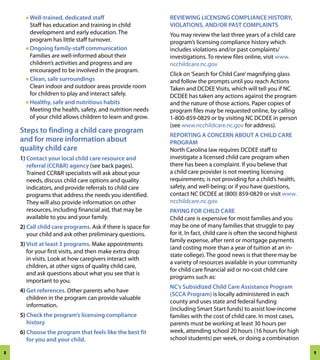
plans are to improve quality. The following sample
license shows the star rating and points earned by
a program.
Sample License
Quality Child Care
High quality child care is consistently shown to
have positive benefits for children. When visiting
a program you’ll want to look for these important
signs of quality child care:
	 n Higher star rating
The program license is posted and the program
has a higher star rating (if applicable) which
means better quality care for your child.
	 n Few children per staff
A small number of children for each staff
member allows each child to receive
individualized attention and care.
	 n Small group size
Small group size promotes a nurturing, secure
setting.
	 n Developmentally-appropriate curriculum
The program uses a plan to encourage learning
and involve children in activities that suit their
ages and developmental stages.
	 n Positive interaction
Children communicate with and learn from
staff and each other.
	 n Consistent supervision of children
Each staff member is responsible for the same
children each day.
Age
Infants
(Birth to 12 months)
Toddlers
(12 to 23 months)
2 years old
(24 to 36 months)
3 years old
4 years old
5 years old
6 years and older
Ratio Requirements for the
Star Rated License
1 Point 2 - 6 Points 7 Points
1:5 1:5 1:4
1:6 1:6 1:5
1:10 1:9 1:8
1:15 1:10 1:9
1:20 1:13 1:12
1:25 1:15 1:14
1:25 1:20 1:19
State of North Carolina
Department of Health and Human Services
Division of Child Development
Three Star Child Care License
ABC CHILD CARE CENTER
123 ANYWHERE ST
RALEIGH, NC 27777
In each area rated, this facility earned
Staff Education: 4 out of 7 points
Programs Standards: 4 out of 7 points
Quality Point: 1 out of 1 point
Total: 9 out of 15 points
ID Number: 92999999
Type of Facility: Center
Issued to CHILDCARE, SUZIE
In accordance with Article 7 Chapter 110 of the North Carolina General Statutes, the above named child care facility is issued a rated license. Licenses vary from an overall rating of one
to five stars, based upon their cumulative points in the three categories above.
This license must be displayed in a prominent place so it may be available and shown to each child’s parent or guardian when the child is enrolled. This license cannot be bought, sold,
or transferred. It is only valid for the location/address noted above. This permit is the property of the State of North Carolina and must be returned to the Division of Child
Development in the event of termination or revocation.
Secretary, Department of Health  Human Services Director, Division of Child Development
Age Range: 0 - 12 years
Capacity: 1st shift: 58; 2nd shift 8; 3rd shift:8
Effective Date: July 1, 2007
Restrictions:
Daytime care only
Children in care on ground level only
Shows the number of stars earned
(shaded) out of the number of stars
possible (blank)
Shows the name and physical
location of the program
Shows how many points the
program earned in each of the two
components
Shows basic licensing information
such as number of children allowed,
ages allowed and any restrictions
6 7
n Well-trained, dedicated staff
Staff has education and training in child
development and early education. The
program has little staff turnover.
	 n Ongoing family-staff communication
Families are well-informed about their
children’s activities and progress and are
encouraged to be involved in the program.
	 n Clean, safe surroundings
Clean indoor and outdoor areas provide room
for children to play and interact safely.
	 n Healthy, safe and nutritious habits
Meeting the health, safety, and nutrition needs
of your child allows children to learn and grow.
Steps to finding a child care program
and for more information about
quality child care
1) Contact your local child care resource and
referral (CCRR) agency (see back pages).
Trained CCRR specialists will ask about your
needs, discuss child care options and quality
indicators, and provide referrals to child care
programs that address the needs you identified.
They will also provide information on other
resources, including financial aid, that may be
available to you and your family.
2) Call child care programs. Ask if there is space for
your child and ask other preliminary questions.
3) Visit at least 3 programs. Make appointments
for your first visits, and then make extra drop
in visits. Look at how caregivers interact with
children, at other signs of quality child care,
and ask questions about what you see that is
important to you.
4) Get references. Other parents who have
children in the program can provide valuable
information.
5) Check the program’s licensing compliance
history
6) Choose the program that feels like the best fit
for you and your child.
REVIEWING LICENSING COMPLIANCE HISTORY,
VIOLATIONS, AND/OR PAST COMPLAINTS
You may review the last three years of a child care
program’s licensing compliance history which
includes violations and/or past complaints/
investigations. To review files online, visit www.
ncchildcare.nc.gov
Click on‘Search for Child Care’magnifying glass
and follow the prompts until you reach Actions
Taken and DCDEE Visits, which will tell you if NC
DCDEE has taken any actions against the program
and the nature of those actions. Paper copies of
program files may be requested online, by calling
1-800-859-0829 or by visiting NC DCDEE in person
(see www.ncchildcare.nc.gov for address).
REPORTING A CONCERN ABOUT A CHILD CARE
PROGRAM
North Carolina law requires DCDEE staff to
investigate a licensed child care program when
there has been a complaint. If you believe that
a child care provider is not meeting licensing
requirements; is not providing for a child’s health,
safety, and well-being; or if you have questions,
contact NC DCDEE at (800) 859-0829 or visit www.
ncchildcare.nc.gov.
PAYING FOR CHILD CARE
Child care is expensive for most families and you
may be one of many families that struggle to pay
for it. In fact, child care is often the second highest
family expense, after rent or mortgage payments
(and costing more than a year of tuition at an in-
state college). The good news is that there may be
a variety of resources available in your community
for child care financial aid or no-cost child care
programs such as:
NC’s Subsidized Child Care Assistance Program
(SCCA Program) is locally administered in each
county and uses state and federal funding
(including Smart Start funds) to assist low-income
families with the cost of child care. In most cases,
parents must be working at least 30 hours per
week, attending school 20 hours (16 hours for high
school students) per week, or doing a combination
8 9
of both. Families receive a voucher for child care
subsidy and are required to choose a 3-star, 4-star,
5-star or GS110-106 participating program that
best meets the needs of the child and family.
In many counties there is a waiting list for child
care subsidy. If your family is eligible, you are
encouraged to put your name on the waiting list
for services for when funding becomes available.
North Carolina Pre-Kindergarten (NC Pre-K) is
a state-funded, statewide, voluntary program
that helps prepare eligible 4-year-old children
for school success by providing them with high
quality pre-school experiences. NC Pre-K is free, and
priority is given to low-income children who have
not been in child care, who have special needs, are
from a home where little to no English is spoken
or have at least one active duty military parent.
NC Pre-K classrooms operate in centers and school
settings for 6 1/2 hours per day, follow the public
school calendar, meet a 1:9 staff-to-child ratio, and
have no more than 18 children in a classroom.
Early Head Start (EHS) is a federally-funded,
community-based program for low-income
pregnant women, and families with young children
from birth to age 3. EHS services are free, promote
healthy prenatal outcomes for pregnant women
and enhance the development of infants and
toddlers.
Early Head Start-Child Care Partnership (EHS-
CCP) is a federally-funded program available in
participating child care programs in some NC
communities. EHS-CCP enhances the quality
and comprehensiveness of infant-toddler care
and provides health and family support services
to enrolled low-income birth to three-year-old
children and their families, and prepares children
for transition into Head Start and preschool.
Head Start (HS) is a federally-funded, free,
community-based program for children ages 3 to
5 from low-income families that promotes school
readiness by enhancing the social and cognitive
development of children by providing educational,
health, nutritional, social, and other services.
For more information, contact your local CCRR by
finding your county in the list below.
Region 1 - Albemarle Alliance for Children and Families:
Counties served: Bertie, Camden, Chowan, Currituck, Gates,
Hertford, Northampton, Pasquotank, Perquimans
1-800-262-8314 or http://albemarleacf.org/what-we-do/
for-families/
		 - Children  Youth Partnership for Dare County
		 County served: Dare
		 252-441-4737 or http://darekids.org/our-services
Region 2 - Craven Smart Start, Inc. CCRR
Counties served: Beaufort, Craven, Hyde, Pamlico, Tyrrell,
Washington
Call: 866-262-5300 ext. 23 or http://www.cravensmartstart.
org/child-care/
Region 3 – ChildLinks / Martin-Pitt Partnership for Children
Counties served: Carteret, Greene, Jones, Lenoir, Martin, Pitt
1-855-730-5798 or http://www.mppfc.org/parents/child-
care-referral/
		 - Onslow County Partnership for Children
		 County served: Onslow
		 1-888-378-2470 or http://www.onslowkids.org
Region 4 - Puzzles / Southeastern CCRR
Counties served: Bladen, Brunswick, Columbus, Duplin, New
Hanover, Pender, Sampson
1-800-653-5212 or https://www.puzzlesregion.com/parents.
php
Region 5 - Partnership for Children of Cumberland County
Counties served: Anson, Cumberland, Hoke, Montgomery,
Moore, Richmond, Robeson, Scotland
1-877-230-3024 or https://ccpfc.org/families/child-care-
search-and-subsidy/
Region 6 - Child Care Resources Inc.
Counties served: Cabarrus, Mecklenburg, Rowan, Stanly,
Union
704-348-2181 or www.findchildcarenenc.com
Region 7 - Child Care Connections of Cleveland County, Inc.
Counties served: Cleveland, Gaston, Lincoln
704-487-7778 or http://www.ccchildcareconnections.org
		- The Children’s Resource Center of Catawba
County
County served: Catawba
828-695-6565 or https://
childrensresourcecenter.org/
10 11
Region 8 - Southwestern Child Development Commission
Counties served: Buncombe, Cherokee, Clay, Graham,
Haywood, Henderson, Jackson, Macon, Madison, Polk,
Rutherford, Swain, Transylvania
1-877-752-5955 or http://www.swcdcinc.org/family-
services/finding-quality-child-care.php
Region 9 - Child Care Solutions / Iredell County
Partnership for Young Children
Counties served: Alexander, Avery, Burke, Caldwell, Iredell,
McDowell, Mitchell, Watauga, Yancey
877-670-8735 or http://region9ccrr.org/region9-resource-
referral/
Region 10 – Child Care Resource Center
Counties served: Alleghany, Ashe, Davidson, Davie,
Forsyth, Stokes, Surry, Wilkes, Yadkin
336-245-4900 or http://www.childcareresourcecenter.org
Region 11 - Regional CCRR of Guilford Child
Development
Counties served: Guilford, Randolph, Rockingham
1-800-289-5098 or http://guilfordchilddev.org/parents/
care/
Region 12 - Child Care Services Association
Counties served: Alamance, Caswell, Durham, Franklin,
Granville, Orange, Person, Vance, Wake
1-855-327-5933 or http://www.childcareservices.org/fs/
finding/
Region 13 – Chatham Co. Partnership for Children
Counties served: Chatham, Harnett, Johnston, Lee, Wayne
1-855-231-8717 or http://chathamkids.org/families/
findcare/
Region 14 - Down East Partnership for Children
Counties served: Edgecombe, Halifax, Nash, Warren,
Wilson
1-888-285-0849 or http://depc.org/
searching-for-child-care/
NC Child Care Resource  Referral Council, June 2018

NC DCDEE child care information

  • 1.
    ChildCare inNorthCarolina Published by: NorthCarolina Child Care Resource & Referral Council with funding from the North Carolina Division of Child Development & Early Education
  • 2.
    Child Care Licensing Childcare programs are licensed and/or regulated by the North Carolina Division of Child Development and Early Education (DCDEE). A child care program is required to be licensed if it serves: n three or more unrelated children under the age of 13; n on a regular basis (at least one day per week); n for more than four but less than 24 hours per day. Child care requirements are designed to protect the health, safety and well-being of your child while he or she is in child care. Basic requirements that must be met address staff qualifications and training, staff/child ratios, health and safety, space and equipment, curriculum, transportation, program records, and discipline and behavior management. All regulated child care programs must maintain at least a 75% compliance rate with these requirements. Child care centers and family child care homes are visited at least once a year by DCDEE for program monitoring. Types of Care Your family can choose from among many different types of programs including both programs that are regulated by DCDEE and programs that are license-exempt/legally operating. Learning about the types of child care that are available can help you find the right fit for your child and family. Regulated child care in North Carolina includes: Licensed Child Care Centers (CCC) are programs where 6 to 12 children (or 15 children if school- age only) are cared for in a home (Center in a Residence) or where three or more children are cared for in a building other than a home, including stand-alone buildings, schools, churches, synagogues, and mosques. Children are usually grouped in classrooms by age. As they grow, children typically move to the next age group with a different classroom teacher. Choosing a child care program is one of the most important early decisions you’ll make for your child. The quality of the program you choose matters! Research indicates that children’s intellectual, social, emotional, and physical development are positively impacted by high quality and negatively impacted by poor quality. Child care that provides a safe, stable, and stimulating environment helps to nurture your child’s healthy development, better prepares him or her for kindergarten, and makes it possible for you to work or attend school. 2 3
  • 3.
    Licensed Family ChildCare Homes (FCCH) are smaller programs offered in a provider’s home for more than two children not related to the provider. These programs offer a home-like setting and opportunity for siblings to be cared for together. A FCCH may care for up to eight children, with no more than five preschool children in care at any given time, including the provider’s own preschool-age children. Developmental Day Centers are licensed programs that serve children ages birth through 21 who are diagnosed with developmental delays, developmental disabilities, or have been identified with a diagnosed physical or cognitive condition which has a high probability of resulting in a developmental delay. These programs are designed to meet the individualized needs of children in areas of self- help, physical (gross/fine motor), language and speech, and cognitive and psychosocial skills. Religious-sponsored child care facilities (GS 110-106) are child care programs operated by a church, synagogue, mosque or school of religious charter that are regulated, but not licensed. These programs operate with a Notice of Compliance from DCDEE and must meet required NC health and safety standards but are exempt from requirements related to staff qualifications, corporal punishment, and child activities. Programs that are not required to be regulated, but may choose to do so, include, but are not limited to: Part-Day Preschools serving children birth to age 5 that operate for up to 4 hours/day; School-Age Child Care serving children ages 5 to 13 before and/or after school hours up to 4 hours/day, and during school holidays and vacations; Drop-in or short-term care provided while parents participate in activities that are not employment related, and where the parents are on the premises or otherwise easily accessible; Recreational programs operated for less than four consecutive months in a year (e.g. summer camps); Legally Exempt Family Child Care Homes may serve up to two non-related children (in addition to the provider’s own children) without being licensed by DCDEE. Please visit DCDEE’s website for a full list of license-exempt programs: www.ncchildcare.nc.gov/parents/pr_sn2_ov_lr.asp Contact your local child care resource referral (CCRR) agency (see back pages) for more information and help finding a child care program that meets your family’s needs. Star Rated License Education of staff caring for children and the daily program environment are two of the most important parts of high quality child care. NC has a star rated license system which awards programs one to five stars based on state-defined standards related to staff education and program quality. This system was designed to help parents more easily differentiate the quality of child care programs. One star means a program meets minimum licensing requirements. Two to five stars means a program has voluntarily met progressively higher standards in staff education and program quality. Staff Education reflects the education and experience of a program’s staff (which positively impacts program quality). Program Standards reflects the quality of care children receive, and assesses child/adult interactions, classroom materials and indoor/ outdoor equipment available for children, indoor/outdoor space per child, and staff-to- child ratios. Child care programs can earn up to seven points in each of these areas. One extra“quality point” may be earned by meeting additional education or program criteria not previously addressed 4 5
  • 4.
    under the StaffEducation or Program Standards components such as further reducing staff-child ratios, using an approved curriculum, or obtaining higher education certification, credentials, or additional training hours. The chart below shows how many points programs can earn for staff-child ratios. Staff to Child Ratios for Child Care Centers Child care licenses must be posted where you can see them. When visiting a program, look for its license. Look at the license to see how many program and staff education points the program has earned. If a program has low points and a low star rating, ask why and find out what their plans are to improve quality. The following sample license shows the star rating and points earned by a program. Sample License Quality Child Care High quality child care is consistently shown to have positive benefits for children. When visiting a program you’ll want to look for these important signs of quality child care: n Higher star rating The program license is posted and the program has a higher star rating (if applicable) which means better quality care for your child. n Few children per staff A small number of children for each staff member allows each child to receive individualized attention and care. n Small group size Small group size promotes a nurturing, secure setting. n Developmentally-appropriate curriculum The program uses a plan to encourage learning and involve children in activities that suit their ages and developmental stages. n Positive interaction Children communicate with and learn from staff and each other. n Consistent supervision of children Each staff member is responsible for the same children each day. Age Infants (Birth to 12 months) Toddlers (12 to 23 months) 2 years old (24 to 36 months) 3 years old 4 years old 5 years old 6 years and older Ratio Requirements for the Star Rated License 1 Point 2 - 6 Points 7 Points 1:5 1:5 1:4 1:6 1:6 1:5 1:10 1:9 1:8 1:15 1:10 1:9 1:20 1:13 1:12 1:25 1:15 1:14 1:25 1:20 1:19 State of North Carolina Department of Health and Human Services Division of Child Development Three Star Child Care License ABC CHILD CARE CENTER 123 ANYWHERE ST RALEIGH, NC 27777 In each area rated, this facility earned Staff Education: 4 out of 7 points Programs Standards: 4 out of 7 points Quality Point: 1 out of 1 point Total: 9 out of 15 points ID Number: 92999999 Type of Facility: Center Issued to CHILDCARE, SUZIE In accordance with Article 7 Chapter 110 of the North Carolina General Statutes, the above named child care facility is issued a rated license. Licenses vary from an overall rating of one to five stars, based upon their cumulative points in the three categories above. This license must be displayed in a prominent place so it may be available and shown to each child’s parent or guardian when the child is enrolled. This license cannot be bought, sold, or transferred. It is only valid for the location/address noted above. This permit is the property of the State of North Carolina and must be returned to the Division of Child Development in the event of termination or revocation. Secretary, Department of Health Human Services Director, Division of Child Development Age Range: 0 - 12 years Capacity: 1st shift: 58; 2nd shift 8; 3rd shift:8 Effective Date: July 1, 2007 Restrictions: Daytime care only Children in care on ground level only Shows the number of stars earned (shaded) out of the number of stars possible (blank) Shows the name and physical location of the program Shows how many points the program earned in each of the two components Shows basic licensing information such as number of children allowed, ages allowed and any restrictions 6 7
  • 5.
    n Well-trained, dedicatedstaff Staff has education and training in child development and early education. The program has little staff turnover. n Ongoing family-staff communication Families are well-informed about their children’s activities and progress and are encouraged to be involved in the program. n Clean, safe surroundings Clean indoor and outdoor areas provide room for children to play and interact safely. n Healthy, safe and nutritious habits Meeting the health, safety, and nutrition needs of your child allows children to learn and grow. Steps to finding a child care program and for more information about quality child care 1) Contact your local child care resource and referral (CCRR) agency (see back pages). Trained CCRR specialists will ask about your needs, discuss child care options and quality indicators, and provide referrals to child care programs that address the needs you identified. They will also provide information on other resources, including financial aid, that may be available to you and your family. 2) Call child care programs. Ask if there is space for your child and ask other preliminary questions. 3) Visit at least 3 programs. Make appointments for your first visits, and then make extra drop in visits. Look at how caregivers interact with children, at other signs of quality child care, and ask questions about what you see that is important to you. 4) Get references. Other parents who have children in the program can provide valuable information. 5) Check the program’s licensing compliance history 6) Choose the program that feels like the best fit for you and your child. REVIEWING LICENSING COMPLIANCE HISTORY, VIOLATIONS, AND/OR PAST COMPLAINTS You may review the last three years of a child care program’s licensing compliance history which includes violations and/or past complaints/ investigations. To review files online, visit www. ncchildcare.nc.gov Click on‘Search for Child Care’magnifying glass and follow the prompts until you reach Actions Taken and DCDEE Visits, which will tell you if NC DCDEE has taken any actions against the program and the nature of those actions. Paper copies of program files may be requested online, by calling 1-800-859-0829 or by visiting NC DCDEE in person (see www.ncchildcare.nc.gov for address). REPORTING A CONCERN ABOUT A CHILD CARE PROGRAM North Carolina law requires DCDEE staff to investigate a licensed child care program when there has been a complaint. If you believe that a child care provider is not meeting licensing requirements; is not providing for a child’s health, safety, and well-being; or if you have questions, contact NC DCDEE at (800) 859-0829 or visit www. ncchildcare.nc.gov. PAYING FOR CHILD CARE Child care is expensive for most families and you may be one of many families that struggle to pay for it. In fact, child care is often the second highest family expense, after rent or mortgage payments (and costing more than a year of tuition at an in- state college). The good news is that there may be a variety of resources available in your community for child care financial aid or no-cost child care programs such as: NC’s Subsidized Child Care Assistance Program (SCCA Program) is locally administered in each county and uses state and federal funding (including Smart Start funds) to assist low-income families with the cost of child care. In most cases, parents must be working at least 30 hours per week, attending school 20 hours (16 hours for high school students) per week, or doing a combination 8 9
  • 6.
    of both. Familiesreceive a voucher for child care subsidy and are required to choose a 3-star, 4-star, 5-star or GS110-106 participating program that best meets the needs of the child and family. In many counties there is a waiting list for child care subsidy. If your family is eligible, you are encouraged to put your name on the waiting list for services for when funding becomes available. North Carolina Pre-Kindergarten (NC Pre-K) is a state-funded, statewide, voluntary program that helps prepare eligible 4-year-old children for school success by providing them with high quality pre-school experiences. NC Pre-K is free, and priority is given to low-income children who have not been in child care, who have special needs, are from a home where little to no English is spoken or have at least one active duty military parent. NC Pre-K classrooms operate in centers and school settings for 6 1/2 hours per day, follow the public school calendar, meet a 1:9 staff-to-child ratio, and have no more than 18 children in a classroom. Early Head Start (EHS) is a federally-funded, community-based program for low-income pregnant women, and families with young children from birth to age 3. EHS services are free, promote healthy prenatal outcomes for pregnant women and enhance the development of infants and toddlers. Early Head Start-Child Care Partnership (EHS- CCP) is a federally-funded program available in participating child care programs in some NC communities. EHS-CCP enhances the quality and comprehensiveness of infant-toddler care and provides health and family support services to enrolled low-income birth to three-year-old children and their families, and prepares children for transition into Head Start and preschool. Head Start (HS) is a federally-funded, free, community-based program for children ages 3 to 5 from low-income families that promotes school readiness by enhancing the social and cognitive development of children by providing educational, health, nutritional, social, and other services. For more information, contact your local CCRR by finding your county in the list below. Region 1 - Albemarle Alliance for Children and Families: Counties served: Bertie, Camden, Chowan, Currituck, Gates, Hertford, Northampton, Pasquotank, Perquimans 1-800-262-8314 or http://albemarleacf.org/what-we-do/ for-families/ - Children Youth Partnership for Dare County County served: Dare 252-441-4737 or http://darekids.org/our-services Region 2 - Craven Smart Start, Inc. CCRR Counties served: Beaufort, Craven, Hyde, Pamlico, Tyrrell, Washington Call: 866-262-5300 ext. 23 or http://www.cravensmartstart. org/child-care/ Region 3 – ChildLinks / Martin-Pitt Partnership for Children Counties served: Carteret, Greene, Jones, Lenoir, Martin, Pitt 1-855-730-5798 or http://www.mppfc.org/parents/child- care-referral/ - Onslow County Partnership for Children County served: Onslow 1-888-378-2470 or http://www.onslowkids.org Region 4 - Puzzles / Southeastern CCRR Counties served: Bladen, Brunswick, Columbus, Duplin, New Hanover, Pender, Sampson 1-800-653-5212 or https://www.puzzlesregion.com/parents. php Region 5 - Partnership for Children of Cumberland County Counties served: Anson, Cumberland, Hoke, Montgomery, Moore, Richmond, Robeson, Scotland 1-877-230-3024 or https://ccpfc.org/families/child-care- search-and-subsidy/ Region 6 - Child Care Resources Inc. Counties served: Cabarrus, Mecklenburg, Rowan, Stanly, Union 704-348-2181 or www.findchildcarenenc.com Region 7 - Child Care Connections of Cleveland County, Inc. Counties served: Cleveland, Gaston, Lincoln 704-487-7778 or http://www.ccchildcareconnections.org - The Children’s Resource Center of Catawba County County served: Catawba 828-695-6565 or https:// childrensresourcecenter.org/ 10 11
  • 7.
    Region 8 -Southwestern Child Development Commission Counties served: Buncombe, Cherokee, Clay, Graham, Haywood, Henderson, Jackson, Macon, Madison, Polk, Rutherford, Swain, Transylvania 1-877-752-5955 or http://www.swcdcinc.org/family- services/finding-quality-child-care.php Region 9 - Child Care Solutions / Iredell County Partnership for Young Children Counties served: Alexander, Avery, Burke, Caldwell, Iredell, McDowell, Mitchell, Watauga, Yancey 877-670-8735 or http://region9ccrr.org/region9-resource- referral/ Region 10 – Child Care Resource Center Counties served: Alleghany, Ashe, Davidson, Davie, Forsyth, Stokes, Surry, Wilkes, Yadkin 336-245-4900 or http://www.childcareresourcecenter.org Region 11 - Regional CCRR of Guilford Child Development Counties served: Guilford, Randolph, Rockingham 1-800-289-5098 or http://guilfordchilddev.org/parents/ care/ Region 12 - Child Care Services Association Counties served: Alamance, Caswell, Durham, Franklin, Granville, Orange, Person, Vance, Wake 1-855-327-5933 or http://www.childcareservices.org/fs/ finding/ Region 13 – Chatham Co. Partnership for Children Counties served: Chatham, Harnett, Johnston, Lee, Wayne 1-855-231-8717 or http://chathamkids.org/families/ findcare/ Region 14 - Down East Partnership for Children Counties served: Edgecombe, Halifax, Nash, Warren, Wilson 1-888-285-0849 or http://depc.org/ searching-for-child-care/ NC Child Care Resource Referral Council, June 2018