Navigating Process Improvement:
Value Stream Mapping Examples
for Operational Excellence
Share Post:
LinkedIn
Twitter
Facebook
Reddit
Value stream mapping (VSM) is a powerful tool used in lean management to visualize,
analyze, and improve the flow of materials and information within a process or value
stream. By identifying value-added and non-value-added activities, streamlining
workflows, and eliminating waste, organizations can optimize efficiency, reduce lead
times, and enhance overall performance. This guide will explore several value stream
mapping examples across different industries to illustrate how this methodology can
drive process improvement and operational excellence.
Types of Value Stream Mapping Example
1. Manufacturing Value Stream Mapping Example
In a manufacturing setting, value stream mapping can be used to streamline production
processes and improve operational efficiency. For example, consider a company that
manufactures automobiles. By creating a value stream map of the production process,
from raw materials to finished vehicles, the organization can identify areas of waste,
such as excess inventory, long setup times, or bottlenecks in production.
Through value stream mapping, the company can implement lean principles to optimize
the flow of materials, standardize work processes, and reduce lead times. For instance,
by implementing just-in-time inventory systems, reducing changeover times through
SMED (Single-Minute Exchange of Die) techniques, and implementing kanban systems
to signal production needs, the company can improve productivity, minimize waste, and
enhance overall efficiency in manufacturing operations.
2. Healthcare Value Stream Mapping Example
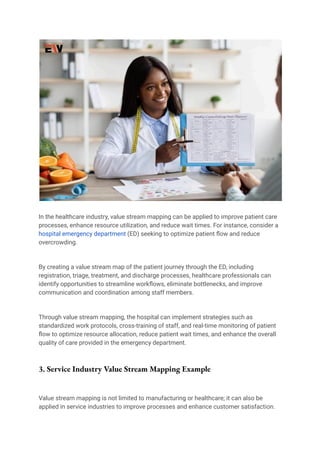
In the healthcare industry, value stream mapping can be applied to improve patient care
processes, enhance resource utilization, and reduce wait times. For instance, consider a
hospital emergency department (ED) seeking to optimize patient flow and reduce
overcrowding.
By creating a value stream map of the patient journey through the ED, including
registration, triage, treatment, and discharge processes, healthcare professionals can
identify opportunities to streamline workflows, eliminate bottlenecks, and improve
communication and coordination among staff members.
Through value stream mapping, the hospital can implement strategies such as
standardized work protocols, cross-training of staff, and real-time monitoring of patient
flow to optimize resource allocation, reduce patient wait times, and enhance the overall
quality of care provided in the emergency department.
3. Service Industry Value Stream Mapping Example
Value stream mapping is not limited to manufacturing or healthcare; it can also be
applied in service industries to improve processes and enhance customer satisfaction.
For example, consider a customer service call center aiming to improve response times
and efficiency in handling customer inquiries.
By creating a value stream map of the customer service process, from initial contact to
resolution of the issue, the call center can identify areas of inefficiency, such as
redundant processes, excessive handoffs between departments, or delays in accessing
necessary information.
Through value stream mapping, the call center can implement strategies such as
implementing self-service options for common inquiries, providing training to agents to
handle a wider range of issues, and implementing software tools for streamlined case
management and knowledge sharing.
Additional Examples and Applications of Value Stream Mapping
1. Supply Chain Optimization
Value stream mapping can be applied to optimize supply chain processes, from raw
material sourcing to distribution and delivery. By creating a value stream map of the
supply chain, organizations can identify opportunities to reduce lead times, eliminate
bottlenecks, and improve inventory management to meet customer demand more
effectively.
2. Office and Administrative Processes
Value stream mapping can be used to improve office and administrative processes, such
as order processing, invoicing, and document management. By visualizing the flow of
information and identifying areas of waste, organizations can streamline workflows,
reduce errors, and enhance productivity in administrative functions.
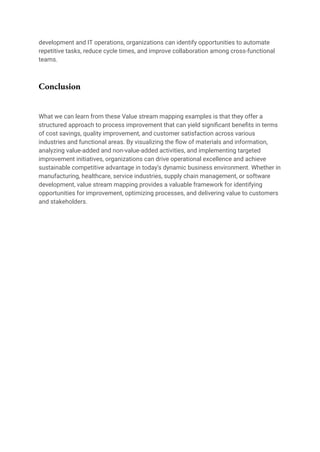
3. Software Development and IT Operations
Value stream mapping examples are also present in software development and IT
operations to improve project management, software deployment, and service delivery
processes. By mapping the flow of tasks, approvals, and handoffs in software
development and IT operations, organizations can identify opportunities to automate
repetitive tasks, reduce cycle times, and improve collaboration among cross-functional
teams.
Conclusion
What we can learn from these Value stream mapping examples is that they offer a
structured approach to process improvement that can yield significant benefits in terms
of cost savings, quality improvement, and customer satisfaction across various
industries and functional areas. By visualizing the flow of materials and information,
analyzing value-added and non-value-added activities, and implementing targeted
improvement initiatives, organizations can drive operational excellence and achieve
sustainable competitive advantage in today’s dynamic business environment. Whether in
manufacturing, healthcare, service industries, supply chain management, or software
development, value stream mapping provides a valuable framework for identifying
opportunities for improvement, optimizing processes, and delivering value to customers
and stakeholders.

Navigating Process Improvement_ Value Stream Mapping Examples for Operational Excellence.pdf

  • 1.
    Navigating Process Improvement: ValueStream Mapping Examples for Operational Excellence Share Post: LinkedIn Twitter Facebook Reddit Value stream mapping (VSM) is a powerful tool used in lean management to visualize, analyze, and improve the flow of materials and information within a process or value stream. By identifying value-added and non-value-added activities, streamlining workflows, and eliminating waste, organizations can optimize efficiency, reduce lead times, and enhance overall performance. This guide will explore several value stream mapping examples across different industries to illustrate how this methodology can drive process improvement and operational excellence.
  • 2.
    Types of ValueStream Mapping Example 1. Manufacturing Value Stream Mapping Example In a manufacturing setting, value stream mapping can be used to streamline production processes and improve operational efficiency. For example, consider a company that manufactures automobiles. By creating a value stream map of the production process, from raw materials to finished vehicles, the organization can identify areas of waste, such as excess inventory, long setup times, or bottlenecks in production. Through value stream mapping, the company can implement lean principles to optimize the flow of materials, standardize work processes, and reduce lead times. For instance, by implementing just-in-time inventory systems, reducing changeover times through SMED (Single-Minute Exchange of Die) techniques, and implementing kanban systems to signal production needs, the company can improve productivity, minimize waste, and enhance overall efficiency in manufacturing operations. 2. Healthcare Value Stream Mapping Example
  • 3.
    In the healthcareindustry, value stream mapping can be applied to improve patient care processes, enhance resource utilization, and reduce wait times. For instance, consider a hospital emergency department (ED) seeking to optimize patient flow and reduce overcrowding. By creating a value stream map of the patient journey through the ED, including registration, triage, treatment, and discharge processes, healthcare professionals can identify opportunities to streamline workflows, eliminate bottlenecks, and improve communication and coordination among staff members. Through value stream mapping, the hospital can implement strategies such as standardized work protocols, cross-training of staff, and real-time monitoring of patient flow to optimize resource allocation, reduce patient wait times, and enhance the overall quality of care provided in the emergency department. 3. Service Industry Value Stream Mapping Example Value stream mapping is not limited to manufacturing or healthcare; it can also be applied in service industries to improve processes and enhance customer satisfaction.
  • 4.
    For example, considera customer service call center aiming to improve response times and efficiency in handling customer inquiries. By creating a value stream map of the customer service process, from initial contact to resolution of the issue, the call center can identify areas of inefficiency, such as redundant processes, excessive handoffs between departments, or delays in accessing necessary information. Through value stream mapping, the call center can implement strategies such as implementing self-service options for common inquiries, providing training to agents to handle a wider range of issues, and implementing software tools for streamlined case management and knowledge sharing. Additional Examples and Applications of Value Stream Mapping 1. Supply Chain Optimization
  • 5.
    Value stream mappingcan be applied to optimize supply chain processes, from raw material sourcing to distribution and delivery. By creating a value stream map of the supply chain, organizations can identify opportunities to reduce lead times, eliminate bottlenecks, and improve inventory management to meet customer demand more effectively. 2. Office and Administrative Processes Value stream mapping can be used to improve office and administrative processes, such as order processing, invoicing, and document management. By visualizing the flow of information and identifying areas of waste, organizations can streamline workflows, reduce errors, and enhance productivity in administrative functions. 3. Software Development and IT Operations Value stream mapping examples are also present in software development and IT operations to improve project management, software deployment, and service delivery processes. By mapping the flow of tasks, approvals, and handoffs in software
  • 6.
    development and IToperations, organizations can identify opportunities to automate repetitive tasks, reduce cycle times, and improve collaboration among cross-functional teams. Conclusion What we can learn from these Value stream mapping examples is that they offer a structured approach to process improvement that can yield significant benefits in terms of cost savings, quality improvement, and customer satisfaction across various industries and functional areas. By visualizing the flow of materials and information, analyzing value-added and non-value-added activities, and implementing targeted improvement initiatives, organizations can drive operational excellence and achieve sustainable competitive advantage in today’s dynamic business environment. Whether in manufacturing, healthcare, service industries, supply chain management, or software development, value stream mapping provides a valuable framework for identifying opportunities for improvement, optimizing processes, and delivering value to customers and stakeholders.