Persuasive Writing
LESSON 1
Introduction to
persuasive writing
Navigating NAPLAN
A Voiceless Teaching
and Learning Program
Years 7 & 9
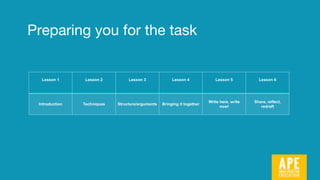
Lesson 1 Lesson 2 Lesson 3 Lesson 4 Lesson 5 Lesson 6
Introduction Techniques Structure/arguments Bringing it together
Write here, write
now!
Share, reflect,
redraft
Preparing you for the task
The power of persuasion
Why do we
persuade
others?
Activity
As a class, discuss the
reasons why we seek to
persuade others.
What is persuasive writing?
• When you write persuasively, you are
trying to convince the reader to agree with
your position.
• It can be distinguished from other types of
writing, which have a different purpose.
• For example, if you were writing to educate
someone, you would simply present the
relevant facts and explain the topics,
concepts and issues involved. Your
purpose would be to educate them, not to
persuade them into adopting a certain view
or position.
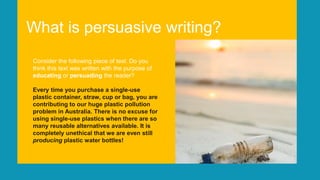
What is persuasive writing?
Consider the following piece of text. Do you
think this text was written with the purpose of
educating or persuading the reader?
Every time you purchase a single-use
plastic container, straw, cup or bag, you are
contributing to our huge plastic pollution
problem in Australia. There is no excuse for
using single-use plastics when there are so
many reusable alternatives available. It is
completely unethical that we are even still
producing plastic water bottles!
What is persuasive writing?
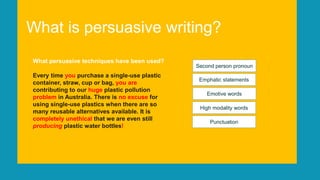
What persuasive techniques have been used?
Every time you purchase a single-use plastic
container, straw, cup or bag, you are
contributing to our huge plastic pollution
problem in Australia. There is no excuse for
using single-use plastics when there are so
many reusable alternatives available. It is
completely unethical that we are even still
producing plastic water bottles!
Second person pronoun
Emotive words
High modality words
Punctuation
Emphatic statements

Navigating naplan-lesson-one-power point-slides

  • 1.
    Persuasive Writing LESSON 1 Introductionto persuasive writing Navigating NAPLAN A Voiceless Teaching and Learning Program Years 7 & 9
  • 2.
    Lesson 1 Lesson2 Lesson 3 Lesson 4 Lesson 5 Lesson 6 Introduction Techniques Structure/arguments Bringing it together Write here, write now! Share, reflect, redraft Preparing you for the task
  • 3.
    The power ofpersuasion Why do we persuade others? Activity As a class, discuss the reasons why we seek to persuade others.
  • 4.
    What is persuasivewriting? • When you write persuasively, you are trying to convince the reader to agree with your position. • It can be distinguished from other types of writing, which have a different purpose. • For example, if you were writing to educate someone, you would simply present the relevant facts and explain the topics, concepts and issues involved. Your purpose would be to educate them, not to persuade them into adopting a certain view or position.
  • 5.
    What is persuasivewriting? Consider the following piece of text. Do you think this text was written with the purpose of educating or persuading the reader? Every time you purchase a single-use plastic container, straw, cup or bag, you are contributing to our huge plastic pollution problem in Australia. There is no excuse for using single-use plastics when there are so many reusable alternatives available. It is completely unethical that we are even still producing plastic water bottles!
  • 6.
    What is persuasivewriting? What persuasive techniques have been used? Every time you purchase a single-use plastic container, straw, cup or bag, you are contributing to our huge plastic pollution problem in Australia. There is no excuse for using single-use plastics when there are so many reusable alternatives available. It is completely unethical that we are even still producing plastic water bottles! Second person pronoun Emotive words High modality words Punctuation Emphatic statements