Round
ONE
LIREO
Respiratory organ is
responsible for the taking
in of oxygen and
expelling of carbon
dioxide.
SCIENCE
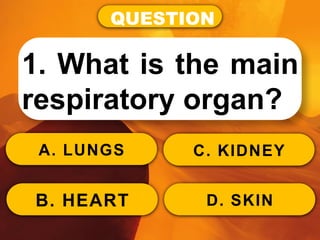
QUESTION
1. What is the main
respiratory organ?
A. LUNGS
B. HEART
C. KIDNEY
D. SKIN
ANSWER
A. LUNGS
SET is one of the most fundamental
concepts in Mathematics. The set
theory which was developed in the
19th
century is now a common part of
Mathematics and can be used as a
foundation from which nearly all
Mathematical concepts can be
derived.
MATHEMATICS
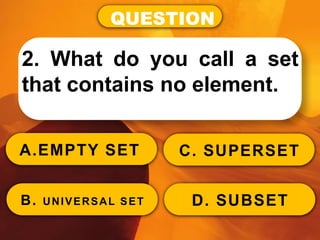
QUESTION
2. What do you call a set
that contains no element.
A.EMPTY SET
B. UNIVERSAL SET
C. SUPERSET
D. SUBSET
ANSWER
A.EMPTY SET
A force is a push or pull upon
an object resulting from the
object’s interaction with
another object. Whenever
there is an interaction between
two object, there is a force
upon each of the objects.
SCIENCE
QUESTION
3. What do you call to the force
acting against or opposite an object
in contact which makes the
movement of the object slow down.
A. NORMAL FORCE
B. APPLIED
C. FRICTION
D. GRAVITY
ANSWER
C. FRICTION
SET it is a collection or group
of objects and it is well-defined.
well–defined means that it
is possible to determine
whether an object belongs to a
given set or not.
MATHEMATICS
QUESTION
4. Which of the following is
a well-defined set?
A. The set of big
people
B. The set of
happy people
C. The set of
intelligent teachers
D. The set of
prime numbers
ANSWER
D. The set of prime
numbers
An atom is the smallest
unit of ordinary matter
that forms a chemical
element.
SCIENCE
QUESTION
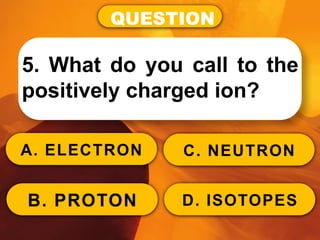
5. What do you call to the
positively charged ion?
A. ELECTRON
B. PROTON
C. NEUTRON
D. ISOTOPES
ANSWER
B. PROTON
MATHEMATICS
QUESTION
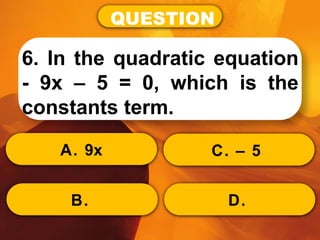
6. In the quadratic equation
- 9x – 5 = 0, which is the
constants term.
A. 9x
B.
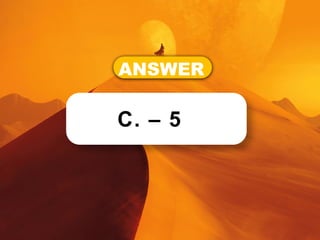
C. – 5
D.
ANSWER
C. – 5
Cell is the smallest unit
that can live on its own
and makes up all living
organism and tissues of
the body.
SCIENCE
QUESTION
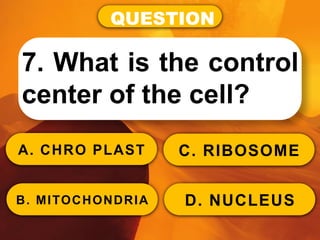
7. What is the control
center of the cell?
A. CHRO PLAST
B. MITOCHONDRIA
C. RIBOSOME
D. NUCLEUS
ANSWER
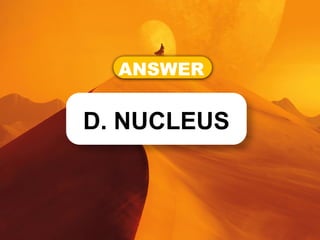
D. NUCLEUS
MATHEMATICS
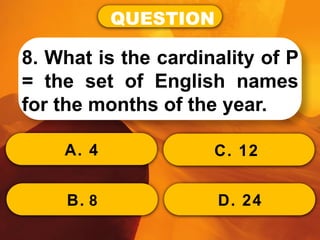
QUESTION
8. What is the cardinality of P
= the set of English names
for the months of the year.
A. 4
B. 8
C. 12
D. 24
ANSWER
C. 12
Our solar system
consists of the star, the
sun and everything
bound to it by gravity just
like our planets.
SCIENCE
QUESTION
9. What is known
as the red planet?
A. VENUS
B. MARS
C. EARTH
D. MERCURY
ANSWER
B. MARS
An atom is the basic building block of
chemistry. It is the smallest unit into which
matter can be divided without the release
of electrically charged particles. A typical
atom consists of three subatomic particles:
protons, neutrons, and electrons. All the
positive charge of an atom is contained in
the nucleus, and originates from the
protons. Neutrons are neutrally-charged.
Electrons, which are negatively-charged,
are located outside of the nucleus.
SCIENCE
QUESTION
10. What do you call to the
electrons that are located in the
outermost electron shell of an
atom?
A. VALENCE
ELECTRONS
B. VALENCE
NEUTRON
C. FORCE
D. ISOTOPES
ANSWER
A. VALENCE
ELECTRONS
Nutrients are the substances which provide
energy and biomolecules necessary for
carrying out the various body functions. All
living organisms need nutrients for proper
functioning and growth. But they show
divergence in how they fulfill this demand.
Some animals feed on simple inorganic
compounds to meet their nutrient
requirement, while others utilise complex
compounds. The mode of nutrition varies
from one species to another.
SCIENCE
QUESTION
11. What term refers to the living
organisms that live and feed on
dead and decaying organisms?
A. HERBIVORES
B. SAPROPHYTES
C. CARNIVORES
D. FOOD WEB
ANSWER
B. SAPROPHYTES
MATHEMATICS
QUESTION
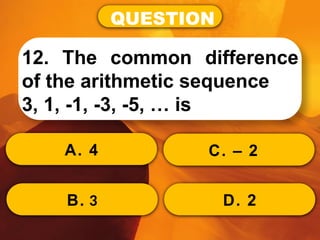
12. The common difference
of the arithmetic sequence
3, 1, -1, -3, -5, … is
A. 4
B. 3
C. – 2
D. 2
ANSWER
C. – 2
Climate change refers to
long-term shits in
temperatures and weather
patterns. These shitts may
be natural , such as through
variations in the solar cycle.
SCIENCE
QUESTION
13. What is do you call to
the short term atmospheric
conditions?
A. EARTHQUAKE
B. TSUNAMI
C. CLIMATE
D. WEATHER
ANSWER
D. WEATHER
Skeletal system as a support
structure of your body. It gives
the body its shape, allows
movement, makes blood cells,
provides protection for organs
and stores minerals.
SCIENCE
QUESTION
14. How many bones
does a human adualt
have?
A. 206 bones
B. 207 bones
C. 208 bones
D. 209 bones
ANSWER
A. 206 bones
The water cycle is a
biogeochemical cycle that
describes the continuous
movement of water on,
above and below the
surfaces of the earth.
SCIENCE
QUESTION
15. It is the phase of water
cycle in which the vapor is
turning back into liquid water?
A.CONDENSATION
B. EVAPORATION
C. PRECIPITATION
D. VAPORIZATION

ANSWER
A.CONDENSATION

Natural Sciences Mathematics Computer S QS Round 1.pptx

  • 1.
  • 2.
    Respiratory organ is responsiblefor the taking in of oxygen and expelling of carbon dioxide. SCIENCE
  • 3.
    QUESTION 1. What isthe main respiratory organ? A. LUNGS B. HEART C. KIDNEY D. SKIN
  • 4.
  • 5.
    SET is oneof the most fundamental concepts in Mathematics. The set theory which was developed in the 19th century is now a common part of Mathematics and can be used as a foundation from which nearly all Mathematical concepts can be derived. MATHEMATICS
  • 6.
    QUESTION 2. What doyou call a set that contains no element. A.EMPTY SET B. UNIVERSAL SET C. SUPERSET D. SUBSET
  • 7.
  • 8.
    A force isa push or pull upon an object resulting from the object’s interaction with another object. Whenever there is an interaction between two object, there is a force upon each of the objects. SCIENCE
  • 9.
    QUESTION 3. What doyou call to the force acting against or opposite an object in contact which makes the movement of the object slow down. A. NORMAL FORCE B. APPLIED C. FRICTION D. GRAVITY
  • 10.
  • 11.
    SET it isa collection or group of objects and it is well-defined. well–defined means that it is possible to determine whether an object belongs to a given set or not. MATHEMATICS
  • 12.
    QUESTION 4. Which ofthe following is a well-defined set? A. The set of big people B. The set of happy people C. The set of intelligent teachers D. The set of prime numbers
  • 13.
    ANSWER D. The setof prime numbers
  • 14.
    An atom isthe smallest unit of ordinary matter that forms a chemical element. SCIENCE
  • 15.
    QUESTION 5. What doyou call to the positively charged ion? A. ELECTRON B. PROTON C. NEUTRON D. ISOTOPES
  • 16.
  • 17.
  • 18.
    QUESTION 6. In thequadratic equation - 9x – 5 = 0, which is the constants term. A. 9x B. C. – 5 D.
  • 19.
  • 20.
    Cell is thesmallest unit that can live on its own and makes up all living organism and tissues of the body. SCIENCE
  • 21.
    QUESTION 7. What isthe control center of the cell? A. CHRO PLAST B. MITOCHONDRIA C. RIBOSOME D. NUCLEUS
  • 22.
  • 23.
  • 24.
    QUESTION 8. What isthe cardinality of P = the set of English names for the months of the year. A. 4 B. 8 C. 12 D. 24
  • 25.
  • 26.
    Our solar system consistsof the star, the sun and everything bound to it by gravity just like our planets. SCIENCE
  • 27.
    QUESTION 9. What isknown as the red planet? A. VENUS B. MARS C. EARTH D. MERCURY
  • 28.
  • 29.
    An atom isthe basic building block of chemistry. It is the smallest unit into which matter can be divided without the release of electrically charged particles. A typical atom consists of three subatomic particles: protons, neutrons, and electrons. All the positive charge of an atom is contained in the nucleus, and originates from the protons. Neutrons are neutrally-charged. Electrons, which are negatively-charged, are located outside of the nucleus. SCIENCE
  • 30.
    QUESTION 10. What doyou call to the electrons that are located in the outermost electron shell of an atom? A. VALENCE ELECTRONS B. VALENCE NEUTRON C. FORCE D. ISOTOPES
  • 31.
  • 32.
    Nutrients are thesubstances which provide energy and biomolecules necessary for carrying out the various body functions. All living organisms need nutrients for proper functioning and growth. But they show divergence in how they fulfill this demand. Some animals feed on simple inorganic compounds to meet their nutrient requirement, while others utilise complex compounds. The mode of nutrition varies from one species to another. SCIENCE
  • 33.
    QUESTION 11. What termrefers to the living organisms that live and feed on dead and decaying organisms? A. HERBIVORES B. SAPROPHYTES C. CARNIVORES D. FOOD WEB
  • 34.
  • 35.
  • 36.
    QUESTION 12. The commondifference of the arithmetic sequence 3, 1, -1, -3, -5, … is A. 4 B. 3 C. – 2 D. 2
  • 37.
  • 38.
    Climate change refersto long-term shits in temperatures and weather patterns. These shitts may be natural , such as through variations in the solar cycle. SCIENCE
  • 39.
    QUESTION 13. What isdo you call to the short term atmospheric conditions? A. EARTHQUAKE B. TSUNAMI C. CLIMATE D. WEATHER
  • 40.
  • 41.
    Skeletal system asa support structure of your body. It gives the body its shape, allows movement, makes blood cells, provides protection for organs and stores minerals. SCIENCE
  • 42.
    QUESTION 14. How manybones does a human adualt have? A. 206 bones B. 207 bones C. 208 bones D. 209 bones
  • 43.
  • 44.
    The water cycleis a biogeochemical cycle that describes the continuous movement of water on, above and below the surfaces of the earth. SCIENCE
  • 45.
    QUESTION 15. It isthe phase of water cycle in which the vapor is turning back into liquid water? A.CONDENSATION B. EVAPORATION C. PRECIPITATION D. VAPORIZATION
  • 46.