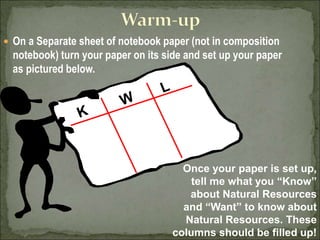
 On a Separate sheet of notebook paper (not in composition
notebook) turn your paper on its side and set up your paper
as pictured below.
Once your paper is set up,
tell me what you “Know”
about Natural Resources
and “Want” to know about
Natural Resources. These
columns should be filled up!
Essential Question:
How do you differentiate between renewable
and nonrenewable resources?
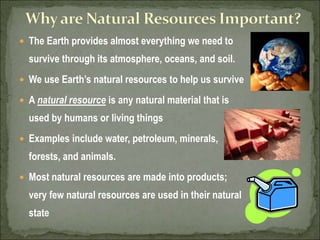
 The Earth provides almost everything we need to
survive through its atmosphere, oceans, and soil.
 We use Earth’s natural resources to help us survive
 A natural resource is any natural material that is
used by humans or living things
 Examples include water, petroleum, minerals,
forests, and animals.
 Most natural resources are made into products;
very few natural resources are used in their natural
state
 A renewable resource is a natural resource that can be
used and replaced over a relatively short time
 Although they can be replaced, we have often used them
more quickly than they can be replaced
 Examples:
 Water
 Trees
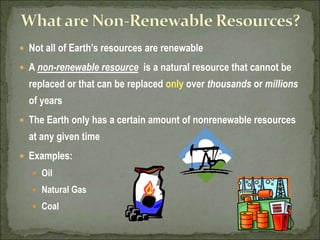
 Not all of Earth’s resources are renewable
 A non-renewable resource is a natural resource that cannot be
replaced or that can be replaced only over thousands or millions
of years
 The Earth only has a certain amount of nonrenewable resources
at any given time
 Examples:
 Oil
 Natural Gas
 Coal
 Energy Resources are natural resources that humans use to
generate energy
 Most of the energy we use comes from fossil fuels.
 A Fossil Fuel is a nonrenewable energy resource formed
from the remains of plants and animals that lived long ago.
 Examples of fossil fuels include petroleum, coal, and
natural gas.
 When these fossil fuels are burned they produce energy
 However, when these fossil fuels are burned and because
they are non-renewable resources they are gone.
 Once they are used up and gone, new supplies won’t be
available for thousands or millions of years
 Most of our energy needs comes from the use of fossil
fuels, but there are two main problems with fossil fuels:
 Availability is limited
 Obtaining and using fossil fuels harms the environment
 To continue to have energy, but reduce pollution we must
find alternative energy sources
 Like all things, each alternative
energy sources has pros and cons
 Nuclear Energy- energy from fission
or fusion reactions
 Solar Energy- energy from the sun
 Wind Energy- energy from the wind
 Hydroelectricity- energy from the flow
of water
 Biomass- energy from burning
organic or living matter
 Geothermal- energy from the earth
 These energy sources are
Inexhaustible meaning they are
constant and will not run out
 We need to be careful on how we use our
natural resources and use them only when
necessary
 Conservation is the preservation and
careful management of the environment and
of natural resources
 Reduce, Reuse, and Recycle!!!
 One way is to limit their uses
 Example: turn off the faucet, replant plants
 Recycling is the process by which used or
discarded materials are treated for reuse
 What is the difference between renewable and non-
renewable resources?
 What is an example of a natural resource?
 What is an example of a renewable resource?
 Explain the difference between how coal and oil are
formed.
 What is an example of a non-renewable resource?
 Are fossil fuels renewable or non-renewable? Explain
 Give three examples of fossil fuels.
 Name the 6 alternative resources.

Natural Resources.ppt

  • 1.
     On aSeparate sheet of notebook paper (not in composition notebook) turn your paper on its side and set up your paper as pictured below. Once your paper is set up, tell me what you “Know” about Natural Resources and “Want” to know about Natural Resources. These columns should be filled up!
  • 2.
    Essential Question: How doyou differentiate between renewable and nonrenewable resources?
  • 3.
     The Earthprovides almost everything we need to survive through its atmosphere, oceans, and soil.  We use Earth’s natural resources to help us survive  A natural resource is any natural material that is used by humans or living things  Examples include water, petroleum, minerals, forests, and animals.  Most natural resources are made into products; very few natural resources are used in their natural state
  • 4.
     A renewableresource is a natural resource that can be used and replaced over a relatively short time  Although they can be replaced, we have often used them more quickly than they can be replaced  Examples:  Water  Trees
  • 5.
     Not allof Earth’s resources are renewable  A non-renewable resource is a natural resource that cannot be replaced or that can be replaced only over thousands or millions of years  The Earth only has a certain amount of nonrenewable resources at any given time  Examples:  Oil  Natural Gas  Coal
  • 6.
     Energy Resourcesare natural resources that humans use to generate energy  Most of the energy we use comes from fossil fuels.  A Fossil Fuel is a nonrenewable energy resource formed from the remains of plants and animals that lived long ago.  Examples of fossil fuels include petroleum, coal, and natural gas.  When these fossil fuels are burned they produce energy  However, when these fossil fuels are burned and because they are non-renewable resources they are gone.  Once they are used up and gone, new supplies won’t be available for thousands or millions of years
  • 9.
     Most ofour energy needs comes from the use of fossil fuels, but there are two main problems with fossil fuels:  Availability is limited  Obtaining and using fossil fuels harms the environment  To continue to have energy, but reduce pollution we must find alternative energy sources
  • 10.
     Like allthings, each alternative energy sources has pros and cons  Nuclear Energy- energy from fission or fusion reactions  Solar Energy- energy from the sun  Wind Energy- energy from the wind  Hydroelectricity- energy from the flow of water  Biomass- energy from burning organic or living matter  Geothermal- energy from the earth  These energy sources are Inexhaustible meaning they are constant and will not run out
  • 11.
     We needto be careful on how we use our natural resources and use them only when necessary  Conservation is the preservation and careful management of the environment and of natural resources  Reduce, Reuse, and Recycle!!!  One way is to limit their uses  Example: turn off the faucet, replant plants  Recycling is the process by which used or discarded materials are treated for reuse
  • 12.
     What isthe difference between renewable and non- renewable resources?  What is an example of a natural resource?  What is an example of a renewable resource?  Explain the difference between how coal and oil are formed.  What is an example of a non-renewable resource?  Are fossil fuels renewable or non-renewable? Explain  Give three examples of fossil fuels.  Name the 6 alternative resources.