Stacy Davis
stacyld@hawaii.edu
11/15/11
Social Studies, Technology, Language Arts
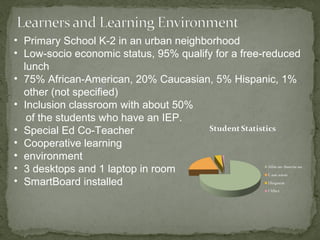
• Primary School K-2 in an urban neighborhood
• Low-socio economic status, 95% qualify for a free-reduced
lunch
• 75% African-American, 20% Caucasian, 5% Hispanic, 1%
other (not specified)
• Inclusion classroom with about 50%
of the students who have an IEP.
• Special Ed Co-Teacher
• Cooperative learning
• environment
• 3 desktops and 1 laptop in room
• SmartBoard installed
 Purpose- This lesson will meet Virginia standard of Learning in History,
Geography, and Computing and technology
 History- 2.2 The student will compare the lives and contributions of
three American Indian cultures of the past and present, with emphasis
on the Powhatan of the Eastern Woodlands, the Lakota of the Plains, and
the Pueblo peoples of the Southwest.
 Geography-2.4 The student will develop map skills by c)locating the
regions of the Powhatan, Lakota, and Pueblo Indians on United States
maps; d) understanding the relationship between the environment and
the culture of the Powhatan, Lakota, and Pueblo Indians.
 Computer and Technology-C/T K-2.2 The student will demonstrate
proficiency in the use of technology. Demonstrate the use of mouse,
keyboard, printer, multimedia devices, and earphones. Use multimedia
resources such as interactive books and software with graphical
interfaces.
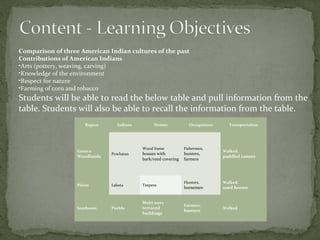
Region Indians Homes Occupations Transportation
Eastern
Woodlands
Powhatan
Wood frame
houses with
bark/reed covering
Fishermen,
hunters,
farmers
Walked,
paddled canoes
Plains Lakota Teepees
Hunters,
horsemen
Walked,
used horses
Southwest Pueblo
Multi-story
terraced
buildings
Farmers,
hunters
Walked
Comparison of three American Indian cultures of the past
Contributions of American Indians
•Arts (pottery, weaving, carving)
•Knowledge of the environment
•Respect for nature
•Farming of corn and tobacco
Students will be able to read the below table and pull information from the
table. Students will also be able to recall the information from the table.
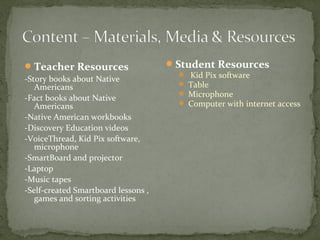
Teacher Resources
-Story books about Native
Americans
-Fact books about Native
Americans
-Native American workbooks
-Discovery Education videos
-VoiceThread, Kid Pix software,
microphone
-SmartBoard and projector
-Laptop
-Music tapes
-Self-created Smartboard lessons ,
games and sorting activities
Student Resources
 Kid Pix software
 Table
 Microphone
 Computer with internet access
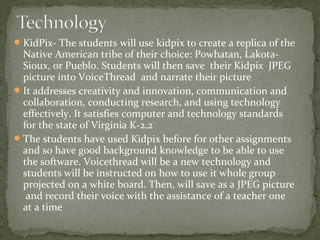
KidPix- The students will use kidpix to create a replica of the
Native American tribe of their choice: Powhatan, Lakota-
Sioux, or Pueblo. Students will then save their Kidpix JPEG
picture into VoiceThread and narrate their picture
It addresses creativity and innovation, communication and
collaboration, conducting research, and using technology
effectively. It satisfies computer and technology standards
for the state of Virginia K-2.2
The students have used Kidpix before for other assignments
and so have good background knowledge to be able to use
the software. Voicethread will be a new technology and
students will be instructed on how to use it whole group
projected on a white board. Then, will save as a JPEG picture
and record their voice with the assistance of a teacher one
at a time
The students will learn the subject matter by
1.Listening to stories
2. Viewing videos
3. Using/reading tables
4. Playing online games
5. Doing online webquests
6. Sorting photos of elements of the tribes
7. Singing songs, dancing, and acting (miming)
8. Creating an illustration of the environment of a Native
American Tribe including appropriate illustrations for:
Flora/Fauna, housing, food, occupations, transportation,
clothing, and climate
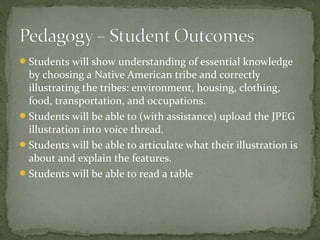
Students will show understanding of essential knowledge
by choosing a Native American tribe and correctly
illustrating the tribes: environment, housing, clothing,
food, transportation, and occupations.
Students will be able to (with assistance) upload the JPEG
illustration into voice thread.
Students will be able to articulate what their illustration is
about and explain the features.
Students will be able to read a table
Learning of essential knowledge based on illustration and
articulation of illustration
Unit exam (paper test with Senteo remotes)
If students are able to: follow directions, cooperate with
classmates, grasp essential knowledge, and answer
questions
Read a table
Completion of unit assignments and participation
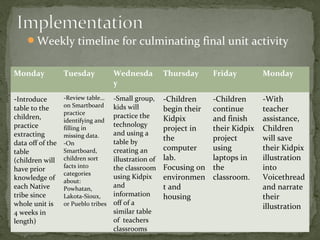
Weekly timeline for culminating final unit activity
Monday Tuesday Wednesda
y
Thursday Friday Monday
-Introduce
table to the
children,
practice
extracting
data off of the
table
(children will
have prior
knowledge of
each Native
tribe since
whole unit is
4 weeks in
length)
-Review table…
on Smartboard
practice
identifying and
filling in
missing data.
-On
Smartboard,
children sort
facts into
categories
about:
Powhatan,
Lakota-Sioux,
or Pueblo tribes
-Small group,
kids will
practice the
technology
and using a
table by
creating an
illustration of
the classroom
using Kidpix
and
information
off of a
similar table
of teachers
classrooms
-Children
begin their
Kidpix
project in
the
computer
lab.
Focusing on
environmen
t and
housing
-Children
continue
and finish
their Kidpix
project
using
laptops in
the
classroom.
-With
teacher
assistance,
Children
will save
their Kidpix
illustration
into
Voicethread
and narrate
their
illustration
The lesson will be effective and successful if:
-Each child has an illustration that contains all
essential components that focus on the tribe that
the child chose
-Students are able to answer questions from data
on a table
-Students are able to follow the directions they are
given
-Students are able to articulate and explain their
illustration
-Students are able to use the technology effectively
with minimal assistance (if any) from an adult.
Native Americans, 2nd Grade

Native Americans, 2nd Grade

  • 1.
  • 2.
    • Primary SchoolK-2 in an urban neighborhood • Low-socio economic status, 95% qualify for a free-reduced lunch • 75% African-American, 20% Caucasian, 5% Hispanic, 1% other (not specified) • Inclusion classroom with about 50% of the students who have an IEP. • Special Ed Co-Teacher • Cooperative learning • environment • 3 desktops and 1 laptop in room • SmartBoard installed
  • 3.
     Purpose- Thislesson will meet Virginia standard of Learning in History, Geography, and Computing and technology  History- 2.2 The student will compare the lives and contributions of three American Indian cultures of the past and present, with emphasis on the Powhatan of the Eastern Woodlands, the Lakota of the Plains, and the Pueblo peoples of the Southwest.  Geography-2.4 The student will develop map skills by c)locating the regions of the Powhatan, Lakota, and Pueblo Indians on United States maps; d) understanding the relationship between the environment and the culture of the Powhatan, Lakota, and Pueblo Indians.  Computer and Technology-C/T K-2.2 The student will demonstrate proficiency in the use of technology. Demonstrate the use of mouse, keyboard, printer, multimedia devices, and earphones. Use multimedia resources such as interactive books and software with graphical interfaces.
  • 4.
    Region Indians HomesOccupations Transportation Eastern Woodlands Powhatan Wood frame houses with bark/reed covering Fishermen, hunters, farmers Walked, paddled canoes Plains Lakota Teepees Hunters, horsemen Walked, used horses Southwest Pueblo Multi-story terraced buildings Farmers, hunters Walked Comparison of three American Indian cultures of the past Contributions of American Indians •Arts (pottery, weaving, carving) •Knowledge of the environment •Respect for nature •Farming of corn and tobacco Students will be able to read the below table and pull information from the table. Students will also be able to recall the information from the table.
  • 5.
    Teacher Resources -Story booksabout Native Americans -Fact books about Native Americans -Native American workbooks -Discovery Education videos -VoiceThread, Kid Pix software, microphone -SmartBoard and projector -Laptop -Music tapes -Self-created Smartboard lessons , games and sorting activities Student Resources  Kid Pix software  Table  Microphone  Computer with internet access
  • 6.
    KidPix- The studentswill use kidpix to create a replica of the Native American tribe of their choice: Powhatan, Lakota- Sioux, or Pueblo. Students will then save their Kidpix JPEG picture into VoiceThread and narrate their picture It addresses creativity and innovation, communication and collaboration, conducting research, and using technology effectively. It satisfies computer and technology standards for the state of Virginia K-2.2 The students have used Kidpix before for other assignments and so have good background knowledge to be able to use the software. Voicethread will be a new technology and students will be instructed on how to use it whole group projected on a white board. Then, will save as a JPEG picture and record their voice with the assistance of a teacher one at a time
  • 7.
    The students willlearn the subject matter by 1.Listening to stories 2. Viewing videos 3. Using/reading tables 4. Playing online games 5. Doing online webquests 6. Sorting photos of elements of the tribes 7. Singing songs, dancing, and acting (miming) 8. Creating an illustration of the environment of a Native American Tribe including appropriate illustrations for: Flora/Fauna, housing, food, occupations, transportation, clothing, and climate
  • 8.
    Students will showunderstanding of essential knowledge by choosing a Native American tribe and correctly illustrating the tribes: environment, housing, clothing, food, transportation, and occupations. Students will be able to (with assistance) upload the JPEG illustration into voice thread. Students will be able to articulate what their illustration is about and explain the features. Students will be able to read a table
  • 9.
    Learning of essentialknowledge based on illustration and articulation of illustration Unit exam (paper test with Senteo remotes) If students are able to: follow directions, cooperate with classmates, grasp essential knowledge, and answer questions Read a table Completion of unit assignments and participation
  • 10.
    Weekly timeline forculminating final unit activity Monday Tuesday Wednesda y Thursday Friday Monday -Introduce table to the children, practice extracting data off of the table (children will have prior knowledge of each Native tribe since whole unit is 4 weeks in length) -Review table… on Smartboard practice identifying and filling in missing data. -On Smartboard, children sort facts into categories about: Powhatan, Lakota-Sioux, or Pueblo tribes -Small group, kids will practice the technology and using a table by creating an illustration of the classroom using Kidpix and information off of a similar table of teachers classrooms -Children begin their Kidpix project in the computer lab. Focusing on environmen t and housing -Children continue and finish their Kidpix project using laptops in the classroom. -With teacher assistance, Children will save their Kidpix illustration into Voicethread and narrate their illustration
  • 11.
    The lesson willbe effective and successful if: -Each child has an illustration that contains all essential components that focus on the tribe that the child chose -Students are able to answer questions from data on a table -Students are able to follow the directions they are given -Students are able to articulate and explain their illustration -Students are able to use the technology effectively with minimal assistance (if any) from an adult.

Editor's Notes

  • #3 -School located in the Hampton Roads region of Virginia. This areas is highly populated. The school is located in the urban inner city of the City of Chesapeake. It is the oldest part of the city and the old heart. The population is elderly mostly with younger families living in section 8 housing developments and some of the older single family homes that surround the school. There is also a trailer park development near the school that is within the school boundaries as well. -Parental involvement is generally low. There are transportation issues and parents typically work during the day which does not permit for many visits to the school. Many parents do not attend parent teacher conferences, or volunteer at the school. - The school itself is a Balanced Literacy pilot school. As a Title 1 school, they have had great success with implementation of the program. The program encourages tables v. desks, and students sit in heterogeneous groups based on reading ability. Approximately 30% of male students at the school have repeated Kindergarten to strengthen beginning literacy skills. This is a large number, but the school has found it necessary for continued success in school. Because of this, many students are 1 year older than the typical 2nd grader. This can at times affect their interest in certain subjects.
  • #4 History 2.2 – students will learn about the region, transportation, environment, occupations, lifestyle, use of natural resources, housing, clothing, and language of the three Native American tribes being focused on through reading of books, watching videos, reconstructing environments, acting out occupations, sorting, categorizing and singing about the tribes. Geography 2.4 – Students will be able to identify on a map, the regions where the Native American tribes one lived. Computer and Technology C/T K-2.2 – Students will turn on computer and navigate to watch videos, go on web quests, listen to interactive books, and create environments on Kidpix
  • #5 Students will need to be able to recall the information listed above. Students will able be able to read the table and pull information from the table. Students should be able to fill in missing information on the table and identify if components are missing. Students will be able to use the data off the table to create a picture on kidpix of one tribes environment illustrating the information in the table above along with additional info from lessons.
  • #6 -Books are gathered by the media specialist (librarian) at the beginning of the unit and distributed to teachers who then share the books around the grade level. Both storybooks and factual books are used
  • #7 ETEC standards: 1. Creativity and innovation: Students are creating an illustration themselves using software that allows them to be creative. 2.Communication and Collaboration: Students create a Kidpix in small groups of our classroom environment as a sample project. 3. Conducting Research- Children may look for additional clip-art to use in their illustration to represent essential knowledge 4. Using technology effectively: The children are learning how to use technology effectively by creating an original illustration to demonstrate knowledge
  • #9 It is extremely important that students are able to articulate their illustrations and be able to explain what their illustration is of and the components to demonstrate understanding of the material.
  • #10 All assessments are considered in determining whether the child has the essential knowledge for the unit and can demonstrate knowledge. Children in grades lower than 3 are not given letter grades. They are given Outstanding/excels grade level standards, Satisfactory/meets grade level standards, Progressing/ towards grade level standards, Unsatisfactory/ far from meeting grade level standards.
  • #11 Children will be finishing up the whole 4 week unit at this point. The previous 3 weeks, students will have learned about the individual tribes at a rate of 1 per week. This week is focusing on review of the tribes and comparing and contrasting the tribes and their lifestyles. It also focuses on incorporating the skills of reading and using a table as well as addresses the computer and technology standards. -The children at PPS have had extensive experience with Kidpix and using a computer by the second grade. The new skills will simply be saving it as a JPEG, and using Voicethread (which will be modeled whole group, but executed one on one with the special ed teacher)
  • #12 -Uploading of illustration and Voicethread will be conducted throughout the day pulling children aside individually to do their own in the special educator’s home room (to provide a quiet distraction free environment). The following Monday after the written assessment students will view all the illustrations on Voicethread whole group.
  • #13 Include any final thoughts, ideas, inspiring quotations, images, etc. that will give an appropriate end to your presentation of your learning unit. Remember to be professional!