THE NATIONAL LIBRARY  OF LATVIA
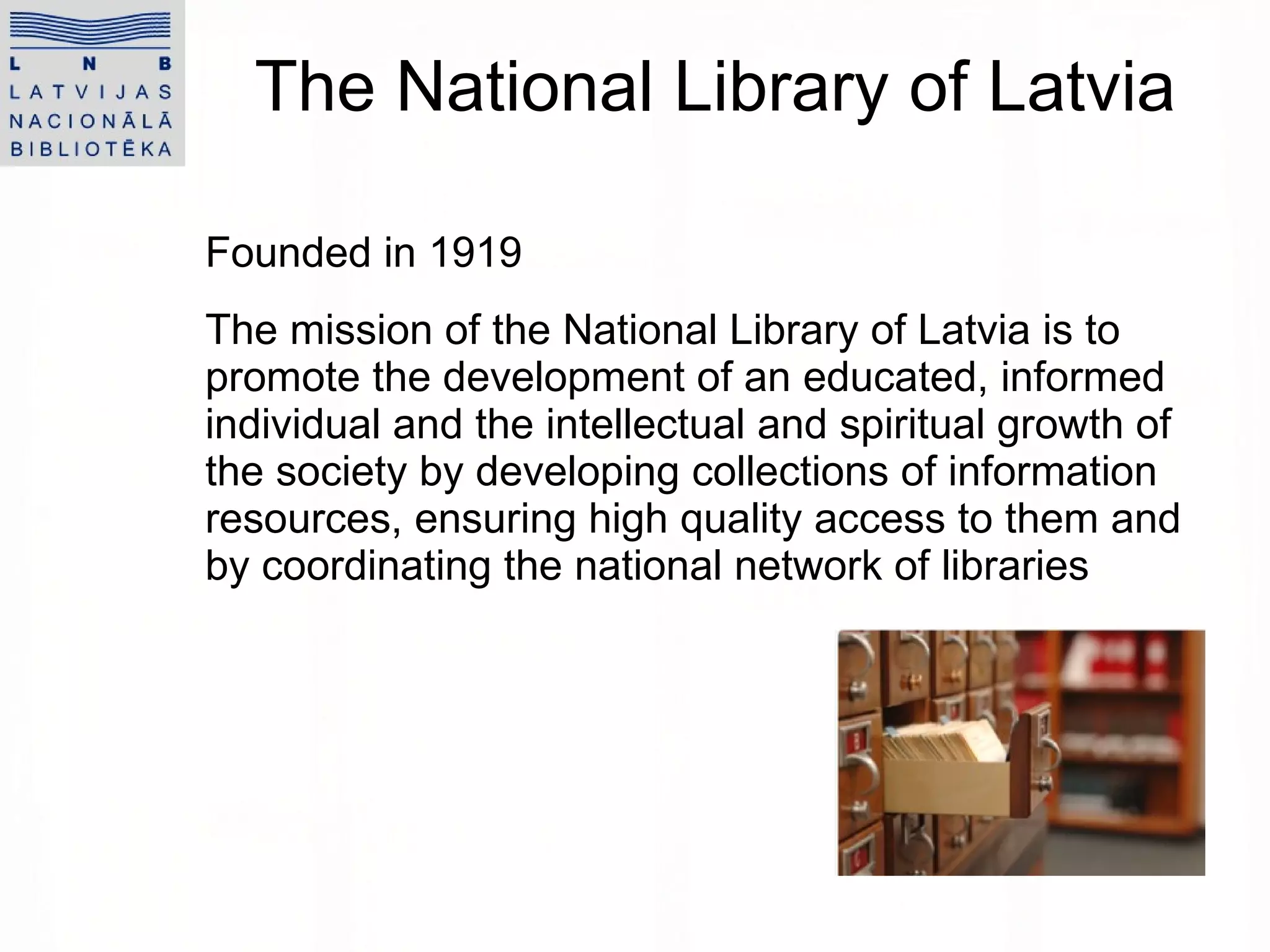
The National Library of Latvia Founded in 1919 The  mission  of the National Library of Latvia  is to promote the development of an   educated, informed individual and the intellectual and spiritual growth of the society by developing collections of information resources, ensuring high quality access to them and by coordinating the   national network of libraries
The  National Library of Latvia is located in 7  buildings. Six of them are in Riga and there is a repository 30 km from Riga in Silakrogs
 
Göteborg Book Fair September 25 - 28, 2008
NLL main indicators NLL collection    4078877 Number of users    104171 Number of registered users 43070 Numbers of visits    717859 Number of handouts    1125944 Average age of visitors    27 years 80% of readers use Library for study  and research Number of employees    339  including 184 librarians  
The Collection of the NLL Historically the Collection has been formed from the 17th to the 20th century, including both printed works and manuscripts from the 15th century Library of Royal [Swedish] Liceum in Riga (established in 1675) Publications in Latvian, German, English, French, Russian, Polish,  Swedish  etc., total in 60 languages
Values of the Collection Collection in total: 4078877   units National editions – the core of the Collection (1586- ) Heritage of the Baltic German materials Editions of Russian emigration (1917- ) Soviet heritage – the source for soviet studies Special collections of the NLL (Letonica, maps, printed music, graphic productions etc.)
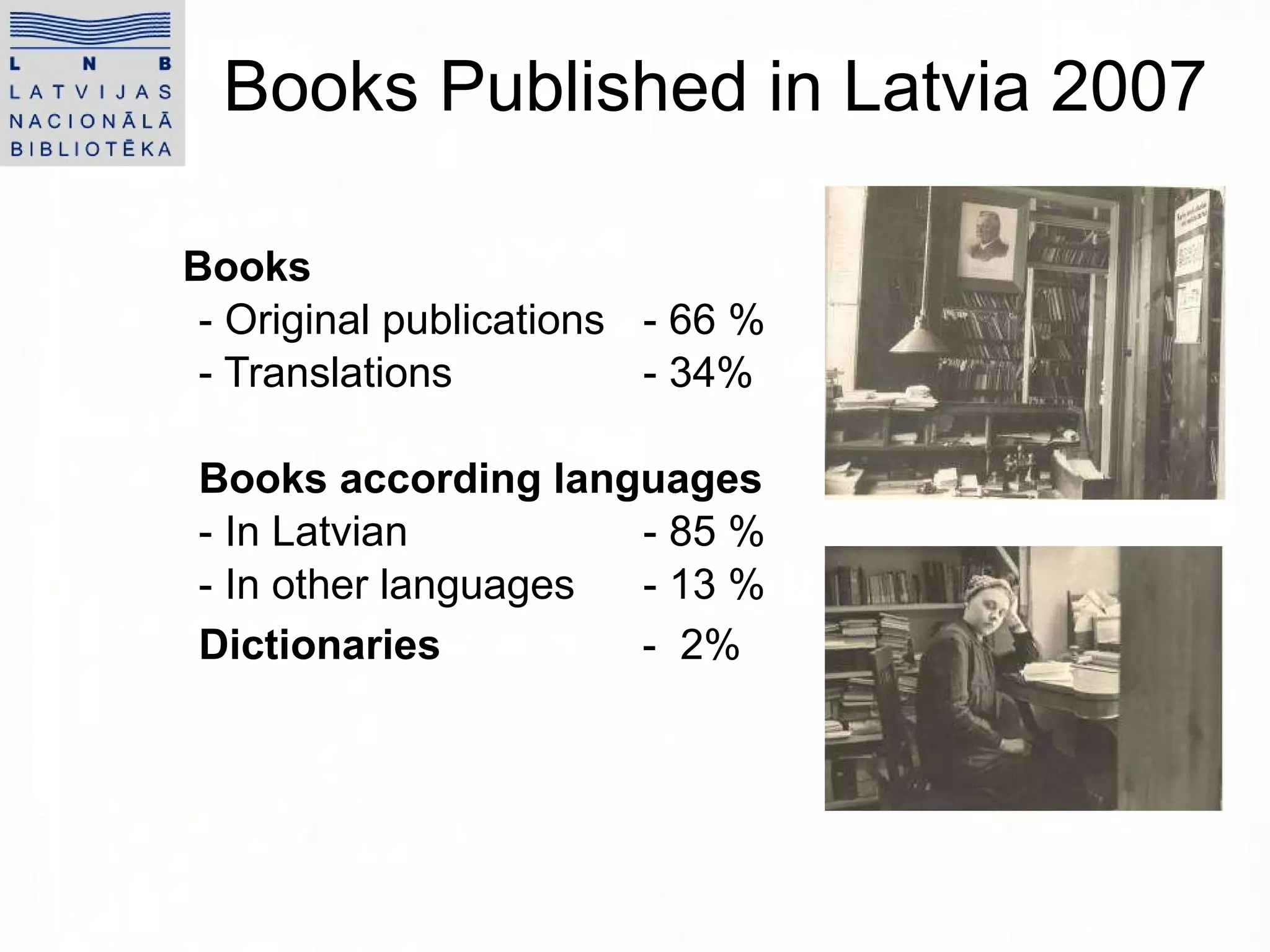
Books Published in Latvia 2007 Books  - Original publications - 66 %  - Translations - 34% Books according languages - In Latvian - 85 % - In other languages - 13 % Dictionaries  -  2%
Other publications in Latvia 2007 Journals, Serials In Latvian   -   69% In other languages   -   31 % Newspapers - In Latvian     -  74 % - In other languages   - 26 %
The Training Center Since the year 2007 the Training Cent er  of the NLL functions as a Regional training cent er   for  the public libraries development project, that is being financed from Latvian state and the foundation of Bill & Melinda Gates’s Courses Improvement of skills of information technology and internet usage Innovative activity in libraries Effective presentation methods attended by 17 groups of librarians
Register of the Scientific Institutions The entry of the NLL into the Register of Scientific Institutions of the Ministry of Education and Science
NLL – member of international organizations UNESCO IFLA International Association of Music libraries, Archives and  Documentation Centres (IAML) International Association of Sound and Audiovisual Archives (IASA) ISBN ISMN ISSN IGeLU European Library Automation Group (ELAG) CENL CDNL CERL LIBER School Library Association (SLA) European Commission for Preservation and Access (ECPA) European Bureau of Library, Information and Documentation Associations (EBLIDA) Association for the Advancement of Baltic Studies, Inc.(AABS) Bibliotheca Baltica The Institute of Conservation (Icon)  The Institute of Paper Conservation (IPC) The British association of paper Historians International Internet Preservation Association (IIPA)
Bilateral C ooperation Agreements 1.  National Libraries of Estonia and Lithuania 2.  National Library of the Czech Republic 3.  National Library of Sweden 4.  Slovak National Library 5.  National Library of Poland 6.  National Library of Belarus 7.  National Library of Russia 8.  State Library of Russia 9.  Library for Foreign Literature (Russia) 10. National Library of Karelia  (Russia) 11. The Vernadsky National Library of Ukraina 12. National Parliamentary Library of Georgia 13. Library Association of Georgia 14. National Library of Azerbaijan
3 general target groups Services  rendered to the  state  –  the legal deposit, national bibliography,  official  press and library statistics, etc. To  other libraries  – advisory, coordination, excellence   / competence, research and professional information  centre  ( 1/ 3 of NLL employees ) Directly to  general population   / public  – i n   accordance with the international practice ,   p redominantly   social  sciences and humanities.
The target audience of NLL Children and adolescents, especially young adults Teachers Students Researchers and experts Employees of culture and art sectors Pensioners Disabled people Entrepreneurs Communications representatives Politicians Foreign nationals Everybody wishing to expand their knowledge Readers 2.0  Librarians Publishers
Library – for students and  school children A place to receive alternative, additional information  on  study subjects , a place  to  work on  projects,  school homeworks A pl a ce to find out something new and exciting A place to form  more extensive and deep knowledge of Latvian history, economy and culture A place to meet like-minded people (discussion clubs, hobbies, etc. ) A place to develop the  abilities to work with information
Göteborg Book Fair September 25 - 28, 2008
Library – for researchers Collections of branch literature, electronic resources Assistance of a knowledgeable branch librarian Accessibility of the  new, state-of-the-art technologies Comfortable,  well - equipped  p ace  to  work Individual work  sp aces,  possibility to  boo k  the literature for the period of working on the research project
Library – for entrepreneurs Real time service s Unbiased, credible information (the offer of alternative, safe sources of information) Flexible and fast delivery of information High quality, professional assistance provided by  the information specialist s
Library – for everybody A place to f ind out how to obtain the information needed in everyday life A place t o improve and develop one’s interests A place t o learn new skills and professions  A place t o attend culture events, discussions, interest clubs,  training sessions
3 main components New building –  The  Castle of  L ight Country wide lib’s network –  The  Lightnet Digital library –  The  Lighthouse
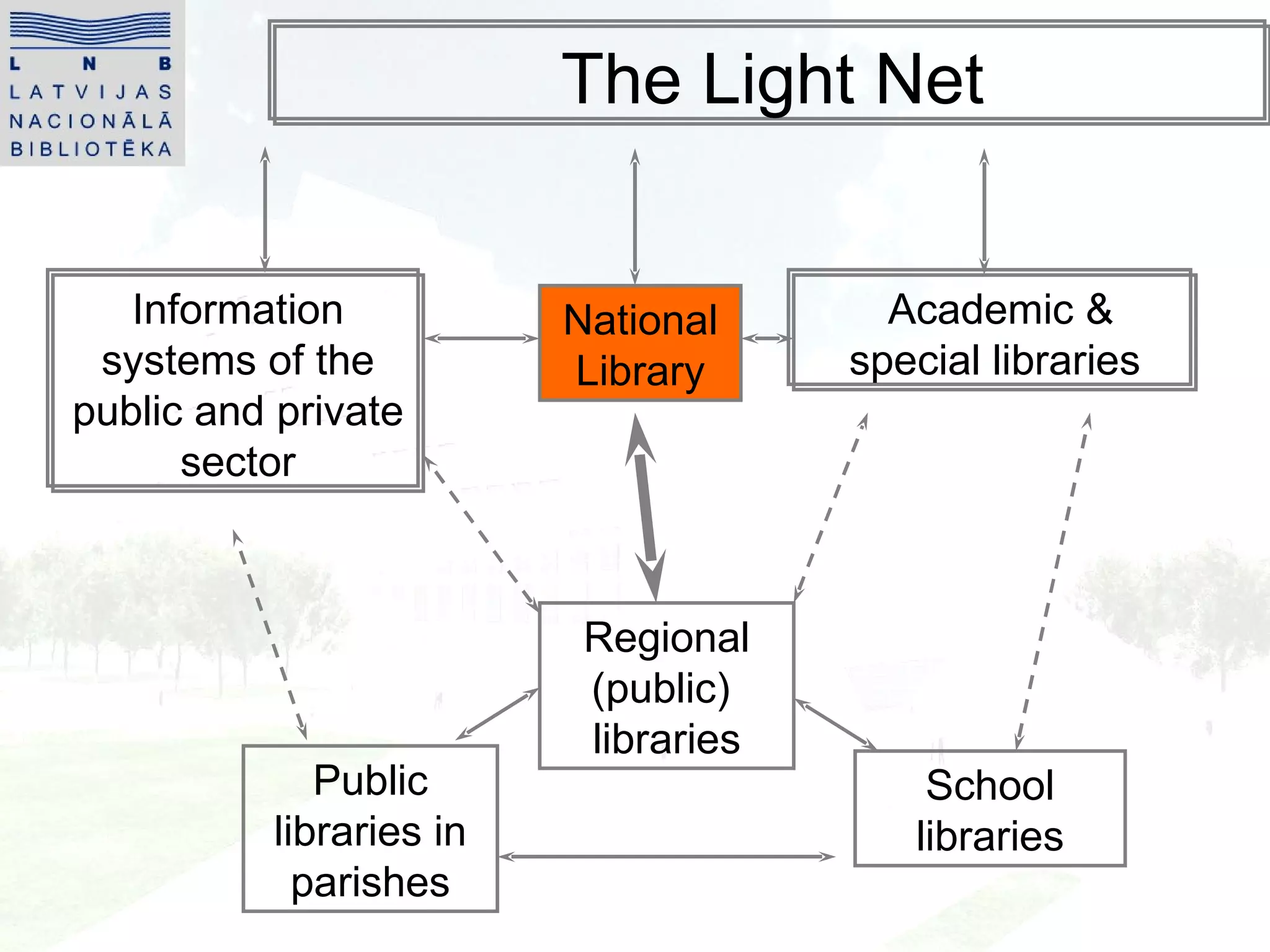
The Light Net Regional (public)  libraries Academic & special libraries Information systems of the public and private sector National Library Public libraries in parishes School libraries
National Digital Library LETONICA –  new, interactive opportunities T he National Digital Library of Latvia  LETONICA  formed in 2006   ensures the wider access to the values of national heritage   Partners:  Memory institutions Cooperation with education institutions on content development (Ministry of Education, University of Latvia, art schools, a.o.) The dawn of PPP (Microsoft, Tilde, Exigen)
 
 
3  Faces of  the National Library of Latvia R eal, physical library with the infrastructure of  the building (reading rooms,  halls, exhibitions,   etc.) and ICT Digital  library  (collection of electronic resources and access point) Virtual  library  (distance services – references, selection of information resources, ordering and receiving   / document  delivery or print on demand)
The new role of the library Library – a creati v e laboratory where information turns into knowledge Library – a  collection of undiscovered treasures (to be aware of and to use own values   / collections,  to  be able to  promote  them) Library –  a  “stage” for produc tion of  performances (a site where interesting events are held, a meeting point)
The new building of the National Library of Latvia Castle of Light Göteborg Book Fair September 25 - 28, 2008
History of the Castle of Light The necessity to build the new  National L ibrary  in Latvia  has been recognised since 192 8 1988  –  Government  passes  the resolution to design the  new building of the National Library 1989 – architect Gunārs Birkerts was accepted as a designer of the new Library 1995 – Hill International, USA was selected to lead the Project and Construction management November 17, 1999  –  UNESCO General Conference  issues a  Resolution  to  support the  National Library  project  Castle of Light 2000  – t he design  of the Castle of Light  receive s  American Architecture Award
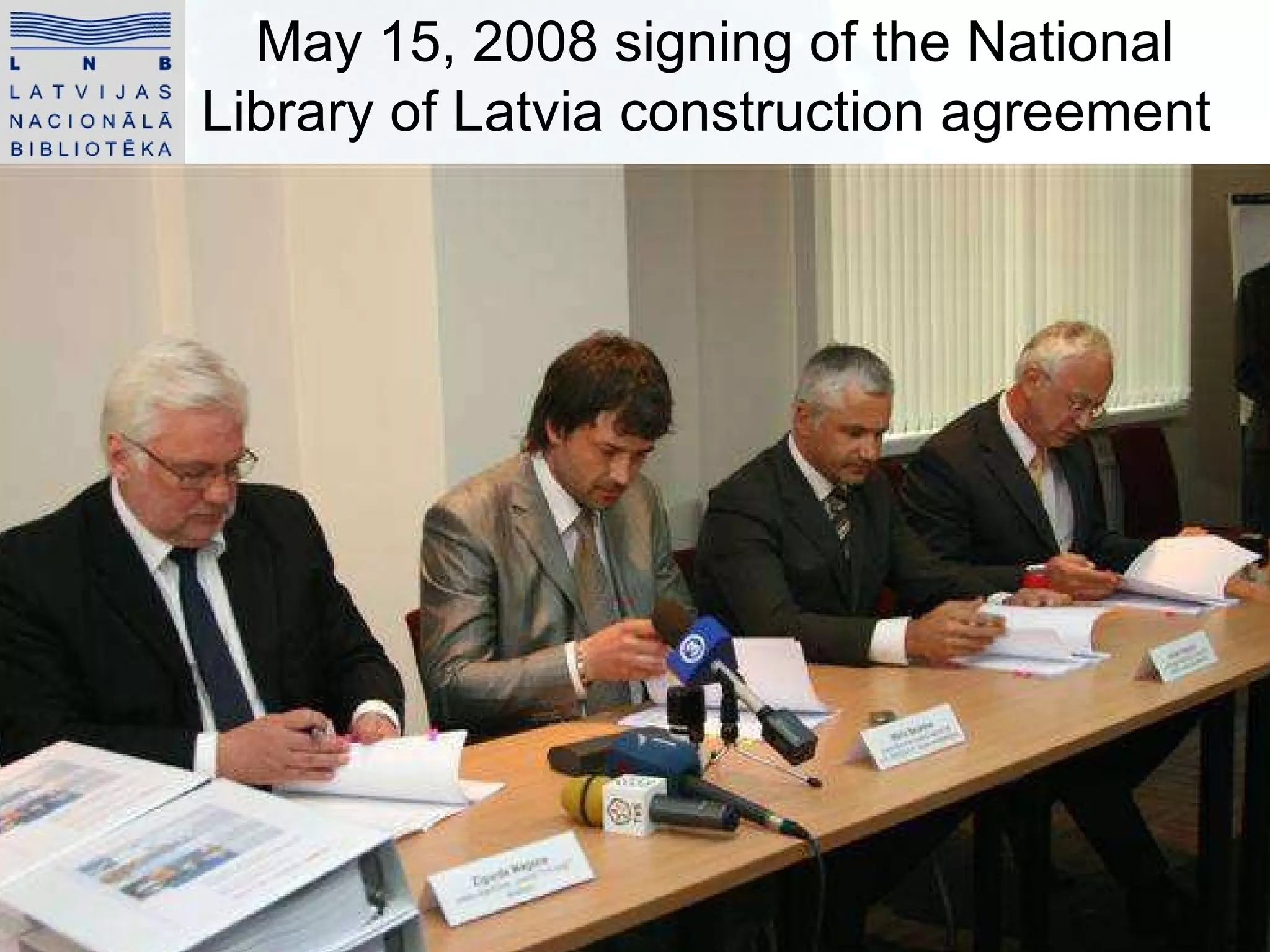
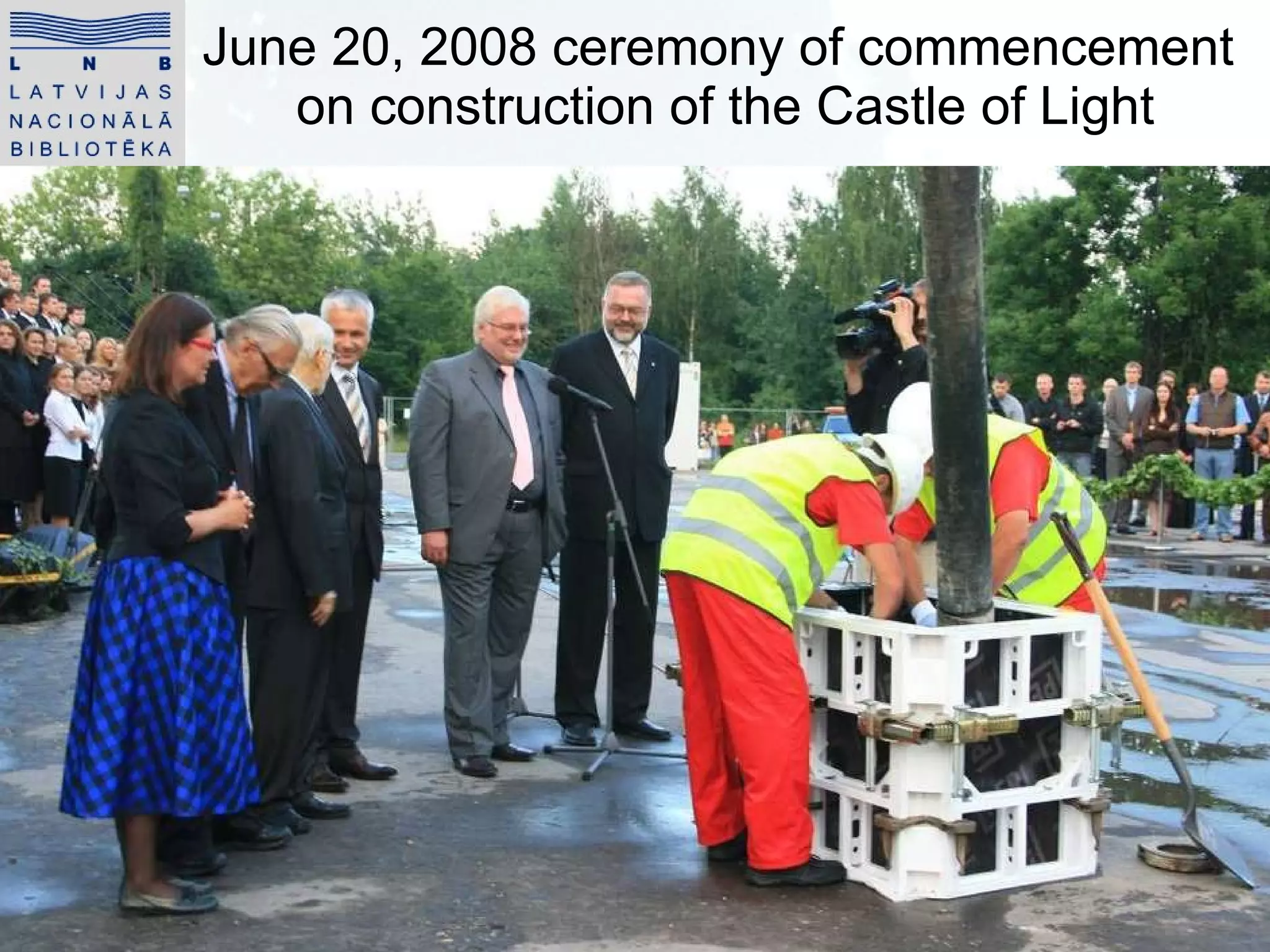
July  13 , 200 2   –  the Saeima (Parlament)  adopts  the law on the implementation of the  National Library  project  (revised 08.05.2003.) November 2007 – design development is completed May 15, 2008 – signing of the National Library of Latvia construction agreement  History of the Castle of Light June 20, 2008 ceremony of commencement  on construction of the Castle of Light August 2010 installation of first glass panels
May 15, 2008 signing of the National Library of Latvia construction agreement   Göteborg Book Fair September 25 - 28, 2008
June 20, 2008 ceremony of commencement  on construction of the Castle of Light Göteborg Book Fair September 25 - 28, 2008
Project management The National Library project The Castle of Light next to Riga Concert Hall, Museum of Contemporary Art and Liepaja Concert Hall Giant Amber represent the government’s largest investment projects in the area of culture in Latvia. Planning, design and construction is realised by the state agency The New Three Brothers  www.j3b.gov.lv The comissionary of the project The Castle of Light is the Ministry of Culture The Govenment has assigned the Supervisory Institution of the Library project development
 
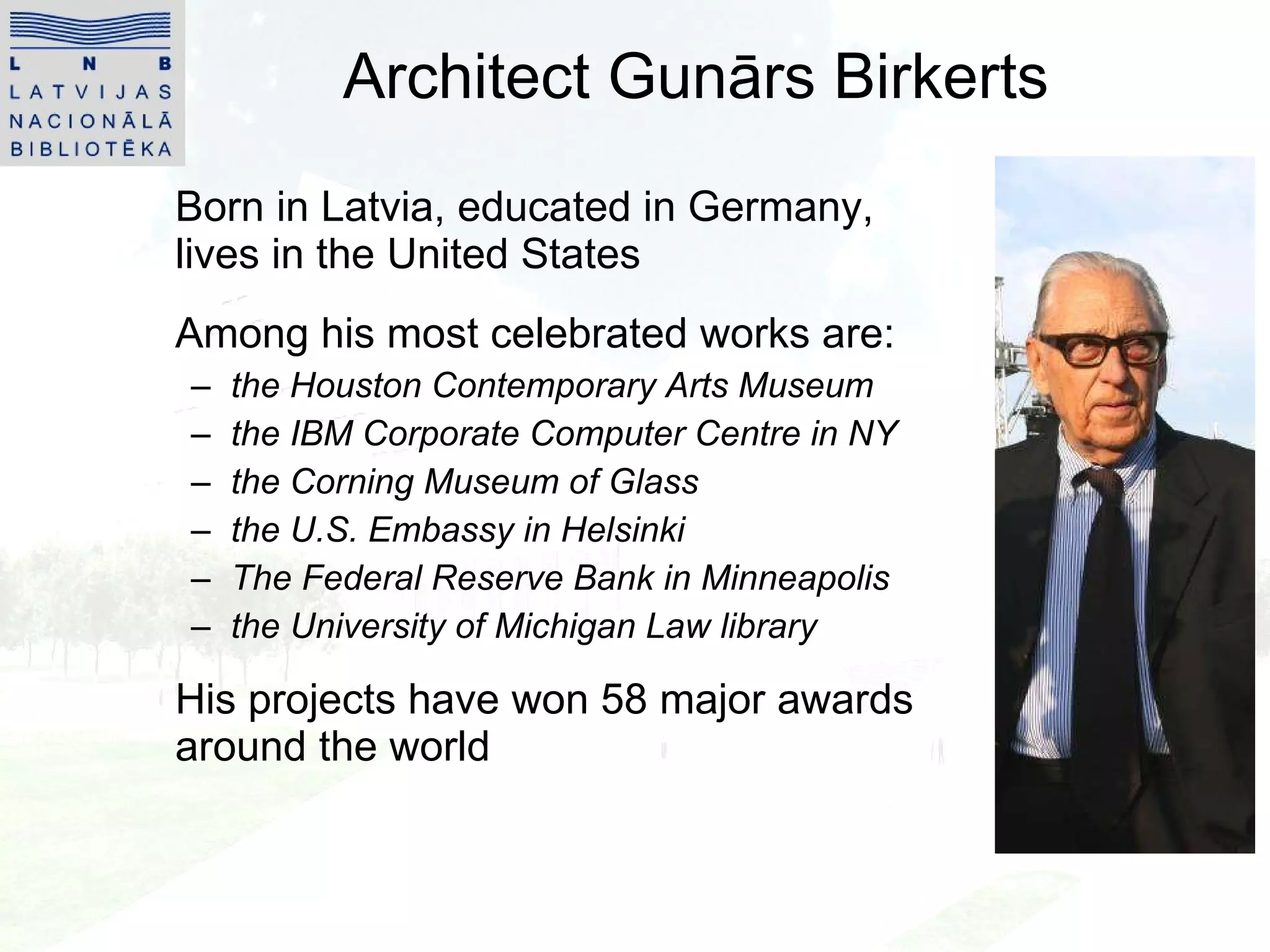
Architect Gunārs Birkerts Born in Latvia, educated in Germany, lives in the United States Among his most celebrated works are:  the Houston Contemporary Arts Museum the IBM Corporate Computer Centre in NY  the Corning Museum of Glass  the U.S. Embassy in Helsinki The Federal Reserve Bank in Minneapolis the University of Michigan Law library His projects have won 58 major awards around the world
Göteborg Book Fair September 25 - 28, 2008
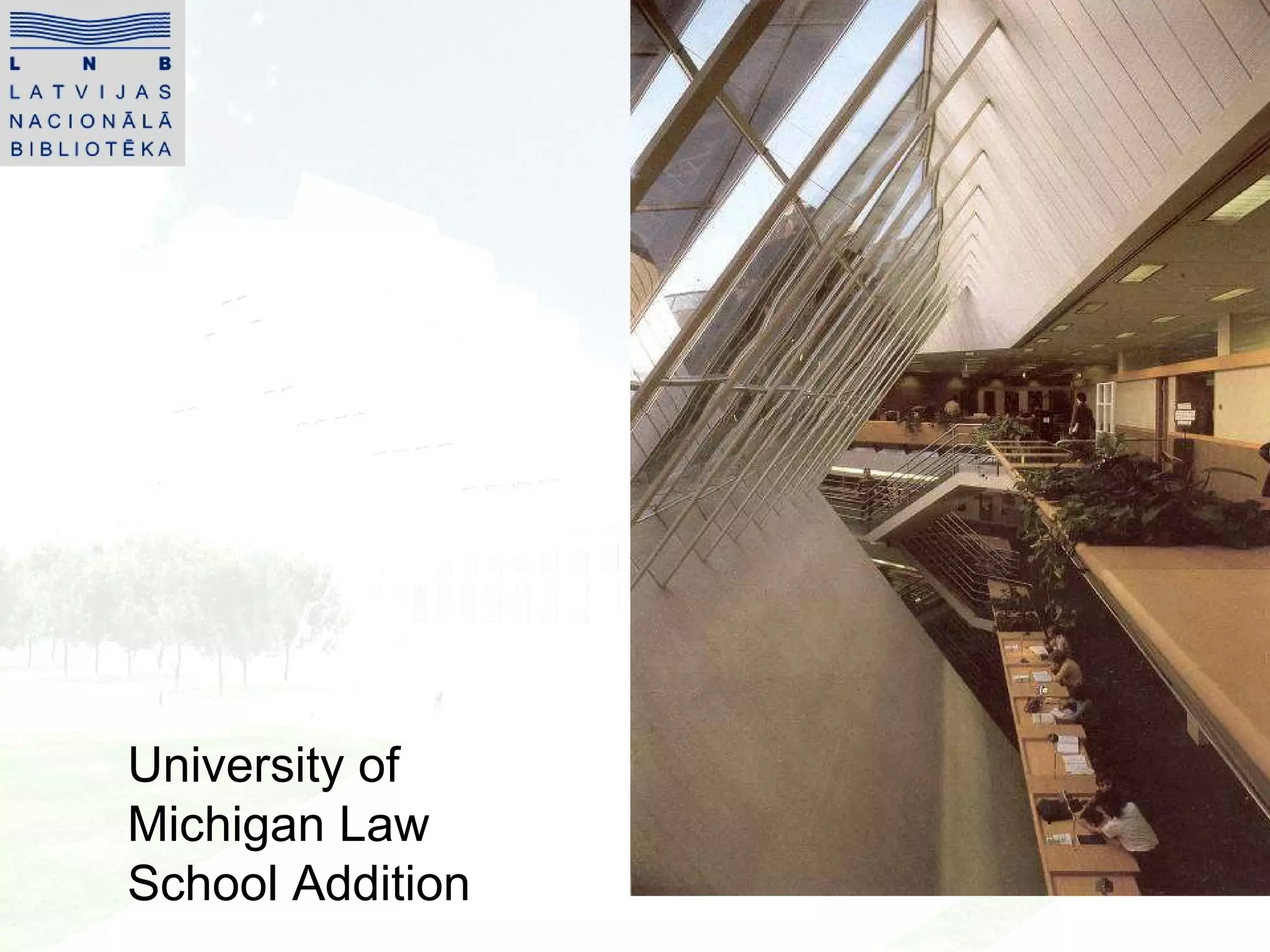
University of Michigan Law School Addition
Ohio State University Library
Göteborg Book Fair September 25 - 28, 2008 The City of San José &   San José State University
Göteborg Book Fair September 25 - 28, 2008 Riga at night and the new National Library of Latvia
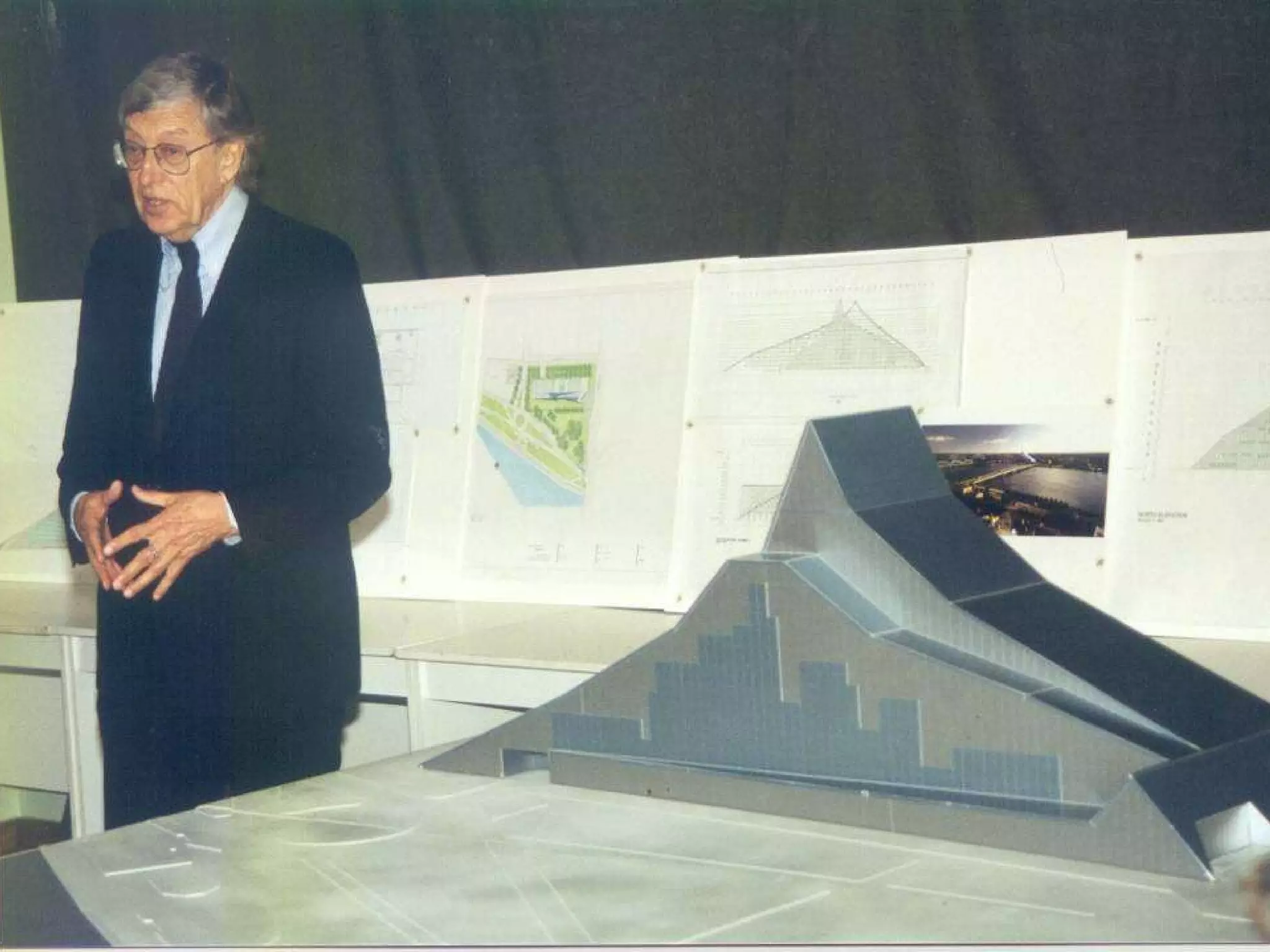
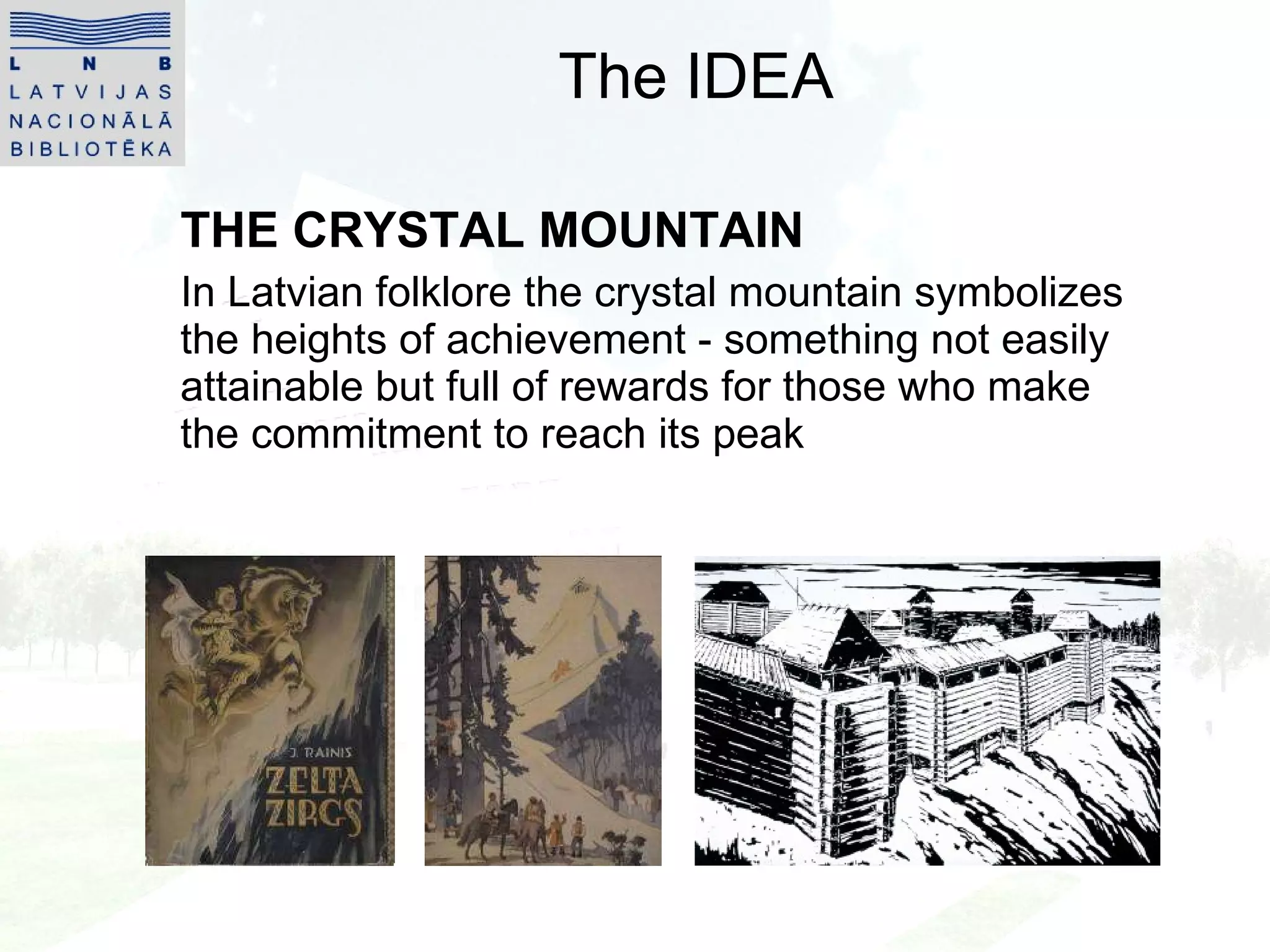
The IDEA THE CRYSTAL MOUNTAIN In Latvian folklore the crystal mountain symbolizes the heights of achievement - something not easily attainable but full of rewards for those who make the commitment to reach its peak
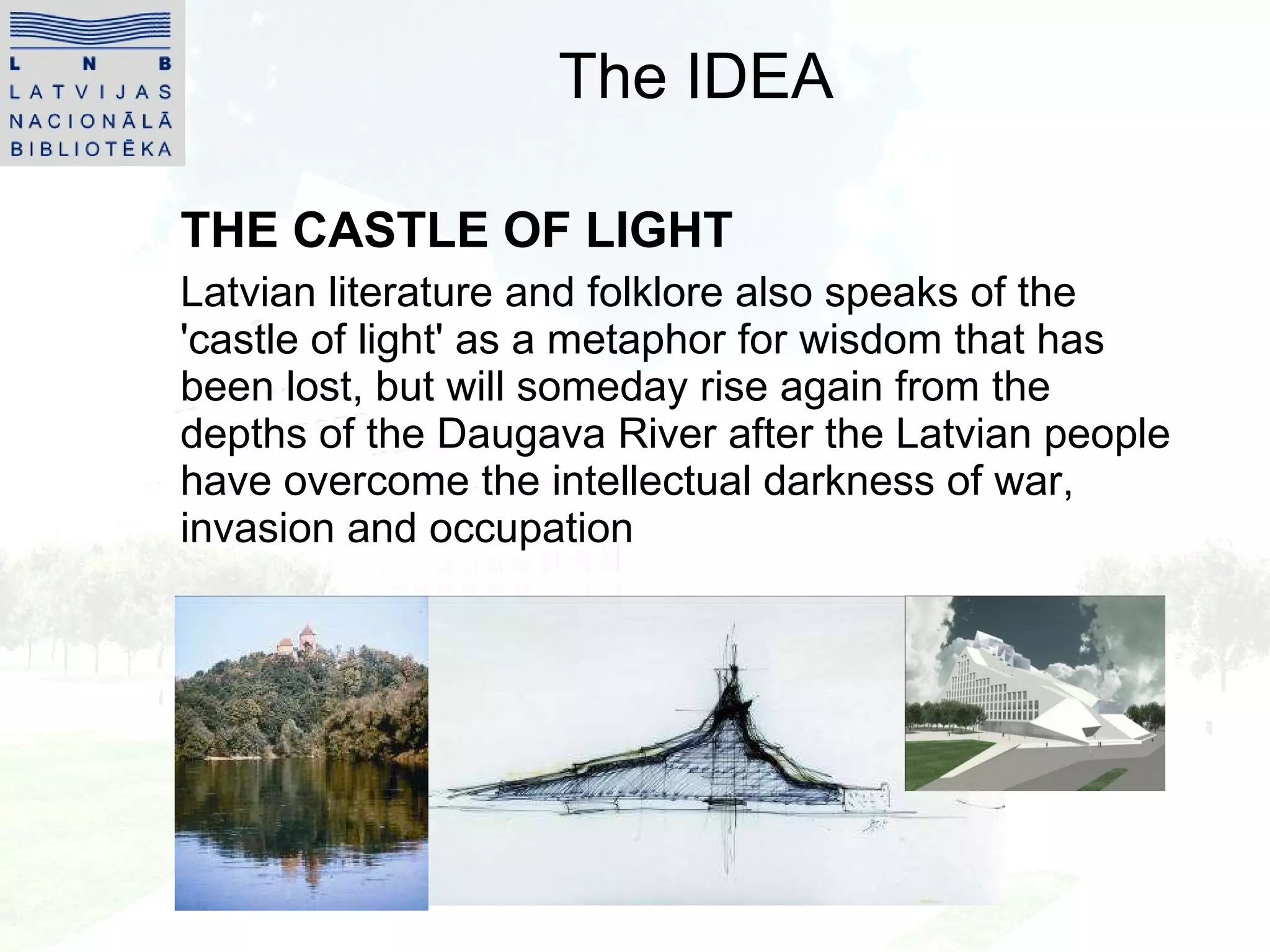
The IDEA THE CASTLE OF LIGHT Latvian literature and folklore also speaks of the 'castle of light' as a metaphor for wisdom that has been lost, but will someday rise again from the depths of the Daugava River after the Latvian people have overcome the intellectual darkness of war, invasion and occupation
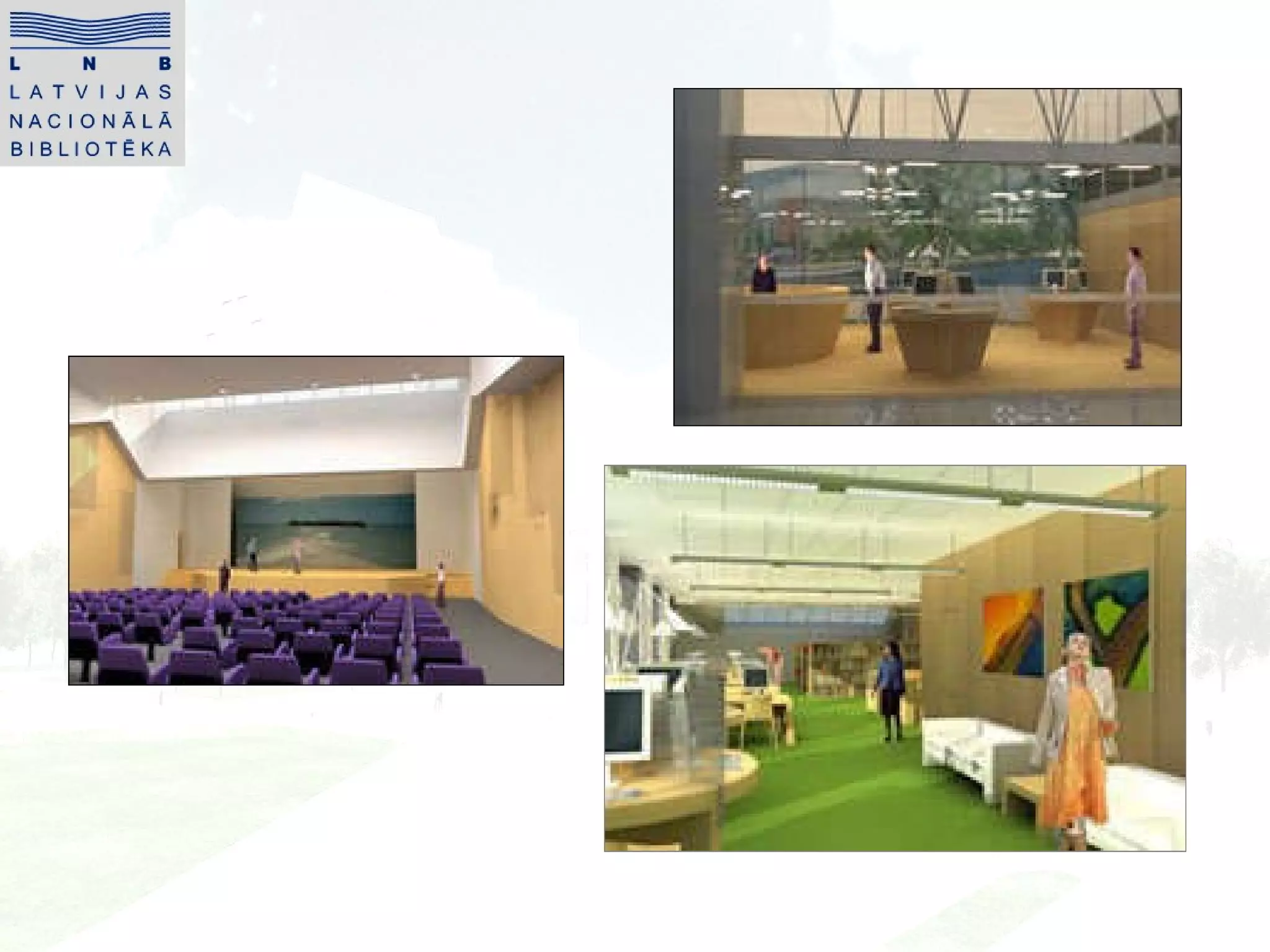
The IDEA Birkerts has incorporated both of these evocative Latvian symbols in the design of the new Latvian National Library building Latvia's new National Library building designed by Gunārs Birkerts is both a striking architectural symbol for Latvia and a state-of-the-art, multi-functional structure that meets the needs of a modern information based society Located on the left bank of the legendary Daugava River, its glassy slopes will mirror the spires that shape the distinctive silhouette of Riga's elegant Old Town
The layout of the territory 1- The Latvian National  Library 2- Technical service rooms 3- Underground parking 4 - The reconstruction of Mūkusalas iela
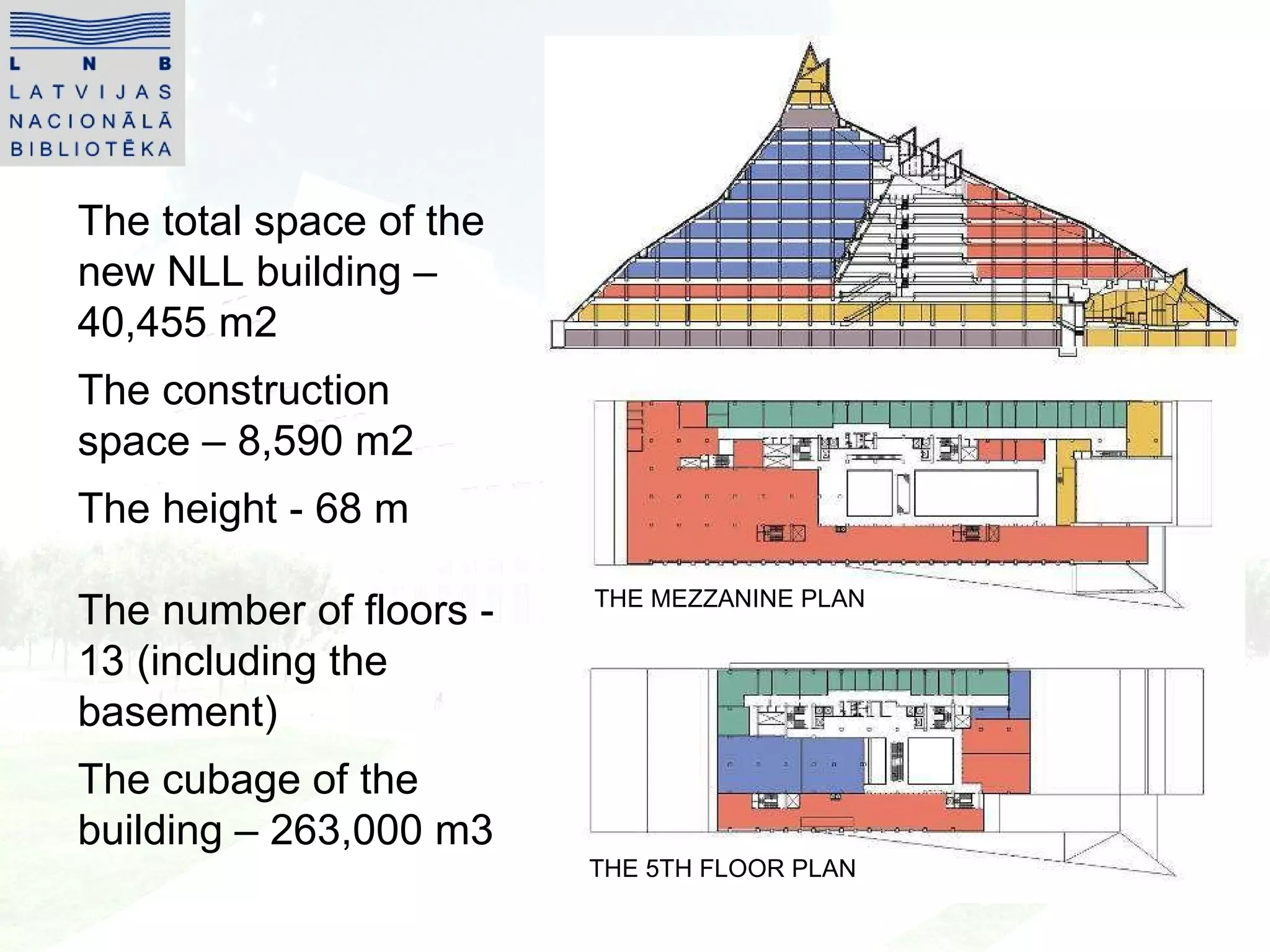
The total space of the new  NLL  building – 40,455 m2  The construction space – 8,590 m2  The height - 68 m  The number of floors - 13 (including the basement) The cubage of the building – 263,000 m3  THE MEZZANINE PLAN THE 5TH FLOOR PLAN
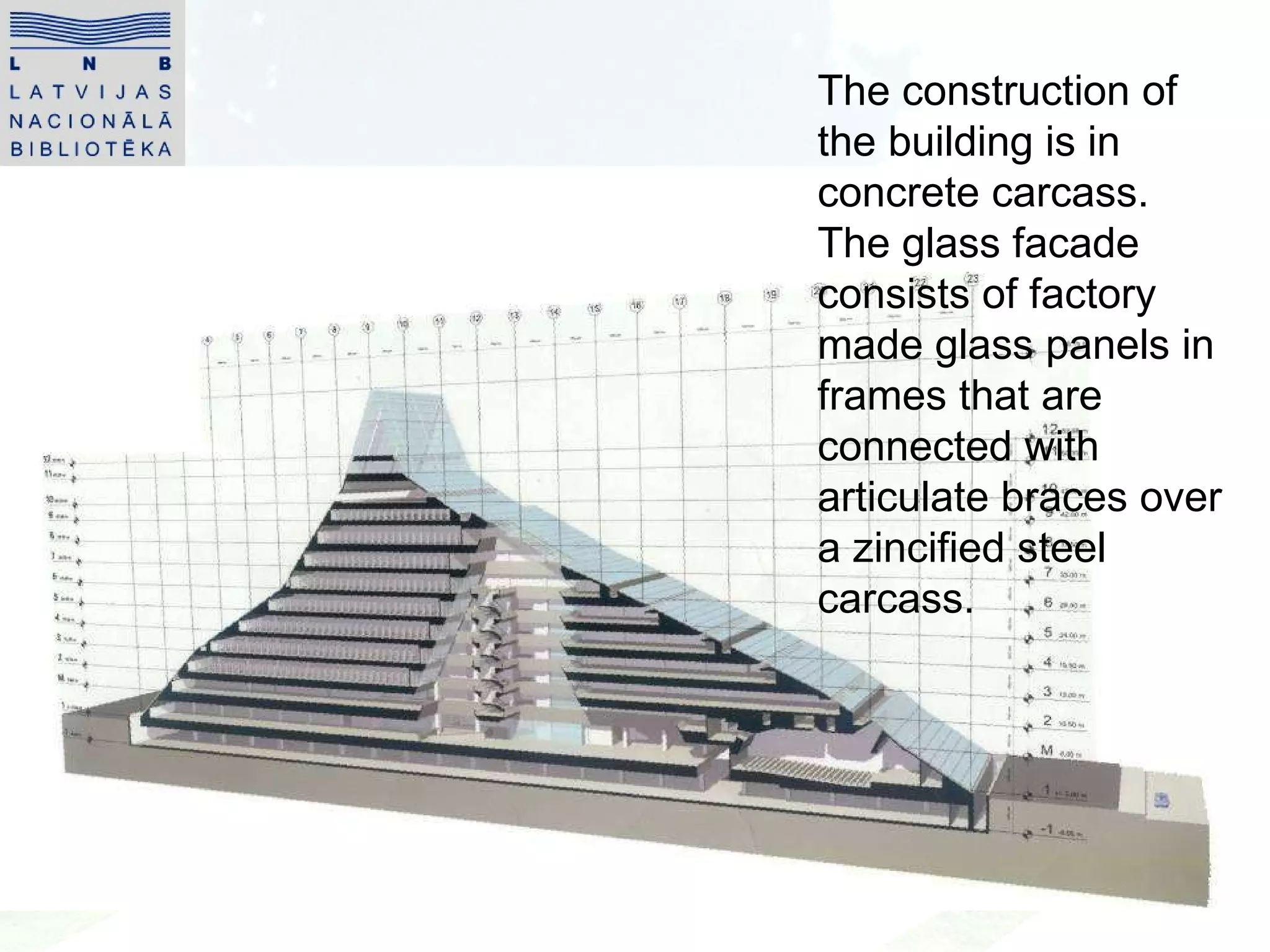
The construction  of  the building is in concrete carcass. The glass facade consists of factory made glass panels in frames that are connected with articulate braces over a zincified steel carcass.
Building Standards 1. Reader station size: 2.5 to 3 square meters 2. 300 – 400 volumes per square meter in reading rooms  3. 600 – 900 volumes per square meter in compact shelving  4. Space assignment per employee: 5 – 8 square meters 5. Acoustic barrier: 43-45dB. 6. Lighting level on reader station table top: 500 lux. 7. Temperature level in reading rooms: 21-24 C; in stack storage area: 18C. 8. Humidity level in reading room:  55-65%; in stack storage area: 45-55%. 9. Air exchange: 2 volumes per hour.
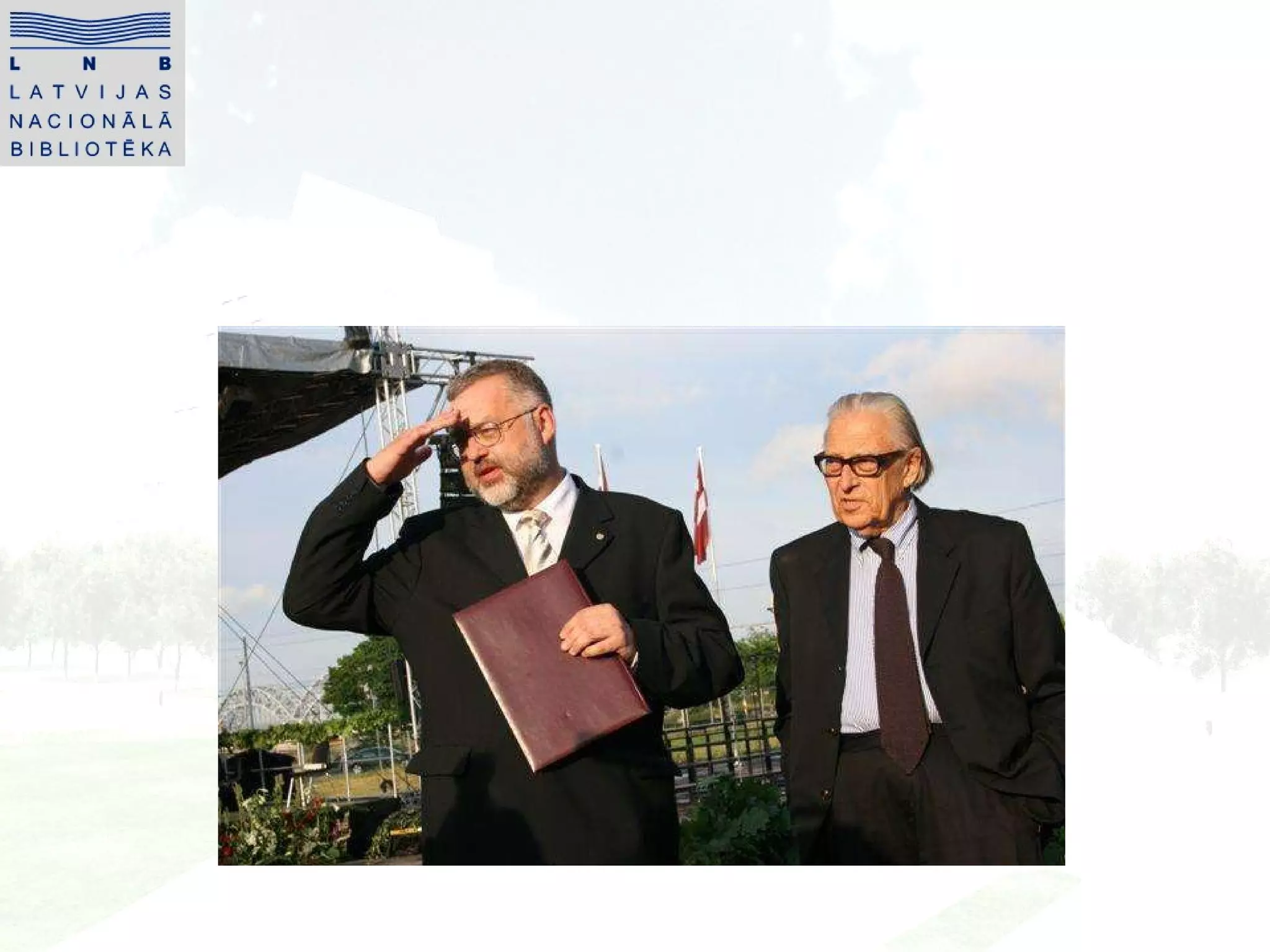
Support to the Project The significance of the project lasting almost a century was confirmed by high-level international recognition when almost  all 170 member states during the UNESCO General Conference in 1999 adopted a resolution, calling international community to ensure all possible support As a result UNESCO established International Commission of Experts in 2000 . September 8, 2000 the first meeting of Experts took place in Riga, at the Ministry of Culture
Friends and supporters
A library is not simply a building, but a repository of knowledge where information can be stored, protected and shared. The building that houses a library is both a  structure and a symbol of the human knowledge it contains and reveres.
 

National Library of Latvia2010

  • 1.
  • 2.
    The National Libraryof Latvia Founded in 1919 The mission of the National Library of Latvia is to promote the development of an educated, informed individual and the intellectual and spiritual growth of the society by developing collections of information resources, ensuring high quality access to them and by coordinating the national network of libraries
  • 3.
    The NationalLibrary of Latvia is located in 7 buildings. Six of them are in Riga and there is a repository 30 km from Riga in Silakrogs
  • 4.
  • 5.
    Göteborg Book FairSeptember 25 - 28, 2008
  • 6.
    NLL main indicatorsNLL collection  4078877 Number of users 104171 Number of registered users 43070 Numbers of visits 717859 Number of handouts 1125944 Average age of visitors 27 years 80% of readers use Library for study and research Number of employees 339 including 184 librarians  
  • 7.
    The Collection ofthe NLL Historically the Collection has been formed from the 17th to the 20th century, including both printed works and manuscripts from the 15th century Library of Royal [Swedish] Liceum in Riga (established in 1675) Publications in Latvian, German, English, French, Russian, Polish, Swedish etc., total in 60 languages
  • 8.
    Values of theCollection Collection in total: 4078877 units National editions – the core of the Collection (1586- ) Heritage of the Baltic German materials Editions of Russian emigration (1917- ) Soviet heritage – the source for soviet studies Special collections of the NLL (Letonica, maps, printed music, graphic productions etc.)
  • 9.
    Books Published inLatvia 2007 Books - Original publications - 66 % - Translations - 34% Books according languages - In Latvian - 85 % - In other languages - 13 % Dictionaries - 2%
  • 10.
    Other publications inLatvia 2007 Journals, Serials In Latvian - 69% In other languages - 31 % Newspapers - In Latvian - 74 % - In other languages - 26 %
  • 11.
    The Training CenterSince the year 2007 the Training Cent er of the NLL functions as a Regional training cent er for the public libraries development project, that is being financed from Latvian state and the foundation of Bill & Melinda Gates’s Courses Improvement of skills of information technology and internet usage Innovative activity in libraries Effective presentation methods attended by 17 groups of librarians
  • 12.
    Register of theScientific Institutions The entry of the NLL into the Register of Scientific Institutions of the Ministry of Education and Science
  • 13.
    NLL – memberof international organizations UNESCO IFLA International Association of Music libraries, Archives and Documentation Centres (IAML) International Association of Sound and Audiovisual Archives (IASA) ISBN ISMN ISSN IGeLU European Library Automation Group (ELAG) CENL CDNL CERL LIBER School Library Association (SLA) European Commission for Preservation and Access (ECPA) European Bureau of Library, Information and Documentation Associations (EBLIDA) Association for the Advancement of Baltic Studies, Inc.(AABS) Bibliotheca Baltica The Institute of Conservation (Icon) The Institute of Paper Conservation (IPC) The British association of paper Historians International Internet Preservation Association (IIPA)
  • 14.
    Bilateral C ooperationAgreements 1. National Libraries of Estonia and Lithuania 2. National Library of the Czech Republic 3. National Library of Sweden 4. Slovak National Library 5. National Library of Poland 6. National Library of Belarus 7. National Library of Russia 8. State Library of Russia 9. Library for Foreign Literature (Russia) 10. National Library of Karelia (Russia) 11. The Vernadsky National Library of Ukraina 12. National Parliamentary Library of Georgia 13. Library Association of Georgia 14. National Library of Azerbaijan
  • 15.
    3 general targetgroups Services rendered to the state – the legal deposit, national bibliography, official press and library statistics, etc. To other libraries – advisory, coordination, excellence / competence, research and professional information centre ( 1/ 3 of NLL employees ) Directly to general population / public – i n accordance with the international practice , p redominantly social sciences and humanities.
  • 16.
    The target audienceof NLL Children and adolescents, especially young adults Teachers Students Researchers and experts Employees of culture and art sectors Pensioners Disabled people Entrepreneurs Communications representatives Politicians Foreign nationals Everybody wishing to expand their knowledge Readers 2.0 Librarians Publishers
  • 17.
    Library – forstudents and school children A place to receive alternative, additional information on study subjects , a place to work on projects, school homeworks A pl a ce to find out something new and exciting A place to form more extensive and deep knowledge of Latvian history, economy and culture A place to meet like-minded people (discussion clubs, hobbies, etc. ) A place to develop the abilities to work with information
  • 18.
    Göteborg Book FairSeptember 25 - 28, 2008
  • 19.
    Library – forresearchers Collections of branch literature, electronic resources Assistance of a knowledgeable branch librarian Accessibility of the new, state-of-the-art technologies Comfortable, well - equipped p ace to work Individual work sp aces, possibility to boo k the literature for the period of working on the research project
  • 20.
    Library – forentrepreneurs Real time service s Unbiased, credible information (the offer of alternative, safe sources of information) Flexible and fast delivery of information High quality, professional assistance provided by the information specialist s
  • 21.
    Library – foreverybody A place to f ind out how to obtain the information needed in everyday life A place t o improve and develop one’s interests A place t o learn new skills and professions A place t o attend culture events, discussions, interest clubs, training sessions
  • 22.
    3 main componentsNew building – The Castle of L ight Country wide lib’s network – The Lightnet Digital library – The Lighthouse
  • 23.
    The Light NetRegional (public) libraries Academic & special libraries Information systems of the public and private sector National Library Public libraries in parishes School libraries
  • 24.
    National Digital LibraryLETONICA – new, interactive opportunities T he National Digital Library of Latvia LETONICA formed in 2006 ensures the wider access to the values of national heritage Partners: Memory institutions Cooperation with education institutions on content development (Ministry of Education, University of Latvia, art schools, a.o.) The dawn of PPP (Microsoft, Tilde, Exigen)
  • 25.
  • 26.
  • 27.
    3 Facesof the National Library of Latvia R eal, physical library with the infrastructure of the building (reading rooms, halls, exhibitions, etc.) and ICT Digital library (collection of electronic resources and access point) Virtual library (distance services – references, selection of information resources, ordering and receiving / document delivery or print on demand)
  • 28.
    The new roleof the library Library – a creati v e laboratory where information turns into knowledge Library – a collection of undiscovered treasures (to be aware of and to use own values / collections, to be able to promote them) Library – a “stage” for produc tion of performances (a site where interesting events are held, a meeting point)
  • 29.
    The new buildingof the National Library of Latvia Castle of Light Göteborg Book Fair September 25 - 28, 2008
  • 30.
    History of theCastle of Light The necessity to build the new National L ibrary in Latvia has been recognised since 192 8 1988 – Government passes the resolution to design the new building of the National Library 1989 – architect Gunārs Birkerts was accepted as a designer of the new Library 1995 – Hill International, USA was selected to lead the Project and Construction management November 17, 1999 – UNESCO General Conference issues a Resolution to support the National Library project Castle of Light 2000 – t he design of the Castle of Light receive s American Architecture Award
  • 31.
    July 13, 200 2 – the Saeima (Parlament) adopts the law on the implementation of the National Library project (revised 08.05.2003.) November 2007 – design development is completed May 15, 2008 – signing of the National Library of Latvia construction agreement History of the Castle of Light June 20, 2008 ceremony of commencement on construction of the Castle of Light August 2010 installation of first glass panels
  • 32.
    May 15, 2008signing of the National Library of Latvia construction agreement Göteborg Book Fair September 25 - 28, 2008
  • 33.
    June 20, 2008ceremony of commencement on construction of the Castle of Light Göteborg Book Fair September 25 - 28, 2008
  • 34.
    Project management TheNational Library project The Castle of Light next to Riga Concert Hall, Museum of Contemporary Art and Liepaja Concert Hall Giant Amber represent the government’s largest investment projects in the area of culture in Latvia. Planning, design and construction is realised by the state agency The New Three Brothers www.j3b.gov.lv The comissionary of the project The Castle of Light is the Ministry of Culture The Govenment has assigned the Supervisory Institution of the Library project development
  • 35.
  • 36.
    Architect Gunārs BirkertsBorn in Latvia, educated in Germany, lives in the United States Among his most celebrated works are: the Houston Contemporary Arts Museum the IBM Corporate Computer Centre in NY the Corning Museum of Glass the U.S. Embassy in Helsinki The Federal Reserve Bank in Minneapolis the University of Michigan Law library His projects have won 58 major awards around the world
  • 37.
    Göteborg Book FairSeptember 25 - 28, 2008
  • 38.
    University of MichiganLaw School Addition
  • 39.
  • 40.
    Göteborg Book FairSeptember 25 - 28, 2008 The City of San José & San José State University
  • 41.
    Göteborg Book FairSeptember 25 - 28, 2008 Riga at night and the new National Library of Latvia
  • 42.
    The IDEA THECRYSTAL MOUNTAIN In Latvian folklore the crystal mountain symbolizes the heights of achievement - something not easily attainable but full of rewards for those who make the commitment to reach its peak
  • 43.
    The IDEA THECASTLE OF LIGHT Latvian literature and folklore also speaks of the 'castle of light' as a metaphor for wisdom that has been lost, but will someday rise again from the depths of the Daugava River after the Latvian people have overcome the intellectual darkness of war, invasion and occupation
  • 44.
    The IDEA Birkertshas incorporated both of these evocative Latvian symbols in the design of the new Latvian National Library building Latvia's new National Library building designed by Gunārs Birkerts is both a striking architectural symbol for Latvia and a state-of-the-art, multi-functional structure that meets the needs of a modern information based society Located on the left bank of the legendary Daugava River, its glassy slopes will mirror the spires that shape the distinctive silhouette of Riga's elegant Old Town
  • 45.
    The layout ofthe territory 1- The Latvian National Library 2- Technical service rooms 3- Underground parking 4 - The reconstruction of Mūkusalas iela
  • 46.
    The total spaceof the new NLL building – 40,455 m2 The construction space – 8,590 m2 The height - 68 m The number of floors - 13 (including the basement) The cubage of the building – 263,000 m3 THE MEZZANINE PLAN THE 5TH FLOOR PLAN
  • 47.
    The construction of the building is in concrete carcass. The glass facade consists of factory made glass panels in frames that are connected with articulate braces over a zincified steel carcass.
  • 48.
    Building Standards 1.Reader station size: 2.5 to 3 square meters 2. 300 – 400 volumes per square meter in reading rooms 3. 600 – 900 volumes per square meter in compact shelving 4. Space assignment per employee: 5 – 8 square meters 5. Acoustic barrier: 43-45dB. 6. Lighting level on reader station table top: 500 lux. 7. Temperature level in reading rooms: 21-24 C; in stack storage area: 18C. 8. Humidity level in reading room: 55-65%; in stack storage area: 45-55%. 9. Air exchange: 2 volumes per hour.
  • 49.
    Support to theProject The significance of the project lasting almost a century was confirmed by high-level international recognition when almost all 170 member states during the UNESCO General Conference in 1999 adopted a resolution, calling international community to ensure all possible support As a result UNESCO established International Commission of Experts in 2000 . September 8, 2000 the first meeting of Experts took place in Riga, at the Ministry of Culture
  • 50.
  • 51.
    A library isnot simply a building, but a repository of knowledge where information can be stored, protected and shared. The building that houses a library is both a structure and a symbol of the human knowledge it contains and reveres.
  • 52.

Editor's Notes

  • #2 Šajā referātā es gribētu pieskarties jautājumam par fiziskas, telpiskas infrastruktūras mūsdienu un rītdienas lomu zināšanu sabiedrībā. Nav noslēpums, ka attiecībā uz bibliotēkām, arī arhīviem un citām atmiņas institūcijām pastāv arī visai radikāli viedokļi. Jēga ir tikai tam, kas ir ciparos. Googlēšana – universāla atslēga informācijas videi. Informācijas brokeri, mentori nav vajadzīgi. Ir taču web 2.0 ēra. Tūrpat pie durvīm 3.0, 4.0. 700.000 latviešu, kas ir 1/3 no valsts iedzīvotājiem ir vienā blogā: draugi.lv. Neiedomājami grūti šādā situācijā vērtību sistēmā klājas reālām celtnēm un tur strādājošiem. Tajā pašā laikā tieši pēdējos gados iezīmējušās iniciatīvas, kuru mērķis ir sistemātiski radīt vidi izglītībai, zināšanām un kultūrai digitālā vidē. Kā galvenie spēlētāji te tiek iezīmēti publiskie veidojumi, tiesa, ar rekomendāciju iesaistīt arī privātā sektora kapacitāti.
  • #17 The target audience of NLL is very diverse and broad, including the readers of all social strata, sectors and ages
  • #22 How to choose a doctor, use medication, principles of healthy nutrition To read the scholars’ opinions on the new discoveries in science (gene research, bionics, etc.) How to protect one’s ownership rights, to learn new professions. Acquiring the skills for working with contemporary technologies (DVDs, multimedia equipment) Participate in discussions on the development of a child, solving family problems