Advanced Hurdle Technique
Coach Tyler Mettille & Coach Nate Heddleston
Youngstown State University The University of Mount Union
for 100 & 110 hurdles
Where We Seek Improvement
I. Top-end and Fitness:
What we do on interval day and away
from the hurdles
II. Start:
What we do from the block to hurdle 1
(H1)
III. Body Orientation & Hurdle
Mechanics:
What we do over the hurdles
IV. Ground Mechanics:
What we do into and off-the-back of
the hurdles
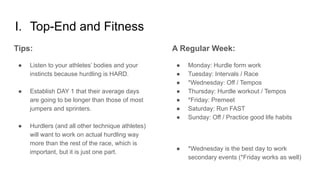
I. Top-End and Fitness
A Regular Week:
● Monday: Hurdle form work
● Tuesday: Intervals / Race
● *Wednesday: Off / Tempos
● Thursday: Hurdle workout / Tempos
● *Friday: Premeet
● Saturday: Run FAST
● Sunday: Off / Practice good life habits
● *Wednesday is the best day to work
secondary events (*Friday works as well)
Tips:
● Listen to your athletes’ bodies and your
instincts because hurdling is HARD.
● Establish DAY 1 that their average days
are going to be longer than those of most
jumpers and sprinters.
● Hurdlers (and all other technique athletes)
will want to work on actual hurdling way
more than the rest of the race, which is
important, but it is just one part.
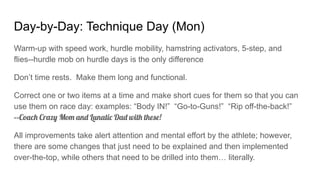
Day-by-Day: Technique Day (Mon)
Warm-up with speed work, hurdle mobility, hamstring activators, 5-step, and
flies--hurdle mob on hurdle days is the only difference
Don’t time rests. Make them long and functional.
Correct one or two items at a time and make short cues for them so that you can
use them on race day: examples: “Body IN!” “Go-to-Guns!” “Rip off-the-back!”
--Coach Crazy Mom and Lunatic Dad with these!
All improvements take alert attention and mental effort by the athlete; however,
there are some changes that just need to be explained and then implemented
over-the-top, while others that need to be drilled into them… literally.
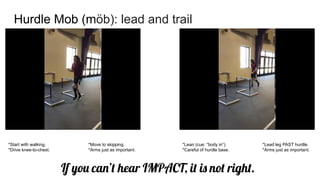
Hurdle Mob (möb): lead and trail
If you can’t hear IMPACT, it is not right.
*Start with walking. *Move to skipping.
*Drive knee-to-chest. *Arms just as important.
*Lean (cue: “body in”). *Lead leg PAST hurdle.
*Careful of hurdle base. *Arms just as important.
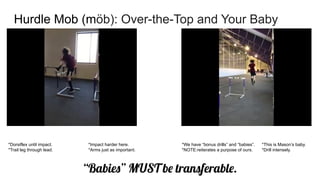
Hurdle Mob (möb): Over-the-Top and Your Baby
“Babies” MUST be transferable.
*Dorsiflex until impact. *Impact harder here.
*Trail leg through lead. *Arms just as important.
*We have “bonus drills” and “babies”. *This is Mason’s baby.
*NOTE:reiterates a purpose of ours. *Drill intensely.
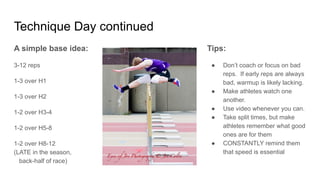
Technique Day continued
A simple base idea:
3-12 reps
1-3 over H1
1-3 over H2
1-2 over H3-4
1-2 over H5-8
1-2 over H8-12
(LATE in the season,
back-half of race)
Tips:
● Don’t coach or focus on bad
reps. If early reps are always
bad, warmup is likely lacking.
● Make athletes watch one
another.
● Use video whenever you can.
● Take split times, but make
athletes remember what good
ones are for them
● CONSTANTLY remind them
that speed is essential
Day-by-Day: Interval Day… when no one wants to be friends
You’re a track coach, so be a track coach.
Treat hurdlers like sprinters on these days. RACE.
Remember that you can always add hurdles to various places in interval reps, if
you are short on days, as long as they are at the beginning and the rest is
adequately long.
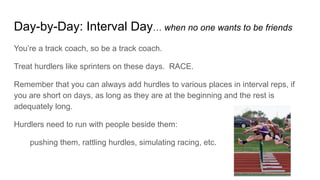
Hurdlers need to run with people beside them:
pushing them, rattling hurdles, simulating racing, etc.
Day-by-Day: Tempos
Tempo day can be added to any day when they hurdle, if there aren’t enough days
in the week. LISTEN: there will NEVER be enough days in the week. If you figure
out a way that there can be 8 (or 9) days in a week to train hurdlers, PLEASE
contact me IMMEDIATELY!
When adding tempos to hurdle days, have the hurdlers do half of whatever your
sprinters are doing.
Tempo reps should be 4-8 reps of 150-200 meters at around 70% intensity.
When they are sore, they need them more than ever. We tempo to feel good.
Day-by-Day: The Hurdle Workout
Hurdle races are built from front to back, so make the first part fast first.
These days are for hurdle endurance, so time rests.
USE THE CUES that you put into place on the early days. Coaching and
feedback should be quicker. Don’t let them control these with their concerns by
confusing them with hurdle technique day. REMEMBER: Cues are great for
those crazy moms and dads, as well as headcase athletes!
Push through anything but risk. If they’re tired, push them until their form breaks
down; then, stop. If anything (viz. a hammy or an old injury) starts hurting, STOP.
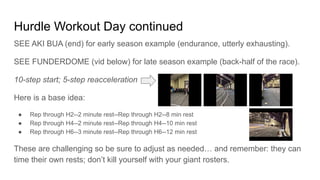
Hurdle Workout Day continued
SEE AKI BUA (end) for early season example (endurance, utterly exhausting).
SEE FUNDERDOME (vid below) for late season example (back-half of the race).
10-step start; 5-step reacceleration
Here is a base idea:
● Rep through H2--2 minute rest--Rep through H2--8 min rest
● Rep through H4--2 minute rest--Rep through H4--10 min rest
● Rep through H6--3 minute rest--Rep through H6--12 min rest
These are challenging so be sure to adjust as needed… and remember: they can
time their own rests; don’t kill yourself with your giant rosters.
Premeet
These days are to feel good below the waist and above the shoulders, so:
● Limit reps
● Stop when they get it right so that you can...
● End on a good rep
● Reinforce those cues: review for the test
They’re going to be goofy because of all the energy that YOU put in their bodies.
Allow them to enjoy themselves; track is stressful enough.
Meet Day! LET’S GO!!
FOR THE LOVE OF GOD, GO FAST!
● Cues again.
● (say “hello” & then) Be a boyfriend/girlfriend or son/daughter after competition.
Let’s talk about variables.
● Video Race to review later.
● Put a time limit on pouting
● Celebrate or learn (or both)--vid.
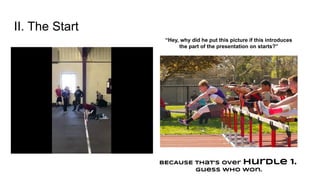
II. The Start
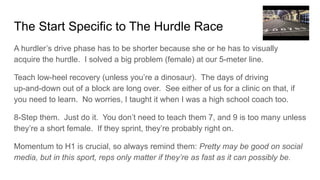
“Hey, why did he put this picture if this introduces
the part of the presentation on starts?”
BECAUSE That’s over hurdle 1.
Guess who won.
A hurdler’s drive phase has to be shorter because she or he has to visually
acquire the hurdle. I solved a big problem (female) at our 5-meter line.
Teach low-heel recovery (unless you’re a dinosaur). The days of driving
up-and-down out of a block are long over. See either of us for a clinic on that, if
you need to learn. No worries, I taught it when I was a high school coach too.
8-Step them. Just do it. You don’t need to teach them 7, and 9 is too many unless
they’re a short female. If they sprint, they’re probably right on.
Momentum to H1 is crucial, so always remind them: Pretty may be good on social
media, but in this sport, reps only matter if they’re as fast as it can possibly be.
The Start Specific to The Hurdle Race
When improving a hurdler’s start, understand the risks versus rewards:
● The starting blocks are boom or bust: if they aren’t using them properly or if
they aren’t strong enough, the blocks are slowing them down.
● They need to attack the hurdle, so do it without the barrier (or with the hurdle
down) a couple times per week.
● If it ain’t broke, don’t fix it (at least until everything else is pretty strong)
● H1 is often a little different looking from other hurdles. As things change,
revisit H1 versus H2 and remind athletes of good habits.
● If I haven’t mentioned this yet: SWEET HEAVENS, GO FAST!
The Start continued
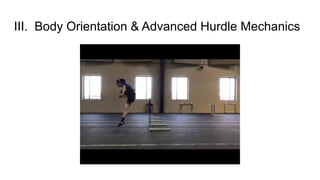
III. Body Orientation & Advanced Hurdle Mechanics
Before Body Orientation & Advanced Hurdle Mechanics
...a refresher on basic hurdle mechanics:
● Lead Arm--Check the watch (then hammer down)
● Trail Arm--Go to holster (then drive up)
● Lead Leg--Kick in the door
● *Trail Leg--flat past the hurdle and down THROUGH the track (leave dents)
● Torso--LEAN
● *I love you, but PLEASE stop telling them to “REEEEACH” with their trail legs
Make everything transferrable.
Yes, there is a whole slide about this.
If you’ve ever been around a start line at a hurdle race, you know that there is no
shortage of hurdle drills. Why do we need all these things? I used to worry: am I
leaving all these things out of my training?
An idea isn’t a good idea just because you had it.
If a drill isn’t warming the athlete up, increasing mobility or good habits, or
improving their speed or form, DUDE, why are they doing it?
Step-step-step: “hey coach, why don’t we do that?”
Going into a hurdle, athletes should do a cut-step.
This is THE LAST thing that I work on, and it should be for you too because an
athlete will be almost always be TRULY ELITE before she or he is hot on the
hurdles.
I like to drill it in because I don’t like them thinking too hard at initial attack.
Here is a great link (if you ever need it):
https://www.youtube.com/watch?v=P493svYg3wY
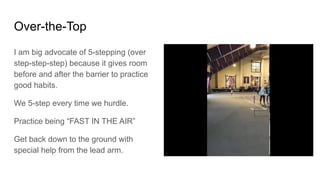
I am big advocate of 5-stepping (over
step-step-step) because it gives room
before and after the barrier to practice
good habits.
We 5-step every time we hurdle.
Practice being “FAST IN THE AIR”
Get back down to the ground with
special help from the lead arm.
Over-the-Top
IV. Off-the-Back: this is my secret
● Lead leg gets down quickly and as vertically as possible
● Arms return to sprint positions (holster and face), NOT behind and NOT wide
● Trail leg hammers down
These cues dictate:
● Proper tempo and speed between hurdles
● Speed at the end of the race
● Whether shorter athletes three-step properly or at all
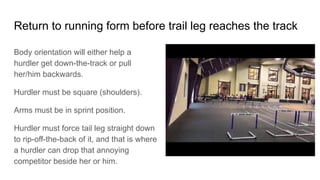
Body orientation will either help a
hurdler get down-the-track or pull
her/him backwards.
Hurdler must be square (shoulders).
Arms must be in sprint position.
Hurdler must force tail leg straight down
to rip-off-the-back of it, and that is where
a hurdler can drop that annoying
competitor beside her or him.
Return to running form before trail leg reaches the track
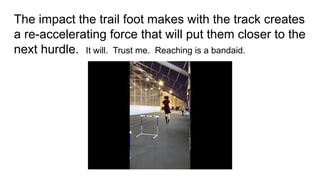
The impact the trail foot makes with the track creates
a re-accelerating force that will put them closer to the
next hurdle. It will. Trust me. Reaching is a bandaid.
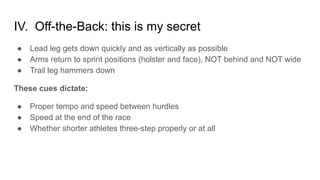
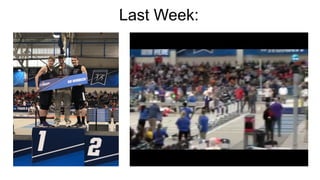
Last Week:
Tyler Mettille
Youngstown State University
Assistant Track & Field Coach
Recruiting Coordinator
tsmettille@ysu.edu
https://youtu.be/mpuwwAursGA
Nate Heddleston
The University of Mount Union
Assistant Track & Field Coach
heddlenl@mountunion.edu
Team Twitter: @UMUTFXC
Team Instagram: UMUTFXC
Head Coach Snap: UMUTFXC

Nathan Heddleston Teacher Us Advanced Hurdle Techniques

  • 1.
    Advanced Hurdle Technique CoachTyler Mettille & Coach Nate Heddleston Youngstown State University The University of Mount Union for 100 & 110 hurdles
  • 3.
    Where We SeekImprovement I. Top-end and Fitness: What we do on interval day and away from the hurdles II. Start: What we do from the block to hurdle 1 (H1) III. Body Orientation & Hurdle Mechanics: What we do over the hurdles IV. Ground Mechanics: What we do into and off-the-back of the hurdles
  • 4.
    I. Top-End andFitness A Regular Week: ● Monday: Hurdle form work ● Tuesday: Intervals / Race ● *Wednesday: Off / Tempos ● Thursday: Hurdle workout / Tempos ● *Friday: Premeet ● Saturday: Run FAST ● Sunday: Off / Practice good life habits ● *Wednesday is the best day to work secondary events (*Friday works as well) Tips: ● Listen to your athletes’ bodies and your instincts because hurdling is HARD. ● Establish DAY 1 that their average days are going to be longer than those of most jumpers and sprinters. ● Hurdlers (and all other technique athletes) will want to work on actual hurdling way more than the rest of the race, which is important, but it is just one part.
  • 5.
    Day-by-Day: Technique Day(Mon) Warm-up with speed work, hurdle mobility, hamstring activators, 5-step, and flies--hurdle mob on hurdle days is the only difference Don’t time rests. Make them long and functional. Correct one or two items at a time and make short cues for them so that you can use them on race day: examples: “Body IN!” “Go-to-Guns!” “Rip off-the-back!” --Coach Crazy Mom and Lunatic Dad with these! All improvements take alert attention and mental effort by the athlete; however, there are some changes that just need to be explained and then implemented over-the-top, while others that need to be drilled into them… literally.
  • 6.
    Hurdle Mob (möb):lead and trail If you can’t hear IMPACT, it is not right. *Start with walking. *Move to skipping. *Drive knee-to-chest. *Arms just as important. *Lean (cue: “body in”). *Lead leg PAST hurdle. *Careful of hurdle base. *Arms just as important.
  • 7.
    Hurdle Mob (möb):Over-the-Top and Your Baby “Babies” MUST be transferable. *Dorsiflex until impact. *Impact harder here. *Trail leg through lead. *Arms just as important. *We have “bonus drills” and “babies”. *This is Mason’s baby. *NOTE:reiterates a purpose of ours. *Drill intensely.
  • 8.
    Technique Day continued Asimple base idea: 3-12 reps 1-3 over H1 1-3 over H2 1-2 over H3-4 1-2 over H5-8 1-2 over H8-12 (LATE in the season, back-half of race) Tips: ● Don’t coach or focus on bad reps. If early reps are always bad, warmup is likely lacking. ● Make athletes watch one another. ● Use video whenever you can. ● Take split times, but make athletes remember what good ones are for them ● CONSTANTLY remind them that speed is essential
  • 9.
    Day-by-Day: Interval Day…when no one wants to be friends You’re a track coach, so be a track coach. Treat hurdlers like sprinters on these days. RACE. Remember that you can always add hurdles to various places in interval reps, if you are short on days, as long as they are at the beginning and the rest is adequately long. Hurdlers need to run with people beside them: pushing them, rattling hurdles, simulating racing, etc.
  • 10.
    Day-by-Day: Tempos Tempo daycan be added to any day when they hurdle, if there aren’t enough days in the week. LISTEN: there will NEVER be enough days in the week. If you figure out a way that there can be 8 (or 9) days in a week to train hurdlers, PLEASE contact me IMMEDIATELY! When adding tempos to hurdle days, have the hurdlers do half of whatever your sprinters are doing. Tempo reps should be 4-8 reps of 150-200 meters at around 70% intensity. When they are sore, they need them more than ever. We tempo to feel good.
  • 11.
    Day-by-Day: The HurdleWorkout Hurdle races are built from front to back, so make the first part fast first. These days are for hurdle endurance, so time rests. USE THE CUES that you put into place on the early days. Coaching and feedback should be quicker. Don’t let them control these with their concerns by confusing them with hurdle technique day. REMEMBER: Cues are great for those crazy moms and dads, as well as headcase athletes! Push through anything but risk. If they’re tired, push them until their form breaks down; then, stop. If anything (viz. a hammy or an old injury) starts hurting, STOP.
  • 12.
    Hurdle Workout Daycontinued SEE AKI BUA (end) for early season example (endurance, utterly exhausting). SEE FUNDERDOME (vid below) for late season example (back-half of the race). 10-step start; 5-step reacceleration Here is a base idea: ● Rep through H2--2 minute rest--Rep through H2--8 min rest ● Rep through H4--2 minute rest--Rep through H4--10 min rest ● Rep through H6--3 minute rest--Rep through H6--12 min rest These are challenging so be sure to adjust as needed… and remember: they can time their own rests; don’t kill yourself with your giant rosters.
  • 13.
    Premeet These days areto feel good below the waist and above the shoulders, so: ● Limit reps ● Stop when they get it right so that you can... ● End on a good rep ● Reinforce those cues: review for the test They’re going to be goofy because of all the energy that YOU put in their bodies. Allow them to enjoy themselves; track is stressful enough.
  • 14.
    Meet Day! LET’SGO!! FOR THE LOVE OF GOD, GO FAST! ● Cues again. ● (say “hello” & then) Be a boyfriend/girlfriend or son/daughter after competition. Let’s talk about variables. ● Video Race to review later. ● Put a time limit on pouting ● Celebrate or learn (or both)--vid.
  • 15.
    II. The Start “Hey,why did he put this picture if this introduces the part of the presentation on starts?” BECAUSE That’s over hurdle 1. Guess who won.
  • 16.
    A hurdler’s drivephase has to be shorter because she or he has to visually acquire the hurdle. I solved a big problem (female) at our 5-meter line. Teach low-heel recovery (unless you’re a dinosaur). The days of driving up-and-down out of a block are long over. See either of us for a clinic on that, if you need to learn. No worries, I taught it when I was a high school coach too. 8-Step them. Just do it. You don’t need to teach them 7, and 9 is too many unless they’re a short female. If they sprint, they’re probably right on. Momentum to H1 is crucial, so always remind them: Pretty may be good on social media, but in this sport, reps only matter if they’re as fast as it can possibly be. The Start Specific to The Hurdle Race
  • 17.
    When improving ahurdler’s start, understand the risks versus rewards: ● The starting blocks are boom or bust: if they aren’t using them properly or if they aren’t strong enough, the blocks are slowing them down. ● They need to attack the hurdle, so do it without the barrier (or with the hurdle down) a couple times per week. ● If it ain’t broke, don’t fix it (at least until everything else is pretty strong) ● H1 is often a little different looking from other hurdles. As things change, revisit H1 versus H2 and remind athletes of good habits. ● If I haven’t mentioned this yet: SWEET HEAVENS, GO FAST! The Start continued
  • 18.
    III. Body Orientation& Advanced Hurdle Mechanics
  • 19.
    Before Body Orientation& Advanced Hurdle Mechanics ...a refresher on basic hurdle mechanics: ● Lead Arm--Check the watch (then hammer down) ● Trail Arm--Go to holster (then drive up) ● Lead Leg--Kick in the door ● *Trail Leg--flat past the hurdle and down THROUGH the track (leave dents) ● Torso--LEAN ● *I love you, but PLEASE stop telling them to “REEEEACH” with their trail legs
  • 20.
    Make everything transferrable. Yes,there is a whole slide about this. If you’ve ever been around a start line at a hurdle race, you know that there is no shortage of hurdle drills. Why do we need all these things? I used to worry: am I leaving all these things out of my training? An idea isn’t a good idea just because you had it. If a drill isn’t warming the athlete up, increasing mobility or good habits, or improving their speed or form, DUDE, why are they doing it? Step-step-step: “hey coach, why don’t we do that?”
  • 21.
    Going into ahurdle, athletes should do a cut-step. This is THE LAST thing that I work on, and it should be for you too because an athlete will be almost always be TRULY ELITE before she or he is hot on the hurdles. I like to drill it in because I don’t like them thinking too hard at initial attack. Here is a great link (if you ever need it): https://www.youtube.com/watch?v=P493svYg3wY
  • 22.
    I am bigadvocate of 5-stepping (over step-step-step) because it gives room before and after the barrier to practice good habits. We 5-step every time we hurdle. Practice being “FAST IN THE AIR” Get back down to the ground with special help from the lead arm. Over-the-Top
  • 23.
    IV. Off-the-Back: thisis my secret ● Lead leg gets down quickly and as vertically as possible ● Arms return to sprint positions (holster and face), NOT behind and NOT wide ● Trail leg hammers down These cues dictate: ● Proper tempo and speed between hurdles ● Speed at the end of the race ● Whether shorter athletes three-step properly or at all
  • 24.
    Body orientation willeither help a hurdler get down-the-track or pull her/him backwards. Hurdler must be square (shoulders). Arms must be in sprint position. Hurdler must force tail leg straight down to rip-off-the-back of it, and that is where a hurdler can drop that annoying competitor beside her or him. Return to running form before trail leg reaches the track
  • 25.
    The impact thetrail foot makes with the track creates a re-accelerating force that will put them closer to the next hurdle. It will. Trust me. Reaching is a bandaid.
  • 26.
  • 27.
    Tyler Mettille Youngstown StateUniversity Assistant Track & Field Coach Recruiting Coordinator tsmettille@ysu.edu https://youtu.be/mpuwwAursGA Nate Heddleston The University of Mount Union Assistant Track & Field Coach heddlenl@mountunion.edu Team Twitter: @UMUTFXC Team Instagram: UMUTFXC Head Coach Snap: UMUTFXC