Presentation Layout
1-Introduction
1.1- Whatis Nanotechnology?
1.1.1- Why nanoscale?
1.1.2- What is nanomaterial?
1.1.3- Nanomaterials’ characteristics
1.2- When Nanotechnology started
1.3- Approaches of Nanotechnology
1.3.1- Bottom-up or top-down?
2- Applications of Nanotechnology
3.
1.1- What isNanotechnology?
• The design, characterization, and application of
structures, devices, and systems by controlled
manipulation of size and shape of materials at
the nanometer scale (atomic, molecular, and
macromolecular scale)
• To produce materials with at least one
novel/superior characteristic or property.
4.
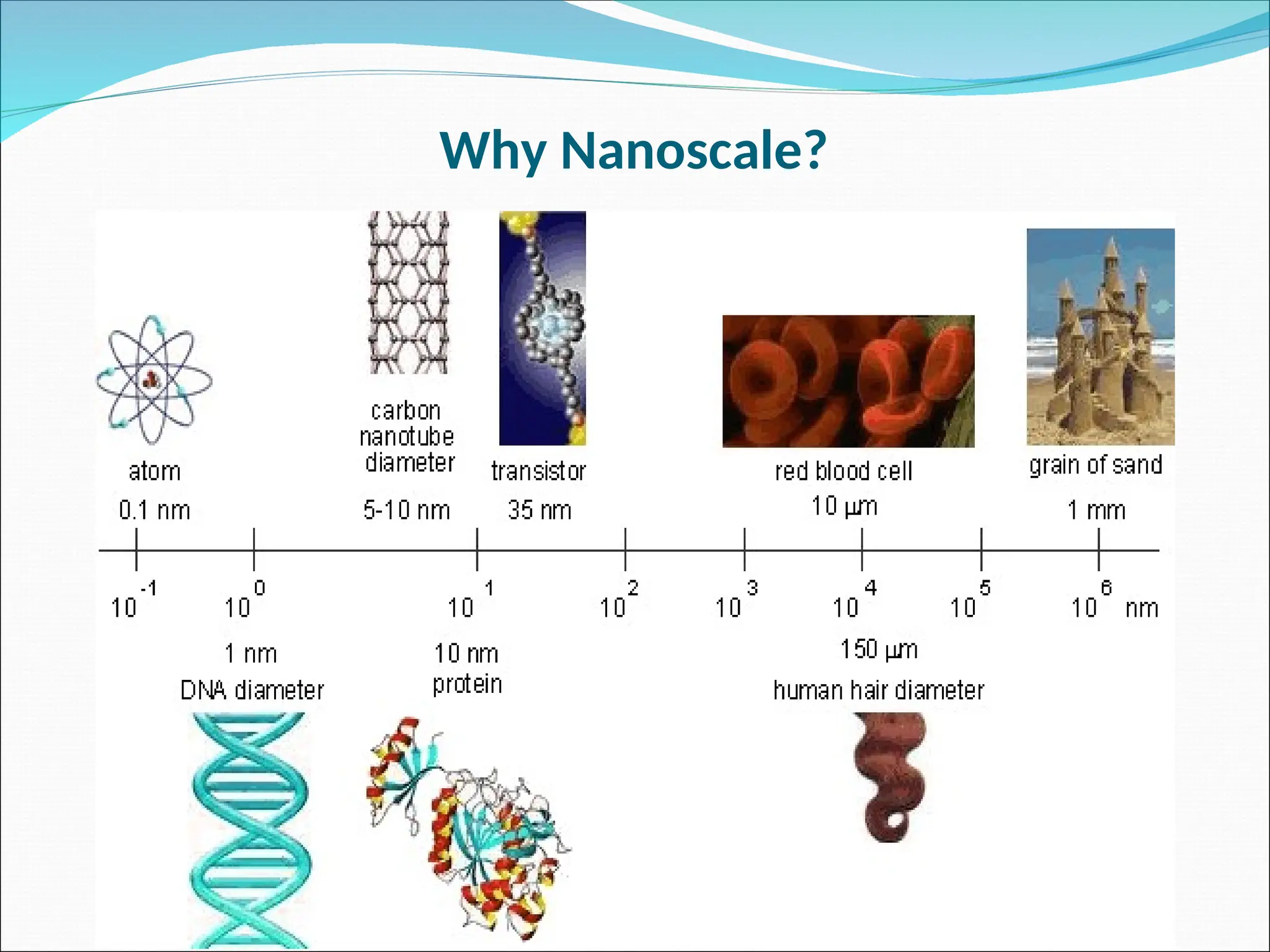
Why Nanoscale?
Ananometer (nm) is one thousand millionth of
a meter. People are interested in the nanoscale
because at this scale physical and chemical
properties of materials differ significantly from
those at a larger scale.
1.1.2- What isnanomaterial?
• Is defined as any material that has unique or
novel properties, due to the nanoscale ( nano
metre scale) structuring.
• These are formed by incorporation or
structuring of nanoparticles.
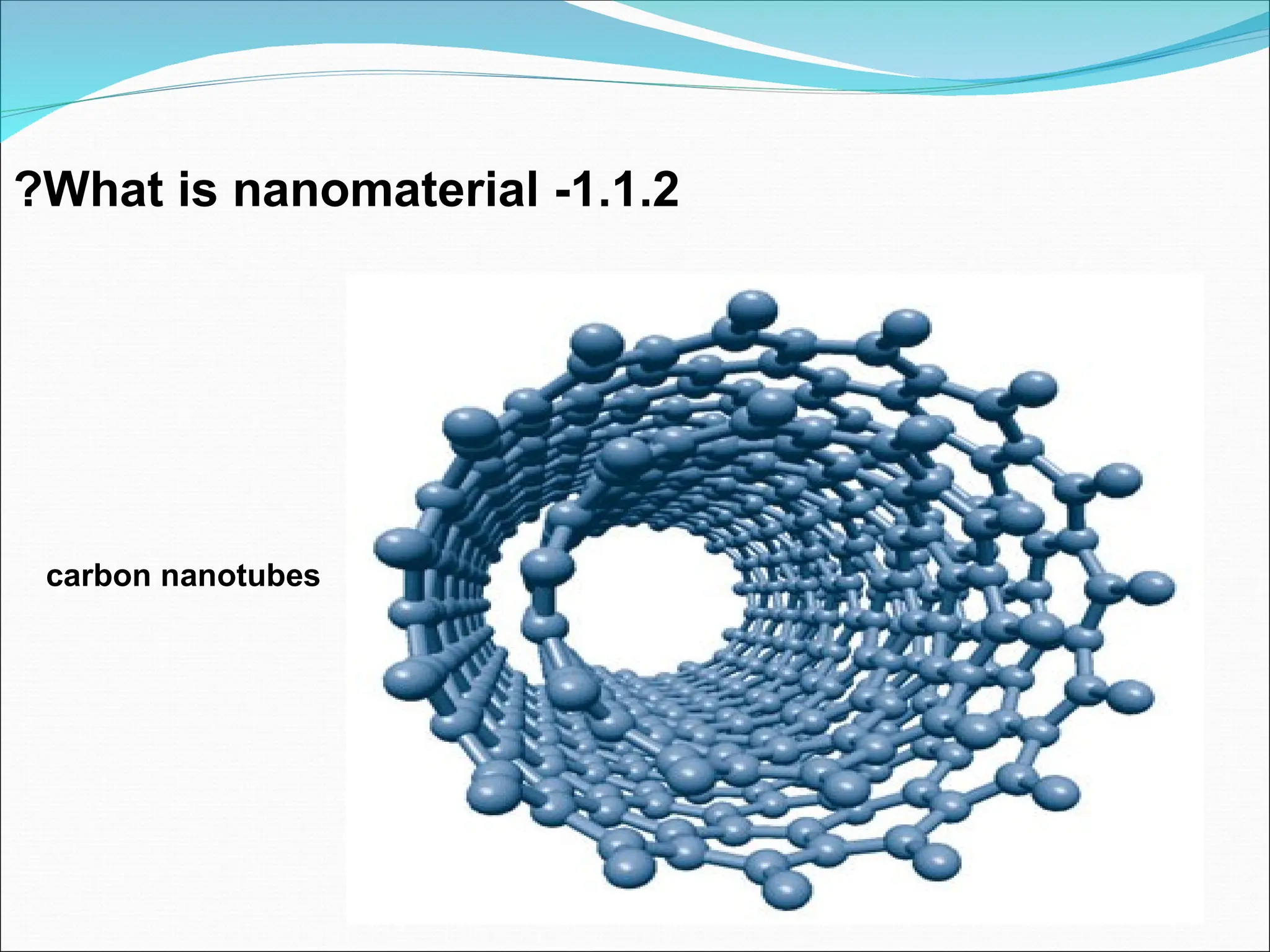
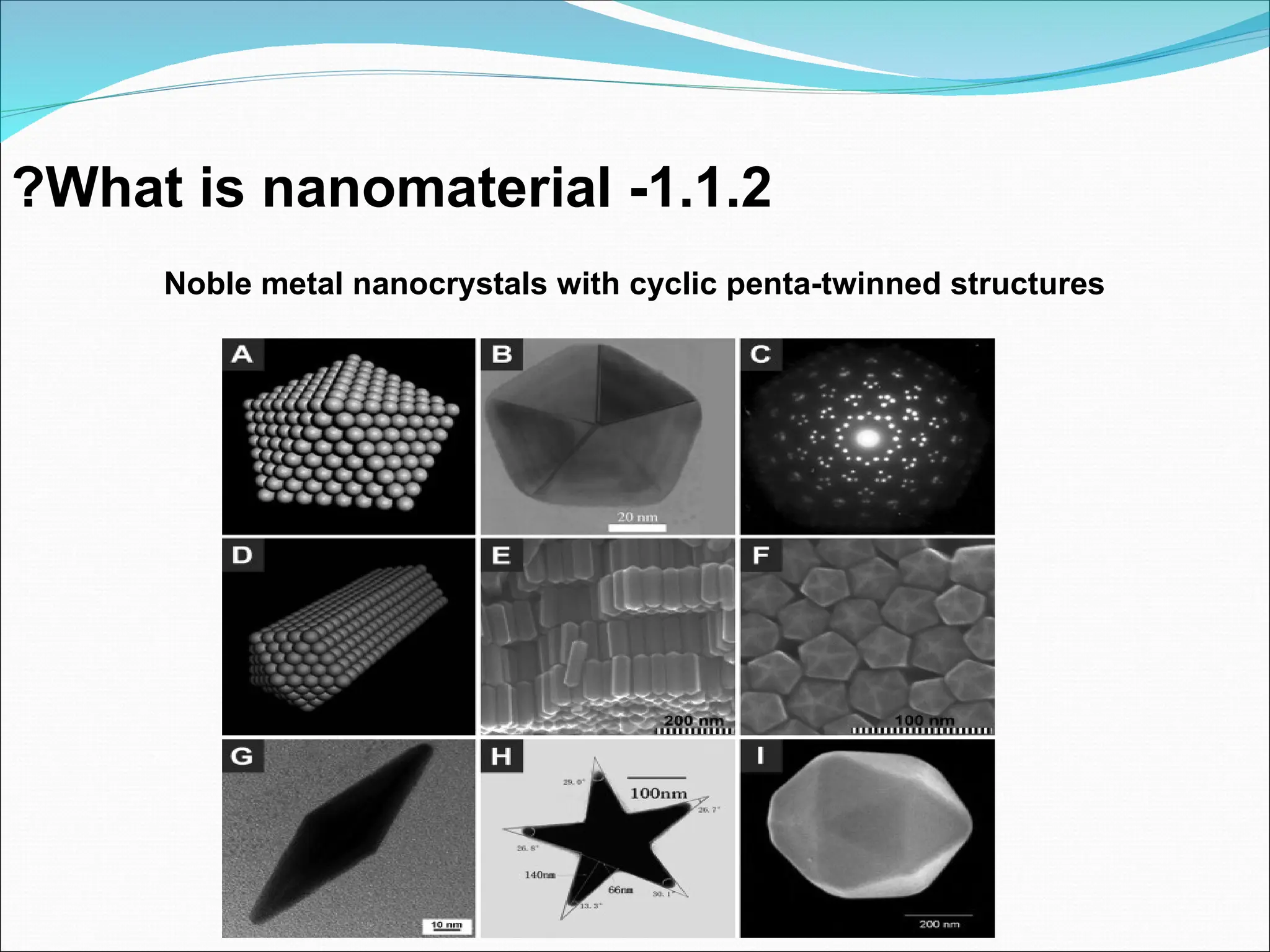
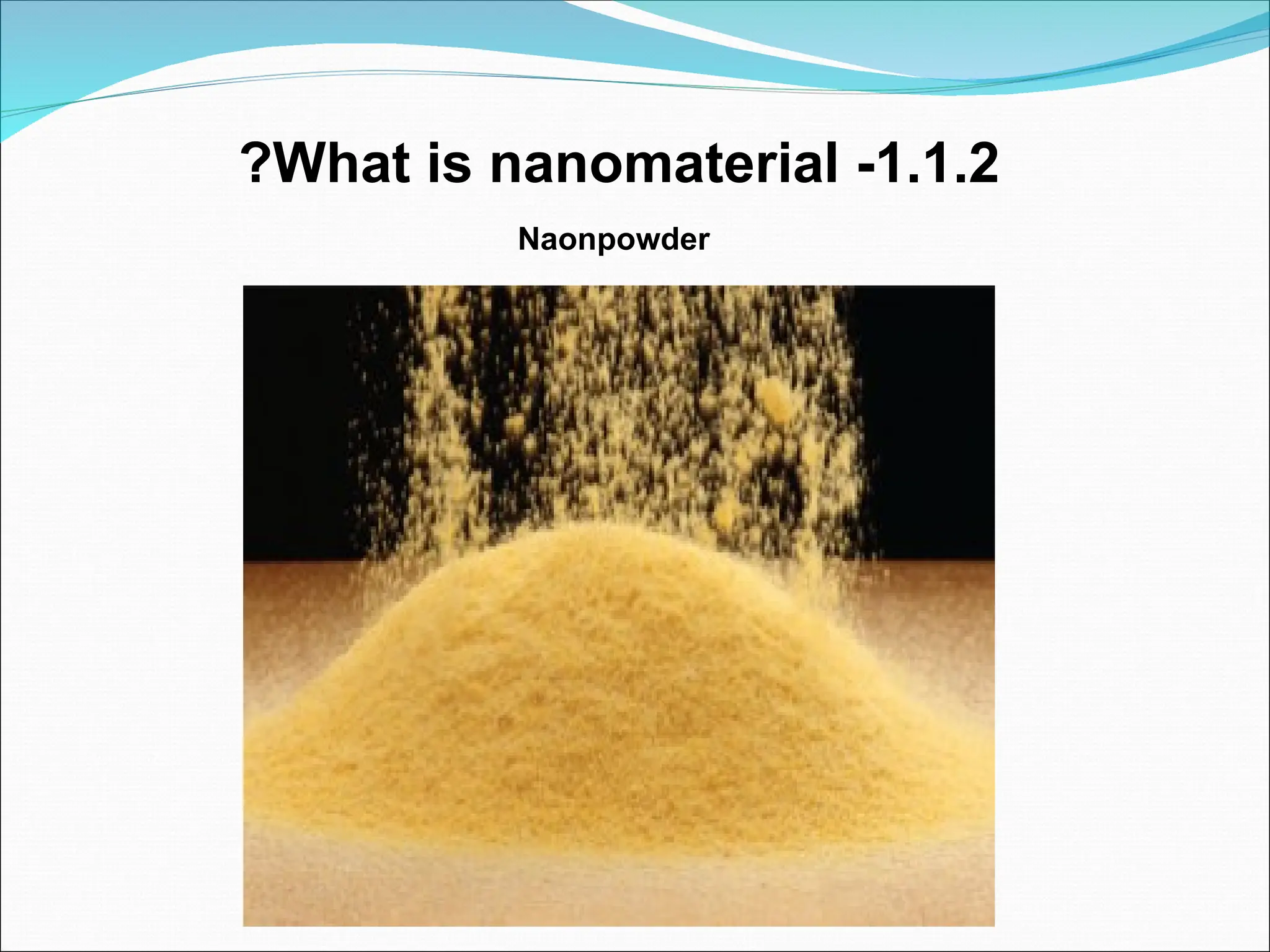
• They are subdivided into nanocrystals,
nanopowders, and nanotubes: A sequence
of nanoscale of C60 atoms arranged in a long
thin cylindrical structure.
1.1.2- What isnanomaterial?
• Nanotubes are extremely strong
mechanically and very pure
conductors of electric current.
• Applications of the nanotube
include resistors, capacitors, inducto
rs, diodes and transistors.
11.
1.1.2- What isnanomaterial?
• Nanomaterials are interesting
because at the small scale, materials
have fundamentally different
properties than at the bulk due to
increased surface area to volume
ratios.
12.
1.1.2- What isnanomaterial?
• Increased interaction and reactvity is one
of the by products of materials that are
nanoscale, which means potentially using
less of the material or that even on the
nanoscale the properties are so utterly
different from that of the bulk scale.
13.
1.1.2- Nanomaterials’ Characteristics
Mostof them are novel, why?
•One definition of novel materials is:
(new forms of existing materials with
characteristics that differ significantly
from familiar or naturally-occurring
forms.)
• Nanomaterials can have one, two or
three dimensions in the nanoscale
14.
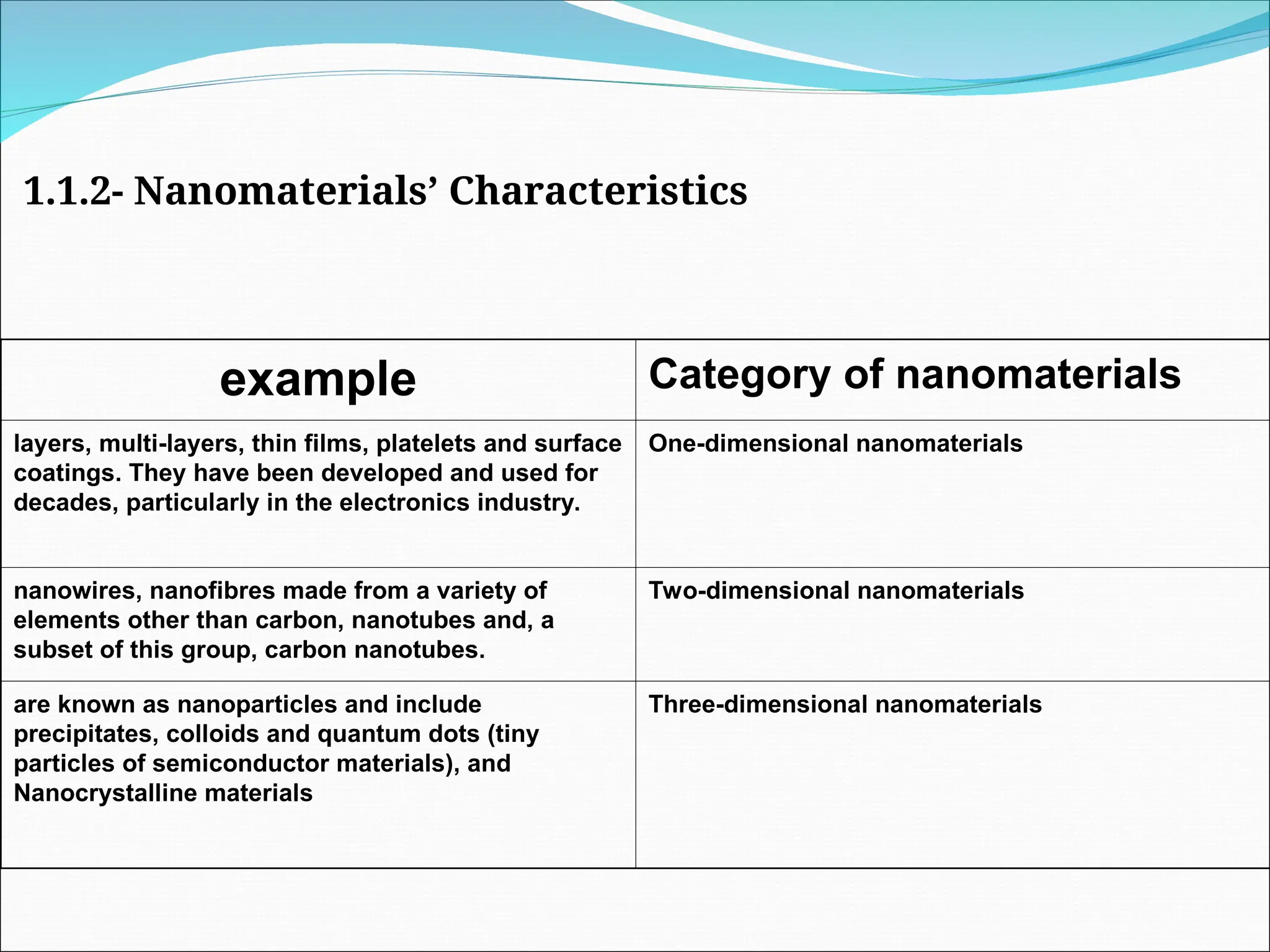
Category of nanomaterials
example
One-dimensionalnanomaterials
layers, multi-layers, thin films, platelets and surface
coatings. They have been developed and used for
decades, particularly in the electronics industry.
Two-dimensional nanomaterials
nanowires, nanofibres made from a variety of
elements other than carbon, nanotubes and, a
subset of this group, carbon nanotubes.
Three-dimensional nanomaterials
are known as nanoparticles and include
precipitates, colloids and quantum dots (tiny
particles of semiconductor materials), and
Nanocrystalline materials
1.1.2- Nanomaterials’ Characteristics
15.
1.2- When Nanotechnologystarted
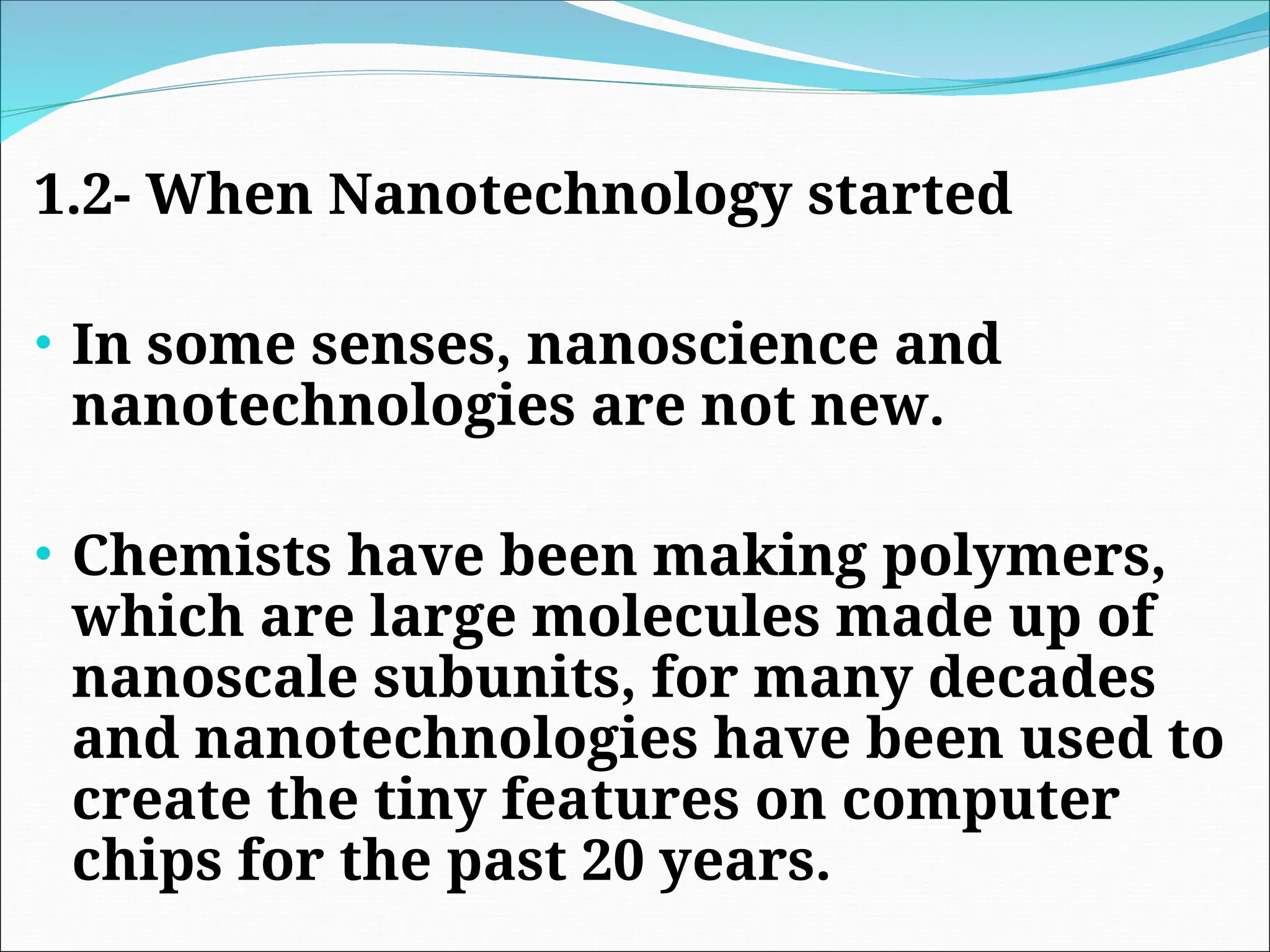
• In some senses, nanoscience and
nanotechnologies are not new.
• Chemists have been making polymers,
which are large molecules made up of
nanoscale subunits, for many decades
and nanotechnologies have been used to
create the tiny features on computer
chips for the past 20 years.
16.
1.2- When Nanotechnologystarted
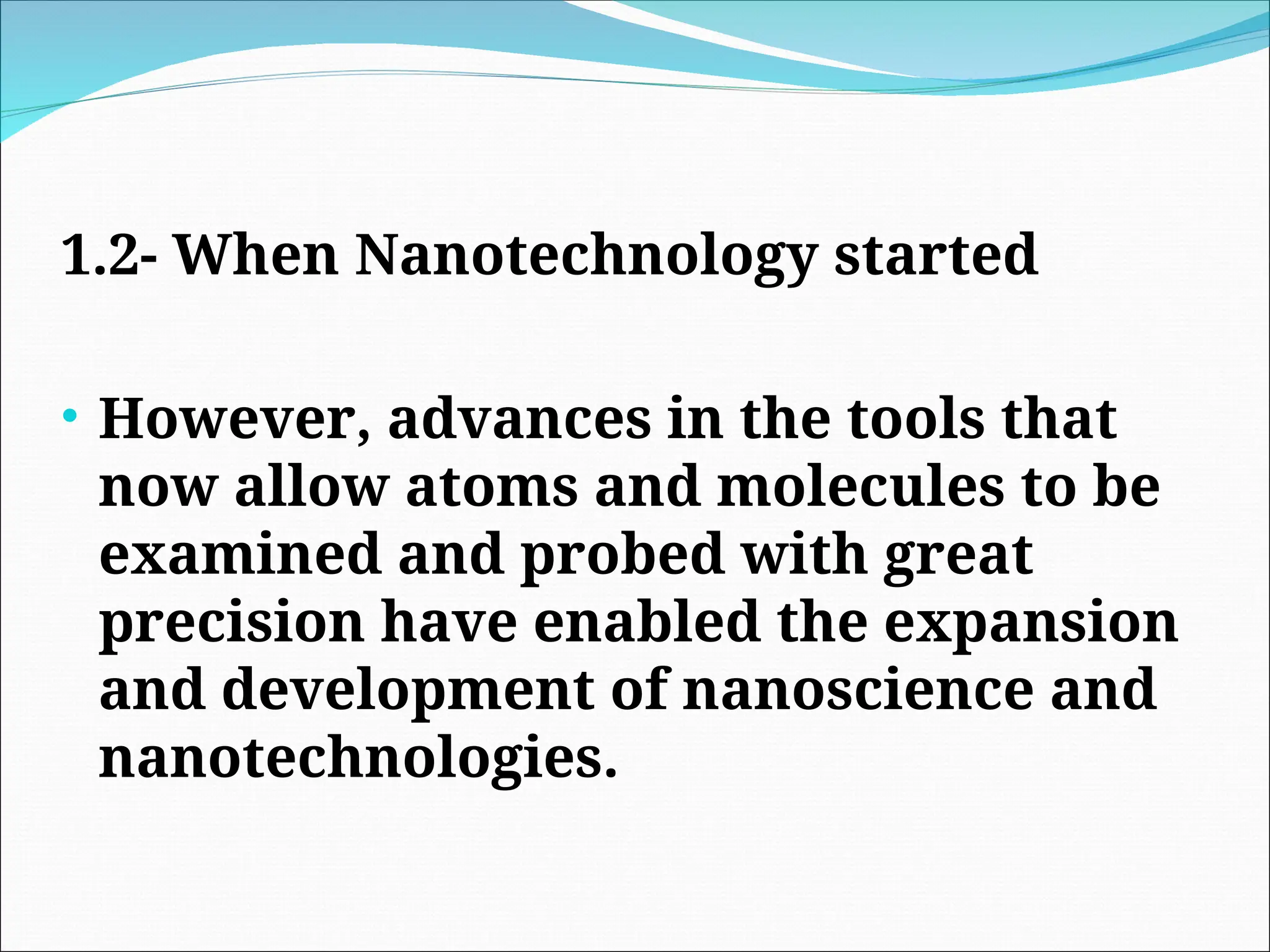
• However, advances in the tools that
now allow atoms and molecules to be
examined and probed with great
precision have enabled the expansion
and development of nanoscience and
nanotechnologies.
17.
1.3- Approaches ofNanotechnology (growth methods ):
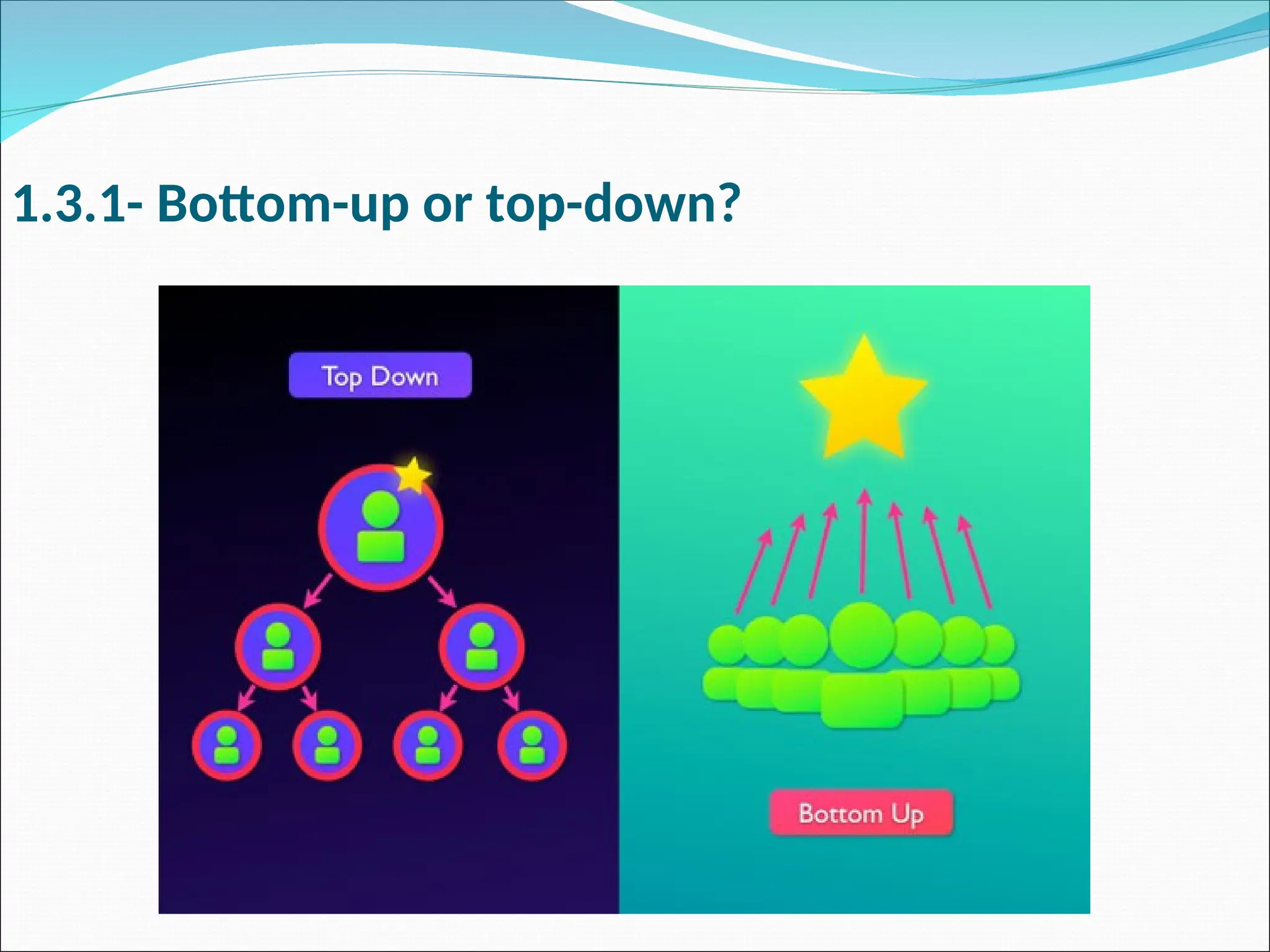
1.3.1- Bottom-up or top-down?
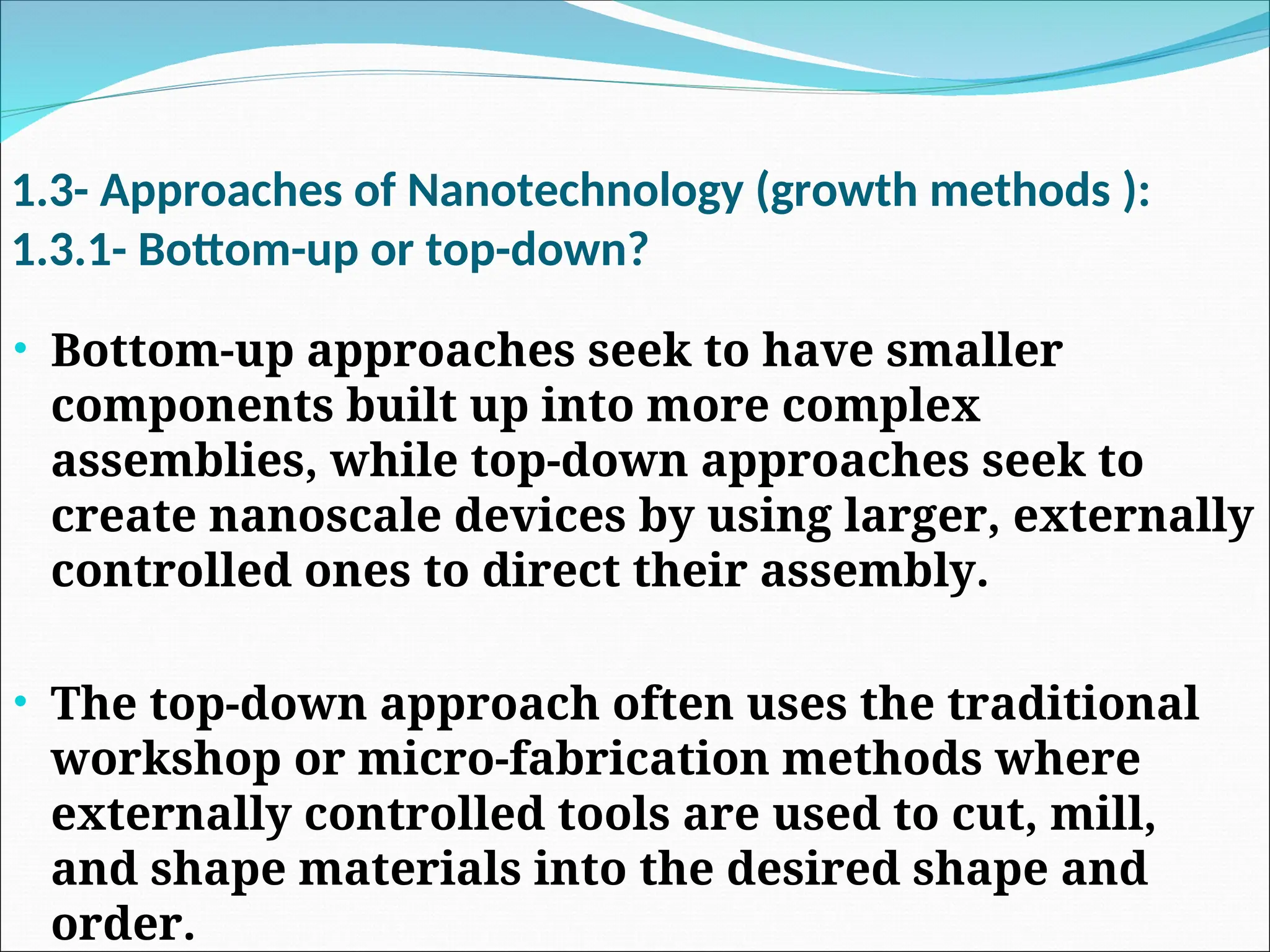
• Bottom-up approaches seek to have smaller
components built up into more complex
assemblies, while top-down approaches seek to
create nanoscale devices by using larger, externally
controlled ones to direct their assembly.
• The top-down approach often uses the traditional
workshop or micro-fabrication methods where
externally controlled tools are used to cut, mill,
and shape materials into the desired shape and
order.
18.
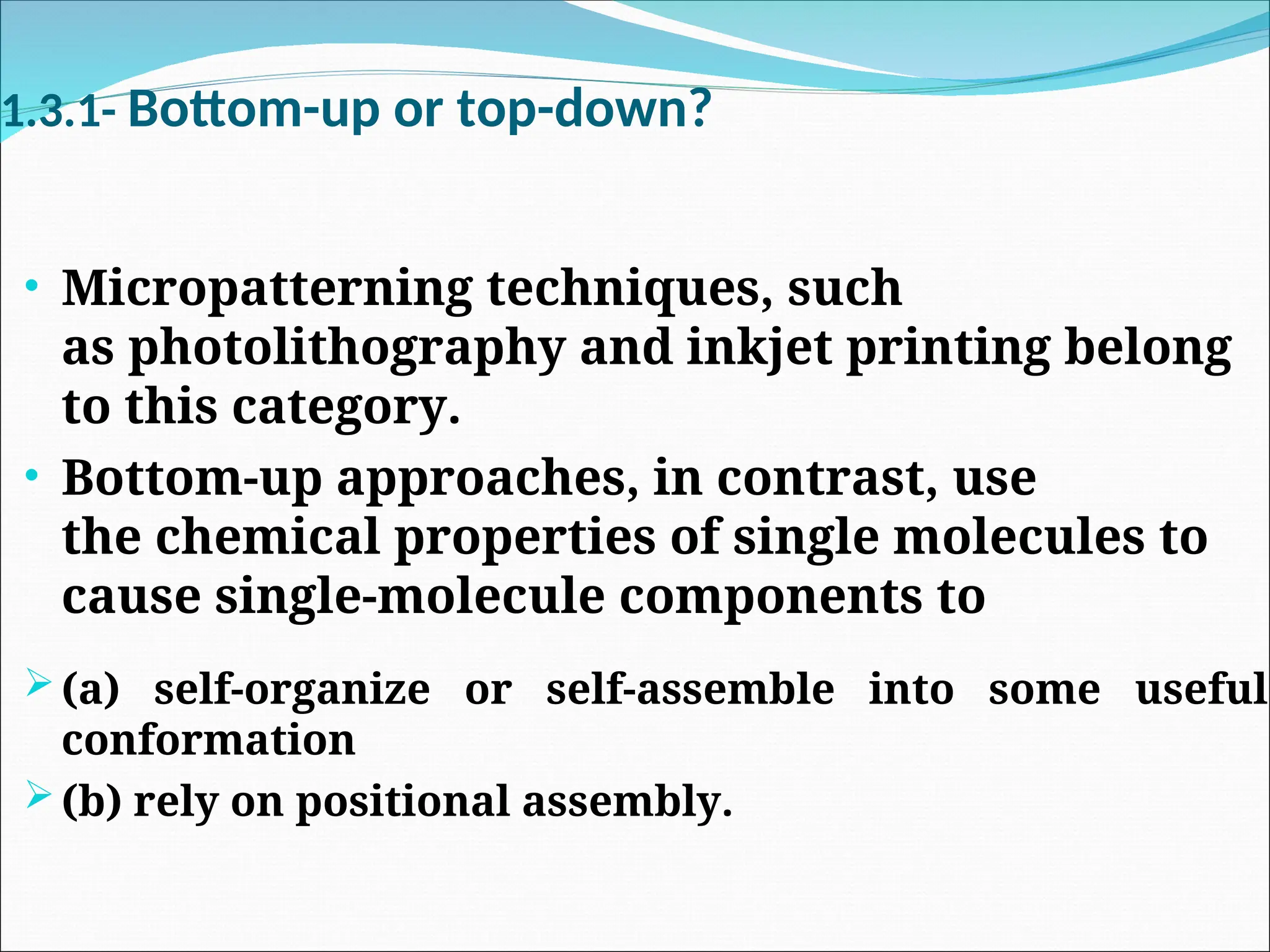
1.3.1- Bottom-up ortop-down?
• Micropatterning techniques, such
as photolithography and inkjet printing belong
to this category.
• Bottom-up approaches, in contrast, use
the chemical properties of single molecules to
cause single-molecule components to
(a) self-organize or self-assemble into some useful
conformation
(b) rely on positional assembly.
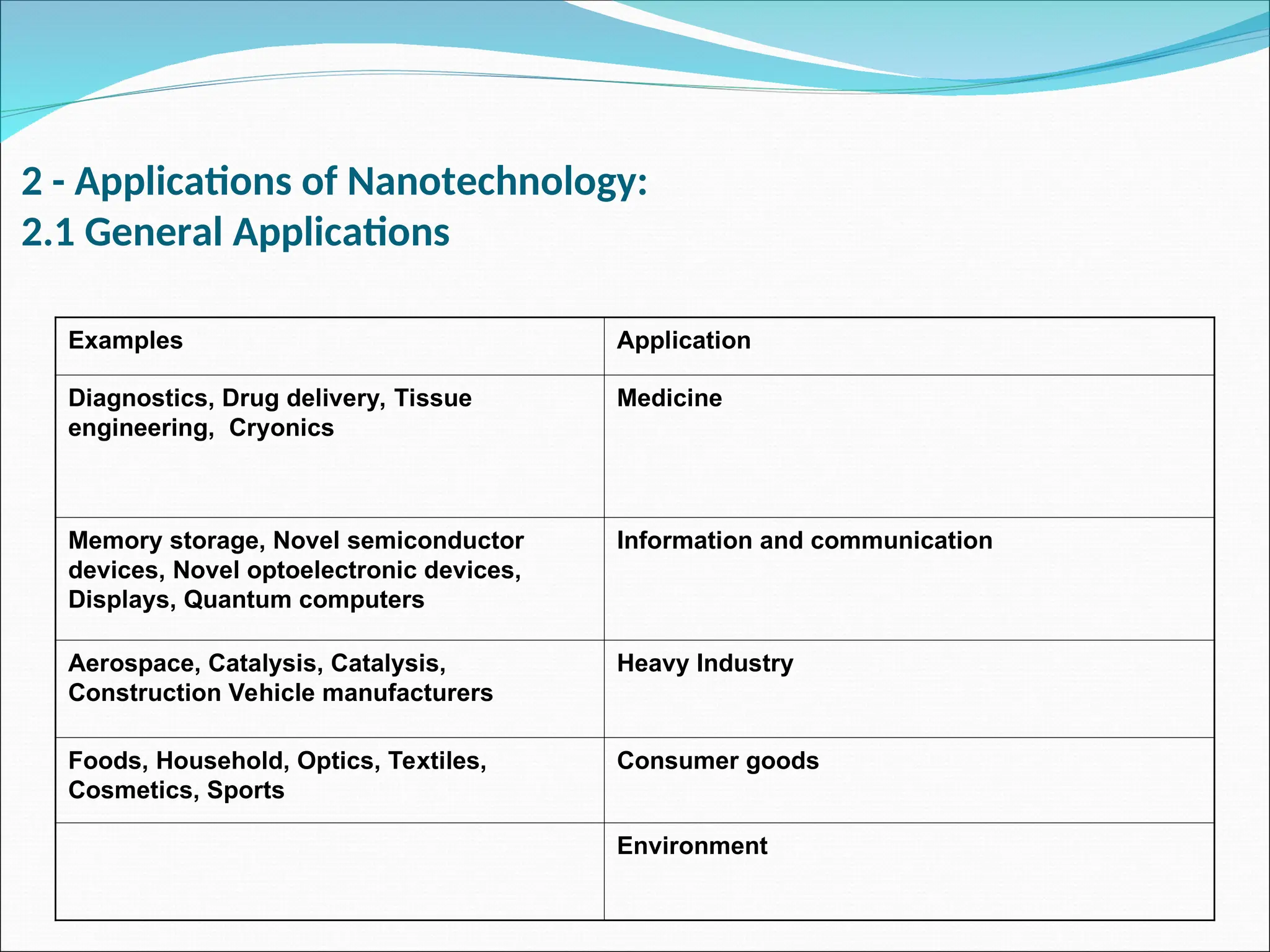
2 - Applicationsof Nanotechnology:
2.1 General Applications
Application
Examples
Medicine
Diagnostics, Drug delivery, Tissue
engineering, Cryonics
Information and communication
Memory storage, Novel semiconductor
devices, Novel optoelectronic devices,
Displays, Quantum computers
Heavy Industry
Aerospace, Catalysis, Catalysis,
Construction Vehicle manufacturers
Consumer goods
Foods, Household, Optics, Textiles,
Cosmetics, Sports
Environment
21.
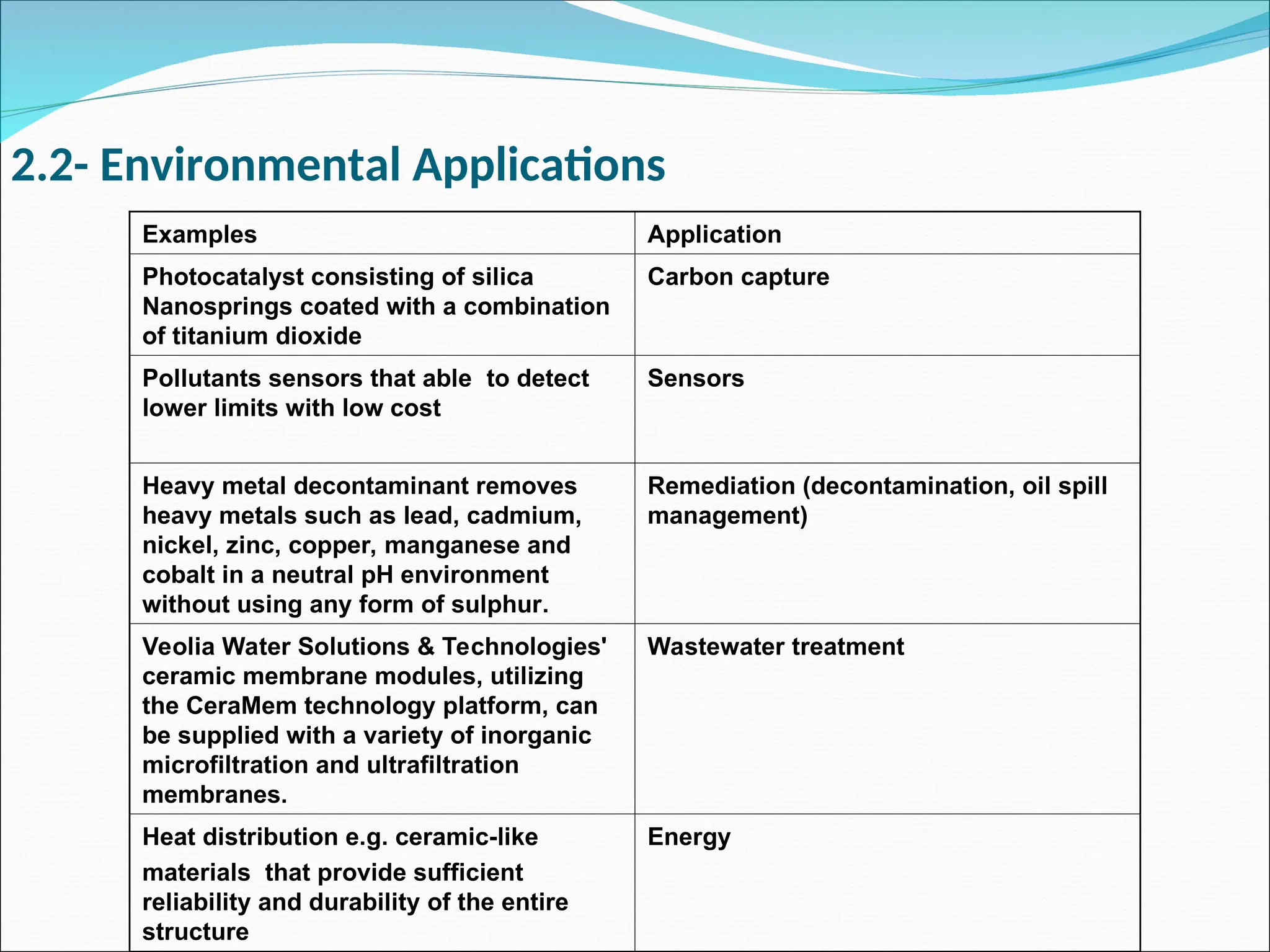
2.2- Environmental Applications
Application
Examples
Carboncapture
Photocatalyst consisting of silica
Nanosprings coated with a combination
of titanium dioxide
Sensors
Pollutants sensors that able to detect
lower limits with low cost
Remediation (decontamination, oil spill
management)
Heavy metal decontaminant removes
heavy metals such as lead, cadmium,
nickel, zinc, copper, manganese and
cobalt in a neutral pH environment
without using any form of sulphur.
Wastewater treatment
Veolia Water Solutions & Technologies'
ceramic membrane modules, utilizing
the CeraMem technology platform, can
be supplied with a variety of inorganic
microfiltration and ultrafiltration
membranes.
Energy
Heat distribution e.g. ceramic-like
materials that provide sufficient
reliability and durability of the entire
structure