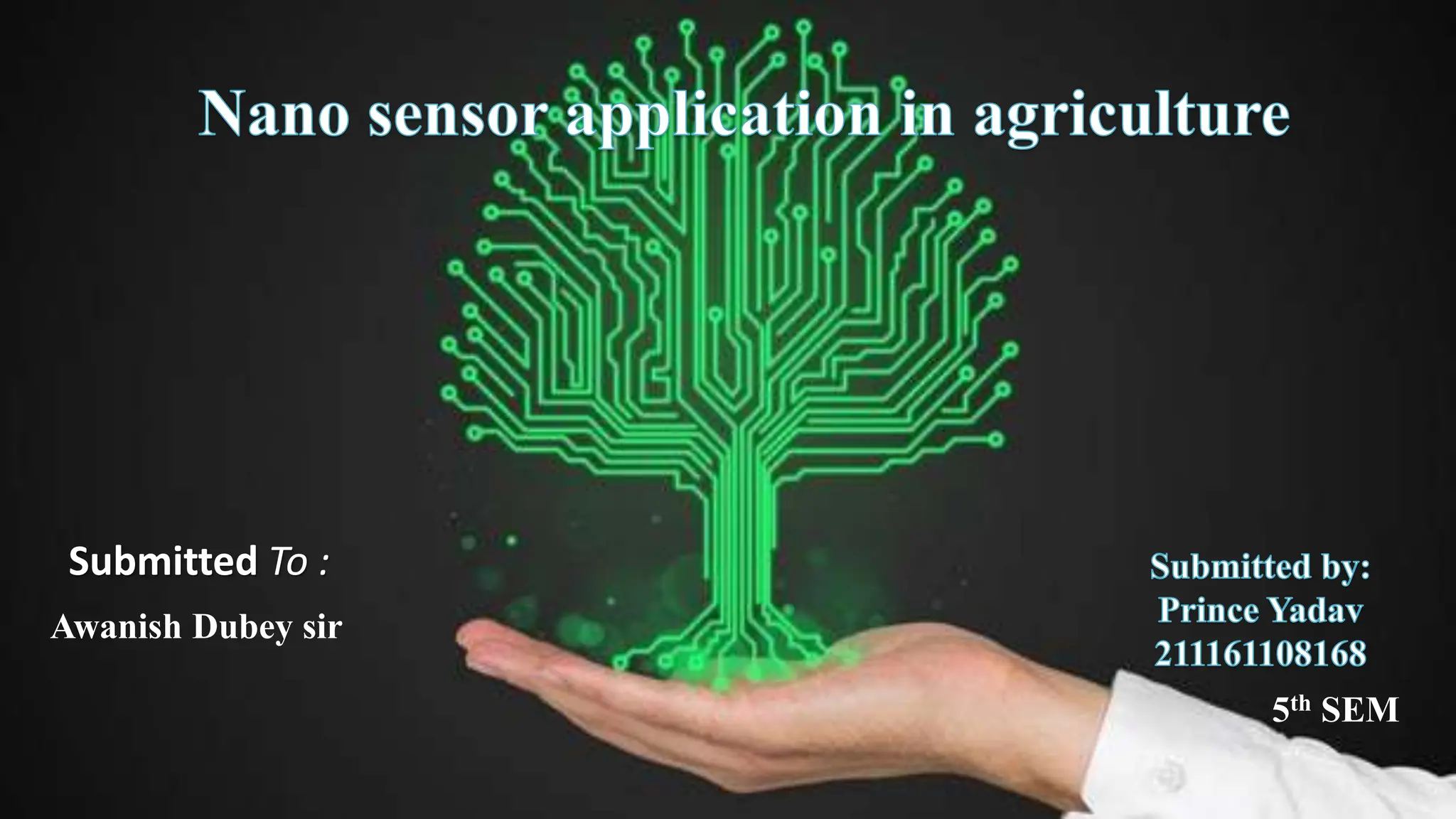
Submitted To :
Awanish Dubey sir
5th SEM
Introduction
• Food and agriculture sectors - promising area - sustainability and economic growth
of a country.
• With limited availability of land and water resources, growth in agriculture can be
achieved only by increasing productivity through good agronomy and supporting it
with an effective use of modern technology.
• Nanotechnology based sensing gained enormous momentum and provided broad
spectrum application in food and agriculture sector
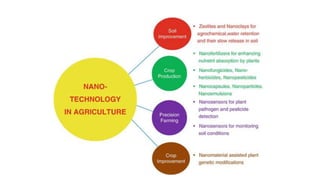
• Implementing nanotechnology - provided a new edge to the agrotechnology,
improved irrigation and efficient delivery of agrochemicals like fertilizers,
herbicides and pesticides, and enhanced the food production and processing,
packaging and storage.
• Major portion of the research in agricultural nanotechnology is in
the area of degradation of harmful pesticides by converting them
into harmless and useful components such as minerals and water.
• Nanosensor-usefull for in-field, on-line and real-time detection of
pesticides, pathogens, toxic materials, proteins, antibiotics, odours
creating bacteria, microbes, etc. in soil, air, water, food, plants and
animals.
• Nanotechnology puts the impetus to revolutionize the area of
diagnostics in health, medicine, food, environment, and agriculture
sector, transitioning theoretical aspects into the practical output.
“An extremely small device capable of detecting and responding
to physical stimuli with dimension in the order of one billion of a meter”
Physical stimuli: biological and chemical substances, displacement,
motion, force, mass, acoustic, thermal and electromagnetic. It collects and
measures data regarding some property of a phenomenon, object, or material.
• Nanomaterials and nanosensors increase sensitivity and detection level to
pico-, femto-, atto- and even zepto- scales (10-12-10-21) – this facilitates helps
in early detection.
Nano Sensor
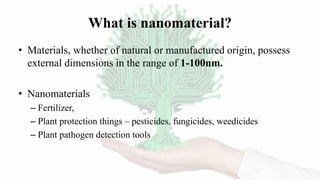
What is nanomaterial?
• Materials, whether of natural or manufactured origin, possess
external dimensions in the range of 1-100nm.
• Nanomaterials
– Fertilizer,
– Plant protection things – pesticides, fungicides, weedicides
– Plant pathogen detection tools
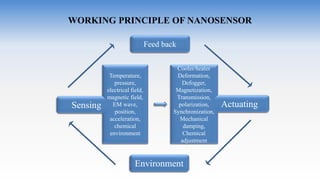
Feed back
Environment
Sensing Actuating
Temperature,
pressure,
electrical field,
magnetic field,
EM wave,
position,
acceleration,
chemical
environment
Cooler/heater
Deformation,
Defogger,
Magnetization,
Transmission,
polarization,
Synchronization,
Mechanical
damping,
Chemical
adjustment
WORKING PRINCIPLE OF NANOSENSOR
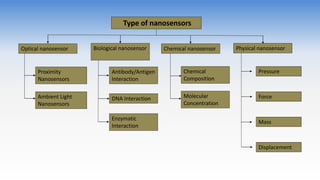
Type of nanosensors
Optical nanosensor
Ambient Light
Nanosensors
Proximity
Nanosensors
Enzymatic
Interaction
DNA Interaction
Antibody/Antigen
Interaction
Physical nanosensor
Chemical nanosensor
Biological nanosensor
Molecular
Concentration
Chemical
Composition
Displacement
Mass
Force
Pressure
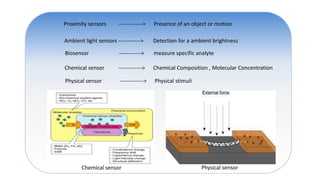
Proximity sensors -------------> Presence of an object or motion
Ambient light sensors ------------> Detection for a ambient brightness
Biosensor ------------> measure specific analyte
Chemical sensor -------------> Chemical Composition , Molecular Concentration
Physical sensor -------------> Physical stimuli
Physical sensor
Chemical sensor
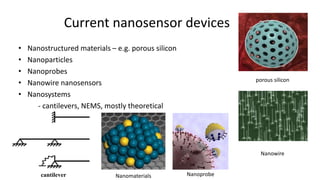
Current nanosensor devices
• Nanostructured materials – e.g. porous silicon
• Nanoparticles
• Nanoprobes
• Nanowire nanosensors
• Nanosystems
- cantilevers, NEMS, mostly theoretical
porous silicon
Nanowire
Nanoprobe
Nanomaterials
cantilever
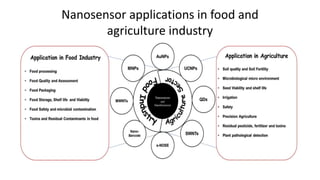
Nanosensor applications in food and
agriculture industry
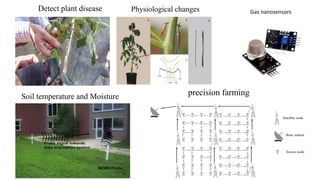
Detect plant disease Physiological changes
Soil temperature and Moisture precision farming
Gas nanosensors
Disadvantage
• Understanding the relationship between nanoparticles and the environment forms an
important area of research.
• There are several mechanisms by which nanoparticles are believed to affect the
environment negatively.
• some nanoparticles are able to reduce the functioning of (and may even disrupt or
kill) naturally occurring microbial communities, as well as microbial communities
that are employed in industrial processes (e.g., those that are used in sanitation
processes, including sewage treatment).
Conclusion
• Nanosensors could play an important role in providing powerful analytical tools to
the agricultural diagnosis sector,
• Rapid, low cost, high sensitivity and specificity measurements in field situations are
required.
• A wide range of transducers is also available to engineer new Nanosensing devices.
• The promise shown by biosensor technology is very real, however there are some
technological obstacles that need to be overcome.
Nanosensor technology in agriculture ppt.pptx

Nanosensor technology in agriculture ppt.pptx

  • 1.
    Submitted To : AwanishDubey sir 5th SEM
  • 2.
    Introduction • Food andagriculture sectors - promising area - sustainability and economic growth of a country. • With limited availability of land and water resources, growth in agriculture can be achieved only by increasing productivity through good agronomy and supporting it with an effective use of modern technology. • Nanotechnology based sensing gained enormous momentum and provided broad spectrum application in food and agriculture sector • Implementing nanotechnology - provided a new edge to the agrotechnology, improved irrigation and efficient delivery of agrochemicals like fertilizers, herbicides and pesticides, and enhanced the food production and processing, packaging and storage.
  • 3.
    • Major portionof the research in agricultural nanotechnology is in the area of degradation of harmful pesticides by converting them into harmless and useful components such as minerals and water. • Nanosensor-usefull for in-field, on-line and real-time detection of pesticides, pathogens, toxic materials, proteins, antibiotics, odours creating bacteria, microbes, etc. in soil, air, water, food, plants and animals. • Nanotechnology puts the impetus to revolutionize the area of diagnostics in health, medicine, food, environment, and agriculture sector, transitioning theoretical aspects into the practical output.
  • 4.
    “An extremely smalldevice capable of detecting and responding to physical stimuli with dimension in the order of one billion of a meter” Physical stimuli: biological and chemical substances, displacement, motion, force, mass, acoustic, thermal and electromagnetic. It collects and measures data regarding some property of a phenomenon, object, or material. • Nanomaterials and nanosensors increase sensitivity and detection level to pico-, femto-, atto- and even zepto- scales (10-12-10-21) – this facilitates helps in early detection. Nano Sensor
  • 5.
    What is nanomaterial? •Materials, whether of natural or manufactured origin, possess external dimensions in the range of 1-100nm. • Nanomaterials – Fertilizer, – Plant protection things – pesticides, fungicides, weedicides – Plant pathogen detection tools
  • 7.
    Feed back Environment Sensing Actuating Temperature, pressure, electricalfield, magnetic field, EM wave, position, acceleration, chemical environment Cooler/heater Deformation, Defogger, Magnetization, Transmission, polarization, Synchronization, Mechanical damping, Chemical adjustment WORKING PRINCIPLE OF NANOSENSOR
  • 8.
    Type of nanosensors Opticalnanosensor Ambient Light Nanosensors Proximity Nanosensors Enzymatic Interaction DNA Interaction Antibody/Antigen Interaction Physical nanosensor Chemical nanosensor Biological nanosensor Molecular Concentration Chemical Composition Displacement Mass Force Pressure
  • 9.
    Proximity sensors ------------->Presence of an object or motion Ambient light sensors ------------> Detection for a ambient brightness Biosensor ------------> measure specific analyte Chemical sensor -------------> Chemical Composition , Molecular Concentration Physical sensor -------------> Physical stimuli Physical sensor Chemical sensor
  • 10.
    Current nanosensor devices •Nanostructured materials – e.g. porous silicon • Nanoparticles • Nanoprobes • Nanowire nanosensors • Nanosystems - cantilevers, NEMS, mostly theoretical porous silicon Nanowire Nanoprobe Nanomaterials cantilever
  • 12.
    Nanosensor applications infood and agriculture industry
  • 13.
    Detect plant diseasePhysiological changes Soil temperature and Moisture precision farming Gas nanosensors
  • 14.
    Disadvantage • Understanding therelationship between nanoparticles and the environment forms an important area of research. • There are several mechanisms by which nanoparticles are believed to affect the environment negatively. • some nanoparticles are able to reduce the functioning of (and may even disrupt or kill) naturally occurring microbial communities, as well as microbial communities that are employed in industrial processes (e.g., those that are used in sanitation processes, including sewage treatment).
  • 15.
    Conclusion • Nanosensors couldplay an important role in providing powerful analytical tools to the agricultural diagnosis sector, • Rapid, low cost, high sensitivity and specificity measurements in field situations are required. • A wide range of transducers is also available to engineer new Nanosensing devices. • The promise shown by biosensor technology is very real, however there are some technological obstacles that need to be overcome.

Editor's Notes

  • #4  There are reports of acute toxicity due to the use of persistent pesticides and the presence of residues of these pesticides in the environment was noticed even decades after their use (Chaudhry et al. 2008). Humans, along with other non-target species face serious health risks due to the bioaccumulation of persistent pesticides in the food chain.
  • #5 They are devices that can detect and sense certain signals , the signal could be biomedical, optical, electronical, electrical, physical or mechanical signals A sensor is a transducer that converts a measurement (a quantity or parameter) into a signal that carries information.
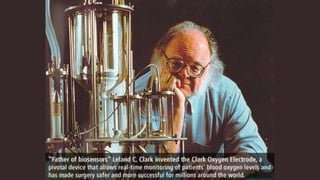
  • #7 The father of biosensor is Dr Leland Clark in 1954 he invented the Clark oxygen electrode which allows you to measure dissolved oxygen in biomedical, environmental and industrial applications. This invention enables doctors in the USA today to perform 750,000 open-heart surgeries each year. The Clark oxygen electrode, which he invented in 1954, remains the standard for measuring dissolved oxygen in biomedical, environmental, and industrial applications. The electrode quickly measures blood oxygen levels, enabling doctors to perform 750,000 open-heart surgeries each year. electrochemistry of oxygen gas reduction at platinum (Pt) metal electrodes
  • #11  Porous silicon is identical to the silicon used in many technical applications today, but its surface contains tiny pores ranging from <2nm to microns, that can absorb and emit light Besides their use in genetic engineering, nanoparticle-based FRET sensors (Figure 1b) have been developed for the detection of biomolecules. A variety of nanoparticles has been used, including gold nanoparticles, semiconductor quantum dots (QDs), and lanthanide-doped upconversion nanoparticles (UCNPs), which act as either a FRET donor or a quencher (48).