baruch osoveskiy
baruch@dbaces.com
 Baruch osoveskiy
 Senior Consultant in dbaces.com
 Linux-Unix SYSADMIN form 1997
 DBA on Oracle and MySQL Since 2000
 Working with unstructured Data (“big data”)
since 2000 like text and spatial
 Oracle and Microsoft Partners
 Oracle Aces and Ace Directors
 What we do
◦ Remote DBA services
◦ Database consulting and projects
◦ Oracle identity and access management
◦ Training
 Platforms
◦ Oracle DB
◦ Microsoft SQL Server
◦ MySQL
◦ PostgreSQL
 One webinar each week
 Webinar recording will be available on site a few
days after webinar
 Check our webinars schedule @
http://www.dbaces.com/training/upcoming-webinars
 subscribe to get updates @ www.dbaces.com
 MySQL replication Introduction
 New features in MySQL 5.6 replication
 How to Create MySQL replication with hot-
backups
 How To monitor MySQL replication
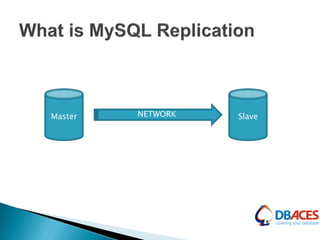
Master SlaveNETWORK
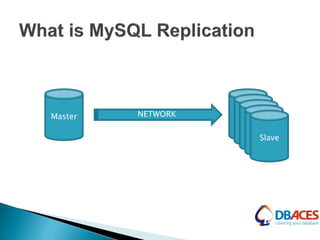
Master SlaveNETWORK
Slave
Slave
Slave
Slave
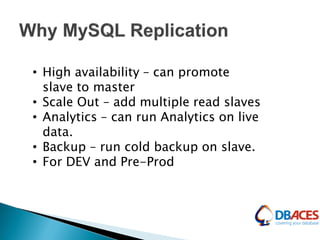
• High availability – can promote
slave to master
• Scale Out – add multiple read slaves
• Analytics – can run Analytics on live
data.
• Backup – run cold backup on slave.
• For DEV and Pre-Prod
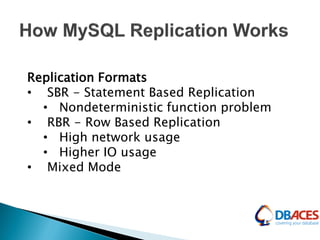
Replication Formats
• SBR - Statement Based Replication
• Nondeterministic function problem
• RBR - Row Based Replication
• High network usage
• Higher IO usage
• Mixed Mode
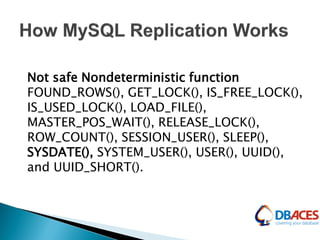
Not safe Nondeterministic function
FOUND_ROWS(), GET_LOCK(), IS_FREE_LOCK(),
IS_USED_LOCK(), LOAD_FILE(),
MASTER_POS_WAIT(), RELEASE_LOCK(),
ROW_COUNT(), SESSION_USER(), SLEEP(),
SYSDATE(), SYSTEM_USER(), USER(), UUID(),
and UUID_SHORT().
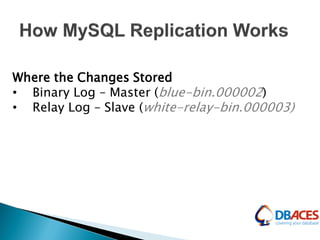
Where the Changes Stored
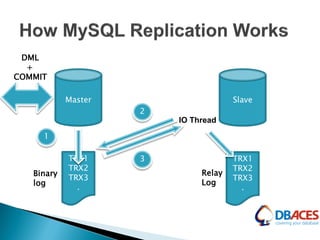
• Binary Log – Master (blue-bin.000002)
• Relay Log – Slave (white-relay-bin.000003)
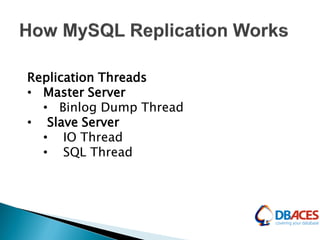
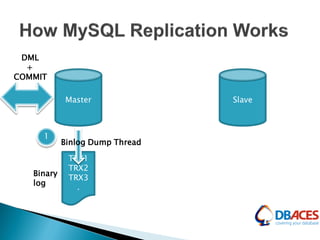
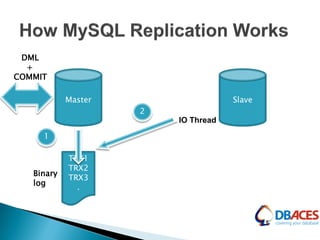
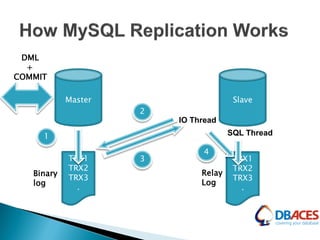
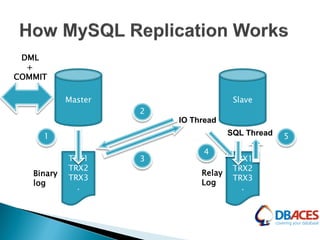
Replication Threads
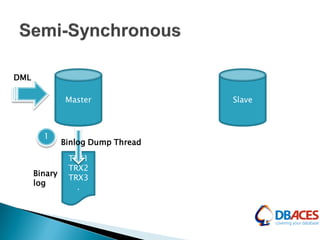
• Master Server
• Binlog Dump Thread
• Slave Server
• IO Thread
• SQL Thread
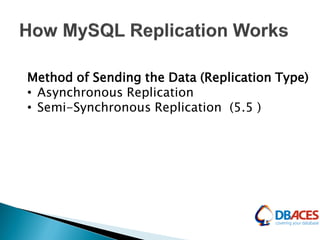
Method of Sending the Data (Replication Type)
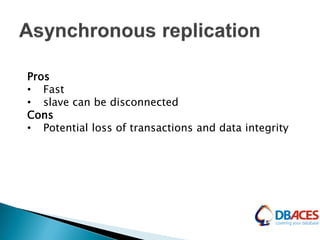
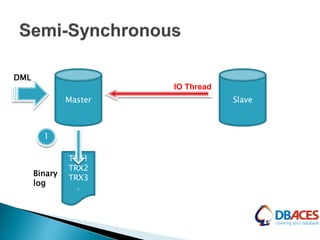
• Asynchronous Replication
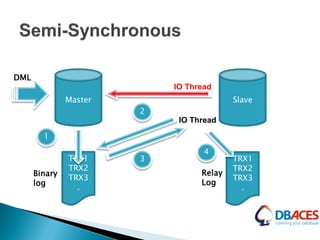
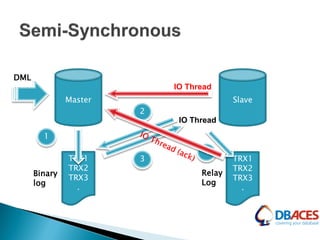
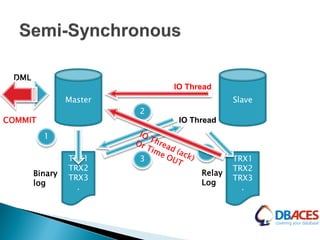
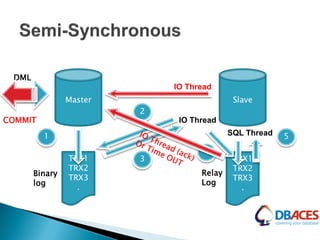
• Semi-Synchronous Replication (5.5 )
Master
TRX1
TRX2
TRX3
.
Slave
1
Binary
log
DML
+
COMMIT
Binlog Dump Thread
Master
TRX1
TRX2
TRX3
.
Slave
1
2
Binary
log
IO Thread
DML
+
COMMIT
Master
TRX1
TRX2
TRX3
.
Slave
TRX1
TRX2
TRX3
.
1
2
3
Binary
log
Relay
Log
IO Thread
DML
+
COMMIT
Master
TRX1
TRX2
TRX3
.
Slave
TRX1
TRX2
TRX3
.
1
2
3
4
Binary
log
Relay
Log
IO Thread
SQL Thread
DML
+
COMMIT
Master
TRX1
TRX2
TRX3
.
Slave
TRX1
TRX2
TRX3
.
1
2
3
4
5
Binary
log
Relay
Log
IO Thread
SQL Thread
DML
+
COMMIT
Pros
• Fast
• slave can be disconnected
Cons
• Potential loss of transactions and data integrity
Master
TRX1
TRX2
TRX3
.
Slave
1
Binary
log
DML
Binlog Dump Thread
Master
TRX1
TRX2
TRX3
.
Slave
1
Binary
log
DML
IO Thread
Master
TRX1
TRX2
TRX3
.
Slave
1
Binary
log
DML
IO Thread
2
3
4
IO Thread
TRX1
TRX2
TRX3
.
Relay
Log
Master
TRX1
TRX2
TRX3
.
Slave
TRX1
TRX2
TRX3
.
1
2
3
4
Binary
log
Relay
Log
IO Thread
IO Thread
DML
Master
TRX1
TRX2
TRX3
.
Slave
TRX1
TRX2
TRX3
.
1
2
3
4
Binary
log
Relay
Log
IO Thread
IO Thread
DML
COMMIT
Master
TRX1
TRX2
TRX3
.
Slave
TRX1
TRX2
TRX3
.
1
2
3
4
Binary
log
Relay
Log
IO Thread
IO Thread
DML
COMMIT
5SQL Thread
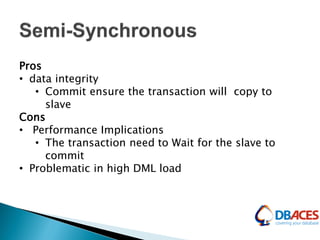
Pros
• data integrity
• Commit ensure the transaction will copy to
slave
Cons
• Performance Implications
• The transaction need to Wait for the slave to
commit
• Problematic in high DML load
What's New
• Multi threaded Slave
• Relay log recovery
• Binary Log Group Commit
• Crash-safe Replication – Binlog Checksums
• Global Transaction ID
You can read more in:
http://dev.mysql.com/tech-resources/articles/whats-new-in-mysql-5.6.html
Replication performance is improved by using
multiple execution threads to apply replication
events
slave-parallel-workers=2
You can read more in:
http://dev.mysql.com/tech-resources/articles/whats-new-in-mysql-5.6.html
• slave can automatically recover from a failure and
resume replicating DML updates
• the slave can roll back replication to the last
successfully committed transaction
relay-log-recovery =1
You can read more in:
http://dev.mysql.com/tech-resources/articles/whats-new-in-mysql-5.6.html
And in
Bug #13893363
• Commit a group of transactions to the binary log.
• Ensures durability with good performance.
• Designed to handle seamlessly temporary peeks
on the workload.
enable by default in 5.6
You can read more in:
http://dev.mysql.com/tech-resources/articles/whats-new-in-mysql-5.6.html
Master and slave can have different data
• Non deterministic queries.
• Wrong use of replication filters.
• Write executed on slave outside the.
replication (slave is not read only)
• Binlogs or relay log corruption.
How to check ?
Before 5.6 you can use only :
• show slave status
• pt-table-checksum
• utilty from precona that can check table
checksum
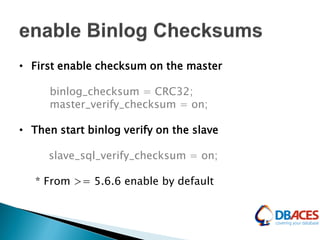
• First enable checksum on the master
binlog_checksum = CRC32;
master_verify_checksum = on;
• Then start binlog verify on the slave
slave_sql_verify_checksum = on;
* From >= 5.6.6 enable by default
mysql> show slave status
…
Last_Error : 1538
Last_Error : relay log read error……
…..
# mysqlbinlog --verify-binlog-checksum mysql_18676-relay-bin.000002
[...]
ERROR: Error in Log_event::read_log_event(): 'Event crc check failed!
Most likely there is event corruption.', data_len: 103, event_type: 2
ERROR: Could not read entry at offset 283: Error in log format or read
error.
[...]
Pros
• Can help to find error in the bin log/relay log
• Notify on a bin log corruption
Cons
• More CPU for the CRC
• The MySQL will keep writing to the corrupt bin log
• Transactions are not guaranteed to execute in
the order of the Binary logs
• The show slave status is not accurate
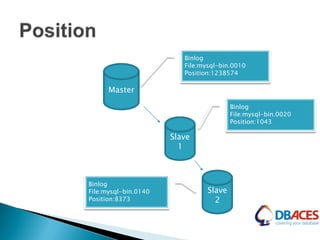
Master
Slave
1
Slave
2
Binlog
File:mysql-bin.0010
Position:1238574
Binlog
File:mysql-bin.0020
Position:1043
Binlog
File:mysql-bin.0140
Position:8373
• The same event can have different Binary log file
and position on different slaves
• Hard to find inconsistency in replication
• Very problematic to reconfigure replication
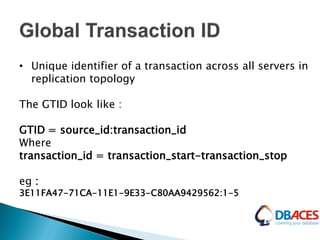
• Unique identifier of a transaction across all servers in
replication topology
The GTID look like :
GTID = source_id:transaction_id
Where
transaction_id = transaction_start-transaction_stop
eg :
3E11FA47-71CA-11E1-9E33-C80AA9429562:1-5
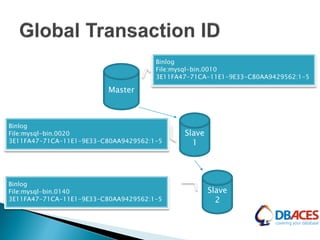
Master
Slave
1
Slave
2
Binlog
File:mysql-bin.0010
3E11FA47-71CA-11E1-9E33-C80AA9429562:1-5
Binlog
File:mysql-bin.0020
3E11FA47-71CA-11E1-9E33-C80AA9429562:1-5
Binlog
File:mysql-bin.0140
3E11FA47-71CA-11E1-9E33-C80AA9429562:1-5
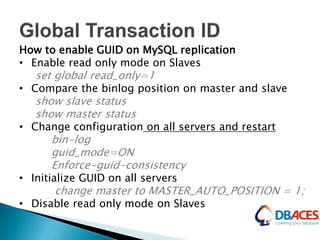
How to enable GUID on MySQL replication
• Enable read only mode on Slaves
set global read_only=1
• Compare the binlog position on master and slave
show slave status
show master status
• Change configuration on all servers and restart
bin-log
guid_mode=ON
Enforce-guid-consistency
• Initialize GUID on all servers
change master to MASTER_AUTO_POSITION = 1;
• Disable read only mode on Slaves
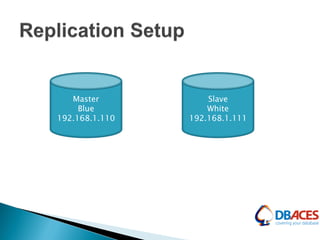
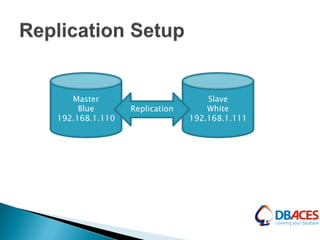
Master
Blue
192.168.1.110
Slave
White
192.168.1.111
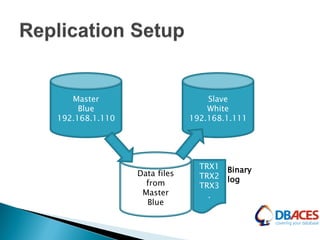
Master
Blue
192.168.1.110
Slave
White
192.168.1.111
Data files
from
Master
Blue
TRX1
TRX2
TRX3
.
Binary
log
Master
Blue
192.168.1.110
Slave
White
192.168.1.111
Replication
blue.my.cnf
[mysqld]
...
server-id=1
report-host=blue
binlog-format=MIXED
log-bin
log-slave-updates=true
gtid-mode=on
enforce-gtid-consistency=true
master-info-repository=TABLE
relay-log-info-repository=TABLE
sync-master-info=1
binlog-checksum=CRC32
master-verify-checksum=1
white.my.cnf
[mysqld]
...
server-id=2
report-host=white
binlog-format=MIXED
log-slave-updates=true
log-bin
gtid-mode=on
enforce-gtid-consistency=true
master-info-repository=TABLE
relay-log-info-repository=TABLE
sync-master-info=1
slave-parallel-workers=2
binlog-checksum=CRC32
master-verify-checksum=1
slave-sql-verify-checksum=1
binlog-rows-query-log_events=1
On Master:
[mysqld]
rpl_semi_sync_master_enabled=1
rpl_semi_sync_master_timeout=1000 # 1 second
On each Slave:
[mysqld]
rpl_semi_sync_slave_enabled=1
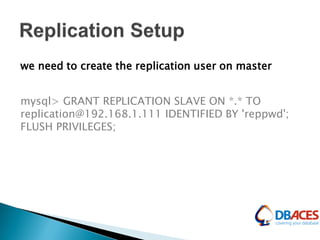
we need to create the replication user on master
mysql> GRANT REPLICATION SLAVE ON *.* TO
replication@192.168.1.111 IDENTIFIED BY 'reppwd';
FLUSH PRIVILEGES;
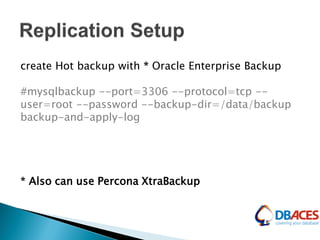
create Hot backup with * Oracle Enterprise Backup
#mysqlbackup --port=3306 --protocol=tcp --
user=root --password --backup-dir=/data/backup
backup-and-apply-log
* Also can use Percona XtraBackup
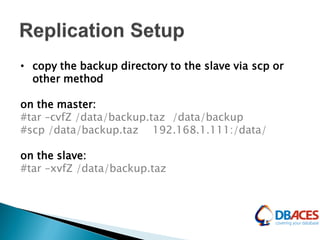
• copy the backup directory to the slave via scp or
other method
on the master:
#tar –cvfZ /data/backup.taz /data/backup
#scp /data/backup.taz 192.168.1.111:/data/
on the slave:
#tar –xvfZ /data/backup.taz
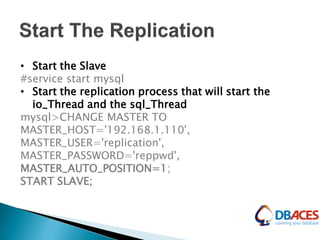
• Start the Slave
#service start mysql
• Start the replication process that will start the
io_Thread and the sql_Thread
mysql>CHANGE MASTER TO
MASTER_HOST='192.168.1.110',
MASTER_USER='replication',
MASTER_PASSWORD='reppwd',
MASTER_AUTO_POSITION=1;
START SLAVE;
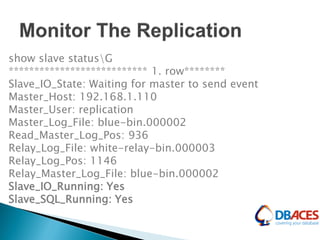
show slave statusG
*************************** 1. row********
Slave_IO_State: Waiting for master to send event
Master_Host: 192.168.1.110
Master_User: replication
Master_Log_File: blue-bin.000002
Read_Master_Log_Pos: 936
Relay_Log_File: white-relay-bin.000003
Relay_Log_Pos: 1146
Relay_Master_Log_File: blue-bin.000002
Slave_IO_Running: Yes
Slave_SQL_Running: Yes
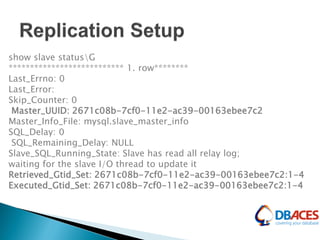
show slave statusG
*************************** 1. row********
Last_Errno: 0
Last_Error:
Skip_Counter: 0
Master_UUID: 2671c08b-7cf0-11e2-ac39-00163ebee7c2
Master_Info_File: mysql.slave_master_info
SQL_Delay: 0
SQL_Remaining_Delay: NULL
Slave_SQL_Running_State: Slave has read all relay log;
waiting for the slave I/O thread to update it
Retrieved_Gtid_Set: 2671c08b-7cf0-11e2-ac39-00163ebee7c2:1-4
Executed_Gtid_Set: 2671c08b-7cf0-11e2-ac39-00163ebee7c2:1-4
baruch@dbaces.com

MySQL replication best practices 105-232-931