Copyright © 2019 Oracle and/or its affiliates.
MySQL Performance Tuning:
The Perfect Scalability
(HOL3025)
MySQL Principal Technical Support Engineer
Oracle MySQL Support
September 17, 2019
Mirko Ortensi
The following is intended to outline our general product direction. It is intended for information purposes
only, and may not be incorporated into any contract. It is not a commitment to deliver any material, code,
or functionality, and should not be relied upon in making purchasing decisions. The development,
release, timing, and pricing of any features or functionality described for Oracle’s products may change
and remains at the sole discretion of Oracle Corporation.
Statements in this presentation relating to Oracle’s future plans, expectations, beliefs, intentions and
prospects are “forward-looking statements” and are subject to material risks and uncertainties. A detailed
discussion of these factors and other risks that affect our business is contained in Oracle’s Securities and
Exchange Commission (SEC) filings, including our most recent reports on Form 10-K and Form 10-Q
under the heading “Risk Factors.” These filings are available on the SEC’s website or on Oracle’s website
at http://www.oracle.com/investor. All information in this presentation is current as of September 2019
and Oracle undertakes no duty to update any statement in light of new information or future events.
Safe Harbor
Copyright © 2019 Oracle and/or its affiliates.
Our Goal
When dataset and concurrency increase,
horizontal and vertical scaling can address
service growth. But in order to achieve
perfect scalability, I/O, CPU and Network
bound workloads can meet additional
improvements at no expense to get the
most out of MySQL Server.
Copyright © 2019 Oracle and/or its affiliates.
Why This Matters
Scaling up and out a database implies more
performing storage, more processing
capacity, additional memory and higher
bandwidth. Keeping adjustements to
infrastructure as little as possible helps
keeping operational expenditure limited.
Copyright © 2019 Oracle and/or its affiliates.
“Query is slow
Copyright © 2019 Oracle and/or its affiliates.
Anonymous
Copyright © 2019 Oracle and/or its affiliates.
Mirko Ortensi
MySQL Principal Technical Support Engineer
Agenda
• Horizontal vs Vertical scaling
• I/O Bound Workload
• CPU Bound Workload
• Network Bound Workload
• OS-wise
• Conclusions
Copyright © 2019 Oracle and/or its affiliates.
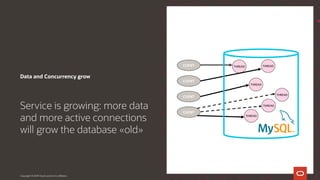
Data and Concurrency grow
Service is growing: more data
and more active connections
will grow the database «old»
Copyright © 2019 Oracle and/or its affiliates.
THREAD
THREAD
THREAD
THREAD
CLIENT
CLIENT
CLIENT
CLIENT
THREAD
THREAD
I/O, CPU and NETWORK bound
More locks + scans Buffer pool should be
increased
More connections
threads
I/O throughput
Copyright © 2019 Oracle and/or its affiliates.
Agenda
• Horizontal vs Vertical scaling
• I/O Bound Workload
• CPU Bound Workload
• Network Bound Workload
• OS-wise
• Conclusions
Copyright © 2019 Oracle and/or its affiliates.
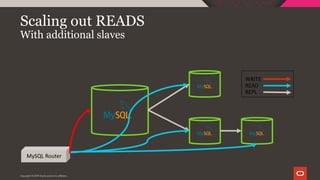
Scaling out READS
With additional slaves
MySQL Router
WRITE
READ
REPL
Copyright © 2019 Oracle and/or its affiliates.
Scaling out READS
With additional slaves
• Create slave server (clone(), MEB, mysqldump)
• Distribute read and write operations accordingly
• Slaves can be delayed
Copyright © 2019 Oracle and/or its affiliates.
Scaling out READS
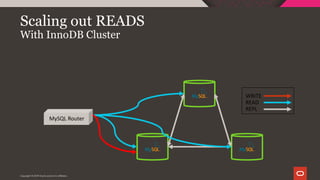
With InnoDB Cluster
MySQL Router
WRITE
READ
REPL
Copyright © 2019 Oracle and/or its affiliates.
Scaling out READS
With InnoDB Cluster
• Highly available with automatic failover
• Integrated solution to scale and balance reads
• Up to 9 replicas
• Writes do not scale (single or multi master)
• Read your own writes
Copyright © 2019 Oracle and/or its affiliates.
Scaling out WRITES
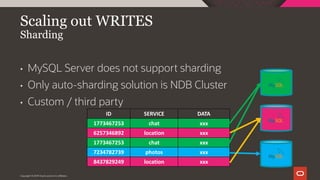
Sharding
• MySQL Server does not support sharding
• Only auto-sharding solution is NDB Cluster
• Custom / third party
ID SERVICE DATA
1773467253 chat xxx
6257346892 location xxx
1773467253 chat xxx
7234782739 photos xxx
8437829249 location xxx
Copyright © 2019 Oracle and/or its affiliates.
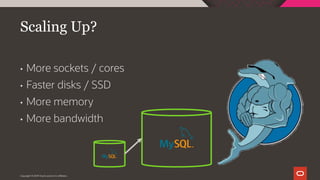
Scaling Up?
• More sockets / cores
• Faster disks / SSD
• More memory
• More bandwidth
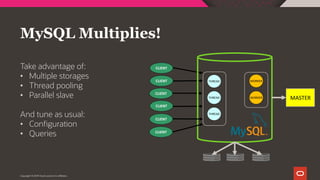
MySQL Multiplies!
Take advantage of:
• Multiple storages
• Thread pooling
• Parallel slave
And tune as usual:
• Configuration
• Queries
Copyright © 2019 Oracle and/or its affiliates.
CLIENT
CLIENT
CLIENT
CLIENT
THREAD
THREAD
THREAD
CLIENT
CLIENT
WORKER
WORKER
MASTER
1 2 3
Copyright © 2019 Oracle and/or its affiliates.
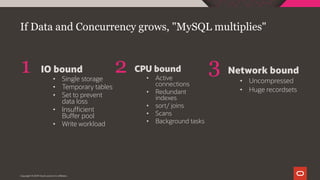
If Data and Concurrency grows, "MySQL multiplies"
IO bound
• Single storage
• Temporary tables
• Set to prevent
data loss
• Insufficient
Buffer pool
• Write workload
CPU bound
• Active
connections
• Redundant
indexes
• sort/ joins
• Scans
• Background tasks
Network bound
• Uncompressed
• Huge recordsets
• Linux (native/VM)
• MySQL 8
• sysstat
• world.sql https://bit.ly/2kO70nY
HOL3025
Copyright © 2019 Oracle and/or its affiliates.
Agenda
• Horizontal vs Vertical scaling
• I/O Bound Workload
• CPU Bound Workload
• Network Bound Workload
• OS-wise
• Conclusions
Copyright © 2019 Oracle and/or its affiliates.
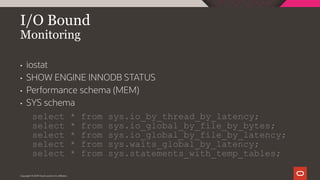
I/O Bound
Monitoring
• iostat
• SHOW ENGINE INNODB STATUS
• Performance schema (MEM)
• SYS schema
select * from sys.io_by_thread_by_latency;
select * from sys.io_global_by_file_by_bytes;
select * from sys.io_global_by_file_by_latency;
select * from sys.waits_global_by_latency;
select * from sys.statements_with_temp_tables;
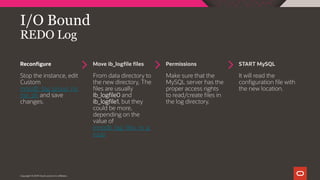
Reconfigure Move ib_logfile files Permissions START MySQL
Copyright © 2019 Oracle and/or its affiliates.
I/O Bound
REDO Log
Stop the instance, edit
Custom
innodb_log_group_ho
me_dir and save
changes.
From data directory to
the new directory, The
files are usually
ib_logfile0 and
ib_logfile1, but they
could be more,
depending on the
value of
innodb_log_files_in_g
roup
Make sure that the
MySQL server has the
proper access rights
to read/create files in
the log directory.
It will read the
configuration file with
the new location.
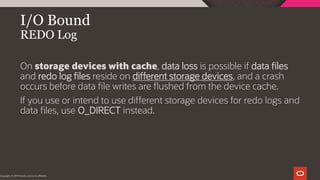
On storage devices with cache, data loss is possible if data files
and redo log files reside on different storage devices, and a crash
occurs before data file writes are flushed from the device cache.
If you use or intend to use different storage devices for redo logs and
data files, use O_DIRECT instead.
I/O Bound
REDO Log
Copyright © 2019 Oracle and/or its affiliates.
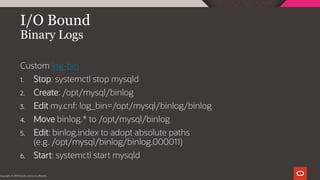
I/O Bound
Binary Logs
Copyright © 2019 Oracle and/or its affiliates.
Custom log-bin
1. Stop: systemctl stop mysqld
2. Create: /opt/mysql/binlog
3. Edit my.cnf: log_bin=/opt/mysql/binlog/binlog
4. Move binlog.* to /opt/mysql/binlog
5. Edit: binlog.index to adopt absolute paths
(e.g. /opt/mysql/binlog/binlog.000011)
6. Start: systemctl start mysqld
I/O Bound
Binary Logs
Copyright © 2019 Oracle and/or its affiliates.
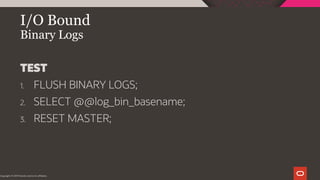
TEST
1. FLUSH BINARY LOGS;
2. SELECT @@log_bin_basename;
3. RESET MASTER;
I/O Bound
UNDO Logs
Copyright © 2019 Oracle and/or its affiliates.
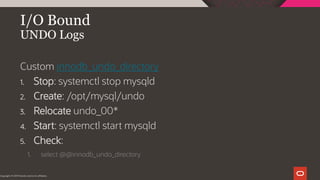
Custom innodb_undo_directory
1. Stop: systemctl stop mysqld
2. Create: /opt/mysql/undo
3. Relocate undo_00*
4. Start: systemctl start mysqld
5. Check:
1. select @@innodb_undo_directory
I/O Bound
EXTERNAL tablespace
Copyright © 2019 Oracle and/or its affiliates.
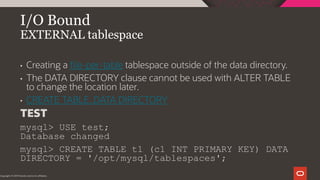
• Creating a file-per-table tablespace outside of the data directory.
• The DATA DIRECTORY clause cannot be used with ALTER TABLE
to change the location later.
• CREATE TABLE..DATA DIRECTORY
TEST
mysql> USE test;
Database changed
mysql> CREATE TABLE t1 (c1 INT PRIMARY KEY) DATA
DIRECTORY = '/opt/mysql/tablespaces';
I/O Bound
GENERAL tablespace
Copyright © 2019 Oracle and/or its affiliates.
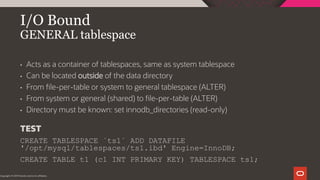
• Acts as a container of tablespaces, same as system tablespace
• Can be located outside of the data directory
• From file-per-table or system to general tablespace (ALTER)
• From system or general (shared) to file-per-table (ALTER)
• Directory must be known: set innodb_directories (read-only)
TEST
CREATE TABLESPACE `ts1` ADD DATAFILE
'/opt/mysql/tablespaces/ts1.ibd' Engine=InnoDB;
CREATE TABLE t1 (c1 INT PRIMARY KEY) TABLESPACE ts1;
I/O Bound
Partitioning
Copyright © 2019 Oracle and/or its affiliates.
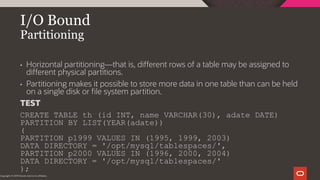
• Horizontal partitioning—that is, different rows of a table may be assigned to
different physical partitions.
• Partitioning makes it possible to store more data in one table than can be held
on a single disk or file system partition.
TEST
CREATE TABLE th (id INT, name VARCHAR(30), adate DATE)
PARTITION BY LIST(YEAR(adate))
(
PARTITION p1999 VALUES IN (1995, 1999, 2003)
DATA DIRECTORY = '/opt/mysql/tablespaces/',
PARTITION p2000 VALUES IN (1996, 2000, 2004)
DATA DIRECTORY = '/opt/mysql/tablespaces/'
);
I/O Bound
Session and Global Temporary Tablespace
Copyright © 2019 Oracle and/or its affiliates.
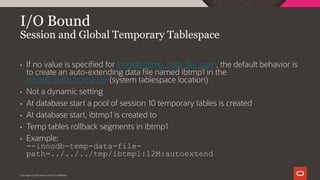
• If no value is specified for innodb_temp_data_file_path, the default behavior is
to create an auto-extending data file named ibtmp1 in the
innodb_data_home_dir (system tablespace location)
• Not a dynamic setting
• At database start a pool of session 10 temporary tables is created
• At database start, ibtmp1 is created to
• Temp tables rollback segments in ibtmp1
• Example:
--innodb-temp-data-file-
path=../../../tmp/ibtmp1:12M:autoextend
I/O Bound
Session and Global Temporary Tablespace
Copyright © 2019 Oracle and/or its affiliates.
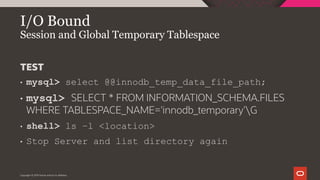
TEST
• mysql> select @@innodb_temp_data_file_path;
• mysql> SELECT * FROM INFORMATION_SCHEMA.FILES
WHERE TABLESPACE_NAME='innodb_temporary'G
• shell> ls –l <location>
• Stop Server and list directory again
I/O Bound
Logging
General log
general_log_file
Slow Query Log
slow_query_log_file
Audit Log
audit_log_file
Copyright © 2019 Oracle and/or its affiliates.
I/O Bound
Flush method
Copyright © 2019 Oracle and/or its affiliates.
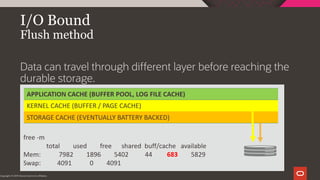
Data can travel through different layer before reaching the
durable storage.
I/O Bound
Flush method
Copyright © 2019 Oracle and/or its affiliates.
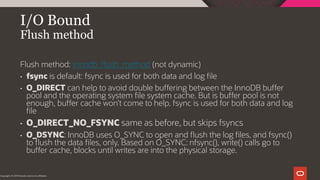
Flush method: innodb_flush_method (not dynamic)
• fsync is default: fsync is used for both data and log file
• O_DIRECT can help to avoid double buffering between the InnoDB buffer
pool and the operating system file system cache. But is buffer pool is not
enough, buffer cache won’t come to help. fsync is used for both data and log
file
• O_DIRECT_NO_FSYNC same as before, but skips fsyncs
• O_DSYNC: InnoDB uses O_SYNC to open and flush the log files, and fsync()
to flush the data files, only. Based on O_SYNC: nfsync(), write() calls go to
buffer cache, blocks until writes are into the physical storage.
I/O Bound
Flush method monitoring
Copyright © 2019 Oracle and/or its affiliates.
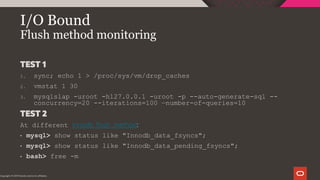
TEST 1
1. sync; echo 1 > /proc/sys/vm/drop_caches
2. vmstat 1 30
3. mysqlslap -uroot -h127.0.0.1 -uroot -p --auto-generate-sql --
concurrency=20 --iterations=100 —number-of-queries=10
TEST 2
At different innodb_flush_method:
• mysql> show status like "Innodb_data_fsyncs";
• mysql> show status like "Innodb_data_pending_fsyncs";
• bash> free -m
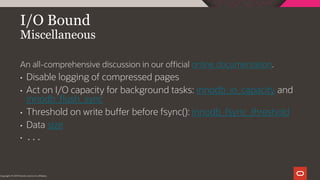
I/O Bound
Miscellaneous
Copyright © 2019 Oracle and/or its affiliates.
An all-comprehensive discussion in our official online documentation.
• Disable logging of compressed pages
• Act on I/O capacity for background tasks: innodb_io_capacity and
innodb_flush_sync
• Threshold on write buffer before fsync(): innodb_fsync_threshold
• Data size
• ...
Agenda
• Horizontal vs Vertical scaling
• I/O Bound Workload
• CPU Bound Workload
• Network Bound Workload
• OS-wise
• Conclusions
Copyright © 2019 Oracle and/or its affiliates.
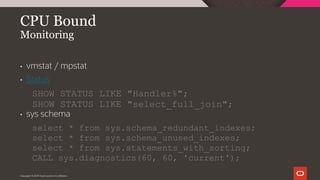
CPU Bound
Monitoring
• vmstat / mpstat
• Status
SHOW STATUS LIKE "Handler%";
SHOW STATUS LIKE "select_full_join";
• sys schema
select * from sys.schema_redundant_indexes;
select * from sys.schema_unused_indexes;
select * from sys.statements_with_sorting;
CALL sys.diagnostics(60, 60, 'current');
Copyright © 2019 Oracle and/or its affiliates.
CPU Bound
Thread Pool
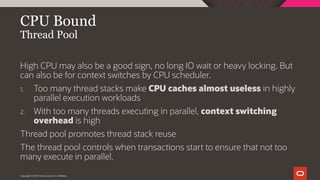
High CPU may also be a good sign, no long IO wait or heavy locking. But
can also be for context switches by CPU scheduler.
1. Too many thread stacks make CPU caches almost useless in highly
parallel execution workloads
2. With too many threads executing in parallel, context switching
overhead is high
Thread pool promotes thread stack reuse
The thread pool controls when transactions start to ensure that not too
many execute in parallel.
Copyright © 2019 Oracle and/or its affiliates.
CPU Bound
Query Tuning
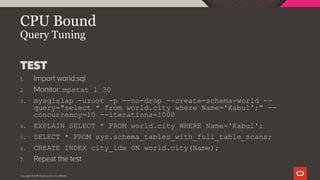
TEST
1. Import world.sql
2. Monitor: mpstat 1 30
3. mysqlslap -uroot -p --no-drop --create-schema=world --
query="select * from world.city where Name='Kabul';" --
concurrency=10 --iterations=1000
4. EXPLAIN SELECT * FROM world.city WHERE Name='Kabul';
5. SELECT * FROM sys.schema_tables_with_full_table_scans;
6. CREATE INDEX city_idx ON world.city(Name);
7. Repeat the test
Copyright © 2019 Oracle and/or its affiliates.
CPU Bound
Replication
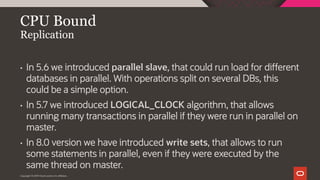
• In 5.6 we introduced parallel slave, that could run load for different
databases in parallel. With operations split on several DBs, this
could be a simple option.
• In 5.7 we introduced LOGICAL_CLOCK algorithm, that allows
running many transactions in parallel if they were run in parallel on
master.
• In 8.0 version we have introduced write sets, that allows to run
some statements in parallel, even if they were executed by the
same thread on master.
Copyright © 2019 Oracle and/or its affiliates.
CPU Bound
Miscellaneous
• Tablespace compression
• Protocol compression
• Thread cache
• SSL
• Background
Checkpoint
Purge
Automatic Statistics Calculation
Agenda
• Horizontal vs Vertical scaling
• I/O Bound Workload
• CPU Bound Workload
• Network Bound Workload
• OS-wise
• Conclusions
Copyright © 2019 Oracle and/or its affiliates.
NETWORK Bound
Compression
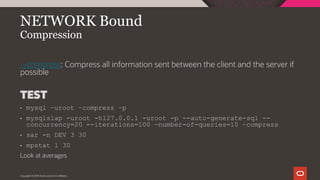
--compress: Compress all information sent between the client and the server if
possible
TEST
• mysql –uroot –compress –p
• mysqlslap -uroot -h127.0.0.1 -uroot -p --auto-generate-sql --
concurrency=20 --iterations=100 —number-of-queries=10 –compress
• sar -n DEV 3 30
• mpstat 1 30
Look at averages
Agenda
• Horizontal vs Vertical scaling
• I/O Bound Workload
• CPU Bound Workload
• Network Bound Workload
• OS-wise
• Conclusions
Copyright © 2019 Oracle and/or its affiliates.
OS-wise
SWAP, SWAPPINESS and AFFINITY
SWAP & SWAPPINESS
cat /proc/sys/vm/swappiness
AFFINITY
At the linux OS level, you can limit the number of processors that the
kernel will utilize for a user space process using numactl, or more
commonly taskset.
Copyright © 2019 Oracle and/or its affiliates.
OS-wise
SWAP, SWAPPINESS and AFFINITY
TEST
• Identify systemd configuration file:
/etc/systemd/system/multi-user.target.wants/mysqld.service
• Modify:
[Service]
CPUAffinity=1
• bash> systemctl daemon-reload
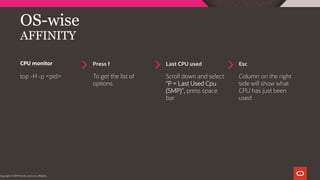
CPU monitor Press f Last CPU used Esc
OS-wise
AFFINITY
top -H -p <pid> To get the list of
options
Scroll down and select
"P = Last Used Cpu
(SMP)", press space
bar
Column on the right
side will show what
CPU has just been
used
Copyright © 2019 Oracle and/or its affiliates.
Agenda
• Horizontal vs Vertical scaling
• I/O Bound Workload
• CPU Bound Workload
• Network Bound Workload
• OS-wise
• Conclusions
Copyright © 2019 Oracle and/or its affiliates.
Conclusion
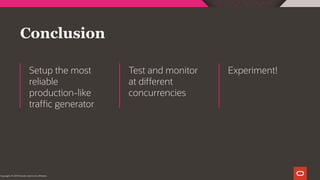
Setup the most
reliable
production-like
traffic generator
Test and monitor
at different
concurrencies
Experiment!
Copyright © 2019 Oracle and/or its affiliates.
Thank You
Copyright © 2019 Oracle and/or its affiliates.
MySQL Principal Technical Support Engineer
Oracle MySQL Support
September 17, 2019
Mirko Ortensi
Session Survey
Help us make the content
even better. Please complete
the session survey in the
Mobile App.
Copyright © 2019 Oracle and/or its affiliates.
What’s Ahead
Tuesday
5pm-5.45pm
Thursday
Copyright © 2019 Oracle and/or its affiliates.
NDB, Simply the World’s Highest-
Throughput Transactional Datastore
[DEV2554]
Moscone South - Room 205
10am-10:45am What’s New in MySQL Optimizer and
Executor? [DEV2077]
Moscone South - Room 205
The preceding is intended to outline our general product direction. It is intended for information purposes
only, and may not be incorporated into any contract. It is not a commitment to deliver any material, code,
or functionality, and should not be relied upon in making purchasing decisions. The development,
release, timing, and pricing of any features or functionality described for Oracle’s products may change
and remains at the sole discretion of Oracle Corporation.
Statements in this presentation relating to Oracle’s future plans, expectations, beliefs, intentions and
prospects are “forward-looking statements” and are subject to material risks and uncertainties. A detailed
discussion of these factors and other risks that affect our business is contained in Oracle’s Securities and
Exchange Commission (SEC) filings, including our most recent reports on Form 10-K and Form 10-Q
under the heading “Risk Factors.” These filings are available on the SEC’s website or on Oracle’s website
at http://www.oracle.com/investor. All information in this presentation is current as of September 2019
and Oracle undertakes no duty to update any statement in light of new information or future events.
Safe Harbor
Copyright © 2019 Oracle and/or its affiliates.

MySQL Performance Tuning: The Perfect Scalability (OOW2019)

  • 1.
    Copyright © 2019Oracle and/or its affiliates. MySQL Performance Tuning: The Perfect Scalability (HOL3025) MySQL Principal Technical Support Engineer Oracle MySQL Support September 17, 2019 Mirko Ortensi
  • 2.
    The following isintended to outline our general product direction. It is intended for information purposes only, and may not be incorporated into any contract. It is not a commitment to deliver any material, code, or functionality, and should not be relied upon in making purchasing decisions. The development, release, timing, and pricing of any features or functionality described for Oracle’s products may change and remains at the sole discretion of Oracle Corporation. Statements in this presentation relating to Oracle’s future plans, expectations, beliefs, intentions and prospects are “forward-looking statements” and are subject to material risks and uncertainties. A detailed discussion of these factors and other risks that affect our business is contained in Oracle’s Securities and Exchange Commission (SEC) filings, including our most recent reports on Form 10-K and Form 10-Q under the heading “Risk Factors.” These filings are available on the SEC’s website or on Oracle’s website at http://www.oracle.com/investor. All information in this presentation is current as of September 2019 and Oracle undertakes no duty to update any statement in light of new information or future events. Safe Harbor Copyright © 2019 Oracle and/or its affiliates.
  • 3.
    Our Goal When datasetand concurrency increase, horizontal and vertical scaling can address service growth. But in order to achieve perfect scalability, I/O, CPU and Network bound workloads can meet additional improvements at no expense to get the most out of MySQL Server. Copyright © 2019 Oracle and/or its affiliates.
  • 4.
    Why This Matters Scalingup and out a database implies more performing storage, more processing capacity, additional memory and higher bandwidth. Keeping adjustements to infrastructure as little as possible helps keeping operational expenditure limited. Copyright © 2019 Oracle and/or its affiliates.
  • 5.
    “Query is slow Copyright© 2019 Oracle and/or its affiliates. Anonymous
  • 6.
    Copyright © 2019Oracle and/or its affiliates. Mirko Ortensi MySQL Principal Technical Support Engineer
  • 7.
    Agenda • Horizontal vsVertical scaling • I/O Bound Workload • CPU Bound Workload • Network Bound Workload • OS-wise • Conclusions Copyright © 2019 Oracle and/or its affiliates.
  • 8.
    Data and Concurrencygrow Service is growing: more data and more active connections will grow the database «old» Copyright © 2019 Oracle and/or its affiliates. THREAD THREAD THREAD THREAD CLIENT CLIENT CLIENT CLIENT THREAD THREAD
  • 9.
    I/O, CPU andNETWORK bound More locks + scans Buffer pool should be increased More connections threads I/O throughput Copyright © 2019 Oracle and/or its affiliates.
  • 10.
    Agenda • Horizontal vsVertical scaling • I/O Bound Workload • CPU Bound Workload • Network Bound Workload • OS-wise • Conclusions Copyright © 2019 Oracle and/or its affiliates.
  • 11.
    Copyright © 2019Oracle and/or its affiliates. Scaling out READS With additional slaves MySQL Router WRITE READ REPL
  • 12.
    Copyright © 2019Oracle and/or its affiliates. Scaling out READS With additional slaves • Create slave server (clone(), MEB, mysqldump) • Distribute read and write operations accordingly • Slaves can be delayed
  • 13.
    Copyright © 2019Oracle and/or its affiliates. Scaling out READS With InnoDB Cluster MySQL Router WRITE READ REPL
  • 14.
    Copyright © 2019Oracle and/or its affiliates. Scaling out READS With InnoDB Cluster • Highly available with automatic failover • Integrated solution to scale and balance reads • Up to 9 replicas • Writes do not scale (single or multi master) • Read your own writes
  • 15.
    Copyright © 2019Oracle and/or its affiliates. Scaling out WRITES Sharding • MySQL Server does not support sharding • Only auto-sharding solution is NDB Cluster • Custom / third party ID SERVICE DATA 1773467253 chat xxx 6257346892 location xxx 1773467253 chat xxx 7234782739 photos xxx 8437829249 location xxx
  • 16.
    Copyright © 2019Oracle and/or its affiliates. Scaling Up? • More sockets / cores • Faster disks / SSD • More memory • More bandwidth
  • 17.
    MySQL Multiplies! Take advantageof: • Multiple storages • Thread pooling • Parallel slave And tune as usual: • Configuration • Queries Copyright © 2019 Oracle and/or its affiliates. CLIENT CLIENT CLIENT CLIENT THREAD THREAD THREAD CLIENT CLIENT WORKER WORKER MASTER
  • 18.
    1 2 3 Copyright© 2019 Oracle and/or its affiliates. If Data and Concurrency grows, "MySQL multiplies" IO bound • Single storage • Temporary tables • Set to prevent data loss • Insufficient Buffer pool • Write workload CPU bound • Active connections • Redundant indexes • sort/ joins • Scans • Background tasks Network bound • Uncompressed • Huge recordsets
  • 19.
    • Linux (native/VM) •MySQL 8 • sysstat • world.sql https://bit.ly/2kO70nY HOL3025 Copyright © 2019 Oracle and/or its affiliates.
  • 20.
    Agenda • Horizontal vsVertical scaling • I/O Bound Workload • CPU Bound Workload • Network Bound Workload • OS-wise • Conclusions Copyright © 2019 Oracle and/or its affiliates.
  • 21.
    Copyright © 2019Oracle and/or its affiliates. I/O Bound Monitoring • iostat • SHOW ENGINE INNODB STATUS • Performance schema (MEM) • SYS schema select * from sys.io_by_thread_by_latency; select * from sys.io_global_by_file_by_bytes; select * from sys.io_global_by_file_by_latency; select * from sys.waits_global_by_latency; select * from sys.statements_with_temp_tables;
  • 22.
    Reconfigure Move ib_logfilefiles Permissions START MySQL Copyright © 2019 Oracle and/or its affiliates. I/O Bound REDO Log Stop the instance, edit Custom innodb_log_group_ho me_dir and save changes. From data directory to the new directory, The files are usually ib_logfile0 and ib_logfile1, but they could be more, depending on the value of innodb_log_files_in_g roup Make sure that the MySQL server has the proper access rights to read/create files in the log directory. It will read the configuration file with the new location.
  • 23.
    On storage deviceswith cache, data loss is possible if data files and redo log files reside on different storage devices, and a crash occurs before data file writes are flushed from the device cache. If you use or intend to use different storage devices for redo logs and data files, use O_DIRECT instead. I/O Bound REDO Log Copyright © 2019 Oracle and/or its affiliates.
  • 24.
    I/O Bound Binary Logs Copyright© 2019 Oracle and/or its affiliates. Custom log-bin 1. Stop: systemctl stop mysqld 2. Create: /opt/mysql/binlog 3. Edit my.cnf: log_bin=/opt/mysql/binlog/binlog 4. Move binlog.* to /opt/mysql/binlog 5. Edit: binlog.index to adopt absolute paths (e.g. /opt/mysql/binlog/binlog.000011) 6. Start: systemctl start mysqld
  • 25.
    I/O Bound Binary Logs Copyright© 2019 Oracle and/or its affiliates. TEST 1. FLUSH BINARY LOGS; 2. SELECT @@log_bin_basename; 3. RESET MASTER;
  • 26.
    I/O Bound UNDO Logs Copyright© 2019 Oracle and/or its affiliates. Custom innodb_undo_directory 1. Stop: systemctl stop mysqld 2. Create: /opt/mysql/undo 3. Relocate undo_00* 4. Start: systemctl start mysqld 5. Check: 1. select @@innodb_undo_directory
  • 27.
    I/O Bound EXTERNAL tablespace Copyright© 2019 Oracle and/or its affiliates. • Creating a file-per-table tablespace outside of the data directory. • The DATA DIRECTORY clause cannot be used with ALTER TABLE to change the location later. • CREATE TABLE..DATA DIRECTORY TEST mysql> USE test; Database changed mysql> CREATE TABLE t1 (c1 INT PRIMARY KEY) DATA DIRECTORY = '/opt/mysql/tablespaces';
  • 28.
    I/O Bound GENERAL tablespace Copyright© 2019 Oracle and/or its affiliates. • Acts as a container of tablespaces, same as system tablespace • Can be located outside of the data directory • From file-per-table or system to general tablespace (ALTER) • From system or general (shared) to file-per-table (ALTER) • Directory must be known: set innodb_directories (read-only) TEST CREATE TABLESPACE `ts1` ADD DATAFILE '/opt/mysql/tablespaces/ts1.ibd' Engine=InnoDB; CREATE TABLE t1 (c1 INT PRIMARY KEY) TABLESPACE ts1;
  • 29.
    I/O Bound Partitioning Copyright ©2019 Oracle and/or its affiliates. • Horizontal partitioning—that is, different rows of a table may be assigned to different physical partitions. • Partitioning makes it possible to store more data in one table than can be held on a single disk or file system partition. TEST CREATE TABLE th (id INT, name VARCHAR(30), adate DATE) PARTITION BY LIST(YEAR(adate)) ( PARTITION p1999 VALUES IN (1995, 1999, 2003) DATA DIRECTORY = '/opt/mysql/tablespaces/', PARTITION p2000 VALUES IN (1996, 2000, 2004) DATA DIRECTORY = '/opt/mysql/tablespaces/' );
  • 30.
    I/O Bound Session andGlobal Temporary Tablespace Copyright © 2019 Oracle and/or its affiliates. • If no value is specified for innodb_temp_data_file_path, the default behavior is to create an auto-extending data file named ibtmp1 in the innodb_data_home_dir (system tablespace location) • Not a dynamic setting • At database start a pool of session 10 temporary tables is created • At database start, ibtmp1 is created to • Temp tables rollback segments in ibtmp1 • Example: --innodb-temp-data-file- path=../../../tmp/ibtmp1:12M:autoextend
  • 31.
    I/O Bound Session andGlobal Temporary Tablespace Copyright © 2019 Oracle and/or its affiliates. TEST • mysql> select @@innodb_temp_data_file_path; • mysql> SELECT * FROM INFORMATION_SCHEMA.FILES WHERE TABLESPACE_NAME='innodb_temporary'G • shell> ls –l <location> • Stop Server and list directory again
  • 32.
    I/O Bound Logging General log general_log_file SlowQuery Log slow_query_log_file Audit Log audit_log_file Copyright © 2019 Oracle and/or its affiliates.
  • 33.
    I/O Bound Flush method Copyright© 2019 Oracle and/or its affiliates. Data can travel through different layer before reaching the durable storage.
  • 34.
    I/O Bound Flush method Copyright© 2019 Oracle and/or its affiliates. Flush method: innodb_flush_method (not dynamic) • fsync is default: fsync is used for both data and log file • O_DIRECT can help to avoid double buffering between the InnoDB buffer pool and the operating system file system cache. But is buffer pool is not enough, buffer cache won’t come to help. fsync is used for both data and log file • O_DIRECT_NO_FSYNC same as before, but skips fsyncs • O_DSYNC: InnoDB uses O_SYNC to open and flush the log files, and fsync() to flush the data files, only. Based on O_SYNC: nfsync(), write() calls go to buffer cache, blocks until writes are into the physical storage.
  • 35.
    I/O Bound Flush methodmonitoring Copyright © 2019 Oracle and/or its affiliates. TEST 1 1. sync; echo 1 > /proc/sys/vm/drop_caches 2. vmstat 1 30 3. mysqlslap -uroot -h127.0.0.1 -uroot -p --auto-generate-sql -- concurrency=20 --iterations=100 —number-of-queries=10 TEST 2 At different innodb_flush_method: • mysql> show status like "Innodb_data_fsyncs"; • mysql> show status like "Innodb_data_pending_fsyncs"; • bash> free -m
  • 36.
    I/O Bound Miscellaneous Copyright ©2019 Oracle and/or its affiliates. An all-comprehensive discussion in our official online documentation. • Disable logging of compressed pages • Act on I/O capacity for background tasks: innodb_io_capacity and innodb_flush_sync • Threshold on write buffer before fsync(): innodb_fsync_threshold • Data size • ...
  • 37.
    Agenda • Horizontal vsVertical scaling • I/O Bound Workload • CPU Bound Workload • Network Bound Workload • OS-wise • Conclusions Copyright © 2019 Oracle and/or its affiliates.
  • 38.
    Copyright © 2019Oracle and/or its affiliates. CPU Bound Monitoring • vmstat / mpstat • Status SHOW STATUS LIKE "Handler%"; SHOW STATUS LIKE "select_full_join"; • sys schema select * from sys.schema_redundant_indexes; select * from sys.schema_unused_indexes; select * from sys.statements_with_sorting; CALL sys.diagnostics(60, 60, 'current');
  • 39.
    Copyright © 2019Oracle and/or its affiliates. CPU Bound Thread Pool High CPU may also be a good sign, no long IO wait or heavy locking. But can also be for context switches by CPU scheduler. 1. Too many thread stacks make CPU caches almost useless in highly parallel execution workloads 2. With too many threads executing in parallel, context switching overhead is high Thread pool promotes thread stack reuse The thread pool controls when transactions start to ensure that not too many execute in parallel.
  • 40.
    Copyright © 2019Oracle and/or its affiliates. CPU Bound Query Tuning TEST 1. Import world.sql 2. Monitor: mpstat 1 30 3. mysqlslap -uroot -p --no-drop --create-schema=world -- query="select * from world.city where Name='Kabul';" -- concurrency=10 --iterations=1000 4. EXPLAIN SELECT * FROM world.city WHERE Name='Kabul'; 5. SELECT * FROM sys.schema_tables_with_full_table_scans; 6. CREATE INDEX city_idx ON world.city(Name); 7. Repeat the test
  • 41.
    Copyright © 2019Oracle and/or its affiliates. CPU Bound Replication • In 5.6 we introduced parallel slave, that could run load for different databases in parallel. With operations split on several DBs, this could be a simple option. • In 5.7 we introduced LOGICAL_CLOCK algorithm, that allows running many transactions in parallel if they were run in parallel on master. • In 8.0 version we have introduced write sets, that allows to run some statements in parallel, even if they were executed by the same thread on master.
  • 42.
    Copyright © 2019Oracle and/or its affiliates. CPU Bound Miscellaneous • Tablespace compression • Protocol compression • Thread cache • SSL • Background Checkpoint Purge Automatic Statistics Calculation
  • 43.
    Agenda • Horizontal vsVertical scaling • I/O Bound Workload • CPU Bound Workload • Network Bound Workload • OS-wise • Conclusions Copyright © 2019 Oracle and/or its affiliates.
  • 44.
    Copyright © 2019Oracle and/or its affiliates. NETWORK Bound Compression --compress: Compress all information sent between the client and the server if possible TEST • mysql –uroot –compress –p • mysqlslap -uroot -h127.0.0.1 -uroot -p --auto-generate-sql -- concurrency=20 --iterations=100 —number-of-queries=10 –compress • sar -n DEV 3 30 • mpstat 1 30 Look at averages
  • 45.
    Agenda • Horizontal vsVertical scaling • I/O Bound Workload • CPU Bound Workload • Network Bound Workload • OS-wise • Conclusions Copyright © 2019 Oracle and/or its affiliates.
  • 46.
    Copyright © 2019Oracle and/or its affiliates. OS-wise SWAP, SWAPPINESS and AFFINITY SWAP & SWAPPINESS cat /proc/sys/vm/swappiness AFFINITY At the linux OS level, you can limit the number of processors that the kernel will utilize for a user space process using numactl, or more commonly taskset.
  • 47.
    Copyright © 2019Oracle and/or its affiliates. OS-wise SWAP, SWAPPINESS and AFFINITY TEST • Identify systemd configuration file: /etc/systemd/system/multi-user.target.wants/mysqld.service • Modify: [Service] CPUAffinity=1 • bash> systemctl daemon-reload
  • 48.
    CPU monitor Pressf Last CPU used Esc OS-wise AFFINITY top -H -p <pid> To get the list of options Scroll down and select "P = Last Used Cpu (SMP)", press space bar Column on the right side will show what CPU has just been used Copyright © 2019 Oracle and/or its affiliates.
  • 49.
    Agenda • Horizontal vsVertical scaling • I/O Bound Workload • CPU Bound Workload • Network Bound Workload • OS-wise • Conclusions Copyright © 2019 Oracle and/or its affiliates.
  • 50.
    Conclusion Setup the most reliable production-like trafficgenerator Test and monitor at different concurrencies Experiment! Copyright © 2019 Oracle and/or its affiliates.
  • 51.
    Thank You Copyright ©2019 Oracle and/or its affiliates. MySQL Principal Technical Support Engineer Oracle MySQL Support September 17, 2019 Mirko Ortensi
  • 52.
    Session Survey Help usmake the content even better. Please complete the session survey in the Mobile App. Copyright © 2019 Oracle and/or its affiliates.
  • 53.
    What’s Ahead Tuesday 5pm-5.45pm Thursday Copyright ©2019 Oracle and/or its affiliates. NDB, Simply the World’s Highest- Throughput Transactional Datastore [DEV2554] Moscone South - Room 205 10am-10:45am What’s New in MySQL Optimizer and Executor? [DEV2077] Moscone South - Room 205
  • 54.
    The preceding isintended to outline our general product direction. It is intended for information purposes only, and may not be incorporated into any contract. It is not a commitment to deliver any material, code, or functionality, and should not be relied upon in making purchasing decisions. The development, release, timing, and pricing of any features or functionality described for Oracle’s products may change and remains at the sole discretion of Oracle Corporation. Statements in this presentation relating to Oracle’s future plans, expectations, beliefs, intentions and prospects are “forward-looking statements” and are subject to material risks and uncertainties. A detailed discussion of these factors and other risks that affect our business is contained in Oracle’s Securities and Exchange Commission (SEC) filings, including our most recent reports on Form 10-K and Form 10-Q under the heading “Risk Factors.” These filings are available on the SEC’s website or on Oracle’s website at http://www.oracle.com/investor. All information in this presentation is current as of September 2019 and Oracle undertakes no duty to update any statement in light of new information or future events. Safe Harbor Copyright © 2019 Oracle and/or its affiliates.