I
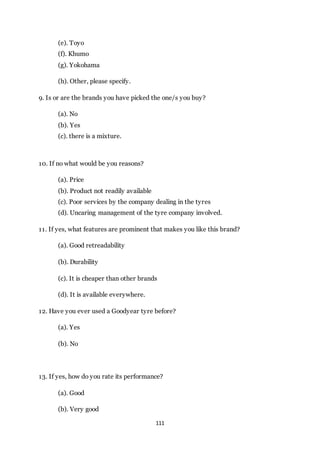
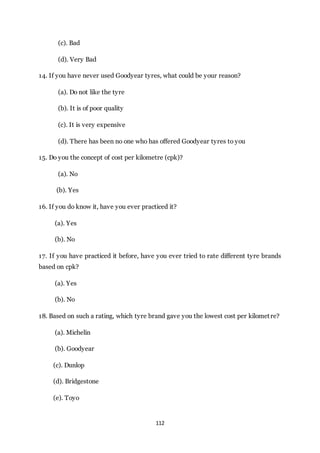
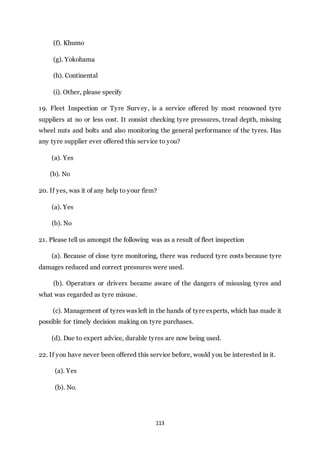
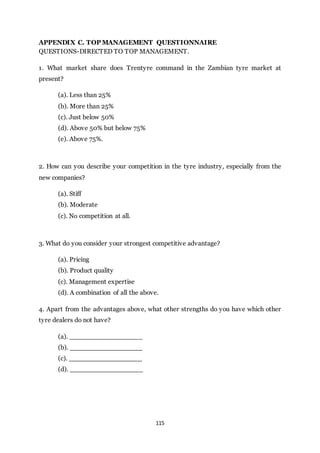
DECLARATION
I, the undersigned, hereby declare that this research thesis is my own original work
and that all sources have been accurately reported and acknowledged, and that this
document has not been previously, in its entirety or in part, submitted at any
university in order to obtain academic qualifications.
____________
DICKSON PHIRI DATE......................
II
ABSTRACT.
This paper draws its strength on the importance of strategic leadership to
manage change, especially one that is not envisioned. The question here that
this paper would like to address is “how can new corporate leaders achieve
success when there is an abrupt change in top leadership?” Such change
caused by death, resignations or instant dismissals due to gross misconduct,
can the incoming management succeed? In most situations the new leadership
will not come from internal human resources but from outside. This is true in
developing countries where the company is foreign owned. “How then would
the new management start running the affairs of the company in a country
they have little or no knowledge about?”
The foregone questions describe the true situation that took place at Trentyre
Zambia Ltd, specifically looking at the Copperbelt operations where the Top
Management resigned; the Managing Director, the Company Secretary and
Northern Zambia Director. This left the company in the hands of the middle
management and some junior staff whose knowledge about running a
company was limited. The company was forced to recall one of their Directors
who were based in Malawi who had a lot of knowledge about the Zambian
market to assist. Even he, however, had questionable management skills to
run such a big corporate entity as his background is that of a salesman with
little or no leadership qualities. It meant, then that the new management had
to depend on the help of this middle management to make decisions. Were
such decisions the best for the company? If not, what was the best solution to
such a dilemma?
III
Due to the above short-comings and having full knowledge that Zambia is a
strategic market for mining tyres, which contribute the highest Gross Profit,
the company’s Head Office in South Africa appointed new management to run
the South-Central African Cluster which included Zambia, Malawi, Zimbabwe
and Democratic Republic of Congo. The question was, “how was the new
management which had never stayed in Zambia, who had no idea in the
structure of the mining industry in Zambia and had little or no knowledge
about the general market conditions in this Cluster going to manage the
affairs of Trendier successfully? Do they have the correct leadership qualities
to repel the negative rumours going round that Trendier Zambia was closing
down? How about the big customers who had contracts with Trendier, whose
royalty was going down due to the negative publicity peddled by the
immediate past management, has the new management in the Trentyre North
(Copperbelt) got the qualities to provide strategic leadership to avoid an
impending loss of business?
IV
DEDICATION.
First and foremost, I dedicate thesis to God Almighty, for the strength and spiritual
support during the time I was organizing this work. I also dedicate this work to my
wife Valentina and my children, Dickson Junior, Bright, Mercy, Tamanda and
Mapalo. Thank you all for your love and patience with me.
V
ACKNOWLEDGEMENTS
I would like to express my profound gratitude to my thesis advisor, Professor
Kachepa, for being such an excellent mentor, a flexible advisor, and a supportive
teacher. I would also like to thank young Mathias Ndhlovu for his time and valuable
input in the development of this work. I would like to extend my gratitude to my first
born son Dickson Phiri Junior for his relenting help in typing this thesis. Without
him, I would have found it difficult to complete it.
Finally, I would like to express my appreciation to all my friends who assisted me
with all sorts of reading materials such as books, journals and some magazines. Guys,
you are wonderful. Thanks also to my family; especially my parents, the late Mr.
Kawala Mendulo Phiri and Mrs Nyanyiwe Banda Phiri, who are my source of
inspiration and example and also my wife Valentina and all my for their
understanding during the time I was always busy writing this thesis. To you all, may
God The Almighty bless you.
VI
LIST OF APPENDICES PAGE
Appendix A. Employee Questionnaire 102
Appendix B. Customer Questionnaire 105
Appendix C. Management Questionnaire 111
VII
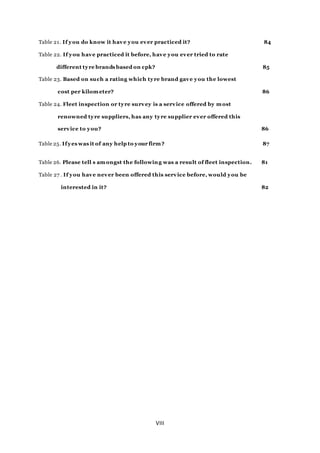
LIST OF TABLES
T able Page
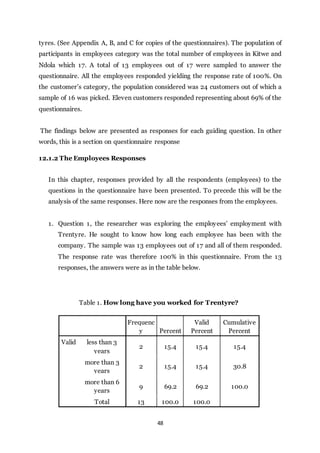
Table 1. How long have you worked for T rentyre? 48
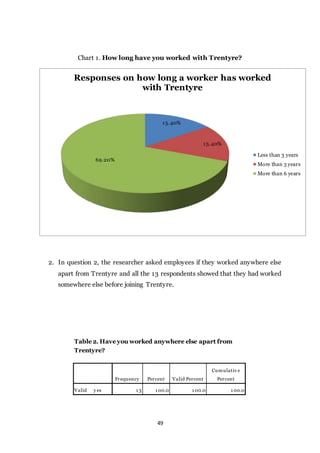
Table 2. Have you worked anywhere else apart from T rentyre? 49
Table 3. With your currentexperience with T rentyre what do you like about them?50
Table 4. In the same vein as above,what don’t you like about Trentyre? 51
Table 5. How is T rentyre fairing amongst all tyre dealers? 53
Table 6. If it is doing well what do you attribute this success to? 55
Table 7 . If T rentyre is not doing well what would you say are the causes? 56
Table 8. Have you witnessed any loss ofa good customer ifthe answer is 57
yes what could have caused that loss?
Table 9. What do you think has made some big customers to buy from
T rentyre after change of managem ent? 58
Table 10. Ifyou have a relationship with Trentyre,what would you say you
like about them? 70
Table 11. How do you rate T rentyre services amongst the tyre suppliers? 71
Table 12. According to you, (those without a relationship with T rentyre)
would you deal with them if they were to fulfil the condition y0u
have stated above? 72
Table 13. T here are so many tyre brands in the market today, which is your
preferred brand or brands 73
Table 14. Is or are the brands you have picked the one you buy? 75
Table 15. If not what would be your reasons? 76
Table 16. If yes what features are prominent that makes you like this brand? 77
Table 17. Have you ever used Goodyear tyre before? 78
Table 18. Ifyes,how do you rate its performance? 79
Table 19. Ifyou have never used Goodyear tyres,what could be your reasons? 82
Table 20. Do you know the concept ofcost per kilometre? 83
VIII
Table 21. If you do know it have you ever practiced it? 84
Table 22. If you have practiced it before, have you ever tried to rate
different tyre brands based on cpk? 85
Table 23. Based on such a rating which tyre brand gave you the lowest
cost per kilometer? 86
Table 24. Fleet inspection or tyre survey is a service offered by most
renowned tyre suppliers, has any tyre supplier ever offered this
service to you? 86
Table 25. Ifyes was it of any help to your firm? 87
Table 26. Please tell s amongst the following was a result of fleet inspection. 81
Table 27 . If you have never been offered this service before, would you be
interested in it? 82
IX
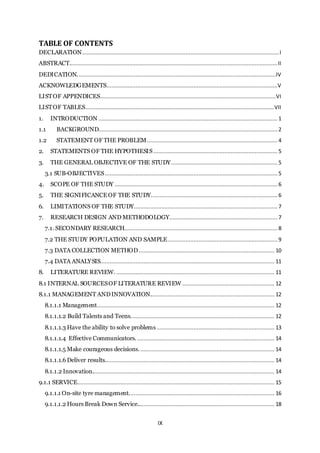
TABLE OF CONTENTS
DECLARATION..........................................................................................................................I
ABSTRACT.................................................................................................................................II
DEDICATION...........................................................................................................................IV
ACKNOWLEDGEMENTS..........................................................................................................V
LISTOF APPENDICES.............................................................................................................VI
LISTOF TABLES.....................................................................................................................VII
1. INTRODUCTION ............................................................................................................... 1
1.1 BACKGROUND............................................................................................................... 2
1.2 STATEMENT OF THE PROBLEM................................................................................. 4
2. STATEMENTS OF THE HYPOTHESIS............................................................................. 5
3. THE GENERAL OBJECTIVE OF THE STUDY..................................................................5
3.1 SUB-OBJECTIVES...........................................................................................................5
4. SCOPE OF THE STUDY .....................................................................................................6
5. THE SIGNIFICANCEOF THE STUDY.............................................................................. 6
6. LIMITATIONS OF THE STUDY......................................................................................... 7
7. RESEARCH DESIGN AND METHODOLOGY...................................................................7
7.1. SECONDARY RESEARCH............................................................................................... 8
7.2 THE STUDY POPULATION AND SAMPLE....................................................................9
7.3 DATA COLLECTION METHOD.................................................................................... 10
7.4 DATA ANALYSIS............................................................................................................ 11
8. LITERATURE REVIEW................................................................................................... 11
8.1 INTERNAL SOURCESOF LITERATURE REVIEW ......................................................... 12
8.1.1 MANAGEMENT ANDINNOVATION............................................................................. 12
8.1.1.1 Management.............................................................................................................. 12
8.1.1.1.2 Build Talents and Teens......................................................................................... 12
8.1.1.1.3 Have the ability to solve problems......................................................................... 13
8.1.1.1.4 Effective Communicators...................................................................................... 14
8.1.1.1.5 Make courageous decisions. ................................................................................... 14
8.1.1.1.6 Deliver results......................................................................................................... 14
8.1.1.2 Innovation................................................................................................................. 14
9.1.1 SERVICE.......................................................................................................................... 15
9.1.1.1 On-site tyre management.......................................................................................... 16
9.1.1.1.2 Hours Break Down Service..................................................................................... 18
X
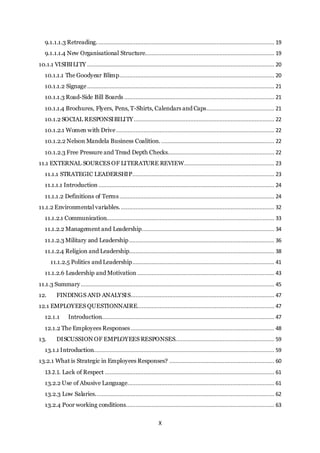
9.1.1.1.3 Retreading.............................................................................................................. 19
9.1.1.1.4 New Organisational Structure................................................................................ 19
10.1.1 VISIBILITY .................................................................................................................... 20
10.1.1.1 The Goodyear Blimp................................................................................................ 20
10.1.1.2 Signage.................................................................................................................... 21
10.1.1.3 Road-Side Bill Boards ............................................................................................. 21
10.1.1.4 Brochures, Flyers, Pens, T-Shirts, Calendars and Caps.......................................... 21
10.1.2 SOCIAL RESPONSIBILITY....................................................................................... 22
10.1.2.1 Women with Drive.................................................................................................. 22
10.1.2.2 Nelson Mandela Business Coalition. ...................................................................... 22
10.1.2.3 Free Pressure and Tread Depth Checks.................................................................. 22
11.1 EXTERNAL SOURCES OF LITERATURE REVIEW........................................................ 23
11.1.1 STRATEGIC LEADERSHIP........................................................................................ 23
11.1.1.1 Introduction ............................................................................................................. 24
11.1.1.2 Definitions of Terms................................................................................................ 24
11.1.2 Environmental variables. ............................................................................................... 32
11.1.2.1 Communication........................................................................................................ 33
11.1.2.2 Management and Leadership.................................................................................. 34
11.1.2.3 Military and Leadership.......................................................................................... 36
11.1.2.4 Religion and Leadership.......................................................................................... 38
11.1.2.5 Politics and Leadership........................................................................................ 41
11.1.2.6 Leadership and Motivation ..................................................................................... 43
11.1.3 Summary........................................................................................................................ 45
12. FINDINGS AND ANALYSIS......................................................................................... 47
12.1 EMPLOYEES QUESTIONNAIRE..................................................................................... 47
12.1.1 Introduction........................................................................................................... 47
12.1.2 The Employees Responses......................................................................................... 48
13. DISCUSSION OF EMPLOYEES RESPONSES............................................................. 59
13.1.1 Introduction................................................................................................................ 59
13.2.1 What is Strategic in Employees Responses? ................................................................. 60
13.2.1. Lack of Respect ......................................................................................................... 61
13.2.2 Use of Abusive Language........................................................................................... 61
13.2.3 Low Salaries............................................................................................................... 62
13.2.4 Poor working conditions............................................................................................ 63
XI
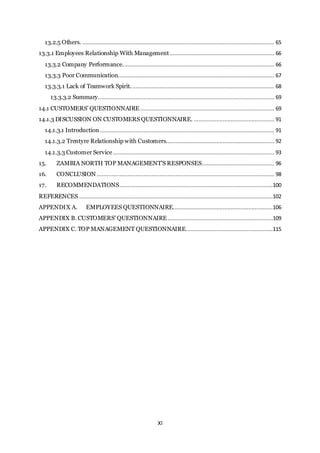
13.2.5 Others. ....................................................................................................................... 65
13.3.1 Employees Relationship With Management................................................................. 66
13.3.2 Company Performance.............................................................................................. 66
13.3.3 Poor Communication................................................................................................. 67
13.3.3.1 Lack of Teamwork Spirit......................................................................................... 68
13.3.3.2 Summary............................................................................................................. 69
14.1 CUSTOMERS’ QUESTIONNAIRE ................................................................................... 69
14.1.3 DISCUSSION ON CUSTOMERS QUESTIONNAIRE. .................................................. 91
14.1.3.1 Introduction ............................................................................................................ 91
14.1.3.2 Trentyre Relationship with Customers................................................................... 92
14.1.3.3 Customer Service.................................................................................................... 93
15. ZAMBIA NORTH TOP MANAGEMENT’S RESPONSES............................................. 96
16. CONCLUSION .............................................................................................................. 98
17. RECOMMENDATIONS...............................................................................................100
REFERENCES ........................................................................................................................102
APPENDIX A. EMPLOYEES QUESTIONNAIRE..............................................................106
APPENDIX B. CUSTOMERS’ QUESTIONNAIRE .................................................................109
APPENDIX C. TOP MANAGEMENT QUESTIONNAIRE......................................................115
1
1. INTRODUCTION
When there is change of management in any organization, the expectation of all the
stakeholders are always high for the new management to achieve massive success in
a short period. Knowing quite well that the chief Executive Officers (CEOs) of
organizations are not perfect individuals and they operate in an imperfect world, the
stakeholders still behave like a child who believes that his father is the most powerful
man in the world. The market place which is the measuring tape for these CEOs is
mostly measured in terms of profits one make and in a short period for that matter.
It is even worse where there is an abrupt change of management due to deaths or
resignations and that the old management was doing very well, the expectation is
that the new management must perform much better than the old one regardless of
how the old management conducted their business. Any negative variations in
performance will be met with stiff penalties such as demotions, being forced to resign
or outright dismissals.
What then can the new management do to achieve congruence in such a scenario? I
say use “strategic leadership” to achieve it. In my own understanding, a strategic
leader is the one who when appointed to a new position, will first of all learn all the
complexities of the organization within a reasonably short period, identify
individuals within the organization to help him point out the success areas and the
problem areas of the company and finally find ways of improving and solutions to the
problems so identified. The new leader must learn all about the company’s
customers, know his/her employees and all the other issues which will affect the
company’s business, including the external environment. Apart from this a strategic
leader must also learn about the country’s economy and its political leadership.
These issues will be vital to the success of the company. Strategic leadership,
2
therefore, is the leader’s ability to learn all the above and be able to
interpret the company’s vision in line with what he has learnt to other
employees and empower them to create strategic change as necessary.
Strategic leadership provides the vision, the direction, the purpose for growth and
the context for the success of the company, (www.1000ventures.com/business). It
also initiates “outside the box” thinking to generate future growth.
Did the new management at Trentyre really minded all the above during the
transition process? Did they mind the relationship which was there before between
management and the customers? How about the employees, were they treated the
same way the old management did? This research is critically looking at these cases
in the changeover of management at Trentyre. The answers to the above questions
should be in the responses from the questionnaires that were distributed to the new
management, to customers and to employees on the Copperbelt Province.
1.1 BACKGROUND
Trentyre Zambia came into being in 1996 owned by Tredcor Zambia. Tredcor Ltd is a
subsidiary company of Goodyear Tire and Rubber Company. Its main business is to
sell new tyres and tyre accessories (tubes, valves, valve caps, etc). Trentyre also has a
manufacturing plant based in Lusaka which does retreading of tyres. This is where
the old tyre which is not damaged but it is finished, can be taken to our plant to put a
new tread on top (re – tread). By doing this, the life of the original tyre is increased to
the benefit of the owner.
On the Copperbelt, this company started as a small outlet whose office was at
Blackhood Hodge along Kitwe-Chingola Road. At that time, its main competitor was
Dunlop Zambia Ltd. When Dunlop closed its offices and operations in June 2001,
3
most of Dunlop’s business went to Trentyre. This made Trentyre to grow fast and
became almost like a monopoly. Its main competitor after Dunlop, Maxiprest, lost its
only contract with Mopani Copper Mines. This contract was eventually won by
Trentyre. This meant that the whole mining industry was buying most of their tyres
from Trentyre. The contributing factor was mostly the premium Goodyear tyre brand
that the company sells and which is liked by the majority customers. Management
also contributed to this success by providing Mopani, Chibuluma and Konkola
Copper Mines an almost free service to maintain the tyres at their sites.
All business was rosy until about June/July 2011. This is the time when the
Managing Director of Trentyre Zambia resigned to form his own tyre company.
Following his resignation, the whole Top management resigned and followed him.
Some of the Branch Managers and a lot of Trentyre junior staff resigned from
Trentyre and joined the new company. All the employees felt insecure such that
when the new management was appointed, it was not wholly accepted by most of the
employees. There followed strikes which turned out to be dangerous and put the
name of the company into disrepute. Moreover, the strike action by workers,
especially from the mine sites, was handled very unprofessionally by senior
managers. The new management decided that the contract for service should be
discontinued as it was just a headache to the company and yet it was not making any
profits. They did this knowing very well that supply of new tyres was dependent on
the service contract. Despite the advice which was given that the termination of the
service contract, would affect the contract for the supply of new tyres, management
went ahead to terminate that contract, to Mopani and Chibuluma Mines. This finally
took place in April and May, 2012. Management extended the contract to Konkola
Copper Mines to June 2012.
4
It did not take long before Mopani and Chibuluma reacted to this termination of the
service contract. By the end of June 2012, both mines terminated the contracts for
the supply of new tyres. This made management to think twice on the service
contract at KCM. They allowed it to continue for fear of also losing the supply of new
tyres. By the time of this research, this service contract at KCM was still in place. Up
to date, Trentyre has lost Chibuluma Mines, Mopani mines and some of the
contractors and suppliers to these mines who have gone to the opposition. Was there
any strategic leadership in their actions?
1.2 STATEMENT OF THE PROBLEM
The problem that this study will address is whether the new Trentyre management
provided strategic leadership during the process of transition from the old
management to the new one. This problem came about because of the manner in
which the entire old management resigned from the company to form a new one. The
question here was whether the new management had the capacity to handle the
complex situation that was left by the former directors. This investigation is
important because without the presence of strategic leadership during any change of
management will cause losses to the company such as:
1.1. Customers – the customers relationship with the old management will
determine their allegiance; whether to change to the new management or
continue with the old one. Should the new management fail to handle
issues correctly, then they will lose some of the customers who will go with
the old management.
1.2. Employees – as it were with the customers, the wrong handling of the
employees’ welfare can backfire on the new management. There might be
a lot of resignations which may cost the company dearly due to new
5
recruitments and unsatisfied customers. During the training period
customers may be forced to receive shoddy jobs from the trainees and
eventually decide to go to the opposition.
Looking at the above issues, it is incumbent upon the new management to know how
to treat the situation in order to succeed. These two (2) cases are the main problems
that this study will address. I have the belief that this research will bring out
pertinent issues which will require further investigation.
2. STATEMENTS OF THE HYPOTHESIS
This research is based on four (4) hypotheses. These are:
2.1. The achievement of personal goals is a catalyst for a successful strategic
leadership.
2.2. Without education, strategic leadership cannot excel.
2.3. Teamwork and strategic leadership are greatly related.
2.4. Lack of communication is the reason for the failed strategic leadership
work.
3. THE GENERAL OBJECTIVE OF THE STUDY
The general objective of this study is to “look at what strategic leadership is
and assess if the new management at Trentyre followed its principles to
avert a catastrophe posed by the loss of the entire old top
management”. The problem is whether the new management at Trentyre has
provided good leadership to sustain the market share that they found and grow it.
This problem will be analysed from the perspective of the employees and the
customers in the towns of study.
3.1 SUB-OBJECTIVES
The sub-objectives of the study are:
6
(1). New Management’s competence in providing strategic leadership in the wake of
the abrupt change caused by the resignation of the top management.
(2). Employee/new management relationship in decision making.
(3). Customer relationship with new management
4. SCOPE OF THE STUDY
This study is delimited to Trentyre Zambia Ltd, a subsidiary of the Goodyear on the
Copperbelt. In particular the study will look at the impact of the new management on
sustaining its customer base and improve on it around the Copperbelt Province. To
be specific the study will cover 4 strategic towns namely Ndola, Kitwe, Mufulira and
Chingola. It is believed that the result from these towns will be representative enough
of the whole Copperbelt province.
5. THE SIGNIFICANCE OF THE STUDY.
May I mention it never in the history of Goodyear/ Trentyre Zambia has a research
such as this one been. Therefore, being the first of its kind, there are so many
challenges that I have; the biggest of which is the non-availability of published data
on Trentyre Zambia and it’s management. This study will bring about the feeling of
the market Customers) and the employees on the change of management at Trentyre.
In other words, management will be assessed by its own employees and the
customers. This will help management to know whether it is moving in the right
direction or else it has to change its course. The assessment that will come from the
customers can also help Trentyre management to re-strategise if it is not doing well
or maintain and or improve the same strategies if they are working well.
To the general readership, this study can help in understanding some of the reasons
why companies maintain or lose customers when there is an abrupt change of
management as what happened at Trentyre Zambia in the year 2011. It is also meant
7
to show the general business community how the employee/management as well as
management/customer relationships have helped or destroyed Trentyre’s tyre
market. This study can impart good knowledge in the management of change the
Trentyre way.
6. LIMITATIONS OF THE STUDY
Being the first of its kind, the significant limiting factor of this research was
documented sources of data for literature review. There were very few written
sources of literature on Trentyre. Even some of the information to do with its history
could hardly be found. The other limiting factors were:
a. Time – due to the fact that i am an employee and I have to satisfy my
company, the only time I had was after hours and weekends to compile my
report. This made it very difficult for to do it in time.
b. Financial Factor – this research was not sponsored. This meant that I had to
use my limited finances to organise data. As a result of this, I found it difficult
to collect all the data that that was going to form part of this research with my
limited time.
7. RESEARCH DESIGN AND METHODOLOGY
The methodology of the study specifies how the study will be carried out to research
the stated objective of determining whether strategic leadership principles are being
practiced in Trentyre or not. Parahoo (2006), states that the methodology selected
for research should be the one most suited so as to achieve an answer to the proposed
research question. For the purpose of the proposed research question of this
researcher, descriptive qualitative research design has been chosen. Qualitative
research is a systematic, subjective approach to describe life experiences and give the
8
meaning (Burns and Grove, 2009). This is the research which allows the researchers
to explore behaviors, feelings and experiences in depth, quality and complexity of
situations through a holistic framework (Holloway and Wheeler, 2002). The
following section provides a brief description of the research methodology that will
be used in this research. In contrast, quantitative research is formal systematic
approach which incorporates numerical data to obtain information about anything
(Burns and Grove, 2009), which is not suitable for this study. Being a novice
researcher, I have chosen the simple descriptive qualitative study.
The following section will in brief describe how the data will be collected in both the
secondary and primary research.
7.1. SECONDARY RESEARCH
Saunders, Lewis & Thornhill, (1997:38-42) recommended that during the secondary
research process, the foundation of the study should be built on a critical literature
review. Perry (1998) recommends that most PhD studies should follow a deductive
approach. In this approach the literature is used to help the researcher identify
theories and ideas to be tested through the use of data. In this way a theoretical
framework can be developed. An extensive literature review has been conducted in
strategic leadership where previous research published in books, journals, articles
and relevant sources on the internet, other working papers, government documents
and web pages have been analyzed. This information has been collected both from
the Trentyre internal documents and from other authors who have written a lot on
Strategic Leadership.
7.1. PRIMARY EMPIRICAL RESEARCH
Empirical research, also known as primary research, refers to sources of information
that have originated directly as a result of a particular problem under investigation
9
(Mc Danliel & Gates, 2001:25). As proposed by a number of authors (Tull &
Hawkins, 1993:51-197; Saunders, Lewis & Thornhill, 1997; Hair, Bush & Ortinau,
2000) the methodology section of the primary research section should address the
following decision stages:
1. Specifying the type of study, defining the target population and sample size.
2. Describing the data collection method, determining the research instruments
to be used and specifying how the collected data will be analyzed
My research will use the email survey as a method of data collection. This survey
design allows for the collection of a large amount of data from a sizeable sample in a
highly economical way, but a common problem of email surveys is the low response
rate (Tull & Hawkins, 1993:188). Since the possible low response rate is one of the
main concerns of the researcher, a combination of email surveys and door-to-door
delivery of questionnaires will be used to improve the response rate.
7.2 THE STUDY POPULATION AND SAMPLE
The sample selected for this study consisted of the top 8 transporters in the towns
under study out of 30 identified, 8 managers from mining companies mainly Mopani
and KCM out of a total of 20, 13 Trentyre employees in Kitwe and Ndola out of 17 and
all the 1 Area Sales Manager of Trentyre Zambia. In short the total population this
researcher considered was 30 transporters, 20 managers for Konkola Copper Mines
and Mopani Copper Mines, 17 employees and 1 director of Trentyre Zambia totaling
68. My sample was 30. All these were selected basing on the researcher’s judgment
and experience with them. They have been treated as key informants (Seidler, 1974).
Their responsibilities in their organizations give them a unique and comprehensive
10
view of strategic leadership activities. Zahra (1991:206) states that CEOs and
directors responsible for strategy formulation and implementation, are familiar with
the organization’s environment, strategy and structure and are able to see their
organization “holistically”. As the top ranking individual responsible for strategic
direction in an organization, they are often called upon to evaluate major new
ventures, to approve financial support for projects and are involved in evaluating
ongoing activities.
7.3 DATA COLLECTION METHOD
The data for the empirical study was collected by emailing questionnaires to some
companies while others were delivered by hand, especially to those where this
researcher do not have close contact. The advantage of sending questionnaires by
email is that a lot of respondents can be reached at a very low cost and in a short
period. It is, however, a very unreliable method especially if the researcher is not
known by the respondents. The response rate is also very low with this method of
data collection. The other problem is that, for busy executives, they can easily ignore
the email because there are so many important things they need to do for their
companies than answering a questionnaire.
On the other hand, the hand delivered questionnaire ensures confidence that it has
been received by the respondent. The respondent feels duty bound because he would
like to get rid of the researcher. As a result, the response rate is moderately high with
this method. The biggest enemy of this method, however, is cost. It is very expensive
to collect data if delivery has to be done door-to-door.
The combination of the two brought about a reasonable response rate to warrant a
good conclusion of the research.
11
7.4 DATA ANALYSIS
The data collected from the three categories of the questionnaires was analyzed
according to each question from the questionnaire using a simple descriptive
qualitative technique which will, thereafter, be presented in tables and charts using
software called Statistical Package for Social Sciences (SPSS version 16.0).
8. LITERATURE REVIEW.
Very little literature has been found about Trentyre and its management in relation
to strategic leadership. With the limited literature, the review is divided into 2 main
parts namely,
A. Internal
B. External
Under internal literature review, the following areas have been looked at:
I. Management and Innovation
ii. Service
iii. Visibility
iv. Social responsibility
From the external literature review, the following areas have been covered:
i. Strategic Leadership
ii. Management vs. Leadership
iii. Strategic leadership in Different Fields
iv. Leadership and Motivation
12
8.1 INTERNAL SOURCES OF LITERATURE REVIEW
This is the literature gathered from the company’s publications and also those
posted by the company on the internet. The main concentration is on
literature that touches on the main concern of the research; “Strategic
Leadership”.
8.1.1 MANAGEMENT AND INNOVATION.
8.1.1.1 Management
Trentyre is a trading company for Goodyear. Goodyear manufactures tyres
and distributes them to many Trentyre branches to be sold. It is Goodyear’s
policy to ensure that the right people are appointed in the right positions to
lead the company to high heights. In March 2007, Goodyear appointed Mr
Mike King to be in charge of Trentyre operation throughout the world.
According to Goodyear’s website www.goodyear.com/mission/leadership-
traits.html, Goodyear will be driven by leaders who:
8.1.1.1.2 Build Talents and Teens.
Goodyear encourages its employees to get the necessary skills so as to
stand a chance to take up senior positions in the company and country
where they operate. In South Africa, Goodyear contributes to the
engineering pool with a valuable stream of qualifying apprentices.
The Wingfoot Clan (2012), in its issue 1 of this magazine the recent
appointed Instrumentation Technician, Mr Everton Fisher, made his
mentors proud with his extra efforts. Fisher did not only pass his trade test
certificate after 3 years instead of the usual 4 years, but he also achieved
the highest mark in the country.
13
The issue of building talents is paramount in Goodyear in order to foster
innovation and good leadership. According to Goodyear’s “On Track”
(2012) magazine on page 16, within the Goodyear’s group of companies, a
pipeline of development ensures that high performing individuals are
withered to the full potential, enriched by courses like the 2012 tailor-
made innovation leadership programme held at the Golden Institute of
Business Science (GIBS) at the University of Pretoria. This programme was
titled “Innovation Leadership” because it was about building talents in
three specific areas as it was a reported in this magazine and thus;
(a) Leading yourself – how you lead your life for your benefit and the
benefit of those around you. This will include how you present yourself
to others.
(b) Leading others – how do you lead others will emanate from how you
managed to lead yourself. If a person has failed to manage his own way
of living, he cannot manage to lead others. A person’s personal success
will have a lot of bearing in the way he or she will lead others.
(c) Leading change – Only visionary leaders will manage to lead change.
People who have no vision will not manage to lead change because they
will after all act like a blind person who cannot see where he or she is
going and, therefore, cannot lead others. It is through such
programmes that Goodyear nurtures good leaders in the company.
8.1.1.1.3 Have the ability to solve problems
Leaders are there to help provide solution to a number of problems
faced by the company. This of course should be with the assistance of
14
the other members of the company. Leaders must be articulate,
intelligent, caring and understanding.
8.1.1.1.4 Effective Communicators.
In the Goodyear corporate/Goodyear mission publication
(www.goodyear.com/mission/leadership-traits.html), a good leader is
one who unambiguously communicates to his/her subordinates. Clear
communication requires clear understanding of instruction and policy
pronouncement. This will further have an effect on reduced accidents
and costly mistakes.
8.1.1.1.5 Make courageous decisions.
In the Wingfoot Clan (2012), Rolf Rohrmuller, Cluster Director,
Namibia, Botswana and Angola refused to conduct business in a certain
manner in Angola which placed the security of, both himself and his
family, at risk. In most cases risk decision are highly paying and need
courageous workers who do not fear failure to make them
8.1.1.1.6 Deliver results.
Lastly Goodyear will be driven by leaders who will deliver results. A
leader in name only without result is not worth it
(www.goodyear.com/misssion/leadership-traits.html).
8.1.1.2 Innovation.
In the words of GYR’s chairman R.J.Keegan, Innovation can be
defined as an improvement of a production, process or service from its
current state to a point where it has greater value to our customers.
(Goodyear Corporate Responsibility report, 2007). Strategic leadership
15
will be a failure if it does not innovate. GYR and all its associates which
include Trentyre believe that innovation is critical to our business, our
customers and other dealers. In this issue of the corporate
responsibility, GYR believes that products and services quality will
never be accomplished without innovation and as a matter of fact, GYR
regards innovation as one of the main traits of strategic leadership.
9.1.1 SERVICE
Strategic leadership will fail terribly if the services they render to their clients
are not liked or appreciated. Service can mean an intangible product produced
and sold to the customer directly such as banking, accountancy, legal services,
entertainment and education (W.J.Keegan, 2004). It can also mean a job done
to a customer who has bought intangible and/or tangible products such as
carrying a customer’s goodies to his/her car, fitting a customer’s new tyre at
no extra cost, free product use technical advice, free or at little cost backup on
products bought by a customer etc. The second set of service is meant to add
more value to the product/service bought by the customer. John burnet, 2008
define a service as “a deed, a performance or an effort”. Burnet goes further
to say that a service is a product that is consumed at the same time it is
produced. For example, a football match a musical entertainment or a dance
festival. Strategic leaders who deal in tangible products can use good services
to win customers to themselves. Services can also be used as a means to
cultivate a sense of trust in a customer about a given company and its
products. Some companies are identified by the service they provide. Some of
the services that Goodyear/Trentyre provides to its customers are:
16
9.1.1.1 On-site tyre management.
Goodyear and Trentyre have put service as a means to win and keep its
customers. In its magazine, “On Track, 2012”Glen Duffield, the Goodyear
National Commercial Accounts Manager, wrote that, “Excellent services will
maintain New Business”. This was in reference to the newly acquired
customer, Coca-Cola. Goodyear through its associate Trentyre entered into an
agreement which entailed Trentyre being in charge of the complete tyre
management of all the 26 Coca-Cola depots in South Africa. According to
Glen, in the magazine On Track, pg 7, the agreement with Coca-Cola is that
Trentyre will ensure the smooth running of its fleet and also in driving down
the overall CPK (cost per kilometre). He concluded by saying “it is an
impressive selling tool”. This deal which was dabbed the Coca-Cola Fortune
proved to be a success for Trentyre.
On the same topic, Samantha Steffens, Goodyear’s Country Procurement
Manager, said the Coca-Cola Fortune has come a long way with Trentyre,
having started with a service of just a couple of depots in 2004. In 2011, they
decided to nationalise the contract. Because of Trentyre’s record of excellent
service and willingness to adapt to the Coca-Cola Fortune way of doing
business, the contract was awarded to Trentyre. This was not just cost benefit
to the company, but also about positive relationships, further said Samantha
(On Track, 2012)
The contract at Coca-Cola Fortune encompasses a fleet of more than 800
vehicles, which is about 10,000 wheels all serviced by Trentyre. Trentyre has
technicians stationed on site at most of Coca-Cola depots, (On Track, 2012).
17
Glen who is the brain child of the Coca-Cola Fortune lastly commented that,
“Excellent service and great communication will ensure Trentyre longevity
in maintaining this blue chip contract into the future”. (On Track, 2012).
In Trentyre as it is in Goodyear, service is regarded as strategic tool to remain
afloat.
In one of the internet based publication, the 3D Car Shows, titled, Trentyre
moves confidently into consumer territory, Trentyre has introduced what is
called an On-Site Tyre Management for consumers. This is a service where a
Trentyre team of experts is permanently stationed at the dealership such as
Hyundai East Rand. The Trentyre teams at such dealership provide services
such as fitting and balancing tyres as well as wheel alignment of vehicles. The
Business Manager for Trentyre Boksburg commented that by maintaining a
professional service to Hyundai East Rand, we hopefully will be able to grow
our business relationship into the future.
Trentyre has been offering this on-site tyre management service to the mines
and other clients all-over Africa. Trentyre offer full tyre management solution
including tyre bay management, effective tyre maintenance in accordance to
the customer operational requirements, pressure check top-ups and timely
advice on the way tyres are performing. (www.trentyre.co.za/mgt tyre-
mgt.php. Trentyre provides skilled technicians to take over the daily
responsibility of tyre maintenance which includes tyre fitting, operational area
inspection, tyre performance monitoring and timely advice to operators when
they have tochange their tyres. Included here are pressure checks, tread depth
checks, rim component check, wheel studs and wheel nut checks and check on
oil leaks on the hubs which have effect on the tyre performance.
18
At the end of the day, detailed reporting is done and presented to
management of the host company for action. Reports such as tyre surveys
(which shows the pattern of pressures in tyres, missing valve caps, missing
valve extension, missing wheel nuts and studs, leaking oil, signs of mechanical
failure on the tyres and general performance of the tyres) and scrap tyre
reports, (which shows reasons why tyres which are no longer in use were
scrapped) are all presented to the host company for action. The scrapped tyres
can be due to operator abuse, manufacturing faults, mechanical failure or
unavoidable operation faults. These reports provide a platform to put up
proactive measures that will ensure effective use of the tyres and are presented
to the owners of the company so that they can take corrective measures. On
the other hand, when this service is in place, operators are well aware that
they are under check such that they are always careful in their work. This will
ensure a prolonged tyre life and this has an effect of reducing tyre costs (Tyre
Management System).
9.1.1.1.2 Hours Break Down Service.
The other service that is emphasised by Trentyre, especially in South Africa is
the 24 hours break down service and the tyre repairs. These services can be
conducted at any time and at any place throughout South Africa. This service
has further been extended through the line of rail up to the Democratic
Republic of Congo via Zambia. This service entails Trentyre attending to all
tyre problem break downs such as repairing punctured tyre and replacing
burst tyres with new ones.
19
9.1.1.1.3 Retreading.
The retreading of finished tyres to extend their lives is one other integral
element in TMS (Tyre management service). This service reduces the cost
which benefits the owners of such tyres (Press Room).
9.1.1.1.4 New Organisational Structure.
In its magazine the Wingfoot Clan (2012: p. 5). Goodyear has established a
new Organisational structure called the “Product Business unit”. Effective,
February 1, 2012, Goodyear has divided its business into three categories
namely:
(1) Consumer
(2) Commercial
(3) Off-the road (OTR). (Wingfoot Clan, 2012).
(i) Consumer products- these are tyres sold to customers who own small
vehicles which fit tyre sizes 10” to 20” such as 145R10, 155/80R13, up
to 275/40R20. These are termed consumer tyres because most of their
users are individuals or small business units who mostly buy these
tyres for their own personal use.
(ii) Commercial products- In this category are tyres ranging from 8.25-20
way up to 445/65R22.5. These are tyres used mostly by commercial
business units such as transporters, freight forwarders, large
wholesaler and large supermarkets. They are mainly used to transport
merchandise from one point to the other or are hired for such business.
(iii) OTR (Off the road) and specialised products- In this category we can
consider mining tyres- OTR and farm tyres.
20
The purpose of introducing the new structure according to Jean-
Jacques Wiroth, Managing Director Goodyear Tyre and rubber
holding’s was to create an integrated focused group organisational
structure to consolidate existing resources and to ensure alignment
with Europe, Middle East and Africa (EMEA) regional structures. This
will ensure Goodyear and its associates such as Trentyre view business
in the same manner according to product business units (PBUs) (The
Wingfoot Clan page 5). Mr Wiroth said “We are confident that our new
PBU structure will achieve our business goals and will directly
contribute to building our plans for the future growth”.
The other notable strategic leadership role played by management at
Goodyear/Trentyre is that of dividing Trentyre into clusters. One
cluster consists of Zambia, Congo DR, Malawi and Zimbabwe while the
other one is that of Botswana, Namibia and Angola. The cluster means
the grouping of such countries according to their proximity.
10.1.1 VISIBILITY
Trentyre/Goodyear considers visibility as one of the major strategic
leadership actions. The following are sure ways of making it a point that
Trentyre/Goodyear is noticed by people everywhere:
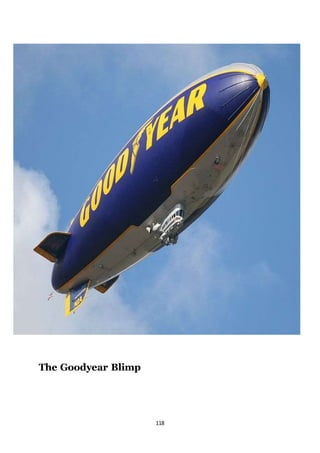
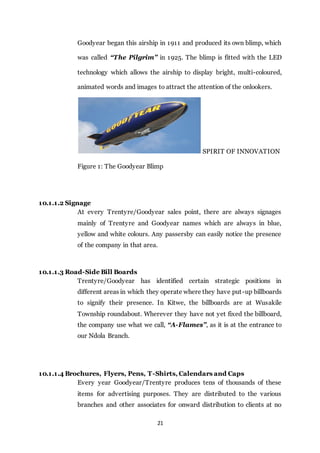
10.1.1.1 The Goodyear Blimp
The Goodyear blimp as can be seen below is an airship operated by
Goodyear Tire and Rubber Company for advertising purposes.
21
Goodyear began this airship in 1911 and produced its own blimp, which
was called “The Pilgrim” in 1925. The blimp is fitted with the LED
technology which allows the airship to display bright, multi-coloured,
animated words and images to attract the attention of the onlookers.
SPIRIT OF INNOVATION
Figure 1: The Goodyear Blimp
10.1.1.2 Signage
At every Trentyre/Goodyear sales point, there are always signages
mainly of Trentyre and Goodyear names which are always in blue,
yellow and white colours. Any passersby can easily notice the presence
of the company in that area.
10.1.1.3 Road-Side Bill Boards
Trentyre/Goodyear has identified certain strategic positions in
different areas in which they operate where they have put-up billboards
to signify their presence. In Kitwe, the billboards are at Wusakile
Township roundabout. Wherever they have not yet fixed the billboard,
the company use what we call, “A-Flames”, as it is at the entrance to
our Ndola Branch.
10.1.1.4 Brochures, Flyers, Pens, T-Shirts, Calendars and Caps
Every year Goodyear/Trentyre produces tens of thousands of these
items for advertising purposes. They are distributed to the various
branches and other associates for onward distribution to clients at no
22
cost at all. These items can be found in offices, houses and in vehicles to
always remind the customers of the Trentyre/Goodyear in their
presence.
10.1.2 SOCIAL RESPONSIBILITY
Social responsibility is helping the communities in which the company
operates. It is a strategic leadership effort which ensures that the
community in which the company’s employees live is a better place. In its
Corporate Responsibility Report, (2007, pg 20-23), Goodyear outlines
major primary community activities focused on safety innovation,
translating a variety of initiatives to help keep citizens safe and secure.
This strategic charitable effort takes different forms in different countries
where Goodyear operates and some of them are as follows:
10.1.2.1 Women with Drive
In the Asian Pacific Region, Goodyear held autocare events throughout
2007. Here women were targeted and taught car care and service
techniques to keep them safe on the road. The women learnt how a
vehicle operates, ways to keep it dependable, how to check tyres and
oil.
10.1.2.2 Nelson Mandela Business Coalition.
Goodyear continues to provide assistance and support to citizens
suffering from the effects of HIV/AIDS disease (Goodyear Corporate
Responsibility Report, 2007, pg. 21). Goodyear helps both with
financial and material support to improve the quality of lives in Africa.
10.1.2.3 Free Pressure and Tread Depth Checks.
23
In Zambia, Trentyre/Goodyear encourages motorists to have their
pressures checked by the qualified tyre fitters at all its branches.
Motorists are assisted to check the life of their tyres to ensure their
safety on the road.
11.1 EXTERNAL SOURCES OF LITERATURE REVIEW
According to the researcher’s understanding, this is the literature collected
from books, journals, any published articles, newspapers, government
gazettes, and on internet on the topic of the researcher’s interest. This
information has got nothing to do with, in this case, Trentyre/Goodyear as a
company under research. It is simply the general overview as propounded by
scholars on strategic leadership.
11.1.1 STRATEGIC LEADERSHIP
“Some must follow, and some command, though all are made of
clay”. Longfellow
The above quote is a somewhat realistic perception of life in today’s world of
business, the political arena, and even in religion. Associate Editor Kevin
Miller of Leaders (Myra, 1981), contends that: Leadership is a puzzling,
paradoxical art. It demands both broad vision and attention to
detail. It simultaneously calls for uncanny intuition and hard-
headed analysis. It means often standing alone, yet proves itself
in its ability to rally people. Leading isn’t easy”.
However, leadership is not optional; it is essential. It is essential for
motivation and direction. It is also essential for evaluation and
accomplishment. It is the one ingredient essential for the success of any
organization (Swindoll, 1985,). Maxwell (1998) suggests that “everything
rises and falls on leadership and any endeavour you can
24
undertake that involves other people will live or die depending on
leadership”.
11.1.1.1 Introduction
A search of the literature determined that the subject of strategic leadership
has been studied in business, but not very much is available in research on
government, religion, or more importantly for this work, on Trentyre Zambia.
Therefore, there is a lack of guidance in Trentyre literature for strategic
leadership.
While other literature on strategic leadership for other businesses has been
found, Trentyre Zambia has lagged behind in literature guidance. There is a
clear need for more study on strategic leadership at Trentyre if there is to be
any meaningful or desired change, both in people attitude and management
leadership qualities.
This literature review is designed to provide a context, looking first at
definitions of terms used in this study, followed by a section on strategic
leadership. The literature review on strategic leadership section will be
followed by a breakdown of tactical and strategic leadership aspects from
different professions. The organization of this literature review material is
designed to give a full and rich context to the considerations of strategic
leadership, and what experience has taught leaders in the movement from
tactical to strategic leadership that can be applied to government, businesses,
religion and law enforcement leadership.
11.1.1.2 Definitions of Terms
11.1.1.2.1. Tactical
Webster’s defines tactical as characterized by skilful tactics or adroit
manoeuvring or procedure of or pertaining to a manoeuvre or plan of action
25
designed as an expedient toward gaining a desired end or temporary
advantage (Webster Dictionary, 1989, p. 1447).
11.1.1.2.2. Tactical Leadership
Tactical Leadership is the leadership that facilitates an immediate response to
a pressing problem (Justice Africa, 2004). Tactical Leadership is a leadership
style used when the objective is very clear, a plan for achieving the objective
has been developed, and the members of the collective effort are being led in
the execution of the plan (The Dorothy A. Johnson Centre for Philanthropy &
Non-profit Leadership Strategic, 2004).
11.1.1.2.3. Tactical Values
Tactical values are the day-to-day ways we conduct ourselves to achieve the
end goals. Tactical values define the "means" to get to the desired "ends."
There are always more tactical values than strategic values for there are more
ways to get somewhere than places to go. Tactical and Strategic components
exist in organizations whether they are effective or ineffective. Whether they
are industry leaders or on the brink of bankruptcy, they have strategic values
that chart their course and tactical values that guide their policies and
procedures. Tactical Values are the values that actually guide our decision-
making, priorities, and policies in the workplace (Decision Point, Inc, 2004).
11.1.1.2.4. Strategic
Strategy is the gentle art of re-perceiving; move away from what is known by
clearing the mind, clearing the place, and clearing the beliefs (John Kao,
Professor, Stanford Business School, 2006). Strategy is the art of making use
of time and space. I am less chary of the latter than the former; space we can
recover; time never (Napoleon Bonaparte, 2005). Strategy is about stretching
limited resources to fit ambitious aspirations (C.K. Prahalad, Professor,
University of Michigan, Business School, 2006).
11.1.1.2.5. Strategic Values.
26
A strategic value is an event or idea that will produce a comparative advantage
to the business. Strategic values chart the course of the business. Many
companies develop business strategies for the sake of doing so without the
intention of using a framework to design and implement strategy. Such
strategies become a bunch of statements that sit on corporate mugs and logos.
Strategic value is more than a just strategy. It involves the assessment of ideas
in terms of their strategic value to the business and the implementation of the
chosen ideas.
What business strategy is all about, in a word, is competitive advantage. The
sole purpose of strategic planning is to enable a company to gain, as efficiently
as possible, a sustainable edge over its competitors. Corporate strategy thus
implies an attempt to alter a company's strength relative to that of its
competitors in the most efficient way.
Strategic thinking must integrate what executives learn from all sources; from
their own and other’s experience, from analysis of financial data, and from
trends in the larger environment—into a coherent sense of direction for the
business. Strategic planning is not strategic thinking.
One is analysis and the other is synthesis; strategic thinking assures resiliency
and informs coherent decision-making in a rapidly changing environment.
(Bennett & Brown, 1995, p. 170)
Strategic leadership is multifunctional; it involves managing through others,
and helps organizations cope with change that seems to be increasing
exponentially in today’s globalized environment (Huey, 1994, as cited in
Amin, 1998,). It requires the ability to accommodate and integrate both
external and internal conditions, and to manage and engage in complex
information processing. Firms use the strategic management process
successfully through effective strategic leadership (Hitt & Keats, 1992, as cited
in Amin, 1998,). Strategy is the framework of choices that determine the
nature and direction of an organization. (Freedman & Tregoe, 2003, p. 15)
Strategy is concerned with what an organization aims to be, and why.
(Freedman & Tregoe, 2003, p. 17)
27
Tactical is what to think about and how to do it (skills), strategic is what needs
to be done and how to think about it (assessment, decisions, priorities,
alignment, critical reflection). Tactical is looking at a piece of the puzzle,
strategic is looking at all the pieces of the puzzle.
11.1.1.3. Definition of Strategic Leadership
11.1.1.3.1. Introduction
Conventional wisdom presumes that strategic leadership of organizations is
primarily provided by chief executives, presidents or general managers
(Kotter, 1982). This in essence in not the case as the impact of individuals on
organizational performance has been known to be ambiguous or
inconsequential (Salansik & Pfeffer, 1977). An individual is unlikely to succeed
to run the company without involving others. The truth of the matter is a
leader lead through others. Failure is paramount to a leader who is self; who
wants everything to himself. Strategic Leadership refers to the creation of an
all inclusive sense of purpose and direction which guide integrated strategy
formulation and implementation in organizations (Hosmer, 1982). No one
person can carry out this task on his/her own. Summer (1980), says strategic
leadership is a multifaceted concept which includes functions such as
integration of societal ethics with organizational ethics, the alignment of
philosophies regarding the roles of a leader, society and the organization and
the alignment of the organization with respect to influence and power in
society.
11.1.1.3.2. What Strategic Leadership Is
Different scholars and other academicians have defined strategic leadership in
many ways. Rowe (2001) defines strategic leadership as “the ability to
influence others to voluntarily make day-to-day decisions that enhance the
long term viability of the organisation while at the same time maintaining its
short-term financial stability”. Another scholar, Davies defines it as “having
the organizational ability with strategic orientation to translate strategy into
28
action, align people and organizations, determine effective strategic
intervention points and develop strategic competences (Davies, 2004)”.
Davies highlights the concept of “adaptive capacity”, a strategy that enables
leaders to change and learn through asserting that mastering chaos,
complexity and change requires new ways of seeing and thinking (Sanders,
1998). The strategic leader’s eyes are strategically future oriented. A strategic
leader has influence over the organization by aligning its systems, culture and
organizational structure to ensure consistence with strategy (Beatty and
Quinn, 2010). Strategic Leadership is about setting and not just reacting to
agendas, it’s about identifying problems and initiating change that makes for
substantial improvement rather than managing change (Pearce, 2008). One of
the influential and interesting definitions of strategic leadership is that
provided by Barron, (1995). He defines it as “practicing existing abilities and
skills and influencing others to train in new formats for new leadership
models”. Specifically to obtain successful educational management within the
organization, leaders should think strategically about where changes are
needed and why. Barron (1995) further advises that new leaders should be in
possession of three fundamental skills, which are:
a. Problem solving
b. Decision Making Ability
c. Creative/critical thinking.
A very common definition of strategic leadership is the one provided by
Harvard Business Review, 81(8), 38-45, which says, “Strategic Leadership is
the ability to anticipate, envision, maintain flexibility and empower others to
create strategic change as necessary”, (Insearch of Global Leaders, 2003).
Strategic Leadership involves managing through others, managing an entire
enterprise rather than a functional sub-unit and coping with change that
continues to increase in the current competitive landscape. Because of the
complexity of the competition and technological advancements, strategic
leaders must learn to effectively influence human behaviour in uncertain
environments. The management of human capital may be the most critical of
the strategic leader’s skills (M.A. Hitt and R.D. Ireland, 2002).
29
11.1.1.3.3. A Strategic Leader
As the definition of strategic leadership says, the manager’s job is to apply a
combination of decisions regarding the whole concept of his/her business. It
involves making strategic choices amongst so many so that the scarce
resources are well utilised to satisfy the market’s wants over a long time.
According to Bryson, (1995, pg 32), a strategy can be defined as a pattern of
purposes, policies, programmes, actions, decisions or resource allocations that
define what an organization is, what it does and why it does it. For a strategic
leader, therefore, it is imperative that he/she knows the company’s policies,
programmes and purposes for him/her to be able to achieve its goals. Such an
alert leader will also be able to help other employees to understand the
company’s reason for being and how to achieve its goals. Competent strategic
leaders also establish the context through which stakeholders, such as
customers, employees, and suppliers can perform at peak efficiency (J.E. Post,
L.E. Preston and S. Sachs, 2002). In the absence of such leadership, that is
when a company is left with a void leadership, for reasons best known to the
owners, the ripple effects are widely felt both within and outside the company.
Within the company, there is likely to be a crisis of morale, a crisis of
confidence and of course a crisis of productivity amongst employees.
Moreover, stockholders may panic and may sell their shares because they are
not sure anymore about the safety and future of their investment.
Outside the company, suppliers of raw materials, semi-finished and finished
products may refuse to render credit facility to such a company for fear of
losing their money (D.C. Carey & D. Ogden, 2000).
The epitome of strategic leadership is the ability to manage the firm’s
operations effectively and sustain high performance over time (M. Maccoby,
2001).
However, a strategic leader, while perhaps taking more time, would address
the opportunity for organizational improvement and learning in a
systems/contingency mode. Again, while Vecchio’s (1995) more tactical view
that “Leadership is the process through which leaders influence the attitudes,
30
behaviours, and values of others, Byrd’s (1987), states that, “Strategic
leadership is the leader's ability to anticipate, envision, maintain flexibility,
and empower others to create strategic change as necessary”. An explanation
of strategic change is when the leader can change the strategy being used by
the organization; “modifying its behaviour to reflect new knowledge and
insights” (Wheelen & Hunger, 2002, p. 8). Hitt and Keats (1992) say that “It
requires the ability to accommodate and integrate both external and internal
conditions, and to manage and engage in complex information processing.
Firms use the strategic management process successfully through effective
strategic leadership”.
To continue with the above example, the fundamental solution/strategic
leadership context would use an open (external, environment) system answer,
realizing that any loss of middle career or end-of-career personnel will cause a
domino effect. More qualified people will need to be tested, backgrounds
investigated, hired, trained, and promoted. Therefore, a strategic leader would
do risk assessments, succession planning, consider demographic changes, and
engage in other contingency planning, while understanding that doing
something to any part of the system will affect other parts of the system. In
this manner, unintended consequences can be minimized while addressing
the source of the problem; a strategic plan for hiring, training, and retiring.
While the principal and ultimate responsibility for law enforcement strategic
leadership lies with the chief of police, managers within the organization
should strive toward strategic leadership in order to both make the
organization successful and to prepare themselves to move from being
predominantly a tactical leader toward being more of a strategic leader.
John Kotter (1990) and others think that organizations are under-led and
over-managed and retired Rear Admiral Grace Hopper, USN, (1986), in his
retirement speech said, “You manage things, you lead people”. While most
would agree with these ideas, strategic leadership emphasizes both leading
and managing. However, because of the realities, conditions, and complexities
of today’s world, strategic leadership is a paradigm shift for many leaders. It is
both difficult to implement and somewhat complicated to learn, especially for
those who are hands-on, do-it-yourself leaders.
31
These types of leaders typically stay so busy leading tactically, that they do not
have time to develop themselves or subordinates through education,
delegation, and mentoring, nor do they have time for critical reflection, action
learning, or critical self-reflection, (Mezirow, 1990, p. 30). Persistent self and
subordinate development is key to strategic leading and is accomplished
through frequent reflection and continuous lifelong learning. A related issue
that precludes continuous learning is the political environment that demands
the chief be available at the beck and call of the mayor or city manager. This
atmosphere does not encourage, and sometimes actually penalizes the leader
for these educational experiences because of the distance and travel costs to
seminars and training. Most leaders, tactical or strategic, learn something
every time they resolve a problem. A lessons’ learned aspect should be a part
of every situation. However, it is more important for a lessons learned
assessment to occur in the greater context of strategic leading rather than a
situational, tactical (symptomatic) learning. For example, if a law enforcement
leader finds someone in the executive branch of a local, state, or federal
government difficult to deal with (policy, budget, personnel incident, etc.),
and the learning is that the leader decides not to deal with that person again, it
could be a good tactical response, but not necessarily a good strategic
response. Because most of our developing leaders have not been taught or
mentored in strategic leadership, tactical leaders many times find themselves
in a vicious self-defeating circle when they are placed in the chief of police
position. In Management of Organizational Behaviour, Hersey and Blanchard
(1993) give a definition of strategic leadership when they write through a
strategic model, “organizational performance is the product of many factors,
including organizational structure, knowledge, non-human resources,
strategic positioning, and human process”. A strategy is a broad integrated
plan of action to accomplish organizational goals. Because a strategy is an
integrated plan, all of the factors or variables are interrelated. Integration is
not only essential to meeting current business and social needs, but, it is
essential to the change process necessary to meet future business and social
needs of the organization (Hersey and Blanchard, 1993, p. 403). In their
book, The Art and Discipline of Strategic Leadership, Freedman and Tregoe
(2003) say that: “Strategic leadership requires a combination of art and
32
discipline”. What is meant by art? It means thinking that is creative, out of the
box, and blue sky. Examples include the creation of alternative strategic
visions for top team assessment, new product development, the crafting of
what-if scenarios, the identification of decision-making criteria, and the
design of a new culture that is strategically aligned. Creativity is also required
in other activities such as communicating the strategy and supporting
ownership of and commitment to it. Discipline is essential, both in the
thought process involved in strategy and in its execution; the strategic leader
needs to craft and implement a plan, the leader needs to ensure consistency of
decision making throughout the organization when so many options are
available and the strategic leader must be sure to regularly monitor, review,
and update strategy (Freedman and Tregoe, 2003, p. 3)
11.1.2 Environmental variables.
These are expectations of governmental and regulatory bodies, the local and global
communities where the organization operates, economic and technological trends,
threats and opportunities, and trends in society at large. In attempting to identify
what components or competencies are involved in strategic leadership, Freedman
and Tregoe (2003) write about characteristics and traits of successful strategic
leaders. They say strategic leaders have “Good judgment, passion and courage. They
collaborate with others very well. Above all, they have got good strategic thinking
ability. Apart from the above, strategic leaders must show creativity,
expressiveness, tolerance for ambiguity and a sense of stewardship for the future”.
In describing the leaders of today, Freedman and Tregoe refer to Keith Alm of
Hallmark International who says that “those who are not strategic leaders had no
generation of new ideas, no forethought regarding dynamics in their own markets,
and relationship to the consumer”. Strategic leadership requires strategic leaders to
initiate processes that ensure their organization scans the environment to maintain
an awareness of societal, international, technological, demographic, and economic
developments. The primary role in this environmental scanning process for the
strategic leader is to interpret the scanned data to determine the organization’s
response. For example, if the Marketing Manager learns from the Marketing
Executive in charge of Market Intelligence that competitors have slashed the prices
33
of a given product in the market, the Marketing Manager needs to interpret this data
and then explain to relevant stakeholders what this observation means to the
company. He then needs to solicit for ideas from his senior managers and other
stakeholders for the type of action to take in order to decide a course for the
organization, and influence external decision makers to collaborate on solutions. In
short, strategic leaders are always wary of the happenings in the areas of politics,
economy, social/culture and technology. These areas offer both opportunities and
threats to businesses.
11.1.2.1 Communication
Freedman and Tregoe (2003) propose that communication is a strategic
unifier in the achievement of all the company’s goals. They further write that
the ultimate goal of communication must lead to behaviour change. This is no
one time event. At every opportunity, communication about the specific
changes individuals and teams are asked to accept, help them make the leap to
action. Strategic leaders must strive to always inform others the processes of
setting goals, developing job descriptions and performance expectations,
evaluating priorities, managing projects, acquiring new skills, implementing
systems and processes, and modelling new values and beliefs. These events
signal that the times they are changing, and are a call to climb on board.
Freedman and Tragoe (2003), further writes that no communication is
successful unless it answers the question “What does this mean for me?” This
is the core message for every stakeholder. When you’re asking individuals and
groups to change their behaviour and align their efforts with the strategic
vision, they’d better understand what you want them to do and why.
(Freedman and Tregoe, 2003, p. 171).
Covey (1991) writes that a strategic leader can provide direction and vision,
motivate and build a complementary team based on mutual respect if he is
more effectiveness-minded than efficiency-minded, more concerned with
direction and results than with methods, systems, and procedures.
34
The strategic leadership literature ideas and concepts are built upon the
voluminous work done previously on leadership from different perspectives. It
is instructive and helpful to see the evolution of leadership theory as each
theorist’s work builds and expands on predecessors’ studies. Following are
samples from academic, military, religion, government, business, and even
law enforcement, that informed not only the above strategic leadership
literature, but build the foundation for this study of Trentyre strategic
leadership.
11.1.2.2 Management and Leadership
Some writers take an academic approach, and in order to break down the
aspects into segments that can be analyzed and explained, they separate
duties and/or actions into the categories of leaders compared to managers.
Often the definitions for managers, while not named as such, are closely
aligned with tactical leading while definitions of leaders are similar to
strategic leading. The following list is one illustration.
Conger and Kanungo’s Differences between Managership and Leadership
A Manager Work
1. Engages in day-to-day activities: Maintains and allocates resources.
2. Exhibits supervisory behaviour: Acts to make others maintain standard job
behaviour.
3. Administers subsystems within organizations.
4. Asks how and when to engage in standard practice.
5. Acts within established organizational culture.
6. Uses transactional influence: Induces compliance in manifest behaviour
using rewards, sanctions, and formal authority.
7. Relies on control strategies to get things done by subordinates.
8. Supports the status quo and stabilizes the organization.
35
A Leader’s Work
1. Formulates long-term objectives for reforming the system: Plans strategy
and tactics
2. Exhibits leading behaviour: Acts to bring about change in others congruent
with long-term objectives.
3. Innovates for the entire organization
4. Asks when and why to change standard practice
5. Creates vision and meaning for the organization and strives to transform
culture.
6. Uses transformational influence: Induces change in values, attitudes and
behaviour using personal examples and expertise.
7. Uses empowering strategies to make followers internalize values.
8. Challenges the status quo and creates change.
____________________________________________________
Note. From Charismatic Leadership in Organizations, by Conger, J. A., &
Kanungo, R. N. (1998), Thousand Oaks, CA: Sage Publication. Copyright 1998
by Sage Publications, Inc.
Other writers like Stephen R. Covey, in Principle-Centred Leadership (1991)
writes about management versus leadership, and says whereas leadership is
similar to strategic leading, management is akin to tactical leading. He
suggests that leadership deals with direction; with making sure that the ladder
is leaning against the right wall. Management deals with speed. To double
one’s speed in the wrong direction, however, is the very definition of
foolishness. Leadership deals with vision that is with keeping the missions in
sight and with effectiveness and results. Management deals with establishing
structure and systems to get those results. It focuses on efficiency, cost benefit
analyses, logistics, methods, procedures, and policies. Leadership focuses on
the top line. Management focuses on the bottom line. Leadership derives its
power from values and correct principles. Management organizes resources to
serve selected objectives to produce the bottom line. (Covey, 1991, p. 246)
36
In the sixth edition of Management of Organizational Behaviour, Hersey and
Blanchard (1993) write that: Management and leadership are often thought of
as one and the same thing. We feel, however, that there is an important
distinction between the two concepts; leadership is a broader concept than
management. Management is leadership in which the achievement of
organizational goals is paramount. Leadership occurs any time one attempts
to influence the behaviour of an individual or group, regardless of the reason.
(Blanchard, 1993). In leadership, there are three general competencies and
these are:
(a) Diagnosing—being able to understand the situation you are trying to
influence.
(b) Adapting—being able to adapt your behaviour and the other resources you
have available to meet the contingencies of the situation.
(c) Communicating—being able to communicate in a way that people easily
understand and accept
11.1.2.3 Military and Leadership
Similarly, since strategic leadership literature and practice are built upon
work done previously, it is instructive to review the literature from the
military point of view, especially since they are possibly the first to make the
distinction between tactical and strategic leadership. The former U.S. Army
General who became the 34th President of the United States, Dwight David
Eisenhower (1890 – 1969), is credited with saying that leaders should “not
lead by hitting people over the head; that is assault, not leadership.”
Generals, the Chief Executive Officers of the military, need to manage assets,
not only from an organizational or fiscal standpoint, but they need to have a
strategy for what it takes to wage war. A large part of waging war is leading
people. From one military perspective, one of the first paragraphs in the
United States Marine Corps’ (USMC, 1986) leadership manual, entitled,
Leadership Readings and Discussions, posits: An individual’s
responsibility for leadership is not dependent upon authority.
Marines are expected to exert proper influence upon their
37
comrades by setting examples of obedience, courage, zeal,
sobriety, neatness, and attention to duty. A later paragraph reads;
“Effective personal relations in an organization can be satisfactory only
when there is complete understanding and respect between individuals.
Commanders must strive for forceful and competent leadership throughout
the entire organization. They should inform the troops of plans of action and
reasons therefore, whenever it is possible and practicable to do so.
Commanders will endeavour to remove on all occasions those causes which
make for misunderstanding or dissatisfaction. They must assure that all
members of the command are acquainted with procedures for registering
complaints, together with the action taken thereon. Commanders must build
a feeling of confidence which will ensure the free approach by subordinates
for advice and assistance not only in military matters, but for personal
problems as well” USMC, 1986). The manual refers to a change in relations
between officers and enlisted personnel after the World War. The text calls it a
comradeship and brotherhood. It goes further and says the relationship
between officers and enlisted men should in no sense be that of superior and
inferior, or that of master and servant, but rather that of teacher and
scholar. In fact, it should partake of the nature of the relation between father
and son, to the extent that officers, especially commanding officers, are
responsible for the physical, mental, and moral welfare, as well as the
discipline and military training of the young people under their command
who are serving the nation in the Marine Corps. (USMC, 1986, p. 1-A-3). In
the same manual, (US Marine Corps Manual, 1986), General John A. LeJeune,
a famous USMC General, is quoted as saying, “Military leadership is the sum
of those qualities on intellect, human understanding and moral character
that enable a person to inspire and to control a group of people successfully”.
The manual defines command as, “The authority a person in the military
lawfully exercises over subordinates by virtue of his rank and assignment or
position”. It defines management as, “The process of planning, organizing,
coordinating, directing, and controlling resources such as people, material,
time and money to accomplish the organization’s mission” (USMC, 1986, p.
1-B-1). Finally, it defines leadership as, “the process of influencing [people] in
such a manner as to accomplish the mission” (USMC, 1986, p. 1-B-1).
38
The manual addresses the concept of values that control the way a
commander’s Marines receive, comprehend, and obey orders they are given.
The values identified are personal values, for example, honesty, responsibility,
loyalty, moral courage, and friendliness; social values, including, “social
responsibility, loving, interpersonal relationships, social consciousness,
equality, justice, liberty, freedom, and pride in our country” (USMC, 1986, p.
2-A-2); economic values, such as “equal employment, stable economy,
balancing of supply and demand of productive goods, money, private
property, pride of ownership, and taxes”; political values, including “loyalty to
country, concern for national welfare, democracy, and the ‘American Way,’
public service, voting, elections, and civic responsibility; and religious values,
such as “reverence for life, human dignity, and freedom to worship” (USMC,
1986, p. 2-B-3). Obviously, these are more strategic than tactical
considerations.
11.1.2.4 Religion and Leadership
From the realm of a Biblical perspective, according to Swindoll (1985), there
are several positive characteristics of good leadership. First, sensitivity to the
needs of the people you are leading is required. Words seldom associated with
competent leaders who accomplish great things are gentleness and
tenderness. However, those leaders who exhibit these characteristics show
their people that they care about them personally and are attuned to the
things important to the individuals. He quotes the following reference from
the Bible, “But we proved to be gentle among you, as a nursing mother
tenderly cares for her own children” (1 Thessalonians 2:7). All of the scripture
that is quoted above and in the following paragraphs is taken from the New
American Standard Bible (1978) version of Paul’s letters to the Church at
Thessalonica. Secondly, the leader must have affection for the people being
led. To those who are disciplined and determined, speaking of love and
warmth might also be a surprise. This characteristic denotes a fond affection
and should be considered invaluable in an atmosphere of hostile competition
and emotional trauma. This attribute fosters open communication, including
downward communication, lateral communication, and upward
39
communication. Again he draws a reference from the Bible, “Having thus a
fond affection for you, we were well-pleased to impart to you not only the
gospel of God, but also our own lives, because you had become very dear to
us” (1 Thessalonians 2:8). Both of the first two aspects are related and also
directly relate to the third. Authenticity of life is the third characteristic of
good leadership and it is closely tied to the first two aspects because leaders
who have sensitivity to needs and affection for people must somehow
demonstrate those traits. Not only do these kinds of leaders issue directives,
they open up themselves with truth through the authentic reality of their own
lives. These leaders practice what they preach, without pompous air, not
distant, demanding despots who are aloof, living in a world of secrecy. This
aspect of being approachable and accessible engenders personal and
organizational trust. Again Swindoll (1985) quotes from the Bible, “Nor did
we eat anyone’s bread without paying for it, but with labour and hardship
we kept working night and day so that we might not be a burden to any of
you; not because we do not have the right to this, but in order to offer
ourselves as a model for you, that you might follow our example” (1
Thessalonians 2:9-10).
Finally, a good leader needs to be enthusiastic in affirmation through
exhorting, encouraging, and imploring. Swindoll (1985), again quotes from
the same reference, “You are witnesses, and so is God, how devoutly and
uprightly and blamelessly we behaved toward you believers; just as you
know how we were exhorting and encouraging and imploring each one of
you as a father would his own children, so that you may walk in a manner
worthy of the God who calls you into His own kingdom and glory (1
Thessalonians 2:10-12).” In other words, a leader needs to be a cheerleader.
This can also be compared to a father sitting in the bleachers, yelling
encouragements to his child playing a game until his voice turns hoarse. It
would not occur to the father to say, ‘Take my child out of the game!’ after a
poorly executed play. Rather, he would shout the more loudly in exhortation.
Likewise, when a subordinate fails, the leader must give him the opportunity
to fail, dust him off and send him back into the game. This kind of treatment
encourages a continual flow of ideas coming from employees. These four
aspects are relationship oriented and development centred, and are therefore,
40
strategic in nature. Swindoll (1985) says that just as there are at least four
positive characteristics, conversely, there are four aspects to omit for effective
leadership. First, is deception, and from the Bible, “For our exhortation does
not come from error or impurity or by way of deceit” (1 Thessalonians 2:3). A
leader must not be double-tongued, employ a hidden agenda, or have
improper motives. A few years ago, Elton Trueblood, as cited in MacDonald
(1981) said, It is hard to think of any job in which the moral element is lacking.
The skill of the dentist is wholly irrelevant if he is unprincipled and
irresponsible. There is little, in that case, to keep him from extracting teeth
unnecessarily, because the patient is usually in a helpless situation. It is easy
to see the harm that can be done by an unprincipled lawyer. Indeed, such a
man is far more dangerous if he is skilled than if he is not skilled. Swindoll
(1985) continues that there are many leaders with power and brains, with
riches and popularity, but a leader who exhibits the attributes of integrity,
skill, and sincerity are too rare.
The next negative characteristic to avoid is flattery. “But just as we have been
approved by God to be entrusted with the gospel, so we speak, not as
pleasing men but God, who examines our hearts. For we never came with
flattering speech, as you know”, (1 Thessalonians 2:4-5a). There is a fine line
between a leader who must please people and a leader who gets along well
with people. However, once the line is crossed, not only do the employees not
respect the leader, the leader loses self-respect because of fence-sitting and
hedging the truth to attempt keeping peace at any cost. In effect, the leader is
relegated to a follower who wants to be called a leader.
In order to stay away from this ill, leaders must know and respect who they
are before trying to get other people to like them. A telltale sign of this
insecurity is flattery in place of decisiveness. Swindoll (1985) asks two
questions in this regard: “Do you know yourself? And, do you like yourself?”
He submits that if these two pieces are not in place, you probably cannot build
any meaningful leadership accomplishments in your life. Unless you are at
peace with yourself, you will not be able to conquer the need to flatter.
41
Another negative aspect is greed, “For we never came with flattering speech,
as you know, nor with a pretext for greed. God is witness (1 Thessalonians
2:5).” Swindoll (1985) says that when a leader is a people-pleaser, anyone can
see it, it is public knowledge; but greed can be hidden from people, because no
one knows the leader’s motive. He calls greed a motivational cancer, because
greed does not stop at healthy and necessary competition. Martin (1974) says
Greed has three facets: “love of things, love of fame and love of pleasure”; and
these can be attacked directly with frugality, anonymity, and moderation.
Reduction of greed will be translated into stepped-up vitality, diminished self-
centeredness, and a clearer awareness of our real identity. For a permanent
commitment to working with the tools of the spiritual life provides a
disciplined basis for liberation from greed’s tentacles.
The last negative consideration, according to Swindoll (1985), is
authoritarianism. He renders this example from the Bible, “For we never
came with flattering speech, as you know, nor with a pretext for greed—God
is witness—nor did we seek glory from men, either from you or others, even
though as apostles of Christ we might have asserted our authority” (1
Thessalonians 2:5-6). Here Swindoll (1985) writes that Paul, as an Apostle,
was the highest titled person in the Church, but instead of playing the role of
the high and mighty, he restrained himself. Leaders often fall into the habit of
throwing their weight around and taking advantage of their position. Swindoll
likens this kind of a leader to one who plays games.
11.1.2.5 Politics and Leadership
Certainly, no study of the literature would be complete without looking at how
our elected and appointed leaders in government view tactical or strategic
leadership. Politician John W. Gardner was appointed Secretary of Health,
Education and Welfare (HEW) by U. S. President Lyndon Johnson’s in 1965.
Gardner made a career in working on Government issues, both in and out of
Government service, first at a post teaching psychology at Connecticut College
for Women. He then began Government employment in analyzing enemy
propaganda broadcast to Latin America. World War II attracted him to the
42
Marine Corps and the Office of Strategic Services, the intelligence arm of the
American War effort. After the war he went with the Carnegie Corporation,
then the HEW Cabinet position and, on to the Urban Coalition. Later he
worked on the Commission on White House Fellowship, at Common Cause,
and finally Positive Coaching Alliance. As an author he wrote On Leadership:
Can We Be Equal and Excellent Too? (Gardner, 1990); proposing that the
world is in a state of threat levels. War, terrorism, globalism, AIDS, illicit
drugs, environmental concerns, nuclear incidents and economics all ebb and
flow in spectacular media coverage. The list could be extended by anyone
moderately informed. He says that to discover solutions to the issues,
incidents and crises is difficult, if not impossible. To muster the required
resources, to direct the energy needed, and to maintain the commitment for
the long-term solutions, can only be done through leadership. Gardner
ponders; suppose that we can no longer summon our forces to such effort.
Suppose that we have lost the capacity to motivate ourselves for arduous
exertions on behalf of the group. A discussion of leadership cannot avoid such
questions. Effective leaders heighten motivation and confidence, but when
these qualities have been greatly diminished, leaders have a hard time leading.
Shared values are the bedrock on which leaders build the edifice of group
achievement. No examination of leadership would be complete without
attention to the decay and possible regeneration of the value framework.
Gardner (1990) says that leadership is dispersed throughout all segments of
society; government, business, organized labour, the professions, the minority
communities, the universities, social agencies, and so on. This is a strategic
view of leadership that uses a systems/contingency view in leading. He also
writes that today’s world is characterized by vast and interdependent
organized systems. Gardner (1990) proposes that in developing this kind of
leadership, the first step is not action but rather the first step is
understanding. The first issue of concern is how to think about leadership.
Gardner (1990) apparently does not agree with the trait theorists, but believes
that most of what leaders have that enables them to lead is learned. He writes
of what he calls “leadership in this country today”. He cautions against
confusing leadership with power. He says a military dictator has power. The
thug who sticks a gun in your ribs has power. Leadership is something else.
43
He also says not to confuse leadership with official authority, which is simply
legitimized power. Meter maids have it; the person who audits your tax
returns has it. Confusion between leadership and official authority has a
deadly effect on large organizations”.
Gardner (1990) says that a leader must exercise political judgment, achieve
workable unity in a pluralistic society, establish trust and serve as a symbol for
what the agency is about. The leader must enable and empower by, sharing
information, sharing power, building confidence, removing barriers, seeking,
finding, and husbanding resources, resolving conflicts, and providing
organizational arrangements appropriate to group effort.
Gardner (1990) addresses the media aspect as part of the strategic leadership
perspective. That is, the means of communicating are unimaginably greater
than ever before. So despite the wonders of modern communication, the
leader has to compete with other distractions, both in giving and receiving
information. Gardner (1990) also writes about the importance of networking,
(the process of creating or maintaining a pattern of informal linkages among
individuals or institutions). Likewise, building community among constituents
of all types is not just another of the innumerable requirements of
contemporary leadership. It is one of the highest and most essential skills a
leader can command.
11.1.2.6 Leadership and Motivation
Richard Holden (1994) wrote that the ability to get the organization from
where it is to where it is supposed to be rests with the twin concepts of
leadership and motivation. It might be said that leadership provides the
organization’s focus and objectives, while motivation provides the
organization’s will to succeed. (Holden, 1994, p. 46). He also wrote that the
ability to lead is the single most important managerial skill possessed by an
administrator, and that leadership assumes willingness on the part of others
to follow. Holden (1994) further says that the primary skill necessary for
effective management is the ability to interact well with people. Additionally, a
leader needs vision, sales ability, tenacity and be skilled in building a support
44
network both within the organization and among various societal and political
groups and finally, a leader need to posses infinite patience. This is a strategic
view. Holden (1994) continues by saying that there is an art of leading and
makes the following assertion; over the past 50 years there has been a
substantial growth in the area of management training. Business schools
continue to prosper; police management training is a growing phenomenon
around the world. Despite this trend it must be acknowledged that although
administrative skills are often enhanced by these programs, leadership skills
appear to remain relatively constant over time. Holden (1994) touches on a
very pertinent question regarding a key aspect of any kind of leadership,
especially strategic leadership. How does one teach commitment to ethical
behaviour to a person who did not acquire this from parents and childhood
friends? Honesty and integrity are crucial to effective management, but these
traits are also learned early in life. How then can they be learnt in a school?
Later, Holden (1994) addresses lifelong learning when he writes; a primary
reason that poor managers cannot learn to be good managers may be their
unwillingness to acknowledge that there is anything about management they
need to learn. Holden’s (1994) writings that come close to describing the
difference between tactical and strategic leadership and the
systems/contingency approach are as follows: the Chief Executive Officer
(CEO) is in a position to view the needs of the overall organization from the
perspective of neutrality. CEOs must have a clear understanding of the various
strengths and weaknesses of an organization’s many parts so that they can
understand the capabilities of the organization as a whole. Additionally, the
CEO must know what the organization is attempting to accomplish.
William (Bill) Bratton (1998) wrote about the strategies and leadership it took
to change the New York Police Department (NYPD). He wanted to change it
from an agency that never focused on crime where no one is held accountable,
that was a fearful, centralized bureaucracy with little focus on goals into a
complete turnaround. He was Commissioner for a short 27 months, but he
accomplished his goal by reducing serious crime in New York City by 33%,
including the fact that the murder rate was cut in half. He was successful
45
through his strategic leadership approach. He and his team created Compstat,
which is a combination of computer statistics on crime and demographic
analysis, while holding his management team accountable. His strategies
included:
• Accurate and Timely Intelligence
• Rapid Deployment
• Effective Tactics
• Relentless Follow-up and Assessment.
Bratton (1998) and his leadership team used this approach against guns,
youth violence, drugs, domestic violence, and quality of life issues. They called
it as “a battle plan that would win the war on crime in New York City”. They
needed to not only focus on crime, they were forced to consider court
caseloads, jail population, budget, politics, time, public support, fear,
sufficient personnel, education, marketing, corruption, brutality, racism,
social mores, cultures, respect, attitudes, and on and on. Even after Bratton
left the organization, the NYPD was successful in strategic leadership as they
continued to reduce crime and improve the living conditions in New York
City.
11.1.3 Summary
There are some observations that can be made about this literature review.
Obviously there are many manifestations of leadership, some that apply in
almost every instance, such as ethical leadership, and some that only apply in
unique situations, like community policing. A common thread that runs
through all of the different aspects of strategic leadership, in general, is an
identification of the leaders with their followers. It does not rely solely on
position power, rather on personal power. From the military perspective, it is
setting “examples of obedience, courage, zeal, sobriety, neatness, and attention
to duty” (USMC, 1986,). Understanding, respect, and communication are
emphasized by business, religion, and the military. An idea that was common
in the military and the religious viewpoint was that of a parent and child
relationship. In fact, the religious literature focused almost entirely on the
relationship aspect.
46
Whether from a business, a military, a governmental, or a religious viewpoint,
it is apparent from the entire foregoing discussion that strategic leaders must
invest themselves not only in the expertise of their work, but in the people they
lead. All of the leadership viewpoints cited included trust as a major factor. The
strategic leader must develop trust through respect, fairness, support,
predictability, competency, and above all, communication. The process is not a
one-shot deal, but is a continuous and perpetual undertaking. Strategic
leadership is comprised of at least a combination of tactical competencies, a
continuous lifelong learning, human development, relationships, and trust.
An organization takes in resources from its environment (inputs), processes
these inputs, transforms the inputs into other products or services, (output),
and distributes the outputs to individuals, groups, or organizations within the
community in which the organization operates. To ensure all these processes
run smoothly, it requires a sure magician; a strategic leader to command the
process. He must, with the help of his followers strategically plan and
implement those plans. The strategic leader and his/her team must
differentiate long-range and short-term goals of the organization. They must
also be able to strategically assign who would carry out the implementation of
these different types of plans. Roberg and Kuykendall (1990) write that;
Strategic plans are designed to meet the long-range, overall goals of the
organization; operational plans are designed to meet the specific tasks
required to implement the strategic plans. Strategic plans focus on external
environmental factors that affect how the goals and objectives of the
organization will be defined and achieved. Thus, important environmental
factors that any strategic leader should consider in developing strategic
planning include followers(employees), government, economy, competition,
internal business demands, crime rate, technology and community attitudes,
especially regarding the provision of social services and how order
maintenance activities are handled (Roberg and Kirchhoff, 1985, pp. 133-153).
Criteria used to measure these factors may include population trends and
geographic dispersion, number of businesses and geographic dispersion, retail
sales trends, employment trends, crime analysis (e.g., Uniformed Crime
47
Reports, victim support surveys), and citizen attitudes as measured through
surveys and interviews. Strategic planning is important to managers because it
allows them to prepare for and deal with the changing environmental
conditions in which their organizations operate.
12. FINDINGS AND ANALYSIS
The part one (1) of this chapter 12.1 will first present the findings from the
questionnaire on employees. Thereafter, it will analyse the same findings basing on
the researcher’s critical analysis of the overall situation. In part two of the same
chapter 12.2, the researcher will go further to present and analyse the responses from
the customers’ questionnaire which will followed by what management had to say on
the same issue. At the end of all this, the synthesis of the 3 questionnaires will be
done to close the research.
12.1 EMPLOYEES QUESTIONNAIRE
12.1.1 Introduction
This chapter presents the results from this study, and findings are reported as
responses to each of the guiding questions for the questionnaires from the
employees, customers and from Trentyre’s Regional Manager. The questionnaire
results for each category and interpretation are reported first and then the
integration of the data from all the three categories of the questionnaires are
synthesized in discussion later. This presentation will enable the user of this
information to first read the answers and read also the analysis of the data so
gathered by the researcher.
A questionnaire was hand delivered to the sampled employees of Trentyrerequesting
their participation in research regarding the position of Trentyre in the market, the
employees’ work conditions and what say employees have on their company
leadership after the change of management. The recipients were asked to answer the
questions and return their responses to the researcher by way of collection by the
researcher or hand delivery for those close to the researcher.
Part one of the questionnaire consisted of 11 questions on employees feelings about
their company leadership and what they want from the company. Part Two consisted
of 23 questions on customers relationship with Trentyre and their product; Goodyear
48
tyres. (See Appendix A, B, and C for copies of the questionnaires). The population of
participants in employees category was the total number of employees in Kitwe and
Ndola which 17. A total of 13 employees out of 17 were sampled to answer the
questionnaire. All the employees responded yielding the response rate of 100%. On
the customer’s category, the population considered was 24 customers out of which a
sample of 16 was picked. Eleven customers responded representing about 69% of the
questionnaires.
The findings below are presented as responses for each guiding question. In other
words, this is a section on questionnaire response
12.1.2 The Employees Responses
In this chapter, responses provided by all the respondents (employees) to the
questions in the questionnaire have been presented. To precede this will be the
analysis of the same responses. Here now are the responses from the employees.
1. Question 1, the researcher was exploring the employees’ employment with
Trentyre. He sought to know how long each employee has been with the
company. The sample was 13 employees out of 17 and all of them responded.
The response rate was therefore 100% in this questionnaire. From the 13
responses, the answers were as in the table below.
Table 1. How long have you worked for Trentyre?
Frequenc
y Percent
Valid
Percent
Cumulative
Percent
Valid less than 3
years
2 15.4 15.4 15.4
more than 3
years
2 15.4 15.4 30.8
more than 6
years
9 69.2 69.2 100.0
Total 13 100.0 100.0
49
Chart 1. How long have you worked with Trentyre?
2. In question 2, the researcher asked employees if they worked anywhere else
apart from Trentyre and all the 13 respondents showed that they had worked
somewhere else before joining Trentyre.
Table 2. Have you worked anywhere else apart from
Trentyre?
Frequency Percent Valid Percent
Cumulativ e
Percent
Valid y es 1 3 1 00.0 1 00.0 1 00.0
15.40%
15.40%
69.20%
Responses on how long a worker has worked
with Trentyre
Less than 3 years
More than 3 years
More than 6 years
50
3. In question 3, the employees were asked about what they like about Trentyre.
Their responses were as below. Out of the 13 responses, 0nly 3 mentioned
good management as their answer. All the responses gave various other
reasons, which the most prominent was good relationship with other
employees.
Chart2. With your current experience with Trentyre what do you
like about them?
Table 3. With your current experience with Trentyre what do you
like about them?
Frequenc
y Percent
Valid
Percent
Cumulative
Percent
Valid good management 3 23.1 23.1 23.1
good working
conditions
1 7.7 7.7 30.8
good relationship
with other employees
5 38.5 38.5 69.2
good initial training
provided
3 23.1 23.1 92.3
good career
development
1 7.7 7.7 100.0
Total 13 100.0 100.0
51
4. Question 4 sought to know what employees dislike about Trentyre. Nine (9)
out of the 13 respondents said low salaries are what they do not like about
Trentyre. One (1) employee did not give the answer, while three other
employees chose other reasons.
Table 4. In the same vein as above, what don’t you like about Trentyre?
0.00%
5.00%
10.00%
15.00%
20.00%
25.00%
30.00%
35.00%
40.00%
Good
management
Good working
conditions
Good
relationship
with other
employees
Good initial
training
provided
Good career
development
23.10%
7.70%
38.50%
23.10%
7.70%
Frequency Percent Valid Percent
Cumulativ e
Percent
Missing
Valid
1 7 .7 7 .7 7 .7
poor working conditions 1 7 .7 7 .7 1 5.4
low salaries 9 69.2 69.2 84.6
lack of communication
amongst employees
1 7 .7 7 .7 92.3
lack of consultation by
management on issues
affecting employees
1 7 .7 7 .7 1 00.0
Total 1 3 1 00.0 1 00.0
52
Chart 3. In the same vein as above, what don’t you like about Trentyre?
5. This was an open question which required the respondents to write, in their
own words, what they want management to do to satisfy them. Their answers
were as follows
a. Increase the salaries – four (4) employees want management to increase
their salaries.
b. Improve conditions of service – Four (4) employees wrote that
management should improve their conditions of service. There was no
elaboration on the answer but when further queried by this researcher,
said they would, apart from salaries, management must introduce a
0.00%
10.00%
20.00%
30.00%
40.00%
50.00%
60.00%
70.00%
Poor working
conditions
Low salaries Lack of
communication
amongst
employees
Lack of
consultation by
management
on issues
affecting
employees
Missing
7.70%
69.20%
7.70% 7.70% 7.70%
53
medical scheme for employees, give loans to workers, and introduce an
education allowance for both employees and their immediate families
c. Career development – Two (2) employees wrote about career development
and employee mentioned refresher training which is much related to
career development.
d. Communication – Two (2) employees mentioned that management must
improve their communication with the employees.
6. This question wanted to find out why employees think Trentyre is faring well
amongst all other tyre suppliers around the Copperbelt Province of Zambia.
Four (4) respondents believed that it was fairing very well, five (5) of them
believed the company was not doing well, three (3) employee believed that
Trentyre was somewhat trying and one employee believed that Trentyre was
doing very badly.
Table 5. How is Trentyre fairing amongst all tyre
dealers?
Frequency Percent Valid Percent
Cumulativ e
Percent
Valid v ery well 4 30.8 30.8 30.8
not v ery well 5 38.5 38.5 69.2
trying 3 23.1 23.1 92.3
v ery bad 1 7 .7 7 .7 1 00.0
Total 1 3 1 00.0 1 00.0
54
Chart 4. How is Trentyre fairing amongst all tyre dealers?
7. As a follow-up to question 6, the researcher wanted to know why the
respondents who think Trentyre was doing well for those who gave that
answer. Out of the 13 responses, six (6) said it was because of the good
product, one (1) said it was because of good prices, the other one (1) gave
customer loyalty as the reason and the remainder 5 employees did not
respond. This result is as in table
30.80%
38.50%
23.10%
7 .70%
Trentyre's fairing amongst all tyre dealers
Very well
not very well
trying
very bad
55
Chart 5. If Trentyre is doing well what do you attribute this success to?
8. For those who said Trentyre was not doing well, what was the reason? Four
employees (4) cited poor management as the cause of not doing well. Three
(3) employees said it was due high prices of tyres as the reason and lastly one
(1) employee said it was due negative publicity which was peddled during the
process of change of management.
7.70%
46.20%
7.70%
38.50%
Employees assessment of Trentyre's performance
amongst other tyre dealers
Good prices
Good products
Customer loyalty
Missing
Table 6. If it is doing well what do you attribute this success
to?
Frequency Percent Valid Percent
Cumulative
Percent
Missing
Valid
5 38.5 38.5 38.5
good prices 1 7.7 7.7 46.2
good products 6 46.2 46.2 92.3
customer loyalty 1 7.7 7.7 100.0
Total 13 100.0 100.0
56
Chart 6. If Trentyre is not doing well what would you say are the causes?
9. The researcher in question 9 wanted to know employees alertness as regards
the loss of company customers to the competition and what causes such
losses. The responses were as follows: 23.1% said it was due to high prices of
Goodyear tyres while the majority of 69.2% believed it was lack of foresight on
the part of management that we lost such customers.
7.70%
61.50%
23.10%
7.70%
What employees feel are the causes of not doing
well are
Missing
Poor management
High prices
Negative publicity about the
company
Table 7. If Trentyre is not doing well what would you say are the causes?
Frequency Percent Valid Percent
Cumulative
Percent
Missing
Valid
1 7.7 7.7 7.7
poor management 8 61.5 61.5 69.2
high prices 3 23.1 23.1 92.3
negative publicityabout the
company
1 7.7 7.7 100.0
Total 13 100.0 100.0
57
Table 8. Have you witnessed any loss of a good customer if the answer
is yes what could have caused that loss?
Frequency Percent Valid Percent
Cumulativ e
Percent
Missing
Valid
1 7 .7 7 .7 7 .7
high prices 3 23.1 23.1 30.8
lack of foresight on the part
of management
9 69.2 69.2 1 00.0
Total 1 3 1 00.0 1 00.0
Chart 7. Have you ever witnessed any loss of a good customer? If
yes, what could have caused that?
10.Question 10 sought to find out from the employees' perspective why certain
big companies have continued to deal with Trentyre after the change of
23.10%
69.20%
7.70%
Causes of loss of any big customer
High prices
Lack of foresight on the part
of management
Missing system
58
management. All the respondents in this question said it was due to the good
product that Trentyre sell.
Table 9. What do you think has made some big customers to buy from
Trentyre after change of management?
Frequency Percent Valid Percent
Cumulativ e
Percent
Valid our good ty re management
serv ice
4 30.8 30.8 30.8
our good product 9 69.2 69.2 1 00.0
Total 1 3 1 00.0 1 00.0
Chart 8. Mention any big customer that has continued buying tyres from
them after the change of management. What do think have made them
stick with Trentyre?
0
10
20
30
40
50
60
70
Our good tyre
management
system
Our good
product
Our good
management
Our good prices Our on time
delivery
30.8%
69.2%
0% 0% 0%
59
11. Question 11 was an open question which wanted employees to advise
management on what they need to
a. Increase the customer base
b. Maintain the current loyal customers
c. Win back those that have gone to the competition on the Copperbelt.
According to the researcher’s assessment, most of the respondents seemed not
to have understood the question. Out of the 8 respondents two (2) employees
managed to give some answers to this question.
i. The first answer was that management should provide longer credit
facility to customers than the 30 days currently in place.
ii. Management should carry out advertisements in various media for our
product
iii. Management should provide incentives for the clients such as giving
them calendars, T-shirts and diaries.
13.DISCUSSION OF EMPLOYEES RESPONSES.
13.1.1 Introduction
Top leaders of any organization, including staff members, share the responsibility of
strategic leadership. Realistically, only one or two percent of the members of an
organization will ever attain strategic leadership rank or position, but, anyone
working directly for a strategic leader should be well-versed in strategic thinking
concepts in order to adequately support and advise the leader (S.T. Gerras, 2010).
Effective strategic decision making and leadership cannot reside merely in one
leader. The changing external environment and the complexity of large organizations
create a situation where the leader at the top of the organizational hierarchy cannot
possibly lead the organization without receiving help in information gathering,
assessment, and knowledge management. Effective strategic leadership depends on
the interactions amongst the leader, those being led or influenced (both in and out of
the organization) and the situations or circumstances facing the organization. The
complexity of these relationships and interactions determine the effectiveness of
strategic leaders and their teams. Therefore, this research focuses on the concept of
strategic leadership, rather than the strategic leader alone.
60
The employees of Trentyre while being led do also have a say in the wellbeing of their
company. Their courtesy in receiving the customers and the service they provide
while the customer waits, will determine whether the customer will continue buying
from Trentyre or not. These employees then must be regarded as very important
partners in Trentyre’s success. The roles they are playing must be recognized and
commended by the company. From their responses to the questionnaire, one must be
mindful of how much knowledge these people have which the company can make use
of. My analysis below is completely my good understanding of the situation at the
company being one of the employees. Of course people say there is some biasness in
my analysis, but my comfort is in the fact that I was not using my own answers but
those provided by the respondents.
13.2.1 What is Strategic in Employees Responses?
Only those who do not know what strategic leadership is can trash what the
employees said in their responses. Let’s face it. Most of the employees have been with
the company for more than two (years). Moreover, over 69% of the employees have
worked for the company for more than six (6) years. This in itself tells us a story.
That is, that these employees know their company very well and they have the
capability to advise their management on most pertinent issues facing the company.
It is certain that these employees also know their company’s customers very well and
also the competitors. Furthermore, all of the respondents have worked with some
other companies before they joined Trentyre. They are capable of comparing this
management with the one/s from their previous employment. In some way this
information may be very important to management. That is why in business
benchmarking (Comparing your company’s business practices and performance
tactics to those of the best performers in the industry) is not a sin. This is one of the
ways most businesses take moves to make improvements to their operations.
Thinking that junior employees can offer nothing to the operations of the company,
is not anywhere near the principles of strategic leadership.
61
A very interesting scenario is trying to know what employees like about your
company thinking that they will all say “good management”. After going through the
answers, it was discovered that more employees liked other things other than the
good management at Trentyre. This certainly is a cause for worry. What wrong does
management do that makes them being disliked by their own employees? This
researcher went off the questionnaire to find out more from some of the employees
why they dislike management. Their answers were as follows:
13.2.1. Lack of Respect
Most of them mentioned lack of respect for them as employees for not liking
management. Respect for employees is very cardinal in making sure that they
perform to their fullest capacity. The relationship of the employees and management
of a company should not be as that between the father and the son. These are grown
adults and must be treated as such. Castigating them in the public will create a lot of
resentment in them and will completely affect their performance. This is a situation
where workers want to show that they are hard workers only when the manager is
present. When he/she is out of sight they lazy around and only gets busy when they
see him/her. When an employee does something wrong it is in the best interest of a
manager to provide good direction for him/her or them. When an employee fail it is
better to “dust them and urge them to try harder”. Shouting at them will make them
with fear which may further lead into them making many more mistakes. So there
will be a lot of time wasting and as it were in the principles of “Just – In – Time”, this
is a great cost to the company.
13.2.2 Use of Abusive Language
The use of abusive language by some senior managers came out prominently as one
of the reason for the employees’ dislike of their top leadership. They mentioned that
the use of abusive language at work is making them feel like they are not human
beings. This certainly is a danger to strategic leadership. Such type of leadership will
cause negative publicity on itself. The same disgruntled workers will peddle negative
62
messages to the general community who are stakeholders in the management of the
company. This is a minus on strategic leadership.
13.2.3 Low Salaries.
Are low salaries a strategic leadership issue? Though most authors have said nothing
on salaries in connection with strategic leadership, a strong relationship between
salaries/wages and the success of strategic leadership has been found. In most
literature on motivation, it is true that salaries have a diminishing marginal effect.
They will motivate someone to a certain level and anymore increases in salary will
not motivate an individual. That principle is 100% true and it can be proven. This,
however, is always the case with top level company management or owners of
companies where is not an issue as it is always at their disposal.
My contention is about salaries/wages of those in the middle and lower management
levels. Are salaries/wages not an issue? At Trentyre, during the research, it was
discovered that the majority of the employees, if not all, are not in their top form in
terms of performance due to low salaries. Is strategic leadership not about effective
performance? If performance is not on top of the lead or the roof, then to me
strategic leadership has failed. Instead there is just management involved. What
should have caused strategic leadership to fail? Certainly, in this case, it is the issue
of salaries/wages. It is important, therefore, for management not to ignore calls from
employees for realistic better salaries/wages. A more serious issue is that the
majority of human resources professionals appear to believe that employees are
likely to over report the importance of pay in employee surveys. Rynes, Colbert, and
Brown (2002) presented the following statement to 959 members of the Society for
Human Resource Management (SHRM): “Surveys that directly ask employees how
important pay is to them are likely to overestimate pay’s true importance in actual
decisions” (Rynes, Colbert and Brown, 2002: p. 158). In particular, we focus on well-
documented findings that employees tend to say that pay is less important to them
than it actually is. This is an important point because if employees’ reports are taken
at face value, HR professionals are likely to seriously underestimate the motivational
potential of pay. In contrast, analytic studies of actual behaviors in response to
motivational initiatives nearly always show pay to be the most effective motivator.
Indeed, after conducting the first such analysis with respect to motivational
interventions, Locke, Feren, McCaleb, Shaw, and Denny (1980, p. 379) concluded:
63
“Money is the crucial incentive that no other incentive or motivational technique
comes even close to money with respect to its instrumental value”. Subsequent
research has continued to support their conclusion. Why do such discrepancies
occur, and how can psychological theories help us explain them? The common
tendency for people to say one thing but do another is known as socially desirable
responding: “the tendency to choose items that reflect societally approved behaviors”
(Nunnally & Bernstein, 1994, p. 382). Social desirability stems from either a lack of
self-insight or a lack of frankness (Nunnally & Bernstein, 1994). In the case of pay,
people are likely to understate importance either because they misjudge how they
might react to, say, an offer of a higher paying job, or due to social norms that view
money as a less noble source of motivation than factors such as challenging work or
work that makes a contribution to society.
The reports in the preceding paragraph are mostly for developed countries. Now if
you take Zambia, where Trentyre whose main focus of this research is, it must be
very serious. I have not come across the research on the behavior of Zambians
towards pay as a motivator. That would be interesting. However, my conclusion on
the face value of it is that pay is the greatest motivator amongst many workers in
Zambia. The only people who can dispute this are either, company owners, Chief
Executive Officers, Human Resources Professionals and highly paid professionals
who regard money as not important or they try to protect their own company
interest. To most employees in Zambia, they would rather have a pay rise rather than
being sent on a fully paid adventure or having their medical bills paid for by the
company. Basing on this assumption, then, that is why employees at Trentyre, almost
unanimously, requested for management for an upward move of their salaries.
13.2.4 Poor working conditions
Apart from salaries/wages, other working conditions are very important to the
employees. Such conditions of service they mentioned as:
a. Safety at place of work – employees feel motivated when they know the
place where they will be working is very safe. An unsafe working place always
makes someone to always think about their safety as they work and this affects
their performance. Employees criticized management on the machinery which
64
is always breaking down. They said these old machines are not safe to work
with and appealed to management to replace them.
b. Education allowance – education is key to the understanding of the
company’s vision and mission statement by employees. Some employees told
me that they find it difficult to understand some of the literature sent to them
by the company. Moreover, the age group amongst these employees is
between 25 and 35. These are the likely managers of the future. But will they
take over the company as illiterates and expected to perform. Without
education, strategic leadership is almost a non-starter. A strategic leader will
not be able to work with people who cannot interpret or understand the
company vision. It is, therefore, important for management to consider the
plight of employees as regards their advancement in education. A number of
employees said to this researcher that they wanted to go to school, but that
they cannot afford due to the low salaries.
c. Lack of medical scheme (for employees and their families) - Medical
scheme is an important tool in enhancing the employee’s free mind. Where
there is no medical scheme, whenever the member of the family is sick, it
affects an employee’s performance at work. This also brings about pilferage
because such an employee will be looking for money to take their family
members to the hospital. The performance of the affected employee is always
below par because they are always absent minded thinking about their sick
family members. A strategic leader is supposed to be compassionate about his
workers and cannot allow themselves to treat their employees like that. When
this happens, it means the basic principles of strategic leadership are not
being practiced. As Freedman and Tregoe (2003, p.202), referring to
individual traits of a strategic leader, they posit that:
“Strategic leadership draws deeply on the inner reserves of the Chief
Executive Officer. Qualities such as decisiveness, drive, toughness, passion,
integrity, a balance of optimism and realism, a willingness to delegate
appropriately, and an ability to motivate the top team and every employee
are prerequisites”. Without passion for the employees will mean failure on the
part of strategic leadership. My underlining of the word passion is to express
65
its importance to strategic leadership. A strategic leader must have passion for
his/her employees. Lack of medical scheme at Trentyre is taken by employees
to mean that management does not care about them.
13.2.5 Others.
Among others, employees mentioned lunch allowance, transport allowance
and overtime allowance. These too are very important to employees. Failure to
provide lunch to employees will result into hungry individuals and a hungry
individual cannot perform above average. On over-time, if employees are not
satisfied with it, they are not willing to work after hours. This might affect the
company’s goodwill to its clientele who need urgent service after hours.
Coming to work in time is very important to every company. Late coming
makes customers who want to be served early in the opening hours not to
receive such service and will seek somewhere else for assistance. If there is
such a trend, it might result in losses of customers. That is not any of the
tenets of strategic leadership. Employees must be comfortable in their
movement from and to work. Even when it comes to working overtime, they
are not worried because they know there is transport. Some companies have
provided vehicles for transporting their workers to and from work. That is a
strategic leadership move.
After a number of comments were presented, one employee retorted and said
“How then can I like such management?” Surely how can one like someone
who does not consider them as part of a team? Rich Hughes and Katherine
Beatty (2005), from the Center for Creative Leadership asserted that:
Individuals and teams enact strategic leadership when they think, act, and
influence in ways that promote the sustainable competitive advantage of the
organization. Strategic leadership is about teamwork working towards the
achievement of the same goal. They have the same vision, values, company culture
and they are like brothers and sisters in one family. In Principle-Centered
Leadership, Covey (1991, p. 249) says that: A strategic leader can provide direction
and vision, motivate and build a complementary team based on mutual respect if he
66
is more effectiveness-minded than efficiency-minded, more concerned with direction
and results than with methods, systems, and procedures. Team-building is supposed
to be one of the skills of a strategic leader. More importantly, a strategic leader must
consider the plight of his followers if he is to succeed. Strategic leadership is not only
about achieving company goals but also achieving individual goals. A person, whose
personal goals are not being achieved, will find an excuse whenever they fail. A
company, whose employees are not satisfied, will surely experience an increase in
theft of either company assets or products.
13.3.1 Employees Relationship With Management
The success of an organization is certainly dependent on cordial relationship between
management and its employees. A “mouse and cat” type of relationship will always
make, even the vibrant organization, to fail. Management must try by all means to
improve its relationship with its workers because this is the recipe for success.
From the responses to questions 3, out of the eight (13) answers only three (3)
employees said they liked Trentyre because of good management, 1 employee said it
was because of career development and 1 employee gave an answer related to good
management, that is good working conditions. These preceding 5 responses are a
plus on the part of management. However the other eight (8) employees gave other
reasons other than management. To me it is not health for management to have only
38.5% of the employees on its side. They have to work extra hard to improve their
relationship with the workers. Even for those three who said they liked Trentyre
because of good management, might have said so for a reason. Question 3 is most
revealing as the three employees who said they like Trentyre because of its good
management represent only about 38% of a total of 17 employees in Kitwe and
Ndola. When we generalize these responses, this means only about six employees like
management while the other 11 employees do not. This is very dangerous for the
company.
13.3.2 Company Performance.
67
Employees’ consistence on blaming management for the ills the company is going
through cannot be over-emphasized. As if to confirm the allegation in question 3,
question 8 which sought to find out why Trentyre was not faring well in the market
as compared to its competitors, eight (8) employees out rightly said poor
management, three said high prices and one said negative publicity about the
company which was peddled by the old management. Going back a bit to question 7,
for those who believed that the company was doing well, out of the answers they gave
not a single employee gave good management as an answer. What employees are
simply saying is that there is over 60% management failure at the company. The
reason for not doing well given in question seven (7), all means that never has
strategic leadership been practiced by management at Trentyre. Even the
management that is practiced is one of trial and error, which is quite detrimental to
the success of the company.
Some employees confided in the researcher and revealed that management took
radical decisions which made the company lose Mopani and Chibuluma Mines. The
company terminated the service contracts to these mining companies without
consulting the local management and the employees. This had a lot of negative effect
on the operations of Trentyre. Sales went down drastically and there were a lot of
employee resignations in the two branches on the Copperbelt.
Why do employees blame management for all this loss? The researcher’s analysis
found the following as the main reasons:
13.3.3 Poor Communication
Management believed that they were in-charge and not duty bound to inform the
company what they were doing. Every decisions affecting employees welfare that
they took were left in their offices with no regards to other stakeholders in the
organization. Communication has an attitude change effect. So it has the power to
change the way people think and behave. It also has the effect of creating and
normalizing the relationship between or among people. Freedman and Tregoe (2003,
p.163-165), propose that “communication is a strategic unifier”. They further write
that the ultimate goal is that communication must lead to behavior change. This is no
68
one time event. At every opportunity, communication about the specific changes
individuals and teams are asked to accept help them make the leap to action.
Strategy should inform the processes of setting goals, developing job descriptions
and performance expectations, evaluating priorities, managing projects, acquiring
new skills, implementing systems and processes, and modeling new values and
beliefs. These events signal that the times are changing and that all concerned are
called upon to climb on board.
Freedman and Tregoe (2003, p. 171), further says that no communication is
successful unless it answers the question “What does this mean for me?” This is the
core message for every stakeholder. When you’re asking individuals and groups to
change their behavior and align their efforts with the strategic vision of the
organization, they had better understand what you want them to do and why. In
short, this quote is saying that don’t ask other to do what you yourself cannot do. Be
the shining example to all other employees as a strategic leader. This will make it
easier for communication to reach its target and be easily understood.
13.3.3.1 Lack of Teamwork Spirit.
The management at Trentyre seems to be individualists. They are working
against the principle proposed of teamwork by Covey (1991, p. 249) who says
that: “A strategic leader can provide direction and vision, motivate and build
a complementary team based on mutual respect if he is more effectiveness-
minded than efficiency-minded, more concerned with direction and results
than with methods, systems, and procedures. Without teamwork individuals
cannot achieve anything. From the answers of the employees, it is very clear
that management does not involve employees in their day-to day running of
the company. To conclude on this topic, Rich Hughes and Katherine Beatty
(2005), from the Center for Creative Leadership asserted that: “Individuals
and teams enact strategic leadership when they think, act, and influence in
ways that promote the sustainable competitive advantage of the
organization. Teamwork is the cornerstone of strategic leadership. It is
important for any futuristic manager to incorporate other worker of the
company in decision making. Certainly operators have a major role in the
69
running of the company at the lower levels, while supervisors and middle
managers also their own input. These people need to be consulted on issues
concerning their areas of operations. By doing this, top leadership of the
company will be creating consensus which will make every worker in the
company to be accountable. Strategic leadership will certainly thrive in such
an environment.
13.3.3.2 Summary.
From the foregone discussion, it is obvious that employees are an integral part of
strategic leadership. A leader will certainly find it difficult to rule in the absence of
the support of these junior members of management. The questionnaire on
employees should not be regarded as mere rhetoric by all those in leadership. A lot of
issues have come out from them which management can use to improve the face of
their company. It is, therefore, important to consider employees as partners in the
success of the company rather than as mere tools to use for the available work to
accomplish the company’s goals. For strategic leaders, this is one of their major great
success areas.
14.1 CUSTOMERS’ QUESTIONNAIRE
In this part 4 of chapter 12, findings from the customers’ questionnaire will be
presented. The sample was 16 customers out of which 11 customers responded which
represented 68.8%. Below are their responses from the customers:
Question 1. The researcher in this question wanted to know the relationship between
Trentyre and the customers in question. Out of the 11 responses that I received, 6
wrote that their relationship with Trentyre was either good or very good. The other 4
customers had a bad relationship with the company while the last 1 customer had no
relationship with them. As can be seen from the table 6 below, those who had good
relationship with Trentyre represented 18.8%, those with a very strong relationship
were 25%, bad relationship was 25% and lastly with no relationship at all was 6.2%.
Those who did not respond represented 25%.
70
Table 10. How is your relationship with Trentyre?
Frequency Percent Valid Percent
Cumulativ e
Percent
Valid Good 2 1 8.2 1 8.2 1 8.2
Very good 4 36.4 36.4 54.5
Bad 4 36.4 36.4 90.9
No relationship at all 1 9.1 9.1 1 00.0
Total 1 1 1 00.0 1 00.0
Chart 9. How is your relationship with Trentyre?
Question 2. Here the researcher wanted to know from the customer’s perspective,
(those without a relationship), why they do not have a relationship with Trentyre.
From the 11 answers 36.4% felt that Trentyre management do not care about them,
and 9.1% said Trentyre do not visit them. There was a total of 54.5% percent an
accounted for. These are presumably those that who do have a relationship with
Trentyre and did not want to answer this question.
18.20%
36.40%
36.40%
9.10%
Extent of customer relationshipwith Trentyre
Good
Very good
Bad
No relationship at all
71
Table 11. If your relationship is not good or there is none at all, what
would be the reasons amongst the following:
Frequency Percent Valid Percent
Cumulativ e
Percent
Valid Management does not care
about you
4 36.4 80.0 80.0
They donot v isit our
company
1 9.1 20.0 1 00.0
Total 5 45.5 1 00.0
Missing Sy stem 6 54.5
Total 1 1 1 00.0
Chart 10. If your relationship is not good or there is none at all, what
would be the reasons amongst the following?
Question 3. For those with a relationship with Trentyre, the researcher wanted to
know why they like Trentyre. Here the responses are 45.5% said it was because of the
good product and 9.1% proposed good tyre advice as the reason. Again according to
these answers 45.5% never responded to this question. This could be probably due to
those without the relationship who did want to respond.
36.40%
9.10%
54.50%
Reasons for for not having a good relation
Management does not
care about you
They do not visit our
company
Missing system
72
Table 12. If you have a relationship with Trentyre, what would you say
you like about them?
Frequency Percent Valid Percent
Cumulativ e
Percent
Valid A good product (quality) 5 45.5 83.3 83.3
good ty re advice 1 9.1 1 6.7 1 00.0
Total 6 54.5 1 00.0
Missing Sy stem 5 45.5
Total 1 1 1 00.0
Chart 11. If you have a relationship with Trentyre would you say you like
about them?
Question 4. In this question, the researcher wanted customers to put Trentyre
services on a scale together with other tyre suppliers. The rating of the customers was
9.1% of customers said the Trentyre service was somewhat good, 36.4% said Trentyre
45.50%
9.1%
45.50%
Reasons for good relationshipwith Trentyre
A good product
Good tyre advice
Missing system
73
needed to improve their service to the customers, 27.3% said Trentyre service is the
best while the last 9.1% said their service was bad. Two (2) customers did not
respond to this question
Table 13. How do you rate Trentyre services amongst the tyre
suppliers?
Frequency Percent Valid Percent
Cumulativ e
Percent
Valid Somehow good 1 9.1 1 1.1 1 1.1
Need toimprove 4 36.4 44.4 55.6
Very good 3 27 .3 33.3 88.9
Bad 1 9.1 1 1.1 1 00.0
Total 9 81 .8 1 00.0
Missing Sy stem 2 1 8.2
Total 1 1 1 00.0
Chart 12. How do you rate Trentyre services amongst the tyre suppliers?
0.00%
5.00%
10.00%
15.00%
20.00%
25.00%
30.00%
35.00%
40.00%
Somehow
good
Need to
improve
Very good Bad missing
system
9.10%
36.40%
27.30%
9.10%
18.30%
74
Question 5 was an open one requesting customers’ opinion on Trentyre’s
management, its product and on its service. Three (4) customers said the Trentyre
had a good management which represented 36.4%, four (4) representing 36.4%
customers wrote that Trentyre management was poor (bad) while two (3) (27.3%)
customers did not respond.
In the area of the product, all the eight (8) responses said the product was good
representing 72.7%. Three customers or 27.3% again did not respond.
And lastly coming to the service, five (5) customers representing 45.5% said Trentyre
provide good service, one (1) customer said the service was poor, one (1) (9.1%)
customer said was not sure and here four (4) did not respond representing 45.5%.
Question 6 was a also an open question this time asking customers to provide
recommendations in any area of operation. The response rate on this question was
very low. Only two (2) customers representing 18.2% of the total responded
questionnaires wrote some recommendations on it. The recommendations from
customers were:
a. Trentyre should offer more competitive prices
b. Keep more stock of tyres
c. Give company email addresses to all the sales personnel
d. Improve on delivery time i.e. deliver tyres quickly to customers.
Question 7 wanted to know from those customers without a relationship if they could
deal with Trentyre should they meet their conditions. According to the responses,
36.4% are very willing to deal with Trentyre, 9.1% said they already have a running
contract with another supplier and 9.1% said they will think about it. A total of 5
customers representing 45.5% did not respond. These could those with a relationship
with Trentyre who did not respond to this question.
75
Table 14. According to you, (those without a relationship with Trentyre)
would you deal with them if they were to fulfil the condition y0u have
stated above?
Frequency Percent Valid Percent
Cumulativ e
Percent
Valid Yes 4 36.4 66.7 66.7
We are already committed to
another contract
1 9.1 1 6.7 83.3
We will think about it 1 9.1 1 6.7 1 00.0
Total 6 54.5 1 00.0
Missing Sy stem 5 45.5
Total 1 1 1 00.0
Chart 13. According to you (those without a relationship with Trentyre),
would you deal with them if they were to fulfil the conditions you stated
above?
36.40%
9.10%9.10%
45.50%
Customer optionson whether they would want to
deal with trentyre providedthey fulfilthe
conditions previously stated
Yes
We are already commited to
another conract
We will think about it
missing system
76
Question 8 is about the tyre brands found in the market and the researcher wanted to
establish what brands the customers like. Out of all the brands in the questionnaire,
36.4% said they liked Michelin, 18.2% liked Dunlop and 45.5% liked Goodyear. In the
other category there were two different brands which customers chose. These were
Linglong and Pirelli.
Table 15. There are so many tyre brands in the market
today, which is your preferred brand or brands (pick as
many as you wish)
Frequency Percent Valid Percent
Cumulativ e
Percent
Valid Michelin 4 36.4 36.4 36.4
Dunlop 2 1 8.2 1 8.2 54.5
Goody ear 5 45.5 45.5 1 00.0
Total 1 1 1 00.0 1 00.0
Chart 14. Preferred tyre brand by customer in the market
0.00%
5.00%
10.00%
15.00%
20.00%
25.00%
30.00%
35.00%
40.00%
45.00%
50.00%
36.40%
18.20%
45.50%
0% 0% 0% 0%
77
Question nine wanted to find out if customers buy tyres they like. From the answers
collected the research discovered that 36.4% do not buy the tyres they like, 27.3% do
buy their preferred brand and another 36.4% buy the whole lot of mixtures.
Table 16. Is or are the brands you have picked the one
you buy?
Frequency Percent Valid Percent
Cumulativ e
Percent
Valid No 4 36.4 36.4 36.4
Yes 3 27 .3 27 .3 63.6
3 4 36.4 36.4 1 00.0
Total 1 1 1 00.0 1 00.0
Chart 15. Is or are the brand/s you have picked the one/s you buy?
In question 10 the researcher wanted to find out from those who do not buy their
preferred brand, why they do not do so. From the 11 respondents only 45.5% (5
36.40%
27.30%
36.40%
Customer response on the chosen brands
No
Yes
Missing system
78
customers) gave high prices as the reason for not doing so. The other 6 respondents
never responded. This represented 54.5 % of the customers.
Table 17. If not what would be your reasons?
Frequency Percent Valid Percent
Cumulativ e
Percent
Valid Price 5 45.5 1 00.0 1 00.0
Missing Sy stem 6 54.5
Total 1 1 1 00.0
Chart 16. If not what would be your reasons?
Question 11 is finding out from those who buy the brand they like to point out what
features captivate them. From the answers, 18.2 % said it was due to the brand’s good
retreadability, 45.5% gave durability as the reason, 9.1% said it was because it is
available everywhere and 27.3% of the respondents never gave any reasons.
45.5%
54.5%
Reasons for not buying the prefered brands
Price
Missing system
79
Table 18. If yes what features are prominent that makes you like this
brand?
Frequency Percent Valid Percent
Cumulativ e
Percent
Valid Good retreadability 2 1 8.2 25.0 25.0
Durability 5 45.5 62.5 87 .5
It is av ailableeverywhere 1 9.1 1 2.5 1 00.0
Total 8 7 2.7 1 00.0
Missing Sy stem 3 27 .3
Total 1 1 1 00.0
Chart 17. If yes, what features are prominent that makes you like this
brand?
Question 12 the researcher in a no or yes answer wanted to know whether the
customers had used Goodyear tyres before. 90.9% of customers said they have used
Goodyear tyres before. Only one (1) representing 9.1% said they have never used
Goodyear tyres before.
18.20%
45.50%
9.10%
27.30%
Prominent features that make the customer buy the
prefered brand
Good retreadability
Durability
It is available everywhere
Missing system
80
Table 19. Have you ever used Goodyear tyre before?
Frequency Percent Valid Percent
Cumulativ e
Percent
Valid Yes 1 0 90.9 90.9 90.9
No 1 9.1 9.1 1 00.0
Total 1 1 1 00.0 1 00.0
Chart 18. Have you ever used Goodyear tyres before?
For those who had used the Goodyear tyres before, the researcher wanted to how
they rate it. 27.3% said it was a good tyre, 54.5% regarded it as an excellent tyre and
18.2% of the customers never responded. The most interesting thing is that no one
said it was a bad tyre but then do they buy it?
90.90%
9.10%
Customers who have used Goodyear before
Yes
No
81
Table 18. If yes, how do you rate its performance?
Frequency Percent Valid Percent
Cumulativ e
Percent
Valid Good 3 27 .3 33.3 33.3
Very good 6 54.5 66.7 1 00.0
Total 9 81 .8 1 00.0
Missing Sy stem 2 1 8.2
Total 1 1 1 00.0
Chart 19. If yes, how do you rate its performance?
For those who have not used Goodyear tyres before, question 14 needed to establish
their reasons. Only 1 customer representing 9.1% there have never used Goodyear
tyres because no from Goodyear/Trentyre has visited them. The other respondents
never answered this question.
18.2%
54.5%
27.3%
Performance rating of Goodyeartyres by customer
Good
Very Good
Missing System
82
Table 19. If you have never used Goodyear tyres, what could be your
reasons?
Frequency Percent Valid Percent
Cumulativ e
Percent
Valid There has been noone who
has offered Goody ear tyres to
y ou
1 9.1 1 00.0 1 00.0
Missing Sy stem 1 0 90.9
Total 1 1 1 00.0
Chart 20. If you have never used Goodyear tyres before, what could be
your reasons?
Question 15 was intended to establish the customers’ knowledge about the cost per
kilometre. This concept is whereby the vehicle owner calculates how many kilometres
his/her tyres clock or fuel used divided by the cost of buying the tyres or fuel. For
example, the cost of buying 4 tyres on the Landcruiser may be K4,650. By the time
these tyres finish, the owner finds out that he has done 75,000km. The cost per
kilometre for that vehicle would be K4,650 divide by 75,000km = 0.062 ngwee. So
our CPK for this vehicle is K0.06 approximately.
9.10%
90.90%
Reasons for not using Goodyear tires by
customer
There has been no one who
has ofered Goodyear tyres to
you
Missing Sysem
83
The answers from the customers for this question were 45.5% not knowing it and
54.5% knowing it.
Table 20. Do you know the concept of cost per kilometre?
Frequency Percent Valid Percent
Cumulativ e
Percent
Valid No 5 45.5 45.5 45.5
Yes 6 54.5 54.5 1 00.0
Total 1 1 1 00.0 1 00.0
Chart 21. Do you know the concept of cost per kilometre?
In question 16, the researcher wanted to know if the customers who know the CPK
concept have ever used it. Only 18.2% responded in affirmative, 45.5% have never
used it and 36.4% did not respond.
45.50%
54.50%
Customers' knowlegde about concept of cost per
kilometer
No
Yes
84
Table 21. If you do know it have you ever practiced it?
Frequency Percent Valid Percent
Cumulativ e
Percent
Valid Yes 2 1 8.2 28.6 28.6
No 5 45.5 7 1.4 1 00.0
Total 7 63.6 1 00.0
Missing Sy stem 4 36.4
Total 1 1 1 00.0
Chart 22. If you do know it, have you ever practiced it?
The concept of CPK can be used to rate the performance of different brands of tyres.
The brand of tyres with the lowest cost per kilometre will actually be the cheapest.
For example, the original costs of 3 different types 265/70R16tyres and the
kilometres they clock are as follows:
Tyre 1 cost is K4650 and it does 75000km.
Tyre 2 costs K3750 and it does 30000km
18.20%
45.50%
36.40%
Response on whether customer has ever practiced
cpk
Yes
No
Missing system
85
Tyre 3 costs 6850 and does 120000km.
Which is the cheapest tyre amongst the three? When calculated, tyre 1 gives us
K0.062 per kilometre, tyre 2 it is Ko.125 per kilometre and finally tyre 3 will give us
K0.057 per kilometre. Our answer then will be tyre 3 is the cheapest. Despite its high
original cost, tyre 3 gives us the lowest cost per kilometre.
In question 17, the idea was to know from those who have used this concept if they
have ever rated different brands of tyres. Unfortunately not even one has ever carried
out this exercise.
Table 22. If you have practiced it before, have you ever
tried to rate different tyre brands based on cpk?
Frequency Percent Valid Percent
Cumulativ e
Percent
Valid no 3 27 .3 1 00.0 1 00.0
Missing Sy stem 8 7 2.7
Total 1 1 1 00.0
Chart 23. If you have practiced it before, have you ever tried to rate
different tyre brands based on cpk?
27.30%
72.70%
Customers' rating of different tyre brands based
on cpk.
No
Missing system
86
Coming to question 18 which sought to establish if those who rated different brands
using the CPK, have discovered the brand that has the cheapest cost per kilometre.
Again, basing on question 17, since no one has ever rated the tyres, this question was
a 100% unanswered.
Table 23. Based on such a rating
which tyre brand gave you the
lowest cost per kilometre?
Frequency Percent
Missing Sy stem 1 1 1 00.0
Question 19 introduced one of the major service tyre suppliers provide. This is the
fleet inspection or the tyre survey service. In this service, the provider checks the
customer’s tyres in terms of the pressures, the tread depth, the valve extensions, the
valve caps, the missing studs and wheel nuts and the way tyres are finishing. The
report from this inspection will alert the owner the fleet about any problems in his
fleet so he can take corrective measures. The intention here was to find out from the
customers if they have ever experienced or been offered this service.
The responses showed that 54.5% have experienced this service while 36.4% have
not. There was 1 no response representing 9.1%.
Table 24. Fleet inspection or tyre survey is a service offered
by most renowned tyre suppliers, has any tyre supplier
ever offered this service to you?
Frequency Percent Valid Percent
Cumulativ e
Percent
Valid y es 6 54.5 60.0 60.0
no 4 36.4 40.0 1 00.0
Total 1 0 90.9 1 00.0
Missing Sy stem 1 9.1
Total 1 1 1 00.0
87
Chart 24. Fleet inspection or tyre survey, is a service offered by most
renowned tyre suppliers at no or less cost. Has any supplier offered you
this service?
Question 20 wanted to know from those who have used it if it was of any help. 54.5%
of the customers said yes that service helped them while the other 45.5% did not
respond probably representing those who have never experienced this service.
Table 25. If yes was it of any help to your firm?
Frequency Percent Valid Percent
Cumulativ e
Percent
Valid y es 6 54.5 1 00.0 1 00.0
Missing Sy stem 5 45.5
Total 1 1 1 00.0
54.50%36.40%
9.10%
Cusomers' experience with fleet inspection or
tyre survey
Yes
No
Missing system
88
Chart 25. If yes, was it of any help to your firm?
In question 21 possible benefits of fleet inspection were selected and customers were
asked to choose which of the benefits was as a result of fleet inspection which was
done for them. 9.1% said because of close tyre monitoring, there were reduced tyre
costs due t the fact that tyre damages reduced and correct pressures were used,
36.4% believed since drivers became aware of the dangers of tyre misuse and
whatever was regarded as tyre misuse and 18.2% said since the management of tyres
was left in the hands of professionals, it became easier to make decisions to correct
situations or to buy tyres.
54.50%
45.50%
Responses on whether custmer benefited from
fleet inspection
Yes
Missing system
89
Table 26. Please tell s amongst the following was a result of fleet
inspection.
Frequency Percent Valid Percent
Cumulativ e
Percent
Valid Because of close tyre
monitoring therewas
reduced tyrecost because
ty re damages reduced and
correct pressures were used
1 9.1 1 4.3 1 4.3
operators became aware of
the dangers of misusing tyres
and what was regarded as
misuse of tyres
4 36.4 57 .1 7 1.4
Management of tyres was left
in the hands of ty reexperts
which has made it possible
for timely decision making
on ty re purchases
2 1 8.2 28.6 1 00.0
Total 7 63.6 1 00.0
Missing Sy stem 4 36.4
Total 1 1 1 00.0
90
Chart 26.The results of fleet inspection according to customers
Question 22 was for those customers who have never experienced this service. The
question is whether they can be interested if offered this service. The responses were
36.4% interested, 9.1% not interested and 54.5% did not respond.
Table 27. If you have never been offered this service
before, would you be interested in it?
Frequency Percent Valid Percent
Cumulativ e
Percent
Valid y es 4 36.4 80.0 80.0
no 1 9.1 20.0 1 00.0
Total 5 45.5 1 00.0
Missing Sy stem 6 54.5
Total 1 1 1 00.0
14.30%
36.40%
18.20%
36.40%
Benefits of fleet Inspection
Reduced Costs
Operator awareness
Timely decision making
Missing system
91
Chart 27. If you have never been offered this service, would you be
interested in it?
14.1.3 DISCUSSION ON CUSTOMERS QUESTIONNAIRE.
14.1.3.1 Introduction
The customers’ relationship is always one of the most important ratings of any
progressive company’s performance. Failure to establish and maintain good
relationship with the customers will entail failure to run the company. Customers
are the reason why a company is alive or else it should have closed long time ago.
It is very important for Trentyre, therefore, to go flat out to mend whatever
relationships have been severed due to the change of management. This will be
very difficult to achieve if there is no strategic leadership in the running of the
company. Whatever concerns customers bring out must be taken seriously and
corrected so that the company changes its dented face and continue to grow.
In this part of chapter 12, my interest is to discuss and give meaning to some of
the answers of the customers. These can be investigated further to come up the
true picture of what is happening at Trentyre and the other companies in general
by conducting a national wide survey. There is still resentment in the customers
36.40%
9.10%
54.50%
Customers' responses on whether they wwould be
interested in fleet inspection
Yes
No
Missing system
92
and that is why rate is not overwhelming. There is also need to increase the
sample size so that the answers are more representative. Despite these
shortcomings, the few customers who responded brought out a number of issues
that can help Trentyre in many ways to improve their operations. My analysis of
the customers’ responses will look at the following issues:
a. Trentyre relationship with customers
b. Trentyre’s customer service
14.1.3.2 Trentyre Relationship with Customers.
In the questionnaire on customers, number 1 question wanted to know how the
relationship between customers and Trentyre was. Of the 11 respondents it was
interesting that 4 said their relationship with Trentyre was very good. This is a
good sign that still is revered by some customers. I would like to note one thing
from the customers answers when we combine this question with question 3.
Those with a relationship with Trentyre like them because of the product. If you
critically consider this question, 45.5 % of customers like Trentyre’s product and
not anything to do with management. This is my biggest concern because this, to
me, means management has no relationship with customers. If a stronger brand
than goodyear with good management were to come on board, Trentyre will be in
trouble. There is a confirmation here from question 2. Those without the
relationship with Trentyre believe that Trentyre management do not care about
them. In this question, it is, to me clear that the management at Trentyre has
done little to counter the negative publicity which was running rounds at the time
of change of management saying it was closing down. Management was supposed
to carry out a deliberate campaign both in the print and electronic media to
support the meagre personnel who were there then. Strategic leadership as I
defined it “is the learning of the complexities of the organisation, the
identification of strategic members of the firm to make a team, the
interpretation of the firm’s vision to other employees, the motivating of other
employees to achieve the company’s vision and the involvement of all
stakeholders in the running of the firm (stakeholders such as the community, the
employees, the government, the customers and stockholders). Once a leader
satisfies these areas of the organization, failure will be far away from sight.
Customers can be involved by way of communicating with them any changes
93
affecting them such as price changes, delivery schedules, reasons for failure to
supply and also issues to do payment schedules. Once these are communicated to
customers by the top management in writing, they cement relationship. One local
customer confided in me and said that Trentyre management is a management of
the rich organizations run by foreigners or whites. When the company is Zambian
company they do not visit them but ask Zambian managers to go there. When it
comes to credit facility, this is only for those same rich organizations. He told me
that he would rather deal with other dealers who care about him. This certainly is
a serious allegation which borders on strategic leadership (regard all customers as
equal).
14.1.3.3 Customer Service
When customers were asked to rate Trentyre in terms of service to them, 36.4% of
the customers politely said the company has to improve its service, 27.3% said its
service is very good while 9.1% said Trentyre service is bad. While Trentyre must
be proud that 27.3% of the customers commended them for their service, i must
mention it here there is a lot they need to do. The 36.4% and the 9.1% who asked
the company to improve and out-rightly saying it was bad, calls for Trentyre
management to work hard that they dot lose those who use its service but want it
to improve.
Service is a strategic leadership tool which help an organization to either go down
or go up (close down or prosper). Service adds value to a company’s sold
products. Service ensures that the customer thinks about going back to the
company where he last bought a given product whenever there will be need in
future. In other words, it is service which will cause a repeat purchase by a
company’s clients. Service is certainly futuristic. Is Trentyre offering the service
that the customers want? From the answers of the customers it is surely clear that
the customers are not happy with Trentyre. There are a lot of gaps in Trentyre’s
provision of service. I will take an example of the fleet inspection, a very
important service to the customers to help them reduce costs, is not being
emphasised to customers. Some customers even said they have never bothered
because they have not seen the tangible results from this service. This is despite
54.5% of the customers saying they have used this service before and they are
very aware of its service. This is because no one has proved to them that there are
94
savings in tyre costs through fleet inspection. The emphasis is on selling the tyres
and making profit. Whatever happens after the sale is the customer’s baby. Even
amongst managers, they feel it is a waste of time to spend a couple of hours in the
customer’s yard conducting fleet inspection. And yet this is one of the best ways
Trentyre can flourish.
The best method of teaching customers the concept of cost per kilometre is to
conduct fleet inspection and give them reports on a monthly basis. As can be
deduced from the responses given by customers, 63.7% do not know this concept.
Moreover, those who have used it before, they seem to find problems to know
why they used it. The about 36% of customers who have used cpk before, have not
gone further to apply it for its intended purpose.
The growing importance of customer service to achieve high levels of customer
satisfaction and loyalty is widely acknowledged. Customer service is recognized as an
integral component of a firm's marketing and logistics strategy aimed at enhancing
market share and managing logistics cost tradeoffs. In practice, customer service is
the most cost-effective component of the marketing mix and can be used to focus
marketing strategy on diverse customers' needs, which is extremely important in
highly competitive markets (Sharma & Lambert, 1994). In addition, customer service
is a key activity that integrates marketing. It is not surprising that the most frequent
functions performed by customer service are marketing oriented such as customer
complaints, sales support, and logistics-oriented emergency orders, and product
recalls (Lancioni, 1995, p. 21). Customer service elements can be classified by four
multifunctional dimensions: time (for example, order cycle time), dependability (for
example, undamaged orders), communications (for example, ease of order taking),
and flexibility (for example, the ability to recognize and respond to a customer's
changing needs) (Gourdin, 2001).
Fundamental customer service attributes are availability, performance, and
reliability. Availability is the capability of having inventory when it is desired by the
customer. Performance deals with the time required to deliver a customer's order
and involves logistical commitment to expected performance time and acceptable
variance. Reliability refers to consistency in quality and accuracy in information
regarding order status and operations (Bowersox & Closs, 1996; Bowersox et al.,
2002).
95
Amongst the recommendations given by customers in question 6, availability and
time (performance) were mentioned. Reliability (quality) was left out because all the
customers believe goodyear is a very good tyre.
a. Availability – Stock availability is a sure way of saying that you know your
market well. Trentyre must always be conscious of the types of vehicles
coming into the country and know what tyre sizes are on the market. Many
customers feel frustrated to be told we do not stock that size of a tyre or we do
not have stock. For such a customer to come back to Trentyre next time he
needs tyres, even if it is for a common size, chances are very low.
b. Time - when an order is made the period taken to deliver the product to the
customer’s premises is very important. For a customer to make that order, it
means he/she has got a need. Most of the companies now order what they can
use at that particular time. This means if the product is not delivered on time,
the customer is inconvenienced or might lose business because of the delay in
the delivery of tyres.
To round-up on service, I would generally comment Trentyre management for
introducing a number of services to its customers which literally free. This
certainly a strategic leadership plus. Services such as:
i. Free tyre fitting and balancing – our customers are offered free tyre
fitting when they buy the tyres. This to protect our customers from
losing their tyre through wrong fitting methods. The customer will also
not spend more than the cost of a tyre.
ii. Free pressure checks – at Trentyre, one can have their pressures
checked for free. When pressures are found to be low, a free pressure
top-up is done for the customer.
iii. Free tyre inspection – Trentyre also offers tyre advice based of a quick
tyre inspection by our tyre fitters. This also a free service.
iv. Trentyre on-site service – this is a service where expert tyre fitters are
stationed at the customer’s premises to carry out all the tyre
management on behalf of the customer. This is the only fee that
96
Trentyre charges due to the fact that there are a lot of consumable
materials such as glue, valves valve caps and core valves used. The tyre
is just like is an employee of the customer involved. The fee that is
charged cannot be compared to the one which the customer can pay if
they were to use their own manpower. This is a saving on the part of the
customer and more business for Trentyre because such a customer will
always feel obligated to from them. This is certainly a strategic
leadership move.
15.ZAMBIA NORTH TOP MANAGEMENT’S RESPONSES
Despite the short-comings highlighted by employees and customers, there are
a number of scores that management has achieved on the Copperbelt. I had
time to talk to the Area Sales Manager, who is the top most managers in
Trentyre Zambia North, and his responses were denying what employees and
customers said.
My first question to him was about what market share Trentyre had when he
took-over and his answer was that it more than 25%. As if to follow-up on this
question, question 9 wanted to find out what market share Trentyre was
commanding now. The answer here was that it was less than 25%.
The above two (2) responses to me show that the performance of Trentyre has
completely gone down. From about 40% market share when the new
management took-over to less than 15% is a big difference. This surely means
that the competitors are giving Trentyre a good run for their money.
In question 3, was to find out from the Regional Manager, his views about the
strength of the competition. His answer was that it is moderately strong. This
to me is a contradiction to the answers of question 1 and 9. If the competition
is moderate, to me they would have grabbed at least 5% of the market share
from Trentyre. Now, taking away about 25% of its market share is not
moderate. This means the competition is stiff. This can be confirmed from the
loss of companies such as Mopani, Chibuluma and NFCA by the manager in
question 7. These three companies went to the opposition and surely no
97
moderate competitor can win customers of those magnitudes from a big tyre
dealer like Trentyre.
In questions 3 and 4, the researcher wanted to know the competitive
advantages Trentyre had. The manager mentioned price, product quality,
management expertise, product support, product range and response to
customer needs as the major advantages. His answer on this question is not
totally agreeable by the employees and the customers. On the question of price
and customers’ needs (service), the employees and customers agreed on these
as some of the reasons for the loss of customers to the opposition. The
customers said the prices of the Trentyre premium brand, Goodyear, is very
expensive compared to a comparable Bridgestone tyre in the market. Some
customers said it was because of this that they have change to even buy
Chinese tyres which now performing comparably to the known brands such as
Michelin, Goodyear, Dunlop and Bridgestone. On the service, 36.4% of the
customers said Trentyre needed toimprove while 9.1% said Trentyre service is
bad. This tells me that about 45.5% of customers in the market are not happy
with Trentyre service.
Basing on the customers’ responses, I would say that they are still interested
in the company’s products and its services and that is why they are giving
Trentyre the advice. The manager’s response on service cannot completely be
written off as wrong, because Trentyre still gives a number of free services to
its customers as already pointed out in the preceding chapter. This is the
reason why a number of customers have continued the relationship with
Trentyre.
There is no doubt Trentyre is a well managed tyre company in Zambia
supported by the biggest manufacturer in Goodyear Tyre and Rubber
Holdings. The Service levels must surely be high and this is the expectation of
its customers. The product quality and management expertise are one of the
best in Zambia. The product range is very good such that Trentyre is able to
supply any tyre size, for any operation in the country; it be mining,
agricultural, logging or transportation, Trentyre is able to satisfy all those
98
markets. As the Regional Manager said in question 3, Trentyre is also able to
provide product support to its customers. One of such product support is
provided through the on-site tyre management.
In an effort to win back some of the customers lost to the opposition, as asked
in question 8, the Regional manager said the company would market its
product and services. He also said the other way is to persistently visit the
customers and continue offering the product and services offered by the
company. It is also the manager’s belief that, in trying to win those lost
customers, the company is doing all its best to understand the customers and
their needs. This will make it easy to offer a complete product to them; the
tyre and all that goes with the tyre (service).
16.CONCLUSION
Strategic Leadership is a topic which is new to Trentyre Zambia and many
more other companies. This was the reason why I found difficult to get any
documented literature review on the same to topic. Strategic Leadership as
can be seen in most of its definitions provides the vision and the direction for
the success of the organization. Strategic leadership deals with the change of
attitude in both management and operational employees. Change of
technology and other processes for running an organization cannot succeed if
the members of such an organization are not willing to change their mind set.
However, the behavioral change in employees will be difficult to achieve if top
leadership does not take deliberate moves to make it happen. One of the
easiest ways to do this is to involve employees, in many ways, to make
decisions about issues affecting their areas of operations. The issue of salary,
communication with them, respecting their persona and medical scheme
came out clearly as contentious issues at Trentyre. It is important for the
company to mind these points raised by employees and never trash them as
mere rhetoric.
On the customers questionnaire it must be clear that they are not happy with
the Trentyre management, the prices of tyres and the service. These are major
99
success areas in any given successful organization in the world. Failure to
please customers in these areas might mean the end of the company.
Management at Trentyre was advised through the responses to the
questionnaire that they should improve their service, they should keep enough
stocks of tyres and that they should charge competitive prices. These are very
important points raised by clients and Trentyre will be wise to table them. The
Trentyre/customer relationship is one other worrying issue which Trentyre
management must endeavor to improve. The life of the company is dependent
on the same customers and they can easily go to competition should
management fail to adhere to their requirements.
From the responses coming out of the employees’ and customers’
questionnaires, it is clear that there is no communication amongst them. This
is a worrying point which certainly needs to be corrected. While management
must be commended for keeping the company intact despite the negative
publicity that went round that Trentyre would close, many more areas seem
not to have been minded by the company. They did not consult conclusively to
come up with the decision they took when they took over. In other ways,
according to my definition of strategic leadership, they didn’t fully learn the
complexities of Trentyre Zambia and hence made wrong decisions. The
termination of the Mopani and Chibuluma service contract is one such wrong
decision.
The question, however is, “did the new management provide strategic
leadership during the transition from the old management to avert any loss of
business?” The answer is certainly a big NO! They believed in individualistic
type of management. They did not take into account teamwork as a very
important tool in running the company. They did not use the strategic
leadership tool of scanning the environment to know what all stakeholders are
up to. Stakeholders in this case are the employees, the community, the
customers, the competitors, the suppliers of raw materials, semi-finished
goods and finished goods and lastly the stockholders. A strategic leader is
supposed to know in advance what all these players in the market are up to in
order to make well informed decisions such as averting a loss of a customer.
100
Moreover strategic leadership urges the manager to be visionary such that he
has to educate his juniors what the company’s vision is and what him, himself
as a leader believes in. The strategic leader is supposed to be a consensus
builder which the new leadership at Trentyre failed to achieve. This made
them lose some of the major customers like Mopani, Chibuluma, Murry and
Roberts, NFC Africa Mining and Lubambe Copper Mine. As in the Area Sales
Manager’s words, hard work, persistence, product knowledge and putting the
customers first will be paramount in winning these customers. It must be
borne in the management’s mind that customer orientation must mean
putting into consideration all the customers’ needs as pointed in the responses
from the customers’ questionnaire.
17.RECOMMENDATIONS
Taking into consideration the short comings of the Trentyre management
coupled with the teachings of strategic leadership, I have the following
recommendations:
1. Trentyre should establish 2 service teams; one for the South and the other
for the North of Zambia. These teams will be in charge organizing fleet
inspections with customers in their respective areas.
2. Trentyre must establish effective channels of communication with
a. Its employees who must be informed of all the happenings in the
company that affecting their welfare.
b. Its customers must always be informed about changes in the company
such as price, management and processes and reasons for effecting
those changes must be communicated to them.
3. Trentyre must establish a deliberate education policy to encourage all
workers to take some courses in their areas of operation. This will make
them more enlightened be able to understand the company’s vision and
mission statement.
4. Trentyre must establish a medical scheme with some company where the
employees and their immediate families will be going for medical
attention.
101
5. Trentyre management must take a deliberate move to educate its
employees about the company’s vision and mission statement. They might
have been talking about it and yet employees do not understand it.
6. To cement the bad relationship, Trentyre management must make a
program to visit all the customers in their database irrespective of the size
or the value of business they give the company. These visits should also
include customers who have never dealt with Trentyre before.
7. Finally, I recommend to Trentyre management to take a deliberate move
to learn and apply the principles of strategic leadership
102
REFERENCES
1. Barron, B.G. and Henderson, M.V. (1995). Strategic Leadership: A theoretical
and operational definition. Journal of Instructional Psychology, 22 (2), 178.
2. Beatty, K. and Quinn, L. (2010). Strategic Command: Taking the view for
organizational Success. Leadership in action 30 (1) p. 3-7.
3. Bennett, S., & Brown, J. (1995). Mindshift: Strategic dialogue for
breakthrough thinking. Portland, OR: Productivity Press.
4. Bonaparte, N. (2005). Why Strategy?
http://www.strategicleadershipforum.org/about/whystrat.htm
5. Bowersox, D.J., and Closs, D.J. (1996). Logistical Management: The
integrated supply chain process (International Edition). New York: McGraw-
Hill.
6. Bowersox, D.L., Closs, D., and Cooper, M. (2002). Supply Chain
Management. New York: McGraw-Hill Irwin.
7. Bratton, W. (1998). Turnaround. New York: Random House Publishing.
8. Burns, J. M. (1978). Leadership. New York: Harper & Row.
9. Burns, N. and Grove, S.K. (2009). The practice of nursing research:
Appraisal, synthesis, and generation of evidence. (Sixth Edition). Saunders,
USA.
10.Byrd, R. E. (1987). Corporate leadership skills: A new synthesis.
Organizational Dynamics, 16(1), 34-43.
11. Carey, D.C. and Ogden, D. (2000). CEO Succession: A Window on how
Boards can get it right when choosing a new Chief Executive Officer. New
York: Oxford University Press.
12. Conger, J. A., & Kanungo, R. N. (1998). Charismatic leadership in
organizations. Thousand Oaks, CA: Sage.
13. Covey, S. R. (1991). Principle-centered leadership. New York: Fireside, Simon
and Schuster.
14. Davie, B.J. and Davies, B. (2004). Strategic Leadership. School Leadership
and Management 24(1).
15. Decision Point. (2004). Values and Culture Analysis: The Scaled Comparison
- A Tool to Focus on Your Organization's Culture and Values.
http://reliablesurveys.com/valuesanalysis.html
103
16. Dorothy A. Johnson Center for Philanthropy and Nonprofit Leadership.
(2004) http://www.gvsu.edu/jcp
17. Eisenhower, D. D. (2002). Leadership quotes.
http://www.leadershipnow.com/leadershipquotes.html
18. Freedman, M., & Tregoe, B. B. (2003). The art and discipline of strategic
leadership. New York: McGraw-Hill.
19. Goodyear Responsibility Report. (2007). www.goodyear.com
20.Gardner, J. W. (1990). On leadership. New York: The Free Press.
21. Gourdin, K. (2001). Global logistics management. Oxford: Blackwell
Publishing.
22.Hersey, P., & Blanchard, K. H. (1993). Management of organizational
behavior. Englewood Cliffs, NJ: Prentice-Hall.
23.Hitt, M.A. and Ireland, R.D. (2002). The Essence of Strategic Leadership:
Managing Human and Social Capital. Journal of Leadership and
Organizational Studies, 9, p. 3-14.
24.Hitt, M. A., & Keats, B. W. (1992). Strategic leadership and restructuring: A
reciprocal interdependence. Westport, CN: Quorum books.
25.Holden, R. N. (1994). Modern police management. Englewood Cliffs, NJ:
Prentice Hall.
26.Holloway, I. and Wheeler S. (2002). Qualitative Research in Nursing (Second
Edition). Blackwell Science Ltd., Oxford, Great Britain.
27. Hosmer, L.T. (1982). The Importance of Strategic Leadership. Journal of
Business Strategy, 3, p. 47-57.
28.Justice Africa. (2004). http://www.justiceafrica.org
29.Kao, J. (2006). Stanford Business School. Why Strategy?
http://www.strategicleadershipforum.org/about/whystrat.htm
30.Kotter, J.P. (1982). The General Managers. Free Press. New York.
31. Kotter, J. P. (1990). What leaders really do? Harvard Business Review, 68(3),
103-111.
32.Lancion, D. (1995). The reporting relationship of customer service. Industrial
Marketing Management, 24 p. 19-26.
104
33.Locke, E.A., Feren, D.B., McCaleb, V.M., Shaw, K.N., and Denny, A.T. (1980).
The relative effectiveness of four methods of motivating employee
performance. New York: Wiley.
34.Maccoby, M. (2001). Making sense of the Leadership Literature. Research
Technology Management, 45(5), p. 58-60.
35.MacDonald, G. (1981). Facing turbulent times. Wheaton, IL: Tyndale House
Publisher.
36.Martin, P. (1974, October 23). The land that greed forgot.
http://www.religiononline. org/showarticle.asp?title=1598.
37. Maxwell, J.C. (1998). Laws of leadership. Nashville, TN: Thomas Nelson.
38.Mezirow, J. (1990). Fostering critical reflection in adulthood. San Francisco:
Jossey-Bass.
39.Myra, H. (1981). Leaders: Learning leadership from some of Christianity’s
best. Carol Stream, IL: Christianity Today.
40.Nunnally, J.C., and Bernstein, I.H. (1994). Psycho-metric theory (Third
Edition). New York: McGraw-Hill.
41. Goodyear On-Track. (2012). CADAR Printers. South Africa.
42.Parhoo, K. (2006). Nursing Research: Principles, Processes and Issues
(Second Edition). Palgrave Macmillan. London, UK.
43.Pearce, C. (2008). Follow the leaders. MIT Sloan Management Review.
44.Post, J.E., Prestone, L.E., and Sachs, S. (2002). Managing the Extended
Enterprise: The New Stakeholders’ View. California Management Review,
45(1), p.6-28.
45.Prahalad, C. K. (2006).
http://www.strategicleadershipforum.org/about/whystrat.htm
46.Roberg, R. R., & Kuykendall, J. (1990). Police organization and
management: Behavior, theory,and processes. Belmont, CA: Brooks/Cole
Publishing Company.
47. Rowe, W.G. (2001). Creating Wealth in Organizations: The role of strategic
leadership. The academy of management executive 15 (1), p.81-94.
48.Rushton, A., Oxley, J., and Croucher, P. (2000). Logistics and distribution
management (Second Edition). London:Kogan Page.
105
49.Rynes, S. L., Colbert, A., and Brown, K.G. (2002). HP professionals’ beliefs
about effective human resource practices: Correspondence between research
and practice. Human Resource Management, 41, p. 149-174.
50.Salancik, G.R. and Pfeffer, J. (1977). Constraints on Administration
Discretion: The Limited Influence of Mayors on City Budgets. Urban Affairs
Quartery, 12, p.475-498.
51. Sanders, T.I. (1998). Strategic thinking and the new science. New York. Free
Press.
52.Sharma, A., and Lambert, D. M. (1994). Segmentation of markets based on
customer service. International Journal of Physical Distribution and Logistics
Management, 24(4), p. 50-58.
53.Summer, C. (1980). Strategic Behavior in business and Government. Little,
Brown and Company, Boston, MA.
54.Swindoll, C. R. (1985). Leadership. Waco, TX: Word Books.
55.USMC, (1986). Leadership readings and discussions. Quantico, VA: USMC.
56.Vecchio, R. P. (1995). Organizational behavior. Orlando, FL.: Harcourt Brace
& Company.
57. Webster’s Encyclopedic Unabridged Dictionary of the English Language.
(1989). New York:Portland House.
58.Wheelen, T. L., & Hunger, J. D. (2002). Strategic management and business
policy, concepts. Upper Saddle River, NJ: Prentice Hall.
59.Wingfoot Clan. (2012). Goodyear Internal Newsletter.
60.www.1000ventures.com/business
61. www.goodyear.com/mission/leadership-traits.html
62.www.trentyre.co.za/mgttyre-mgt.php
106
APPENDIX A. EMPLOYEES QUESTIONNAIRE
EMPLOYEES QUESTIONNAIRE
1. How long have you worked for Trentyre?
(a). Less than 3 years
(b). More than 3 years
(c). Less than 6 years
(d). More than 6 year.
2. Have you worked anywhere else apart from Trentyre?
(a). Yes
(b). No.
3. With your current experience with Trentyre, what do you like about them?
(a). Good management .
(b). Good working conditions.
(c). Good relationship with other employees.
(d). Good initial training provided.
(e). Very conducive working environment.
(f). Involved in decision making.
(g).Good career development.
4. In the same vein as above, what don’t you like about Trentyre?
(a). Poor working conditions
(b). Low salaries
(c). Lack of communication amongst employees
(d). Dad communication from management
(e). Lack of good leadership from management on the Copperbelt
(f). Volatile working environment
(g). Little or no refresher training provided
(h). Lack of consultation by management on issues affecting employees
welfare.
107
5. In your own words, what more would you like management to do to your
satisfaction. Provide three answers.
(i)__________________________
(ii)__________________________
(iii)_________________________
6. How is Trentyre fairing amongst all tyre dealers?
(a). Very well
(b). Not very well
(c). Trying
(d). Very bad.
7. If Trentyre is doing well what do you attribute this success to? Tick all that are
answers.
(a). Good prices
(b). Good products
(c). Good management
(d). Customer loyalty
(e). Product loyalty.
8. If they are not doing well, what would you say are the causes?
(a). Poor management
(b). High prices
(c). Low quality products.
(d). Negative publicity about the company.
9. Have you witnessed any loss of a good customer? If the answer is yes, what could
have caused that loss?
(a). High prices
(b). Poor or no services
(c). Lack of foresight on the part of management.
108
10. Mention any big customer of Trentyre that has continued buying tyres from them
after the change of management. What do you think have made them stick with
Trentyre. (Please tick all that are answers).
(a). Our good tire management service
(b). Our good product
(c). Our good management
(d). Our good prices
(e). Our on time delivery
(f).Our other services mention any 2? 1................................2..............................
11. What do you think top management need to do to:
(a). Increase the number of customers base.
(b). Maintain the current loyal customers.
(c). Win back those that have gone to the completion on the Copperbelt.
a..............................................................................................................................
...............................................................................................................................
b..............................................................................................................................
................................................................................................................................
c..............................................................................................................................
...............................................................................................................................
................................................................................................................................
................................................................................................................................
109
APPENDIX B. CUSTOMERS’ QUESTIONNAIRE
CUSTOMER QUESTIONNAIRE
1. How is your relationship with Trentyre?
(a). Good
(b). Very good
(c). Bad
(d). No relationship at all.
2. If your relationship is not good or there is none at all, what would be the reasons
amongst the following: (You are free to choose more than one answer).
(a). Management does not care about you.
(b). Bad product
(c). High prices
(d). Poor services
(e). Do not know about them
(f). They do not visit our company.
(g). We have got a contract with another tire company.
3. If you have a relationship with Trentyre, what would you say you like about them?
(You can choose even more than one answer)
(a). A good product (quality).
(b). Proactive management
(c). Good services
(d). Good prices
(e). Good tyre advice
4. How do you rate Trentyre services amongst the tire suppliers?
(a). Somehow good
(b). Need to improve
110
(c). very good
(d). Bad.
5. In your own view, what do you think about Trentyre as regards the following:
(i). Management.....................................................................................................
(ii). Product.............................................................................................................
(iii). Services (Pre-sale and after-sale) ...................................................................
6. If you wish please provide any recommendation in any area of operation you fill
Trentyre is behind or needs to work on.
1..............................................................................................................................
2..............................................................................................................................
3..............................................................................................................................
4..............................................................................................................................
5......................................................................................................................
7. According to you, (those without a relationship with Trentyre) would you deal with
them if they were to fulfil the condition you have stated above?
(a). Yes
(b). We are already committed to another contract.
(c). We will think about it
(d). No.
8. There are so many tyre brands in the market today, which is your preferred brand
or brands (pick many as you wish).
(a). Michelin
(b). Dunlop
(c). Goodyear
(d). Bridgestone
111
(e). Toyo
(f). Khumo
(g). Yokohama
(h). Other, please specify.
9. Is or are the brands you have picked the one/s you buy?
(a). No
(b). Yes
(c). there is a mixture.
10. If no what would be you reasons?
(a). Price
(b). Product not readily available
(c). Poor services by the company dealing in the tyres
(d). Uncaring management of the tyre company involved.
11. If yes, what features are prominent that makes you like this brand?
(a). Good retreadability
(b). Durability
(c). It is cheaper than other brands
(d). It is available everywhere.
12. Have you ever used a Goodyear tyre before?
(a). Yes
(b). No
13. If yes, how do you rate its performance?
(a). Good
(b). Very good
112
(c). Bad
(d). Very Bad
14. If you have never used Goodyear tyres, what could be your reason?
(a). Do not like the tyre
(b). It is of poor quality
(c). It is very expensive
(d). There has been no one who has offered Goodyear tyres to you
15. Do you the concept of cost per kilometre (cpk)?
(a). No
(b). Yes
16. If you do know it, have you ever practiced it?
(a). Yes
(b). No
17. If you have practiced it before, have you ever tried to rate different tyre brands
based on cpk?
(a). Yes
(b). No
18. Based on such a rating, which tyre brand gave you the lowest cost per kilometre?
(a). Michelin
(b). Goodyear
(c). Dunlop
(d). Bridgestone
(e). Toyo
113
(f). Khumo
(g). Yokohama
(h). Continental
(i). Other, please specify
19. Fleet Inspection or Tyre Survey, is a service offered by most renowned tyre
suppliers at no or less cost. It consist checking tyre pressures, tread depth, missing
wheel nuts and bolts and also monitoring the general performance of the tyres. Has
any tyre supplier ever offered this service to you?
(a). Yes
(b). No
20. If yes, was it of any help to your firm?
(a). Yes
(b). No
21. Please tell us amongst the following was as a result of fleet inspection
(a). Because of close tyre monitoring, there was reduced tyre costs because tyre
damages reduced and correct pressures were used.
(b). Operators or drivers became aware of the dangers of misusing tyres and
what was regarded as tyre misuse.
(c). Management of tyres was left in the hands of tyre experts, which has made it
possible for timely decision making on tyre purchases.
(d). Due to expert advice, durable tyres are now being used.
22. If you have never been offered this service before, would you be interested in it.
(a). Yes
(b). No.
114
23. In your own words, please give us reasons for the answer you have just given in
question 22.
…………………………………………………………………………………………………………………………
…………………………………………………………………………………………………………………………
……………………………………………………………………………………………………………………….
115
APPENDIX C. TOP MANAGEMENT QUESTIONNAIRE
QUESTIONS-DIRECTED TO TOP MANAGEMENT.
1. What market share does Trentyre command in the Zambian tyre market at
present?
(a). Less than 25%
(b). More than 25%
(c). Just below 50%
(d). Above 50% but below 75%
(e). Above 75%.
2. How can you describe your competition in the tyre industry, especially from the
new companies?
(a). Stiff
(b). Moderate
(c). No competition at all.
3. What do you consider your strongest competitive advantage?
(a). Pricing
(b). Product quality
(c). Management expertise
(d). A combination of all the above.
4. Apart from the advantages above, what other strengths do you have which other
tyre dealers do not have?
(a). __________________
(b). __________________
(c). __________________
(d). __________________
116
5. What would you say about your management’s expertise in terms of their dealing
with your customers?
(a). Very technically sound
(b). Sales experts
(c). Moderately trained
(d). There is need for re-training.
6. How have you managed to work with our competitors. (open question)
7. You have lost Mopani Copper Mines and some of Mopani & KCM contractors. How
much has this affected your turnover?
8. Is there anything you have done or you are doing to win back those customers?
9. When you took over the running of Trentyre, what market share did you find?
(a). Less than 25%
(b). Between 25-50%
(c). Between 50-75%
(d). Above 75%.
10. What has caused the differences in market share in relation to question 1? (you
can choose more than one response)
(a). Loss of some major customers
(b). Poor salesmanship
(c). Increased competition
(d). Implementation of new management styles.
117
11. Lastly, but not the least, what would you comment on your managers in the North
about winning your lost customers?
...........................................................................................................................................
...........................................................................................................................................
...........................................................................................................................................
...........................................................................................................................................
...................................................................................................................................
118
The Goodyear Blimp
119

My MBA Thesis FINAL

  • 1.
    I DECLARATION I, the undersigned,hereby declare that this research thesis is my own original work and that all sources have been accurately reported and acknowledged, and that this document has not been previously, in its entirety or in part, submitted at any university in order to obtain academic qualifications. ____________ DICKSON PHIRI DATE......................
  • 2.
    II ABSTRACT. This paper drawsits strength on the importance of strategic leadership to manage change, especially one that is not envisioned. The question here that this paper would like to address is “how can new corporate leaders achieve success when there is an abrupt change in top leadership?” Such change caused by death, resignations or instant dismissals due to gross misconduct, can the incoming management succeed? In most situations the new leadership will not come from internal human resources but from outside. This is true in developing countries where the company is foreign owned. “How then would the new management start running the affairs of the company in a country they have little or no knowledge about?” The foregone questions describe the true situation that took place at Trentyre Zambia Ltd, specifically looking at the Copperbelt operations where the Top Management resigned; the Managing Director, the Company Secretary and Northern Zambia Director. This left the company in the hands of the middle management and some junior staff whose knowledge about running a company was limited. The company was forced to recall one of their Directors who were based in Malawi who had a lot of knowledge about the Zambian market to assist. Even he, however, had questionable management skills to run such a big corporate entity as his background is that of a salesman with little or no leadership qualities. It meant, then that the new management had to depend on the help of this middle management to make decisions. Were such decisions the best for the company? If not, what was the best solution to such a dilemma?
  • 3.
    III Due to theabove short-comings and having full knowledge that Zambia is a strategic market for mining tyres, which contribute the highest Gross Profit, the company’s Head Office in South Africa appointed new management to run the South-Central African Cluster which included Zambia, Malawi, Zimbabwe and Democratic Republic of Congo. The question was, “how was the new management which had never stayed in Zambia, who had no idea in the structure of the mining industry in Zambia and had little or no knowledge about the general market conditions in this Cluster going to manage the affairs of Trendier successfully? Do they have the correct leadership qualities to repel the negative rumours going round that Trendier Zambia was closing down? How about the big customers who had contracts with Trendier, whose royalty was going down due to the negative publicity peddled by the immediate past management, has the new management in the Trentyre North (Copperbelt) got the qualities to provide strategic leadership to avoid an impending loss of business?
  • 4.
    IV DEDICATION. First and foremost,I dedicate thesis to God Almighty, for the strength and spiritual support during the time I was organizing this work. I also dedicate this work to my wife Valentina and my children, Dickson Junior, Bright, Mercy, Tamanda and Mapalo. Thank you all for your love and patience with me.
  • 5.
    V ACKNOWLEDGEMENTS I would liketo express my profound gratitude to my thesis advisor, Professor Kachepa, for being such an excellent mentor, a flexible advisor, and a supportive teacher. I would also like to thank young Mathias Ndhlovu for his time and valuable input in the development of this work. I would like to extend my gratitude to my first born son Dickson Phiri Junior for his relenting help in typing this thesis. Without him, I would have found it difficult to complete it. Finally, I would like to express my appreciation to all my friends who assisted me with all sorts of reading materials such as books, journals and some magazines. Guys, you are wonderful. Thanks also to my family; especially my parents, the late Mr. Kawala Mendulo Phiri and Mrs Nyanyiwe Banda Phiri, who are my source of inspiration and example and also my wife Valentina and all my for their understanding during the time I was always busy writing this thesis. To you all, may God The Almighty bless you.
  • 6.
    VI LIST OF APPENDICESPAGE Appendix A. Employee Questionnaire 102 Appendix B. Customer Questionnaire 105 Appendix C. Management Questionnaire 111
  • 7.
    VII LIST OF TABLES Table Page Table 1. How long have you worked for T rentyre? 48 Table 2. Have you worked anywhere else apart from T rentyre? 49 Table 3. With your currentexperience with T rentyre what do you like about them?50 Table 4. In the same vein as above,what don’t you like about Trentyre? 51 Table 5. How is T rentyre fairing amongst all tyre dealers? 53 Table 6. If it is doing well what do you attribute this success to? 55 Table 7 . If T rentyre is not doing well what would you say are the causes? 56 Table 8. Have you witnessed any loss ofa good customer ifthe answer is 57 yes what could have caused that loss? Table 9. What do you think has made some big customers to buy from T rentyre after change of managem ent? 58 Table 10. Ifyou have a relationship with Trentyre,what would you say you like about them? 70 Table 11. How do you rate T rentyre services amongst the tyre suppliers? 71 Table 12. According to you, (those without a relationship with T rentyre) would you deal with them if they were to fulfil the condition y0u have stated above? 72 Table 13. T here are so many tyre brands in the market today, which is your preferred brand or brands 73 Table 14. Is or are the brands you have picked the one you buy? 75 Table 15. If not what would be your reasons? 76 Table 16. If yes what features are prominent that makes you like this brand? 77 Table 17. Have you ever used Goodyear tyre before? 78 Table 18. Ifyes,how do you rate its performance? 79 Table 19. Ifyou have never used Goodyear tyres,what could be your reasons? 82 Table 20. Do you know the concept ofcost per kilometre? 83
  • 8.
    VIII Table 21. Ifyou do know it have you ever practiced it? 84 Table 22. If you have practiced it before, have you ever tried to rate different tyre brands based on cpk? 85 Table 23. Based on such a rating which tyre brand gave you the lowest cost per kilometer? 86 Table 24. Fleet inspection or tyre survey is a service offered by most renowned tyre suppliers, has any tyre supplier ever offered this service to you? 86 Table 25. Ifyes was it of any help to your firm? 87 Table 26. Please tell s amongst the following was a result of fleet inspection. 81 Table 27 . If you have never been offered this service before, would you be interested in it? 82
  • 9.
    IX TABLE OF CONTENTS DECLARATION..........................................................................................................................I ABSTRACT.................................................................................................................................II DEDICATION...........................................................................................................................IV ACKNOWLEDGEMENTS..........................................................................................................V LISTOFAPPENDICES.............................................................................................................VI LISTOF TABLES.....................................................................................................................VII 1. INTRODUCTION ............................................................................................................... 1 1.1 BACKGROUND............................................................................................................... 2 1.2 STATEMENT OF THE PROBLEM................................................................................. 4 2. STATEMENTS OF THE HYPOTHESIS............................................................................. 5 3. THE GENERAL OBJECTIVE OF THE STUDY..................................................................5 3.1 SUB-OBJECTIVES...........................................................................................................5 4. SCOPE OF THE STUDY .....................................................................................................6 5. THE SIGNIFICANCEOF THE STUDY.............................................................................. 6 6. LIMITATIONS OF THE STUDY......................................................................................... 7 7. RESEARCH DESIGN AND METHODOLOGY...................................................................7 7.1. SECONDARY RESEARCH............................................................................................... 8 7.2 THE STUDY POPULATION AND SAMPLE....................................................................9 7.3 DATA COLLECTION METHOD.................................................................................... 10 7.4 DATA ANALYSIS............................................................................................................ 11 8. LITERATURE REVIEW................................................................................................... 11 8.1 INTERNAL SOURCESOF LITERATURE REVIEW ......................................................... 12 8.1.1 MANAGEMENT ANDINNOVATION............................................................................. 12 8.1.1.1 Management.............................................................................................................. 12 8.1.1.1.2 Build Talents and Teens......................................................................................... 12 8.1.1.1.3 Have the ability to solve problems......................................................................... 13 8.1.1.1.4 Effective Communicators...................................................................................... 14 8.1.1.1.5 Make courageous decisions. ................................................................................... 14 8.1.1.1.6 Deliver results......................................................................................................... 14 8.1.1.2 Innovation................................................................................................................. 14 9.1.1 SERVICE.......................................................................................................................... 15 9.1.1.1 On-site tyre management.......................................................................................... 16 9.1.1.1.2 Hours Break Down Service..................................................................................... 18
  • 10.
    X 9.1.1.1.3 Retreading.............................................................................................................. 19 9.1.1.1.4New Organisational Structure................................................................................ 19 10.1.1 VISIBILITY .................................................................................................................... 20 10.1.1.1 The Goodyear Blimp................................................................................................ 20 10.1.1.2 Signage.................................................................................................................... 21 10.1.1.3 Road-Side Bill Boards ............................................................................................. 21 10.1.1.4 Brochures, Flyers, Pens, T-Shirts, Calendars and Caps.......................................... 21 10.1.2 SOCIAL RESPONSIBILITY....................................................................................... 22 10.1.2.1 Women with Drive.................................................................................................. 22 10.1.2.2 Nelson Mandela Business Coalition. ...................................................................... 22 10.1.2.3 Free Pressure and Tread Depth Checks.................................................................. 22 11.1 EXTERNAL SOURCES OF LITERATURE REVIEW........................................................ 23 11.1.1 STRATEGIC LEADERSHIP........................................................................................ 23 11.1.1.1 Introduction ............................................................................................................. 24 11.1.1.2 Definitions of Terms................................................................................................ 24 11.1.2 Environmental variables. ............................................................................................... 32 11.1.2.1 Communication........................................................................................................ 33 11.1.2.2 Management and Leadership.................................................................................. 34 11.1.2.3 Military and Leadership.......................................................................................... 36 11.1.2.4 Religion and Leadership.......................................................................................... 38 11.1.2.5 Politics and Leadership........................................................................................ 41 11.1.2.6 Leadership and Motivation ..................................................................................... 43 11.1.3 Summary........................................................................................................................ 45 12. FINDINGS AND ANALYSIS......................................................................................... 47 12.1 EMPLOYEES QUESTIONNAIRE..................................................................................... 47 12.1.1 Introduction........................................................................................................... 47 12.1.2 The Employees Responses......................................................................................... 48 13. DISCUSSION OF EMPLOYEES RESPONSES............................................................. 59 13.1.1 Introduction................................................................................................................ 59 13.2.1 What is Strategic in Employees Responses? ................................................................. 60 13.2.1. Lack of Respect ......................................................................................................... 61 13.2.2 Use of Abusive Language........................................................................................... 61 13.2.3 Low Salaries............................................................................................................... 62 13.2.4 Poor working conditions............................................................................................ 63
  • 11.
    XI 13.2.5 Others. .......................................................................................................................65 13.3.1 Employees Relationship With Management................................................................. 66 13.3.2 Company Performance.............................................................................................. 66 13.3.3 Poor Communication................................................................................................. 67 13.3.3.1 Lack of Teamwork Spirit......................................................................................... 68 13.3.3.2 Summary............................................................................................................. 69 14.1 CUSTOMERS’ QUESTIONNAIRE ................................................................................... 69 14.1.3 DISCUSSION ON CUSTOMERS QUESTIONNAIRE. .................................................. 91 14.1.3.1 Introduction ............................................................................................................ 91 14.1.3.2 Trentyre Relationship with Customers................................................................... 92 14.1.3.3 Customer Service.................................................................................................... 93 15. ZAMBIA NORTH TOP MANAGEMENT’S RESPONSES............................................. 96 16. CONCLUSION .............................................................................................................. 98 17. RECOMMENDATIONS...............................................................................................100 REFERENCES ........................................................................................................................102 APPENDIX A. EMPLOYEES QUESTIONNAIRE..............................................................106 APPENDIX B. CUSTOMERS’ QUESTIONNAIRE .................................................................109 APPENDIX C. TOP MANAGEMENT QUESTIONNAIRE......................................................115
  • 12.
    1 1. INTRODUCTION When thereis change of management in any organization, the expectation of all the stakeholders are always high for the new management to achieve massive success in a short period. Knowing quite well that the chief Executive Officers (CEOs) of organizations are not perfect individuals and they operate in an imperfect world, the stakeholders still behave like a child who believes that his father is the most powerful man in the world. The market place which is the measuring tape for these CEOs is mostly measured in terms of profits one make and in a short period for that matter. It is even worse where there is an abrupt change of management due to deaths or resignations and that the old management was doing very well, the expectation is that the new management must perform much better than the old one regardless of how the old management conducted their business. Any negative variations in performance will be met with stiff penalties such as demotions, being forced to resign or outright dismissals. What then can the new management do to achieve congruence in such a scenario? I say use “strategic leadership” to achieve it. In my own understanding, a strategic leader is the one who when appointed to a new position, will first of all learn all the complexities of the organization within a reasonably short period, identify individuals within the organization to help him point out the success areas and the problem areas of the company and finally find ways of improving and solutions to the problems so identified. The new leader must learn all about the company’s customers, know his/her employees and all the other issues which will affect the company’s business, including the external environment. Apart from this a strategic leader must also learn about the country’s economy and its political leadership. These issues will be vital to the success of the company. Strategic leadership,
  • 13.
    2 therefore, is theleader’s ability to learn all the above and be able to interpret the company’s vision in line with what he has learnt to other employees and empower them to create strategic change as necessary. Strategic leadership provides the vision, the direction, the purpose for growth and the context for the success of the company, (www.1000ventures.com/business). It also initiates “outside the box” thinking to generate future growth. Did the new management at Trentyre really minded all the above during the transition process? Did they mind the relationship which was there before between management and the customers? How about the employees, were they treated the same way the old management did? This research is critically looking at these cases in the changeover of management at Trentyre. The answers to the above questions should be in the responses from the questionnaires that were distributed to the new management, to customers and to employees on the Copperbelt Province. 1.1 BACKGROUND Trentyre Zambia came into being in 1996 owned by Tredcor Zambia. Tredcor Ltd is a subsidiary company of Goodyear Tire and Rubber Company. Its main business is to sell new tyres and tyre accessories (tubes, valves, valve caps, etc). Trentyre also has a manufacturing plant based in Lusaka which does retreading of tyres. This is where the old tyre which is not damaged but it is finished, can be taken to our plant to put a new tread on top (re – tread). By doing this, the life of the original tyre is increased to the benefit of the owner. On the Copperbelt, this company started as a small outlet whose office was at Blackhood Hodge along Kitwe-Chingola Road. At that time, its main competitor was Dunlop Zambia Ltd. When Dunlop closed its offices and operations in June 2001,
  • 14.
    3 most of Dunlop’sbusiness went to Trentyre. This made Trentyre to grow fast and became almost like a monopoly. Its main competitor after Dunlop, Maxiprest, lost its only contract with Mopani Copper Mines. This contract was eventually won by Trentyre. This meant that the whole mining industry was buying most of their tyres from Trentyre. The contributing factor was mostly the premium Goodyear tyre brand that the company sells and which is liked by the majority customers. Management also contributed to this success by providing Mopani, Chibuluma and Konkola Copper Mines an almost free service to maintain the tyres at their sites. All business was rosy until about June/July 2011. This is the time when the Managing Director of Trentyre Zambia resigned to form his own tyre company. Following his resignation, the whole Top management resigned and followed him. Some of the Branch Managers and a lot of Trentyre junior staff resigned from Trentyre and joined the new company. All the employees felt insecure such that when the new management was appointed, it was not wholly accepted by most of the employees. There followed strikes which turned out to be dangerous and put the name of the company into disrepute. Moreover, the strike action by workers, especially from the mine sites, was handled very unprofessionally by senior managers. The new management decided that the contract for service should be discontinued as it was just a headache to the company and yet it was not making any profits. They did this knowing very well that supply of new tyres was dependent on the service contract. Despite the advice which was given that the termination of the service contract, would affect the contract for the supply of new tyres, management went ahead to terminate that contract, to Mopani and Chibuluma Mines. This finally took place in April and May, 2012. Management extended the contract to Konkola Copper Mines to June 2012.
  • 15.
    4 It did nottake long before Mopani and Chibuluma reacted to this termination of the service contract. By the end of June 2012, both mines terminated the contracts for the supply of new tyres. This made management to think twice on the service contract at KCM. They allowed it to continue for fear of also losing the supply of new tyres. By the time of this research, this service contract at KCM was still in place. Up to date, Trentyre has lost Chibuluma Mines, Mopani mines and some of the contractors and suppliers to these mines who have gone to the opposition. Was there any strategic leadership in their actions? 1.2 STATEMENT OF THE PROBLEM The problem that this study will address is whether the new Trentyre management provided strategic leadership during the process of transition from the old management to the new one. This problem came about because of the manner in which the entire old management resigned from the company to form a new one. The question here was whether the new management had the capacity to handle the complex situation that was left by the former directors. This investigation is important because without the presence of strategic leadership during any change of management will cause losses to the company such as: 1.1. Customers – the customers relationship with the old management will determine their allegiance; whether to change to the new management or continue with the old one. Should the new management fail to handle issues correctly, then they will lose some of the customers who will go with the old management. 1.2. Employees – as it were with the customers, the wrong handling of the employees’ welfare can backfire on the new management. There might be a lot of resignations which may cost the company dearly due to new
  • 16.
    5 recruitments and unsatisfiedcustomers. During the training period customers may be forced to receive shoddy jobs from the trainees and eventually decide to go to the opposition. Looking at the above issues, it is incumbent upon the new management to know how to treat the situation in order to succeed. These two (2) cases are the main problems that this study will address. I have the belief that this research will bring out pertinent issues which will require further investigation. 2. STATEMENTS OF THE HYPOTHESIS This research is based on four (4) hypotheses. These are: 2.1. The achievement of personal goals is a catalyst for a successful strategic leadership. 2.2. Without education, strategic leadership cannot excel. 2.3. Teamwork and strategic leadership are greatly related. 2.4. Lack of communication is the reason for the failed strategic leadership work. 3. THE GENERAL OBJECTIVE OF THE STUDY The general objective of this study is to “look at what strategic leadership is and assess if the new management at Trentyre followed its principles to avert a catastrophe posed by the loss of the entire old top management”. The problem is whether the new management at Trentyre has provided good leadership to sustain the market share that they found and grow it. This problem will be analysed from the perspective of the employees and the customers in the towns of study. 3.1 SUB-OBJECTIVES The sub-objectives of the study are:
  • 17.
    6 (1). New Management’scompetence in providing strategic leadership in the wake of the abrupt change caused by the resignation of the top management. (2). Employee/new management relationship in decision making. (3). Customer relationship with new management 4. SCOPE OF THE STUDY This study is delimited to Trentyre Zambia Ltd, a subsidiary of the Goodyear on the Copperbelt. In particular the study will look at the impact of the new management on sustaining its customer base and improve on it around the Copperbelt Province. To be specific the study will cover 4 strategic towns namely Ndola, Kitwe, Mufulira and Chingola. It is believed that the result from these towns will be representative enough of the whole Copperbelt province. 5. THE SIGNIFICANCE OF THE STUDY. May I mention it never in the history of Goodyear/ Trentyre Zambia has a research such as this one been. Therefore, being the first of its kind, there are so many challenges that I have; the biggest of which is the non-availability of published data on Trentyre Zambia and it’s management. This study will bring about the feeling of the market Customers) and the employees on the change of management at Trentyre. In other words, management will be assessed by its own employees and the customers. This will help management to know whether it is moving in the right direction or else it has to change its course. The assessment that will come from the customers can also help Trentyre management to re-strategise if it is not doing well or maintain and or improve the same strategies if they are working well. To the general readership, this study can help in understanding some of the reasons why companies maintain or lose customers when there is an abrupt change of management as what happened at Trentyre Zambia in the year 2011. It is also meant
  • 18.
    7 to show thegeneral business community how the employee/management as well as management/customer relationships have helped or destroyed Trentyre’s tyre market. This study can impart good knowledge in the management of change the Trentyre way. 6. LIMITATIONS OF THE STUDY Being the first of its kind, the significant limiting factor of this research was documented sources of data for literature review. There were very few written sources of literature on Trentyre. Even some of the information to do with its history could hardly be found. The other limiting factors were: a. Time – due to the fact that i am an employee and I have to satisfy my company, the only time I had was after hours and weekends to compile my report. This made it very difficult for to do it in time. b. Financial Factor – this research was not sponsored. This meant that I had to use my limited finances to organise data. As a result of this, I found it difficult to collect all the data that that was going to form part of this research with my limited time. 7. RESEARCH DESIGN AND METHODOLOGY The methodology of the study specifies how the study will be carried out to research the stated objective of determining whether strategic leadership principles are being practiced in Trentyre or not. Parahoo (2006), states that the methodology selected for research should be the one most suited so as to achieve an answer to the proposed research question. For the purpose of the proposed research question of this researcher, descriptive qualitative research design has been chosen. Qualitative research is a systematic, subjective approach to describe life experiences and give the
  • 19.
    8 meaning (Burns andGrove, 2009). This is the research which allows the researchers to explore behaviors, feelings and experiences in depth, quality and complexity of situations through a holistic framework (Holloway and Wheeler, 2002). The following section provides a brief description of the research methodology that will be used in this research. In contrast, quantitative research is formal systematic approach which incorporates numerical data to obtain information about anything (Burns and Grove, 2009), which is not suitable for this study. Being a novice researcher, I have chosen the simple descriptive qualitative study. The following section will in brief describe how the data will be collected in both the secondary and primary research. 7.1. SECONDARY RESEARCH Saunders, Lewis & Thornhill, (1997:38-42) recommended that during the secondary research process, the foundation of the study should be built on a critical literature review. Perry (1998) recommends that most PhD studies should follow a deductive approach. In this approach the literature is used to help the researcher identify theories and ideas to be tested through the use of data. In this way a theoretical framework can be developed. An extensive literature review has been conducted in strategic leadership where previous research published in books, journals, articles and relevant sources on the internet, other working papers, government documents and web pages have been analyzed. This information has been collected both from the Trentyre internal documents and from other authors who have written a lot on Strategic Leadership. 7.1. PRIMARY EMPIRICAL RESEARCH Empirical research, also known as primary research, refers to sources of information that have originated directly as a result of a particular problem under investigation
  • 20.
    9 (Mc Danliel &Gates, 2001:25). As proposed by a number of authors (Tull & Hawkins, 1993:51-197; Saunders, Lewis & Thornhill, 1997; Hair, Bush & Ortinau, 2000) the methodology section of the primary research section should address the following decision stages: 1. Specifying the type of study, defining the target population and sample size. 2. Describing the data collection method, determining the research instruments to be used and specifying how the collected data will be analyzed My research will use the email survey as a method of data collection. This survey design allows for the collection of a large amount of data from a sizeable sample in a highly economical way, but a common problem of email surveys is the low response rate (Tull & Hawkins, 1993:188). Since the possible low response rate is one of the main concerns of the researcher, a combination of email surveys and door-to-door delivery of questionnaires will be used to improve the response rate. 7.2 THE STUDY POPULATION AND SAMPLE The sample selected for this study consisted of the top 8 transporters in the towns under study out of 30 identified, 8 managers from mining companies mainly Mopani and KCM out of a total of 20, 13 Trentyre employees in Kitwe and Ndola out of 17 and all the 1 Area Sales Manager of Trentyre Zambia. In short the total population this researcher considered was 30 transporters, 20 managers for Konkola Copper Mines and Mopani Copper Mines, 17 employees and 1 director of Trentyre Zambia totaling 68. My sample was 30. All these were selected basing on the researcher’s judgment and experience with them. They have been treated as key informants (Seidler, 1974). Their responsibilities in their organizations give them a unique and comprehensive
  • 21.
    10 view of strategicleadership activities. Zahra (1991:206) states that CEOs and directors responsible for strategy formulation and implementation, are familiar with the organization’s environment, strategy and structure and are able to see their organization “holistically”. As the top ranking individual responsible for strategic direction in an organization, they are often called upon to evaluate major new ventures, to approve financial support for projects and are involved in evaluating ongoing activities. 7.3 DATA COLLECTION METHOD The data for the empirical study was collected by emailing questionnaires to some companies while others were delivered by hand, especially to those where this researcher do not have close contact. The advantage of sending questionnaires by email is that a lot of respondents can be reached at a very low cost and in a short period. It is, however, a very unreliable method especially if the researcher is not known by the respondents. The response rate is also very low with this method of data collection. The other problem is that, for busy executives, they can easily ignore the email because there are so many important things they need to do for their companies than answering a questionnaire. On the other hand, the hand delivered questionnaire ensures confidence that it has been received by the respondent. The respondent feels duty bound because he would like to get rid of the researcher. As a result, the response rate is moderately high with this method. The biggest enemy of this method, however, is cost. It is very expensive to collect data if delivery has to be done door-to-door. The combination of the two brought about a reasonable response rate to warrant a good conclusion of the research.
  • 22.
    11 7.4 DATA ANALYSIS Thedata collected from the three categories of the questionnaires was analyzed according to each question from the questionnaire using a simple descriptive qualitative technique which will, thereafter, be presented in tables and charts using software called Statistical Package for Social Sciences (SPSS version 16.0). 8. LITERATURE REVIEW. Very little literature has been found about Trentyre and its management in relation to strategic leadership. With the limited literature, the review is divided into 2 main parts namely, A. Internal B. External Under internal literature review, the following areas have been looked at: I. Management and Innovation ii. Service iii. Visibility iv. Social responsibility From the external literature review, the following areas have been covered: i. Strategic Leadership ii. Management vs. Leadership iii. Strategic leadership in Different Fields iv. Leadership and Motivation
  • 23.
    12 8.1 INTERNAL SOURCESOF LITERATURE REVIEW This is the literature gathered from the company’s publications and also those posted by the company on the internet. The main concentration is on literature that touches on the main concern of the research; “Strategic Leadership”. 8.1.1 MANAGEMENT AND INNOVATION. 8.1.1.1 Management Trentyre is a trading company for Goodyear. Goodyear manufactures tyres and distributes them to many Trentyre branches to be sold. It is Goodyear’s policy to ensure that the right people are appointed in the right positions to lead the company to high heights. In March 2007, Goodyear appointed Mr Mike King to be in charge of Trentyre operation throughout the world. According to Goodyear’s website www.goodyear.com/mission/leadership- traits.html, Goodyear will be driven by leaders who: 8.1.1.1.2 Build Talents and Teens. Goodyear encourages its employees to get the necessary skills so as to stand a chance to take up senior positions in the company and country where they operate. In South Africa, Goodyear contributes to the engineering pool with a valuable stream of qualifying apprentices. The Wingfoot Clan (2012), in its issue 1 of this magazine the recent appointed Instrumentation Technician, Mr Everton Fisher, made his mentors proud with his extra efforts. Fisher did not only pass his trade test certificate after 3 years instead of the usual 4 years, but he also achieved the highest mark in the country.
  • 24.
    13 The issue ofbuilding talents is paramount in Goodyear in order to foster innovation and good leadership. According to Goodyear’s “On Track” (2012) magazine on page 16, within the Goodyear’s group of companies, a pipeline of development ensures that high performing individuals are withered to the full potential, enriched by courses like the 2012 tailor- made innovation leadership programme held at the Golden Institute of Business Science (GIBS) at the University of Pretoria. This programme was titled “Innovation Leadership” because it was about building talents in three specific areas as it was a reported in this magazine and thus; (a) Leading yourself – how you lead your life for your benefit and the benefit of those around you. This will include how you present yourself to others. (b) Leading others – how do you lead others will emanate from how you managed to lead yourself. If a person has failed to manage his own way of living, he cannot manage to lead others. A person’s personal success will have a lot of bearing in the way he or she will lead others. (c) Leading change – Only visionary leaders will manage to lead change. People who have no vision will not manage to lead change because they will after all act like a blind person who cannot see where he or she is going and, therefore, cannot lead others. It is through such programmes that Goodyear nurtures good leaders in the company. 8.1.1.1.3 Have the ability to solve problems Leaders are there to help provide solution to a number of problems faced by the company. This of course should be with the assistance of
  • 25.
    14 the other membersof the company. Leaders must be articulate, intelligent, caring and understanding. 8.1.1.1.4 Effective Communicators. In the Goodyear corporate/Goodyear mission publication (www.goodyear.com/mission/leadership-traits.html), a good leader is one who unambiguously communicates to his/her subordinates. Clear communication requires clear understanding of instruction and policy pronouncement. This will further have an effect on reduced accidents and costly mistakes. 8.1.1.1.5 Make courageous decisions. In the Wingfoot Clan (2012), Rolf Rohrmuller, Cluster Director, Namibia, Botswana and Angola refused to conduct business in a certain manner in Angola which placed the security of, both himself and his family, at risk. In most cases risk decision are highly paying and need courageous workers who do not fear failure to make them 8.1.1.1.6 Deliver results. Lastly Goodyear will be driven by leaders who will deliver results. A leader in name only without result is not worth it (www.goodyear.com/misssion/leadership-traits.html). 8.1.1.2 Innovation. In the words of GYR’s chairman R.J.Keegan, Innovation can be defined as an improvement of a production, process or service from its current state to a point where it has greater value to our customers. (Goodyear Corporate Responsibility report, 2007). Strategic leadership
  • 26.
    15 will be afailure if it does not innovate. GYR and all its associates which include Trentyre believe that innovation is critical to our business, our customers and other dealers. In this issue of the corporate responsibility, GYR believes that products and services quality will never be accomplished without innovation and as a matter of fact, GYR regards innovation as one of the main traits of strategic leadership. 9.1.1 SERVICE Strategic leadership will fail terribly if the services they render to their clients are not liked or appreciated. Service can mean an intangible product produced and sold to the customer directly such as banking, accountancy, legal services, entertainment and education (W.J.Keegan, 2004). It can also mean a job done to a customer who has bought intangible and/or tangible products such as carrying a customer’s goodies to his/her car, fitting a customer’s new tyre at no extra cost, free product use technical advice, free or at little cost backup on products bought by a customer etc. The second set of service is meant to add more value to the product/service bought by the customer. John burnet, 2008 define a service as “a deed, a performance or an effort”. Burnet goes further to say that a service is a product that is consumed at the same time it is produced. For example, a football match a musical entertainment or a dance festival. Strategic leaders who deal in tangible products can use good services to win customers to themselves. Services can also be used as a means to cultivate a sense of trust in a customer about a given company and its products. Some companies are identified by the service they provide. Some of the services that Goodyear/Trentyre provides to its customers are:
  • 27.
    16 9.1.1.1 On-site tyremanagement. Goodyear and Trentyre have put service as a means to win and keep its customers. In its magazine, “On Track, 2012”Glen Duffield, the Goodyear National Commercial Accounts Manager, wrote that, “Excellent services will maintain New Business”. This was in reference to the newly acquired customer, Coca-Cola. Goodyear through its associate Trentyre entered into an agreement which entailed Trentyre being in charge of the complete tyre management of all the 26 Coca-Cola depots in South Africa. According to Glen, in the magazine On Track, pg 7, the agreement with Coca-Cola is that Trentyre will ensure the smooth running of its fleet and also in driving down the overall CPK (cost per kilometre). He concluded by saying “it is an impressive selling tool”. This deal which was dabbed the Coca-Cola Fortune proved to be a success for Trentyre. On the same topic, Samantha Steffens, Goodyear’s Country Procurement Manager, said the Coca-Cola Fortune has come a long way with Trentyre, having started with a service of just a couple of depots in 2004. In 2011, they decided to nationalise the contract. Because of Trentyre’s record of excellent service and willingness to adapt to the Coca-Cola Fortune way of doing business, the contract was awarded to Trentyre. This was not just cost benefit to the company, but also about positive relationships, further said Samantha (On Track, 2012) The contract at Coca-Cola Fortune encompasses a fleet of more than 800 vehicles, which is about 10,000 wheels all serviced by Trentyre. Trentyre has technicians stationed on site at most of Coca-Cola depots, (On Track, 2012).
  • 28.
    17 Glen who isthe brain child of the Coca-Cola Fortune lastly commented that, “Excellent service and great communication will ensure Trentyre longevity in maintaining this blue chip contract into the future”. (On Track, 2012). In Trentyre as it is in Goodyear, service is regarded as strategic tool to remain afloat. In one of the internet based publication, the 3D Car Shows, titled, Trentyre moves confidently into consumer territory, Trentyre has introduced what is called an On-Site Tyre Management for consumers. This is a service where a Trentyre team of experts is permanently stationed at the dealership such as Hyundai East Rand. The Trentyre teams at such dealership provide services such as fitting and balancing tyres as well as wheel alignment of vehicles. The Business Manager for Trentyre Boksburg commented that by maintaining a professional service to Hyundai East Rand, we hopefully will be able to grow our business relationship into the future. Trentyre has been offering this on-site tyre management service to the mines and other clients all-over Africa. Trentyre offer full tyre management solution including tyre bay management, effective tyre maintenance in accordance to the customer operational requirements, pressure check top-ups and timely advice on the way tyres are performing. (www.trentyre.co.za/mgt tyre- mgt.php. Trentyre provides skilled technicians to take over the daily responsibility of tyre maintenance which includes tyre fitting, operational area inspection, tyre performance monitoring and timely advice to operators when they have tochange their tyres. Included here are pressure checks, tread depth checks, rim component check, wheel studs and wheel nut checks and check on oil leaks on the hubs which have effect on the tyre performance.
  • 29.
    18 At the endof the day, detailed reporting is done and presented to management of the host company for action. Reports such as tyre surveys (which shows the pattern of pressures in tyres, missing valve caps, missing valve extension, missing wheel nuts and studs, leaking oil, signs of mechanical failure on the tyres and general performance of the tyres) and scrap tyre reports, (which shows reasons why tyres which are no longer in use were scrapped) are all presented to the host company for action. The scrapped tyres can be due to operator abuse, manufacturing faults, mechanical failure or unavoidable operation faults. These reports provide a platform to put up proactive measures that will ensure effective use of the tyres and are presented to the owners of the company so that they can take corrective measures. On the other hand, when this service is in place, operators are well aware that they are under check such that they are always careful in their work. This will ensure a prolonged tyre life and this has an effect of reducing tyre costs (Tyre Management System). 9.1.1.1.2 Hours Break Down Service. The other service that is emphasised by Trentyre, especially in South Africa is the 24 hours break down service and the tyre repairs. These services can be conducted at any time and at any place throughout South Africa. This service has further been extended through the line of rail up to the Democratic Republic of Congo via Zambia. This service entails Trentyre attending to all tyre problem break downs such as repairing punctured tyre and replacing burst tyres with new ones.
  • 30.
    19 9.1.1.1.3 Retreading. The retreadingof finished tyres to extend their lives is one other integral element in TMS (Tyre management service). This service reduces the cost which benefits the owners of such tyres (Press Room). 9.1.1.1.4 New Organisational Structure. In its magazine the Wingfoot Clan (2012: p. 5). Goodyear has established a new Organisational structure called the “Product Business unit”. Effective, February 1, 2012, Goodyear has divided its business into three categories namely: (1) Consumer (2) Commercial (3) Off-the road (OTR). (Wingfoot Clan, 2012). (i) Consumer products- these are tyres sold to customers who own small vehicles which fit tyre sizes 10” to 20” such as 145R10, 155/80R13, up to 275/40R20. These are termed consumer tyres because most of their users are individuals or small business units who mostly buy these tyres for their own personal use. (ii) Commercial products- In this category are tyres ranging from 8.25-20 way up to 445/65R22.5. These are tyres used mostly by commercial business units such as transporters, freight forwarders, large wholesaler and large supermarkets. They are mainly used to transport merchandise from one point to the other or are hired for such business. (iii) OTR (Off the road) and specialised products- In this category we can consider mining tyres- OTR and farm tyres.
  • 31.
    20 The purpose ofintroducing the new structure according to Jean- Jacques Wiroth, Managing Director Goodyear Tyre and rubber holding’s was to create an integrated focused group organisational structure to consolidate existing resources and to ensure alignment with Europe, Middle East and Africa (EMEA) regional structures. This will ensure Goodyear and its associates such as Trentyre view business in the same manner according to product business units (PBUs) (The Wingfoot Clan page 5). Mr Wiroth said “We are confident that our new PBU structure will achieve our business goals and will directly contribute to building our plans for the future growth”. The other notable strategic leadership role played by management at Goodyear/Trentyre is that of dividing Trentyre into clusters. One cluster consists of Zambia, Congo DR, Malawi and Zimbabwe while the other one is that of Botswana, Namibia and Angola. The cluster means the grouping of such countries according to their proximity. 10.1.1 VISIBILITY Trentyre/Goodyear considers visibility as one of the major strategic leadership actions. The following are sure ways of making it a point that Trentyre/Goodyear is noticed by people everywhere: 10.1.1.1 The Goodyear Blimp The Goodyear blimp as can be seen below is an airship operated by Goodyear Tire and Rubber Company for advertising purposes.
  • 32.
    21 Goodyear began thisairship in 1911 and produced its own blimp, which was called “The Pilgrim” in 1925. The blimp is fitted with the LED technology which allows the airship to display bright, multi-coloured, animated words and images to attract the attention of the onlookers. SPIRIT OF INNOVATION Figure 1: The Goodyear Blimp 10.1.1.2 Signage At every Trentyre/Goodyear sales point, there are always signages mainly of Trentyre and Goodyear names which are always in blue, yellow and white colours. Any passersby can easily notice the presence of the company in that area. 10.1.1.3 Road-Side Bill Boards Trentyre/Goodyear has identified certain strategic positions in different areas in which they operate where they have put-up billboards to signify their presence. In Kitwe, the billboards are at Wusakile Township roundabout. Wherever they have not yet fixed the billboard, the company use what we call, “A-Flames”, as it is at the entrance to our Ndola Branch. 10.1.1.4 Brochures, Flyers, Pens, T-Shirts, Calendars and Caps Every year Goodyear/Trentyre produces tens of thousands of these items for advertising purposes. They are distributed to the various branches and other associates for onward distribution to clients at no
  • 33.
    22 cost at all.These items can be found in offices, houses and in vehicles to always remind the customers of the Trentyre/Goodyear in their presence. 10.1.2 SOCIAL RESPONSIBILITY Social responsibility is helping the communities in which the company operates. It is a strategic leadership effort which ensures that the community in which the company’s employees live is a better place. In its Corporate Responsibility Report, (2007, pg 20-23), Goodyear outlines major primary community activities focused on safety innovation, translating a variety of initiatives to help keep citizens safe and secure. This strategic charitable effort takes different forms in different countries where Goodyear operates and some of them are as follows: 10.1.2.1 Women with Drive In the Asian Pacific Region, Goodyear held autocare events throughout 2007. Here women were targeted and taught car care and service techniques to keep them safe on the road. The women learnt how a vehicle operates, ways to keep it dependable, how to check tyres and oil. 10.1.2.2 Nelson Mandela Business Coalition. Goodyear continues to provide assistance and support to citizens suffering from the effects of HIV/AIDS disease (Goodyear Corporate Responsibility Report, 2007, pg. 21). Goodyear helps both with financial and material support to improve the quality of lives in Africa. 10.1.2.3 Free Pressure and Tread Depth Checks.
  • 34.
    23 In Zambia, Trentyre/Goodyearencourages motorists to have their pressures checked by the qualified tyre fitters at all its branches. Motorists are assisted to check the life of their tyres to ensure their safety on the road. 11.1 EXTERNAL SOURCES OF LITERATURE REVIEW According to the researcher’s understanding, this is the literature collected from books, journals, any published articles, newspapers, government gazettes, and on internet on the topic of the researcher’s interest. This information has got nothing to do with, in this case, Trentyre/Goodyear as a company under research. It is simply the general overview as propounded by scholars on strategic leadership. 11.1.1 STRATEGIC LEADERSHIP “Some must follow, and some command, though all are made of clay”. Longfellow The above quote is a somewhat realistic perception of life in today’s world of business, the political arena, and even in religion. Associate Editor Kevin Miller of Leaders (Myra, 1981), contends that: Leadership is a puzzling, paradoxical art. It demands both broad vision and attention to detail. It simultaneously calls for uncanny intuition and hard- headed analysis. It means often standing alone, yet proves itself in its ability to rally people. Leading isn’t easy”. However, leadership is not optional; it is essential. It is essential for motivation and direction. It is also essential for evaluation and accomplishment. It is the one ingredient essential for the success of any organization (Swindoll, 1985,). Maxwell (1998) suggests that “everything rises and falls on leadership and any endeavour you can
  • 35.
    24 undertake that involvesother people will live or die depending on leadership”. 11.1.1.1 Introduction A search of the literature determined that the subject of strategic leadership has been studied in business, but not very much is available in research on government, religion, or more importantly for this work, on Trentyre Zambia. Therefore, there is a lack of guidance in Trentyre literature for strategic leadership. While other literature on strategic leadership for other businesses has been found, Trentyre Zambia has lagged behind in literature guidance. There is a clear need for more study on strategic leadership at Trentyre if there is to be any meaningful or desired change, both in people attitude and management leadership qualities. This literature review is designed to provide a context, looking first at definitions of terms used in this study, followed by a section on strategic leadership. The literature review on strategic leadership section will be followed by a breakdown of tactical and strategic leadership aspects from different professions. The organization of this literature review material is designed to give a full and rich context to the considerations of strategic leadership, and what experience has taught leaders in the movement from tactical to strategic leadership that can be applied to government, businesses, religion and law enforcement leadership. 11.1.1.2 Definitions of Terms 11.1.1.2.1. Tactical Webster’s defines tactical as characterized by skilful tactics or adroit manoeuvring or procedure of or pertaining to a manoeuvre or plan of action
  • 36.
    25 designed as anexpedient toward gaining a desired end or temporary advantage (Webster Dictionary, 1989, p. 1447). 11.1.1.2.2. Tactical Leadership Tactical Leadership is the leadership that facilitates an immediate response to a pressing problem (Justice Africa, 2004). Tactical Leadership is a leadership style used when the objective is very clear, a plan for achieving the objective has been developed, and the members of the collective effort are being led in the execution of the plan (The Dorothy A. Johnson Centre for Philanthropy & Non-profit Leadership Strategic, 2004). 11.1.1.2.3. Tactical Values Tactical values are the day-to-day ways we conduct ourselves to achieve the end goals. Tactical values define the "means" to get to the desired "ends." There are always more tactical values than strategic values for there are more ways to get somewhere than places to go. Tactical and Strategic components exist in organizations whether they are effective or ineffective. Whether they are industry leaders or on the brink of bankruptcy, they have strategic values that chart their course and tactical values that guide their policies and procedures. Tactical Values are the values that actually guide our decision- making, priorities, and policies in the workplace (Decision Point, Inc, 2004). 11.1.1.2.4. Strategic Strategy is the gentle art of re-perceiving; move away from what is known by clearing the mind, clearing the place, and clearing the beliefs (John Kao, Professor, Stanford Business School, 2006). Strategy is the art of making use of time and space. I am less chary of the latter than the former; space we can recover; time never (Napoleon Bonaparte, 2005). Strategy is about stretching limited resources to fit ambitious aspirations (C.K. Prahalad, Professor, University of Michigan, Business School, 2006). 11.1.1.2.5. Strategic Values.
  • 37.
    26 A strategic valueis an event or idea that will produce a comparative advantage to the business. Strategic values chart the course of the business. Many companies develop business strategies for the sake of doing so without the intention of using a framework to design and implement strategy. Such strategies become a bunch of statements that sit on corporate mugs and logos. Strategic value is more than a just strategy. It involves the assessment of ideas in terms of their strategic value to the business and the implementation of the chosen ideas. What business strategy is all about, in a word, is competitive advantage. The sole purpose of strategic planning is to enable a company to gain, as efficiently as possible, a sustainable edge over its competitors. Corporate strategy thus implies an attempt to alter a company's strength relative to that of its competitors in the most efficient way. Strategic thinking must integrate what executives learn from all sources; from their own and other’s experience, from analysis of financial data, and from trends in the larger environment—into a coherent sense of direction for the business. Strategic planning is not strategic thinking. One is analysis and the other is synthesis; strategic thinking assures resiliency and informs coherent decision-making in a rapidly changing environment. (Bennett & Brown, 1995, p. 170) Strategic leadership is multifunctional; it involves managing through others, and helps organizations cope with change that seems to be increasing exponentially in today’s globalized environment (Huey, 1994, as cited in Amin, 1998,). It requires the ability to accommodate and integrate both external and internal conditions, and to manage and engage in complex information processing. Firms use the strategic management process successfully through effective strategic leadership (Hitt & Keats, 1992, as cited in Amin, 1998,). Strategy is the framework of choices that determine the nature and direction of an organization. (Freedman & Tregoe, 2003, p. 15) Strategy is concerned with what an organization aims to be, and why. (Freedman & Tregoe, 2003, p. 17)
  • 38.
    27 Tactical is whatto think about and how to do it (skills), strategic is what needs to be done and how to think about it (assessment, decisions, priorities, alignment, critical reflection). Tactical is looking at a piece of the puzzle, strategic is looking at all the pieces of the puzzle. 11.1.1.3. Definition of Strategic Leadership 11.1.1.3.1. Introduction Conventional wisdom presumes that strategic leadership of organizations is primarily provided by chief executives, presidents or general managers (Kotter, 1982). This in essence in not the case as the impact of individuals on organizational performance has been known to be ambiguous or inconsequential (Salansik & Pfeffer, 1977). An individual is unlikely to succeed to run the company without involving others. The truth of the matter is a leader lead through others. Failure is paramount to a leader who is self; who wants everything to himself. Strategic Leadership refers to the creation of an all inclusive sense of purpose and direction which guide integrated strategy formulation and implementation in organizations (Hosmer, 1982). No one person can carry out this task on his/her own. Summer (1980), says strategic leadership is a multifaceted concept which includes functions such as integration of societal ethics with organizational ethics, the alignment of philosophies regarding the roles of a leader, society and the organization and the alignment of the organization with respect to influence and power in society. 11.1.1.3.2. What Strategic Leadership Is Different scholars and other academicians have defined strategic leadership in many ways. Rowe (2001) defines strategic leadership as “the ability to influence others to voluntarily make day-to-day decisions that enhance the long term viability of the organisation while at the same time maintaining its short-term financial stability”. Another scholar, Davies defines it as “having the organizational ability with strategic orientation to translate strategy into
  • 39.
    28 action, align peopleand organizations, determine effective strategic intervention points and develop strategic competences (Davies, 2004)”. Davies highlights the concept of “adaptive capacity”, a strategy that enables leaders to change and learn through asserting that mastering chaos, complexity and change requires new ways of seeing and thinking (Sanders, 1998). The strategic leader’s eyes are strategically future oriented. A strategic leader has influence over the organization by aligning its systems, culture and organizational structure to ensure consistence with strategy (Beatty and Quinn, 2010). Strategic Leadership is about setting and not just reacting to agendas, it’s about identifying problems and initiating change that makes for substantial improvement rather than managing change (Pearce, 2008). One of the influential and interesting definitions of strategic leadership is that provided by Barron, (1995). He defines it as “practicing existing abilities and skills and influencing others to train in new formats for new leadership models”. Specifically to obtain successful educational management within the organization, leaders should think strategically about where changes are needed and why. Barron (1995) further advises that new leaders should be in possession of three fundamental skills, which are: a. Problem solving b. Decision Making Ability c. Creative/critical thinking. A very common definition of strategic leadership is the one provided by Harvard Business Review, 81(8), 38-45, which says, “Strategic Leadership is the ability to anticipate, envision, maintain flexibility and empower others to create strategic change as necessary”, (Insearch of Global Leaders, 2003). Strategic Leadership involves managing through others, managing an entire enterprise rather than a functional sub-unit and coping with change that continues to increase in the current competitive landscape. Because of the complexity of the competition and technological advancements, strategic leaders must learn to effectively influence human behaviour in uncertain environments. The management of human capital may be the most critical of the strategic leader’s skills (M.A. Hitt and R.D. Ireland, 2002).
  • 40.
    29 11.1.1.3.3. A StrategicLeader As the definition of strategic leadership says, the manager’s job is to apply a combination of decisions regarding the whole concept of his/her business. It involves making strategic choices amongst so many so that the scarce resources are well utilised to satisfy the market’s wants over a long time. According to Bryson, (1995, pg 32), a strategy can be defined as a pattern of purposes, policies, programmes, actions, decisions or resource allocations that define what an organization is, what it does and why it does it. For a strategic leader, therefore, it is imperative that he/she knows the company’s policies, programmes and purposes for him/her to be able to achieve its goals. Such an alert leader will also be able to help other employees to understand the company’s reason for being and how to achieve its goals. Competent strategic leaders also establish the context through which stakeholders, such as customers, employees, and suppliers can perform at peak efficiency (J.E. Post, L.E. Preston and S. Sachs, 2002). In the absence of such leadership, that is when a company is left with a void leadership, for reasons best known to the owners, the ripple effects are widely felt both within and outside the company. Within the company, there is likely to be a crisis of morale, a crisis of confidence and of course a crisis of productivity amongst employees. Moreover, stockholders may panic and may sell their shares because they are not sure anymore about the safety and future of their investment. Outside the company, suppliers of raw materials, semi-finished and finished products may refuse to render credit facility to such a company for fear of losing their money (D.C. Carey & D. Ogden, 2000). The epitome of strategic leadership is the ability to manage the firm’s operations effectively and sustain high performance over time (M. Maccoby, 2001). However, a strategic leader, while perhaps taking more time, would address the opportunity for organizational improvement and learning in a systems/contingency mode. Again, while Vecchio’s (1995) more tactical view that “Leadership is the process through which leaders influence the attitudes,
  • 41.
    30 behaviours, and valuesof others, Byrd’s (1987), states that, “Strategic leadership is the leader's ability to anticipate, envision, maintain flexibility, and empower others to create strategic change as necessary”. An explanation of strategic change is when the leader can change the strategy being used by the organization; “modifying its behaviour to reflect new knowledge and insights” (Wheelen & Hunger, 2002, p. 8). Hitt and Keats (1992) say that “It requires the ability to accommodate and integrate both external and internal conditions, and to manage and engage in complex information processing. Firms use the strategic management process successfully through effective strategic leadership”. To continue with the above example, the fundamental solution/strategic leadership context would use an open (external, environment) system answer, realizing that any loss of middle career or end-of-career personnel will cause a domino effect. More qualified people will need to be tested, backgrounds investigated, hired, trained, and promoted. Therefore, a strategic leader would do risk assessments, succession planning, consider demographic changes, and engage in other contingency planning, while understanding that doing something to any part of the system will affect other parts of the system. In this manner, unintended consequences can be minimized while addressing the source of the problem; a strategic plan for hiring, training, and retiring. While the principal and ultimate responsibility for law enforcement strategic leadership lies with the chief of police, managers within the organization should strive toward strategic leadership in order to both make the organization successful and to prepare themselves to move from being predominantly a tactical leader toward being more of a strategic leader. John Kotter (1990) and others think that organizations are under-led and over-managed and retired Rear Admiral Grace Hopper, USN, (1986), in his retirement speech said, “You manage things, you lead people”. While most would agree with these ideas, strategic leadership emphasizes both leading and managing. However, because of the realities, conditions, and complexities of today’s world, strategic leadership is a paradigm shift for many leaders. It is both difficult to implement and somewhat complicated to learn, especially for those who are hands-on, do-it-yourself leaders.
  • 42.
    31 These types ofleaders typically stay so busy leading tactically, that they do not have time to develop themselves or subordinates through education, delegation, and mentoring, nor do they have time for critical reflection, action learning, or critical self-reflection, (Mezirow, 1990, p. 30). Persistent self and subordinate development is key to strategic leading and is accomplished through frequent reflection and continuous lifelong learning. A related issue that precludes continuous learning is the political environment that demands the chief be available at the beck and call of the mayor or city manager. This atmosphere does not encourage, and sometimes actually penalizes the leader for these educational experiences because of the distance and travel costs to seminars and training. Most leaders, tactical or strategic, learn something every time they resolve a problem. A lessons’ learned aspect should be a part of every situation. However, it is more important for a lessons learned assessment to occur in the greater context of strategic leading rather than a situational, tactical (symptomatic) learning. For example, if a law enforcement leader finds someone in the executive branch of a local, state, or federal government difficult to deal with (policy, budget, personnel incident, etc.), and the learning is that the leader decides not to deal with that person again, it could be a good tactical response, but not necessarily a good strategic response. Because most of our developing leaders have not been taught or mentored in strategic leadership, tactical leaders many times find themselves in a vicious self-defeating circle when they are placed in the chief of police position. In Management of Organizational Behaviour, Hersey and Blanchard (1993) give a definition of strategic leadership when they write through a strategic model, “organizational performance is the product of many factors, including organizational structure, knowledge, non-human resources, strategic positioning, and human process”. A strategy is a broad integrated plan of action to accomplish organizational goals. Because a strategy is an integrated plan, all of the factors or variables are interrelated. Integration is not only essential to meeting current business and social needs, but, it is essential to the change process necessary to meet future business and social needs of the organization (Hersey and Blanchard, 1993, p. 403). In their book, The Art and Discipline of Strategic Leadership, Freedman and Tregoe (2003) say that: “Strategic leadership requires a combination of art and
  • 43.
    32 discipline”. What ismeant by art? It means thinking that is creative, out of the box, and blue sky. Examples include the creation of alternative strategic visions for top team assessment, new product development, the crafting of what-if scenarios, the identification of decision-making criteria, and the design of a new culture that is strategically aligned. Creativity is also required in other activities such as communicating the strategy and supporting ownership of and commitment to it. Discipline is essential, both in the thought process involved in strategy and in its execution; the strategic leader needs to craft and implement a plan, the leader needs to ensure consistency of decision making throughout the organization when so many options are available and the strategic leader must be sure to regularly monitor, review, and update strategy (Freedman and Tregoe, 2003, p. 3) 11.1.2 Environmental variables. These are expectations of governmental and regulatory bodies, the local and global communities where the organization operates, economic and technological trends, threats and opportunities, and trends in society at large. In attempting to identify what components or competencies are involved in strategic leadership, Freedman and Tregoe (2003) write about characteristics and traits of successful strategic leaders. They say strategic leaders have “Good judgment, passion and courage. They collaborate with others very well. Above all, they have got good strategic thinking ability. Apart from the above, strategic leaders must show creativity, expressiveness, tolerance for ambiguity and a sense of stewardship for the future”. In describing the leaders of today, Freedman and Tregoe refer to Keith Alm of Hallmark International who says that “those who are not strategic leaders had no generation of new ideas, no forethought regarding dynamics in their own markets, and relationship to the consumer”. Strategic leadership requires strategic leaders to initiate processes that ensure their organization scans the environment to maintain an awareness of societal, international, technological, demographic, and economic developments. The primary role in this environmental scanning process for the strategic leader is to interpret the scanned data to determine the organization’s response. For example, if the Marketing Manager learns from the Marketing Executive in charge of Market Intelligence that competitors have slashed the prices
  • 44.
    33 of a givenproduct in the market, the Marketing Manager needs to interpret this data and then explain to relevant stakeholders what this observation means to the company. He then needs to solicit for ideas from his senior managers and other stakeholders for the type of action to take in order to decide a course for the organization, and influence external decision makers to collaborate on solutions. In short, strategic leaders are always wary of the happenings in the areas of politics, economy, social/culture and technology. These areas offer both opportunities and threats to businesses. 11.1.2.1 Communication Freedman and Tregoe (2003) propose that communication is a strategic unifier in the achievement of all the company’s goals. They further write that the ultimate goal of communication must lead to behaviour change. This is no one time event. At every opportunity, communication about the specific changes individuals and teams are asked to accept, help them make the leap to action. Strategic leaders must strive to always inform others the processes of setting goals, developing job descriptions and performance expectations, evaluating priorities, managing projects, acquiring new skills, implementing systems and processes, and modelling new values and beliefs. These events signal that the times they are changing, and are a call to climb on board. Freedman and Tragoe (2003), further writes that no communication is successful unless it answers the question “What does this mean for me?” This is the core message for every stakeholder. When you’re asking individuals and groups to change their behaviour and align their efforts with the strategic vision, they’d better understand what you want them to do and why. (Freedman and Tregoe, 2003, p. 171). Covey (1991) writes that a strategic leader can provide direction and vision, motivate and build a complementary team based on mutual respect if he is more effectiveness-minded than efficiency-minded, more concerned with direction and results than with methods, systems, and procedures.
  • 45.
    34 The strategic leadershipliterature ideas and concepts are built upon the voluminous work done previously on leadership from different perspectives. It is instructive and helpful to see the evolution of leadership theory as each theorist’s work builds and expands on predecessors’ studies. Following are samples from academic, military, religion, government, business, and even law enforcement, that informed not only the above strategic leadership literature, but build the foundation for this study of Trentyre strategic leadership. 11.1.2.2 Management and Leadership Some writers take an academic approach, and in order to break down the aspects into segments that can be analyzed and explained, they separate duties and/or actions into the categories of leaders compared to managers. Often the definitions for managers, while not named as such, are closely aligned with tactical leading while definitions of leaders are similar to strategic leading. The following list is one illustration. Conger and Kanungo’s Differences between Managership and Leadership A Manager Work 1. Engages in day-to-day activities: Maintains and allocates resources. 2. Exhibits supervisory behaviour: Acts to make others maintain standard job behaviour. 3. Administers subsystems within organizations. 4. Asks how and when to engage in standard practice. 5. Acts within established organizational culture. 6. Uses transactional influence: Induces compliance in manifest behaviour using rewards, sanctions, and formal authority. 7. Relies on control strategies to get things done by subordinates. 8. Supports the status quo and stabilizes the organization.
  • 46.
    35 A Leader’s Work 1.Formulates long-term objectives for reforming the system: Plans strategy and tactics 2. Exhibits leading behaviour: Acts to bring about change in others congruent with long-term objectives. 3. Innovates for the entire organization 4. Asks when and why to change standard practice 5. Creates vision and meaning for the organization and strives to transform culture. 6. Uses transformational influence: Induces change in values, attitudes and behaviour using personal examples and expertise. 7. Uses empowering strategies to make followers internalize values. 8. Challenges the status quo and creates change. ____________________________________________________ Note. From Charismatic Leadership in Organizations, by Conger, J. A., & Kanungo, R. N. (1998), Thousand Oaks, CA: Sage Publication. Copyright 1998 by Sage Publications, Inc. Other writers like Stephen R. Covey, in Principle-Centred Leadership (1991) writes about management versus leadership, and says whereas leadership is similar to strategic leading, management is akin to tactical leading. He suggests that leadership deals with direction; with making sure that the ladder is leaning against the right wall. Management deals with speed. To double one’s speed in the wrong direction, however, is the very definition of foolishness. Leadership deals with vision that is with keeping the missions in sight and with effectiveness and results. Management deals with establishing structure and systems to get those results. It focuses on efficiency, cost benefit analyses, logistics, methods, procedures, and policies. Leadership focuses on the top line. Management focuses on the bottom line. Leadership derives its power from values and correct principles. Management organizes resources to serve selected objectives to produce the bottom line. (Covey, 1991, p. 246)
  • 47.
    36 In the sixthedition of Management of Organizational Behaviour, Hersey and Blanchard (1993) write that: Management and leadership are often thought of as one and the same thing. We feel, however, that there is an important distinction between the two concepts; leadership is a broader concept than management. Management is leadership in which the achievement of organizational goals is paramount. Leadership occurs any time one attempts to influence the behaviour of an individual or group, regardless of the reason. (Blanchard, 1993). In leadership, there are three general competencies and these are: (a) Diagnosing—being able to understand the situation you are trying to influence. (b) Adapting—being able to adapt your behaviour and the other resources you have available to meet the contingencies of the situation. (c) Communicating—being able to communicate in a way that people easily understand and accept 11.1.2.3 Military and Leadership Similarly, since strategic leadership literature and practice are built upon work done previously, it is instructive to review the literature from the military point of view, especially since they are possibly the first to make the distinction between tactical and strategic leadership. The former U.S. Army General who became the 34th President of the United States, Dwight David Eisenhower (1890 – 1969), is credited with saying that leaders should “not lead by hitting people over the head; that is assault, not leadership.” Generals, the Chief Executive Officers of the military, need to manage assets, not only from an organizational or fiscal standpoint, but they need to have a strategy for what it takes to wage war. A large part of waging war is leading people. From one military perspective, one of the first paragraphs in the United States Marine Corps’ (USMC, 1986) leadership manual, entitled, Leadership Readings and Discussions, posits: An individual’s responsibility for leadership is not dependent upon authority. Marines are expected to exert proper influence upon their
  • 48.
    37 comrades by settingexamples of obedience, courage, zeal, sobriety, neatness, and attention to duty. A later paragraph reads; “Effective personal relations in an organization can be satisfactory only when there is complete understanding and respect between individuals. Commanders must strive for forceful and competent leadership throughout the entire organization. They should inform the troops of plans of action and reasons therefore, whenever it is possible and practicable to do so. Commanders will endeavour to remove on all occasions those causes which make for misunderstanding or dissatisfaction. They must assure that all members of the command are acquainted with procedures for registering complaints, together with the action taken thereon. Commanders must build a feeling of confidence which will ensure the free approach by subordinates for advice and assistance not only in military matters, but for personal problems as well” USMC, 1986). The manual refers to a change in relations between officers and enlisted personnel after the World War. The text calls it a comradeship and brotherhood. It goes further and says the relationship between officers and enlisted men should in no sense be that of superior and inferior, or that of master and servant, but rather that of teacher and scholar. In fact, it should partake of the nature of the relation between father and son, to the extent that officers, especially commanding officers, are responsible for the physical, mental, and moral welfare, as well as the discipline and military training of the young people under their command who are serving the nation in the Marine Corps. (USMC, 1986, p. 1-A-3). In the same manual, (US Marine Corps Manual, 1986), General John A. LeJeune, a famous USMC General, is quoted as saying, “Military leadership is the sum of those qualities on intellect, human understanding and moral character that enable a person to inspire and to control a group of people successfully”. The manual defines command as, “The authority a person in the military lawfully exercises over subordinates by virtue of his rank and assignment or position”. It defines management as, “The process of planning, organizing, coordinating, directing, and controlling resources such as people, material, time and money to accomplish the organization’s mission” (USMC, 1986, p. 1-B-1). Finally, it defines leadership as, “the process of influencing [people] in such a manner as to accomplish the mission” (USMC, 1986, p. 1-B-1).
  • 49.
    38 The manual addressesthe concept of values that control the way a commander’s Marines receive, comprehend, and obey orders they are given. The values identified are personal values, for example, honesty, responsibility, loyalty, moral courage, and friendliness; social values, including, “social responsibility, loving, interpersonal relationships, social consciousness, equality, justice, liberty, freedom, and pride in our country” (USMC, 1986, p. 2-A-2); economic values, such as “equal employment, stable economy, balancing of supply and demand of productive goods, money, private property, pride of ownership, and taxes”; political values, including “loyalty to country, concern for national welfare, democracy, and the ‘American Way,’ public service, voting, elections, and civic responsibility; and religious values, such as “reverence for life, human dignity, and freedom to worship” (USMC, 1986, p. 2-B-3). Obviously, these are more strategic than tactical considerations. 11.1.2.4 Religion and Leadership From the realm of a Biblical perspective, according to Swindoll (1985), there are several positive characteristics of good leadership. First, sensitivity to the needs of the people you are leading is required. Words seldom associated with competent leaders who accomplish great things are gentleness and tenderness. However, those leaders who exhibit these characteristics show their people that they care about them personally and are attuned to the things important to the individuals. He quotes the following reference from the Bible, “But we proved to be gentle among you, as a nursing mother tenderly cares for her own children” (1 Thessalonians 2:7). All of the scripture that is quoted above and in the following paragraphs is taken from the New American Standard Bible (1978) version of Paul’s letters to the Church at Thessalonica. Secondly, the leader must have affection for the people being led. To those who are disciplined and determined, speaking of love and warmth might also be a surprise. This characteristic denotes a fond affection and should be considered invaluable in an atmosphere of hostile competition and emotional trauma. This attribute fosters open communication, including downward communication, lateral communication, and upward
  • 50.
    39 communication. Again hedraws a reference from the Bible, “Having thus a fond affection for you, we were well-pleased to impart to you not only the gospel of God, but also our own lives, because you had become very dear to us” (1 Thessalonians 2:8). Both of the first two aspects are related and also directly relate to the third. Authenticity of life is the third characteristic of good leadership and it is closely tied to the first two aspects because leaders who have sensitivity to needs and affection for people must somehow demonstrate those traits. Not only do these kinds of leaders issue directives, they open up themselves with truth through the authentic reality of their own lives. These leaders practice what they preach, without pompous air, not distant, demanding despots who are aloof, living in a world of secrecy. This aspect of being approachable and accessible engenders personal and organizational trust. Again Swindoll (1985) quotes from the Bible, “Nor did we eat anyone’s bread without paying for it, but with labour and hardship we kept working night and day so that we might not be a burden to any of you; not because we do not have the right to this, but in order to offer ourselves as a model for you, that you might follow our example” (1 Thessalonians 2:9-10). Finally, a good leader needs to be enthusiastic in affirmation through exhorting, encouraging, and imploring. Swindoll (1985), again quotes from the same reference, “You are witnesses, and so is God, how devoutly and uprightly and blamelessly we behaved toward you believers; just as you know how we were exhorting and encouraging and imploring each one of you as a father would his own children, so that you may walk in a manner worthy of the God who calls you into His own kingdom and glory (1 Thessalonians 2:10-12).” In other words, a leader needs to be a cheerleader. This can also be compared to a father sitting in the bleachers, yelling encouragements to his child playing a game until his voice turns hoarse. It would not occur to the father to say, ‘Take my child out of the game!’ after a poorly executed play. Rather, he would shout the more loudly in exhortation. Likewise, when a subordinate fails, the leader must give him the opportunity to fail, dust him off and send him back into the game. This kind of treatment encourages a continual flow of ideas coming from employees. These four aspects are relationship oriented and development centred, and are therefore,
  • 51.
    40 strategic in nature.Swindoll (1985) says that just as there are at least four positive characteristics, conversely, there are four aspects to omit for effective leadership. First, is deception, and from the Bible, “For our exhortation does not come from error or impurity or by way of deceit” (1 Thessalonians 2:3). A leader must not be double-tongued, employ a hidden agenda, or have improper motives. A few years ago, Elton Trueblood, as cited in MacDonald (1981) said, It is hard to think of any job in which the moral element is lacking. The skill of the dentist is wholly irrelevant if he is unprincipled and irresponsible. There is little, in that case, to keep him from extracting teeth unnecessarily, because the patient is usually in a helpless situation. It is easy to see the harm that can be done by an unprincipled lawyer. Indeed, such a man is far more dangerous if he is skilled than if he is not skilled. Swindoll (1985) continues that there are many leaders with power and brains, with riches and popularity, but a leader who exhibits the attributes of integrity, skill, and sincerity are too rare. The next negative characteristic to avoid is flattery. “But just as we have been approved by God to be entrusted with the gospel, so we speak, not as pleasing men but God, who examines our hearts. For we never came with flattering speech, as you know”, (1 Thessalonians 2:4-5a). There is a fine line between a leader who must please people and a leader who gets along well with people. However, once the line is crossed, not only do the employees not respect the leader, the leader loses self-respect because of fence-sitting and hedging the truth to attempt keeping peace at any cost. In effect, the leader is relegated to a follower who wants to be called a leader. In order to stay away from this ill, leaders must know and respect who they are before trying to get other people to like them. A telltale sign of this insecurity is flattery in place of decisiveness. Swindoll (1985) asks two questions in this regard: “Do you know yourself? And, do you like yourself?” He submits that if these two pieces are not in place, you probably cannot build any meaningful leadership accomplishments in your life. Unless you are at peace with yourself, you will not be able to conquer the need to flatter.
  • 52.
    41 Another negative aspectis greed, “For we never came with flattering speech, as you know, nor with a pretext for greed. God is witness (1 Thessalonians 2:5).” Swindoll (1985) says that when a leader is a people-pleaser, anyone can see it, it is public knowledge; but greed can be hidden from people, because no one knows the leader’s motive. He calls greed a motivational cancer, because greed does not stop at healthy and necessary competition. Martin (1974) says Greed has three facets: “love of things, love of fame and love of pleasure”; and these can be attacked directly with frugality, anonymity, and moderation. Reduction of greed will be translated into stepped-up vitality, diminished self- centeredness, and a clearer awareness of our real identity. For a permanent commitment to working with the tools of the spiritual life provides a disciplined basis for liberation from greed’s tentacles. The last negative consideration, according to Swindoll (1985), is authoritarianism. He renders this example from the Bible, “For we never came with flattering speech, as you know, nor with a pretext for greed—God is witness—nor did we seek glory from men, either from you or others, even though as apostles of Christ we might have asserted our authority” (1 Thessalonians 2:5-6). Here Swindoll (1985) writes that Paul, as an Apostle, was the highest titled person in the Church, but instead of playing the role of the high and mighty, he restrained himself. Leaders often fall into the habit of throwing their weight around and taking advantage of their position. Swindoll likens this kind of a leader to one who plays games. 11.1.2.5 Politics and Leadership Certainly, no study of the literature would be complete without looking at how our elected and appointed leaders in government view tactical or strategic leadership. Politician John W. Gardner was appointed Secretary of Health, Education and Welfare (HEW) by U. S. President Lyndon Johnson’s in 1965. Gardner made a career in working on Government issues, both in and out of Government service, first at a post teaching psychology at Connecticut College for Women. He then began Government employment in analyzing enemy propaganda broadcast to Latin America. World War II attracted him to the
  • 53.
    42 Marine Corps andthe Office of Strategic Services, the intelligence arm of the American War effort. After the war he went with the Carnegie Corporation, then the HEW Cabinet position and, on to the Urban Coalition. Later he worked on the Commission on White House Fellowship, at Common Cause, and finally Positive Coaching Alliance. As an author he wrote On Leadership: Can We Be Equal and Excellent Too? (Gardner, 1990); proposing that the world is in a state of threat levels. War, terrorism, globalism, AIDS, illicit drugs, environmental concerns, nuclear incidents and economics all ebb and flow in spectacular media coverage. The list could be extended by anyone moderately informed. He says that to discover solutions to the issues, incidents and crises is difficult, if not impossible. To muster the required resources, to direct the energy needed, and to maintain the commitment for the long-term solutions, can only be done through leadership. Gardner ponders; suppose that we can no longer summon our forces to such effort. Suppose that we have lost the capacity to motivate ourselves for arduous exertions on behalf of the group. A discussion of leadership cannot avoid such questions. Effective leaders heighten motivation and confidence, but when these qualities have been greatly diminished, leaders have a hard time leading. Shared values are the bedrock on which leaders build the edifice of group achievement. No examination of leadership would be complete without attention to the decay and possible regeneration of the value framework. Gardner (1990) says that leadership is dispersed throughout all segments of society; government, business, organized labour, the professions, the minority communities, the universities, social agencies, and so on. This is a strategic view of leadership that uses a systems/contingency view in leading. He also writes that today’s world is characterized by vast and interdependent organized systems. Gardner (1990) proposes that in developing this kind of leadership, the first step is not action but rather the first step is understanding. The first issue of concern is how to think about leadership. Gardner (1990) apparently does not agree with the trait theorists, but believes that most of what leaders have that enables them to lead is learned. He writes of what he calls “leadership in this country today”. He cautions against confusing leadership with power. He says a military dictator has power. The thug who sticks a gun in your ribs has power. Leadership is something else.
  • 54.
    43 He also saysnot to confuse leadership with official authority, which is simply legitimized power. Meter maids have it; the person who audits your tax returns has it. Confusion between leadership and official authority has a deadly effect on large organizations”. Gardner (1990) says that a leader must exercise political judgment, achieve workable unity in a pluralistic society, establish trust and serve as a symbol for what the agency is about. The leader must enable and empower by, sharing information, sharing power, building confidence, removing barriers, seeking, finding, and husbanding resources, resolving conflicts, and providing organizational arrangements appropriate to group effort. Gardner (1990) addresses the media aspect as part of the strategic leadership perspective. That is, the means of communicating are unimaginably greater than ever before. So despite the wonders of modern communication, the leader has to compete with other distractions, both in giving and receiving information. Gardner (1990) also writes about the importance of networking, (the process of creating or maintaining a pattern of informal linkages among individuals or institutions). Likewise, building community among constituents of all types is not just another of the innumerable requirements of contemporary leadership. It is one of the highest and most essential skills a leader can command. 11.1.2.6 Leadership and Motivation Richard Holden (1994) wrote that the ability to get the organization from where it is to where it is supposed to be rests with the twin concepts of leadership and motivation. It might be said that leadership provides the organization’s focus and objectives, while motivation provides the organization’s will to succeed. (Holden, 1994, p. 46). He also wrote that the ability to lead is the single most important managerial skill possessed by an administrator, and that leadership assumes willingness on the part of others to follow. Holden (1994) further says that the primary skill necessary for effective management is the ability to interact well with people. Additionally, a leader needs vision, sales ability, tenacity and be skilled in building a support
  • 55.
    44 network both withinthe organization and among various societal and political groups and finally, a leader need to posses infinite patience. This is a strategic view. Holden (1994) continues by saying that there is an art of leading and makes the following assertion; over the past 50 years there has been a substantial growth in the area of management training. Business schools continue to prosper; police management training is a growing phenomenon around the world. Despite this trend it must be acknowledged that although administrative skills are often enhanced by these programs, leadership skills appear to remain relatively constant over time. Holden (1994) touches on a very pertinent question regarding a key aspect of any kind of leadership, especially strategic leadership. How does one teach commitment to ethical behaviour to a person who did not acquire this from parents and childhood friends? Honesty and integrity are crucial to effective management, but these traits are also learned early in life. How then can they be learnt in a school? Later, Holden (1994) addresses lifelong learning when he writes; a primary reason that poor managers cannot learn to be good managers may be their unwillingness to acknowledge that there is anything about management they need to learn. Holden’s (1994) writings that come close to describing the difference between tactical and strategic leadership and the systems/contingency approach are as follows: the Chief Executive Officer (CEO) is in a position to view the needs of the overall organization from the perspective of neutrality. CEOs must have a clear understanding of the various strengths and weaknesses of an organization’s many parts so that they can understand the capabilities of the organization as a whole. Additionally, the CEO must know what the organization is attempting to accomplish. William (Bill) Bratton (1998) wrote about the strategies and leadership it took to change the New York Police Department (NYPD). He wanted to change it from an agency that never focused on crime where no one is held accountable, that was a fearful, centralized bureaucracy with little focus on goals into a complete turnaround. He was Commissioner for a short 27 months, but he accomplished his goal by reducing serious crime in New York City by 33%, including the fact that the murder rate was cut in half. He was successful
  • 56.
    45 through his strategicleadership approach. He and his team created Compstat, which is a combination of computer statistics on crime and demographic analysis, while holding his management team accountable. His strategies included: • Accurate and Timely Intelligence • Rapid Deployment • Effective Tactics • Relentless Follow-up and Assessment. Bratton (1998) and his leadership team used this approach against guns, youth violence, drugs, domestic violence, and quality of life issues. They called it as “a battle plan that would win the war on crime in New York City”. They needed to not only focus on crime, they were forced to consider court caseloads, jail population, budget, politics, time, public support, fear, sufficient personnel, education, marketing, corruption, brutality, racism, social mores, cultures, respect, attitudes, and on and on. Even after Bratton left the organization, the NYPD was successful in strategic leadership as they continued to reduce crime and improve the living conditions in New York City. 11.1.3 Summary There are some observations that can be made about this literature review. Obviously there are many manifestations of leadership, some that apply in almost every instance, such as ethical leadership, and some that only apply in unique situations, like community policing. A common thread that runs through all of the different aspects of strategic leadership, in general, is an identification of the leaders with their followers. It does not rely solely on position power, rather on personal power. From the military perspective, it is setting “examples of obedience, courage, zeal, sobriety, neatness, and attention to duty” (USMC, 1986,). Understanding, respect, and communication are emphasized by business, religion, and the military. An idea that was common in the military and the religious viewpoint was that of a parent and child relationship. In fact, the religious literature focused almost entirely on the relationship aspect.
  • 57.
    46 Whether from abusiness, a military, a governmental, or a religious viewpoint, it is apparent from the entire foregoing discussion that strategic leaders must invest themselves not only in the expertise of their work, but in the people they lead. All of the leadership viewpoints cited included trust as a major factor. The strategic leader must develop trust through respect, fairness, support, predictability, competency, and above all, communication. The process is not a one-shot deal, but is a continuous and perpetual undertaking. Strategic leadership is comprised of at least a combination of tactical competencies, a continuous lifelong learning, human development, relationships, and trust. An organization takes in resources from its environment (inputs), processes these inputs, transforms the inputs into other products or services, (output), and distributes the outputs to individuals, groups, or organizations within the community in which the organization operates. To ensure all these processes run smoothly, it requires a sure magician; a strategic leader to command the process. He must, with the help of his followers strategically plan and implement those plans. The strategic leader and his/her team must differentiate long-range and short-term goals of the organization. They must also be able to strategically assign who would carry out the implementation of these different types of plans. Roberg and Kuykendall (1990) write that; Strategic plans are designed to meet the long-range, overall goals of the organization; operational plans are designed to meet the specific tasks required to implement the strategic plans. Strategic plans focus on external environmental factors that affect how the goals and objectives of the organization will be defined and achieved. Thus, important environmental factors that any strategic leader should consider in developing strategic planning include followers(employees), government, economy, competition, internal business demands, crime rate, technology and community attitudes, especially regarding the provision of social services and how order maintenance activities are handled (Roberg and Kirchhoff, 1985, pp. 133-153). Criteria used to measure these factors may include population trends and geographic dispersion, number of businesses and geographic dispersion, retail sales trends, employment trends, crime analysis (e.g., Uniformed Crime
  • 58.
    47 Reports, victim supportsurveys), and citizen attitudes as measured through surveys and interviews. Strategic planning is important to managers because it allows them to prepare for and deal with the changing environmental conditions in which their organizations operate. 12. FINDINGS AND ANALYSIS The part one (1) of this chapter 12.1 will first present the findings from the questionnaire on employees. Thereafter, it will analyse the same findings basing on the researcher’s critical analysis of the overall situation. In part two of the same chapter 12.2, the researcher will go further to present and analyse the responses from the customers’ questionnaire which will followed by what management had to say on the same issue. At the end of all this, the synthesis of the 3 questionnaires will be done to close the research. 12.1 EMPLOYEES QUESTIONNAIRE 12.1.1 Introduction This chapter presents the results from this study, and findings are reported as responses to each of the guiding questions for the questionnaires from the employees, customers and from Trentyre’s Regional Manager. The questionnaire results for each category and interpretation are reported first and then the integration of the data from all the three categories of the questionnaires are synthesized in discussion later. This presentation will enable the user of this information to first read the answers and read also the analysis of the data so gathered by the researcher. A questionnaire was hand delivered to the sampled employees of Trentyrerequesting their participation in research regarding the position of Trentyre in the market, the employees’ work conditions and what say employees have on their company leadership after the change of management. The recipients were asked to answer the questions and return their responses to the researcher by way of collection by the researcher or hand delivery for those close to the researcher. Part one of the questionnaire consisted of 11 questions on employees feelings about their company leadership and what they want from the company. Part Two consisted of 23 questions on customers relationship with Trentyre and their product; Goodyear
  • 59.
    48 tyres. (See AppendixA, B, and C for copies of the questionnaires). The population of participants in employees category was the total number of employees in Kitwe and Ndola which 17. A total of 13 employees out of 17 were sampled to answer the questionnaire. All the employees responded yielding the response rate of 100%. On the customer’s category, the population considered was 24 customers out of which a sample of 16 was picked. Eleven customers responded representing about 69% of the questionnaires. The findings below are presented as responses for each guiding question. In other words, this is a section on questionnaire response 12.1.2 The Employees Responses In this chapter, responses provided by all the respondents (employees) to the questions in the questionnaire have been presented. To precede this will be the analysis of the same responses. Here now are the responses from the employees. 1. Question 1, the researcher was exploring the employees’ employment with Trentyre. He sought to know how long each employee has been with the company. The sample was 13 employees out of 17 and all of them responded. The response rate was therefore 100% in this questionnaire. From the 13 responses, the answers were as in the table below. Table 1. How long have you worked for Trentyre? Frequenc y Percent Valid Percent Cumulative Percent Valid less than 3 years 2 15.4 15.4 15.4 more than 3 years 2 15.4 15.4 30.8 more than 6 years 9 69.2 69.2 100.0 Total 13 100.0 100.0
  • 60.
    49 Chart 1. Howlong have you worked with Trentyre? 2. In question 2, the researcher asked employees if they worked anywhere else apart from Trentyre and all the 13 respondents showed that they had worked somewhere else before joining Trentyre. Table 2. Have you worked anywhere else apart from Trentyre? Frequency Percent Valid Percent Cumulativ e Percent Valid y es 1 3 1 00.0 1 00.0 1 00.0 15.40% 15.40% 69.20% Responses on how long a worker has worked with Trentyre Less than 3 years More than 3 years More than 6 years
  • 61.
    50 3. In question3, the employees were asked about what they like about Trentyre. Their responses were as below. Out of the 13 responses, 0nly 3 mentioned good management as their answer. All the responses gave various other reasons, which the most prominent was good relationship with other employees. Chart2. With your current experience with Trentyre what do you like about them? Table 3. With your current experience with Trentyre what do you like about them? Frequenc y Percent Valid Percent Cumulative Percent Valid good management 3 23.1 23.1 23.1 good working conditions 1 7.7 7.7 30.8 good relationship with other employees 5 38.5 38.5 69.2 good initial training provided 3 23.1 23.1 92.3 good career development 1 7.7 7.7 100.0 Total 13 100.0 100.0
  • 62.
    51 4. Question 4sought to know what employees dislike about Trentyre. Nine (9) out of the 13 respondents said low salaries are what they do not like about Trentyre. One (1) employee did not give the answer, while three other employees chose other reasons. Table 4. In the same vein as above, what don’t you like about Trentyre? 0.00% 5.00% 10.00% 15.00% 20.00% 25.00% 30.00% 35.00% 40.00% Good management Good working conditions Good relationship with other employees Good initial training provided Good career development 23.10% 7.70% 38.50% 23.10% 7.70% Frequency Percent Valid Percent Cumulativ e Percent Missing Valid 1 7 .7 7 .7 7 .7 poor working conditions 1 7 .7 7 .7 1 5.4 low salaries 9 69.2 69.2 84.6 lack of communication amongst employees 1 7 .7 7 .7 92.3 lack of consultation by management on issues affecting employees 1 7 .7 7 .7 1 00.0 Total 1 3 1 00.0 1 00.0
  • 63.
    52 Chart 3. Inthe same vein as above, what don’t you like about Trentyre? 5. This was an open question which required the respondents to write, in their own words, what they want management to do to satisfy them. Their answers were as follows a. Increase the salaries – four (4) employees want management to increase their salaries. b. Improve conditions of service – Four (4) employees wrote that management should improve their conditions of service. There was no elaboration on the answer but when further queried by this researcher, said they would, apart from salaries, management must introduce a 0.00% 10.00% 20.00% 30.00% 40.00% 50.00% 60.00% 70.00% Poor working conditions Low salaries Lack of communication amongst employees Lack of consultation by management on issues affecting employees Missing 7.70% 69.20% 7.70% 7.70% 7.70%
  • 64.
    53 medical scheme foremployees, give loans to workers, and introduce an education allowance for both employees and their immediate families c. Career development – Two (2) employees wrote about career development and employee mentioned refresher training which is much related to career development. d. Communication – Two (2) employees mentioned that management must improve their communication with the employees. 6. This question wanted to find out why employees think Trentyre is faring well amongst all other tyre suppliers around the Copperbelt Province of Zambia. Four (4) respondents believed that it was fairing very well, five (5) of them believed the company was not doing well, three (3) employee believed that Trentyre was somewhat trying and one employee believed that Trentyre was doing very badly. Table 5. How is Trentyre fairing amongst all tyre dealers? Frequency Percent Valid Percent Cumulativ e Percent Valid v ery well 4 30.8 30.8 30.8 not v ery well 5 38.5 38.5 69.2 trying 3 23.1 23.1 92.3 v ery bad 1 7 .7 7 .7 1 00.0 Total 1 3 1 00.0 1 00.0
  • 65.
    54 Chart 4. Howis Trentyre fairing amongst all tyre dealers? 7. As a follow-up to question 6, the researcher wanted to know why the respondents who think Trentyre was doing well for those who gave that answer. Out of the 13 responses, six (6) said it was because of the good product, one (1) said it was because of good prices, the other one (1) gave customer loyalty as the reason and the remainder 5 employees did not respond. This result is as in table 30.80% 38.50% 23.10% 7 .70% Trentyre's fairing amongst all tyre dealers Very well not very well trying very bad
  • 66.
    55 Chart 5. IfTrentyre is doing well what do you attribute this success to? 8. For those who said Trentyre was not doing well, what was the reason? Four employees (4) cited poor management as the cause of not doing well. Three (3) employees said it was due high prices of tyres as the reason and lastly one (1) employee said it was due negative publicity which was peddled during the process of change of management. 7.70% 46.20% 7.70% 38.50% Employees assessment of Trentyre's performance amongst other tyre dealers Good prices Good products Customer loyalty Missing Table 6. If it is doing well what do you attribute this success to? Frequency Percent Valid Percent Cumulative Percent Missing Valid 5 38.5 38.5 38.5 good prices 1 7.7 7.7 46.2 good products 6 46.2 46.2 92.3 customer loyalty 1 7.7 7.7 100.0 Total 13 100.0 100.0
  • 67.
    56 Chart 6. IfTrentyre is not doing well what would you say are the causes? 9. The researcher in question 9 wanted to know employees alertness as regards the loss of company customers to the competition and what causes such losses. The responses were as follows: 23.1% said it was due to high prices of Goodyear tyres while the majority of 69.2% believed it was lack of foresight on the part of management that we lost such customers. 7.70% 61.50% 23.10% 7.70% What employees feel are the causes of not doing well are Missing Poor management High prices Negative publicity about the company Table 7. If Trentyre is not doing well what would you say are the causes? Frequency Percent Valid Percent Cumulative Percent Missing Valid 1 7.7 7.7 7.7 poor management 8 61.5 61.5 69.2 high prices 3 23.1 23.1 92.3 negative publicityabout the company 1 7.7 7.7 100.0 Total 13 100.0 100.0
  • 68.
    57 Table 8. Haveyou witnessed any loss of a good customer if the answer is yes what could have caused that loss? Frequency Percent Valid Percent Cumulativ e Percent Missing Valid 1 7 .7 7 .7 7 .7 high prices 3 23.1 23.1 30.8 lack of foresight on the part of management 9 69.2 69.2 1 00.0 Total 1 3 1 00.0 1 00.0 Chart 7. Have you ever witnessed any loss of a good customer? If yes, what could have caused that? 10.Question 10 sought to find out from the employees' perspective why certain big companies have continued to deal with Trentyre after the change of 23.10% 69.20% 7.70% Causes of loss of any big customer High prices Lack of foresight on the part of management Missing system
  • 69.
    58 management. All therespondents in this question said it was due to the good product that Trentyre sell. Table 9. What do you think has made some big customers to buy from Trentyre after change of management? Frequency Percent Valid Percent Cumulativ e Percent Valid our good ty re management serv ice 4 30.8 30.8 30.8 our good product 9 69.2 69.2 1 00.0 Total 1 3 1 00.0 1 00.0 Chart 8. Mention any big customer that has continued buying tyres from them after the change of management. What do think have made them stick with Trentyre? 0 10 20 30 40 50 60 70 Our good tyre management system Our good product Our good management Our good prices Our on time delivery 30.8% 69.2% 0% 0% 0%
  • 70.
    59 11. Question 11was an open question which wanted employees to advise management on what they need to a. Increase the customer base b. Maintain the current loyal customers c. Win back those that have gone to the competition on the Copperbelt. According to the researcher’s assessment, most of the respondents seemed not to have understood the question. Out of the 8 respondents two (2) employees managed to give some answers to this question. i. The first answer was that management should provide longer credit facility to customers than the 30 days currently in place. ii. Management should carry out advertisements in various media for our product iii. Management should provide incentives for the clients such as giving them calendars, T-shirts and diaries. 13.DISCUSSION OF EMPLOYEES RESPONSES. 13.1.1 Introduction Top leaders of any organization, including staff members, share the responsibility of strategic leadership. Realistically, only one or two percent of the members of an organization will ever attain strategic leadership rank or position, but, anyone working directly for a strategic leader should be well-versed in strategic thinking concepts in order to adequately support and advise the leader (S.T. Gerras, 2010). Effective strategic decision making and leadership cannot reside merely in one leader. The changing external environment and the complexity of large organizations create a situation where the leader at the top of the organizational hierarchy cannot possibly lead the organization without receiving help in information gathering, assessment, and knowledge management. Effective strategic leadership depends on the interactions amongst the leader, those being led or influenced (both in and out of the organization) and the situations or circumstances facing the organization. The complexity of these relationships and interactions determine the effectiveness of strategic leaders and their teams. Therefore, this research focuses on the concept of strategic leadership, rather than the strategic leader alone.
  • 71.
    60 The employees ofTrentyre while being led do also have a say in the wellbeing of their company. Their courtesy in receiving the customers and the service they provide while the customer waits, will determine whether the customer will continue buying from Trentyre or not. These employees then must be regarded as very important partners in Trentyre’s success. The roles they are playing must be recognized and commended by the company. From their responses to the questionnaire, one must be mindful of how much knowledge these people have which the company can make use of. My analysis below is completely my good understanding of the situation at the company being one of the employees. Of course people say there is some biasness in my analysis, but my comfort is in the fact that I was not using my own answers but those provided by the respondents. 13.2.1 What is Strategic in Employees Responses? Only those who do not know what strategic leadership is can trash what the employees said in their responses. Let’s face it. Most of the employees have been with the company for more than two (years). Moreover, over 69% of the employees have worked for the company for more than six (6) years. This in itself tells us a story. That is, that these employees know their company very well and they have the capability to advise their management on most pertinent issues facing the company. It is certain that these employees also know their company’s customers very well and also the competitors. Furthermore, all of the respondents have worked with some other companies before they joined Trentyre. They are capable of comparing this management with the one/s from their previous employment. In some way this information may be very important to management. That is why in business benchmarking (Comparing your company’s business practices and performance tactics to those of the best performers in the industry) is not a sin. This is one of the ways most businesses take moves to make improvements to their operations. Thinking that junior employees can offer nothing to the operations of the company, is not anywhere near the principles of strategic leadership.
  • 72.
    61 A very interestingscenario is trying to know what employees like about your company thinking that they will all say “good management”. After going through the answers, it was discovered that more employees liked other things other than the good management at Trentyre. This certainly is a cause for worry. What wrong does management do that makes them being disliked by their own employees? This researcher went off the questionnaire to find out more from some of the employees why they dislike management. Their answers were as follows: 13.2.1. Lack of Respect Most of them mentioned lack of respect for them as employees for not liking management. Respect for employees is very cardinal in making sure that they perform to their fullest capacity. The relationship of the employees and management of a company should not be as that between the father and the son. These are grown adults and must be treated as such. Castigating them in the public will create a lot of resentment in them and will completely affect their performance. This is a situation where workers want to show that they are hard workers only when the manager is present. When he/she is out of sight they lazy around and only gets busy when they see him/her. When an employee does something wrong it is in the best interest of a manager to provide good direction for him/her or them. When an employee fail it is better to “dust them and urge them to try harder”. Shouting at them will make them with fear which may further lead into them making many more mistakes. So there will be a lot of time wasting and as it were in the principles of “Just – In – Time”, this is a great cost to the company. 13.2.2 Use of Abusive Language The use of abusive language by some senior managers came out prominently as one of the reason for the employees’ dislike of their top leadership. They mentioned that the use of abusive language at work is making them feel like they are not human beings. This certainly is a danger to strategic leadership. Such type of leadership will cause negative publicity on itself. The same disgruntled workers will peddle negative
  • 73.
    62 messages to thegeneral community who are stakeholders in the management of the company. This is a minus on strategic leadership. 13.2.3 Low Salaries. Are low salaries a strategic leadership issue? Though most authors have said nothing on salaries in connection with strategic leadership, a strong relationship between salaries/wages and the success of strategic leadership has been found. In most literature on motivation, it is true that salaries have a diminishing marginal effect. They will motivate someone to a certain level and anymore increases in salary will not motivate an individual. That principle is 100% true and it can be proven. This, however, is always the case with top level company management or owners of companies where is not an issue as it is always at their disposal. My contention is about salaries/wages of those in the middle and lower management levels. Are salaries/wages not an issue? At Trentyre, during the research, it was discovered that the majority of the employees, if not all, are not in their top form in terms of performance due to low salaries. Is strategic leadership not about effective performance? If performance is not on top of the lead or the roof, then to me strategic leadership has failed. Instead there is just management involved. What should have caused strategic leadership to fail? Certainly, in this case, it is the issue of salaries/wages. It is important, therefore, for management not to ignore calls from employees for realistic better salaries/wages. A more serious issue is that the majority of human resources professionals appear to believe that employees are likely to over report the importance of pay in employee surveys. Rynes, Colbert, and Brown (2002) presented the following statement to 959 members of the Society for Human Resource Management (SHRM): “Surveys that directly ask employees how important pay is to them are likely to overestimate pay’s true importance in actual decisions” (Rynes, Colbert and Brown, 2002: p. 158). In particular, we focus on well- documented findings that employees tend to say that pay is less important to them than it actually is. This is an important point because if employees’ reports are taken at face value, HR professionals are likely to seriously underestimate the motivational potential of pay. In contrast, analytic studies of actual behaviors in response to motivational initiatives nearly always show pay to be the most effective motivator. Indeed, after conducting the first such analysis with respect to motivational interventions, Locke, Feren, McCaleb, Shaw, and Denny (1980, p. 379) concluded:
  • 74.
    63 “Money is thecrucial incentive that no other incentive or motivational technique comes even close to money with respect to its instrumental value”. Subsequent research has continued to support their conclusion. Why do such discrepancies occur, and how can psychological theories help us explain them? The common tendency for people to say one thing but do another is known as socially desirable responding: “the tendency to choose items that reflect societally approved behaviors” (Nunnally & Bernstein, 1994, p. 382). Social desirability stems from either a lack of self-insight or a lack of frankness (Nunnally & Bernstein, 1994). In the case of pay, people are likely to understate importance either because they misjudge how they might react to, say, an offer of a higher paying job, or due to social norms that view money as a less noble source of motivation than factors such as challenging work or work that makes a contribution to society. The reports in the preceding paragraph are mostly for developed countries. Now if you take Zambia, where Trentyre whose main focus of this research is, it must be very serious. I have not come across the research on the behavior of Zambians towards pay as a motivator. That would be interesting. However, my conclusion on the face value of it is that pay is the greatest motivator amongst many workers in Zambia. The only people who can dispute this are either, company owners, Chief Executive Officers, Human Resources Professionals and highly paid professionals who regard money as not important or they try to protect their own company interest. To most employees in Zambia, they would rather have a pay rise rather than being sent on a fully paid adventure or having their medical bills paid for by the company. Basing on this assumption, then, that is why employees at Trentyre, almost unanimously, requested for management for an upward move of their salaries. 13.2.4 Poor working conditions Apart from salaries/wages, other working conditions are very important to the employees. Such conditions of service they mentioned as: a. Safety at place of work – employees feel motivated when they know the place where they will be working is very safe. An unsafe working place always makes someone to always think about their safety as they work and this affects their performance. Employees criticized management on the machinery which
  • 75.
    64 is always breakingdown. They said these old machines are not safe to work with and appealed to management to replace them. b. Education allowance – education is key to the understanding of the company’s vision and mission statement by employees. Some employees told me that they find it difficult to understand some of the literature sent to them by the company. Moreover, the age group amongst these employees is between 25 and 35. These are the likely managers of the future. But will they take over the company as illiterates and expected to perform. Without education, strategic leadership is almost a non-starter. A strategic leader will not be able to work with people who cannot interpret or understand the company vision. It is, therefore, important for management to consider the plight of employees as regards their advancement in education. A number of employees said to this researcher that they wanted to go to school, but that they cannot afford due to the low salaries. c. Lack of medical scheme (for employees and their families) - Medical scheme is an important tool in enhancing the employee’s free mind. Where there is no medical scheme, whenever the member of the family is sick, it affects an employee’s performance at work. This also brings about pilferage because such an employee will be looking for money to take their family members to the hospital. The performance of the affected employee is always below par because they are always absent minded thinking about their sick family members. A strategic leader is supposed to be compassionate about his workers and cannot allow themselves to treat their employees like that. When this happens, it means the basic principles of strategic leadership are not being practiced. As Freedman and Tregoe (2003, p.202), referring to individual traits of a strategic leader, they posit that: “Strategic leadership draws deeply on the inner reserves of the Chief Executive Officer. Qualities such as decisiveness, drive, toughness, passion, integrity, a balance of optimism and realism, a willingness to delegate appropriately, and an ability to motivate the top team and every employee are prerequisites”. Without passion for the employees will mean failure on the part of strategic leadership. My underlining of the word passion is to express
  • 76.
    65 its importance tostrategic leadership. A strategic leader must have passion for his/her employees. Lack of medical scheme at Trentyre is taken by employees to mean that management does not care about them. 13.2.5 Others. Among others, employees mentioned lunch allowance, transport allowance and overtime allowance. These too are very important to employees. Failure to provide lunch to employees will result into hungry individuals and a hungry individual cannot perform above average. On over-time, if employees are not satisfied with it, they are not willing to work after hours. This might affect the company’s goodwill to its clientele who need urgent service after hours. Coming to work in time is very important to every company. Late coming makes customers who want to be served early in the opening hours not to receive such service and will seek somewhere else for assistance. If there is such a trend, it might result in losses of customers. That is not any of the tenets of strategic leadership. Employees must be comfortable in their movement from and to work. Even when it comes to working overtime, they are not worried because they know there is transport. Some companies have provided vehicles for transporting their workers to and from work. That is a strategic leadership move. After a number of comments were presented, one employee retorted and said “How then can I like such management?” Surely how can one like someone who does not consider them as part of a team? Rich Hughes and Katherine Beatty (2005), from the Center for Creative Leadership asserted that: Individuals and teams enact strategic leadership when they think, act, and influence in ways that promote the sustainable competitive advantage of the organization. Strategic leadership is about teamwork working towards the achievement of the same goal. They have the same vision, values, company culture and they are like brothers and sisters in one family. In Principle-Centered Leadership, Covey (1991, p. 249) says that: A strategic leader can provide direction and vision, motivate and build a complementary team based on mutual respect if he
  • 77.
    66 is more effectiveness-mindedthan efficiency-minded, more concerned with direction and results than with methods, systems, and procedures. Team-building is supposed to be one of the skills of a strategic leader. More importantly, a strategic leader must consider the plight of his followers if he is to succeed. Strategic leadership is not only about achieving company goals but also achieving individual goals. A person, whose personal goals are not being achieved, will find an excuse whenever they fail. A company, whose employees are not satisfied, will surely experience an increase in theft of either company assets or products. 13.3.1 Employees Relationship With Management The success of an organization is certainly dependent on cordial relationship between management and its employees. A “mouse and cat” type of relationship will always make, even the vibrant organization, to fail. Management must try by all means to improve its relationship with its workers because this is the recipe for success. From the responses to questions 3, out of the eight (13) answers only three (3) employees said they liked Trentyre because of good management, 1 employee said it was because of career development and 1 employee gave an answer related to good management, that is good working conditions. These preceding 5 responses are a plus on the part of management. However the other eight (8) employees gave other reasons other than management. To me it is not health for management to have only 38.5% of the employees on its side. They have to work extra hard to improve their relationship with the workers. Even for those three who said they liked Trentyre because of good management, might have said so for a reason. Question 3 is most revealing as the three employees who said they like Trentyre because of its good management represent only about 38% of a total of 17 employees in Kitwe and Ndola. When we generalize these responses, this means only about six employees like management while the other 11 employees do not. This is very dangerous for the company. 13.3.2 Company Performance.
  • 78.
    67 Employees’ consistence onblaming management for the ills the company is going through cannot be over-emphasized. As if to confirm the allegation in question 3, question 8 which sought to find out why Trentyre was not faring well in the market as compared to its competitors, eight (8) employees out rightly said poor management, three said high prices and one said negative publicity about the company which was peddled by the old management. Going back a bit to question 7, for those who believed that the company was doing well, out of the answers they gave not a single employee gave good management as an answer. What employees are simply saying is that there is over 60% management failure at the company. The reason for not doing well given in question seven (7), all means that never has strategic leadership been practiced by management at Trentyre. Even the management that is practiced is one of trial and error, which is quite detrimental to the success of the company. Some employees confided in the researcher and revealed that management took radical decisions which made the company lose Mopani and Chibuluma Mines. The company terminated the service contracts to these mining companies without consulting the local management and the employees. This had a lot of negative effect on the operations of Trentyre. Sales went down drastically and there were a lot of employee resignations in the two branches on the Copperbelt. Why do employees blame management for all this loss? The researcher’s analysis found the following as the main reasons: 13.3.3 Poor Communication Management believed that they were in-charge and not duty bound to inform the company what they were doing. Every decisions affecting employees welfare that they took were left in their offices with no regards to other stakeholders in the organization. Communication has an attitude change effect. So it has the power to change the way people think and behave. It also has the effect of creating and normalizing the relationship between or among people. Freedman and Tregoe (2003, p.163-165), propose that “communication is a strategic unifier”. They further write that the ultimate goal is that communication must lead to behavior change. This is no
  • 79.
    68 one time event.At every opportunity, communication about the specific changes individuals and teams are asked to accept help them make the leap to action. Strategy should inform the processes of setting goals, developing job descriptions and performance expectations, evaluating priorities, managing projects, acquiring new skills, implementing systems and processes, and modeling new values and beliefs. These events signal that the times are changing and that all concerned are called upon to climb on board. Freedman and Tregoe (2003, p. 171), further says that no communication is successful unless it answers the question “What does this mean for me?” This is the core message for every stakeholder. When you’re asking individuals and groups to change their behavior and align their efforts with the strategic vision of the organization, they had better understand what you want them to do and why. In short, this quote is saying that don’t ask other to do what you yourself cannot do. Be the shining example to all other employees as a strategic leader. This will make it easier for communication to reach its target and be easily understood. 13.3.3.1 Lack of Teamwork Spirit. The management at Trentyre seems to be individualists. They are working against the principle proposed of teamwork by Covey (1991, p. 249) who says that: “A strategic leader can provide direction and vision, motivate and build a complementary team based on mutual respect if he is more effectiveness- minded than efficiency-minded, more concerned with direction and results than with methods, systems, and procedures. Without teamwork individuals cannot achieve anything. From the answers of the employees, it is very clear that management does not involve employees in their day-to day running of the company. To conclude on this topic, Rich Hughes and Katherine Beatty (2005), from the Center for Creative Leadership asserted that: “Individuals and teams enact strategic leadership when they think, act, and influence in ways that promote the sustainable competitive advantage of the organization. Teamwork is the cornerstone of strategic leadership. It is important for any futuristic manager to incorporate other worker of the company in decision making. Certainly operators have a major role in the
  • 80.
    69 running of thecompany at the lower levels, while supervisors and middle managers also their own input. These people need to be consulted on issues concerning their areas of operations. By doing this, top leadership of the company will be creating consensus which will make every worker in the company to be accountable. Strategic leadership will certainly thrive in such an environment. 13.3.3.2 Summary. From the foregone discussion, it is obvious that employees are an integral part of strategic leadership. A leader will certainly find it difficult to rule in the absence of the support of these junior members of management. The questionnaire on employees should not be regarded as mere rhetoric by all those in leadership. A lot of issues have come out from them which management can use to improve the face of their company. It is, therefore, important to consider employees as partners in the success of the company rather than as mere tools to use for the available work to accomplish the company’s goals. For strategic leaders, this is one of their major great success areas. 14.1 CUSTOMERS’ QUESTIONNAIRE In this part 4 of chapter 12, findings from the customers’ questionnaire will be presented. The sample was 16 customers out of which 11 customers responded which represented 68.8%. Below are their responses from the customers: Question 1. The researcher in this question wanted to know the relationship between Trentyre and the customers in question. Out of the 11 responses that I received, 6 wrote that their relationship with Trentyre was either good or very good. The other 4 customers had a bad relationship with the company while the last 1 customer had no relationship with them. As can be seen from the table 6 below, those who had good relationship with Trentyre represented 18.8%, those with a very strong relationship were 25%, bad relationship was 25% and lastly with no relationship at all was 6.2%. Those who did not respond represented 25%.
  • 81.
    70 Table 10. Howis your relationship with Trentyre? Frequency Percent Valid Percent Cumulativ e Percent Valid Good 2 1 8.2 1 8.2 1 8.2 Very good 4 36.4 36.4 54.5 Bad 4 36.4 36.4 90.9 No relationship at all 1 9.1 9.1 1 00.0 Total 1 1 1 00.0 1 00.0 Chart 9. How is your relationship with Trentyre? Question 2. Here the researcher wanted to know from the customer’s perspective, (those without a relationship), why they do not have a relationship with Trentyre. From the 11 answers 36.4% felt that Trentyre management do not care about them, and 9.1% said Trentyre do not visit them. There was a total of 54.5% percent an accounted for. These are presumably those that who do have a relationship with Trentyre and did not want to answer this question. 18.20% 36.40% 36.40% 9.10% Extent of customer relationshipwith Trentyre Good Very good Bad No relationship at all
  • 82.
    71 Table 11. Ifyour relationship is not good or there is none at all, what would be the reasons amongst the following: Frequency Percent Valid Percent Cumulativ e Percent Valid Management does not care about you 4 36.4 80.0 80.0 They donot v isit our company 1 9.1 20.0 1 00.0 Total 5 45.5 1 00.0 Missing Sy stem 6 54.5 Total 1 1 1 00.0 Chart 10. If your relationship is not good or there is none at all, what would be the reasons amongst the following? Question 3. For those with a relationship with Trentyre, the researcher wanted to know why they like Trentyre. Here the responses are 45.5% said it was because of the good product and 9.1% proposed good tyre advice as the reason. Again according to these answers 45.5% never responded to this question. This could be probably due to those without the relationship who did want to respond. 36.40% 9.10% 54.50% Reasons for for not having a good relation Management does not care about you They do not visit our company Missing system
  • 83.
    72 Table 12. Ifyou have a relationship with Trentyre, what would you say you like about them? Frequency Percent Valid Percent Cumulativ e Percent Valid A good product (quality) 5 45.5 83.3 83.3 good ty re advice 1 9.1 1 6.7 1 00.0 Total 6 54.5 1 00.0 Missing Sy stem 5 45.5 Total 1 1 1 00.0 Chart 11. If you have a relationship with Trentyre would you say you like about them? Question 4. In this question, the researcher wanted customers to put Trentyre services on a scale together with other tyre suppliers. The rating of the customers was 9.1% of customers said the Trentyre service was somewhat good, 36.4% said Trentyre 45.50% 9.1% 45.50% Reasons for good relationshipwith Trentyre A good product Good tyre advice Missing system
  • 84.
    73 needed to improvetheir service to the customers, 27.3% said Trentyre service is the best while the last 9.1% said their service was bad. Two (2) customers did not respond to this question Table 13. How do you rate Trentyre services amongst the tyre suppliers? Frequency Percent Valid Percent Cumulativ e Percent Valid Somehow good 1 9.1 1 1.1 1 1.1 Need toimprove 4 36.4 44.4 55.6 Very good 3 27 .3 33.3 88.9 Bad 1 9.1 1 1.1 1 00.0 Total 9 81 .8 1 00.0 Missing Sy stem 2 1 8.2 Total 1 1 1 00.0 Chart 12. How do you rate Trentyre services amongst the tyre suppliers? 0.00% 5.00% 10.00% 15.00% 20.00% 25.00% 30.00% 35.00% 40.00% Somehow good Need to improve Very good Bad missing system 9.10% 36.40% 27.30% 9.10% 18.30%
  • 85.
    74 Question 5 wasan open one requesting customers’ opinion on Trentyre’s management, its product and on its service. Three (4) customers said the Trentyre had a good management which represented 36.4%, four (4) representing 36.4% customers wrote that Trentyre management was poor (bad) while two (3) (27.3%) customers did not respond. In the area of the product, all the eight (8) responses said the product was good representing 72.7%. Three customers or 27.3% again did not respond. And lastly coming to the service, five (5) customers representing 45.5% said Trentyre provide good service, one (1) customer said the service was poor, one (1) (9.1%) customer said was not sure and here four (4) did not respond representing 45.5%. Question 6 was a also an open question this time asking customers to provide recommendations in any area of operation. The response rate on this question was very low. Only two (2) customers representing 18.2% of the total responded questionnaires wrote some recommendations on it. The recommendations from customers were: a. Trentyre should offer more competitive prices b. Keep more stock of tyres c. Give company email addresses to all the sales personnel d. Improve on delivery time i.e. deliver tyres quickly to customers. Question 7 wanted to know from those customers without a relationship if they could deal with Trentyre should they meet their conditions. According to the responses, 36.4% are very willing to deal with Trentyre, 9.1% said they already have a running contract with another supplier and 9.1% said they will think about it. A total of 5 customers representing 45.5% did not respond. These could those with a relationship with Trentyre who did not respond to this question.
  • 86.
    75 Table 14. Accordingto you, (those without a relationship with Trentyre) would you deal with them if they were to fulfil the condition y0u have stated above? Frequency Percent Valid Percent Cumulativ e Percent Valid Yes 4 36.4 66.7 66.7 We are already committed to another contract 1 9.1 1 6.7 83.3 We will think about it 1 9.1 1 6.7 1 00.0 Total 6 54.5 1 00.0 Missing Sy stem 5 45.5 Total 1 1 1 00.0 Chart 13. According to you (those without a relationship with Trentyre), would you deal with them if they were to fulfil the conditions you stated above? 36.40% 9.10%9.10% 45.50% Customer optionson whether they would want to deal with trentyre providedthey fulfilthe conditions previously stated Yes We are already commited to another conract We will think about it missing system
  • 87.
    76 Question 8 isabout the tyre brands found in the market and the researcher wanted to establish what brands the customers like. Out of all the brands in the questionnaire, 36.4% said they liked Michelin, 18.2% liked Dunlop and 45.5% liked Goodyear. In the other category there were two different brands which customers chose. These were Linglong and Pirelli. Table 15. There are so many tyre brands in the market today, which is your preferred brand or brands (pick as many as you wish) Frequency Percent Valid Percent Cumulativ e Percent Valid Michelin 4 36.4 36.4 36.4 Dunlop 2 1 8.2 1 8.2 54.5 Goody ear 5 45.5 45.5 1 00.0 Total 1 1 1 00.0 1 00.0 Chart 14. Preferred tyre brand by customer in the market 0.00% 5.00% 10.00% 15.00% 20.00% 25.00% 30.00% 35.00% 40.00% 45.00% 50.00% 36.40% 18.20% 45.50% 0% 0% 0% 0%
  • 88.
    77 Question nine wantedto find out if customers buy tyres they like. From the answers collected the research discovered that 36.4% do not buy the tyres they like, 27.3% do buy their preferred brand and another 36.4% buy the whole lot of mixtures. Table 16. Is or are the brands you have picked the one you buy? Frequency Percent Valid Percent Cumulativ e Percent Valid No 4 36.4 36.4 36.4 Yes 3 27 .3 27 .3 63.6 3 4 36.4 36.4 1 00.0 Total 1 1 1 00.0 1 00.0 Chart 15. Is or are the brand/s you have picked the one/s you buy? In question 10 the researcher wanted to find out from those who do not buy their preferred brand, why they do not do so. From the 11 respondents only 45.5% (5 36.40% 27.30% 36.40% Customer response on the chosen brands No Yes Missing system
  • 89.
    78 customers) gave highprices as the reason for not doing so. The other 6 respondents never responded. This represented 54.5 % of the customers. Table 17. If not what would be your reasons? Frequency Percent Valid Percent Cumulativ e Percent Valid Price 5 45.5 1 00.0 1 00.0 Missing Sy stem 6 54.5 Total 1 1 1 00.0 Chart 16. If not what would be your reasons? Question 11 is finding out from those who buy the brand they like to point out what features captivate them. From the answers, 18.2 % said it was due to the brand’s good retreadability, 45.5% gave durability as the reason, 9.1% said it was because it is available everywhere and 27.3% of the respondents never gave any reasons. 45.5% 54.5% Reasons for not buying the prefered brands Price Missing system
  • 90.
    79 Table 18. Ifyes what features are prominent that makes you like this brand? Frequency Percent Valid Percent Cumulativ e Percent Valid Good retreadability 2 1 8.2 25.0 25.0 Durability 5 45.5 62.5 87 .5 It is av ailableeverywhere 1 9.1 1 2.5 1 00.0 Total 8 7 2.7 1 00.0 Missing Sy stem 3 27 .3 Total 1 1 1 00.0 Chart 17. If yes, what features are prominent that makes you like this brand? Question 12 the researcher in a no or yes answer wanted to know whether the customers had used Goodyear tyres before. 90.9% of customers said they have used Goodyear tyres before. Only one (1) representing 9.1% said they have never used Goodyear tyres before. 18.20% 45.50% 9.10% 27.30% Prominent features that make the customer buy the prefered brand Good retreadability Durability It is available everywhere Missing system
  • 91.
    80 Table 19. Haveyou ever used Goodyear tyre before? Frequency Percent Valid Percent Cumulativ e Percent Valid Yes 1 0 90.9 90.9 90.9 No 1 9.1 9.1 1 00.0 Total 1 1 1 00.0 1 00.0 Chart 18. Have you ever used Goodyear tyres before? For those who had used the Goodyear tyres before, the researcher wanted to how they rate it. 27.3% said it was a good tyre, 54.5% regarded it as an excellent tyre and 18.2% of the customers never responded. The most interesting thing is that no one said it was a bad tyre but then do they buy it? 90.90% 9.10% Customers who have used Goodyear before Yes No
  • 92.
    81 Table 18. Ifyes, how do you rate its performance? Frequency Percent Valid Percent Cumulativ e Percent Valid Good 3 27 .3 33.3 33.3 Very good 6 54.5 66.7 1 00.0 Total 9 81 .8 1 00.0 Missing Sy stem 2 1 8.2 Total 1 1 1 00.0 Chart 19. If yes, how do you rate its performance? For those who have not used Goodyear tyres before, question 14 needed to establish their reasons. Only 1 customer representing 9.1% there have never used Goodyear tyres because no from Goodyear/Trentyre has visited them. The other respondents never answered this question. 18.2% 54.5% 27.3% Performance rating of Goodyeartyres by customer Good Very Good Missing System
  • 93.
    82 Table 19. Ifyou have never used Goodyear tyres, what could be your reasons? Frequency Percent Valid Percent Cumulativ e Percent Valid There has been noone who has offered Goody ear tyres to y ou 1 9.1 1 00.0 1 00.0 Missing Sy stem 1 0 90.9 Total 1 1 1 00.0 Chart 20. If you have never used Goodyear tyres before, what could be your reasons? Question 15 was intended to establish the customers’ knowledge about the cost per kilometre. This concept is whereby the vehicle owner calculates how many kilometres his/her tyres clock or fuel used divided by the cost of buying the tyres or fuel. For example, the cost of buying 4 tyres on the Landcruiser may be K4,650. By the time these tyres finish, the owner finds out that he has done 75,000km. The cost per kilometre for that vehicle would be K4,650 divide by 75,000km = 0.062 ngwee. So our CPK for this vehicle is K0.06 approximately. 9.10% 90.90% Reasons for not using Goodyear tires by customer There has been no one who has ofered Goodyear tyres to you Missing Sysem
  • 94.
    83 The answers fromthe customers for this question were 45.5% not knowing it and 54.5% knowing it. Table 20. Do you know the concept of cost per kilometre? Frequency Percent Valid Percent Cumulativ e Percent Valid No 5 45.5 45.5 45.5 Yes 6 54.5 54.5 1 00.0 Total 1 1 1 00.0 1 00.0 Chart 21. Do you know the concept of cost per kilometre? In question 16, the researcher wanted to know if the customers who know the CPK concept have ever used it. Only 18.2% responded in affirmative, 45.5% have never used it and 36.4% did not respond. 45.50% 54.50% Customers' knowlegde about concept of cost per kilometer No Yes
  • 95.
    84 Table 21. Ifyou do know it have you ever practiced it? Frequency Percent Valid Percent Cumulativ e Percent Valid Yes 2 1 8.2 28.6 28.6 No 5 45.5 7 1.4 1 00.0 Total 7 63.6 1 00.0 Missing Sy stem 4 36.4 Total 1 1 1 00.0 Chart 22. If you do know it, have you ever practiced it? The concept of CPK can be used to rate the performance of different brands of tyres. The brand of tyres with the lowest cost per kilometre will actually be the cheapest. For example, the original costs of 3 different types 265/70R16tyres and the kilometres they clock are as follows: Tyre 1 cost is K4650 and it does 75000km. Tyre 2 costs K3750 and it does 30000km 18.20% 45.50% 36.40% Response on whether customer has ever practiced cpk Yes No Missing system
  • 96.
    85 Tyre 3 costs6850 and does 120000km. Which is the cheapest tyre amongst the three? When calculated, tyre 1 gives us K0.062 per kilometre, tyre 2 it is Ko.125 per kilometre and finally tyre 3 will give us K0.057 per kilometre. Our answer then will be tyre 3 is the cheapest. Despite its high original cost, tyre 3 gives us the lowest cost per kilometre. In question 17, the idea was to know from those who have used this concept if they have ever rated different brands of tyres. Unfortunately not even one has ever carried out this exercise. Table 22. If you have practiced it before, have you ever tried to rate different tyre brands based on cpk? Frequency Percent Valid Percent Cumulativ e Percent Valid no 3 27 .3 1 00.0 1 00.0 Missing Sy stem 8 7 2.7 Total 1 1 1 00.0 Chart 23. If you have practiced it before, have you ever tried to rate different tyre brands based on cpk? 27.30% 72.70% Customers' rating of different tyre brands based on cpk. No Missing system
  • 97.
    86 Coming to question18 which sought to establish if those who rated different brands using the CPK, have discovered the brand that has the cheapest cost per kilometre. Again, basing on question 17, since no one has ever rated the tyres, this question was a 100% unanswered. Table 23. Based on such a rating which tyre brand gave you the lowest cost per kilometre? Frequency Percent Missing Sy stem 1 1 1 00.0 Question 19 introduced one of the major service tyre suppliers provide. This is the fleet inspection or the tyre survey service. In this service, the provider checks the customer’s tyres in terms of the pressures, the tread depth, the valve extensions, the valve caps, the missing studs and wheel nuts and the way tyres are finishing. The report from this inspection will alert the owner the fleet about any problems in his fleet so he can take corrective measures. The intention here was to find out from the customers if they have ever experienced or been offered this service. The responses showed that 54.5% have experienced this service while 36.4% have not. There was 1 no response representing 9.1%. Table 24. Fleet inspection or tyre survey is a service offered by most renowned tyre suppliers, has any tyre supplier ever offered this service to you? Frequency Percent Valid Percent Cumulativ e Percent Valid y es 6 54.5 60.0 60.0 no 4 36.4 40.0 1 00.0 Total 1 0 90.9 1 00.0 Missing Sy stem 1 9.1 Total 1 1 1 00.0
  • 98.
    87 Chart 24. Fleetinspection or tyre survey, is a service offered by most renowned tyre suppliers at no or less cost. Has any supplier offered you this service? Question 20 wanted to know from those who have used it if it was of any help. 54.5% of the customers said yes that service helped them while the other 45.5% did not respond probably representing those who have never experienced this service. Table 25. If yes was it of any help to your firm? Frequency Percent Valid Percent Cumulativ e Percent Valid y es 6 54.5 1 00.0 1 00.0 Missing Sy stem 5 45.5 Total 1 1 1 00.0 54.50%36.40% 9.10% Cusomers' experience with fleet inspection or tyre survey Yes No Missing system
  • 99.
    88 Chart 25. Ifyes, was it of any help to your firm? In question 21 possible benefits of fleet inspection were selected and customers were asked to choose which of the benefits was as a result of fleet inspection which was done for them. 9.1% said because of close tyre monitoring, there were reduced tyre costs due t the fact that tyre damages reduced and correct pressures were used, 36.4% believed since drivers became aware of the dangers of tyre misuse and whatever was regarded as tyre misuse and 18.2% said since the management of tyres was left in the hands of professionals, it became easier to make decisions to correct situations or to buy tyres. 54.50% 45.50% Responses on whether custmer benefited from fleet inspection Yes Missing system
  • 100.
    89 Table 26. Pleasetell s amongst the following was a result of fleet inspection. Frequency Percent Valid Percent Cumulativ e Percent Valid Because of close tyre monitoring therewas reduced tyrecost because ty re damages reduced and correct pressures were used 1 9.1 1 4.3 1 4.3 operators became aware of the dangers of misusing tyres and what was regarded as misuse of tyres 4 36.4 57 .1 7 1.4 Management of tyres was left in the hands of ty reexperts which has made it possible for timely decision making on ty re purchases 2 1 8.2 28.6 1 00.0 Total 7 63.6 1 00.0 Missing Sy stem 4 36.4 Total 1 1 1 00.0
  • 101.
    90 Chart 26.The resultsof fleet inspection according to customers Question 22 was for those customers who have never experienced this service. The question is whether they can be interested if offered this service. The responses were 36.4% interested, 9.1% not interested and 54.5% did not respond. Table 27. If you have never been offered this service before, would you be interested in it? Frequency Percent Valid Percent Cumulativ e Percent Valid y es 4 36.4 80.0 80.0 no 1 9.1 20.0 1 00.0 Total 5 45.5 1 00.0 Missing Sy stem 6 54.5 Total 1 1 1 00.0 14.30% 36.40% 18.20% 36.40% Benefits of fleet Inspection Reduced Costs Operator awareness Timely decision making Missing system
  • 102.
    91 Chart 27. Ifyou have never been offered this service, would you be interested in it? 14.1.3 DISCUSSION ON CUSTOMERS QUESTIONNAIRE. 14.1.3.1 Introduction The customers’ relationship is always one of the most important ratings of any progressive company’s performance. Failure to establish and maintain good relationship with the customers will entail failure to run the company. Customers are the reason why a company is alive or else it should have closed long time ago. It is very important for Trentyre, therefore, to go flat out to mend whatever relationships have been severed due to the change of management. This will be very difficult to achieve if there is no strategic leadership in the running of the company. Whatever concerns customers bring out must be taken seriously and corrected so that the company changes its dented face and continue to grow. In this part of chapter 12, my interest is to discuss and give meaning to some of the answers of the customers. These can be investigated further to come up the true picture of what is happening at Trentyre and the other companies in general by conducting a national wide survey. There is still resentment in the customers 36.40% 9.10% 54.50% Customers' responses on whether they wwould be interested in fleet inspection Yes No Missing system
  • 103.
    92 and that iswhy rate is not overwhelming. There is also need to increase the sample size so that the answers are more representative. Despite these shortcomings, the few customers who responded brought out a number of issues that can help Trentyre in many ways to improve their operations. My analysis of the customers’ responses will look at the following issues: a. Trentyre relationship with customers b. Trentyre’s customer service 14.1.3.2 Trentyre Relationship with Customers. In the questionnaire on customers, number 1 question wanted to know how the relationship between customers and Trentyre was. Of the 11 respondents it was interesting that 4 said their relationship with Trentyre was very good. This is a good sign that still is revered by some customers. I would like to note one thing from the customers answers when we combine this question with question 3. Those with a relationship with Trentyre like them because of the product. If you critically consider this question, 45.5 % of customers like Trentyre’s product and not anything to do with management. This is my biggest concern because this, to me, means management has no relationship with customers. If a stronger brand than goodyear with good management were to come on board, Trentyre will be in trouble. There is a confirmation here from question 2. Those without the relationship with Trentyre believe that Trentyre management do not care about them. In this question, it is, to me clear that the management at Trentyre has done little to counter the negative publicity which was running rounds at the time of change of management saying it was closing down. Management was supposed to carry out a deliberate campaign both in the print and electronic media to support the meagre personnel who were there then. Strategic leadership as I defined it “is the learning of the complexities of the organisation, the identification of strategic members of the firm to make a team, the interpretation of the firm’s vision to other employees, the motivating of other employees to achieve the company’s vision and the involvement of all stakeholders in the running of the firm (stakeholders such as the community, the employees, the government, the customers and stockholders). Once a leader satisfies these areas of the organization, failure will be far away from sight. Customers can be involved by way of communicating with them any changes
  • 104.
    93 affecting them suchas price changes, delivery schedules, reasons for failure to supply and also issues to do payment schedules. Once these are communicated to customers by the top management in writing, they cement relationship. One local customer confided in me and said that Trentyre management is a management of the rich organizations run by foreigners or whites. When the company is Zambian company they do not visit them but ask Zambian managers to go there. When it comes to credit facility, this is only for those same rich organizations. He told me that he would rather deal with other dealers who care about him. This certainly is a serious allegation which borders on strategic leadership (regard all customers as equal). 14.1.3.3 Customer Service When customers were asked to rate Trentyre in terms of service to them, 36.4% of the customers politely said the company has to improve its service, 27.3% said its service is very good while 9.1% said Trentyre service is bad. While Trentyre must be proud that 27.3% of the customers commended them for their service, i must mention it here there is a lot they need to do. The 36.4% and the 9.1% who asked the company to improve and out-rightly saying it was bad, calls for Trentyre management to work hard that they dot lose those who use its service but want it to improve. Service is a strategic leadership tool which help an organization to either go down or go up (close down or prosper). Service adds value to a company’s sold products. Service ensures that the customer thinks about going back to the company where he last bought a given product whenever there will be need in future. In other words, it is service which will cause a repeat purchase by a company’s clients. Service is certainly futuristic. Is Trentyre offering the service that the customers want? From the answers of the customers it is surely clear that the customers are not happy with Trentyre. There are a lot of gaps in Trentyre’s provision of service. I will take an example of the fleet inspection, a very important service to the customers to help them reduce costs, is not being emphasised to customers. Some customers even said they have never bothered because they have not seen the tangible results from this service. This is despite 54.5% of the customers saying they have used this service before and they are very aware of its service. This is because no one has proved to them that there are
  • 105.
    94 savings in tyrecosts through fleet inspection. The emphasis is on selling the tyres and making profit. Whatever happens after the sale is the customer’s baby. Even amongst managers, they feel it is a waste of time to spend a couple of hours in the customer’s yard conducting fleet inspection. And yet this is one of the best ways Trentyre can flourish. The best method of teaching customers the concept of cost per kilometre is to conduct fleet inspection and give them reports on a monthly basis. As can be deduced from the responses given by customers, 63.7% do not know this concept. Moreover, those who have used it before, they seem to find problems to know why they used it. The about 36% of customers who have used cpk before, have not gone further to apply it for its intended purpose. The growing importance of customer service to achieve high levels of customer satisfaction and loyalty is widely acknowledged. Customer service is recognized as an integral component of a firm's marketing and logistics strategy aimed at enhancing market share and managing logistics cost tradeoffs. In practice, customer service is the most cost-effective component of the marketing mix and can be used to focus marketing strategy on diverse customers' needs, which is extremely important in highly competitive markets (Sharma & Lambert, 1994). In addition, customer service is a key activity that integrates marketing. It is not surprising that the most frequent functions performed by customer service are marketing oriented such as customer complaints, sales support, and logistics-oriented emergency orders, and product recalls (Lancioni, 1995, p. 21). Customer service elements can be classified by four multifunctional dimensions: time (for example, order cycle time), dependability (for example, undamaged orders), communications (for example, ease of order taking), and flexibility (for example, the ability to recognize and respond to a customer's changing needs) (Gourdin, 2001). Fundamental customer service attributes are availability, performance, and reliability. Availability is the capability of having inventory when it is desired by the customer. Performance deals with the time required to deliver a customer's order and involves logistical commitment to expected performance time and acceptable variance. Reliability refers to consistency in quality and accuracy in information regarding order status and operations (Bowersox & Closs, 1996; Bowersox et al., 2002).
  • 106.
    95 Amongst the recommendationsgiven by customers in question 6, availability and time (performance) were mentioned. Reliability (quality) was left out because all the customers believe goodyear is a very good tyre. a. Availability – Stock availability is a sure way of saying that you know your market well. Trentyre must always be conscious of the types of vehicles coming into the country and know what tyre sizes are on the market. Many customers feel frustrated to be told we do not stock that size of a tyre or we do not have stock. For such a customer to come back to Trentyre next time he needs tyres, even if it is for a common size, chances are very low. b. Time - when an order is made the period taken to deliver the product to the customer’s premises is very important. For a customer to make that order, it means he/she has got a need. Most of the companies now order what they can use at that particular time. This means if the product is not delivered on time, the customer is inconvenienced or might lose business because of the delay in the delivery of tyres. To round-up on service, I would generally comment Trentyre management for introducing a number of services to its customers which literally free. This certainly a strategic leadership plus. Services such as: i. Free tyre fitting and balancing – our customers are offered free tyre fitting when they buy the tyres. This to protect our customers from losing their tyre through wrong fitting methods. The customer will also not spend more than the cost of a tyre. ii. Free pressure checks – at Trentyre, one can have their pressures checked for free. When pressures are found to be low, a free pressure top-up is done for the customer. iii. Free tyre inspection – Trentyre also offers tyre advice based of a quick tyre inspection by our tyre fitters. This also a free service. iv. Trentyre on-site service – this is a service where expert tyre fitters are stationed at the customer’s premises to carry out all the tyre management on behalf of the customer. This is the only fee that
  • 107.
    96 Trentyre charges dueto the fact that there are a lot of consumable materials such as glue, valves valve caps and core valves used. The tyre is just like is an employee of the customer involved. The fee that is charged cannot be compared to the one which the customer can pay if they were to use their own manpower. This is a saving on the part of the customer and more business for Trentyre because such a customer will always feel obligated to from them. This is certainly a strategic leadership move. 15.ZAMBIA NORTH TOP MANAGEMENT’S RESPONSES Despite the short-comings highlighted by employees and customers, there are a number of scores that management has achieved on the Copperbelt. I had time to talk to the Area Sales Manager, who is the top most managers in Trentyre Zambia North, and his responses were denying what employees and customers said. My first question to him was about what market share Trentyre had when he took-over and his answer was that it more than 25%. As if to follow-up on this question, question 9 wanted to find out what market share Trentyre was commanding now. The answer here was that it was less than 25%. The above two (2) responses to me show that the performance of Trentyre has completely gone down. From about 40% market share when the new management took-over to less than 15% is a big difference. This surely means that the competitors are giving Trentyre a good run for their money. In question 3, was to find out from the Regional Manager, his views about the strength of the competition. His answer was that it is moderately strong. This to me is a contradiction to the answers of question 1 and 9. If the competition is moderate, to me they would have grabbed at least 5% of the market share from Trentyre. Now, taking away about 25% of its market share is not moderate. This means the competition is stiff. This can be confirmed from the loss of companies such as Mopani, Chibuluma and NFCA by the manager in question 7. These three companies went to the opposition and surely no
  • 108.
    97 moderate competitor canwin customers of those magnitudes from a big tyre dealer like Trentyre. In questions 3 and 4, the researcher wanted to know the competitive advantages Trentyre had. The manager mentioned price, product quality, management expertise, product support, product range and response to customer needs as the major advantages. His answer on this question is not totally agreeable by the employees and the customers. On the question of price and customers’ needs (service), the employees and customers agreed on these as some of the reasons for the loss of customers to the opposition. The customers said the prices of the Trentyre premium brand, Goodyear, is very expensive compared to a comparable Bridgestone tyre in the market. Some customers said it was because of this that they have change to even buy Chinese tyres which now performing comparably to the known brands such as Michelin, Goodyear, Dunlop and Bridgestone. On the service, 36.4% of the customers said Trentyre needed toimprove while 9.1% said Trentyre service is bad. This tells me that about 45.5% of customers in the market are not happy with Trentyre service. Basing on the customers’ responses, I would say that they are still interested in the company’s products and its services and that is why they are giving Trentyre the advice. The manager’s response on service cannot completely be written off as wrong, because Trentyre still gives a number of free services to its customers as already pointed out in the preceding chapter. This is the reason why a number of customers have continued the relationship with Trentyre. There is no doubt Trentyre is a well managed tyre company in Zambia supported by the biggest manufacturer in Goodyear Tyre and Rubber Holdings. The Service levels must surely be high and this is the expectation of its customers. The product quality and management expertise are one of the best in Zambia. The product range is very good such that Trentyre is able to supply any tyre size, for any operation in the country; it be mining, agricultural, logging or transportation, Trentyre is able to satisfy all those
  • 109.
    98 markets. As theRegional Manager said in question 3, Trentyre is also able to provide product support to its customers. One of such product support is provided through the on-site tyre management. In an effort to win back some of the customers lost to the opposition, as asked in question 8, the Regional manager said the company would market its product and services. He also said the other way is to persistently visit the customers and continue offering the product and services offered by the company. It is also the manager’s belief that, in trying to win those lost customers, the company is doing all its best to understand the customers and their needs. This will make it easy to offer a complete product to them; the tyre and all that goes with the tyre (service). 16.CONCLUSION Strategic Leadership is a topic which is new to Trentyre Zambia and many more other companies. This was the reason why I found difficult to get any documented literature review on the same to topic. Strategic Leadership as can be seen in most of its definitions provides the vision and the direction for the success of the organization. Strategic leadership deals with the change of attitude in both management and operational employees. Change of technology and other processes for running an organization cannot succeed if the members of such an organization are not willing to change their mind set. However, the behavioral change in employees will be difficult to achieve if top leadership does not take deliberate moves to make it happen. One of the easiest ways to do this is to involve employees, in many ways, to make decisions about issues affecting their areas of operations. The issue of salary, communication with them, respecting their persona and medical scheme came out clearly as contentious issues at Trentyre. It is important for the company to mind these points raised by employees and never trash them as mere rhetoric. On the customers questionnaire it must be clear that they are not happy with the Trentyre management, the prices of tyres and the service. These are major
  • 110.
    99 success areas inany given successful organization in the world. Failure to please customers in these areas might mean the end of the company. Management at Trentyre was advised through the responses to the questionnaire that they should improve their service, they should keep enough stocks of tyres and that they should charge competitive prices. These are very important points raised by clients and Trentyre will be wise to table them. The Trentyre/customer relationship is one other worrying issue which Trentyre management must endeavor to improve. The life of the company is dependent on the same customers and they can easily go to competition should management fail to adhere to their requirements. From the responses coming out of the employees’ and customers’ questionnaires, it is clear that there is no communication amongst them. This is a worrying point which certainly needs to be corrected. While management must be commended for keeping the company intact despite the negative publicity that went round that Trentyre would close, many more areas seem not to have been minded by the company. They did not consult conclusively to come up with the decision they took when they took over. In other ways, according to my definition of strategic leadership, they didn’t fully learn the complexities of Trentyre Zambia and hence made wrong decisions. The termination of the Mopani and Chibuluma service contract is one such wrong decision. The question, however is, “did the new management provide strategic leadership during the transition from the old management to avert any loss of business?” The answer is certainly a big NO! They believed in individualistic type of management. They did not take into account teamwork as a very important tool in running the company. They did not use the strategic leadership tool of scanning the environment to know what all stakeholders are up to. Stakeholders in this case are the employees, the community, the customers, the competitors, the suppliers of raw materials, semi-finished goods and finished goods and lastly the stockholders. A strategic leader is supposed to know in advance what all these players in the market are up to in order to make well informed decisions such as averting a loss of a customer.
  • 111.
    100 Moreover strategic leadershipurges the manager to be visionary such that he has to educate his juniors what the company’s vision is and what him, himself as a leader believes in. The strategic leader is supposed to be a consensus builder which the new leadership at Trentyre failed to achieve. This made them lose some of the major customers like Mopani, Chibuluma, Murry and Roberts, NFC Africa Mining and Lubambe Copper Mine. As in the Area Sales Manager’s words, hard work, persistence, product knowledge and putting the customers first will be paramount in winning these customers. It must be borne in the management’s mind that customer orientation must mean putting into consideration all the customers’ needs as pointed in the responses from the customers’ questionnaire. 17.RECOMMENDATIONS Taking into consideration the short comings of the Trentyre management coupled with the teachings of strategic leadership, I have the following recommendations: 1. Trentyre should establish 2 service teams; one for the South and the other for the North of Zambia. These teams will be in charge organizing fleet inspections with customers in their respective areas. 2. Trentyre must establish effective channels of communication with a. Its employees who must be informed of all the happenings in the company that affecting their welfare. b. Its customers must always be informed about changes in the company such as price, management and processes and reasons for effecting those changes must be communicated to them. 3. Trentyre must establish a deliberate education policy to encourage all workers to take some courses in their areas of operation. This will make them more enlightened be able to understand the company’s vision and mission statement. 4. Trentyre must establish a medical scheme with some company where the employees and their immediate families will be going for medical attention.
  • 112.
    101 5. Trentyre managementmust take a deliberate move to educate its employees about the company’s vision and mission statement. They might have been talking about it and yet employees do not understand it. 6. To cement the bad relationship, Trentyre management must make a program to visit all the customers in their database irrespective of the size or the value of business they give the company. These visits should also include customers who have never dealt with Trentyre before. 7. Finally, I recommend to Trentyre management to take a deliberate move to learn and apply the principles of strategic leadership
  • 113.
    102 REFERENCES 1. Barron, B.G.and Henderson, M.V. (1995). Strategic Leadership: A theoretical and operational definition. Journal of Instructional Psychology, 22 (2), 178. 2. Beatty, K. and Quinn, L. (2010). Strategic Command: Taking the view for organizational Success. Leadership in action 30 (1) p. 3-7. 3. Bennett, S., & Brown, J. (1995). Mindshift: Strategic dialogue for breakthrough thinking. Portland, OR: Productivity Press. 4. Bonaparte, N. (2005). Why Strategy? http://www.strategicleadershipforum.org/about/whystrat.htm 5. Bowersox, D.J., and Closs, D.J. (1996). Logistical Management: The integrated supply chain process (International Edition). New York: McGraw- Hill. 6. Bowersox, D.L., Closs, D., and Cooper, M. (2002). Supply Chain Management. New York: McGraw-Hill Irwin. 7. Bratton, W. (1998). Turnaround. New York: Random House Publishing. 8. Burns, J. M. (1978). Leadership. New York: Harper & Row. 9. Burns, N. and Grove, S.K. (2009). The practice of nursing research: Appraisal, synthesis, and generation of evidence. (Sixth Edition). Saunders, USA. 10.Byrd, R. E. (1987). Corporate leadership skills: A new synthesis. Organizational Dynamics, 16(1), 34-43. 11. Carey, D.C. and Ogden, D. (2000). CEO Succession: A Window on how Boards can get it right when choosing a new Chief Executive Officer. New York: Oxford University Press. 12. Conger, J. A., & Kanungo, R. N. (1998). Charismatic leadership in organizations. Thousand Oaks, CA: Sage. 13. Covey, S. R. (1991). Principle-centered leadership. New York: Fireside, Simon and Schuster. 14. Davie, B.J. and Davies, B. (2004). Strategic Leadership. School Leadership and Management 24(1). 15. Decision Point. (2004). Values and Culture Analysis: The Scaled Comparison - A Tool to Focus on Your Organization's Culture and Values. http://reliablesurveys.com/valuesanalysis.html
  • 114.
    103 16. Dorothy A.Johnson Center for Philanthropy and Nonprofit Leadership. (2004) http://www.gvsu.edu/jcp 17. Eisenhower, D. D. (2002). Leadership quotes. http://www.leadershipnow.com/leadershipquotes.html 18. Freedman, M., & Tregoe, B. B. (2003). The art and discipline of strategic leadership. New York: McGraw-Hill. 19. Goodyear Responsibility Report. (2007). www.goodyear.com 20.Gardner, J. W. (1990). On leadership. New York: The Free Press. 21. Gourdin, K. (2001). Global logistics management. Oxford: Blackwell Publishing. 22.Hersey, P., & Blanchard, K. H. (1993). Management of organizational behavior. Englewood Cliffs, NJ: Prentice-Hall. 23.Hitt, M.A. and Ireland, R.D. (2002). The Essence of Strategic Leadership: Managing Human and Social Capital. Journal of Leadership and Organizational Studies, 9, p. 3-14. 24.Hitt, M. A., & Keats, B. W. (1992). Strategic leadership and restructuring: A reciprocal interdependence. Westport, CN: Quorum books. 25.Holden, R. N. (1994). Modern police management. Englewood Cliffs, NJ: Prentice Hall. 26.Holloway, I. and Wheeler S. (2002). Qualitative Research in Nursing (Second Edition). Blackwell Science Ltd., Oxford, Great Britain. 27. Hosmer, L.T. (1982). The Importance of Strategic Leadership. Journal of Business Strategy, 3, p. 47-57. 28.Justice Africa. (2004). http://www.justiceafrica.org 29.Kao, J. (2006). Stanford Business School. Why Strategy? http://www.strategicleadershipforum.org/about/whystrat.htm 30.Kotter, J.P. (1982). The General Managers. Free Press. New York. 31. Kotter, J. P. (1990). What leaders really do? Harvard Business Review, 68(3), 103-111. 32.Lancion, D. (1995). The reporting relationship of customer service. Industrial Marketing Management, 24 p. 19-26.
  • 115.
    104 33.Locke, E.A., Feren,D.B., McCaleb, V.M., Shaw, K.N., and Denny, A.T. (1980). The relative effectiveness of four methods of motivating employee performance. New York: Wiley. 34.Maccoby, M. (2001). Making sense of the Leadership Literature. Research Technology Management, 45(5), p. 58-60. 35.MacDonald, G. (1981). Facing turbulent times. Wheaton, IL: Tyndale House Publisher. 36.Martin, P. (1974, October 23). The land that greed forgot. http://www.religiononline. org/showarticle.asp?title=1598. 37. Maxwell, J.C. (1998). Laws of leadership. Nashville, TN: Thomas Nelson. 38.Mezirow, J. (1990). Fostering critical reflection in adulthood. San Francisco: Jossey-Bass. 39.Myra, H. (1981). Leaders: Learning leadership from some of Christianity’s best. Carol Stream, IL: Christianity Today. 40.Nunnally, J.C., and Bernstein, I.H. (1994). Psycho-metric theory (Third Edition). New York: McGraw-Hill. 41. Goodyear On-Track. (2012). CADAR Printers. South Africa. 42.Parhoo, K. (2006). Nursing Research: Principles, Processes and Issues (Second Edition). Palgrave Macmillan. London, UK. 43.Pearce, C. (2008). Follow the leaders. MIT Sloan Management Review. 44.Post, J.E., Prestone, L.E., and Sachs, S. (2002). Managing the Extended Enterprise: The New Stakeholders’ View. California Management Review, 45(1), p.6-28. 45.Prahalad, C. K. (2006). http://www.strategicleadershipforum.org/about/whystrat.htm 46.Roberg, R. R., & Kuykendall, J. (1990). Police organization and management: Behavior, theory,and processes. Belmont, CA: Brooks/Cole Publishing Company. 47. Rowe, W.G. (2001). Creating Wealth in Organizations: The role of strategic leadership. The academy of management executive 15 (1), p.81-94. 48.Rushton, A., Oxley, J., and Croucher, P. (2000). Logistics and distribution management (Second Edition). London:Kogan Page.
  • 116.
    105 49.Rynes, S. L.,Colbert, A., and Brown, K.G. (2002). HP professionals’ beliefs about effective human resource practices: Correspondence between research and practice. Human Resource Management, 41, p. 149-174. 50.Salancik, G.R. and Pfeffer, J. (1977). Constraints on Administration Discretion: The Limited Influence of Mayors on City Budgets. Urban Affairs Quartery, 12, p.475-498. 51. Sanders, T.I. (1998). Strategic thinking and the new science. New York. Free Press. 52.Sharma, A., and Lambert, D. M. (1994). Segmentation of markets based on customer service. International Journal of Physical Distribution and Logistics Management, 24(4), p. 50-58. 53.Summer, C. (1980). Strategic Behavior in business and Government. Little, Brown and Company, Boston, MA. 54.Swindoll, C. R. (1985). Leadership. Waco, TX: Word Books. 55.USMC, (1986). Leadership readings and discussions. Quantico, VA: USMC. 56.Vecchio, R. P. (1995). Organizational behavior. Orlando, FL.: Harcourt Brace & Company. 57. Webster’s Encyclopedic Unabridged Dictionary of the English Language. (1989). New York:Portland House. 58.Wheelen, T. L., & Hunger, J. D. (2002). Strategic management and business policy, concepts. Upper Saddle River, NJ: Prentice Hall. 59.Wingfoot Clan. (2012). Goodyear Internal Newsletter. 60.www.1000ventures.com/business 61. www.goodyear.com/mission/leadership-traits.html 62.www.trentyre.co.za/mgttyre-mgt.php
  • 117.
    106 APPENDIX A. EMPLOYEESQUESTIONNAIRE EMPLOYEES QUESTIONNAIRE 1. How long have you worked for Trentyre? (a). Less than 3 years (b). More than 3 years (c). Less than 6 years (d). More than 6 year. 2. Have you worked anywhere else apart from Trentyre? (a). Yes (b). No. 3. With your current experience with Trentyre, what do you like about them? (a). Good management . (b). Good working conditions. (c). Good relationship with other employees. (d). Good initial training provided. (e). Very conducive working environment. (f). Involved in decision making. (g).Good career development. 4. In the same vein as above, what don’t you like about Trentyre? (a). Poor working conditions (b). Low salaries (c). Lack of communication amongst employees (d). Dad communication from management (e). Lack of good leadership from management on the Copperbelt (f). Volatile working environment (g). Little or no refresher training provided (h). Lack of consultation by management on issues affecting employees welfare.
  • 118.
    107 5. In yourown words, what more would you like management to do to your satisfaction. Provide three answers. (i)__________________________ (ii)__________________________ (iii)_________________________ 6. How is Trentyre fairing amongst all tyre dealers? (a). Very well (b). Not very well (c). Trying (d). Very bad. 7. If Trentyre is doing well what do you attribute this success to? Tick all that are answers. (a). Good prices (b). Good products (c). Good management (d). Customer loyalty (e). Product loyalty. 8. If they are not doing well, what would you say are the causes? (a). Poor management (b). High prices (c). Low quality products. (d). Negative publicity about the company. 9. Have you witnessed any loss of a good customer? If the answer is yes, what could have caused that loss? (a). High prices (b). Poor or no services (c). Lack of foresight on the part of management.
  • 119.
    108 10. Mention anybig customer of Trentyre that has continued buying tyres from them after the change of management. What do you think have made them stick with Trentyre. (Please tick all that are answers). (a). Our good tire management service (b). Our good product (c). Our good management (d). Our good prices (e). Our on time delivery (f).Our other services mention any 2? 1................................2.............................. 11. What do you think top management need to do to: (a). Increase the number of customers base. (b). Maintain the current loyal customers. (c). Win back those that have gone to the completion on the Copperbelt. a.............................................................................................................................. ............................................................................................................................... b.............................................................................................................................. ................................................................................................................................ c.............................................................................................................................. ............................................................................................................................... ................................................................................................................................ ................................................................................................................................
  • 120.
    109 APPENDIX B. CUSTOMERS’QUESTIONNAIRE CUSTOMER QUESTIONNAIRE 1. How is your relationship with Trentyre? (a). Good (b). Very good (c). Bad (d). No relationship at all. 2. If your relationship is not good or there is none at all, what would be the reasons amongst the following: (You are free to choose more than one answer). (a). Management does not care about you. (b). Bad product (c). High prices (d). Poor services (e). Do not know about them (f). They do not visit our company. (g). We have got a contract with another tire company. 3. If you have a relationship with Trentyre, what would you say you like about them? (You can choose even more than one answer) (a). A good product (quality). (b). Proactive management (c). Good services (d). Good prices (e). Good tyre advice 4. How do you rate Trentyre services amongst the tire suppliers? (a). Somehow good (b). Need to improve
  • 121.
    110 (c). very good (d).Bad. 5. In your own view, what do you think about Trentyre as regards the following: (i). Management..................................................................................................... (ii). Product............................................................................................................. (iii). Services (Pre-sale and after-sale) ................................................................... 6. If you wish please provide any recommendation in any area of operation you fill Trentyre is behind or needs to work on. 1.............................................................................................................................. 2.............................................................................................................................. 3.............................................................................................................................. 4.............................................................................................................................. 5...................................................................................................................... 7. According to you, (those without a relationship with Trentyre) would you deal with them if they were to fulfil the condition you have stated above? (a). Yes (b). We are already committed to another contract. (c). We will think about it (d). No. 8. There are so many tyre brands in the market today, which is your preferred brand or brands (pick many as you wish). (a). Michelin (b). Dunlop (c). Goodyear (d). Bridgestone
  • 122.
    111 (e). Toyo (f). Khumo (g).Yokohama (h). Other, please specify. 9. Is or are the brands you have picked the one/s you buy? (a). No (b). Yes (c). there is a mixture. 10. If no what would be you reasons? (a). Price (b). Product not readily available (c). Poor services by the company dealing in the tyres (d). Uncaring management of the tyre company involved. 11. If yes, what features are prominent that makes you like this brand? (a). Good retreadability (b). Durability (c). It is cheaper than other brands (d). It is available everywhere. 12. Have you ever used a Goodyear tyre before? (a). Yes (b). No 13. If yes, how do you rate its performance? (a). Good (b). Very good
  • 123.
    112 (c). Bad (d). VeryBad 14. If you have never used Goodyear tyres, what could be your reason? (a). Do not like the tyre (b). It is of poor quality (c). It is very expensive (d). There has been no one who has offered Goodyear tyres to you 15. Do you the concept of cost per kilometre (cpk)? (a). No (b). Yes 16. If you do know it, have you ever practiced it? (a). Yes (b). No 17. If you have practiced it before, have you ever tried to rate different tyre brands based on cpk? (a). Yes (b). No 18. Based on such a rating, which tyre brand gave you the lowest cost per kilometre? (a). Michelin (b). Goodyear (c). Dunlop (d). Bridgestone (e). Toyo
  • 124.
    113 (f). Khumo (g). Yokohama (h).Continental (i). Other, please specify 19. Fleet Inspection or Tyre Survey, is a service offered by most renowned tyre suppliers at no or less cost. It consist checking tyre pressures, tread depth, missing wheel nuts and bolts and also monitoring the general performance of the tyres. Has any tyre supplier ever offered this service to you? (a). Yes (b). No 20. If yes, was it of any help to your firm? (a). Yes (b). No 21. Please tell us amongst the following was as a result of fleet inspection (a). Because of close tyre monitoring, there was reduced tyre costs because tyre damages reduced and correct pressures were used. (b). Operators or drivers became aware of the dangers of misusing tyres and what was regarded as tyre misuse. (c). Management of tyres was left in the hands of tyre experts, which has made it possible for timely decision making on tyre purchases. (d). Due to expert advice, durable tyres are now being used. 22. If you have never been offered this service before, would you be interested in it. (a). Yes (b). No.
  • 125.
    114 23. In yourown words, please give us reasons for the answer you have just given in question 22. ………………………………………………………………………………………………………………………… ………………………………………………………………………………………………………………………… ……………………………………………………………………………………………………………………….
  • 126.
    115 APPENDIX C. TOPMANAGEMENT QUESTIONNAIRE QUESTIONS-DIRECTED TO TOP MANAGEMENT. 1. What market share does Trentyre command in the Zambian tyre market at present? (a). Less than 25% (b). More than 25% (c). Just below 50% (d). Above 50% but below 75% (e). Above 75%. 2. How can you describe your competition in the tyre industry, especially from the new companies? (a). Stiff (b). Moderate (c). No competition at all. 3. What do you consider your strongest competitive advantage? (a). Pricing (b). Product quality (c). Management expertise (d). A combination of all the above. 4. Apart from the advantages above, what other strengths do you have which other tyre dealers do not have? (a). __________________ (b). __________________ (c). __________________ (d). __________________
  • 127.
    116 5. What wouldyou say about your management’s expertise in terms of their dealing with your customers? (a). Very technically sound (b). Sales experts (c). Moderately trained (d). There is need for re-training. 6. How have you managed to work with our competitors. (open question) 7. You have lost Mopani Copper Mines and some of Mopani & KCM contractors. How much has this affected your turnover? 8. Is there anything you have done or you are doing to win back those customers? 9. When you took over the running of Trentyre, what market share did you find? (a). Less than 25% (b). Between 25-50% (c). Between 50-75% (d). Above 75%. 10. What has caused the differences in market share in relation to question 1? (you can choose more than one response) (a). Loss of some major customers (b). Poor salesmanship (c). Increased competition (d). Implementation of new management styles.
  • 128.
    117 11. Lastly, butnot the least, what would you comment on your managers in the North about winning your lost customers? ........................................................................................................................................... ........................................................................................................................................... ........................................................................................................................................... ........................................................................................................................................... ...................................................................................................................................
  • 129.
  • 130.