Introduction
• Task schedulingin distributed systems optimizes resource allocation,
balances workloads, and reduces execution time to enhance
performance. As large-scale systems like cloud computing, big data,
and IoT grow, efficient scheduling is crucial for scalability and
reliability. However, existing methods struggle with scalability,
adaptability, and fault tolerance, leading to inefficiencies and reduced
system performance.
3.
Statement of theProblem
Current scheduling algorithms struggle with
• Handling dynamic workloads in real-time.
• Scalability issues as the system grows.
• Load balancing and fault tolerance limitations in distributed systems.
Objectives
General Objective
• Todesign and implement an optimized hybrid task scheduling
algorithm that improves efficiency, scalability, and adaptability in
distributed systems.
6.
Specific Objectives
• Toanalyze existing scheduling techniques (Heuristic, Meta-Heuristic,
ML-based).
• To develop a hybrid scheduling model (GA + PSO + Priority-based).
• To simulate and evaluate the proposed model using CloudSim.
• To compare the proposed approach with traditional scheduling
techniques.
Key Challenges &Research Gaps
• Scalability: Many algorithms struggle with performance in large
systems.
• Adaptability: Static methods fail under dynamic workloads.
• Fault Tolerance: Lack of robust recovery mechanisms for node
failures.
• Computational Efficiency: Need for high performance with minimal
overhead.
Methodology
• Research Approach:Theoretical analysis (literature review, algorithm
selection).
• Experimental testing using simulation tools (CloudSim).
• Steps:
1. Develop hybrid task scheduling algorithms.
2. Implement algorithms in CloudSim for testing.
3. Evaluate performance (execution time, load balancing, resource
utilization, fault tolerance).
13.
Theoretical Analysis
• LiteratureReview: Conduct an in-depth review of existing scheduling
algorithms, including heuristic, meta-heuristic, machine learning.
• Algorithm Selection: Identify the strengths and weaknesses of
different methods to inform the design of a new hybrid algorithm that
combines Genetic Algorithm (GA), Particle Swarm Optimization (PSO),
and Priority-Based Scheduling.
14.
Experimental Testing
• SimulationTool: Utilize CloudSim, a robust simulation platform for
modeling distributed systems, to test the performance of the
proposed algorithm.
• Setup: Create a virtual environment with data centers, virtual
machines (VMs), and network configurations to replicate real-world
scenarios.
15.
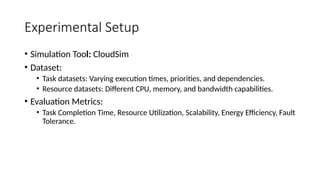
Experimental Setup
• SimulationTool: CloudSim
• Dataset:
• Task datasets: Varying execution times, priorities, and dependencies.
• Resource datasets: Different CPU, memory, and bandwidth capabilities.
• Evaluation Metrics:
• Task Completion Time, Resource Utilization, Scalability, Energy Efficiency, Fault
Tolerance.
16.
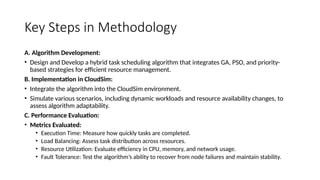
Key Steps inMethodology
A. Algorithm Development:
• Design and Develop a hybrid task scheduling algorithm that integrates GA, PSO, and priority-
based strategies for efficient resource management.
B. Implementation in CloudSim:
• Integrate the algorithm into the CloudSim environment.
• Simulate various scenarios, including dynamic workloads and resource availability changes, to
assess algorithm adaptability.
C. Performance Evaluation:
• Metrics Evaluated:
• Execution Time: Measure how quickly tasks are completed.
• Load Balancing: Assess task distribution across resources.
• Resource Utilization: Evaluate efficiency in CPU, memory, and network usage.
• Fault Tolerance: Test the algorithm’s ability to recover from node failures and maintain stability.
17.
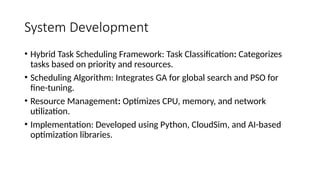
System Development
• HybridTask Scheduling Framework: Task Classification: Categorizes
tasks based on priority and resources.
• Scheduling Algorithm: Integrates GA for global search and PSO for
fine-tuning.
• Resource Management: Optimizes CPU, memory, and network
utilization.
• Implementation: Developed using Python, CloudSim, and AI-based
optimization libraries.
Results
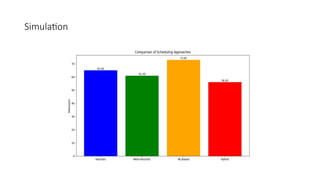
• Performance Improvement:Hybrid scheduling reduced task execution
time by 20% compared to traditional methods.
• Scalability: Successfully handled up to 10,000 tasks with minimal
performance drop.
• Load Balancing: Dynamic task distribution improved resource usage
by 30%.
• Fault Tolerance: Reduced failures and improved system recovery time.
20.
Limitations
• Computational Overhead:Hybrid models require more processing power.
• Data Dependency for Machine Learning: ML components (e.g., Reinforcement
Learning) need large datasets, which may not always be available or could lead
to biased results.
• Complexity in Algorithm Design: Combining multiple techniques (heuristic,
meta-heuristic, ML) increases complexity, making parameter tuning challenging.
• Adaptability to Dynamic Environments: The algorithm may require further
optimization for highly dynamic conditions, such as frequent workload changes.
• Real-World Testing: The study relies on simulations, not real-world cloud
deployment.
21.
Conclusion & FutureWork
• Conclusion
Hybrid scheduling (GA + PSO + Priority-based) improves task
allocation, scalability, and system efficiency.
Simulation results confirm superior performance over traditional
methods.
• Future Work
Implement in real-world cloud environments (AWS, Google Cloud).
Explore deep learning integration for adaptive scheduling.
Optimize energy efficiency for green computing solutions.
#7 After consulting a variety of sources, you will need to narrow your topic. For example, the topic of internet safety is huge, but you could narrow that topic to include internet safety in regards to social media apps that teenagers are using heavily. A topic like that is more specific and will be relevant to your peers. Some questions to think about to help you narrow your topic:
What topics of the research interest me the most?
What topics of the research will interest my audience the most?
What topics will the audience find more engaging? Shocking? Inspiring?
#11 When conducting research, it is easy to go to one source: Wikipedia. However, you need to include a variety of sources in your research. Consider the following sources:
Who can I interview to get more information on the topic?
Is the topic current and will it be relevant to my audience?
What articles, blogs, and magazines may have something related to my topic?
Is there a YouTube video on the topic? If so, what is it about?
What images can I find related to the topic?
#22 You can use this slide as your opening or closing slide. Should you choose to use it as a closing, make sure you review the main points of your presentation. One creative way to do that is by adding animations to the various graphics on a slide. This slide has 4 different graphics, and, when you view the slideshow, you will see that you can click to reveal the next graphic. Similarly, as you review the main topics in your presentation, you may want each point to show up when you are addressing that topic.
Add animation to images and graphics:
Select your image or graphic.
Click on the Animations tab.
Choose from the options. The animation for this slide is “Split”. The drop-down menu in the Animation section gives even more animations you can use.
If you have multiple graphics or images, you will see a number appear next to it that notes the order of the animations.
Note: You will want to choose the animations carefully. You do not want to make your audience dizzy from your presentation.