•Number cards 1 through 30 are shuffled
and placed on the table face down. One
card is chosen at random. What is the
probability that the number chosen is:
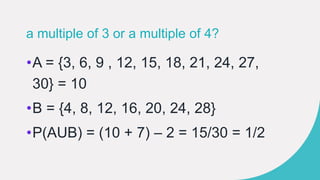
a multiple of 3 or a multiple of 4?
•A = {3, 6, 9 , 12, 15, 18, 21, 24, 27,
30} = 10
•B = {4, 8, 12, 16, 20, 24, 28}
•P(AUB) = (10 + 7) – 2 = 15/30 = 1/2
a multiple of 3 and a multiple of 4?
•A = {3, 6, 9 , 12, 15, 18, 21, 24, 27,
30} = 10
•B = {4, 8, 12, 16, 20, 24, 28}
•P(A ∩ B) = 2/30 = 1/15
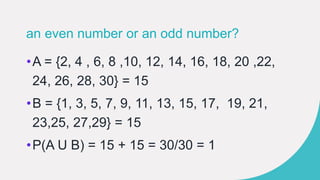
an even number or an odd number?
•A = {2, 4 , 6, 8 ,10, 12, 14, 16, 18, 20 ,22,
24, 26, 28, 30} = 15
•B = {1, 3, 5, 7, 9, 11, 13, 15, 17, 19, 21,
23,25, 27,29} = 15
•P(A U B) = 15 + 15 = 30/30 = 1
an even number and an odd number?
•A = {2, 4 , 6, 8 ,10, 12, 14, 16, 18, 20 ,22,
24, 26, 28, 30} = 15
•B = {1, 3, 5, 7, 9, 11, 13, 15, 17, 19, 21,
23,25, 27,29} = 15
•P(A ∩ B) = 0
a multiple of 5 or contains the digit 2?
•A = {5, 10, 15, 20, 25, 30} = 6
•B = {2, 12, 20, 21,22, 23,24, 25,26,
27,28, 29} = 12
•P(A 𝑈 B) = (6 + 12) - 2 = 16/30 = 8/15
a multiple of 3 and contains the digit 2?
•A = {3, 6, 9, 12, 15, 18, 21, 24, 27, 30} =
10
•B = {2, 12, 20, 21,22, 23,24, 25,26,
27,28, 29} = 12
•P(A ∩ B) = 4/30 = 2/15
Working by Group
• Each group will be given whiteboard and worksheet to work on, each group will
answer the following questions and will be given points. The group with the highest
score combine with the worksheet will be declared winner.
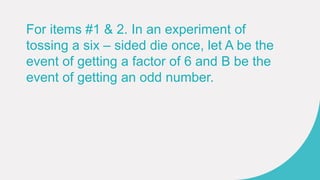
For items #1 & 2. In an experiment of
tossing a six – sided die once, let A be the
event of getting a factor of 6 and B be the
event of getting an odd number.
1. What is A ∪ B?
Answer . (A U B) = {1, 2, 3, 5,
6}
A = {1, 2, 3, 6} B = {1, 3, 5}
2. What is the cardinality of A ∩ B?
• Answer . 2
• {1, 3}
3. A box contains 7 black marbles, 8 white
marbles, and 5 yellow marbles. If a marble is
drawn at random, what is the probability of
getting a black or a yellow marble?
Answer . 3 / 5
P(B U Y) = (7+5)/20=12/20=3/5
4. A letter is randomly chosen from the
word “MATHEMATICS”. Find the
probability that a letter A or T is selected.
Answer . 4/11
P(A U T) = (2+2)/11=4/11
5. A die is rolled once. What is the
probability that the result is an even
number or a factor of 2?
Answer . 2/3
A = {2, 4, 6} B = {1, 2}
P(A𝑈B) = (3+2) – 1 = 4/6 = 2/3
12
27
18 33
a.Korea
a. Korea only
c. Japan or Hong Kong?
d. Korea and Hong Kong?
d. Hong Kong but not
Japan?
Let’s Update the Scores
Assignment
Study the mutually and non
mutually exclusive events

Mutually and Not Mutually Exclusive Events

  • 2.
    •Number cards 1through 30 are shuffled and placed on the table face down. One card is chosen at random. What is the probability that the number chosen is:
  • 3.
    a multiple of3 or a multiple of 4? •A = {3, 6, 9 , 12, 15, 18, 21, 24, 27, 30} = 10 •B = {4, 8, 12, 16, 20, 24, 28} •P(AUB) = (10 + 7) – 2 = 15/30 = 1/2
  • 4.
    a multiple of3 and a multiple of 4? •A = {3, 6, 9 , 12, 15, 18, 21, 24, 27, 30} = 10 •B = {4, 8, 12, 16, 20, 24, 28} •P(A ∩ B) = 2/30 = 1/15
  • 5.
    an even numberor an odd number? •A = {2, 4 , 6, 8 ,10, 12, 14, 16, 18, 20 ,22, 24, 26, 28, 30} = 15 •B = {1, 3, 5, 7, 9, 11, 13, 15, 17, 19, 21, 23,25, 27,29} = 15 •P(A U B) = 15 + 15 = 30/30 = 1
  • 6.
    an even numberand an odd number? •A = {2, 4 , 6, 8 ,10, 12, 14, 16, 18, 20 ,22, 24, 26, 28, 30} = 15 •B = {1, 3, 5, 7, 9, 11, 13, 15, 17, 19, 21, 23,25, 27,29} = 15 •P(A ∩ B) = 0
  • 7.
    a multiple of5 or contains the digit 2? •A = {5, 10, 15, 20, 25, 30} = 6 •B = {2, 12, 20, 21,22, 23,24, 25,26, 27,28, 29} = 12 •P(A 𝑈 B) = (6 + 12) - 2 = 16/30 = 8/15
  • 8.
    a multiple of3 and contains the digit 2? •A = {3, 6, 9, 12, 15, 18, 21, 24, 27, 30} = 10 •B = {2, 12, 20, 21,22, 23,24, 25,26, 27,28, 29} = 12 •P(A ∩ B) = 4/30 = 2/15
  • 10.
    Working by Group •Each group will be given whiteboard and worksheet to work on, each group will answer the following questions and will be given points. The group with the highest score combine with the worksheet will be declared winner.
  • 12.
    For items #1& 2. In an experiment of tossing a six – sided die once, let A be the event of getting a factor of 6 and B be the event of getting an odd number.
  • 13.
    1. What isA ∪ B? Answer . (A U B) = {1, 2, 3, 5, 6} A = {1, 2, 3, 6} B = {1, 3, 5}
  • 14.
    2. What isthe cardinality of A ∩ B? • Answer . 2 • {1, 3}
  • 15.
    3. A boxcontains 7 black marbles, 8 white marbles, and 5 yellow marbles. If a marble is drawn at random, what is the probability of getting a black or a yellow marble? Answer . 3 / 5 P(B U Y) = (7+5)/20=12/20=3/5
  • 16.
    4. A letteris randomly chosen from the word “MATHEMATICS”. Find the probability that a letter A or T is selected. Answer . 4/11 P(A U T) = (2+2)/11=4/11
  • 17.
    5. A dieis rolled once. What is the probability that the result is an even number or a factor of 2? Answer . 2/3 A = {2, 4, 6} B = {1, 2} P(A𝑈B) = (3+2) – 1 = 4/6 = 2/3
  • 22.
  • 27.
  • 28.
  • 29.
    c. Japan orHong Kong?
  • 30.
    d. Korea andHong Kong?
  • 31.
    d. Hong Kongbut not Japan?
  • 32.
  • 35.
  • 36.
    Study the mutuallyand non mutually exclusive events