Music Video Analysis
Iggy Azalea - Fancy
Narrative
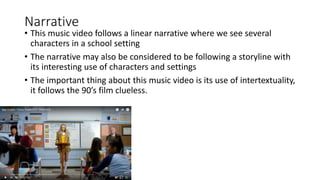
• This music video follows a linear narrative where we see several
characters in a school setting
• The narrative may also be considered to be following a storyline with
its interesting use of characters and settings
• The important thing about this music video is its use of intertextuality,
it follows the 90’s film clueless.
Genre
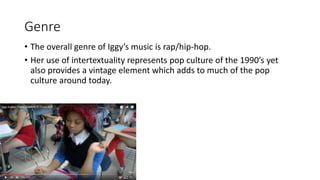
• The overall genre of Iggy’s music is rap/hip-hop.
• Her use of intertextuality represents pop culture of the 1990’s yet
also provides a vintage element which adds to much of the pop
culture around today.
Conventions
• According to Andrew Goodwin’s theory it adheres to:
• A relationship between the lyrics and visuals (illustrating, amplifying
or contradicting the lyrics)
• A relationship between music and visuals
• A demand from the record company for lots of close-ups of the main
artist
• Intertextual references
Cinematography
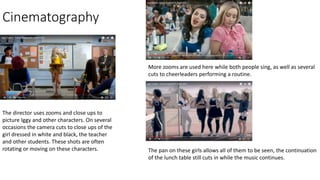
The director uses zooms and close ups to
picture Iggy and other characters. On several
occasions the camera cuts to close ups of the
girl dressed in white and black, the teacher
and other students. These shots are often
rotating or moving on these characters.
More zooms are used here while both people sing, as well as several
cuts to cheerleaders performing a routine.
The pan on these girls allows all of them to be seen, the continuation
of the lunch table still cuts in while the music continues.
Cinematography
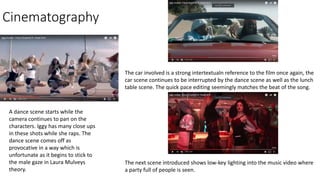
A dance scene starts while the
camera continues to pan on the
characters. Iggy has many close ups
in these shots while she raps. The
dance scene comes off as
provocative in a way which is
unfortunate as it begins to stick to
the male gaze in Laura Mulveys
theory.
The car involved is a strong intertextualn reference to the film once again, the
car scene continues to be interrupted by the dance scene as well as the lunch
table scene. The quick pace editing seemingly matches the beat of the song.
The next scene introduced shows low-key lighting into the music video where
a party full of people is seen.
Cinematography
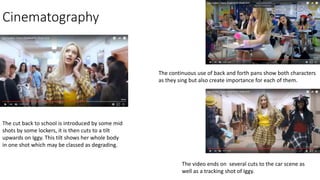
The cut back to school is introduced by some mid
shots by some lockers, it is then cuts to a tilt
upwards on Iggy. This tilt shows her whole body
in one shot which may be classed as degrading.
The continuous use of back and forth pans show both characters
as they sing but also create importance for each of them.
The video ends on several cuts to the car scene as
well as a tracking shot of Iggy.
Postmodernism
• The use of intertextuality is recognisable. Broadly, if we see music promos
as frequently drawing upon existing texts in order to spark recognition in
the audience, we have a working definition of ‘intertextuality’ thus
showing postmodernism in the music video.
• Postmodern texts ofren assume a great knowledge on behalf of the
audience with the use of conventions of representation and stereotypes.
They have used the stereotype of a high school queen bee surrounded by
her peers, which in turn acts as a source of humour and pleasure.
• The music video has attempted to serve multiple audiences with its use of
intertextual references, appealing to not only a young demographic but
older ones who want to see the film recreated. The fact it features several
prominent women all in which have been slightly sexualised applies to a
male audience.

Music video analysis

  • 1.
  • 2.
    Narrative • This musicvideo follows a linear narrative where we see several characters in a school setting • The narrative may also be considered to be following a storyline with its interesting use of characters and settings • The important thing about this music video is its use of intertextuality, it follows the 90’s film clueless.
  • 3.
    Genre • The overallgenre of Iggy’s music is rap/hip-hop. • Her use of intertextuality represents pop culture of the 1990’s yet also provides a vintage element which adds to much of the pop culture around today.
  • 4.
    Conventions • According toAndrew Goodwin’s theory it adheres to: • A relationship between the lyrics and visuals (illustrating, amplifying or contradicting the lyrics) • A relationship between music and visuals • A demand from the record company for lots of close-ups of the main artist • Intertextual references
  • 5.
    Cinematography The director useszooms and close ups to picture Iggy and other characters. On several occasions the camera cuts to close ups of the girl dressed in white and black, the teacher and other students. These shots are often rotating or moving on these characters. More zooms are used here while both people sing, as well as several cuts to cheerleaders performing a routine. The pan on these girls allows all of them to be seen, the continuation of the lunch table still cuts in while the music continues.
  • 6.
    Cinematography A dance scenestarts while the camera continues to pan on the characters. Iggy has many close ups in these shots while she raps. The dance scene comes off as provocative in a way which is unfortunate as it begins to stick to the male gaze in Laura Mulveys theory. The car involved is a strong intertextualn reference to the film once again, the car scene continues to be interrupted by the dance scene as well as the lunch table scene. The quick pace editing seemingly matches the beat of the song. The next scene introduced shows low-key lighting into the music video where a party full of people is seen.
  • 7.
    Cinematography The cut backto school is introduced by some mid shots by some lockers, it is then cuts to a tilt upwards on Iggy. This tilt shows her whole body in one shot which may be classed as degrading. The continuous use of back and forth pans show both characters as they sing but also create importance for each of them. The video ends on several cuts to the car scene as well as a tracking shot of Iggy.
  • 8.
    Postmodernism • The useof intertextuality is recognisable. Broadly, if we see music promos as frequently drawing upon existing texts in order to spark recognition in the audience, we have a working definition of ‘intertextuality’ thus showing postmodernism in the music video. • Postmodern texts ofren assume a great knowledge on behalf of the audience with the use of conventions of representation and stereotypes. They have used the stereotype of a high school queen bee surrounded by her peers, which in turn acts as a source of humour and pleasure. • The music video has attempted to serve multiple audiences with its use of intertextual references, appealing to not only a young demographic but older ones who want to see the film recreated. The fact it features several prominent women all in which have been slightly sexualised applies to a male audience.