Temple Beth El Comparative Religion Lecture Series Music in Buddhism Role and Uses of Music in Buddhism


Sutras were originally recited from memory Oldest parts of the sutras are believed to be the gatta sections – verse Later when writing was applied to the sutras they were expanded upon and the prose sections were used to enhance or expand upon what was contained in the gatta sections
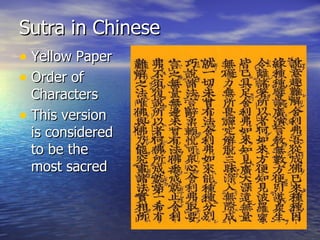
Sutra in Chinese Yellow Paper Order of Characters This version is considered to be the most sacred
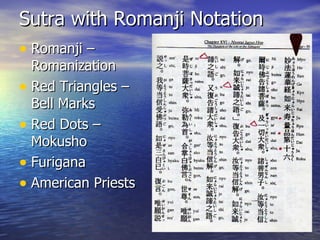
Sutra with Romanji Notation Romanji – Romanization Red Triangles – Bell Marks Red Dots – Mokusho Furigana American Priests
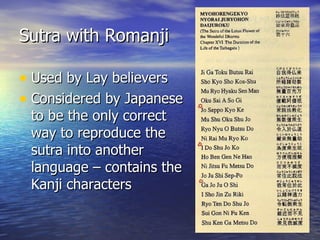
Sutra with Romanji Used by Lay believers Considered by Japanese to be the only correct way to reproduce the sutra into another language – contains the Kanji characters
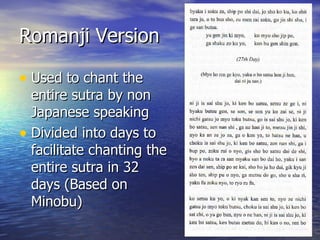
Romanji Version Used to chant the entire sutra by non Japanese speaking Divided into days to facilitate chanting the entire sutra in 32 days (Based on Minobu)
Rituals and Formalities Initially very few As Buddhism moved into monasteries rituals were established Buddhism moved away from lay practitioners
First Major Split in Buddhism Monastic traditions commonly referred to as Hinayana though now only Therevadan exists of all the original Hinayana schools Mahayana a response to monastic traditions was lay focused – less emphasis on priests
Development of Mahayana Buddhism Different schools formed – sects or denominations Each sect adopted sutras that were believed to represent the Buddha’s important teachings Within each denomination rituals were created and orders of service established
Major Nichiren Denominations Nichiren Shu Rissho Kose Kai Nipponzan Myohoji Kempon Hokke Kai Nichiren Shoshu Soka Gakkai – lay only Reiyukai – lay only
Lotus Sutra Primary sutra in all Nichiren Denominations Ceremony in the Air Great Stupa appears Many Treasures Buddha Appearance of Bodhisattvas from Underground Most important Chapter 16 – Life Span Chapter Second Most important Chapter 2 - Expedients
Services in Nichiren Shu Primarily the order and contents of a service in its most simplest form is the re-enactment of the Ceremony in the Air More complicated and fancy services recreate the entire sutra in an abbreviated form
Buddhism is primarily experiential Place ourselves at the Ceremony in the Air as Bodhisattvas from Underground The assembly for us has not been dispersed Understanding our relationship to what is taught in the Sutra Deepening our relationship enables us to better understand what our actions and behaviors should be Attainment of Enlightenment
Musical Elements in the Lotus Sutra Preaching – without the teaching nothing happens – everything is in response to the Dharma being taught Heavenly drums Bells and gongs Heavenly music Fragrant incense Flowers raining down from the heavens
Three Treasures Many songs, parts of services, and service manner relate to the Three Treasures Buddha – our teacher who attained enlightenment and teaches how to become Buddhas Dharma – the teaching of the Buddha which enable us to become Buddhas as the Buddha did Sangha (Samgha) – community of believers, practitioners who in community follow and encourage others in the teachings of the Buddha
Buddhist Service as a Participatory Experience Eastern or Asian Traditions – culturally Buddhist ceremony and services are done by priests and lay people observe and benefit by experiencing the spirituality of the service Western adoptions – culturally lay people whish to actually participate in the services
Sutra Recitation Before the rise of what are called “New Religions” not uncommon for lay people to not even know how to read or recite the sutras Incense offering is commonly done during the sutra recitation portions because people can’t say the sutra and so it gives them something to do In the West most people learn to recite the sutra and do so during service so the incense offering occurs during the mantra chanting
Adaptations in the West More instruction is given in how to read and recite the Sutras Instruction in how to sing and perform Shomyo (Buddhist Hymns) Translation of Sutras and use of native language (also being done more in Japan as well) Translation of Shomyo to be sung in English Training lay people to assist in ceremonies and services
Translations Sutras into English – presents little difficulty when used in services except generally the English is longer Shomyo into English – very challenging because of the use of abbreviations in the Shindoku (The liturgical language - Japanese pronunciation of Chinese Characters) ‘ Bu’ standing in for Butsu meaning Buddha, we cannot just say Bu in English and have an understanding occur automatically Where one syllable is used in a song may require several in English
Movements Clockwise direction Bowing Regular bow Raihai – deep bow – forehead touching the floor, hands raised from the floor to above ears alongside head Hand placement Gassho, never half Gassho – appreciation and respect Sashu – left hand over right
Instruments Kanamaru – large bell Inken – hand bell Kei – plank bell Mokusho – wooden drum Mokugyo – fish drum Taiko – large drum Uchiwataiko – hand held drum Nyo – cymbals – generally only used for Shu San Hachi – gong – generally only used for Shu San
Use of Instruments Kanamaru – signal bell for everyone in hall 3 rings – Dai Sho Dai – hard, soft, hard 5 rings – Dai Dai Sho Sho Dai – hard, hard, soft, soft, hard (less frequent) Inken – signal bell for priests movements and singing Kei – signal bell for priests demarcating sections of service – same bell pattern for 3 rings, 2 or 1 Mokusho & Mokugyo – wooden percussion for keeping the rhythm (Mokugyo is used during memorial services generally or for in home visits by priests) Taiko – large drum Opening/Beginning – demonstrate to illustrate Accompanies the mokusho during service omitting first beat Uchiwataiko – used during service when chanting Odaimoku and when marching – again first beat is omitted
Major/Main Shomyo Dojoge – Invitation and welcome of Buddhas Sanborai – Offering/Praising Three Treasures Kirisange – Flower strewing Sanki – Taking Refuge in the Three Treasures Buso – Parting of the Buddhas, sending the Buddhas to where they wish to be
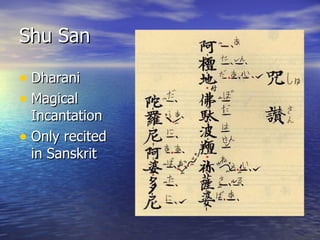
Special Occasion Shomyo Shu San – special incantation directly from the Lotus Sutra, always pronounced or sung in Sanskrit – offered for protection (portion of Atandai) Taiyo – song of prayer used in special ceremonies, accompanied by special offerings such as incense and water Versatile song as special sections are added or left out depending upon the service Special sections or verses are added especially when a priest dies
Format of Shomyo Solo introduction to each verse Joint or group singing of ending of verse Sagaru - first note tone is approached gradually Japanese consider it unpleasing to the ear to begin harshly Gradual even if only slight Embai – slight single note trill, hiccup Oru – rapid drop to lower note Joe no kiri – “I” in Shu San Kirazu – no breath during pause Breathing is very regulated – only at specific spots
Other Ceremonial Items Chukei - fan Hossu – whisk Egoro – handheld incense burner Hanazra – flower petal tray
Perhaps the oldest Buddhist Song Tisarana Sung the same in all countries Buddham saranam gacchami Dharmman saranam gacchami Sangham saranam gacchami I take refuge in the Buddha I take refuge in the Dharma I take refuge in the Sangha
Demonstration of Shomyo
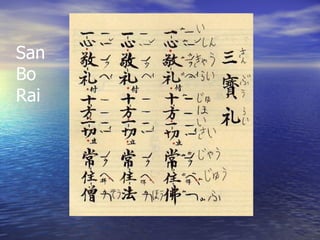
San Bo Rai
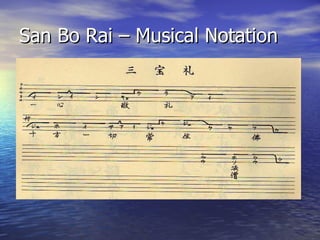
San Bo Rai – Musical Notation
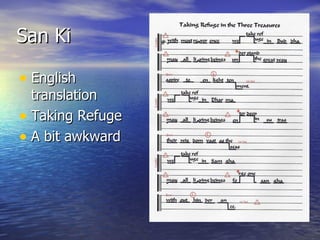
San Ki English translation Taking Refuge A bit awkward
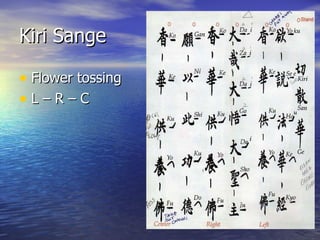
Kiri Sange Flower tossing L – R – C
Shu San Dharani Magical Incantation Only recited in Sanskrit
Robes - Dress Juban – short undershirt Hakue – longer undergarment Hakuma – pleated skirt Dofuku – informal robe over street clothes Wagesa – folded kesa worn with Dofuku Kojie – formal robe with long sleeves Kesa – Buddhas garment – 5 panel and 8 panel Zori – slipper shoes Tabi – special socks

Music In Buddhism

  • 1.
    Temple Beth ElComparative Religion Lecture Series Music in Buddhism Role and Uses of Music in Buddhism
  • 2.
  • 3.
  • 4.
  • 5.
  • 6.
    Sutras were originallyrecited from memory Oldest parts of the sutras are believed to be the gatta sections – verse Later when writing was applied to the sutras they were expanded upon and the prose sections were used to enhance or expand upon what was contained in the gatta sections
  • 7.
    Sutra in ChineseYellow Paper Order of Characters This version is considered to be the most sacred
  • 8.
    Sutra with RomanjiNotation Romanji – Romanization Red Triangles – Bell Marks Red Dots – Mokusho Furigana American Priests
  • 9.
    Sutra with RomanjiUsed by Lay believers Considered by Japanese to be the only correct way to reproduce the sutra into another language – contains the Kanji characters
  • 10.
    Romanji Version Usedto chant the entire sutra by non Japanese speaking Divided into days to facilitate chanting the entire sutra in 32 days (Based on Minobu)
  • 11.
    Rituals and FormalitiesInitially very few As Buddhism moved into monasteries rituals were established Buddhism moved away from lay practitioners
  • 12.
    First Major Splitin Buddhism Monastic traditions commonly referred to as Hinayana though now only Therevadan exists of all the original Hinayana schools Mahayana a response to monastic traditions was lay focused – less emphasis on priests
  • 13.
    Development of MahayanaBuddhism Different schools formed – sects or denominations Each sect adopted sutras that were believed to represent the Buddha’s important teachings Within each denomination rituals were created and orders of service established
  • 14.
    Major Nichiren DenominationsNichiren Shu Rissho Kose Kai Nipponzan Myohoji Kempon Hokke Kai Nichiren Shoshu Soka Gakkai – lay only Reiyukai – lay only
  • 15.
    Lotus Sutra Primarysutra in all Nichiren Denominations Ceremony in the Air Great Stupa appears Many Treasures Buddha Appearance of Bodhisattvas from Underground Most important Chapter 16 – Life Span Chapter Second Most important Chapter 2 - Expedients
  • 16.
    Services in NichirenShu Primarily the order and contents of a service in its most simplest form is the re-enactment of the Ceremony in the Air More complicated and fancy services recreate the entire sutra in an abbreviated form
  • 17.
    Buddhism is primarilyexperiential Place ourselves at the Ceremony in the Air as Bodhisattvas from Underground The assembly for us has not been dispersed Understanding our relationship to what is taught in the Sutra Deepening our relationship enables us to better understand what our actions and behaviors should be Attainment of Enlightenment
  • 18.
    Musical Elements inthe Lotus Sutra Preaching – without the teaching nothing happens – everything is in response to the Dharma being taught Heavenly drums Bells and gongs Heavenly music Fragrant incense Flowers raining down from the heavens
  • 19.
    Three Treasures Manysongs, parts of services, and service manner relate to the Three Treasures Buddha – our teacher who attained enlightenment and teaches how to become Buddhas Dharma – the teaching of the Buddha which enable us to become Buddhas as the Buddha did Sangha (Samgha) – community of believers, practitioners who in community follow and encourage others in the teachings of the Buddha
  • 20.
    Buddhist Service asa Participatory Experience Eastern or Asian Traditions – culturally Buddhist ceremony and services are done by priests and lay people observe and benefit by experiencing the spirituality of the service Western adoptions – culturally lay people whish to actually participate in the services
  • 21.
    Sutra Recitation Beforethe rise of what are called “New Religions” not uncommon for lay people to not even know how to read or recite the sutras Incense offering is commonly done during the sutra recitation portions because people can’t say the sutra and so it gives them something to do In the West most people learn to recite the sutra and do so during service so the incense offering occurs during the mantra chanting
  • 22.
    Adaptations in theWest More instruction is given in how to read and recite the Sutras Instruction in how to sing and perform Shomyo (Buddhist Hymns) Translation of Sutras and use of native language (also being done more in Japan as well) Translation of Shomyo to be sung in English Training lay people to assist in ceremonies and services
  • 23.
    Translations Sutras intoEnglish – presents little difficulty when used in services except generally the English is longer Shomyo into English – very challenging because of the use of abbreviations in the Shindoku (The liturgical language - Japanese pronunciation of Chinese Characters) ‘ Bu’ standing in for Butsu meaning Buddha, we cannot just say Bu in English and have an understanding occur automatically Where one syllable is used in a song may require several in English
  • 24.
    Movements Clockwise directionBowing Regular bow Raihai – deep bow – forehead touching the floor, hands raised from the floor to above ears alongside head Hand placement Gassho, never half Gassho – appreciation and respect Sashu – left hand over right
  • 25.
    Instruments Kanamaru –large bell Inken – hand bell Kei – plank bell Mokusho – wooden drum Mokugyo – fish drum Taiko – large drum Uchiwataiko – hand held drum Nyo – cymbals – generally only used for Shu San Hachi – gong – generally only used for Shu San
  • 26.
    Use of InstrumentsKanamaru – signal bell for everyone in hall 3 rings – Dai Sho Dai – hard, soft, hard 5 rings – Dai Dai Sho Sho Dai – hard, hard, soft, soft, hard (less frequent) Inken – signal bell for priests movements and singing Kei – signal bell for priests demarcating sections of service – same bell pattern for 3 rings, 2 or 1 Mokusho & Mokugyo – wooden percussion for keeping the rhythm (Mokugyo is used during memorial services generally or for in home visits by priests) Taiko – large drum Opening/Beginning – demonstrate to illustrate Accompanies the mokusho during service omitting first beat Uchiwataiko – used during service when chanting Odaimoku and when marching – again first beat is omitted
  • 27.
    Major/Main Shomyo Dojoge– Invitation and welcome of Buddhas Sanborai – Offering/Praising Three Treasures Kirisange – Flower strewing Sanki – Taking Refuge in the Three Treasures Buso – Parting of the Buddhas, sending the Buddhas to where they wish to be
  • 28.
    Special Occasion ShomyoShu San – special incantation directly from the Lotus Sutra, always pronounced or sung in Sanskrit – offered for protection (portion of Atandai) Taiyo – song of prayer used in special ceremonies, accompanied by special offerings such as incense and water Versatile song as special sections are added or left out depending upon the service Special sections or verses are added especially when a priest dies
  • 29.
    Format of ShomyoSolo introduction to each verse Joint or group singing of ending of verse Sagaru - first note tone is approached gradually Japanese consider it unpleasing to the ear to begin harshly Gradual even if only slight Embai – slight single note trill, hiccup Oru – rapid drop to lower note Joe no kiri – “I” in Shu San Kirazu – no breath during pause Breathing is very regulated – only at specific spots
  • 30.
    Other Ceremonial ItemsChukei - fan Hossu – whisk Egoro – handheld incense burner Hanazra – flower petal tray
  • 31.
    Perhaps the oldestBuddhist Song Tisarana Sung the same in all countries Buddham saranam gacchami Dharmman saranam gacchami Sangham saranam gacchami I take refuge in the Buddha I take refuge in the Dharma I take refuge in the Sangha
  • 32.
  • 33.
  • 34.
    San Bo Rai– Musical Notation
  • 35.
    San Ki Englishtranslation Taking Refuge A bit awkward
  • 36.
    Kiri Sange Flowertossing L – R – C
  • 37.
    Shu San DharaniMagical Incantation Only recited in Sanskrit
  • 38.
    Robes - DressJuban – short undershirt Hakue – longer undergarment Hakuma – pleated skirt Dofuku – informal robe over street clothes Wagesa – folded kesa worn with Dofuku Kojie – formal robe with long sleeves Kesa – Buddhas garment – 5 panel and 8 panel Zori – slipper shoes Tabi – special socks