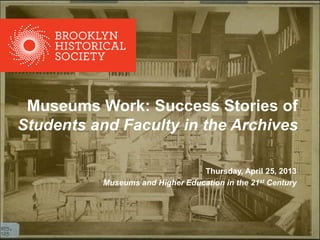
Museums Work: Success Stories of
Students and Faculty in the Archives
Thursday, April 25, 2013
Museums and Higher Education in the 21st Century
Welcome
Robin M. Katz,
Outreach + Public Services Archivist
Co-Director, Students and Faculty in the Archives
@robinmkatz #safabhs
rkatz@brooklynhistory.org
Students and Faculty in the Archives (SAFA)
• Innovative postsecondary education program
which uses primary sources to build document
analysis, information literacy, and critical thinking
skills in undergraduates
Students and Faculty in the Archives (SAFA)
• Three year, $750,000 US Dept of Education
FIPSE grant
• Three schools: City Tech, LIU, St. Francis
• Nineteen partner faculty
– SAFA professional development
• Wide variety of disciplines and types of classes
Students and Faculty in the Archives (SAFA)
• Centered around class visits to the archives
• Over four semesters (Fall 2011 – Spring 2013)
– 1,100 individual students
– 63 courses
– 100 class visits to Brooklyn Historical Society
Students and Faculty in the Archives (SAFA)
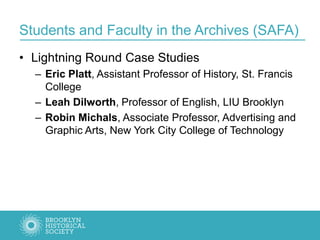
• Our Teaching Philosophy
– Goals and objectives
– No show-and –tell
– Actively use materials
– Less is more
– Document Analysis
• Specific vs. generic prompts
– Why did Henry Ward Beecher write this letter?
– Who is the creator? What type of document is this?
Students and Faculty in the Archives (SAFA)
• Lightning Round Case Studies
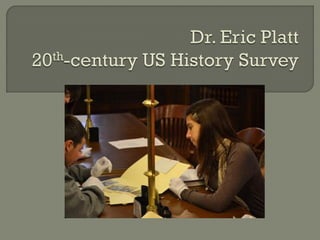
– Eric Platt, Assistant Professor of History, St. Francis
College
– Leah Dilworth, Professor of English, LIU Brooklyn
– Robin Michals, Associate Professor, Advertising and
Graphic Arts, New York City College of Technology
Understand historical continuity and
change
Work with a wide variety of primary
sources:
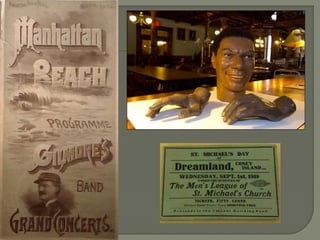
• Reexamine everyday items for their historical
importance
Develop analysis and research skills
Demonstrate increased awareness of
local history
Realize their roles as historical actors
“I was fascinated by the historical
influences of the areas that I frequent
daily.”
“[I] never realized how big Brooklyn was
historically.”
“To see and hold history in my hand
[with the tickets] was just amazing. . . .
Looking at that ticket made me realize
that when I go to a sports game, I will be
holding history in my hand as well. We
don’t realize that every day we continue
to make history.”
… if you have ever seen a daguerreotype
image on a book or online is nothing like
the actual thing… another difference
between them is the exposure time, as we
can see on the daguerreotype, the
woman looks so serious, and that is
because the exposure time was too long
(it could have lasted up to several
minutes)…
—Regina Torres
Leah Dilworth
Professor of English
Long Island University Brooklyn Campus
New York City College of Technology
City University of New York
Advertising Design and Graphic Arts
GRA 2330 Digital Photography
Course Goals and Objectives
• Develop visual literacy and powers of
observation.
• Understand photography as representation
and as a changing set of technologies.
• Recognize the impact of the process of
creating an image on its visual form.
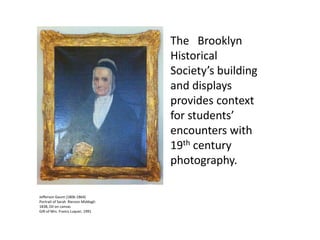
The Brooklyn
Historical
Society’s building
and displays
provides context
for students’
encounters with
19th century
photography.
Jefferson Gaunt (1806-1864)
Portrait of Sarah Rierson Middagh
1838, Oil on canvas
Gift of Mrs. Francs Luquer, 1991
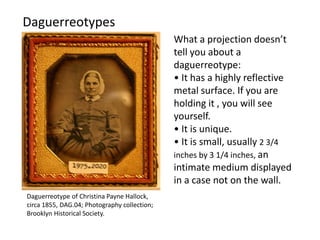
What a projection doesn’t
tell you about a
daguerreotype:
• It has a highly reflective
metal surface. If you are
holding it , you will see
yourself.
• It is unique.
• It is small, usually 2 3/4
inches by 3 1/4 inches, an
intimate medium displayed
in a case not on the wall.
Daguerreotypes
Daguerreotype of Christina Payne Hallock,
circa 1855, DAG.04; Photography collection;
Brooklyn Historical Society.
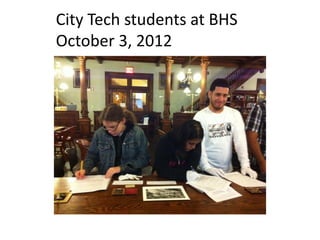
City Tech students at BHS
October 3, 2012
Student Response
The daguerreotype … was a copper plate, which
made it reflective, encased in a frame with
matting to protect it and had a decent amount
of weight to it. By contrast any of the digital
images I’ve taken this semester weigh nothing
until I decide to print them out and then they
weight only as much as the paper they are
printed on.
—Andrea Morin
Student Response
… if you have ever seen a daguerreotype image
on a book or online is nothing like the actual
thing… another difference between them is
the exposure time, as we can see on the
daguerreotype, the woman looks so serious,
and that is because the exposure time was too
long (it could have lasted up to several
minutes)…
—Regina Torres
Findings
• Independent evaluators have found thatSAFA
students are more engaged and perform better
their peers
• This year, will receive and analyze retention data
• 2012 Evaluation Report available online at
http://safa.brooklynhistory.org/docs/Eval-Report-
2012.pdf
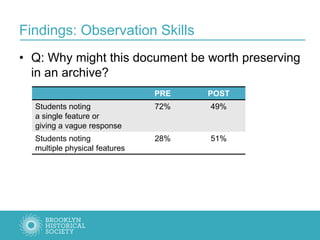
Findings: Observation Skills
• Q: Why might this document be worth preserving
in an archive?
PRE POST
Students noting
a single feature or
giving a vague response
72% 49%
Students noting
multiple physical features
28% 51%
Findings: Articulating ‘a usable past’
• Q: Why might this document be worth preserving
in an archive?
Sample PRE responses Sample POST responses
This is a photo from the past To show how society valued
entertainment.
Because it showed what was
going on at that moment.
[It] shows how technology was
progressing in the US.
It gives insight… to what life was
like during the 1960s.
It shows how people were
sending postal cards through the
telegrams and how it was
different… than… today.
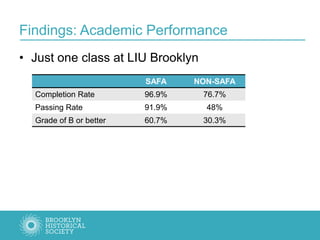
Findings: Academic Performance
• Just one class at LIU Brooklyn
SAFA NON-SAFA
Completion Rate 96.9% 76.7%
Passing Rate 91.9% 48%
Grade of B or better 60.7% 30.3%
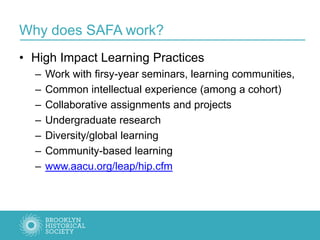
Why does SAFA work?
• High Impact Learning Practices
– Work with firsy-year seminars, learning communities,
– Common intellectual experience (among a cohort)
– Collaborative assignments and projects
– Undergraduate research
– Diversity/global learning
– Community-based learning
– www.aacu.org/leap/hip.cfm
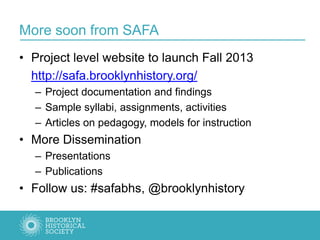
More soon from SAFA
• Project level website to launch Fall 2013
http://safa.brooklynhistory.org/
– Project documentation and findings
– Sample syllabi, assignments, activities
– Articles on pedagogy, models for instruction
• More Dissemination
– Presentations
– Publications
• Follow us: #safabhs, @brooklynhistory

Museums Work: Success Stories from Students and Faculty in the Archives

  • 1.
    Museums Work: SuccessStories of Students and Faculty in the Archives Thursday, April 25, 2013 Museums and Higher Education in the 21st Century
  • 2.
    Welcome Robin M. Katz, Outreach+ Public Services Archivist Co-Director, Students and Faculty in the Archives @robinmkatz #safabhs rkatz@brooklynhistory.org
  • 3.
    Students and Facultyin the Archives (SAFA) • Innovative postsecondary education program which uses primary sources to build document analysis, information literacy, and critical thinking skills in undergraduates
  • 4.
    Students and Facultyin the Archives (SAFA) • Three year, $750,000 US Dept of Education FIPSE grant • Three schools: City Tech, LIU, St. Francis • Nineteen partner faculty – SAFA professional development • Wide variety of disciplines and types of classes
  • 5.
    Students and Facultyin the Archives (SAFA) • Centered around class visits to the archives • Over four semesters (Fall 2011 – Spring 2013) – 1,100 individual students – 63 courses – 100 class visits to Brooklyn Historical Society
  • 6.
    Students and Facultyin the Archives (SAFA) • Our Teaching Philosophy – Goals and objectives – No show-and –tell – Actively use materials – Less is more – Document Analysis • Specific vs. generic prompts – Why did Henry Ward Beecher write this letter? – Who is the creator? What type of document is this?
  • 7.
    Students and Facultyin the Archives (SAFA) • Lightning Round Case Studies – Eric Platt, Assistant Professor of History, St. Francis College – Leah Dilworth, Professor of English, LIU Brooklyn – Robin Michals, Associate Professor, Advertising and Graphic Arts, New York City College of Technology
  • 11.
    Understand historical continuityand change Work with a wide variety of primary sources: • Reexamine everyday items for their historical importance Develop analysis and research skills Demonstrate increased awareness of local history Realize their roles as historical actors
  • 12.
    “I was fascinatedby the historical influences of the areas that I frequent daily.” “[I] never realized how big Brooklyn was historically.”
  • 13.
    “To see andhold history in my hand [with the tickets] was just amazing. . . . Looking at that ticket made me realize that when I go to a sports game, I will be holding history in my hand as well. We don’t realize that every day we continue to make history.”
  • 14.
    … if youhave ever seen a daguerreotype image on a book or online is nothing like the actual thing… another difference between them is the exposure time, as we can see on the daguerreotype, the woman looks so serious, and that is because the exposure time was too long (it could have lasted up to several minutes)… —Regina Torres
  • 15.
    Leah Dilworth Professor ofEnglish Long Island University Brooklyn Campus
  • 16.
    New York CityCollege of Technology City University of New York Advertising Design and Graphic Arts GRA 2330 Digital Photography
  • 17.
    GRA 2330 DigitalPhotography Course Goals and Objectives • Develop visual literacy and powers of observation. • Understand photography as representation and as a changing set of technologies. • Recognize the impact of the process of creating an image on its visual form.
  • 18.
    The Brooklyn Historical Society’s building anddisplays provides context for students’ encounters with 19th century photography. Jefferson Gaunt (1806-1864) Portrait of Sarah Rierson Middagh 1838, Oil on canvas Gift of Mrs. Francs Luquer, 1991
  • 19.
    What a projectiondoesn’t tell you about a daguerreotype: • It has a highly reflective metal surface. If you are holding it , you will see yourself. • It is unique. • It is small, usually 2 3/4 inches by 3 1/4 inches, an intimate medium displayed in a case not on the wall. Daguerreotypes Daguerreotype of Christina Payne Hallock, circa 1855, DAG.04; Photography collection; Brooklyn Historical Society.
  • 20.
    City Tech studentsat BHS October 3, 2012
  • 21.
    Student Response The daguerreotype… was a copper plate, which made it reflective, encased in a frame with matting to protect it and had a decent amount of weight to it. By contrast any of the digital images I’ve taken this semester weigh nothing until I decide to print them out and then they weight only as much as the paper they are printed on. —Andrea Morin
  • 22.
    Student Response … ifyou have ever seen a daguerreotype image on a book or online is nothing like the actual thing… another difference between them is the exposure time, as we can see on the daguerreotype, the woman looks so serious, and that is because the exposure time was too long (it could have lasted up to several minutes)… —Regina Torres
  • 23.
    Findings • Independent evaluatorshave found thatSAFA students are more engaged and perform better their peers • This year, will receive and analyze retention data • 2012 Evaluation Report available online at http://safa.brooklynhistory.org/docs/Eval-Report- 2012.pdf
  • 24.
    Findings: Observation Skills •Q: Why might this document be worth preserving in an archive? PRE POST Students noting a single feature or giving a vague response 72% 49% Students noting multiple physical features 28% 51%
  • 25.
    Findings: Articulating ‘ausable past’ • Q: Why might this document be worth preserving in an archive? Sample PRE responses Sample POST responses This is a photo from the past To show how society valued entertainment. Because it showed what was going on at that moment. [It] shows how technology was progressing in the US. It gives insight… to what life was like during the 1960s. It shows how people were sending postal cards through the telegrams and how it was different… than… today.
  • 26.
    Findings: Academic Performance •Just one class at LIU Brooklyn SAFA NON-SAFA Completion Rate 96.9% 76.7% Passing Rate 91.9% 48% Grade of B or better 60.7% 30.3%
  • 27.
    Why does SAFAwork? • High Impact Learning Practices – Work with firsy-year seminars, learning communities, – Common intellectual experience (among a cohort) – Collaborative assignments and projects – Undergraduate research – Diversity/global learning – Community-based learning – www.aacu.org/leap/hip.cfm
  • 28.
    More soon fromSAFA • Project level website to launch Fall 2013 http://safa.brooklynhistory.org/ – Project documentation and findings – Sample syllabi, assignments, activities – Articles on pedagogy, models for instruction • More Dissemination – Presentations – Publications • Follow us: #safabhs, @brooklynhistory