Multiplying and Dividing
Fractions
7th Grade Math
August, 2013
A Quick Review:
 KEY POINT when multiplying or dividing
fractions:
Change a mixed number into
an improper fraction,
 Still simplify your answer.
More on Multiplying Fractions:
 “of” means multiply!
 Example:
 There are 8 cars in Michael’s toy collection. 1/2 of
the cars are red. How many red cars does Michael
have?
 This problem is asking “What is 1/2 of 8?”
 A way to answer it is to put a multiplication sign in place of “of.” You
then get 1/2 x 8 or 8 x ½ (remember that multiplication is
commutative).
Multiplying Fractions:
 Multiplying fractions is easier than adding or
subtraction because you don’t need to find
common denominators. YAY!!!!!!
 Just multiply straight across.
 Multiply numerators
 Then, multiply denominators
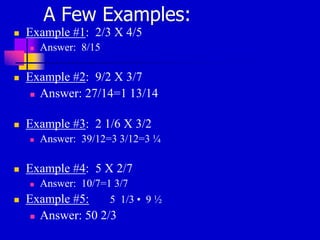
A Few Examples:
 Example #1: 2/3 X 4/5
 Answer: 8/15
 Example #2: 9/2 X 3/7
 Answer: 27/14=1 13/14
 Example #3: 2 1/6 X 3/2
 Answer: 39/12=3 3/12=3 ¼
 Example #4: 5 X 2/7
 Answer: 10/7=1 3/7
 Example #5: 5 1/3 • 9 ½
 Answer: 50 2/3
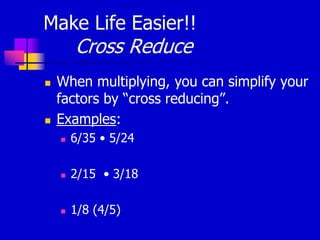
Make Life Easier!!
Cross Reduce
 When multiplying, you can simplify your
factors by “cross reducing”.
 Examples:
 6/35 • 5/24
 2/15 • 3/18
 1/8 (4/5)
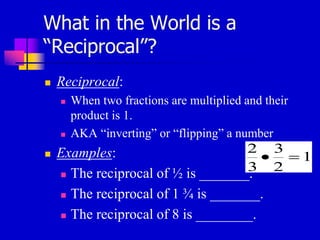
What in the World is a
“Reciprocal”?
 Reciprocal:
 When two fractions are multiplied and their
product is 1.
 AKA “inverting” or “flipping” a number
 Examples:
 The reciprocal of ½ is _______.
 The reciprocal of 1 ¾ is _______.
 The reciprocal of 8 is ________.
1
2
3
3
2


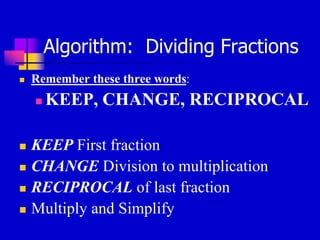
Algorithm: Dividing Fractions
 Remember these three words:
 KEEP, CHANGE, RECIPROCAL
 KEEP First fraction
 CHANGE Division to multiplication
 RECIPROCAL of last fraction
 Multiply and Simplify
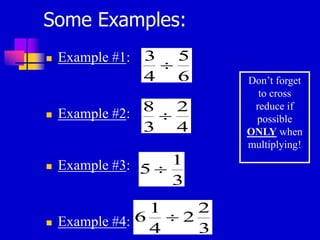
Some Examples:
 Example #1:
 Example #2:
 Example #3:
 Example #4:
6
5
4
3

4
2
3
8

3
1
5 
3
2
2
4
1
6 
Don’t forget
to cross
reduce if
possible
ONLY when
multiplying!
“Card and Domino Multiplication/Division”
 Each partner draws one (1) card and one (1)
domino
 Card = whole number
 Domino = fraction
 Multiply your two numbers (individually)
 Divide your two numbers (individually)
 Compare your answers. If you both have the
same answer, give your team a point for each
problem. Highest points (with work shown) wins
candy!

multiply and divide fractions.ppt

  • 1.
  • 2.
    A Quick Review: KEY POINT when multiplying or dividing fractions: Change a mixed number into an improper fraction,  Still simplify your answer.
  • 3.
    More on MultiplyingFractions:  “of” means multiply!  Example:  There are 8 cars in Michael’s toy collection. 1/2 of the cars are red. How many red cars does Michael have?  This problem is asking “What is 1/2 of 8?”  A way to answer it is to put a multiplication sign in place of “of.” You then get 1/2 x 8 or 8 x ½ (remember that multiplication is commutative).
  • 4.
    Multiplying Fractions:  Multiplyingfractions is easier than adding or subtraction because you don’t need to find common denominators. YAY!!!!!!  Just multiply straight across.  Multiply numerators  Then, multiply denominators
  • 5.
    A Few Examples: Example #1: 2/3 X 4/5  Answer: 8/15  Example #2: 9/2 X 3/7  Answer: 27/14=1 13/14  Example #3: 2 1/6 X 3/2  Answer: 39/12=3 3/12=3 ¼  Example #4: 5 X 2/7  Answer: 10/7=1 3/7  Example #5: 5 1/3 • 9 ½  Answer: 50 2/3
  • 6.
    Make Life Easier!! CrossReduce  When multiplying, you can simplify your factors by “cross reducing”.  Examples:  6/35 • 5/24  2/15 • 3/18  1/8 (4/5)
  • 7.
    What in theWorld is a “Reciprocal”?  Reciprocal:  When two fractions are multiplied and their product is 1.  AKA “inverting” or “flipping” a number  Examples:  The reciprocal of ½ is _______.  The reciprocal of 1 ¾ is _______.  The reciprocal of 8 is ________. 1 2 3 3 2  
  • 8.
    Algorithm: Dividing Fractions Remember these three words:  KEEP, CHANGE, RECIPROCAL  KEEP First fraction  CHANGE Division to multiplication  RECIPROCAL of last fraction  Multiply and Simplify
  • 9.
    Some Examples:  Example#1:  Example #2:  Example #3:  Example #4: 6 5 4 3  4 2 3 8  3 1 5  3 2 2 4 1 6  Don’t forget to cross reduce if possible ONLY when multiplying!
  • 10.
    “Card and DominoMultiplication/Division”  Each partner draws one (1) card and one (1) domino  Card = whole number  Domino = fraction  Multiply your two numbers (individually)  Divide your two numbers (individually)  Compare your answers. If you both have the same answer, give your team a point for each problem. Highest points (with work shown) wins candy!