RESEARCH POSTER PRESENTATION DESIGN © 2012
www.PosterPresentations.com
Spray cooling is a promising technique for electronics’ heat
management that can produce very high heat flux in a small area. Spray
cooling is the process of breaking apart (atomizing) a liquid into droplets
that through conduction and evaporation decrease the temperature of
miniature electronic devices as they impact. Detailed study of the behavior
of a droplet on impact will give a deeper understanding of spray cooling;
therefore, opening ways to innovation and increasing cooling efficiency.
Introduction
Research Overview
All Experiments:
•Phantom v7.1 Camera
•Tiffen 52mm lens
•EFD, 740 Dispense Valve
•EFD, Valvemate 7000 Controller
•Airgas, Compressed Nitrogen
•Phantom Camera Control v2.14
Cavity Study:
•Plastic Container
•Pipette
•Rain-X Rain Repellant
•Ethanol
•Measuring tape
Single Valve/Two Valves:
•EFD, 740 Dispense Valve
Materials
Droplet Chopper:
•Sketch the mechanism and create a Solidworks model
•Fabricate using Acrylic disk, wood, and micro motor
•Build a casing to keep water from splashing
•Alter voltage input to motor to increase or decrease disk speed until
desired frequency of droplets is acquired
Methods Continued Results
Cavity Study:
• Acquired times at which cavity from droplet is deepest
• Optimal frequency at which droplets will impact at the deepest
cavity can be calculated
• Mechanisms:
• Only the droplet chopper and piezoelectric droplet generator
came close to producing similar size and consecutive droplets
References
• Bar-Cohen, A., M. Arik, and M. Ohadi. "Direct Liquid Cooling of High Flux Micro and Nano
Electronic Components." Proceedings of the IEEE 94.8 (2006): 1549-570. Print.
• Yang, J. C., W. Chien, M. King, and W. L. Grosshandler. "A Simple Piezoelectric Droplet
Generator." Experiments in Fluids 23.5 (1997): 445-47. Print.
Acknowledgements
I would like to thank Dr. Guillermo Aguilar for giving me the opportunity to work in his lab. As
well as thanks to Darren Banks for serving as a mentor even with his busy schedule. Also a special
thanks to UC LEADS for funding my research this summer.
Cavity Study:
•Produce single droplet at velocities of .8, 2.3, 3.1, and 3.7 m/s
•Record impact and measure depth of cavity produced at each velocity
•Graph depth vs time and analyze data
Multiple Droplet Mechanisms:
•Single Valve
• Idea: Consecutive droplets would be produced given a certain
time valve is open
• Problem: Two consecutive droplets were analyzed to show a
difference of .4mm in diameter between the two
•Two Valves
• Idea: Each valve would produce an equal size droplet after the
other
• Problem: Center of impact of the second droplets would be off
the center of the first
•Pre-Separation
• Idea: Have same sized droplets separated by air within a tube
• Problem: Would only work for micro level study
•Droplet Chopper
• Idea: Droplets will be created through a spinning disk which will
slice a stream of water
• Problem: Difficult to create steady and consistent droplets
•Piezoelectric Droplet Generator
• Idea: Vibrations created by a piezoelectric disk will force water to
overcome surface tension
• Problem: Frequency required to produce droplets requires a high
voltage input
Cavity Study:
• The data collected for the measurements of the cavities produced
from different velocities will serve to find the optimal frequency for
which to study multiple droplet impact
Mechanisms:
• Further work would be needed to improve the consistency of the
droplet chopper
• A higher voltage input is required for the piezoelectric disk to be
able to input a strong enough vibration to overcome surface tension
Piezoelectric Droplet Generator:
•Fabricate based on design used in prior experiments
•Using function generator input a square wave with desired frequency
into piezo ceramic disk
•Amplify voltage input using an op-amp circuit to increase vibrations
from the piezoelectric disk
•Change nozzle to decrease orifice to decrease amount of vibrations
needed to break surface tension
Single Valve:
•Set an amount of time valve is open
•Surface tension controls amount of droplets
Cavity Study:
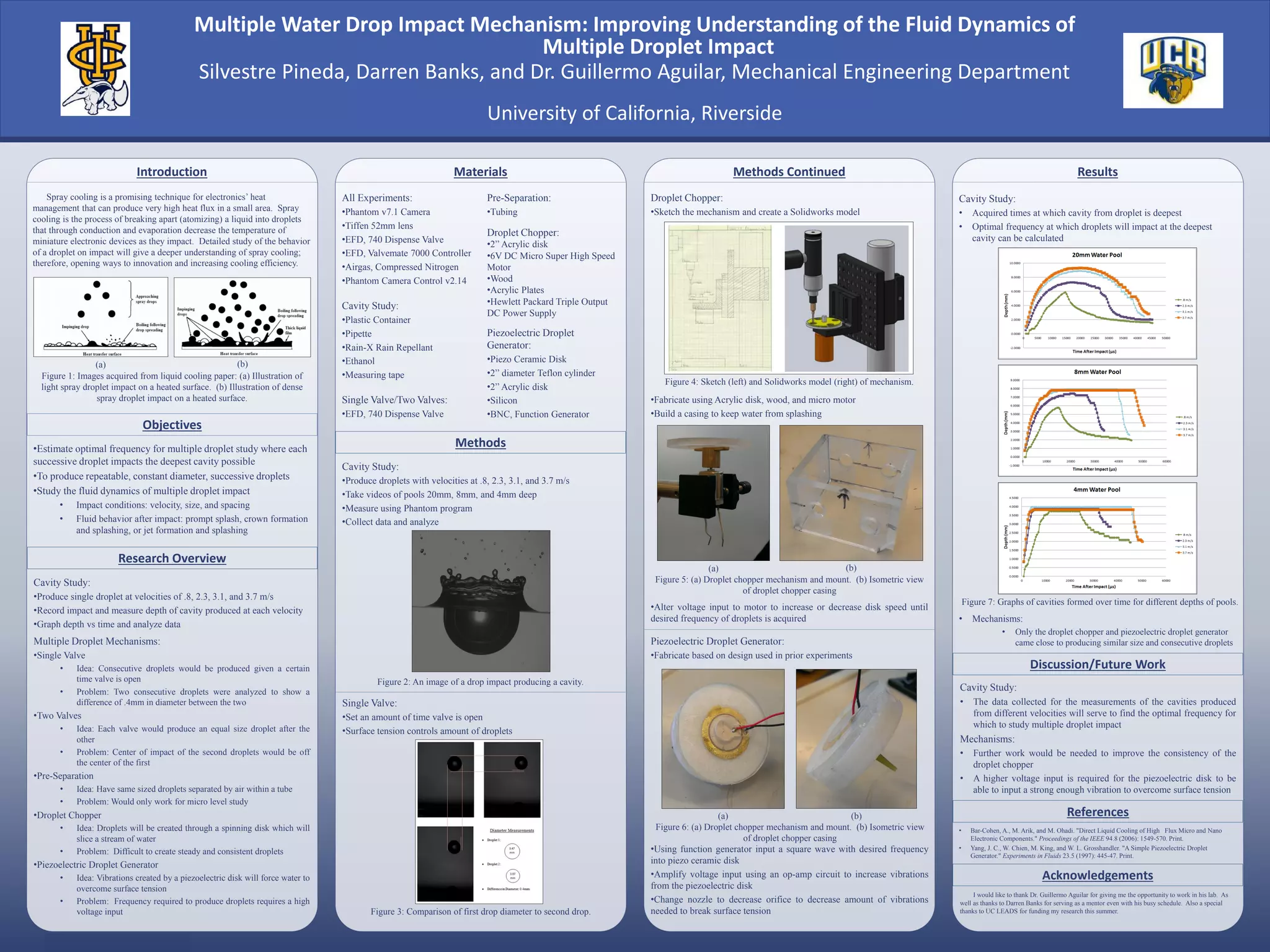
•Produce droplets with velocities at .8, 2.3, 3.1, and 3.7 m/s
•Take videos of pools 20mm, 8mm, and 4mm deep
•Measure using Phantom program
•Collect data and analyze
Objectives
Methods
University of California, Riverside
Silvestre Pineda, Darren Banks, and Dr. Guillermo Aguilar, Mechanical Engineering Department
Multiple Water Drop Impact Mechanism: Improving Understanding of the Fluid Dynamics of
Multiple Droplet Impact
Pre-Separation:
•Tubing
Droplet Chopper:
•2” Acrylic disk
•6V DC Micro Super High Speed
Motor
•Wood
•Acrylic Plates
•Hewlett Packard Triple Output
DC Power Supply
Piezoelectric Droplet
Generator:
•Piezo Ceramic Disk
•2” diameter Teflon cylinder
•2” Acrylic disk
•Silicon
•BNC, Function Generator
Discussion/Future Work
•Estimate optimal frequency for multiple droplet study where each
successive droplet impacts the deepest cavity possible
•To produce repeatable, constant diameter, successive droplets
•Study the fluid dynamics of multiple droplet impact
• Impact conditions: velocity, size, and spacing
• Fluid behavior after impact: prompt splash, crown formation
and splashing, or jet formation and splashing
Figure 2: An image of a drop impact producing a cavity.
Figure 4: Sketch (left) and Solidworks model (right) of mechanism.
Figure 3: Comparison of first drop diameter to second drop.
(a) (b)
Figure 5: (a) Droplet chopper mechanism and mount. (b) Isometric view
of droplet chopper casing
(a) (b)
Figure 6: (a) Droplet chopper mechanism and mount. (b) Isometric view
of droplet chopper casing
(a) (b)
Figure 1: Images acquired from liquid cooling paper: (a) Illustration of
light spray droplet impact on a heated surface. (b) Illustration of dense
spray droplet impact on a heated surface.
Figure 7: Graphs of cavities formed over time for different depths of pools.

Multiple Water Drop Impact Mechanism

  • 1.
    RESEARCH POSTER PRESENTATIONDESIGN © 2012 www.PosterPresentations.com Spray cooling is a promising technique for electronics’ heat management that can produce very high heat flux in a small area. Spray cooling is the process of breaking apart (atomizing) a liquid into droplets that through conduction and evaporation decrease the temperature of miniature electronic devices as they impact. Detailed study of the behavior of a droplet on impact will give a deeper understanding of spray cooling; therefore, opening ways to innovation and increasing cooling efficiency. Introduction Research Overview All Experiments: •Phantom v7.1 Camera •Tiffen 52mm lens •EFD, 740 Dispense Valve •EFD, Valvemate 7000 Controller •Airgas, Compressed Nitrogen •Phantom Camera Control v2.14 Cavity Study: •Plastic Container •Pipette •Rain-X Rain Repellant •Ethanol •Measuring tape Single Valve/Two Valves: •EFD, 740 Dispense Valve Materials Droplet Chopper: •Sketch the mechanism and create a Solidworks model •Fabricate using Acrylic disk, wood, and micro motor •Build a casing to keep water from splashing •Alter voltage input to motor to increase or decrease disk speed until desired frequency of droplets is acquired Methods Continued Results Cavity Study: • Acquired times at which cavity from droplet is deepest • Optimal frequency at which droplets will impact at the deepest cavity can be calculated • Mechanisms: • Only the droplet chopper and piezoelectric droplet generator came close to producing similar size and consecutive droplets References • Bar-Cohen, A., M. Arik, and M. Ohadi. "Direct Liquid Cooling of High Flux Micro and Nano Electronic Components." Proceedings of the IEEE 94.8 (2006): 1549-570. Print. • Yang, J. C., W. Chien, M. King, and W. L. Grosshandler. "A Simple Piezoelectric Droplet Generator." Experiments in Fluids 23.5 (1997): 445-47. Print. Acknowledgements I would like to thank Dr. Guillermo Aguilar for giving me the opportunity to work in his lab. As well as thanks to Darren Banks for serving as a mentor even with his busy schedule. Also a special thanks to UC LEADS for funding my research this summer. Cavity Study: •Produce single droplet at velocities of .8, 2.3, 3.1, and 3.7 m/s •Record impact and measure depth of cavity produced at each velocity •Graph depth vs time and analyze data Multiple Droplet Mechanisms: •Single Valve • Idea: Consecutive droplets would be produced given a certain time valve is open • Problem: Two consecutive droplets were analyzed to show a difference of .4mm in diameter between the two •Two Valves • Idea: Each valve would produce an equal size droplet after the other • Problem: Center of impact of the second droplets would be off the center of the first •Pre-Separation • Idea: Have same sized droplets separated by air within a tube • Problem: Would only work for micro level study •Droplet Chopper • Idea: Droplets will be created through a spinning disk which will slice a stream of water • Problem: Difficult to create steady and consistent droplets •Piezoelectric Droplet Generator • Idea: Vibrations created by a piezoelectric disk will force water to overcome surface tension • Problem: Frequency required to produce droplets requires a high voltage input Cavity Study: • The data collected for the measurements of the cavities produced from different velocities will serve to find the optimal frequency for which to study multiple droplet impact Mechanisms: • Further work would be needed to improve the consistency of the droplet chopper • A higher voltage input is required for the piezoelectric disk to be able to input a strong enough vibration to overcome surface tension Piezoelectric Droplet Generator: •Fabricate based on design used in prior experiments •Using function generator input a square wave with desired frequency into piezo ceramic disk •Amplify voltage input using an op-amp circuit to increase vibrations from the piezoelectric disk •Change nozzle to decrease orifice to decrease amount of vibrations needed to break surface tension Single Valve: •Set an amount of time valve is open •Surface tension controls amount of droplets Cavity Study: •Produce droplets with velocities at .8, 2.3, 3.1, and 3.7 m/s •Take videos of pools 20mm, 8mm, and 4mm deep •Measure using Phantom program •Collect data and analyze Objectives Methods University of California, Riverside Silvestre Pineda, Darren Banks, and Dr. Guillermo Aguilar, Mechanical Engineering Department Multiple Water Drop Impact Mechanism: Improving Understanding of the Fluid Dynamics of Multiple Droplet Impact Pre-Separation: •Tubing Droplet Chopper: •2” Acrylic disk •6V DC Micro Super High Speed Motor •Wood •Acrylic Plates •Hewlett Packard Triple Output DC Power Supply Piezoelectric Droplet Generator: •Piezo Ceramic Disk •2” diameter Teflon cylinder •2” Acrylic disk •Silicon •BNC, Function Generator Discussion/Future Work •Estimate optimal frequency for multiple droplet study where each successive droplet impacts the deepest cavity possible •To produce repeatable, constant diameter, successive droplets •Study the fluid dynamics of multiple droplet impact • Impact conditions: velocity, size, and spacing • Fluid behavior after impact: prompt splash, crown formation and splashing, or jet formation and splashing Figure 2: An image of a drop impact producing a cavity. Figure 4: Sketch (left) and Solidworks model (right) of mechanism. Figure 3: Comparison of first drop diameter to second drop. (a) (b) Figure 5: (a) Droplet chopper mechanism and mount. (b) Isometric view of droplet chopper casing (a) (b) Figure 6: (a) Droplet chopper mechanism and mount. (b) Isometric view of droplet chopper casing (a) (b) Figure 1: Images acquired from liquid cooling paper: (a) Illustration of light spray droplet impact on a heated surface. (b) Illustration of dense spray droplet impact on a heated surface. Figure 7: Graphs of cavities formed over time for different depths of pools.