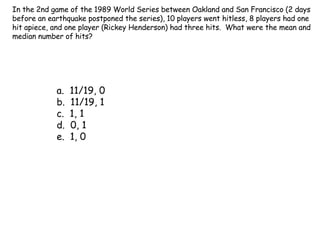
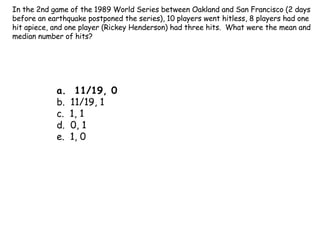
In the 2nd game of the 1989 World Series between Oakland and San Francisco (2 days before an earthquake postponed the series), 10 players went hitless, 8 players had one hit apiece, and one player (Rickey Henderson) had three hits.  What were the mean and median number of hits? a.  11/19, 0 b.  11/19, 1 c.  1, 1 d.  0, 1 e.  1, 0
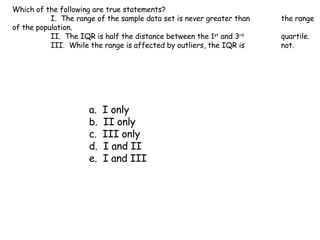
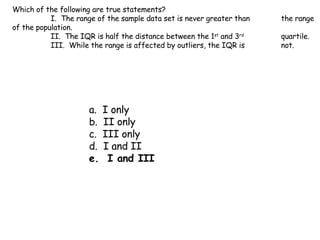
Which of the following are true statements? I.  The range of the sample data set is never greater than  the range of the population. II.  The IQR is half the distance between the 1 st  and 3 rd   quartile. III.  While the range is affected by outliers, the IQR is  not. a.  I only b.  II only c.  III only d.  I and II e.  I and III
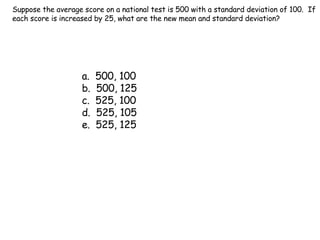
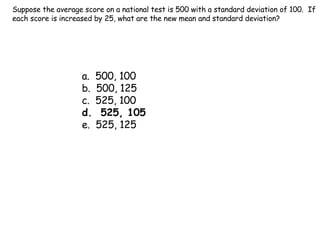
Suppose the average score on a national test is 500 with a standard deviation of 100.  If each score is increased by 25, what are the new mean and standard deviation? a.  500, 100 b.  500, 125 c.  525, 100 d.  525, 105 e.  525, 125
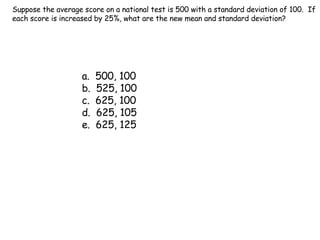
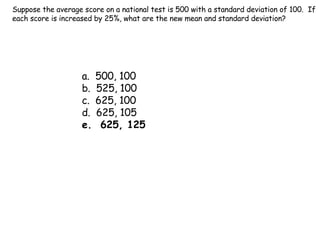
Suppose the average score on a national test is 500 with a standard deviation of 100.  If each score is increased by 25%, what are the new mean and standard deviation? a.  500, 100 b.  525, 100 c.  625, 100 d.  625, 105 e.  625, 125
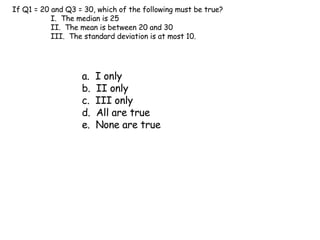
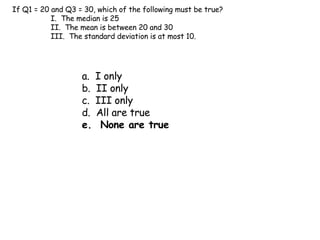
If Q1 = 20 and Q3 = 30, which of the following must be true? I.  The median is 25 II.  The mean is between 20 and 30 III.  The standard deviation is at most 10. a.  I only b.  II only c.  III only d.  All are true e.  None are true

Multiple Choice Review Questions Unit I AP Statistics

  • 1.
    In the 2ndgame of the 1989 World Series between Oakland and San Francisco (2 days before an earthquake postponed the series), 10 players went hitless, 8 players had one hit apiece, and one player (Rickey Henderson) had three hits. What were the mean and median number of hits? a. 11/19, 0 b. 11/19, 1 c. 1, 1 d. 0, 1 e. 1, 0
  • 2.
    In the 2ndgame of the 1989 World Series between Oakland and San Francisco (2 days before an earthquake postponed the series), 10 players went hitless, 8 players had one hit apiece, and one player (Rickey Henderson) had three hits. What were the mean and median number of hits? a. 11/19, 0 b. 11/19, 1 c. 1, 1 d. 0, 1 e. 1, 0
  • 3.
    Which of thefollowing are true statements? I. The range of the sample data set is never greater than the range of the population. II. The IQR is half the distance between the 1 st and 3 rd quartile. III. While the range is affected by outliers, the IQR is not. a. I only b. II only c. III only d. I and II e. I and III
  • 4.
    Which of thefollowing are true statements? I. The range of the sample data set is never greater than the range of the population. II. The IQR is half the distance between the 1 st and 3 rd quartile. III. While the range is affected by outliers, the IQR is not. a. I only b. II only c. III only d. I and II e. I and III
  • 5.
    Suppose the averagescore on a national test is 500 with a standard deviation of 100. If each score is increased by 25, what are the new mean and standard deviation? a. 500, 100 b. 500, 125 c. 525, 100 d. 525, 105 e. 525, 125
  • 6.
    Suppose the averagescore on a national test is 500 with a standard deviation of 100. If each score is increased by 25, what are the new mean and standard deviation? a. 500, 100 b. 500, 125 c. 525, 100 d. 525, 105 e. 525, 125
  • 7.
    Suppose the averagescore on a national test is 500 with a standard deviation of 100. If each score is increased by 25%, what are the new mean and standard deviation? a. 500, 100 b. 525, 100 c. 625, 100 d. 625, 105 e. 625, 125
  • 8.
    Suppose the averagescore on a national test is 500 with a standard deviation of 100. If each score is increased by 25%, what are the new mean and standard deviation? a. 500, 100 b. 525, 100 c. 625, 100 d. 625, 105 e. 625, 125
  • 9.
    If Q1 =20 and Q3 = 30, which of the following must be true? I. The median is 25 II. The mean is between 20 and 30 III. The standard deviation is at most 10. a. I only b. II only c. III only d. All are true e. None are true
  • 10.
    If Q1 =20 and Q3 = 30, which of the following must be true? I. The median is 25 II. The mean is between 20 and 30 III. The standard deviation is at most 10. a. I only b. II only c. III only d. All are true e. None are true