1
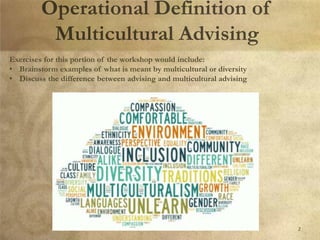
Exercises for this portion of the workshop would include:
• Brainstorm examples of what is meant by multicultural or diversity
• Discuss the difference between advising and multicultural advising
2
Diversity
Race/Ethnicity
Sexual
Orientation
Age
Ability
Socio-
economic
Status
Religion
Gender
Identity or
Expression
National
Origin
3
 cultural self-awareness
 culture –specific advising knowledge
 advising practice and action
 advocacy toward transformation
Source: D. Carroll, Multicultural Advising [E-book] (Chapter 2). Manhattan: Kansas State University. 4
What is culture?
5
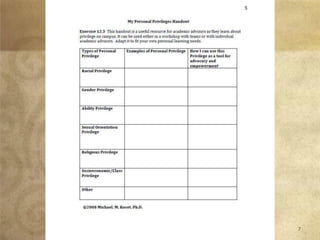
What are the benefits of being White?
6
7
"I was taught to see racism only in
individual acts of meanness, not in
invisible systems conferring dominance
on my group“
– Peggy McIntosh 8
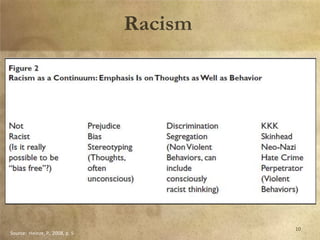
Not Racist Racist
9
Source: Heinze, P., 2008, p. 5
10
Conformity Stage  Minimal awareness of self as a racial being and limited knowledge of minority groups
 White culture is thought to be the most developed and all others are inferior
 Minority inferiority provides the justification for discriminatory practices
Dissonance Stage  Forced to deal with inconsistencies that have been compartmentalized
 May bring individuals face to face with their own prejudices and biases
 As a result of conflicts, may retreat to previous stage or move on to the next
Resistance and
Immersion Stage
 Realize what racism means
 Acknowledgement of White person’s own racism
 Conflicting feelings may produce a flight back to earlier stages or movement to the introspective stage
Introspection Stage  Compromise between the extremes of unconditional acceptance of White identity and the rejection of Whiteness
 Develops a searching, observing, and questioning attitude
Integrative
Awareness Stage
 Understanding of self as a racial/cultural being
 Awareness of sociopolitical influences with respect to racism
 Appreciation of racial/cultural diversity
 Increased commitment toward eradicating oppression
 Formation of nonracist White Euro-American identity emerges and becomes internalized
Source: Sue & Sue, 2008, 5-6.
Sue & Sue’s White Racial Identity Development Model
11
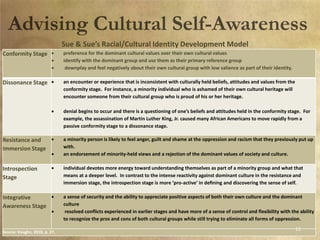
Conformity Stage  preference for the dominant cultural values over their own cultural values
 identify with the dominant group and use them as their primary reference group
 downplay and feel negatively about their own cultural group with low salience as part of their identity.
Dissonance Stage  an encounter or experience that is inconsistent with culturally held beliefs, attitudes and values from the
conformity stage. For instance, a minority individual who is ashamed of their own cultural heritage will
encounter someone from their cultural group who is proud of his or her heritage.
 denial begins to occur and there is a questioning of one’s beliefs and attitudes held in the conformity stage. For
example, the assassination of Martin Luther King, Jr. caused many African Americans to move rapidly from a
passive conformity stage to a dissonance stage.
Resistance and
Immersion Stage
 a minority person is likely to feel anger, guilt and shame at the oppression and racism that they previously put up
with.
 an endorsement of minority-held views and a rejection of the dominant values of society and culture.
Introspection
Stage
 individual devotes more energy toward understanding themselves as part of a minority group and what that
means at a deeper level. In contrast to the intense reactivity against dominant culture in the resistance and
immersion stage, the introspection stage is more ‘pro-active’ in defining and discovering the sense of self.
Integrative
Awareness Stage
 a sense of security and the ability to appreciate positive aspects of both their own culture and the dominant
culture
 resolved conflicts experienced in earlier stages and have more of a sense of control and flexibility with the ability
to recognize the pros and cons of both cultural groups while still trying to eliminate all forms of oppression.
Source: Vaughn, 2010, p. 27.
Sue & Sue’s Racial/Cultural Identity Development Model
12
Source: Huff, L., 2007.
13
Listening Empathically
Platinum Rule “Do unto others as they themselves would have done unto them.”
Milton Bennet’s (1998) model involves 6 steps:
1) assuming difference,
2) knowing self,
3) suspending self,
4) allowing guided imagination,
5) allowing empathic experience,
6) reestablishing self.
Source: Carlstrom, A., 2005
14
Focusing on Meaning
Focusing on meaning involves questioning
1) if we understood what the student meant to communicate, and
2) if we communicated what we meant for the student to understand.
Craig Storti’s (1994) 7 principles for approaching intercultural communication to guard against
misinterpretations:
• Do not assume sameness.
• What we think of as normal or human behavior may only be cultural.
• Familiar behaviors may have different meanings.
• Do not assume that what we meant is what was understood.
• Do not assume that what we understood is what was meant.
• We do not have to like or accept “different” behavior, but we may find it helpful to
understand where it comes from.
• Most people do behave rationally; we just have to discover the rationale. (Although it is
important to keep in mind that a preference for rationality can be a culturally bound
preference).
Source: Carlstrom, A., 2005
15
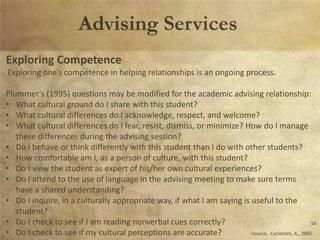
Exploring Competence
Exploring one’s competence in helping relationships is an ongoing process.
Plummer’s (1995) questions may be modified for the academic advising relationship:
• What cultural ground do I share with this student?
• What cultural differences do I acknowledge, respect, and welcome?
• What cultural differences do I fear, resist, dismiss, or minimize? How do I manage
these differences during the advising session?
• Do I behave or think differently with this student than I do with other students?
• How comfortable am I, as a person of culture, with this student?
• Do I view the student as expert of his/her own cultural experiences?
• Do I attend to the use of language in the advising meeting to make sure terms
have a shared understanding?
• Do I inquire, in a culturally appropriate way, if what I am saying is useful to the
student?
• Do I check to see if I am reading nonverbal cues correctly?
• Do I check to see if my cultural perceptions are accurate? Source: Carlstrom, A., 2005
16
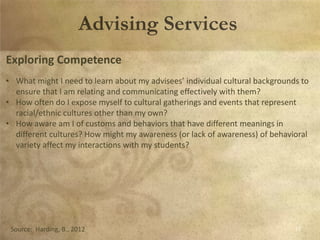
Exploring Competence
• What might I need to learn about my advisees’ individual cultural backgrounds to
ensure that I am relating and communicating effectively with them?
• How often do I expose myself to cultural gatherings and events that represent
racial/ethnic cultures other than my own?
• How aware am I of customs and behaviors that have different meanings in
different cultures? How might my awareness (or lack of awareness) of behavioral
variety affect my interactions with my students?
Source: Harding, B., 2012 17
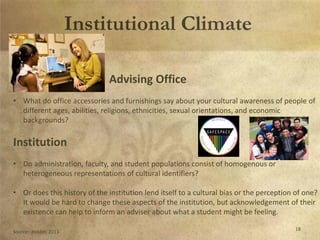
Advising Office
• What do office accessories and furnishings say about your cultural awareness of people of
different ages, abilities, religions, ethnicities, sexual orientations, and economic
backgrounds?
Institution
• Do administration, faculty, and student populations consist of homogenous or
heterogeneous representations of cultural identifiers?
• Or does this history of the institution lend itself to a cultural bias or the perception of one?
It would be hard to change these aspects of the institution, but acknowledgement of their
existence can help to inform an adviser about what a student might be feeling.
Source: Holder, 2013
18
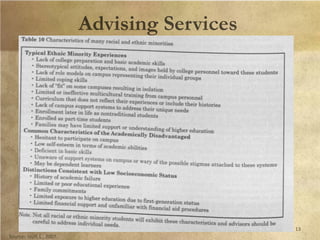
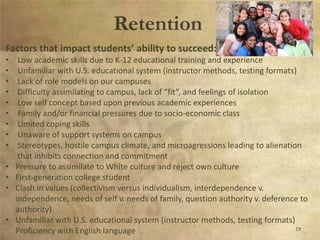
Factors that impact students’ ability to succeed:
• Low academic skills due to K-12 educational training and experience
• Unfamiliar with U.S. educational system (instructor methods, testing formats)
• Lack of role models on our campuses
• Difficulty assimilating to campus, lack of “fit”, and feelings of isolation
• Low self concept based upon previous academic experiences
• Family and/or financial pressures due to socio-economic class
• Limited coping skills
• Unaware of support systems on campus
• Stereotypes, hostile campus climate, and microagressions leading to alienation
that inhibits connection and commitment
• Pressure to assimilate to White culture and reject own culture
• First-generation college student
• Clash in values (collectivism versus individualism, interdependence v.
independence, needs of self v. needs of family, question authority v. deference to
authority)
• Unfamiliar with U.S. educational system (instructor methods, testing formats)
Proficiency with English language 19
“Advising is a key to student retention. The best way to keep
students enrolled is to keep them stimulated, challenged and
progressing toward a meaningful goal. The best way to do that--
especially among new students--is through informed academic
advising.”
Anderson, Edward 'Chip'.
20
Workshop Exercises would include:
• Divide into groups by department, brainstorm ways to increase diversity inclusiveness
in the curriculum and classroom
21
References
Anderson, E. (1997). National Academic Advising Association. Retrieved from Academic Advising for
student success and retention: http://www.nacada.ksu.edu/Resources/Clearinghouse/View-
Articles/Advising-and-Retention-Quotes.aspx#sthash.WWYlz2os.dpuf
Barber, L. (2012). A qualitative study of the multidimensional racial development among first year
African American college students attending a predominantly white institution. Journal of Negro
Education, 81 (1), 7-81.
Carlstrom, A. (2005, December). Preparing for multicultural advising relationships. Retrieved from
Academic Advising Today (28)4: https://www.nacada.ksu.edu/Resources/Academic-Advising-
Today/View-Articles/Preparing-for-Multicultural-Advising-Relationships.aspx
Carroll, D. (2014). What is Multicultural Advising. In D. Carroll, Multicultural Advising [E-book] (p.
Chapter 2). Manhattan: Kansas State University.
Core Values of Academic Advising. (2016, February). Retrieved from NACADA:
https://www.nacada.ksu.edu/Portals/0/Regional_Divisions/documents/Core%20values%20of%
20academic%20advising%20Statement%20Feb%202016.pdf
Cujet, M. (2010). Environmental Influences on College Culture. In M. H.-H. In M.J. Cuyjet,
Multiculturalism on Campus: Theory, Models, and Practices for Understanding Diversity and
Creating Inclusion (pp. 37-63). Sterling: Stylus.
Diversity Institute. (2016, April 16). Retrieved from College of Southern Maryland:
http://www.csmd.edu/community/institutes/diversity-institute/
Diversity Steering Plan, C. (2010). University of Maryland. Retrieved from Transforming Maryland:
Excellence in diversity and inclusion: https://issuu.com/umaryland/docs/22628
Gilbert, C. K. (2005). Improving Academic Advisor Preparation through Cultural Self-Awareness.
Academic Advising Today, Volume 28 Number 3.
Gordon, V. N. (2006). Career advising: an academic advisor's guide. San Francisco: John Wiley & Sons,
Inc.
Harding, B. (2012). Advising students of color. Retrieved from NACADA Clearinghouse of Academic
Advising Resources : http://www.nacada.ksu.edu/Resources/Clearinghouse/View-
Articles/Advising-students-of-color.aspx
Heinze, P. (2008). Let's Talk About Race Baby: How a White Professor Teaches White Students About
White Privilege & Racism. Multicultural Education. 16. No. 1 Fall 2008, 2-11.
Holder, C. (2013, September 27). Academic Advising in a Multicultural World. Retrieved from The
Mentor: An Academic Advising Journal: https://dus.psu.edu/mentor/2013/09/academic-
advising-multicultural-world/
Huff, L. &. (2007). Multiculturalism in an increasingly diverse academic world. In I. L. Jordan, Advising
Special Populations: Adult learners, community college students, LGBTQ students, multicultural
students, students on probation, undecided students. Monograph Series, No. 17 (pp. 105-115).
Manhattan: National Academic Advising Association.
Kenney, K., & Kenney, M. (2008). Racial/Cultural Identity Development in People of Color: Therapeutic
Implications. In D. Sue, & D. Sue, Counseling the Culturally Diverse 5th Edition (pp. 419-445).
Hoboken: John Wiley & Sons, Inc.
Lamont, B. (2005). East meets west - bridging the academic advising divide. Retrieved from NACADA
Clearinghouse of Academic Advising Resources - See more at:
http://www.nacada.ksu.edu/Resources/Clearinghouse/View-Articles/East-meets-West--
Bridging-the-advising-divide.aspx#sthash.e8YIaWwC.dpuf:
http://www.nacada.ksu.edu/Resources/Clearinghouse/View-Articles/East-meets-West--
Bridging-the-advising-divide.aspx
Martinez, M. &. (2004). Latinos at Community Colleges. New Directions for Student Services. No. 105, 51-
62.
Martiznez, M., & Fernandez, E. (2004). Latinos at Community Colleges. New Directions for Student
services. No. 105 (Spring), 51-62.
Moy, E. (2013). Asians on campus: understanding the Asian Americans' experience and struggles in
higher education (electronic thesis). Manhattan, Kansas.
Nutt, C. (2003). Academic Advising and Student Retention and Persistence. Retrieved from NACADA
Clearinghouse of Academic Advising Resources :
http://www.nacada.ksu.edu/tabid/3318/articleType/ArticleView/articleId/636/article.aspx
Quick Facts. (2016, April 10). Retrieved from College of Southern Maryland:
http://www.csmd.edu/about/quick-facts/index.html
Rankin, S. (2005). Campus Climates for Secual Minorities. New Directions for Student Services, No. 111,
17-23.
Renn, K. (2013, April 18). Supporting all students: Strategies for LGBT Success. Chet Peters Lecture
Series. Manhattan, Kansas.
Strategic Plan. (2016, April 10). Retrieved from College of Southern Maryland:
http://www.csmd.edu/about/strategic-plan/index.html
22
Sturzl-Forrest, S. (2012). Advising first year internation students. Helping First Semester International
Undergraduates Taxi to Academic Success. Retrieved from NACADA Clearinghouse of Academic
Advising Resources: https://www.nacada.ksu.edu/Resources/Clearinghouse/View-
Articles/Advising-first-year-international-students.aspx
Sue, D., & Sue, D. (2008). White Racial Identity Development. Therapeutic Implications. In D. Sue, & D.
Sue, Counseling the Culturally Diverse 4th Edition (pp. 203-228). New York: Wiley.
Tilford, g. (2000-2001). Multicultural Competency Development: Preparing Students to Live and Work in
a Diverse World. Retrieved from Kansas State University: http://tilford.k-
state.edu/resources/multicultural-competency-development.html
Torres, V., Reiser, A., LePeau, L., Davis, L., & Ruder, J. (2006). Case studies: A model of first generation
Latino/a College Students' approach to seeking academic information. NACADA Journal 26 (2),
65-70.
Vaughn, L. (2010). Psychology Culture: Thinking, Feeling, and Behaving in Global Contexts. New York:
Psychology Press.
23

Multicultural Advising Presentation

  • 1.
  • 2.
    Exercises for thisportion of the workshop would include: • Brainstorm examples of what is meant by multicultural or diversity • Discuss the difference between advising and multicultural advising 2
  • 3.
  • 4.
     cultural self-awareness culture –specific advising knowledge  advising practice and action  advocacy toward transformation Source: D. Carroll, Multicultural Advising [E-book] (Chapter 2). Manhattan: Kansas State University. 4
  • 5.
  • 6.
    What are thebenefits of being White? 6
  • 7.
  • 8.
    "I was taughtto see racism only in individual acts of meanness, not in invisible systems conferring dominance on my group“ – Peggy McIntosh 8
  • 9.
  • 10.
    Source: Heinze, P.,2008, p. 5 10
  • 11.
    Conformity Stage Minimal awareness of self as a racial being and limited knowledge of minority groups  White culture is thought to be the most developed and all others are inferior  Minority inferiority provides the justification for discriminatory practices Dissonance Stage  Forced to deal with inconsistencies that have been compartmentalized  May bring individuals face to face with their own prejudices and biases  As a result of conflicts, may retreat to previous stage or move on to the next Resistance and Immersion Stage  Realize what racism means  Acknowledgement of White person’s own racism  Conflicting feelings may produce a flight back to earlier stages or movement to the introspective stage Introspection Stage  Compromise between the extremes of unconditional acceptance of White identity and the rejection of Whiteness  Develops a searching, observing, and questioning attitude Integrative Awareness Stage  Understanding of self as a racial/cultural being  Awareness of sociopolitical influences with respect to racism  Appreciation of racial/cultural diversity  Increased commitment toward eradicating oppression  Formation of nonracist White Euro-American identity emerges and becomes internalized Source: Sue & Sue, 2008, 5-6. Sue & Sue’s White Racial Identity Development Model 11
  • 12.
    Conformity Stage preference for the dominant cultural values over their own cultural values  identify with the dominant group and use them as their primary reference group  downplay and feel negatively about their own cultural group with low salience as part of their identity. Dissonance Stage  an encounter or experience that is inconsistent with culturally held beliefs, attitudes and values from the conformity stage. For instance, a minority individual who is ashamed of their own cultural heritage will encounter someone from their cultural group who is proud of his or her heritage.  denial begins to occur and there is a questioning of one’s beliefs and attitudes held in the conformity stage. For example, the assassination of Martin Luther King, Jr. caused many African Americans to move rapidly from a passive conformity stage to a dissonance stage. Resistance and Immersion Stage  a minority person is likely to feel anger, guilt and shame at the oppression and racism that they previously put up with.  an endorsement of minority-held views and a rejection of the dominant values of society and culture. Introspection Stage  individual devotes more energy toward understanding themselves as part of a minority group and what that means at a deeper level. In contrast to the intense reactivity against dominant culture in the resistance and immersion stage, the introspection stage is more ‘pro-active’ in defining and discovering the sense of self. Integrative Awareness Stage  a sense of security and the ability to appreciate positive aspects of both their own culture and the dominant culture  resolved conflicts experienced in earlier stages and have more of a sense of control and flexibility with the ability to recognize the pros and cons of both cultural groups while still trying to eliminate all forms of oppression. Source: Vaughn, 2010, p. 27. Sue & Sue’s Racial/Cultural Identity Development Model 12
  • 13.
  • 14.
    Listening Empathically Platinum Rule“Do unto others as they themselves would have done unto them.” Milton Bennet’s (1998) model involves 6 steps: 1) assuming difference, 2) knowing self, 3) suspending self, 4) allowing guided imagination, 5) allowing empathic experience, 6) reestablishing self. Source: Carlstrom, A., 2005 14
  • 15.
    Focusing on Meaning Focusingon meaning involves questioning 1) if we understood what the student meant to communicate, and 2) if we communicated what we meant for the student to understand. Craig Storti’s (1994) 7 principles for approaching intercultural communication to guard against misinterpretations: • Do not assume sameness. • What we think of as normal or human behavior may only be cultural. • Familiar behaviors may have different meanings. • Do not assume that what we meant is what was understood. • Do not assume that what we understood is what was meant. • We do not have to like or accept “different” behavior, but we may find it helpful to understand where it comes from. • Most people do behave rationally; we just have to discover the rationale. (Although it is important to keep in mind that a preference for rationality can be a culturally bound preference). Source: Carlstrom, A., 2005 15
  • 16.
    Exploring Competence Exploring one’scompetence in helping relationships is an ongoing process. Plummer’s (1995) questions may be modified for the academic advising relationship: • What cultural ground do I share with this student? • What cultural differences do I acknowledge, respect, and welcome? • What cultural differences do I fear, resist, dismiss, or minimize? How do I manage these differences during the advising session? • Do I behave or think differently with this student than I do with other students? • How comfortable am I, as a person of culture, with this student? • Do I view the student as expert of his/her own cultural experiences? • Do I attend to the use of language in the advising meeting to make sure terms have a shared understanding? • Do I inquire, in a culturally appropriate way, if what I am saying is useful to the student? • Do I check to see if I am reading nonverbal cues correctly? • Do I check to see if my cultural perceptions are accurate? Source: Carlstrom, A., 2005 16
  • 17.
    Exploring Competence • Whatmight I need to learn about my advisees’ individual cultural backgrounds to ensure that I am relating and communicating effectively with them? • How often do I expose myself to cultural gatherings and events that represent racial/ethnic cultures other than my own? • How aware am I of customs and behaviors that have different meanings in different cultures? How might my awareness (or lack of awareness) of behavioral variety affect my interactions with my students? Source: Harding, B., 2012 17
  • 18.
    Advising Office • Whatdo office accessories and furnishings say about your cultural awareness of people of different ages, abilities, religions, ethnicities, sexual orientations, and economic backgrounds? Institution • Do administration, faculty, and student populations consist of homogenous or heterogeneous representations of cultural identifiers? • Or does this history of the institution lend itself to a cultural bias or the perception of one? It would be hard to change these aspects of the institution, but acknowledgement of their existence can help to inform an adviser about what a student might be feeling. Source: Holder, 2013 18
  • 19.
    Factors that impactstudents’ ability to succeed: • Low academic skills due to K-12 educational training and experience • Unfamiliar with U.S. educational system (instructor methods, testing formats) • Lack of role models on our campuses • Difficulty assimilating to campus, lack of “fit”, and feelings of isolation • Low self concept based upon previous academic experiences • Family and/or financial pressures due to socio-economic class • Limited coping skills • Unaware of support systems on campus • Stereotypes, hostile campus climate, and microagressions leading to alienation that inhibits connection and commitment • Pressure to assimilate to White culture and reject own culture • First-generation college student • Clash in values (collectivism versus individualism, interdependence v. independence, needs of self v. needs of family, question authority v. deference to authority) • Unfamiliar with U.S. educational system (instructor methods, testing formats) Proficiency with English language 19
  • 20.
    “Advising is akey to student retention. The best way to keep students enrolled is to keep them stimulated, challenged and progressing toward a meaningful goal. The best way to do that-- especially among new students--is through informed academic advising.” Anderson, Edward 'Chip'. 20
  • 21.
    Workshop Exercises wouldinclude: • Divide into groups by department, brainstorm ways to increase diversity inclusiveness in the curriculum and classroom 21
  • 22.
    References Anderson, E. (1997).National Academic Advising Association. Retrieved from Academic Advising for student success and retention: http://www.nacada.ksu.edu/Resources/Clearinghouse/View- Articles/Advising-and-Retention-Quotes.aspx#sthash.WWYlz2os.dpuf Barber, L. (2012). A qualitative study of the multidimensional racial development among first year African American college students attending a predominantly white institution. Journal of Negro Education, 81 (1), 7-81. Carlstrom, A. (2005, December). Preparing for multicultural advising relationships. Retrieved from Academic Advising Today (28)4: https://www.nacada.ksu.edu/Resources/Academic-Advising- Today/View-Articles/Preparing-for-Multicultural-Advising-Relationships.aspx Carroll, D. (2014). What is Multicultural Advising. In D. Carroll, Multicultural Advising [E-book] (p. Chapter 2). Manhattan: Kansas State University. Core Values of Academic Advising. (2016, February). Retrieved from NACADA: https://www.nacada.ksu.edu/Portals/0/Regional_Divisions/documents/Core%20values%20of% 20academic%20advising%20Statement%20Feb%202016.pdf Cujet, M. (2010). Environmental Influences on College Culture. In M. H.-H. In M.J. Cuyjet, Multiculturalism on Campus: Theory, Models, and Practices for Understanding Diversity and Creating Inclusion (pp. 37-63). Sterling: Stylus. Diversity Institute. (2016, April 16). Retrieved from College of Southern Maryland: http://www.csmd.edu/community/institutes/diversity-institute/ Diversity Steering Plan, C. (2010). University of Maryland. Retrieved from Transforming Maryland: Excellence in diversity and inclusion: https://issuu.com/umaryland/docs/22628 Gilbert, C. K. (2005). Improving Academic Advisor Preparation through Cultural Self-Awareness. Academic Advising Today, Volume 28 Number 3. Gordon, V. N. (2006). Career advising: an academic advisor's guide. San Francisco: John Wiley & Sons, Inc. Harding, B. (2012). Advising students of color. Retrieved from NACADA Clearinghouse of Academic Advising Resources : http://www.nacada.ksu.edu/Resources/Clearinghouse/View- Articles/Advising-students-of-color.aspx Heinze, P. (2008). Let's Talk About Race Baby: How a White Professor Teaches White Students About White Privilege & Racism. Multicultural Education. 16. No. 1 Fall 2008, 2-11. Holder, C. (2013, September 27). Academic Advising in a Multicultural World. Retrieved from The Mentor: An Academic Advising Journal: https://dus.psu.edu/mentor/2013/09/academic- advising-multicultural-world/ Huff, L. &. (2007). Multiculturalism in an increasingly diverse academic world. In I. L. Jordan, Advising Special Populations: Adult learners, community college students, LGBTQ students, multicultural students, students on probation, undecided students. Monograph Series, No. 17 (pp. 105-115). Manhattan: National Academic Advising Association. Kenney, K., & Kenney, M. (2008). Racial/Cultural Identity Development in People of Color: Therapeutic Implications. In D. Sue, & D. Sue, Counseling the Culturally Diverse 5th Edition (pp. 419-445). Hoboken: John Wiley & Sons, Inc. Lamont, B. (2005). East meets west - bridging the academic advising divide. Retrieved from NACADA Clearinghouse of Academic Advising Resources - See more at: http://www.nacada.ksu.edu/Resources/Clearinghouse/View-Articles/East-meets-West-- Bridging-the-advising-divide.aspx#sthash.e8YIaWwC.dpuf: http://www.nacada.ksu.edu/Resources/Clearinghouse/View-Articles/East-meets-West-- Bridging-the-advising-divide.aspx Martinez, M. &. (2004). Latinos at Community Colleges. New Directions for Student Services. No. 105, 51- 62. Martiznez, M., & Fernandez, E. (2004). Latinos at Community Colleges. New Directions for Student services. No. 105 (Spring), 51-62. Moy, E. (2013). Asians on campus: understanding the Asian Americans' experience and struggles in higher education (electronic thesis). Manhattan, Kansas. Nutt, C. (2003). Academic Advising and Student Retention and Persistence. Retrieved from NACADA Clearinghouse of Academic Advising Resources : http://www.nacada.ksu.edu/tabid/3318/articleType/ArticleView/articleId/636/article.aspx Quick Facts. (2016, April 10). Retrieved from College of Southern Maryland: http://www.csmd.edu/about/quick-facts/index.html Rankin, S. (2005). Campus Climates for Secual Minorities. New Directions for Student Services, No. 111, 17-23. Renn, K. (2013, April 18). Supporting all students: Strategies for LGBT Success. Chet Peters Lecture Series. Manhattan, Kansas. Strategic Plan. (2016, April 10). Retrieved from College of Southern Maryland: http://www.csmd.edu/about/strategic-plan/index.html 22
  • 23.
    Sturzl-Forrest, S. (2012).Advising first year internation students. Helping First Semester International Undergraduates Taxi to Academic Success. Retrieved from NACADA Clearinghouse of Academic Advising Resources: https://www.nacada.ksu.edu/Resources/Clearinghouse/View- Articles/Advising-first-year-international-students.aspx Sue, D., & Sue, D. (2008). White Racial Identity Development. Therapeutic Implications. In D. Sue, & D. Sue, Counseling the Culturally Diverse 4th Edition (pp. 203-228). New York: Wiley. Tilford, g. (2000-2001). Multicultural Competency Development: Preparing Students to Live and Work in a Diverse World. Retrieved from Kansas State University: http://tilford.k- state.edu/resources/multicultural-competency-development.html Torres, V., Reiser, A., LePeau, L., Davis, L., & Ruder, J. (2006). Case studies: A model of first generation Latino/a College Students' approach to seeking academic information. NACADA Journal 26 (2), 65-70. Vaughn, L. (2010). Psychology Culture: Thinking, Feeling, and Behaving in Global Contexts. New York: Psychology Press. 23