DEPARTMENT OF ENERGETICS
Numerical Heat Transfer
Multicomponent Mass Transfer:
Basic Physics and
Engineering Modeling
Pietro Asinari, PhD
Spring 2007, TOP – UIC Program: The Master of
Science Degree of the University of Illinois
at the ‘Politecnico di Torino’
NHT: Multicomponent Mass Transfer
Outline of this Section
2
• Multicomponent (or multi – species) fluid flows 🡪
heuristic vs. kinetic derivation
• Popular modeling approaches 🡪 Fick Model vs.
Maxwell – Stefan model
• Further extensions 🡪 simultaneous heat and
mass transfer; generalized driving force;
fluid flow in porous media (dusty gas model)
• Reactive mixture flows 🡪 combustion: laminar
reaction rates; effects due to turbulent
fluctuations; brief discussion of advanced
modeling issues
NHT: Multicomponent Mass Transfer
Fick Model
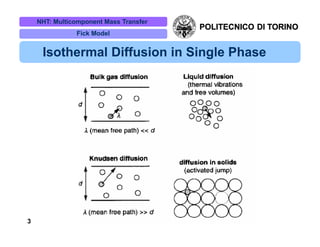
Isothermal Diffusion in Single Phase
3
NHT: Multicomponent Mass Transfer
Fick Model
Concentration Measures
Molar (or Number)
Density
Mixture (or Total)
Molar Density
Mole (or Volume) Fraction
of Species i-th
Mixture (or Total)
Density
Mass Fraction
of Species i-th
4
NHT: Multicomponent Mass Transfer
Fick Model
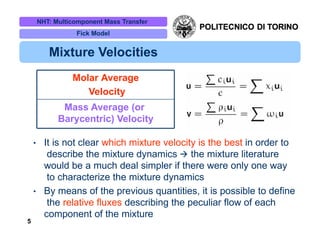
Mixture Velocities
Molar Average
Velocity
Mass Average (or
Barycentric) Velocity
• It is not clear which mixture velocity is the best in order to
describe the mixture dynamics 🡪 the mixture literature
would be a much deal simpler if there were only one way
to characterize the mixture dynamics
• By means of the previous quantities, it is possible to define
the relative fluxes describing the peculiar flow of each
component of the mixture
5
NHT: Multicomponent Mass Transfer
Fick Model
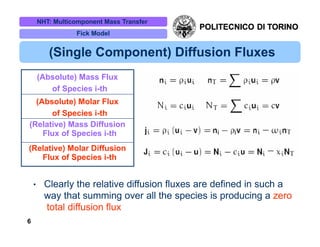
(Single Component) Diffusion Fluxes
(Absolute) Mass Flux
of Species i-th
(Absolute) Molar Flux
of Species i-th
(Relative) Mass Diffusion
Flux of Species i-th
(Relative) Molar Diffusion
Flux of Species i-th
• Clearly the relative diffusion fluxes are defined in such a
way that summing over all the species is producing a zero
total diffusion flux
6
NHT: Multicomponent Mass Transfer
Fick Model
Chemical Net Rates of Production
Molar Net Rate of
Production of Species i-th
Mass Net Rate of
Production of Species i-th
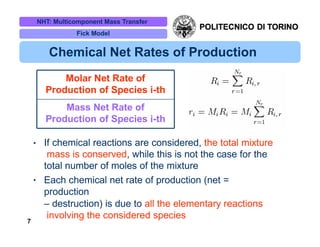
• If chemical reactions are considered, the total mixture
mass is conserved, while this is not the case for the
total number of moles of the mixture
• Each chemical net rate of production (net =
production
– destruction) is due to all the elementary reactions
involving the considered species
7
NHT: Multicomponent Mass Transfer
Fick Model
Equation of Change for Species Mass
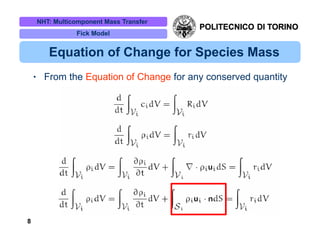
• From the Equation of Change for any conserved quantity
8
NHT: Multicomponent Mass Transfer
Fick Model
Species Transport Equation (STE)
• The previous equation is not closed 🡪 the mass diffusion
flux must be expressed as a function of the single species
concentrations, which are the actual additional unknowns
to be considered in mixture modeling 🡪 this relationship is
sometimes called phenomenological law (or model)
9
NHT: Multicomponent Mass Transfer
Fick Model
Equivalent Formulations of STE
• Equivalent formulations of STE can be derived 🡪 They
look similar each other if expressed in terms of single-
species quantities: however summing over all the mixture
components yields very different results !
10
NHT: Multicomponent Mass Transfer
Fick Model
Fick Model
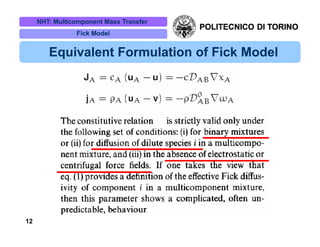
• It is a phenomenological model (or law) based on
experimental studies involving binary mixtures
• DAB and DBA are the Fick diffusion coefficients (it is
always better to refer the latter to the original models)
11
NHT: Multicomponent Mass Transfer
Fick Model
Equivalent Formulation of Fick Model
12
NHT: Multicomponent Mass Transfer
Fick Model
Centrifugal Separation
13
NHT: Multicomponent Mass Transfer
Fick Model
14
Linearized Theory
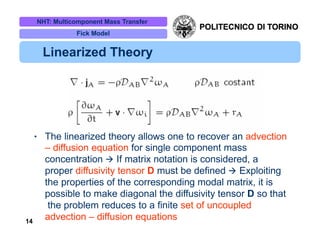
• The linearized theory allows one to recover an advection
– diffusion equation for single component mass
concentration 🡪 If matrix notation is considered, a
proper diffusivity tensor D must be defined 🡪 Exploiting
the properties of the corresponding modal matrix, it is
possible to make diagonal the diffusivity tensor D so that
the problem reduces to a finite set of uncoupled
advection – diffusion equations
NHT: Multicomponent Mass Transfer
Fick Model
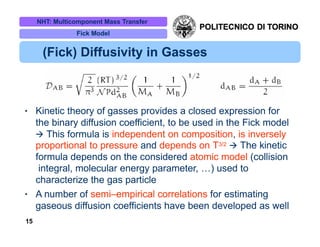
(Fick) Diffusivity in Gasses
• Kinetic theory of gasses provides a closed expression for
the binary diffusion coefficient, to be used in the Fick model
🡪 This formula is independent on composition, is inversely
proportional to pressure and depends on T3/2 🡪 The kinetic
formula depends on the considered atomic model (collision
integral, molecular energy parameter, …) used to
characterize the gas particle
• A number of semi–empirical correlations for estimating
gaseous diffusion coefficients have been developed as well
15
NHT: Multicomponent Mass Transfer
Fick Model
(Fick) Diffusivity in Liquids
• In case of infinite dilution and if the diffusing species is very
large compared to the solvent molecules, it is possible to
derive a purely theoretical method of estimating the binary
diffusivity (Stokes – Einstein formula) 🡪 However, the
diffusion coefficients in binary mixtures of real liquids can be
strong functions of composition
• Also in this case, a number of semi–empirical correlations
for estimating liquid diffusion coefficients have been
developed as well
16
NHT: Multicomponent Mass Transfer
Fick Model
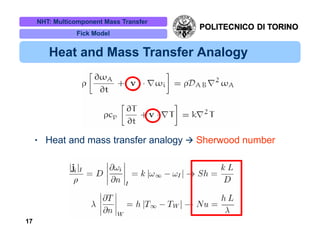
Heat and Mass Transfer Analogy
• Heat and mass transfer analogy 🡪 Sherwood number
17
NHT: Multicomponent Mass Transfer
Fick Model
Experimental Correlations
k v
h


D
Nu = h L /

= g (Re, Pr)
Re = v L /

Sh = k L / D
= f (Re, Sc)
= a Re1/2 Sc1/2
Sc =  /
D
18
Pr =  /

Le =  /
D
NHT: Multicomponent Mass Transfer
Maxwell – Stefan Model
(1) Duncan & Toor Experiment (1962)
19
NHT: Multicomponent Mass Transfer
Maxwell – Stefan Model
(1) Duncan & Toor Experiment: Why
20
NHT: Multicomponent Mass Transfer
Maxwell – Stefan Model
(2) Vinograd & McBain Experiment (1941)
21
NHT: Multicomponent Mass Transfer
Maxwell – Stefan Model
(2) Vinograd & McBain Experiment: Why
22
NHT: Multicomponent Mass Transfer
Maxwell – Stefan Model
Maxwell–Stefan (MF) for Binary Mixtures
R gas constant
23
NHT: Multicomponent Mass Transfer
Maxwell – Stefan Model
Maxwell–Stefan Diffusivity
24
NHT: Multicomponent Mass Transfer
Maxwell – Stefan Model
Maxwell–Stefan Consistency
• Consistency of Maxwell – Stefan model with Fick
model in case of binary mixture 🡪 x2 = 1 – x1
25
NHT: Multicomponent Mass Transfer
Maxwell – Stefan Model
MS for Multicomponent Mixtures
26
NHT: Multicomponent Mass Transfer
Maxwell – Stefan Model
Maxwell–Stefan vs. Fick Model
27
NHT: Multicomponent Mass Transfer
Maxwell – Stefan Model
Limiting Case: Solvent Species
28
NHT: Multicomponent Mass Transfer
Maxwell – Stefan Model
29
Limiting Case: Dilute Species
• This limiting case suggests an idea: it is possible to use
the simple Fick model by providing a proper
expression for the diffusivity in such a way to recover
the correct dynamics 🡪 effective diffusivity methods
NHT: Multicomponent Mass Transfer
Further Extensions: Heat & Mass Transfer
Heat 🡪 Mass Transfer
1
2
30
NHT: Multicomponent Mass Transfer
Further Extensions: Heat & Mass Transfer
Heat 🡪 Mass Transfer
3
31
NHT: Multicomponent Mass Transfer
Further Extensions: External Force
Generalized Driving Force
32
NHT: Multicomponent Mass Transfer
Further Extensions: External Force
Incorporating Mechanical Equilibrium
• Two important body forces:
– electrostatic potentials (ionic systems)
– centrifugal forces (centrifugal separation)
33
NHT: Multicomponent Mass Transfer
Further Extensions: Porous Media
Fluid Flow in Porous Media
• Sometimes it is convenient to model the fluid flow
through a porous medium by means of the average
flow properties and skipping the actual
microscopic details (homogenization problem) 🡪
Upscaling?
34
NHT: Multicomponent Mass Transfer
Further Extensions: Porous Media
Diffusion Mechanisms in Porous Media
35
NHT: Multicomponent Mass Transfer
Further Extensions: Porous Media
Electric Analogue Circuit
• Bulk and Knudsen diffusion mechanisms occur together
and it is better to take both mechanisms into account 🡪
the distinction between them depends only on the actual
size of the pores through which the mixture is flowing
36
NHT: Multicomponent Mass Transfer
Further Extensions: Porous Media
Dusty Gas Model
• Straightforward application of the Maxwell–Stefan
diffusion equations 🡪 let us consider the porous medium
(solid phase) as consisting of giant molecules (dust)
uniformly distributed in space
37
NHT: Multicomponent Mass Transfer
Further Extensions: Porous Media
Starting Equation of Dusty Gas Model
• The primed quantities appearing in the previous equation
refer now to the pseudo–mixture which includes the dust
molecules 🡪 the quantities of physical interest are those
which refer to the mixture only (free–gas) 🡪 some
simplifications must be considered
38
NHT: Multicomponent Mass Transfer
Further Extensions: Porous Media
Assumptions of Dusty Gas Model
• The dust concentration is spatially uniform
• The dust is motionless, so that Nn+1=0
• The molecular weight of the dust molecule is large
39
NHT: Multicomponent Mass Transfer
Further Extensions: Porous Media
Effective Diffusion Coefficients
• Effective binary pair diffusion coefficients
• Effective Knudsen coefficients
40

Multicomponent Separation process_art1_v1.5.pptx

  • 1.
    DEPARTMENT OF ENERGETICS NumericalHeat Transfer Multicomponent Mass Transfer: Basic Physics and Engineering Modeling Pietro Asinari, PhD Spring 2007, TOP – UIC Program: The Master of Science Degree of the University of Illinois at the ‘Politecnico di Torino’
  • 2.
    NHT: Multicomponent MassTransfer Outline of this Section 2 • Multicomponent (or multi – species) fluid flows 🡪 heuristic vs. kinetic derivation • Popular modeling approaches 🡪 Fick Model vs. Maxwell – Stefan model • Further extensions 🡪 simultaneous heat and mass transfer; generalized driving force; fluid flow in porous media (dusty gas model) • Reactive mixture flows 🡪 combustion: laminar reaction rates; effects due to turbulent fluctuations; brief discussion of advanced modeling issues
  • 3.
    NHT: Multicomponent MassTransfer Fick Model Isothermal Diffusion in Single Phase 3
  • 4.
    NHT: Multicomponent MassTransfer Fick Model Concentration Measures Molar (or Number) Density Mixture (or Total) Molar Density Mole (or Volume) Fraction of Species i-th Mixture (or Total) Density Mass Fraction of Species i-th 4
  • 5.
    NHT: Multicomponent MassTransfer Fick Model Mixture Velocities Molar Average Velocity Mass Average (or Barycentric) Velocity • It is not clear which mixture velocity is the best in order to describe the mixture dynamics 🡪 the mixture literature would be a much deal simpler if there were only one way to characterize the mixture dynamics • By means of the previous quantities, it is possible to define the relative fluxes describing the peculiar flow of each component of the mixture 5
  • 6.
    NHT: Multicomponent MassTransfer Fick Model (Single Component) Diffusion Fluxes (Absolute) Mass Flux of Species i-th (Absolute) Molar Flux of Species i-th (Relative) Mass Diffusion Flux of Species i-th (Relative) Molar Diffusion Flux of Species i-th • Clearly the relative diffusion fluxes are defined in such a way that summing over all the species is producing a zero total diffusion flux 6
  • 7.
    NHT: Multicomponent MassTransfer Fick Model Chemical Net Rates of Production Molar Net Rate of Production of Species i-th Mass Net Rate of Production of Species i-th • If chemical reactions are considered, the total mixture mass is conserved, while this is not the case for the total number of moles of the mixture • Each chemical net rate of production (net = production – destruction) is due to all the elementary reactions involving the considered species 7
  • 8.
    NHT: Multicomponent MassTransfer Fick Model Equation of Change for Species Mass • From the Equation of Change for any conserved quantity 8
  • 9.
    NHT: Multicomponent MassTransfer Fick Model Species Transport Equation (STE) • The previous equation is not closed 🡪 the mass diffusion flux must be expressed as a function of the single species concentrations, which are the actual additional unknowns to be considered in mixture modeling 🡪 this relationship is sometimes called phenomenological law (or model) 9
  • 10.
    NHT: Multicomponent MassTransfer Fick Model Equivalent Formulations of STE • Equivalent formulations of STE can be derived 🡪 They look similar each other if expressed in terms of single- species quantities: however summing over all the mixture components yields very different results ! 10
  • 11.
    NHT: Multicomponent MassTransfer Fick Model Fick Model • It is a phenomenological model (or law) based on experimental studies involving binary mixtures • DAB and DBA are the Fick diffusion coefficients (it is always better to refer the latter to the original models) 11
  • 12.
    NHT: Multicomponent MassTransfer Fick Model Equivalent Formulation of Fick Model 12
  • 13.
    NHT: Multicomponent MassTransfer Fick Model Centrifugal Separation 13
  • 14.
    NHT: Multicomponent MassTransfer Fick Model 14 Linearized Theory • The linearized theory allows one to recover an advection – diffusion equation for single component mass concentration 🡪 If matrix notation is considered, a proper diffusivity tensor D must be defined 🡪 Exploiting the properties of the corresponding modal matrix, it is possible to make diagonal the diffusivity tensor D so that the problem reduces to a finite set of uncoupled advection – diffusion equations
  • 15.
    NHT: Multicomponent MassTransfer Fick Model (Fick) Diffusivity in Gasses • Kinetic theory of gasses provides a closed expression for the binary diffusion coefficient, to be used in the Fick model 🡪 This formula is independent on composition, is inversely proportional to pressure and depends on T3/2 🡪 The kinetic formula depends on the considered atomic model (collision integral, molecular energy parameter, …) used to characterize the gas particle • A number of semi–empirical correlations for estimating gaseous diffusion coefficients have been developed as well 15
  • 16.
    NHT: Multicomponent MassTransfer Fick Model (Fick) Diffusivity in Liquids • In case of infinite dilution and if the diffusing species is very large compared to the solvent molecules, it is possible to derive a purely theoretical method of estimating the binary diffusivity (Stokes – Einstein formula) 🡪 However, the diffusion coefficients in binary mixtures of real liquids can be strong functions of composition • Also in this case, a number of semi–empirical correlations for estimating liquid diffusion coefficients have been developed as well 16
  • 17.
    NHT: Multicomponent MassTransfer Fick Model Heat and Mass Transfer Analogy • Heat and mass transfer analogy 🡪 Sherwood number 17
  • 18.
    NHT: Multicomponent MassTransfer Fick Model Experimental Correlations k v h   D Nu = h L /  = g (Re, Pr) Re = v L /  Sh = k L / D = f (Re, Sc) = a Re1/2 Sc1/2 Sc =  / D 18 Pr =  /  Le =  / D
  • 19.
    NHT: Multicomponent MassTransfer Maxwell – Stefan Model (1) Duncan & Toor Experiment (1962) 19
  • 20.
    NHT: Multicomponent MassTransfer Maxwell – Stefan Model (1) Duncan & Toor Experiment: Why 20
  • 21.
    NHT: Multicomponent MassTransfer Maxwell – Stefan Model (2) Vinograd & McBain Experiment (1941) 21
  • 22.
    NHT: Multicomponent MassTransfer Maxwell – Stefan Model (2) Vinograd & McBain Experiment: Why 22
  • 23.
    NHT: Multicomponent MassTransfer Maxwell – Stefan Model Maxwell–Stefan (MF) for Binary Mixtures R gas constant 23
  • 24.
    NHT: Multicomponent MassTransfer Maxwell – Stefan Model Maxwell–Stefan Diffusivity 24
  • 25.
    NHT: Multicomponent MassTransfer Maxwell – Stefan Model Maxwell–Stefan Consistency • Consistency of Maxwell – Stefan model with Fick model in case of binary mixture 🡪 x2 = 1 – x1 25
  • 26.
    NHT: Multicomponent MassTransfer Maxwell – Stefan Model MS for Multicomponent Mixtures 26
  • 27.
    NHT: Multicomponent MassTransfer Maxwell – Stefan Model Maxwell–Stefan vs. Fick Model 27
  • 28.
    NHT: Multicomponent MassTransfer Maxwell – Stefan Model Limiting Case: Solvent Species 28
  • 29.
    NHT: Multicomponent MassTransfer Maxwell – Stefan Model 29 Limiting Case: Dilute Species • This limiting case suggests an idea: it is possible to use the simple Fick model by providing a proper expression for the diffusivity in such a way to recover the correct dynamics 🡪 effective diffusivity methods
  • 30.
    NHT: Multicomponent MassTransfer Further Extensions: Heat & Mass Transfer Heat 🡪 Mass Transfer 1 2 30
  • 31.
    NHT: Multicomponent MassTransfer Further Extensions: Heat & Mass Transfer Heat 🡪 Mass Transfer 3 31
  • 32.
    NHT: Multicomponent MassTransfer Further Extensions: External Force Generalized Driving Force 32
  • 33.
    NHT: Multicomponent MassTransfer Further Extensions: External Force Incorporating Mechanical Equilibrium • Two important body forces: – electrostatic potentials (ionic systems) – centrifugal forces (centrifugal separation) 33
  • 34.
    NHT: Multicomponent MassTransfer Further Extensions: Porous Media Fluid Flow in Porous Media • Sometimes it is convenient to model the fluid flow through a porous medium by means of the average flow properties and skipping the actual microscopic details (homogenization problem) 🡪 Upscaling? 34
  • 35.
    NHT: Multicomponent MassTransfer Further Extensions: Porous Media Diffusion Mechanisms in Porous Media 35
  • 36.
    NHT: Multicomponent MassTransfer Further Extensions: Porous Media Electric Analogue Circuit • Bulk and Knudsen diffusion mechanisms occur together and it is better to take both mechanisms into account 🡪 the distinction between them depends only on the actual size of the pores through which the mixture is flowing 36
  • 37.
    NHT: Multicomponent MassTransfer Further Extensions: Porous Media Dusty Gas Model • Straightforward application of the Maxwell–Stefan diffusion equations 🡪 let us consider the porous medium (solid phase) as consisting of giant molecules (dust) uniformly distributed in space 37
  • 38.
    NHT: Multicomponent MassTransfer Further Extensions: Porous Media Starting Equation of Dusty Gas Model • The primed quantities appearing in the previous equation refer now to the pseudo–mixture which includes the dust molecules 🡪 the quantities of physical interest are those which refer to the mixture only (free–gas) 🡪 some simplifications must be considered 38
  • 39.
    NHT: Multicomponent MassTransfer Further Extensions: Porous Media Assumptions of Dusty Gas Model • The dust concentration is spatially uniform • The dust is motionless, so that Nn+1=0 • The molecular weight of the dust molecule is large 39
  • 40.
    NHT: Multicomponent MassTransfer Further Extensions: Porous Media Effective Diffusion Coefficients • Effective binary pair diffusion coefficients • Effective Knudsen coefficients 40