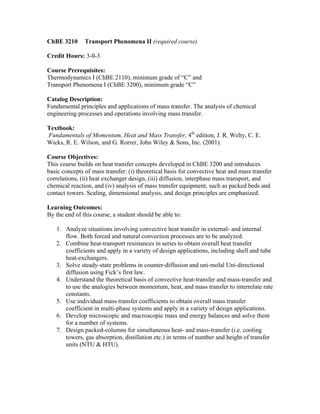
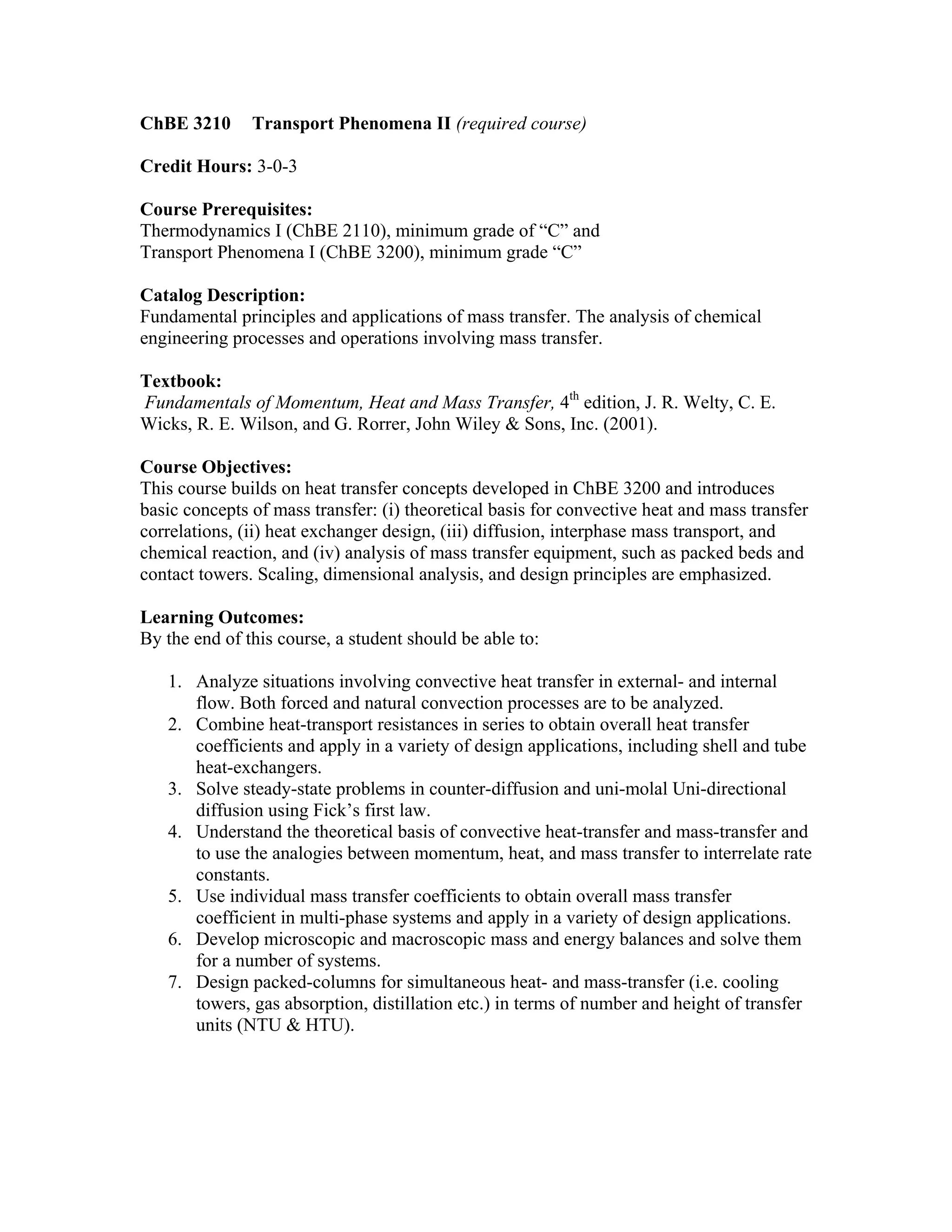
ChBE 3210 Transport Phenomena II (required course)
Credit Hours: 3-0-3
Course Prerequisites:
Thermodynamics I (ChBE 2110), minimum grade of “C” and
Transport Phenomena I (ChBE 3200), minimum grade “C”
Catalog Description:
Fundamental principles and applications of mass transfer. The analysis of chemical
engineering processes and operations involving mass transfer.
Textbook:
Fundamentals of Momentum, Heat and Mass Transfer, 4th
edition, J. R. Welty, C. E.
Wicks, R. E. Wilson, and G. Rorrer, John Wiley & Sons, Inc. (2001).
Course Objectives:
This course builds on heat transfer concepts developed in ChBE 3200 and introduces
basic concepts of mass transfer: (i) theoretical basis for convective heat and mass transfer
correlations, (ii) heat exchanger design, (iii) diffusion, interphase mass transport, and
chemical reaction, and (iv) analysis of mass transfer equipment, such as packed beds and
contact towers. Scaling, dimensional analysis, and design principles are emphasized.
Learning Outcomes:
By the end of this course, a student should be able to:
1. Analyze situations involving convective heat transfer in external- and internal
flow. Both forced and natural convection processes are to be analyzed.
2. Combine heat-transport resistances in series to obtain overall heat transfer
coefficients and apply in a variety of design applications, including shell and tube
heat-exchangers.
3. Solve steady-state problems in counter-diffusion and uni-molal Uni-directional
diffusion using Fick’s first law.
4. Understand the theoretical basis of convective heat-transfer and mass-transfer and
to use the analogies between momentum, heat, and mass transfer to interrelate rate
constants.
5. Use individual mass transfer coefficients to obtain overall mass transfer
coefficient in multi-phase systems and apply in a variety of design applications.
6. Develop microscopic and macroscopic mass and energy balances and solve them
for a number of systems.
7. Design packed-columns for simultaneous heat- and mass-transfer (i.e. cooling
towers, gas absorption, distillation etc.) in terms of number and height of transfer
units (NTU & HTU).
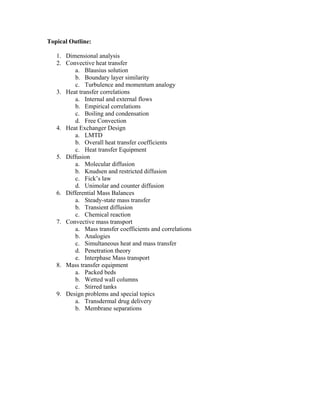
Topical Outline:
1. Dimensional analysis
2. Convective heat transfer
a. Blausius solution
b. Boundary layer similarity
c. Turbulence and momentum analogy
3. Heat transfer correlations
a. Internal and external flows
b. Empirical correlations
c. Boiling and condensation
d. Free Convection
4. Heat Exchanger Design
a. LMTD
b. Overall heat transfer coefficients
c. Heat transfer Equipment
5. Diffusion
a. Molecular diffusion
b. Knudsen and restricted diffusion
c. Fick’s law
d. Unimolar and counter diffusion
6. Differential Mass Balances
a. Steady-state mass transfer
b. Transient diffusion
c. Chemical reaction
7. Convective mass transport
a. Mass transfer coefficients and correlations
b. Analogies
c. Simultaneous heat and mass transfer
d. Penetration theory
e. Interphase Mass transport
8. Mass transfer equipment
a. Packed beds
b. Wetted wall columns
c. Stirred tanks
9. Design problems and special topics
a. Transdermal drug delivery
b. Membrane separations

3210.pdf

  • 1.
    ChBE 3210 TransportPhenomena II (required course) Credit Hours: 3-0-3 Course Prerequisites: Thermodynamics I (ChBE 2110), minimum grade of “C” and Transport Phenomena I (ChBE 3200), minimum grade “C” Catalog Description: Fundamental principles and applications of mass transfer. The analysis of chemical engineering processes and operations involving mass transfer. Textbook: Fundamentals of Momentum, Heat and Mass Transfer, 4th edition, J. R. Welty, C. E. Wicks, R. E. Wilson, and G. Rorrer, John Wiley & Sons, Inc. (2001). Course Objectives: This course builds on heat transfer concepts developed in ChBE 3200 and introduces basic concepts of mass transfer: (i) theoretical basis for convective heat and mass transfer correlations, (ii) heat exchanger design, (iii) diffusion, interphase mass transport, and chemical reaction, and (iv) analysis of mass transfer equipment, such as packed beds and contact towers. Scaling, dimensional analysis, and design principles are emphasized. Learning Outcomes: By the end of this course, a student should be able to: 1. Analyze situations involving convective heat transfer in external- and internal flow. Both forced and natural convection processes are to be analyzed. 2. Combine heat-transport resistances in series to obtain overall heat transfer coefficients and apply in a variety of design applications, including shell and tube heat-exchangers. 3. Solve steady-state problems in counter-diffusion and uni-molal Uni-directional diffusion using Fick’s first law. 4. Understand the theoretical basis of convective heat-transfer and mass-transfer and to use the analogies between momentum, heat, and mass transfer to interrelate rate constants. 5. Use individual mass transfer coefficients to obtain overall mass transfer coefficient in multi-phase systems and apply in a variety of design applications. 6. Develop microscopic and macroscopic mass and energy balances and solve them for a number of systems. 7. Design packed-columns for simultaneous heat- and mass-transfer (i.e. cooling towers, gas absorption, distillation etc.) in terms of number and height of transfer units (NTU & HTU).
  • 2.
    Topical Outline: 1. Dimensionalanalysis 2. Convective heat transfer a. Blausius solution b. Boundary layer similarity c. Turbulence and momentum analogy 3. Heat transfer correlations a. Internal and external flows b. Empirical correlations c. Boiling and condensation d. Free Convection 4. Heat Exchanger Design a. LMTD b. Overall heat transfer coefficients c. Heat transfer Equipment 5. Diffusion a. Molecular diffusion b. Knudsen and restricted diffusion c. Fick’s law d. Unimolar and counter diffusion 6. Differential Mass Balances a. Steady-state mass transfer b. Transient diffusion c. Chemical reaction 7. Convective mass transport a. Mass transfer coefficients and correlations b. Analogies c. Simultaneous heat and mass transfer d. Penetration theory e. Interphase Mass transport 8. Mass transfer equipment a. Packed beds b. Wetted wall columns c. Stirred tanks 9. Design problems and special topics a. Transdermal drug delivery b. Membrane separations