Introduction
Sentiment Analysis:
oSentiment analysis is the computational study of people's
opinions, feedbacks, attitudes, viewpoints and emotions towards
a particular product, issue, service or topic.[2].
o It is also known as Opinion Mining.
o Sentiment Analysis is the process of determining whether a piece
of writing is positive, negative or neutral.
06/02/25 3
4.
Sentiment analysisis a subfield of natural language processing (NLP) and data analysis
that involves determining the emotional tone behind a series of words. It aims to classify
the sentiment expressed in a piece of text or an image, categorizing it into positive,
negative, or neutral sentiments. This analysis helps organizations understand consumer
opinions, preferences, and trends related to their products or services.
Types of Sentiment Analysis
Text-Based Sentiment Analysis:
Description: Analyzes written content, such as reviews, social media posts, or customer feedback.
Methods:
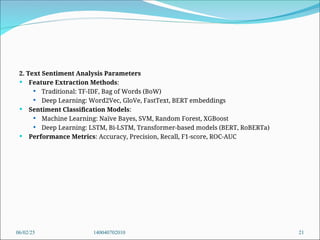
Rule-Based Approaches: Use predefined lists of words and rules to determine sentiment.
Machine Learning Approaches: Utilize algorithms (e.g., Naive Bayes, SVM) to classify sentiment
based on training data.
Deep Learning Approaches: Implement neural networks (e.g., LSTMs, Transformers) to capture
complex patterns in the text.
Applications: Used in monitoring brand reputation, analyzing customer feedback, and sentiment-driven
marketing strategies.
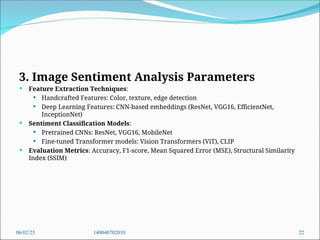
Image-Based Sentiment Analysis:
Description: Evaluates visual content to infer sentiment, often through facial expressions, visual cues, or
context.
Methods:
Computer Vision Techniques: Use image processing and analysis to detect features that indicate
sentiment.
Deep Learning Approaches: Employ Convolution Neural Networks (CNNs) to analyze images and
classify them based on emotional content.
Applications: Used in social media analysis, marketing campaigns, and understanding consumer reactions
to products through images.
06/02/25 140040702010 4
5.
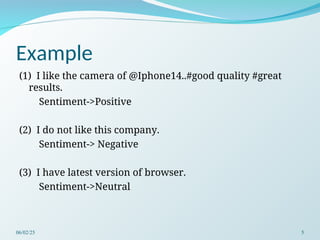
Example
(1) I likethe camera of @Iphone14..#good quality #great
results.
Sentiment->Positive
(2) I do not like this company.
Sentiment-> Negative
(3) I have latest version of browser.
Sentiment->Neutral
06/02/25 5
Objective
To createand assess machine learning models for sentiment
analysis based on products.
To explore the effectiveness of traditional ML algorithms (e.g.,
Naïve Bayes, SVM) and advanced deep learning techniques (e.g.,
LSTM, BERT)[11]
in classifying sentiments.
To address challenges such as handling slang, sarcasm, and
domain-specific terminology in customer reviews.
To provide actionable insights by visualizing sentiment
distribution across product categories.
06/02/25 8
9.
Motivation
Why Sentiment Analysis?
Getting opinion of people
Decision making process in business
Determine marketing strategy
Improve customer service
Improve product and profit making process
06/02/25 9
10.
Scope
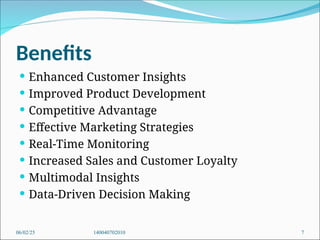
Researchers andBusiness managers are very interested to understand the
thoughts of people.
Organizations are adapting sentiment tool to improve their products and
services for marketing and ecommerce.
Sentiment analysis secures better targeted marketing, faster detection of
opportunities and threats and brand-reputation handling.
06/02/25 10
11.
Literature Review
Title ofResearch Paper Sentiment Analysis using Naive Bayes Algorithm[10]
Authors Prashantkumar Mishra, Sanjeev Anant Patil, Parvathi Aniyeri
Publication Year 2022
Published By IEEE, International Informatics and Software Engineering
Conference(IISEC)
Summary •This research uses a publicly available labelled dataset on
Kaggle.
•A comprehensive series of data cleaning and preparation
techniques are organized to progressively make the tweets more
comprehensible to typical language handling algorithms.
•The dataset is trained using the train test split model to run the
Nave Bayes model.
•The findings are plotted using a word cloud graphical format.
06/02/25 11
12.
Cont..
Title of ResearchPaper Sentiment Analysis with Machine Learning[13]
Authors M. Jagadeesan; T.M. Saravanan; P.A. Selvaraj; U. Asif Ali; J.
Arunsivaraj; S. Balasubramanian
Publication Year 2022
Published By IEEE,International Conference on Automation, Computing and
Renewable Systems (ICACRS)
Summary •The main purpose of the proposed model is to find the offensive
content in tweets.
•Sentiment analysis overcomes the Natural Language Processing
(NLP) challenge by using Machine Learning (ML) models to
perform classification, text mining, text analysis, data analysis,
and data visualization to identify positive and negative tweets.
•Logistic Regression and Support Vector Machine are used to
predict results with different levels of accuracy.
06/02/25 12
13.
Cont..
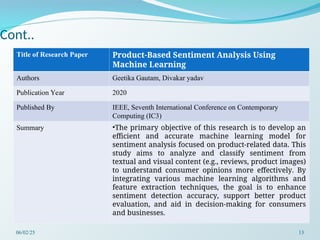
Title of ResearchPaper Product-Based Sentiment Analysis Using
Machine Learning
Authors Geetika Gautam, Divakar yadav
Publication Year 2020
Published By IEEE, Seventh International Conference on Contemporary
Computing (IC3)
Summary •The primary objective of this research is to develop an
efficient and accurate machine learning model for
sentiment analysis focused on product-related data. This
study aims to analyze and classify sentiment from
textual and visual content (e.g., reviews, product images)
to understand consumer opinions more effectively. By
integrating various machine learning algorithms and
feature extraction techniques, the goal is to enhance
sentiment detection accuracy, support better product
evaluation, and aid in decision-making for consumers
and businesses.
06/02/25 13
14.
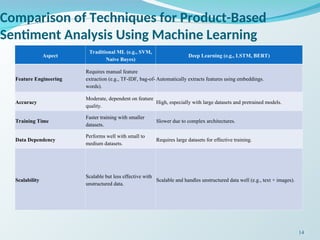
Comparison of Techniquesfor Product-Based
Sentiment Analysis Using Machine Learning
Aspect
Traditional ML (e.g., SVM,
Naive Bayes)
Deep Learning (e.g., LSTM, BERT)
Feature Engineering
Requires manual feature
extraction (e.g., TF-IDF, bag-of-
words).
Automatically extracts features using embeddings.
Accuracy
Moderate, dependent on feature
quality.
High, especially with large datasets and pretrained models.
Training Time
Faster training with smaller
datasets.
Slower due to complex architectures.
Data Dependency
Performs well with small to
medium datasets.
Requires large datasets for effective training.
Scalability
Scalable but less effective with
unstructured data.
Scalable and handles unstructured data well (e.g., text + images).
14
15.
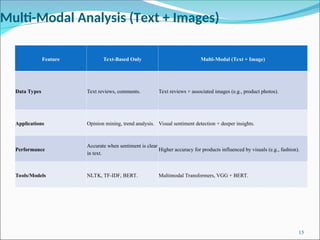
Multi-Modal Analysis (Text+ Images)
Feature Text-Based Only Multi-Modal (Text + Image)
Data Types Text reviews, comments. Text reviews + associated images (e.g., product photos).
Applications Opinion mining, trend analysis. Visual sentiment detection + deeper insights.
Performance
Accurate when sentiment is clear
in text.
Higher accuracy for products influenced by visuals (e.g., fashion).
Tools/Models NLTK, TF-IDF, BERT. Multimodal Transformers, VGG + BERT.
15
16.
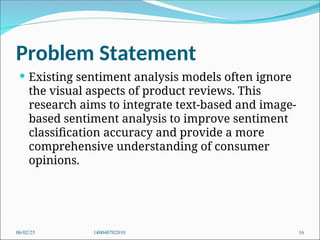
Problem Statement
Existingsentiment analysis models often ignore
the visual aspects of product reviews. This
research aims to integrate text-based and image-
based sentiment analysis to improve sentiment
classification accuracy and provide a more
comprehensive understanding of consumer
opinions.
06/02/25 140040702010 16
17.
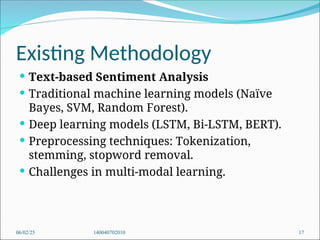
Existing Methodology
Text-basedSentiment Analysis
Traditional machine learning models (Naïve
Bayes, SVM, Random Forest).
Deep learning models (LSTM, Bi-LSTM, BERT).
Preprocessing techniques: Tokenization,
stemming, stopword removal.
Challenges in multi-modal learning.
06/02/25 140040702010 17
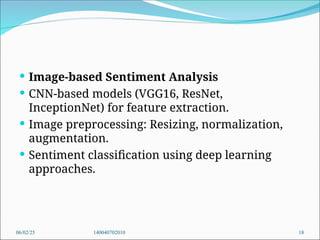
18.
Image-based SentimentAnalysis
CNN-based models (VGG16, ResNet,
InceptionNet) for feature extraction.
Image preprocessing: Resizing, normalization,
augmentation.
Sentiment classification using deep learning
approaches.
06/02/25 140040702010 18
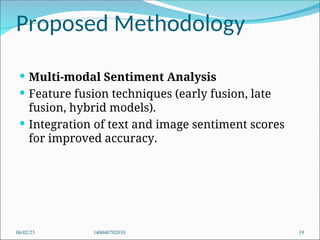
19.
Proposed Methodology
Multi-modalSentiment Analysis
Feature fusion techniques (early fusion, late
fusion, hybrid models).
Integration of text and image sentiment scores
for improved accuracy.
06/02/25 140040702010 19
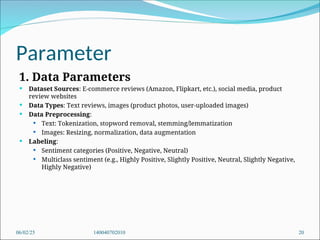
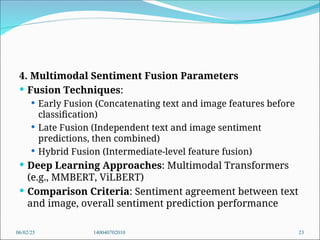
4. Multimodal SentimentFusion Parameters
Fusion Techniques:
Early Fusion (Concatenating text and image features before
classification)
Late Fusion (Independent text and image sentiment
predictions, then combined)
Hybrid Fusion (Intermediate-level feature fusion)
Deep Learning Approaches: Multimodal Transformers
(e.g., MMBERT, ViLBERT)
Comparison Criteria: Sentiment agreement between text
and image, overall sentiment prediction performance
06/02/25 140040702010 23
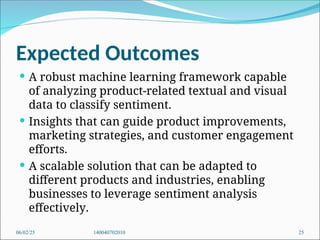
Expected Outcomes
Arobust machine learning framework capable
of analyzing product-related textual and visual
data to classify sentiment.
Insights that can guide product improvements,
marketing strategies, and customer engagement
efforts.
A scalable solution that can be adapted to
different products and industries, enabling
businesses to leverage sentiment analysis
effectively.
06/02/25 140040702010 25
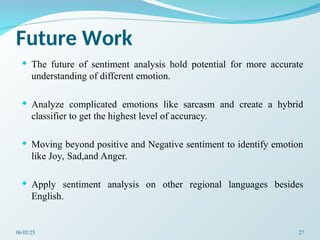
Future Work
Thefuture of sentiment analysis hold potential for more accurate
understanding of different emotion.
Analyze complicated emotions like sarcasm and create a hybrid
classifier to get the highest level of accuracy.
Moving beyond positive and Negative sentiment to identify emotion
like Joy, Sad,and Anger.
Apply sentiment analysis on other regional languages besides
English.
06/02/25 27
28.
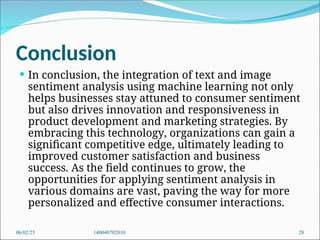
Conclusion
In conclusion,the integration of text and image
sentiment analysis using machine learning not only
helps businesses stay attuned to consumer sentiment
but also drives innovation and responsiveness in
product development and marketing strategies. By
embracing this technology, organizations can gain a
significant competitive edge, ultimately leading to
improved customer satisfaction and business
success. As the field continues to grow, the
opportunities for applying sentiment analysis in
various domains are vast, paving the way for more
personalized and effective consumer interactions.
06/02/25 140040702010 28
29.
References
[1] Dr. ZubairKhan, Ashish Kumar, Sunny Kumar, “A Survey of
Data Mining: Concepts with Applications and its Future
Scope”, International Journal of Computer Science Trends and
Technology (IJCST), Volume 2, Issue 3, May-Jun 2020.
[2] Vidisha M. Pradhan, Jay Vala, Prem Balani, “A Survey on
Sentiment Analysis Algorithms for Opinion Mining”, International
Journal of Computer Applications, Volume 133-No.9, January 2019.
[3] Vishal A. Kharde, S.S. Sonawane, “Sentiment Analysis of Twitter
Data: A Survey of Techniques”, International Journal of
Computer Applications, Volume 139-No.11, April 2022.
[4] Mohini Chaudhari, Sharvari Govilkar, “A Survey of
Machine Learning techniques for Sentiment
Classification”, International Journal on Computational Science &
Applications (IJCSA), Volume 5, No.3, June 2021.
06/02/25 29
30.
[5] Karan Diware,Vikram Rajpurohit, Nikit Kale, Swati Ringe, “Data
Mining and Text Analysis of Twitter Data”, International Journal
of Advance Research In Computer Science and Software
Engineering, Volume 6, Issue 2, February 2021.
[6] Ana C.E.S Lima, Leandro N. de Castro, “Automatic sentiment
analysis of twitter messages”, IEEE, pages 1-7,2020.
[7] Purva Mestry, Shruti Joshi, Sonal Mehta, Ashwini Save,
“A Survey on Twitter Sentiment Analysis with Various Algorithms”,
International Journal of Compute Applications, 2022.
[8] Raisa Varghese, Jayasree M, “A Survey on Sentiment Analysis
and Opinion Mining”, International Journal of Research in
Engineering and Technology (IJRET), Volume 2, 2021.
06/02/25 30

![Introduction
Sentiment Analysis:
o Sentiment analysis is the computational study of people's
opinions, feedbacks, attitudes, viewpoints and emotions towards
a particular product, issue, service or topic.[2].
o It is also known as Opinion Mining.
o Sentiment Analysis is the process of determining whether a piece
of writing is positive, negative or neutral.
06/02/25 3](https://image.slidesharecdn.com/mukeshjoshiyarafinal-250602164405-2d04da99/85/Mukesh-Joshiyara_xnffhhhhhhhhhhhhhhhhhhh-3-320.jpg)
![Cont..
Table 1. Sample of Emotions used [6]
06/02/25 6
Emotion Feeling Sentiment
: ) Happy Positive
: ( Sad Negative
: | Straight Face Neutral
:<D Horror Negative
xD laughing Positive](https://image.slidesharecdn.com/mukeshjoshiyarafinal-250602164405-2d04da99/85/Mukesh-Joshiyara_xnffhhhhhhhhhhhhhhhhhhh-6-320.jpg)
![Objective
To create and assess machine learning models for sentiment
analysis based on products.
To explore the effectiveness of traditional ML algorithms (e.g.,
Naïve Bayes, SVM) and advanced deep learning techniques (e.g.,
LSTM, BERT)[11]
in classifying sentiments.
To address challenges such as handling slang, sarcasm, and
domain-specific terminology in customer reviews.
To provide actionable insights by visualizing sentiment
distribution across product categories.
06/02/25 8](https://image.slidesharecdn.com/mukeshjoshiyarafinal-250602164405-2d04da99/85/Mukesh-Joshiyara_xnffhhhhhhhhhhhhhhhhhhh-8-320.jpg)
![Literature Review
Title of Research Paper Sentiment Analysis using Naive Bayes Algorithm[10]
Authors Prashantkumar Mishra, Sanjeev Anant Patil, Parvathi Aniyeri
Publication Year 2022
Published By IEEE, International Informatics and Software Engineering
Conference(IISEC)
Summary •This research uses a publicly available labelled dataset on
Kaggle.
•A comprehensive series of data cleaning and preparation
techniques are organized to progressively make the tweets more
comprehensible to typical language handling algorithms.
•The dataset is trained using the train test split model to run the
Nave Bayes model.
•The findings are plotted using a word cloud graphical format.
06/02/25 11](https://image.slidesharecdn.com/mukeshjoshiyarafinal-250602164405-2d04da99/85/Mukesh-Joshiyara_xnffhhhhhhhhhhhhhhhhhhh-11-320.jpg)
![Cont..
Title of Research Paper Sentiment Analysis with Machine Learning[13]
Authors M. Jagadeesan; T.M. Saravanan; P.A. Selvaraj; U. Asif Ali; J.
Arunsivaraj; S. Balasubramanian
Publication Year 2022
Published By IEEE,International Conference on Automation, Computing and
Renewable Systems (ICACRS)
Summary •The main purpose of the proposed model is to find the offensive
content in tweets.
•Sentiment analysis overcomes the Natural Language Processing
(NLP) challenge by using Machine Learning (ML) models to
perform classification, text mining, text analysis, data analysis,
and data visualization to identify positive and negative tweets.
•Logistic Regression and Support Vector Machine are used to
predict results with different levels of accuracy.
06/02/25 12](https://image.slidesharecdn.com/mukeshjoshiyarafinal-250602164405-2d04da99/85/Mukesh-Joshiyara_xnffhhhhhhhhhhhhhhhhhhh-12-320.jpg)
![Sentiment Classification
Techniques
06/02/25 24
Fig.1 Sentiment classification techniques[7]](https://image.slidesharecdn.com/mukeshjoshiyarafinal-250602164405-2d04da99/85/Mukesh-Joshiyara_xnffhhhhhhhhhhhhhhhhhhh-24-320.jpg)
![References
[1] Dr. Zubair Khan, Ashish Kumar, Sunny Kumar, “A Survey of
Data Mining: Concepts with Applications and its Future
Scope”, International Journal of Computer Science Trends and
Technology (IJCST), Volume 2, Issue 3, May-Jun 2020.
[2] Vidisha M. Pradhan, Jay Vala, Prem Balani, “A Survey on
Sentiment Analysis Algorithms for Opinion Mining”, International
Journal of Computer Applications, Volume 133-No.9, January 2019.
[3] Vishal A. Kharde, S.S. Sonawane, “Sentiment Analysis of Twitter
Data: A Survey of Techniques”, International Journal of
Computer Applications, Volume 139-No.11, April 2022.
[4] Mohini Chaudhari, Sharvari Govilkar, “A Survey of
Machine Learning techniques for Sentiment
Classification”, International Journal on Computational Science &
Applications (IJCSA), Volume 5, No.3, June 2021.
06/02/25 29](https://image.slidesharecdn.com/mukeshjoshiyarafinal-250602164405-2d04da99/85/Mukesh-Joshiyara_xnffhhhhhhhhhhhhhhhhhhh-29-320.jpg)
![[5] Karan Diware, Vikram Rajpurohit, Nikit Kale, Swati Ringe, “Data
Mining and Text Analysis of Twitter Data”, International Journal
of Advance Research In Computer Science and Software
Engineering, Volume 6, Issue 2, February 2021.
[6] Ana C.E.S Lima, Leandro N. de Castro, “Automatic sentiment
analysis of twitter messages”, IEEE, pages 1-7,2020.
[7] Purva Mestry, Shruti Joshi, Sonal Mehta, Ashwini Save,
“A Survey on Twitter Sentiment Analysis with Various Algorithms”,
International Journal of Compute Applications, 2022.
[8] Raisa Varghese, Jayasree M, “A Survey on Sentiment Analysis
and Opinion Mining”, International Journal of Research in
Engineering and Technology (IJRET), Volume 2, 2021.
06/02/25 30](https://image.slidesharecdn.com/mukeshjoshiyarafinal-250602164405-2d04da99/85/Mukesh-Joshiyara_xnffhhhhhhhhhhhhhhhhhhh-30-320.jpg)