Conceptual Framework
           Multi-Stakeholder Partnerships (MSPs) in Development Sector
Background
The concept of development has undergone a major theoretical shift from top down
advocacy by classical Western economists who equated it with economic growth,
industrialization and capital formation to the ones that took into account general well
being of people, improvement in their quality of life (UNDP) and widening of their
choices (Amartya Sen). These approaches also severed ‘development’s association
exclusively with economic growth and capital formation; and poverty came to be defined
not merely as denial of access to resources, but also as denial of access to ‘information' or
‘knowledge’, which is increasingly being regarded as indispensable for development.
“International institutions, country donors and the broader development community are
rapidly coming to the conclusion that knowledge is central to development - that
knowledge is development” (World Development Report, World Bank, 1998).
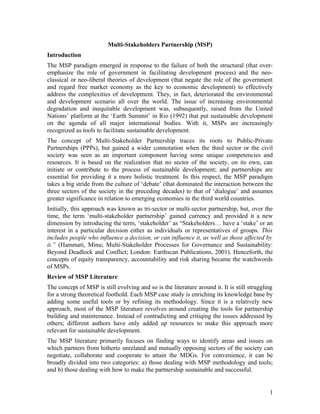
The MSP paradigm emerged in response to the failure of both the structural (that over-
emphasize the role of government in facilitating development process) and the neo-
classical or neo-liberal theories of development (that negate the role of the government
and regard free market economy as the key to economic development) to effectively
address the complexities of development. The issue of increasing environmental
degradation and inequitable development was, subsequently, raised from the United
Nations’ platform at the ‘Earth Summit’ in Rio (1992) that put sustainable development
on the agenda of all major international bodies. With it, MSPs are increasingly
recognized as tools to facilitate sustainable development.
The concept of Multi-Stakeholder Partnership traces its roots to Public-Private
Partnerships (PPPs), but gained a wider connotation when the third sector or the civil
society was seen as an important component having some unique competencies and
resources. It is based on the realization that no sector of the society, on its own, can
initiate or contribute to the process of sustainable development; and partnerships are
essential for providing it a more holistic treatment. In this respect, the MSP paradigm
takes a big stride from the culture of ‘debate’ (that dominated the interaction between the
three sectors of the society in the preceding decades) to that of ‘dialogue’ and assumes
greater significance in relation to emerging economies in the third world countries.
Initially, this approach was known as tri-sector or multi-sector partnership, but, over the
time, the term ‘multi-stakeholder partnership’ gained currency and provided it a new
dimension by introducing the term, ‘stakeholder’ as “Stakeholders… have a ‘stake’ or an
interest in a particular decision either as individuals or representatives of groups. This
includes people who influence a decision, or can influence it, as well as those affected by
it.” (Hammati, Minu; Multi-Stakeholder Processes for Governance and Sustainability:
Beyond Deadlock and Conflict; London: Earthscan Publications, 2001). Henceforth, the
concepts of equity transparency, accountability and risk sharing became the watchwords
of MSPs.
Review of MSP Literature


                                                                                           1
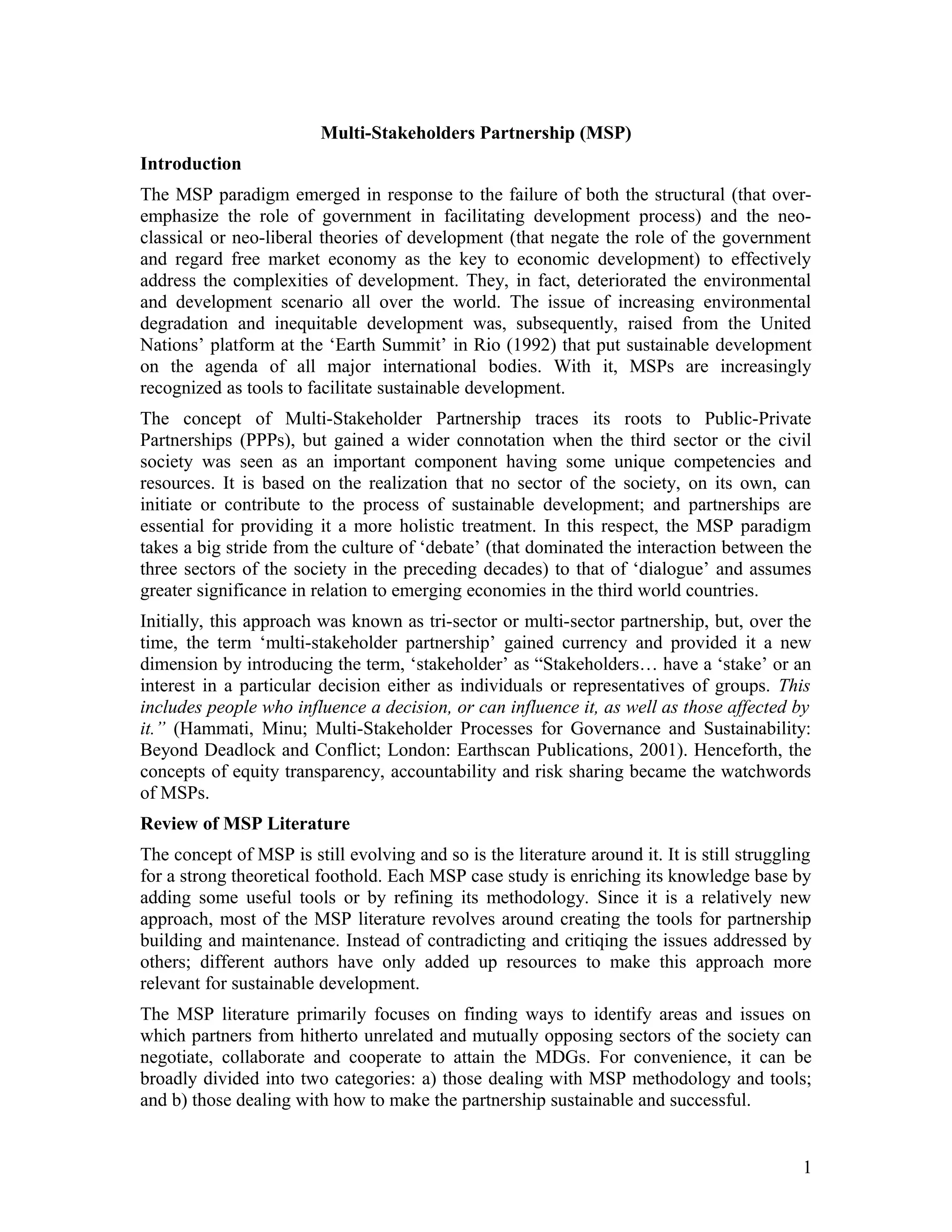
The concept of MSP is still evolving and so is the literature around it. It is still struggling
for a strong theoretical foothold. Each MSP case study is enriching its knowledge base by
adding some useful tools or by refining its methodology. Since it is a relatively new
approach, most of the MSP literature revolves around creating the tools for partnership
building and maintenance. Instead of contradicting and critiqing the issues addressed by
others; different authors have only added up resources to make this approach more
relevant for sustainable development.
The MSP literature primarily focuses on finding ways to identify areas and issues on
which partners from hitherto unrelated and mutually opposing sectors of the society can
negotiate, collaborate and cooperate to attain the MDGs. For convenience, it can be
broadly divided into two categories: a) those dealing with MSP methodology and tools;
and b) those dealing with how to make the partnership sustainable and successful.
In the latter context, several authors have attempted to analyze the role of ‘broker’, ‘third
party facilitator’ or ‘leader’ in tri-sector partnerships. In “The Guiding Hand”, Ros
Tennyson and Luke Wilde find the role of the ‘broker’ indispensable for facilitating
partnerships. He carries the responsibility of building and continuing a successful
partnership till its objectives are met. They have identified seven stages of partnership
building. The broker plays an important role throughout this process till the partners start
thinking in terms of institutionalizing or sustaining the partnership.
The same argument is put forward by Michael Warner in his short novel, “The New
Broker”, where MSP is explained from the private/business perspective. He uses the
narrative format to discuss how MSPs can be effectively used to add value to the
development programmes of the private sector, what are the major constraints to the
partnership building process and how these could be resolved through the mediation of a
‘third party facilitator’.
Minu Hammati’s book, “Multi-Stakeholder Processes for Governance and Sustainability:
Beyond Deadlock and Conflict”, views the MSP paradigm as a major shift from formal
discussions on development issues to actual action or implementation of programs.
Taking an eclectic approach to understand MSP, it discusses the ‘building blocks’ that are
essential for its sustenance in different situations/contexts. Partnership building
progresses through five stages- context, framing, inputs, dialogues/meetings and output.
In a similar vein, “The Partnering Tool Book” by Ros Tennyson analyses all aspects of
partnership building after establishing the rationale for using this approach.
The idea of MSP finds a concrete shape in the issue paper prepared by the “Overseas
Development Institute” and the “Foundation for Development Cooperation” that focuses
on each aspect of such partnerships in great detail. With reference to MSP case studies
carried out in different parts of the world under different socio-cultural and geographical
contexts, it analyses its relevance for the business, government and civil society; their
role in the partnership; and the resources, skills and competencies contributed by them to
make it successful.
From these studies, it can be surmised that there is no ideal model of MSP that can
address any situational or contextual demands. It is not a panacea for all problems, but in
certain conditions, it can be applied very effectively. The MSPs vary from each other in
terms of the issues they have taken up, their objectives, scope or scale and their time


                                                                                             2
frames. So, on the one hand, there are international MSP forums like the ones initiated by
the GKP and the World Bank (Business Partners for Development Program) while, on the
other, there are short term, localized MSPs like the Ericsson Response to disaster
management. The MSP case studies undertaken in different parts of the world suggest
that this approach is resilient enough to suit different situational and contextual demands.
Still, there are certain parameters or indicators that ought to be present to classify any
study as a MSP.
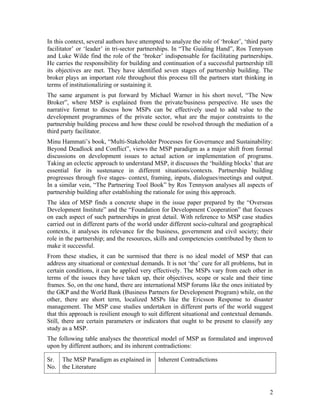
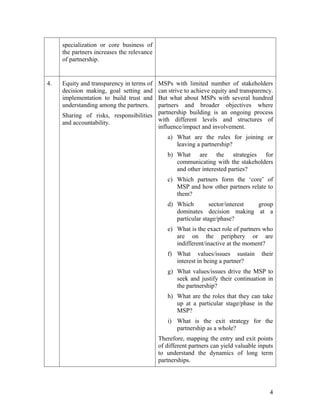
The following table analyses the theoretical model of MSP as formulated and improved
upon by different authors; and its inherent contradictions:

Sr. The MSP Paradigm as explained in           Inherent Contradictions
No. the Literature
    (Parameters/Indicators)

1.    Collaboration among different            With a number of interest groups operating
      sectors of the society: the public       within each sector, its homogeneity is
      sector (government organizations         questionable. Even the NGO sector within
      functioning at various levels-           the Civil Society is highly diversified in
      Central, State, District); the private   terms of specialization: there are NGOs
      sector (business, industry) and the      engaged in R&D, training and capacity
      civil society (NGOs, research            building and implementing development
      organisations, academia, media)          programs at the community level.
      - This partnership seeks to achieve      Since the community is influenced by the end
      some common objectives in                results of the partnership, their ‘stake’ in the
      addition to specific interests and       partnership cannot be denied.
      goals of each partner, necessitating     In this context, the questions that arise are-
      sufficient   overlap     of    their
      individual goals/objectives.             a) What is the status and role of the people or
                                               community within the MSP and in relation to
      - The beneficiaries of the               other stakeholders?
      partnership are the people, along
      with the stakeholders themselves.        b) Can they influence the decision making
                                               process?
                                               d) What are the ways (PRA?) in which they
                                               can be involved/included in the partnership
                                               decision making process?
                                               e) What are the procedures for monitoring
                                               and measuring the performance of the
                                               partnership against both individual and wider
                                               development objectives?

2.    Emphasis on the use of ICTs as           The term ICT is used in the widest sense to
      development tools; enablers of           include all traditional/modern ICT mediums
      sustainable development as they          to facilitate wider reach in spite of
      help in bridging the digital divide      infrastructural limitations.
      that would, consequently, lead to


                                                                                                3
achieving some of the MDGs.

3.   Pooling together and contributing What are the hidden interests that drive
     unique    individual   resources, different sectors/interest groups to share
     competencies and strengths in a resources and competencies?
     complementary and synergistic
     way.
     - Sharing of skills, knowledge,
     human resources, values, etc in
     addition to funding.
     -    Maximum        use    of    the
     specialization or core business of
     the partners increases the relevance
     of partnership.


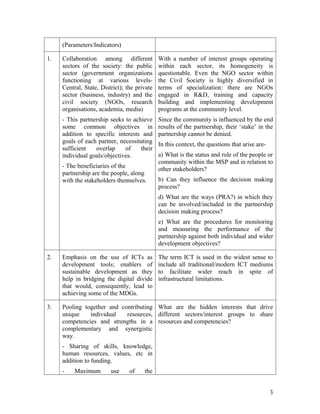
4.   Equity and transparency in terms ofMSPs with limited number of stakeholders
     decision making, goal setting and  can strive to achieve equity and transparency.
     implementation to build trust and  But what about MSPs with several hundred
     understanding among the partners.  partners and broader objectives where
     Sharing of risks, responsibilities partnership building is an ongoing process
                                        with different levels and structures of
     and accountability.
                                        influence/impact and involvement.
                                             a) What are the rules for joining or
                                                leaving a partnership?
                                             b) What are the strategies for
                                                communicating with the stakeholders
                                                and other interested parties?
                                             c) Which partners form the ‘core’ of
                                                MSP and how other partners relate to
                                                them?
                                             d) Which         sector/interest group
                                                dominates decision making at a
                                                particular stage/phase?
                                             e) What is the exact role of partners who
                                                are on the periphery or are
                                                indifferent/inactive at the moment?
                                             f) What values/issues sustain       their
                                                interest in being a partner?
                                             g) What values/issues drive the MSP to
                                                seek and justify their continuation in


                                                                                    4
the partnership?
                                                h) What are the roles that they can take
                                                   up at a particular stage/phase in the
                                                   MSP?
                                                i) What is the exit strategy for the
                                                   partnership as a whole?
                                             Therefore, mapping the entry and exit points
                                             of different partners can yield valuable inputs
                                             to understand the dynamics of long term
                                             partnerships.

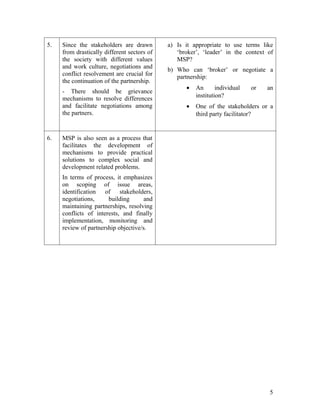
5.   Since the stakeholders are drawn           a) Is it appropriate to use a term like
     from drastically different sectors of         ‘broker’ in the context of MSP?
     the society with different values          b) Who can ‘broker’ or negotiate a
     and work culture, negotiations and            partnership:
     conflict resolvement are crucial for
     the continuation of the partnership.               •   An       individual   or     an
     - There should be grievance                            institution?
     mechanisms to resolve differences                  •   One of the stakeholders or a
     and facilitate negotiations among                      third party facilitator?
     the partners.


6.   MSP is also seen as a process that
     facilitates the development of
     mechanisms to provide practical
     solutions to complex social and
     development related problems.
     In terms of process, it emphasizes
     on scoping of issue areas,
     identification of stakeholders,
     negotiations,     building       and
     maintaining partnerships, resolving
     conflicts of interests, and finally
     implementation, monitoring and
     review of partnership objective/s.


                                                                                          5

Multi-Stakeholder Partnerships in Development Sector: A Conceptual Framework

  • 1.
    Conceptual Framework Multi-Stakeholder Partnerships (MSPs) in Development Sector Background The concept of development has undergone a major theoretical shift from top down advocacy by classical Western economists who equated it with economic growth, industrialization and capital formation to the ones that took into account general well being of people, improvement in their quality of life (UNDP) and widening of their choices (Amartya Sen). These approaches also severed ‘development’s association exclusively with economic growth and capital formation; and poverty came to be defined not merely as denial of access to resources, but also as denial of access to ‘information' or ‘knowledge’, which is increasingly being regarded as indispensable for development. “International institutions, country donors and the broader development community are rapidly coming to the conclusion that knowledge is central to development - that knowledge is development” (World Development Report, World Bank, 1998). The MSP paradigm emerged in response to the failure of both the structural (that over- emphasize the role of government in facilitating development process) and the neo- classical or neo-liberal theories of development (that negate the role of the government and regard free market economy as the key to economic development) to effectively address the complexities of development. The issue of increasing environmental degradation and inequitable development was, subsequently, raised from the United Nations’ platform at the ‘Earth Summit’ in Rio (1992) that put sustainable development on the agenda of all major international bodies. With it, MSPs are increasingly recognized as tools to facilitate sustainable development. The concept of Multi-Stakeholder Partnership traces its roots to Public-Private Partnerships (PPPs), but gained a wider connotation when the third sector or the civil society was seen as an important component having some unique competencies and resources. It is based on the realization that no sector of the society, on its own, can initiate or contribute to the process of sustainable development; and partnerships are essential for providing it a more holistic treatment. In this respect, the MSP paradigm takes a big stride from the culture of ‘debate’ (that dominated the interaction between the three sectors of the society in the preceding decades) to that of ‘dialogue’ and assumes greater significance in relation to emerging economies in the third world countries. Initially, this approach was known as tri-sector or multi-sector partnership, but, over the time, the term ‘multi-stakeholder partnership’ gained currency and provided it a new dimension by introducing the term, ‘stakeholder’ as “Stakeholders… have a ‘stake’ or an interest in a particular decision either as individuals or representatives of groups. This includes people who influence a decision, or can influence it, as well as those affected by it.” (Hammati, Minu; Multi-Stakeholder Processes for Governance and Sustainability: Beyond Deadlock and Conflict; London: Earthscan Publications, 2001). Henceforth, the concepts of equity transparency, accountability and risk sharing became the watchwords of MSPs. Review of MSP Literature 1
  • 2.
    The concept ofMSP is still evolving and so is the literature around it. It is still struggling for a strong theoretical foothold. Each MSP case study is enriching its knowledge base by adding some useful tools or by refining its methodology. Since it is a relatively new approach, most of the MSP literature revolves around creating the tools for partnership building and maintenance. Instead of contradicting and critiqing the issues addressed by others; different authors have only added up resources to make this approach more relevant for sustainable development. The MSP literature primarily focuses on finding ways to identify areas and issues on which partners from hitherto unrelated and mutually opposing sectors of the society can negotiate, collaborate and cooperate to attain the MDGs. For convenience, it can be broadly divided into two categories: a) those dealing with MSP methodology and tools; and b) those dealing with how to make the partnership sustainable and successful. In the latter context, several authors have attempted to analyze the role of ‘broker’, ‘third party facilitator’ or ‘leader’ in tri-sector partnerships. In “The Guiding Hand”, Ros Tennyson and Luke Wilde find the role of the ‘broker’ indispensable for facilitating partnerships. He carries the responsibility of building and continuing a successful partnership till its objectives are met. They have identified seven stages of partnership building. The broker plays an important role throughout this process till the partners start thinking in terms of institutionalizing or sustaining the partnership. The same argument is put forward by Michael Warner in his short novel, “The New Broker”, where MSP is explained from the private/business perspective. He uses the narrative format to discuss how MSPs can be effectively used to add value to the development programmes of the private sector, what are the major constraints to the partnership building process and how these could be resolved through the mediation of a ‘third party facilitator’. Minu Hammati’s book, “Multi-Stakeholder Processes for Governance and Sustainability: Beyond Deadlock and Conflict”, views the MSP paradigm as a major shift from formal discussions on development issues to actual action or implementation of programs. Taking an eclectic approach to understand MSP, it discusses the ‘building blocks’ that are essential for its sustenance in different situations/contexts. Partnership building progresses through five stages- context, framing, inputs, dialogues/meetings and output. In a similar vein, “The Partnering Tool Book” by Ros Tennyson analyses all aspects of partnership building after establishing the rationale for using this approach. The idea of MSP finds a concrete shape in the issue paper prepared by the “Overseas Development Institute” and the “Foundation for Development Cooperation” that focuses on each aspect of such partnerships in great detail. With reference to MSP case studies carried out in different parts of the world under different socio-cultural and geographical contexts, it analyses its relevance for the business, government and civil society; their role in the partnership; and the resources, skills and competencies contributed by them to make it successful. From these studies, it can be surmised that there is no ideal model of MSP that can address any situational or contextual demands. It is not a panacea for all problems, but in certain conditions, it can be applied very effectively. The MSPs vary from each other in terms of the issues they have taken up, their objectives, scope or scale and their time 2
  • 3.
    frames. So, onthe one hand, there are international MSP forums like the ones initiated by the GKP and the World Bank (Business Partners for Development Program) while, on the other, there are short term, localized MSPs like the Ericsson Response to disaster management. The MSP case studies undertaken in different parts of the world suggest that this approach is resilient enough to suit different situational and contextual demands. Still, there are certain parameters or indicators that ought to be present to classify any study as a MSP. The following table analyses the theoretical model of MSP as formulated and improved upon by different authors; and its inherent contradictions: Sr. The MSP Paradigm as explained in Inherent Contradictions No. the Literature (Parameters/Indicators) 1. Collaboration among different With a number of interest groups operating sectors of the society: the public within each sector, its homogeneity is sector (government organizations questionable. Even the NGO sector within functioning at various levels- the Civil Society is highly diversified in Central, State, District); the private terms of specialization: there are NGOs sector (business, industry) and the engaged in R&D, training and capacity civil society (NGOs, research building and implementing development organisations, academia, media) programs at the community level. - This partnership seeks to achieve Since the community is influenced by the end some common objectives in results of the partnership, their ‘stake’ in the addition to specific interests and partnership cannot be denied. goals of each partner, necessitating In this context, the questions that arise are- sufficient overlap of their individual goals/objectives. a) What is the status and role of the people or community within the MSP and in relation to - The beneficiaries of the other stakeholders? partnership are the people, along with the stakeholders themselves. b) Can they influence the decision making process? d) What are the ways (PRA?) in which they can be involved/included in the partnership decision making process? e) What are the procedures for monitoring and measuring the performance of the partnership against both individual and wider development objectives? 2. Emphasis on the use of ICTs as The term ICT is used in the widest sense to development tools; enablers of include all traditional/modern ICT mediums sustainable development as they to facilitate wider reach in spite of help in bridging the digital divide infrastructural limitations. that would, consequently, lead to 3
  • 4.
    achieving some ofthe MDGs. 3. Pooling together and contributing What are the hidden interests that drive unique individual resources, different sectors/interest groups to share competencies and strengths in a resources and competencies? complementary and synergistic way. - Sharing of skills, knowledge, human resources, values, etc in addition to funding. - Maximum use of the specialization or core business of the partners increases the relevance of partnership. 4. Equity and transparency in terms ofMSPs with limited number of stakeholders decision making, goal setting and can strive to achieve equity and transparency. implementation to build trust and But what about MSPs with several hundred understanding among the partners. partners and broader objectives where Sharing of risks, responsibilities partnership building is an ongoing process with different levels and structures of and accountability. influence/impact and involvement. a) What are the rules for joining or leaving a partnership? b) What are the strategies for communicating with the stakeholders and other interested parties? c) Which partners form the ‘core’ of MSP and how other partners relate to them? d) Which sector/interest group dominates decision making at a particular stage/phase? e) What is the exact role of partners who are on the periphery or are indifferent/inactive at the moment? f) What values/issues sustain their interest in being a partner? g) What values/issues drive the MSP to seek and justify their continuation in 4
  • 5.
    the partnership? h) What are the roles that they can take up at a particular stage/phase in the MSP? i) What is the exit strategy for the partnership as a whole? Therefore, mapping the entry and exit points of different partners can yield valuable inputs to understand the dynamics of long term partnerships. 5. Since the stakeholders are drawn a) Is it appropriate to use a term like from drastically different sectors of ‘broker’ in the context of MSP? the society with different values b) Who can ‘broker’ or negotiate a and work culture, negotiations and partnership: conflict resolvement are crucial for the continuation of the partnership. • An individual or an - There should be grievance institution? mechanisms to resolve differences • One of the stakeholders or a and facilitate negotiations among third party facilitator? the partners. 6. MSP is also seen as a process that facilitates the development of mechanisms to provide practical solutions to complex social and development related problems. In terms of process, it emphasizes on scoping of issue areas, identification of stakeholders, negotiations, building and maintaining partnerships, resolving conflicts of interests, and finally implementation, monitoring and review of partnership objective/s. 5