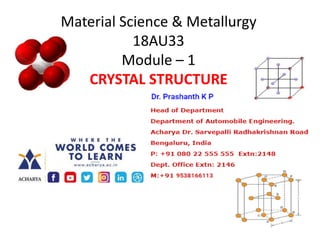
Material Science & Metallurgy
18AU33
Module – 1
CRYSTAL STRUCTURE
CRYSTAL STRUCTURE
• CRYSTAL
• CRYSTAL STRUCTURE
• UNIT CELL
• SPACE LATTICE
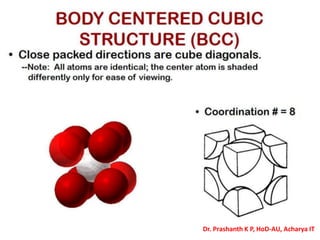
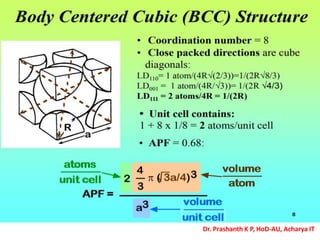
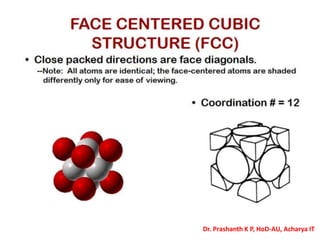
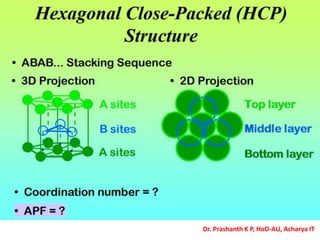
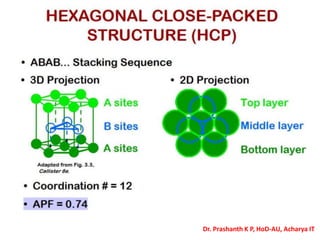
• CO-ORDINATION NUMBER
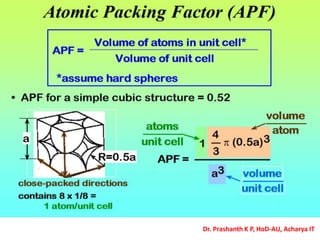
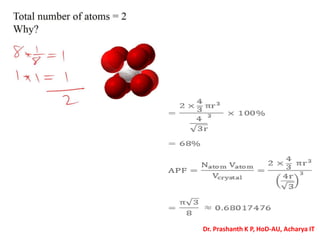
• APF
Dr. Prashanth K P, HoD-AU, Acharya IT
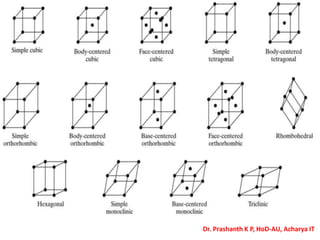
• A crystal or crystalline solid is a solid material whose constituents (such
as atoms, molecules, or ions) are arranged in a highly ordered microscopic
structure, forming a crystal lattice that extends in all directions.
• Crystal structure is a description of the ordered arrangement
of atoms, ions or molecules in a crystalline material. Ordered structures
occur from the intrinsic nature of the constituent particles to form
symmetric patterns that repeat along the principal directions of three-
dimensional space in matter.
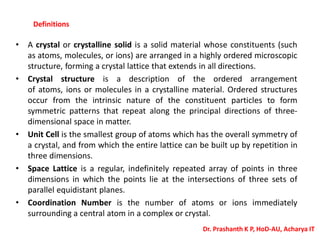
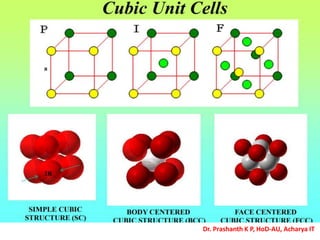
• Unit Cell is the smallest group of atoms which has the overall symmetry of
a crystal, and from which the entire lattice can be built up by repetition in
three dimensions.
• Space Lattice is a regular, indefinitely repeated array of points in three
dimensions in which the points lie at the intersections of three sets of
parallel equidistant planes.
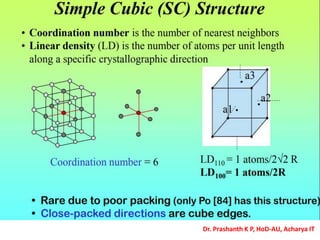
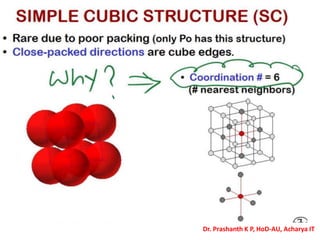
• Coordination Number is the number of atoms or ions immediately
surrounding a central atom in a complex or crystal.
Definitions
Dr. Prashanth K P, HoD-AU, Acharya IT
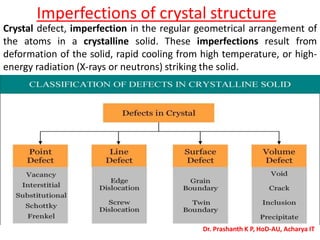
Imperfections of crystal structure
Crystal defect, imperfection in the regular geometrical arrangement of
the atoms in a crystalline solid. These imperfections result from
deformation of the solid, rapid cooling from high temperature, or high-
energy radiation (X-rays or neutrons) striking the solid.
Dr. Prashanth K P, HoD-AU, Acharya IT
Point Defect
Imperfections or defects in crystalline solid can be broadly classified into four
groups, namely, point defect, line defect, surface defect and volume defect.
Point defect is considered as the zero dimensional (0-D) defect, as by
mathematical definition, a point is unit-less dimensionless quantity! By the way,
point defect is the smallest possible defect in any material.
Vacancy – A Point Defect
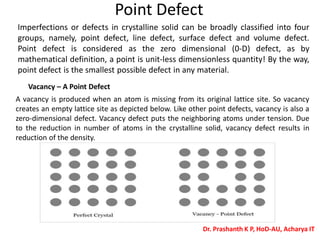
A vacancy is produced when an atom is missing from its original lattice site. So vacancy
creates an empty lattice site as depicted below. Like other point defects, vacancy is also a
zero-dimensional defect. Vacancy defect puts the neighboring atoms under tension. Due
to the reduction in number of atoms in the crystalline solid, vacancy defect results in
reduction of the density.
Dr. Prashanth K P, HoD-AU, Acharya IT
• Interstitial – A Point Defect
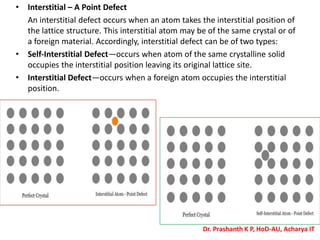
An interstitial defect occurs when an atom takes the interstitial position of
the lattice structure. This interstitial atom may be of the same crystal or of
a foreign material. Accordingly, interstitial defect can be of two types:
• Self-Interstitial Defect—occurs when atom of the same crystalline solid
occupies the interstitial position leaving its original lattice site.
• Interstitial Defect—occurs when a foreign atom occupies the interstitial
position.
Dr. Prashanth K P, HoD-AU, Acharya IT
Substitutional – A Point Defect
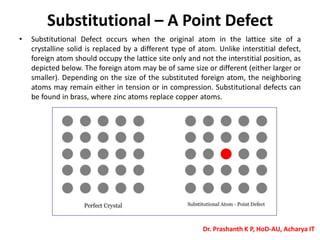
• Substitutional Defect occurs when the original atom in the lattice site of a
crystalline solid is replaced by a different type of atom. Unlike interstitial defect,
foreign atom should occupy the lattice site only and not the interstitial position, as
depicted below. The foreign atom may be of same size or different (either larger or
smaller). Depending on the size of the substituted foreign atom, the neighboring
atoms may remain either in tension or in compression. Substitutional defects can
be found in brass, where zinc atoms replace copper atoms.
Dr. Prashanth K P, HoD-AU, Acharya IT
Schottky Defect
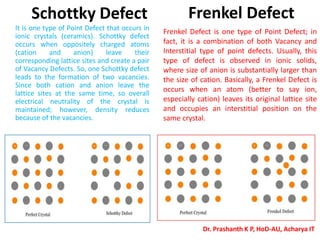
It is one type of Point Defect that occurs in
ionic crystals (ceramics). Schottky defect
occurs when oppositely charged atoms
(cation and anion) leave their
corresponding lattice sites and create a pair
of Vacancy Defects. So, one Schottky defect
leads to the formation of two vacancies.
Since both cation and anion leave the
lattice sites at the same time, so overall
electrical neutrality of the crystal is
maintained; however, density reduces
because of the vacancies.
Frenkel Defect
Frenkel Defect is one type of Point Defect; in
fact, it is a combination of both Vacancy and
Interstitial type of point defects. Usually, this
type of defect is observed in ionic solids,
where size of anion is substantially larger than
the size of cation. Basically, a Frenkel Defect is
occurs when an atom (better to say ion,
especially cation) leaves its original lattice site
and occupies an interstitial position on the
same crystal.
Dr. Prashanth K P, HoD-AU, Acharya IT
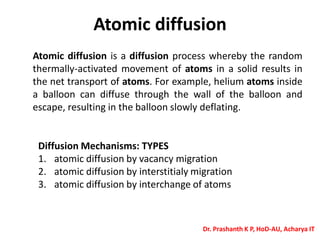
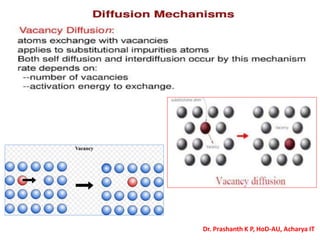
Atomic diffusion
Atomic diffusion is a diffusion process whereby the random
thermally-activated movement of atoms in a solid results in
the net transport of atoms. For example, helium atoms inside
a balloon can diffuse through the wall of the balloon and
escape, resulting in the balloon slowly deflating.
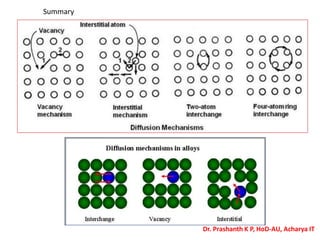
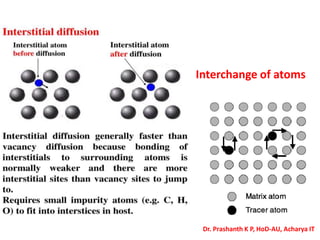
Diffusion Mechanisms: TYPES
1. atomic diffusion by vacancy migration
2. atomic diffusion by interstitialy migration
3. atomic diffusion by interchange of atoms
Dr. Prashanth K P, HoD-AU, Acharya IT
Interchange of atoms
Dr. Prashanth K P, HoD-AU, Acharya IT
Summary
Dr. Prashanth K P, HoD-AU, Acharya IT
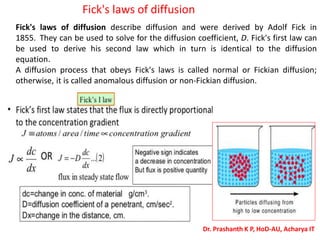
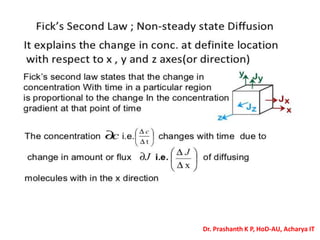
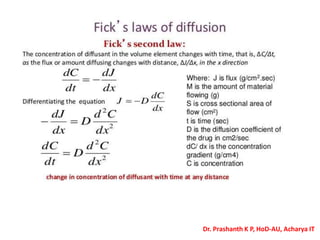
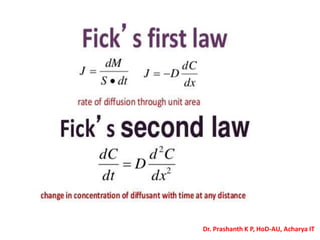
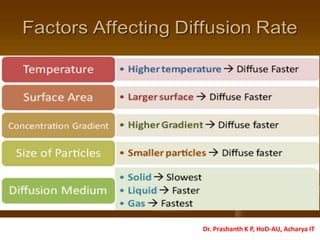
Fick's laws of diffusion
Fick's laws of diffusion describe diffusion and were derived by Adolf Fick in
1855. They can be used to solve for the diffusion coefficient, D. Fick's first law can
be used to derive his second law which in turn is identical to the diffusion
equation.
A diffusion process that obeys Fick's laws is called normal or Fickian diffusion;
otherwise, it is called anomalous diffusion or non-Fickian diffusion.
Dr. Prashanth K P, HoD-AU, Acharya IT

MSM Module 1 Crystal Structure PPT in PDF.pdf

  • 1.
    Material Science &Metallurgy 18AU33 Module – 1 CRYSTAL STRUCTURE
  • 2.
    CRYSTAL STRUCTURE • CRYSTAL •CRYSTAL STRUCTURE • UNIT CELL • SPACE LATTICE • CO-ORDINATION NUMBER • APF Dr. Prashanth K P, HoD-AU, Acharya IT
  • 3.
    • A crystalor crystalline solid is a solid material whose constituents (such as atoms, molecules, or ions) are arranged in a highly ordered microscopic structure, forming a crystal lattice that extends in all directions. • Crystal structure is a description of the ordered arrangement of atoms, ions or molecules in a crystalline material. Ordered structures occur from the intrinsic nature of the constituent particles to form symmetric patterns that repeat along the principal directions of three- dimensional space in matter. • Unit Cell is the smallest group of atoms which has the overall symmetry of a crystal, and from which the entire lattice can be built up by repetition in three dimensions. • Space Lattice is a regular, indefinitely repeated array of points in three dimensions in which the points lie at the intersections of three sets of parallel equidistant planes. • Coordination Number is the number of atoms or ions immediately surrounding a central atom in a complex or crystal. Definitions Dr. Prashanth K P, HoD-AU, Acharya IT
  • 4.
    Dr. Prashanth KP, HoD-AU, Acharya IT
  • 5.
    Dr. Prashanth KP, HoD-AU, Acharya IT
  • 6.
    Dr. Prashanth KP, HoD-AU, Acharya IT
  • 7.
    Dr. Prashanth KP, HoD-AU, Acharya IT
  • 8.
    Dr. Prashanth KP, HoD-AU, Acharya IT
  • 9.
    Dr. Prashanth KP, HoD-AU, Acharya IT
  • 10.
    Dr. Prashanth KP, HoD-AU, Acharya IT
  • 11.
    Dr. Prashanth KP, HoD-AU, Acharya IT
  • 12.
    Dr. Prashanth KP, HoD-AU, Acharya IT
  • 13.
    Dr. Prashanth KP, HoD-AU, Acharya IT
  • 14.
    Dr. Prashanth KP, HoD-AU, Acharya IT
  • 15.
    Dr. Prashanth KP, HoD-AU, Acharya IT
  • 16.
    Dr. Prashanth KP, HoD-AU, Acharya IT
  • 17.
    Dr. Prashanth KP, HoD-AU, Acharya IT
  • 18.
    Dr. Prashanth KP, HoD-AU, Acharya IT
  • 19.
    Dr. Prashanth KP, HoD-AU, Acharya IT
  • 20.
    Dr. Prashanth KP, HoD-AU, Acharya IT
  • 21.
    Dr. Prashanth KP, HoD-AU, Acharya IT
  • 22.
    Imperfections of crystalstructure Crystal defect, imperfection in the regular geometrical arrangement of the atoms in a crystalline solid. These imperfections result from deformation of the solid, rapid cooling from high temperature, or high- energy radiation (X-rays or neutrons) striking the solid. Dr. Prashanth K P, HoD-AU, Acharya IT
  • 23.
    Point Defect Imperfections ordefects in crystalline solid can be broadly classified into four groups, namely, point defect, line defect, surface defect and volume defect. Point defect is considered as the zero dimensional (0-D) defect, as by mathematical definition, a point is unit-less dimensionless quantity! By the way, point defect is the smallest possible defect in any material. Vacancy – A Point Defect A vacancy is produced when an atom is missing from its original lattice site. So vacancy creates an empty lattice site as depicted below. Like other point defects, vacancy is also a zero-dimensional defect. Vacancy defect puts the neighboring atoms under tension. Due to the reduction in number of atoms in the crystalline solid, vacancy defect results in reduction of the density. Dr. Prashanth K P, HoD-AU, Acharya IT
  • 24.
    • Interstitial –A Point Defect An interstitial defect occurs when an atom takes the interstitial position of the lattice structure. This interstitial atom may be of the same crystal or of a foreign material. Accordingly, interstitial defect can be of two types: • Self-Interstitial Defect—occurs when atom of the same crystalline solid occupies the interstitial position leaving its original lattice site. • Interstitial Defect—occurs when a foreign atom occupies the interstitial position. Dr. Prashanth K P, HoD-AU, Acharya IT
  • 25.
    Substitutional – APoint Defect • Substitutional Defect occurs when the original atom in the lattice site of a crystalline solid is replaced by a different type of atom. Unlike interstitial defect, foreign atom should occupy the lattice site only and not the interstitial position, as depicted below. The foreign atom may be of same size or different (either larger or smaller). Depending on the size of the substituted foreign atom, the neighboring atoms may remain either in tension or in compression. Substitutional defects can be found in brass, where zinc atoms replace copper atoms. Dr. Prashanth K P, HoD-AU, Acharya IT
  • 26.
    Schottky Defect It isone type of Point Defect that occurs in ionic crystals (ceramics). Schottky defect occurs when oppositely charged atoms (cation and anion) leave their corresponding lattice sites and create a pair of Vacancy Defects. So, one Schottky defect leads to the formation of two vacancies. Since both cation and anion leave the lattice sites at the same time, so overall electrical neutrality of the crystal is maintained; however, density reduces because of the vacancies. Frenkel Defect Frenkel Defect is one type of Point Defect; in fact, it is a combination of both Vacancy and Interstitial type of point defects. Usually, this type of defect is observed in ionic solids, where size of anion is substantially larger than the size of cation. Basically, a Frenkel Defect is occurs when an atom (better to say ion, especially cation) leaves its original lattice site and occupies an interstitial position on the same crystal. Dr. Prashanth K P, HoD-AU, Acharya IT
  • 27.
    Dr. Prashanth KP, HoD-AU, Acharya IT
  • 28.
    Dr. Prashanth KP, HoD-AU, Acharya IT
  • 29.
    Dr. Prashanth KP, HoD-AU, Acharya IT
  • 30.
    Dr. Prashanth KP, HoD-AU, Acharya IT
  • 31.
    Dr. Prashanth KP, HoD-AU, Acharya IT
  • 32.
    Dr. Prashanth KP, HoD-AU, Acharya IT
  • 33.
    Dr. Prashanth KP, HoD-AU, Acharya IT
  • 34.
    Dr. Prashanth KP, HoD-AU, Acharya IT
  • 35.
    Dr. Prashanth KP, HoD-AU, Acharya IT
  • 36.
    Dr. Prashanth KP, HoD-AU, Acharya IT
  • 37.
    Atomic diffusion Atomic diffusionis a diffusion process whereby the random thermally-activated movement of atoms in a solid results in the net transport of atoms. For example, helium atoms inside a balloon can diffuse through the wall of the balloon and escape, resulting in the balloon slowly deflating. Diffusion Mechanisms: TYPES 1. atomic diffusion by vacancy migration 2. atomic diffusion by interstitialy migration 3. atomic diffusion by interchange of atoms Dr. Prashanth K P, HoD-AU, Acharya IT
  • 38.
    Dr. Prashanth KP, HoD-AU, Acharya IT
  • 39.
    Interchange of atoms Dr.Prashanth K P, HoD-AU, Acharya IT
  • 40.
    Summary Dr. Prashanth KP, HoD-AU, Acharya IT
  • 41.
    Fick's laws ofdiffusion Fick's laws of diffusion describe diffusion and were derived by Adolf Fick in 1855. They can be used to solve for the diffusion coefficient, D. Fick's first law can be used to derive his second law which in turn is identical to the diffusion equation. A diffusion process that obeys Fick's laws is called normal or Fickian diffusion; otherwise, it is called anomalous diffusion or non-Fickian diffusion. Dr. Prashanth K P, HoD-AU, Acharya IT
  • 42.
    Dr. Prashanth KP, HoD-AU, Acharya IT
  • 43.
    Dr. Prashanth KP, HoD-AU, Acharya IT
  • 44.
    Dr. Prashanth KP, HoD-AU, Acharya IT
  • 45.
    Dr. Prashanth KP, HoD-AU, Acharya IT