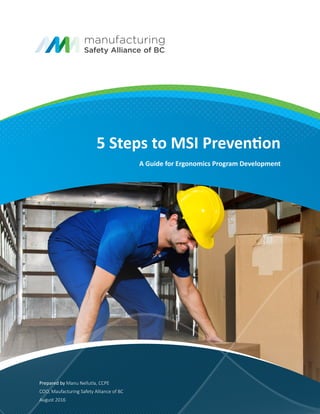
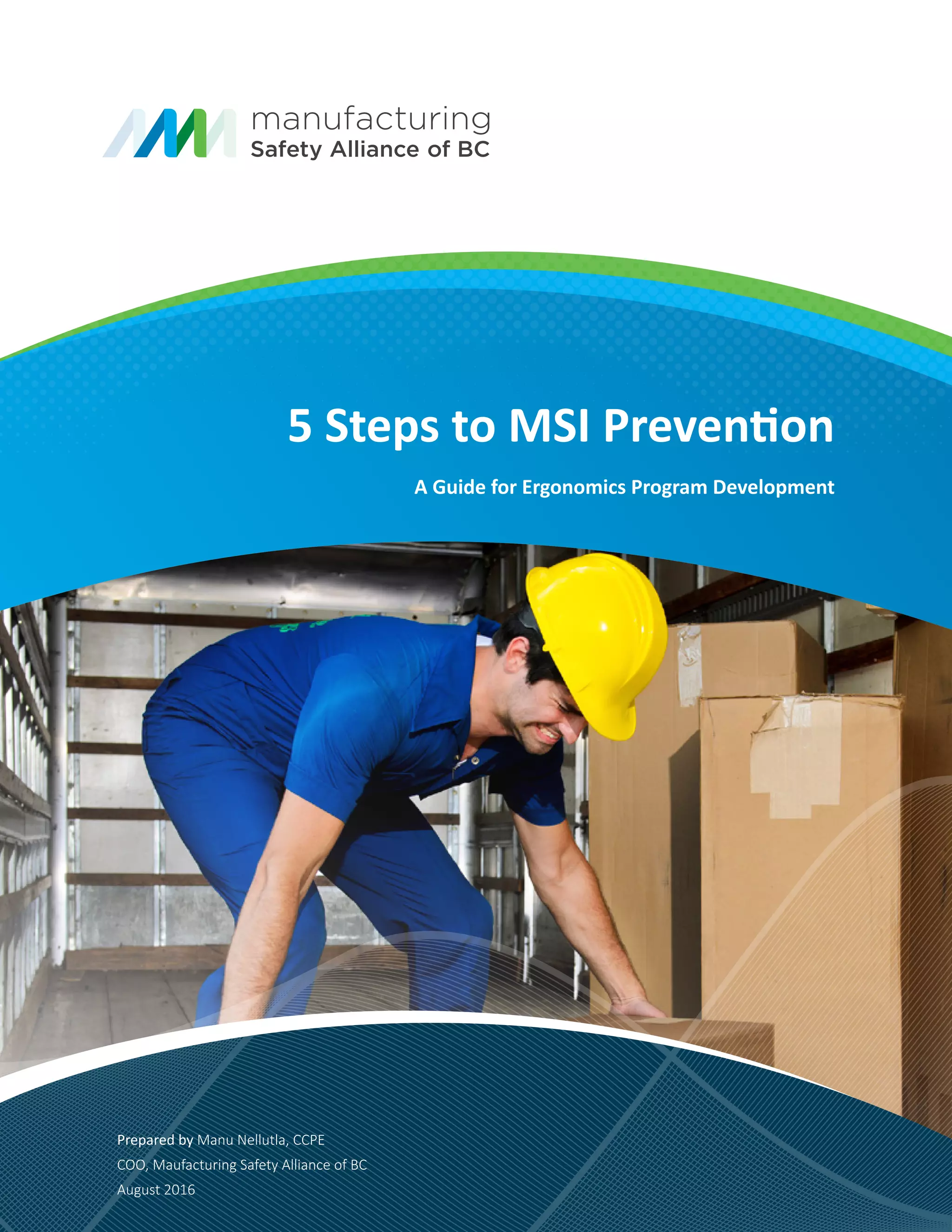
5 Steps to MSI Prevention
A Guide for Ergonomics Program Development
Prepared by Manu Nellutla, CCPE
COO, Maufacturing Safety Alliance of BC
August 2016
PREPARED BY:
Manu Nellutla, CCPE
COO, Maufacturing Safety Alliance of BC
August 2016
Table of Contents
Definitions 1
Acronyms 1
Introduction 2
MSI Management System (Strategic Framework) 2
Five Steps to MSI Prevention: Process Flow Chart 3
Five Steps to MSI Prevention: Process Details 4
Step 1 Identify the problem and review the current situation 4
Step 2 Identify the resources available and constitute ergonomics team 5
Step 3 Conduct ergonomics assessment with systems approach 6
Step 4 Review recommendations with JHSC/Management
and make necessary changes		 7
STEP 5 Regular Evaluation of the MSI Prevention Program 8
Conclusion 9
Acknowledgements 9
Definitions
โ€œMusculoskeletal injuryโ€ (or MSI) means an injury or disorder of the muscles, tendons, ligaments, joints,
nerves, blood vessels or related soft tissue including a sprain, strain and inflammation, that may be
caused or aggravated by work. (WorkSafeBC, 2015).
Ergonomics (or human factors) is the scientific discipline concerned with the understanding of
interactions among humans and other elements of a system, and the profession that applies theory,
principles, data and methods to design in order to optimize human well-being and overall system
performance. (International Ergonomics Association, 2015).
Acronyms
JHSC: 		 Joint Health and Safety Committee
MSI: 		 Musculoskeletal Injury (Injuries)
OHS: 		 Occupational Health and Safety
PE: 		 Participatory Ergonomics
STENA: 		 Specific Task Ergonomics Needs Assessment
MSI Prevention Guide - 2016
1
T 1.604.795.9595 F 1.604.795.9507 E manufacturing@safetyalliancebc.ca
Introduction
Manufacturing Safety Alliance of BCโ€™s MSI Prevention Guide has been developed to provide guidance
to an organization in implementing an ergonomics program at their workplace.
This guidebook was developed taking into consideration WorkSafeBCโ€™s OHS regulations 4.46 to 4.53
which cover the risk factors, identification by assessment, and controls to be put in place. They also state
the components of an ergonomics program by discussing the education and training needed and the
evaluation of the program.
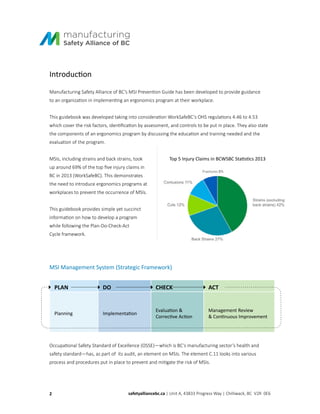
MSIs, including strains and back strains, took
up around 69% of the top five injury claims in
BC in 2013 (WorkSafeBC). This demonstrates
the need to introduce ergonomics programs at
workplaces to prevent the occurrence of MSIs.
This guidebook provides simple yet succinct
information on how to develop a program
while following the Plan-Do-Check-Act
Cycle framework.
Top 5 Injury Claims in BCWSBC Statistics 2013
MSI Management System (Strategic Framework)
PLAN DO CHECK ACT
Planning Implementation
Evaluation &
Corrective Action
Management Review
& Continuous Improvement
Occupational Safety Standard of Excellence (OSSE)โ€”which is BCโ€™s manufacturing sectorโ€™s health and
safety standardโ€”has, as part of its audit, an element on MSIs. The element C.11 looks into various
process and procedures put in place to prevent and mitigate the risk of MSIs.
2 safetyalliancebc.ca | Unit A, 43833 Progress Way | Chilliwack, BC V2R 0E6
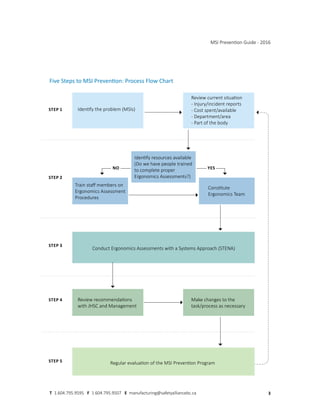
Five Steps to MSI Prevention: Process Flow Chart
STEP 1
STEP 2
STEP 3
STEP 4
STEP 5
Train staff members on
Ergonomics Assessment
Procedures
Identify the problem (MSIs)
Review current situation
- Injury/incident reports
- Cost spent/available
- Department/area
- Part of the body
Constitute
Ergonomics Team
Make changes to the
task/process as necessary
Identify resources available
(Do we have people trained
to complete proper
Ergonomics Assessments?)
Review recommendations
with JHSC and Management
Conduct Ergonomics Assessments with a Systems Approach (STENA)
Regular evaluation of the MSI Prevention Program
YES
NO
MSI Prevention Guide - 2016
3
T 1.604.795.9595 F 1.604.795.9507 E manufacturing@safetyalliancebc.ca
Five Steps to MSI Prevention: Process Details
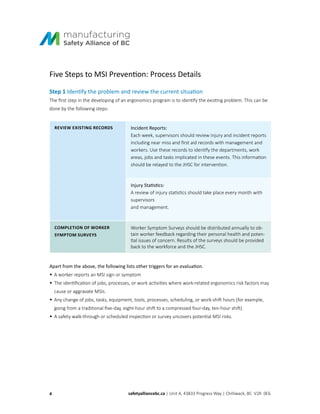
Step 1 Identify the problem and review the current situation
The first step in the developing of an ergonomics program is to identify the existing problem. This can be
done by the following steps:
REVIEW EXISTING RECORDS Incident Reports:
Each week, supervisors should review injury and incident reports
including near miss and first aid records with management and
workers. Use these records to identify the departments, work
areas, jobs and tasks implicated in these events. This information
should be relayed to the JHSC for intervention.
Injury Statistics:
A review of injury statistics should take place every month with
supervisors
and management.
COMPLETION OF WORKER
SYMPTOM SURVEYS
Worker Symptom Surveys should be distributed annually to ob-
tain worker feedback regarding their personal health and poten-
tial issues of concern. Results of the surveys should be provided
back to the workforce and the JHSC.
Apart from the above, the following lists other triggers for an evaluation.
โ€ข A worker reports an MSI sign or symptom
โ€ข The identification of jobs, processes, or work activities where work-related ergonomics risk factors may
cause or aggravate MSIs.
โ€ข Any change of jobs, tasks, equipment, tools, processes, scheduling, or work-shift hours (for example,
going from a traditional five-day, eight-hour shift to a compressed four-day, ten-hour shift)
โ€ข A safety walk-through or scheduled inspection or survey uncovers potential MSI risks.
4 safetyalliancebc.ca | Unit A, 43833 Progress Way | Chilliwack, BC V2R 0E6
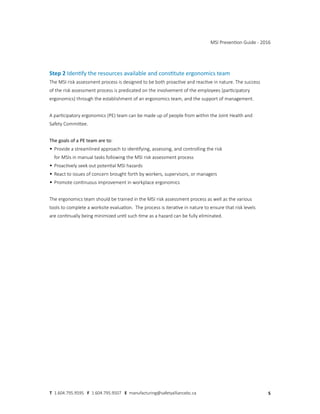
Step 2 Identify the resources available and constitute ergonomics team
The MSI risk assessment process is designed to be both proactive and reactive in nature. The success
of the risk assessment process is predicated on the involvement of the employees (participatory
ergonomics) through the establishment of an ergonomics team, and the support of management.
A participatory ergonomics (PE) team can be made up of people from within the Joint Health and
Safety Committee.
The goals of a PE team are to:
โ€ข Provide a streamlined approach to identifying, assessing, and controlling the risk
for MSIs in manual tasks following the MSI risk assessment process
โ€ข Proactively seek out potential MSI hazards
โ€ข React to issues of concern brought forth by workers, supervisors, or managers
โ€ข Promote continuous improvement in workplace ergonomics
The ergonomics team should be trained in the MSI risk assessment process as well as the various
tools to complete a worksite evaluation. The process is iterative in nature to ensure that risk levels
are continually being minimized until such time as a hazard can be fully eliminated.
MSI Prevention Guide - 2016
5
T 1.604.795.9595 F 1.604.795.9507 E manufacturing@safetyalliancebc.ca
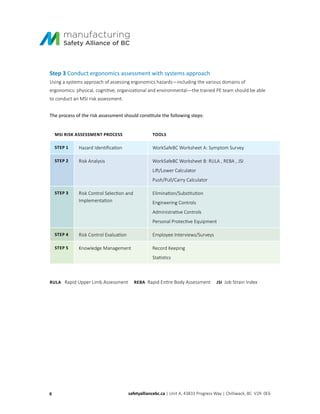
Step 3 Conduct ergonomics assessment with systems approach
Using a systems approach of assessing ergonomics hazardsโ€”including the various domains of
ergonomics: physical, cognitive, organizational and environmentalโ€”the trained PE team should be able
to conduct an MSI risk assessment.
The process of the risk assessment should constitute the following steps:
MSI RISK ASSESSMENT PROCESS TOOLS
STEP 1 Hazard Identification WorkSafeBC Worksheet A: Symptom Survey
STEP 2 Risk Analysis WorkSafeBC Worksheet B: RULA , REBA , JSI
Lift/Lower Calculator
Push/Pull/Carry Calculator
STEP 3 Risk Control Selection and
Implementation
Elimination/Substitution
Engineering Controls
Administrative Controls
Personal Protective Equipment
STEP 4 Risk Control Evaluation Employee Interviews/Surveys
STEP 5 Knowledge Management Record Keeping
Statistics
RULA Rapid Upper Limb Assessment REBA Rapid Entire Body Assessment JSI Job Strain Index
6 safetyalliancebc.ca | Unit A, 43833 Progress Way | Chilliwack, BC V2R 0E6
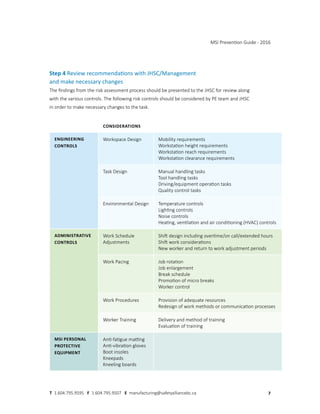
Step 4 Review recommendations with JHSC/Management
and make necessary changes
The findings from the risk assessment process should be presented to the JHSC for review along
with the various controls. The following risk controls should be considered by PE team and JHSC
in order to make necessary changes to the task.
CONSIDERATIONS
ENGINEERING
CONTROLS
Workspace Design Mobility requirements
Workstation height requirements
Workstation reach requirements
Workstation clearance requirements
Task Design Manual handling tasks
Tool handling tasks
Driving/equipment operation tasks
Quality control tasks
Environmental Design Temperature controls
Lighting controls
Noise controls
Heating, ventilation and air conditioning (HVAC) controls
ADMINISTRATIVE
CONTROLS
Work Schedule
Adjustments
Shift design including overtime/on call/extended hours
Shift work considerations
New worker and return to work adjustment periods
Work Pacing Job rotation
Job enlargement
Break schedule
Promotion of micro breaks
Worker control
Work Procedures Provision of adequate resources
Redesign of work methods or communication processes
Worker Training Delivery and method of training
Evaluation of training
MSI PERSONAL
PROTECTIVE
EQUIPMENT
Anti-fatigue matting
Anti-vibration gloves
Boot insoles
Kneepads
Kneeling boards
MSI Prevention Guide - 2016
7
T 1.604.795.9595 F 1.604.795.9507 E manufacturing@safetyalliancebc.ca
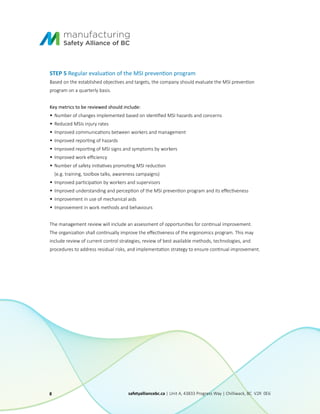
STEP 5 Regular evaluation of the MSI prevention program
Based on the established objectives and targets, the company should evaluate the MSI prevention
program on a quarterly basis.
Key metrics to be reviewed should include:
โ€ข Number of changes implemented based on identified MSI hazards and concerns
โ€ข Reduced MSIs injury rates
โ€ข Improved communications between workers and management
โ€ข Improved reporting of hazards
โ€ข Improved reporting of MSI signs and symptoms by workers
โ€ข Improved work efficiency
โ€ข Number of safety initiatives promoting MSI reduction
(e.g. training, toolbox talks, awareness campaigns)
โ€ข Improved participation by workers and supervisors
โ€ข Improved understanding and perception of the MSI prevention program and its effectiveness
โ€ข Improvement in use of mechanical aids
โ€ข Improvement in work methods and behaviours
The management review will include an assessment of opportunities for continual improvement.
The organization shall continually improve the effectiveness of the ergonomics program. This may
include review of current control strategies, review of best available methods, technologies, and
procedures to address residual risks, and implementation strategy to ensure continual improvement.
8 safetyalliancebc.ca | Unit A, 43833 Progress Way | Chilliwack, BC V2R 0E6
Conclusion
Preventing and reducing MSIs is an important aspect of health and safety systems because MSIs develop
both acutely and over time. Return to Work programs also get impacted with the prolonged presence
of MSIs. Developing a robust ergonomics program has been one of the challenging tasks for most of the
organizations. Following โ€˜5 Steps to MSI Preventionโ€™ will provide organizations with proper guidance on
successful implementation of an ergonomics program.
Acknowledgements
The โ€˜5 Steps to MSI Preventionโ€™ guidebook has been developed by the Manufacturing Safety Alliance
of BC in partnership with Canadian Materials Handling and Distribution Society (CMHDS) and BC
Chiropractors Association as part of the Transportation Initiative Committee.
The Transportation Initiative Committee comprises of:
โ€ข Dan Beer, Director of Sales at Forklift Blackbelt, CMHDS President
โ€ข Rick LeBlanc, Writer and Editor at Packaging Revolution, CMHDS
โ€ข Ryan Parry, PDC Manager at Toyota Canada, CMHDS
โ€ข Dr. Don Nixdorf, Director at College of Chiropractors of BC, Director at Vertebral Media,
Vice President at Farabloc Development Corporation
โ€ข Rick Nickelchok, Executive Director at BC Chiropractic Association
โ€ข Theresa Holizki, Q.C., Advisor to Manufacturing Safety Alliance of BC
โ€ข Manobhiram (Manu) Nellutla, CCPE, COO at Manufacturing Safety Alliance of BC
MSI Prevention Guide - 2016
9
T 1.604.795.9595 F 1.604.795.9507 E manufacturing@safetyalliancebc.ca
safetyalliancebc.ca | Unit A, 43833 Progress Way | Chilliwack, BC V2R 0E6
T 1.604.795.9595 F 1.604.795.9507 E manufacturing@safetyalliancebc.ca

MSABC-Stena-2016-web.pdf

  • 1.
    5 Steps toMSI Prevention A Guide for Ergonomics Program Development Prepared by Manu Nellutla, CCPE COO, Maufacturing Safety Alliance of BC August 2016
  • 2.
    PREPARED BY: Manu Nellutla,CCPE COO, Maufacturing Safety Alliance of BC August 2016 Table of Contents Definitions 1 Acronyms 1 Introduction 2 MSI Management System (Strategic Framework) 2 Five Steps to MSI Prevention: Process Flow Chart 3 Five Steps to MSI Prevention: Process Details 4 Step 1 Identify the problem and review the current situation 4 Step 2 Identify the resources available and constitute ergonomics team 5 Step 3 Conduct ergonomics assessment with systems approach 6 Step 4 Review recommendations with JHSC/Management and make necessary changes 7 STEP 5 Regular Evaluation of the MSI Prevention Program 8 Conclusion 9 Acknowledgements 9
  • 3.
    Definitions โ€œMusculoskeletal injuryโ€ (orMSI) means an injury or disorder of the muscles, tendons, ligaments, joints, nerves, blood vessels or related soft tissue including a sprain, strain and inflammation, that may be caused or aggravated by work. (WorkSafeBC, 2015). Ergonomics (or human factors) is the scientific discipline concerned with the understanding of interactions among humans and other elements of a system, and the profession that applies theory, principles, data and methods to design in order to optimize human well-being and overall system performance. (International Ergonomics Association, 2015). Acronyms JHSC: Joint Health and Safety Committee MSI: Musculoskeletal Injury (Injuries) OHS: Occupational Health and Safety PE: Participatory Ergonomics STENA: Specific Task Ergonomics Needs Assessment MSI Prevention Guide - 2016 1 T 1.604.795.9595 F 1.604.795.9507 E manufacturing@safetyalliancebc.ca
  • 4.
    Introduction Manufacturing Safety Allianceof BCโ€™s MSI Prevention Guide has been developed to provide guidance to an organization in implementing an ergonomics program at their workplace. This guidebook was developed taking into consideration WorkSafeBCโ€™s OHS regulations 4.46 to 4.53 which cover the risk factors, identification by assessment, and controls to be put in place. They also state the components of an ergonomics program by discussing the education and training needed and the evaluation of the program. MSIs, including strains and back strains, took up around 69% of the top five injury claims in BC in 2013 (WorkSafeBC). This demonstrates the need to introduce ergonomics programs at workplaces to prevent the occurrence of MSIs. This guidebook provides simple yet succinct information on how to develop a program while following the Plan-Do-Check-Act Cycle framework. Top 5 Injury Claims in BCWSBC Statistics 2013 MSI Management System (Strategic Framework) PLAN DO CHECK ACT Planning Implementation Evaluation & Corrective Action Management Review & Continuous Improvement Occupational Safety Standard of Excellence (OSSE)โ€”which is BCโ€™s manufacturing sectorโ€™s health and safety standardโ€”has, as part of its audit, an element on MSIs. The element C.11 looks into various process and procedures put in place to prevent and mitigate the risk of MSIs. 2 safetyalliancebc.ca | Unit A, 43833 Progress Way | Chilliwack, BC V2R 0E6
  • 5.
    Five Steps toMSI Prevention: Process Flow Chart STEP 1 STEP 2 STEP 3 STEP 4 STEP 5 Train staff members on Ergonomics Assessment Procedures Identify the problem (MSIs) Review current situation - Injury/incident reports - Cost spent/available - Department/area - Part of the body Constitute Ergonomics Team Make changes to the task/process as necessary Identify resources available (Do we have people trained to complete proper Ergonomics Assessments?) Review recommendations with JHSC and Management Conduct Ergonomics Assessments with a Systems Approach (STENA) Regular evaluation of the MSI Prevention Program YES NO MSI Prevention Guide - 2016 3 T 1.604.795.9595 F 1.604.795.9507 E manufacturing@safetyalliancebc.ca
  • 6.
    Five Steps toMSI Prevention: Process Details Step 1 Identify the problem and review the current situation The first step in the developing of an ergonomics program is to identify the existing problem. This can be done by the following steps: REVIEW EXISTING RECORDS Incident Reports: Each week, supervisors should review injury and incident reports including near miss and first aid records with management and workers. Use these records to identify the departments, work areas, jobs and tasks implicated in these events. This information should be relayed to the JHSC for intervention. Injury Statistics: A review of injury statistics should take place every month with supervisors and management. COMPLETION OF WORKER SYMPTOM SURVEYS Worker Symptom Surveys should be distributed annually to ob- tain worker feedback regarding their personal health and poten- tial issues of concern. Results of the surveys should be provided back to the workforce and the JHSC. Apart from the above, the following lists other triggers for an evaluation. โ€ข A worker reports an MSI sign or symptom โ€ข The identification of jobs, processes, or work activities where work-related ergonomics risk factors may cause or aggravate MSIs. โ€ข Any change of jobs, tasks, equipment, tools, processes, scheduling, or work-shift hours (for example, going from a traditional five-day, eight-hour shift to a compressed four-day, ten-hour shift) โ€ข A safety walk-through or scheduled inspection or survey uncovers potential MSI risks. 4 safetyalliancebc.ca | Unit A, 43833 Progress Way | Chilliwack, BC V2R 0E6
  • 7.
    Step 2 Identifythe resources available and constitute ergonomics team The MSI risk assessment process is designed to be both proactive and reactive in nature. The success of the risk assessment process is predicated on the involvement of the employees (participatory ergonomics) through the establishment of an ergonomics team, and the support of management. A participatory ergonomics (PE) team can be made up of people from within the Joint Health and Safety Committee. The goals of a PE team are to: โ€ข Provide a streamlined approach to identifying, assessing, and controlling the risk for MSIs in manual tasks following the MSI risk assessment process โ€ข Proactively seek out potential MSI hazards โ€ข React to issues of concern brought forth by workers, supervisors, or managers โ€ข Promote continuous improvement in workplace ergonomics The ergonomics team should be trained in the MSI risk assessment process as well as the various tools to complete a worksite evaluation. The process is iterative in nature to ensure that risk levels are continually being minimized until such time as a hazard can be fully eliminated. MSI Prevention Guide - 2016 5 T 1.604.795.9595 F 1.604.795.9507 E manufacturing@safetyalliancebc.ca
  • 8.
    Step 3 Conductergonomics assessment with systems approach Using a systems approach of assessing ergonomics hazardsโ€”including the various domains of ergonomics: physical, cognitive, organizational and environmentalโ€”the trained PE team should be able to conduct an MSI risk assessment. The process of the risk assessment should constitute the following steps: MSI RISK ASSESSMENT PROCESS TOOLS STEP 1 Hazard Identification WorkSafeBC Worksheet A: Symptom Survey STEP 2 Risk Analysis WorkSafeBC Worksheet B: RULA , REBA , JSI Lift/Lower Calculator Push/Pull/Carry Calculator STEP 3 Risk Control Selection and Implementation Elimination/Substitution Engineering Controls Administrative Controls Personal Protective Equipment STEP 4 Risk Control Evaluation Employee Interviews/Surveys STEP 5 Knowledge Management Record Keeping Statistics RULA Rapid Upper Limb Assessment REBA Rapid Entire Body Assessment JSI Job Strain Index 6 safetyalliancebc.ca | Unit A, 43833 Progress Way | Chilliwack, BC V2R 0E6
  • 9.
    Step 4 Reviewrecommendations with JHSC/Management and make necessary changes The findings from the risk assessment process should be presented to the JHSC for review along with the various controls. The following risk controls should be considered by PE team and JHSC in order to make necessary changes to the task. CONSIDERATIONS ENGINEERING CONTROLS Workspace Design Mobility requirements Workstation height requirements Workstation reach requirements Workstation clearance requirements Task Design Manual handling tasks Tool handling tasks Driving/equipment operation tasks Quality control tasks Environmental Design Temperature controls Lighting controls Noise controls Heating, ventilation and air conditioning (HVAC) controls ADMINISTRATIVE CONTROLS Work Schedule Adjustments Shift design including overtime/on call/extended hours Shift work considerations New worker and return to work adjustment periods Work Pacing Job rotation Job enlargement Break schedule Promotion of micro breaks Worker control Work Procedures Provision of adequate resources Redesign of work methods or communication processes Worker Training Delivery and method of training Evaluation of training MSI PERSONAL PROTECTIVE EQUIPMENT Anti-fatigue matting Anti-vibration gloves Boot insoles Kneepads Kneeling boards MSI Prevention Guide - 2016 7 T 1.604.795.9595 F 1.604.795.9507 E manufacturing@safetyalliancebc.ca
  • 10.
    STEP 5 Regularevaluation of the MSI prevention program Based on the established objectives and targets, the company should evaluate the MSI prevention program on a quarterly basis. Key metrics to be reviewed should include: โ€ข Number of changes implemented based on identified MSI hazards and concerns โ€ข Reduced MSIs injury rates โ€ข Improved communications between workers and management โ€ข Improved reporting of hazards โ€ข Improved reporting of MSI signs and symptoms by workers โ€ข Improved work efficiency โ€ข Number of safety initiatives promoting MSI reduction (e.g. training, toolbox talks, awareness campaigns) โ€ข Improved participation by workers and supervisors โ€ข Improved understanding and perception of the MSI prevention program and its effectiveness โ€ข Improvement in use of mechanical aids โ€ข Improvement in work methods and behaviours The management review will include an assessment of opportunities for continual improvement. The organization shall continually improve the effectiveness of the ergonomics program. This may include review of current control strategies, review of best available methods, technologies, and procedures to address residual risks, and implementation strategy to ensure continual improvement. 8 safetyalliancebc.ca | Unit A, 43833 Progress Way | Chilliwack, BC V2R 0E6
  • 11.
    Conclusion Preventing and reducingMSIs is an important aspect of health and safety systems because MSIs develop both acutely and over time. Return to Work programs also get impacted with the prolonged presence of MSIs. Developing a robust ergonomics program has been one of the challenging tasks for most of the organizations. Following โ€˜5 Steps to MSI Preventionโ€™ will provide organizations with proper guidance on successful implementation of an ergonomics program. Acknowledgements The โ€˜5 Steps to MSI Preventionโ€™ guidebook has been developed by the Manufacturing Safety Alliance of BC in partnership with Canadian Materials Handling and Distribution Society (CMHDS) and BC Chiropractors Association as part of the Transportation Initiative Committee. The Transportation Initiative Committee comprises of: โ€ข Dan Beer, Director of Sales at Forklift Blackbelt, CMHDS President โ€ข Rick LeBlanc, Writer and Editor at Packaging Revolution, CMHDS โ€ข Ryan Parry, PDC Manager at Toyota Canada, CMHDS โ€ข Dr. Don Nixdorf, Director at College of Chiropractors of BC, Director at Vertebral Media, Vice President at Farabloc Development Corporation โ€ข Rick Nickelchok, Executive Director at BC Chiropractic Association โ€ข Theresa Holizki, Q.C., Advisor to Manufacturing Safety Alliance of BC โ€ข Manobhiram (Manu) Nellutla, CCPE, COO at Manufacturing Safety Alliance of BC MSI Prevention Guide - 2016 9 T 1.604.795.9595 F 1.604.795.9507 E manufacturing@safetyalliancebc.ca
  • 12.
    safetyalliancebc.ca | UnitA, 43833 Progress Way | Chilliwack, BC V2R 0E6 T 1.604.795.9595 F 1.604.795.9507 E manufacturing@safetyalliancebc.ca