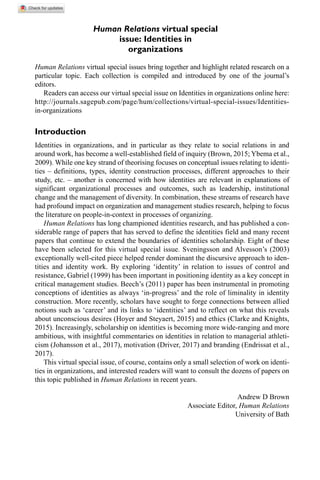
Human Relations virtual special
issue: Identities in
organizations
Human Relations virtual special issues bring together and highlight related research on a
particular topic. Each collection is compiled and introduced by one of the journal’s
editors.
Readers can access our virtual special issue on Identities in organizations online here:
http://journals.sagepub.com/page/hum/collections/virtual-special-issues/Identities-
in-organizations
Introduction
Identities in organizations, and in particular as they relate to social relations in and
around work, has become a well-established field of inquiry (Brown, 2015; Ybema et al.,
2009). While one key strand of theorising focuses on conceptual issues relating to identi-
ties – definitions, types, identity construction processes, different approaches to their
study, etc. – another is concerned with how identities are relevant in explanations of
significant organizational processes and outcomes, such as leadership, institutional
change and the management of diversity. In combination, these streams of research have
had profound impact on organization and management studies research, helping to focus
the literature on people-in-context in processes of organizing.
Human Relations has long championed identities research, and has published a con-
siderable range of papers that has served to define the identities field and many recent
papers that continue to extend the boundaries of identities scholarship. Eight of these
have been selected for this virtual special issue. Sveningsson and Alvesson’s (2003)
exceptionally well-cited piece helped render dominant the discursive approach to iden-
tities and identity work. By exploring ‘identity’ in relation to issues of control and
resistance, Gabriel (1999) has been important in positioning identity as a key concept in
critical management studies. Beech’s (2011) paper has been instrumental in promoting
conceptions of identities as always ‘in-progress’ and the role of liminality in identity
construction. More recently, scholars have sought to forge connections between allied
notions such as ‘career’ and its links to ‘identities’ and to reflect on what this reveals
about unconscious desires (Hoyer and Steyaert, 2015) and ethics (Clarke and Knights,
2015). Increasingly, scholarship on identities is becoming more wide-ranging and more
ambitious, with insightful commentaries on identities in relation to managerial athleti-
cism (Johansson et al., 2017), motivation (Driver, 2017) and branding (Endrissat et al.,
2017).
This virtual special issue, of course, contains only a small selection of work on identi-
ties in organizations, and interested readers will want to consult the dozens of papers on
this topic published in Human Relations in recent years.
Andrew D Brown
Associate Editor, Human Relations
University of Bath
758573HUM0010.1177/0018726718758573Human Relations
research-article2018
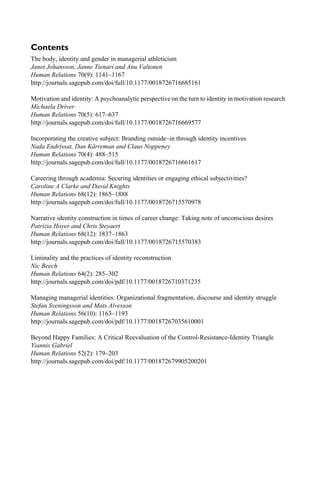
Contents
The body, identity and gender in managerial athleticism
Janet Johansson, Janne Tienari and Anu Valtonen
Human Relations 70(9): 1141–1167
http://journals.sagepub.com/doi/full/10.1177/0018726716685161
Motivation and identity: A psychoanalytic perspective on the turn to identity in motivation research
Michaela Driver
Human Relations 70(5): 617–637
http://journals.sagepub.com/doi/full/10.1177/0018726716669577
Incorporating the creative subject: Branding outside–in through identity incentives
Nada Endrissat, Dan Kärreman and Claus Noppeney
Human Relations 70(4): 488–515
http://journals.sagepub.com/doi/full/10.1177/0018726716661617
Careering through academia: Securing identities or engaging ethical subjectivities?
Caroline A Clarke and David Knights
Human Relations 68(12): 1865–1888
http://journals.sagepub.com/doi/full/10.1177/0018726715570978
Narrative identity construction in times of career change: Taking note of unconscious desires
Patrizia Hoyer and Chris Steyaert
Human Relations 68(12): 1837–1863
http://journals.sagepub.com/doi/full/10.1177/0018726715570383
Liminality and the practices of identity reconstruction
Nic Beech
Human Relations 64(2): 285–302
http://journals.sagepub.com/doi/pdf/10.1177/0018726710371235
Managing managerial identities: Organizational fragmentation, discourse and identity struggle
Stefan Sveningsson and Mats Alvesson
Human Relations 56(10): 1163–1193
http://journals.sagepub.com/doi/pdf/10.1177/00187267035610001
Beyond Happy Families: A Critical Reevaluation of the Control-Resistance-Identity Triangle
Yiannis Gabriel
Human Relations 52(2): 179–203
http://journals.sagepub.com/doi/pdf/10.1177/001872679905200201
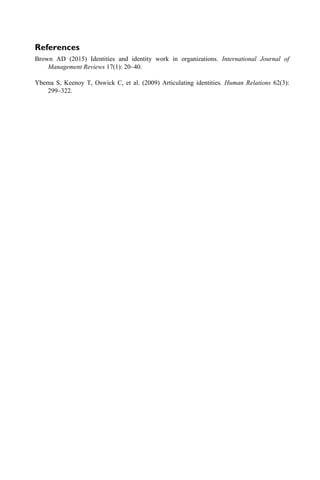
References
Brown AD (2015) Identities and identity work in organizations. International Journal of
Management Reviews 17(1): 20–40.
Ybema S, Keenoy T, Oswick C, et al. (2009) Articulating identities. Human Relations 62(3):
299–322.

Identities in Organizations

  • 1.
    Human Relations virtualspecial issue: Identities in organizations Human Relations virtual special issues bring together and highlight related research on a particular topic. Each collection is compiled and introduced by one of the journal’s editors. Readers can access our virtual special issue on Identities in organizations online here: http://journals.sagepub.com/page/hum/collections/virtual-special-issues/Identities- in-organizations Introduction Identities in organizations, and in particular as they relate to social relations in and around work, has become a well-established field of inquiry (Brown, 2015; Ybema et al., 2009). While one key strand of theorising focuses on conceptual issues relating to identi- ties – definitions, types, identity construction processes, different approaches to their study, etc. – another is concerned with how identities are relevant in explanations of significant organizational processes and outcomes, such as leadership, institutional change and the management of diversity. In combination, these streams of research have had profound impact on organization and management studies research, helping to focus the literature on people-in-context in processes of organizing. Human Relations has long championed identities research, and has published a con- siderable range of papers that has served to define the identities field and many recent papers that continue to extend the boundaries of identities scholarship. Eight of these have been selected for this virtual special issue. Sveningsson and Alvesson’s (2003) exceptionally well-cited piece helped render dominant the discursive approach to iden- tities and identity work. By exploring ‘identity’ in relation to issues of control and resistance, Gabriel (1999) has been important in positioning identity as a key concept in critical management studies. Beech’s (2011) paper has been instrumental in promoting conceptions of identities as always ‘in-progress’ and the role of liminality in identity construction. More recently, scholars have sought to forge connections between allied notions such as ‘career’ and its links to ‘identities’ and to reflect on what this reveals about unconscious desires (Hoyer and Steyaert, 2015) and ethics (Clarke and Knights, 2015). Increasingly, scholarship on identities is becoming more wide-ranging and more ambitious, with insightful commentaries on identities in relation to managerial athleti- cism (Johansson et al., 2017), motivation (Driver, 2017) and branding (Endrissat et al., 2017). This virtual special issue, of course, contains only a small selection of work on identi- ties in organizations, and interested readers will want to consult the dozens of papers on this topic published in Human Relations in recent years. Andrew D Brown Associate Editor, Human Relations University of Bath 758573HUM0010.1177/0018726718758573Human Relations research-article2018
  • 2.
    Contents The body, identityand gender in managerial athleticism Janet Johansson, Janne Tienari and Anu Valtonen Human Relations 70(9): 1141–1167 http://journals.sagepub.com/doi/full/10.1177/0018726716685161 Motivation and identity: A psychoanalytic perspective on the turn to identity in motivation research Michaela Driver Human Relations 70(5): 617–637 http://journals.sagepub.com/doi/full/10.1177/0018726716669577 Incorporating the creative subject: Branding outside–in through identity incentives Nada Endrissat, Dan Kärreman and Claus Noppeney Human Relations 70(4): 488–515 http://journals.sagepub.com/doi/full/10.1177/0018726716661617 Careering through academia: Securing identities or engaging ethical subjectivities? Caroline A Clarke and David Knights Human Relations 68(12): 1865–1888 http://journals.sagepub.com/doi/full/10.1177/0018726715570978 Narrative identity construction in times of career change: Taking note of unconscious desires Patrizia Hoyer and Chris Steyaert Human Relations 68(12): 1837–1863 http://journals.sagepub.com/doi/full/10.1177/0018726715570383 Liminality and the practices of identity reconstruction Nic Beech Human Relations 64(2): 285–302 http://journals.sagepub.com/doi/pdf/10.1177/0018726710371235 Managing managerial identities: Organizational fragmentation, discourse and identity struggle Stefan Sveningsson and Mats Alvesson Human Relations 56(10): 1163–1193 http://journals.sagepub.com/doi/pdf/10.1177/00187267035610001 Beyond Happy Families: A Critical Reevaluation of the Control-Resistance-Identity Triangle Yiannis Gabriel Human Relations 52(2): 179–203 http://journals.sagepub.com/doi/pdf/10.1177/001872679905200201
  • 3.
    References Brown AD (2015)Identities and identity work in organizations. International Journal of Management Reviews 17(1): 20–40. Ybema S, Keenoy T, Oswick C, et al. (2009) Articulating identities. Human Relations 62(3): 299–322.