Why Is Israel Attacking Lebanon Now
Israel stated that it had been attacking in Lebanon to destroy Hezbollah's
military capabilities so that they no longer pose a threat to it. At the start of the
invasion, the Lebanese Armed Forces (LAF) withdrew from parts of the Blue
Line. On 27 November, the ceasefire agreement came into effect.
Why is Lebanon at war with Israel?
In response to Palestinian attacks from Lebanon, Israel invaded the country in
1978 and again in 1982. After this it occupied southern Lebanon until 2000,
while fighting a guerrilla conflict against Shia paramilitaries. After Israel's
withdrawal, Hezbollah attacks sparked the 2006 Lebanon War.
Notable wars and violent events
Time Name Israeli deaths[citation
needed] Arab deaths Notes
1948–1949 First Arab–Israeli War 6,373 10,000[157]
Israeli victory, independence confirmed
Time Name Israeli deaths[citation
needed] Arab deaths Notes
1951–1955 Palestinian Fedayeen insurgency 967 3,000–5,000[158]
Israeli victory
1956 Suez War 231 2,000[159]
Israeli military victory, Egyptian political victory
Israeli occupation of the Sinai Peninsula until March 1957
1967 Six-Day War 776 12,000[160]
–13,000[161]
Israeli victory
Israel captures and occupies the Gaza Strip and Sinai Peninsula from Egypt, the West Bank from Jordan, and
the Golan Heights from Syria
1967–1970 War of Attrition 1,424 2,500[162]
Both sides claim victory, continued Israeli control of Sinai
1968–1982
Palestinian insurgency in South
Lebanon
Israeli victory
1973 Yom Kippur War 2,688 11,000[163]
–13,000[164]
Israeli victory, Arab offensives repulsed
Camp David Accords followed by Egypt–Israel peace treaty; Israel returns Sinai Peninsula in exchange for
mutual recognition
1978 First Israeli invasion of Lebanon 18 1,100 Israeli victory, PLO expelled from southern Lebanon
1982
Second Israeli invasion of
Lebanon
1,216 19,085[165]
Israeli tactical victory but strategic failure
Syrian political advantage
PLO expelled from Lebanon
1982–2000 South Lebanon conflict 559 1,897
Hezbollah victory
Israeli withdrawal from southern Lebanon
1,276 Hezbollah soldiers, and 621 soldiers of the pro-Israel South Lebanon Army died.
1987–1993 First Palestinian Intifada 200 1,491[166]
Israeli victory, uprising suppressed
1991 Iraqi rocket attacks on Israel 13 0 Iraqi strategic failure, Iraq fails to provoke Israeli retaliation
2000–2008 Second Intifada 1,100 4,973[167]
Israeli victory, uprising suppressed
Time Name Israeli deaths[citation
needed] Arab deaths Notes
2006 2006 Lebanon War 165[168]
1,191[168]
Inconclusive,
44 Israeli civilians, 121 Israeli soldiers, 281 Hezbollah and various other militias, 43 Lebanese soldiers, 867
Lebanese civilians died.
2014 2014 Gaza War 73[169]
2,251[169]
Inconclusive
2023–
present
Gaza war
(As of October 2024)
1,770
36,000[170]
–43,000[171]
Ongoing
2023–2024
Israel–Hezbollah conflict (2023–
2024)
100 4,000[172]
Ceasefire
The Arab–Israeli conflict is the phenomenon involving political tension,
military conflicts, and other disputes between various Arab countries, militias
and Israel, which escalated during the 20th century. The roots of the Arab–
Israeli conflict have been attributed to the support by Arab League member
countries for the Palestinians, a fellow League member, in the ongoing Israeli–
Palestinian conflict; this in turn has been attributed to the simultaneous rise of
Zionism and Arab nationalism towards the end of the 19th century, though the
two national movements had not clashed until the 1920s. In recent times, the
Arab-Israeli conflict has shifted to more of a Iranian-Israeli conflict.
Part of the Israeli–Palestinian conflict arose from the conflicting
claims by these movements to the land that formed the British Mandatory
Palestine, which was regarded by the Jewish people as their ancestral
homeland, while at the same time it was regarded by the Pan-Arab movement
as historically and currently belonging to the Palestinians,and in the Pan-
Islamic context, as Muslim lands. The sectarian conflict within the British
Mandate territory between Palestinian Jews and Arabs escalated into a full-
scale Palestinian civil war in 1947. Taking the side of the Palestinians,
especially following the Israeli Declaration of Independence, the neighbouring
Arab countries invaded the by-then former Mandate territory in May 1948,
commencing the First Arab–Israeli War.
Large-scale hostilities mostly ended with ceasefire agreements after the 1973
Yom Kippur War. Peace agreements were signed between Israel and Egypt in
1979, resulting in Israeli withdrawal from the Sinai Peninsula and the abolition
of the military governance system in the West Bank and Gaza Strip, in favor of
Israeli Civil Administration and consequent unilateral annexation of the Golan
Heights and East Jerusalem.
The nature of the conflict has shifted over the years from the large-scale,
regional Arab–Israeli conflict to a more local Israeli–Palestinian conflict,
which peaked during the 1982 Lebanon War when Israel intervened in the
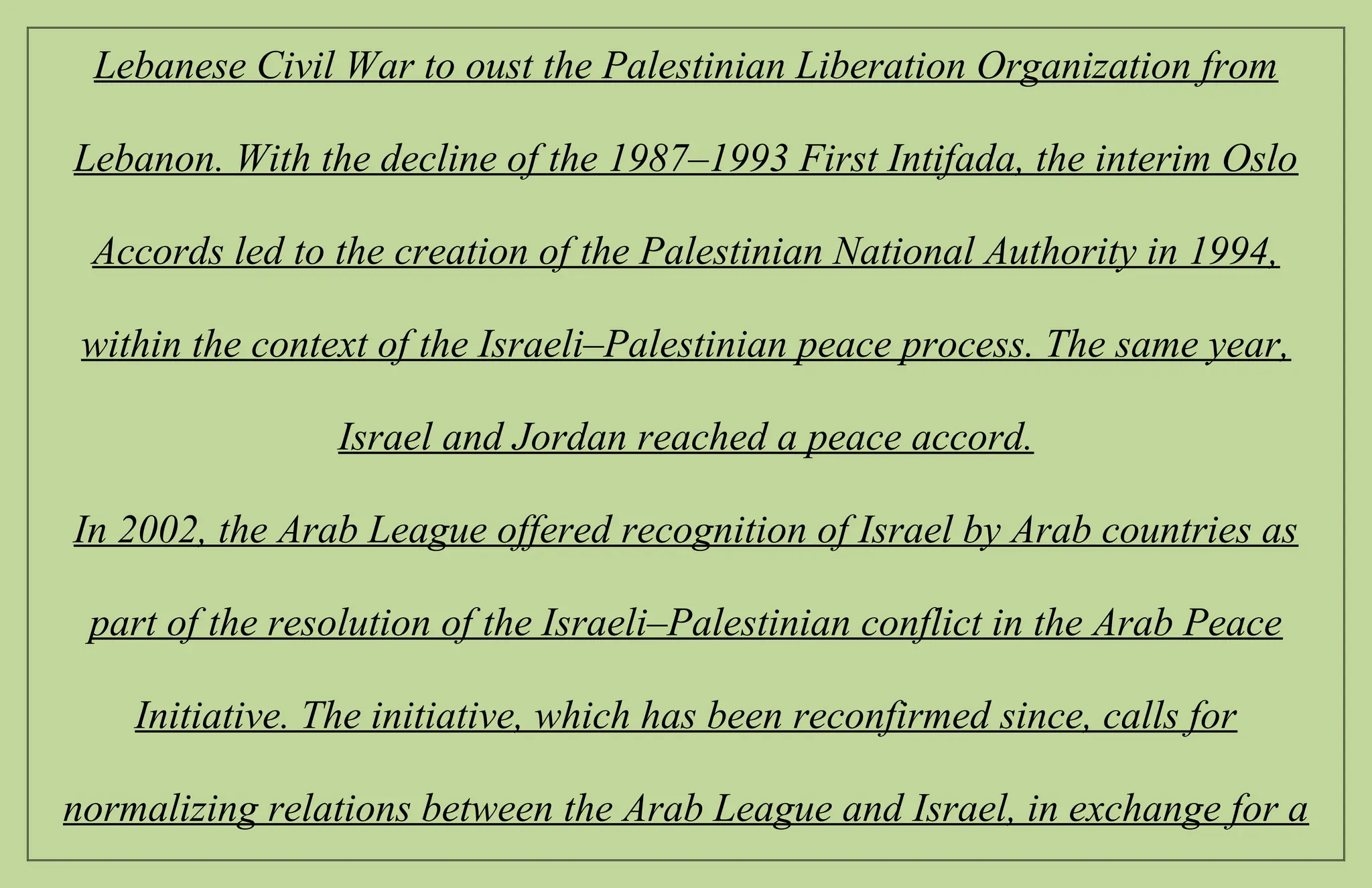
Lebanese Civil War to oust the Palestinian Liberation Organization from
Lebanon. With the decline of the 1987–1993 First Intifada, the interim Oslo
Accords led to the creation of the Palestinian National Authority in 1994,
within the context of the Israeli–Palestinian peace process. The same year,
Israel and Jordan reached a peace accord.
In 2002, the Arab League offered recognition of Israel by Arab countries as
part of the resolution of the Israeli–Palestinian conflict in the Arab Peace
Initiative. The initiative, which has been reconfirmed since, calls for
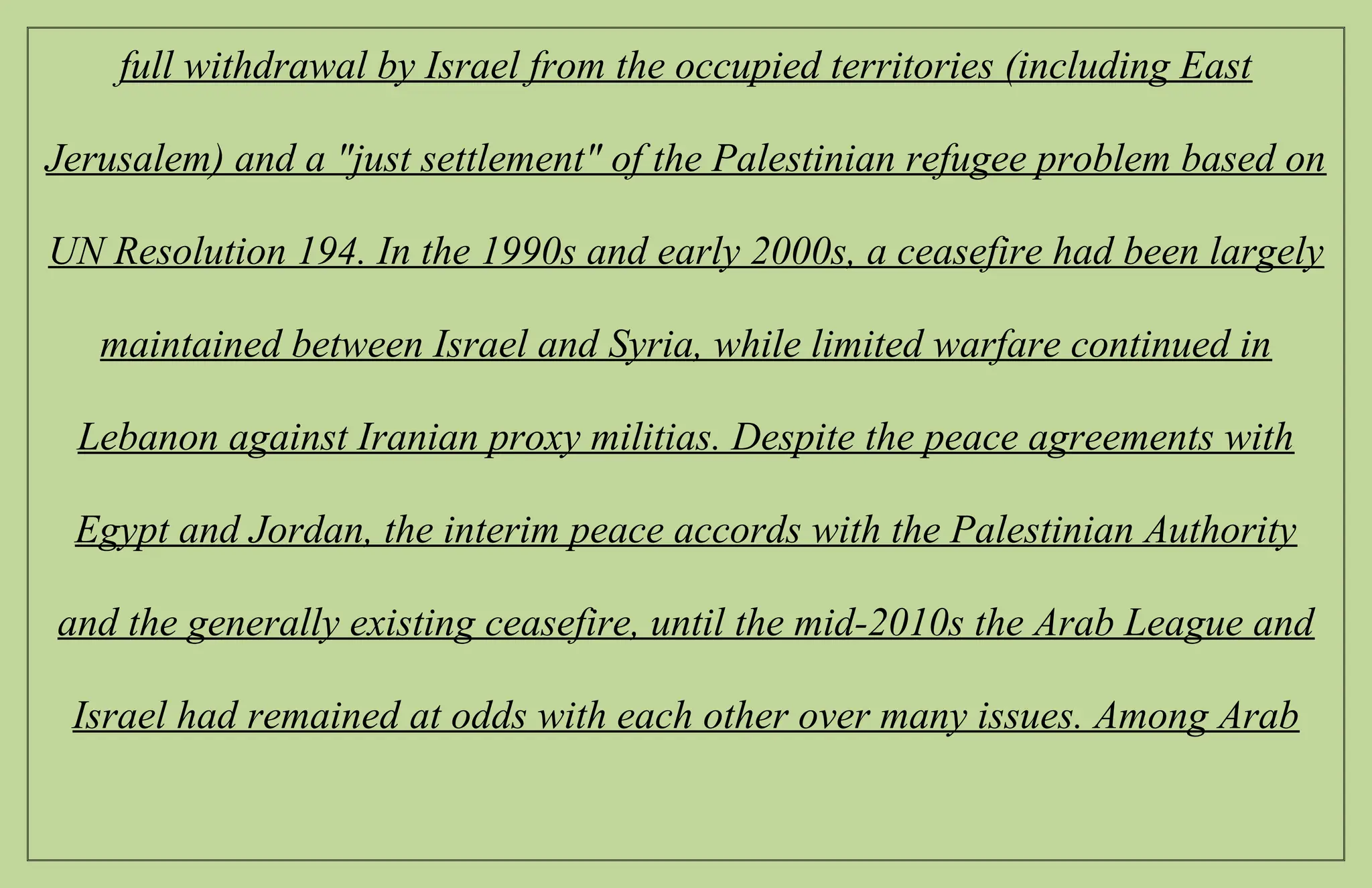
normalizing relations between the Arab League and Israel, in exchange for a
full withdrawal by Israel from the occupied territories (including East
Jerusalem) and a "just settlement" of the Palestinian refugee problem based on
UN Resolution 194. In the 1990s and early 2000s, a ceasefire had been largely
maintained between Israel and Syria, while limited warfare continued in
Lebanon against Iranian proxy militias. Despite the peace agreements with
Egypt and Jordan, the interim peace accords with the Palestinian Authority
and the generally existing ceasefire, until the mid-2010s the Arab League and
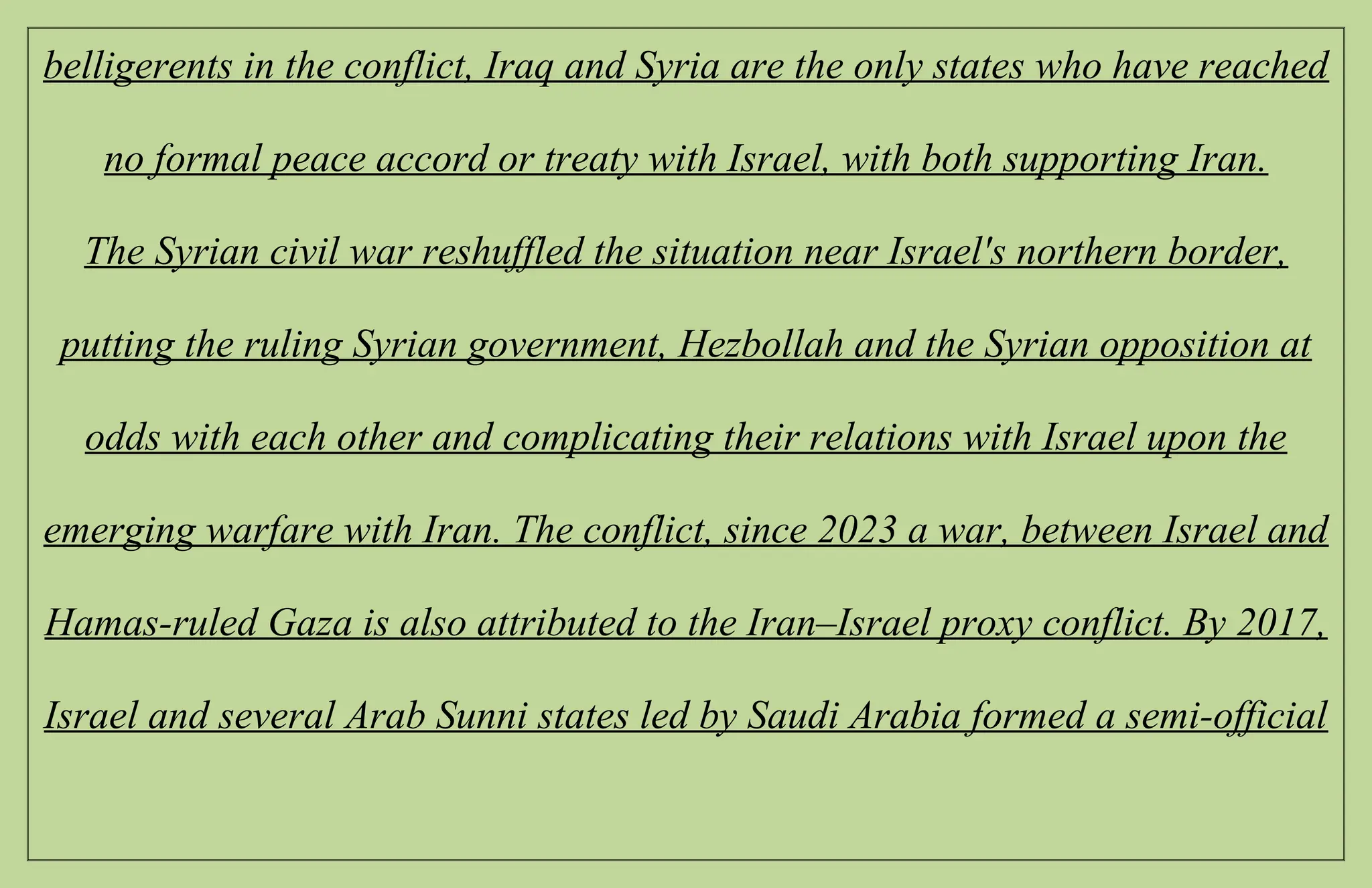
Israel had remained at odds with each other over many issues. Among Arab
belligerents in the conflict, Iraq and Syria are the only states who have reached
no formal peace accord or treaty with Israel, with both supporting Iran.
The Syrian civil war reshuffled the situation near Israel's northern border,
putting the ruling Syrian government, Hezbollah and the Syrian opposition at
odds with each other and complicating their relations with Israel upon the
emerging warfare with Iran. The conflict, since 2023 a war, between Israel and
Hamas-ruled Gaza is also attributed to the Iran–Israel proxy conflict. By 2017,
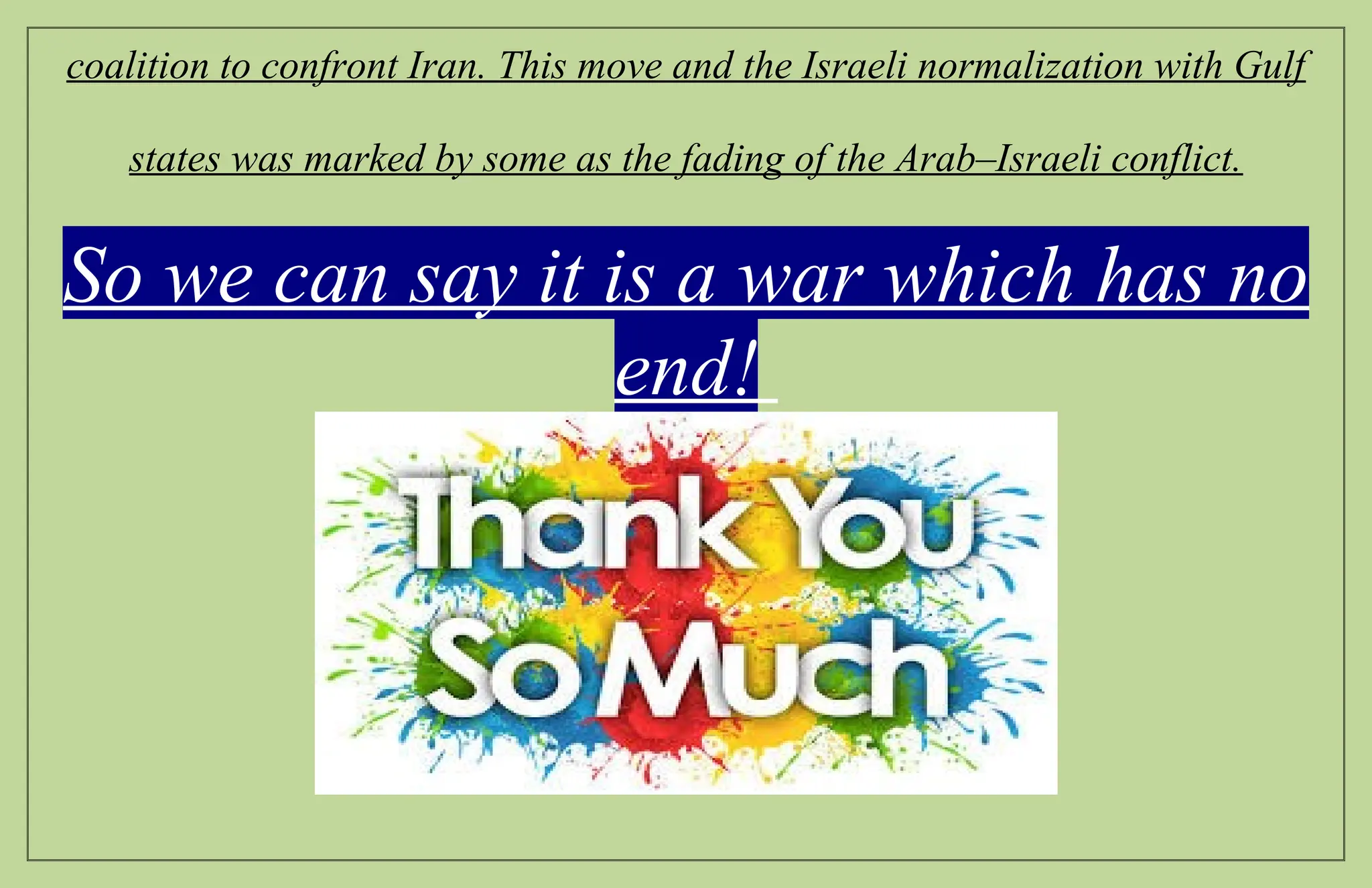
Israel and several Arab Sunni states led by Saudi Arabia formed a semi-official
coalition to confront Iran. This move and the Israeli normalization with Gulf
states was marked by some as the fading of the Arab–Israeli conflict.
So we can say it is a war which has no
end!

MS SAJJDALODHI NOTES FROM IGCSEWhy Is Israel Attacking Lebanon Now.docx

  • 1.
    Why Is IsraelAttacking Lebanon Now Israel stated that it had been attacking in Lebanon to destroy Hezbollah's military capabilities so that they no longer pose a threat to it. At the start of the
  • 2.
    invasion, the LebaneseArmed Forces (LAF) withdrew from parts of the Blue Line. On 27 November, the ceasefire agreement came into effect. Why is Lebanon at war with Israel? In response to Palestinian attacks from Lebanon, Israel invaded the country in 1978 and again in 1982. After this it occupied southern Lebanon until 2000, while fighting a guerrilla conflict against Shia paramilitaries. After Israel's withdrawal, Hezbollah attacks sparked the 2006 Lebanon War. Notable wars and violent events Time Name Israeli deaths[citation needed] Arab deaths Notes 1948–1949 First Arab–Israeli War 6,373 10,000[157] Israeli victory, independence confirmed
  • 3.
    Time Name Israelideaths[citation needed] Arab deaths Notes 1951–1955 Palestinian Fedayeen insurgency 967 3,000–5,000[158] Israeli victory 1956 Suez War 231 2,000[159] Israeli military victory, Egyptian political victory Israeli occupation of the Sinai Peninsula until March 1957 1967 Six-Day War 776 12,000[160] –13,000[161] Israeli victory Israel captures and occupies the Gaza Strip and Sinai Peninsula from Egypt, the West Bank from Jordan, and the Golan Heights from Syria 1967–1970 War of Attrition 1,424 2,500[162] Both sides claim victory, continued Israeli control of Sinai 1968–1982 Palestinian insurgency in South Lebanon Israeli victory 1973 Yom Kippur War 2,688 11,000[163] –13,000[164] Israeli victory, Arab offensives repulsed Camp David Accords followed by Egypt–Israel peace treaty; Israel returns Sinai Peninsula in exchange for mutual recognition 1978 First Israeli invasion of Lebanon 18 1,100 Israeli victory, PLO expelled from southern Lebanon 1982 Second Israeli invasion of Lebanon 1,216 19,085[165] Israeli tactical victory but strategic failure Syrian political advantage PLO expelled from Lebanon 1982–2000 South Lebanon conflict 559 1,897 Hezbollah victory Israeli withdrawal from southern Lebanon 1,276 Hezbollah soldiers, and 621 soldiers of the pro-Israel South Lebanon Army died. 1987–1993 First Palestinian Intifada 200 1,491[166] Israeli victory, uprising suppressed 1991 Iraqi rocket attacks on Israel 13 0 Iraqi strategic failure, Iraq fails to provoke Israeli retaliation 2000–2008 Second Intifada 1,100 4,973[167] Israeli victory, uprising suppressed
  • 4.
    Time Name Israelideaths[citation needed] Arab deaths Notes 2006 2006 Lebanon War 165[168] 1,191[168] Inconclusive, 44 Israeli civilians, 121 Israeli soldiers, 281 Hezbollah and various other militias, 43 Lebanese soldiers, 867 Lebanese civilians died. 2014 2014 Gaza War 73[169] 2,251[169] Inconclusive 2023– present Gaza war (As of October 2024) 1,770 36,000[170] –43,000[171] Ongoing 2023–2024 Israel–Hezbollah conflict (2023– 2024) 100 4,000[172] Ceasefire The Arab–Israeli conflict is the phenomenon involving political tension, military conflicts, and other disputes between various Arab countries, militias and Israel, which escalated during the 20th century. The roots of the Arab–
  • 5.
    Israeli conflict havebeen attributed to the support by Arab League member countries for the Palestinians, a fellow League member, in the ongoing Israeli– Palestinian conflict; this in turn has been attributed to the simultaneous rise of Zionism and Arab nationalism towards the end of the 19th century, though the two national movements had not clashed until the 1920s. In recent times, the Arab-Israeli conflict has shifted to more of a Iranian-Israeli conflict. Part of the Israeli–Palestinian conflict arose from the conflicting claims by these movements to the land that formed the British Mandatory Palestine, which was regarded by the Jewish people as their ancestral
  • 6.
    homeland, while atthe same time it was regarded by the Pan-Arab movement as historically and currently belonging to the Palestinians,and in the Pan- Islamic context, as Muslim lands. The sectarian conflict within the British Mandate territory between Palestinian Jews and Arabs escalated into a full- scale Palestinian civil war in 1947. Taking the side of the Palestinians, especially following the Israeli Declaration of Independence, the neighbouring Arab countries invaded the by-then former Mandate territory in May 1948, commencing the First Arab–Israeli War.
  • 7.
    Large-scale hostilities mostlyended with ceasefire agreements after the 1973 Yom Kippur War. Peace agreements were signed between Israel and Egypt in 1979, resulting in Israeli withdrawal from the Sinai Peninsula and the abolition of the military governance system in the West Bank and Gaza Strip, in favor of Israeli Civil Administration and consequent unilateral annexation of the Golan Heights and East Jerusalem. The nature of the conflict has shifted over the years from the large-scale, regional Arab–Israeli conflict to a more local Israeli–Palestinian conflict, which peaked during the 1982 Lebanon War when Israel intervened in the
  • 8.
    Lebanese Civil Warto oust the Palestinian Liberation Organization from Lebanon. With the decline of the 1987–1993 First Intifada, the interim Oslo Accords led to the creation of the Palestinian National Authority in 1994, within the context of the Israeli–Palestinian peace process. The same year, Israel and Jordan reached a peace accord. In 2002, the Arab League offered recognition of Israel by Arab countries as part of the resolution of the Israeli–Palestinian conflict in the Arab Peace Initiative. The initiative, which has been reconfirmed since, calls for normalizing relations between the Arab League and Israel, in exchange for a
  • 9.
    full withdrawal byIsrael from the occupied territories (including East Jerusalem) and a "just settlement" of the Palestinian refugee problem based on UN Resolution 194. In the 1990s and early 2000s, a ceasefire had been largely maintained between Israel and Syria, while limited warfare continued in Lebanon against Iranian proxy militias. Despite the peace agreements with Egypt and Jordan, the interim peace accords with the Palestinian Authority and the generally existing ceasefire, until the mid-2010s the Arab League and Israel had remained at odds with each other over many issues. Among Arab
  • 10.
    belligerents in theconflict, Iraq and Syria are the only states who have reached no formal peace accord or treaty with Israel, with both supporting Iran. The Syrian civil war reshuffled the situation near Israel's northern border, putting the ruling Syrian government, Hezbollah and the Syrian opposition at odds with each other and complicating their relations with Israel upon the emerging warfare with Iran. The conflict, since 2023 a war, between Israel and Hamas-ruled Gaza is also attributed to the Iran–Israel proxy conflict. By 2017, Israel and several Arab Sunni states led by Saudi Arabia formed a semi-official
  • 11.
    coalition to confrontIran. This move and the Israeli normalization with Gulf states was marked by some as the fading of the Arab–Israeli conflict. So we can say it is a war which has no end!