Moulin Rouge Jacqui Whitmore Professor Radek FLM 2009-01 3 December 2009
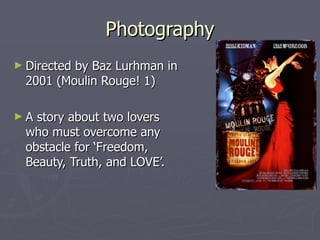
Photography Directed by Baz Lurhman in 2001 (Moulin Rouge! 1) A story about two lovers who must overcome any obstacle for ‘Freedom, Beauty, Truth, and LOVE’.
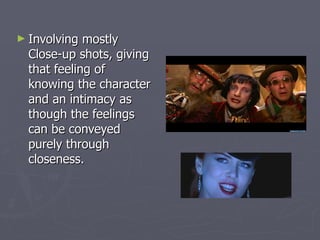
Involving mostly Close-up shots, giving that feeling of knowing the character and an intimacy as though the feelings can be conveyed purely through closeness.
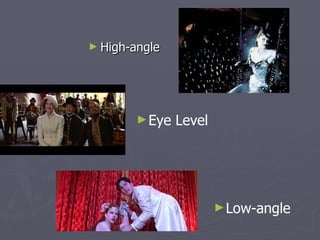
Angles Most of the film consists of Eye-level angling. But in the beginning of the movie there are more high-angle shots (a smattering of Birds-eye as well) To give a hopeful feeling to the audience. Towards the end the cameras stray downward, making the audience feel helpless.
High-angle Eye Level Low-angle
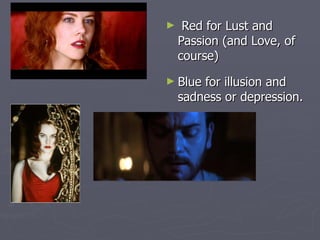
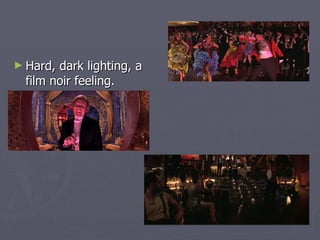
Coloration and Lighting Moulin Rouge is most often low-key with Hard lighting, making shadows and highlights starker and more contrasting. Colors are such a huge part of the movie’s symbolism.
Red for Lust and Passion (and Love, of course) Blue for illusion and sadness or depression.
Hard, dark lighting, a film noir feeling.
Mise-en-Scene Mise-en-Scene is not a very large portion of this movie, but it is sometimes used to convey the themes of duality and the importance of ‘Freedom, Beauty, Truth, and Love’.
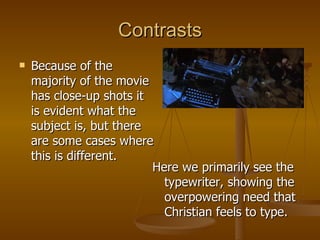
Contrasts Because of the majority of the movie has close-up shots it is evident what the subject is, but there are some cases where this is different. Here we primarily see the typewriter, showing the overpowering need that Christian feels to type.
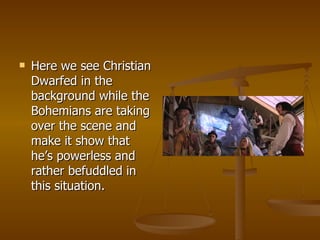
Here we see Christian Dwarfed in the background while the Bohemians are taking over the scene and make it show that he’s powerless and rather befuddled in this situation.
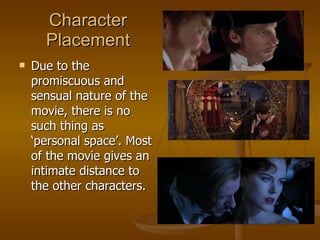
Character Placement Due to the promiscuous and sensual nature of the movie, there is no such thing as ‘personal space’. Most of the movie gives an intimate distance to the other characters.
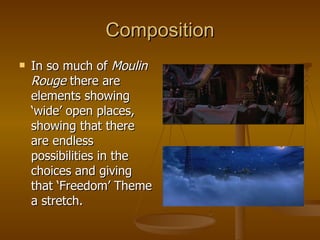
Composition In so much of  Moulin Rouge  there are elements showing ‘wide’ open places, showing that there are endless possibilities in the choices and giving that ‘Freedom’ Theme a stretch.
Movement Movement is such a large part of  Rouge  This is a song widely about near-catches and dance and movement.
Movement within the Frame The characters primarily move from left to right, both in dance and in regular walking and movement.  A case of this would be while Ziddler is singing the introduction of the Moulin Rouge in ‘You’ll Have Fun’.
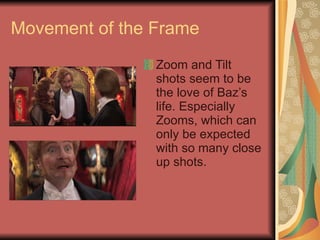
Movement of the Frame Zoom and Tilt shots seem to be the love of Baz’s life. Especially Zooms, which can only be expected with so many close up shots.
Animation Showed most often as a sign that there is something ‘bad’ going on. Very often A slow-motion sequence will come up when, say, Santine is showing signs of her illness, coughing, fainting, falling, and eventually dying.
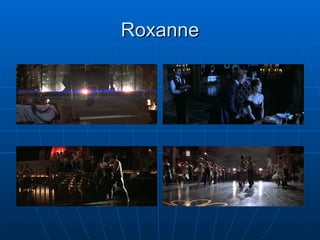
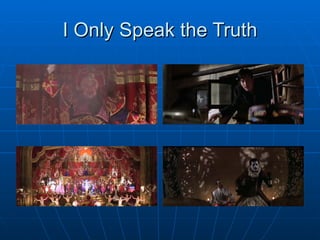
Editing There is an instance of each kind of editing in  Moulin Rouge . But the one that I want to focus on, as it happens the most often, is Classical Cutting, because of the song-sequences this happens often in the movie.
Roxanne
I Only Speak the Truth
So often the Classical cutting shows how high emotions are rolling, and gives a feel of what is happening to each character as well go through, tying together at the end of each song.
Sound Music is the tying theme, the purpose, if you will of the movie, and the vehicle of the theme.
Music The chord structures of so many of these songs are beautiful to listen to, but give the seventh chord, giving unease and stress to the scenes. An underscore is only taken out at important moments, times that seem like time, hearts, and emotions stop and are suspended.
Acting There several Stars in  Moulin Rouge , including Ewan McGregor, Nicole Kidman, and John Leguizamo (Moulin Rouge, 2) But, conversely, there are many extras/Trained professionals. The male extras, for the most part, seem to have little talent, whereas the females dance, and all extras, I imagine, sing.
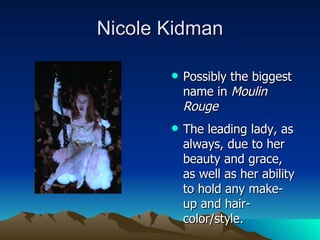
Nicole Kidman Possibly the biggest name in  Moulin Rouge The leading lady, as always, due to her beauty and grace, as well as her ability to hold any make-up and hair-color/style.
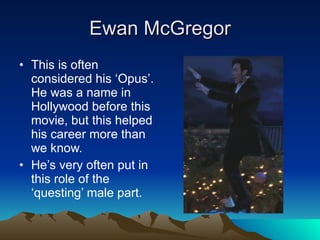
Ewan McGregor This is often considered his ‘Opus’. He was a name in Hollywood before this movie, but this helped his career more than we know. He’s very often put in this role of the ‘questing’ male part.
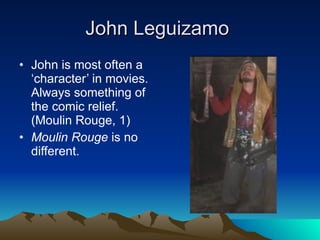
John Leguizamo  John is most often a ‘character’ in movies. Always something of the comic relief. (Moulin Rouge, 1) Moulin Rouge  is no different.
Drama Moulin Rouge , being a ‘musical’ movie, is so very like a musical, only with the ability to use camera angles and close ups. Film is the best medium for this movie, able to see the nuances and use those cuts in songs instead of only having the performers (as with the Love-Medley on the Elephant)
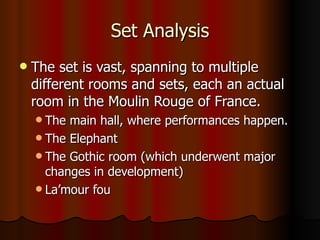
Set Analysis The set is vast, spanning to multiple different rooms and sets, each an actual room in the Moulin Rouge of France. The main hall, where performances happen. The Elephant The Gothic room (which underwent major changes in development) La’mour fou
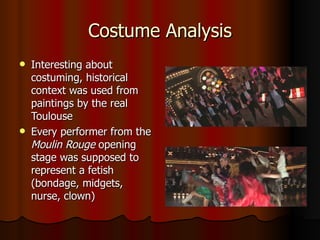
Costume Analysis Interesting about costuming, historical context was used from paintings by the real Toulouse Every performer from the  Moulin Rouge  opening stage was supposed to represent a fetish (bondage, midgets, nurse, clown)
Story The movie is based on Barbara F. McManus’ Pyramid. In the beginning, we see Christian typing his story, thus the story plays out and, in the end, we see how Christian got to that point of depression and why he is no longer with Satine.
Sub plots The large story is all about the love of Satine and Christian, but there ARE sub plots Toulouse is trying to get his bohemian show The Duke is attempting to make Satine only his with Zidler Satine has her agenda of becoming a ‘real actress’
Writing Moulin Rouge is based, mostly, on three stories: The Little Clay Cart (the element of a play within a play going on) The Orpheus story (a man goes into the very pits of hell to find his love, almost takes her out of the underworld, only to have her taken away.) La Traviata (the ‘Fallen’ woman) (Moulin Rouge, 1)
The Script This underwent several different edits. Originally, The Duke was to seduce both Christian and Satine and hook them on morphine (I haven’t been able to find this script, but I WANT to) The Duke had a song called ‘My Way’ In the beginning of the movie, Christians father and other men were going to have a song medley of how he should stay. And, the ‘placeholder’ name of the Duke was ‘Count von Groovy’ (Moulin Rouge, 2)
Ideology The ideology of  Moulin Rouge  is explicitly all BUT conservative, giving a liberal sense of the world. The line of ‘Freedom, Beauty, Truth, and that which we believe in above all things; Love’ comes out multiple times, saying how love is beautiful, so long as it is true love.
Moulin Rouge  is, as the times would suspect, very traditional in male and female roles;  women are to be objects of sex and desire, delicate and beautiful at all times. Men are in control of all things and are the only ones in business mind (As seen with Zidler and the Duke talking of Satine’s fate without her presence)
Liberal views are shown, however, in that the protagonists are almost completely pacifistic it seems (only the Duke and his henchman use violence as a means of getting what they want). The idea of the woman going with the penniless writer instead of the rich man is something that isn’t new, but that certainly goes against the ‘economically correct’ thing to do.
Theory Moulin Rouge  is very formalistic. The camera angles, lighting, and many dance sequences are evidence of using all of the film components to tell the story and the underlying plot.
There is a definite historic basis to  Rouge  but it is mostly a fictional love story with the directors spin on things.
 
Works Cited &quot;Moulin Rouge!&quot;  Internet Movie Database . 2001. Web. Fall 2009. <http://www.imdb.com/>. &quot;Moulin Rouge!&quot;  Wikipedia . 2001. Web. Fall 2009. <http://en.wikipedia.org/wiki/Main_Page>. Moulin Rouge . Dir. Baz Lurhmann. Perf. Nicole Kidman, Ewan McGregor, John Leguizamo. Fox Studios, 2001. DVD.

Moulin Rouge Film Final

  • 1.
    Moulin Rouge JacquiWhitmore Professor Radek FLM 2009-01 3 December 2009
  • 2.
    Photography Directed byBaz Lurhman in 2001 (Moulin Rouge! 1) A story about two lovers who must overcome any obstacle for ‘Freedom, Beauty, Truth, and LOVE’.
  • 3.
    Involving mostly Close-upshots, giving that feeling of knowing the character and an intimacy as though the feelings can be conveyed purely through closeness.
  • 4.
    Angles Most ofthe film consists of Eye-level angling. But in the beginning of the movie there are more high-angle shots (a smattering of Birds-eye as well) To give a hopeful feeling to the audience. Towards the end the cameras stray downward, making the audience feel helpless.
  • 5.
  • 6.
    Coloration and LightingMoulin Rouge is most often low-key with Hard lighting, making shadows and highlights starker and more contrasting. Colors are such a huge part of the movie’s symbolism.
  • 7.
    Red for Lustand Passion (and Love, of course) Blue for illusion and sadness or depression.
  • 8.
    Hard, dark lighting,a film noir feeling.
  • 9.
    Mise-en-Scene Mise-en-Scene isnot a very large portion of this movie, but it is sometimes used to convey the themes of duality and the importance of ‘Freedom, Beauty, Truth, and Love’.
  • 10.
    Contrasts Because ofthe majority of the movie has close-up shots it is evident what the subject is, but there are some cases where this is different. Here we primarily see the typewriter, showing the overpowering need that Christian feels to type.
  • 11.
    Here we seeChristian Dwarfed in the background while the Bohemians are taking over the scene and make it show that he’s powerless and rather befuddled in this situation.
  • 12.
    Character Placement Dueto the promiscuous and sensual nature of the movie, there is no such thing as ‘personal space’. Most of the movie gives an intimate distance to the other characters.
  • 13.
    Composition In somuch of Moulin Rouge there are elements showing ‘wide’ open places, showing that there are endless possibilities in the choices and giving that ‘Freedom’ Theme a stretch.
  • 14.
    Movement Movement issuch a large part of Rouge This is a song widely about near-catches and dance and movement.
  • 15.
    Movement within theFrame The characters primarily move from left to right, both in dance and in regular walking and movement. A case of this would be while Ziddler is singing the introduction of the Moulin Rouge in ‘You’ll Have Fun’.
  • 16.
    Movement of theFrame Zoom and Tilt shots seem to be the love of Baz’s life. Especially Zooms, which can only be expected with so many close up shots.
  • 17.
    Animation Showed mostoften as a sign that there is something ‘bad’ going on. Very often A slow-motion sequence will come up when, say, Santine is showing signs of her illness, coughing, fainting, falling, and eventually dying.
  • 18.
    Editing There isan instance of each kind of editing in Moulin Rouge . But the one that I want to focus on, as it happens the most often, is Classical Cutting, because of the song-sequences this happens often in the movie.
  • 19.
  • 20.
    I Only Speakthe Truth
  • 21.
    So often theClassical cutting shows how high emotions are rolling, and gives a feel of what is happening to each character as well go through, tying together at the end of each song.
  • 22.
    Sound Music isthe tying theme, the purpose, if you will of the movie, and the vehicle of the theme.
  • 23.
    Music The chordstructures of so many of these songs are beautiful to listen to, but give the seventh chord, giving unease and stress to the scenes. An underscore is only taken out at important moments, times that seem like time, hearts, and emotions stop and are suspended.
  • 24.
    Acting There severalStars in Moulin Rouge , including Ewan McGregor, Nicole Kidman, and John Leguizamo (Moulin Rouge, 2) But, conversely, there are many extras/Trained professionals. The male extras, for the most part, seem to have little talent, whereas the females dance, and all extras, I imagine, sing.
  • 25.
    Nicole Kidman Possiblythe biggest name in Moulin Rouge The leading lady, as always, due to her beauty and grace, as well as her ability to hold any make-up and hair-color/style.
  • 26.
    Ewan McGregor Thisis often considered his ‘Opus’. He was a name in Hollywood before this movie, but this helped his career more than we know. He’s very often put in this role of the ‘questing’ male part.
  • 27.
    John Leguizamo John is most often a ‘character’ in movies. Always something of the comic relief. (Moulin Rouge, 1) Moulin Rouge is no different.
  • 28.
    Drama Moulin Rouge, being a ‘musical’ movie, is so very like a musical, only with the ability to use camera angles and close ups. Film is the best medium for this movie, able to see the nuances and use those cuts in songs instead of only having the performers (as with the Love-Medley on the Elephant)
  • 29.
    Set Analysis Theset is vast, spanning to multiple different rooms and sets, each an actual room in the Moulin Rouge of France. The main hall, where performances happen. The Elephant The Gothic room (which underwent major changes in development) La’mour fou
  • 30.
    Costume Analysis Interestingabout costuming, historical context was used from paintings by the real Toulouse Every performer from the Moulin Rouge opening stage was supposed to represent a fetish (bondage, midgets, nurse, clown)
  • 31.
    Story The movieis based on Barbara F. McManus’ Pyramid. In the beginning, we see Christian typing his story, thus the story plays out and, in the end, we see how Christian got to that point of depression and why he is no longer with Satine.
  • 32.
    Sub plots Thelarge story is all about the love of Satine and Christian, but there ARE sub plots Toulouse is trying to get his bohemian show The Duke is attempting to make Satine only his with Zidler Satine has her agenda of becoming a ‘real actress’
  • 33.
    Writing Moulin Rougeis based, mostly, on three stories: The Little Clay Cart (the element of a play within a play going on) The Orpheus story (a man goes into the very pits of hell to find his love, almost takes her out of the underworld, only to have her taken away.) La Traviata (the ‘Fallen’ woman) (Moulin Rouge, 1)
  • 34.
    The Script Thisunderwent several different edits. Originally, The Duke was to seduce both Christian and Satine and hook them on morphine (I haven’t been able to find this script, but I WANT to) The Duke had a song called ‘My Way’ In the beginning of the movie, Christians father and other men were going to have a song medley of how he should stay. And, the ‘placeholder’ name of the Duke was ‘Count von Groovy’ (Moulin Rouge, 2)
  • 35.
    Ideology The ideologyof Moulin Rouge is explicitly all BUT conservative, giving a liberal sense of the world. The line of ‘Freedom, Beauty, Truth, and that which we believe in above all things; Love’ comes out multiple times, saying how love is beautiful, so long as it is true love.
  • 36.
    Moulin Rouge is, as the times would suspect, very traditional in male and female roles; women are to be objects of sex and desire, delicate and beautiful at all times. Men are in control of all things and are the only ones in business mind (As seen with Zidler and the Duke talking of Satine’s fate without her presence)
  • 37.
    Liberal views areshown, however, in that the protagonists are almost completely pacifistic it seems (only the Duke and his henchman use violence as a means of getting what they want). The idea of the woman going with the penniless writer instead of the rich man is something that isn’t new, but that certainly goes against the ‘economically correct’ thing to do.
  • 38.
    Theory Moulin Rouge is very formalistic. The camera angles, lighting, and many dance sequences are evidence of using all of the film components to tell the story and the underlying plot.
  • 39.
    There is adefinite historic basis to Rouge but it is mostly a fictional love story with the directors spin on things.
  • 40.
  • 41.
    Works Cited &quot;MoulinRouge!&quot; Internet Movie Database . 2001. Web. Fall 2009. <http://www.imdb.com/>. &quot;Moulin Rouge!&quot; Wikipedia . 2001. Web. Fall 2009. <http://en.wikipedia.org/wiki/Main_Page>. Moulin Rouge . Dir. Baz Lurhmann. Perf. Nicole Kidman, Ewan McGregor, John Leguizamo. Fox Studios, 2001. DVD.