Michael
Pilch Visionary Cybersecurity Leader |
Driving Innovation and Mentorship
www.ciobusinessworld.com
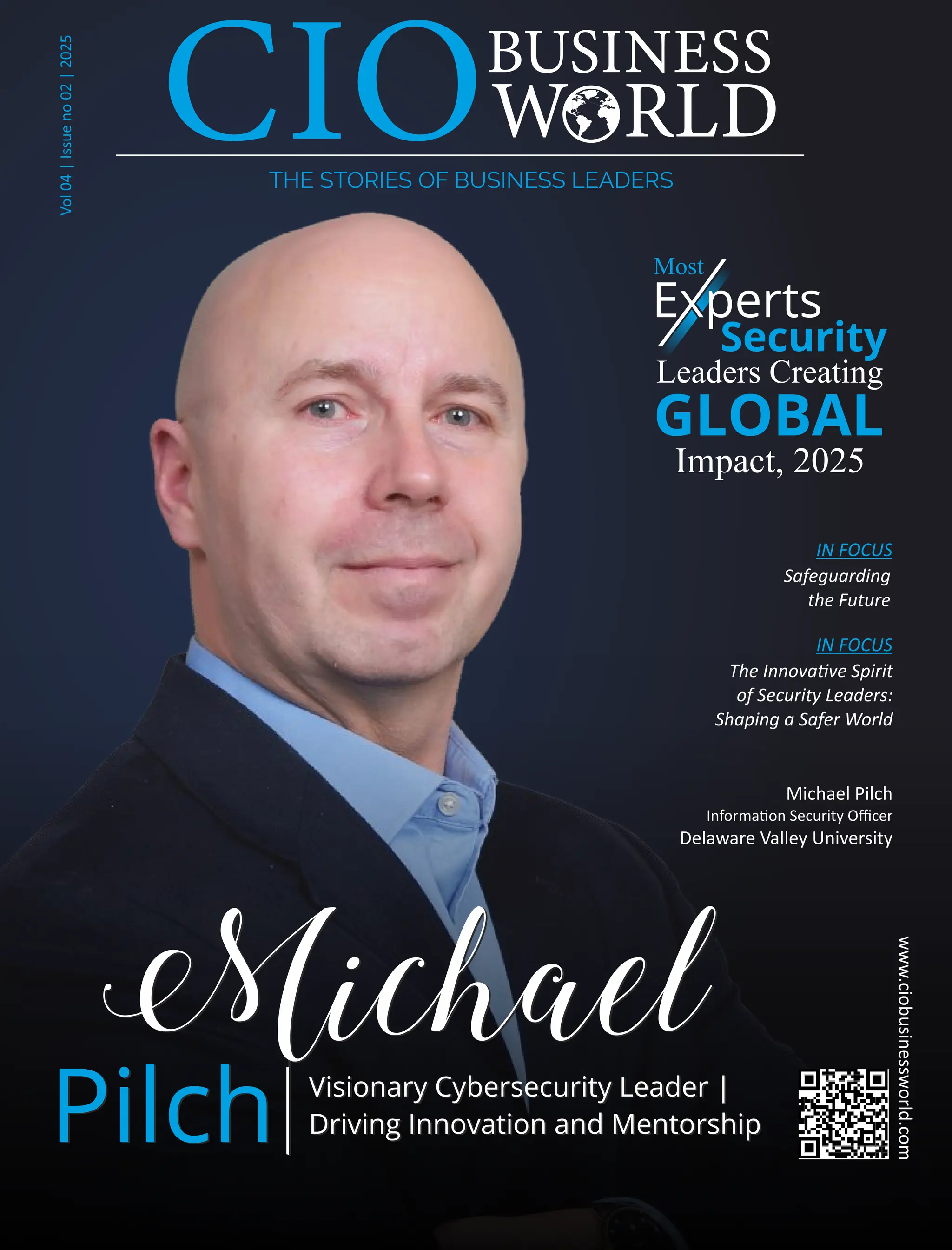
Michael
Pilch Visionary Cybersecurity Leader |
Driving Innovation and Mentorship
Most
Security
Leaders Creating
GLOBAL
Impact, 2025
E erts
p
Michael Pilch
Informa on Security Officer
Delaware Valley University
Safeguarding
the Future
IN FOCUS
The Innova ve Spirit
of Security Leaders:
Shaping a Safer World
IN FOCUS
Vol
04
|
Issue
no
02
|
2025
n today’s fast-evolving world, where digital landscapes
Iand physical infrastructures are under constant threat,
security leaders stand as the vanguards of resilience,
innovation, and protection. At CIO Business World, we are
honored to feature the trailblazers in security—those
shaping the global discourse on cybersecurity, risk
management, and crisis response. This special feature,
“Security Leaders Creating Global Impact,” highlights the
individuals and organizations that are not just mitigating
risks but pioneering transformative solutions to safeguard
businesses, governments, and communities worldwide.
Security leadership has transcended traditional boundaries.
No longer confined to boardrooms or IT departments,
security experts now operate at the forefront of
technological advancements, geopolitical stability, and
corporate governance. From defending against sophisticated
cyber threats to deploying AI-driven surveillance systems
and strengthening international security frameworks,
today’s security leaders are redefining what it means to
protect people, data, and critical infrastructures.
As cyber threats become more sophisticated, security
leaders are adopting cutting-edge solutions such as AI-
powered threat detection, Zero Trust frameworks, and
blockchain-based security protocols. These innovations are
not just reactive measures; they are proactive strategies
designed to outmaneuver cybercriminals and safeguard
sensitive data. Meanwhile, physical security has also
undergone a digital transformation, integrating biometrics,
smart surveillance, and IoT-enabled security systems to
ensure a seamless and adaptive defense mechanism.
Beyond technology, the human element in security
leadership remains pivotal. The role of CISOs, security
strategists, and ethical hackers has never been more critical.
These professionals are driving conversations around data
privacy, ethical AI implementation, and global security
collaboration. The rise of cross-border partnerships—such
as INTERPOL’s cybercrime initiatives and international
cybersecurity alliances—exemplifies the collective effort
required to combat threats that transcend national and
corporate borders.
Moreover, security leaders today are not just problem-
solvers; they are visionaries influencing policy-making,
compliance regulations, and corporate security culture.
Their contributions to regulatory frameworks such as
GDPR, CCPA, and industry-specific compliance laws
ensure that security is embedded in the DNA of modern
businesses. They also play a crucial role in fostering
security awareness programs that empower employees,
stakeholders, and the public to become active participants
in global security efforts.
At CIO Business World, we recognize that security is not a
static discipline—it is a dynamic force that evolves
alongside emerging technologies and global challenges.
This feature celebrates the resilience, adaptability, and
innovative spirit of security leaders who are not only
responding to threats but also shaping a safer, more secure
future. Their work is instrumental in ensuring business
continuity, protecting consumer trust, and reinforcing the
foundations of a stable global economy.
As we shine a spotlight on these industry pioneers, we
invite our readers—business leaders, technology
executives, and security professionals—to engage, learn,
and collaborate in this shared mission. Security is no longer
just a function of IT; it is a strategic imperative that defines
the success and sustainability of organizations in the digital
era.
Join us in exploring how security leaders are making a
global impact, driving innovation, and fortifying the future
of business and society.
Security Leaders Creating
Global Impact
From the
Editor’s desk
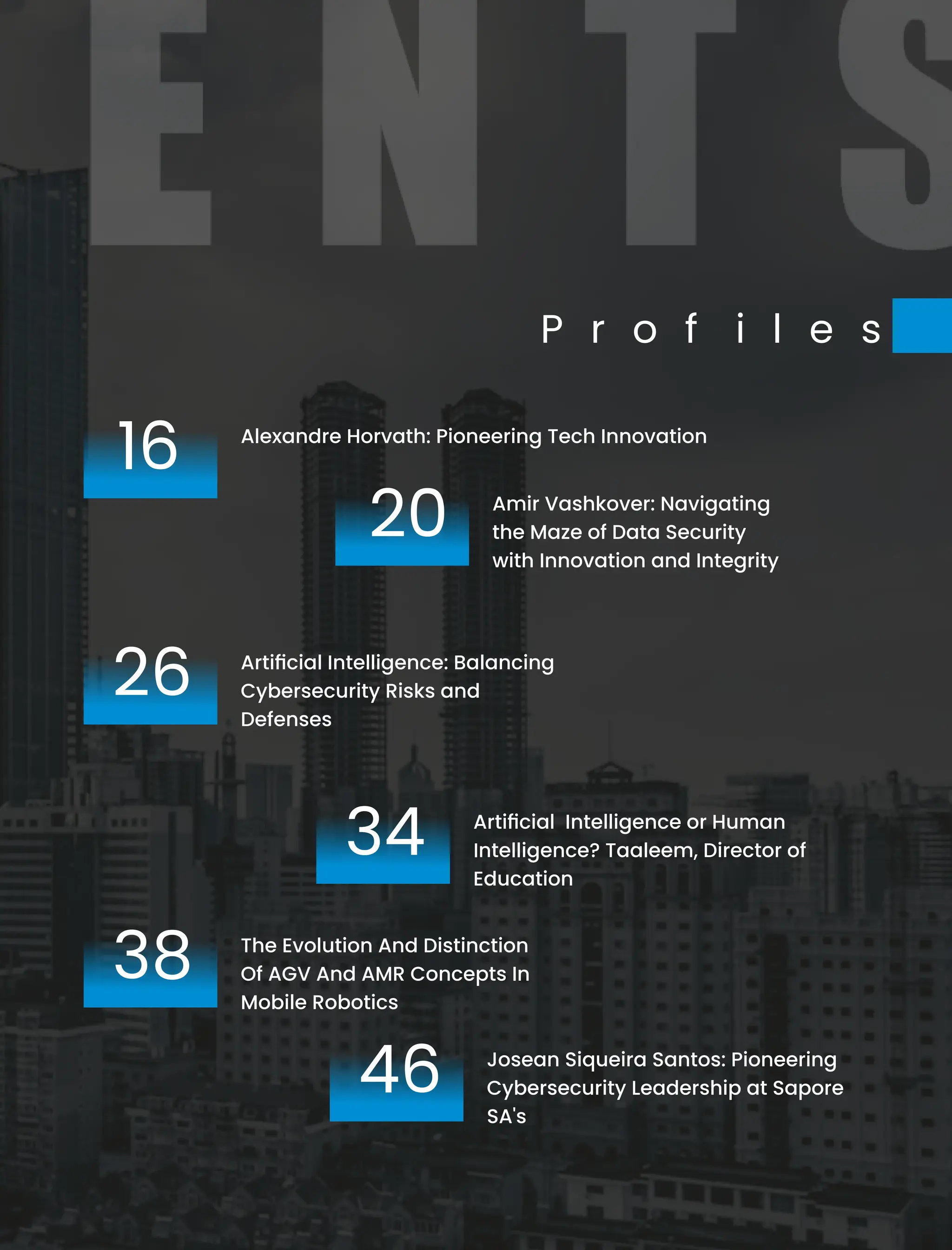
A r t i c l e s
30 42
Safeguarding the
Future
The Innovative Spirit of
Security Leaders_
Shaping a Safer World
Michael Pilch
Visionary Cybersecurity
Leader | Driving Innovation
and Mentorship
10
C o v e r S t o r y
P r o f i l e s
16 Alexandre Horvath: Pioneering Tech Innovation
26 Artificial Intelligence: Balancing
Cybersecurity Risks and
Defenses
20 Amir Vashkover: Navigating
the Maze of Data Security
with Innovation and Integrity
Artificial Intelligence or Human
Intelligence? Taaleem, Director of
Education
34
Josean Siqueira Santos: Pioneering
Cybersecurity Leadership at Sapore
SA's
46
38 The Evolution And Distinction
Of AGV And AMR Concepts In
Mobile Robotics
April, 2025
Michael Pilch
Informa on Security Officer
Delaware Valley University
10 | April www.ciobusinessworld.com
Michael
Pilch Visionary Cybersecurity Leader |
Driving Innovation and Mentorship
C o v e r S t o r y
For Michael Pilch, leadership, cybersecurity innovation, and lifelong learning
aren’t just ambitions—they're a way of life. While advancing his cybersecurity
career, mentoring future professionals, and managing family commitments, he
pursued a rigorous master’s degree at UMass Lowell, dedicating early mornings, late
nights, and weekends to mastering governance, risk management, and security strategy.
That same relentless dedication carried him through the grueling CISSP exam,
demonstrating how passion, discipline, and structured execution turn challenges into
achievements.
Now, as the Information Security Officer at Delaware Valley University, Michael
applies his strategic vision and expertise to tackle evolving cyber threats, enhance
organizational resilience, and mentor the next generation of security professionals. His
journey is a testament to resilience, forward-thinking leadership, and the transformative
power of dedication in the field of cybersecurity.
11 | April www.ciobusinessworld.com
Threats, Challenges, and the Role of Leadership
Michael is a highly respected cybersecurity leader and
serves as Delaware Valley University's Information Security
Officer. With over 15 years of experience, his expertise
spans cybersecurity, risk management, governance, cloud
workloads, virtualization, systems engineering, and network
administration. Committed to protecting the university’s
digital infrastructure, he continuously works to enhance its
security posture.
He holds industry-recognized certifications, including the
Certified Information Systems Security Professional
(CISSP), reflecting his deep cybersecurity expertise. His
academic background includes a bachelor’s degree in
Business Administration from Mansfield University and a
master’s degree in Information Technology from the
University of Massachusetts Lowell. Dedicated to staying
ahead of emerging cybersecurity threats, Pilch actively
engages in continuous learning, research, and industry
collaboration to drive innovation and improve cybersecurity
best practices. As a recognized thought leader, he frequently
speaks at conferences, leads roundtable discussions, and
appears on podcasts to share insights on cybersecurity
trends, strategies, and emerging threats.
Cybersecurity is critical in protecting systems, networks,
applications, and data from cyberattacks while ensuring a
rapid and effective response to security incidents.
Cyberattacks have led to the downfall of long-standing
organizations, such as Lincoln College, Saint Margaret’s
Health, and KNP, with 60% of small businesses closing
within six months due to financial and operational damage.
Cybersecurity is also a matter of national security. Modern
conflicts now involve cyber warfare, with adversaries
targeting infrastructure, intelligence, and public perception.
Russia’s hacking of Ukraine’s power grid provided a
significant strategic advantage, while Ukraine countered
through social engineering tactics, identifying the locations
of Russian troops and launching successful airstrikes.
During the onset of the Hamas-Israel conflict, cybersecurity
firm Cloudflare mitigated large-scale DDoS attacks
designed to disrupt websites providing critical rocket alerts
for civilians.
Cyber threats come in many forms. Nation-states and state-
sponsored hackers engage in cyber espionage, sabotage,
and warfare. Organized crime groups exploit cyberattacks
for financial gain through ransomware, fraud, and data
breaches. Hacktivists target organizations and governments
for ideological, social, or political reasons. Even less-skilled
attackers, known as script kiddies, pose risks by leveraging
pre-made hacking tools to exploit vulnerabilities. With
adversaries constantly evolving their tactics and leveraging
sophisticated tools, cybersecurity remains an ongoing battle
that demands vigilance, expertise, and proactive defense
strategies.
The Role of AI in Cybersecurity
Artificial Intelligence (AI) is revolutionizing cybersecurity
as a weapon for attackers and as a defense tool for security
professionals. Traditionally, phishing emails have been
easily identified due to poor spelling, grammar, and unusual
language. However, AI can eliminate these red flags,
making phishing emails and text messages far more
convincing and difficult to detect.
Deepfake technology, another AI-driven threat, enables the
creation of highly realistic videos, images, and voice
recordings using only a short sample of a person's voice or
appearance. This technology has been exploited in
fraudulent schemes, such as impersonating a CEO to trick
employees into making unauthorized payments, phone calls
for financial scams, and using fake videos and voice
recordings in romance scams. Additionally, AI enables
attackers to develop more sophisticated malware,
potentially elevating novice hackers into highly capable
cyber criminals.
On the defensive side, AI and machine learning (ML) tools
play a crucial role in enhancing threat prevention, detection,
and response. These technologies analyze network traffic,
system activity, and user behavior to establish normal
baselines and identify anomalies. By processing large
volumes of log data, AI can detect indicators of
compromise and attack patterns, significantly improving an
organization’s ability to respond to cyber threats.
Furthermore, predictive analytics help organizations
anticipate and prevent attacks before they occur,
strengthening an organization’s overall cybersecurity
posture.
Preparing for the Quantum Threat
If given the opportunity, Michael Pilch would prioritize
enhancing security awareness training. A 2024 Fortinet
research report indicates that 67% of companies are
concerned about their employees' lack of fundamental
security awareness. Despite this, many organizations fail to
implement security training programs. Yet, social
12 | April www.ciobusinessworld.com
engineering remains one of the
most effective attack
vectors—tricking an individual
into granting access to a network
is often easier than bypassing a
firewall.
A common cybersecurity principle
states that end users are the
weakest link in security. However,
with proper security awareness
training, employees can become a
company’s greatest defense. Well-
trained individuals are more likely
to recognize and prevent social
engineering attacks, such as
phishing, USB drop attacks, and
the dangers of unsecured public
Wi-Fi. Additionally, security-
conscious employees adopt
stronger cybersecurity habits,
including using password
managers, creating complex
passwords, and enabling
multifactor authentication (MFA).
Looking ahead, quantum
computing poses a major
challenge to cybersecurity, with
the most significant threat being
its ability to break
encryption—the backbone of
modern data protection.
Encryption converts plain text into
cipher text, ensuring that data
remains secure in storage and
transit. It safeguards everything
from personal information to
critical infrastructure. Historically,
as encryption standards have been
broken, new and stronger methods
have replaced them. However,
with the rapid advancements in
quantum computing and AI, the
pace at which encryption is
broken could soon outstrip the
development of new
cryptographic defenses. This
highlights the urgent need for
organizations to prepare for a
post-quantum security landscape
13 | April www.ciobusinessworld.com
by adopting quantum-resistant cryptographic solutions
before existing encryption methods become obsolete.
Governments, researchers, and cybersecurity professionals
are already working on post-quantum cryptography
(PQC)—encryption algorithms designed to withstand
quantum-based attacks. However, organizations must
proactively assess their cryptographic dependencies,
monitor advancements in PQC, and develop migration
strategies to ensure long-term security in the quantum era.
Committed to Excellence, Mentorship, and Community
Service
In managing cybersecurity priorities, Pilch upholds the
highest ethical standards while balancing multiple
competing responsibilities. Above all, the protection of
human life remains paramount. Ensuring business
continuity is critical, as cybersecurity should support
operations rather than hinder them. Security controls must
also be cost-effective and practical—investing $1,000 to
protect a $100 asset is not a reasonable approach. His
philosophy centers on making cybersecurity a business
enabler, ensuring that security measures align with
organizational goals while effectively mitigating risks.
Michael believes that passion, dedication, and hard work
are essential for success in cybersecurity. Throughout his
career, he has been fortunate to work alongside exceptional
mentors, managers, and leaders who have supported and
guided him. Their influence played a pivotal role in shaping
his success, and he is deeply grateful for their insights and
encouragement. With a strong desire to pay it forward, he
actively mentors and supports the next generation of
cybersecurity professionals.
Pilch is committed to giving back to his community through
mentorship, education, and service. As a member of the
Occupational Advisory Committee for the Lackawanna
County Career Technology Center, he helps shape the
Computer Networking Infrastructure and Cybersecurity
program by advising on curriculum development and lab
equipment. Last year, he engaged with students, providing
career guidance, industry insights, and hands-on experience
through a penetration testing exercise.
Beyond his professional contributions, he regularly speaks
at industry conferences and appears on podcasts, sharing
expertise on cybersecurity trends, threats, and best
practices. Through these engagements, he aims to educate,
inspire, and strengthen the cybersecurity community.
Outside of cybersecurity, Pilch is dedicated to community
service. As an adult leader in his son’s Boy Scout Troop, he
participates in community service projects such as replacing
flags on graves for Memorial Day, assisting with flag
retirement ceremonies, food drives, and local event support.
His family has also opened their home as foster parents,
providing a stable and supportive environment for children
in need. Whether through education, mentorship, or
community service, Michael is passionate about making a
lasting impact, both professionally and personally. He
believes that cybersecurity is not just about protecting
systems—it’s about protecting people, businesses, and the
future of our digital world.
14 | April www.ciobusinessworld.com
16 | April www.ciobusinessworld.com
17 | April www.ciobusinessworld.com
18 | April www.ciobusinessworld.com
19 | April www.ciobusinessworld.com
20 | April www.ciobusinessworld.com
21 | April www.ciobusinessworld.com
22 | April www.ciobusinessworld.com
23 | April www.ciobusinessworld.com
26 | April www.ciobusinessworld.com
27 | April www.ciobusinessworld.com
28 | April www.ciobusinessworld.com
SAFEGUARDING THE
Future
S
ecurity leaders play a crucial role in shaping a safer
world. In today's digital age, where cyber threats,
geopolitical risks, and organizational security
challenges are evolving rapidly, security professionals are
stepping up to create a global impact. Whether in
cybersecurity, physical security, or risk management, these
leaders are driving innovations, influencing policies, and
strengthening global resilience. Their contributions extend
beyond individual organizations, affecting entire industries
and even national security frameworks.
30 | April www.ciobusinessworld.com
Future
31 | April www.ciobusinessworld.com
Security is no longer just a business concern—it is a global
priority. With cyberattacks on the rise, corporate espionage
increasing, and international conflicts impacting supply
chains, the need for strong security leadership has never
been greater. Security leaders today must navigate complex
global challenges, including cyber threats, corporate
security issues, geopolitical risks, and physical security
concerns such as terrorism. These professionals are not only
defending against attacks but also proactively designing
strategies to mitigate risks before they arise. By addressing
these concerns, security leaders are shaping policies,
implementing robust defense strategies, and fostering
global collaboration.
Cybersecurity is at the heart of modern security efforts.
Industry experts, government officials, and ethical hackers
are working together to strengthen digital defenses.
Organizations are adopting AI-driven security measures,
Zero Trust architectures, and multi-layered defenses to
combat evolving threats. International alliances, such as
INTERPOL’s cybercrime task forces and cybersecurity
partnerships between countries, ensure faster response
times to threats. Additionally, security leaders are investing
in education and awareness programs to ensure that
employees and individuals can recognize and prevent cyber
threats. By fostering a culture of cybersecurity awareness,
they are helping to build stronger defenses at both
individual and organizational levels.
Beyond the digital realm, security leaders are also focused
on physical security. Large corporations, governments, and
security agencies are working to ensure safety in
workplaces, public areas, and critical infrastructures. Crisis
preparedness is a top priority, with security professionals
designing emergency response plans for incidents such as
natural disasters, terrorist threats, and workplace violence.
The integration of AI-powered surveillance, biometrics, and
smart security systems has significantly improved threat
detection and response. Moreover, organizations like ISO
(International Organization for Standardization) set security
standards that companies worldwide adhere to, enhancing
global security resilience. These initiatives not only protect
people and assets but also ensure that businesses can
operate without disruption.
Security leaders don’t just respond to threats—they shape
the future of security policies and innovation. Many
influential figures in security advocate for stronger data
protection laws, international cybersecurity treaties, and
improved risk management strategies. They work alongside
governments to draft cybersecurity and privacy laws,
ensuring that digital and physical security measures are
backed by solid legal frameworks. Additionally, ethical
security solutions, such as responsible AI usage and
biometric data protection, are being developed to balance
security with privacy rights. A diverse security workforce
also plays a crucial role in bringing fresh perspectives and
innovative solutions to complex challenges, making the
industry more inclusive and effective.
As security threats evolve, security leaders must
continuously adapt. The future of global security leadership
will likely focus on AI and automation, leveraging
advanced technologies for predictive threat analysis and
automated security responses. Global cooperation will also
be essential, with countries and organizations strengthening
international alliances to combat security risks more
effectively. Furthermore, ethical security practices will
remain a top priority, ensuring that privacy and human
rights are not compromised in the pursuit of stronger
security measures.
Security leaders are shaping the world in profound ways,
creating safer digital and physical environments for
individuals, businesses, and nations. Their global impact is
undeniable, and as challenges grow, so will their influence
in securing the future. By staying ahead of threats,
implementing innovative solutions, and fostering
international collaboration, these leaders continue to make a
lasting difference in global security.
32 | April www.ciobusinessworld.com
34 | April www.ciobusinessworld.com
35 | April www.ciobusinessworld.com
36 | April www.ciobusinessworld.com
38 | April www.ciobusinessworld.com
39 | April www.ciobusinessworld.com
40 | April www.ciobusinessworld.com
A leader
is one who knows the
way, goes the way,
and shows the way.
42 | April www.ciobusinessworld.com
The Innovative Spirit of Security Leaders:
Shaping a Safer World
ecurity leaders are more than just protectors—they are innovators,
Svisionaries, and architects of a safer future. In a world where threats are
evolving at an unprecedented pace, these professionals are redefining
security through groundbreaking solutions, technological advancements, and
strategic foresight. Their ability to anticipate challenges, adapt to new risks, and
integrate cutting-edge innovations is transforming the global security landscape.
From cybersecurity to physical safety and crisis management, security leaders
are revolutionizing how we approach protection in an interconnected world.
Pioneering Cybersecurity Advancements
One of the most pressing security concerns today is the ever-growing threat of
cyberattacks. Security leaders are at the forefront of developing new strategies to
combat hacking, data breaches, and digital espionage. They are leveraging
artificial intelligence (AI) and machine learning to create predictive
cybersecurity models that can detect and neutralize threats before they occur.
Zero Trust Architecture, a groundbreaking approach to cybersecurity, ensures
that every user and device must continuously verify their identity before
accessing critical systems. This innovation has significantly reduced the risk of
unauthorized access and data leaks. Additionally, ethical hackers, also known as
"white hat" hackers, are working alongside organizations to test vulnerabilities
and strengthen digital defenses. By thinking like cybercriminals, these
professionals stay ahead of malicious threats, ensuring businesses and
individuals remain protected.
43 | April www.ciobusinessworld.com
Smart Technology and the Future of Physical Security
Security leaders are embracing the power of smart
technology to enhance physical security measures.
Advanced surveillance systems now incorporate AI-
powered facial recognition, behavioral analysis, and
biometric authentication to detect potential threats in real
time. These innovations are particularly crucial in high-risk
areas such as airports, government buildings, and large
public events.
Moreover, drone technology is being utilized for border
security, disaster response, and facility monitoring.
Autonomous drones equipped with thermal imaging and
high-resolution cameras can quickly assess security
situations, providing real-time intelligence to response
teams. Smart locks, IoT-connected security systems, and
geofencing technology are also transforming home and
corporate security, ensuring greater protection with minimal
human intervention.
Revolutionizing Crisis Management with Predictive
Analytics
Security leaders are taking crisis management to a new
level with the use of predictive analytics and simulation
technology. By analyzing past incidents and global risk
factors, AI-driven systems can forecast potential security
threats and enable organizations to prepare in advance. This
proactive approach minimizes the impact of natural
disasters, cyberattacks, and terrorist threats.
For instance, digital twin technology—virtual replicas of
physical environments—is being used in security planning.
These digital models allow organizations to simulate
emergency scenarios, test different response strategies, and
refine their crisis management plans. This innovative tool
has been instrumental in improving disaster preparedness in
industries such as aviation, healthcare, and energy.
Innovative Leadership in Risk Intelligence
Security leaders are no longer just reactive forces; they are
proactive strategists who rely on data-driven intelligence to
make informed decisions. Risk intelligence platforms use
big data and AI to analyze geopolitical risks, supply chain
vulnerabilities, and emerging security trends. These insights
help businesses, governments, and international
organizations mitigate risks before they escalate.
Cyber threat intelligence sharing is another key innovation.
Security experts from different sectors collaborate through
global alliances, sharing real-time threat information to
prevent large-scale cyberattacks. Organizations such as the
Cyber Threat Alliance (CTA) and Information Sharing and
Analysis Centers (ISACs) enable security leaders to
respond faster and more effectively to global security
challenges.
Balancing Security with Privacy
As security technologies evolve, ethical considerations have
become a major focus for security leaders. The rise of facial
recognition, biometric authentication, and AI surveillance
has raised concerns about data privacy and individual
rights. Innovative security leaders are developing solutions
that balance security with ethical responsibility.
Privacy-enhancing technologies, such as homomorphic
encryption and decentralized identity verification, allow
users to protect their personal data while still benefiting
from robust security measures. Security innovators are also
advocating for transparency and accountability in AI-driven
security solutions, ensuring that these technologies are used
responsibly and do not contribute to mass surveillance or
discrimination.
A Future Built on Innovation
The future of security is being shaped by leaders who
embrace innovation and adapt to an ever-changing
landscape. The integration of AI, blockchain, quantum
encryption, and biometric security will continue to
revolutionize how we protect data, people, and
infrastructure.
Security leaders are not only addressing today’s
threats—they are anticipating tomorrow’s challenges. Their
innovative spirit is driving the development of smarter,
more efficient security solutions that will define the future
of global protection. Through collaboration, technological
advancements, and ethical leadership, these pioneers are
ensuring that security is not just a reactive measure, but a
proactive force for a safer, more resilient world.
44 | April www.ciobusinessworld.com
46 | April www.ciobusinessworld.com
47 | April www.ciobusinessworld.com
48 | April www.ciobusinessworld.com
Most Expert Security Leaders Creating a Global Impact, 2025

Most Expert Security Leaders Creating a Global Impact, 2025

  • 1.
    Michael Pilch Visionary CybersecurityLeader | Driving Innovation and Mentorship www.ciobusinessworld.com Michael Pilch Visionary Cybersecurity Leader | Driving Innovation and Mentorship Most Security Leaders Creating GLOBAL Impact, 2025 E erts p Michael Pilch Informa on Security Officer Delaware Valley University Safeguarding the Future IN FOCUS The Innova ve Spirit of Security Leaders: Shaping a Safer World IN FOCUS Vol 04 | Issue no 02 | 2025
  • 4.
    n today’s fast-evolvingworld, where digital landscapes Iand physical infrastructures are under constant threat, security leaders stand as the vanguards of resilience, innovation, and protection. At CIO Business World, we are honored to feature the trailblazers in security—those shaping the global discourse on cybersecurity, risk management, and crisis response. This special feature, “Security Leaders Creating Global Impact,” highlights the individuals and organizations that are not just mitigating risks but pioneering transformative solutions to safeguard businesses, governments, and communities worldwide. Security leadership has transcended traditional boundaries. No longer confined to boardrooms or IT departments, security experts now operate at the forefront of technological advancements, geopolitical stability, and corporate governance. From defending against sophisticated cyber threats to deploying AI-driven surveillance systems and strengthening international security frameworks, today’s security leaders are redefining what it means to protect people, data, and critical infrastructures. As cyber threats become more sophisticated, security leaders are adopting cutting-edge solutions such as AI- powered threat detection, Zero Trust frameworks, and blockchain-based security protocols. These innovations are not just reactive measures; they are proactive strategies designed to outmaneuver cybercriminals and safeguard sensitive data. Meanwhile, physical security has also undergone a digital transformation, integrating biometrics, smart surveillance, and IoT-enabled security systems to ensure a seamless and adaptive defense mechanism. Beyond technology, the human element in security leadership remains pivotal. The role of CISOs, security strategists, and ethical hackers has never been more critical. These professionals are driving conversations around data privacy, ethical AI implementation, and global security collaboration. The rise of cross-border partnerships—such as INTERPOL’s cybercrime initiatives and international cybersecurity alliances—exemplifies the collective effort required to combat threats that transcend national and corporate borders. Moreover, security leaders today are not just problem- solvers; they are visionaries influencing policy-making, compliance regulations, and corporate security culture. Their contributions to regulatory frameworks such as GDPR, CCPA, and industry-specific compliance laws ensure that security is embedded in the DNA of modern businesses. They also play a crucial role in fostering security awareness programs that empower employees, stakeholders, and the public to become active participants in global security efforts. At CIO Business World, we recognize that security is not a static discipline—it is a dynamic force that evolves alongside emerging technologies and global challenges. This feature celebrates the resilience, adaptability, and innovative spirit of security leaders who are not only responding to threats but also shaping a safer, more secure future. Their work is instrumental in ensuring business continuity, protecting consumer trust, and reinforcing the foundations of a stable global economy. As we shine a spotlight on these industry pioneers, we invite our readers—business leaders, technology executives, and security professionals—to engage, learn, and collaborate in this shared mission. Security is no longer just a function of IT; it is a strategic imperative that defines the success and sustainability of organizations in the digital era. Join us in exploring how security leaders are making a global impact, driving innovation, and fortifying the future of business and society. Security Leaders Creating Global Impact
  • 5.
  • 6.
    A r ti c l e s 30 42 Safeguarding the Future The Innovative Spirit of Security Leaders_ Shaping a Safer World Michael Pilch Visionary Cybersecurity Leader | Driving Innovation and Mentorship 10 C o v e r S t o r y
  • 7.
    P r of i l e s 16 Alexandre Horvath: Pioneering Tech Innovation 26 Artificial Intelligence: Balancing Cybersecurity Risks and Defenses 20 Amir Vashkover: Navigating the Maze of Data Security with Innovation and Integrity Artificial Intelligence or Human Intelligence? Taaleem, Director of Education 34 Josean Siqueira Santos: Pioneering Cybersecurity Leadership at Sapore SA's 46 38 The Evolution And Distinction Of AGV And AMR Concepts In Mobile Robotics
  • 8.
  • 10.
    Michael Pilch Informa onSecurity Officer Delaware Valley University 10 | April www.ciobusinessworld.com
  • 11.
    Michael Pilch Visionary CybersecurityLeader | Driving Innovation and Mentorship C o v e r S t o r y For Michael Pilch, leadership, cybersecurity innovation, and lifelong learning aren’t just ambitions—they're a way of life. While advancing his cybersecurity career, mentoring future professionals, and managing family commitments, he pursued a rigorous master’s degree at UMass Lowell, dedicating early mornings, late nights, and weekends to mastering governance, risk management, and security strategy. That same relentless dedication carried him through the grueling CISSP exam, demonstrating how passion, discipline, and structured execution turn challenges into achievements. Now, as the Information Security Officer at Delaware Valley University, Michael applies his strategic vision and expertise to tackle evolving cyber threats, enhance organizational resilience, and mentor the next generation of security professionals. His journey is a testament to resilience, forward-thinking leadership, and the transformative power of dedication in the field of cybersecurity. 11 | April www.ciobusinessworld.com
  • 12.
    Threats, Challenges, andthe Role of Leadership Michael is a highly respected cybersecurity leader and serves as Delaware Valley University's Information Security Officer. With over 15 years of experience, his expertise spans cybersecurity, risk management, governance, cloud workloads, virtualization, systems engineering, and network administration. Committed to protecting the university’s digital infrastructure, he continuously works to enhance its security posture. He holds industry-recognized certifications, including the Certified Information Systems Security Professional (CISSP), reflecting his deep cybersecurity expertise. His academic background includes a bachelor’s degree in Business Administration from Mansfield University and a master’s degree in Information Technology from the University of Massachusetts Lowell. Dedicated to staying ahead of emerging cybersecurity threats, Pilch actively engages in continuous learning, research, and industry collaboration to drive innovation and improve cybersecurity best practices. As a recognized thought leader, he frequently speaks at conferences, leads roundtable discussions, and appears on podcasts to share insights on cybersecurity trends, strategies, and emerging threats. Cybersecurity is critical in protecting systems, networks, applications, and data from cyberattacks while ensuring a rapid and effective response to security incidents. Cyberattacks have led to the downfall of long-standing organizations, such as Lincoln College, Saint Margaret’s Health, and KNP, with 60% of small businesses closing within six months due to financial and operational damage. Cybersecurity is also a matter of national security. Modern conflicts now involve cyber warfare, with adversaries targeting infrastructure, intelligence, and public perception. Russia’s hacking of Ukraine’s power grid provided a significant strategic advantage, while Ukraine countered through social engineering tactics, identifying the locations of Russian troops and launching successful airstrikes. During the onset of the Hamas-Israel conflict, cybersecurity firm Cloudflare mitigated large-scale DDoS attacks designed to disrupt websites providing critical rocket alerts for civilians. Cyber threats come in many forms. Nation-states and state- sponsored hackers engage in cyber espionage, sabotage, and warfare. Organized crime groups exploit cyberattacks for financial gain through ransomware, fraud, and data breaches. Hacktivists target organizations and governments for ideological, social, or political reasons. Even less-skilled attackers, known as script kiddies, pose risks by leveraging pre-made hacking tools to exploit vulnerabilities. With adversaries constantly evolving their tactics and leveraging sophisticated tools, cybersecurity remains an ongoing battle that demands vigilance, expertise, and proactive defense strategies. The Role of AI in Cybersecurity Artificial Intelligence (AI) is revolutionizing cybersecurity as a weapon for attackers and as a defense tool for security professionals. Traditionally, phishing emails have been easily identified due to poor spelling, grammar, and unusual language. However, AI can eliminate these red flags, making phishing emails and text messages far more convincing and difficult to detect. Deepfake technology, another AI-driven threat, enables the creation of highly realistic videos, images, and voice recordings using only a short sample of a person's voice or appearance. This technology has been exploited in fraudulent schemes, such as impersonating a CEO to trick employees into making unauthorized payments, phone calls for financial scams, and using fake videos and voice recordings in romance scams. Additionally, AI enables attackers to develop more sophisticated malware, potentially elevating novice hackers into highly capable cyber criminals. On the defensive side, AI and machine learning (ML) tools play a crucial role in enhancing threat prevention, detection, and response. These technologies analyze network traffic, system activity, and user behavior to establish normal baselines and identify anomalies. By processing large volumes of log data, AI can detect indicators of compromise and attack patterns, significantly improving an organization’s ability to respond to cyber threats. Furthermore, predictive analytics help organizations anticipate and prevent attacks before they occur, strengthening an organization’s overall cybersecurity posture. Preparing for the Quantum Threat If given the opportunity, Michael Pilch would prioritize enhancing security awareness training. A 2024 Fortinet research report indicates that 67% of companies are concerned about their employees' lack of fundamental security awareness. Despite this, many organizations fail to implement security training programs. Yet, social 12 | April www.ciobusinessworld.com
  • 13.
    engineering remains oneof the most effective attack vectors—tricking an individual into granting access to a network is often easier than bypassing a firewall. A common cybersecurity principle states that end users are the weakest link in security. However, with proper security awareness training, employees can become a company’s greatest defense. Well- trained individuals are more likely to recognize and prevent social engineering attacks, such as phishing, USB drop attacks, and the dangers of unsecured public Wi-Fi. Additionally, security- conscious employees adopt stronger cybersecurity habits, including using password managers, creating complex passwords, and enabling multifactor authentication (MFA). Looking ahead, quantum computing poses a major challenge to cybersecurity, with the most significant threat being its ability to break encryption—the backbone of modern data protection. Encryption converts plain text into cipher text, ensuring that data remains secure in storage and transit. It safeguards everything from personal information to critical infrastructure. Historically, as encryption standards have been broken, new and stronger methods have replaced them. However, with the rapid advancements in quantum computing and AI, the pace at which encryption is broken could soon outstrip the development of new cryptographic defenses. This highlights the urgent need for organizations to prepare for a post-quantum security landscape 13 | April www.ciobusinessworld.com
  • 14.
    by adopting quantum-resistantcryptographic solutions before existing encryption methods become obsolete. Governments, researchers, and cybersecurity professionals are already working on post-quantum cryptography (PQC)—encryption algorithms designed to withstand quantum-based attacks. However, organizations must proactively assess their cryptographic dependencies, monitor advancements in PQC, and develop migration strategies to ensure long-term security in the quantum era. Committed to Excellence, Mentorship, and Community Service In managing cybersecurity priorities, Pilch upholds the highest ethical standards while balancing multiple competing responsibilities. Above all, the protection of human life remains paramount. Ensuring business continuity is critical, as cybersecurity should support operations rather than hinder them. Security controls must also be cost-effective and practical—investing $1,000 to protect a $100 asset is not a reasonable approach. His philosophy centers on making cybersecurity a business enabler, ensuring that security measures align with organizational goals while effectively mitigating risks. Michael believes that passion, dedication, and hard work are essential for success in cybersecurity. Throughout his career, he has been fortunate to work alongside exceptional mentors, managers, and leaders who have supported and guided him. Their influence played a pivotal role in shaping his success, and he is deeply grateful for their insights and encouragement. With a strong desire to pay it forward, he actively mentors and supports the next generation of cybersecurity professionals. Pilch is committed to giving back to his community through mentorship, education, and service. As a member of the Occupational Advisory Committee for the Lackawanna County Career Technology Center, he helps shape the Computer Networking Infrastructure and Cybersecurity program by advising on curriculum development and lab equipment. Last year, he engaged with students, providing career guidance, industry insights, and hands-on experience through a penetration testing exercise. Beyond his professional contributions, he regularly speaks at industry conferences and appears on podcasts, sharing expertise on cybersecurity trends, threats, and best practices. Through these engagements, he aims to educate, inspire, and strengthen the cybersecurity community. Outside of cybersecurity, Pilch is dedicated to community service. As an adult leader in his son’s Boy Scout Troop, he participates in community service projects such as replacing flags on graves for Memorial Day, assisting with flag retirement ceremonies, food drives, and local event support. His family has also opened their home as foster parents, providing a stable and supportive environment for children in need. Whether through education, mentorship, or community service, Michael is passionate about making a lasting impact, both professionally and personally. He believes that cybersecurity is not just about protecting systems—it’s about protecting people, businesses, and the future of our digital world. 14 | April www.ciobusinessworld.com
  • 16.
    16 | Aprilwww.ciobusinessworld.com
  • 17.
    17 | Aprilwww.ciobusinessworld.com
  • 18.
    18 | Aprilwww.ciobusinessworld.com
  • 19.
    19 | Aprilwww.ciobusinessworld.com
  • 20.
    20 | Aprilwww.ciobusinessworld.com
  • 21.
    21 | Aprilwww.ciobusinessworld.com
  • 22.
    22 | Aprilwww.ciobusinessworld.com
  • 23.
    23 | Aprilwww.ciobusinessworld.com
  • 26.
    26 | Aprilwww.ciobusinessworld.com
  • 27.
    27 | Aprilwww.ciobusinessworld.com
  • 28.
    28 | Aprilwww.ciobusinessworld.com
  • 30.
    SAFEGUARDING THE Future S ecurity leadersplay a crucial role in shaping a safer world. In today's digital age, where cyber threats, geopolitical risks, and organizational security challenges are evolving rapidly, security professionals are stepping up to create a global impact. Whether in cybersecurity, physical security, or risk management, these leaders are driving innovations, influencing policies, and strengthening global resilience. Their contributions extend beyond individual organizations, affecting entire industries and even national security frameworks. 30 | April www.ciobusinessworld.com Future
  • 31.
    31 | Aprilwww.ciobusinessworld.com
  • 32.
    Security is nolonger just a business concern—it is a global priority. With cyberattacks on the rise, corporate espionage increasing, and international conflicts impacting supply chains, the need for strong security leadership has never been greater. Security leaders today must navigate complex global challenges, including cyber threats, corporate security issues, geopolitical risks, and physical security concerns such as terrorism. These professionals are not only defending against attacks but also proactively designing strategies to mitigate risks before they arise. By addressing these concerns, security leaders are shaping policies, implementing robust defense strategies, and fostering global collaboration. Cybersecurity is at the heart of modern security efforts. Industry experts, government officials, and ethical hackers are working together to strengthen digital defenses. Organizations are adopting AI-driven security measures, Zero Trust architectures, and multi-layered defenses to combat evolving threats. International alliances, such as INTERPOL’s cybercrime task forces and cybersecurity partnerships between countries, ensure faster response times to threats. Additionally, security leaders are investing in education and awareness programs to ensure that employees and individuals can recognize and prevent cyber threats. By fostering a culture of cybersecurity awareness, they are helping to build stronger defenses at both individual and organizational levels. Beyond the digital realm, security leaders are also focused on physical security. Large corporations, governments, and security agencies are working to ensure safety in workplaces, public areas, and critical infrastructures. Crisis preparedness is a top priority, with security professionals designing emergency response plans for incidents such as natural disasters, terrorist threats, and workplace violence. The integration of AI-powered surveillance, biometrics, and smart security systems has significantly improved threat detection and response. Moreover, organizations like ISO (International Organization for Standardization) set security standards that companies worldwide adhere to, enhancing global security resilience. These initiatives not only protect people and assets but also ensure that businesses can operate without disruption. Security leaders don’t just respond to threats—they shape the future of security policies and innovation. Many influential figures in security advocate for stronger data protection laws, international cybersecurity treaties, and improved risk management strategies. They work alongside governments to draft cybersecurity and privacy laws, ensuring that digital and physical security measures are backed by solid legal frameworks. Additionally, ethical security solutions, such as responsible AI usage and biometric data protection, are being developed to balance security with privacy rights. A diverse security workforce also plays a crucial role in bringing fresh perspectives and innovative solutions to complex challenges, making the industry more inclusive and effective. As security threats evolve, security leaders must continuously adapt. The future of global security leadership will likely focus on AI and automation, leveraging advanced technologies for predictive threat analysis and automated security responses. Global cooperation will also be essential, with countries and organizations strengthening international alliances to combat security risks more effectively. Furthermore, ethical security practices will remain a top priority, ensuring that privacy and human rights are not compromised in the pursuit of stronger security measures. Security leaders are shaping the world in profound ways, creating safer digital and physical environments for individuals, businesses, and nations. Their global impact is undeniable, and as challenges grow, so will their influence in securing the future. By staying ahead of threats, implementing innovative solutions, and fostering international collaboration, these leaders continue to make a lasting difference in global security. 32 | April www.ciobusinessworld.com
  • 34.
    34 | Aprilwww.ciobusinessworld.com
  • 35.
    35 | Aprilwww.ciobusinessworld.com
  • 36.
    36 | Aprilwww.ciobusinessworld.com
  • 38.
    38 | Aprilwww.ciobusinessworld.com
  • 39.
    39 | Aprilwww.ciobusinessworld.com
  • 40.
    40 | Aprilwww.ciobusinessworld.com
  • 41.
    A leader is onewho knows the way, goes the way, and shows the way.
  • 42.
    42 | Aprilwww.ciobusinessworld.com
  • 43.
    The Innovative Spiritof Security Leaders: Shaping a Safer World ecurity leaders are more than just protectors—they are innovators, Svisionaries, and architects of a safer future. In a world where threats are evolving at an unprecedented pace, these professionals are redefining security through groundbreaking solutions, technological advancements, and strategic foresight. Their ability to anticipate challenges, adapt to new risks, and integrate cutting-edge innovations is transforming the global security landscape. From cybersecurity to physical safety and crisis management, security leaders are revolutionizing how we approach protection in an interconnected world. Pioneering Cybersecurity Advancements One of the most pressing security concerns today is the ever-growing threat of cyberattacks. Security leaders are at the forefront of developing new strategies to combat hacking, data breaches, and digital espionage. They are leveraging artificial intelligence (AI) and machine learning to create predictive cybersecurity models that can detect and neutralize threats before they occur. Zero Trust Architecture, a groundbreaking approach to cybersecurity, ensures that every user and device must continuously verify their identity before accessing critical systems. This innovation has significantly reduced the risk of unauthorized access and data leaks. Additionally, ethical hackers, also known as "white hat" hackers, are working alongside organizations to test vulnerabilities and strengthen digital defenses. By thinking like cybercriminals, these professionals stay ahead of malicious threats, ensuring businesses and individuals remain protected. 43 | April www.ciobusinessworld.com
  • 44.
    Smart Technology andthe Future of Physical Security Security leaders are embracing the power of smart technology to enhance physical security measures. Advanced surveillance systems now incorporate AI- powered facial recognition, behavioral analysis, and biometric authentication to detect potential threats in real time. These innovations are particularly crucial in high-risk areas such as airports, government buildings, and large public events. Moreover, drone technology is being utilized for border security, disaster response, and facility monitoring. Autonomous drones equipped with thermal imaging and high-resolution cameras can quickly assess security situations, providing real-time intelligence to response teams. Smart locks, IoT-connected security systems, and geofencing technology are also transforming home and corporate security, ensuring greater protection with minimal human intervention. Revolutionizing Crisis Management with Predictive Analytics Security leaders are taking crisis management to a new level with the use of predictive analytics and simulation technology. By analyzing past incidents and global risk factors, AI-driven systems can forecast potential security threats and enable organizations to prepare in advance. This proactive approach minimizes the impact of natural disasters, cyberattacks, and terrorist threats. For instance, digital twin technology—virtual replicas of physical environments—is being used in security planning. These digital models allow organizations to simulate emergency scenarios, test different response strategies, and refine their crisis management plans. This innovative tool has been instrumental in improving disaster preparedness in industries such as aviation, healthcare, and energy. Innovative Leadership in Risk Intelligence Security leaders are no longer just reactive forces; they are proactive strategists who rely on data-driven intelligence to make informed decisions. Risk intelligence platforms use big data and AI to analyze geopolitical risks, supply chain vulnerabilities, and emerging security trends. These insights help businesses, governments, and international organizations mitigate risks before they escalate. Cyber threat intelligence sharing is another key innovation. Security experts from different sectors collaborate through global alliances, sharing real-time threat information to prevent large-scale cyberattacks. Organizations such as the Cyber Threat Alliance (CTA) and Information Sharing and Analysis Centers (ISACs) enable security leaders to respond faster and more effectively to global security challenges. Balancing Security with Privacy As security technologies evolve, ethical considerations have become a major focus for security leaders. The rise of facial recognition, biometric authentication, and AI surveillance has raised concerns about data privacy and individual rights. Innovative security leaders are developing solutions that balance security with ethical responsibility. Privacy-enhancing technologies, such as homomorphic encryption and decentralized identity verification, allow users to protect their personal data while still benefiting from robust security measures. Security innovators are also advocating for transparency and accountability in AI-driven security solutions, ensuring that these technologies are used responsibly and do not contribute to mass surveillance or discrimination. A Future Built on Innovation The future of security is being shaped by leaders who embrace innovation and adapt to an ever-changing landscape. The integration of AI, blockchain, quantum encryption, and biometric security will continue to revolutionize how we protect data, people, and infrastructure. Security leaders are not only addressing today’s threats—they are anticipating tomorrow’s challenges. Their innovative spirit is driving the development of smarter, more efficient security solutions that will define the future of global protection. Through collaboration, technological advancements, and ethical leadership, these pioneers are ensuring that security is not just a reactive measure, but a proactive force for a safer, more resilient world. 44 | April www.ciobusinessworld.com
  • 46.
    46 | Aprilwww.ciobusinessworld.com
  • 47.
    47 | Aprilwww.ciobusinessworld.com
  • 48.
    48 | Aprilwww.ciobusinessworld.com