1
Monroe County Autism Foundation
Public Relations Campaign Recommendation
Skylar Whitney
4.29.15
2
Situation Analysis
HISTORY: Monroe County Autism Foundation (MCAF) exists to serve children in Monroe
County, Indiana who are diagnosed with Autism Spectrum Disorder by providing financial
resources for necessary educational and therapeutic interventions. MCAF was founded in 2011
as R.E.A.C.H. Autism Foundation. The original mission was to help families in the community,
with children diagnosed with ASD, obtain the much-needed services they deserve. After adding
more board members and the eventual resignation of the founding president, R.E.A.C.H.
transformed into the current foundation, while trying to keep a similar mission to help those on
Monroe County.
COMPETITION: They have many competitors in the nonprofit sector, large and small, that pull
funding away from MCAF and the families they are striving to help. Local Autism-support
competitors with similar missions to MCAF include the Indiana Resource Center for Autism—
who is supported by the Indiana Institute on Disability and Community, as well as the research
center of the VP Provost for Research at IU Bloomington—and the Autism Society of America’s
South Central Indiana Chapter, which is just one chapter of a nationwide nonprofit supported
by large companies across the country. Outside competitors include any other nonprofit
corporations with missions that require donations from their audiences ranging from
healthcare and animals to the environment. All nonprofit organizations are competing for a
limited number of donation resources.
GOAL: According to the President of the Foundation—Andrew Lambert, Monroe County Autism
Foundation’s “most important goal” for 2015, aside from providing essential benefits to
families in need, is to increase the organization’s visibility and awareness among their target
audiences. Those three key audiences include: current donors, Monroe County families with
children diagnosed on the spectrum, and potential donors and volunteers interested in aiding
MCAF and their mission.
REPUTATION: The first impression of this organization is that its newly formed board is still
figuring out the nonprofit side of communications. Currently, the foundations strengths lie in
the organization and dedication of its board members, the number of upcoming fundraising
events, and the lack of outright competition in Bloomington, Indiana. MCAF’s weaknesses are
their lack of a strong social media presence, the lack of publicity surrounding their upcoming
events, and their website, which lacks easily accessible information and a regularly scheduled
communication platform. All of the weaknesses MCAF faces are communications-related, which
limit them from achieving their largest goal for the year and take away from the strengths the
organization currently possess.
3
Communications Analysis
COMMUNICATIONS: The Monroe County Autism Foundation’s current approach to increasing
visibility and mission awareness among its audiences is attempting to expand in Bloomington
via social media sites, like Facebook, and support materials, such as informational brochures.
Presently, the foundation does not have any goals aimed toward specific communications
tactics allowing MCAF to reach these segmented audiences. Because of their position in the
early stages of building, they should be as accessible as possible with multiple outlets for two-
way communication.
AUDIENCE: Without the donations, MCAF would have no money to operate or to help families;
therefore, the most important audience to Monroe County Autism Foundation is the potential
donors and volunteers interested in pledging money to children and family-support nonprofits.
These individuals are members of the middle to upper class, traditionally liberal, with interests
in supporting others through charitable donations or actions. Next, MCAF focuses on reaching
parents with children diagnosed on the spectrum, who are members of the lower or middle
class and unable to afford therapy or other assistive—yet costly—programs. Many of the
members of both segments are either unaware of the benefits Monroe County Autism
Foundation offers, or are confused on the purpose of the Foundation (i.e., distributing
monetary benefits, therapy, insurance). Lastly, current or previous donors should be considered
as an important audience because they are already connected to MCAF.
TOOLS: Monroe County Autism Foundation’s primary communications tools are the
organizations website, an informational brochure about Autism, and the Facebook page. The
brand looses recognition and value outside the Southern Indiana Autism Community because of
the sheer volume of other nonprofit’s communications. Previously, MCAF has not presented a
cohesive brand image to prospective donors or families, making it difficult for people to
recognize or look for a message.
WEBSITE: Monroe County Autism Foundation has a basic website which is maintained by
Tribeswell, a website design and Internet marketing firm. Aside from the home page and some
basic facts about Autism, all of the information provided on the website is outdated or
unneeded. Not only is the list of board members out-of-date, but the address and phone
number listed are old as well. Additionally, the donation page is extremely confusing. It only
accepts donations in increments of $10 dollars and asks for a quantity of $10 dollar donations
(i.e., 2 = $20, 3 = $30). This deters interested parties from donating online because they are not
free to make their own donation decision. If users still decide to make a donation and input a
quantity, they are redirected to PayPal page under the name of R.E.A.C.H Foundation, LLC. This
further confuses audience members and creates uncertainty about MCAF’s credibility.
SUPPORT MEDIA: Much of the information in the organization’s brochure is facts about Autism
Spectrum Disorder, how it affects the families of the diagnosed individuals, and what types of
services are traditionally offered. The way this information is presented gives little insight as to
4
the purpose or mission of Monroe County Autism Foundation. With no contact information
provided, it is difficult for people who are interested to get that information.
SOCIAL MEDIA: The organization’s Facebook page provides a link to the website and pictures
from past events. The page had 74 likes despite the previous lapse in posts; before February of
2015, MCAF posted an average of once every two months. Just prior to the communications
tracking, MCAF made some updates to their Facebook page, including adding upcoming event
pages, photos of support media, and use of hashtags. Although the page was created for the
event, zero Facebook users had been invited to RSVP to the event. The support media photos
that were uploaded received a lot of post shares and five likes. Overall, the history of
infrequent posts makes their page look unprofessional and outdated.
Communications Tracking
RESEARCH: Prior to analysis of MCAF’s single social media account, their Facebook page had
less than 75 likes, infrequent posts with month-long absences, and a basic lack of organizational
presence online.
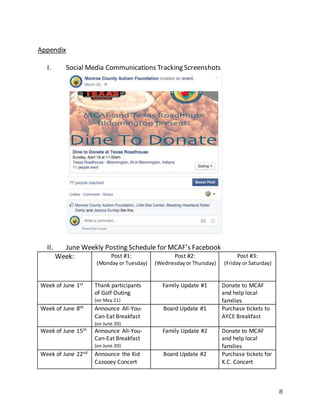
TRACKING: The 10-day social media tracking began March 25th, 2015 and monitored any posts,
comments, likes, and shares. On the first day of the tracking, MCAF created and shared two
identical event pages for their upcoming Dine to Donate nights (April 12th and April 19th),
sponsored by Texas Roadhouse. These events are held each Sunday in April in honor of Autism
Awareness Month and each event at the end of the 10-day monitoring period, each event little
to no publicity. The April 12th event had only one like with no shares or comments and zero
people attending or invited. The second event, on April 19th, had four likes, but zero attendance
responses, no shares or comments (Appendix I). Also, no people had been invited to the event,
making it impossible for people to respond.
FOLLOW-UP: Aside from the two events, MCAF had no other posts on their Facebook page. The
foundation also made no connections with its audience members or other similar organizations.
Because of the four likes on the second event post and the slight increase in recent posting
frequency, Monroe County Autism Foundation’s page received nine new likes. Since the close
of the communications tracking (as of Saturday April 25th) the page had increased to 93 likes.
Public Relations Campaign Outline and Tool Development
STRATEGY: The communications campaign for Monroe County Autism Foundation will deliver
its mission to audiences over a three-month strategy for the organization’s most important goal
of 2015, launching June 1st, 2015. The core message of the campaign is the desire of MCAF to
enable families that would be otherwise unable to afford or achieve remedial therapy for their
children with the help of the local community through the creation of multiple communication
platforms between Monroe County Autism Foundation and it’s publics. Elements of this
campaign will utilize upcoming fundraising events to reach more donors and families. The four
5
elements include: increasing the social media presence of MCAF to include multiple posts per
week; creating and distributing a monthly newsletter; redesigning the brochure; and purchasing
a traditional radio advertisement with a popular station in and around Monroe County. These
elements will to increase the organization’s visibility and awareness among their target
audiences of potential donors families with autistic members, and local individuals interested in
aiding MCAF with their mission.
SOCIAL MEDIA: By creating and organizing multiple communications platforms, MCAF will be
able to reach key audiences with MCAF’s mission, basic information, and organizational
updates. First, The organization’s Facebook page will be used to share informational posts
about upcoming summer events and sponsorships, as well as the creation of individual event
pages for each one. After the creation of the event pages on June 1st, each of the 7 board
members should send event invitations to their list of friends in and around Monroe County
who are on Facebook. This will give people the opportunity to get more involved because they
have a personal connection to a member of the MCAF Board and it gives them ample time to
plan to attend the event. This stronger social media presence also provides the event pages
with credibility because hundreds of people will be invited to attend each event. Monroe
County Autism Foundation should also adhere a weekly posting schedule on Facebook by
setting posts to queue weeks in advance beginning June 1st and continuing throughout the
campaign (Appendix II). This provides MCAF with a cohesive and planned, yet simple, presence
on social media. It is recommended that MCAF post a minimum of three times per week: at
least one post will pertain to an upcoming event, at least one post will pertain to the work that
the board is doing with local families, and at least one post per week will exclusively request
donations to aid MCAF’s mission, although all posts will include some form of call-to-action.
With an increase of traffic on MCAF’s Facebook page, page and post likes, comments, and
shares are likely to increase as well. The activity provides perspective donors or volunteers with
both a two-way communication platform and a credible source for information pertaining to
the foundation. It also delivers families with an easy way to connect with MCAF to receive the
help they provide to those in need.
E-NEWSLETTER: Second, MCAF should construct a monthly e-newsletter to distribute
information to interested parties, presenting a year-round way to keep in contact with the most
interested parties. Information distributed will include times and dates of upcoming events,
opportunities to get involved, and updates on families helped with the funds raised. Most of
the information shared each month on the foundation’s Facebook page will serve as a content
outline for the e-newsletter. A sign-up box will be featured on the foundation’s website
homepage, donation page, and volunteer page, as well as sharing the e-newsletter sign-up
information on the Facebook page. This push of information to interested parties shows them
where their donations are going and how to get involved with events. This e-newsletter
invitation should also be sent in print form to previous donors, which keeps MCAF and the
families it helps stay on the minds of those who support the mission. The sign-ups for this
newsletter would begin on Facebook with the campaign in June, following with the addition to
the website shortly after campaign launch. The first newsletter would be sent out on July 15th
and monthly on 15th for at least two months to test effectiveness.
6
BROCHURE: Next, Monroe County Autism Foundation should assess the current brochure being
used to promote the organization. The foundation should plan to remove any information not
pertaining directly to MCAF and it’s mission, and redesign the brochure to be more modern and
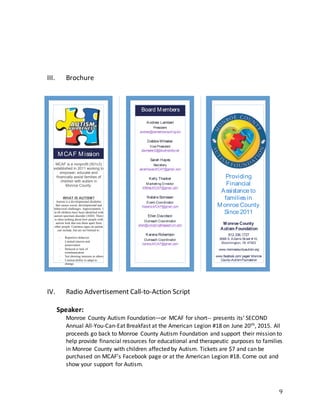
professional. Four major updates to the brochure include: current contact information, photos
of events or persons assisted, family testimonials, and a directly stated mission should all be
included in the update as well (Appendix III). Contact information for each board member and
the current address and phone number for MCAF should be added clearly on the new brochure.
One section of the brochure should be dedicated to a photo and testimonial quote from a
family who has been sponsored by MCAF. Additionally, the types of services the foundation
offers should also be included to inform families seeking assistance what MCAF is able to do to
help, along with a clear mission statement for the organization. The brochure will be included in
press kits, and any support media used at events. This will clarify for any interested audiences
who MCAF is and what their contributions are allowing MCAF to do for the families in Monroe
County affected by Autism.
ADVERTISEMENT: Finally, MCAF should use a small amount of donated funds to purchase a
radio advertisement with Bloomington’s B97. This advertisement will serve as an introduction
of Monroe County Autism Foundation and it’s upcoming event to the city of Bloomington and
its surrounding areas. It will begin airing on B97 one week after the campaign launch, on
Monday, June 8th. Information about the date, location, and tickets for the 2nd Annual MCAF All-
You-Can-Eat Breakfast event will also be included in this advertisement. Interested audience
members in the area could also become volunteers or attendants of future events. A call-to-
action will end the advertisement asking listeners to “Like” the Facebook page and buy tickets
to the 2nd Annual MCAF All-You-Can-Eat Breakfast (Appendix IV). This shows the B97 audience,
which is mainly students and younger Bloomington residents (ages 25-35), that the event is
open to the public, getting even more audience members involved. Upon evaluation if the radio
advertisement is viewed by the foundation as successful, it is recommended that they purchase
another advertisement and use similar event marketing techniques for the 4th Annual MCAF 5K
in either September or October of 2015.
EVALUTATION: To evaluate this campaign, MCAF will measure the elements in multiple ways
following the three-month implementation, on August 31st, 2015. First, they will assess for an
increase in the number of page and post likes, comments and shares, and the frequency of
which interested audience members communicate with the Foundation on Facebook. Social
media is the most important platform for communication with potential audience members, so
MCAF should aim for a 15 percent increase throughout the three-month campaign. If the social
media schedule continues with a minimum of 3 posts per week through the end of 2015, MCAF
should expect a near 40 percent increase in followers and a 15 to 20 percent increase in
communication with the foundation’s page. Next, MCAF can track the number of registrations
to the monthly e-newsletter and responses to the donor letters. The number of participants at
each event should be closely monitored, either by ticket sales or head counting. E-newsletter
sign-up sheets should also be included at each event to encourage attendees to register and
continue their support for MCAF. Any annual events will be compared to the turnout from the
7
previous year or years for evaluation of success. Specifically, ticket sales for the All-You-Can-Eat
Breakfast in June should be monitored to track the effectiveness of the radio advertisement
compared to the sales of last years breakfast event. Finally, the amount of donations collected
during the three-month campaign—June 1st-August 31st, 2015—will provide some additional
insight into the use of social media, fundraising events, and traditional advertisements have on
the financial stability of the foundation.
8
Appendix
I. Social Media Communications Tracking Screenshots
II. June Weekly Posting Schedule for MCAF’s Facebook
Week: Post #1:
(Monday or Tuesday)
Post #2:
(Wednesdayor Thursday)
Post #3:
(Friday or Saturday)
Week of June 1st Thank participants
of Golf Outing
(on May 21)
Family Update #1 Donate to MCAF
and help local
families
Week of June 8th Announce All-You-
Can-Eat Breakfast
(on June 20)
Board Update #1 Purchase tickets to
AYCE Breakfast
Week of June 15th Announce All-You-
Can-Eat Breakfast
(on June 20)
Family Update #2 Donate to MCAF
and help local
families
Week of June 22nd Announce the Kid
Cazooey Concert
Board Update #2 Purchase tickets for
K.C. Concert
9
III. Brochure
IV. Radio Advertisement Call-to-Action Script
Speaker:
Monroe County Autism Foundation—or MCAF for short-- presents its’ SECOND
Annual All-You-Can-Eat Breakfast at the American Legion #18 on June 20th, 2015. All
proceeds go back to Monroe County Autism Foundation and support their mission to
help provide financial resources for educational and therapeutic purposes to families
in Monroe County with children affected by Autism. Tickets are $7 and can be
purchased on MCAF’s Facebook page or at the American Legion #18. Come out and
show your support for Autism.
MCAF Mission
Board Members
Andrew Lambert
President
andrew@lambertconsulting.biz
DebbieWheeler
Vice President
dswheeler53@bluemarble.net
Sarah Hayes
Secretary
sarahhayes.MCAF@gmail.com
Kelly Thacker
Marketing Director
klfeltes.MCAF@gmail.com
Natalie Somesan
Event Coordinator
Natalie.MCAF@gmail.com
Ellen Davidson
Outreach Coordinator
ellen@unlockingthespectrum.com
Karena Robertson
Outreach Coordinator
karena.MCAF@gmail.com
Providing
Financial
Assistance to
familiesin
Monroe County
Since 2011
Monroe County
Autism Foundation
MCAF is a nonprofit (501c3)
established in 2011 working to
empower, educate and
financially assist families of
children with autism in
Monroe County.
WHAT IS AUTISM?
Autism is a developmental disability
that causes social, developmental and
behavioral challenges. Approximately 1
in 68 children have been identified with
autism spectrum disorder (ASD). There
is often nothing about how people with
autism look that sets them apart from
other people. Common signs on autism
can include, but are not limited to:
· Repetitive behavior
· Limited interest and
preservation
· Delayed or lack of
communication
· Not showing interests in others
· Limited ability to adapt to
change
812.336.1727
2668 S. Adams Street #10,
Bloomington, IN 47403
www.monroecountyautism.org
www.facebook.com/ pages/ Monroe-
County-Autism-Foundation

Monroe County Autism Foundation Campaign Presentation

  • 1.
    1 Monroe County AutismFoundation Public Relations Campaign Recommendation Skylar Whitney 4.29.15
  • 2.
    2 Situation Analysis HISTORY: MonroeCounty Autism Foundation (MCAF) exists to serve children in Monroe County, Indiana who are diagnosed with Autism Spectrum Disorder by providing financial resources for necessary educational and therapeutic interventions. MCAF was founded in 2011 as R.E.A.C.H. Autism Foundation. The original mission was to help families in the community, with children diagnosed with ASD, obtain the much-needed services they deserve. After adding more board members and the eventual resignation of the founding president, R.E.A.C.H. transformed into the current foundation, while trying to keep a similar mission to help those on Monroe County. COMPETITION: They have many competitors in the nonprofit sector, large and small, that pull funding away from MCAF and the families they are striving to help. Local Autism-support competitors with similar missions to MCAF include the Indiana Resource Center for Autism— who is supported by the Indiana Institute on Disability and Community, as well as the research center of the VP Provost for Research at IU Bloomington—and the Autism Society of America’s South Central Indiana Chapter, which is just one chapter of a nationwide nonprofit supported by large companies across the country. Outside competitors include any other nonprofit corporations with missions that require donations from their audiences ranging from healthcare and animals to the environment. All nonprofit organizations are competing for a limited number of donation resources. GOAL: According to the President of the Foundation—Andrew Lambert, Monroe County Autism Foundation’s “most important goal” for 2015, aside from providing essential benefits to families in need, is to increase the organization’s visibility and awareness among their target audiences. Those three key audiences include: current donors, Monroe County families with children diagnosed on the spectrum, and potential donors and volunteers interested in aiding MCAF and their mission. REPUTATION: The first impression of this organization is that its newly formed board is still figuring out the nonprofit side of communications. Currently, the foundations strengths lie in the organization and dedication of its board members, the number of upcoming fundraising events, and the lack of outright competition in Bloomington, Indiana. MCAF’s weaknesses are their lack of a strong social media presence, the lack of publicity surrounding their upcoming events, and their website, which lacks easily accessible information and a regularly scheduled communication platform. All of the weaknesses MCAF faces are communications-related, which limit them from achieving their largest goal for the year and take away from the strengths the organization currently possess.
  • 3.
    3 Communications Analysis COMMUNICATIONS: TheMonroe County Autism Foundation’s current approach to increasing visibility and mission awareness among its audiences is attempting to expand in Bloomington via social media sites, like Facebook, and support materials, such as informational brochures. Presently, the foundation does not have any goals aimed toward specific communications tactics allowing MCAF to reach these segmented audiences. Because of their position in the early stages of building, they should be as accessible as possible with multiple outlets for two- way communication. AUDIENCE: Without the donations, MCAF would have no money to operate or to help families; therefore, the most important audience to Monroe County Autism Foundation is the potential donors and volunteers interested in pledging money to children and family-support nonprofits. These individuals are members of the middle to upper class, traditionally liberal, with interests in supporting others through charitable donations or actions. Next, MCAF focuses on reaching parents with children diagnosed on the spectrum, who are members of the lower or middle class and unable to afford therapy or other assistive—yet costly—programs. Many of the members of both segments are either unaware of the benefits Monroe County Autism Foundation offers, or are confused on the purpose of the Foundation (i.e., distributing monetary benefits, therapy, insurance). Lastly, current or previous donors should be considered as an important audience because they are already connected to MCAF. TOOLS: Monroe County Autism Foundation’s primary communications tools are the organizations website, an informational brochure about Autism, and the Facebook page. The brand looses recognition and value outside the Southern Indiana Autism Community because of the sheer volume of other nonprofit’s communications. Previously, MCAF has not presented a cohesive brand image to prospective donors or families, making it difficult for people to recognize or look for a message. WEBSITE: Monroe County Autism Foundation has a basic website which is maintained by Tribeswell, a website design and Internet marketing firm. Aside from the home page and some basic facts about Autism, all of the information provided on the website is outdated or unneeded. Not only is the list of board members out-of-date, but the address and phone number listed are old as well. Additionally, the donation page is extremely confusing. It only accepts donations in increments of $10 dollars and asks for a quantity of $10 dollar donations (i.e., 2 = $20, 3 = $30). This deters interested parties from donating online because they are not free to make their own donation decision. If users still decide to make a donation and input a quantity, they are redirected to PayPal page under the name of R.E.A.C.H Foundation, LLC. This further confuses audience members and creates uncertainty about MCAF’s credibility. SUPPORT MEDIA: Much of the information in the organization’s brochure is facts about Autism Spectrum Disorder, how it affects the families of the diagnosed individuals, and what types of services are traditionally offered. The way this information is presented gives little insight as to
  • 4.
    4 the purpose ormission of Monroe County Autism Foundation. With no contact information provided, it is difficult for people who are interested to get that information. SOCIAL MEDIA: The organization’s Facebook page provides a link to the website and pictures from past events. The page had 74 likes despite the previous lapse in posts; before February of 2015, MCAF posted an average of once every two months. Just prior to the communications tracking, MCAF made some updates to their Facebook page, including adding upcoming event pages, photos of support media, and use of hashtags. Although the page was created for the event, zero Facebook users had been invited to RSVP to the event. The support media photos that were uploaded received a lot of post shares and five likes. Overall, the history of infrequent posts makes their page look unprofessional and outdated. Communications Tracking RESEARCH: Prior to analysis of MCAF’s single social media account, their Facebook page had less than 75 likes, infrequent posts with month-long absences, and a basic lack of organizational presence online. TRACKING: The 10-day social media tracking began March 25th, 2015 and monitored any posts, comments, likes, and shares. On the first day of the tracking, MCAF created and shared two identical event pages for their upcoming Dine to Donate nights (April 12th and April 19th), sponsored by Texas Roadhouse. These events are held each Sunday in April in honor of Autism Awareness Month and each event at the end of the 10-day monitoring period, each event little to no publicity. The April 12th event had only one like with no shares or comments and zero people attending or invited. The second event, on April 19th, had four likes, but zero attendance responses, no shares or comments (Appendix I). Also, no people had been invited to the event, making it impossible for people to respond. FOLLOW-UP: Aside from the two events, MCAF had no other posts on their Facebook page. The foundation also made no connections with its audience members or other similar organizations. Because of the four likes on the second event post and the slight increase in recent posting frequency, Monroe County Autism Foundation’s page received nine new likes. Since the close of the communications tracking (as of Saturday April 25th) the page had increased to 93 likes. Public Relations Campaign Outline and Tool Development STRATEGY: The communications campaign for Monroe County Autism Foundation will deliver its mission to audiences over a three-month strategy for the organization’s most important goal of 2015, launching June 1st, 2015. The core message of the campaign is the desire of MCAF to enable families that would be otherwise unable to afford or achieve remedial therapy for their children with the help of the local community through the creation of multiple communication platforms between Monroe County Autism Foundation and it’s publics. Elements of this campaign will utilize upcoming fundraising events to reach more donors and families. The four
  • 5.
    5 elements include: increasingthe social media presence of MCAF to include multiple posts per week; creating and distributing a monthly newsletter; redesigning the brochure; and purchasing a traditional radio advertisement with a popular station in and around Monroe County. These elements will to increase the organization’s visibility and awareness among their target audiences of potential donors families with autistic members, and local individuals interested in aiding MCAF with their mission. SOCIAL MEDIA: By creating and organizing multiple communications platforms, MCAF will be able to reach key audiences with MCAF’s mission, basic information, and organizational updates. First, The organization’s Facebook page will be used to share informational posts about upcoming summer events and sponsorships, as well as the creation of individual event pages for each one. After the creation of the event pages on June 1st, each of the 7 board members should send event invitations to their list of friends in and around Monroe County who are on Facebook. This will give people the opportunity to get more involved because they have a personal connection to a member of the MCAF Board and it gives them ample time to plan to attend the event. This stronger social media presence also provides the event pages with credibility because hundreds of people will be invited to attend each event. Monroe County Autism Foundation should also adhere a weekly posting schedule on Facebook by setting posts to queue weeks in advance beginning June 1st and continuing throughout the campaign (Appendix II). This provides MCAF with a cohesive and planned, yet simple, presence on social media. It is recommended that MCAF post a minimum of three times per week: at least one post will pertain to an upcoming event, at least one post will pertain to the work that the board is doing with local families, and at least one post per week will exclusively request donations to aid MCAF’s mission, although all posts will include some form of call-to-action. With an increase of traffic on MCAF’s Facebook page, page and post likes, comments, and shares are likely to increase as well. The activity provides perspective donors or volunteers with both a two-way communication platform and a credible source for information pertaining to the foundation. It also delivers families with an easy way to connect with MCAF to receive the help they provide to those in need. E-NEWSLETTER: Second, MCAF should construct a monthly e-newsletter to distribute information to interested parties, presenting a year-round way to keep in contact with the most interested parties. Information distributed will include times and dates of upcoming events, opportunities to get involved, and updates on families helped with the funds raised. Most of the information shared each month on the foundation’s Facebook page will serve as a content outline for the e-newsletter. A sign-up box will be featured on the foundation’s website homepage, donation page, and volunteer page, as well as sharing the e-newsletter sign-up information on the Facebook page. This push of information to interested parties shows them where their donations are going and how to get involved with events. This e-newsletter invitation should also be sent in print form to previous donors, which keeps MCAF and the families it helps stay on the minds of those who support the mission. The sign-ups for this newsletter would begin on Facebook with the campaign in June, following with the addition to the website shortly after campaign launch. The first newsletter would be sent out on July 15th and monthly on 15th for at least two months to test effectiveness.
  • 6.
    6 BROCHURE: Next, MonroeCounty Autism Foundation should assess the current brochure being used to promote the organization. The foundation should plan to remove any information not pertaining directly to MCAF and it’s mission, and redesign the brochure to be more modern and professional. Four major updates to the brochure include: current contact information, photos of events or persons assisted, family testimonials, and a directly stated mission should all be included in the update as well (Appendix III). Contact information for each board member and the current address and phone number for MCAF should be added clearly on the new brochure. One section of the brochure should be dedicated to a photo and testimonial quote from a family who has been sponsored by MCAF. Additionally, the types of services the foundation offers should also be included to inform families seeking assistance what MCAF is able to do to help, along with a clear mission statement for the organization. The brochure will be included in press kits, and any support media used at events. This will clarify for any interested audiences who MCAF is and what their contributions are allowing MCAF to do for the families in Monroe County affected by Autism. ADVERTISEMENT: Finally, MCAF should use a small amount of donated funds to purchase a radio advertisement with Bloomington’s B97. This advertisement will serve as an introduction of Monroe County Autism Foundation and it’s upcoming event to the city of Bloomington and its surrounding areas. It will begin airing on B97 one week after the campaign launch, on Monday, June 8th. Information about the date, location, and tickets for the 2nd Annual MCAF All- You-Can-Eat Breakfast event will also be included in this advertisement. Interested audience members in the area could also become volunteers or attendants of future events. A call-to- action will end the advertisement asking listeners to “Like” the Facebook page and buy tickets to the 2nd Annual MCAF All-You-Can-Eat Breakfast (Appendix IV). This shows the B97 audience, which is mainly students and younger Bloomington residents (ages 25-35), that the event is open to the public, getting even more audience members involved. Upon evaluation if the radio advertisement is viewed by the foundation as successful, it is recommended that they purchase another advertisement and use similar event marketing techniques for the 4th Annual MCAF 5K in either September or October of 2015. EVALUTATION: To evaluate this campaign, MCAF will measure the elements in multiple ways following the three-month implementation, on August 31st, 2015. First, they will assess for an increase in the number of page and post likes, comments and shares, and the frequency of which interested audience members communicate with the Foundation on Facebook. Social media is the most important platform for communication with potential audience members, so MCAF should aim for a 15 percent increase throughout the three-month campaign. If the social media schedule continues with a minimum of 3 posts per week through the end of 2015, MCAF should expect a near 40 percent increase in followers and a 15 to 20 percent increase in communication with the foundation’s page. Next, MCAF can track the number of registrations to the monthly e-newsletter and responses to the donor letters. The number of participants at each event should be closely monitored, either by ticket sales or head counting. E-newsletter sign-up sheets should also be included at each event to encourage attendees to register and continue their support for MCAF. Any annual events will be compared to the turnout from the
  • 7.
    7 previous year oryears for evaluation of success. Specifically, ticket sales for the All-You-Can-Eat Breakfast in June should be monitored to track the effectiveness of the radio advertisement compared to the sales of last years breakfast event. Finally, the amount of donations collected during the three-month campaign—June 1st-August 31st, 2015—will provide some additional insight into the use of social media, fundraising events, and traditional advertisements have on the financial stability of the foundation.
  • 8.
    8 Appendix I. Social MediaCommunications Tracking Screenshots II. June Weekly Posting Schedule for MCAF’s Facebook Week: Post #1: (Monday or Tuesday) Post #2: (Wednesdayor Thursday) Post #3: (Friday or Saturday) Week of June 1st Thank participants of Golf Outing (on May 21) Family Update #1 Donate to MCAF and help local families Week of June 8th Announce All-You- Can-Eat Breakfast (on June 20) Board Update #1 Purchase tickets to AYCE Breakfast Week of June 15th Announce All-You- Can-Eat Breakfast (on June 20) Family Update #2 Donate to MCAF and help local families Week of June 22nd Announce the Kid Cazooey Concert Board Update #2 Purchase tickets for K.C. Concert
  • 9.
    9 III. Brochure IV. RadioAdvertisement Call-to-Action Script Speaker: Monroe County Autism Foundation—or MCAF for short-- presents its’ SECOND Annual All-You-Can-Eat Breakfast at the American Legion #18 on June 20th, 2015. All proceeds go back to Monroe County Autism Foundation and support their mission to help provide financial resources for educational and therapeutic purposes to families in Monroe County with children affected by Autism. Tickets are $7 and can be purchased on MCAF’s Facebook page or at the American Legion #18. Come out and show your support for Autism. MCAF Mission Board Members Andrew Lambert President andrew@lambertconsulting.biz DebbieWheeler Vice President dswheeler53@bluemarble.net Sarah Hayes Secretary sarahhayes.MCAF@gmail.com Kelly Thacker Marketing Director klfeltes.MCAF@gmail.com Natalie Somesan Event Coordinator Natalie.MCAF@gmail.com Ellen Davidson Outreach Coordinator ellen@unlockingthespectrum.com Karena Robertson Outreach Coordinator karena.MCAF@gmail.com Providing Financial Assistance to familiesin Monroe County Since 2011 Monroe County Autism Foundation MCAF is a nonprofit (501c3) established in 2011 working to empower, educate and financially assist families of children with autism in Monroe County. WHAT IS AUTISM? Autism is a developmental disability that causes social, developmental and behavioral challenges. Approximately 1 in 68 children have been identified with autism spectrum disorder (ASD). There is often nothing about how people with autism look that sets them apart from other people. Common signs on autism can include, but are not limited to: · Repetitive behavior · Limited interest and preservation · Delayed or lack of communication · Not showing interests in others · Limited ability to adapt to change 812.336.1727 2668 S. Adams Street #10, Bloomington, IN 47403 www.monroecountyautism.org www.facebook.com/ pages/ Monroe- County-Autism-Foundation