Radek Szymczyszyn
@erszcz
Tech Lead at Erlang Solutions
radek.szymczyszyn@erlang-solutions.com www.erlang-solutions.com
©2024 Erlang Solutions
Monorepo
The solution or the problem?
Microservices
are everywhere
“A system design copies the communication structure
of the organisation building it”
Melvin E. Conway, 1967
Two-pizza team
- 3-9 people, “can be fed with two pizzas”
- Engaged
- Autonomous
- Owns the product over its entire lifecycle
- 1:1 relationship - one team maintains a single microservice
- “A high performance development organization consists of multiple teams”
Sources:
1. Learn to Scale Innovation, Not
Complexity
2. Service per team
Microservice
Benefits:
- Modularity
- Scalability
- Integration of heterogeneous and legacy systems
- Distributed development
Concerns:
- Services form information barriers
- Inter-service calls over a network have a higher cost
- Testing and deployment are more complicated
- Moving responsibilities between services is more difficult
- Viewing the size of services as the primary structuring mechanism can lead to too many services
- Two-phased commits are regarded as an anti-pattern
- Development and support of many services are more challenging if they are built with different tools and technologies
- The protocol typically used with microservices (HTTP) was designed for public-facing services, and as such is unsuitable for working
internal microservices that often must be impeccably reliable
- Decomposition methodology often uses functional decomposition, which does not handle changes in the requirements
- The very concept of microservice is misleading since there are only services. There is no sound definition of when a service starts or stops
being a microservice
- Data aggregation
Source:
Microservices - Wikipedia
Microservice
Benefits:
- Modularity
- Scalability
- Integration of heterogeneous and legacy systems
- Distributed development
Concerns:
- Services form information barriers
- Inter-service calls over a network have a higher cost
- Testing and deployment are more complicated
- Moving responsibilities between services is more difficult
- Viewing the size of services as the primary structuring mechanism can lead to too many services
- Two-phased commits are regarded as an anti-pattern
- Development and support of many services are more challenging if they are built with different tools and technologies
- The protocol typically used with microservices (HTTP) was designed for public-facing services, and as such is unsuitable for working
internal microservices that often must be impeccably reliable
- Decomposition methodology often uses functional decomposition, which does not handle changes in the requirements
- The very concept of microservice is misleading since there are only services. There is no sound definition of when a service starts or stops
being a microservice
- Data aggregation
Source:
Microservices - Wikipedia
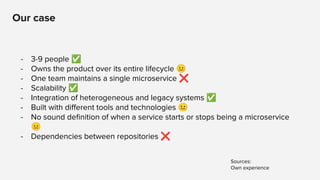
Our case
- 3-9 people ✅
- Owns the product over its entire lifecycle 😐
- One team maintains a single microservice ❌
- Scalability ✅
- Integration of heterogeneous and legacy systems ✅
- Built with different tools and technologies 😐
- No sound definition of when a service starts or stops being a microservice
😐
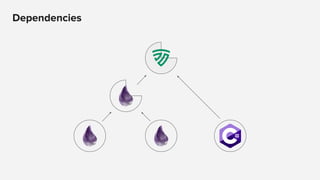
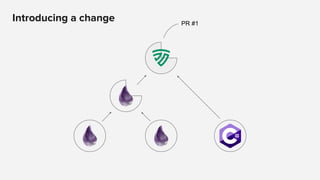
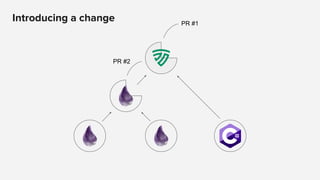
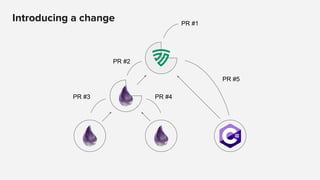
- Dependencies between repositories ❌
Sources:
Own experience
Dependencies
Introducing a change PR #1
PR #2
Introducing a change PR #1
PR #2
PR #3 PR #4
PR #5
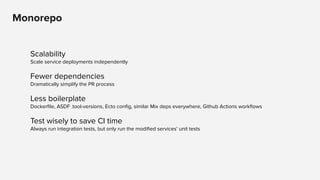
Monorepo
Scalability
Scale service deployments independently
Fewer dependencies
Dramatically simplify the PR process
Less boilerplate
Dockerfile, ASDF .tool-versions, Ecto config, similar Mix deps everywhere, Github Actions workflows
Test wisely to save CI time
Always run integration tests, but only run the modified services’ unit tests
Monorepo
Let’s see if that’s feasible…
https://github.com/erszcz/monorepo-example
Thank you!
@erszcz

Monorepo Pattern - the solution or the problem?

  • 1.
    Radek Szymczyszyn @erszcz Tech Leadat Erlang Solutions radek.szymczyszyn@erlang-solutions.com www.erlang-solutions.com ©2024 Erlang Solutions Monorepo The solution or the problem?
  • 3.
  • 4.
    “A system designcopies the communication structure of the organisation building it” Melvin E. Conway, 1967
  • 7.
    Two-pizza team - 3-9people, “can be fed with two pizzas” - Engaged - Autonomous - Owns the product over its entire lifecycle - 1:1 relationship - one team maintains a single microservice - “A high performance development organization consists of multiple teams” Sources: 1. Learn to Scale Innovation, Not Complexity 2. Service per team
  • 8.
    Microservice Benefits: - Modularity - Scalability -Integration of heterogeneous and legacy systems - Distributed development Concerns: - Services form information barriers - Inter-service calls over a network have a higher cost - Testing and deployment are more complicated - Moving responsibilities between services is more difficult - Viewing the size of services as the primary structuring mechanism can lead to too many services - Two-phased commits are regarded as an anti-pattern - Development and support of many services are more challenging if they are built with different tools and technologies - The protocol typically used with microservices (HTTP) was designed for public-facing services, and as such is unsuitable for working internal microservices that often must be impeccably reliable - Decomposition methodology often uses functional decomposition, which does not handle changes in the requirements - The very concept of microservice is misleading since there are only services. There is no sound definition of when a service starts or stops being a microservice - Data aggregation Source: Microservices - Wikipedia
  • 9.
    Microservice Benefits: - Modularity - Scalability -Integration of heterogeneous and legacy systems - Distributed development Concerns: - Services form information barriers - Inter-service calls over a network have a higher cost - Testing and deployment are more complicated - Moving responsibilities between services is more difficult - Viewing the size of services as the primary structuring mechanism can lead to too many services - Two-phased commits are regarded as an anti-pattern - Development and support of many services are more challenging if they are built with different tools and technologies - The protocol typically used with microservices (HTTP) was designed for public-facing services, and as such is unsuitable for working internal microservices that often must be impeccably reliable - Decomposition methodology often uses functional decomposition, which does not handle changes in the requirements - The very concept of microservice is misleading since there are only services. There is no sound definition of when a service starts or stops being a microservice - Data aggregation Source: Microservices - Wikipedia
  • 10.
    Our case - 3-9people ✅ - Owns the product over its entire lifecycle 😐 - One team maintains a single microservice ❌ - Scalability ✅ - Integration of heterogeneous and legacy systems ✅ - Built with different tools and technologies 😐 - No sound definition of when a service starts or stops being a microservice 😐 - Dependencies between repositories ❌ Sources: Own experience
  • 11.
  • 12.
  • 13.
  • 14.
    Introducing a changePR #1 PR #2 PR #3 PR #4 PR #5
  • 15.
    Monorepo Scalability Scale service deploymentsindependently Fewer dependencies Dramatically simplify the PR process Less boilerplate Dockerfile, ASDF .tool-versions, Ecto config, similar Mix deps everywhere, Github Actions workflows Test wisely to save CI time Always run integration tests, but only run the modified services’ unit tests
  • 16.
    Monorepo Let’s see ifthat’s feasible… https://github.com/erszcz/monorepo-example
  • 17.