Monitoring and Evaluation
Understanding M&E and Designing Projects
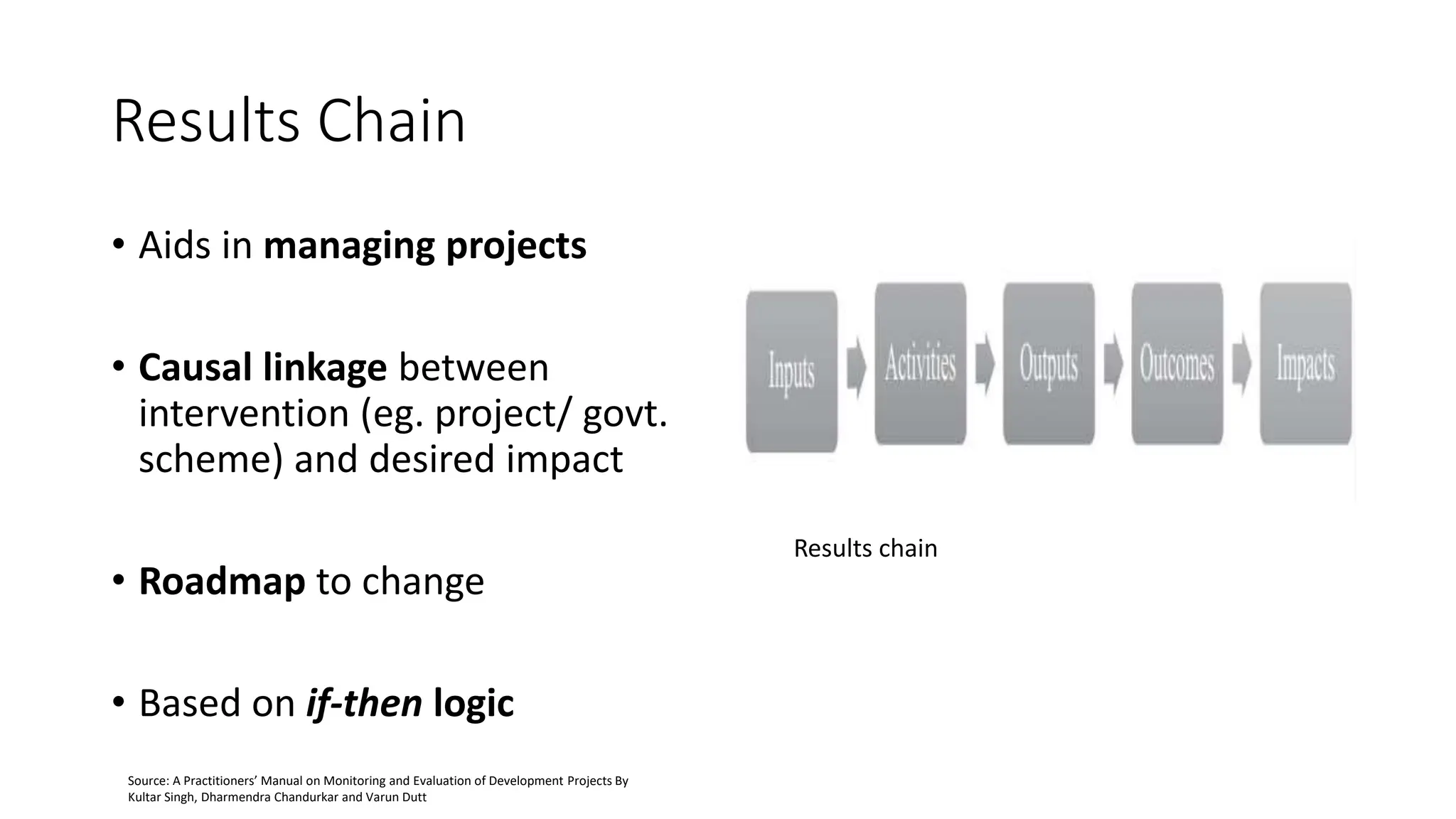
Results Chain
• Aids in managing projects
• Causal linkage between
intervention (eg. project/ govt.
scheme) and desired impact
• Roadmap to change
• Based on if-then logic
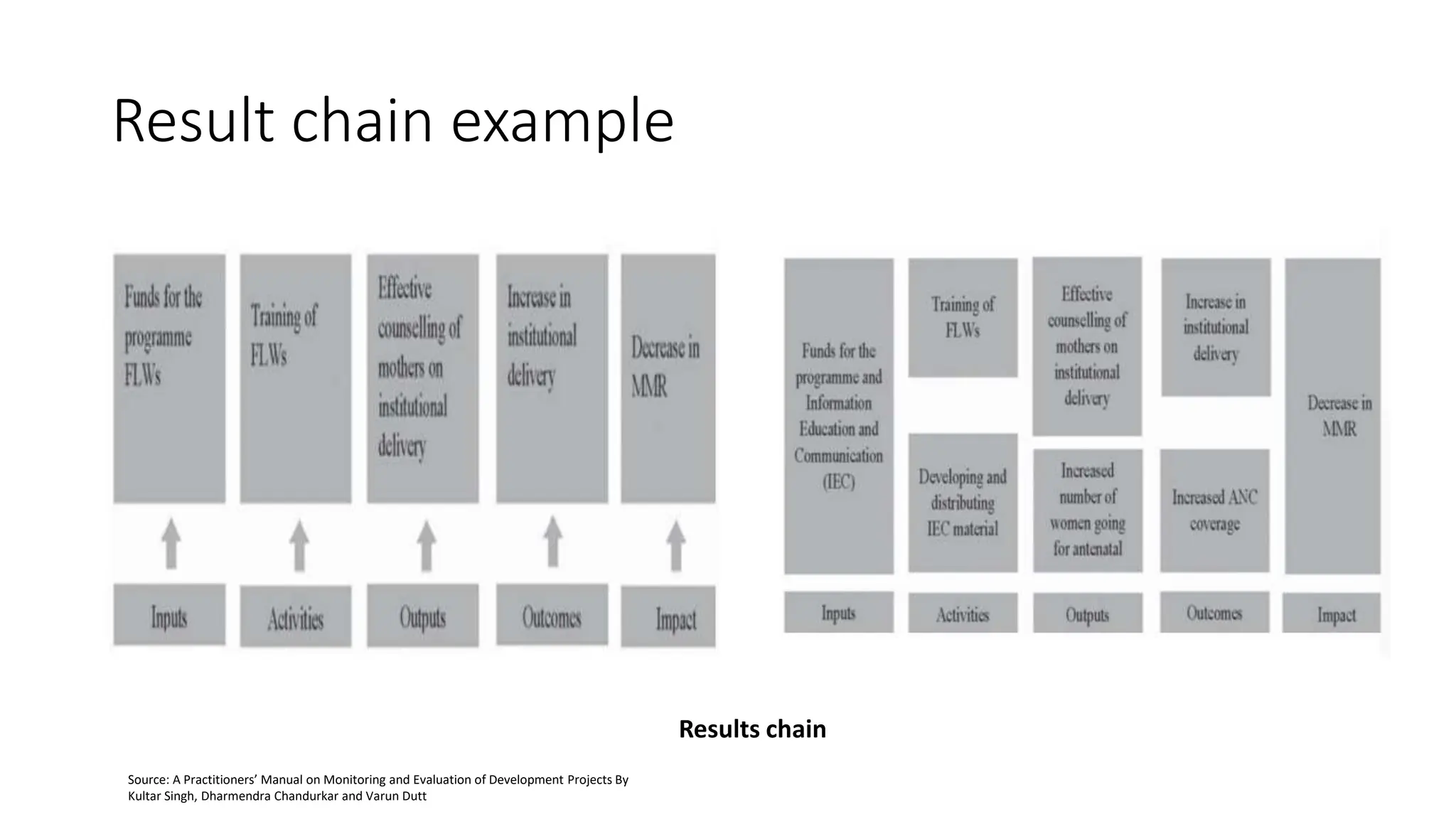
Results chain
Source: A Practitioners’ Manual on Monitoring and Evaluation of Development Projects By
Kultar Singh, Dharmendra Chandurkar and Varun Dutt
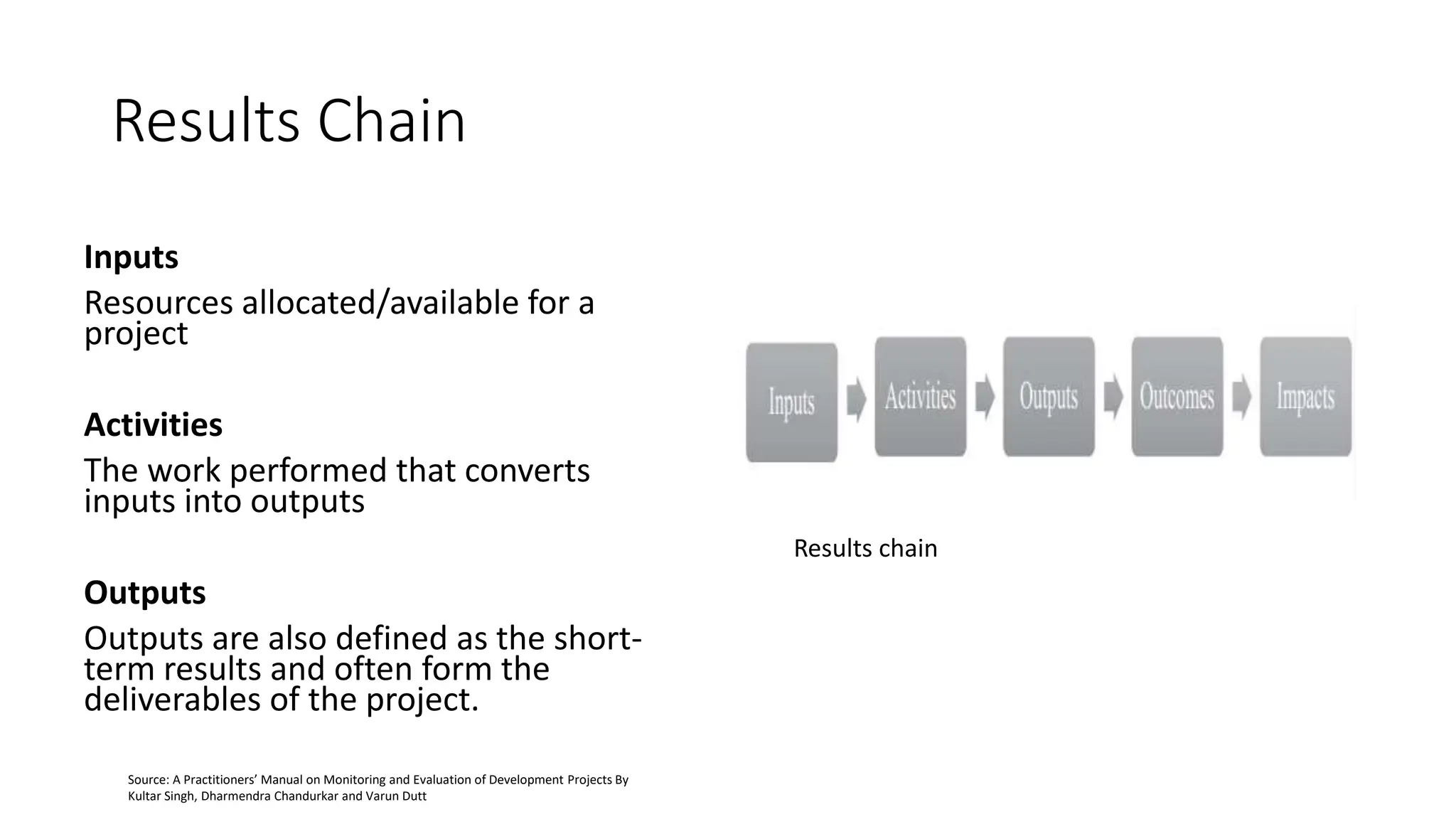
Results Chain
Inputs
Resources allocated/available for a
project
Activities
The work performed that converts
inputs into outputs
Outputs
Outputs are also defined as the short-
term results and often form the
deliverables of the project.
Results chain
Source: A Practitioners’ Manual on Monitoring and Evaluation of Development Projects By
Kultar Singh, Dharmendra Chandurkar and Varun Dutt
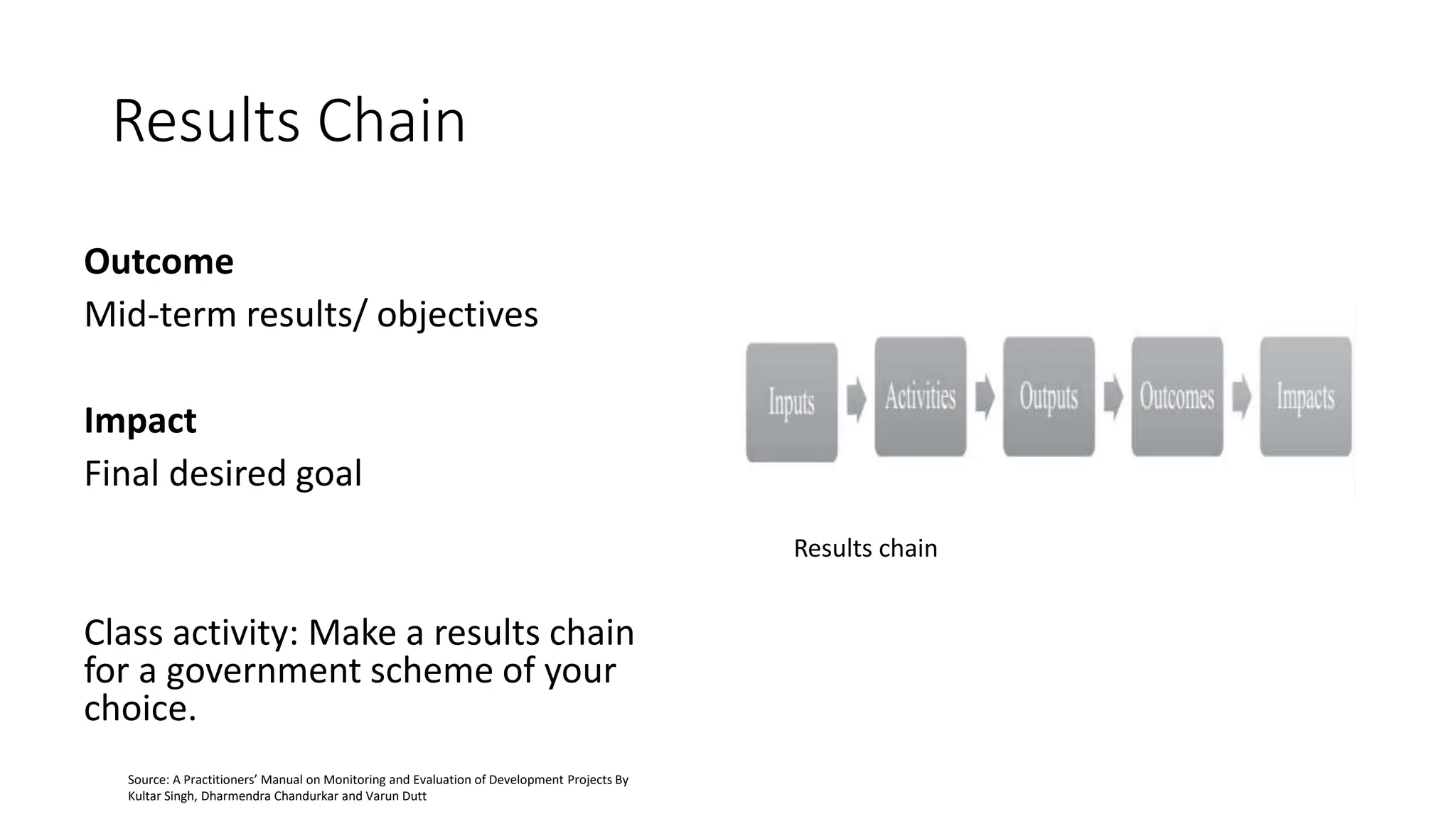
Results Chain
Outcome
Mid-term results/ objectives
Impact
Final desired goal
Class activity: Make a results chain
for a government scheme of your
choice.
Results chain
Source: A Practitioners’ Manual on Monitoring and Evaluation of Development Projects By
Kultar Singh, Dharmendra Chandurkar and Varun Dutt
Result chain example
Results chain
Source: A Practitioners’ Manual on Monitoring and Evaluation of Development Projects By
Kultar Singh, Dharmendra Chandurkar and Varun Dutt
Activity
Develop a Results chain for a government scheme
being currently implemented
Logical Framework
Logical Framework Analysis
It is a project management tool
It was developed for USAID
Helps organize the project and structure the project
Aims: Efficient resource allocation ; performance measurement;
development of standards for the project
Source: A Practitioners’ Manual on Monitoring and Evaluation of Development Projects By
Kultar Singh, Dharmendra Chandurkar and Varun Dutt
Steps in Logical Framework Analysis
1. Situation Analysis
Attempt is made to understand the existing situation
Identify what is ‘wrong’
Causes for the situation are analyzed
Serves as an entry point to the project by throwing light on what needs to be done
Activity : For the same government scheme you chose, think of the possible situations
which led to the implementation the government scheme. Elucidate the situation in detail.
Source: A Practitioners’ Manual on Monitoring and Evaluation of Development Projects By
Kultar Singh, Dharmendra Chandurkar and Varun Dutt
Steps in Logical Framework Analysis
2. Problem Analysis
Involves identifying the key problems and then establishing the cause
and effect relationships between these problems
Helps in identifying the ‘root causes’ and subsequently addressing
them
Source: A Practitioners’ Manual on Monitoring and Evaluation of Development Projects By
Kultar Singh, Dharmendra Chandurkar and Varun Dutt
Steps in Logical Framework Analysis
2. Problem Analysis
Common method used to identify the core problem is the problem tree,
which helps to visually depict the connection between the various
possible causes of the problem
Source: A Practitioners’ Manual on Monitoring and Evaluation of Development Projects By
Kultar Singh, Dharmendra Chandurkar and Varun Dutt
Steps in Logical Framework Analysis
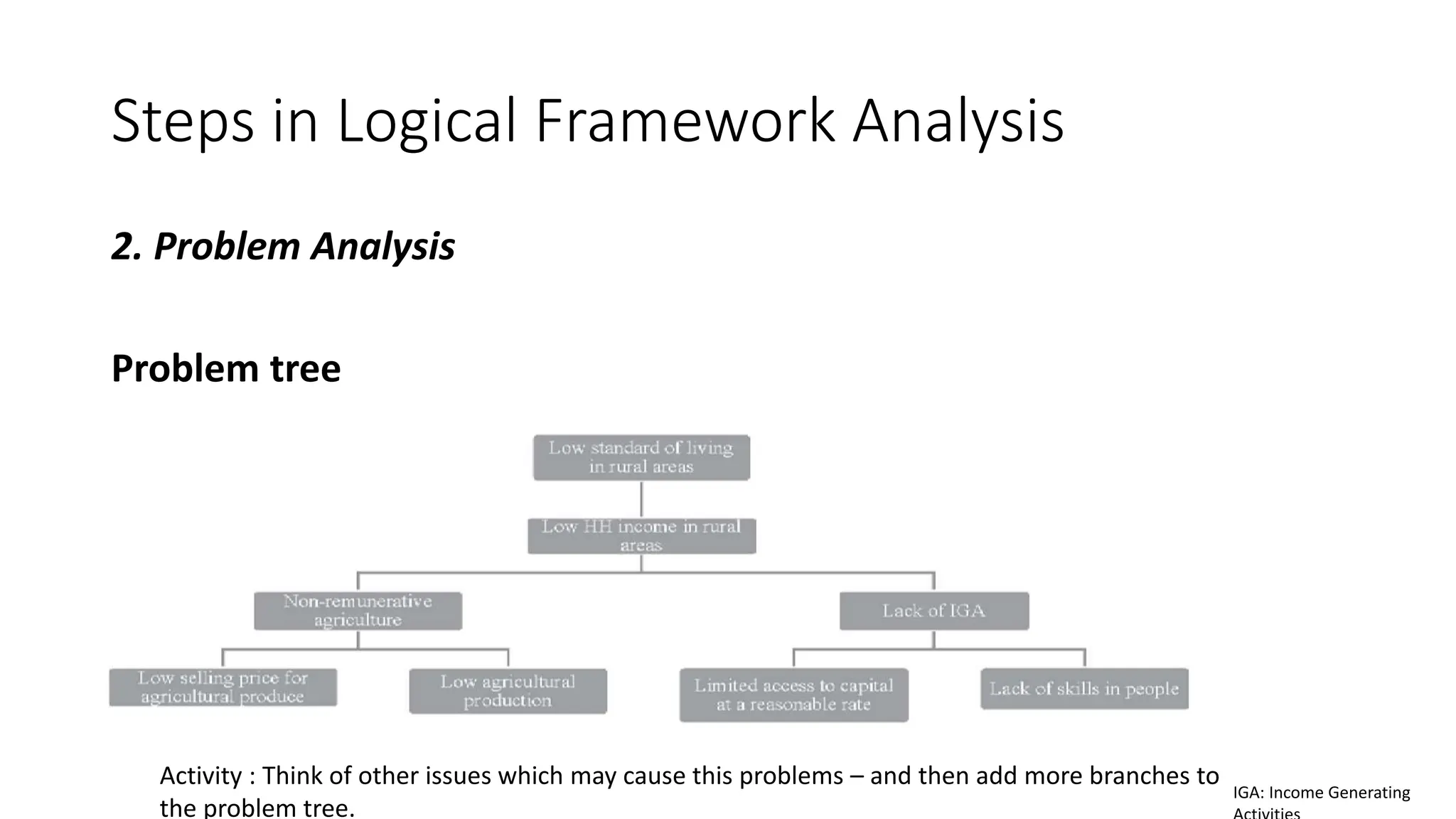
2. Problem Analysis
Problem tree
Activity : Think of other issues which may cause this problems – and then add more branches to
the problem tree.
IGA: Income Generating
Steps in Logical Framework Analysis
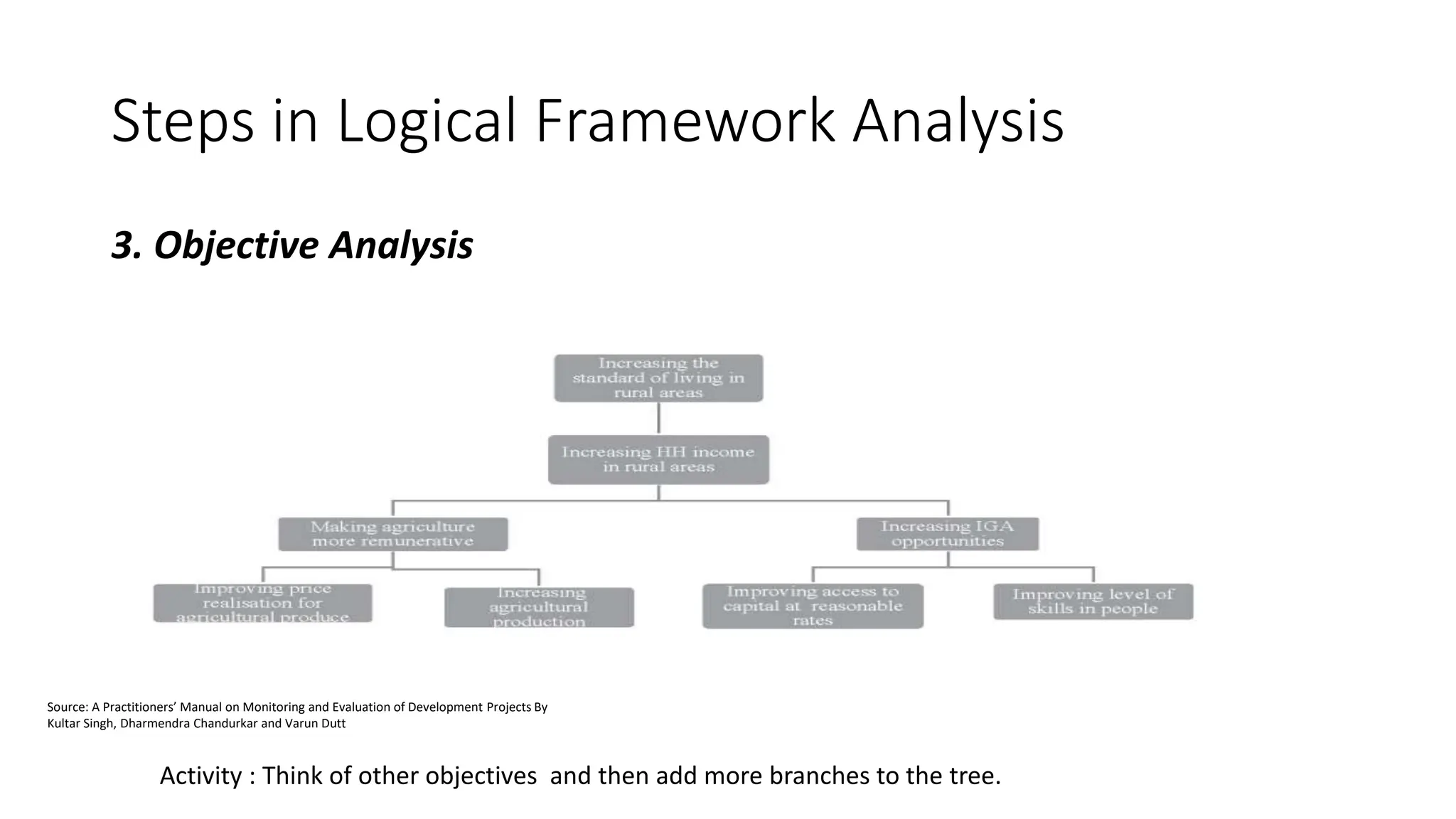
3. Objective Analysis
After identifying the problems and developing the problem tree, the next
step is to conduct the objective analysis.
It is done o formulate the objectives of the project by developing an
objective tree.
The problem statements (negatives) are turned into objective statements
(positives).
Source: A Practitioners’ Manual on Monitoring and Evaluation of Development Projects By
Kultar Singh, Dharmendra Chandurkar and Varun Dutt
Steps in Logical Framework Analysis
3. Objective Analysis
While the problem tree shows the cause and effect relationship
between problems, the objective tree shows the means to the end
relationship between the objectives.
Source: A Practitioners’ Manual on Monitoring and Evaluation of Development Projects By
Kultar Singh, Dharmendra Chandurkar and Varun Dutt
Steps in Logical Framework Analysis
3. Objective Analysis
Activity : Think of other objectives and then add more branches to the tree.
Source: A Practitioners’ Manual on Monitoring and Evaluation of Development Projects By
Kultar Singh, Dharmendra Chandurkar and Varun Dutt
Steps in Logical Framework Analysis
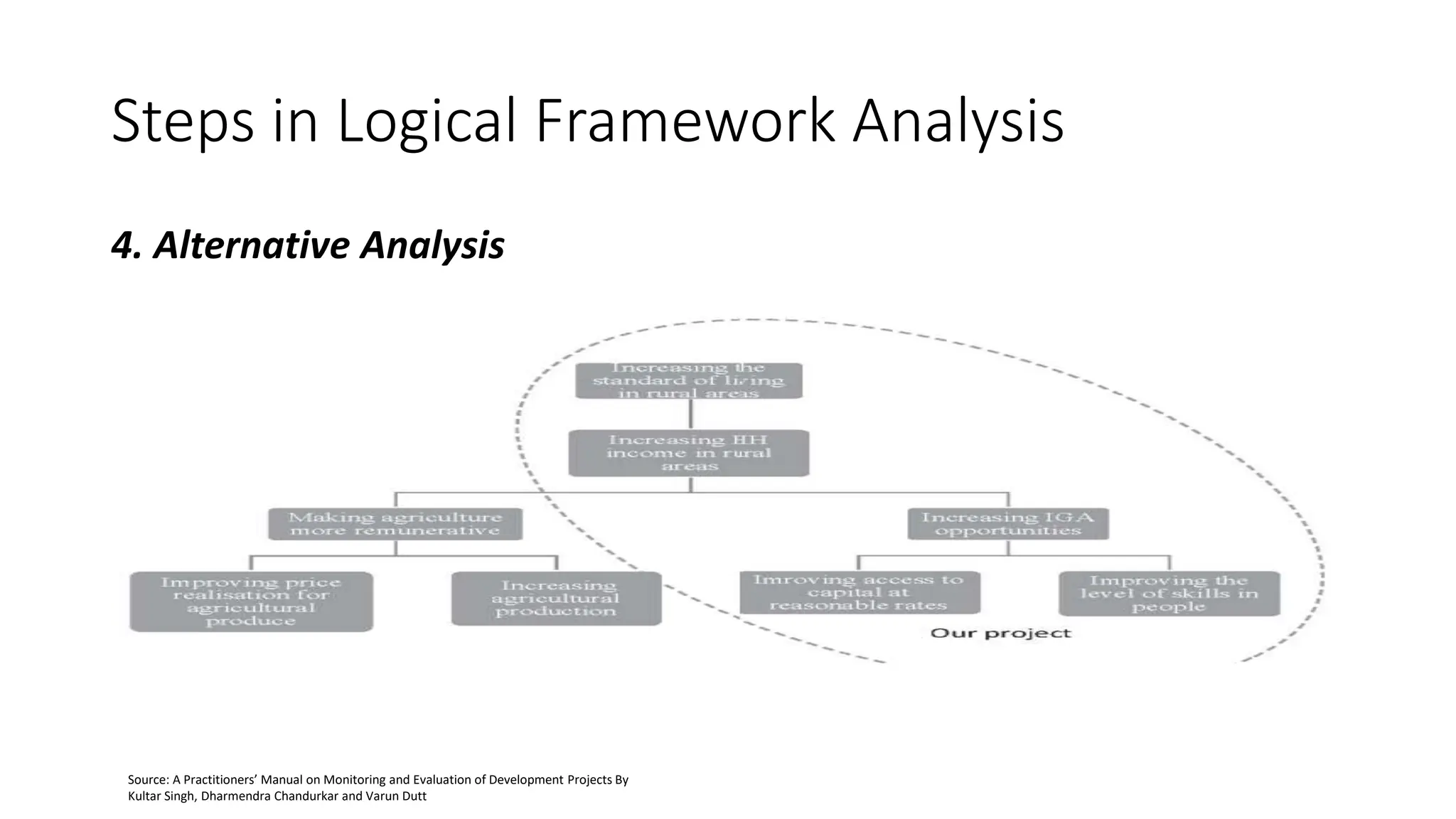
4. Alternative Analysis
It is done in order to identify the possible alternative options and
select one project strategy
Criteria like benefits to the target group, resource availability,
sustainability of the intervention, technical feasibility, relevance,
likelihood of success, implementability etc., can be used for the
assessment of the alternatives
Source: A Practitioners’ Manual on Monitoring and Evaluation of Development Projects By
Kultar Singh, Dharmendra Chandurkar and Varun Dutt
Steps in Logical Framework Analysis
4. Alternative Analysis
Different branches in the objective tree, which constitute of alternate
options, are then identified
It is advisable to have a set of assessments to reach to one specific
alternative
Source: A Practitioners’ Manual on Monitoring and Evaluation of Development Projects By
Kultar Singh, Dharmendra Chandurkar and Varun Dutt
Steps in Logical Framework Analysis
4. Alternative Analysis
Source: A Practitioners’ Manual on Monitoring and Evaluation of Development Projects By
Kultar Singh, Dharmendra Chandurkar and Varun Dutt
Steps in Logical Framework Analysis
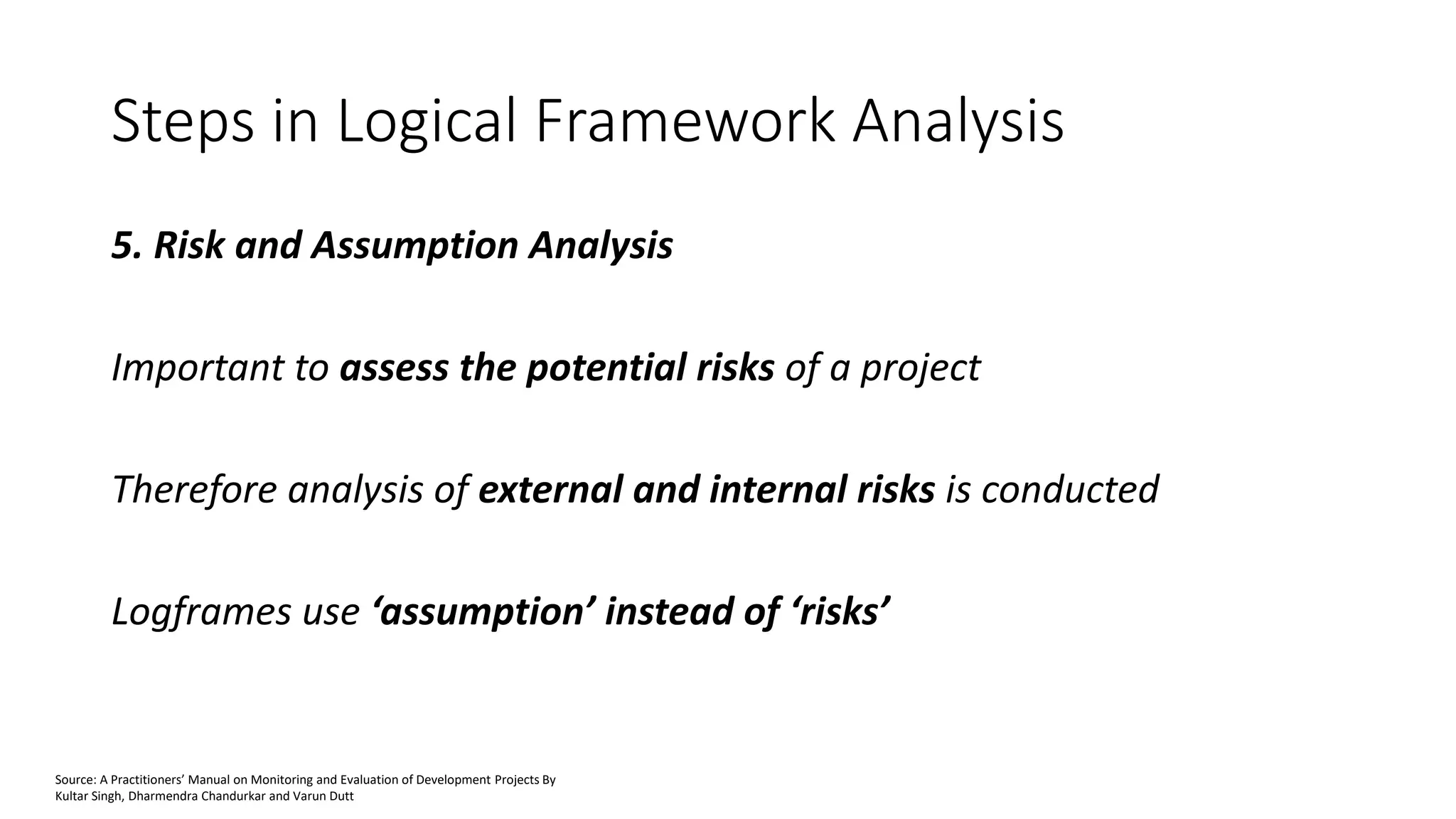
5. Risk and Assumption Analysis
Important to assess the potential risks of a project
Therefore analysis of external and internal risks is conducted
Logframes use ‘assumption’ instead of ‘risks’
Source: A Practitioners’ Manual on Monitoring and Evaluation of Development Projects By
Kultar Singh, Dharmendra Chandurkar and Varun Dutt
Steps in Logical Framework Analysis
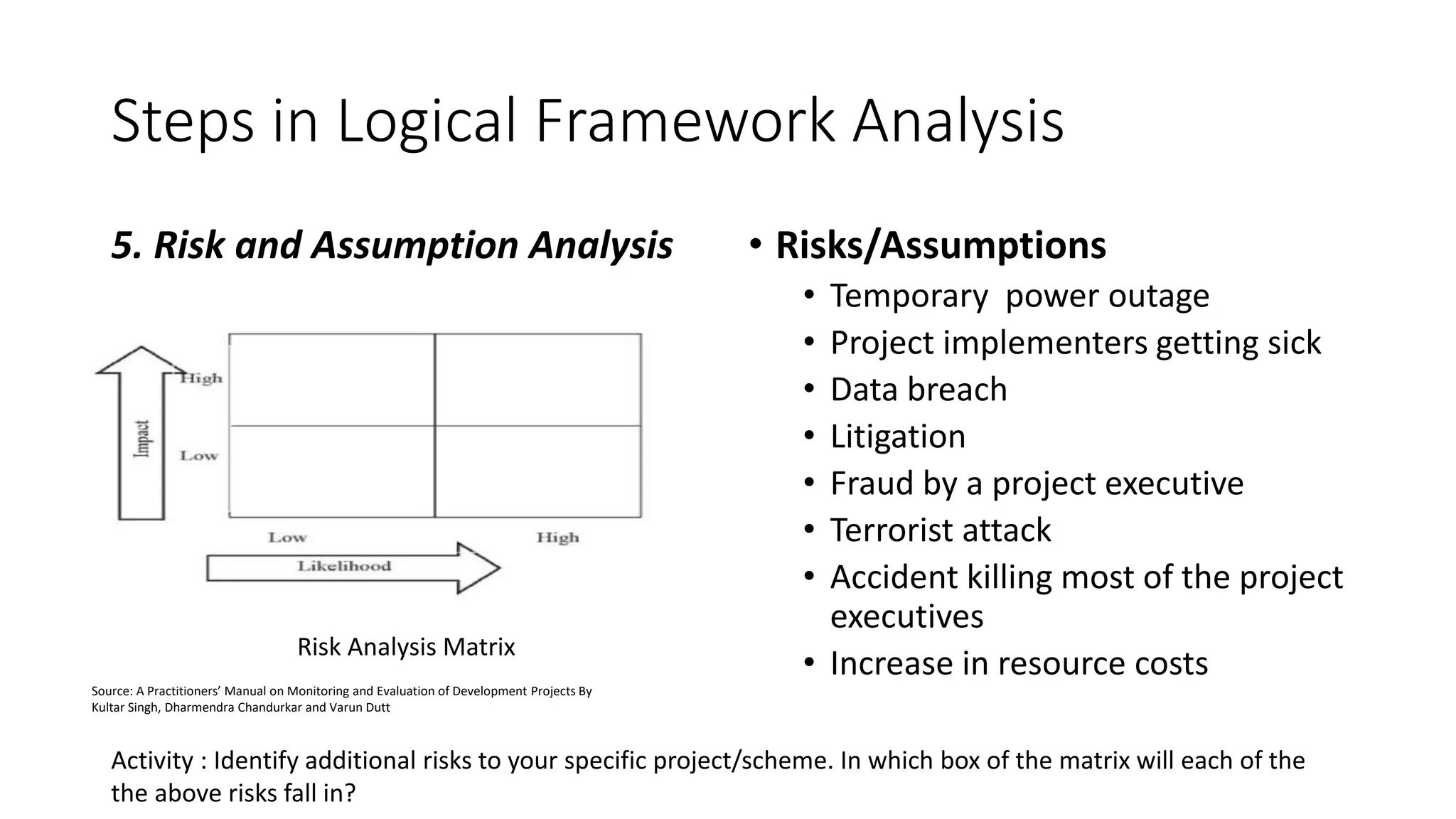
5. Risk and Assumption Analysis • Risks/Assumptions
• Temporary power outage
• Project implementers getting sick
• Data breach
• Litigation
• Fraud by a project executive
• Terrorist attack
• Accident killing most of the project
executives
• Increase in resource costs
Risk Analysis Matrix
Activity : Identify additional risks to your specific project/scheme. In which box of the matrix will each of the
the above risks fall in?
Source: A Practitioners’ Manual on Monitoring and Evaluation of Development Projects By
Kultar Singh, Dharmendra Chandurkar and Varun Dutt
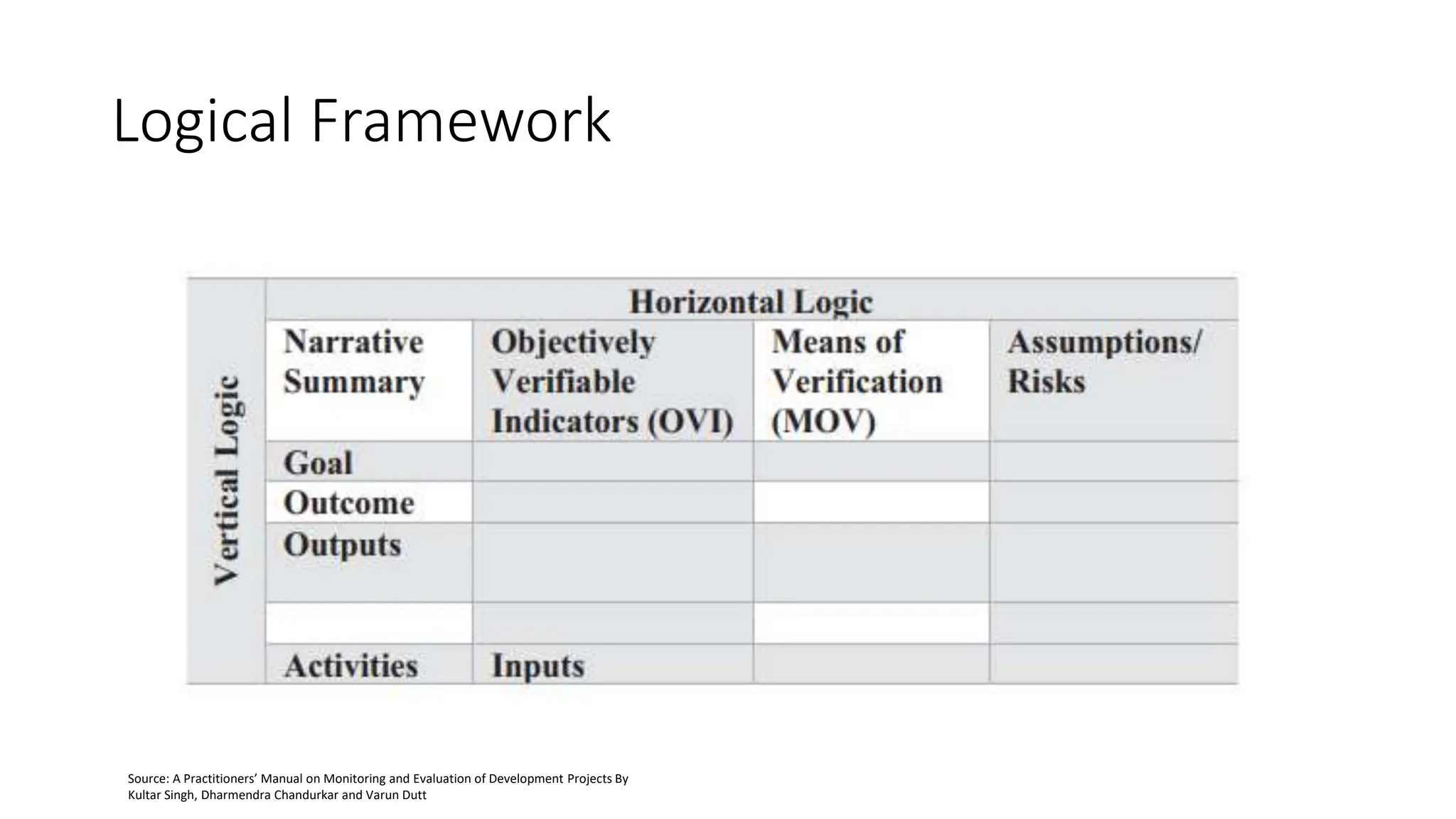
Logical Framework
Source: A Practitioners’ Manual on Monitoring and Evaluation of Development Projects By
Kultar Singh, Dharmendra Chandurkar and Varun Dutt
Steps in Logical Framework Analysis
Show all 5 steps for LFA. Use the following schemes/projects :
- Smart Cities
- National Mission for Clean Ganga
- PM Swasthya Suraksha Yojana
- Start up India
- Digital India Mission
Monitoring Sustainability via Metrics
https://sps.columbia.edu/news/importance-sustainability-metrics-
sustainability-management
Balanced Scorecard
• The balanced scorecard is a strategic management framework used
by organizations to monitor and manage performance across key
areas of their operations.
• It provides a comprehensive view of performance
• It helps align the strategic objectives with operational activities.
• The balanced scorecard comprises four perspectives: Financial,
Customer, Internal Business Processes, and Learning and
Growth
Source: https://hbr.org/1992/01/the-balanced-scorecard-
measures-that-drive-performance-2
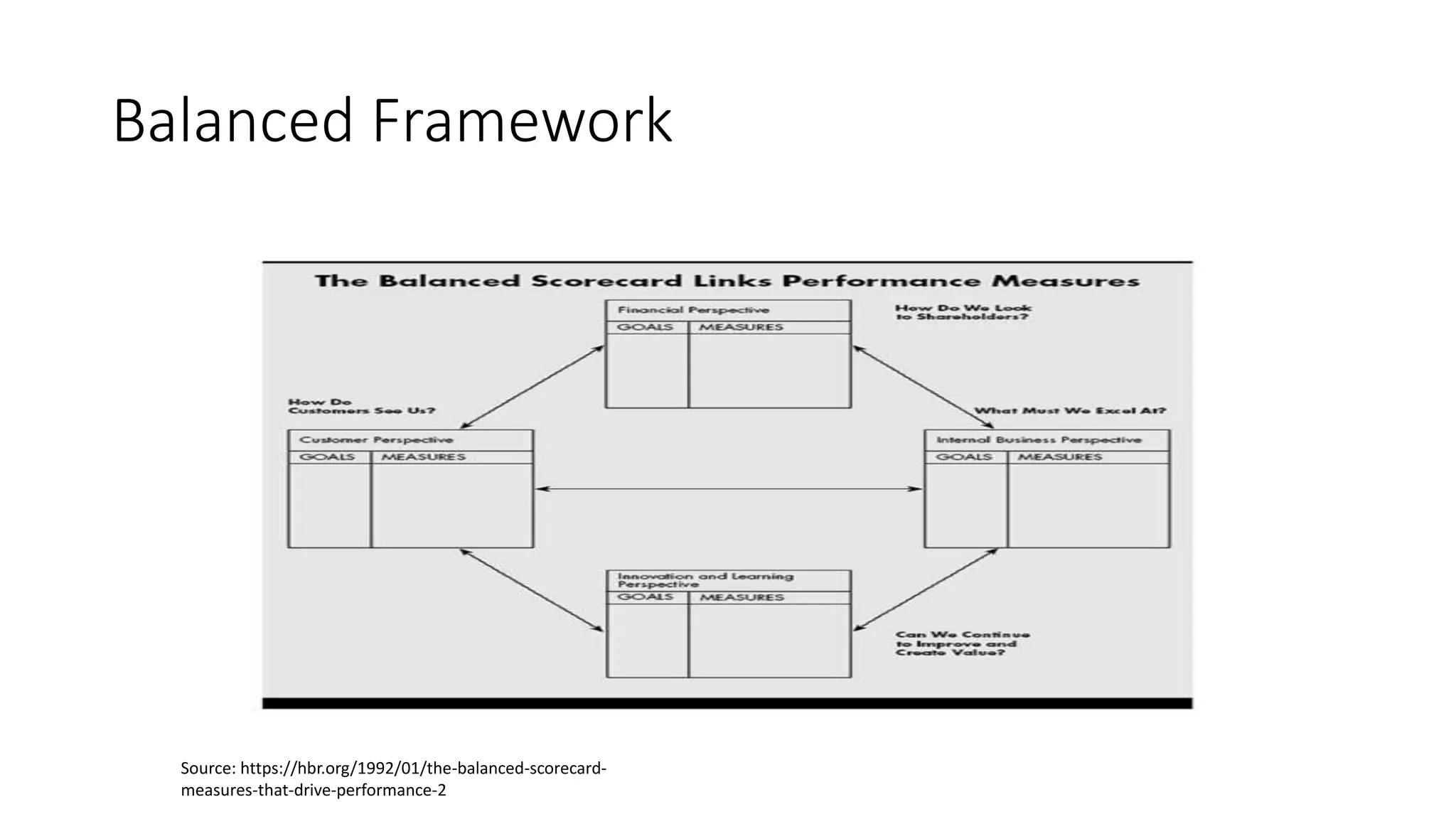
Balanced Framework
Source: https://hbr.org/1992/01/the-balanced-scorecard-
measures-that-drive-performance-2
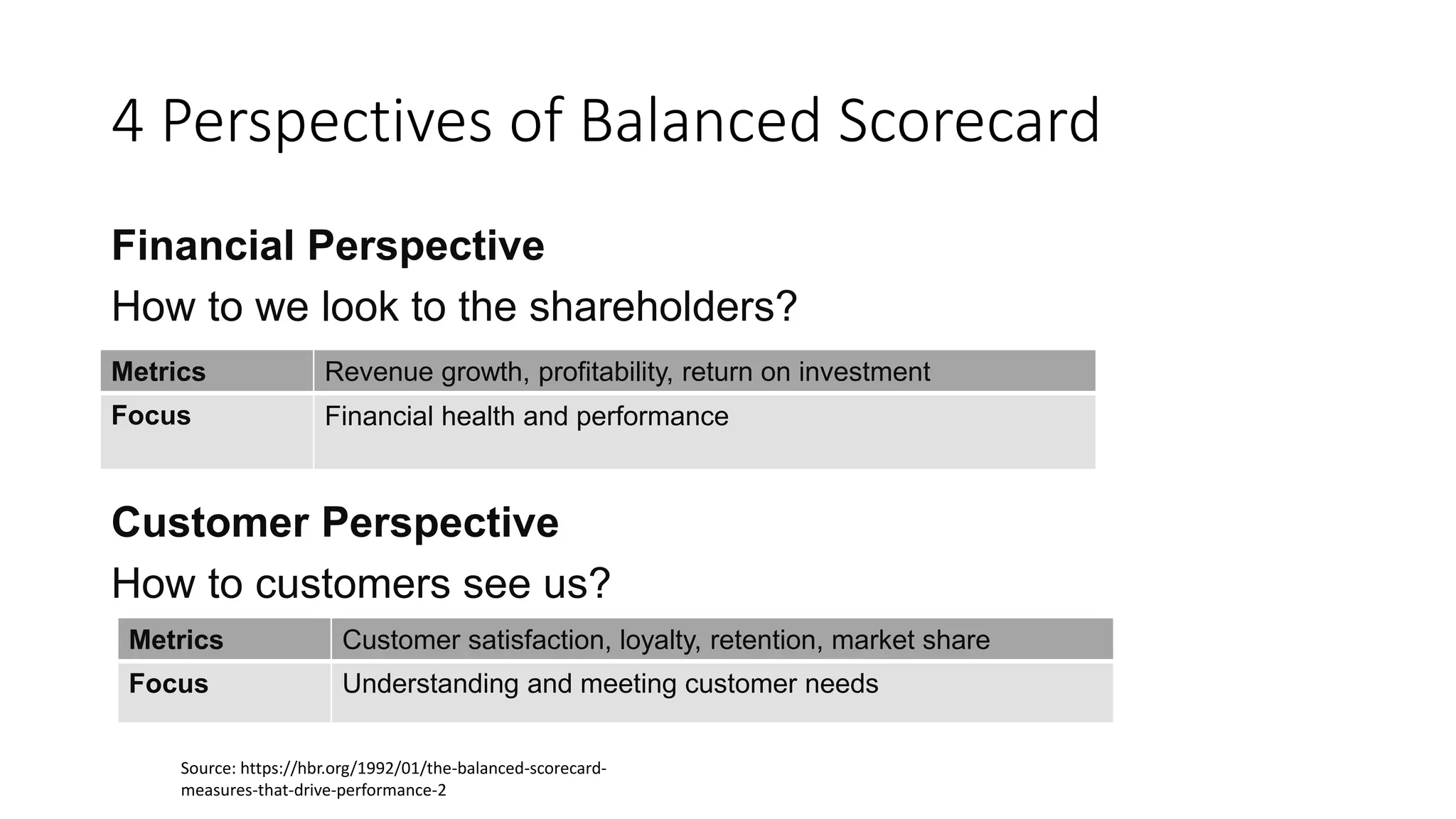
4 Perspectives of Balanced Scorecard
Financial Perspective
How to we look to the shareholders?
Customer Perspective
How to customers see us?
Metrics Revenue growth, profitability, return on investment
Focus Financial health and performance
Metrics Customer satisfaction, loyalty, retention, market share
Focus Understanding and meeting customer needs
Source: https://hbr.org/1992/01/the-balanced-scorecard-
measures-that-drive-performance-2
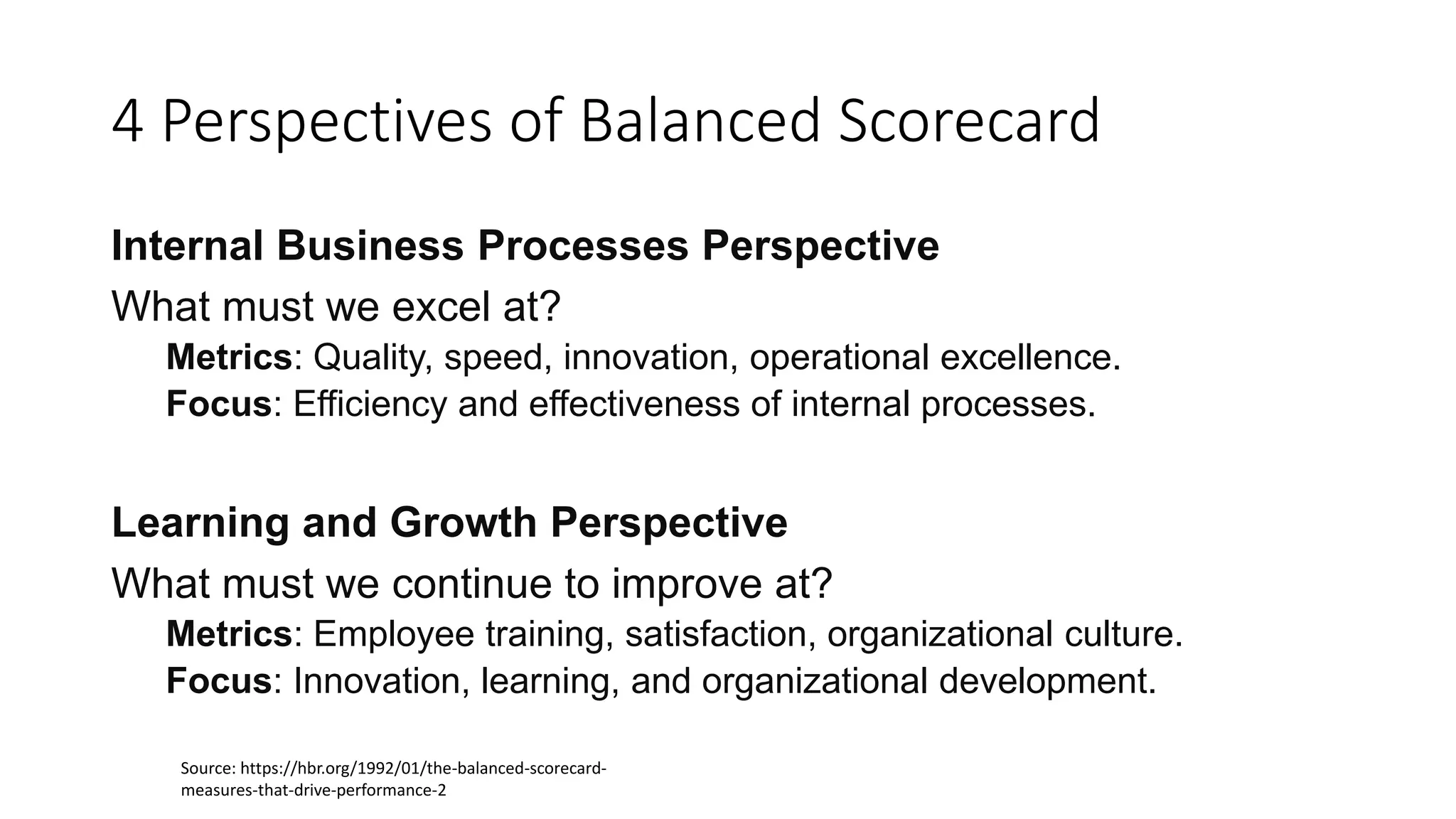
4 Perspectives of Balanced Scorecard
Internal Business Processes Perspective
What must we excel at?
Metrics: Quality, speed, innovation, operational excellence.
Focus: Efficiency and effectiveness of internal processes.
Learning and Growth Perspective
What must we continue to improve at?
Metrics: Employee training, satisfaction, organizational culture.
Focus: Innovation, learning, and organizational development.
Source: https://hbr.org/1992/01/the-balanced-scorecard-
measures-that-drive-performance-2
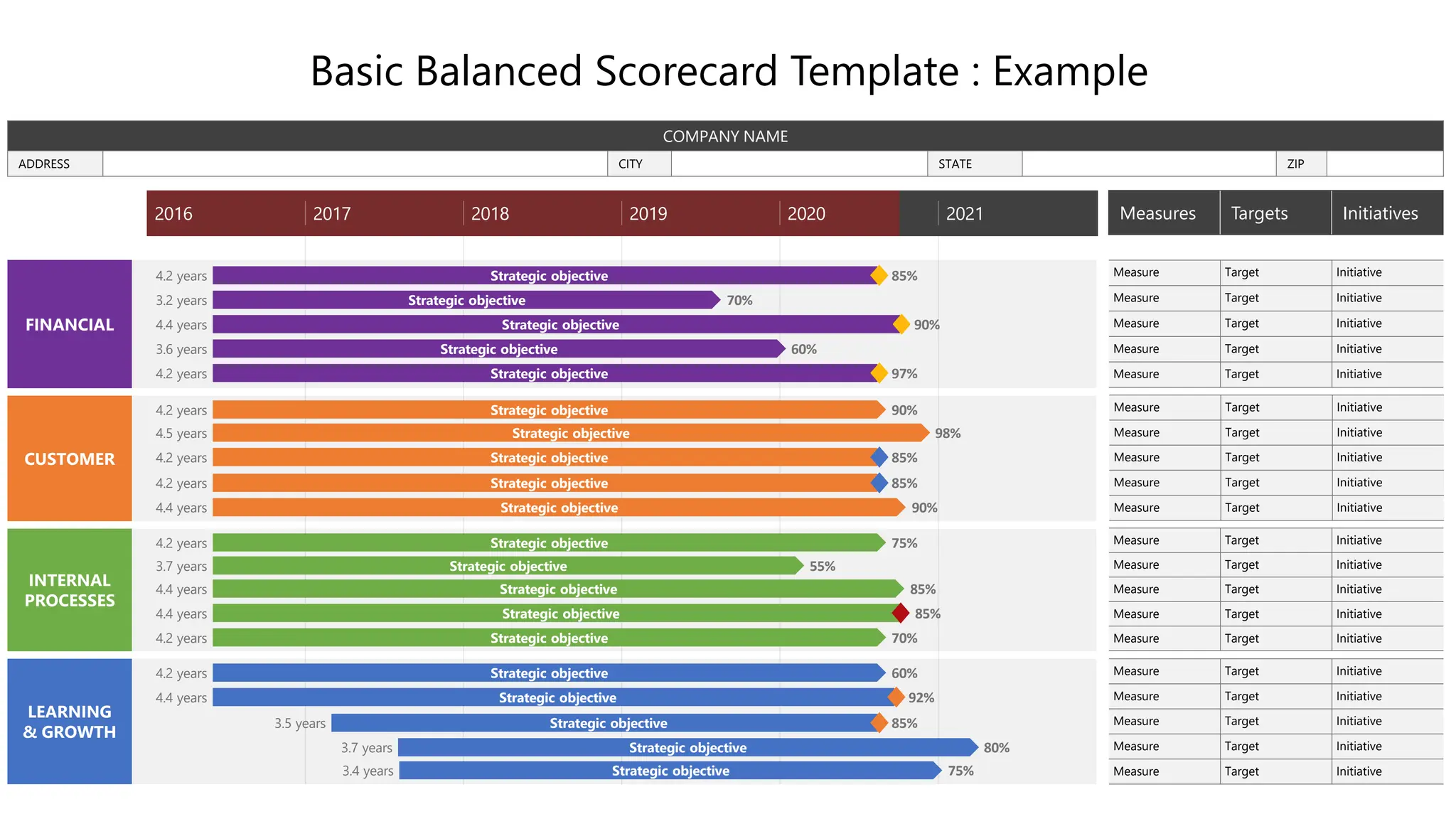
FINANCIAL
CUSTOMER
INTERNAL
PROCESSES
LEARNING
& GROWTH
2016 2017 2018 2019 2020
4.2 years 85%
Strategic objective
3.2 years 70%
Strategic objective
4.4 years 90%
Strategic objective
3.6 years 60%
Strategic objective
4.2 years 97%
Strategic objective
4.2 years 90%
Strategic objective
4.5 years 98%
Strategic objective
4.2 years 85%
Strategic objective
4.2 years 85%
Strategic objective
4.4 years 90%
Strategic objective
4.2 years 75%
Strategic objective
3.7 years 55%
Strategic objective
4.4 years 85%
Strategic objective
4.4 years 85%
Strategic objective
4.2 years 70%
Strategic objective
4.2 years 60%
Strategic objective
4.4 years 92%
Strategic objective
3.5 years 85%
Strategic objective
3.7 years 80%
Strategic objective
3.4 years 75%
Strategic objective
2021
Basic Balanced Scorecard Template : Example
COMPANY NAME
ADDRESS CITY STATE ZIP
Measure Target Initiative
Measures Targets Initiatives
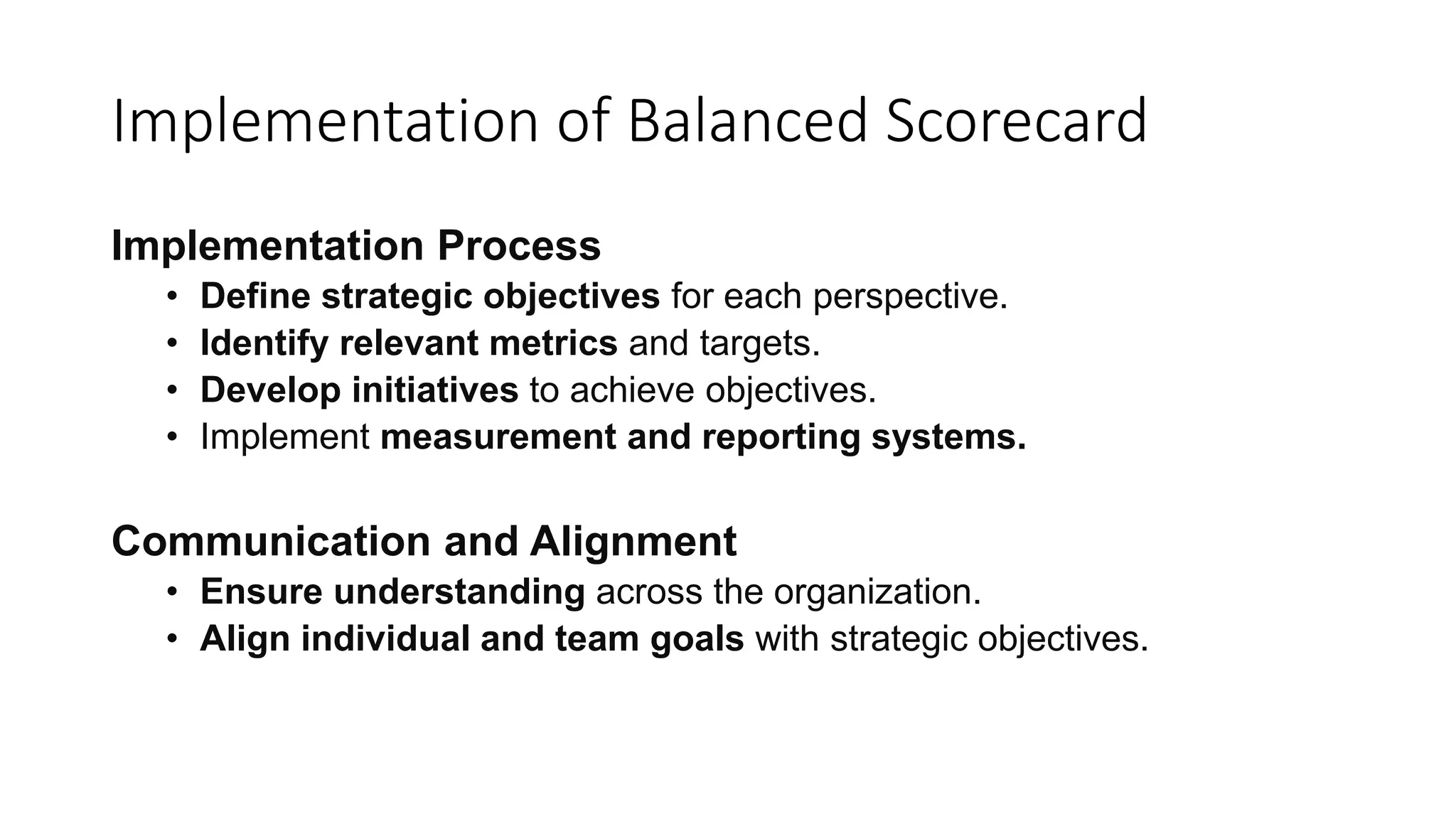
Implementation of Balanced Scorecard
Implementation Process
• Define strategic objectives for each perspective.
• Identify relevant metrics and targets.
• Develop initiatives to achieve objectives.
• Implement measurement and reporting systems.
Communication and Alignment
• Ensure understanding across the organization.
• Align individual and team goals with strategic objectives.
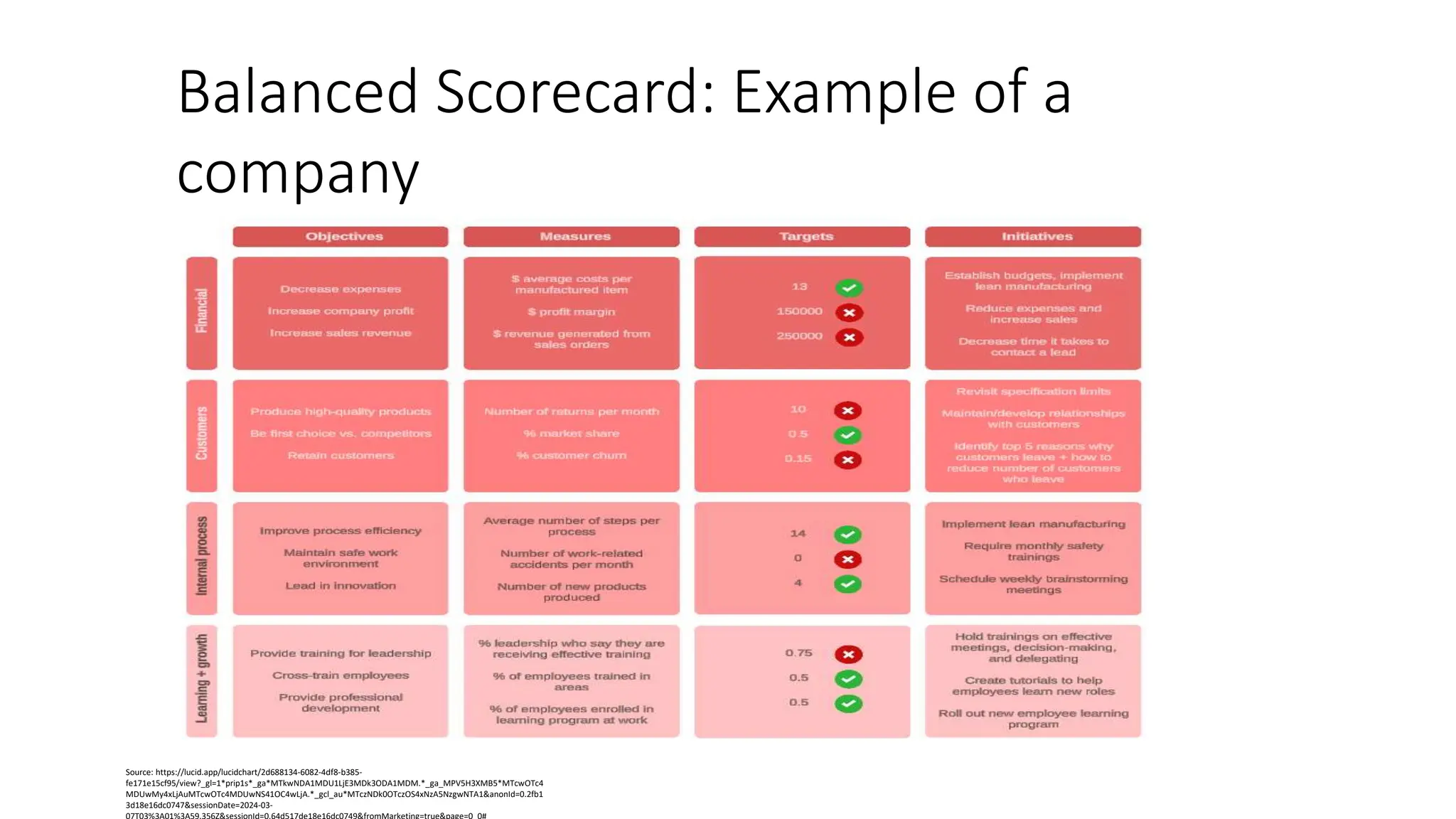
Balanced Scorecard: Example of a
company
Source: https://lucid.app/lucidchart/2d688134-6082-4df8-b385-
fe171e15cf95/view?_gl=1*prip1s*_ga*MTkwNDA1MDU1LjE3MDk3ODA1MDM.*_ga_MPV5H3XMB5*MTcwOTc4
MDUwMy4xLjAuMTcwOTc4MDUwNS41OC4wLjA.*_gcl_au*MTczNDk0OTczOS4xNzA5NzgwNTA1&anonId=0.2fb1
3d18e16dc0747&sessionDate=2024-03-
07T03%3A01%3A59.356Z&sessionId=0.64d517de18e16dc0749&fromMarketing=true&page=0_0#
Implementation of Balanced Scorecard
Comprehensive Performance Evaluation
• Provides a holistic view of organizational performance.
• Enables better decision-making and resource allocation.
Strategic Alignment
• Ensures alignment of operational activities with strategic
objectives.
• Fosters a shared understanding of organizational goals.
Continuous Improvement
• Identifies areas for improvement and opportunities for innovation.
• Facilitates a culture of continuous learning and adaptation.
Conclusion
• The balanced scorecard is a powerful tool for strategic
management, offering an overview of performance across
key areas.
• It incorporates both financial and non-financial metrics.
• It enables organizations to make informed decisions, drive
performance improvement, and achieve long-term success.
Life Cycle Assessment (LCA)
Systematic analysis of environmental impact over the course of the
entire life cycle of a :
• Product,
• Material,
• Process, or
• A Measurable activity.
LCA models the environmental implications of the many interacting
systems that make up industrial production. When accurately
performed, it can provide valuable data that decision-makers can use
in support of sustainability initiatives.
Source: https://www.rit.edu/sustainabilityinstitute/blog/what-life-cycle-assessment-lca
Life Cycle Thinking (LCT)
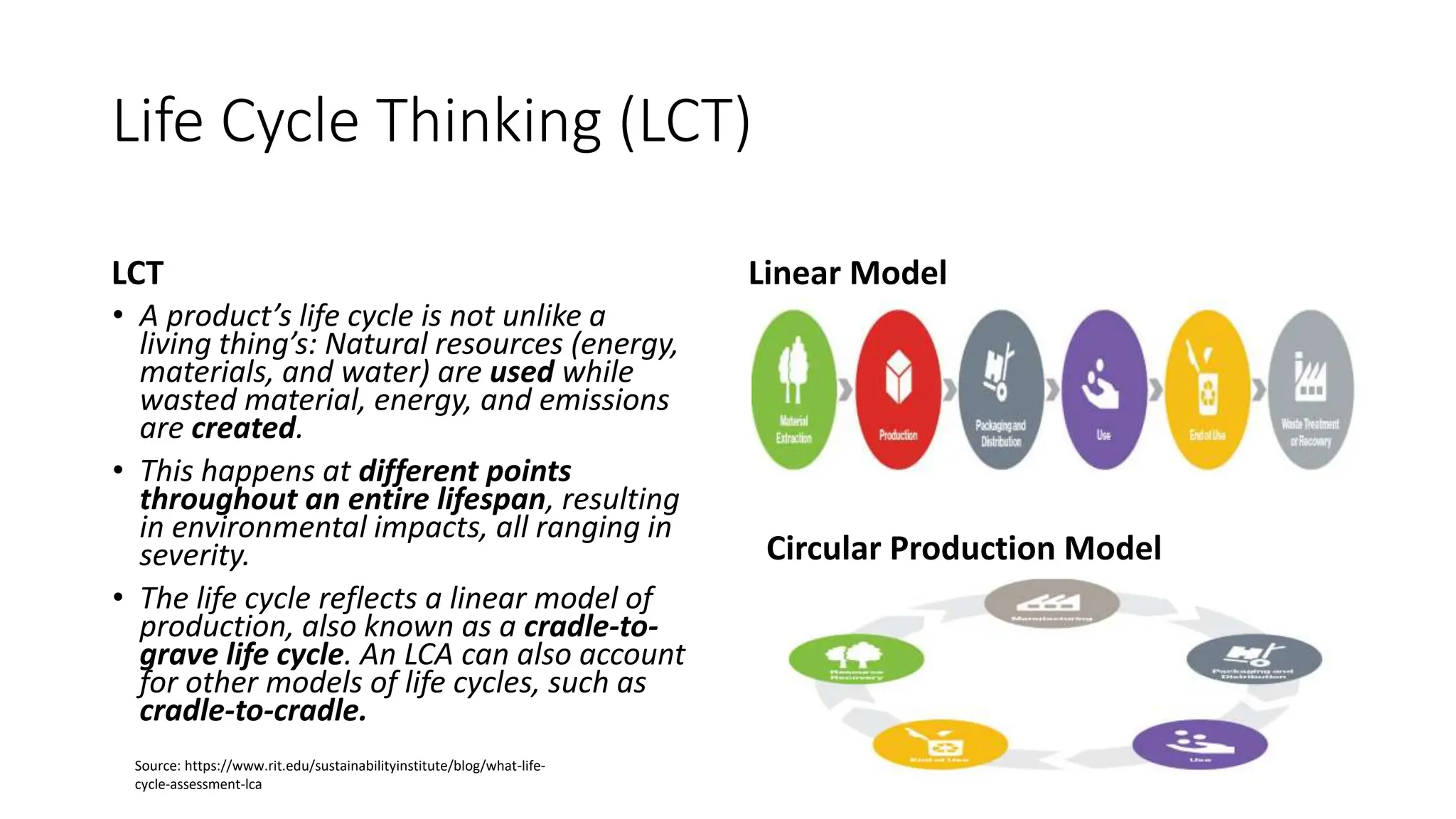
LCT Linear Model
• A product’s life cycle is not unlike a
living thing’s: Natural resources (energy,
materials, and water) are used while
wasted material, energy, and emissions
are created.
• This happens at different points
throughout an entire lifespan, resulting
in environmental impacts, all ranging in
severity.
• The life cycle reflects a linear model of
production, also known as a cradle-to-
grave life cycle. An LCA can also account
for other models of life cycles, such as
cradle-to-cradle.
Circular Production Model
Source: https://www.rit.edu/sustainabilityinstitute/blog/what-life-
cycle-assessment-lca
LCA - Reading
https://www2.deloitte.com/content/dam/Deloitte/us/Documents/proc
ess-and-operations/us-consulting-
enhancingthevalueoflifecycleassessment-112514.pdf
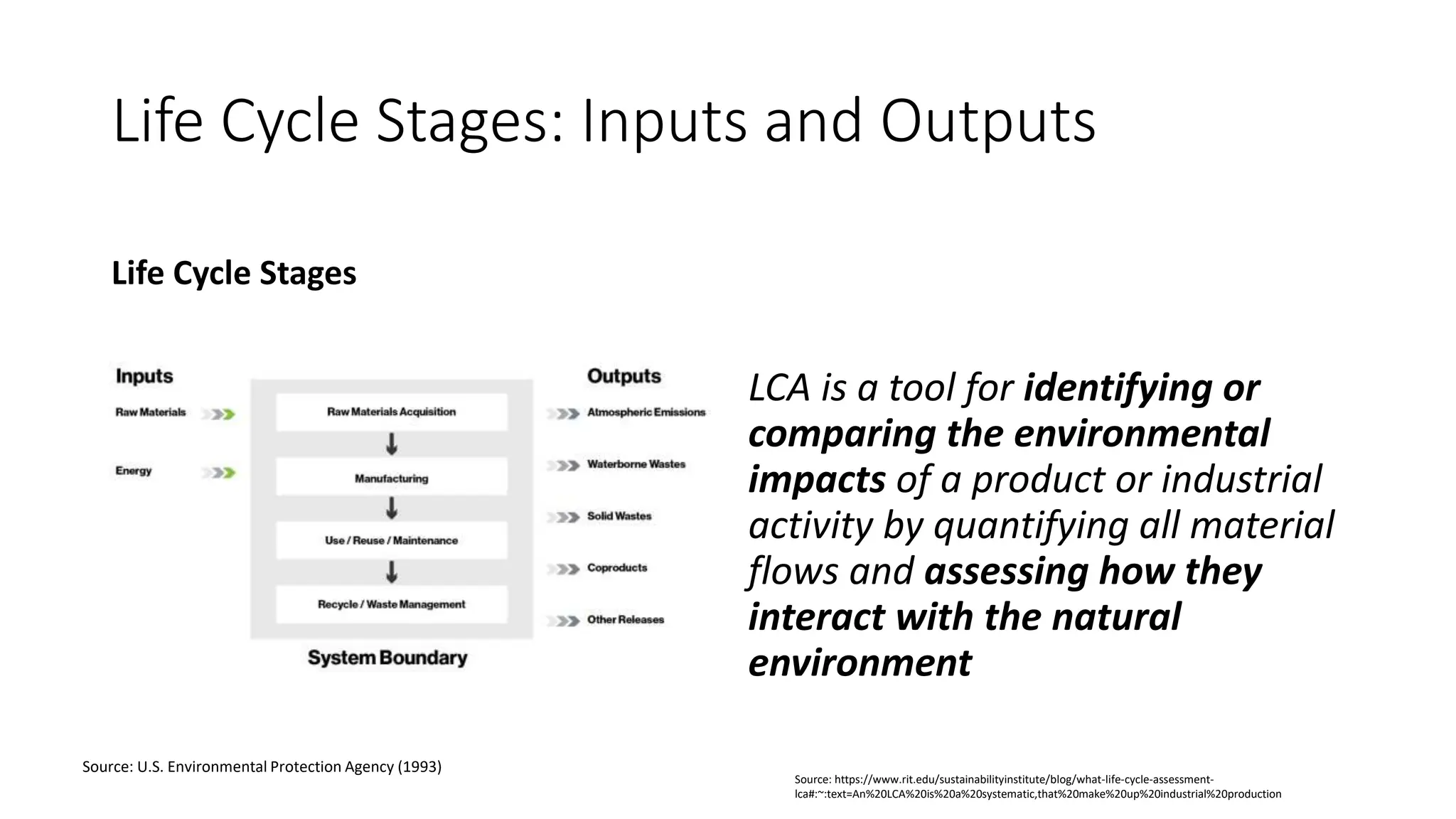
Life Cycle Stages: Inputs and Outputs
Life Cycle Stages
LCA is a tool for identifying or
comparing the environmental
impacts of a product or industrial
activity by quantifying all material
flows and assessing how they
interact with the natural
environment
Source: U.S. Environmental Protection Agency (1993)
Source: https://www.rit.edu/sustainabilityinstitute/blog/what-life-cycle-assessment-
lca#:~:text=An%20LCA%20is%20a%20systematic,that%20make%20up%20industrial%20production
Steps of LCA
Source: https://www.rit.edu/sustainabilityinstitute/blog/what-life-cycle-assessment-
lca#:~:text=An%20LCA%20is%20a%20systematic,that%20make%20up%20industrial%20production
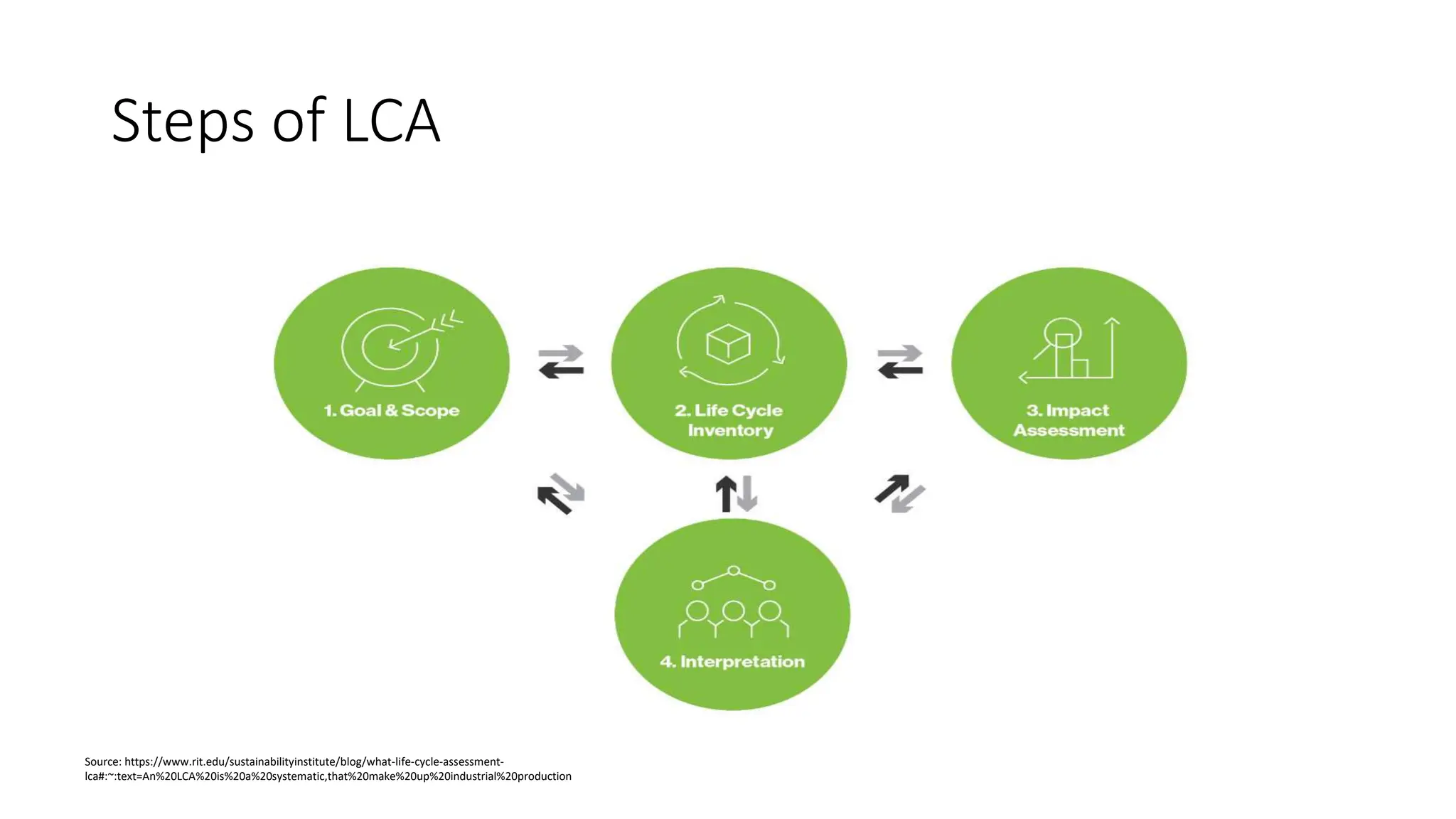
Steps
The ISO standards describe the principles and full framework for
conducting an LCA. The assessment is broken down into the
following four phases:
1.Goal and scope definition
2.Life cycle inventory analysis (LCI)
3.Life cycle impact assessment (LCIA)
4.Interpretation
Source: https://www.rit.edu/sustainabilityinstitute/blog/what-life-cycle-assessment-
lca#:~:text=An%20LCA%20is%20a%20systematic,that%20make%20up%20industrial%20production
Step 1 : Goals and Scope
Functional units, system boundaries, and limits to the
analysis are set to outline where in the life cycle the study begins and
where it ends
Functional Unit = measurement of production or output against
which impact indicator metrics
Scope of an LCA is determined by the number of life cycle stages
and impact categories that will be assessed
Businesses are more likely to choose an LCA with a narrow scope –
requires less time and resources
Source: https://www.rit.edu/sustainabilityinstitute/blog/what-life-cycle-assessment-
lca#:~:text=An%20LCA%20is%20a%20systematic,that%20make%20up%20industrial%20production
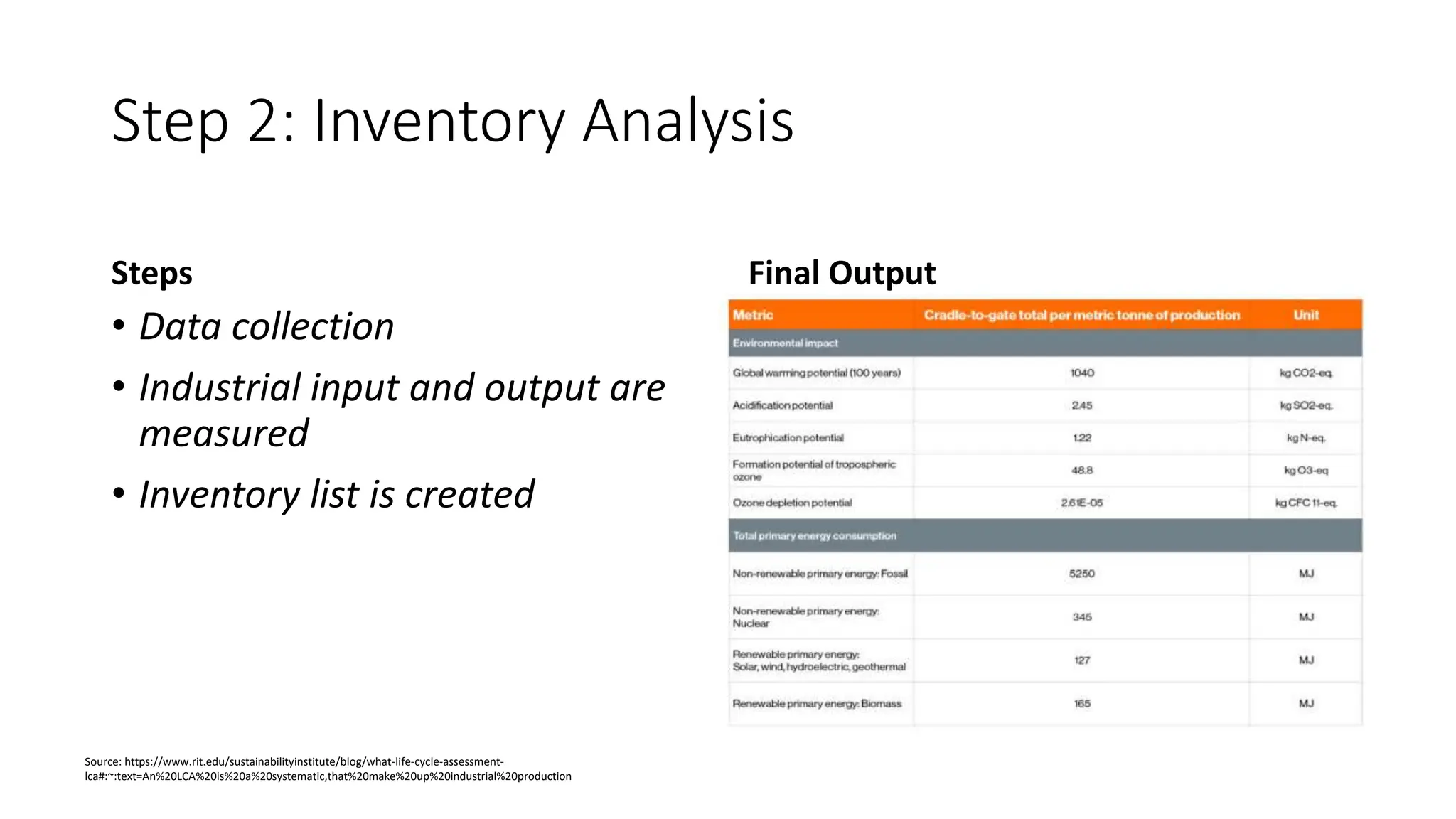
Step 2: Inventory Analysis
Steps
• Data collection
• Industrial input and output are
measured
• Inventory list is created
Final Output
Source: https://www.rit.edu/sustainabilityinstitute/blog/what-life-cycle-assessment-
lca#:~:text=An%20LCA%20is%20a%20systematic,that%20make%20up%20industrial%20production
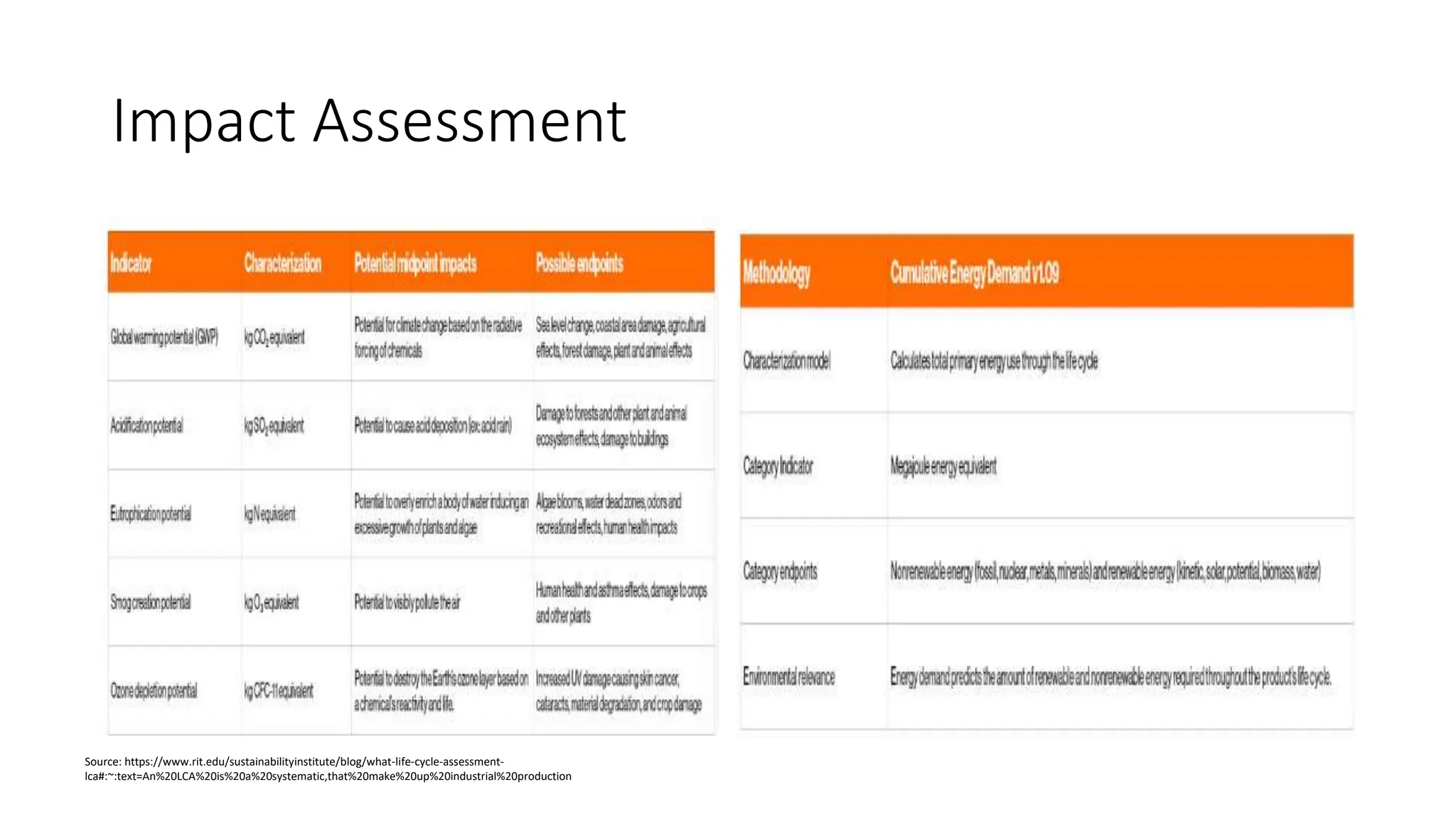
Step 3: Impact Assessment
• Analysis of inventory data
• Making meaningful conclusions from the data analysis
• The U.S. Environmental Protection Agency breaks down an LCIA into the
following steps:
1.selection and definition of impact categories
2.classification
3.characterization
4.normalization
5.grouping
6.weighting
7.evaluating and reporting LCIA results
Source: https://www.rit.edu/sustainabilityinstitute/blog/what-life-cycle-assessment-
lca#:~:text=An%20LCA%20is%20a%20systematic,that%20make%20up%20industrial%20production
Impact Assessment
Source: https://www.rit.edu/sustainabilityinstitute/blog/what-life-cycle-assessment-
lca#:~:text=An%20LCA%20is%20a%20systematic,that%20make%20up%20industrial%20production
Step 4 – Interpretation, Critical Review and
Reporting
• Interpreted alongside its original goals and scope
• Results are most often put into a report format; it has :
Key priorities for mitigating environmental impact
Suggested opportunities for improving the sustainability
• ISO standards for LCA dictate that this interpretation should
Identify significant issues based on the LCI( Inventory Analysis; Step
2) and LCIA phase (Impact Assessment; Step 3);
Evaluate the study itself, how complete it is, if it’s done sensitively
and consistently, and account for uncertainty; and
Provide conclusions, limitations, and recommendations.
Source: https://www.rit.edu/sustainabilityinstitute/blog/what-life-cycle-assessment-
lca#:~:text=An%20LCA%20is%20a%20systematic,that%20make%20up%20industrial%20production
Questions
• Develop a Theory of Change for a government intervention of your
choice. Provide the analysis of various tools such a Logical
Framework, Results Framework etc. used to evaluate a project.
• How does a balanced scorecard aid in monitoring the enterprise ?
Explain with the help of an example.
• Explain the Life Cycle Assessment. Describe and critically analyse all
steps to conduct an LCA.

Monitoring and Evaluation Logical Framework.pptx

  • 1.
    Monitoring and Evaluation UnderstandingM&E and Designing Projects
  • 2.
    Results Chain • Aidsin managing projects • Causal linkage between intervention (eg. project/ govt. scheme) and desired impact • Roadmap to change • Based on if-then logic Results chain Source: A Practitioners’ Manual on Monitoring and Evaluation of Development Projects By Kultar Singh, Dharmendra Chandurkar and Varun Dutt
  • 3.
    Results Chain Inputs Resources allocated/availablefor a project Activities The work performed that converts inputs into outputs Outputs Outputs are also defined as the short- term results and often form the deliverables of the project. Results chain Source: A Practitioners’ Manual on Monitoring and Evaluation of Development Projects By Kultar Singh, Dharmendra Chandurkar and Varun Dutt
  • 4.
    Results Chain Outcome Mid-term results/objectives Impact Final desired goal Class activity: Make a results chain for a government scheme of your choice. Results chain Source: A Practitioners’ Manual on Monitoring and Evaluation of Development Projects By Kultar Singh, Dharmendra Chandurkar and Varun Dutt
  • 5.
    Result chain example Resultschain Source: A Practitioners’ Manual on Monitoring and Evaluation of Development Projects By Kultar Singh, Dharmendra Chandurkar and Varun Dutt
  • 6.
    Activity Develop a Resultschain for a government scheme being currently implemented
  • 7.
    Logical Framework Logical FrameworkAnalysis It is a project management tool It was developed for USAID Helps organize the project and structure the project Aims: Efficient resource allocation ; performance measurement; development of standards for the project Source: A Practitioners’ Manual on Monitoring and Evaluation of Development Projects By Kultar Singh, Dharmendra Chandurkar and Varun Dutt
  • 8.
    Steps in LogicalFramework Analysis 1. Situation Analysis Attempt is made to understand the existing situation Identify what is ‘wrong’ Causes for the situation are analyzed Serves as an entry point to the project by throwing light on what needs to be done Activity : For the same government scheme you chose, think of the possible situations which led to the implementation the government scheme. Elucidate the situation in detail. Source: A Practitioners’ Manual on Monitoring and Evaluation of Development Projects By Kultar Singh, Dharmendra Chandurkar and Varun Dutt
  • 9.
    Steps in LogicalFramework Analysis 2. Problem Analysis Involves identifying the key problems and then establishing the cause and effect relationships between these problems Helps in identifying the ‘root causes’ and subsequently addressing them Source: A Practitioners’ Manual on Monitoring and Evaluation of Development Projects By Kultar Singh, Dharmendra Chandurkar and Varun Dutt
  • 10.
    Steps in LogicalFramework Analysis 2. Problem Analysis Common method used to identify the core problem is the problem tree, which helps to visually depict the connection between the various possible causes of the problem Source: A Practitioners’ Manual on Monitoring and Evaluation of Development Projects By Kultar Singh, Dharmendra Chandurkar and Varun Dutt
  • 11.
    Steps in LogicalFramework Analysis 2. Problem Analysis Problem tree Activity : Think of other issues which may cause this problems – and then add more branches to the problem tree. IGA: Income Generating
  • 12.
    Steps in LogicalFramework Analysis 3. Objective Analysis After identifying the problems and developing the problem tree, the next step is to conduct the objective analysis. It is done o formulate the objectives of the project by developing an objective tree. The problem statements (negatives) are turned into objective statements (positives). Source: A Practitioners’ Manual on Monitoring and Evaluation of Development Projects By Kultar Singh, Dharmendra Chandurkar and Varun Dutt
  • 13.
    Steps in LogicalFramework Analysis 3. Objective Analysis While the problem tree shows the cause and effect relationship between problems, the objective tree shows the means to the end relationship between the objectives. Source: A Practitioners’ Manual on Monitoring and Evaluation of Development Projects By Kultar Singh, Dharmendra Chandurkar and Varun Dutt
  • 14.
    Steps in LogicalFramework Analysis 3. Objective Analysis Activity : Think of other objectives and then add more branches to the tree. Source: A Practitioners’ Manual on Monitoring and Evaluation of Development Projects By Kultar Singh, Dharmendra Chandurkar and Varun Dutt
  • 15.
    Steps in LogicalFramework Analysis 4. Alternative Analysis It is done in order to identify the possible alternative options and select one project strategy Criteria like benefits to the target group, resource availability, sustainability of the intervention, technical feasibility, relevance, likelihood of success, implementability etc., can be used for the assessment of the alternatives Source: A Practitioners’ Manual on Monitoring and Evaluation of Development Projects By Kultar Singh, Dharmendra Chandurkar and Varun Dutt
  • 16.
    Steps in LogicalFramework Analysis 4. Alternative Analysis Different branches in the objective tree, which constitute of alternate options, are then identified It is advisable to have a set of assessments to reach to one specific alternative Source: A Practitioners’ Manual on Monitoring and Evaluation of Development Projects By Kultar Singh, Dharmendra Chandurkar and Varun Dutt
  • 17.
    Steps in LogicalFramework Analysis 4. Alternative Analysis Source: A Practitioners’ Manual on Monitoring and Evaluation of Development Projects By Kultar Singh, Dharmendra Chandurkar and Varun Dutt
  • 18.
    Steps in LogicalFramework Analysis 5. Risk and Assumption Analysis Important to assess the potential risks of a project Therefore analysis of external and internal risks is conducted Logframes use ‘assumption’ instead of ‘risks’ Source: A Practitioners’ Manual on Monitoring and Evaluation of Development Projects By Kultar Singh, Dharmendra Chandurkar and Varun Dutt
  • 19.
    Steps in LogicalFramework Analysis 5. Risk and Assumption Analysis • Risks/Assumptions • Temporary power outage • Project implementers getting sick • Data breach • Litigation • Fraud by a project executive • Terrorist attack • Accident killing most of the project executives • Increase in resource costs Risk Analysis Matrix Activity : Identify additional risks to your specific project/scheme. In which box of the matrix will each of the the above risks fall in? Source: A Practitioners’ Manual on Monitoring and Evaluation of Development Projects By Kultar Singh, Dharmendra Chandurkar and Varun Dutt
  • 20.
    Logical Framework Source: APractitioners’ Manual on Monitoring and Evaluation of Development Projects By Kultar Singh, Dharmendra Chandurkar and Varun Dutt
  • 21.
    Steps in LogicalFramework Analysis Show all 5 steps for LFA. Use the following schemes/projects : - Smart Cities - National Mission for Clean Ganga - PM Swasthya Suraksha Yojana - Start up India - Digital India Mission
  • 22.
    Monitoring Sustainability viaMetrics https://sps.columbia.edu/news/importance-sustainability-metrics- sustainability-management
  • 23.
    Balanced Scorecard • Thebalanced scorecard is a strategic management framework used by organizations to monitor and manage performance across key areas of their operations. • It provides a comprehensive view of performance • It helps align the strategic objectives with operational activities. • The balanced scorecard comprises four perspectives: Financial, Customer, Internal Business Processes, and Learning and Growth Source: https://hbr.org/1992/01/the-balanced-scorecard- measures-that-drive-performance-2
  • 24.
  • 25.
    4 Perspectives ofBalanced Scorecard Financial Perspective How to we look to the shareholders? Customer Perspective How to customers see us? Metrics Revenue growth, profitability, return on investment Focus Financial health and performance Metrics Customer satisfaction, loyalty, retention, market share Focus Understanding and meeting customer needs Source: https://hbr.org/1992/01/the-balanced-scorecard- measures-that-drive-performance-2
  • 26.
    4 Perspectives ofBalanced Scorecard Internal Business Processes Perspective What must we excel at? Metrics: Quality, speed, innovation, operational excellence. Focus: Efficiency and effectiveness of internal processes. Learning and Growth Perspective What must we continue to improve at? Metrics: Employee training, satisfaction, organizational culture. Focus: Innovation, learning, and organizational development. Source: https://hbr.org/1992/01/the-balanced-scorecard- measures-that-drive-performance-2
  • 27.
    FINANCIAL CUSTOMER INTERNAL PROCESSES LEARNING & GROWTH 2016 20172018 2019 2020 4.2 years 85% Strategic objective 3.2 years 70% Strategic objective 4.4 years 90% Strategic objective 3.6 years 60% Strategic objective 4.2 years 97% Strategic objective 4.2 years 90% Strategic objective 4.5 years 98% Strategic objective 4.2 years 85% Strategic objective 4.2 years 85% Strategic objective 4.4 years 90% Strategic objective 4.2 years 75% Strategic objective 3.7 years 55% Strategic objective 4.4 years 85% Strategic objective 4.4 years 85% Strategic objective 4.2 years 70% Strategic objective 4.2 years 60% Strategic objective 4.4 years 92% Strategic objective 3.5 years 85% Strategic objective 3.7 years 80% Strategic objective 3.4 years 75% Strategic objective 2021 Basic Balanced Scorecard Template : Example COMPANY NAME ADDRESS CITY STATE ZIP Measure Target Initiative Measure Target Initiative Measure Target Initiative Measure Target Initiative Measure Target Initiative Measure Target Initiative Measure Target Initiative Measure Target Initiative Measure Target Initiative Measure Target Initiative Measure Target Initiative Measure Target Initiative Measure Target Initiative Measure Target Initiative Measure Target Initiative Measure Target Initiative Measure Target Initiative Measure Target Initiative Measure Target Initiative Measure Target Initiative Measures Targets Initiatives
  • 28.
    Implementation of BalancedScorecard Implementation Process • Define strategic objectives for each perspective. • Identify relevant metrics and targets. • Develop initiatives to achieve objectives. • Implement measurement and reporting systems. Communication and Alignment • Ensure understanding across the organization. • Align individual and team goals with strategic objectives.
  • 29.
    Balanced Scorecard: Exampleof a company Source: https://lucid.app/lucidchart/2d688134-6082-4df8-b385- fe171e15cf95/view?_gl=1*prip1s*_ga*MTkwNDA1MDU1LjE3MDk3ODA1MDM.*_ga_MPV5H3XMB5*MTcwOTc4 MDUwMy4xLjAuMTcwOTc4MDUwNS41OC4wLjA.*_gcl_au*MTczNDk0OTczOS4xNzA5NzgwNTA1&anonId=0.2fb1 3d18e16dc0747&sessionDate=2024-03- 07T03%3A01%3A59.356Z&sessionId=0.64d517de18e16dc0749&fromMarketing=true&page=0_0#
  • 30.
    Implementation of BalancedScorecard Comprehensive Performance Evaluation • Provides a holistic view of organizational performance. • Enables better decision-making and resource allocation. Strategic Alignment • Ensures alignment of operational activities with strategic objectives. • Fosters a shared understanding of organizational goals. Continuous Improvement • Identifies areas for improvement and opportunities for innovation. • Facilitates a culture of continuous learning and adaptation.
  • 31.
    Conclusion • The balancedscorecard is a powerful tool for strategic management, offering an overview of performance across key areas. • It incorporates both financial and non-financial metrics. • It enables organizations to make informed decisions, drive performance improvement, and achieve long-term success.
  • 32.
    Life Cycle Assessment(LCA) Systematic analysis of environmental impact over the course of the entire life cycle of a : • Product, • Material, • Process, or • A Measurable activity. LCA models the environmental implications of the many interacting systems that make up industrial production. When accurately performed, it can provide valuable data that decision-makers can use in support of sustainability initiatives. Source: https://www.rit.edu/sustainabilityinstitute/blog/what-life-cycle-assessment-lca
  • 33.
    Life Cycle Thinking(LCT) LCT Linear Model • A product’s life cycle is not unlike a living thing’s: Natural resources (energy, materials, and water) are used while wasted material, energy, and emissions are created. • This happens at different points throughout an entire lifespan, resulting in environmental impacts, all ranging in severity. • The life cycle reflects a linear model of production, also known as a cradle-to- grave life cycle. An LCA can also account for other models of life cycles, such as cradle-to-cradle. Circular Production Model Source: https://www.rit.edu/sustainabilityinstitute/blog/what-life- cycle-assessment-lca
  • 34.
  • 35.
    Life Cycle Stages:Inputs and Outputs Life Cycle Stages LCA is a tool for identifying or comparing the environmental impacts of a product or industrial activity by quantifying all material flows and assessing how they interact with the natural environment Source: U.S. Environmental Protection Agency (1993) Source: https://www.rit.edu/sustainabilityinstitute/blog/what-life-cycle-assessment- lca#:~:text=An%20LCA%20is%20a%20systematic,that%20make%20up%20industrial%20production
  • 36.
    Steps of LCA Source:https://www.rit.edu/sustainabilityinstitute/blog/what-life-cycle-assessment- lca#:~:text=An%20LCA%20is%20a%20systematic,that%20make%20up%20industrial%20production
  • 37.
    Steps The ISO standardsdescribe the principles and full framework for conducting an LCA. The assessment is broken down into the following four phases: 1.Goal and scope definition 2.Life cycle inventory analysis (LCI) 3.Life cycle impact assessment (LCIA) 4.Interpretation Source: https://www.rit.edu/sustainabilityinstitute/blog/what-life-cycle-assessment- lca#:~:text=An%20LCA%20is%20a%20systematic,that%20make%20up%20industrial%20production
  • 38.
    Step 1 :Goals and Scope Functional units, system boundaries, and limits to the analysis are set to outline where in the life cycle the study begins and where it ends Functional Unit = measurement of production or output against which impact indicator metrics Scope of an LCA is determined by the number of life cycle stages and impact categories that will be assessed Businesses are more likely to choose an LCA with a narrow scope – requires less time and resources Source: https://www.rit.edu/sustainabilityinstitute/blog/what-life-cycle-assessment- lca#:~:text=An%20LCA%20is%20a%20systematic,that%20make%20up%20industrial%20production
  • 39.
    Step 2: InventoryAnalysis Steps • Data collection • Industrial input and output are measured • Inventory list is created Final Output Source: https://www.rit.edu/sustainabilityinstitute/blog/what-life-cycle-assessment- lca#:~:text=An%20LCA%20is%20a%20systematic,that%20make%20up%20industrial%20production
  • 40.
    Step 3: ImpactAssessment • Analysis of inventory data • Making meaningful conclusions from the data analysis • The U.S. Environmental Protection Agency breaks down an LCIA into the following steps: 1.selection and definition of impact categories 2.classification 3.characterization 4.normalization 5.grouping 6.weighting 7.evaluating and reporting LCIA results Source: https://www.rit.edu/sustainabilityinstitute/blog/what-life-cycle-assessment- lca#:~:text=An%20LCA%20is%20a%20systematic,that%20make%20up%20industrial%20production
  • 41.
  • 42.
    Step 4 –Interpretation, Critical Review and Reporting • Interpreted alongside its original goals and scope • Results are most often put into a report format; it has : Key priorities for mitigating environmental impact Suggested opportunities for improving the sustainability • ISO standards for LCA dictate that this interpretation should Identify significant issues based on the LCI( Inventory Analysis; Step 2) and LCIA phase (Impact Assessment; Step 3); Evaluate the study itself, how complete it is, if it’s done sensitively and consistently, and account for uncertainty; and Provide conclusions, limitations, and recommendations. Source: https://www.rit.edu/sustainabilityinstitute/blog/what-life-cycle-assessment- lca#:~:text=An%20LCA%20is%20a%20systematic,that%20make%20up%20industrial%20production
  • 43.
    Questions • Develop aTheory of Change for a government intervention of your choice. Provide the analysis of various tools such a Logical Framework, Results Framework etc. used to evaluate a project. • How does a balanced scorecard aid in monitoring the enterprise ? Explain with the help of an example. • Explain the Life Cycle Assessment. Describe and critically analyse all steps to conduct an LCA.