“Any sizable group anywhere, any day,
could start a nonpolitical monetary unit
and system. There is no law against it,
and no legislation need to be invoked.”
E.C. Riegel
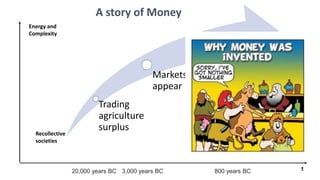
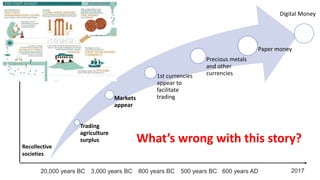
Trading
agriculture
surplus
Markets
appear
1st currencies
appear to
facilitate
trading
Recollective
societies
t
Energy and
Complexity
A story of Money
20,000 years BC 3,000 years BC 800 years BC
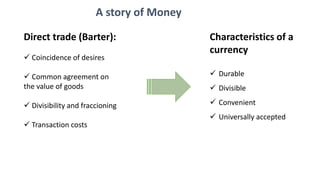
Direct trade (Barter):
 Coincidence of desires
 Common agreement on
the value of goods
 Divisibility and fraccioning
 Transaction costs
Characteristics of a
currency
 Durable
 Divisible
 Convenient
 Universally accepted
A story of Money
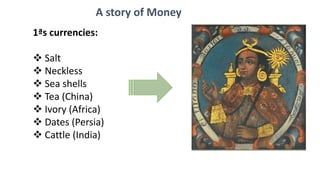
1ªs currencies:
 Salt
 Neckless
 Sea shells
 Tea (China)
 Ivory (Africa)
 Dates (Persia)
 Cattle (India)
Metals:
 Gold
 Silver
 Coper
 Iron
A story of Money
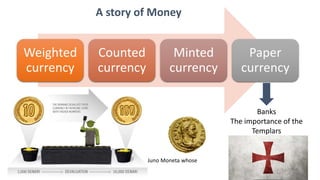
Weighted
currency
Counted
currency
Minted
currency
Paper
currency
III a.c. – Romans used to coin currency in the temple of Juno Moneta whose
funtion was to predict future events (“monere”)
Banks
The importance of the
Templars
A story of Money
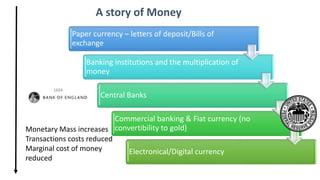
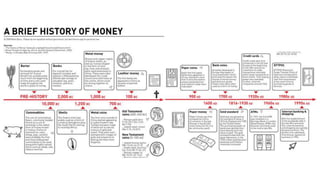
Paper currency – letters of deposit/Bills of
exchange
Banking institutions and the multiplication of
money
Central Banks
Commercial banking & Fiat currency (no
convertibility to gold)
Electronical/Digital currency
Monetary Mass increases
Transactions costs reduced
Marginal cost of money
reduced
1694
A story of Money
Trading
agriculture
surplus
Markets
appear
1st currencies
appear to
facilitate
trading
Precious metals
and other
currencies
Paper money
Recollective
societies
Energy and
Complexity Digital Money
What’s wrong with this story?
20,000 years BC 3,000 years BC 800 years BC 500 years BC 600 years AD 2017
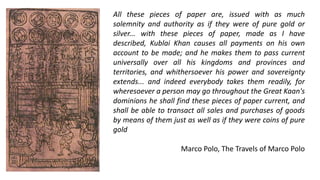
All these pieces of paper are, issued with as much
solemnity and authority as if they were of pure gold or
silver... with these pieces of paper, made as I have
described, Kublai Khan causes all payments on his own
account to be made; and he makes them to pass current
universally over all his kingdoms and provinces and
territories, and whithersoever his power and sovereignty
extends... and indeed everybody takes them readily, for
wheresoever a person may go throughout the Great Kaan's
dominions he shall find these pieces of paper current, and
shall be able to transact all sales and purchases of goods
by means of them just as well as if they were coins of pure
gold
Marco Polo, The Travels of Marco Polo
Trading
agriculture
surplus
Markets
appear
1st currencies
appear to
facilitate
trading
Recollective
societies
t
Energy and
Complexity
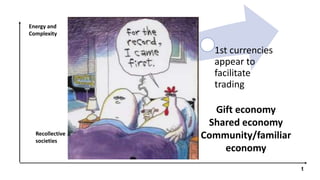
Gift economy
Shared economy
Community/familiar
economy
14
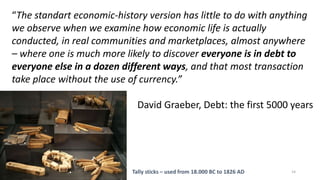
“The standart economic-history version has little to do with anything
we observe when we examine how economic life is actually
conducted, in real communities and marketplaces, almost anywhere
– where one is much more likely to discover everyone is in debt to
everyone else in a dozen different ways, and that most transaction
take place without the use of currency.”
David Graeber, Debt: the first 5000 years
Tally sticks – used from 18.000 BC to 1826 AD
Trading
agriculture
surplus
Markets
appear
1st currencies
appear to
facilitate
trading
Recollective
societies
t
Energy and
Complexity
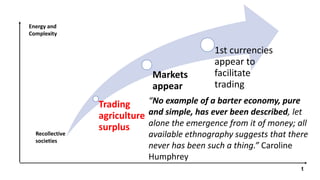
“No example of a barter economy, pure
and simple, has ever been described, let
alone the emergence from it of money; all
available ethnography suggests that there
never has been such a thing.” Caroline
Humphrey
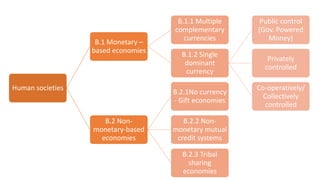
Human societies
B.1 Monetary –
based economies
B.1.1 Multiple
complementary
currencies
B.1.2 Single
dominant
currency
Public control
(Gov. Powered
Money)
Privately
controlled
Co-operatively/
Collectively
controlled
B.2 Non-
monetary-based
economies
B.2.1No currency
- Gift economies
B.2.2 Non-
monetary mutual
credit systems
B.2.3 Tribal
sharing
economies
Who issues money?
Who controls money circulation?
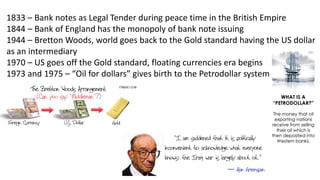
1833 – Bank notes as Legal Tender during peace time in the British Empire
1844 – Bank of England has the monopoly of bank note issuing
1944 – Bretton Woods, world goes back to the Gold standard having the US dollar
as an intermediary
1970 – US goes off the Gold standard, floating currencies era begins
1973 and 1975 – “Oil for dollars” gives birth to the Petrodollar system
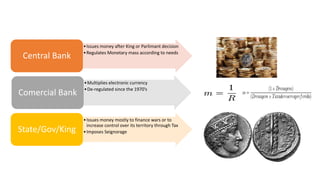
•Issues money after King or Parlimant decision
•Regulates Monetary mass according to needs
Central Bank
•Multiplies electronic currency
•De-regulated since the 1970’s
Comercial Bank
•Issues money mostly to finance wars or to
increase control over its territory through Tax
•Imposes SeignorageState/Gov/King
Tabela:[5] Sistema de empréstimo com reserva fracionada, passando por 10 ciclos com uma taxa de
reserva em 20%[2][6][7]
banco individual quantidade depositada quantidade emprestada reservas
A 100 80 20
B 80 64 16
C 64 51.20 12.80
D 51.20 40.96 10.24
E 40.96 32.77 8.19
F 32.77 26.21 6.55
G 26.21 20.97 5.24
H 20.97 16.78 4.19
I 16.78 13.42 3.36
J 13.42 10.74 2.68
K 10.74
reservas totais:
89.26
total depositado: total emprestado: reservas totais + a ultima
quantidade depositada:
457.05 357.05 100
dinheiro comercial criado +
dinheiro do banco central:
dinheiro do banco comercial
criado: dinheiro do banco central:
457.05 357.05 100
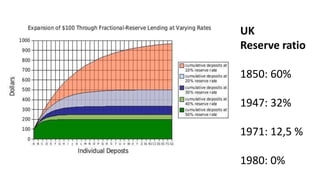
UK
Reserve ratio
1850: 60%
1947: 32%
1971: 12,5 %
1980: 0%
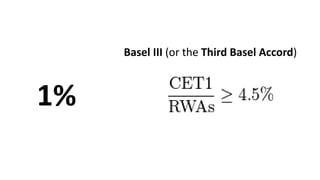
1%
Basel III (or the Third Basel Accord)
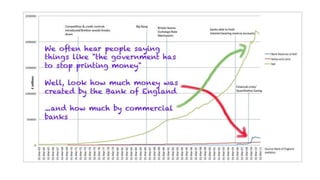
Who controls money?
State?
People?
Parlament?
King?
Efficient markets?
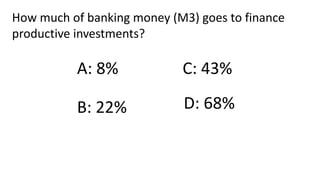
A: 8%
B: 22%
C: 43%
D: 68%
How much of banking money (M3) goes to finance
productive investments?
Economic inequality
Economic scarcity and competition
Financial instability (Boom & Bust cycles)
Environmental and Social unsustainability
Unethical and immoral behaviors
Non-democratic control of money and power
Our current
monetary
systems
drives..

Aulas 2 iseg_money lab_2017

  • 3.
    “Any sizable groupanywhere, any day, could start a nonpolitical monetary unit and system. There is no law against it, and no legislation need to be invoked.” E.C. Riegel
  • 5.
  • 6.
    Direct trade (Barter): Coincidence of desires  Common agreement on the value of goods  Divisibility and fraccioning  Transaction costs Characteristics of a currency  Durable  Divisible  Convenient  Universally accepted A story of Money
  • 7.
    1ªs currencies:  Salt Neckless  Sea shells  Tea (China)  Ivory (Africa)  Dates (Persia)  Cattle (India) Metals:  Gold  Silver  Coper  Iron A story of Money
  • 8.
    Weighted currency Counted currency Minted currency Paper currency III a.c. –Romans used to coin currency in the temple of Juno Moneta whose funtion was to predict future events (“monere”) Banks The importance of the Templars A story of Money
  • 9.
    Paper currency –letters of deposit/Bills of exchange Banking institutions and the multiplication of money Central Banks Commercial banking & Fiat currency (no convertibility to gold) Electronical/Digital currency Monetary Mass increases Transactions costs reduced Marginal cost of money reduced 1694 A story of Money
  • 10.
    Trading agriculture surplus Markets appear 1st currencies appear to facilitate trading Preciousmetals and other currencies Paper money Recollective societies Energy and Complexity Digital Money What’s wrong with this story? 20,000 years BC 3,000 years BC 800 years BC 500 years BC 600 years AD 2017
  • 11.
    All these piecesof paper are, issued with as much solemnity and authority as if they were of pure gold or silver... with these pieces of paper, made as I have described, Kublai Khan causes all payments on his own account to be made; and he makes them to pass current universally over all his kingdoms and provinces and territories, and whithersoever his power and sovereignty extends... and indeed everybody takes them readily, for wheresoever a person may go throughout the Great Kaan's dominions he shall find these pieces of paper current, and shall be able to transact all sales and purchases of goods by means of them just as well as if they were coins of pure gold Marco Polo, The Travels of Marco Polo
  • 13.
  • 14.
    14 “The standart economic-historyversion has little to do with anything we observe when we examine how economic life is actually conducted, in real communities and marketplaces, almost anywhere – where one is much more likely to discover everyone is in debt to everyone else in a dozen different ways, and that most transaction take place without the use of currency.” David Graeber, Debt: the first 5000 years Tally sticks – used from 18.000 BC to 1826 AD
  • 15.
    Trading agriculture surplus Markets appear 1st currencies appear to facilitate trading Recollective societies t Energyand Complexity “No example of a barter economy, pure and simple, has ever been described, let alone the emergence from it of money; all available ethnography suggests that there never has been such a thing.” Caroline Humphrey
  • 17.
    Human societies B.1 Monetary– based economies B.1.1 Multiple complementary currencies B.1.2 Single dominant currency Public control (Gov. Powered Money) Privately controlled Co-operatively/ Collectively controlled B.2 Non- monetary-based economies B.2.1No currency - Gift economies B.2.2 Non- monetary mutual credit systems B.2.3 Tribal sharing economies
  • 19.
    Who issues money? Whocontrols money circulation?
  • 20.
    1833 – Banknotes as Legal Tender during peace time in the British Empire 1844 – Bank of England has the monopoly of bank note issuing 1944 – Bretton Woods, world goes back to the Gold standard having the US dollar as an intermediary 1970 – US goes off the Gold standard, floating currencies era begins 1973 and 1975 – “Oil for dollars” gives birth to the Petrodollar system
  • 21.
    •Issues money afterKing or Parlimant decision •Regulates Monetary mass according to needs Central Bank •Multiplies electronic currency •De-regulated since the 1970’s Comercial Bank •Issues money mostly to finance wars or to increase control over its territory through Tax •Imposes SeignorageState/Gov/King
  • 22.
    Tabela:[5] Sistema deempréstimo com reserva fracionada, passando por 10 ciclos com uma taxa de reserva em 20%[2][6][7] banco individual quantidade depositada quantidade emprestada reservas A 100 80 20 B 80 64 16 C 64 51.20 12.80 D 51.20 40.96 10.24 E 40.96 32.77 8.19 F 32.77 26.21 6.55 G 26.21 20.97 5.24 H 20.97 16.78 4.19 I 16.78 13.42 3.36 J 13.42 10.74 2.68 K 10.74 reservas totais: 89.26 total depositado: total emprestado: reservas totais + a ultima quantidade depositada: 457.05 357.05 100 dinheiro comercial criado + dinheiro do banco central: dinheiro do banco comercial criado: dinheiro do banco central: 457.05 357.05 100
  • 23.
    UK Reserve ratio 1850: 60% 1947:32% 1971: 12,5 % 1980: 0%
  • 24.
    1% Basel III (orthe Third Basel Accord)
  • 26.
  • 28.
    A: 8% B: 22% C:43% D: 68% How much of banking money (M3) goes to finance productive investments?
  • 30.
    Economic inequality Economic scarcityand competition Financial instability (Boom & Bust cycles) Environmental and Social unsustainability Unethical and immoral behaviors Non-democratic control of money and power Our current monetary systems drives..

Editor's Notes

  • #2 Banking institutions are more important than armies
  • #3 Rothschild quote on the power of money
  • #12 Visão eurocêntrica da evolução monetária..e arrogante..é impossivel afzer o trace back do dinheiro e saber o que é ou não moeda do passado pois estamos a olhar para a nossa concepção actual do que é moeda e dinheiro..
  • #14 Debt came first..imagine first writings accounting debts :D
  • #15 Introduzir a lógica de que é a moeda que cria o Mercado e não ao contrário… Sistemas de IOU, mesmo a própria moeda é um IOU pois não tem valor intrínseco..passagem para o mito 2
  • #19 A moeda como algo vivo em constante mutação e adaptação social…
  • #20 A história e evolução do dinheiro e da moeda e bem mais complexa e não linear do que a historia neoclássica que nos é contado. Contudo requer muito mais aulas e muito mais tempo para ser aprofundada..como tal quero apenas focar-me nos últimos 100 anos e perceber como chegamos a isto.
  • #24 Should be isent and free for influence institutions..imagem do FED
  • #25 Should be isent and free for influence institutions..imagem do FED