MONEY MARKET OPERATIONSPRESENTED BY:AMIT GUPTAASHISH SARNASHILPA.A.KUMARVIVEK
WHAT IS MONEY MARKET?Money market means market where money or its equal can be traded.
It consists of financial institutions and dealers in money or credit who wish to produce liquidity.
It is part of financial market where instruments with high liquidity and very short term maturities are traded.CONT…As per RBI definitions “ A market for short terms financial assets that are close substitute for money, facilitates the exchange of money in primary and secondary market”.
The money market is a mechanism that deals with the lending and borrowing of short term funds (less than one year).
A segment of the financial market in which financial instruments with high liquidity and very short maturities are traded.CONT….It doesn’t actually deal in cash or money but deals with substitute of cash like trade bills, promissory notes & govt papers which can converted into cash without any loss at low transaction cost.
It includes all individual, institution and intermediaries.Features of Money MarketIt is a market purely for short-terms funds or financial assets called near money.It deals with financial assets having a maturity period less than one year only.In Money Market transaction can not take place formal like stock exchange, only through oral communication, relevant document and written communication transaction can be done.
CONT…Transaction have to be conducted without the help of brokers.It is not a single homogeneous market, it comprises of several submarket like call money market, acceptance & bill market.The component of Money Market are the commercial banks, acceptance houses & NBFC (Non-banking financial companies).
Objective of Money Market?To provide a parking place to employ short   term surplus funds.To provide room for overcoming short term deficits.To enable the central bank to influence and regulate liquidity in the economy through its intervention in this market.To provide a reasonable access to users of short-term funds to meet their requirement quickly, adequately at reasonable cost.
Importance of the Money MarketDevelopment of trade & industry.
Development of capital market.
Smooth functioning of commercial banks.
Effective central bank control.
Formulation of suitable monetary policy.
“Access to short-term funds allows large financial institutions, the federal government and government agencies to finance short-term operations. This function is the most important feature of the money market.”Money Market ParticipantsCommercial banks and savings associationsGSEsThe Federal ReserveCorporations and finance companiesPension funds and insurance companiesBrokers and dealers
Commercial Banks and Savings AssociationsPlay five important roles:1.Borrow in money market:To meet their reserve needsTo make loans to their commercial or household customers2.Hold significant levels of Treasury securities on asset side of their balance sheetsAssist other participants by:Providing credit enhancements for a fee to those issuing commercial paper and bankers’ acceptances
CONT…Serve as agents and underwriters in commercial paper marketServe as primary dealers of U.S. government securitiesEnables them to trade money market securities on behalf of their corporate customers
GSEsGovernments & Government-Sponsored Enterprises (GSEs):U.S. Treasury is world’s single largest borrowerIssues U.S. Treasury bills (T-bills)Treasury notes and bonds that have longer maturitiesPrivately owned GSEs:Federal National Mortgage Association (Fannie Mae)Federal Farm Credit Banks Funding Corporation (FFCBFC)Student Loan Marketing Association (Sallie Mae)
Privately-owned GSEsEngaged in assisting with finance of:HousingAgricultureEducationState and municipal (local governments and special districts) governments issue short-term municipal notes to finance:Their own expenditures Expenditures of local schools, hospitals and private firms
The Federal ReserveFed controls level of reserves available to depository institutionsopen market purchase and sale of T-billsrepurchase agreements
Corporations/Finance CompaniesUse money markets toraise fundsstore funds Issue large amounts of commercial paper as primary source of fundswhich they lend to consumers and firmsuse to make up for temporary shortfalls of cash
Pension Funds and Insurance CompaniesBoth use money market for cash management to provide needed liquidity
Brokers and DealersEnsure the regular functioning of the money marketMarket new issues of securitiesRepurchase securitiesEstablish secondary market Act as intermediaries in the RP marketMatch buyers and sellers
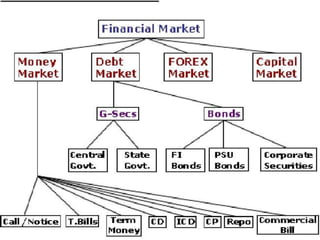
Composition of Money Market   Money Market consists of a number of sub-markets which collectively constitute the money market. They are,Call Money Market
Commercial bills market or discount market
Acceptance market
Treasury bill marketInstrument of Money MarketCommercial papers.
Certificate of deposit.
Repo instrument
Repurchase agreement
Money Market mutual fundCall Money MarketThe call notice money market has graduated into a broad and vibrant institution. Call/Notice money is the money borrowed or lent on demand for a very short period. When money is borrowed or lent for a day, it is known as Call (Overnight) Money. Intervening holidays and/or Sunday are excluded for this purpose.When money is borrowed or lent for more than a day and up to 14 days, it is "Notice Money". No collateral security is required to cover these transactions.From May 1, 1989, the interest rates in the call and the notice money market are market determined. Interest rates in this market are highly sensitive to the demand - supply factors
CONT….The call market enables the banks and institutions to even out their day to day deficits and surpluses of money. Banks especially access the call market to borrow/lend money for adjusting their cash reserve requirements (CRR). The lenders having steady inflow of funds (e.g. LIC, UTI) look at the call market as an outlet for deploying funds on short term basis.
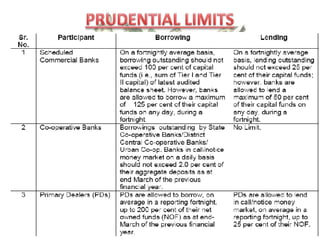
CONT…In the call market, banks can currently borrow not beyond 100 per cent of their capital funds on a fortnightly average basis and on daily basis it cannot exceed 125 per cent. They can lend up to 25 per cent of their capital funds on a fortnightly average basis and 50 per cent on a daily basis.
OPERATIONS IN CALL MONEYBorrowers and lenders contact each other over telephone. The borrowers and lenders arrive at a deal specifying the amount of loan and the rate of interest. After the deal is over, the lender issues FBL cheque in favor of the borrower. The borrower in turn issues call money borrowing receipt. When the loan is repaid with interest, the lender returns the duly discharged receipt.
OPERATIONS IN CALL MONEYThe deal can be directly negotiated by routing it through the Discount and Finance House of India (DFHI).The borrowers and lenders inform the DFHI about their fund requirement and availability at a specified rate of interest.Once the deal is confirmed, the Deal Settlement Advice is exchanged.In case the DFHI borrows, it issues a call deposit receipt to the    lender and receives RBI cheque for the money borrowed. The reverse takes place in the case of lending by the DFHI. The duly discharged call deposit receipt is surrendered at the time of settlement. Call loans can be renewed upto a maximum period of 14 days only and such renewals are recorded on the back of the deposit receipt by the borrower.
PRUDENTIAL LIMITS
Commercial bills marketBills of exchange are negotiable instruments drawn by the seller (drawer) on the buyer (drawee) for the value of the goods delivered to him. Such bills are called trade bills. When trade bills are accepted by commercial banks, they are called commercial bills. If the seller wishes to give some period for payment, the bill would be payable at a future date (usance bill). During the currency of the bill, if the seller is in need of funds, he may approach his bank for discounting the bill.
CONT…One of the methods of providing credit to customers by bank is by discounting commercial bills at a prescribed discount rate. The bank will receive the maturity proceeds (face value) of discounted bill from the drawee. In the meanwhile, if the bank is in need of funds, it can rediscount the bill already discounted by it in the commercial bill rediscount market at the market related rediscount rate. (The RBI introduced the Bill Market Scheme in 1952 and a new scheme called the Bill Rediscounting Scheme in November 1970).
CONT…With a view to eliminating movement of papers and facilitating multiple rediscounting, the RBI introduced an innovative instrument known as "Derivative Usance Promissory Notes" backed by such eligible commercial bills for required amounts and usance period (up to 90 days). Government has exempted stamp duty on derivative usance promissory notes. This has indeed simplified and streamlined the bill rediscounting by Institutions and made commercial bill an active instrument in the secondary money market.
CONT…In the bill rediscounting market, it is possible to acquire bills having balance maturity period of different days up to 90 days. As some banks were using the facility of rediscounting commercial bills and derivative usance promissory notes for as short a period as one day merely a substitute for call money, RBI has since restricted such rediscounting for a minimum period of 15 days.
Acceptance market A bankers acceptance (BA) is a money market instrument: a short-term discount instrument that usually arises in the course of international trade.A draft is a legally binding order by one party (the drawer) to a second party (the drawee) to make payment to a third party (the payee).When a draft guarantees payment for goods in international trade, it is called a bill of exchange.
CONT..A draft can require immediate payment by the second party to the third upon presentation of the draft. This is called a sight draft.An importer might write a draft promising payment to an exporter for delivery of goods with payment to occur 60 days after the goods are delivered. Such drafts are called time drafts.
CONT..In cases where the drawer and drawee of a time draft are distinct parties, the payee may submit the draft to the drawee for confirmation that the draft is a legitimate order and that the drawee will make payment on the specified date. Such confirmation is called acceptance—the drawee accepts the order to pay as legitimate.
CONT..The drawee stamps ACCEPTED on the draft and is thereafter obligated to make the specified payment when it is due. If the drawee is a bank, the acceptance is called a bankers acceptance (BA).A bankers acceptance is an obligation of the accepting bank.Bankers acceptances are quoted in discount form. Maturities are generally between one and six months, and they trade as bearer instruments.
Treasury bill marketTreasury Bills are money market instruments to finance the short term requirements of the Government of India. These are discounted securities and thus are issued at a discount to face value.The return to the investor is the difference between the maturity value and issue price.
Types Of Treasury Bills There are different types of Treasury bills based on the maturity period and utility of the issuance like, ad-hoc Treasury bills, 3 months, 6 months and 12months Treasury bills etc. In India, at present, the Treasury Bills are issued for the following tenors 91-days, 182-days and 364-days Treasury bills.
Benefits Of Investment In Treasury Bills No tax deducted at source Zero default risk being sovereign paper Highly liquid money market instrument Better returns especially in the short term Transparency Simplified settlement High degree of tradeability and active secondary market facilitates meeting unplanned fund requirements.
Features FormThe treasury bills are issued in the form of promissory note in physical form or by credit to Subsidiary General Ledger (SGL) account or Gilt account in dematerialisedform.Minimum Amount Of Bids Bids for treasury bills are to be made for a minimum amount of Rs 25000/- only and in multiples thereof. Eligibility: All entities registered in India like banks, financial institutions, Primary Dealers, firms, companies, corporate bodies, partnership firms, institutions, mutual funds, Foreign Institutional Investors, State Governments, Provident Funds, trusts, research organizations, Nepal Rashtra bank and even individuals are eligible to bid and purchase Treasury bills. Repayment The treasury bills are repaid at par on the expiry of their tenor at the office of the Reserve Bank of India, Mumbai. 
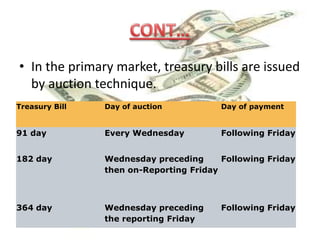
CONT…In the primary market, treasury bills are issued by auction technique.
Commercial paper (CP)CP is a short term unsecured loan issued by a corporation typically financing day to day operation.CP is very safe investment because the financial situation of a company can easily be predicted over a few months.Only company with high credit rating issues CP’s.
SALIENT FEATURES They are unsecured debts of corporate and are issued in the form of promissory notes, redeemable at par to the holder at maturity. Only corporate who get an investment grade rating can issue CPs, as per RBI rules.  It is issued at a discount to face value.  Attracts issuance stamp duty in primary issue.  Has to be mandatorily rated by one of the credit rating agencies.  It is issued as per RBI guidelines
CONT… It’s held in De-mat form.  CP can be issued in denominations of Rs.5 lakh or multiples thereof. Amount invested by a single investor should not be less than Rs.5 lakh (face value).  Issued at discount to face value as may be determined by the issuer.  Bank and FI’s are prohibited from issuance and underwriting of CP’s.  Can be issued for a maturity for a minimum of 15 days and a maximum up to one year from the date of issue.
RBI GUIDELINES ON ISSUE OF COMMERCIAL PAPER Corporate, primary dealers, satellite dealers and all India financial institutions are permitted to raise short term finance through issue of commercial paper, which should be within the umbrella limit fixed by RBI. A corporate can issue Commercial Paper if:1. Its tangible net worth is not less than Rs.5 Crores as per latest balance sheet.2. Working capital limit is obtained from banks/ all India financial institutions, and3. Its borrowable account is classified as standard asset by banks/ all India financial institutions.
CONT..Commercial paper can be issued for maturities between a minimum of 15 days and a maximum of up to one year from the date of issue.  The maturity date of commercial paper should not exceed the date beyond the date up to which credit rating is valid.A company can issue commercial paper to an aggregate amount within the limit approved by board of directors or limit specified by credit rating agency, whichever is lower.  Banks and financial institutions have the flexibility to fix working capital limits duly taking into account the resource pattern of company’s financing including commercial papers.
Certificate of deposit (CD)It is a short term borrowing more like a bank term deposit account.It is a promissory note issued by a bank in form of a certificate entitling the bearer to receive interest.The certificate bears the maturity date, the fixed rate of interest and the value. It can be issued in any denomination.While buying Certificate of Deposit, return method should be seen. Returns can be based on Annual Percentage Yield (APY) or Annual Percentage Rate (APR).
Salient Features of CDs CDs can be issued to individuals, corporations, companies, trusts, funds, associates, etc. NRIs can subscribe to CDs on non-repatriable basis. CDs attract stamp duty as applicable to negotiable instruments. Banks have to maintain SLR and CRR on the issue price of CDs. No ceiling on the amount to be issued. The minimum issue size of CDs is Rs.5 lakhs and multiples thereof. CDs are transferable by endorsement and delivery. The minimum lock-in-period for CDs is 15 days.CDs are issued by Banks, when the deposit growth is sluggish and credit demand is high and a tightening trend in call rate is evident. CDs are generally considered high cost liabilities and banks have recourse to them only under tight liquidity conditions.
Repurchase Agreements:Repurchase transactions, called Repo or Reverse Repo are transactions or short term loans in which two parties agree to sell and repurchase the same security.They are usually used for overnight borrowingRepo/Reverse Repo transactions can be done only between the parties approved by RBI and in RBI approved securities viz. State Govt Securities, T-Bills, PSU Bonds, FI Bonds, Corporate Bonds etc.
CONT..Under repurchase agreement the seller sells specified securities with an agreement to repurchase the same at a mutually decided future date and price.Such a transaction is called a Repo when viewed from the perspective of the seller of the securities and Reverse Repo when viewed from the perspective of the buyer of the securities.
CONT..The lender or buyer in a Repo is entitled to receive compensation for use of funds provided to the counterparty.The rate of interest agreed upon is called the Repo rate. The Repo rate is negotiated by the counterparties independently of the coupon rate or rates of the underlying securities and is influenced by overall money market conditions.
Money Market mutual fundMoney market mutual funds offer a convenient parking place for cash reserves when an investor is not quite ready to make an investment or is anticipating a near-term cash outlay for a non-investment purpose. Money market mutual funds offer ultimate safety and liquidity.An investor holding a basket of mutual funds from a single fund company may occasionally want to transfer assets from one fund to another

Money

  • 1.
    MONEY MARKET OPERATIONSPRESENTEDBY:AMIT GUPTAASHISH SARNASHILPA.A.KUMARVIVEK
  • 3.
    WHAT IS MONEYMARKET?Money market means market where money or its equal can be traded.
  • 4.
    It consists offinancial institutions and dealers in money or credit who wish to produce liquidity.
  • 5.
    It is partof financial market where instruments with high liquidity and very short term maturities are traded.CONT…As per RBI definitions “ A market for short terms financial assets that are close substitute for money, facilitates the exchange of money in primary and secondary market”.
  • 6.
    The money marketis a mechanism that deals with the lending and borrowing of short term funds (less than one year).
  • 7.
    A segment of thefinancial market in which financial instruments with high liquidity and very short maturities are traded.CONT….It doesn’t actually deal in cash or money but deals with substitute of cash like trade bills, promissory notes & govt papers which can converted into cash without any loss at low transaction cost.
  • 8.
    It includes allindividual, institution and intermediaries.Features of Money MarketIt is a market purely for short-terms funds or financial assets called near money.It deals with financial assets having a maturity period less than one year only.In Money Market transaction can not take place formal like stock exchange, only through oral communication, relevant document and written communication transaction can be done.
  • 9.
    CONT…Transaction have tobe conducted without the help of brokers.It is not a single homogeneous market, it comprises of several submarket like call money market, acceptance & bill market.The component of Money Market are the commercial banks, acceptance houses & NBFC (Non-banking financial companies).
  • 10.
    Objective of MoneyMarket?To provide a parking place to employ short term surplus funds.To provide room for overcoming short term deficits.To enable the central bank to influence and regulate liquidity in the economy through its intervention in this market.To provide a reasonable access to users of short-term funds to meet their requirement quickly, adequately at reasonable cost.
  • 11.
    Importance of theMoney MarketDevelopment of trade & industry.
  • 12.
  • 13.
    Smooth functioning ofcommercial banks.
  • 14.
  • 15.
    Formulation of suitablemonetary policy.
  • 16.
    “Access to short-termfunds allows large financial institutions, the federal government and government agencies to finance short-term operations. This function is the most important feature of the money market.”Money Market ParticipantsCommercial banks and savings associationsGSEsThe Federal ReserveCorporations and finance companiesPension funds and insurance companiesBrokers and dealers
  • 17.
    Commercial Banks andSavings AssociationsPlay five important roles:1.Borrow in money market:To meet their reserve needsTo make loans to their commercial or household customers2.Hold significant levels of Treasury securities on asset side of their balance sheetsAssist other participants by:Providing credit enhancements for a fee to those issuing commercial paper and bankers’ acceptances
  • 18.
    CONT…Serve as agentsand underwriters in commercial paper marketServe as primary dealers of U.S. government securitiesEnables them to trade money market securities on behalf of their corporate customers
  • 19.
    GSEsGovernments & Government-SponsoredEnterprises (GSEs):U.S. Treasury is world’s single largest borrowerIssues U.S. Treasury bills (T-bills)Treasury notes and bonds that have longer maturitiesPrivately owned GSEs:Federal National Mortgage Association (Fannie Mae)Federal Farm Credit Banks Funding Corporation (FFCBFC)Student Loan Marketing Association (Sallie Mae)
  • 20.
    Privately-owned GSEsEngaged inassisting with finance of:HousingAgricultureEducationState and municipal (local governments and special districts) governments issue short-term municipal notes to finance:Their own expenditures Expenditures of local schools, hospitals and private firms
  • 21.
    The Federal ReserveFedcontrols level of reserves available to depository institutionsopen market purchase and sale of T-billsrepurchase agreements
  • 22.
    Corporations/Finance CompaniesUse moneymarkets toraise fundsstore funds Issue large amounts of commercial paper as primary source of fundswhich they lend to consumers and firmsuse to make up for temporary shortfalls of cash
  • 23.
    Pension Funds andInsurance CompaniesBoth use money market for cash management to provide needed liquidity
  • 24.
    Brokers and DealersEnsurethe regular functioning of the money marketMarket new issues of securitiesRepurchase securitiesEstablish secondary market Act as intermediaries in the RP marketMatch buyers and sellers
  • 25.
    Composition of MoneyMarket Money Market consists of a number of sub-markets which collectively constitute the money market. They are,Call Money Market
  • 26.
    Commercial bills marketor discount market
  • 27.
  • 28.
    Treasury bill marketInstrumentof Money MarketCommercial papers.
  • 29.
  • 30.
  • 31.
  • 32.
    Money Market mutualfundCall Money MarketThe call notice money market has graduated into a broad and vibrant institution. Call/Notice money is the money borrowed or lent on demand for a very short period. When money is borrowed or lent for a day, it is known as Call (Overnight) Money. Intervening holidays and/or Sunday are excluded for this purpose.When money is borrowed or lent for more than a day and up to 14 days, it is "Notice Money". No collateral security is required to cover these transactions.From May 1, 1989, the interest rates in the call and the notice money market are market determined. Interest rates in this market are highly sensitive to the demand - supply factors
  • 33.
    CONT….The call marketenables the banks and institutions to even out their day to day deficits and surpluses of money. Banks especially access the call market to borrow/lend money for adjusting their cash reserve requirements (CRR). The lenders having steady inflow of funds (e.g. LIC, UTI) look at the call market as an outlet for deploying funds on short term basis.
  • 34.
    CONT…In the callmarket, banks can currently borrow not beyond 100 per cent of their capital funds on a fortnightly average basis and on daily basis it cannot exceed 125 per cent. They can lend up to 25 per cent of their capital funds on a fortnightly average basis and 50 per cent on a daily basis.
  • 35.
    OPERATIONS IN CALLMONEYBorrowers and lenders contact each other over telephone. The borrowers and lenders arrive at a deal specifying the amount of loan and the rate of interest. After the deal is over, the lender issues FBL cheque in favor of the borrower. The borrower in turn issues call money borrowing receipt. When the loan is repaid with interest, the lender returns the duly discharged receipt.
  • 36.
    OPERATIONS IN CALLMONEYThe deal can be directly negotiated by routing it through the Discount and Finance House of India (DFHI).The borrowers and lenders inform the DFHI about their fund requirement and availability at a specified rate of interest.Once the deal is confirmed, the Deal Settlement Advice is exchanged.In case the DFHI borrows, it issues a call deposit receipt to the lender and receives RBI cheque for the money borrowed. The reverse takes place in the case of lending by the DFHI. The duly discharged call deposit receipt is surrendered at the time of settlement. Call loans can be renewed upto a maximum period of 14 days only and such renewals are recorded on the back of the deposit receipt by the borrower.
  • 37.
  • 38.
    Commercial bills marketBillsof exchange are negotiable instruments drawn by the seller (drawer) on the buyer (drawee) for the value of the goods delivered to him. Such bills are called trade bills. When trade bills are accepted by commercial banks, they are called commercial bills. If the seller wishes to give some period for payment, the bill would be payable at a future date (usance bill). During the currency of the bill, if the seller is in need of funds, he may approach his bank for discounting the bill.
  • 39.
    CONT…One of themethods of providing credit to customers by bank is by discounting commercial bills at a prescribed discount rate. The bank will receive the maturity proceeds (face value) of discounted bill from the drawee. In the meanwhile, if the bank is in need of funds, it can rediscount the bill already discounted by it in the commercial bill rediscount market at the market related rediscount rate. (The RBI introduced the Bill Market Scheme in 1952 and a new scheme called the Bill Rediscounting Scheme in November 1970).
  • 40.
    CONT…With a viewto eliminating movement of papers and facilitating multiple rediscounting, the RBI introduced an innovative instrument known as "Derivative Usance Promissory Notes" backed by such eligible commercial bills for required amounts and usance period (up to 90 days). Government has exempted stamp duty on derivative usance promissory notes. This has indeed simplified and streamlined the bill rediscounting by Institutions and made commercial bill an active instrument in the secondary money market.
  • 41.
    CONT…In the billrediscounting market, it is possible to acquire bills having balance maturity period of different days up to 90 days. As some banks were using the facility of rediscounting commercial bills and derivative usance promissory notes for as short a period as one day merely a substitute for call money, RBI has since restricted such rediscounting for a minimum period of 15 days.
  • 42.
    Acceptance market Abankers acceptance (BA) is a money market instrument: a short-term discount instrument that usually arises in the course of international trade.A draft is a legally binding order by one party (the drawer) to a second party (the drawee) to make payment to a third party (the payee).When a draft guarantees payment for goods in international trade, it is called a bill of exchange.
  • 43.
    CONT..A draft canrequire immediate payment by the second party to the third upon presentation of the draft. This is called a sight draft.An importer might write a draft promising payment to an exporter for delivery of goods with payment to occur 60 days after the goods are delivered. Such drafts are called time drafts.
  • 44.
    CONT..In cases wherethe drawer and drawee of a time draft are distinct parties, the payee may submit the draft to the drawee for confirmation that the draft is a legitimate order and that the drawee will make payment on the specified date. Such confirmation is called acceptance—the drawee accepts the order to pay as legitimate.
  • 45.
    CONT..The drawee stampsACCEPTED on the draft and is thereafter obligated to make the specified payment when it is due. If the drawee is a bank, the acceptance is called a bankers acceptance (BA).A bankers acceptance is an obligation of the accepting bank.Bankers acceptances are quoted in discount form. Maturities are generally between one and six months, and they trade as bearer instruments.
  • 46.
    Treasury bill marketTreasuryBills are money market instruments to finance the short term requirements of the Government of India. These are discounted securities and thus are issued at a discount to face value.The return to the investor is the difference between the maturity value and issue price.
  • 47.
    Types Of TreasuryBills There are different types of Treasury bills based on the maturity period and utility of the issuance like, ad-hoc Treasury bills, 3 months, 6 months and 12months Treasury bills etc. In India, at present, the Treasury Bills are issued for the following tenors 91-days, 182-days and 364-days Treasury bills.
  • 48.
    Benefits Of InvestmentIn Treasury Bills No tax deducted at source Zero default risk being sovereign paper Highly liquid money market instrument Better returns especially in the short term Transparency Simplified settlement High degree of tradeability and active secondary market facilitates meeting unplanned fund requirements.
  • 49.
    Features FormThe treasury billsare issued in the form of promissory note in physical form or by credit to Subsidiary General Ledger (SGL) account or Gilt account in dematerialisedform.Minimum Amount Of Bids Bids for treasury bills are to be made for a minimum amount of Rs 25000/- only and in multiples thereof. Eligibility: All entities registered in India like banks, financial institutions, Primary Dealers, firms, companies, corporate bodies, partnership firms, institutions, mutual funds, Foreign Institutional Investors, State Governments, Provident Funds, trusts, research organizations, Nepal Rashtra bank and even individuals are eligible to bid and purchase Treasury bills. Repayment The treasury bills are repaid at par on the expiry of their tenor at the office of the Reserve Bank of India, Mumbai. 
  • 50.
    CONT…In the primarymarket, treasury bills are issued by auction technique.
  • 51.
    Commercial paper (CP)CPis a short term unsecured loan issued by a corporation typically financing day to day operation.CP is very safe investment because the financial situation of a company can easily be predicted over a few months.Only company with high credit rating issues CP’s.
  • 52.
    SALIENT FEATURES Theyare unsecured debts of corporate and are issued in the form of promissory notes, redeemable at par to the holder at maturity. Only corporate who get an investment grade rating can issue CPs, as per RBI rules.  It is issued at a discount to face value.  Attracts issuance stamp duty in primary issue.  Has to be mandatorily rated by one of the credit rating agencies.  It is issued as per RBI guidelines
  • 53.
    CONT… It’s heldin De-mat form.  CP can be issued in denominations of Rs.5 lakh or multiples thereof. Amount invested by a single investor should not be less than Rs.5 lakh (face value).  Issued at discount to face value as may be determined by the issuer.  Bank and FI’s are prohibited from issuance and underwriting of CP’s.  Can be issued for a maturity for a minimum of 15 days and a maximum up to one year from the date of issue.
  • 54.
    RBI GUIDELINES ONISSUE OF COMMERCIAL PAPER Corporate, primary dealers, satellite dealers and all India financial institutions are permitted to raise short term finance through issue of commercial paper, which should be within the umbrella limit fixed by RBI. A corporate can issue Commercial Paper if:1. Its tangible net worth is not less than Rs.5 Crores as per latest balance sheet.2. Working capital limit is obtained from banks/ all India financial institutions, and3. Its borrowable account is classified as standard asset by banks/ all India financial institutions.
  • 55.
    CONT..Commercial paper canbe issued for maturities between a minimum of 15 days and a maximum of up to one year from the date of issue.  The maturity date of commercial paper should not exceed the date beyond the date up to which credit rating is valid.A company can issue commercial paper to an aggregate amount within the limit approved by board of directors or limit specified by credit rating agency, whichever is lower.  Banks and financial institutions have the flexibility to fix working capital limits duly taking into account the resource pattern of company’s financing including commercial papers.
  • 56.
    Certificate of deposit(CD)It is a short term borrowing more like a bank term deposit account.It is a promissory note issued by a bank in form of a certificate entitling the bearer to receive interest.The certificate bears the maturity date, the fixed rate of interest and the value. It can be issued in any denomination.While buying Certificate of Deposit, return method should be seen. Returns can be based on Annual Percentage Yield (APY) or Annual Percentage Rate (APR).
  • 57.
    Salient Features ofCDs CDs can be issued to individuals, corporations, companies, trusts, funds, associates, etc. NRIs can subscribe to CDs on non-repatriable basis. CDs attract stamp duty as applicable to negotiable instruments. Banks have to maintain SLR and CRR on the issue price of CDs. No ceiling on the amount to be issued. The minimum issue size of CDs is Rs.5 lakhs and multiples thereof. CDs are transferable by endorsement and delivery. The minimum lock-in-period for CDs is 15 days.CDs are issued by Banks, when the deposit growth is sluggish and credit demand is high and a tightening trend in call rate is evident. CDs are generally considered high cost liabilities and banks have recourse to them only under tight liquidity conditions.
  • 58.
    Repurchase Agreements:Repurchase transactions,called Repo or Reverse Repo are transactions or short term loans in which two parties agree to sell and repurchase the same security.They are usually used for overnight borrowingRepo/Reverse Repo transactions can be done only between the parties approved by RBI and in RBI approved securities viz. State Govt Securities, T-Bills, PSU Bonds, FI Bonds, Corporate Bonds etc.
  • 59.
    CONT..Under repurchase agreementthe seller sells specified securities with an agreement to repurchase the same at a mutually decided future date and price.Such a transaction is called a Repo when viewed from the perspective of the seller of the securities and Reverse Repo when viewed from the perspective of the buyer of the securities.
  • 60.
    CONT..The lender orbuyer in a Repo is entitled to receive compensation for use of funds provided to the counterparty.The rate of interest agreed upon is called the Repo rate. The Repo rate is negotiated by the counterparties independently of the coupon rate or rates of the underlying securities and is influenced by overall money market conditions.
  • 61.
    Money Market mutualfundMoney market mutual funds offer a convenient parking place for cash reserves when an investor is not quite ready to make an investment or is anticipating a near-term cash outlay for a non-investment purpose. Money market mutual funds offer ultimate safety and liquidity.An investor holding a basket of mutual funds from a single fund company may occasionally want to transfer assets from one fund to another