June Monetary Policy Review
Cape Town
3 June 2015
Headlines
 Evolving global conditions
 Headline CPI likely to be sticky around 6% as petrol impact dissipates
 Underlying inflation and expectations persistent
 Output gap still negative, but potential growth lower
 Risks to inflation high…
 Food, electricity, remuneration, currency
 Monetary policy remains in a gradual tightening cycle
2
Overview of the presentation
I. The world economy
II. Growth and the GDP forecast
III. Inflation and the inflation outlook
3
I. The world economy
4
Modest global recovery shaped by mixed AE fortunes & EM
weakness – longer term acceleration will be EM driven
5Source: IMF World Economic Outlook
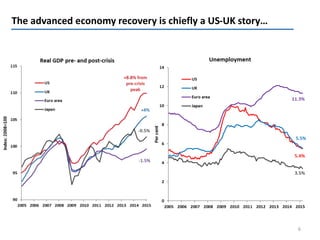
The advanced economy recovery is chiefly a US-UK story…
6
China’s economy is slowing and rebalancing…
8
…with important consequences for commodity prices
9
Chinese monetary policy easing as inflation falls & GDP slows
10
Global monetary conditions continue to support financing in
EMs
11
…but at risk of reversal as monetary conditions tighten
12
II. Growth and the GDP forecast
13
SA growth forecasts closer to 2%, with pick up late in the period
14
1.5
1.7
1.9
2.1
2.3
2.5
2.7
2.9
3.1
3.3
3.5
Date of forecast
Growth forecasts over time
2015 real GDP
2016 real GDP
2017 real GDP
-7
-6
-5
-4
-3
-2
-1
0
1
2
3
4
5
6
7
8
2007 2008 2009 2010 2011 2012 2013 2014 2015 2016 2017
Growth fan chart
Lower potential but output gap still negative
15
Improved measures of potential have narrowed the output gap
estimate
16
Weak global demand results in low and volatile exports
17
… and inflation diluting competitiveness gains…
18
… while commodity prices decline … CSC over?
19
Commodity price assumptions down 37% in two years
Shortages in energy intensive economy hit hard
21
…curtailing investment (outside electricity sector)
22
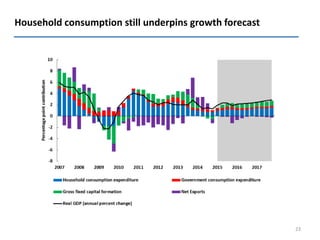
Household consumption still underpins growth forecast
23
…while debt to GDP burdens weigh against further leverage
24
And net job creation tailing off
25
III. Inflation and the inflation outlook
26
World inflation unusually low due to weak demand… falling
food & oil prices
27
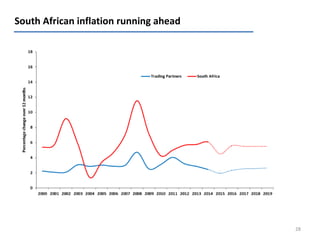
South African inflation running ahead
28
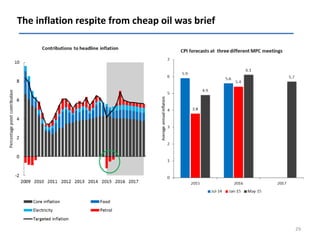
The inflation respite from cheap oil was brief
29
Higher inflation propelled by a series of supply shocks…
30
…as well as high unit labour cost growth
31
Not unhinging expectations, but fostering convergence
32
Convergence around the top of the target range
33
Hassan, Shakill, Siobhan Redford, and Franz Ruch. 2015. Dispersion of Inflation Expectations. SA Reserve Bank, Working Paper
(forthcoming).
Forecast at top of the target and risks to the upside
34
World food prices low, but currency and drought keeping SA prices
buoyant
35
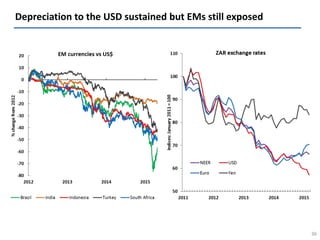
Depreciation to the USD sustained but EMs still exposed
36
South Africa’s current account deficit narrowing slowly
37
Unit labour costs expected to moderate somewhat, with risks
38
0
3
6
9
12
15
Core inflation Unit labour cost
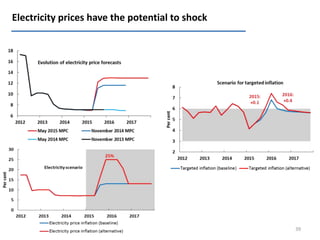
Electricity prices have the potential to shock
39
Conclusion: Monetary policy shaped by an array of factors…
• Global financial conditions as
rates change… speed & timing
• Inflationary pressures at
elevated levels
• Risks… food, electricity,
remuneration, currency
• Sustained breach as core &
expectations high?
• MPC indicated a preference for a
Gradual normalisation path in
keeping with or flexible IT
framework
40

Monetary Policy Forum

Editor's Notes

  • #9 Dmtu is dry metric ton units
  • #21 The nominal exchange rate of the rand has followed a depreciating trend from the end of 2010 through to the third quarter of 2013. High frequency data shows some stabilisation of the level of the nominal exchange rate of the rand over the most recent quarter. After allowing the real effective exchange rate of the rand to reflect the nominal exchange rate deterioration through 2013, it is then assumed to remain constant at the more depreciated third-quarter level over the remainder of the forecast period. As a result the real effective exchange rate assumption remains unchanged with only a modest technical depreciation envisaged in 2014. The announcement by the US Federal Reserve to delay the tapering of its bond purchasing programme and the expectation of a peaceful resolution on Syria’s use of chemical weapons has relieved negative pressure on the rand exchange rate, as it has for most emerging market currencies. Investor sentiment towards South Africa’s currency continues to be weighed down by labour issues and fears of further credit downgrades. Current account deficit concerns persist as the trade account remains under pressure. 1. The real effective exchange rate of the rand as shown, was implemented with the release of the December 2008 Quarterly Bulletin. Here, the real effective exchange rate of the rand comprises the weighted basket of South Africa’s 15 major trading partner currencies. Producer price indices for manufactured goods have been used in the calculation.
  • #40 Electricity scenario: prices up 25% from September 2015, then 13.1 for 2016/17 and 2017/18
  • #43 Note that corporate debt , in the top chart, includes bonds – it’s not just credit.