A new tumour targeting bombesin peptide: agonist vs antagonist
    Linda M. van der Graaf1, Thea Maina2, Pantelis J. Marsouvanidis2, Marleen Melis1, Eric P.
Krenning1, Jean martinez3, Luc Brunel3, Jean-Alain Fehrentz3, Berthold A. Nock2, Marion de Jong1
  1 Erasmus   MC, dept. of Nuclear Medicine, Rotterdam, the Netherlands, 2 NCSR “Demokritos”, Athens, Greece,
               3 Faculté de Pharmacie, CNRS-Universités de Montpellier 1 et 2, Montpellier, France


Introduction:                                             Aim:
                                                          In the current study the new bombesin antagonist
    radionuclide      peptide receptor on tumour cell     JMV4168 was characterized, which is an attractive
                                                          alternative to agonists (e.g. AMBA with similar
Bombesin peptide analogues specifically bind to
                                                          GRPR affinity) because of its biosafety.
Gastrin Releasing Peptide receptors (GRPR) that
are overexpressed on prostate and breast cancers.         Materials and Methods:
When radiolabelled diagnostic imaging (e.g. 111In)
                                                          In vitro assays using 111In-JMV4168 were
or therapeutic application (e.g. 177Lu) is feasible.
                                                          performed on GRPR expressing prostate cancer
Proof of concept has been obtained clinically using       PC3 cells. Cell radiation doses were calculated for
peptide agonists, however severe side effects were        internalized and cell-surface bound fractions. In
observed in patients. Recent studies have revealed        vivo behaviour was tested in PC3 and PC295
the superior profile of GRPR-antagonists as               xenografted mice. Biodistribution studies were
compared to agonists.                                     performed 4(-72) h after injection of 10 pmol 111In
                                                          (not shown) - or 177Lu-JMV4168, with an extra 4 h
                                                          group co-injected with an excess of unlabelled
Results:                                                  JMV4168 as specificity control. Also a 1 h dynamic
                                                          SPECT/CT imaging study (every 5 min.) with 250
                                                          pmol 111In-JMV4168 was performed.


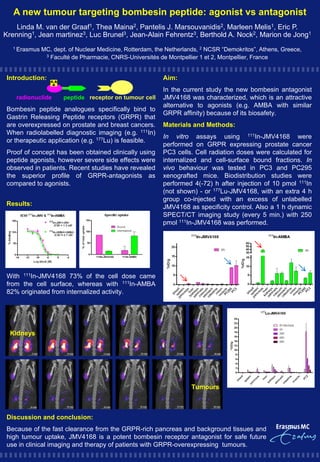
With 111In-JMV4168 73% of the cell dose came
from the cell surface, whereas with 111In-AMBA
82% originated from internalized activity.


  Kidneys


                                                                    Tumours


Discussion and conclusion:
Because of the fast clearance from the GRPR-rich pancreas and background tissues and
high tumour uptake, JMV4168 is a potent bombesin receptor antagonist for safe future
use in clinical imaging and therapy of patients with GRPR-overexpressing tumours.

MolMed dag 2012 JMV

  • 1.
    A new tumourtargeting bombesin peptide: agonist vs antagonist Linda M. van der Graaf1, Thea Maina2, Pantelis J. Marsouvanidis2, Marleen Melis1, Eric P. Krenning1, Jean martinez3, Luc Brunel3, Jean-Alain Fehrentz3, Berthold A. Nock2, Marion de Jong1 1 Erasmus MC, dept. of Nuclear Medicine, Rotterdam, the Netherlands, 2 NCSR “Demokritos”, Athens, Greece, 3 Faculté de Pharmacie, CNRS-Universités de Montpellier 1 et 2, Montpellier, France Introduction: Aim: In the current study the new bombesin antagonist radionuclide peptide receptor on tumour cell JMV4168 was characterized, which is an attractive alternative to agonists (e.g. AMBA with similar Bombesin peptide analogues specifically bind to GRPR affinity) because of its biosafety. Gastrin Releasing Peptide receptors (GRPR) that are overexpressed on prostate and breast cancers. Materials and Methods: When radiolabelled diagnostic imaging (e.g. 111In) In vitro assays using 111In-JMV4168 were or therapeutic application (e.g. 177Lu) is feasible. performed on GRPR expressing prostate cancer Proof of concept has been obtained clinically using PC3 cells. Cell radiation doses were calculated for peptide agonists, however severe side effects were internalized and cell-surface bound fractions. In observed in patients. Recent studies have revealed vivo behaviour was tested in PC3 and PC295 the superior profile of GRPR-antagonists as xenografted mice. Biodistribution studies were compared to agonists. performed 4(-72) h after injection of 10 pmol 111In (not shown) - or 177Lu-JMV4168, with an extra 4 h group co-injected with an excess of unlabelled Results: JMV4168 as specificity control. Also a 1 h dynamic SPECT/CT imaging study (every 5 min.) with 250 pmol 111In-JMV4168 was performed. With 111In-JMV4168 73% of the cell dose came from the cell surface, whereas with 111In-AMBA 82% originated from internalized activity. Kidneys Tumours Discussion and conclusion: Because of the fast clearance from the GRPR-rich pancreas and background tissues and high tumour uptake, JMV4168 is a potent bombesin receptor antagonist for safe future use in clinical imaging and therapy of patients with GRPR-overexpressing tumours.