MOLECULAR MARKERS
Dr. Muhammad Arif
Genomics, Proteomics and Bioinformatics
Overview
• Definition of molecular markers
• Polymorphism
• Causes of polymorphism
• Types of molecular markers
• Methodology of molecular markers
• Applications
11/30/2020 NIBGE Ph.D lecture
Molecular markers
Molecular markers are defined as the short
sequences of DNA (primers or probe) which
directly reveal the polymorphism of DNA.
The polymorphic sequences correspond or not
to coding sequences.
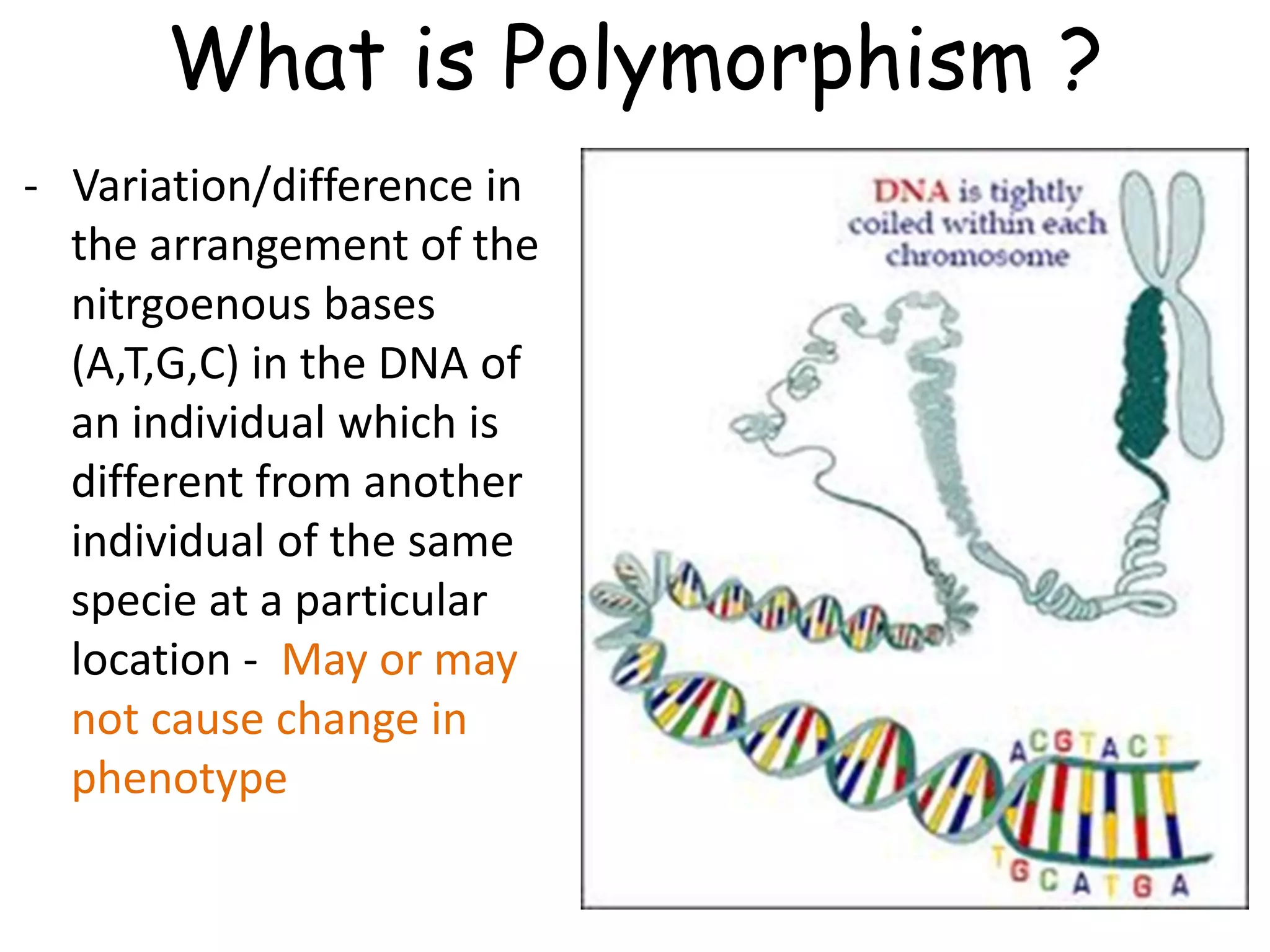
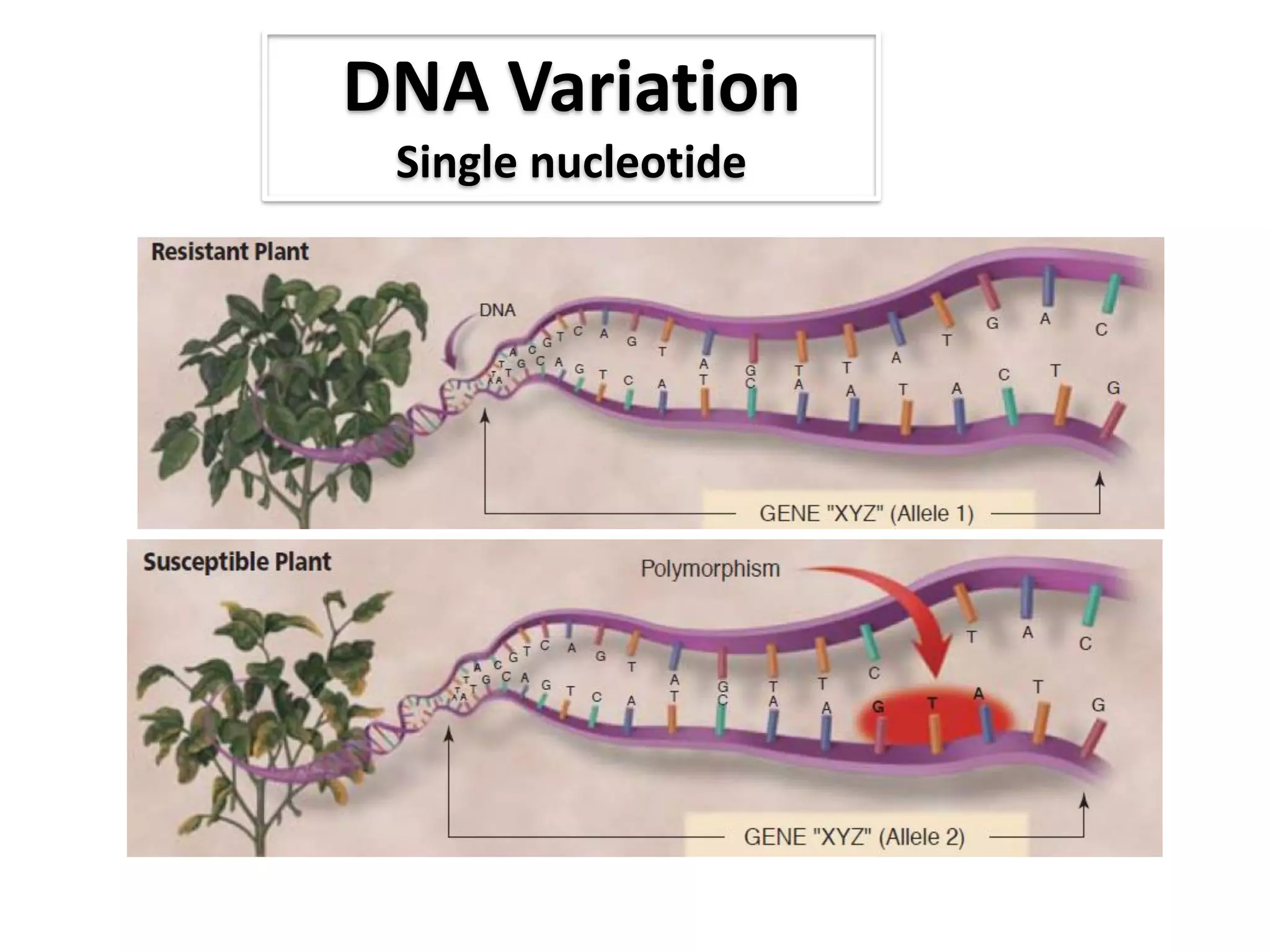
What is Polymorphism ?
- Variation/difference in
the arrangement of the
nitrgoenous bases
(A,T,G,C) in the DNA of
an individual which is
different from another
individual of the same
specie at a particular
location - May or may
not cause change in
phenotype
DNA Variation
Single nucleotide
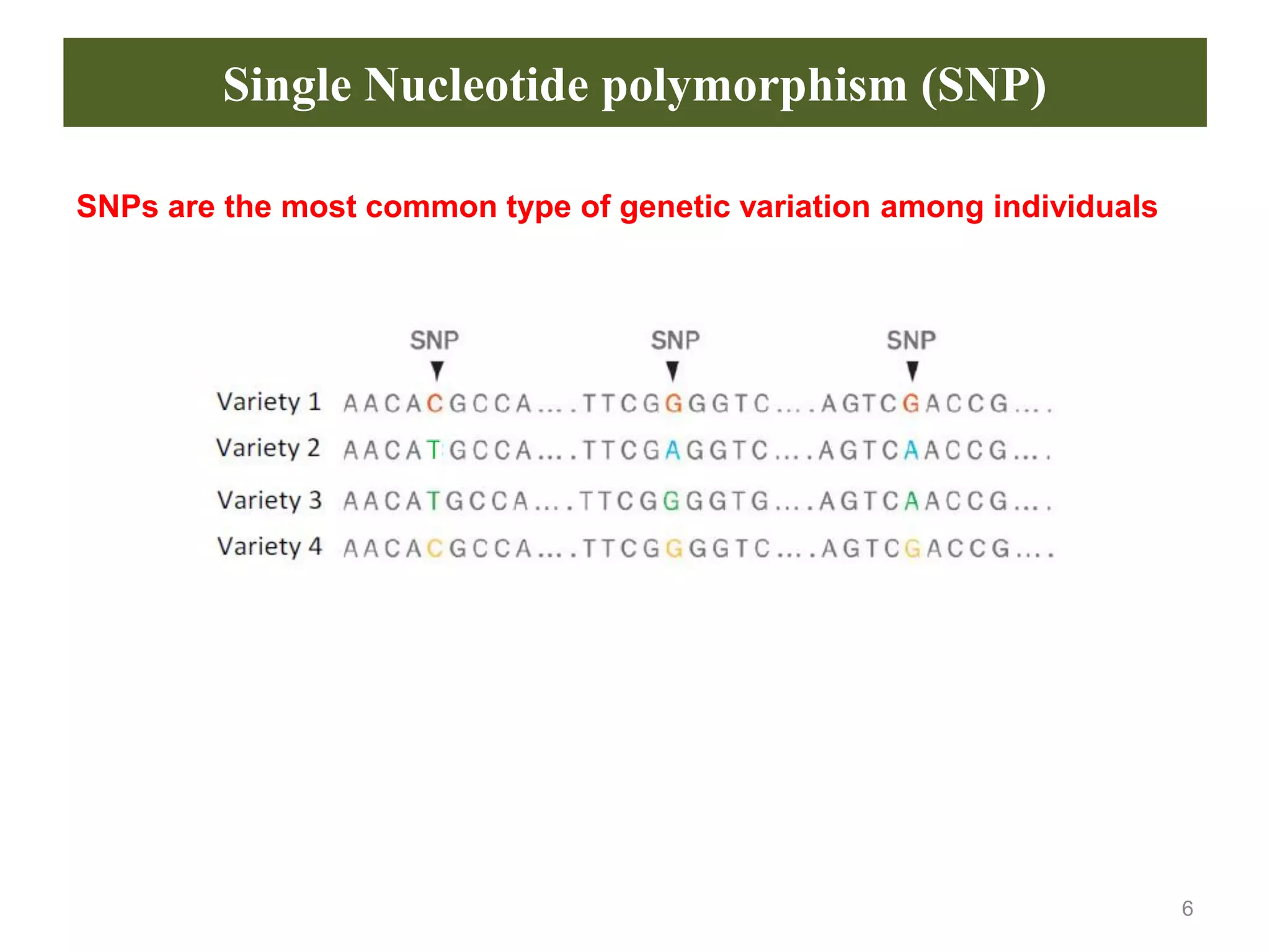
Single Nucleotide polymorphism (SNP)
6
SNPs are the most common type of genetic variation among individuals
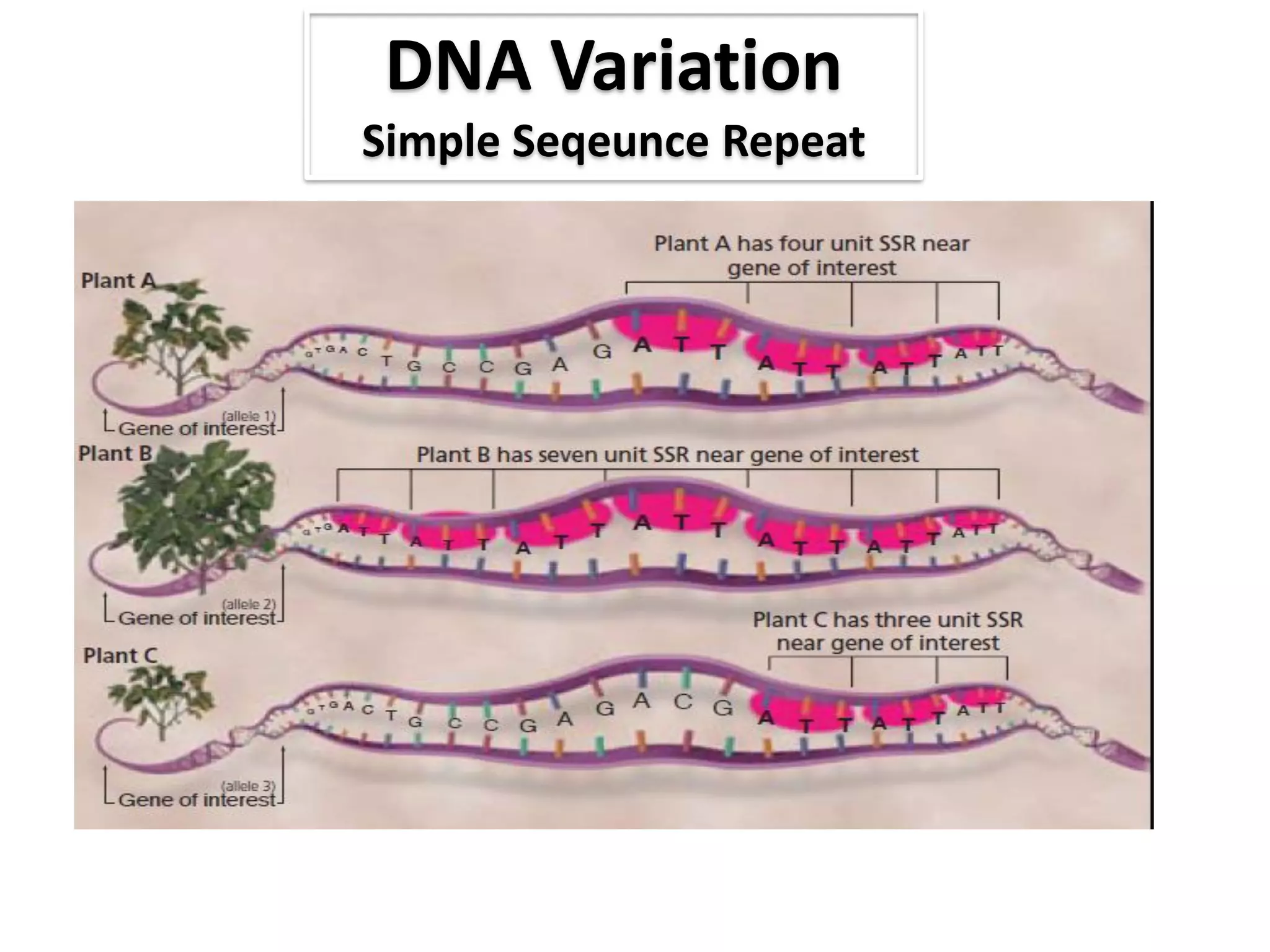
DNA Variation
Simple Seqeunce Repeat
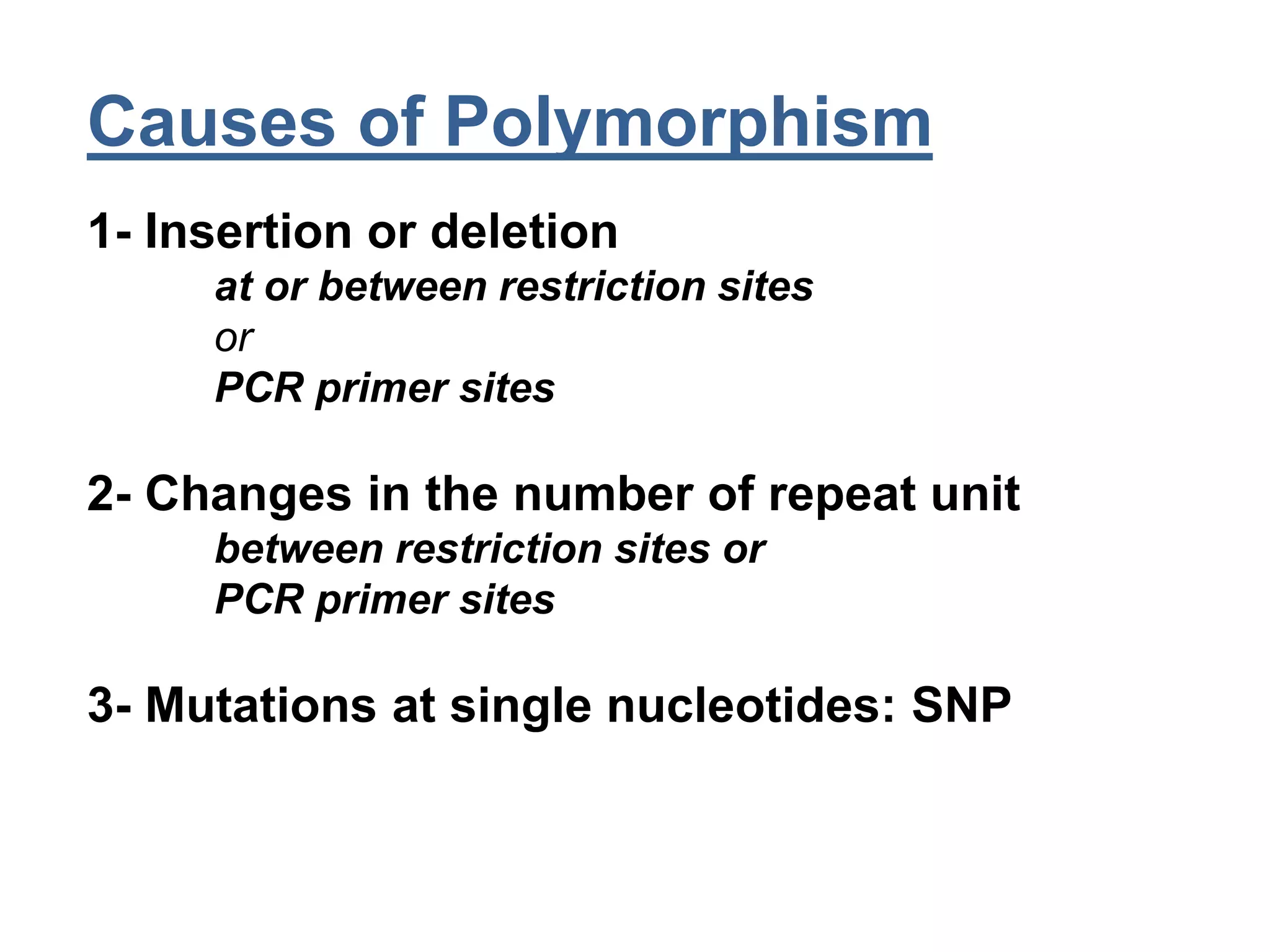
Causes of Polymorphism
1- Insertion or deletion
at or between restriction sites
or
PCR primer sites
2- Changes in the number of repeat unit
between restriction sites or
PCR primer sites
3- Mutations at single nucleotides: SNP
Types of Molecular Markers
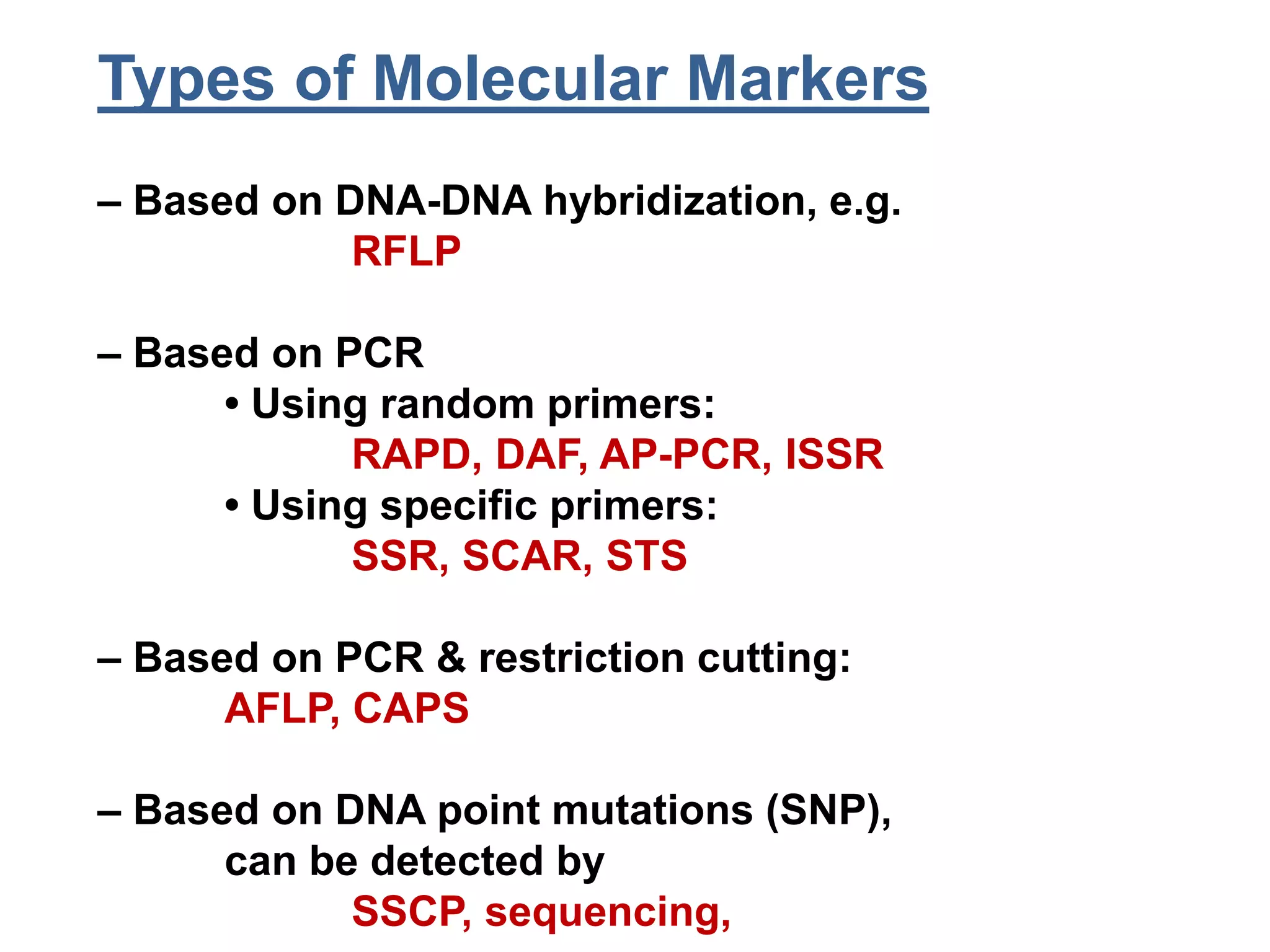
– Based on DNA-DNA hybridization, e.g.
RFLP
– Based on PCR
• Using random primers:
RAPD, DAF, AP-PCR, ISSR
• Using specific primers:
SSR, SCAR, STS
– Based on PCR & restriction cutting:
AFLP, CAPS
– Based on DNA point mutations (SNP),
can be detected by
SSCP, sequencing,
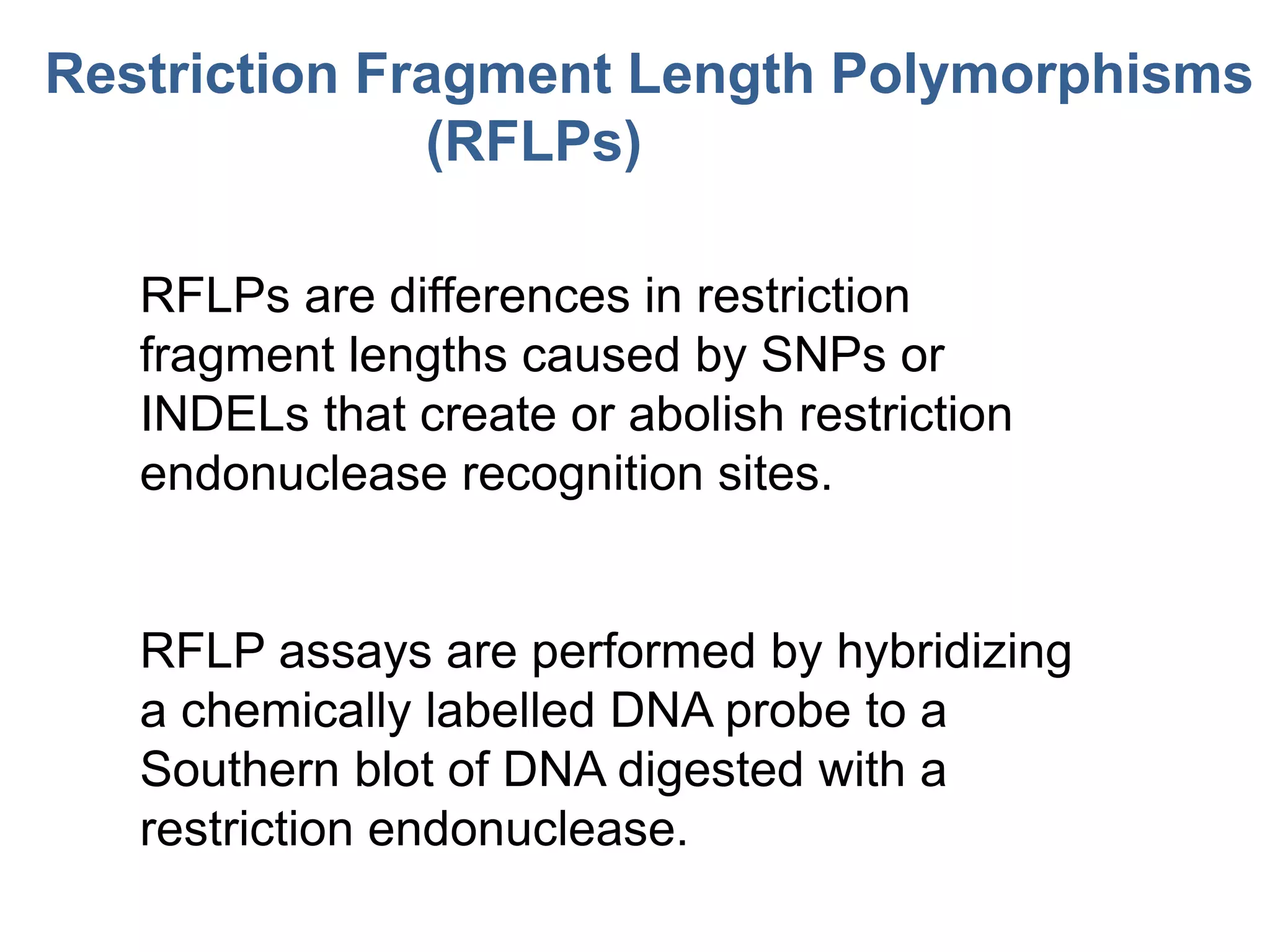
RFLPs are differences in restriction
fragment lengths caused by SNPs or
INDELs that create or abolish restriction
endonuclease recognition sites.
RFLP assays are performed by hybridizing
a chemically labelled DNA probe to a
Southern blot of DNA digested with a
restriction endonuclease.
Restriction Fragment Length Polymorphisms
(RFLPs)
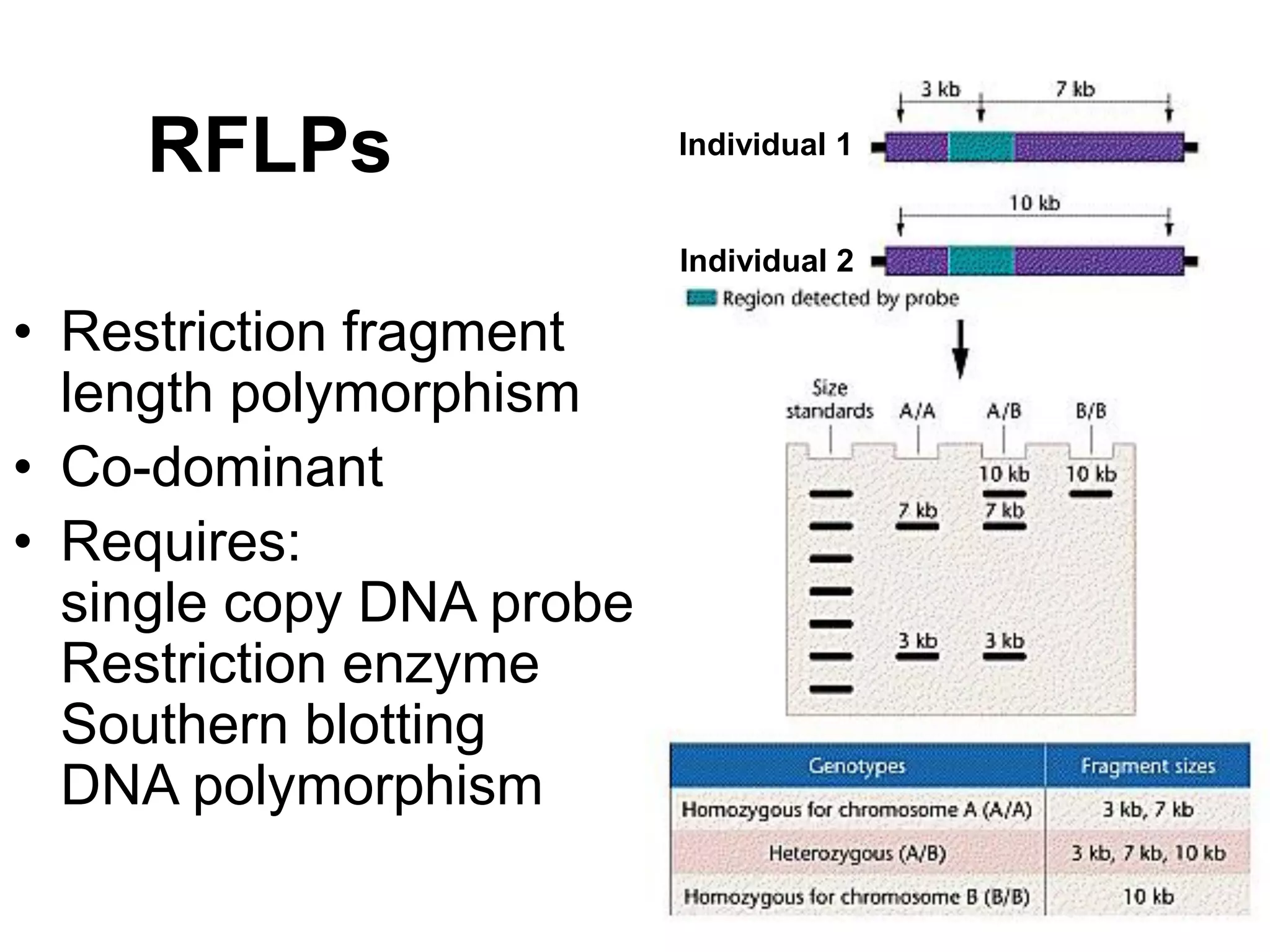
RFLPs
• Restriction fragment
length polymorphism
• Co-dominant
• Requires:
single copy DNA probe
Restriction enzyme
Southern blotting
DNA polymorphism
Individual 1
Individual 2
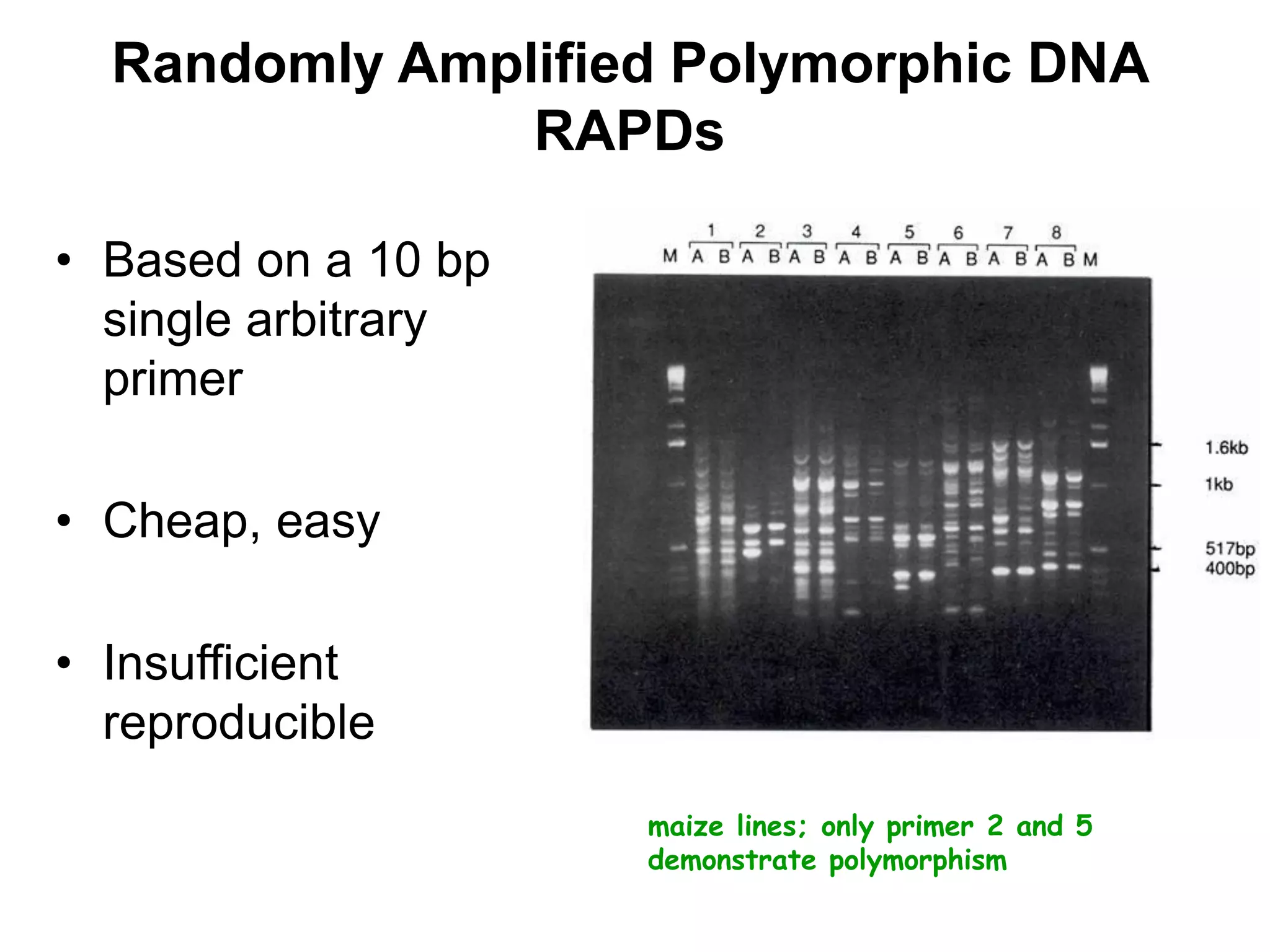
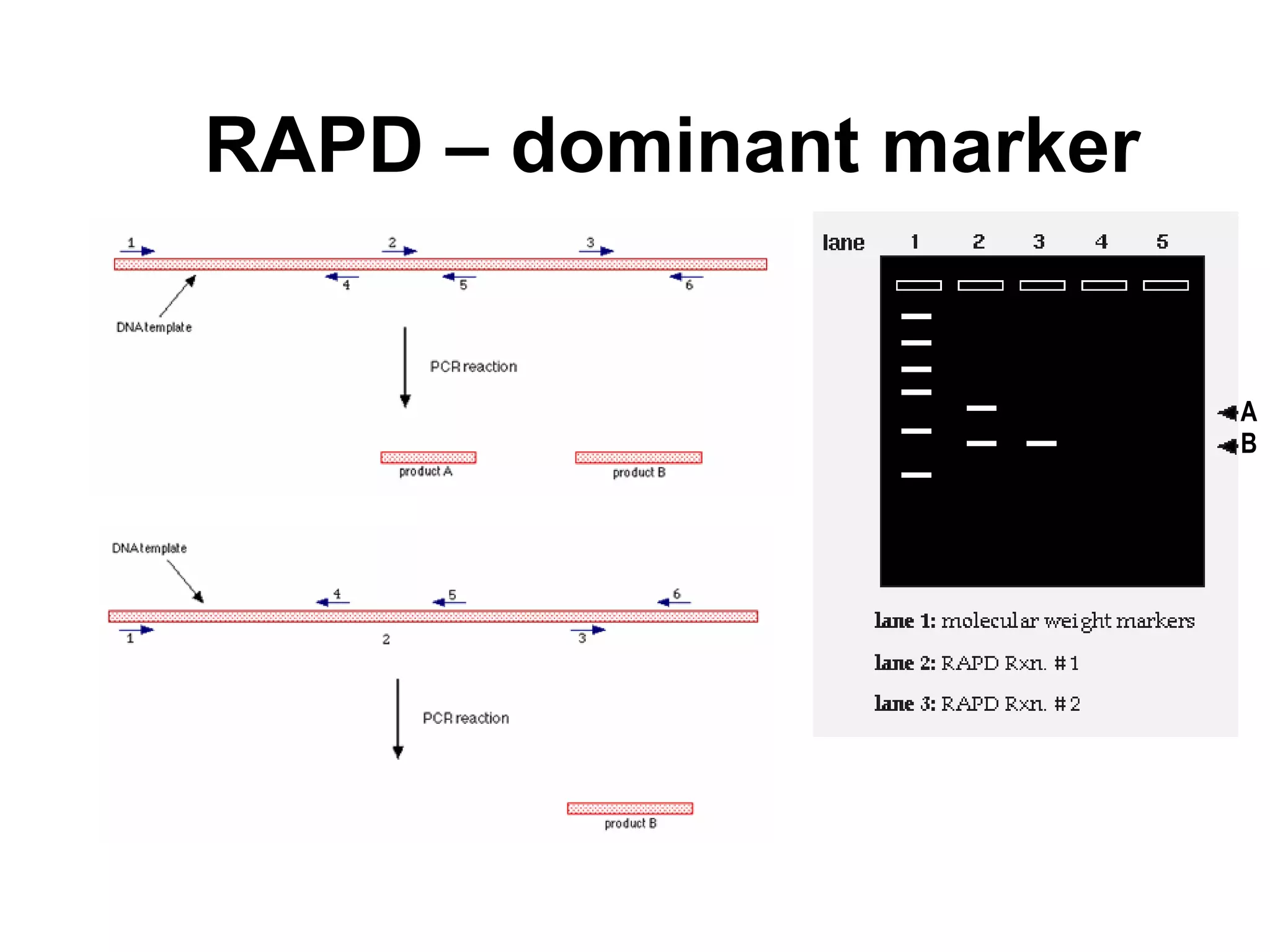
Randomly Amplified Polymorphic DNA
RAPDs
• Based on a 10 bp
single arbitrary
primer
• Cheap, easy
• Insufficient
reproducible
maize lines; only primer 2 and 5
demonstrate polymorphism
RAPD – dominant marker
A
B
•A combination of PCR and RFLP
•Informative fingerprints of amplified
fragments
Amplified Fragment Length Polymorphisms
AFLPs
AFLP: Major Steps
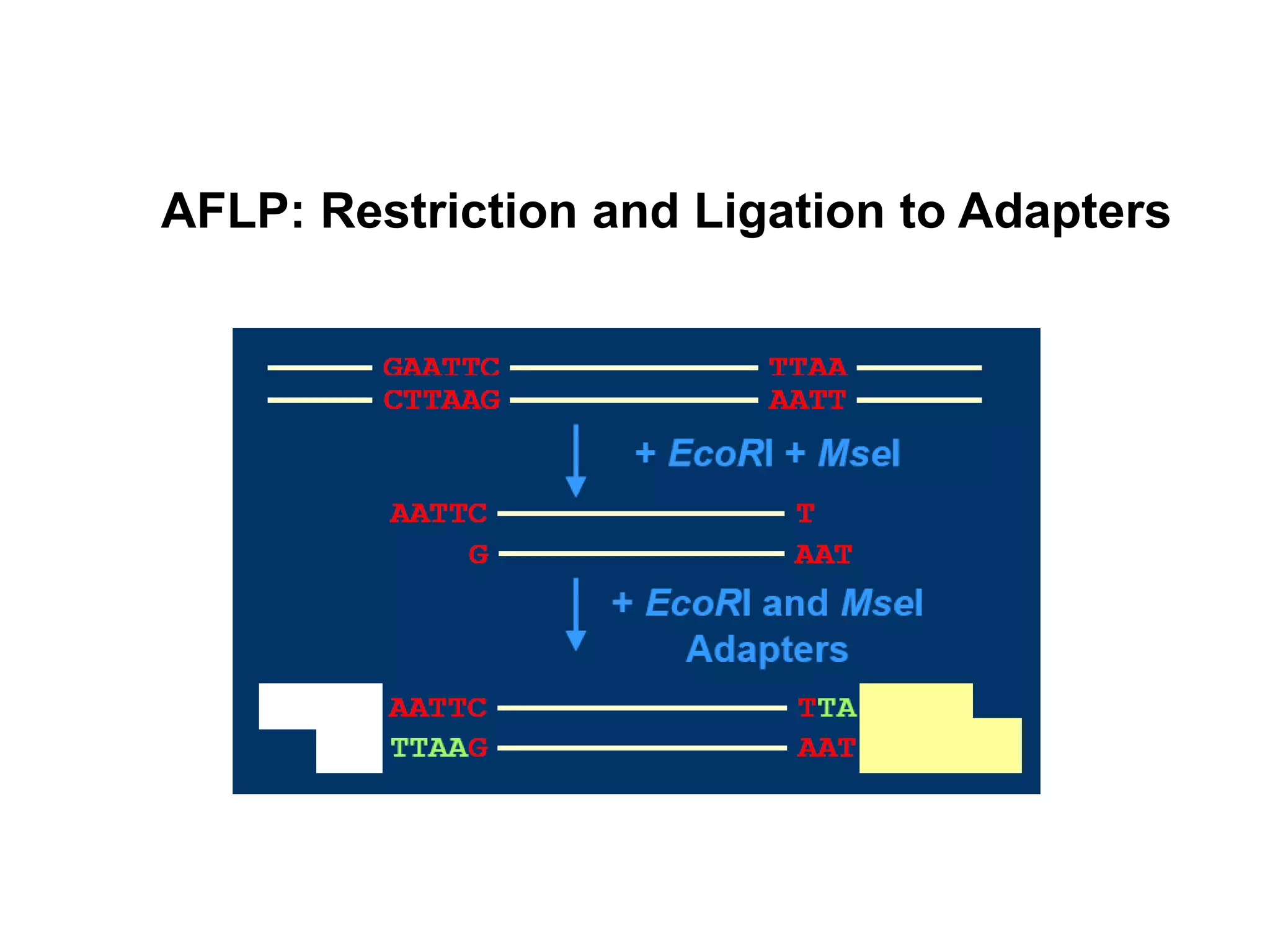
• Restriction endonuclease digestion of genomic
DNA and ligation of specific adapters
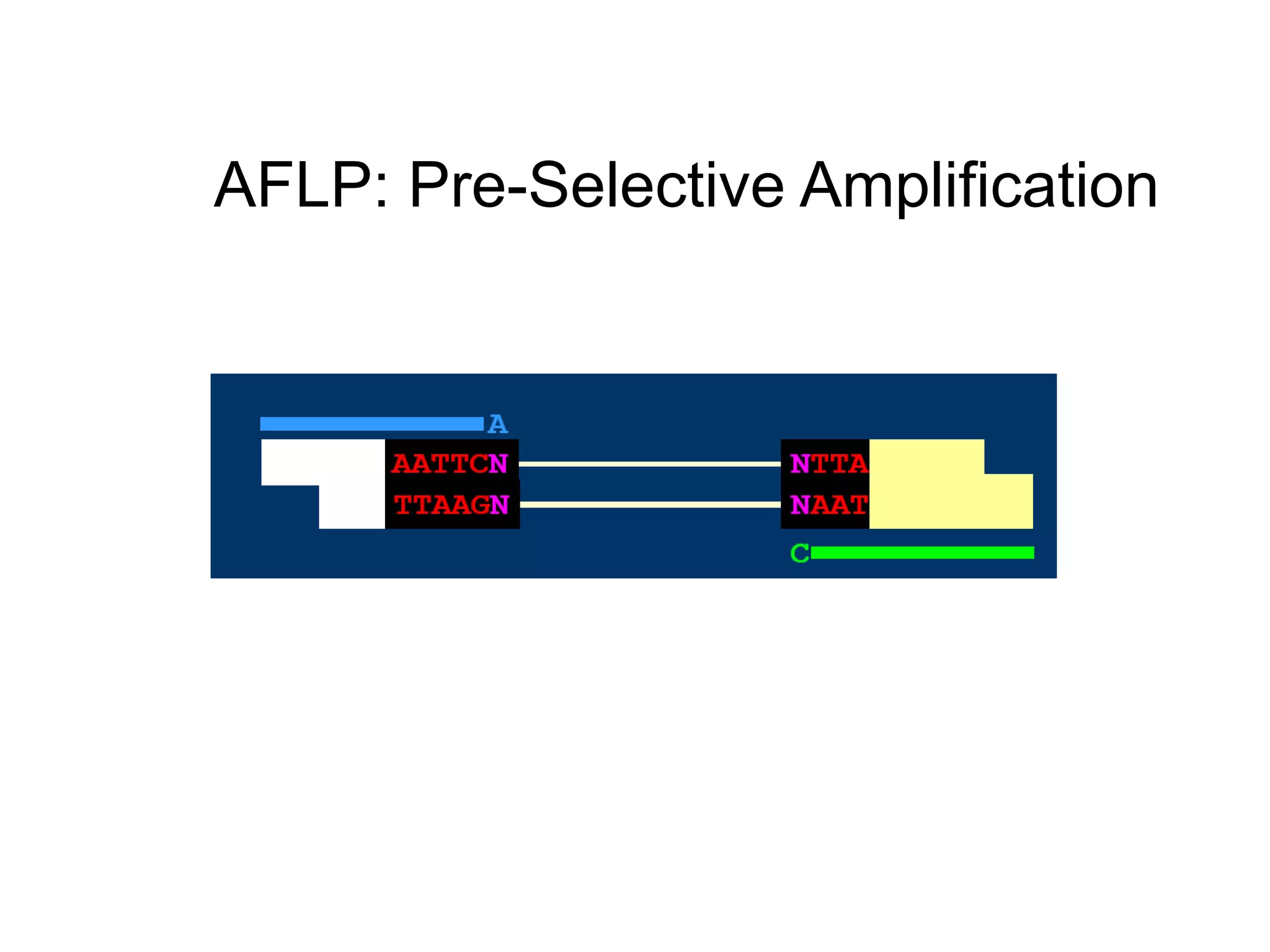
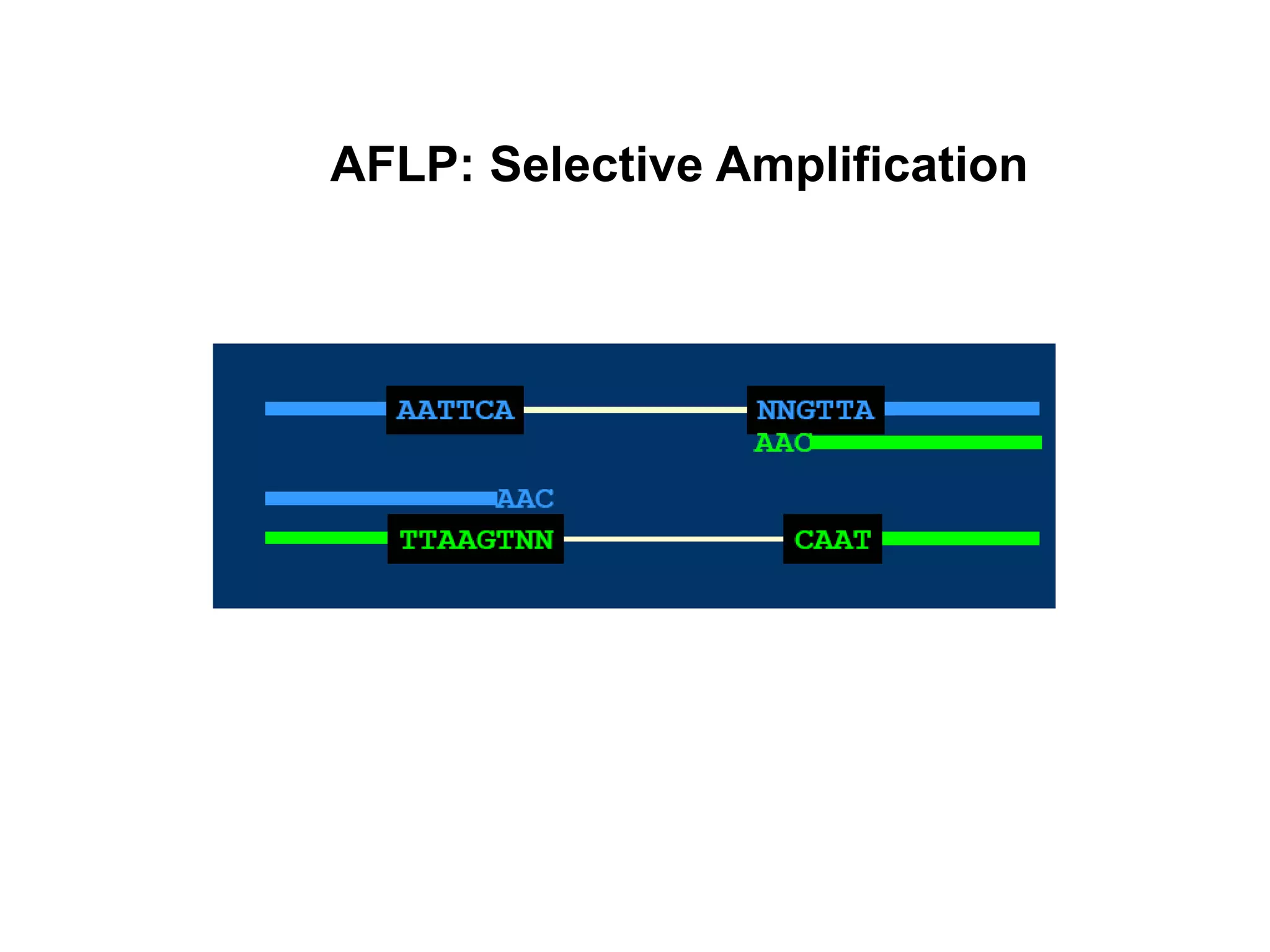
• Amplification of the restriction fragments by PCR
using primer pairs containing common sequences
of the adapter and two or three arbitrary
Nucleotides
• Analysis of the amplified fragments using gel
electrophoresis
AFLP-Major Steps
• Genomic DNA double digests with a 4-cutter
(MseI) and a 6-cutter (EcoR1)
• Ligate adapters to the EcoR1 and MseI RE sites
• Primers complementary to Adapters with selective
nucleotides at 3’ ends and perform PCR
amplification
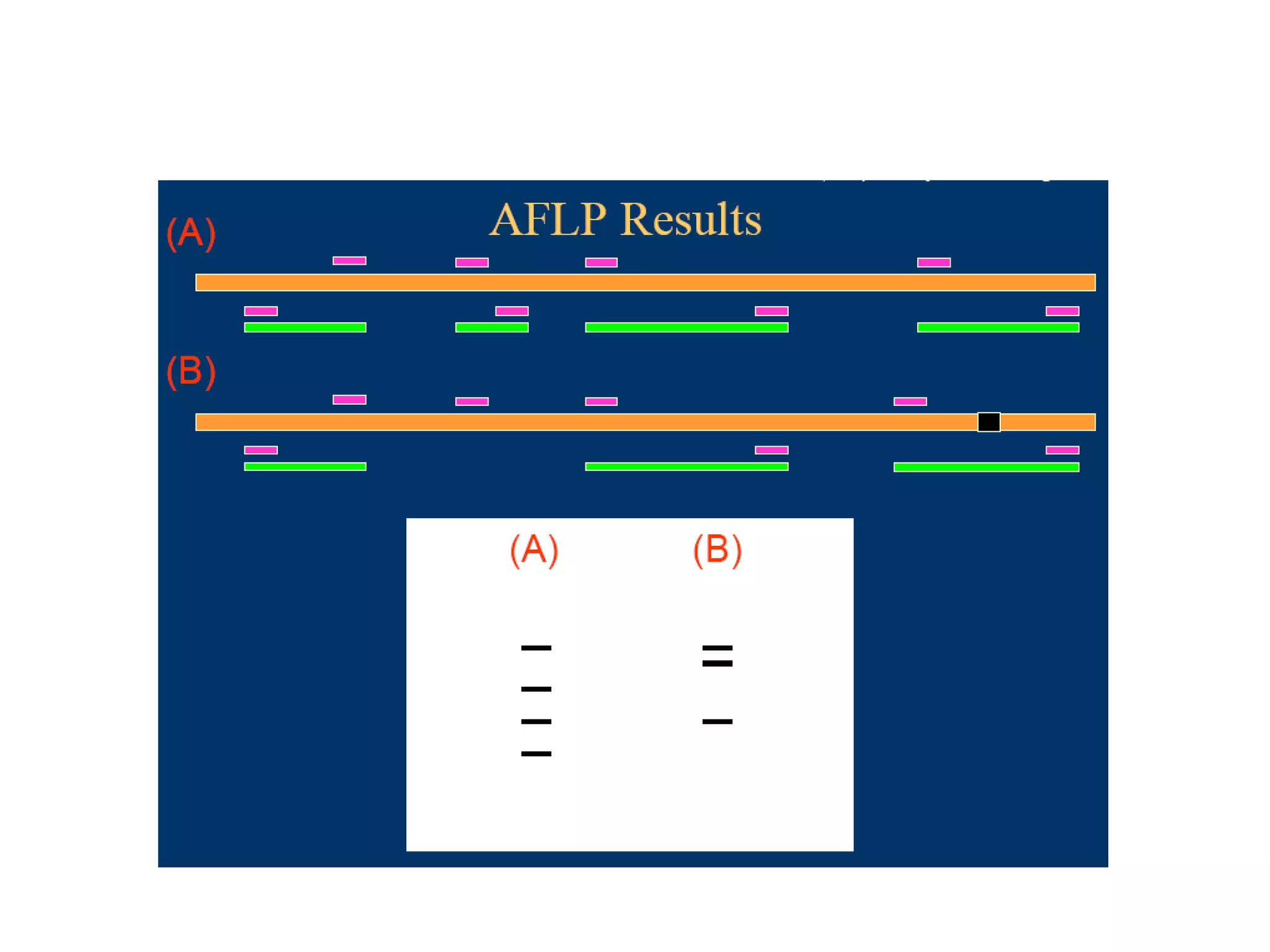
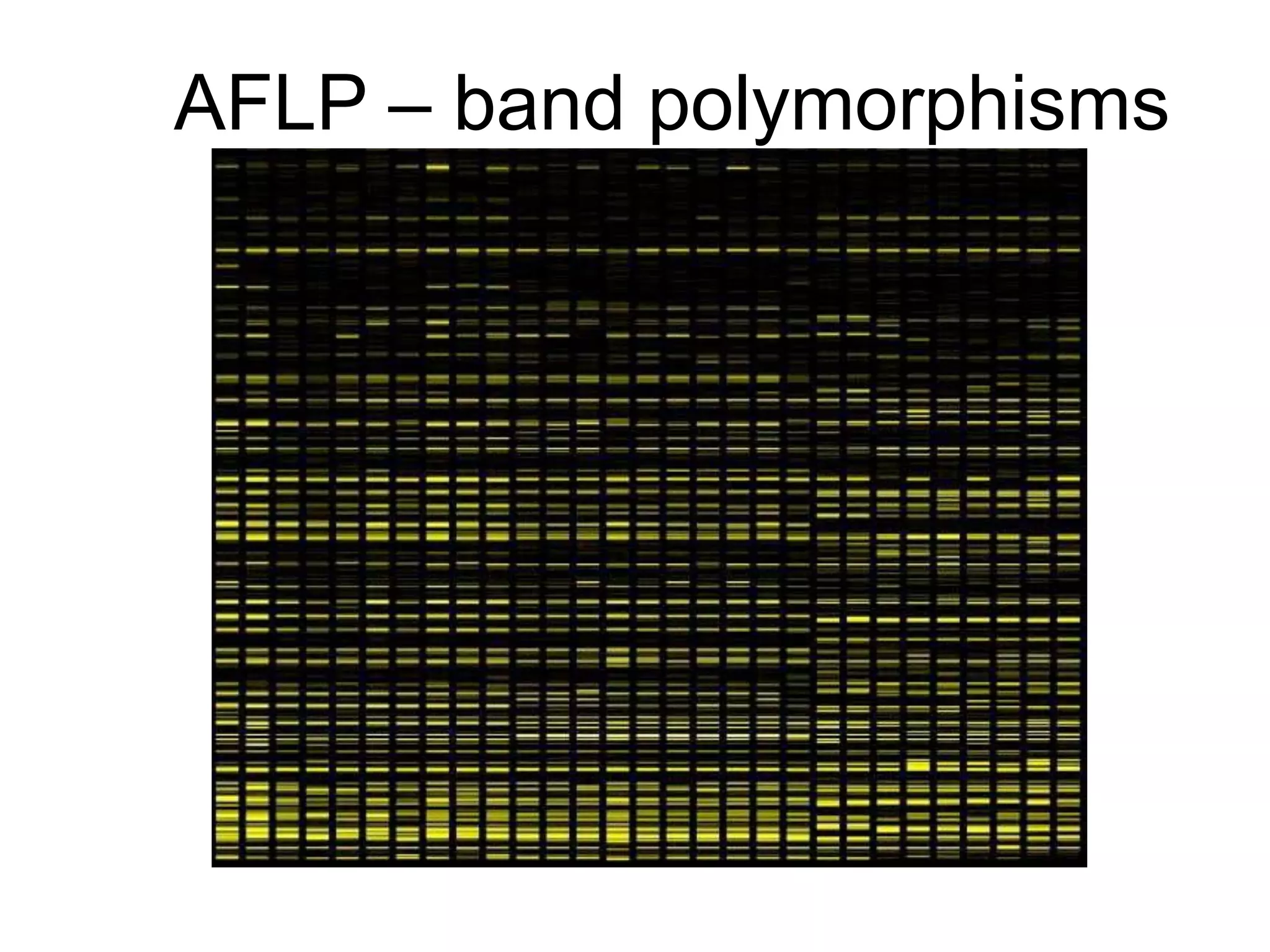
• Separate DNA fragments on high-resolution gels
• After detection, screen for band polymorphisms
AFLP: Restriction and Ligation to Adapters
AFLP: Pre-Selective Amplification
Primer (+ 1) for pre-selective amplification
AFLP: Selective Amplification
Primer (+ 3) for selective amplification
AFLP – band polymorphisms
• Simple sequence repeats (SSRs) or microsatellites
are tandemly repeated mono-,di-, tri-, tetra-, penta-,
and hexa-nucleotide motifs.
SSR length polymorphisms are caused by differences
in the number of repeats.
• SSR loci are “individually amplified by PCR using
pairs of oligonucleotide primers specific to unique DNA
sequences flanking the SSR sequence”.
Simple Sequence Repeats
(SSRs)
Why Have SSRs Had Such a Large Impact
on Genomics?
• SSRs tend to be highly polymorphic.
• SSRs are highly abundant and randomly dispersed
throughout most genomes.
• Most SSR markers are co-dominant and locus
specific.
• Genotyping throughput is high and can be
automated.
SSR - methodolgy
Genotype A
Genotype A Genotype B
PCR amplification with
radiolabelled nucleoltide
Polyacrylamide Gel Electrophoresis
of PCR products and autoradiography
[AT]18 [AT]22
[AT]
18
[AT]
22
Genotype B
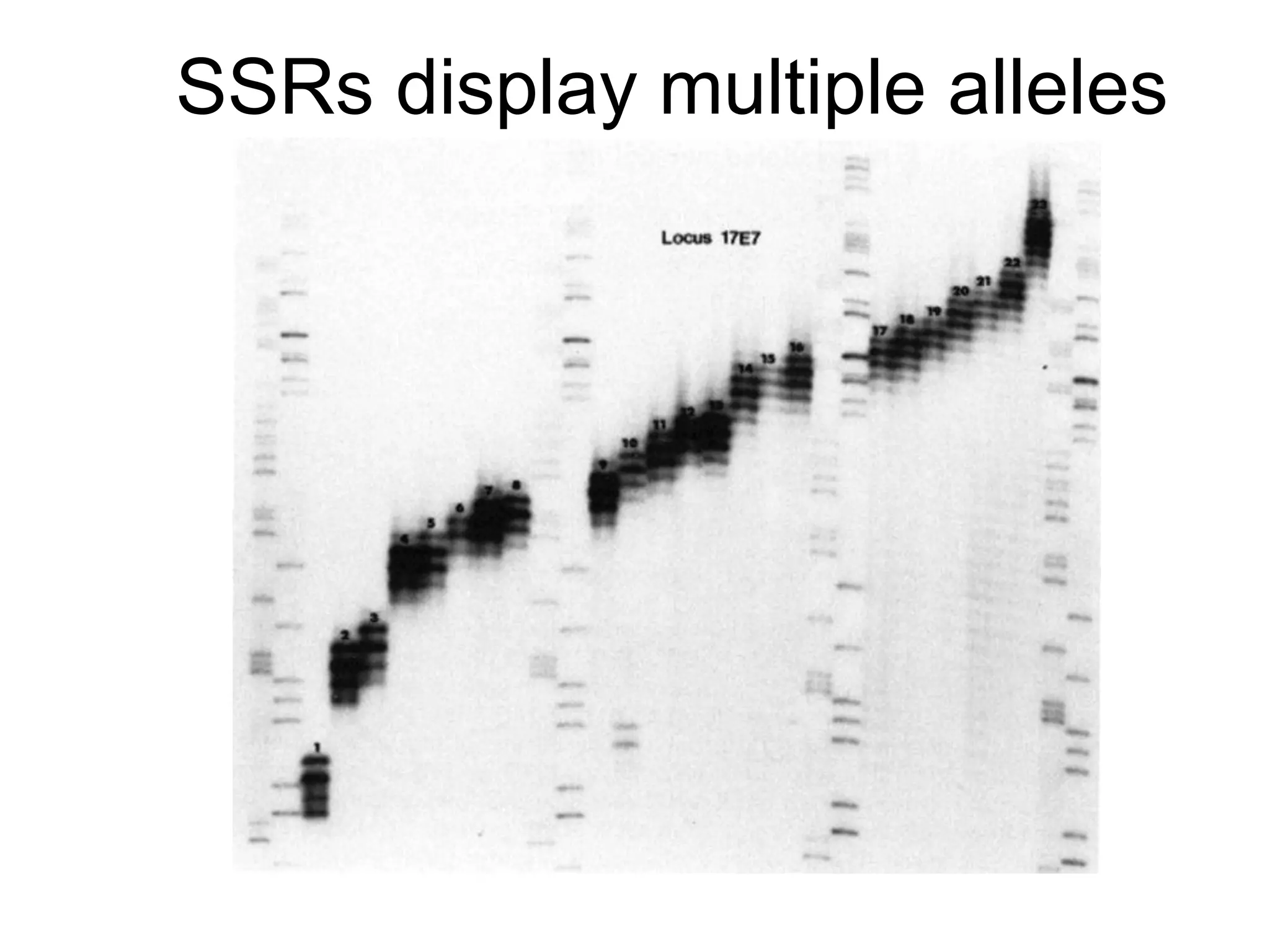
SSRs display multiple alleles
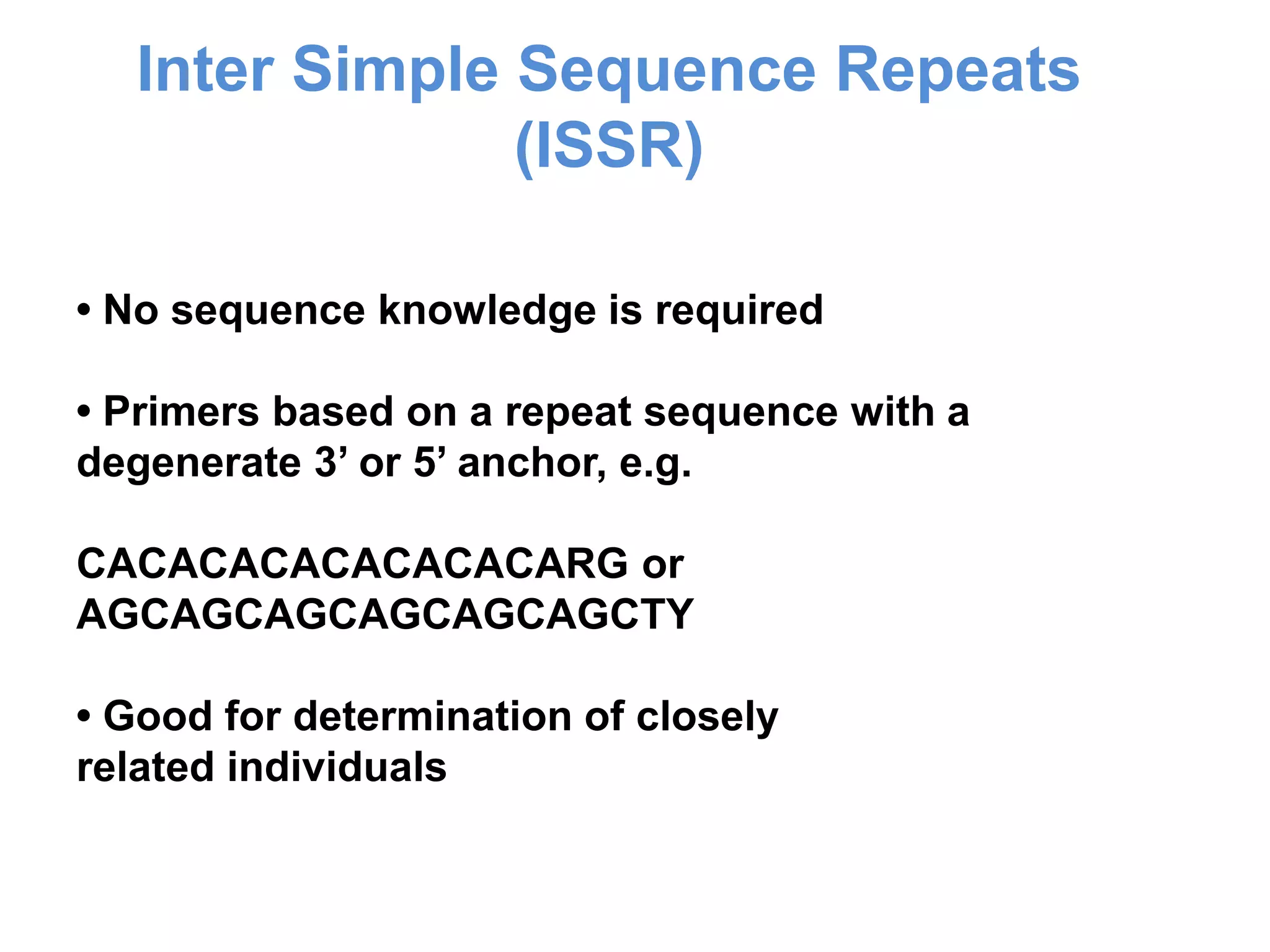
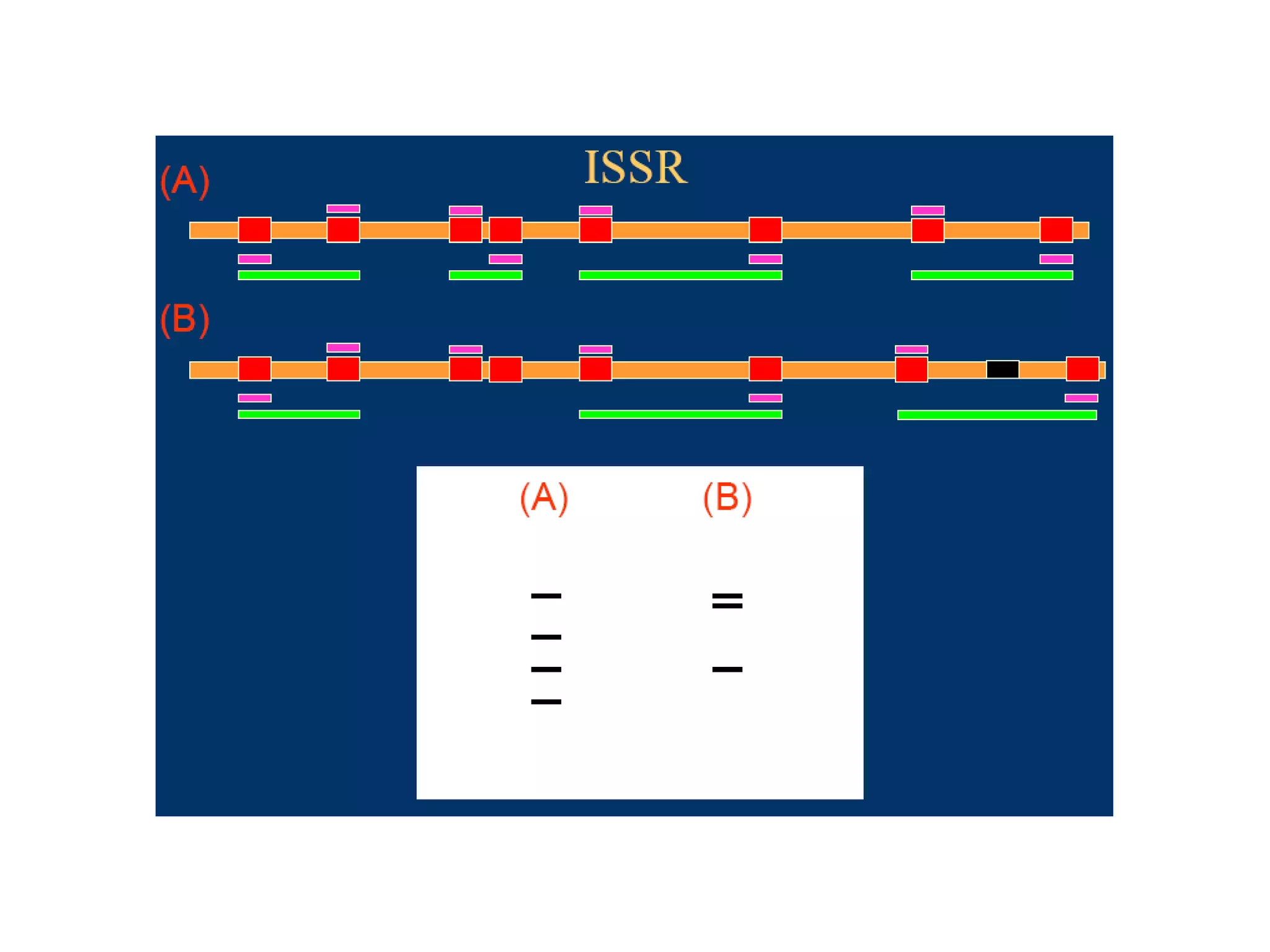
• No sequence knowledge is required
• Primers based on a repeat sequence with a
degenerate 3’ or 5’ anchor, e.g.
CACACACACACACACARG or
AGCAGCAGCAGCAGCAGCTY
• Good for determination of closely
related individuals
Inter Simple Sequence Repeats
(ISSR)
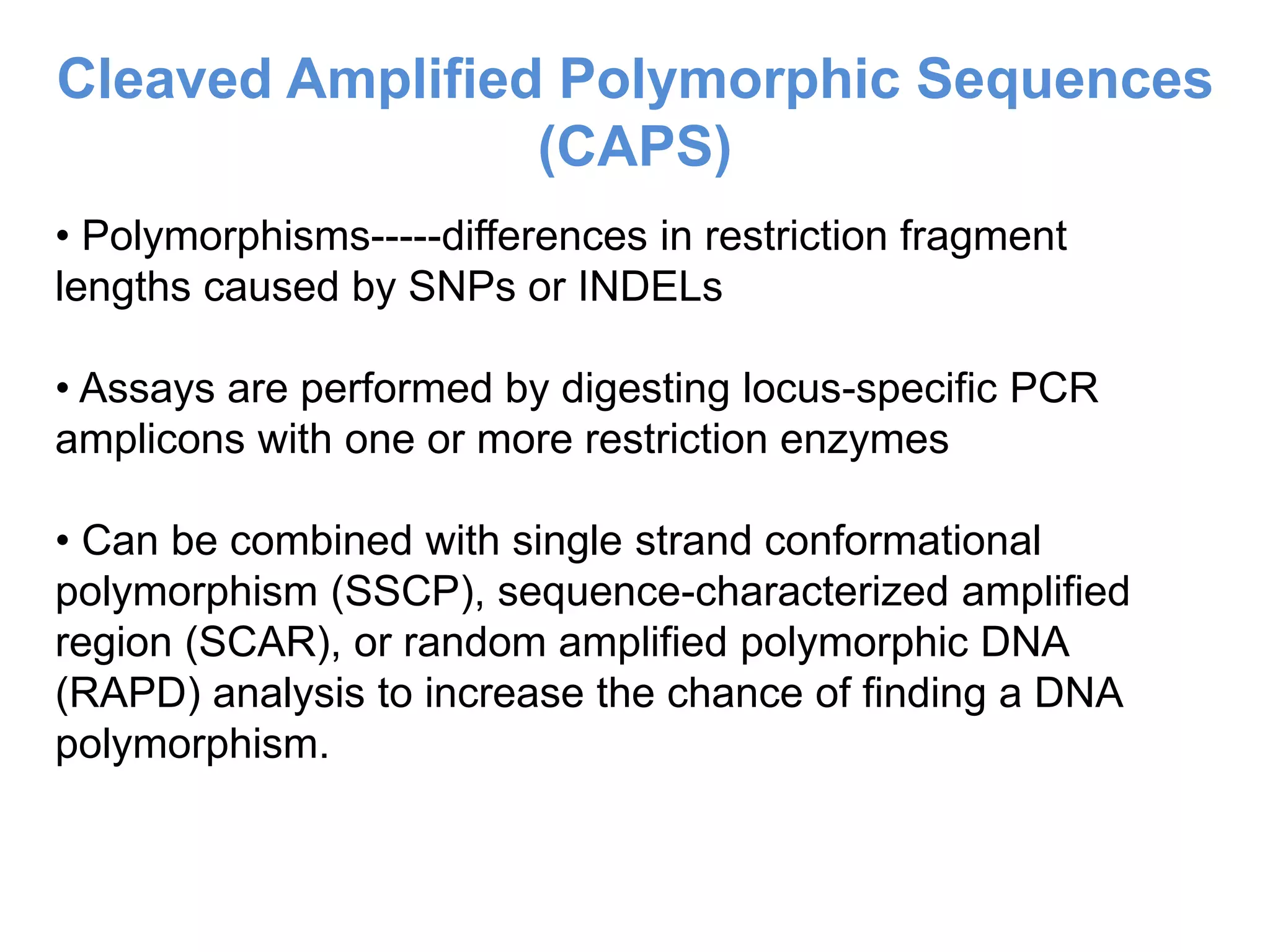
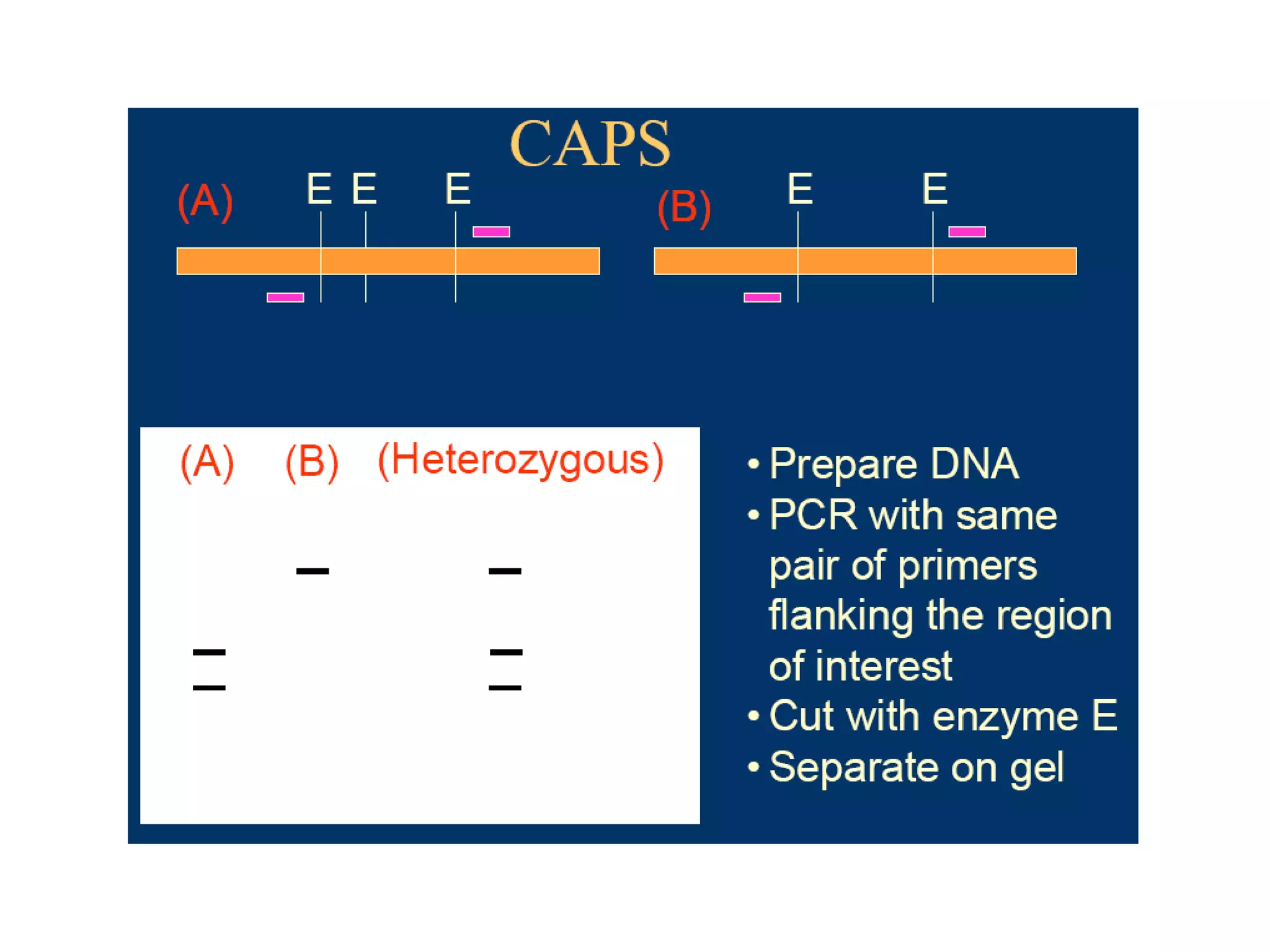
• Polymorphisms-----differences in restriction fragment
lengths caused by SNPs or INDELs
• Assays are performed by digesting locus-specific PCR
amplicons with one or more restriction enzymes
• Can be combined with single strand conformational
polymorphism (SSCP), sequence-characterized amplified
region (SCAR), or random amplified polymorphic DNA
(RAPD) analysis to increase the chance of finding a DNA
polymorphism.
Cleaved Amplified Polymorphic Sequences
(CAPS)
• DNA polymorphisms produced by differential
folding of single-stranded DNA with mutations.
• Assays are performed using heat-denatured
DNA on nondenaturing DNA sequencing gels.
•Special gels (e.g., mutation detection
enhancement gels) have been developed to
enhance the discovery of single strand
conformational polymorphisms caused by
INDELs, SNPs, or SSRs.
Single Strand Conformational Polymorphisms
(SSCPs)
• Paternity and Maternity Issues
• Criminal Identification and Forensics
• Diagnosis of Inherited Disorders
• Diagnosis of Disease
• Relationships among germplasm
• Varietal purity and identification
• QTL Identification
• Early selection in plants
Applications of DNA Fingerprinting

Molecular Markers and Applications-Lecture.pdf

  • 1.
    MOLECULAR MARKERS Dr. MuhammadArif Genomics, Proteomics and Bioinformatics
  • 2.
    Overview • Definition ofmolecular markers • Polymorphism • Causes of polymorphism • Types of molecular markers • Methodology of molecular markers • Applications 11/30/2020 NIBGE Ph.D lecture
  • 3.
    Molecular markers Molecular markersare defined as the short sequences of DNA (primers or probe) which directly reveal the polymorphism of DNA. The polymorphic sequences correspond or not to coding sequences.
  • 4.
    What is Polymorphism? - Variation/difference in the arrangement of the nitrgoenous bases (A,T,G,C) in the DNA of an individual which is different from another individual of the same specie at a particular location - May or may not cause change in phenotype
  • 5.
  • 6.
    Single Nucleotide polymorphism(SNP) 6 SNPs are the most common type of genetic variation among individuals
  • 7.
  • 8.
    Causes of Polymorphism 1-Insertion or deletion at or between restriction sites or PCR primer sites 2- Changes in the number of repeat unit between restriction sites or PCR primer sites 3- Mutations at single nucleotides: SNP
  • 9.
    Types of MolecularMarkers – Based on DNA-DNA hybridization, e.g. RFLP – Based on PCR • Using random primers: RAPD, DAF, AP-PCR, ISSR • Using specific primers: SSR, SCAR, STS – Based on PCR & restriction cutting: AFLP, CAPS – Based on DNA point mutations (SNP), can be detected by SSCP, sequencing,
  • 10.
    RFLPs are differencesin restriction fragment lengths caused by SNPs or INDELs that create or abolish restriction endonuclease recognition sites. RFLP assays are performed by hybridizing a chemically labelled DNA probe to a Southern blot of DNA digested with a restriction endonuclease. Restriction Fragment Length Polymorphisms (RFLPs)
  • 11.
    RFLPs • Restriction fragment lengthpolymorphism • Co-dominant • Requires: single copy DNA probe Restriction enzyme Southern blotting DNA polymorphism Individual 1 Individual 2
  • 12.
    Randomly Amplified PolymorphicDNA RAPDs • Based on a 10 bp single arbitrary primer • Cheap, easy • Insufficient reproducible maize lines; only primer 2 and 5 demonstrate polymorphism
  • 13.
  • 14.
    •A combination ofPCR and RFLP •Informative fingerprints of amplified fragments Amplified Fragment Length Polymorphisms AFLPs
  • 15.
    AFLP: Major Steps •Restriction endonuclease digestion of genomic DNA and ligation of specific adapters • Amplification of the restriction fragments by PCR using primer pairs containing common sequences of the adapter and two or three arbitrary Nucleotides • Analysis of the amplified fragments using gel electrophoresis
  • 16.
    AFLP-Major Steps • GenomicDNA double digests with a 4-cutter (MseI) and a 6-cutter (EcoR1) • Ligate adapters to the EcoR1 and MseI RE sites • Primers complementary to Adapters with selective nucleotides at 3’ ends and perform PCR amplification • Separate DNA fragments on high-resolution gels • After detection, screen for band polymorphisms
  • 17.
    AFLP: Restriction andLigation to Adapters
  • 18.
    AFLP: Pre-Selective Amplification Primer(+ 1) for pre-selective amplification
  • 19.
    AFLP: Selective Amplification Primer(+ 3) for selective amplification
  • 21.
    AFLP – bandpolymorphisms
  • 22.
    • Simple sequencerepeats (SSRs) or microsatellites are tandemly repeated mono-,di-, tri-, tetra-, penta-, and hexa-nucleotide motifs. SSR length polymorphisms are caused by differences in the number of repeats. • SSR loci are “individually amplified by PCR using pairs of oligonucleotide primers specific to unique DNA sequences flanking the SSR sequence”. Simple Sequence Repeats (SSRs)
  • 23.
    Why Have SSRsHad Such a Large Impact on Genomics? • SSRs tend to be highly polymorphic. • SSRs are highly abundant and randomly dispersed throughout most genomes. • Most SSR markers are co-dominant and locus specific. • Genotyping throughput is high and can be automated.
  • 24.
    SSR - methodolgy GenotypeA Genotype A Genotype B PCR amplification with radiolabelled nucleoltide Polyacrylamide Gel Electrophoresis of PCR products and autoradiography [AT]18 [AT]22 [AT] 18 [AT] 22 Genotype B
  • 25.
  • 26.
    • No sequenceknowledge is required • Primers based on a repeat sequence with a degenerate 3’ or 5’ anchor, e.g. CACACACACACACACARG or AGCAGCAGCAGCAGCAGCTY • Good for determination of closely related individuals Inter Simple Sequence Repeats (ISSR)
  • 28.
    • Polymorphisms-----differences inrestriction fragment lengths caused by SNPs or INDELs • Assays are performed by digesting locus-specific PCR amplicons with one or more restriction enzymes • Can be combined with single strand conformational polymorphism (SSCP), sequence-characterized amplified region (SCAR), or random amplified polymorphic DNA (RAPD) analysis to increase the chance of finding a DNA polymorphism. Cleaved Amplified Polymorphic Sequences (CAPS)
  • 30.
    • DNA polymorphismsproduced by differential folding of single-stranded DNA with mutations. • Assays are performed using heat-denatured DNA on nondenaturing DNA sequencing gels. •Special gels (e.g., mutation detection enhancement gels) have been developed to enhance the discovery of single strand conformational polymorphisms caused by INDELs, SNPs, or SSRs. Single Strand Conformational Polymorphisms (SSCPs)
  • 32.
    • Paternity andMaternity Issues • Criminal Identification and Forensics • Diagnosis of Inherited Disorders • Diagnosis of Disease • Relationships among germplasm • Varietal purity and identification • QTL Identification • Early selection in plants Applications of DNA Fingerprinting