Moist Heat Sterilization
Presented by
Jozef Mastej, Vice President of Operations
Gibraltar Laboratories, Inc.
http://www.gibraltarlabsinc.com/services/sterilization-services.html
Proprietary and Confidential © Gibraltar Laboratories, Inc.
2
Comprehensive guide to steam sterilization and sterility assurance in health care facilities
• ANSI/AAMI ST-79
• Overview
Saturated steam under pressure is one of the oldest methods used in
health care facilities to sterilize medical devices. Because this method
has been available for so many years, it is thought to be a simple
process, one that is well understood and controlled. However the
efficacy of any sterilization process, including saturated steam,
depends on:
1) Consistent system for lowering and limiting bioburden before
sterilization. Cleanability Studies (Manual and Automated
Cleaning/Disinfection) Disinfection included in the cleaning process of
three instruments or one instrument three times and one control.
Instrument(s) will be inoculated with artificial soil medium containing
test organism(s).
Cleaning definition- Removal of contamination from an item to the
extent necessary for further processing or for the intended use. In
health care facilities, cleaning consists of the removal, usually with
detergent and water, of adherent soil (e.g., blood, protein substances,
and other debris) from the surfaces, crevices, serrations, joints, and
lumens of instruments, devices, and equipment by a manual or
mechanical process that prepares the items for safe handling and/or
further decontamination.
MOIST HEAT STERILIZATION
3
Comprehensive guide to steam sterilization and sterility assurance in health care facilities
• ANSI/AAMI ST-79
• Overview - continued
MOIST HEAT STERILIZATION
2) Properly preparing items for sterilization
3) Selecting the appropriate sterilization parameters.
Steam sterilization definition-Sterilization process that uses saturated steam under pressure, for a specified
exposure time and at a specified temperature, as the sterilizing agent. Sterilization is the validated process used
to render a product free from viable microorganisms. ST79 Tables 4 and 5 [Minimum cycle times for gravity-
displacement and dynamic-air-removal steam sterilization cycles].
 Thermocouples inside the containers [performed on one full-cycle without drying time per each
sterilization condition]
 Sterilization efficacy study to demonstrate sterilization assurance level 10-6 using overkill method
[performed on three ½ cycle (s) per each sterilization condition]
Sterility Assurance Level: Probability of a single viable microorganisms occurring on an item after
sterilization. SAL 10-6 means that there is less than or equal to one chance in a million that a single viable
microorganism is present on a sterilized item. It is generally accepted that a SAL 10-6 is appropriate for
items intended to come into contact with compromised tissue.
 Verification of drying time [performed on three full-cycle (s) with full drying time and any additional
instructions; such as door “cracked” open, additional cooling outside the autoclave, etc.
4
Comprehensive guide to steam sterilization and sterility assurance in health care facilities
• ANSI/AAMI ST-79 • Overview - continued
MOIST HEAT STERILIZATION
4) Establishing and implementing controls to maintain the sterility of sterilized items until they are used.
 Stability Studies [performed at minimum on full-cycle including drying time per each sterilization process
and stored for appropriate time under real time conditions or accelerated condition. Upon completion of
storage, samples are tested for sterility].
 Longevity/Functionality cycle(s) -Restrictions on Reprocessing, qualification of instruments, qualification of
vendors, etc.
Example [100 full sterilization cycles or as suggested by the sponsor. Dynamic Air Removal and Gravity-
Displacement. Cleaning step simulated use in between each cycle]
Examples of medical trays being prepared for steam sterilization
5
Containment devices for reusable medical device sterilization
• ANSI/AAMI ST-77
MOIST HEAT STERILIZATION
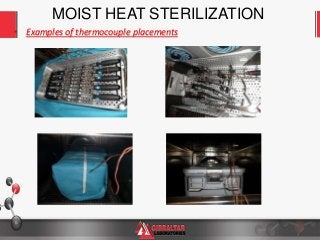
STERILIZATION VALIDATION - PART 1 [Temperature mapping]
Purpose: To verify acceptable temperature distribution within containment
device during a sterilization process.
 Internal mapping profiles of temperature distribution inside the containment device, with
thermocouples placed in strategic areas, shall be conducted on full-cycles. Areas that may be
considered for monitoring are the containment device corners [lid and bottom], on the sides,
at the center, and on the inner side of any filter.
 At a minimum, a probe shall be placed in a lower corner, the diagonally opposite corner, and
the center of the containment device. If filters are used in the containment device, fourth
thermocouple shall be placed on the inner side of the filter.
 For thermal sterilization processes, calibrated temperature thermocouples shall be used to
map the temperature profiles of the containment devices.
 For containment devices that require a filter, testing shall be performed with commercially
available filter material that is compatible with the sterilization method and recommended by
the containment device manufacture. Compatible filter material/commercial grades shall be
clearly indicated in the product labeling.
 Simultaneously containment devices should be double wrapped with Convertors Bio-Shield
Sterilization Wraps or placed in a Rigid Container.
6
• Examples of thermocouple placements
MOIST HEAT STERILIZATION
7
• ANSI/AAMI ST-79
MOIST HEAT STERILIZATION
STERILIZATION VALIDATION - PART 2 [Microbiological Challenge]
Purpose: To demonstrate sterilization assurance level 10-6 using overkill method
 Determination of using either liquid spore suspension or inoculated carrier Geobacillus
stearothermophilus.
 Biological Indicator or liquid spore suspension requirements.
 D121value ≥ 1.0 minute [AAMI TIR 12] or ≥ 1.5 minutes [ANSI/AAMI/ISO 11138-3] – based on
the Manufacturer’s Certificate.
 The BI’s or Geobacillus stearothermophilus spore suspension will be enumerated to verify its
population and confirm identity.
Biological indicator (BI): Inoculated carrier contained within its primary pack ready for use and that
provides a defined resistance to the specified sterilization process.
Spore Suspension: Spore Suspensions contain bacterial spores in an aqueous solution and contain no extraneous
contamination that could affect performance. Providing a defined resistance to the specified sterilization process.
8
MOIST HEAT STERILIZATION
PART 2 [Microbiological Challenge] - continued
1. Calibrated Steam Sterilizer, FDA-cleared 510K1. Convertors Bio-Shield Sterilization Wraps, FDA-
cleared 510K
2. Rigid Containers, FDA-cleared 510K
ANSI/AAMI ST-79
9
 Determination of placement of BI’s or inoculation placement
and rationale.
 Sterilization processes.
 Gravity-displacement steam sterilization: Type of sterilization
process in which incoming steam displaces residual air through a
port or drain usually in or near the bottom of the sterilizer
chamber.
 Pre-vacuum steam sterilization: Also known as dynamic air
removal steam sterilization. One of two types of sterilization
cycles in which air is removed from the chamber and the load by
means of a series of pressure and vacuum excursions [pre-
vacuum cycle] or by means of a series of steam flushes or
pressure pulses above atmospheric pressure [steam-flush-
pressure-pulse (SFPP) cycle].
MOIST HEAT STERILIZATION
PART 2 [Microbiological Challenge] - continued
• ANSI/AAMI ST-79
10
Conservative determination of lethal rate of the sterilization process – Overkill
approach
 The BI's will be distributed on every level of the tray to provide coverage of the interior
space of the tray and are positioned in potentially difficult areas to sterilize with respect to
lumen, surface of the instrument and to provide geometric coverage as worst case position.
 Three half-cycles of each sterilization process using maximum load configuration.
 Pulsed pre-vacuum half-cycle – 2 minutes at 132°C exposure time
 Gravity-displacement half-cycle – 7.5 minutes at 132°C exposure time
 In addition three pulsed pre-vacuum half-cycle – 2 minutes at 132°C exposure time using
minimum load configuration.
In summary, it will be determined if a ≥ six log reduction of the indicator microorganism is
achieved in the half-cycles. If all the BI’s are negative upon sterility testing after exposure to the
half-cycle, the full-cycle will equal twice the exposure time used in the half-cycle. In the future,
when a full-cycle is run, a reduction of >12 logs is expected and a SAL of 10-6 will be attained.
MOIST HEAT STERILIZATION
PART 2 [Microbiological Challenge] - continued
• ANSI/AAMI ST-79
11
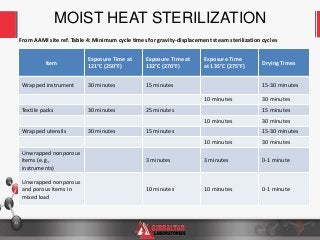
Item
Exposure Time at
121°C (250°F)
Exposure Time at
132°C (270°F)
Exposure Time
at 135°C (275°F)
Drying Times
Wrapped instrument 30 minutes 15 minutes 15-30 minutes
10 minutes 30 minutes
Textile packs 30 minutes 25 minutes 15 minutes
10 minutes 30 minutes
Wrapped utensils 30 minutes 15 minutes 15-30 minutes
10 minutes 30 minutes
Unwrapped nonporous
items (e.g.,
instruments)
3 minutes 3 minutes 0-1 minute
Unwrapped nonporous
and porous items in
mixed load
10 minutes 10 minutes 0-1 minute
MOIST HEAT STERILIZATION
From AAMI site ref. Table 4: Minimum cycle times for gravity-displacement steam sterilization cycles
12
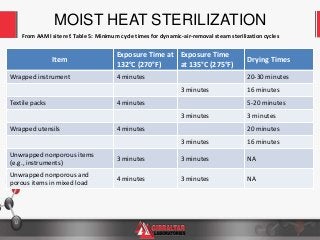
Item
Exposure Time at
132°C (270°F)
Exposure Time
at 135°C (275°F)
Drying Times
Wrapped instrument 4 minutes 20-30 minutes
3 minutes 16 minutes
Textile packs 4 minutes 5-20 minutes
3 minutes 3 minutes
Wrapped utensils 4 minutes 20 minutes
3 minutes 16 minutes
Unwrapped nonporous items
(e.g., instruments)
3 minutes 3 minutes NA
Unwrapped nonporous and
porous items in mixed load
4 minutes 3 minutes NA
MOIST HEAT STERILIZATION
From AAMI site ref. Table 5: Minimum cycle times for dynamic-air-removal steam sterilization cycles
13
The dryness of the trays fully loaded with its associated implants and reusable
instruments shall be included in the validation process because dryness following
sterilization is critical in maintaining the sterility of the trays and its components.
 The weight of the double Convertors Bio-Shield Sterilization Wraps shall be
recorded.
 The surgical tray shall be simultaneously double wrapped with Convertors Bio-
Shield Sterilization Wraps or placed inside the rigid container.
 The surgical tray shall be placed in the steam sterilizer for the three full-cycle.
Note: The fully loaded chamber is the worst case condition with respect to drying time for a given
sterilization process.
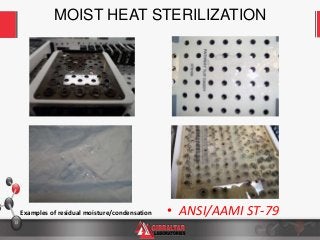
 Following sterilization the surgical tray shall be inspected for the presence of
moisture by removing the wrapping, and examining the tray and its
components.
 The tray’s Convertors Bio-Shield Sterilization Wraps shall be removed and their
weight recorded. In addition, with respect to moisture retention following
sterilization, the wrap weight shall not increase by more than 3% relative to its
weight before sterilization.
MOIST HEAT STERILIZATION
PART 3 [Drying Times]
14
MOIST HEAT STERILIZATION
• ANSI/AAMI ST-79Examples of residual moisture/condensation
THANK YOU!
Proprietary and Confidential © Gibraltar Laboratories, Inc.
www.gibraltarlabsinc.com / (973) 227-6882
http://www.gibraltarlabsinc.com/services/sterilization-services.html

Moist Heat Steam sterilization

  • 1.
    Moist Heat Sterilization Presentedby Jozef Mastej, Vice President of Operations Gibraltar Laboratories, Inc. http://www.gibraltarlabsinc.com/services/sterilization-services.html Proprietary and Confidential © Gibraltar Laboratories, Inc.
  • 2.
    2 Comprehensive guide tosteam sterilization and sterility assurance in health care facilities • ANSI/AAMI ST-79 • Overview Saturated steam under pressure is one of the oldest methods used in health care facilities to sterilize medical devices. Because this method has been available for so many years, it is thought to be a simple process, one that is well understood and controlled. However the efficacy of any sterilization process, including saturated steam, depends on: 1) Consistent system for lowering and limiting bioburden before sterilization. Cleanability Studies (Manual and Automated Cleaning/Disinfection) Disinfection included in the cleaning process of three instruments or one instrument three times and one control. Instrument(s) will be inoculated with artificial soil medium containing test organism(s). Cleaning definition- Removal of contamination from an item to the extent necessary for further processing or for the intended use. In health care facilities, cleaning consists of the removal, usually with detergent and water, of adherent soil (e.g., blood, protein substances, and other debris) from the surfaces, crevices, serrations, joints, and lumens of instruments, devices, and equipment by a manual or mechanical process that prepares the items for safe handling and/or further decontamination. MOIST HEAT STERILIZATION
  • 3.
    3 Comprehensive guide tosteam sterilization and sterility assurance in health care facilities • ANSI/AAMI ST-79 • Overview - continued MOIST HEAT STERILIZATION 2) Properly preparing items for sterilization 3) Selecting the appropriate sterilization parameters. Steam sterilization definition-Sterilization process that uses saturated steam under pressure, for a specified exposure time and at a specified temperature, as the sterilizing agent. Sterilization is the validated process used to render a product free from viable microorganisms. ST79 Tables 4 and 5 [Minimum cycle times for gravity- displacement and dynamic-air-removal steam sterilization cycles].  Thermocouples inside the containers [performed on one full-cycle without drying time per each sterilization condition]  Sterilization efficacy study to demonstrate sterilization assurance level 10-6 using overkill method [performed on three ½ cycle (s) per each sterilization condition] Sterility Assurance Level: Probability of a single viable microorganisms occurring on an item after sterilization. SAL 10-6 means that there is less than or equal to one chance in a million that a single viable microorganism is present on a sterilized item. It is generally accepted that a SAL 10-6 is appropriate for items intended to come into contact with compromised tissue.  Verification of drying time [performed on three full-cycle (s) with full drying time and any additional instructions; such as door “cracked” open, additional cooling outside the autoclave, etc.
  • 4.
    4 Comprehensive guide tosteam sterilization and sterility assurance in health care facilities • ANSI/AAMI ST-79 • Overview - continued MOIST HEAT STERILIZATION 4) Establishing and implementing controls to maintain the sterility of sterilized items until they are used.  Stability Studies [performed at minimum on full-cycle including drying time per each sterilization process and stored for appropriate time under real time conditions or accelerated condition. Upon completion of storage, samples are tested for sterility].  Longevity/Functionality cycle(s) -Restrictions on Reprocessing, qualification of instruments, qualification of vendors, etc. Example [100 full sterilization cycles or as suggested by the sponsor. Dynamic Air Removal and Gravity- Displacement. Cleaning step simulated use in between each cycle] Examples of medical trays being prepared for steam sterilization
  • 5.
    5 Containment devices forreusable medical device sterilization • ANSI/AAMI ST-77 MOIST HEAT STERILIZATION STERILIZATION VALIDATION - PART 1 [Temperature mapping] Purpose: To verify acceptable temperature distribution within containment device during a sterilization process.  Internal mapping profiles of temperature distribution inside the containment device, with thermocouples placed in strategic areas, shall be conducted on full-cycles. Areas that may be considered for monitoring are the containment device corners [lid and bottom], on the sides, at the center, and on the inner side of any filter.  At a minimum, a probe shall be placed in a lower corner, the diagonally opposite corner, and the center of the containment device. If filters are used in the containment device, fourth thermocouple shall be placed on the inner side of the filter.  For thermal sterilization processes, calibrated temperature thermocouples shall be used to map the temperature profiles of the containment devices.  For containment devices that require a filter, testing shall be performed with commercially available filter material that is compatible with the sterilization method and recommended by the containment device manufacture. Compatible filter material/commercial grades shall be clearly indicated in the product labeling.  Simultaneously containment devices should be double wrapped with Convertors Bio-Shield Sterilization Wraps or placed in a Rigid Container.
  • 6.
    6 • Examples ofthermocouple placements MOIST HEAT STERILIZATION
  • 7.
    7 • ANSI/AAMI ST-79 MOISTHEAT STERILIZATION STERILIZATION VALIDATION - PART 2 [Microbiological Challenge] Purpose: To demonstrate sterilization assurance level 10-6 using overkill method  Determination of using either liquid spore suspension or inoculated carrier Geobacillus stearothermophilus.  Biological Indicator or liquid spore suspension requirements.  D121value ≥ 1.0 minute [AAMI TIR 12] or ≥ 1.5 minutes [ANSI/AAMI/ISO 11138-3] – based on the Manufacturer’s Certificate.  The BI’s or Geobacillus stearothermophilus spore suspension will be enumerated to verify its population and confirm identity. Biological indicator (BI): Inoculated carrier contained within its primary pack ready for use and that provides a defined resistance to the specified sterilization process. Spore Suspension: Spore Suspensions contain bacterial spores in an aqueous solution and contain no extraneous contamination that could affect performance. Providing a defined resistance to the specified sterilization process.
  • 8.
    8 MOIST HEAT STERILIZATION PART2 [Microbiological Challenge] - continued 1. Calibrated Steam Sterilizer, FDA-cleared 510K1. Convertors Bio-Shield Sterilization Wraps, FDA- cleared 510K 2. Rigid Containers, FDA-cleared 510K ANSI/AAMI ST-79
  • 9.
    9  Determination ofplacement of BI’s or inoculation placement and rationale.  Sterilization processes.  Gravity-displacement steam sterilization: Type of sterilization process in which incoming steam displaces residual air through a port or drain usually in or near the bottom of the sterilizer chamber.  Pre-vacuum steam sterilization: Also known as dynamic air removal steam sterilization. One of two types of sterilization cycles in which air is removed from the chamber and the load by means of a series of pressure and vacuum excursions [pre- vacuum cycle] or by means of a series of steam flushes or pressure pulses above atmospheric pressure [steam-flush- pressure-pulse (SFPP) cycle]. MOIST HEAT STERILIZATION PART 2 [Microbiological Challenge] - continued • ANSI/AAMI ST-79
  • 10.
    10 Conservative determination oflethal rate of the sterilization process – Overkill approach  The BI's will be distributed on every level of the tray to provide coverage of the interior space of the tray and are positioned in potentially difficult areas to sterilize with respect to lumen, surface of the instrument and to provide geometric coverage as worst case position.  Three half-cycles of each sterilization process using maximum load configuration.  Pulsed pre-vacuum half-cycle – 2 minutes at 132°C exposure time  Gravity-displacement half-cycle – 7.5 minutes at 132°C exposure time  In addition three pulsed pre-vacuum half-cycle – 2 minutes at 132°C exposure time using minimum load configuration. In summary, it will be determined if a ≥ six log reduction of the indicator microorganism is achieved in the half-cycles. If all the BI’s are negative upon sterility testing after exposure to the half-cycle, the full-cycle will equal twice the exposure time used in the half-cycle. In the future, when a full-cycle is run, a reduction of >12 logs is expected and a SAL of 10-6 will be attained. MOIST HEAT STERILIZATION PART 2 [Microbiological Challenge] - continued • ANSI/AAMI ST-79
  • 11.
    11 Item Exposure Time at 121°C(250°F) Exposure Time at 132°C (270°F) Exposure Time at 135°C (275°F) Drying Times Wrapped instrument 30 minutes 15 minutes 15-30 minutes 10 minutes 30 minutes Textile packs 30 minutes 25 minutes 15 minutes 10 minutes 30 minutes Wrapped utensils 30 minutes 15 minutes 15-30 minutes 10 minutes 30 minutes Unwrapped nonporous items (e.g., instruments) 3 minutes 3 minutes 0-1 minute Unwrapped nonporous and porous items in mixed load 10 minutes 10 minutes 0-1 minute MOIST HEAT STERILIZATION From AAMI site ref. Table 4: Minimum cycle times for gravity-displacement steam sterilization cycles
  • 12.
    12 Item Exposure Time at 132°C(270°F) Exposure Time at 135°C (275°F) Drying Times Wrapped instrument 4 minutes 20-30 minutes 3 minutes 16 minutes Textile packs 4 minutes 5-20 minutes 3 minutes 3 minutes Wrapped utensils 4 minutes 20 minutes 3 minutes 16 minutes Unwrapped nonporous items (e.g., instruments) 3 minutes 3 minutes NA Unwrapped nonporous and porous items in mixed load 4 minutes 3 minutes NA MOIST HEAT STERILIZATION From AAMI site ref. Table 5: Minimum cycle times for dynamic-air-removal steam sterilization cycles
  • 13.
    13 The dryness ofthe trays fully loaded with its associated implants and reusable instruments shall be included in the validation process because dryness following sterilization is critical in maintaining the sterility of the trays and its components.  The weight of the double Convertors Bio-Shield Sterilization Wraps shall be recorded.  The surgical tray shall be simultaneously double wrapped with Convertors Bio- Shield Sterilization Wraps or placed inside the rigid container.  The surgical tray shall be placed in the steam sterilizer for the three full-cycle. Note: The fully loaded chamber is the worst case condition with respect to drying time for a given sterilization process.  Following sterilization the surgical tray shall be inspected for the presence of moisture by removing the wrapping, and examining the tray and its components.  The tray’s Convertors Bio-Shield Sterilization Wraps shall be removed and their weight recorded. In addition, with respect to moisture retention following sterilization, the wrap weight shall not increase by more than 3% relative to its weight before sterilization. MOIST HEAT STERILIZATION PART 3 [Drying Times]
  • 14.
    14 MOIST HEAT STERILIZATION •ANSI/AAMI ST-79Examples of residual moisture/condensation
  • 15.
    THANK YOU! Proprietary andConfidential © Gibraltar Laboratories, Inc. www.gibraltarlabsinc.com / (973) 227-6882 http://www.gibraltarlabsinc.com/services/sterilization-services.html