Network Protocols
Tracing thePath
• Cybersecurity analysts need to have a deep understanding of how networks operate. They
must be able to determine the origin of traffic and its destination.
• Traffic from a computer to an internet server can take many paths.
3.
Network Protocols
Tracing thePath (Contd.)
• A combination of copper and fiber-optic
cables that go over land and under the ocean
carry data traffic. These connections connect
telecommunications facilities and ISPs
distributed throughout the world.
• Global Tier 1 and Tier 2 ISPs connect portions
of the internet together, usually through an
Internet Exchange Point (IXP).
• Larger networks connect to Tier 2 networks
through a Point of Presence (PoP), which is
usually a location in the building where
physical connections to the ISP are made. The
Tier 3 ISPs connect homes and businesses to
the internet.
Communications Protocols
What areProtocols?
• Simply having a connection between end devices
is not enough to enable communication. For
communication to occur, devices must know
“how” to communicate.
• Communication is governed by rules called
protocols.
• These protocols are specific to the type of
communication method occurring.
• Network protocols specify many features of
network communication.
6.
Communications Protocols
Network Protocols
•Network protocols provide the means for computers to communicate on networks.
• Network protocols dictate the message encoding, formatting, encapsulation, size, timing, and delivery
options.
• Networking protocols define a common format and set of rules for exchanging messages between
devices.
• Some common networking protocols are Hypertext Transfer Protocol (HTTP), Transmission Control
Protocol (TCP), and Internet Protocol (IP).
Note: IP in this course refers to both the IPv4 and IPv6 protocols. IPv6 is the most recent version of IP
and will eventually replace the more common IPv4.
7.
Communications Protocols
Network Protocols(Contd.)
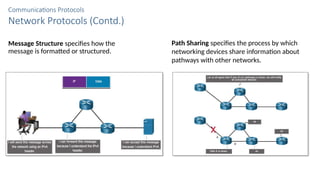
Message Structure specifies how the
message is formatted or structured.
Path Sharing specifies the process by which
networking devices share information about
pathways with other networks.
8.
Communications Protocols
Network Protocols(Contd.)
Information Sharing specifies how and when
error and system messages are passed between
devices.
Session Management manages the setup and
termination of data transfer sessions.
9.
Communications Protocols
The TCP/IPProtocol Suite
• TCP/IP is the protocol suite used by the internet and
the networks of today.
• TCP/IP has two important aspects for vendors and
manufacturers:
• Open standard protocol suite - This
means it is freely available to the
public and can be used by any vendor
on their hardware or in their
software.
• Standards-based protocol suite - This
means it has been endorsed by the
networking industry and approved by
a standards organization.
10.
Communications Protocols
The TCP/IPProtocol Suite (Contd.)
Lets have a look at the brief description of protocols at each layer.
Application Layer
• Name System - DNS (Domain Name System): Translates domain names into IP addresses.
Host Config
Protocol Description
DHCPv4 (Dynamic Host Configuration Protocol for IPv4) Dynamically assigns IPv4 addressing information to DHCPv4 clients
at start-up and allows the addresses to be re-used when no longer
needed.
DHCPv6 (Dynamic Host Configuration Protocol for IPv6) It is similar to DHCPv4. Dynamically assigns IPv6 addressing
information to DHCPv6 clients at start-up.
SLAAC (Stateless Address Autoconfiguration) A method that allows a device to obtain its IPv6 addressing
information without using a DHCPv6 server.
Editor's Notes
#2 5 - Network Protocols
5.1 – Network Communications Process
5.1.4 – Tracing the Path
#3 5 - Network Protocols
5.1 – Network Communications Process
5.1.4 – Tracing the Path
#4 Source:
5 – Network Protocols
5.2 – Communications Protocols
In-Session Activities / Explanations:
Time: 25 mins
Instructor Notes:
Give an introduction to the topic and discuss the protocol and its functions.
Briefly explain TCP/IP Protocol Suite.
Ensure the learners know about encapsulation.
Talk over message formatting, size and timing.
Describe the three methods of communications.
Take the learners through OSI reference model and TCP/IP protocol model.
Key Points: OSI reference model, TCP/IP protocol, Encapsulation, Message formatting, Unicast, Multicast, Broadcast
#5 5 - Network Protocols
5.2 – Communications Protocols
5.2.1 – What are Protocols?