Praetorian Security Trainingand Assessment Center, Inc.
3D JGS Complex, 4th Ave. Bagong Lipunan ng Crame, Quezon City,
Quezon City, Philippines
17/02/2025 1
Training Module Disclaimer& Copyright Infringement
Notice Disclaimer:
This training module is for educational purposes only. The information provided
is intended to enhance security personnel's knowledge and skills but does not
substitute for official regulations, laws, or company policies.
Copyright Infringement Notice:
All materials, including text, images, and presentation content, are copyrighted
and owned by the author. Unauthorized reproduction, distribution, or
modification of this material without written permission is strictly prohibited and
may result in legal action.
8.
HOUSE RULES FORTRAINING
Guidelines for Participants:
1.Punctuality – Arrive on time and be prepared for each session.
2.Respect – Maintain professionalism when interacting with trainers and fellow
trainees.
3.Participation – Engage in discussions, activities, and role-playing exercises.
4.Mobile Phones – Keep devices on silent mode; use only when necessary.
5.Confidentiality – Do not share training materials without permission.
6.Dress Code – Follow the prescribed uniform or business attire.
7.Cleanliness – Maintain a clean and organized training environment.
8.Compliance – Follow all safety protocols and emergency procedures.
Module 3: Dutiesand Responsibilities of Security Guard
I. Introduction
Security guards play a vital role in maintaining safety and security within various environments. This module provides
an in-depth understanding of their duties, responsibilities, and essential functions to ensure effective security operations.
II. Learning Objectives
By the end of this module, participants will be able to:
• Understand basic security concepts and their application.
• Identify and implement security guard responsibilities.
• Execute security-related tasks, including patrolling, access control, and crime incident response.
• Communicate effectively using telephone and radio protocols.
• Apply self-defense principles and proper use of force.
17/02/2025 17
18.
1. Basic SecurityConcepts
• Principles of Security
• Aspects of Security
• Identifying Hazards and Threats
• 11 General Orders (GOs) of Security Guards
17/02/2025 18
19.
2. Security GuardBasic Functions
• Patrolling
o Purpose of Patrolling
o Tools and Equipment Used
o Areas of Responsibility
o Patrolling Objectives
• Recording and Documentation
o Visitor and Access Control Logs
o Materials Control and Inventory Management
• Communication Courtesy
o Telephone and Radio Communication Etiquette
o Reporting Procedures
17/02/2025 19
20.
• Vehicle Controland Inspection
o Inspection Checkpoints
o Verifying Credentials and Access Passes
• Reacting to Crime Incidents
o Immediate Response Procedures
o Coordination with Law Enforcement
• Concept of Self-Defense
o Legal and Ethical Considerations
o Defensive Tactics
• Arrest and Use of Force
o Guidelines on Performing Arrests
o Proper Use of Force and Escalation of Response
17/02/2025 20
21.
• Duties DuringStrike, Lockouts, and Civil Disturbances
o Managing Crowd Control
o Ensuring Safety of Property and Personnel
• Emergency Situations
o Stampede and Crowd Control
o Relieving the Guard
o Turn-over of Firearms and Properties
o Safety and Security Evaluation
o Explosives, Ammunition, Ordnance, and Bomb/IEDs Orientation
o Scenario and Bomb Threat Response
o SOP on Buddy-Buddy System on Posting Security Guards
o SOP on Male and Female Buddy System
17/02/2025 21
22.
3. Crime ScenePreservation
• Definition of Terms
• How to Preserve Evidence in a Crime Scene
• Coordination with Local Police and Emergency Units
• Use of Police Line and Restricted Areas
• Proper Recording and Note-Taking
IV. Instructional Methods
• Lecture and Discussion: Theoretical concepts and security guidelines.
• Demonstrations: Hands-on training in patrolling, inspections, and arrests.
• Role-Playing Exercises: Scenarios to practice communication and response techniques.
• Assessments: Written exams and practical evaluations.
17/02/2025 22
23.
V. Conclusion
This trainingmodule ensures security personnel are equipped with the necessary knowledge and skills to perform their
duties effectively and responsibly. The training will enhance their preparedness, professionalism, and adherence to
security protocols.
enhance your security knowledge and skills!
17/02/2025 23
24.
Basic Security Concepts
1.History of Security
Security has evolved from ancient times, where civilizations used guards to protect their territories, to modern
security measures involving advanced technology and intelligence operations.
• Ancient Era – Use of guards and military personnel to protect kingdoms.
• Industrial Revolution – Growth of private security firms in response to industrialization.
• Modern Era – Integration of cyber security, counterintelligence, and private security services.
• Philippines Context – The security industry in the Philippines was formalized with the Private Security
Agency Law (RA 11917) and the role of PNP-SOSIA in regulating security guards and agencies.
17/02/2025 24
2. Definition ofTerms
• Security – The state of being free from danger or threat.
• Risk – The possibility of harm, loss, or negative impact due to an identified threat.
• Threat – Any potential danger that can harm individuals, organizations, or nations.
• Hazard – A source of potential damage or harm.
• Access Control – Restriction of entry to authorized individuals only.
• Counterintelligence – Measures taken to prevent espionage and security breaches.
17/02/2025 26
27.
3. Examples andPresentation
Security principles are applied differently depending on the setting:
Philippines Context:
• Private security agencies are widely used for commercial, industrial, and residential protection.
• The Philippine National Police - Supervisory Office for Security and Investigation Agencies (PNP-
SOSIA) enforces security regulations.
• Security guards must undergo mandatory training under RA 11917 and must comply with the 11
General Orders (GOs) of security guards.
17/02/2025 27
International Context:
• Countrieshave various security frameworks such as the U.S. Department of Homeland Security (DHS)
and Interpol for international security cooperation.
• Private military contractors operate globally, providing specialized security services.
17/02/2025 29
4. Principles ofSecurity
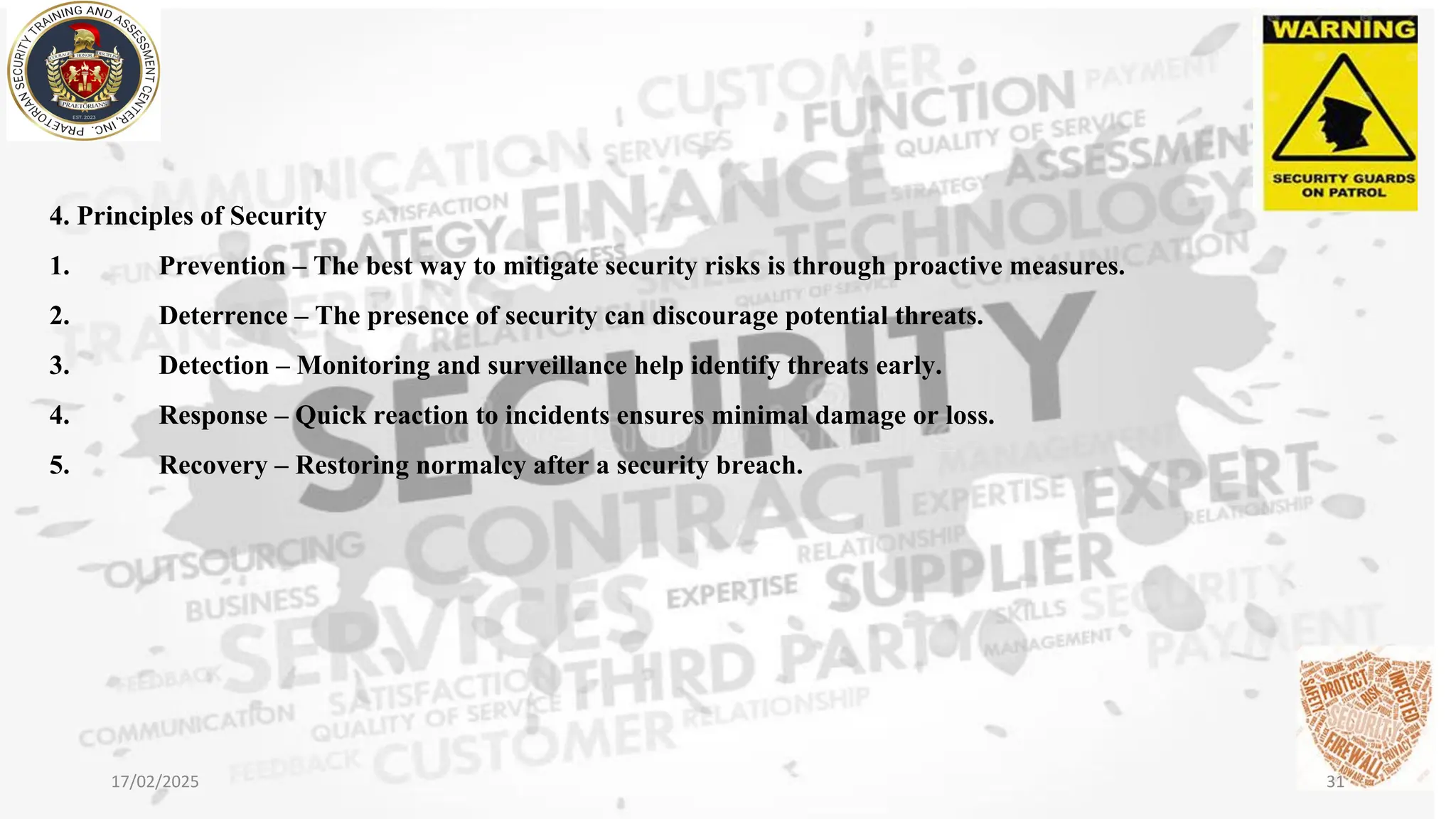
1. Prevention – The best way to mitigate security risks is through proactive measures.
2. Deterrence – The presence of security can discourage potential threats.
3. Detection – Monitoring and surveillance help identify threats early.
4. Response – Quick reaction to incidents ensures minimal damage or loss.
5. Recovery – Restoring normalcy after a security breach.
17/02/2025 31
32.
5. Aspects ofSecurity
• Physical Security – Guards, barriers, and surveillance systems.
• Personnel Security – Background checks, vetting, and internal security measures.
• Information Security – Protecting sensitive data and cyber assets.
• Operational Security – Secure planning and execution of activities.
• National Security – Defense against external and internal threats.
17/02/2025 32
11 General Orders(GOs) of Security Guards (Philippines)
1. To take charge of the post and all company property in view.
2. To walk the post in a military manner, keeping always alert.
3. To report all violations of orders to superiors.
4. To repeat all calls from posts more distant from the guardhouse.
5. To quit the post only when properly relieved.
6. To receive, obey, and pass on to the relieving guard all orders from superiors.
7. To talk to no one except in the line of duty.
8. To sound the alarm in case of fire or disorder.
9. To call the superior officer in any case not covered by instructions.
10. To salute all company officials, officers, and visitors.
11. To be especially watchful at night and during times of challenge.
17/02/2025 36
37.
11 General Orders(GOs) ng mga Security Guard sa Pilipinas (Tagalog Version)
1.Pangasiwaan ang puwesto at lahat ng ari-arian ng kumpanya na nasa paningin.
2.Magpatrolya sa puwesto nang may disiplinang militar at laging alerto.
3.Iulat ang lahat ng paglabag sa utos sa nakatataas.
4.Ulitin ang lahat ng tawag mula sa mga puwestong mas malayo sa himpilan ng guwardiya.
5.Lisanin lamang ang puwesto kapag may tamang kapalit.
6.Tanggapin, sundin, at ipasa sa papalit na guwardiya ang lahat ng utos mula sa nakatataas
7.Huwag makipag-usap kaninuman maliban kung ito ay may kinalaman sa tungkulin.
8.Patunugin ang alarma kung may sunog o kaguluhan.
9.Tawagan ang nakatataas na opisyal para sa anumang hindi sakop ng mga tagubilin.
10.Magbigay galang sa lahat ng opisyal ng kumpanya, nakatataas na opisyal, at mga bisita.
11.Maging mas mapagmatyag lalo na sa gabi at sa panahon ng panganib.
17/02/2025 37
38.
Security Guard BasicFunctions
1. History and Definition of Security Guarding
Security guarding has evolved from medieval watchmen protecting towns to modern-day private security
forces supporting law enforcement. In the Philippines, security guards are regulated by RA 11917, while
internationally, private security firms follow regulations such as the Private Security Services Act (U.S.) and
SIA Licensing (U.K.).
2. Patrolling
Purpose of Patrolling
• Prevent crime by maintaining visibility.
• Detect and report irregularities such as trespassing and theft.
• Ensure safety of personnel and assets.
Tools and Equipment Used
• Baton, flashlight, and whistle.
• Communication radios.
• Surveillance cameras and GPS tracking.
17/02/2025 38
39.
Security Guard BasicFunctions
Areas of Responsibility
• Fixed post patrols (buildings, entry points).
• Mobile patrols (large compounds, perimeter security).
• Random patrols (prevent predictable patterns).
Patrolling Objectives
• Secure critical areas.
• Identify security breaches.
• Provide rapid response when needed.
17/02/2025 39
40.
3. Recording andDocumentation
Visitor and Access Control Logs
• Maintain records of personnel entering/exiting premises.
• Verify identification and credentials.
Materials Control and Inventory Management
• Secure storage areas.
• Prevent unauthorized access or theft.
17/02/2025 40
4. Communication Courtesy
Telephoneand Radio Communication Etiquette
• Use clear and concise language.
• Follow proper radio protocols (e.g., "Over," "Roger," "10-4").
Reporting Procedures
• Incident reports must include who, what, when, where, and how.
• Immediate reporting to superiors or law enforcement when necessary.
5. Vehicle Control and Inspection
Inspection Checkpoints
• Check vehicles for contraband or unauthorized items.
• Record vehicle details for security logs.
Verifying Credentials and Access Passes
• Ensure all vehicles have valid permits.
• Prevent unauthorized entry.
17/02/2025 42
43.
6. Reacting toCrime Incidents
Immediate Response Procedures
• Secure the area and assess threats.
• Call for backup or law enforcement if needed.
Coordination with Law Enforcement
• Provide detailed reports and assist investigations.
• Preserve the crime scene until authorities arrive.
7. Concept of Self-Defense
Legal and Ethical Considerations
• Follow Philippine self-defense laws (Article 11 of the RPC).
• Avoid excessive force unless necessary.
Defensive Tactics
• Use non-lethal techniques first.
• Employ verbal de-escalation when possible.
17/02/2025 43
44.
8. Arrest andUse of Force
Guidelines on Performing Arrests
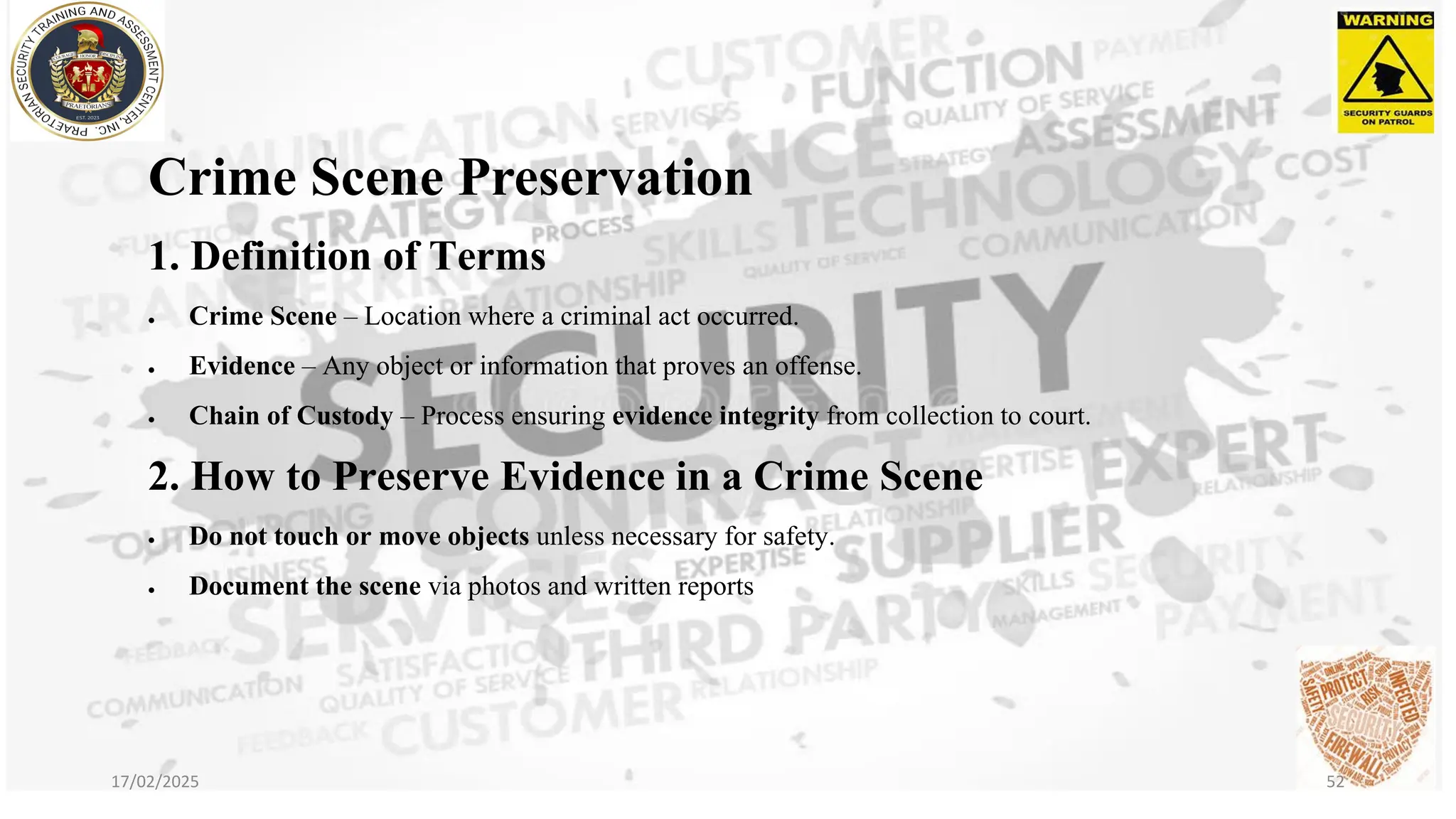
• Security guards can conduct citizen’s arrests (Rule 113, Section 5 of RPC).
• Detainees must be handed over to police immediately.
Proper Use of Force and Escalation of Response
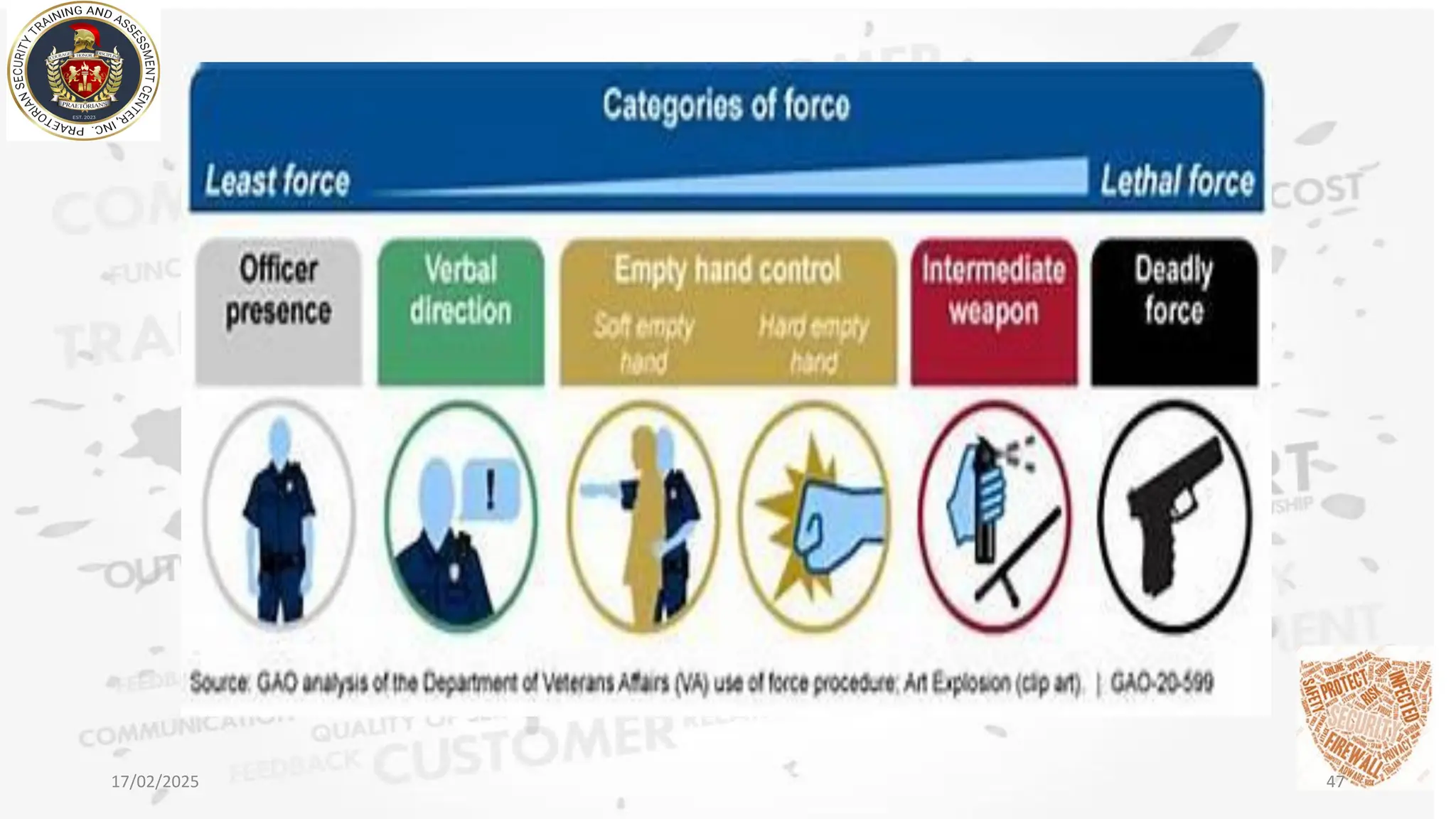
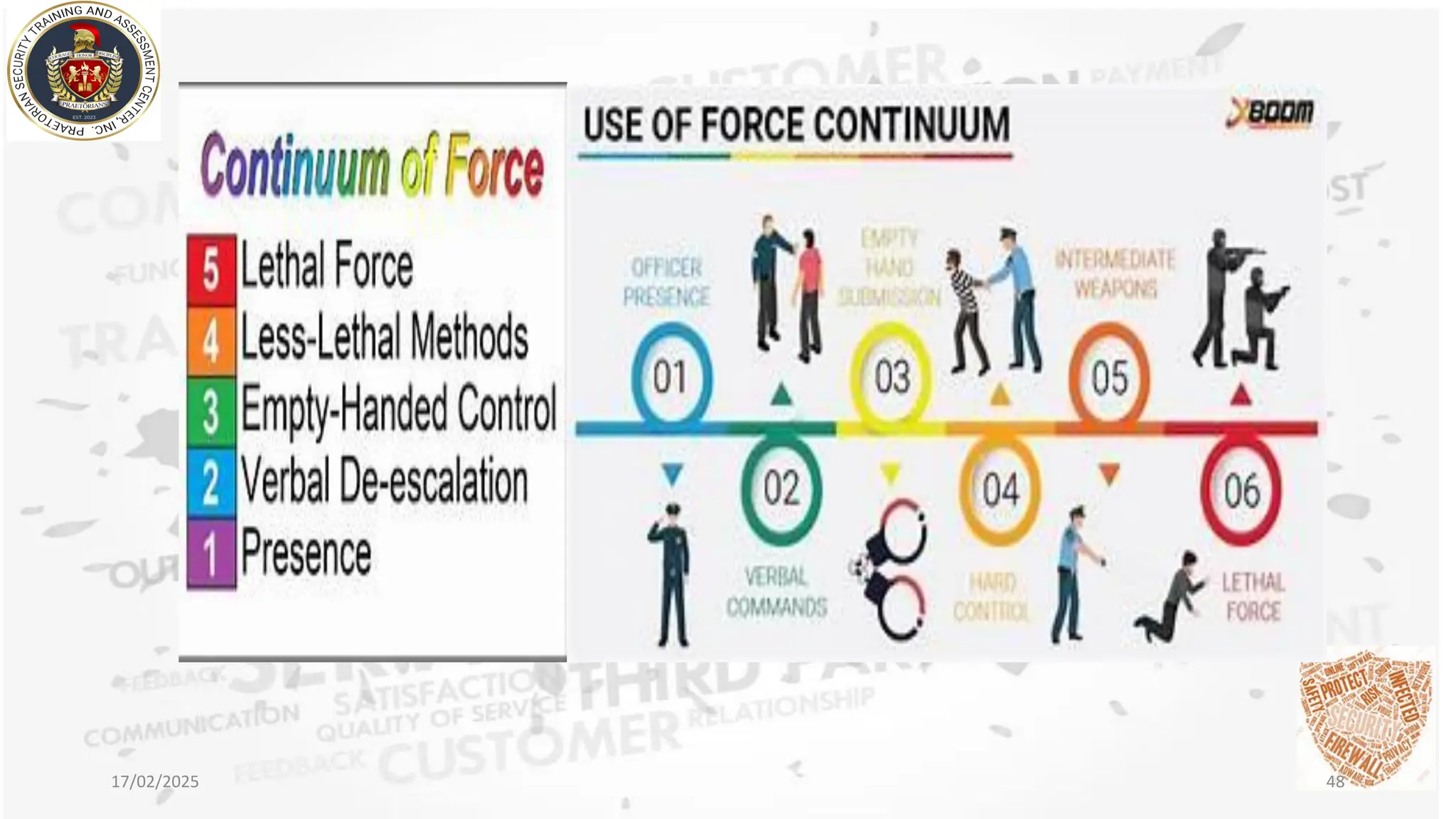
• Use of force continuum (verbal commands → soft control → hard control → non-lethal force
→ lethal force).
• Document all force-related incidents.
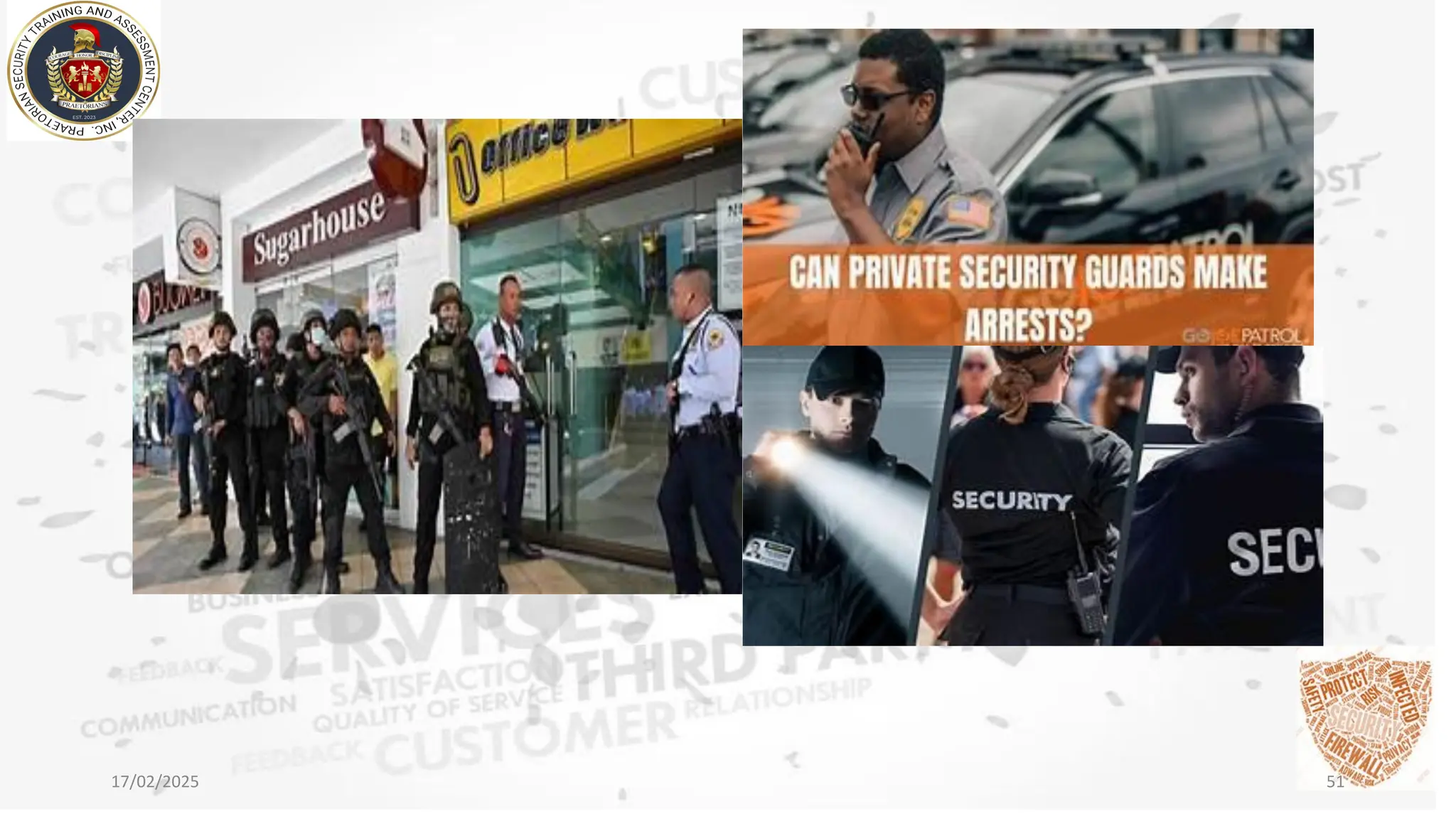
9. Duties During Strike, Lockouts, and Civil Disturbances
Managing Crowd Control
• Use barriers and formations to control movement.
• Maintain neutrality and avoid physical confrontation.
Ensuring Safety of Property and Personnel
• Secure vital company assets.
• Escort employees safely if necessary.
17/02/2025 44
10. Emergency Situations
Stampedeand Crowd Control
• Direct crowds safely to prevent panic.
• Use megaphones and visual signals for guidance.
Relieving the Guard
• Conduct proper shift handovers with incident briefings.
Turn-over of Firearms and Properties
• Follow PNP-SOSIA guidelines for firearm handling.
Safety and Security Evaluation
• Regular risk assessments for threats.
Explosives, Ammunition, Ordnance, and Bomb/IEDs Orientation
• Recognizing suspicious packages and devices.
• Evacuation and reporting procedures.
17/02/2025 46
10. Emergency Situations
Scenarioand Bomb Threat Response
• Isolate the area and alert authorities immediately.
SOP on Buddy-Buddy System on Posting Security Guards
• Enhances response efficiency and accountability.
SOP on Male and Female Buddy System
• Ensures gender-sensitive security deployments.
17/02/2025 49
Crime Scene Preservation
1.Definition of Terms
• Crime Scene – Location where a criminal act occurred.
• Evidence – Any object or information that proves an offense.
• Chain of Custody – Process ensuring evidence integrity from collection to court.
2. How to Preserve Evidence in a Crime Scene
• Do not touch or move objects unless necessary for safety.
• Document the scene via photos and written reports
17/02/2025 52
53.
3. Coordination withLocal Police and Emergency Units
• Call the PNP-CIDG, NBI, or emergency responders based on the crime type.
• Cooperate fully with investigators.
4. Use of Police Line and Restricted Areas
• Establish a perimeter using barricades or tape.
• Control access to authorized personnel only.
5. Proper Recording and Note-Taking
• Incident reports should include:
o Date, time, and location.
o Description of persons involved.
o Witness statements (if applicable).
17/02/2025 53
54.
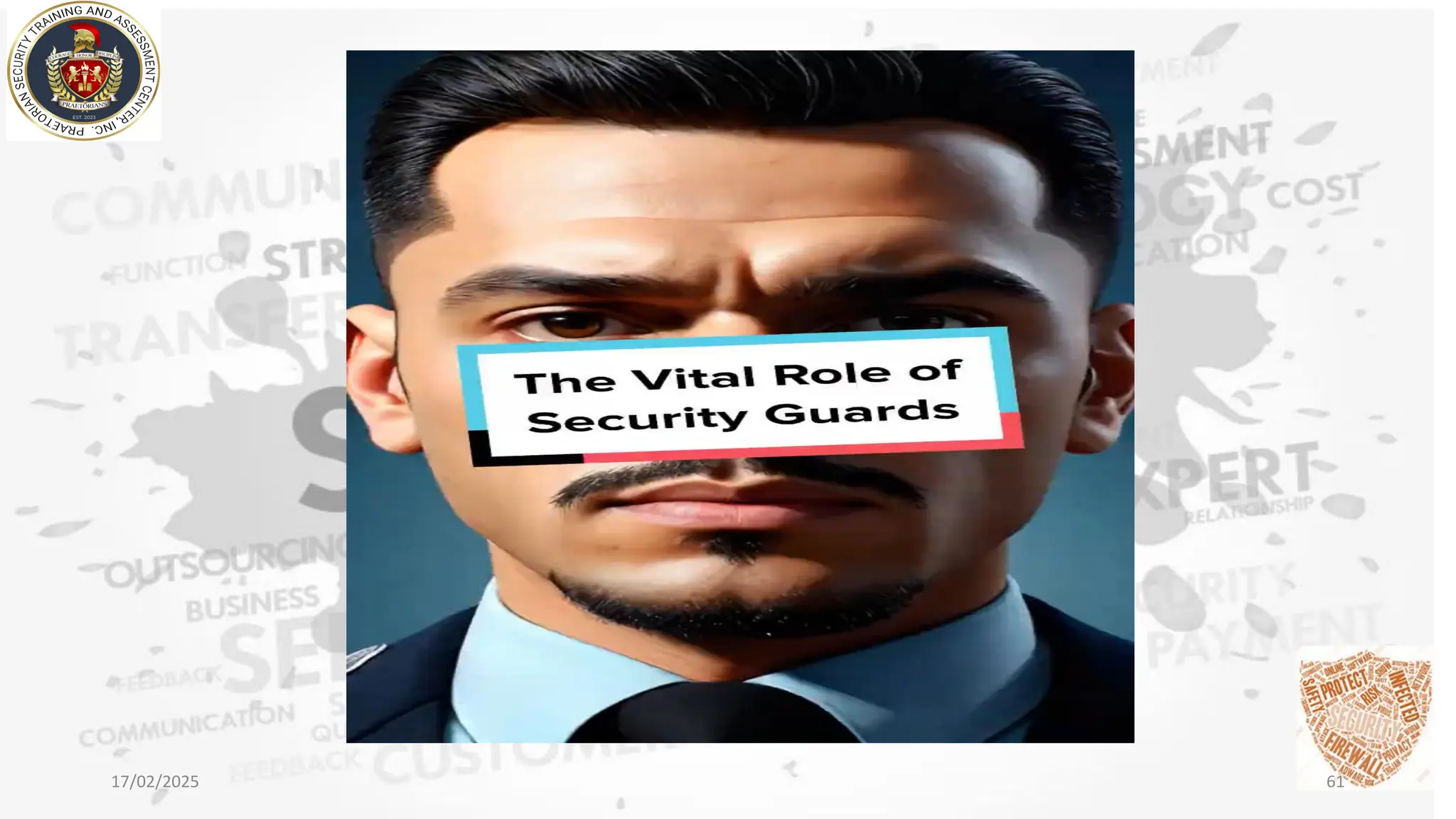
Basic Security GuardDuties, Functions, and Roles in Society
Security guards play a crucial role in maintaining safety, order, and security in
various environments.
Their duties extend beyond just guarding properties; they also serve as
deterrents to crime, first responders in emergencies, and enforcers of safety
regulations. Below are their fundamental duties, functions, and roles in society:
________________________________________
17/02/2025 54
55.
A. Protection ofLife and Property
• Safeguard individuals, assets, and establishments from theft,
vandalism, or harm.
• Prevent unauthorized access to restricted areas.
17/02/2025 55
56.
B. Crime Preventionand Deterrence
• Serve as a visible deterrent against criminal activities.
• Monitor suspicious behavior and report criminal activities.
17/02/2025 56
57.
C. Surveillance andPatrolling
• Conduct regular patrols (foot or vehicle) to check for any security
breaches.
• Monitor security cameras, alarm systems, and access control
systems.
17/02/2025 57
58.
D. Emergency Responseand Crisis Management
• Act as first responders in case of fire, medical emergencies, or
disasters.
• Coordinate with law enforcement, fire departments, and medical
personnel.
17/02/2025 58
59.
E. Crowd Controland Access Management
• Regulate the entry and exit of personnel, visitors, and vehicles.
• Maintain order during events, protests, or public gatherings.
17/02/2025 59
60.
F. Reporting andDocumentation
• Write detailed reports on incidents, security breaches, and daily
activities.
• Maintain records of visitors, deliveries, and emergency responses.
17/02/2025 60
2. Functions ofa Security Guard
A. Static Security (Fixed Post Duty)
• Guard entrances, checkpoints, or designated security posts.
• Control access points and verify identifications.
B. Mobile Security (Patrolling Duty)
• Conduct foot, bicycle, or vehicle patrols to inspect surroundings.
• Look for signs of intrusion, damage, or hazards.
C. Intelligence and Investigation
• Gather information about potential threats.
• Conduct preliminary investigations on security-related incidents.
D. Customer Service and Assistance
• Assist customers, employees, and visitors with inquiries.
• Provide directions and escort individuals when necessary.
17/02/2025 63
64.
E. Law EnforcementSupport
• Cooperate with police and government agencies in crime prevention.
• Apprehend suspects when legally authorized and required.
3. Role of Security Guards in Society
A. Guardian of Public Safety
• Help create a safe environment for businesses, schools, hospitals, and
communities.
• Reduce fear and crime through a strong security presence.
B. First Line of Defense Against Threats
• Serve as the first responders in times of emergencies and threats.
• Prevent terrorist acts, sabotage, and unauthorized surveillance
17/02/2025 64
65.
C. Economic andBusiness Protection
• Ensure businesses run smoothly without security threats.
• Prevent losses due to theft, fraud, or property damage.
D. Support to Law Enforcement and Government Agencies
• Work alongside police, military, and emergency responders.
• Assist in enforcing laws and security policies.
E. Peacekeeping in Society
• Control aggressive behavior in public places.
• Promote discipline and order during social events.
17/02/2025 65
66.
Conclusion
Security guards arevital to public safety, law enforcement, and crime prevention. Their
presence not only deters crime but also ensures the well-being of individuals and
communities.
Whether in private establishments or public spaces, security personnel uphold order,
enforce safety protocols, and respond to emergencies, making them an essential part of
a secure and functioning society.
17/02/2025 66