Module 5 |Chapter 9
ACTIVE FIRE CONTROL
BUILDING SERVICES - III 18ARC63
Basic concepts in fixed firefighting installations, Fire sprinklers,
Fire Hydrants, Automatic fire detection and alarm systems
Ar. Kusumanjali S
Asst. Professor
ANRVSA, Bengaluru
2.
BUILDING SERVICES -III 18ARC63
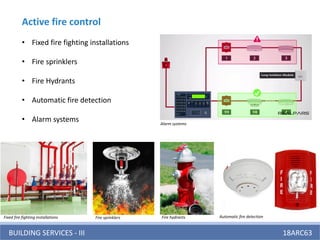
Active fire control
• Fixed fire fighting installations
• Fire sprinklers
• Fire Hydrants
• Automatic fire detection
• Alarm systems
Fixed fire fighting installations Fire sprinklers Fire hydrants Automatic fire detection
Alarm systems
3.
BUILDING SERVICES -III 18ARC63
FIRE FIGHTING
Fire in a building is an undesirable combustion of material in a building not under
control. It can cause loss of life, damage to papers and valuables, furniture and
property, the main structure etc. if not brought under control.
The main principle aim of fire fighting is in the priority of:
1) Saving lives
2) Protection of property
3) Reduce interruptions in the functioning of buildings
4) Prevention of fire.
There are four classes of fire :
a) Ordinary combustion
b) Burning of liquids
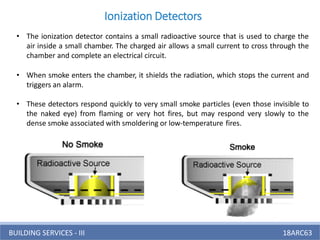
c) Electrical fire
d) Metal fire
4.
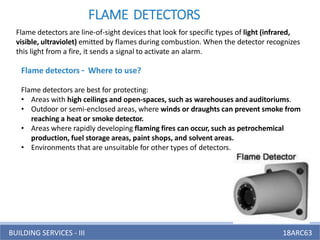
BUILDING SERVICES -III 18ARC63
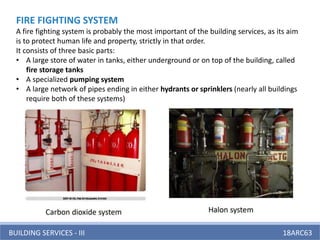
FIRE FIGHTING SYSTEM
A fire fighting system is probably the most important of the building services, as its aim
is to protect human life and property, strictly in that order.
It consists of three basic parts:
• A large store of water in tanks, either underground or on top of the building, called
fire storage tanks
• A specialized pumping system
• A large network of pipes ending in either hydrants or sprinklers (nearly all buildings
require both of these systems)
BUILDING SERVICES -III 18ARC63
FIRE FIGHTING
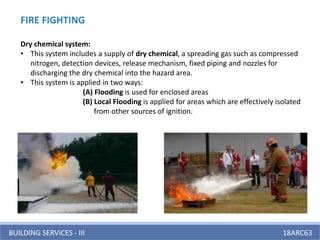
Dry chemical system:
• This system includes a supply of dry chemical, a spreading gas such as compressed
nitrogen, detection devices, release mechanism, fixed piping and nozzles for
discharging the dry chemical into the hazard area.
• This system is applied in two ways:
(A) Flooding is used for enclosed areas
(B) Local Flooding is applied for areas which are effectively isolated
from other sources of ignition.
7.
BUILDING SERVICES -III 18ARC63
FIRE FIGHTING
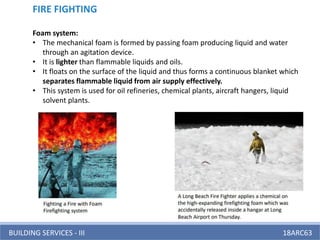
Foam system:
• The mechanical foam is formed by passing foam producing liquid and water
through an agitation device.
• It is lighter than flammable liquids and oils.
• It floats on the surface of the liquid and thus forms a continuous blanket which
separates flammable liquid from air supply effectively.
• This system is used for oil refineries, chemical plants, aircraft hangers, liquid
solvent plants.
8.
BUILDING SERVICES -III 18ARC63
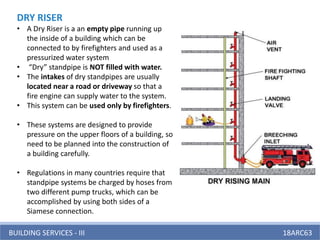
DRY RISER
• A Dry Riser is a an empty pipe running up
the inside of a building which can be
connected to by firefighters and used as a
pressurized water system
• “Dry” standpipe is NOT filled with water.
• The intakes of dry standpipes are usually
located near a road or driveway so that a
fire engine can supply water to the system.
• This system can be used only by firefighters.
• These systems are designed to provide
pressure on the upper floors of a building, so
need to be planned into the construction of
a building carefully.
• Regulations in many countries require that
standpipe systems be charged by hoses from
two different pump trucks, which can be
accomplished by using both sides of a
Siamese connection.
9.
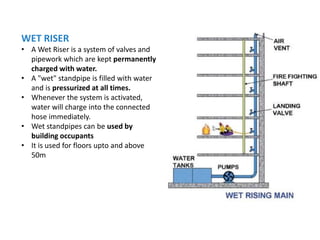
WET RISER
• AWet Riser is a system of valves and
pipework which are kept permanently
charged with water.
• A "wet" standpipe is filled with water
and is pressurized at all times.
• Whenever the system is activated,
water will charge into the connected
hose immediately.
• Wet standpipes can be used by
building occupants
• It is used for floors upto and above
50m
10.
BUILDING SERVICES -III 18ARC63
SPRINKLERS
• It is an active fire protection
measure, consisting of a water
supply system, providing adequate
pressure and flow rate to a water
distribution piping system, onto
which fire sprinklers are connected.
• Although historically only used in
factories and large commercial
buildings, home and small building
systems are now available at a cost-
effective price.
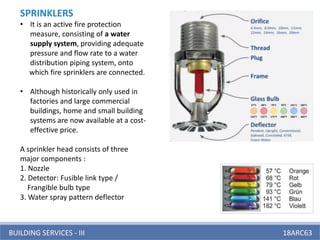
A sprinkler head consists of three
major components :
1. Nozzle
2. Detector: Fusible link type /
Frangible bulb type
3. Water spray pattern deflector
BUILDING SERVICES -III 18ARC63
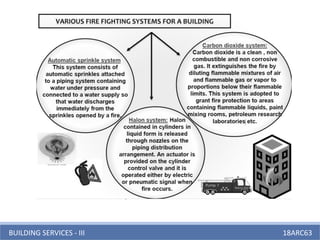
WETPIPE SYSTEM:
• Wet-pipe sprinkler systems
employ automatic sprinklers
attached to a piping system
containing water and connected
to a water supply so that water
discharges immediately from
sprinklers opened by a fire.
• This type is most reliable and
simple.
• Only those sprinklers which
have been operated by heat
over the fire will discharge
water.
DRYPIPE SYSTEM:
• Dry-pipe sprinkler systems employ
automatic sprinkler attached to a
piping system containing air or
nitrogen.
• When sprinklers are open by a fire,
the gas is released and the dry pipe
valve is open by the water pressure.
• The water then flows into the
piping system and discharges only
from those sprinklers which have
been open by heat over the fire.
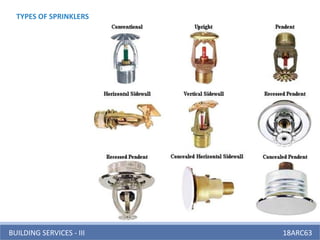
TYPES OF SPRINKLERS
13.
BUILDING SERVICES -III 18ARC63
FUSIBLE LINK TYPE:
• The fusible link type of heat detector is
constructed of a “eutectic alloy” which
melt at a specific temperature rather
than gradually softening.
• When the link temperature reaches its
melting point, the link is pulled apart by
the water pressure and opens nozzle.
FRANGIBLE BULB TYPE:
• The frangible bulb type of detector
contains a glass bulb partially filled
with a liquid that expands with
temperature.
• At the rated temperature, the liquid
will shatter the bulb and open the
nozzle
SPRINKLERS
DETECTORS:
14.
BUILDING SERVICES -III 18ARC63
SPRINKLERS
• During the incipient fire stage, heat output is relatively low and unable to cause
sprinkler operation.
• As the fire intensity increases, however, the sprinkler's sensing elements become
exposed to elevated temperatures (typically in excess of 135-225°F/57-107°C)and
they begin to deform.
• Assuming temperatures remain high, as they would during an increasing fire, the
element will fatigue after an approximate 30 second to 4 minute period.
• This will release the sprinkler's seals allowing water to discharge onto the fire.
• In most situations less than 2 sprinklers are needed to suppress the fire.
• In fast growing fire scenarios such as a flammable liquid spill, up to 12 sprinklers may
be required for control.
15.
BUILDING SERVICES -III 18ARC63
SPRINKLERS
Operation
• Each closed-head sprinkler is held closed by either a heat-sensitive glass bulb or a
two- part metal link held together with fusible alloy.
• The glass bulb or link applies pressure to a pipe cap which acts as a plug which
prevents water from flowing until the ambient temperature around the sprinkler
reaches the design activation temperature of the individual sprinkler head.
• In a standard wet-pipe sprinkler system, each sprinkler activates independently when
the predetermined heat level is reached.
• Because of this, the number of sprinklers that operate is limited to only those near
the fire, thereby maximizing the available water pressure over the point of fire
origin
16.
BUILDING SERVICES -III 18ARC63
• Under standard testing procedures (135 °C air at a velocity of 2.5 m/s), a 68 °C sprinkler
bulb will break within 7 to 33 seconds, depending on the RTI (Response time index).
• A sprinkler activation will do less damage than a fire department hose stream, which
provide approximately 900 liters/min (250 US gallons/min).
• A typical sprinkler used for industrial manufacturing occupancies discharge about 75-
150 liters/min (20-40 US gallons/min).
• In addition, a sprinkler will usually activate between one and four minutes, whereas
the fire department typically takes at least five minutes to arrive at the fire site after
receiving an alarm, and an additional ten minutes to set up equipment and apply hose
streams to the fire. This additional time can result in a much larger fire, requiring much
more water to achieve extinguishment.
SPRINKLERS
17.
BUILDING SERVICES -III 18ARC63
Different types of Automatic fire sprinklers:
• Wet Pipe System
• Dry Pipe System
• Deluge System
• Pre-action System
• Foam Water Sprinkler System
• Water Spray
18.
BUILDING SERVICES -III 18ARC63
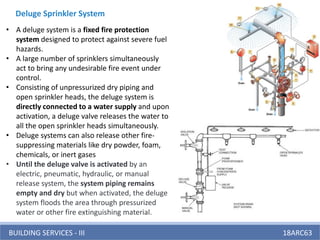
• A deluge system is a fixed fire protection
system designed to protect against severe fuel
hazards.
• A large number of sprinklers simultaneously
act to bring any undesirable fire event under
control.
• Consisting of unpressurized dry piping and
open sprinkler heads, the deluge system is
directly connected to a water supply and upon
activation, a deluge valve releases the water to
all the open sprinkler heads simultaneously.
• Deluge systems can also release other fire-
suppressing materials like dry powder, foam,
chemicals, or inert gases
• Until the deluge valve is activated by an
electric, pneumatic, hydraulic, or manual
release system, the system piping remains
empty and dry but when activated, the deluge
system floods the area through pressurized
water or other fire extinguishing material.
Deluge Sprinkler System
19.
BUILDING SERVICES -III 18ARC63
FIRE HYDRANT SYSTEM
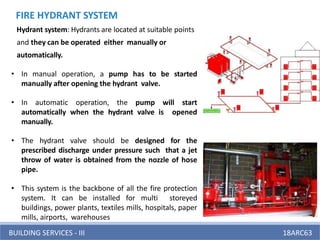
Hydrant system: Hydrants are located at suitable points
and they can be operated either manually or
automatically.
• In manual operation, a pump has to be started
manually after opening the hydrant valve.
• In automatic operation, the pump will start
automatically when the hydrant valve is opened
manually.
• The hydrant valve should be designed for the
prescribed discharge under pressure such that a jet
throw of water is obtained from the nozzle of hose
pipe.
• This system is the backbone of all the fire protection
system. It can be installed for multi storeyed
buildings, power plants, textiles mills, hospitals, paper
mills, airports, warehouses
20.
BUILDING SERVICES -III 18ARC63
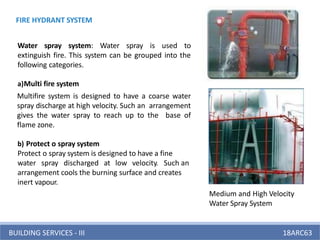
Water spray system: Water spray is used to
extinguish fire. This system can be grouped into the
following categories.
a)Multi fire system
Multifire system is designed to have a coarse water
spray discharge at high velocity. Such an arrangement
gives the water spray to reach up to the base of
flame zone.
b) Protect o spray system
Protect o spray system is designed to have a fine
water spray discharged at low velocity. Such an
arrangement cools the burning surface and creates
inert vapour.
Medium and High Velocity
Water Spray System
FIRE HYDRANT SYSTEM
21.
BUILDING SERVICES -III 18ARC63
FIRE DETECTOR
• Finding increasing use for the protection of human life and of valuables.
• Their main function is to quickly identify a developing fire and alert building
occupants and emergency response personnel before extensive damage occurs.
• A fire detector comprises a body - which are received fire detecting means to
detect the appearance of a fire and electrical circuits to convert the output of
the fire detecting means into electrical signals, and control and indicating
equipment connected to the detectors via communication means.
22.
BUILDING SERVICES -III 18ARC63
General guidelines for placing fire detectors:
• At least one detector in each room, storage area, and hallway.
• You may need more than one detector per room for those that exceed the
manufacturer's spacing requirements. For example, if your detector is rated for
30 feet, install detectors so they are evenly spaced with no more then 30 feet
between detectors.
• Place the detector as close to the centre of the ceiling as possible when only
one detector is required in a room or space.
• Put at least one detector in each closet, elevator , stairwell, and other
enclosed spaces.
• Place a detector at the top of each flight of stairs.
• Place all smoke detectors at least three feet from ceiling fans
23.
BUILDING SERVICES -III 18ARC63
Types of fire detectors:
Several types involving a available. Considerable number of different detection
techniques are
Common types
•Flame (ultra-violet , or infra-red sensing)
•Heat (fixed temperature, rate-of -rise, ultra-sonic wave. pattern)
•Smoke (photo-electric, ionization chamber, condensation nuclei)
For practical purposes
• However, only heat detectors (fixed temperature, rate-of-rise, and rate
compensated) and
• smoke detectors (photo-electric and ionization) need to be considered.
FIRE DETECTOR
24.
BUILDING SERVICES -III 18ARC63
HEAT DETECTORS:
A heat detector is a fire alarm device designed to respond when the converted thermal
energy of a fire increases the temperature of a heat sensitive element. The thermal mass
and conductivity of the element regulate the rate flow of heat into the element. All heat
detectors have this thermal lag.
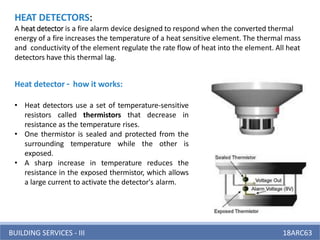
Heat detector – how it works:
• Heat detectors use a set of temperature-sensitive
resistors called thermistors that decrease in
resistance as the temperature rises.
• One thermistor is sealed and protected from the
surrounding temperature while the other is
exposed.
• A sharp increase in temperature reduces the
resistance in the exposed thermistor, which allows
a large current to activate the detector's alarm.
25.
BUILDING SERVICES -III 18ARC63
Heat detectors have two main classifications of operation:
• Rate-of-rise
• Fixed Temperature
• This is the most common type of heat detector.
• Fixed temperature detectors operate when the heat sensitive element reaches a set
operating temperature.
• Thermal lag delays the accumulation of heat at the sensitive element so that a fixed-
temperature device will reach its operating temperature sometime after the
surrounding air temperature exceeds that temperature.
• The most common fixed temperature point for electrically connected heat detectors
is 136.4°F (58°C).
• Technological developments have enabled the perfection of detectors that activate
at a temperature of 117°F (47°C), increasing the available reaction time and margin
of safety.
Fixed temperature heat detectors :
26.
BUILDING SERVICES -III 18ARC63
Rate-of-rise heat detectors
• Rate-of-Rise (ROR) heat detectors operate on a rapid rise in element temperature of
12° to 15°F (6.7° to 8.3°C) increase per minute, irrespective of the starting
temperature.
• This type of heat detector can operate at a lower temperature fire condition than
would be possible if the threshold were fixed.
• Rate of rise detectors may not respond to low energy release rates of slowly
developing fires.
• To detect slowly developing fires combination detectors add a fixed temperature
element that will ultimately respond when the fixed temperature element reaches the
design threshold.
27.
BUILDING SERVICES -III 18ARC63
Heat detector selection
• A heat detector will nonetheless notify of a fire in a kitchen or utility area (i.e.,
laundry room, garage, or attic), where smoke detectors should not be installed. This
will allow extra time to evacuate the building or to put out the fire if possible.
• Mechanical heat detectors are independent fire warning stations that - unlike smoke
detectors - can be installed in any area of a home.
• Portability, ease of installation, and excellent performance and reliability make this a
good choice for residential fire protection when combined with the required smoke
detectors.
• Because the detectors are not interconnected, heat activation identifies the location of
the fire, facilitating evacuation from the home.
• Each type of heat detector has its advantages, and it cannot be said that one type of
heat detector should always be used instead of another.
28.
BUILDING SERVICES -III 18ARC63
Heat detector selection
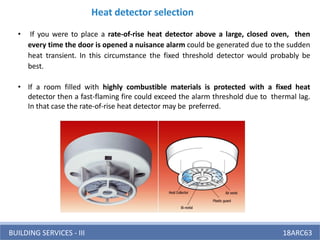
• If you were to place a rate-of-rise heat detector above a large, closed oven, then
every time the door is opened a nuisance alarm could be generated due to the sudden
heat transient. In this circumstance the fixed threshold detector would probably be
best.
• If a room filled with highly combustible materials is protected with a fixed heat
detector then a fast-flaming fire could exceed the alarm threshold due to thermal lag.
In that case the rate-of-rise heat detector may be preferred.
29.
BUILDING SERVICES -III 18ARC63
• Heat detectors are ideal for areas where flammable gasses and liquids are handled or
any area where a fire will quickly cause a large change in the surrounding temperature.
• Heat detectors are also suitable for:
Dirty, dusty or smoky environments.
• Indoor areas without winds or drafts that can prevent smoke from reaching the
detector.
• Manufacturing areas where large quantities of vapors, gases, or fumes may be present.
• Areas where particles of combustion are normally present, such as in kitchens, furnace
rooms, utility rooms, and garages or where ovens, burners or vehicle exhaust gases are
present.
Heat detector – where to use?
30.
BUILDING SERVICES -III 18ARC63
SMOKE DETECTORS:
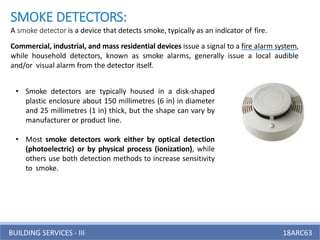
A smoke detector is a device that detects smoke, typically as an indicator of fire.
Commercial, industrial, and mass residential devices issue a signal to a fire alarm system,
while household detectors, known as smoke alarms, generally issue a local audible
and/or visual alarm from the detector itself.
• Smoke detectors are typically housed in a disk-shaped
plastic enclosure about 150 millimetres (6 in) in diameter
and 25 millimetres (1 in) thick, but the shape can vary by
manufacturer or product line.
• Most smoke detectors work either by optical detection
(photoelectric) or by physical process (ionization), while
others use both detection methods to increase sensitivity
to smoke.
31.
BUILDING SERVICES -III 18ARC63
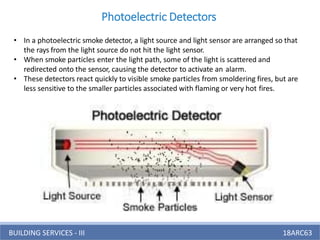
• In a photoelectric smoke detector, a light source and light sensor are arranged so that
the rays from the light source do not hit the light sensor.
• When smoke particles enter the light path, some of the light is scattered and
redirected onto the sensor, causing the detector to activate an alarm.
• These detectors react quickly to visible smoke particles from smoldering fires, but are
less sensitive to the smaller particles associated with flaming or very hot fires.
Photoelectric Detectors
32.
BUILDING SERVICES -III 18ARC63
• The ionization detector contains a small radioactive source that is used to charge the
air inside a small chamber. The charged air allows a small current to cross through the
chamber and complete an electrical circuit.
• When smoke enters the chamber, it shields the radiation, which stops the current and
triggers an alarm.
• These detectors respond quickly to very small smoke particles (even those invisible to
the naked eye) from flaming or very hot fires, but may respond very slowly to the
dense smoke associated with smoldering or low-temperature fires.
Ionization Detectors
33.
BUILDING SERVICES -III 18ARC63
Ionization and photoelectric – difference:
• Obviously domestic photo-electric detectors operate when visible smoke reaches an
appropriate concentration.
• Ion chamber detectors, on the other hand, substantially respond at a certain
concentration of particles, size not being as significant as might be expected. If paper is
burned fairly cleanly, for example, a detector can alarm before smoke becomes visible.
• A characteristic of smoke is that as it ages (over a matter of ten minutes or so)
agglomeration occurs; in other words, a number of particles come together to form one
larger particle. An ion chamber detector will be much less responsive to such aged
smoke. To a crude approximation, therefore, it can be said that an ion chamber detector
responds when a particular mass rate of burning is attained regardless of the nature of
the combustible.
• As a result, ion chamber detectors can be much slower than photo-electric detectors in
responding to smouldering fires as initiated by cigarettes in chesterfields, for example,
Unfortunately, when periods of more than half an hour or so are involved, such
smouldering fires can give smoke levels that will render an escape route untenable
before an ion chamber detector will respond.
34.
BUILDING SERVICES -III 18ARC63
Ionization and photoelectric – difference:
• On the other hand, when flaming combustion is involved, an ion chamber detector can be expected to
respond before most photo-electric types. Response to cooking fumes is also usually faster and this
feature makes ion chamber detectors prone to false alarms when they are located near kitchens.
• Being overcome by smoke is the usual mechanism resulting in death by fire in the home, However, heat
detectors do have a part to play in a home fire detection system.Their function is to complement smoke
detectors, where a high level of safety is desired, by sensing fire in closed compartments remote from,
far eg, the sleeping householder.
• Heat detectors may prove the best choice in a domestic kitchen largely because moderate fires capable
of activating them (e.g., fire in a frying pan) can develop quite rapidly. A second justification for this
use is by default, that smoke detectors (particularly the ionization type) are unduly prone to false
alarm during normal cooking practices.
HOW DOES THE PERFORMANCE OF SMOKE AND HEAT
DETECTORS COMPARE?
• Heat detectors will only operate following the development of a vigorous fire.
• They are therefore quite unacceptable (from the life-safety point of view') for installation in the
living areas and escape routes of a home.
35.
BUILDING SERVICES -III 18ARC63
FLAME DETECTORS
Flame detectors are line-of-sight devices that look for specific types of light (infrared,
visible, ultraviolet) emitted by flames during combustion. When the detector recognizes
this light from a fire, it sends a signal to activate an alarm.
Flame detectors – Where to use?
Flame detectors are best for protecting:
• Areas with high ceilings and open-spaces, such as warehouses and auditoriums.
• Outdoor or semi-enclosed areas, where winds or draughts can prevent smoke from
reaching a heat or smoke detector.
• Areas where rapidly developing flaming fires can occur, such as petrochemical
production, fuel storage areas, paint shops, and solvent areas.
• Environments that are unsuitable for other types of detectors.
36.
BUILDING SERVICES -III 18ARC63
Responses of Fire Detectors
• Once the fire is detected, the immediate response of the detector is to trigger a desired
responsive action.
• The immediate responsive action depends upon the overall design of fire prevention
system.
• It can be activation of audible and visual alarms.
• In some arrangements, fire detectors can transmit signals to remote monitoring
stations.
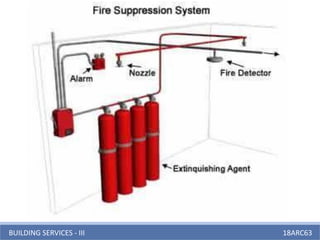
• It can even activate fire extinguishing systems and emergency shutdown of equipments
and processes that might increase the severity of fire.
• In some emergency response systems, they also activate the emergency shutdown of
energized equipment and initiate the fire fighting system in place.
• Timely intimation of fire can save lives and avoid material losses effectively.
37.
BUILDING SERVICES -III 18ARC63
• Protection of fire detectors:
Detectors that are installed outdoors and need to be shielded from the weather to
work properly or may be exposed to corrosive environments must be protected from
corrosion.
• Provide a canopy, hood, or other suitable protection (such as a non-corrosive coating)
for detection equipment, requiring protection from the weather.
• In order to keep detection equipment operable, they must be located away from or out
of contact with materials or equipment which may cause physical damage or be
protected by a cage or metal guard.
• Locate or otherwise protect detection equipment, so that it is protected from
mechanical or physical impact that may render it inoperable.
• All detectors must be securely mounted to a solid surface, such as screwed to a
junction box with a mounting plate or other appropriate method that prevents them
from putting pressure or stress on attached wires or tubing.
• Assure that detectors are supported independently of their attachment to wires or
tubing.
38.
BUILDING SERVICES -III 18ARC63
The following applies to fire detection systems used for specific applications:
• When a fire detection system is installed for the purpose of activating a fire
extinguishing or suppression system, it must be designed to respond in time to
control or extinguish the potential fire.
• When a fire detection system is installed as an employee evacuation alarm, it
must be designed and installed to provide a warning for emergency action and
safe escape of employees.
• Do not delay alarms or devices actuated by fire detectors for more than 30
seconds, unless the delay is necessary for the safety of employees. For example,
if a fire suppression system uses a compressed gas that will flood an occupied
area, it will be necessary to give employees time to escape.
BUILDING SERVICES -III 18ARC63
FIRE ALARM SYSTEM
An automatic fire alarm system is designed to detect the unwanted presence of fire by
monitoring environmental changes associated with combustion.
General Types:
• Automatically activated,
• Manually activated, or
• Combination of both automatic and manual.
General application:
•Intended to notify the building occupants to evacuate in the event of a fire or other
emergency, report the event to an off-premises location in order to summon emergency
services, and to prepare the structure and associated systems to control the spread of fire
and smoke.
Cost:
• Relatively high - these systems are generally found only in larger homes.
• The system can cost $1000 or more to install, with 24-hour monitoring service adding $15
to $20 per month.
41.
BUILDING SERVICES -III 18ARC63
Wireless and Wired Fire Alarm Systems
•For a wired fire alarm wires from each individual sensor is connected to the main unit
which indicates where there is a fire.
•For the wireless unit the principle is radio waves transmitted from individual sensors to the
main alarm unit.
Fundamental Configuration:
1. Fire alarm control panel(FACP) or Fire alarm control unit (FACU)
2. Primary Power supply
3. Secondary (backup) Power supplies
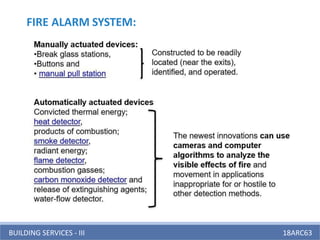
4. Initiating Devices
5. Notification appliances
6. Building Safety Interfaces
FIRE ALARM SYSTEM:
BUILDING SERVICES -III 18ARC63
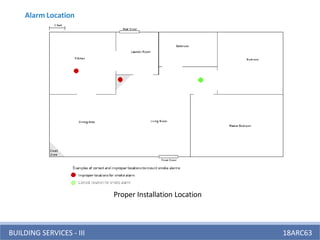
Do not install smoke alarms
• In or near kitchens, bathrooms or laundry rooms, if the alarm has an
ionization sensor
• In attics, cellars or other areas that become very hot, cold or dusty
• On un-insulated exterior walls or ceilings that are not insulated from the
roof (the alarm will get too hot and/or cold)
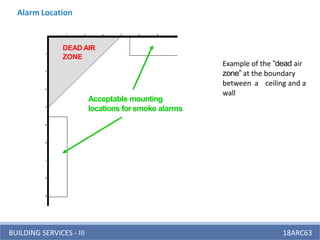
• In the “deadair zones”that occur within two feet of any corner of a room
or hallway
• In the “dead air zone” that is found within four inches of the edge of any
ceiling, or the top edge of any wall
• In any area where air flow is restricted or there is a very strong draft or air
flow
FIRE ALARM SYSTEM:
44.
BUILDING SERVICES -III 18ARC63
Alarm Location
Example of the “dead air
zone” at the boundary
between a ceiling and a
wall
DEAD AIR
ZONE
Acceptable mounting
locations for smoke alarms