Module 1 Readings: Young Love
1. Christopher Marlowe, “The Passionate Shepherd to
his Love” 2
2. Sir Walter Ralegh, “The Nymph’s Reply” 3
3. William Shakespeare, “Prologue” from Romeo
and Juliet 4
4. William Shakespeare, “First kiss,” Act 1,
scene 5 from Romeo and Juliet 4
5. Emily Brontë, “I am Heathcliff,” Ch. 9
from Wuthering Heights 14
6. Virginia Woolf, “Clarissa’s Memories of Sally
Seton,” from Mrs. Dalloway 29
2
1. Christopher Marlowe, “The Passionate Shepherd to
his Love”
Come live with me and be my love,
And we will all the pleasures prove,
That Valleys, groves, hills,and fields,
Woods, or steepy mountain yields.
And we will sit upon the Rocks,
Seeing the Shepherdsfeed their flocks,
By shallow Rivers to whose falls
Melodious birdssing Madrigals.
And I will make thee beds of Roses
And a thousand fragrant posies,
A cap of flowers, and a kirtle
Embroidered all with leaves of Myrtle;
A gown made of the finest wool
Which from our pretty Lambs we pull;
Fair linedslippers for the cold,
With buckles of the purest gold;
A belt of straw and Ivy buds,
With Coral clasps and Amber studs:
And if thesepleasures may thee move,
Come live with me, and be my love.
The Shepherds’ Swains shall dance and sing
For thy delight each May-morning:
If thesedelights thy mind may move,
Then live with me, and be my love.
3
2. Sir Walter Ralegh, “The Nymph’s Reply”
If all the world and love were young,
And truth in every Shepherd’s tongue,
These pretty pleasures might me move,
To live with thee, and be thy love.
Timedrives the flocks from field to fold,
When Rivers rage and Rocks growcold,
And Philomel becometh dumb,
The rest complains of caresto come.
The flowers do fade, and wanton fields,
To wayward winter reckoning yields,
A honey tongue, a heartof gall,
Is fancy’s spring, but sorrow’s fall.
Thy gowns, thy shoes, thy beds of Roses,
Thy cap, thy kirtle, and thy posies
Soonbreak, soon wither, soon forgotten:
In folly ripe, in reason rotten.
Thy belt of straw and Ivy buds,
The Coral clasps and amber studs,
All thesein me no means can move
To come to thee and be thy love.
But could youth last, and love still breed,
Had joys no date, nor age no need,
Then thesedelights my mind might move
To live with thee, and be thy love.
4
3. William Shakespeare, “Prologue” from Romeo
and Juliet
Two households, both alike in dignity,
In fair Verona, where we lay our scene,
From ancient grudge break to new mutiny,
Where civil blood makes civil hands unclean.
From forth the fatal loins of thesetwo foes
A pair of star-cross'd lovers take their life;
Whose misadventured piteous overthrows
Do with their death bury their parents' strife.
The fearful passage of their death-mark'd love,
And the continuance of their parents' rage,
Which, but their children's end, nought could
remove,
Is now the two hours' traffic of our stage;
The which if you with patient ears attend,
What here shall miss, our toil shall strive to
mend.
4. William Shakespeare, “First kiss,” Act 1,
scene 5 from Romeo and Juliet
Romeo and Juliet meet at a party held by Juliet’s family, the
Capulets, who are mortal
enemies of Romeo’s family, the Montagues. Romeo had
previously been infatuated with
another young woman, Rosaline, but at the party—which he and
his friends essentially
gatecrash in the hope of runnining into Rosaline—he encounters
Juliet and immediately
transfers his affections to her.
[A hall in Capulet's house.]
[Musicians waiting. Enter Servingmen with napkins]
First Servant
Where's Potpan, that he helps not to take away? He
shift a trencher? he scrape a trencher!
Second Servant
When good manners shall lie all in one or two men's
hands and they unwashed too, 'tis a foul thing.
First Servant
5
Away with the joint-stools, remove the
court-cupboard, look to the plate. Good thou, save
me a piece of marchpane; and, as thou lovest me, let
the porter let in Susan Grindstone and Nell.
Antony, and Potpan!
Second Servant
Ay, boy, ready.
First Servant
You are looked for and called for, asked for and
sought for, in the great chamber.
Second Servant
We cannot be here and there too. Cheerly, boys; be
brisk awhile, and the longer liver take all.
[Enter CAPULET, with JULIET and others of his house,
meeting the Guests and
Maskers]
CAPULET
Welcome, gentlemen! ladies that have their toes
Unplagued with corns will have a bout with you.
Ah ha, my mistresses! which of you all
Will now deny to dance? she that makes dainty,
She, I'll swear, hath corns; am I come near ye now?
Welcome, gentlemen! I have seen the day
That I have worn a visor and could tell
A whispering tale in a fair lady's ear,
Such as would please: 'tis gone, 'tis gone, 'tis gone:
You are welcome, gentlemen! come, musicians, play.
A hall, a hall! give room! and foot it, girls.
[Music plays, and they dance]
More light, you knaves; and turn the tables up,
And quench the fire, the room is grown too hot.
Ah, sirrah, this unlook'd-for sport comes well.
6
Nay, sit, nay, sit, good cousin Capulet;
For you and I are past our dancing days:
How long is't now since last yourself and I
Were in a mask?
Second Capulet
By'r lady, thirty years.
CAPULET
What, man! 'tis not so much, 'tis not so much:
'Tis since the nuptials of Lucentio,
Come pentecost as quickly as it will,
Some five and twenty years; and then we mask'd.
Second Capulet
'Tis more, 'tis more, his son is elder, sir;
His son is thirty.
CAPULET
Will you tell me that?
His son was but a ward two years ago.
ROMEO
[To a Servingman]
What lady is that, which doth
enrich the hand
Of yonder knight?
Servant
I know not, sir.
ROMEO
O, she doth teach the torches to burn bright!
It seems she hangs upon the cheek of night
7
Like a rich jewel in an Ethiope's ear;
Beauty too rich for use, for earth too dear!
So shows a snowy dove trooping with crows,
As yonder lady o'er her fellows shows.
The measure done, I'll watch her place of stand,
And, touching hers, make blessed my rude hand.
Did my heart love till now? forswear it, sight!
For I ne'er saw true beauty till this night.
TYBALT
This, by his voice, should be a Montague.
Fetch me my rapier, boy. What dares the slave
Come hither, cover'd with an antic face,
To fleer and scorn at our solemnity?
Now, by the stock and honour of my kin,
To strike him dead, I hold it not a sin.
CAPULET
Why, how now, kinsman! wherefore storm you so?
TYBALT
Uncle, this is a Montague, our foe,
A villain that is hither come in spite,
To scorn at our solemnity this night.
CAPULET
Young Romeo is it?
TYBALT
'Tis he, that villain Romeo.
CAPULET
Content thee, gentle coz, let him alone;
He bears him like a portly gentleman;
And, to say truth, Verona brags of him
To be a virtuous and well-govern'd youth:
8
I would not for the wealth of all the town
Here in my house do him disparagement:
Therefore be patient, take no note of him:
It is my will, the which if thou respect,
Show a fair presence and put off these frowns,
And ill-beseeming semblance for a feast.
TYBALT
It fits, when such a villain is a guest:
I'll not endure him.
CAPULET
He shall be endured:
What, goodman boy! I say, he shall: go to;
Am I the master here, or you? go to.
You'll not endure him! God shall mend my soul!
You'll make a mutiny among my guests!
You will set cock-a-hoop! you'll be the man!
TYBALT
Why, uncle, 'tis a shame.
CAPULET
Go to, go to;
You are a saucy boy: is't so, indeed?
This trick may chance to scathe you, I know what:
You must contrary me! marry, 'tis time.
Well said, my hearts! You are a princox; go:
Be quiet, or -- More light, more light! For shame!
I'll make you quiet. What, cheerly, my hearts!
TYBALT
Patience perforce with wilful choler meeting
Makes my flesh tremble in their different greeting.
I will withdraw: but this intrusion shall
Now seeming sweet convert to bitter gall.
9
[Exit]
ROMEO
[To JULIET]
If I profane with my unworthiest hand
This holy shrine, the gentle fine is this:
My lips, two blushing pilgrims, ready stand
To smooth that rough touch with a tender kiss.
JULIET
Good pilgrim, you do wrong your hand too much,
Which mannerly devotion shows in this;
For saints have hands that pilgrims' hands do touch,
And palm to palm is holy palmers' kiss.
ROMEO
Have not saints lips, and holy palmers too?
JULIET
Ay, pilgrim, lips that they must use in prayer.
ROMEO
O, then, dear saint, let lips do what hands do;
They pray, grant thou, lest faith turn to despair.
JULIET
Saints do not move, though grant for prayers' sake.
ROMEO
Then move not, while my prayer's effect I take.
Thus from my lips, by yours, my sin is purged.
JULIET
10
Then have my lips the sin that they have took.
ROMEO
Sin from thy lips? O trespass sweetly urged!
Give me my sin again.
JULIET
You kiss by the book.
Nurse
Madam, your mother craves a word with you.
ROMEO
What is her mother?
Nurse
Marry, bachelor,
Her mother is the lady of the house,
And a good lady, and a wise and virtuous
I nursed her daughter, that you talk'd withal;
I tell you, he that can lay hold of her
Shall have the chinks.
ROMEO
Is she a Capulet?
O dear account! my life is my foe's debt.
BENVOLIO
Away, begone; the sport is at the best.
ROMEO
Ay, so I fear; the more is my unrest.
CAPULET
11
Nay, gentlemen, prepare not to be gone;
We have a trifling foolish banquet towards.
Is it e'en so? why, then, I thank you all
I thank you, honest gentlemen; good night.
More torches here! Come on then, let's to bed.
Ah, sirrah, by my fay, it waxes late:
I'll to my rest.
[Exeunt all but JULIET and Nurse]
JULIET
Come hither, nurse. What is yond gentleman?
Nurse
The son and heir of old Tiberio.
JULIET
What's he that now is going out of door?
Nurse
Marry, that, I think, be young Petrucio.
JULIET
What's he that follows there, that would not dance?
Nurse
I know not.
JULIET
Go ask his name: if he be married.
My grave is like to be my wedding bed.
Nurse
12
His name is Romeo, and a Montague;
The only son of your great enemy.
JULIET
My only love sprung from my only hate!
Too early seen unknown, and known too late!
Prodigious birth of love it is to me,
That I must love a loathed enemy.
Nurse
What's this? what's this?
JULIET
A rhyme I learn'd even now
Of one I danced withal.
[One calls within 'Juliet.']
Nurse
Anon, anon!
Come, let's away; the strangers all are gone.
[Exeunt]
[Enter Chorus]
Chorus
Now old desire doth in his death-bed lie,
And young affection gapes to be his heir;
That fair for which love groan'd for and would die,
With tender Juliet match'd, is now not fair.
Now Romeo is beloved and loves again,
Alike betwitched by the charm of looks,
But to his foe supposed he must complain,
And she steal love's sweet bait from fearful hooks:
Being held a foe, he may not have access
To breathe such vows as lovers use to swear;
13
And she as much in love, her means much less
To meet her new-beloved any where:
But passion lends them power, time means, to meet
Tempering extremities with extreme sweet.
[Exit]
14
5. Emily Brontë, “I am Heathcliff,” Ch. 9
from Wuthering Heights
Brontë’s novel is set in the wild moorlands of
Yorkshire and charts the interactions
between the residents of two houses—Wuthering Heights
and Thrushcross Grange.
The scenes in the extract below take place at
Wuthering Heights, where the Earnshaw
family resides. The members of the household include
Hindley and Catherine (Cathy)
Earnshaw,who are brother and sister, and Heathcliff,
an orphan boy adopted by old
Mr. Earnshaw,Hindley and Catherine’s now-deceased
father. The household also
includes Nelly Dean, the housekeeper, and Joseph,
a servant who is a self-righteous
Christian. Cathy and Heathcliff are greatfriends in
their youth but, after the death of
his father, Hindley reduces Heathcliff’s status to
that of a servant, and repeatedly
degrades him. Hindley is a violent and disappointed
alcoholic who abuses his son,
Hareton, as well as the rest of the household.
Cathy is being courted by the sensitive
and sophisticated Edgar Linton, the owner of
Thrushcross Grange, who seems to offer
her somesort of escape from the nightmare of
Wuthering Heights. In the scenes below,
we see somethingof the cruelty and darkness that
pervades Wuthering Heights as well
as Cathy’s attempts to reconcile her love for
Heathcliff with her attraction to Linton.
He entered, vociferating oaths dreadful to hear;
and caught me in the act of stowing
his son awayin the kitchen cupboard. Hareton
was impressed with a wholesome
terror of encountering either his wild beast’s
fondness or his madman’s rage;for in
one he ran a chance of being squeezed and
kissed to death, and in the otherof being
flung into the fire, or dashed against the wall;
and the poor thingremained perfectly
quietwherever I chose to put him.
‘There, I’ve found it out at last!’ cried
Hindley, pulling me back by the skin of my
neck, like a dog. ‘By heaven and hell, you’ve
sworn between you to murder that
child! I know how it is, now, that he is
always out of my way. But, with the help of
Satan, I shall make you swallow the carving-
knife, Nelly! You needn’t laugh; for I’ve
just crammed Kenneth, head-downmost, in the Black-
horse marsh; and two is the
same as one—and I want to kill someof you: I
shall have no rest till I do!’
‘But I don’t like the carving-knife, Mr. Hindley,’ I
answered; ‘it has been cutting red
herrings. I’d rather be shot, if you please.’
‘You’d rather be damned!’ he said; ‘and so you
shall. No law in England can hinder a
man from keeping his house decent, and mine’s
abominable! Open your mouth.’ He
held the knifein his hand, and pushed its point
between my teeth: but, for my part, I
15
was never much afraid of his vagaries. I
spat out, and affirmed it tasted detestably—
I would not take it on any account.
‘Oh!’ said he, releasing me, ‘I see that hideous
little villain is not Hareton: I beg your
pardon, Nell. If it be, he deserves flaying
alive for not running to welcome me, and
for screaming as if I were a goblin.
Unnatural cub, come hither! I’ll teach
thee to
impose on a good-hearted, deluded father.
Now, don’t you thinkthe lad would be
handsomer cropped? It makes a dog fiercer,
and I love somethingfierce—get me a
scissors—something fierce and trim! Besides, it’s
infernal affectation—devilish
conceit it is, to cherish our ears—we’re asses
enough without them. Hush, child,
hush! Well then, it is my darling! wisht,
dry thy eyes—there’s a joy; kiss me. What!
it won’t? Kiss me, Hareton! Damn thee,
kiss me! By God, as if I would rear
such a
monster! As sure as I’m living, I’ll break
the brat’s neck.’
Poor Hareton was squalling and kicking in his father’s
arms with all his might, and
redoubled his yells when he carried him up-stairs
and lifted him over the banister. I
criedout that he would frighten the childinto fits,
and ran to rescue him. As I
reached them, Hindley leant forward on the rails to
listen to a noise below; almost
forgetting what he had in his hands. ‘Who is
that?’ he asked, hearing someone
approaching the stairs’-foot. I leant forward
also, for the purpose of signing to
Heathcliff, whose step I recognised, not to
come further; and, at the instant when
my
eye quitted Hareton, he gave a sudden spring,
delivered himself from the careless
grasp that held him, and fell.
There was scarcely time to experience a thrillof
horror before we saw that the little
wretch was safe. Heathcliff arrived underneath
just at the critical moment; by a
natural impulse he arrested his descent, and setting
him on his feet, looked up to
discover the author of the accident. A miser
who has parted with a lucky lottery
ticket for five shillings, and findsnext day he has
lost in the bargain five thousand
pounds, could not showa blanker countenance
than he did on beholding the figure
of Mr. Earnshaw above. It expressed, plainer
than words could do, the intensest
anguish at having made himself the instrument
of thwarting his own revenge. Had it
been dark,I daresay he would have tried to remedy
the mistake by smashing
Hareton’s skull on the steps; but, we witnessed his
salvation; and I was presently
below with my precious charge pressed to my
heart. Hindley descendedmore
leisurely, sobered and abashed.
‘It is your fault, Ellen,’ he said; ‘you should
have kept him out of sight: you should
have taken him from me! Is he injured
anywhere?’
16
‘Injured!’ I criedangrily; ‘if he is not killed,
he’ll be an idiot! Oh! I wonder
his
mother does not rise from her grave to see how
you use him. You’re worse than a
heathen—treating your own flesh and blood in that
manner!’ He attempted to touch
the child, who, on finding himself with me, sobbed
off his terror directly. At the first
finger his father laid on him, however, he
shrieked again louder than before, and
struggled as if he would go into convulsions.
‘You shall not meddle with him!’ I continued.
‘He hatesyou—theyall hate you—
that’s the truth! A happy family you
have; and a pretty state you’re come
to!’
‘I shall come to a prettier, yet, Nelly,’ laughed
the misguidedman, recovering his
hardness. ‘At present, convey yourself and him
away. And hark you, Heathcliff!
clear you too quitefrom my reach and hearing. I
wouldn’t murder you to-night;
unless, perhaps, I set the house on fire: but
that’s as my fancy goes.’
While saying this he took a pint bottle of
brandy from the dresser, and poured some
into a tumbler.
‘Nay, don’t!’ I entreated. ‘Mr. Hindley, do
take warning. Havemercy on this
unfortunate boy, if you care nothing for yourself!’
‘Any one will do better for him than I shall,’ he
answered.
‘Have mercy on your own soul!’ I said,
endeavouring to snatch the glassfrom his
hand.
‘Not I! On the contrary, I shall have great
pleasure in sending it to perdition to
punish its Maker,’ exclaimed the blasphemer.
‘Here’s to its hearty damnation!’
He drank the spirits and impatiently bade us
go; terminating his command with a
sequel of horrid imprecations too bad to repeat
or remember.
‘It’s a pity he cannot kill himself with drink,’
observed Heathcliff, muttering an echo
of curses back when the door was shut. ‘He’s
doing his very utmost; but his
constitution defies him. Mr. Kenneth says he
would wager his mare that he’ll outlive
any man on this side Gimmerton, and go to the
grave a hoary sinner; unless some
happy chance out of the common course befall
him.’
I went into the kitchen, and sat down to lull
my little lamb to sleep. Heathcliff, as I
thought, walked through to the barn. It turned
out afterwards that he only got as far
as the otherside the settle, when he flung
himself on a bench by the wall, removed
from the fire and remained silent.
17
I was rocking Hareton on my knee, and
humming a song that began,—
It was far in the night, and the bairnies grat,
The mither beneath the mools heard that,
when Miss Cathy, who had listened to the hubbub
from her room, put her head in,
and whispered,—‘Are you alone, Nelly?’
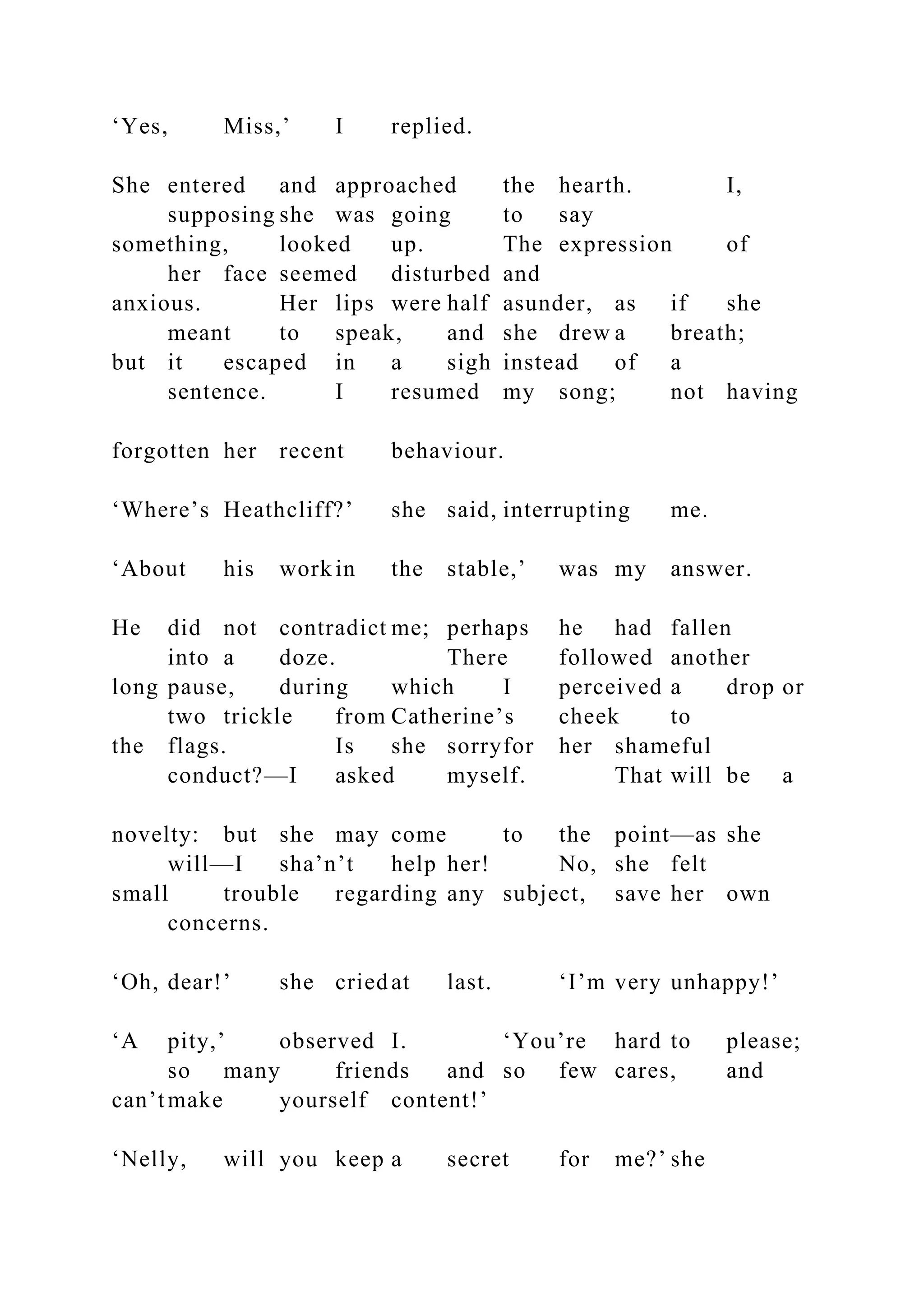
‘Yes, Miss,’ I replied.
She entered and approached the hearth. I,
supposing she was going to say
something, looked up. The expression of
her face seemed disturbed and
anxious. Her lips were half asunder, as if she
meant to speak, and she drew a breath;
but it escaped in a sigh instead of a
sentence. I resumed my song; not having
forgotten her recent behaviour.
‘Where’s Heathcliff?’ she said, interrupting me.
‘About his work in the stable,’ was my answer.
He did not contradict me; perhaps he had fallen
into a doze. There followed another
long pause, during which I perceived a drop or
two trickle from Catherine’s cheek to
the flags. Is she sorryfor her shameful
conduct?—I asked myself. That will be a
novelty: but she may come to the point—as she
will—I sha’n’t help her! No, she felt
small trouble regarding any subject, save her own
concerns.
‘Oh, dear!’ she criedat last. ‘I’m very unhappy!’
‘A pity,’ observed I. ‘You’re hard to please;
so many friends and so few cares, and
can’tmake yourself content!’
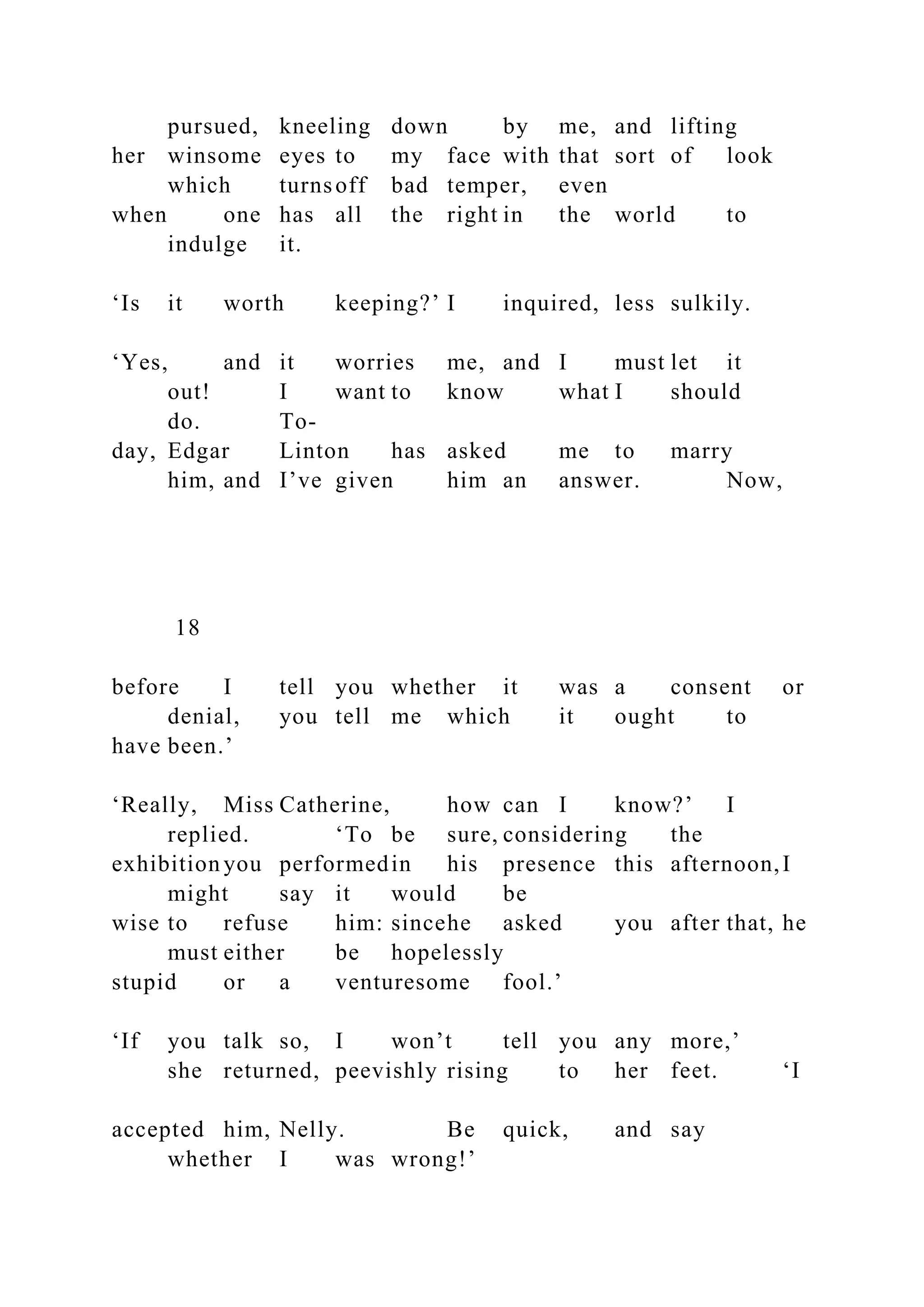
‘Nelly, will you keep a secret for me?’ she
pursued, kneeling down by me, and lifting
her winsome eyes to my face with that sort of look
which turnsoff bad temper, even
when one has all the right in the world to
indulge it.
‘Is it worth keeping?’ I inquired, less sulkily.
‘Yes, and it worries me, and I must let it
out! I want to know what I should
do. To-
day, Edgar Linton has asked me to marry
him, and I’ve given him an answer. Now,
18
before I tell you whether it was a consent or
denial, you tell me which it ought to
have been.’
‘Really, Miss Catherine, how can I know?’ I
replied. ‘To be sure, considering the
exhibition you performedin his presence this afternoon,I
might say it would be
wise to refuse him: sincehe asked you after that, he
must either be hopelessly
stupid or a venturesome fool.’
‘If you talk so, I won’t tell you any more,’
she returned, peevishly rising to her feet. ‘I
accepted him, Nelly. Be quick, and say
whether I was wrong!’
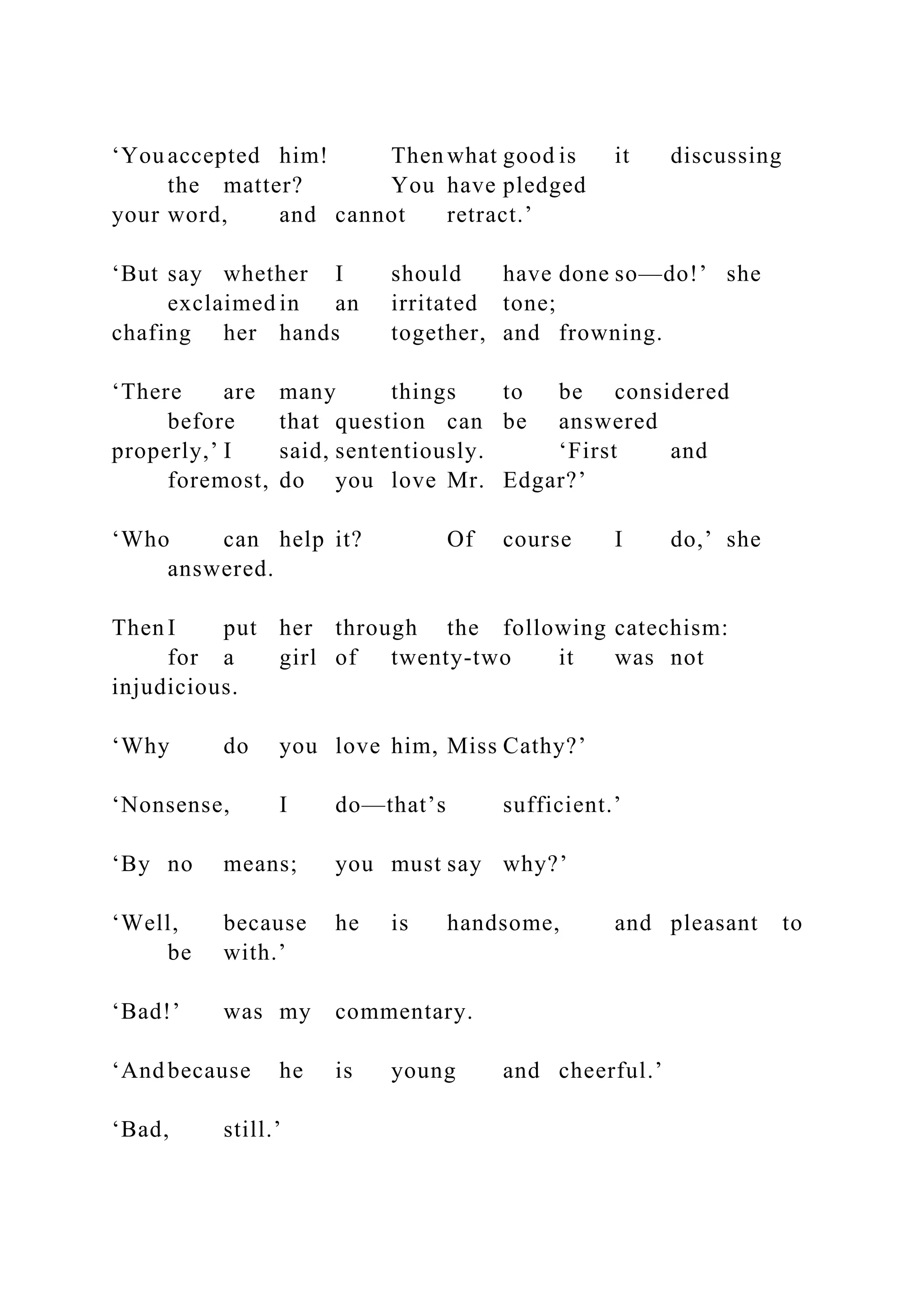
‘You accepted him! Then what good is it discussing
the matter? You have pledged
your word, and cannot retract.’
‘But say whether I should have done so—do!’ she
exclaimed in an irritated tone;
chafing her hands together, and frowning.
‘There are many things to be considered
before that question can be answered
properly,’ I said, sententiously. ‘First and
foremost, do you love Mr. Edgar?’
‘Who can help it? Of course I do,’ she
answered.
Then I put her through the following catechism:
for a girl of twenty-two it was not
injudicious.
‘Why do you love him, Miss Cathy?’
‘Nonsense, I do—that’s sufficient.’
‘By no means; you must say why?’
‘Well, because he is handsome, and pleasant to
be with.’
‘Bad!’ was my commentary.
‘And because he is young and cheerful.’
‘Bad, still.’
‘And because he loves me.’
19
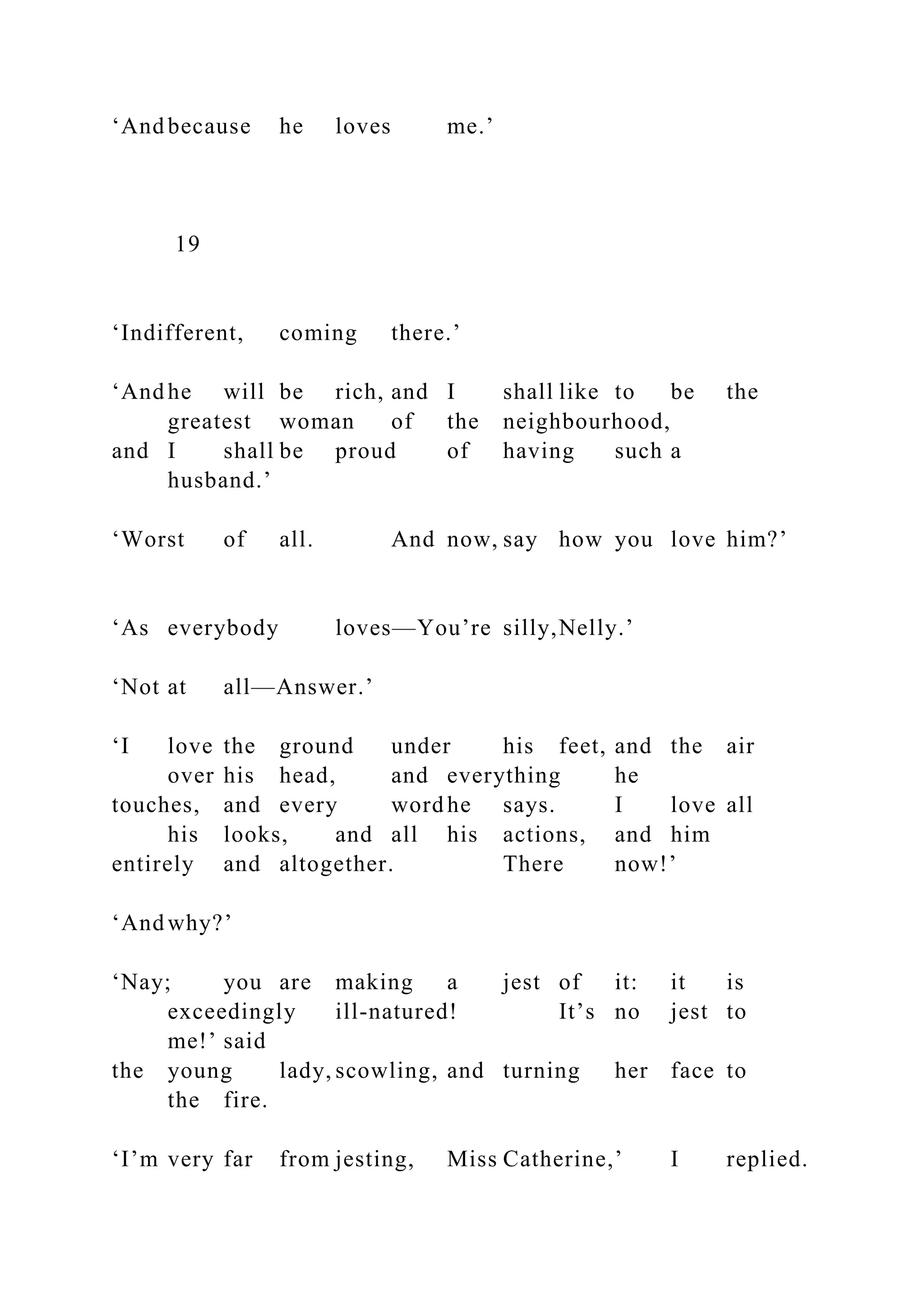
‘Indifferent, coming there.’
‘And he will be rich, and I shall like to be the
greatest woman of the neighbourhood,
and I shall be proud of having such a
husband.’
‘Worst of all. And now, say how you love him?’
‘As everybody loves—You’re silly,Nelly.’
‘Not at all—Answer.’
‘I love the ground under his feet, and the air
over his head, and everything he
touches, and every word he says. I love all
his looks, and all his actions, and him
entirely and altogether. There now!’
‘And why?’
‘Nay; you are making a jest of it: it is
exceedingly ill-natured! It’s no jest to
me!’ said
the young lady, scowling, and turning her face to
the fire.
‘I’m very far from jesting, Miss Catherine,’ I replied.
‘You love Mr. Edgar because he
is handsome, and young, and cheerful, and rich,
and loves you. The last, however,
goes for nothing: you would love him without that,
probably; and with it you
wouldn’t, unless he possessed the four former
attractions.’
‘No, to be sure not: I should only pity him—hate
him, perhaps, if he were ugly,and a
clown.’
‘But thereare several otherhandsome, rich young
men in the world: handsomer,
possibly, and richer than he is. What should
hinder you from loving them?’
‘If therebe any, they are out of my way: I’ve seen
none like Edgar.’
‘You may see some; and he won’t always be
handsome, and young, and may not
always be rich.’
‘He is now; and I have only to do with the present.
I wish you would speak
rationally.’
20
‘Well, that settles it: if you have only to do
with the present, marry Mr. Linton.’
‘I don’t want your permission for that—I shall
marry him: and yet you have not told
me whether I’m right.’
‘Perfectly right; if people be right to marry
only for the present. And now, let us
hear what you are unhappy about. Yourbrother
will be pleased; the old lady and
gentlemanwill not object, I think; you will escape
from a disorderly, comfortless
home into a wealthy, respectable one; and you
love Edgar, and Edgar loves you. All
seems smooth and easy:where is the obstacle?’
‘Here! and here!’ replied Catherine, striking
one hand on her forehead, and the other
on her breast: ‘in whicheverplace the soul lives.
In my soul and in my heart, I’m
convinced I’m wrong!’
‘That’s very strange! I cannot make it
out.’
‘It’s my secret. But if you will not mock at
me, I’ll explain it: I can’tdo it distinctly;
but I’ll give you a feeling of how I feel.’
She seated herself by me again: her countenance
grew sadder and graver, and her
clasped hands trembled.
‘Nelly, do you never dream queer dreams?’
she said, suddenly, after someminutes’
reflection.
‘Yes, now and then,’ I answered.
‘And so do I. I’ve dreamt in my life dreams
that have stayed with me ever after, and
changed my ideas: they’ve gone through and through
me, like wine through water,
and altered the colour of my mind. And
this is one: I’m going to tell it—but take
care
not to smile at any part of it.’
‘Oh! don’t, Miss Catherine!’ I cried. ‘We’re
dismal enough without conjuring up
ghosts and visions to perplex us. Come,
come, be merry and like yourself! Lookat
little Hareton! he’s dreaming nothing dreary. How
sweetly he smiles in his sleep!’
‘Yes; and how sweetly his father curses in
his solitude! You remember him, I
daresay, when he was just such another as that
chubby thing: nearly as young and
21
innocent. However, Nelly, I shall oblige you to
listen: it’s not long;and I’ve no power
to be merry to-night.’
‘I won’t hear it, I won’t hear it!’ I
repeated, hastily.
I was superstitious about dreams then, and am
still; and Catherine had an unusual
gloom in her aspect, that made me dread
somethingfrom which I might shape a
prophecy, and foresee a fearful catastrophe.
She was vexed, but she did not
proceed. Apparently taking up another subject,
she recommenced in a shorttime.
‘If I were in heaven, Nelly, I should be
extremely miserable.’
‘Because you are not fit to go there,’ I
answered. ‘All sinners would be miserable in
heaven.’
‘But it is not for that. I dreamt once that I
was there.’
‘I tell you I won’t hearken to your dreams,
Miss Catherine! I’ll go to bed,’I
interrupted again.
She laughed, and held me down; for I made a
motion to leave my chair.
‘This is nothing,’ criedshe: ‘I was only going to
say that heaven did not seemto be
my home; and I broke my heartwith weeping to
come back to earth; and the angels
were so angry that they flung me out into the
middle of the heath on the top of
Wuthering Heights; where I woke sobbing
for joy. That will do to explain my secret,
as well as the other. I’ve no more business to
marry Edgar Linton than I have to be
in heaven; and if the wicked man in therehad
not brought Heathcliff so low, I
shouldn’t have thought of it. It would degrade
me to marry Heathcliff now; so he
shall never know how I love him: and that, not
because he’s handsome, Nelly, but
because he’s more myself than I am. Whatever
our soulsare made of, his and mine
are the same; and Linton’s is as different as a
moonbeam from lightning, or frost
from fire.’
Ere this speech ended I became sensible of
Heathcliff’s presence. Having noticed a
slight movement, I turned my head, and
saw him rise from the bench, and steal out
noiselessly. He had listened till he heard
Catherine say it would degrade her to
marry him, and then he stayed to hear no further.
My companion, sitting on the
ground, was prevented by the back of the settle
from remarking his presence or
departure; but I started, and bade her hush!
22
‘Why?’ she asked, gazing nervously round.
‘Joseph is here,’ I answered, catching opportunely
the roll of his cartwheels up the
road;‘and Heathcliff will come in with him. I’m
not sure whether he were not at the
door this moment.’
‘Oh, he couldn’t overhear me at the door!’ said
she. ‘Give me Hareton, while you get
the supper, and when it is ready ask me to
sup with you. I want to cheat my
uncomfortable conscience, and be convinced that
Heathcliff has no notion of these
things. He has not, has he? He does not
know what being in love is!’
‘I see no reason that he should not know, as
well as you,’ I returned; ‘and if you are
his choice, he’ll be the most unfortunate creature
that ever was born! As soon as
you become Mrs. Linton, he losesfriend, and love,
and all! Haveyou considered how
you’ll bear the separation, and how he’ll bear to be
quitedeserted in the
world? Because, Miss Catherine—’
‘He quitedeserted! we separated!’ she exclaimed,
with an accent of
indignation. ‘Who is to separate us, pray?
They’ll meet the fate of Milo! Not as
long
as I live, Ellen: for no mortal creature.
Every Linton on the face of the earthmight
melt into nothing before I could consent to
forsake Heathcliff. Oh, that’s not what I
intend—that’s not what I mean! I shouldn’t be
Mrs. Linton were such a price
demanded! He’llbe as much to me as he
has been all his lifetime. Edgar must shake
off his antipathy, and tolerate him, at least.
He will, when he learns my true feelings
towards him. Nelly, I see now you thinkme a
selfish wretch; but did it never strike
you that if Heathcliff and I married, we should be
beggars? whereas, if I marry
Linton I can aid Heathcliff to rise, and place
him out of my brother’s power.’
‘With your husband’s money, Miss Catherine?’ I
asked. ‘You’ll find him not so pliable
as you calculate upon: and, though I’m hardly a
judge, I thinkthat’s the worst motive
you’ve given yet for being the wife of young
Linton.’
‘It is not,’ retorted she; ‘it is the best! The
others were the satisfaction of my whims:
and for Edgar’s sake,too, to satisfy him. This is
for the sake of one who
comprehends in his person my feelings to Edgar
and myself. I cannot express it; but
surely you and everybody have a notion that
thereis or should be an existence of
yours beyond you. What were the use of
my creation, if I were entirely contained
here? My greatmiseries in this world have
been Heathcliff’s miseries, and I watched
and felt each from the beginning: my greatthought in
living is himself. If all else
23
perished, and he remained, I should still continue to
be; and if all else remained, and
he were annihilated, the universe would turn to a
mighty stranger: I should not
seema part of it.—My love for Linton is like
the foliage in the woods: time will
change it, I’m well aware, as winter changes
the trees. My love for Heathcliff
resembles the eternal rocks beneath: a source of
little visible delight, but
necessary. Nelly, I am Heathcliff!
He’s always, always in my mind: not as a
pleasure,
any more than I am always a pleasure to myself,
but as my own being. So don’t talk
of our separationagain: it is impracticable; and—’
She paused, and hid her face in the foldsof my
gown; but I jerked it forcibly away.
I
was out of patience with her folly!
‘If I can make any sense of your nonsense,
Miss,’ I said, ‘it only goes to convince me
that you are ignorant of the duties you undertake in
marrying; or else that you are a
wicked, unprincipled girl. But trouble me with no
more secrets: I’ll not promise to
keep them.’
‘You’ll keep that?’ she asked, eagerly.
‘No, I’ll not promise,’ I repeated.
She was about to insist, when the entrance of
Joseph finished our conversation; and
Catherine removed her seat to a corner, and nursed
Hareton, while I made the
supper. After it was cooked, my fellow-
servant and I began to quarrel who should
carrysometo Mr. Hindley; and we didn’t settle it
till all was nearly cold. Then we
cameto the agreementthat we would let him ask, if
he wanted any; for we feared
particularly to go into his presence when he
had been sometime alone.
‘And how isn’t that nowt comed in fro’ th’ field, be
this time? What is he about? girt
idle seeght!’ demanded the old man, looking round
for Heathcliff.
‘I’ll call him,’ I replied. ‘He’s in the
barn,I’ve no doubt.’
I went and called, but got no answer. On
returning, I whispered to Catherine that he
had heard a good part of what she said, I was
sure; and told how I saw him quit the
kitchen just as she complained of her brother’s
conduct regarding him. She jumped
up in a fine fright, flung Hareton on to
the settle, and ran to seek for her friend
herself; not taking leisure to consider why she
was so flurried, or how her talk
would have affected him. She was absent such a
while that Joseph proposed we
should wait no longer. He cunningly conjectured
they were staying awayin order to
24
avoid hearing his protracted blessing. They were
‘ill eneugh for ony fahl manners,’
he affirmed. And on their behalf he added
that nighta special prayer to the usual
quarter-of-an-hour’s supplication before meat, and
would have tacked another to
the end of the grace, had not his young
mistress broken in upon him with a hurried
command that he must run down the road,and,
wherever Heathcliff had rambled,
find and make him re-enter directly!
‘I want to speak to him, and I must, before
I go upstairs,’ she said. ‘And the gate is
open: he is somewhere out of hearing; for he
would not reply, though I shouted at
the top of the fold as loud as I could.’
Joseph objected at first; she was too much in
earnest, however, to suffer
contradiction; and at last he placed his hat on
his head, and walked grumbling
forth. Meantime, Catherine paced up and
down the floor, exclaiming—‘I wonder
where he is—I wonder where he can be!
What did I say, Nelly? I’ve forgotten.
Was
he vexed at my bad humour this afternoon?
Dear! tell me what I’ve said to grieve
him? I do wish he’d come. I do wish he
would!’
‘What a noise for nothing!’ I cried, though
rather uneasy myself. ‘What a trifle
scares
you! It’s surely no greatcause of alarm
that Heathcliff should take a moonlight
saunter on the moors, or even lie too sulky to
speak to us in the hay-loft. I’ll engage
he’s lurking there. See if I don’t ferret
him out!’
I departed to renew my search; its result
was disappointment, and Joseph’s quest
ended in the same.
‘Yon lad gets war und war!’ observed he on re-
entering. ‘He’s left th’ gate at t’ full
swing, and Miss’s pony has trodden dahn two rigs o’
corn,and plottered through,
raight o’er into t’ meadow! Hahsomdiver, t’
maister ‘ull play t’ devilto-morn, and
he’ll do weel. He’s patience itsseln wi’ sich
careless, offald craters—patience itsseln
he is! Bud he’ll not be soa allus—yah’s see, all
on ye! Yah mun’n’t drivehim out of
his heead for nowt!’
‘Have you found Heathcliff, you ass?’interrupted
Catherine. ‘Have you been looking
for him, as I ordered?’
‘I sud more likker look for th’ horse,’ he replied.
‘It ’ud be to more sense. Bud I
can
look for norther horse nur man of a neeght
loikethis—as black as t’ chimbley! und
Heathcliff’s noan t’ chap to coom at my
whistle—happen he’ll be less hard o’ hearing
wi’ ye!’
25
It was a very dark evening for summer: the clouds
appeared inclined to thunder, and
I said we had better all sit down; the
approaching rain would be certain to bring
him
home without further trouble. However,
Catherine would not be persuaded into
tranquillity. She kept wandering to and fro,
from the gate to the door, in a state of
agitation which permitted no repose; and at length
took up a permanent situation
on one side of the wall, near the road:where,
heedless of my expostulations and the
growling thunder, and the greatdrops that began to
plash around her, she
remained, calling at intervals, and then listening, and
then crying outright. She beat
Hareton, or any child, at a good passionate fit
of crying.
About midnight, while we still sat up, the storm
camerattling over the Heights in full
fury. There was a violent wind, as well as
thunder, and either one or the othersplit
a tree off at the corner of the building: a
huge bough fell across the roof, and
knocked down a portion of the east chimney-
stack, sending a clatter of stones and
soot into the kitchen-fire. We thought a bolt
had fallen in the middle of us; and
Joseph swung on to his knees, beseeching
the Lord to remember the patriarchs
Noah and Lot, and, as in former times, spare
the righteous, though he smote the
ungodly. I felt somesentiment that it must be a
judgment on us also. The Jonah, in
my mind, was Mr. Earnshaw; and I shook
the handle of his den that I might
ascertain
if he were yet living. He replied audibly
enough, in a fashion which made my
companion vociferate, more clamorously than before,
that a wide distinction might
be drawn between saints like himself and sinners
like his master. But the uproar
passed awayin twenty minutes, leaving us all
unharmed; excepting Cathy, who got
thoroughly drenched for her obstinacy in refusing to
take shelter, and standing
bonnetless and shawlless to catch as much
water as she could with her hair and
clothes. She camein and lay down on the
settle, all soaked as she was, turning her
face to the back, and putting her hands before
it.
‘Well, Miss!’ I exclaimed, touching her
shoulder; ‘you are not bent on getting your
death, are you? Do you know what o’clock it
is? Half-past twelve. Come, come to
bed! there’s no use waiting any longer on that
foolish boy: he’ll be gone to
Gimmerton, and he’ll stay therenow. He guesses
we shouldn’t wait for him till this
late hour: at least, he guesses that only Mr.
Hindley would be up; and he’d rather
avoid having the door opened by the master.’
‘Nay, nay, he’s noan at Gimmerton,’ said Joseph.
‘I’s niverwonder but he’s at t’
bothom of a bog-hoile. This visitation worn’t
for nowt, and I wod hev’ ye to look out,
Miss—yah muh be t’ next. Thank Hivin
for all! All warks togither for gooid to
them
as is chozzen, and piked out fro’ th’ rubbidge!
Yah knaw whet t’ Scripture ses.’ And
26
he began quoting several texts, referring us to
chapters and verses where we might
find them.
I, having vainly begged the wilful girl to
rise and remove her wet things, left him
preaching and her shivering, and betook myself to
bed with little Hareton, who slept
as fast as if everyone had been sleeping round
him. I heard Joseph read on a while
afterwards; then I distinguished his slow step on
the ladder, and then I dropped
asleep.
Coming down somewhat later than usual, I saw, by
the sunbeams piercing the
chinks of the shutters, Miss Catherine still seated
near the fireplace. The house-door
was ajar, too; light entered from its unclosed windows;
Hindley had come out, and
stood on the kitchen hearth, haggard and drowsy.
‘What ails you, Cathy?’ he was saying when I
entered: ‘you look as dismal as a
drowned whelp. Why are you so damp and
pale, child?’
‘I’ve been wet,’she answered reluctantly, ‘and I’m cold,
that’s all.’
‘Oh, she is naughty!’ I cried, perceiving the
master to be tolerably sober. ‘She got
steeped in the shower of yesterday evening, and
thereshe has sat the nightthrough,
and I couldn’t prevail on her to stir.’
Mr. Earnshaw stared at us in surprise. ‘The
nightthrough,’ he repeated. ‘What kept
her up? not fear of the thunder, surely? That
was over hours since.’
Neither of us wished to mention Heathcliff’s
absence, as long as we could conceal it;
so I replied, I didn’t know how she took it
into her head to sit up; and she said
nothing. The morning was freshand cool;I threw
back the lattice, and presently the
roomfilled with sweet scents from the garden;
but Catherine called peevishly to me,
‘Ellen, shut the window. I’m starving!’ And
her teeth chattered as she shrank closer
to the almost extinguished embers.
‘She’s ill,’ said Hindley, taking her wrist; ‘I
suppose that’s the reason she would not
go to bed. Damn it! I don’t want to
be troubled with more sickness here. What
took
you into the rain?’
‘Running after t’ lads, as usuald!’ croaked Joseph,
catching an opportunity from our
hesitation to thrust in his evil tongue. ‘If I
war yah, maister, I’d just slam t’ boards i’
their facesall on ’em, gentle and simple! Never
a day ut yah’re off, but yon cat o’
27
Linton comes sneaking hither; and Miss Nelly,
shoo’s a fine lass! shoo sits watching
for ye i’ t’ kitchen; and as yah’re in at
one door, he’s out at t’other; and, then, wer
grand lady goes a-courtingof her side! It’s bonny
behaviour, lurking amang t’ fields,
after twelve o’ t’ night, wi’ that fahl, flaysome
divil of a gipsy, Heathcliff! They think
I’m blind; but I’m noan: nowt ut t’ soart!—I
seed young Linton boath coming and
going, and I seed yah’ (directing his discourse to
me), ‘yah gooid fur nowt, slattenly
witch! nip up and bolt into th’ house, t’ minute
yah heard t’ maister’s horse-fit clatter
up t’ road.’
‘Silence, eavesdropper!’ criedCatherine; ‘none of
your insolence before me! Edgar
Linton cameyesterday by chance, Hindley; and it
was I who told him to be off:
because I knew you would not like to have
met him as you were.’
‘You lie, Cathy, no doubt,’ answered her brother,
‘and you are a confounded
simpleton! But never mind Linton at
present: tell me, were you not with Heathcliff
last night? Speak the truth, now. You
need not be afraid of harming him: though I
hate him as much as ever, he did me a good
turn a shorttime sincethat will make
my conscience tender of breaking his neck.
To prevent it, I shall send him about his
business this very morning; and after he’s gone, I’d
advise you all to look sharp: I
shall only have the more humour for you.’
‘I never saw Heathcliff last night,’ answered
Catherine, beginning to sob bitterly:
‘and if you do turn him out of doors, I’ll go
with him. But, perhaps, you’ll never have
an opportunity: perhaps, he’s gone.’ Here she
burstinto uncontrollable grief, and
the remainder of her words were inarticulate.
Hindley lavished on her a torrent of scornful
abuse, and bade her get to her room
immediately, or she shouldn’t cry for nothing! I
obliged her to obey; and I shall
never forget what a scene she acted when
we reached her chamber: it terrified me. I
thought she was going mad, and I begged Joseph
to run for the doctor. It proved the
commencement of delirium: Mr. Kenneth, as soon as he
saw her, pronounced her
dangerously ill; she had a fever. He bled
her, and he told me to let her live on whey
and water-gruel, and take care she did not throw
herself downstairs or out of the
window; and then he left: for he had enough to do
in the parish, where two or three
miles was the ordinary distance between cottage
and cottage.
Though I cannot say I made a gentle
nurse, and Joseph and the master were no
better, and though our patient was as wearisome
and headstrong as a patient could
be, she weathered it through. Old Mrs. Linton
paid us several visits, to be sure, and
set things to rights, and scolded and ordered us
all; and when Catherine was
28
convalescent, she insisted on conveyingher to
Thrushcross Grange: for which
deliverance we were very grateful. But the poor
dame had reason to repent of her
kindness: she and her husband both took the fever,
and died within a few days of
each other.
Our young lady returned to us saucier and more
passionate, and haughtier than
ever. Heathcliff had never been heard of since
the evening of the thunder-storm;
and, one day, I had the misfortune, when she
had provoked me exceedingly, to lay
the blame of his disappearance on her: where
indeed it belonged, as she well
knew. From that period, for several months,
she ceased to hold any communication
with me, save in the relation of a mere servant.
Joseph fell under a ban also: he
would speak his mind, and lecture her all
the same as if she were a little girl; and she
esteemed herself a woman, and our mistress, and
thought that her recent illness
gave her a claim to be treated with
consideration. Then the doctor had said that
she
would not bear crossing much; she ought to
have her own way; and it was nothing
less than murder in her eyes for any one to
presume to stand up and contradict
her. From Mr. Earnshaw and his companions
she kept aloof; and tutored by
Kenneth, and serious threats of a fit that often
attended her rages, her brother
allowed her whatever she pleased to demand, and
generally avoided aggravating
her fiery temper. He was rather too indulgent in
humouring her caprices; not from
affection, but from pride: he wished earnestly to
see her bring honour to the family
by an alliance with the Lintons, and as long as
she let him alone she might trample
on us like slaves, for aught he cared!
Edgar Linton, as multitudes have been before
and will be after him, was infatuated: and believed
himself the happiest man alive on
the day he led her to Gimmerton Chapel, three
years subsequent to his father’s
death.
Much against my inclination, I was persuaded to
leave Wuthering Heights and
accompany her here. Little Hareton was nearly
five years old, and I had just begun to
teach him his letters. We made a sad
parting; but Catherine’s tears were more
powerful than ours. When I refused to go,
and when she found her entreaties did
not move me, she went lamenting to her husband
and brother. The former offered
me munificent wages; the latter ordered me to
pack up: he wanted no women in the
house, he said, now that therewas no mistress; and as
to Hareton, the curate should
take him in hand, by-and-by. And so I
had but one choice left: to do as I was
ordered. I told the master he got rid of all
decent people only to run to ruin a little
faster; I kissed Hareton, said good-by; and since
then he has been a stranger: and it’s
very queer to thinkit, but I’ve no doubt he
has completely forgotten all about Ellen
Dean, and that he was ever more than all the world
to her and she to him!
29
6. Virginia Woolf, “Clarissa’s Memories of Sally
Seton,” from Mrs. Dalloway
In the excerpt below, the heroine of Virgnia
Woolf’s novel, Clarissa Dalloway,has just
returned from a shopping trip. She has recently been ill
and has to rest during the day,
but she is a little upset that her husband, a
politician,is out to lunch. As she rests,
she
thinks about her husband, about her teenage
friend SallySeton, and about the life she
now has. [Note: the narrative follows Clarissa’s
thoughts in a stream of consciousness
style; you might need to read it once or twice]
Like a nun withdrawing, or a childexploring a
tower, she went upstairs, paused at
the window, cameto the bathroom. There was the
green linoleum and a tap
dripping. There was an emptiness about the heartof
life; an attic room. Women
must put off their rich apparel. At midday they must
disrobe. She pierced the
pincushion and laid her feathered yellow hat on
the bed. The sheets were clean,
tight stretched in a broad white band from side to
side. Narrower and narrower
would her bed be. The candle was half burnt
down and she had read deep in Baron
Marbot’s Memoirs. She had read late at nightof the
retreat from Moscow. For the
House sat so long that Richard insisted, after her
illness, that she must sleep
undisturbed. And really she preferred to read of
the retreat from Moscow. He knew
it. So the roomwas an attic;the bed narrow; and
lyingtherereading, for she slept
badly, she could not dispel a virginity
preserved through childbirth which clung to
her like a sheet. Lovely in girlhood, suddenly
therecamea moment — for example
on the river beneath the woods at Clieveden —
when, through somecontraction of
this cold spirit, she had failed him. And then at
Constantinople, and again and again.
She could see what she lacked. It was not beauty;
it was not mind. It was something
central which permeated; somethingwarm which
broke up surfaces and rippled the
cold contact of man and woman, or of women
together. For THAT she could dimly
perceive. She resented it, had a scruple picked up
Heaven knows where, or, as she
felt, sent by Nature (who is invariably wise); yet
she could not resist sometimes
yielding to the charm of a woman, not a
girl, of a woman confessing, as to her
they
oftendid, somescrape, somefolly. And whether it
was pity, or their beauty, or that
she was older, or someaccident — like a faint
scent, or a violin next door (so strange
is the power of sounds at certain moments),
she did undoubtedly then feel what
men felt. Only for a moment; but it was enough. It
was a sudden revelation, a tinge
like a blush which one tried to check and
then, as it spread, one yielded to its
expansion, and rushed to the farthest verge
and therequivered and felt the world
come closer, swollen with someastonishing
significance, somepressure of rapture,
which split its thin skin and gushed and poured
with an extraordinary alleviation
over the cracks and sores! Then, for that
moment, she had seen an illumination; a
match burning in a crocus; an innermeaning
almost expressed. But the close
30
withdrew; the hard softened. It was over — the
moment. Against such moments
(with women too) therecontrasted(as she laid her
hat down) the bed and Baron
Marbot and the candle half-burnt. Lying awake,
the floor creaked; the lit house was
suddenly darkened, and if she raised her head she
could just hear the click of the
handle released as gently as possible by
Richard, who slipped upstairs in his socks
and then, as oftenas not, dropped his hot-water bottle
and swore! How she laughed!
But this question of love (she thought, putting her
coat away), this falling in love
with women. Take SallySeton; her relation in the
old days with SallySeton. Had not
that, after all, been love?
She sat on the floor — that was her first impression
of Sally— she sat on the floor
with her arms round her knees, smoking a
cigarette. Where could it have been? The
Mannings? The Kinloch-Jones’s? At someparty(where,
she could not be certain), for
she had a distinct recollection of saying to
the man she was with,“Who is THAT?”
And he had told her, and said that Sally’s parents
did not get on (howthat shocked
her — that one’s parents should quarrel!). But all
that evening she could not take
her eyes off Sally. It was an extraordinary beauty
of the kind she most admired,
dark,large-eyed, with that quality which, sinceshe
hadn’t got it herself, she always
envied — a sort of abandonment, as if she
could say anything, do anything; a quality
much commoner in foreigners than in
Englishwomen. Sallyalways said she had
French blood in her veins, an ancestor had
been with Marie Antoinette, had his head
cut off, left a ruby ring. Perhaps that summer she
cameto stay at Bourton, walking in
quiteunexpectedly without a penny in her pocket,
one nightafter dinner, and
upsetting poor Aunt Helena to such an extent that
she never forgave her. There had
been somequarrel at home. She literally hadn’t a
penny that nightwhen she cameto
them — had pawned a brooch to come down.
She had rushed off in a passion. They
sat up till all hours of the nighttalking. Sallyit
was who made her feel, for the first
time,how sheltered the life at Bourton was. She knew
nothing about sex — nothing
about social problems. She had once seen an old
man who had dropped dead in a
field — she had seen cows just after their calves were
born. But Aunt Helena never
likeddiscussion of anything (when Sallygave her
William Morris, it had to be
wrapped in brown paper). There they sat, hour
after hour, talking in her bedroom at
the top of the house, talking about life, how
they were to reform the world. They
meant to found a society to abolish private
property, and actually had a letter
written, though not sent out. The ideaswere Sally’s, of
course — but very soon she
was just as excited — read Platoin bed before
breakfast; read Morris; read Shelley
by the hour.
Sally’s power was amazing, her gift, her personality.
There was her way with
flowers, for instance. At Bourton they always had
stiff little vases all the way down
31
the table. Sallywent out, picked hollyhocks, dahlias
— all sorts of flowers that had
never been seen together — cut their heads off,
and made them swim on the top of
water in bowls. The effect was extraordinary —
coming in to dinner in the sunset.
(Of course Aunt Helena thought it wicked to
treat flowers like that.) Then she forgot
her sponge, and ran along the passage naked.
That grim old housemaid, Ellen Atkins,
went about grumbling—“Suppose any of the
gentlemenhad seen?” Indeed she did
shock people. She was untidy, Papa said.
The strange thing, on looking back, was the
purity, the integrity, of her feeling for
Sally. It was not like one’s feeling for a
man. It was completely disinterested, and
besides, it had a quality which could only
exist between women, between women
just grown up. It was protective, on her side;
sprang from a sense of being in league
together, a presentiment of somethingthat was bound
to part them (theyspoke of
marriage always as a catastrophe), which led to
this chivalry, this protective feeling
which was much more on her side than Sally’s.
For in those days she was completely
reckless; did the most idiotic things out of
bravado; bicycled round the parapet on
the terrace; smoked cigars. Absurd, she was —
very absurd. But the charm was
overpowering, to her at least, so that she could
remember standing in her bedroom
at the top of the house holding the hot-water
can in her hands and saying aloud,
“She is beneath this roof. . . . She is beneath
this roof!”
No, the words meant absolutelynothing to her
now. She could not even get an echo
of her old emotion. But she could remember going
cold with excitement, and doing
her hair in a kind of ecstasy (nowthe old feeling
began to come back to her, as she
took out her hairpins, laid them on the dressing-table,
began to do her hair), with
the rooks flaunting up and down in the pink
evening light, and dressing, and going
downstairs, and feeling as she crossed the hall “if
it were now to die ’twere now to
be most happy.” That was her feeling — Othello’s
feeling, and she felt it, she was
convinced, as strongly as Shakespeare meant
Othello to feel it, all because she was
coming down to dinner in a white frock
to meet SallySeton!
She was wearing pink gauze — was that possible?
She SEEMED, anyhow, all light,
glowing, like somebird or air ball that has flown in,
attached itselffor a moment to a
bramble. But nothing is so strange when one is
in love (and what was this except
being in love?) as the complete indifference of
otherpeople. Aunt Helena just
wandered off after dinner; Papa read the paper. Peter
Walsh might have been there,
and old Miss Cummings; Joseph Breitkopf certainly
was, for he cameevery summer,
poor old man, for weeks and weeks, and pretended to
read German with her, but
really played the piano and sang Brahms without
any voice.
32
All this was only a background for Sally. She
stood by the fireplace talking, in that
beautiful voice which made everything she
said sound like a caress, to Papa, who
had begun to be attracted rather against his
will (he never got over lending her one
of his books and finding it soaked on the
terrace), when suddenly she said, “What a
shame to sit indoors!” and they all went out on to
the terrace and walked up and
down. PeterWalsh and Joseph Breitkopf went on
about Wagner. She and Sallyfell a
little behind. Then camethe most exquisite moment of
her whole life passing a stone
urn with flowers in it. Sallystopped; picked a
flower; kissed her on the lips. The
whole world might have turned upside down!
The others disappeared; thereshe
was alone with Sally. And she felt that she had
been given a present, wrapped up,
and told just to keep it, not to look at it — a
diamond, somethinginfinitely precious,
wrapped up, which, as they walked (up and down,
up and down), she uncovered, or
the radiance burnt through, the revelation, the
religious feeling! — when old Joseph
and Peterfaced them:
“Star-gazing?” said Peter.
It was like running one’s face against a granite
wall in the darkness! It was shocking;
it was horrible!
Not for herself. She felt only how Sallywas being
mauled already, maltreated; she
felt his hostility; his jealousy; his determination to
break into their companionship.
All this she saw as one sees a landscape in a
flash of lightning — and Sally(never
had she admired her so much!) gallantly taking
her way unvanquished. She laughed.
She made old Joseph tell her the names of
the stars, which he likeddoing very
seriously. She stood there: she listened. She heard
the names of the stars.
“Oh this horror!” she said to herself, as if she
had known all along that something
would interrupt, would embitter her moment of
happiness.
Yet, after all, how much she owed to him later.
Always when she thought of him she
thought of their quarrels for somereason — because
she wanted his good opinion
so much, perhaps. She owed him words:
“sentimental,” “civilised”; they started up
every day of her life as if he guarded her. A
book was sentimental; an attitude to life
sentimental. “Sentimental,” perhaps she was to be
thinking of the past. What would
he think, she wondered,when he cameback?
That she had grown older? Would he say that, or
would she see him thinking when
he cameback, that she had grown older? It
was true. Since her illness she had
turned almost white.
33
Laying her brooch on the table, she had a
sudden spasm, as if, while she mused,
the
icy claws had had the chance to fix in her.
She was not old yet. She had just broken
into her fifty-second year. Months and months of it
were still untouched. June, July,
August! Each still remained almost whole, and, as if
to catch the falling drop, Clarissa
(crossing to the dressing-table) plunged into the very
heartof the moment,
transfixed it, there— the moment of this June
morning on which was the pressure
of all the othermornings, seeing the glass, the
dressing-table, and all the bottles
afresh, collecting the whole of her at one point
(as she looked into the glass), seeing
the delicate pink face of the woman who was that
very nightto give a party; of
Clarissa Dalloway;of herself.
How many million times she had seen her face,
and always with the same
imperceptible contraction! She pursed her lips when
she looked in the glass. It was
to give her face point. That was her self —
pointed; dartlike; definite. That was her
self when someeffort, somecall on her to be
her self, drew the parts together, she
alone knew how different, how incompatible and
composed so for the world only
into one centre, one diamond, one woman who sat in
her drawing-room and made a
meeting-point, a radiancy no doubt in somedull
lives, a refuge for the lonely to come
to, perhaps; she had helped young people, who
were grateful to her; had tried to be
the same always, never showing a sign of all
the othersidesof her — faults,
jealousies, vanities, suspicions, like this of Lady
Bruton not asking her to lunch;
which, she thought (combing her hair finally), is
utterly base! Now, where was her
dress?
As part of this week's readings, the textbook tackles the
question of what exactly is meant by “cyberwar”? As the book
says, not everyone agrees. For this discussion, we'll look at one
example of that argument.
In the fall of 2014, an attack on Sony resulted in the theft and
release of company emails, unreleased movies and other data,
along with wiping of hard drives. The attack seemed to be at
least in part retaliation for creating the movie “The Interview”
and an attempt to prevent it's release.
This attack got considerable coverage in the press, and many
commentators referred to it as “cyberwar” or “cyberwarfare” or
other similar terms. And then other commentators said that was
going too far, it wasn't really cyberwar. It's probably the first
time that argument was carried out so much in public, and so
much by people who really hadn't thought much about it before,
including several politicians.
Your assignment for this discussion is the typical format of one
initial post and two responses.
Initial Post
Find an article online where someone refers to the Sony attack
as “cyberwar” or “cyberwarfare” or some similar term that
includes the word “war”. Your post should include a quote from
the article, any necessary explanation of the quote, and a link to
the article.
Writing Assignment Guidelines: Young Love
The prompt for the first writing assignment is:
What attitude does the speaker of “The Nymph’s
Reply” take toward
love?
Youranswers should be submitted via Turnitin (the
link below this one in the Young Love
Module) by 11.55 pm on Friday 29 January
2016.
It should be 250 words. 10% either side is
permissible, but pieces that are longer than
275
words, or shorter than 225, are liable to lose
one letter grade. (Remember: the pointis
not
simply to writedown everything you can thinkof.
Rather, give the topicsomethought and
decide what your argument is and what the best
evidence is you have to support that
argument. At that pointyou should start crafting your
response, working out the best way
to make and support your argument.)
As noted in the sample, “The Frustrations of
Araby” (also available in the Young Love
Module), the writing assignment will be graded on
the basisof its argument, its evidence,
and its style. In particular, I will be asking
threequestions:
1. Does the response provide a clear argument?
2. Does the response provide strong evidence that
supports the argument?
3. Is the response well-formatted and written, free of
grammatical, stylistic, and spelling
errors?
The assignments will be assessed as follows (figures
in parentheses indicate the points you
will be awarded in the grade center for this
assignment):
A (4.8) The writing assignment is strong in
all threeareas. It provides a clear
argument, the evidence provided is strong and
supports that particular
argument, and the work as a whole is well
presented,with no writing
errors.
B (4.3) The writing assignment is strong in
two areas, but falls down
significantly in one area.
The writing assignment contains a relatively strong
argument and
sometextual evidence, but thereis a slight lack of
focus in the
argument and evidence. There might be one or
two writing slips.
C (3.8) The writing assignment is strong in
one area, but falls down in two
areas. (For example, it might be well written
and presented,but the
argument and evidence are below the expected
standard).
The argument lacksclarity and/ or the evidence is
not connected to
the argument as well as it might be. There
might also be someminor
writing or formatting errors.
D (3.3) The writing assignment has significant
weaknesses. The argument may
not be clear, theremight be little or no textual
evidence, or the
evidence may not relate to the argument. There
are also likely to be
errors in the writing and formatting.
F (2.5) The writing assignment does not meet
the minimum expectations in
terms of making an argument, supporting that
argument with
evidence, and presenting the argument in a clear
fashion.
Please note:if you do not submit an assignment,
you will score “0” for the assignment. This
will have a significant impact on your overall
grade.

Module1ReadingsYoungLove1.ChristopherMarlow.docx

  • 1.
    Module 1 Readings:Young Love 1. Christopher Marlowe, “The Passionate Shepherd to his Love” 2 2. Sir Walter Ralegh, “The Nymph’s Reply” 3 3. William Shakespeare, “Prologue” from Romeo and Juliet 4 4. William Shakespeare, “First kiss,” Act 1, scene 5 from Romeo and Juliet 4 5. Emily Brontë, “I am Heathcliff,” Ch. 9 from Wuthering Heights 14 6. Virginia Woolf, “Clarissa’s Memories of Sally Seton,” from Mrs. Dalloway 29 2 1. Christopher Marlowe, “The Passionate Shepherd to his Love” Come live with me and be my love, And we will all the pleasures prove, That Valleys, groves, hills,and fields,
  • 2.
    Woods, or steepymountain yields. And we will sit upon the Rocks, Seeing the Shepherdsfeed their flocks, By shallow Rivers to whose falls Melodious birdssing Madrigals. And I will make thee beds of Roses And a thousand fragrant posies, A cap of flowers, and a kirtle Embroidered all with leaves of Myrtle; A gown made of the finest wool Which from our pretty Lambs we pull; Fair linedslippers for the cold, With buckles of the purest gold; A belt of straw and Ivy buds, With Coral clasps and Amber studs: And if thesepleasures may thee move, Come live with me, and be my love. The Shepherds’ Swains shall dance and sing For thy delight each May-morning: If thesedelights thy mind may move, Then live with me, and be my love. 3 2. Sir Walter Ralegh, “The Nymph’s Reply” If all the world and love were young,
  • 3.
    And truth inevery Shepherd’s tongue, These pretty pleasures might me move, To live with thee, and be thy love. Timedrives the flocks from field to fold, When Rivers rage and Rocks growcold, And Philomel becometh dumb, The rest complains of caresto come. The flowers do fade, and wanton fields, To wayward winter reckoning yields, A honey tongue, a heartof gall, Is fancy’s spring, but sorrow’s fall. Thy gowns, thy shoes, thy beds of Roses, Thy cap, thy kirtle, and thy posies Soonbreak, soon wither, soon forgotten: In folly ripe, in reason rotten. Thy belt of straw and Ivy buds, The Coral clasps and amber studs, All thesein me no means can move To come to thee and be thy love. But could youth last, and love still breed, Had joys no date, nor age no need, Then thesedelights my mind might move To live with thee, and be thy love. 4 3. William Shakespeare, “Prologue” from Romeo
  • 4.
    and Juliet Two households,both alike in dignity, In fair Verona, where we lay our scene, From ancient grudge break to new mutiny, Where civil blood makes civil hands unclean. From forth the fatal loins of thesetwo foes A pair of star-cross'd lovers take their life; Whose misadventured piteous overthrows Do with their death bury their parents' strife. The fearful passage of their death-mark'd love, And the continuance of their parents' rage, Which, but their children's end, nought could remove, Is now the two hours' traffic of our stage; The which if you with patient ears attend, What here shall miss, our toil shall strive to mend. 4. William Shakespeare, “First kiss,” Act 1, scene 5 from Romeo and Juliet Romeo and Juliet meet at a party held by Juliet’s family, the Capulets, who are mortal enemies of Romeo’s family, the Montagues. Romeo had previously been infatuated with another young woman, Rosaline, but at the party—which he and his friends essentially gatecrash in the hope of runnining into Rosaline—he encounters Juliet and immediately transfers his affections to her. [A hall in Capulet's house.] [Musicians waiting. Enter Servingmen with napkins]
  • 5.
    First Servant Where's Potpan,that he helps not to take away? He shift a trencher? he scrape a trencher! Second Servant When good manners shall lie all in one or two men's hands and they unwashed too, 'tis a foul thing. First Servant 5 Away with the joint-stools, remove the court-cupboard, look to the plate. Good thou, save me a piece of marchpane; and, as thou lovest me, let the porter let in Susan Grindstone and Nell. Antony, and Potpan! Second Servant Ay, boy, ready. First Servant You are looked for and called for, asked for and sought for, in the great chamber. Second Servant We cannot be here and there too. Cheerly, boys; be brisk awhile, and the longer liver take all.
  • 6.
    [Enter CAPULET, withJULIET and others of his house, meeting the Guests and Maskers] CAPULET Welcome, gentlemen! ladies that have their toes Unplagued with corns will have a bout with you. Ah ha, my mistresses! which of you all Will now deny to dance? she that makes dainty, She, I'll swear, hath corns; am I come near ye now? Welcome, gentlemen! I have seen the day That I have worn a visor and could tell A whispering tale in a fair lady's ear, Such as would please: 'tis gone, 'tis gone, 'tis gone: You are welcome, gentlemen! come, musicians, play. A hall, a hall! give room! and foot it, girls. [Music plays, and they dance] More light, you knaves; and turn the tables up, And quench the fire, the room is grown too hot. Ah, sirrah, this unlook'd-for sport comes well. 6 Nay, sit, nay, sit, good cousin Capulet; For you and I are past our dancing days: How long is't now since last yourself and I Were in a mask? Second Capulet
  • 7.
    By'r lady, thirtyyears. CAPULET What, man! 'tis not so much, 'tis not so much: 'Tis since the nuptials of Lucentio, Come pentecost as quickly as it will, Some five and twenty years; and then we mask'd. Second Capulet 'Tis more, 'tis more, his son is elder, sir; His son is thirty. CAPULET Will you tell me that? His son was but a ward two years ago. ROMEO [To a Servingman] What lady is that, which doth enrich the hand Of yonder knight? Servant I know not, sir. ROMEO O, she doth teach the torches to burn bright! It seems she hangs upon the cheek of night
  • 8.
    7 Like a richjewel in an Ethiope's ear; Beauty too rich for use, for earth too dear! So shows a snowy dove trooping with crows, As yonder lady o'er her fellows shows. The measure done, I'll watch her place of stand, And, touching hers, make blessed my rude hand. Did my heart love till now? forswear it, sight! For I ne'er saw true beauty till this night. TYBALT This, by his voice, should be a Montague. Fetch me my rapier, boy. What dares the slave Come hither, cover'd with an antic face, To fleer and scorn at our solemnity? Now, by the stock and honour of my kin, To strike him dead, I hold it not a sin. CAPULET Why, how now, kinsman! wherefore storm you so? TYBALT Uncle, this is a Montague, our foe, A villain that is hither come in spite, To scorn at our solemnity this night. CAPULET Young Romeo is it?
  • 9.
    TYBALT 'Tis he, thatvillain Romeo. CAPULET Content thee, gentle coz, let him alone; He bears him like a portly gentleman; And, to say truth, Verona brags of him To be a virtuous and well-govern'd youth: 8 I would not for the wealth of all the town Here in my house do him disparagement: Therefore be patient, take no note of him: It is my will, the which if thou respect, Show a fair presence and put off these frowns, And ill-beseeming semblance for a feast. TYBALT It fits, when such a villain is a guest: I'll not endure him. CAPULET He shall be endured: What, goodman boy! I say, he shall: go to; Am I the master here, or you? go to. You'll not endure him! God shall mend my soul! You'll make a mutiny among my guests! You will set cock-a-hoop! you'll be the man!
  • 10.
    TYBALT Why, uncle, 'tisa shame. CAPULET Go to, go to; You are a saucy boy: is't so, indeed? This trick may chance to scathe you, I know what: You must contrary me! marry, 'tis time. Well said, my hearts! You are a princox; go: Be quiet, or -- More light, more light! For shame! I'll make you quiet. What, cheerly, my hearts! TYBALT Patience perforce with wilful choler meeting Makes my flesh tremble in their different greeting. I will withdraw: but this intrusion shall Now seeming sweet convert to bitter gall. 9 [Exit] ROMEO [To JULIET] If I profane with my unworthiest hand This holy shrine, the gentle fine is this: My lips, two blushing pilgrims, ready stand To smooth that rough touch with a tender kiss.
  • 11.
    JULIET Good pilgrim, youdo wrong your hand too much, Which mannerly devotion shows in this; For saints have hands that pilgrims' hands do touch, And palm to palm is holy palmers' kiss. ROMEO Have not saints lips, and holy palmers too? JULIET Ay, pilgrim, lips that they must use in prayer. ROMEO O, then, dear saint, let lips do what hands do; They pray, grant thou, lest faith turn to despair. JULIET Saints do not move, though grant for prayers' sake. ROMEO Then move not, while my prayer's effect I take. Thus from my lips, by yours, my sin is purged. JULIET 10 Then have my lips the sin that they have took.
  • 12.
    ROMEO Sin from thylips? O trespass sweetly urged! Give me my sin again. JULIET You kiss by the book. Nurse Madam, your mother craves a word with you. ROMEO What is her mother? Nurse Marry, bachelor, Her mother is the lady of the house, And a good lady, and a wise and virtuous I nursed her daughter, that you talk'd withal; I tell you, he that can lay hold of her Shall have the chinks. ROMEO Is she a Capulet? O dear account! my life is my foe's debt. BENVOLIO Away, begone; the sport is at the best.
  • 13.
    ROMEO Ay, so Ifear; the more is my unrest. CAPULET 11 Nay, gentlemen, prepare not to be gone; We have a trifling foolish banquet towards. Is it e'en so? why, then, I thank you all I thank you, honest gentlemen; good night. More torches here! Come on then, let's to bed. Ah, sirrah, by my fay, it waxes late: I'll to my rest. [Exeunt all but JULIET and Nurse] JULIET Come hither, nurse. What is yond gentleman? Nurse The son and heir of old Tiberio. JULIET What's he that now is going out of door? Nurse Marry, that, I think, be young Petrucio.
  • 14.
    JULIET What's he thatfollows there, that would not dance? Nurse I know not. JULIET Go ask his name: if he be married. My grave is like to be my wedding bed. Nurse 12 His name is Romeo, and a Montague; The only son of your great enemy. JULIET My only love sprung from my only hate! Too early seen unknown, and known too late! Prodigious birth of love it is to me, That I must love a loathed enemy. Nurse What's this? what's this? JULIET A rhyme I learn'd even now
  • 15.
    Of one Idanced withal. [One calls within 'Juliet.'] Nurse Anon, anon! Come, let's away; the strangers all are gone. [Exeunt] [Enter Chorus] Chorus Now old desire doth in his death-bed lie, And young affection gapes to be his heir; That fair for which love groan'd for and would die, With tender Juliet match'd, is now not fair. Now Romeo is beloved and loves again, Alike betwitched by the charm of looks, But to his foe supposed he must complain, And she steal love's sweet bait from fearful hooks: Being held a foe, he may not have access To breathe such vows as lovers use to swear; 13 And she as much in love, her means much less To meet her new-beloved any where: But passion lends them power, time means, to meet Tempering extremities with extreme sweet. [Exit]
  • 16.
    14 5. Emily Brontë,“I am Heathcliff,” Ch. 9 from Wuthering Heights Brontë’s novel is set in the wild moorlands of Yorkshire and charts the interactions between the residents of two houses—Wuthering Heights and Thrushcross Grange. The scenes in the extract below take place at Wuthering Heights, where the Earnshaw family resides. The members of the household include Hindley and Catherine (Cathy) Earnshaw,who are brother and sister, and Heathcliff, an orphan boy adopted by old Mr. Earnshaw,Hindley and Catherine’s now-deceased father. The household also includes Nelly Dean, the housekeeper, and Joseph, a servant who is a self-righteous Christian. Cathy and Heathcliff are greatfriends in their youth but, after the death of his father, Hindley reduces Heathcliff’s status to that of a servant, and repeatedly degrades him. Hindley is a violent and disappointed alcoholic who abuses his son, Hareton, as well as the rest of the household. Cathy is being courted by the sensitive and sophisticated Edgar Linton, the owner of Thrushcross Grange, who seems to offer her somesort of escape from the nightmare of Wuthering Heights. In the scenes below,
  • 17.
    we see somethingofthe cruelty and darkness that pervades Wuthering Heights as well as Cathy’s attempts to reconcile her love for Heathcliff with her attraction to Linton. He entered, vociferating oaths dreadful to hear; and caught me in the act of stowing his son awayin the kitchen cupboard. Hareton was impressed with a wholesome terror of encountering either his wild beast’s fondness or his madman’s rage;for in one he ran a chance of being squeezed and kissed to death, and in the otherof being flung into the fire, or dashed against the wall; and the poor thingremained perfectly quietwherever I chose to put him. ‘There, I’ve found it out at last!’ cried Hindley, pulling me back by the skin of my neck, like a dog. ‘By heaven and hell, you’ve sworn between you to murder that child! I know how it is, now, that he is always out of my way. But, with the help of Satan, I shall make you swallow the carving- knife, Nelly! You needn’t laugh; for I’ve just crammed Kenneth, head-downmost, in the Black- horse marsh; and two is the same as one—and I want to kill someof you: I shall have no rest till I do!’ ‘But I don’t like the carving-knife, Mr. Hindley,’ I answered; ‘it has been cutting red herrings. I’d rather be shot, if you please.’
  • 18.
    ‘You’d rather bedamned!’ he said; ‘and so you shall. No law in England can hinder a man from keeping his house decent, and mine’s abominable! Open your mouth.’ He held the knifein his hand, and pushed its point between my teeth: but, for my part, I 15 was never much afraid of his vagaries. I spat out, and affirmed it tasted detestably— I would not take it on any account. ‘Oh!’ said he, releasing me, ‘I see that hideous little villain is not Hareton: I beg your pardon, Nell. If it be, he deserves flaying alive for not running to welcome me, and for screaming as if I were a goblin. Unnatural cub, come hither! I’ll teach thee to impose on a good-hearted, deluded father. Now, don’t you thinkthe lad would be handsomer cropped? It makes a dog fiercer, and I love somethingfierce—get me a scissors—something fierce and trim! Besides, it’s infernal affectation—devilish conceit it is, to cherish our ears—we’re asses enough without them. Hush, child, hush! Well then, it is my darling! wisht, dry thy eyes—there’s a joy; kiss me. What! it won’t? Kiss me, Hareton! Damn thee,
  • 19.
    kiss me! ByGod, as if I would rear such a monster! As sure as I’m living, I’ll break the brat’s neck.’ Poor Hareton was squalling and kicking in his father’s arms with all his might, and redoubled his yells when he carried him up-stairs and lifted him over the banister. I criedout that he would frighten the childinto fits, and ran to rescue him. As I reached them, Hindley leant forward on the rails to listen to a noise below; almost forgetting what he had in his hands. ‘Who is that?’ he asked, hearing someone approaching the stairs’-foot. I leant forward also, for the purpose of signing to Heathcliff, whose step I recognised, not to come further; and, at the instant when my eye quitted Hareton, he gave a sudden spring, delivered himself from the careless grasp that held him, and fell. There was scarcely time to experience a thrillof horror before we saw that the little wretch was safe. Heathcliff arrived underneath just at the critical moment; by a natural impulse he arrested his descent, and setting him on his feet, looked up to discover the author of the accident. A miser who has parted with a lucky lottery ticket for five shillings, and findsnext day he has lost in the bargain five thousand pounds, could not showa blanker countenance than he did on beholding the figure
  • 20.
    of Mr. Earnshawabove. It expressed, plainer than words could do, the intensest anguish at having made himself the instrument of thwarting his own revenge. Had it been dark,I daresay he would have tried to remedy the mistake by smashing Hareton’s skull on the steps; but, we witnessed his salvation; and I was presently below with my precious charge pressed to my heart. Hindley descendedmore leisurely, sobered and abashed. ‘It is your fault, Ellen,’ he said; ‘you should have kept him out of sight: you should have taken him from me! Is he injured anywhere?’ 16 ‘Injured!’ I criedangrily; ‘if he is not killed, he’ll be an idiot! Oh! I wonder his mother does not rise from her grave to see how you use him. You’re worse than a heathen—treating your own flesh and blood in that manner!’ He attempted to touch the child, who, on finding himself with me, sobbed off his terror directly. At the first finger his father laid on him, however, he shrieked again louder than before, and struggled as if he would go into convulsions. ‘You shall not meddle with him!’ I continued.
  • 21.
    ‘He hatesyou—theyall hateyou— that’s the truth! A happy family you have; and a pretty state you’re come to!’ ‘I shall come to a prettier, yet, Nelly,’ laughed the misguidedman, recovering his hardness. ‘At present, convey yourself and him away. And hark you, Heathcliff! clear you too quitefrom my reach and hearing. I wouldn’t murder you to-night; unless, perhaps, I set the house on fire: but that’s as my fancy goes.’ While saying this he took a pint bottle of brandy from the dresser, and poured some into a tumbler. ‘Nay, don’t!’ I entreated. ‘Mr. Hindley, do take warning. Havemercy on this unfortunate boy, if you care nothing for yourself!’ ‘Any one will do better for him than I shall,’ he answered. ‘Have mercy on your own soul!’ I said, endeavouring to snatch the glassfrom his hand. ‘Not I! On the contrary, I shall have great pleasure in sending it to perdition to punish its Maker,’ exclaimed the blasphemer. ‘Here’s to its hearty damnation!’ He drank the spirits and impatiently bade us go; terminating his command with a sequel of horrid imprecations too bad to repeat or remember.
  • 22.
    ‘It’s a pityhe cannot kill himself with drink,’ observed Heathcliff, muttering an echo of curses back when the door was shut. ‘He’s doing his very utmost; but his constitution defies him. Mr. Kenneth says he would wager his mare that he’ll outlive any man on this side Gimmerton, and go to the grave a hoary sinner; unless some happy chance out of the common course befall him.’ I went into the kitchen, and sat down to lull my little lamb to sleep. Heathcliff, as I thought, walked through to the barn. It turned out afterwards that he only got as far as the otherside the settle, when he flung himself on a bench by the wall, removed from the fire and remained silent. 17 I was rocking Hareton on my knee, and humming a song that began,— It was far in the night, and the bairnies grat, The mither beneath the mools heard that, when Miss Cathy, who had listened to the hubbub from her room, put her head in, and whispered,—‘Are you alone, Nelly?’
  • 23.
    ‘Yes, Miss,’ Ireplied. She entered and approached the hearth. I, supposing she was going to say something, looked up. The expression of her face seemed disturbed and anxious. Her lips were half asunder, as if she meant to speak, and she drew a breath; but it escaped in a sigh instead of a sentence. I resumed my song; not having forgotten her recent behaviour. ‘Where’s Heathcliff?’ she said, interrupting me. ‘About his work in the stable,’ was my answer. He did not contradict me; perhaps he had fallen into a doze. There followed another long pause, during which I perceived a drop or two trickle from Catherine’s cheek to the flags. Is she sorryfor her shameful conduct?—I asked myself. That will be a novelty: but she may come to the point—as she will—I sha’n’t help her! No, she felt small trouble regarding any subject, save her own concerns. ‘Oh, dear!’ she criedat last. ‘I’m very unhappy!’ ‘A pity,’ observed I. ‘You’re hard to please; so many friends and so few cares, and can’tmake yourself content!’ ‘Nelly, will you keep a secret for me?’ she
  • 24.
    pursued, kneeling downby me, and lifting her winsome eyes to my face with that sort of look which turnsoff bad temper, even when one has all the right in the world to indulge it. ‘Is it worth keeping?’ I inquired, less sulkily. ‘Yes, and it worries me, and I must let it out! I want to know what I should do. To- day, Edgar Linton has asked me to marry him, and I’ve given him an answer. Now, 18 before I tell you whether it was a consent or denial, you tell me which it ought to have been.’ ‘Really, Miss Catherine, how can I know?’ I replied. ‘To be sure, considering the exhibition you performedin his presence this afternoon,I might say it would be wise to refuse him: sincehe asked you after that, he must either be hopelessly stupid or a venturesome fool.’ ‘If you talk so, I won’t tell you any more,’ she returned, peevishly rising to her feet. ‘I accepted him, Nelly. Be quick, and say whether I was wrong!’
  • 25.
    ‘You accepted him!Then what good is it discussing the matter? You have pledged your word, and cannot retract.’ ‘But say whether I should have done so—do!’ she exclaimed in an irritated tone; chafing her hands together, and frowning. ‘There are many things to be considered before that question can be answered properly,’ I said, sententiously. ‘First and foremost, do you love Mr. Edgar?’ ‘Who can help it? Of course I do,’ she answered. Then I put her through the following catechism: for a girl of twenty-two it was not injudicious. ‘Why do you love him, Miss Cathy?’ ‘Nonsense, I do—that’s sufficient.’ ‘By no means; you must say why?’ ‘Well, because he is handsome, and pleasant to be with.’ ‘Bad!’ was my commentary. ‘And because he is young and cheerful.’ ‘Bad, still.’
  • 26.
    ‘And because heloves me.’ 19 ‘Indifferent, coming there.’ ‘And he will be rich, and I shall like to be the greatest woman of the neighbourhood, and I shall be proud of having such a husband.’ ‘Worst of all. And now, say how you love him?’ ‘As everybody loves—You’re silly,Nelly.’ ‘Not at all—Answer.’ ‘I love the ground under his feet, and the air over his head, and everything he touches, and every word he says. I love all his looks, and all his actions, and him entirely and altogether. There now!’ ‘And why?’ ‘Nay; you are making a jest of it: it is exceedingly ill-natured! It’s no jest to me!’ said the young lady, scowling, and turning her face to the fire. ‘I’m very far from jesting, Miss Catherine,’ I replied.
  • 27.
    ‘You love Mr.Edgar because he is handsome, and young, and cheerful, and rich, and loves you. The last, however, goes for nothing: you would love him without that, probably; and with it you wouldn’t, unless he possessed the four former attractions.’ ‘No, to be sure not: I should only pity him—hate him, perhaps, if he were ugly,and a clown.’ ‘But thereare several otherhandsome, rich young men in the world: handsomer, possibly, and richer than he is. What should hinder you from loving them?’ ‘If therebe any, they are out of my way: I’ve seen none like Edgar.’ ‘You may see some; and he won’t always be handsome, and young, and may not always be rich.’ ‘He is now; and I have only to do with the present. I wish you would speak rationally.’ 20 ‘Well, that settles it: if you have only to do with the present, marry Mr. Linton.’
  • 28.
    ‘I don’t wantyour permission for that—I shall marry him: and yet you have not told me whether I’m right.’ ‘Perfectly right; if people be right to marry only for the present. And now, let us hear what you are unhappy about. Yourbrother will be pleased; the old lady and gentlemanwill not object, I think; you will escape from a disorderly, comfortless home into a wealthy, respectable one; and you love Edgar, and Edgar loves you. All seems smooth and easy:where is the obstacle?’ ‘Here! and here!’ replied Catherine, striking one hand on her forehead, and the other on her breast: ‘in whicheverplace the soul lives. In my soul and in my heart, I’m convinced I’m wrong!’ ‘That’s very strange! I cannot make it out.’ ‘It’s my secret. But if you will not mock at me, I’ll explain it: I can’tdo it distinctly; but I’ll give you a feeling of how I feel.’ She seated herself by me again: her countenance grew sadder and graver, and her clasped hands trembled. ‘Nelly, do you never dream queer dreams?’ she said, suddenly, after someminutes’ reflection. ‘Yes, now and then,’ I answered.
  • 29.
    ‘And so doI. I’ve dreamt in my life dreams that have stayed with me ever after, and changed my ideas: they’ve gone through and through me, like wine through water, and altered the colour of my mind. And this is one: I’m going to tell it—but take care not to smile at any part of it.’ ‘Oh! don’t, Miss Catherine!’ I cried. ‘We’re dismal enough without conjuring up ghosts and visions to perplex us. Come, come, be merry and like yourself! Lookat little Hareton! he’s dreaming nothing dreary. How sweetly he smiles in his sleep!’ ‘Yes; and how sweetly his father curses in his solitude! You remember him, I daresay, when he was just such another as that chubby thing: nearly as young and 21 innocent. However, Nelly, I shall oblige you to listen: it’s not long;and I’ve no power to be merry to-night.’ ‘I won’t hear it, I won’t hear it!’ I repeated, hastily. I was superstitious about dreams then, and am still; and Catherine had an unusual
  • 30.
    gloom in heraspect, that made me dread somethingfrom which I might shape a prophecy, and foresee a fearful catastrophe. She was vexed, but she did not proceed. Apparently taking up another subject, she recommenced in a shorttime. ‘If I were in heaven, Nelly, I should be extremely miserable.’ ‘Because you are not fit to go there,’ I answered. ‘All sinners would be miserable in heaven.’ ‘But it is not for that. I dreamt once that I was there.’ ‘I tell you I won’t hearken to your dreams, Miss Catherine! I’ll go to bed,’I interrupted again. She laughed, and held me down; for I made a motion to leave my chair. ‘This is nothing,’ criedshe: ‘I was only going to say that heaven did not seemto be my home; and I broke my heartwith weeping to come back to earth; and the angels were so angry that they flung me out into the middle of the heath on the top of Wuthering Heights; where I woke sobbing for joy. That will do to explain my secret, as well as the other. I’ve no more business to marry Edgar Linton than I have to be
  • 31.
    in heaven; andif the wicked man in therehad not brought Heathcliff so low, I shouldn’t have thought of it. It would degrade me to marry Heathcliff now; so he shall never know how I love him: and that, not because he’s handsome, Nelly, but because he’s more myself than I am. Whatever our soulsare made of, his and mine are the same; and Linton’s is as different as a moonbeam from lightning, or frost from fire.’ Ere this speech ended I became sensible of Heathcliff’s presence. Having noticed a slight movement, I turned my head, and saw him rise from the bench, and steal out noiselessly. He had listened till he heard Catherine say it would degrade her to marry him, and then he stayed to hear no further. My companion, sitting on the ground, was prevented by the back of the settle from remarking his presence or departure; but I started, and bade her hush! 22 ‘Why?’ she asked, gazing nervously round. ‘Joseph is here,’ I answered, catching opportunely the roll of his cartwheels up the road;‘and Heathcliff will come in with him. I’m not sure whether he were not at the door this moment.’
  • 32.
    ‘Oh, he couldn’toverhear me at the door!’ said she. ‘Give me Hareton, while you get the supper, and when it is ready ask me to sup with you. I want to cheat my uncomfortable conscience, and be convinced that Heathcliff has no notion of these things. He has not, has he? He does not know what being in love is!’ ‘I see no reason that he should not know, as well as you,’ I returned; ‘and if you are his choice, he’ll be the most unfortunate creature that ever was born! As soon as you become Mrs. Linton, he losesfriend, and love, and all! Haveyou considered how you’ll bear the separation, and how he’ll bear to be quitedeserted in the world? Because, Miss Catherine—’ ‘He quitedeserted! we separated!’ she exclaimed, with an accent of indignation. ‘Who is to separate us, pray? They’ll meet the fate of Milo! Not as long as I live, Ellen: for no mortal creature. Every Linton on the face of the earthmight melt into nothing before I could consent to forsake Heathcliff. Oh, that’s not what I intend—that’s not what I mean! I shouldn’t be Mrs. Linton were such a price demanded! He’llbe as much to me as he has been all his lifetime. Edgar must shake
  • 33.
    off his antipathy,and tolerate him, at least. He will, when he learns my true feelings towards him. Nelly, I see now you thinkme a selfish wretch; but did it never strike you that if Heathcliff and I married, we should be beggars? whereas, if I marry Linton I can aid Heathcliff to rise, and place him out of my brother’s power.’ ‘With your husband’s money, Miss Catherine?’ I asked. ‘You’ll find him not so pliable as you calculate upon: and, though I’m hardly a judge, I thinkthat’s the worst motive you’ve given yet for being the wife of young Linton.’ ‘It is not,’ retorted she; ‘it is the best! The others were the satisfaction of my whims: and for Edgar’s sake,too, to satisfy him. This is for the sake of one who comprehends in his person my feelings to Edgar and myself. I cannot express it; but surely you and everybody have a notion that thereis or should be an existence of yours beyond you. What were the use of my creation, if I were entirely contained here? My greatmiseries in this world have been Heathcliff’s miseries, and I watched and felt each from the beginning: my greatthought in living is himself. If all else 23 perished, and he remained, I should still continue to
  • 34.
    be; and ifall else remained, and he were annihilated, the universe would turn to a mighty stranger: I should not seema part of it.—My love for Linton is like the foliage in the woods: time will change it, I’m well aware, as winter changes the trees. My love for Heathcliff resembles the eternal rocks beneath: a source of little visible delight, but necessary. Nelly, I am Heathcliff! He’s always, always in my mind: not as a pleasure, any more than I am always a pleasure to myself, but as my own being. So don’t talk of our separationagain: it is impracticable; and—’ She paused, and hid her face in the foldsof my gown; but I jerked it forcibly away. I was out of patience with her folly! ‘If I can make any sense of your nonsense, Miss,’ I said, ‘it only goes to convince me that you are ignorant of the duties you undertake in marrying; or else that you are a wicked, unprincipled girl. But trouble me with no more secrets: I’ll not promise to keep them.’ ‘You’ll keep that?’ she asked, eagerly. ‘No, I’ll not promise,’ I repeated. She was about to insist, when the entrance of Joseph finished our conversation; and
  • 35.
    Catherine removed herseat to a corner, and nursed Hareton, while I made the supper. After it was cooked, my fellow- servant and I began to quarrel who should carrysometo Mr. Hindley; and we didn’t settle it till all was nearly cold. Then we cameto the agreementthat we would let him ask, if he wanted any; for we feared particularly to go into his presence when he had been sometime alone. ‘And how isn’t that nowt comed in fro’ th’ field, be this time? What is he about? girt idle seeght!’ demanded the old man, looking round for Heathcliff. ‘I’ll call him,’ I replied. ‘He’s in the barn,I’ve no doubt.’ I went and called, but got no answer. On returning, I whispered to Catherine that he had heard a good part of what she said, I was sure; and told how I saw him quit the kitchen just as she complained of her brother’s conduct regarding him. She jumped up in a fine fright, flung Hareton on to the settle, and ran to seek for her friend herself; not taking leisure to consider why she was so flurried, or how her talk would have affected him. She was absent such a while that Joseph proposed we should wait no longer. He cunningly conjectured they were staying awayin order to
  • 36.
    24 avoid hearing hisprotracted blessing. They were ‘ill eneugh for ony fahl manners,’ he affirmed. And on their behalf he added that nighta special prayer to the usual quarter-of-an-hour’s supplication before meat, and would have tacked another to the end of the grace, had not his young mistress broken in upon him with a hurried command that he must run down the road,and, wherever Heathcliff had rambled, find and make him re-enter directly! ‘I want to speak to him, and I must, before I go upstairs,’ she said. ‘And the gate is open: he is somewhere out of hearing; for he would not reply, though I shouted at the top of the fold as loud as I could.’ Joseph objected at first; she was too much in earnest, however, to suffer contradiction; and at last he placed his hat on his head, and walked grumbling forth. Meantime, Catherine paced up and down the floor, exclaiming—‘I wonder where he is—I wonder where he can be! What did I say, Nelly? I’ve forgotten. Was he vexed at my bad humour this afternoon? Dear! tell me what I’ve said to grieve him? I do wish he’d come. I do wish he would!’ ‘What a noise for nothing!’ I cried, though rather uneasy myself. ‘What a trifle
  • 37.
    scares you! It’s surelyno greatcause of alarm that Heathcliff should take a moonlight saunter on the moors, or even lie too sulky to speak to us in the hay-loft. I’ll engage he’s lurking there. See if I don’t ferret him out!’ I departed to renew my search; its result was disappointment, and Joseph’s quest ended in the same. ‘Yon lad gets war und war!’ observed he on re- entering. ‘He’s left th’ gate at t’ full swing, and Miss’s pony has trodden dahn two rigs o’ corn,and plottered through, raight o’er into t’ meadow! Hahsomdiver, t’ maister ‘ull play t’ devilto-morn, and he’ll do weel. He’s patience itsseln wi’ sich careless, offald craters—patience itsseln he is! Bud he’ll not be soa allus—yah’s see, all on ye! Yah mun’n’t drivehim out of his heead for nowt!’ ‘Have you found Heathcliff, you ass?’interrupted Catherine. ‘Have you been looking for him, as I ordered?’ ‘I sud more likker look for th’ horse,’ he replied. ‘It ’ud be to more sense. Bud I can look for norther horse nur man of a neeght loikethis—as black as t’ chimbley! und Heathcliff’s noan t’ chap to coom at my whistle—happen he’ll be less hard o’ hearing
  • 38.
    wi’ ye!’ 25 It wasa very dark evening for summer: the clouds appeared inclined to thunder, and I said we had better all sit down; the approaching rain would be certain to bring him home without further trouble. However, Catherine would not be persuaded into tranquillity. She kept wandering to and fro, from the gate to the door, in a state of agitation which permitted no repose; and at length took up a permanent situation on one side of the wall, near the road:where, heedless of my expostulations and the growling thunder, and the greatdrops that began to plash around her, she remained, calling at intervals, and then listening, and then crying outright. She beat Hareton, or any child, at a good passionate fit of crying. About midnight, while we still sat up, the storm camerattling over the Heights in full fury. There was a violent wind, as well as thunder, and either one or the othersplit a tree off at the corner of the building: a huge bough fell across the roof, and knocked down a portion of the east chimney- stack, sending a clatter of stones and soot into the kitchen-fire. We thought a bolt
  • 39.
    had fallen inthe middle of us; and Joseph swung on to his knees, beseeching the Lord to remember the patriarchs Noah and Lot, and, as in former times, spare the righteous, though he smote the ungodly. I felt somesentiment that it must be a judgment on us also. The Jonah, in my mind, was Mr. Earnshaw; and I shook the handle of his den that I might ascertain if he were yet living. He replied audibly enough, in a fashion which made my companion vociferate, more clamorously than before, that a wide distinction might be drawn between saints like himself and sinners like his master. But the uproar passed awayin twenty minutes, leaving us all unharmed; excepting Cathy, who got thoroughly drenched for her obstinacy in refusing to take shelter, and standing bonnetless and shawlless to catch as much water as she could with her hair and clothes. She camein and lay down on the settle, all soaked as she was, turning her face to the back, and putting her hands before it. ‘Well, Miss!’ I exclaimed, touching her shoulder; ‘you are not bent on getting your death, are you? Do you know what o’clock it is? Half-past twelve. Come, come to bed! there’s no use waiting any longer on that foolish boy: he’ll be gone to Gimmerton, and he’ll stay therenow. He guesses we shouldn’t wait for him till this
  • 40.
    late hour: atleast, he guesses that only Mr. Hindley would be up; and he’d rather avoid having the door opened by the master.’ ‘Nay, nay, he’s noan at Gimmerton,’ said Joseph. ‘I’s niverwonder but he’s at t’ bothom of a bog-hoile. This visitation worn’t for nowt, and I wod hev’ ye to look out, Miss—yah muh be t’ next. Thank Hivin for all! All warks togither for gooid to them as is chozzen, and piked out fro’ th’ rubbidge! Yah knaw whet t’ Scripture ses.’ And 26 he began quoting several texts, referring us to chapters and verses where we might find them. I, having vainly begged the wilful girl to rise and remove her wet things, left him preaching and her shivering, and betook myself to bed with little Hareton, who slept as fast as if everyone had been sleeping round him. I heard Joseph read on a while afterwards; then I distinguished his slow step on the ladder, and then I dropped asleep. Coming down somewhat later than usual, I saw, by the sunbeams piercing the chinks of the shutters, Miss Catherine still seated
  • 41.
    near the fireplace.The house-door was ajar, too; light entered from its unclosed windows; Hindley had come out, and stood on the kitchen hearth, haggard and drowsy. ‘What ails you, Cathy?’ he was saying when I entered: ‘you look as dismal as a drowned whelp. Why are you so damp and pale, child?’ ‘I’ve been wet,’she answered reluctantly, ‘and I’m cold, that’s all.’ ‘Oh, she is naughty!’ I cried, perceiving the master to be tolerably sober. ‘She got steeped in the shower of yesterday evening, and thereshe has sat the nightthrough, and I couldn’t prevail on her to stir.’ Mr. Earnshaw stared at us in surprise. ‘The nightthrough,’ he repeated. ‘What kept her up? not fear of the thunder, surely? That was over hours since.’ Neither of us wished to mention Heathcliff’s absence, as long as we could conceal it; so I replied, I didn’t know how she took it into her head to sit up; and she said nothing. The morning was freshand cool;I threw back the lattice, and presently the roomfilled with sweet scents from the garden; but Catherine called peevishly to me, ‘Ellen, shut the window. I’m starving!’ And her teeth chattered as she shrank closer to the almost extinguished embers.
  • 42.
    ‘She’s ill,’ saidHindley, taking her wrist; ‘I suppose that’s the reason she would not go to bed. Damn it! I don’t want to be troubled with more sickness here. What took you into the rain?’ ‘Running after t’ lads, as usuald!’ croaked Joseph, catching an opportunity from our hesitation to thrust in his evil tongue. ‘If I war yah, maister, I’d just slam t’ boards i’ their facesall on ’em, gentle and simple! Never a day ut yah’re off, but yon cat o’ 27 Linton comes sneaking hither; and Miss Nelly, shoo’s a fine lass! shoo sits watching for ye i’ t’ kitchen; and as yah’re in at one door, he’s out at t’other; and, then, wer grand lady goes a-courtingof her side! It’s bonny behaviour, lurking amang t’ fields, after twelve o’ t’ night, wi’ that fahl, flaysome divil of a gipsy, Heathcliff! They think I’m blind; but I’m noan: nowt ut t’ soart!—I seed young Linton boath coming and going, and I seed yah’ (directing his discourse to me), ‘yah gooid fur nowt, slattenly witch! nip up and bolt into th’ house, t’ minute yah heard t’ maister’s horse-fit clatter up t’ road.’ ‘Silence, eavesdropper!’ criedCatherine; ‘none of
  • 43.
    your insolence beforeme! Edgar Linton cameyesterday by chance, Hindley; and it was I who told him to be off: because I knew you would not like to have met him as you were.’ ‘You lie, Cathy, no doubt,’ answered her brother, ‘and you are a confounded simpleton! But never mind Linton at present: tell me, were you not with Heathcliff last night? Speak the truth, now. You need not be afraid of harming him: though I hate him as much as ever, he did me a good turn a shorttime sincethat will make my conscience tender of breaking his neck. To prevent it, I shall send him about his business this very morning; and after he’s gone, I’d advise you all to look sharp: I shall only have the more humour for you.’ ‘I never saw Heathcliff last night,’ answered Catherine, beginning to sob bitterly: ‘and if you do turn him out of doors, I’ll go with him. But, perhaps, you’ll never have an opportunity: perhaps, he’s gone.’ Here she burstinto uncontrollable grief, and the remainder of her words were inarticulate. Hindley lavished on her a torrent of scornful abuse, and bade her get to her room immediately, or she shouldn’t cry for nothing! I obliged her to obey; and I shall never forget what a scene she acted when we reached her chamber: it terrified me. I
  • 44.
    thought she wasgoing mad, and I begged Joseph to run for the doctor. It proved the commencement of delirium: Mr. Kenneth, as soon as he saw her, pronounced her dangerously ill; she had a fever. He bled her, and he told me to let her live on whey and water-gruel, and take care she did not throw herself downstairs or out of the window; and then he left: for he had enough to do in the parish, where two or three miles was the ordinary distance between cottage and cottage. Though I cannot say I made a gentle nurse, and Joseph and the master were no better, and though our patient was as wearisome and headstrong as a patient could be, she weathered it through. Old Mrs. Linton paid us several visits, to be sure, and set things to rights, and scolded and ordered us all; and when Catherine was 28 convalescent, she insisted on conveyingher to Thrushcross Grange: for which deliverance we were very grateful. But the poor dame had reason to repent of her kindness: she and her husband both took the fever, and died within a few days of each other. Our young lady returned to us saucier and more
  • 45.
    passionate, and haughtierthan ever. Heathcliff had never been heard of since the evening of the thunder-storm; and, one day, I had the misfortune, when she had provoked me exceedingly, to lay the blame of his disappearance on her: where indeed it belonged, as she well knew. From that period, for several months, she ceased to hold any communication with me, save in the relation of a mere servant. Joseph fell under a ban also: he would speak his mind, and lecture her all the same as if she were a little girl; and she esteemed herself a woman, and our mistress, and thought that her recent illness gave her a claim to be treated with consideration. Then the doctor had said that she would not bear crossing much; she ought to have her own way; and it was nothing less than murder in her eyes for any one to presume to stand up and contradict her. From Mr. Earnshaw and his companions she kept aloof; and tutored by Kenneth, and serious threats of a fit that often attended her rages, her brother allowed her whatever she pleased to demand, and generally avoided aggravating her fiery temper. He was rather too indulgent in humouring her caprices; not from affection, but from pride: he wished earnestly to see her bring honour to the family by an alliance with the Lintons, and as long as she let him alone she might trample on us like slaves, for aught he cared! Edgar Linton, as multitudes have been before
  • 46.
    and will beafter him, was infatuated: and believed himself the happiest man alive on the day he led her to Gimmerton Chapel, three years subsequent to his father’s death. Much against my inclination, I was persuaded to leave Wuthering Heights and accompany her here. Little Hareton was nearly five years old, and I had just begun to teach him his letters. We made a sad parting; but Catherine’s tears were more powerful than ours. When I refused to go, and when she found her entreaties did not move me, she went lamenting to her husband and brother. The former offered me munificent wages; the latter ordered me to pack up: he wanted no women in the house, he said, now that therewas no mistress; and as to Hareton, the curate should take him in hand, by-and-by. And so I had but one choice left: to do as I was ordered. I told the master he got rid of all decent people only to run to ruin a little faster; I kissed Hareton, said good-by; and since then he has been a stranger: and it’s very queer to thinkit, but I’ve no doubt he has completely forgotten all about Ellen Dean, and that he was ever more than all the world to her and she to him! 29
  • 47.
    6. Virginia Woolf,“Clarissa’s Memories of Sally Seton,” from Mrs. Dalloway In the excerpt below, the heroine of Virgnia Woolf’s novel, Clarissa Dalloway,has just returned from a shopping trip. She has recently been ill and has to rest during the day, but she is a little upset that her husband, a politician,is out to lunch. As she rests, she thinks about her husband, about her teenage friend SallySeton, and about the life she now has. [Note: the narrative follows Clarissa’s thoughts in a stream of consciousness style; you might need to read it once or twice] Like a nun withdrawing, or a childexploring a tower, she went upstairs, paused at the window, cameto the bathroom. There was the green linoleum and a tap dripping. There was an emptiness about the heartof life; an attic room. Women must put off their rich apparel. At midday they must disrobe. She pierced the pincushion and laid her feathered yellow hat on the bed. The sheets were clean, tight stretched in a broad white band from side to side. Narrower and narrower would her bed be. The candle was half burnt down and she had read deep in Baron Marbot’s Memoirs. She had read late at nightof the retreat from Moscow. For the House sat so long that Richard insisted, after her illness, that she must sleep
  • 48.
    undisturbed. And reallyshe preferred to read of the retreat from Moscow. He knew it. So the roomwas an attic;the bed narrow; and lyingtherereading, for she slept badly, she could not dispel a virginity preserved through childbirth which clung to her like a sheet. Lovely in girlhood, suddenly therecamea moment — for example on the river beneath the woods at Clieveden — when, through somecontraction of this cold spirit, she had failed him. And then at Constantinople, and again and again. She could see what she lacked. It was not beauty; it was not mind. It was something central which permeated; somethingwarm which broke up surfaces and rippled the cold contact of man and woman, or of women together. For THAT she could dimly perceive. She resented it, had a scruple picked up Heaven knows where, or, as she felt, sent by Nature (who is invariably wise); yet she could not resist sometimes yielding to the charm of a woman, not a girl, of a woman confessing, as to her they oftendid, somescrape, somefolly. And whether it was pity, or their beauty, or that she was older, or someaccident — like a faint scent, or a violin next door (so strange is the power of sounds at certain moments), she did undoubtedly then feel what men felt. Only for a moment; but it was enough. It was a sudden revelation, a tinge like a blush which one tried to check and then, as it spread, one yielded to its expansion, and rushed to the farthest verge
  • 49.
    and therequivered andfelt the world come closer, swollen with someastonishing significance, somepressure of rapture, which split its thin skin and gushed and poured with an extraordinary alleviation over the cracks and sores! Then, for that moment, she had seen an illumination; a match burning in a crocus; an innermeaning almost expressed. But the close 30 withdrew; the hard softened. It was over — the moment. Against such moments (with women too) therecontrasted(as she laid her hat down) the bed and Baron Marbot and the candle half-burnt. Lying awake, the floor creaked; the lit house was suddenly darkened, and if she raised her head she could just hear the click of the handle released as gently as possible by Richard, who slipped upstairs in his socks and then, as oftenas not, dropped his hot-water bottle and swore! How she laughed! But this question of love (she thought, putting her coat away), this falling in love with women. Take SallySeton; her relation in the old days with SallySeton. Had not that, after all, been love? She sat on the floor — that was her first impression of Sally— she sat on the floor with her arms round her knees, smoking a cigarette. Where could it have been? The
  • 50.
    Mannings? The Kinloch-Jones’s?At someparty(where, she could not be certain), for she had a distinct recollection of saying to the man she was with,“Who is THAT?” And he had told her, and said that Sally’s parents did not get on (howthat shocked her — that one’s parents should quarrel!). But all that evening she could not take her eyes off Sally. It was an extraordinary beauty of the kind she most admired, dark,large-eyed, with that quality which, sinceshe hadn’t got it herself, she always envied — a sort of abandonment, as if she could say anything, do anything; a quality much commoner in foreigners than in Englishwomen. Sallyalways said she had French blood in her veins, an ancestor had been with Marie Antoinette, had his head cut off, left a ruby ring. Perhaps that summer she cameto stay at Bourton, walking in quiteunexpectedly without a penny in her pocket, one nightafter dinner, and upsetting poor Aunt Helena to such an extent that she never forgave her. There had been somequarrel at home. She literally hadn’t a penny that nightwhen she cameto them — had pawned a brooch to come down. She had rushed off in a passion. They sat up till all hours of the nighttalking. Sallyit was who made her feel, for the first time,how sheltered the life at Bourton was. She knew nothing about sex — nothing about social problems. She had once seen an old man who had dropped dead in a field — she had seen cows just after their calves were born. But Aunt Helena never
  • 51.
    likeddiscussion of anything(when Sallygave her William Morris, it had to be wrapped in brown paper). There they sat, hour after hour, talking in her bedroom at the top of the house, talking about life, how they were to reform the world. They meant to found a society to abolish private property, and actually had a letter written, though not sent out. The ideaswere Sally’s, of course — but very soon she was just as excited — read Platoin bed before breakfast; read Morris; read Shelley by the hour. Sally’s power was amazing, her gift, her personality. There was her way with flowers, for instance. At Bourton they always had stiff little vases all the way down 31 the table. Sallywent out, picked hollyhocks, dahlias — all sorts of flowers that had never been seen together — cut their heads off, and made them swim on the top of water in bowls. The effect was extraordinary — coming in to dinner in the sunset. (Of course Aunt Helena thought it wicked to treat flowers like that.) Then she forgot her sponge, and ran along the passage naked. That grim old housemaid, Ellen Atkins, went about grumbling—“Suppose any of the gentlemenhad seen?” Indeed she did shock people. She was untidy, Papa said.
  • 52.
    The strange thing,on looking back, was the purity, the integrity, of her feeling for Sally. It was not like one’s feeling for a man. It was completely disinterested, and besides, it had a quality which could only exist between women, between women just grown up. It was protective, on her side; sprang from a sense of being in league together, a presentiment of somethingthat was bound to part them (theyspoke of marriage always as a catastrophe), which led to this chivalry, this protective feeling which was much more on her side than Sally’s. For in those days she was completely reckless; did the most idiotic things out of bravado; bicycled round the parapet on the terrace; smoked cigars. Absurd, she was — very absurd. But the charm was overpowering, to her at least, so that she could remember standing in her bedroom at the top of the house holding the hot-water can in her hands and saying aloud, “She is beneath this roof. . . . She is beneath this roof!” No, the words meant absolutelynothing to her now. She could not even get an echo of her old emotion. But she could remember going cold with excitement, and doing her hair in a kind of ecstasy (nowthe old feeling began to come back to her, as she took out her hairpins, laid them on the dressing-table, began to do her hair), with the rooks flaunting up and down in the pink
  • 53.
    evening light, anddressing, and going downstairs, and feeling as she crossed the hall “if it were now to die ’twere now to be most happy.” That was her feeling — Othello’s feeling, and she felt it, she was convinced, as strongly as Shakespeare meant Othello to feel it, all because she was coming down to dinner in a white frock to meet SallySeton! She was wearing pink gauze — was that possible? She SEEMED, anyhow, all light, glowing, like somebird or air ball that has flown in, attached itselffor a moment to a bramble. But nothing is so strange when one is in love (and what was this except being in love?) as the complete indifference of otherpeople. Aunt Helena just wandered off after dinner; Papa read the paper. Peter Walsh might have been there, and old Miss Cummings; Joseph Breitkopf certainly was, for he cameevery summer, poor old man, for weeks and weeks, and pretended to read German with her, but really played the piano and sang Brahms without any voice. 32 All this was only a background for Sally. She stood by the fireplace talking, in that beautiful voice which made everything she said sound like a caress, to Papa, who
  • 54.
    had begun tobe attracted rather against his will (he never got over lending her one of his books and finding it soaked on the terrace), when suddenly she said, “What a shame to sit indoors!” and they all went out on to the terrace and walked up and down. PeterWalsh and Joseph Breitkopf went on about Wagner. She and Sallyfell a little behind. Then camethe most exquisite moment of her whole life passing a stone urn with flowers in it. Sallystopped; picked a flower; kissed her on the lips. The whole world might have turned upside down! The others disappeared; thereshe was alone with Sally. And she felt that she had been given a present, wrapped up, and told just to keep it, not to look at it — a diamond, somethinginfinitely precious, wrapped up, which, as they walked (up and down, up and down), she uncovered, or the radiance burnt through, the revelation, the religious feeling! — when old Joseph and Peterfaced them: “Star-gazing?” said Peter. It was like running one’s face against a granite wall in the darkness! It was shocking; it was horrible! Not for herself. She felt only how Sallywas being mauled already, maltreated; she felt his hostility; his jealousy; his determination to break into their companionship. All this she saw as one sees a landscape in a flash of lightning — and Sally(never
  • 55.
    had she admiredher so much!) gallantly taking her way unvanquished. She laughed. She made old Joseph tell her the names of the stars, which he likeddoing very seriously. She stood there: she listened. She heard the names of the stars. “Oh this horror!” she said to herself, as if she had known all along that something would interrupt, would embitter her moment of happiness. Yet, after all, how much she owed to him later. Always when she thought of him she thought of their quarrels for somereason — because she wanted his good opinion so much, perhaps. She owed him words: “sentimental,” “civilised”; they started up every day of her life as if he guarded her. A book was sentimental; an attitude to life sentimental. “Sentimental,” perhaps she was to be thinking of the past. What would he think, she wondered,when he cameback? That she had grown older? Would he say that, or would she see him thinking when he cameback, that she had grown older? It was true. Since her illness she had turned almost white. 33 Laying her brooch on the table, she had a
  • 56.
    sudden spasm, asif, while she mused, the icy claws had had the chance to fix in her. She was not old yet. She had just broken into her fifty-second year. Months and months of it were still untouched. June, July, August! Each still remained almost whole, and, as if to catch the falling drop, Clarissa (crossing to the dressing-table) plunged into the very heartof the moment, transfixed it, there— the moment of this June morning on which was the pressure of all the othermornings, seeing the glass, the dressing-table, and all the bottles afresh, collecting the whole of her at one point (as she looked into the glass), seeing the delicate pink face of the woman who was that very nightto give a party; of Clarissa Dalloway;of herself. How many million times she had seen her face, and always with the same imperceptible contraction! She pursed her lips when she looked in the glass. It was to give her face point. That was her self — pointed; dartlike; definite. That was her self when someeffort, somecall on her to be her self, drew the parts together, she alone knew how different, how incompatible and composed so for the world only into one centre, one diamond, one woman who sat in her drawing-room and made a meeting-point, a radiancy no doubt in somedull lives, a refuge for the lonely to come to, perhaps; she had helped young people, who
  • 57.
    were grateful toher; had tried to be the same always, never showing a sign of all the othersidesof her — faults, jealousies, vanities, suspicions, like this of Lady Bruton not asking her to lunch; which, she thought (combing her hair finally), is utterly base! Now, where was her dress? As part of this week's readings, the textbook tackles the question of what exactly is meant by “cyberwar”? As the book says, not everyone agrees. For this discussion, we'll look at one example of that argument. In the fall of 2014, an attack on Sony resulted in the theft and release of company emails, unreleased movies and other data, along with wiping of hard drives. The attack seemed to be at least in part retaliation for creating the movie “The Interview” and an attempt to prevent it's release. This attack got considerable coverage in the press, and many commentators referred to it as “cyberwar” or “cyberwarfare” or other similar terms. And then other commentators said that was going too far, it wasn't really cyberwar. It's probably the first time that argument was carried out so much in public, and so much by people who really hadn't thought much about it before, including several politicians. Your assignment for this discussion is the typical format of one initial post and two responses. Initial Post Find an article online where someone refers to the Sony attack as “cyberwar” or “cyberwarfare” or some similar term that includes the word “war”. Your post should include a quote from the article, any necessary explanation of the quote, and a link to the article.
  • 58.
    Writing Assignment Guidelines:Young Love The prompt for the first writing assignment is: What attitude does the speaker of “The Nymph’s Reply” take toward love? Youranswers should be submitted via Turnitin (the link below this one in the Young Love Module) by 11.55 pm on Friday 29 January 2016. It should be 250 words. 10% either side is permissible, but pieces that are longer than 275 words, or shorter than 225, are liable to lose one letter grade. (Remember: the pointis not simply to writedown everything you can thinkof. Rather, give the topicsomethought and decide what your argument is and what the best evidence is you have to support that
  • 59.
    argument. At thatpointyou should start crafting your response, working out the best way to make and support your argument.) As noted in the sample, “The Frustrations of Araby” (also available in the Young Love Module), the writing assignment will be graded on the basisof its argument, its evidence, and its style. In particular, I will be asking threequestions: 1. Does the response provide a clear argument? 2. Does the response provide strong evidence that supports the argument? 3. Is the response well-formatted and written, free of grammatical, stylistic, and spelling errors? The assignments will be assessed as follows (figures in parentheses indicate the points you will be awarded in the grade center for this assignment): A (4.8) The writing assignment is strong in
  • 60.
    all threeareas. Itprovides a clear argument, the evidence provided is strong and supports that particular argument, and the work as a whole is well presented,with no writing errors. B (4.3) The writing assignment is strong in two areas, but falls down significantly in one area. The writing assignment contains a relatively strong argument and sometextual evidence, but thereis a slight lack of focus in the argument and evidence. There might be one or two writing slips. C (3.8) The writing assignment is strong in one area, but falls down in two areas. (For example, it might be well written and presented,but the argument and evidence are below the expected standard). The argument lacksclarity and/ or the evidence is not connected to the argument as well as it might be. There might also be someminor writing or formatting errors. D (3.3) The writing assignment has significant
  • 61.
    weaknesses. The argumentmay not be clear, theremight be little or no textual evidence, or the evidence may not relate to the argument. There are also likely to be errors in the writing and formatting. F (2.5) The writing assignment does not meet the minimum expectations in terms of making an argument, supporting that argument with evidence, and presenting the argument in a clear fashion. Please note:if you do not submit an assignment, you will score “0” for the assignment. This will have a significant impact on your overall grade.