Ministry of Higher Education & Scientific Research
Directorate of Private Studies
GASHA private technical institute
‫زانستى‬ ‫ذينةوةى‬َ‫ي‬‫تو‬ ‫باآلء‬ ‫ندنى‬َ‫ي‬‫خو‬ ‫وةزارةتى‬
‫ندنى‬َ‫ي‬‫خو‬ ‫وةبةرايةتى‬َ‫ي‬ ِ‫بةر‬‫تايبةت‬
‫تايبةت‬ ‫طةشةى‬ ‫تةكنيكى‬ ‫ثةيمانطةى‬
Quality Assurance ‫جؤرى‬ ‫نيايى‬َ‫ل‬‫د‬
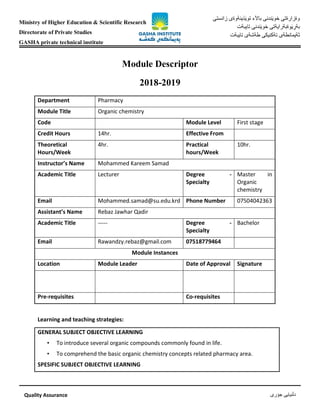
Module Descriptor
2018-2019
Department Pharmacy
Module Title Organic chemistry
Code Module Level First stage
Credit Hours 14hr. Effective From
Theoretical
Hours/Week
4hr. Practical
hours/Week
10hr.
Instructor’s Name Mohammed Kareem Samad
Academic Title Lecturer Degree -
Specialty
Master in
Organic
chemistry
Email Mohammed.samad@su.edu.krd Phone Number 07504042363
Assistant’s Name Rebaz Jawhar Qadir
Academic Title ----- Degree -
Specialty
Bachelor
Email Rawandzy.rebaz@gmail.com 07518779464
Module Instances
Location Module Leader Date of Approval Signature
Pre-requisites Co-requisites
Learning and teaching strategies:
GENERAL SUBJECT OBJECTIVE LEARNING
• To introduce several organic compounds commonly found in life.
• To comprehend the basic organic chemistry concepts related pharmacy area.
SPESIFIC SUBJECT OBJECTIVE LEARNING
Ministry of Higher Education & Scientific Research
Directorate of Private Studies
GASHA private technical institute
‫زانستى‬ ‫ذينةوةى‬َ‫ي‬‫تو‬ ‫باآلء‬ ‫ندنى‬َ‫ي‬‫خو‬ ‫وةزارةتى‬
‫ندنى‬َ‫ي‬‫خو‬ ‫وةبةرايةتى‬َ‫ي‬ ِ‫بةر‬‫تايبةت‬
‫تايبةت‬ ‫طةشةى‬ ‫تةكنيكى‬ ‫ثةيمانطةى‬
Quality Assurance ‫جؤرى‬ ‫نيايى‬َ‫ل‬‫د‬
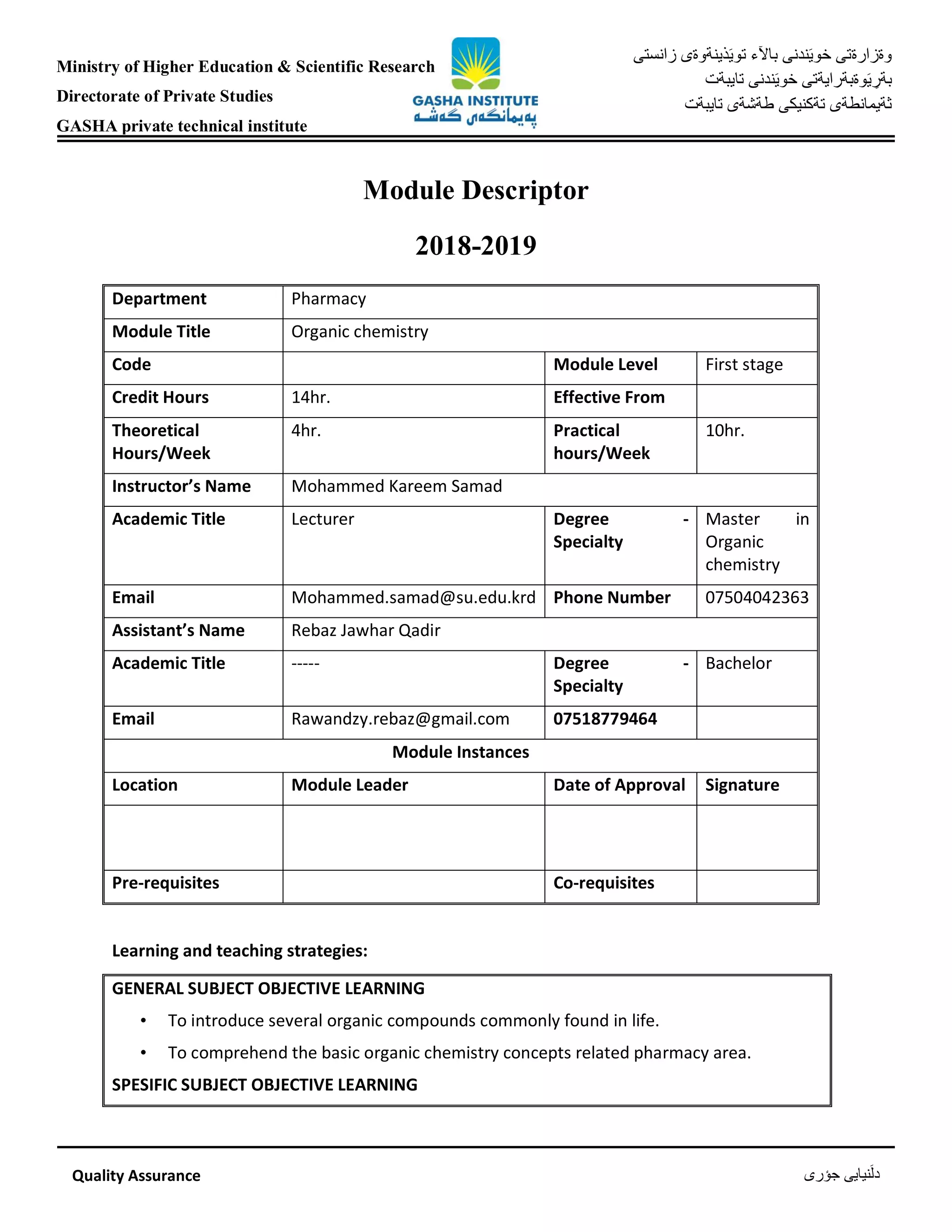
• To explain the students about organic nomenclature as a basic knowledge to
understand the organic physic-chemical properties related pharmacy science such us
pharmaceutics, pharmacology and pharmaceutical chemistry.
• To explain the students about physical properties as a basic knowledge to understand
another/further subject such as drug delivery system and pharmaceutical chemistry.
• To explain the students about several main organic chemical reaction as a basic
knowledge to understand another/further subject such as pharmacology and
pharmaceutical chemistry.
Aims:
The specific objectives of the study were:
1. To evaluate the types of objectives of the selected activities.
2. To assess the inquiry levels assigned to the laboratory tasks.
3. To measure the relevance of the activities in terms of the recent concern, students
In order to achieve these objectives, the study posed the following research questions:
1. What types of objectives are served by the activities included in the course material.
2. What types of laboratory activities dominate the course Practical Organic
Chemistry?
3. How do students and laboratory instructors react to what should be the
objectives of the laboratory tasks?
4. What levels of inquiry are assigned to the laboratory tasks?
5. What are students actually doing and how well are their performance in
Practical Organic Chemistry laboratory sessions?
Learning Outcomes:
After successfully completion of the course students should be able to demonstrate:
• Be able to name the simple organic molecule structure & vice versa (draw the simple
organic molecule name).
• Be able to represent the structure of organic compounds and drugs.
• Be able to explain type of bonds and type of lone pair of electrons.
• Be able to explain the physical properties of main organic compounds.
• Be able to know each type of functional group.
• Be able to draw the simple organic chemical reactions.
• Be able to integrate all learning outcomes mentioned above in a simple organic drug
Ministry of Higher Education & Scientific Research
Directorate of Private Studies
GASHA private technical institute
‫زانستى‬ ‫ذينةوةى‬َ‫ي‬‫تو‬ ‫باآلء‬ ‫ندنى‬َ‫ي‬‫خو‬ ‫وةزارةتى‬
‫ندنى‬َ‫ي‬‫خو‬ ‫وةبةرايةتى‬َ‫ي‬ ِ‫بةر‬‫تايبةت‬
‫تايبةت‬ ‫طةشةى‬ ‫تةكنيكى‬ ‫ثةيمانطةى‬
Quality Assurance ‫جؤرى‬ ‫نيايى‬َ‫ل‬‫د‬
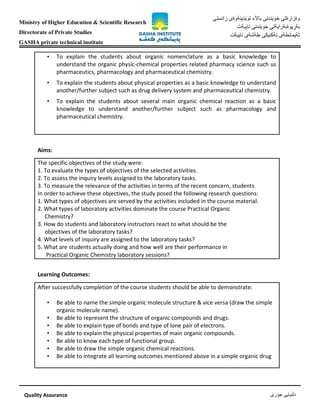
Contents:
Assessments:
The weight (%) of each assessment must be predetermined and the total = 100
 Exams Mid-Term (50%) and Final (50%)
 Quizzes Minimum 2/semester or 4/year (5%)
 Assignments (X) (5%)
 Presentations 1 per semester (5%)
 Lab and Field Visit Reports (10%)
 Attendance (5%)
Feedbacks Specify the methods to be used with the distribution of marks by
percentage (%): exams (mid-term), assignment, quizzes, presentation,
participation, attendance, lab assignments, and field trips.
Reading list Organic chemistry, by Paula Yurkanis Bruice eighth edition, 2017
Organic chemistry, by DaviD Kleineighth, third edition, 2017
Websites
Course time table:
Week 1: Theoretical: Introduction To Organic Chemistry
Practical: Melting point determination of solid organic drugs
Week 2: Theoretical: How The Structure Of A Compound Is Represented
Practical: Melting point determination of solid organic drugs
Week 3: Theoretical: An Introduction To Acids And Bases
Practical: Recrystallization of solid organic drugs
Week 4: Theoretical: How The Structure Of An Acid Affects
Its Pka Value
Practical: Recrystallization of solid organic drugs
Week 5: Theoretical: Functional Groups
Practical: Sublimation of solid organic drugs
Week 6: Theoretical: Alkanes
Practical: Sublimation of solid organic drugs
Week 7: Theoretical: Alkane Nomenclature
Practical: Distillation
Week 8: Theoretical: Cycloalkanes
Ministry of Higher Education & Scientific Research
Directorate of Private Studies
GASHA private technical institute
‫زانستى‬ ‫ذينةوةى‬َ‫ي‬‫تو‬ ‫باآلء‬ ‫ندنى‬َ‫ي‬‫خو‬ ‫وةزارةتى‬
‫ندنى‬َ‫ي‬‫خو‬ ‫وةبةرايةتى‬َ‫ي‬ ِ‫بةر‬‫تايبةت‬
‫تايبةت‬ ‫طةشةى‬ ‫تةكنيكى‬ ‫ثةيمانطةى‬
Quality Assurance ‫جؤرى‬ ‫نيايى‬َ‫ل‬‫د‬
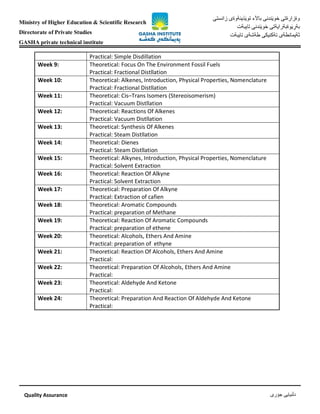
Practical: Simple Disdillation
Week 9: Theoretical: Focus On The Environment Fossil Fuels
Practical: Fractional Distllation
Week 10: Theoretical: Alkenes, Introduction, Physical Properties, Nomenclature
Practical: Fractional Distllation
Week 11: Theoretical: Cis–Trans Isomers (Stereoisomerism)
Practical: Vacuum Distllation
Week 12: Theoretical: Reactions Of Alkenes
Practical: Vacuum Distllation
Week 13: Theoretical: Synthesis Of Alkenes
Practical: Steam Distllation
Week 14: Theoretical: Dienes
Practical: Steam Distllation
Week 15: Theoretical: Alkynes, Introduction, Physical Properties, Nomenclature
Practical: Solvent Extraction
Week 16: Theoretical: Reaction Of Alkyne
Practical: Solvent Extraction
Week 17: Theoretical: Preparation Of Alkyne
Practical: Extraction of cafien
Week 18: Theoretical: Aromatic Compounds
Practical: preparation of Methane
Week 19: Theoretical: Reaction Of Aromatic Compounds
Practical: preparation of ethene
Week 20: Theoretical: Alcohols, Ethers And Amine
Practical: preparation of ethyne
Week 21: Theoretical: Reaction Of Alcohols, Ethers And Amine
Practical:
Week 22: Theoretical: Preparation Of Alcohols, Ethers And Amine
Practical:
Week 23: Theoretical: Aldehyde And Ketone
Practical:
Week 24: Theoretical: Preparation And Reaction Of Aldehyde And Ketone
Practical:

Module descriptor mohammed kareem samad

  • 1.
    Ministry of HigherEducation & Scientific Research Directorate of Private Studies GASHA private technical institute ‫زانستى‬ ‫ذينةوةى‬َ‫ي‬‫تو‬ ‫باآلء‬ ‫ندنى‬َ‫ي‬‫خو‬ ‫وةزارةتى‬ ‫ندنى‬َ‫ي‬‫خو‬ ‫وةبةرايةتى‬َ‫ي‬ ِ‫بةر‬‫تايبةت‬ ‫تايبةت‬ ‫طةشةى‬ ‫تةكنيكى‬ ‫ثةيمانطةى‬ Quality Assurance ‫جؤرى‬ ‫نيايى‬َ‫ل‬‫د‬ Module Descriptor 2018-2019 Department Pharmacy Module Title Organic chemistry Code Module Level First stage Credit Hours 14hr. Effective From Theoretical Hours/Week 4hr. Practical hours/Week 10hr. Instructor’s Name Mohammed Kareem Samad Academic Title Lecturer Degree - Specialty Master in Organic chemistry Email Mohammed.samad@su.edu.krd Phone Number 07504042363 Assistant’s Name Rebaz Jawhar Qadir Academic Title ----- Degree - Specialty Bachelor Email Rawandzy.rebaz@gmail.com 07518779464 Module Instances Location Module Leader Date of Approval Signature Pre-requisites Co-requisites Learning and teaching strategies: GENERAL SUBJECT OBJECTIVE LEARNING • To introduce several organic compounds commonly found in life. • To comprehend the basic organic chemistry concepts related pharmacy area. SPESIFIC SUBJECT OBJECTIVE LEARNING
  • 2.
    Ministry of HigherEducation & Scientific Research Directorate of Private Studies GASHA private technical institute ‫زانستى‬ ‫ذينةوةى‬َ‫ي‬‫تو‬ ‫باآلء‬ ‫ندنى‬َ‫ي‬‫خو‬ ‫وةزارةتى‬ ‫ندنى‬َ‫ي‬‫خو‬ ‫وةبةرايةتى‬َ‫ي‬ ِ‫بةر‬‫تايبةت‬ ‫تايبةت‬ ‫طةشةى‬ ‫تةكنيكى‬ ‫ثةيمانطةى‬ Quality Assurance ‫جؤرى‬ ‫نيايى‬َ‫ل‬‫د‬ • To explain the students about organic nomenclature as a basic knowledge to understand the organic physic-chemical properties related pharmacy science such us pharmaceutics, pharmacology and pharmaceutical chemistry. • To explain the students about physical properties as a basic knowledge to understand another/further subject such as drug delivery system and pharmaceutical chemistry. • To explain the students about several main organic chemical reaction as a basic knowledge to understand another/further subject such as pharmacology and pharmaceutical chemistry. Aims: The specific objectives of the study were: 1. To evaluate the types of objectives of the selected activities. 2. To assess the inquiry levels assigned to the laboratory tasks. 3. To measure the relevance of the activities in terms of the recent concern, students In order to achieve these objectives, the study posed the following research questions: 1. What types of objectives are served by the activities included in the course material. 2. What types of laboratory activities dominate the course Practical Organic Chemistry? 3. How do students and laboratory instructors react to what should be the objectives of the laboratory tasks? 4. What levels of inquiry are assigned to the laboratory tasks? 5. What are students actually doing and how well are their performance in Practical Organic Chemistry laboratory sessions? Learning Outcomes: After successfully completion of the course students should be able to demonstrate: • Be able to name the simple organic molecule structure & vice versa (draw the simple organic molecule name). • Be able to represent the structure of organic compounds and drugs. • Be able to explain type of bonds and type of lone pair of electrons. • Be able to explain the physical properties of main organic compounds. • Be able to know each type of functional group. • Be able to draw the simple organic chemical reactions. • Be able to integrate all learning outcomes mentioned above in a simple organic drug
  • 3.
    Ministry of HigherEducation & Scientific Research Directorate of Private Studies GASHA private technical institute ‫زانستى‬ ‫ذينةوةى‬َ‫ي‬‫تو‬ ‫باآلء‬ ‫ندنى‬َ‫ي‬‫خو‬ ‫وةزارةتى‬ ‫ندنى‬َ‫ي‬‫خو‬ ‫وةبةرايةتى‬َ‫ي‬ ِ‫بةر‬‫تايبةت‬ ‫تايبةت‬ ‫طةشةى‬ ‫تةكنيكى‬ ‫ثةيمانطةى‬ Quality Assurance ‫جؤرى‬ ‫نيايى‬َ‫ل‬‫د‬ Contents: Assessments: The weight (%) of each assessment must be predetermined and the total = 100  Exams Mid-Term (50%) and Final (50%)  Quizzes Minimum 2/semester or 4/year (5%)  Assignments (X) (5%)  Presentations 1 per semester (5%)  Lab and Field Visit Reports (10%)  Attendance (5%) Feedbacks Specify the methods to be used with the distribution of marks by percentage (%): exams (mid-term), assignment, quizzes, presentation, participation, attendance, lab assignments, and field trips. Reading list Organic chemistry, by Paula Yurkanis Bruice eighth edition, 2017 Organic chemistry, by DaviD Kleineighth, third edition, 2017 Websites Course time table: Week 1: Theoretical: Introduction To Organic Chemistry Practical: Melting point determination of solid organic drugs Week 2: Theoretical: How The Structure Of A Compound Is Represented Practical: Melting point determination of solid organic drugs Week 3: Theoretical: An Introduction To Acids And Bases Practical: Recrystallization of solid organic drugs Week 4: Theoretical: How The Structure Of An Acid Affects Its Pka Value Practical: Recrystallization of solid organic drugs Week 5: Theoretical: Functional Groups Practical: Sublimation of solid organic drugs Week 6: Theoretical: Alkanes Practical: Sublimation of solid organic drugs Week 7: Theoretical: Alkane Nomenclature Practical: Distillation Week 8: Theoretical: Cycloalkanes
  • 4.
    Ministry of HigherEducation & Scientific Research Directorate of Private Studies GASHA private technical institute ‫زانستى‬ ‫ذينةوةى‬َ‫ي‬‫تو‬ ‫باآلء‬ ‫ندنى‬َ‫ي‬‫خو‬ ‫وةزارةتى‬ ‫ندنى‬َ‫ي‬‫خو‬ ‫وةبةرايةتى‬َ‫ي‬ ِ‫بةر‬‫تايبةت‬ ‫تايبةت‬ ‫طةشةى‬ ‫تةكنيكى‬ ‫ثةيمانطةى‬ Quality Assurance ‫جؤرى‬ ‫نيايى‬َ‫ل‬‫د‬ Practical: Simple Disdillation Week 9: Theoretical: Focus On The Environment Fossil Fuels Practical: Fractional Distllation Week 10: Theoretical: Alkenes, Introduction, Physical Properties, Nomenclature Practical: Fractional Distllation Week 11: Theoretical: Cis–Trans Isomers (Stereoisomerism) Practical: Vacuum Distllation Week 12: Theoretical: Reactions Of Alkenes Practical: Vacuum Distllation Week 13: Theoretical: Synthesis Of Alkenes Practical: Steam Distllation Week 14: Theoretical: Dienes Practical: Steam Distllation Week 15: Theoretical: Alkynes, Introduction, Physical Properties, Nomenclature Practical: Solvent Extraction Week 16: Theoretical: Reaction Of Alkyne Practical: Solvent Extraction Week 17: Theoretical: Preparation Of Alkyne Practical: Extraction of cafien Week 18: Theoretical: Aromatic Compounds Practical: preparation of Methane Week 19: Theoretical: Reaction Of Aromatic Compounds Practical: preparation of ethene Week 20: Theoretical: Alcohols, Ethers And Amine Practical: preparation of ethyne Week 21: Theoretical: Reaction Of Alcohols, Ethers And Amine Practical: Week 22: Theoretical: Preparation Of Alcohols, Ethers And Amine Practical: Week 23: Theoretical: Aldehyde And Ketone Practical: Week 24: Theoretical: Preparation And Reaction Of Aldehyde And Ketone Practical: